RESEARCH REPORT
Developing a go-to-market strategy:
art or CraFt?
marion Debruyne
Febi tedja lestiani
November 2009
l1
Flanders District of Creativity is the Flemish organization for entrepreneurial creativity. It was founded in 2004 by the Flemish Government as a non-profit organization and enjoys broad support. Flemish businesses, academia, and public institutions use Flanders DC as a platform for cooperation in the pursuit of a more creative Flanders region.
Creativity is the key ingredient in making companies more successful and in helping regional governments ensure a healthy economy with more jobs. Flanders DC inspires creativity and innovation:
1. by learning from the most creative regions in the world, 2. by igniting creative sparks in everyday life and business, and
3. by providing research, practical business tools and business training, in cooperation with the Flanders DC Knowledge Centre.
1. Districts of Creativity: Inspiration from the most creative regions
Responses to global challenges are best found within an international network of excellence. With the single aim of learning from the very best, Flanders DC aims to unite the most dynamic regions in the world within the ‘Districts of Creativity’ network. Every two years, Flanders DC convenes the Creativity World Forum, bringing together government leaders, entrepreneurs, and knowledge institutions to exchange ideas about how to tackle pressing economic problems and make their regions hotbeds for innovation and creativity.
l2
2. Raising awareness: The best way to predict the future is to invent it
Flanders DC encourages entrepreneurs and citizens to look ahead and find creative solutions today for tomorrow's problems. Flanders DC has developed an idea-generation tool to encourage people and organizations to take the first step toward innovation. In addition, Flanders DC has run an awareness campaign entitled ‘Flanders‘ Future’ and has collaborated with national TV station één (VRT) on an idea show named The Devisers (De bedenkers).
3. The Flanders DC Knowledge Centre: Academic support
The Flanders DC Knowledge Centre serves as a link between Flanders DC and Vlerick Leuven Gent Management School. Each year, the Flanders DC Knowledge Centre publishes several reports and develops various tools, case studies and courses. All these projects focus on the role of creativity in a business environment and identify obstacles to, and accelerators of competitive growth.
The Creativity Talks − brief monthly, interactive info sessions − update you on these research activities. See www.creativitytalks.be for a current calendar and subscription information.
ONDERZOEKSRAPPORT
HET INNOVATIEPROCES IN GROTE BEDRIJVEN EN KMO’S
Geert Devos, Mieke Van De Woestyne, Herman Van den Broeck Februari 2007 Kennispartner Kennispartner ISBN-NUMMER : 9789080712195 EAN : 9789080712195 HET INNOV
ATIEPROCES IN GROTE BEDRIJVEN EN KMO’S - F
eb
ru
ari 20
l3
Research reports:
De Vlaamse economie in 2015: Uitdagingen voor de toekomst, Koen De Backer and Leo Sleuwaegen, September 2005, Published in Dutch
Ondernemingscreativiteit als motor van groei voor Vlaamse steden en Brussel, Isabelle De Voldere, Eva Janssens and Jonas Onkelinx, November 2005, Published in Dutch
The Creative Economy: challenges and opportunities for the DC-regions, Isabelle De Voldere, Eva Janssens, Jonas Onkelinx and Leo Sleuwaegen, April 2006, Published in English
Spelers uit de televisiesector getuigen: een verkennende studie in de creatieve industrie,
Marc Buelens and Mieke Van De Woestyne, June 2006, Published in Dutch
Mobiliseren, dynamiseren en enthousiasmeren van onze toekomstige zilvervloot, Thomas Dewilde, Annick Vlaminckx, Ans De Vos and Dirk Buyens, June 2006, Published in Dutch
Development of a regional competitiveness index, Harry Bowen, Wim Moesen and Leo Sleuwaegen, September 2006, Published in English
Innovation outside the lab: strategic innovation as the alternative, Marion Debruyne and Marie Schoovaerts, November 2006, Published in English
De creatieve industrie in Vlaanderen, Tine Maenhout, Isabelle De Voldere, Jonas Onkelinx and Leo Sleuwaegen, December 2006, Published in Dutch
Het innovatieproces in grote bedrijven en KMO’s, Geert Devos, Mieke Van De Woestyne and Herman Van den Broeck, February 2007, Published in Dutch
Creatief ondernemen in Vlaanderen, Tine Maenhout, Jonas Onkelinx and Hans Crijns, March 2007, Published in Dutch
Hoe ondernemers in Vlaanderen opportuniteiten identificeren. Een rapport met tips en tools voor de ondernemer in de praktijk, Eva Cools, Herman Van den Broeck, Sabine Vermeulen, Hans Crijns, Deva Rangarajan, May 2007, published in Dutch
Networking in multinational manufacturing companies, Ann Vereecke, July 2007, published in English
How entrepreneurial are our Flemish students, Hans Crijns and Sabine Vermeulen, November 2007, published in English
Fashionate about Creativity, Isabelle De Voldere, Tine Maenhout and Marion Debruyne, December 2007, published in Dutch
Find the innovator. Identifying and understanding adopters of innovative consumer technologies in Flanders, Marion De Bruyne and Bert Weijters, December 2007, published in English
De case Arteconomy, Eva Cools, Herman Van den Broeck and Tine Maenhout, December 2007, published in Dutch
l4
Entrepreneurship and globalization, Italo Colantone and Leo Sleuwaegen, December 2007, published in English
HR Tools als stimulans voor creativiteit bij uw werknemers, Kristien Van Bruystegem, Vickie Decocker, Koen Dewettinck, Xavier Baeten, December 2007, published in Dutch
Internationalization of SMEs, Jonas Onkelinx, Leo Sleuwaegen, April 2008, published in English
HRM-uitdagingen voor groeiende ondernemingen, Mieke Van De Woestyne, Kristien Van Bruystegem, Koen Dewettinck, March 2008, published in Dutch
Sociaal Ondernemerschap in Vlaanderen, Hans Crijns, Frank Verzele, Sabine Vermeulen, April 2008, published in Dutch
Foreign direct investments. Trends and developments, Frederik De Witte, Isabelle De Voldere, Leo Sleuwaegen, June 2008, published in English
De gezondheidszorg als complex adaptief systeem. Een ander perspectief op innovatie, Paul Gemmel, Lieven De Raedt, November 2008, published in Dutch
Downstream Competitive Advantage. The cognitive Basis of Competitive Advantage. How prototypicality structures and the cognitive processes of satisficing confer strategic benefts, Niraj Dawar, Frank Goedertier, February 2009, published in English
Determinants of successful internationalization by SMEs in Flanders, Jonas Onkelinx, Leo Sleuwaegen, May 2009, published in English
Het gebruik van Web 2.0 ter ondersteuning van open innovatie en collectieve creativiteit. Lessen uit theorie en praktijk in Vlaanderen. Stijn Viaene, Steven De Hertogh, Len De Looze, May 2009, published in Dutch
Foreign Direct Investments. Location choices across the value chain, Frederik De Witte, Leo Sleuwaegen, May 2009, published in English
Prototypically Branded Innovations. Effect of the Typicality of a Brand on Consumer Adoption and Perceived Newness of Branded New Products, Frank Goedertier, July 2009, published in English
Open innovation: The role of collective research centres in stimulating innovation in low tech SMEs, André Spithoven, Mirjam Knockaert, Bart Clarysse, July 2009, published in English
From Creativity to Success: Barriers and Critical Success Factors in the Successful Implementation of Creative Ideas, Inge De Clippeleer, Katleen De Stobbeleir, Koen Dewettinck, and Susan Ashford, July 2009, published in English
Improving social performance in supply chains: exploring practices and pathways to innovation, Robert D. Klassen, August 2009, published in English
The position of plants in Flanders within global manufacturing networks, Ann Vereecke, Annelies Geerts, July 2009, published in English
l5
Innovation In The Elderly Care Sector: At The Edge Of Chaos, Katrien Verleye, Paul Gemmel, September 2009, published in English
Determinanten van het ondernemerschapsproces in Vlaanderen: een internationale vergelijking, Roy Thurik, Olivier Tilleuil, Peter van der Zwan, September 2009, published in Dutch
Published research reports can be downloaded via the Vlerick Leuven Gent Management School library catalogue or via www.flandersdc.be.
In addition to these research projects, the Flanders DC Knowledge Centre has also developed the following tools and training sessions:
Ondernemen.meerdan.ondernemen, an online learning platform
Creativity Class for young high-potentials
Flanders DC Fellows, inspiring role models in business creativity
Creativity Talks, monthly seminars on business creativity and innovation
Innovix, online innovation management game
Flanders DC Academic Seminars, research seminars on business creativity and innovation
TeamScan, online tool
l6 I. Introduction ... 8 1.1 Background ... 8 1.2 Research Objectives ... 8 1.3 Research Questions ... 8 1.4 Research Setting ... 9 1.5 Research Method ... 9
II. Literature Study ... 10
2.1 Go-To-Market Strategy ... 10
2.2 Business Model as Part of Go-To-Market Strategy... 11
2.3 Defining Factors of Go-To-Market Strategy ... 13
2.4 Context Factors in developing a Go-To-Market Strategy ... 17
III. Results and Discussions ... 19
3.1 Key Success Factors of New Product Launch ... 19
3.2 The Role of Business Model in New Product Launch ... 22
3.3 Business Model Formulation Timeline ... 23
3.4 Tools/Framework to Define New Business Model... 24
IV. Limitations ... 32 V. Managerial Implications ... 33 References ... 35 APPENDIX ... 38 Sodexo ... 38 Bekaert ... 39 Solutia Europe ... 40 Vitaya ... 40 Studio 100 ... 41 Base ... 42 Reynaers Aluminium ... 43 Barco ... 44 Brady Corporation ... 45 Traficon ... 46
TABLE OF CONTENT
l7
LIST OF TABLES
Table 1 List of cases ... 9 Table 2.1 Chronology of literature on entry strategy ... 13 Table 2.2 Table dichotomy of conceptualization of ideal timing of entry ... 14
LIST OF DIAGRAMS
Diagram 2.1 Business model design template “Nine building blocks and their
relationships” ... 13 Diagram 3.1 “Can You Spot a Sure Winner” ... 19 Diagram 3.2 Stages of Developing a New Business Model ... 24 Diagram 3.3 Distribution of business models in various stages of business model
l8
1.1 Background
Flanders struggles with the so-called innovation paradox, where substantial resources directed at R&D do not necessarily translate into innovative products and/or services. This paradox invokes the question what goes wrong in the process between R&D and product launch. A thriving company needs a conversion ability, the ability to translate a given idea into a launched product (Chandy et al., 2006). This project focuses on two specific aspects of the missing link between invention and innovation: formulating an appropriate business model as part of the go-to-market strategy.
Understanding the importance of conversion ability, many literatures are attempting to explain the go-to-market strategy, especially to validate new technologies. A successful go-to-market strategy needs to encompass the entirety of the company’s organizational processes in interacting with the customers, starting from the initial contact with customers to the fulfilment of their demands. That is why an essential part of articulating a go-to-market strategy is to define a clear business model that takes the entire business concept as the basis for innovation and bringing that innovation to the market.
Unfortunately these considerable amounts of research still have not addressed two main issues. The first issue is the lack of explanation of the role of business models in the product launch strategy. Although there is an abundant body of research on business models and increasingly on business model innovation, the role of business model definition in the new product development and launch process remains largely unexplored. Likewise, the research on new product launch remains silent on the definition of the right business model for the product as a step in the launch strategy. In this report, we attempt to bring together both the business model definition and the new product launch strategy.
Second issue is the toolkit to develop the business model itself. Even though the formulation of a business model is not a recent concept, there is a relatively small number of tools that exist to guide managers to develop new business models. This is particularly important since designing a good business model has been called an ‘art’ rather than exact science as it requires creativity, insight, and market intelligence (Teece, 2007). Hence, there is a need for tools that help managers articulating their knowledge in the formulation of business models.
1.2 Research Objectives
Based on the aforementioned background, this project aims to investigate the process leading to a successful go-to-market strategy.
1.3 Research Questions
In achieving the research objectives, the following sections will answer the following research questions:
l9
What are the key success factors of new product launch?
Do companies think about the business model in developing a go-to-market strategy or new product launch strategy?
When does this process take place?
Which tools/frameworks should be used to assist managers in going through the process?
1.4 Research Setting
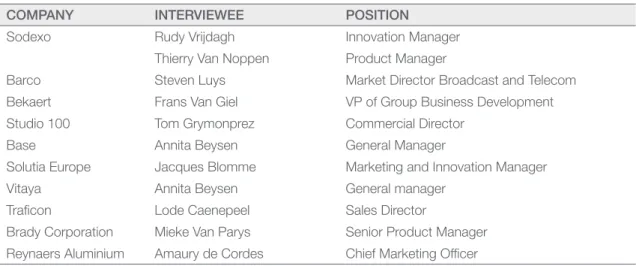
To explore the above research questions, we investigate product launch cases in 10 companies. To ensure that we capture the viewpoints of a wide range of industries, the research uses 10 companies from diverse industrial fields: children product industry, television industry, material industry, electronic industry, food and gift industry, etc. This allows us to explore the relevant issues that are common and valid across industries, as well as to develop a framework that is not context- and industry-specific. At the same time, we sacrifice to some extent depth of insights for the virtue of breadth of applicability. Given the exploratory nature of this project, this approach was deemed appropriate.
1.5 Research Method
The research uses a case-based study of go-to-market strategy development processes to gain exploratory insight in the key elements of the processes, rationale of the decision making in process development and the impact to potential outcome. As mentioned above, the research investigates 10 cases, taking multiple source perspectives.
Based on snowball sampling, the key individuals involved in the development of the go-to-market strategy within their company were identified. Each of them were interviewed using a semi-structured interviewing technique. For some cases, secondary data and internal company documents supplement the information derived from the interview.
Table 1: List of cases
COMPANY INTERVIEWEE POSITION
Sodexo Rudy Vrijdagh Innovation Manager Thierry Van Noppen Product Manager
Barco Steven Luys Market Director Broadcast and Telecom Bekaert Frans Van Giel VP of Group Business Development Studio 100 Tom Grymonprez Commercial Director
Base Annita Beysen General Manager
Solutia Europe Jacques Blomme Marketing and Innovation Manager Vitaya Annita Beysen General manager
Traficon Lode Caenepeel Sales Director
Brady Corporation Mieke Van Parys Senior Product Manager Reynaers Aluminium Amaury de Cordes Chief Marketing Officer
l10
2.1 Go-To-Market Strategy
Understanding the importance of launching new products for companies, numerous literatures attempt to explain the concept of go-to-market strategy. Go-to-market strategy is the “game plan for reaching and serving the right customers in the right markets, through the right channels, with the right products and the right value propositions” (Friedman, 2002, p13).
Only a limited number of sources elaborate the go-to-market strategy in a holistic manner. The majority of them focuses solely on describing the channel of distribution. Albeit being an important component, the channel of distribution is only a part of the go-to-market strategy as a whole. A complete go-to-market strategy contains the following components (Friedman, 2002):
1. Understanding of the Markets
In his observation, Friedman notes that failure in choosing the right market is one of the most common mistakes in developing a go-to-market strategy. By understanding the market, the company is aligning its strategy with the target customers’ need and buying behavior.
Understanding the market can be done by researching essential information on the target customers’ purchasing and consuming pattern.
2. Customers
It is important to know not only the markets of the business product, but also the customers to be targeted. Companies with a good understanding of their markets often have a superficial, anecdotal understanding of their customers. It is especially important to understand the different segments that are present in the market.
3. Channels and Partners
The channel is the initial point of contact between the company and customers. As the channel provides the window on the market, its role cannot be exaggerated. Choosing the right channels, and aligning them correctly with opportunities in the market place, can bring huge impact on sales and profits.
4. The product and the value proposition
Products and services of a business have to be compatible with the needs of the target customers. It is crucial to ensure the correspondence of products and their value proposition with the rest of go-to-market strategy.
5. Putting it all together: the integrated multi channel model
Multi channel integration requires a careful analysis of which channels to be used, what each of them should be doing, how they coordinate and communicate with each other, and how technology is to be used to render effective and harmonious work of all channels as one system in the market. A coordinated, integrated mix of channels can come in many configurations, depending on the product sold, the target customer and the business goal.
l11 Applied to the case of Barco, the complete go-to-market strategy was defined as such:
Market: broadcast
Customers: broadcasters and production companies Channels: direct channel and specialised dealers Product: LCD Monitor
Multi-channel model: targeting of the broadcasters through direct sales and of production companies through dealers
2.2 Business Model as Part of Go-To-Market Strategy
Not only all the components above make up for a successful go-to-market strategy, they are also the key elements of business model. Hence, Chesbrough and Rosenbloom, in The Role of the Business Model in Capturing Value from Innovation, conclude that establishing a clear business model is imperative in having a winning go-to-market strategy. Business models act as mediating constructs between technology and economic value. (Chesbrough & Rosenbloom, 2002)
The business model itself is an important determinant of the profits to be made from an innovation. A mediocre innovation with a great business model may be more profitable than a great innovation with a mediocre business model. (Chesbrough & Rosenbloom, 2002, p)
In the current state of economic downturn, the business model has a significant role in assisting the company to face the insecure economic environment. Osterwalder (2004) accurately points out that companies are incessantly confronted with new information and communication technologies, shorter product life cycle, global markets and tougher competition. Therefore, formulating a business decision becomes a more complex and intricate process (Osterwalder, 2004).
Addressing this challenge, managers are expected to formulate a business model that genuinely represents the business process in their organization. Even though most managers have an intuitive understanding of how his business works and how value is created, in many cases they cannot communicate it in a clear and concise manner (Linder & Cantrell, 200?).
As extracted from popular business articles or academic literature (Hamel, 2002; Moris, et al., 2002; and Peterovic et al., 2001), a business model can be defined as a business concept that has been put into practice. Recent literatures provide a broader and more complete elaboration on the business model concepts. Where previous writings focused on one or two components in business model formulation more current literature tends to assess all components comprehensively.
Osterwalder, et al (2005), integrating the various suggestions of business model conception, proposes a framework of business model based on four pillars:
Infrastructure
Infrastructure is a “value system configuration that is necessary to deliver the value proposition. In other words, the relationship between in-house resources and assets, the activity and process reconfiguration of the business the firm is operating in, and the firm’s partner network” (Pigneur, 2002, p 2).
l12
Core capabilities: The level of company’s capacity and aptitude required to execute a company’s business model.
Partner network: Company’s business alliances which complement other aspects of the business model.
Value configuration: The underlying principle of why the company can offer a mutual benefit both for the business and its customers.
Offering
Value proposition: The products and services offered by the business. As noted by Osterwalder (2004), a value proposition “is an overall view of products and services that together represent value for a specific customer segment. It describes the way a firm differentiates itself from its competitors and is the reason why customers buy from a certain firm and not from another.”
Customers
Target customer: The expected buyer/consumer of the business’ products and services. Target customer is the most potential market segment for the offers.
Distribution channel: The means by which a company delivers products and services to customers. This includes the company’s marketing and distribution strategy.
Customer relationship: The links a company establishes between itself and its different customer segments. The process of managing customer relationships is referred to as customer relationship management.
Note that this element and the previous represent an overlap between the concept of a go-to-market strategy and a business model.
Finances
Finance can be understood as ”costs required to get the infrastructure to create value and as revenues of sold values” (Pigneur, 2002, p 2).
Cost structure: The monetary consequences of the means employed in the business model. A company’s DOC.
Revenue: The way a company makes money through a variety of revenue flows. A company’s income.
l13
Diagram 2.1: Business model design template “Nine building blocks and their relationships” (as cited
from Osterwalder, 2004)
2.3 Defining Factors of Go-To-Market Strategy
The literature on go-to-market strategy also suggests that many other factors, aside from the business model, may affect the strategy’s success. Green, Barclay and Ryans (1995) elaborate on the chronology of literature development and arrive at the conclusion that there is a need for an integrative perspective of entry strategy.
Table 2.1: Table chronology of literature on entry strategy (Green et al., 1995)
AUTHOR(S) RESEARCH QUESTION CONCLUSION Roger A. Kerin,
P. Rajan Varadajan, and Robert A. Peterson (1992)
What are the advantages of being
first movers? First-movers in the industry are being advantaged in the environmental opportunity, competitive strategy, distinctive competencies and resources Ralph E. Biggadike
(1976)
How do the industry structures, and other factors (oligopoly structure, magnitude of investment, sources of advantage positioning, timing) affect performance?
Establishing a good entry strategy requires a more integrative research on various variables mentioned before.
David Kingsbury
Smith (1985) How does timing of entry affect performance? Looking at three marketing strategies and three classifications of environmental variables, there is a need for research on the interrelationship between strategy and environment
Mary Lambkin (1988)
How does order of entry affect performance?
The impact of order of entry to performance is less, when industry structure (i.e. magnitude of investment, etc) and strategy were included in the calculation.
Donna H. Green and Adrian B. Ryans (1990)
How does entry strategy affect market performance in the business simulation modeling?
There are various variables in entry strategies. Each has a different influence on the market performance as shown in the business modeling in Markstrat
l14
The table above indicates that there is a progress of thought. Originally the focus lies on a single component of entry strategy. However, currently there is a deeper understanding of multiple entry strategy consisting of the following factors:
1. Timing of entry
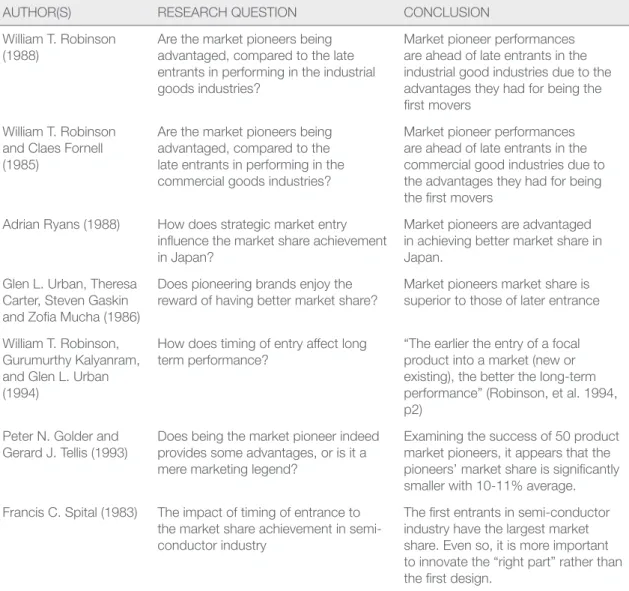
Timing of entry is the decision of when to enter a new or existing market. Even though copious sources agree on its high importance in product launch strategy, there is a lack of agreement in what is the best timing of entry. Barclay, Green and Ryan, in their research on “Entry Strategy and Long term Performance” provide a good summary of the major dichotomy that occurs between the champions of pioneering versus later entry.
Table 2.2: Table dichotomy of conceptualization of ideal timing of entry (Green et al., 1995)
AUTHOR(S) RESEARCH QUESTION CONCLUSION William T. Robinson
(1988)
Are the market pioneers being advantaged, compared to the late entrants in performing in the industrial goods industries?
Market pioneer performances are ahead of late entrants in the industrial good industries due to the advantages they had for being the first movers
William T. Robinson and Claes Fornell (1985)
Are the market pioneers being advantaged, compared to the late entrants in performing in the commercial goods industries?
Market pioneer performances are ahead of late entrants in the commercial good industries due to the advantages they had for being the first movers
Adrian Ryans (1988) How does strategic market entry influence the market share achievement in Japan?
Market pioneers are advantaged in achieving better market share in Japan.
Glen L. Urban, Theresa Carter, Steven Gaskin and Zofia Mucha (1986)
Does pioneering brands enjoy the reward of having better market share?
Market pioneers market share is superior to those of later entrance
William T. Robinson, Gurumurthy Kalyanram, and Glen L. Urban (1994)
How does timing of entry affect long
term performance? “The earlier the entry of a focal product into a market (new or existing), the better the long-term performance” (Robinson, et al. 1994, p2)
Peter N. Golder and
Gerard J. Tellis (1993) Does being the market pioneer indeed provides some advantages, or is it a mere marketing legend?
Examining the success of 50 product market pioneers, it appears that the pioneers’ market share is significantly smaller with 10-11% average. Francis C. Spital (1983) The impact of timing of entrance to
the market share achievement in semi-conductor industry
The first entrants in semi-conductor industry have the largest market share. Even so, it is more important to innovate the “right part” rather than the first design.
l15 Reconciling these differences, Schnaars (1986), in his study of twelve consumer growth markets
(industries), concludes that no single timing strategy has proved best in all instances. The strategy should consider all the relevant internal and external timing factors in order to commit to the ideal time to launch (Scotland, 2008). Among others, internal factors include the production capacity, existing customer relationships and complementary assets. External factors can be varied. One example would be the seasonality. The ideal timing may be when the market is in peak phase as this is when most customers are buying.
2. Structural characteristics of a product market
There is a copious amount of research that draws the significance of the structural/market characteristic of a product market in a go-to-market strategy. Through his research, Sandberg (as cited by Green et al., 1985) suggests that new ventures can be more successful if the following market characteristic are met:
(a) The products in the market are diverse (not homogenous); (b) The industries are in the growth or development stage;
(c) There was a state of imbalance (disequilibrium) in the industry; and
(d) Market barriers do not exist when the ventures attempt to enter the market, and only arose once they already entered the market.
Meanwhile, Yoon and Lilien (1985) suggest that performance for first year market share, for both original and reformulated products, is determined by the number of competitors in the market, marketing efficiency with the new product, and competitiveness of the market.
Barclay, Green and Ryans (1995) recapitulate the potential structural characteristics in the literature as the following:
Number of competitors (Simon, 1986; Yoon and Lilien, 1985)
Barclay, Green and Ryans (1995)’ research shows that the larger the number of active competitors, the earlier the timing of entry and the larger the investment and distribution. However, this research also notes that the number of competitors had the smallest effect on performance.
Growth rate (Ryans, 1988; Sandberg, 1986)
Ryans’s (1988) research shows that products that are introduced into a high growth market or a market with few direct competitors attain higher market shares.
Concentration
Barriers to entry (McDougall, 1987; Orr, 1974)
In the literature, barriers to entry are cited frequently as having impact on entries. To smoothly enter the market, a new entrant must either overcome the barrier or should be built to maintain an early position in an industry (Porter, 1980). Karakaya and Stahl (1989) identify 19 different market-entry barriers discussed in the literature, such as access to distribution channels and customer switching costs.
l16
3. Firm’s capabilities and competencies
Firm’s capabilities and competencies represent the resources, prior experience and firm characteristic that allow the firm to enjoy a competitive advantage in the market. Specifically, by citing various literatures, Green et al. (1995) break down these inherent firm characteristics into the following: (1) Superior resources
Superior resources consist for example of the scale of a manufacturing facility or the strength of the company’s brand names (Day and Wensley, 1988). These resources are inherent characteristics that enable a firm to be at a position that is more advantageous.
(2) Superior skills,
Superior skills result from the distinctive merit of human resources within the firm (Day and Wensley, 1988).
(3) Experience
Another superior resource that is also a unique source of advantage in executing the market entry strategy is experience. As argued by Lawless and Fisher (1990), prior success experience renders a company with better market entry skills and early credibility.
Prior entry experience contributes to higher performance by providing advantages as follows:
Better relationship with customers (i.e.: brand loyalty), better relationship with capital owners, better access to distribution channels. (Hines, 1957; McDougall, 1987; Yip, 1982; as cited by Green et al., 1995);
Better capacity in research and development as well as marketing (Hines, 1957; McDougall, 1987; Yip, 1982);
Learning as a result of previous entries, and/or experience with the same customers (Von Hippel, 1977; as cited by Green et al., 1995).
4. Crossfunctional team in key decision making
Having cross-functional teams make decisions concerning product launches renders the decision making more precise and integrated. The decision making should take into account the considerations of manufacturing, operations, distribution/logistic and marketing/sales strategy. (Benedetto, 1999) All departments’ early involvement in determining the product launch strategy ensures them to better implement the strategy.
5. Market research
Ofek and Turut (2008) argue that market research can inform a firm on the following:
Consumer preferences, especially in the case where the products are offered in a choice set
Consumer price sensitivity
Existence of distinct segments that can be targeted, especially in an attempt to avoid strict price competition
l17
Consumer attachment to existing products and their willingness to switch to a new product
Consumer willingness to invest in learning about a really novel product.
It is important to validate assumptions about the market by observing the actual condition of the market. It is long acknowledged that the high incidence of industrial new product failure takes place because the companies often misunderstood the market. Incorporating “the voice of the customer” is the route to stem unnecessary new product failures due to lack of market acceptance. As reinforced by Benedetto (1999), information-gathering activities of all kinds were very important to successful launches.
6. Integrated, complete and consistent launch strategy
Benedetto (1999) suggests that a complete launch strategy requires both strategic and tactical launch decisions. The strategic launch decisions are strongly linked to the company’s overall strategy and product planning. It comprises of: product strategy, market strategy, competitive strategy and firm strategy. The tactical launch decisions comprise the marketing mix decisions, such as product, promotion, price, distribution and timing (Graaff, 2005).
Several tactical activities that play a part in successful launches are as follows (Benedetto, 1999):
High quality of selling effort, advertising, service and technical support.
Good management of key aspects of the launch, such as marketing plans, overall launch direction, and the launch itself.
Good management of the support programs, such as distribution channel of activities, sales force training, good pricing level and advertising program execution.
Launch timing relative to competition and customers.
It is important to confirm that these tactical activities are attuned to the strategic launch decisions. In conclusion, it is clear that a new product launch strategy requires many interrelated decisions, and that the whole process is only as strong as its weakest link. Moreover, companies also need to adapt their launch strategy according to the context in which they operate. What works in one market environment cannot necessarily be replicated in another environment.
2.4 Context Factors in developing a Go-To-Market Strategy
There are a lot of factors that are influencing the market strategy (Graaf, 2005). Hence, the business model and the other key success of go-to-market strategy need to be adapted to contingencies. These influencing factors can be product related, market related or company related.
Product related factors, such as the novelty of a product and the product advantage have been under the research microscope in the past years. The genuinely novel products (pioneers) are usually targeted more at the innovators and the early adapters (Guiltinan, 1999; Beard and Easingwood, 1996; as cited by Graaf, 2005). Yoon and Lilien (1985) observe that as these kinds of products have a very specific target markets, they tend to have smaller numbers of competitors. Meanwhile, relatively more recent products, a form of adjustment from the original product, are targeted more at
l18
the followers. As they address incrementally larger markets, they are challenged with higher numbers of competitors.
As for the product advantage, in comparison to the products with less advantage, the products with relatively higher advantage are usually launched into the market with better-planned objectives, timing of market entry and clear target markets. They also seem to enter the market with more variation of products. In terms of promotion and distribution, products with more advantage tend to be more bold in their expenditure and as a result, they can use a more diverse range.
Looking at the selection process of market strategy, it appears that targeting a product at a new market requires a great deal of attention to product positioning (Calantone and Montoya-Weiss, 1993). Strategies to launch products to consumers differ from strategies in industrial markets. For instance, industrial products are usually introduced with relatively lower distribution expenditures than consumer products. In launching industrial products, a larger budget goes to personal selling and direct marketing. In contrary, consumer product launches tend to exercise customer promotion, printed advertising and TV/radio advertising (Hultink et al. 2000).
l19 3.1 Key Success Factors of New Product Launch
The research conducted by assessing new product launch reveals that a new product launch will be successful should it follow the following criteria:
1. Superior product/ services
Frans Van Giel, Vice President of Group Business Development Bekaert, shares his guide in launching new products: “How to Spot a Sure Winner” by Eric Mankin. In his presentation, Mankin describes that “a new product will be successful if it does a better job than existing products at satisfying the need of a targeted customer group” (Mankin, 2004).
Mankin also breaks down the categories in which a new product should be better than the existing product as follows:
High purchase motivators
• Lower price
• More benefit offers (i.e.: greater features, etc)
Low purchase barriers
• Easy to use
• Easy to buy
Diagram 3.1: “Can You Spot a Sure Winner” (Mankin, 2004)
l20
Taking Mankin’s theory into application, the produch launch by Brady Corporation, IP Printer, is an innovative solution to address customers needs with RFID recognition (automatic settings of speed/ heat/material/ribbon). It answers the needs in the market because of its easiness to set up and to use.
Another example is Simyo, a telecommunication service by Base. Simyo offers a superior service of calling and sending text messages in four dimensions: low price, more features, easy to use and easy to buy. In terms of cost, Simyo offers its service with the lowest rates in Belgium and without any subscription costs. Simyo is able to have low rates because it is an online telecom operator that does not have shops and expensive offices. In terms of features, Simyo’s prepaid card and top-ups account can be done online, 24 hours a day. This feature also guarantees that the product is easy to use. Finally, in terms of quality, by using the Base network, Simyo offers a good quality service.
2. Timing of Entry
Although in the literature studies there has not been any agreement on whether being the first mover poses any benefit in market competition, Reynaers Aluminium believes that in practice being the market pioneer has given them early advantage. Launching OPTIMA, a new solution for the production of aluminium profiles for the building industry, Reynaers Aluminium enjoys the first mover advantage: go as fast as possible to know the market better and to lock the market as early as possible. OPTIMA has a new target market: customers of PVC (Polyvinyl chloride). Reynaers wishes to increase the pie share and the market size by enticing the customers of PVC windows to shift to aluminium windows.
On the other side of the argument, in the launch of RHDM-2301, Barco gained an advantage from not being first in the market. RHDM-2301 is a new high definition reference monitor that promises broadcast staff and post-production environment the highest level of colour stability and accuracy. Another company that first launched a similar product, failed to match the RHDM-2301 late entrance monitor quality. In this case, the first mover got some negative feedback from disappointed customers. Barco, as a later entrant with the better quality product, could easily grab these quality-conscious customers. As seen in their marketing strategy, Barco’s statement is: “yes they are right, but we have better quality”. Barco also benefits from the effort of the market pioneer to educate the customer that LCD is a good technology for a reference monitor, such that they can launch their product to customers that already have awareness of the technology.
Linking this practice with the theory, Spital (1983) argues that enjoying the first movers’ advantage is not about having the first design, but about designing the “right part”. In the case of OPTIMA, Reynaers is designing the “right part” as it pioneers the infiltration of new target customers. Meanwhile, in the case of RHDM-2301, the “right part” is the monitor with good quality. Thus, Barco can reap the benefit of being the first-mover of launching the “right part”, albeit not being the company with the first design.
However, timing of entry, as proposed by Scotland (2008), should also consider external factors, such as the seasonality or trends. This theory rings true in the launch of Vitaya, a Flemish television station. Vitaya is a television station focusing on lifestyle, such as: happiness, good food, health, family, gardening, interior design, fashion, leisure and travel and lifestyle and human interest. Vitaya
l21 enters the market at a time where the market is particularly conscious about lifestyle. Paying attention
to lifestyle is the trend at the time, as can be seen from the publication of lifestyle magazines, sudden increase of lifestyle book sales volume, etc.
3. Structural characteristics of a product market
The case of RHDM-2301 also reflects Barco’s fair assessment on the structural characteristic of the product market. RHDM-2301 was launched at a time where the market had accepted the LCD technology. In that case, the product was launched to a mature market. This meets Sandberg’s (as cited by Green et al., 1985) criteria of good structural characteristics of a product market:
(a) The products in the market are diverse, as there are various technologies that the market is responsive to
(b) The industry is in the growth or development stage
(c) There was a state of imbalance (disequilibrium) in the industry
(d) Market barriers do not exist when the ventures attempt to enter the market
4. Market research
Traficon realized the importance of market research when they were planning to launch direct sales of Traficam by using internet. Traficam is an intelligent sensor for vehicle presence detection at intersections. It is an all-in-one sensor (integration of camera and detection) with aesthetic design. Through their market research, they discovered that the market was not ready to use the direct sales channel through internet because of two reasons. First, Traficon never sold their products directly. They always used an intermediary channel in the form of system integrators. Implementing a direct sales channel through internet could therefore jeopardize their relationship with these intermediairies. Second, direct sales through internet does not fit the majority of their customers, who are government agencies. Government agencies require an open tendering process for any purchase above a certain monetary value. This requires quotations from different companies. Meanwhile, the internet is not a good medium to govern this open tendering process.
In the case of Traficon above, it is evident that market research holds great significance in making a go-to-market decision. Derived from Ofek and Turut’s (2008) theory, as described in the literature studies section, Traficon’s research market provides the following information:
Consumer preferences of the sales method
Consumers’ lack of valuation to the benefit of “anytime, anywhere” provided by internet method, as majority of the customers use the internet method
Consumers’ attachment to the regular open tender method and their lack of willingness to switch to a new sales method
l22
5. Integrated, complete and consistent launch strategy
Graaf (2005), as carried in the literature studies section, analyzes that the tactical launch decisions comprise the marketing mix decisions, such as product, promotion, price, distribution and timing. This is supported by Tom Grymonprez’ experience, the Commercial Director Studio 100 Benelux. Learning from his role of managing Daens, the adult theatre musicals with international standard of quality, he stated that it is important to have an integrated and consistent launch strategy.
Drawing from Benedetto’s (1998) idea, Daens combines high quality of selling effort, good management of the launch, good management of the support programs, and a good launch timing relative to competition and customers. Daens’ success in having an integrated, complete and consistent launch strategy is indicated by how everyone involved in Daens, in any department, is having full faith in the product and the launch strategy.
3.2 The Role of Business Model in New Product Launch
Jacques Blomme from Solutia Europe explained that it is difficult and almost impossible to have an integrated, complete and consistent launch strategy without having a clear business model. The business model makes a good foundation and the overarching framework needed to develop an integrated, complete and consistent launch strategy. Such strategy needs to consider all the important aspects of strategy launch, such as the company resources, capabilities, product offering and the target market, all of which are included in the business model.
Many companies believe that innovation is the golden swan that can bring profit to the company. However, innovation is only a part of the whole profit-earning machine. Chesbrough and Rosenbloom, as cited in the literature overview, go as far as saying that the business model is a more important determinant of profit than the innovation.
A first conclusion from the cases we studied is that a revision and questioning of the business model is not a given in most organizations. Although many companies have a formal stage-gate process that is followed to guide a project from idea to launch, there is no clear and uniform role for the business model definition in this process. While some companies include the definition of the business model in a very early stage revision of the business case, others only incorporate it late in the process. Predominantly, the definition of the appropriate business model does not get a formal role in the process from development to launch. This is hindered already by the wide range of interpretations that the term “business model” is given. People associate it with a marketing plan, with a channel strategy, with pricing, ….
In the case where companies know the importance of having a business model they often fall into the common trap of getting too comfortable with their existing business model. Companies need to constantly rethink the development of new business models and constantly challenge their current model to ensure a process that is more suitable for their product/service and target market. It is clear that there is a lack of frameworks that guide managers through this process. That is why in the sub-chapter 3.4, we provide a framework for established businesses to formulate a new business model. This framework is an aggregation from the experiences and advice collected through the investigated cases.
l23 Establishing a new business models does not necessarily mean complete reformation or complete
disregard of the existing business model. The best strategy of establishing a new business model is to build upon current resources and capability as reflected in the existing business model.
3.3 Business Model Formulation Timeline
Generally, there are two major practices in conceptualizing the ideal timeline to formulate the right business model to launch an innovation. For most companies observed in this research, business model formulation took place in the early stage even before the companies focused their effort on research and development. Such strategy ensures that the business model influences the way the companies innovate. Furthermore, by having the business model defined at an early stage, the business model becomes more flexible to adjustment throughout the process of product development, launching, marketing and distribution. In that sense, the business model becomes the core spirit that guides the overall process.
Another practice is to formulate the business model subsequent to the completion of the product/ service development. In this practice, the companies focus more on finding the right business model for the product, rather than developing an overall strategy.
The first practice of developing the business model in the beginning is better in minimizing the risk of failure in new product launch, should the company fail to find the right business model once they have invested significant resources to develop the product. Reiterating the discussion in sub-chapter 3.2, finding the right business models, in some cases, can be more important in innovating the products. The process of product development and launch is also more likely to be consistent and sustainable for long-term company performance as it is a derivation of the company’s strategy.
l24
3.4 T
ools/Framework to Define New Business Model
Diagram 3.2:
l25 Essentially, the framework is a synthesis of best practices and lessons learned from the companies
interviewed. Companies that are successful in formulating the right business model usually follow this framework, even though they cannot clearly articulate it. We synthesized the experiences of various companies into the diagram above. The framework indicates that an organization needs to pass through several stages to develop a new business model. Each stage is signified by the gates in the diagram above, and each gate consists of a number of requirements to be fulfilled. The case studies indicate that failure to meet the requirements in each gate before moving on to the next stage can lead to failure of the process as a whole.
The above framework of developing a business model divides the overall process of formulating a new business model into 6 main stages. In each stage, there is a process to be completed. Completion of the process can result in two decisions. If the output of the stage is achieved, the company can move on to the process of the next stage. However, the process can also lead to the decision to implement an alternative strategy. The stages of the business model formulation can be explained as follows:
Stage 1
In order to complete the first stage of the business model formulation, the company needs to go through the following process.
Process:
Formulate new business model candidate(s) either from replicating the existing business model or designing new one(s)
Select the business model(s) that is most appropriate for the product
In this part of the process, the company aims to generate one or more options of new business models that may be compatible with the product they aim to launch. The process of generating options can be done by studying existing business models of similar products from other companies or as described in a broad range of literature studies. Alternatively, the company can also design a brand new business model by combining various existing business models or developing one from scratch.
Completion of the abovementioned process results in the achievement of the following output. Output: Have Business Model Candidate(s)
The company can have more than one business model candidate. The number of candidates will decrease as the selection goes to further stages, as seen in diagram 3.2.
Stage 2
In order to complete the second stage of the business model formulation, the company needs to go through the following process.
l26
Process:
Assessment of how the business model candidates meet the company’s overall strategy
In this part of the process, the company moves further from seeing the compatibility of the business model with the product, as done in the first stage, to see the compatibility of the business model with the company’s overall strategy. A business model is an articulation of the organizational process of a company. Therefore, it should reflect the vision and mission of the organization as a whole. Should the business model not be consistent with the strategy of the company, the business model will not be sustainable and be able to support the company’s long term performance.
At this point questions can be asked such as:
Is the business model compatible with the mission of the company?
Is the business model compatible with the values of the company?
Is the business model compatible with the goals of the company?
Completion of the abovementioned process results in the achievement of the following output. Output: Having business model candidate(s) that is compatible with company’s strategy
Although there can be more than one business model candidate(s) that may fit the criteria of the first and second stages, it is advisable that the company selects the business model that comparatively is more suitable to both the product and company’s overall strategy. However, there is also a possibility of not having any business model that matches both the product and company’s strategy. In that case, the process fails to produce the desired output.
Failure to achieve the aforementioned output can be a basis to consider the following alternative. Alternative:
i. Try to sell the new technology/patent ii. Start a new venture
The aforementioned alternatives indicate that the product launch is better done not within the organization, as it is not consistent with the company’s overall strategy. Forcing to launch a product that does not fit the company’s strategy may lead into the product becoming a burden for the company in the future. Selling the new technology allows the product to be launched by a more appropriate organization. Should the company insist on owning the product/technology, it can start a new venture, whose strategy is in line with the new product/technology. Surely, the decision to start a new venture should consider various other factors.
In the case study of Bekaert, the company has the strategic objective of achieving sustainable profitable growth by pursuing market and technology leadership in selected applications of its two core technological competences: advanced metal transformation and advanced materials and coatings. Therefore, the rationale behind an innovation should be to reinforce or extend the market or technological leadership in a specific segment.
l27 Another example is the business model of RHDM-2301 that meets the aim of Barco’s overall strategy.
Barco is committed to produce products that drive the market with a technology push. The product should be at the right spectrum of novelty that it will sell as a high end product but still with a reasonable scope of market penetration.
Stage 3
In order to complete the third stage of the business model formulation, the company needs to go through the following process.
Process:
Assessment on whether the business model candidates can build upon at least 3 from 5 elements of the company’s current business model
As described in the literature review, section 2, above, Osterwalder defines nine building blocks of business model. Out of those 9, there are five elements that can be the basic capital for a new business model to build upon. They are:
i. Value Proposition ii. Revenue Model iii. Partner Network iv. Target Customer
v. Communication and Distribution Channel
A new business model can feasibly be implemented by a company when 3 out of the abovementioned building blocks are similar to those in the existing business model. In that case, the new business model does not require a complete development of all the building blocks.
Completion of the abovementioned process results in the achievement of the following output. Output: Having business model candidate(s) that is compatible with company’s existing resources and capabilities
Failure to achieve the aforementioned output can be a basis to consider the following alternative. Alternative:
i. Try to sell the new technology/patent ii. Start a new venture
Similar to stage two, failure to meet the output indicates that the product launch is better done not within the organization.
Examples
Sodexo, a Belgian service company in the area of food facilities management and gift industry, has learned a lesson on assessing the compatibility of the business model with the company’s resources and capabilities. In the current business model, Sodexo offers products such as meal vouchers,
l28
gift vouchers, incentive services to companies, birthday and retirement gifts. Sodexo operates mainly in a B2B environment. However, Sodexo designed a new business plan to operate in a B2C environment.
The B2C business model required entirely different resources and capabilities than the B2B business model. Not only does it target a different market, the marketing communication method is also highly different. In the B2B model, the company mainly uses a direct sales force, while B2C relies heavily on internet direct sales. Furthermore, the B2B model uses a revenue model where the service value is paid by the company and the employee can enjoy the full value of the voucher. In a B2C model, no one can pay for the service value. The B2C model also requires heavy marketing communication to build awareness with regular customers.
As Sodexo does not have the competencies to pull off such a different model altogether, the company failed to implement the new business model. More inherently, the business model of B2C failed to leverage the company’s product value proposition. Gift vouchers offer the value of being a gift that can meet the need of diverse employees. However, in the B2C model, gift vouchers are addressed to the individual. For individual levels, gift vouchers are deemed to be an impersonal gift. Hence it cannot deliver the same value as gift vouchers to companies.
On the other hand, Studio 100 successfully implements the idea of building upon existing resources in its business model for Daens, musical theatre. Before formulating the business model for Daens, Studio 100 had experiences in musical theatre for children. Therefore, when formulating the business model for Daens, they attempted to capture a new target market outside the child viewers. In that sense, although targeting new audiences, Daens’ business model builds upon Studio 100’s competency of communication and press strategy, distribution channel, sponsorship and ticketing that is derived from the previous business model.
Barco also implemented a similar strategy. Experienced in LCD technology with over 20 years experience in colour calibration, Barco expanded its target market to post-production audiences through the product RHDM-2301, whereas before Barco only targeted the broadcasters. The expansion meant that Barco can still use its specialized sales force for the broadcasters segment. They only needed to adapt the sales channel to also cater for the post-production audience.
Stage 4
In order to complete the fourth stage of the business model formulation, the company needs to go through the following process.
Process:
Assessment on whether the company can build the other 2 or less elements of its existing business model to match the requirements of new business models
As seen in stage 3, the new business model is built upon three or more building blocks of the existing business model. Hence, the company only needs to leverage two of its other building blocks. Stage 4 of the new business model development requires the process of assessing whether it is feasible for the company to adjust or upgrade its current resources and capabilities to meet the need of the new business model.
l29 This involves answering questions such as:
What resources are necessary to accomplish building the new building block?
What capabilities are necessary to accomplish building the new building block?
What resources are available to accomplish building the new building block?
What capabilities are available to accomplish building the new building block?
Can the missing resources be developed or acquired?
Can the missing capabilities be developed or acquired?
Will this interfere with other priorities or processes within the company?
Are there any inconsistencies between the requirements of the new business model and the requirements of the existing business model?
Completion of the abovementioned process results in the achievement of the following output. Output: Having a business model candidate(s) that is compatible with the capacity of the company to develop its resources and capabilities
Failure to achieve the aforementioned output can be a basis to consider the following alternative. Alternative:
Try to have a joint venture, partnership or alliances
Although failure to meet the output of stage 4 indicates that the new product business model may not be suitable with the company’s competency as a whole, it is important to note that the business model has met 3 out of 5 building blocks. It means that the company has some level of capacity to execute the business model. Therefore, although it fails to meet the output of stage 4, the company can still take advantage of 3 or more building blocks that it has and form a joint venture or partnership with another party that can provide the other 2 or less resources.
Examples:
Solutia Europe, in its production of laminated hurricane glass, keepSafe Maximum glass, decided to form a partnership with a window and ceiling company to leverage its offer to customers.
KeepSafe Maximum are glass windows and doors that can withstand hurricane-force winds up to 110mph, produced by bonding a tough polyvinyl butral (PVB) plastic interlayer between two pieces of glass under heat and pressure (www.keepsafemax.com).
Even though Solutia Europe has managed to develop the glass windows and doors, it cannot leverage its own company resource and capability to provide installation services and design for high-end customers. Therefore, to maximise the success of this product, Solutia resorted to the alternative strategy of forming a partnership with window companies, ceiling companies, etc to bring their value to have a total solution for the end consumers
Adopting a similar strategy, Bekaert, a global company headquartered in Belgium, formed joint ventures with local companies to enter the South American market.
Bekaert’s business is built on two core competences: advanced metal transformation and advanced materials and coatings. Its basic raw material is wire rod, steel wire about the thickness of a finger,
l30
which it converts by mechanical deformation and heat treatment into wires that can be as fine as 1/50th the thickness of a human hair. When Bekaert expanded its steel wire industry to South America, the company adopted a business model covering the entire sales and supply flow, in line with the local market approach. Therefore Bekaert had to look for local partners that offered local sales and supply network knowledge. Depending on the specific needs and organizational set-up, the Bekaert entities in Latin America either or both work with own integrated sales and distribution centers, or outsource the related activities to local distribution networks.
Stage 5
In order to complete the fifth stage of the business model formulation, the company needs to go through the following process.
Process:
Assessment on whether the company can develop a sustainable competitive advantage with the business model candidate(s)
Competitive advantage of a product may be a seasonal competitive advantage. It exists due to a particular trend that is not likely to last long term. To ensure a good long-term performance, it is important to assess whether the business model can assist the company in developing a sustainable competitive advantage. The sustainability level of the competitive advantage should also be a consideration factor in deciding the amount of investment needed in executing the business model.
This assessment involves asking the following questions:
Do we have a sustainable cost advantage over rivals?
Do we have a sustainable differentiation advantage over rivals?
Completion of the abovementioned process resulted in the achievement of the following output. Output: Having a sustainable business model strategy
Stage 6
Completion of the 5 stages above results in the following output Output: Having a new business model
The company may start the stages of business model formulation with a number of business model candidates. As it proceeds to the next stage, business model candidates that can meet the requirement of the stage, until finally in the sixth stage, the company has a business model. This process of narrowing down the business model selection can be seen in diagram 3.3.
Should there be more than one business model that meets the requirement of 6 stages, the company can comparatively select the business model that fits 6 stages the best. However, if there is no business model that can fit all 5 stages, each stage provides alternative strategies for the company to still derive a benefit from the technology/product.
l31
l32
The case study of product launch in 10 different companies is conducted only with established companies. As a result, in the framework of developing business models, it is assumed that the company has an existing business model to build upon. With that assumption, it is asserted that the company is most likely to have had at least 3 out of five resources and capabilities that have become the building blocks of the business model.
These assumptions mean that the application of this research result is limited only to established companies with existing business models and a certain level of resources and capabilities.
l33 In this section we set out a number of conclusions of this study that may assist managerial
decision-making:
1. Selecting the right business model is crucial in order to develop a go-to-market strategy
The business model maps the strategy to translate the product offering into economic value, a language understood by the customer and needed to approach the market. The business model is a bridge from the company’s innovation to go-to-market. That is why it is important to define a clear business model in the go-to-market strategy and to do this early in the process. This means that innovations should not unquestioned be fitted within the existing business model of a company. Companies should with each innovation revisit the appropriate business model and adapt it to the context.
2. Profitable innovations should be market driven
An innovation should be a response to current market demand or an answer to sub-conscious market demand, where the market is not yet aware of such need, but they need it nonetheless. Often a company innovation is driven by technological advancement rather than market demand. However, as seen in the literature review and case observation, an innovation can only bring profit when the company understands the market. Hence, the most profitable formula is that innovation should be 90% market knowledge and 10% technology. It is imperative to understand the company’s overall market, the specific market segment, and the competitive landscape in order to know the need of the market and how to differentiate yourself with the competition.
3. Exploiting before exploring
The research discovers that great companies do not innovate their way to growth. They grow by efficiently exploiting the fullest potential of existing innovations first (Staedler, 2007). By exploiting, it means that the companies make the best or take maximum benefit of the companies’ resources and capabilities.
4. It is important to validate assumptions by doing market research
Market research should not be a task once the development is completed. The literature review and the observation of 10 companies render a consistent message of the importance of market research in all stage of business process: research and development, pricing, positioning, etc.
5. New business models and innovation are not the goal; they are the tools for companies’ growth
Although the previous section elaborates the importance of constantly challenging the existing business model and considering a new business model that is more suitable for the companies’ products, it is important to remember that formulating new business models is a tool to reap more profit.
l34
As reflected in the framework of business model development, the business model needs to fit into the company’s overall strategy, current resources, company’s capabilities and sustainability strategy to ensure the company’s long term performance.