Acta Universitatis Cibiniensis Series E: FOOD TECHNOLOGY Vol. XVII (2013), no.2
129 DOI: 10.2478/aucft-2013-0021
POSSIBILITIES OF THE USE OF ELECTROLYZED
WATER IN POULTRY BREEDING
— short communcation —
Dana JIROTKOVÁ*1, Miloslav ŠOCH *, Naděžda KERNEROVÁ**, Václav PÁLKA *, Luboš ZÁBRANSKÝ *,Iveta MAREŠOVÁ *
* University of South Bohemia in České Budějovice * * University of South Bohemia in České Budějovice
Abstract: the paper deals with verification of the effects of the electrolyzed NaCl-water solution where a new possibility for an alternative procedure to disinfect water is provided. The experiment was done in two chicken breeding halls where the solution was used to disinfect the stable premises and at the same time it was applied into the feed water. The effects of disinfection were verified directly in the stable premises at the interval of 20, 40, 60 minutes after application. Staphylococci and Streptococci and Enterococci were inactive always after 60 minutes of effect. There was significant decrease in the number of total number of microorganisms. An evaluation of the qualitative features of the produced chicken meat, focused mainly on the PSE meat disorder, was a part of the examination, too. After the research was finished, the chickens were slaughtered at the industrial slaughterhouse and samples of the meat were taken (gradually 157 pieces in total) from the individual halls and analysed. The determined share in water loss by dripping was the most significant of the monitored indicators, which could suggest a possible development of the PSE problem, however, the meat colour and the pH values did not confirmed this. The values of pH, colour and loss of water (dripping) ascertained, processed by the T-test did not confirm the hypothesis of the assumed possible differences in occurrence of critical values of these indicators in both groups observed.
Keywords: chicken meat, electrolyzed water, water dripping, disinfection
1 Corresponding author. Mailing address: University of South Bohemia in the Czech Budejovice, Faculty of Agriculture, Department of Veterinary Sciences and Product Quality, 370 05, Studentská 13, České Budějovice, Czech Republic, Phone: +420 389 032 620,
Acta Universitatis Cibiniensis Series E: FOOD TECHNOLOGY Vol. XVII (2013), no.2
130 INTRODUCTION
The research of new, quality and at the same time cheaper disinfection preparations is a subject of a number of expert works. Electrolyzed water was tested as a disinfecting substance in the food industry (Yu-Ru Huang et al., 2008). Otzer et al. (2005) produced a study on influence of electrolyzed water on microorganisms of Escherichia coli and Listeria monocytogenes. Another application has been used against Campylobacter jejuni when washing poultry (Park et al., 2002).
The use of the electrolyzed water to disinfect breeding halls provides a new way resulting not only in reduction of ammonia emissions up in the air from the stable environment but also in suppression of pathogenic microorganisms. This fact is very important for breeding of laying hens being burdened with salmonella in particular. The alternative way of disinfection can be introduced in the animal production provided the conditions for suppressing the growth of pathogenic microorganisms are met. The results relating to the animal production have been published in work by Walker et al., (2005) evaluating cleaning of milk-rooms and milking parlours. The initial investment into the production system is basic. Only potable water, kitchen salt and electricity are needed for producing a solution of electrolyzed water. The main advantage of this system is that it is safe to people, animals and environment. The tested device Envirolyte is a technology of reactors (electrolysers) in which salt solution is converted into a sanitary solution. The NaCl - water solution electrolyzed in the unit is a strong, non-toxic, safe disinfection preparation. It is a clear liquid slightly smelling of chlorine. It contains various mixed oxidants mainly hypochlorous acid and sodium hypochlorite providing the solution with a highly bactericidal and sporocidal effect. As there is a very low concentration of active chlorine, even if diluted with water, the solution does not have any toxic effects or any toxic forms of side products. Application of the electrolyzed water onto the walls of stable premises was done in order to find out the decrease in occurrence of pathogenic microorganisms. It was directly sprayed and then the samples were smeared at the time sequence of 20, 40, 60 minutes after application.
In terms of the quality of the poultry meat, the indicators of possible occurrence of the PSE problem (pale, soft, exudative) – i.e. pH, meat colour and further water loss by dripping – were monitored. The PSE problem determined on the chicken breast muscle is a subject of a number of studies. A dependency between anomalies in colour of the chicken meat and the ways
Acta Universitatis Cibiniensis Series E: FOOD TECHNOLOGY Vol. XVII (2013), no.2
131 to reduce it as much as possible is being searched for. Consumers do not positively perceive the light colour of the chicken meat and it is not suitable for the processing industry, too. Some researchers have indicated that significant variation in breast meat colour exists during processing as well as the retail level ( Barbut, 1997a, Fletcher, 1999a, Wilkins et al., 2000, Petracci and Fletcher, 2002 and Woelfel et al., 2002).Decrease in the defect occurrence is also supported by measures taken before slaughter such as showering chickens with lukewarm water (Guarnieri et al., 2004) and transport conditions (Simones et al., 2009). A direct influence of thermal stress during transport on occurrence of the PSE problem was proved by the study published by Barbut, 1998. Monitoring of the result parameters of the poultry meat and the share of influence of the electrolyzed water applied into the feed water was the subject of stage 2 of the experiment.
MATERIALS AND METHODS
During 2010-2013 an experiment was done in two brick breeding halls designed for chicken farming. The chickens were the hybrid COBB 500 and, in total, samples of 146 samples of the hybrids were tested. The chickens were fed with standard feeding mixture BR1 C at the age of 0-10 days, further BR2 C (10 – 29 days) and BR3 C (29 – 35 days). The chickens in the experiment premises were watered with the 3% solution of water produced in Envirolyte installed there. The checking hall was supplied with common potable water. Water troughs were used for watering. When the chickens were slaughter mature, at the age of 34 days; they were slaughtered in large-capacity slaughterhouses where after the basic slaughter operations had been done samples of the chickens from both halls were taken directly from the line. The samples were taken before entering the cooling tunnel and taken to the laboratory. The pH was measured within 45 minutes from slaughtering and another value of the pH and colour were measured after 24 hours. It was measured with a pH-meter with a needle electrode with automatic temperature correction on the skinless breast muscle. Further, the colour of the meat was determined with ColorEye XTH Spectrophotometer (CIELAB colour system) at the values of L, a*, b*, 24 hours after slaughtering. In order to determine the water loss by dripping, the weighted meat samples were stored in an airtight package in a cool place for a period of 24 hrs and then the difference in weight was determined caused by the released water afterwards. According to Olivio et al. (2001), a PSE breast muscle is
Acta Universitatis Cibiniensis Series E: FOOD TECHNOLOGY Vol. XVII (2013), no.2
132 characterized with the value of pH (24 post mortem) and the colour measured and determined with the value of L.
The samples with the value of L* > 53.0 and pH < 5.9 are classified as PSE meat. The samples with the value of L* between 44.0 and 53.0 and pH > 5.9 are classified as common meat.
The slaughter bodies were stored at the temperature of 4 °C for a period of time of 24 hours.
Application onto walls – the electrolyzed water was sprayed with a portable pressure sprayer (Gloria prima 5 type 39 TE - 3 bars) during 2010 and 2011. The microbiological examination was done in accordance with the quantitative microbiological methods in compliance with ČSN, in
accordance with ISO and EN within the international context. The microbiological examination pursuant to Decree No. 375/2003 Coll. on total number of aerobe microorganisms (ČSN ISO 2293 560 12’) was done from
the walls of the stables. The samples were taken by the smear method. Smears were taken on the day of sanitation. The samples were taken with a cotton pad from the surface of size of 20 cm2 during the smear method. Samples taken after exposition (disinfection): 30g/L tween 80 and 3g/l lecithin are added to the solution after the pad is wet. You can use dry pads for wet places. The pads are held with sterile tongs and surface from which the sample is taken is to be smeared 10y upside down. The pads are put into a bottle containing 40 ml of buffer pepton and 0.1 % solution of salt agar. The samples for the microbiological check of disinfection efficiency of the electrolyzed water were taken by means of smears from the walls of the breeding halls without using densification right after application and further after 20, 40 and 60 minutes of the agent activity.
The examination of the smears was carried out in the accredited laboratory of the State Veterinary Institute in České Budějovice.
RESULTS AND DISCUSSION
The total number of aerobe microorganisms and the number of yeasts and moulds and evidence of Enterococcus sp., Staphylococcus sp. and Streptococcus sp. bacteria presence were determined on the samples of smears from the walls of the breeding halls. Staphylococci and streptococci and enterococci were inactive always after 60 minutes of effect. The yeasts and moulds were determined in 4 stages of the samples. A decrease in yeasts was noticed in one of the series of sample taking after 40 minutes of effect, yeasts were not found in one of the series of samples and the number of
Acta Universitatis Cibiniensis Series E: FOOD TECHNOLOGY Vol. XVII (2013), no.2
133 yeasts did not decrease in two cases. There was a significant decrease in the number of moulds in three out of four stages of sample taking and the significant densification effect occurred during determination of the total number of microorganisms, the result densification efficiency of electrolyzed water was 82%. A certain effect of the electrolyzed water as densification was proved. Another study performed on these same pathogens using electrolyzed water indicated significant log reductions, as well as total elimination in some cases (Horiba et al., 1999), (Kiura et al., 2002), (Kim et al., 2000) etc. Disinfection effect on the walls in the stables was comparable with another surface (Park et al., 2002). Electrolyzed water was successfully tested as disinfecting substance in the food industry (Yu-Ru Huang et al.,2008), (Fabrizio et al., 2002).
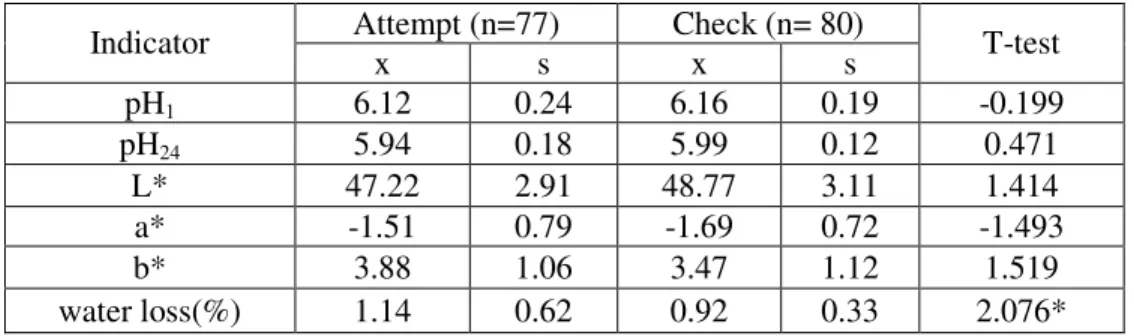
Table 1 Results in summary (acidity of chicken meat, water loss, and colour)
Attempt (n=77) Check (n= 80) Indicator x s x s T-test pH1 6.12 0.24 6.16 0.19 -0.199 pH24 5.94 0.18 5.99 0.12 0.471 L* 47.22 2.91 48.77 3.11 1.414 a* -1.51 0.79 -1.69 0.72 -1.493 b* 3.88 1.06 3.47 1.12 1.519 water loss(%) 1.14 0.62 0.92 0.33 2.076*
The values of pH, colour and water loss by dripping determined, processed by the T-test in terms of statistics, did not confirm the hypothesis of the assumed possible differences in occurrence of critical values of these indicators in both groups observed. The value of water loss by dripping (%) seems to be significant in terms of statistics (P < 0.05), which is one of the indicators leading to a possible development of the PSE problem. According to Barbut (1997) is this indicator important in function properties of the meat. The experiment hall shows higher percentage of water loss. The results of the pH measured 45 minutes after slaughter do not show any differences between the observed halls and thus any influence of drinking water is not evident as for the result acidity of the chicken meat. The pH value measured 24 hours after slaughter confirms this. The measured values of L* colour do not show any significant differences between both observed groups.
The use of the system of the electrolyzed water is thus mainly suitable due to its efficient disinfection not significantly affecting the quality of the result
Acta Universitatis Cibiniensis Series E: FOOD TECHNOLOGY Vol. XVII (2013), no.2
134 raw materials in particular, which has been proved by evaluation of the qualitative meat features.
CONCLUSIONS
Nearly identical values of the observed values of the qualitative indicators of meat quality, i.e. pH and colour of L colour of the meat, were determined in both breeds, which suggests there is a minimal influence of electrolyzed water used for watering and disinfection on the final quality of the poultry meat. Only as for the value of the water dripping in meat, there was an evidential difference between the both monitored groups. In three of four stages of sample takings a significant decrease in the number of moulds was recorded and a significant disinfection effect occurred as for determination of the total number of microorganisms. The use of the electrolyzed water to disinfect the breeding halls can be recommended mainly due to its biological degradability and non-toxicity.
ACKNOWLEDGEMENTS
The Article was supported by Project QI 111B107
REFERENCES
1. Barbut, S. (1998). Estimating the magnitude of the PSE problem in poultry. Journal of Muscle Foods 9: 35-49.
2. Barbut, S. (1997a). Problem of pale exudative meat in broiler chickens. Br. Poult. Sci 38: 355-358.
3. Fletcher, D. L. (1999a). Colour variation in commercial packaged broiler
breast fillets. J. Appl. Polut. Res 8: 67-69.
4. Fletcher, D. L. (2002). Poultry meat quality. Worlds Poult. Sci J. 58: 131-145.
5. Fabrizio, K. A., Sharma, R.R., Demirci, A. & Cutter, C.N. (2002).
Comparison of electrolyzed oxidizing water with various antimicrobial interventions to reduce Salmonella species on poultry.Poultry science 81: 1598-1605.
6. Guarnieri, P., Soars A. L., Olivio, R., Schneider, J. P., Macedo, R. M., Ida, E. I. & Shimokomaki, M. (2004). Pre-slaughter handling with water shower spray inhibits PSE broiler breast meat in commercial plant.
Acta Universitatis Cibiniensis Series E: FOOD TECHNOLOGY Vol. XVII (2013), no.2
135 7. Horiba, N., Hiratsuka, K., Onoe, T.,Yoshida, T., Suzuki, K., Matsumoto, T. & Nakamura, H.(1999). Bactericidal effect of electrolyzed neutral water on bacteria isolated from infected root canals. Oral Surgery, Oral
Medicine, Oral Pathology, Oral radiology, and Endodontic, 87(1):83-87.
8. Kim, C., Hung, Y.C. & Brackett, R.E.(2000). Efficacy of electrolyzed
oxidizing (EO) and chemically modified water on different types of foodborne pathogens. International Journal of Food Microbiology 61: 199-207.
9. Kiura, H., Sano, K., Morimatsu, S., Nakano, T., Morita, C.,Yamaguchi,
M, Maeda, T. & Katsuoka, Y.,(2002). Bactericidal activity of electrolyzed acid water from solution containing sodium chloride at low concentration, in comparison with that at high concentration. Journal of Microbiological methods 49(3): 285-293.
10.Olivio, R., Soare, A. L., Ida, E. I. & Shimokomaki, M. (2001). Dietary vitamin E inhibits poultry PSE and improves meat function properties.
Journal of Food Biochemistry 25: 271-283.
11.Ozer, N. P. & Demirci, A. (2005). Electrolyzed oxidizing water treatment
for decontamination of raw salmon inoculated with Escherichia coli O157:H7 and Listeria monocytogenes Scott A and Response Surface Modelling. Journal of Food Engineering 72(3): 234-241.
12.Park, H., Hung, Y.C. & Brackett, R. E. (2002). Antimicrobial effect of
electrolyzed water for inactivating Campylobacter jejuni during poultry washing. International Journal of Food Microbiology 72: 77-83.
13.Park, H., Hung, Y.C. & Kim, C. (2002). Effectiveness of electrolyzed
water as a sanitizer for treating different surfaces. Journal of food protection 65(8): 1276-1280.
14.Petracci, M. & Fletcher, D. L. (2002) Broiler skin and meat colour
changes during storage. Br. Poult. Sci 81: 1589-1597.
15.Simoes, G.S., Rossa, A., Oba Matsuo, T., Shomikomaki, M. & Ida, E.I.
(2009). Transporte e Ocorrencia de PSE (Pale, Soft, Exudative) E A.-DFD (Dark, Firm, Dry) em Files de Peito de Frango durante o inverno.
Revista National da Carne.
16.Walker, S.P., Demirci, A., Graves, R.E., Spencer, S. B. & Roberts, R. F.
(2005). CIP cleaning of a pipeline milking system using electrolyzed oxidizing water. In: International journal of Dairy Technology 58: 65-73.
17.Wilkins, L. J., Brown, S. N., Philips, A. J. & Warriss, P. D. (2000).
Acta Universitatis Cibiniensis Series E: FOOD TECHNOLOGY Vol. XVII (2013), no.2
136
18.Woelfel, R. L., Owens, C. M., Hirschler, E. M., Martinez-Dawson, R. &
Sams, A. R.(2002). The characterization and incidence of pale, soft and exudative broiler meat in a commercial processing plant. Poult. Sci 81: 576-584.
19.Yu-Ru Huang., Yen-Con Hung., Shun-Yao Hsu., Yao-Wen Huang., Deng-Fwu Hwang. (2008). Application of electrolyzed water in the food industry. Food Control 19, Issue 4: 329-345.