(will be inserted by the editor)
The core of games on ordered structures and
graphs
Michel GRABISCH1 Centre d’´Economie de la Sorbonne
106-112, Bd. de l’Hˆopital, 75103 Paris, France e-mail:[email protected]
Version of September 4, 2009
Abstract In cooperative games, the core is the most popular solution concept, and its properties are well known. In the classical setting of coop-erative games, it is generally assumed that all coalitions can form, i.e., they are all feasible. In many situations, this assumption is too strong and one has to deal with some unfeasible coalitions. Defining a game on a subcol-lection of the power set of the set of players has many implications on the mathematical structure of the core, depending on the precise structure of the subcollection of feasible coalitions. Many authors have contributed to this topic, and we give a unified view of these different results.
MSC Codes: 91A12, 06A06, 90C27
Keywords: TU-game, solution concept, core, feasible coalition, communi-cation graph, partially ordered set
1 Introduction
Let N := {1, . . . , n} be a finite set of players. We consider the situation where these players can form coalitions, and the profit given by the co-operation of the players in a coalition can be freely distributed among its members: this is in general referred to as cooperative profit games with transferable utility, which we will abbreviate in the sequel asTU-games(see, e.g., Driessen (1988); Peleg and Sudh¨olter (2003); Brˆanzei et al. (2005)).
Let v be a TU-game, that is, a set function v : 2N → R such that
v(∅) = 0, assigning to each coalition S ⊆ N its worth (profit) v(S). Let us assume that forming the grand coalitionN is the best way to generate
halshs-00445171, version 1 - 7 Jan 2010
profit. One of the main problems in cooperative game theory is to define a rational sharing among all players of the total worth v(N) of the game. Any sharing is called a solution of the game, since it solves the (difficult) problem of sharing the cake.
The literature on solutions of TU-games is very abundant, and many concepts of solution have been proposed. One may distinguish among them two main families, namely those solutions which are single-valued, and those which are set-valued. In the first category, to each game is assigned a sin-gle solution, which most of the time exists. Best known examples are the Shapley value (Shapley, 1953), the Banzhaf value (Banzhaf, 1965) and any other power index used in voting theory (see, e.g., Felsenthal and Machover (1998)), the nucleolus (Schmeidler, 1969), theτ-value (Tijs, 1981), etc. In the second category, to each game a set of solutions is assigned. This is the case of the core (Gillies, 1953; Shapley, 1971), the bargaining set (Au-mann and Maschler, 1964; Davis and Maschler, 1963), the kernel (Davis and Maschler, 1965), etc.
Among all these solution concepts, the core remains one of the most ap-pealing concepts, due to its simple and intuitive definition. Roughly speak-ing, it is the set of sharing vectors for which “nobody can complain”, or more exactly, which are coalitionally rational. This means that no coalition can be better off by splitting from the grand coalition N, i.e., for every
S⊆N, the payoffx(S) given toS is at least equal tov(S), the profit that
S can make without cooperating with the other players. The core may be empty, but when nonempty, it ensures in some sense the stability of the set of players, hence its interest.
The core is an important notion in economics. In an exchange economy, the core is defined as the set of situations where no coalition of agents can improve the utility of its members by reassigning the initial resources of its own members among them (Debreu and Scarf, 1963). Besides, there are many examples in economics where a common good or resource has to be shared among several users (e.g., a river supplying the water of several towns). The problem of sharing the cost among all the users in a rational way precisely amounts to find a solution like the core (Ambec and Sprumont, 2002; van den Brink and van der Laan, 2005; van den Brink et al., 2007; Khmelnitskaya, 2009). The core is also well known in decision theory and in the field of imprecise probabilities (see the monograph of Walley (1991), and also Chateauneuf and Jaffray (1989)): given a capacity, i.e., a monotonic game v such that v(N) = 1 (Choquet, 1953) representing the uncertainty on the set of states of nature, its core is the set of probability measures compatible with the available information on uncertainty. Conversely, given a family of probability measures representing some uncertainty on the set of states of nature, its lower envelope defines a capacity.
The core has been widely studied, and its properties are well known. In particular, when nonempty it is a bounded convex polyhedron, and the famous Bondareva theorem tells us when the core is nonempty (Bondareva, 1963), while Shapley (1971) and later Ichiishi (1981) found the vertices of the core for convex games.
The classical view in cooperative game theory is to consider that every coalition can form, i.e., a gamev is a mapping defined on 2N, the set of all subsets ofN. A view closer to reality reveals that it is not always possible to assume that every coalition can form, so that one should distinguish betweenfeasibleandunfeasiblecoalitions. For example, some hierarchy may exist on the set of players, and feasible coalitions are those which respect this hierarchy, in the sense that subordinates should be present (games with precedence constraints, Faigle and Kern (1992)). Another example is when coalitions are the connected subgraphs of a communication graph, depicting who can communicate with whom (Myerson, 1977b). More simply, when considering political parties, leftist and rightist parties cannot in general make alliance. In fact, many authors have studied the case where the set of feasible coalitions is a subcollection of 2N, as this paper will show.
The study of the core under such a general framework becomes much more difficult. Surprisingly, even if the core, when nonempty, is still a convex polyhedron, it need not be bounded, and moreover, it need not have vertices. The structure of the core for convex games, perfectly clear in the classical case, is complicated by the fact that it is not always possible to speak of convex games in the usual sense, because the definition of convexity works for a collection of feasible coalitions closed under union and intersection. The aim of this survey is precisely to give a unified view of the scattered results around these questions.
The paper is organized as follows. Section 2 introduces the basic mate-rial on partially ordered sets and polyhedra. Then Section 3 is devoted to a comparative study of various families of set systems (collections of feasible coalitions). Section 4 defines the core and the positive core, and gives the main classical results that are valid when all coalitions are feasible. Section 5 studies the structure of the core under various assumptions on the set sys-tem, while Section 6 does the same for the positive core. Finally, Section 7 studies the case of communication graphs.
Throughout the paper, the following notation will be used: we denote by R+ the set of nonnegative real numbers; N = {1, . . . , n} is the set of players; for any subset S ⊆N, 1S denotes the characteristic function (or vector) of S. For singletons, pairs, etc., we often omit braces and commas to avoid a heavy notation: we writeS\i, 123 instead ofS\ {i}and{1,2,3}.
2 Some prerequisites 2.1 Partially ordered sets
The reader can consult, e.g., Davey and Priestley (1990), Birkhoff (1967), and Gr¨atzer (1998) for more details. A partially ordered set (or poset for short) (P,≤) (or simplyP if no confusion occurs) is a setP endowed with a partial order≤(i.e, a reflexive, antisymmetric and transitive binary rela-tion). As usual,x < ymeansx≤y andx6=y, whilex≥yis equivalent to
y≤x. Two elementsx, y∈P areincomparable, and we denote this byx||y, if neither x ≤y nor y ≤x hold. A useful example of poset in this paper is (2N,⊆). We say that x is covered by y, and we write x ≺ y, if x < y and there is no z∈P such thatx < z < y. Achain in P is a sequence of elementsx1, . . . , xq such thatx1<· · ·< xq, while in anantichain, any two elements are incomparable. A chain from x1 to xq is maximal if no other chain can contain it, i.e., it is a sequence of elementsx1, . . . , xq such that
x1≺ · · · ≺xq. Thelength of a chain is its number of elements minus 1. A subsetQ⊆P is adownset ofP if for anyx∈Q,y ≤ximpliesy∈Q
(and similarly for an upset)1. The set of all downsets ofP is denoted by O(P).
An elementx∈P ismaximal if there is noy∈P such thaty > x(and similarly for aminimal element).x∈P is the (unique)greatest element (or
top element) ofP ifx≥y for ally∈P (and similarly for theleastelement, orbottomelement). SupposeP has a least element⊥. Thenxis anatom of
P ifx≻ ⊥. LetQ⊆P. The element x∈P is anupper bound ofQifx≥y
for ally∈Q(and similarly for alower bound). Forx, y∈P, thesupremum
ofx, y, denoted byx∨y, is the least upper bound of{x, y}, if it exists (and similarly for theinfimum ofx, y, denoted byx∧y).
A posetLis alattice if every pair of elementsx, y∈Lhas a supremum and an infimum. A lattice Lisdistributive if∨,∧obey distributivity, that is,x∨(y∧z) = (x∨y)∧(x∨z) or equivalentlyx∧(y∨z) = (x∧y)∨(x∧z), for allx, y, z ∈L. IfL is finite, then it has a least and a greatest element, which we denote by⊥,⊤respectively. An elementx6=⊥isjoin-irreducible
if it cannot be expressed as a supremum of other elements, or equivalently, if it covers only one element. Atoms are join-irreducible elements. We denote byJ(L) the set of all join-irreducible elements. An important result which will be useful in the sequel is the theorem of Birkhoff (1933): it says that if the lattice (L,≤) is distributive, then it is isomorphic toO(J(L)), where it is understood thatJ(L) is endowed with ≤, and that the set of downsets is endowed with inclusion. Conversely, any posetP generates a distributive latticeO(P). This is illustrated on Figure 2.1
1 Some authors use instead the wordsidealsandfilters. This is however incorrect, since
in the standard terminology, an ideal is a downset closed under supremum, and a filter is an upset closed under infimum.
1 3 4 2 1 2 3 4 ∅ 1 3 123 34 13 134 1234
Fig. 2.1.Left: a distributive latticeL. Join-irreducible elements are those in grey. Middle: the posetJ(L) of join-irreducible elements. Right: the setO(J(L)) of all downsets of
J(L) ordered by inclusion, which is isomorphic toL
LetP be a poset, andx∈P. Theheight ofxis the length of a longest chain in P from a minimal element to x. The height of a lattice L is the height of its top element, i.e., it is the length of a longest chain from bottom to top. When the lattice is distributive, its height is|J(L)|.
2.2 Inequalities and polyhedra
We recall only some basic facts useful for the sequel (see, e.g., Ziegler (1995), Faigle et al. (2002) for details). Our exposition mainly follows Fujishige (2005,§1.2)
We consider a set of linear equalities and inequalities with real constants n X j=1 aijxj≤bi (i∈I) (2.1) n X j=1 a′ijxj=b′i (i∈E). (2.2) This system defines an intersection of halfspaces and hyperplanes, called a (closed convex) polyhedron. A set C ⊆ Rn is a convex cone (or simply a cone) if x, y ∈ C implies that αx+βy ∈ C for all α, β ≥ 0 (conic
combination). The cone is pointed if C∩(−C) = {0} (equivalently, if it has an extreme point, see below). An affine set A is the translation of a subspace of the vector space Rn. Its dimension is the dimension of the subspace. Aline is a one-dimensional affine set, and aray is a “half-line”, i.e., a translation of a set given by{αx|α≥0}for somex∈Rn,x6= 0. An
extreme ray of a cone is a ray whose supporting vector cannot be expressed as a convex combination of the supporting vectors of other rays. Any cone can be expressed as the conic combination of its extreme rays. Anextreme point orvertex of a polyhedronP is a point inP which cannot be expressed as a convex combination of other points in P. A polyhedron is pointed if
it contains an extreme point. Therecession cone C(P) of a polyhedron P
defined by (2.1) and (2.2) is defined by n X j=1 aijxj≤0 (i∈I) (2.3) n X j=1 a′ijxj= 0 (i∈E). (2.4)
The recession cone is either a pointed cone (possibly reduced to{0}) or it contains a line. The following basic properties are fundamental:
(i) P has rays (but no line) if and only if C(P) is a pointed cone different from{0};
(ii) P is pointed if and only ifC(P) does not contain a line, or equivalently, if the system (2.4) and
n
X
j=1
aijxj = 0 (i∈I) has 0 as unique solution.
(iii) P is apolytope (i.e., a bounded polyhedron) if and only ifC(P) ={0}. The fundamental theorem of polyhedra asserts that any pointed polyhedron
P defined by a system (2.1) and (2.2) is the Minkowski sum of its recession cone (generated by its extreme rays; this is the conic part of P) and the convex hull of its extreme points (the convex part ofP):
P = cone(r1, . . . , rk) + conv(ext(P))
where r1, . . . , rk are the extreme rays ofC(P), cone() and conv() indicate respectively the set of all conic and convex combinations, and ext() is the set of extreme points of some convex set.
IfP is not pointed, then it reduces to its recession cone up to a transla-tion.
3 Set systems
Our study deals with games defined on a collection of feasible coalitions. In this section, we introduce various possible structures for these collections. The weakest requirement we introduce is that the collection should include the grand coalition, and for mathematical convenience, the empty set. There are however exceptions to this rule.
A set system F on N is a subset of 2N containing∅ and N. Endowed with inclusion,Fis a poset with top and bottom elementsN,∅respectively.
The set of maximal chains from ∅ toN inF is denoted by C(F). For any
S⊆N, we putF(S) :={T ∈ F |T ⊆S}.
A set systemF isatomistic if{i} ∈ F for alli∈N. For any collection F ⊆2N, we introduce
e
F:={S∈2N |S=F
1∪ · · · ∪Fk, F1, . . . , Fk∈ F pairwise disjoint} the familygenerated byF (Faigle, 1989).
LetFbe a set system. ATU-game(or simplygame) onFis a mapping
v:F →Rsuch thatv(∅) = 0. The game ismonotonic if forS, T∈ F such thatS ⊆T, we havev(S)≤v(T) (and thereforev is nonnegative).
When F = 2N, the notion of convexity and superadditivity are well known. A game is said to beconvex if for anyS, T ∈2N, we have
v(S∪T) +v(S∩T)≥v(S) +v(T).
A gamevissuperadditive if the above inequality holds for disjoint subsets, i.e., for allS, T ∈2N such thatS∩T =∅,
v(S∪T)≥v(S) +v(T).
The above notions generalize as follows. AssumeFis a (set) lattice. A game
v onF isconvex if for anyS, T ∈ F,
v(S∨T) +v(S∧T)≥v(S) +v(T).
Superadditivity amounts to the above inequality restricted to subsetsS, T
such thatS∧T =∅. Obviously, one could not speak of convex game if the set system is not a lattice. It is however possible to find alternative definitions for weaker structures, as will be seen in the sequel (see Section 6.1, and supermodular games in Section 6.2).
TheM¨obius transformofvonFis a real-valued mappingmvonF given implicitely by the system of equations
v(S) = X F⊆S,F∈F
mv(F), S∈ F.
As it is well known, whenF= 2N, we obtainmv(S) =P
F⊆S(−1)|S\F|v(F). The M¨obius transform is known as theHarsanyi dividends (Harsanyi, 1963) in game theory.
Given these general definitions, we turn to the study of the main families of set systems.
3.1 Regular set systems
Let 1≤k≤n. A set system isk-regular if all maximal chains from∅ toN
have the same lengthk(Xie and Grabisch, 2009). An-regular set system is simply called aregular set system (Honda and Grabisch, 2008; Lange and Grabisch, to appear). Equivalently,F is regular if and only if forS, T ∈ F such thatS≻T, we have|S\T|= 1.
Any regular set system satisfies:
(i) One-point extension:if S ∈ F, S 6= N, then ∃i ∈ N\S such that
S∪i∈ F;
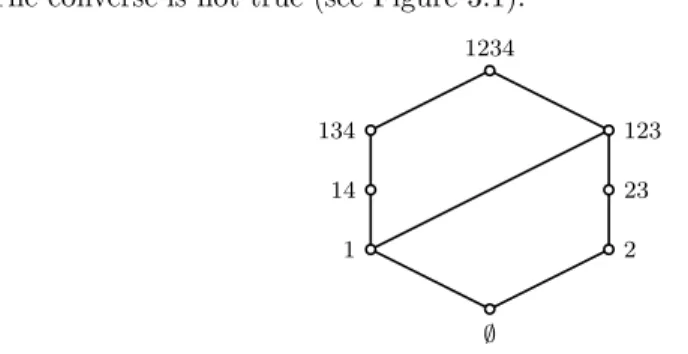
(ii) Accessibility:ifS ∈ F,S6=∅, then∃i∈S such thatS\i∈ F. The converse is not true (see Figure 3.1).
∅ 1 14 134 1234 2 23 123
Fig. 3.1.A set system satisfying one-point extension and accessibility, but which is not
k-regular
In a k-regular set systemF, for anyS, T ∈ F, all maximal chains from
S toT have the same length.
Remark 3.1.Obviously, regular set systems (and to a less extent,k-regular set systems) offer a convenient mathematical framework because all maxi-mal chains have lengthn, and for this reason many notions (in particular marginal worth vectors, and therefore the Shapley value (Shapley, 1953) and the Weber set (see Section 4)) can be defined as in the classical case F = 2N. One can however find motivations for such structures which are more game-theoretically oriented:
(i) The set of connected coalitions in a connected communication graph is a regular set system (see Section 7). The converse is false:{i} ∈ F for all
i∈N is a necessary condition (for necessary and sufficient conditions: see augmenting systems in Section 3.7).
(ii) Maximal chains correspond to permutations on N (or total orders on players). A regular set system forbids some permutations, i.e., some or-derings of the players to enter the game. With k-regular set systems,
k < n, players may enter the game by groups.
3.2 Convex geometries and antimatroids
Aconvex geometryF(Edelman and Jamison, 1985) is a collection of subsets ofN containing the empty set, closed under intersection, and satisfying the one-point extension property. NecessarilyN ∈ F, hence it is a set system, and moreover a regular set system.
Anantimatroid F (Dilworth, 1940) is a collection of subsets ofN con-taining the empty set, closed under union, and satisfying the accessibility property. Any antimatroid satisfies theaugmentation property:
S, T ∈ F with|T|>|S| ⇒ ∃i∈T\S s.t.S∪i∈ F.
IfF satisfies SF =N, thenN ∈ F. Such antimatroids are called normal
by van den Brink (2009).
Remark 3.2.Algaba et al. (2004) relate antimatroids to permission struc-tures; see Section 3.4. However, the relation is somewhat artificial since antimatroids do not always correspond to permission structures (this is the case of systems closed under∪,∩). The unusual word “poset antimatroids” is used, and means the set of upsets (or downsets) of a poset. These are antimatroids closed under intersection. But it is well known that such set systems are distributive latticesO(N) (and so could be called poset convex geometries as well), hence closed under union and intersection (see Sec-tion 2.1).
3.3 Set lattices
If a set system is a lattice, we call it a set lattice. It need not be closed under∩,∪, nor be ak-regular set system (see for example the pentagon on Figure 3.3 (ii)).
If the lattice is distributive, then we benefit from Birkhoff’s theorem and we know that it is generated by a posetP. However this poset is not always
N endowed with some partial order. The following can be easily proved and clarifies the situation (see Xie and Grabisch (2009)):
Proposition 3.3.Let F be a distributive set lattice on N of heightk. The following holds.
(i)F is a k-regular set system, which is generated by a poset P of k ele-ments, i.e., F is isomorphic to O(P).
(ii)F is closed under union and intersection if and only ifF is isomorphic toO(P), whereP can be chosen to be a partition ofN.
(iii)k=nif and only ifF is isomorphic toO(N).
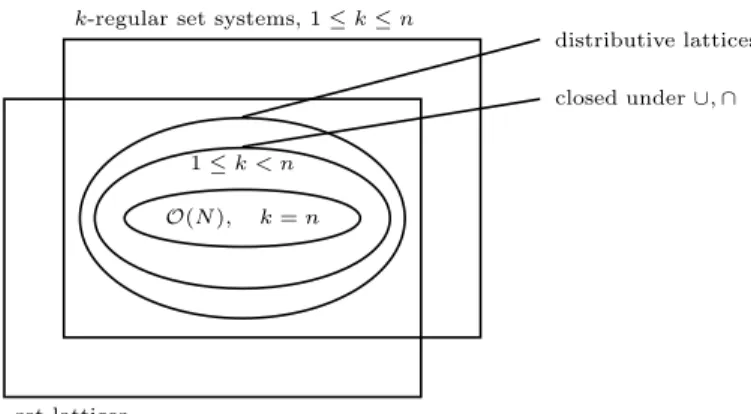
Figure 3.2 shows the relative situation of set lattices andk-regular set sys-tems. Figure 3.3 shows that all inclusions are strict.
set lattices
k-regular set systems, 1≤k≤n
distributive lattices closed under∪,∩
1≤k < n O(N), k=n
Fig. 3.2.Set lattices andk-regular set systems
∅ 1 123 1234 124 2 (i) ∅ 1 12 123 23 (ii) ∅ 1 2 3 123 (iii) ∅ 1 3 123 (iv) ∅ 12 3 123 (v)
Fig. 3.3. (i) k-regular but not a lattice; (ii) lattice but not k-regular; (iii) k-regular lattice but not distributive; (iv) distributive lattice but not closed under ∪; (v) closed under∪,∩but not isomorphic toO(N)
3.4 Systems closed under union and intersection
As seen in Section 3.3, these are particular set lattices, which are distributive and generated by a partition ofN.
Derks and Gilles (1995) proved that they are equivalent to(conjunctive) permission structures of Gilles et al. (1992). A (conjunctive) permission structure is a mappingσ:N →2N such thati6∈σ(i). The players in σ(i) are the direct subordinates ofi. “Conjunctive” means that a playerihas to get the permission to act of all his superiors. Consequently, anautonomous
coalition contains all superiors of every member of the coalition, i.e., the set of autonomous coalitions generated by the permission structureσis
Fσ={S∈2N |S∩σ(N \S) =∅}.
Then F is closed under union and intersection if and only if F = Fσ for some permission structureσ.
See also Algaba et al. (2004) for similar results related to antimatroids (see Section 3.2). They characterizeacyclicpermission structures (i.e., where, for alli∈N, in the set of all subordinates (not limited to the direct ones) ofi,iis not present) by distributive latticesO(N) (called there poset anti-matroids).
3.5 Weakly union-closed systems
A set systemF isweakly union-closed ifF∪F′∈ F for allF, F′ ∈ F such thatF∩F′ 6=∅.
An important consequence is that for anyS ⊆ N, F(S) := {F ∈ F |
F ⊆S}has pairwise disjoint maximal elements.
Thebasis ofF is the collection of setsS inF which cannot be written as S =A∪B, withA, B ∈ F, A, B6=S, A∩B 6=∅ (Bilbao, 2000, Chap. 6). All singletons and pairs ofF are in the basis. Clearly, knowing the basis permits to recoverF.
Remark 3.4. (i) This terminology is used by Faigle and Grabisch (2009). Weakly union-closed systems have been studied under the nameunion stable systems by Algaba (1998) (summarized in Bilbao (2000, Chap. 6)).
(ii) They are closely related to communication graphs because if F rep-resents a communication graph (i.e., F is the collection of connected coalitions of the graph; see Section 7), then the union of two inter-secting connected coalitions must be connected. van den Brink (2009) characterized those weakly union-closed collections which correspond to communication graphs:F ⊆2N is the set of connected coalitions of some comunication graph if and only if∅ ∈ F, F is normal (i.e., SF =N), weakly union-closed, and satisfies2-accessibility (i.e.,S∈ Fwith|S|>1 implies that there exist distincti, j∈S such thatS\iandS\j belong to F). Another characterization is due to Bilbao through augmenting systems (see Section 3.7).
(iii) Similarly, they are also related to the more general notion ofconference structures of Myerson (1980), which generalize communication graphs. A conference structureQis a collection of subsets ofN of cardinality at least 2. Two playersi, jare connected if there is a sequenceS1, . . . , Sk of sets inQsuch thati∈S1, j∈Sk, andSℓ∩Sℓ+16=∅forℓ= 1, . . . , k−1. Then, F := {S ⊆ N | ∀i, j ∈ S, iandj are connected} is a weakly union-closed system. Conversely, given a weakly union-closed systemF, the basis ofFrestricted to sets of cardinality at least 2 can be considered as a conference structure. An equivalent view of this is given by van den Nouweland et al. through hypergraphs (van den Nouweland et al., 1992), since in a hypergraph, a (hyper)link joins several nodes (and thus can be viewed as a subset of cardinality at least 2). Thus, a path in a hypergraph corresponds to a sequenceS1, . . . , Sk as described above.
3.6 Partition systems
They were studied by Bilbao (2000,§5.1) and Algaba et al. (2001). A par-tition system is a collection F ⊆ 2N containing the empty set, all single-tons, and such that for everyS ⊆N, the maximal subsets of S in F form a partition of S (equivalently, F contains ∅, all singletons and is weakly union-closed).
Any set system induced by a communication graph is a partition system. IfF is a partition system, then Fe= 2N.
3.7 Augmenting systems
Anaugmenting system (Bilbao, 2003; Bilbao and Ord´o˜nez, 2009, 2008) is a collectionF ⊆2N containing∅, being weakly union-closed, and satisfying
∀S, T∈ F s.t.S⊆T, ∃i∈T\S s.t.S∪i∈ F.
Remark 3.5. (i) In Bilbao (2003), it is required in addition that SF =N
(obviously, this property should always be required when dealing with collections of subsets).
(ii)Ndoes not necessarily belong toF. IfN ∈ F, the above property implies that all maximal chains from∅to N have the same lengthn, and thus F is a regular set system. The converse is false.
IfN 6∈ F, by weak union-closure, all maximal sets inF, sayF1, . . . , Fk, are disjoint, and noF ∈ F can intersect two distinct maximal subsets. Therefore,Fcan be partitioned into augmenting subsystemsF1, . . . ,Fk onF1, . . . , Fk respectively, which are all regular. Hence, it is sufficient to study the case whereN∈ F.
(iii) An augmenting system is an antimatroid (respectively, convex geometry) if and only if F is closed under union (respectively, intersection). (iv) Augmenting systems are of particular importance since they permit to
characterize communication graphs (see Section 7). Specifically, ifGis a communication graph, the set of connected coalitions is an augmenting system. Conversely, an augmenting system is the collection of connected coalitions of a communication graph if {i} ∈ F for all i ∈ N. Each connected component of the graph corresponds to the augmenting sub-systemsF1, . . . ,Fk mentionned in (ii).
Augmenting systems are also closely related to the previously introduced structures, as shown in the next proposition.
Proposition 3.6.F is an augmenting system containing N if and only if it is regular and weakly union-closed.
Proof. The “only if” part has been already noticed above. Now, suppose it is regular. TakeS⊆T inF, then they lie on some chain. Since the system is regular, there aret−s−1 subsets betweenS andT, which implies the augmentation property.
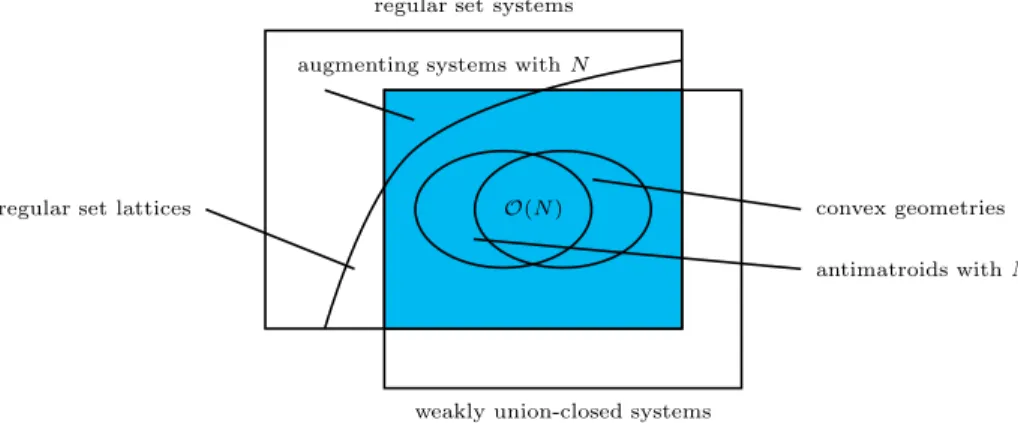
The various relations between regular set systems, weakly union-closed sys-tems and augmenting syssys-tems are illustrated on Figure 3.4. Figure 3.5 shows
regular set systems
weakly union-closed systems augmenting systems withN
regular set lattices
antimatroids withN convex geometries O(N)
Fig. 3.4. Regular set systems and weakly union-closed systems
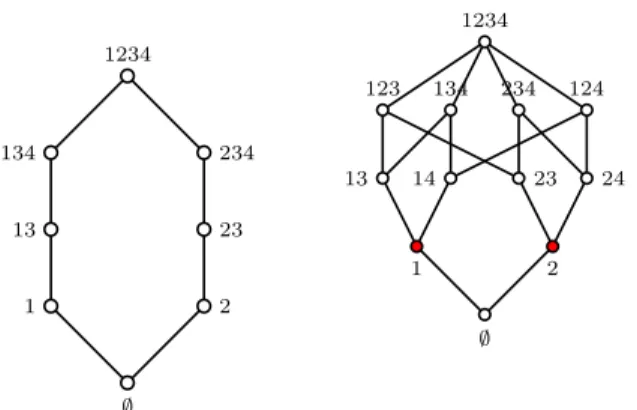
that it is possible to have regular set lattices which are not weakly union-closed, and weakly union-closed regular systems not being a lattice.
∅ 1 13 134 1234 234 23 2 ∅ 1 2 13 14 23 24 123 134 234 124 1234
Fig. 3.5.Left: regular set lattice but not weakly union-closed. Right: regular and weakly union-closed but not a lattice, since 1 and 2 have no supremum
3.8 Coalition structures
Our last category is of different nature since it is not a set system in our sense, and its motivation is very different from the notion of feasible coali-tion. Its origin comes from the domain of coalition formacoali-tion. We neverthe-less mention it here due to its importance, although the topic of coalition formation falls outside the scope of this survey (see, e.g., Holler and Owen (2001), van Deemen (1997)).
A coalition structure on N is a partition of N (Aumann and Dr`eze, 1974). It is called by Owen (1977)a priori union structures.
Letvbe a game on 2N, and consider a coalition structureB:={B
1, . . . , Bm}. Given a payoff vectorx, Bk ∈ B, we define the gamevx∗ on 2Bk by
vx∗(S) =
(
maxT⊆N\Bk(v(S∪T)−x(T)), S⊂Bk, S6=∅
v(S), S=Bk or∅.
Remark 3.7.The above definition considers a game in the classical sense, and not on the blocks of the partition. Another type of game suited for coalition structures is global games and games in partition function form. We mention them without further development since their nature is too far away from coalitional games. Aglobal game (Gilboa and Lehrer, 1991) is a real-valued mapping defined on the set Π(N) of partitions of N: it assigns some worth to any coalition structure. Agame in partition function form (Thrall and Lucas, 1963) is a mappingv assigning a real number to a coalition S and a partition π containing S: knowing that the coalition structure is someπ∈Π(N) such thatS ∈π, v(S, π) is the worth of S in this organization of the society.
4 The core and related notions
Let v be a game on a set system F. A payoff vector is any x ∈ Rn. It represents some amount of money given to the players. By commodity we writex(S) :=Pi∈Sxi for anyS⊆N. A payoff vector isefficient ifx(N) =
v(N). The pre-imputation set of v is the set of all efficient payoff vectors. We define theimputation set ofv as
I(v) :={x∈Rn|xi≥v({i}) if{i} ∈ F andx(N) =v(N)}. Thecore ofv is defined by
core(v) :={x∈Rn|x(S)≥v(S) for allS∈ F andx(N) =v(N)}. Thepositive core ofv is defined by (Faigle, 1989):
core+(v) :={x∈Rn+|x(S)≥v(S) for allS∈ F andx(N) =v(N)}.
Remark 4.1. (i) The classical definition of the core (Shapley, 1971) is recov-ered withF = 2N. It should be noted that the definition is meaningful only if the game is a profit game. For cost games, the inequalities should be reversed. The core is the set of payoff vectors which are coalitionally rational: no coalition can have a better profit if it splits from the grand coalitionN.
(ii) If F contains all singletons and the game is monotonic, the distinction between the core and the positive core is void since they coincide. The positive core retains imputations which are nonnegative, which means that in no case the players would have to pay something instead of being rewarded. This notion is natural essentially if the game is monotonic, for otherwise there would exist players with negative contribution to the game, and those players should be penalized; see also Remark 6.1. (iii) The (positive) core is also well known in decision under risk and
uncer-tainty: it is the set of probability measures dominating a given capac-ity (monotonic game); see, e.g., Walley (1991). More surprisingly, the (positive) core with the reversed inequalities is a well-known concept in combinatorial optimization, under the name of base polyhedron of a polymatroid (Edmonds, 1970), where a polymatroid is nothing else than a submodular2 monotonic game. As we will see, many theorems shown in game theory about the core were already known in combinatorial optimization; see the excellent monograph of Fujishige (2005).
We recall the classical results on the core whenF = 2N.
2 WhenF is closed under∪,∩, asubmodular game, also calledconcave, satisfies the
inequalityv(S∪T) +v(S∩T)≤v(S) +v(T) for allS, T∈2N.
A first important question is to know whether the core is empty or not. A collectionB of nonempty subsets of 2N isbalanced if there exist positive coefficientsλB, B∈ B, such that
X
B∈B
λB1B =1N.
The vectorλ:= (λB)B∈Bis called thebalancing vector. Balanced collections generalize the notion of partitions. Derks and Peters (1998) have shown that a collection is balanced if and only if for all y ∈ Rn such that y(N) = 0 (side-payment vector), if y(S) >0 for some S ∈ B, then it exists S′ ∈ B such thaty(S′)<0.
A game v on 2N is balanced if for every balanced collection B with balancing vectorλit holds
X
B∈B
λBv(B)≤v(N).
This could be interpreted by saying that there is no advantage in divid-ing the grand coalition into balanced collections. The followdivid-ing well-known result is an easy consequence of the duality theorem of linear programming.
Theorem 4.2.(Bondareva, 1963) Letvbe a game on2N. Thencore(v)6=∅
if and only if v is balanced.
Obviously, the interest of the theorem is more mathematical than algo-rithmical. It cannot reasonably be used for testing the nonemptiness of the core of a given game. Since the core is a set of linear inequalities, classical tools testing the feasability of a set of inequalities, like the Fourier-Motzkin elimination, or simply a linear programming solver, should be used.
Assuming that the core is nonempty, it is a polytope, and therefore the question of knowing its vertices arises. To each maximal chainC ∈ C(2N) with C ={∅, S1, . . . , Sn =N}, corresponds bijectively a permutation σ ∈
S(N), the set of permutations onN, such that
Si={σ(1), . . . , σ(i)}, i= 1, . . . , n.
Considering a gamev on 2N, to each permutationσ(or maximal chainC) we assign amarginal worth vector φσ (orφC) inRn by:
φσσ(i):=v(Si)−v(Si−1) =v(Si−1∪σ(i))−v(Si−1). TheWeber set is the convex hull of all marginal worth vectors:
W(v) := conv(φC|C∈ C(2N)).
The following inclusion always holds
core(v)⊆ W(v).
Theorem 4.3.The following assertions are equivalent. (i)v is convex
(ii) All marginal vectors φC,C ∈ C(2N) (or φσ,σ ∈S(N)), belong to the
core
(iii)core(v) = conv({φσ}
σ∈S(N))
(iv)ext(core(v)) ={φσ}
σ∈S(N).
Shapley (1971) proved (i)⇒(ii) and (i)⇒(iv), while Ichiishi (1981) proved (ii)⇒(i). Edmonds (1970) proved the same result as Shapley. This is also mentionned in (Lov´asz, 1983). This result clearly shows why convexity is an important property for games. Indeed, in this case, the core is nonempty and its structure is completely known. In the subsequent sections, we will see that much effort is done for games defined on set systems in order to preserve these properties as far as possible.
5 Structure of the core
5.1 General results for arbitrary set systems
We begin by some simple considerations on the imputation set. If F is atomistic, then I(v) 6= ∅ if and only if v(N) ≥ Pi∈Nv({i}). If F is not atomistic, then it is always true that I(v) 6= ∅. Indeed, if {j} 6∈ F, just takexi =v(i) if{i} ∈ F,xj =v(N)−P{i}∈Fv(i), and xi = 0 otherwise. Similarly,I(v) is bounded if and only ifF is atomistic.
The first question we address is to know when the core is nonempty. It is easy to see that the classical definitions and result of Bondareva on balancedness still work: core(v) 6= ∅ if and only if v is balanced, where balanced collections are understood as collections inF. Another result is due to Faigle (1989), with a different (but equivalent) definition of balancedness. A gamev onF isbalanced if for all familiesA1, . . . , Ak inF andm∈Nit holds 1 m k X i=1 1Ai =1N implies 1 m k X i=1 v(Ai)≤v(N).
In the above, it should be noted that repetitions are allowed in the family and that the length of a family is arbitrary.
Assuming that core(v) is nonempty, one can define its lower envelope v∗, which is a game on 2N:
v∗(S) := min
x∈core(v)x(S), ∀S⊆N.
Note thatv∗(N) =v(N), and ifF= 2N, we have core(v∗) = core(v).
Remark 5.1.The lower envelope is an important notion in decision theory (see Walley (1991)). In game theory, it is called the Harsanyi mingame
(Derks et al., 2008).
An important question is to know whether the equalityv=v∗ holds. Such games are calledexact. If a gamev is exact, by the above mentioned prop-erty, it is the smallest game having the core equal to core(v). Faigle (1989) proved the next result:
Theorem 5.2.A gamevis exact if and only if for all familiesA, A1, . . . , Ak
inF \ {∅}and m, l∈N, k X i=1 1Ai =m1N +l1A implies k X i=1 v(Ai)≤mv(N) +lv(A).
As above, repetitions are allowed in the family. This is similar to a result of Schmeidler (1972), proved when F is a (possibly infinite) family closed under union and complementation:v is exact if and only if for allS∈ F
v(S) = supn X i aiv(Si)−a|v|s.t. X i ai1Si−a1N ≤1S,
with a∈R+,(ai, Si) is a finite sequence inR+× Fo, and|v|:= sup{Piaiv(Si)|(ai, Si) is a finite sequence inR+×F s.t.Piai1Si ≤
1N}.
When nonempty, the core is a polyhedron. Therefore it makes sense to speak of its recession cone (proposed under the name of core of the set systemF by Derks and Reijnierse (1998), hence the notation):
core(F) :={x∈Rn|x(S)≥0 for allS∈ F andx(N) = 0}. A direct application of results of Section 2.2 leads to:
(i) core(v) has rays if and only if core(F) is a pointed cone different from {0}. Then core(F) corresponds to the conic part of core(v);
(ii) core(v) has no vertices if and only if core(F) contains a line; (iii) core(v) is a polytope if and only if core(F) ={0}.
Therefore, it remains to study the structure of the recession cone. We in-troduce
span(F) :=S⊆N |1S=
X
T∈F
λT1T for someλT ∈R .
F is non-degenerate if span(F) = 2N 3. Non-degeneracy implies the dis-cerning property (see Section 5.2). The converse holds ifF is closed under 3 In fact, it is simpler to check the following equivalent condition: for alli∈N, it exists
a linear combination of the1T’s,T ∈ F, giving1i.
∪,∩(see Theorem 5.10). We give two easy sufficient conditions forF to be non-degenerate:
(i) F contains all singletons (obvious from Footnote 3);
(ii) F is regular. Indeed, since any chain has lengthn, all1i’s can be recov-ered from1Sj −1Sj−1, for two consecutive sets Sj, Sj−1in a chain. Theorem 5.3.(Derks and Reijnierse, 1998) core(F) is a pointed cone if and only ifF is non-degenerate.
This result is easy to see from Footnote 2 and Section 2.2. Indeed, non-degeneracy is equivalent to the existence of linear combinations of the1T’s,
T ∈ F, giving all1i’s,i∈N, and the same linear combinations can be used to express allxi’s,i∈N, from the systemx(T) = 0,T ∈ F, thus proving that this system has a unique solution (which is 0). But this is equivalent to say that the recession cone is a pointed cone.
We recall thatF is balanced if ∃λS >0 for all S ∈ F such that1N =
P
S∈FλS1S.
Theorem 5.4.(Derks and Reijnierse, 1998) core(F) is a linear subspace if and only if F is balanced.
Therefore, core(F) ={0} if and only ifF is balanced and non-degenerate. Lastly, considering a gamevonF, we introduce the following extension ofv toFe (Faigle, 1989) ˜ v(S) := maxn X i∈I v(Fi), {Fi}i∈I is aF-partition ofS o ,
where by aF-partition we mean a partition whose blocks belong toF. The game ˜v is superadditive, and if ˜v(N) =v(N), then core(v) = core(˜v), which is easy to show.
Remark 5.5.IfFcontains all singletons (e.g., a partition system), thenFe= 2N, and so ˜vis an extension ofvon 2N: compare with the extensionvdefined in Section 6.3. Also, ˜v is a partitioning game of Kaneko and Wooders (see Section 5.4). Ifvis a superadditive game on a partition system, then ˜v=v. In Bilbao (2000,§5.3) it is shown that ifF is a partition system containing
N andv(N) =v(N) = ˜v(N), then core(v) = core(˜v).
5.2 Set systems closed under∪,∩
Let F be a set system closed under ∪,∩ (such systems are distributive lattices, and correspond to permission structures; see Section 3.4). For each
i∈N we define
Di:=
\
{S∈ F |S∋i}= smallestS inF containingi.
Proposition 5.6.The set ofDi’s coincides with the set of join-irreducible
elements ofF, i.e.,
{Di}i∈N =J(F).
Moreover, if the height of F is strictly smaller thann, necessarily we have Di=Dj for somei, j (the height equals the number of distinctDi’s).
Proof. Suppose there is some Di which is not a join-irreducible element. Then Di can be written as the supremum of other elements, which are smaller. SinceF is closed under∪, one of these elements must containi, a contradiction with the definition ofDi.
Conversely, take a join-irreducible element S. IfS ={i}, we are done. Assume then that|S|>1. Since it covers only one subset, sayS′, for anyi inS\S′,S is the smallest subset containingi, whence the result.
Finally, sinceF is a distributive lattice, its height is the number of join-irreducible elements, hence someDi’s must coincide if the height is less than
n.
Remark 5.7.The setsDi’s are introduced in Derks and Gilles (1995). They are also known in the literature of combinatorial optimization (see Fujishige (2005, Sec. 3.3) and Fujishige (2005, Sec. 7.2 (b.1)) (principal partitions)).
Theorem 5.8.
core(F) = cone(1j−1i|i∈N andj∈Di). IfF is not closed under∪,∩, then any1j−1i is a ray of core(F).
Remark 5.9.This result is due to Derks and Gilles (1995). It was in fact proved when the system is of the type O(N) in a more precise form by Tomizawa (Tomizawa (1983), cited in Fujishige (2005, Th. 3.26)): it says that the extreme rays are those corresponding toj≻iin (N,≤). Note that it could be easily adapted if the lattice is not generated by N, but by a partition ofN (see Proposition 3.3).
The set system F is discerning if all Di’s are different (equivalently, by Proposition 5.6, if the height ofF isn, which is a much simpler condition).
Theorem 5.10.(Derks and Gilles, 1995) Consider F to be closed under
∪,∩. core(F)is a pointed cone if and only if F is discerning.
This result is easy to deduce from previous facts. If the recession cone is pointed, thenF is non-degenerate by Theorem 5.3, which implies the dis-cerning property as mentionned above. IfF is discerning, then its height is
n, and so it is regular, which implies that it is non-degenerate, and therefore, the recession cone is pointed.
WhenF is of the type O(N), for any maximal chainC ∈ C(F), define themarginal vector associated toClike in the classical case, and define the
Weber set as the convex hull of all marginal vectors.
Theorem 5.11.Let F be of the type O(N). Then the convex part of the core is included in the Weber set.
Theorem 5.12.Let F be of the type O(N). Then v is convex if and only if the convex part of the core is equal to the Weber set.
Remark 5.13.The two last theorems are shown by Grabisch and Xie (2009), but they can deduced from Derks and Gilles (1995), where they are stated for acyclic permission structures. Indeed, from Algaba et al. (2004), we know that these systems are equivalent to distributive lattices of the typeO(N) (see Section 3.4). The “only if” part of the latter theorem was already shown by Fujishige and Tomizawa (1983).
Lastly, we address a slightly more general case, where closure under union is replaced by weak union-closure. The following development is due to Faigle (1989).A, B⊆N is acrossing pairifA, Bintersect,A∪B 6=N and
A\B, B\Aare nonempty. ThenFis acrossing family ifA∪B, A∩B∈ F wheneverA, B is a crossing pair.v on a crossing familyF isconvex if for every crossing pairv(A∪B) +v(A∩B)≥v(A) +v(B).
Theorem 5.14.SupposeF is weakly union-closed and closed under inter-section. ThenF˜ is closed under union and intersection, andv convex onF
impliesv˜convex on F˜.
Theorem 5.15.SupposeF is weakly union-closed and closed under inter-section, and v on F is convex. Then v is balanced if and only if for all partitions (with nonempty blocks, as usual){A1, . . . , Ak} of N,
v(A1) +. . . v(Ak)≤v(N).
Now, if theAi’s are only pairwise disjoint, this characterizes complete
bal-ancedness (see Section 6).
5.3 Convex Geometries
The core of games on convex geometries has been studied by Bilbao et al. (1999).
Theorem 5.16.Let v be a game on a convex geometryF.
(i)core(v) is either empty or a pointed polyhedron (i.e., having vertices). (ii) Assume thatcore(v) 6=∅ and that v is nonnegative. Then core(v) is a
polytope if and only ifF is atomistic if and only ifcore(v) = core+(v).
Remark 5.17.(i) is clear from Theorem 5.3 since a convex geometry is non-degenerate (sincen-regular). (ii) was already remarked by Faigle (1989) (see Theorem 6.2).
A game v is quasi-convex if convexity holds only for pairsA, B ∈ F such that A∪B ∈ F. Marginal vectors are defined as usual, considering all maximal chains inF (all of lengthn).
Theorem 5.18.A gamev onF is quasi-convex if and only if all marginal vectors belong to the core.
5.4 Partition systems
LetF be a partition system,v be a game onF, andv its extension on 2N (see Section 6.3). IfN ∈ F, it is easy to establish that core(v)⊆core(v).
Kaneko and Wooders (1982) deal with a weaker definition of partition systems. A partition system only needs to contain all singletons. Then a
partitioning game v is a game on 2N defined from some gamev′ onF by
v(S) = maxn X i∈I
v′(Fi), {Fi}i∈I is aF-partition ofS
o .
Thenv is superadditive and core(v) = core(v′) whenN∈ F.
5.5 k-regular set systems
The core of games on k-regular set systems has been studied by Xie and Grabisch (2009). We mentioned in Section 5.1 that an-regular set system is non-degenerate, hence Theorem 5.3 applies and the core is a pointed polyhedron, unbounded in general. However, in many cases, F could be degenerate, and in this case the core has no vertices. This is the case for the 2-regular set system given in Figure 5.1.
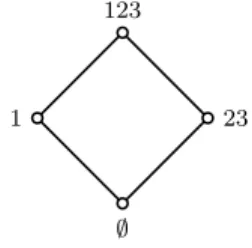
∅
1
123
23
Fig. 5.1.Example of a degenerate 2-regular set system with 3 players
Let F be a k-regular set system, and a maximal chain C := {∅ =
S0, S1, . . . , Sk=N}. Since|Si\Si−1|>1 may occur, the classical definition of a marginal worth vector does not work. Instead, from a given maximal
chain, several marginal worth vectors can be derived. Choose an elementri in Si\Si−1, i= 1, . . . , k. The marginal worth vector associated to C and
r1, . . . , rk is defined by ψC(r1,...,rk)= k X i=1 (v(Si)−v(Si−1))1ri. We haveψC(r1,...,rk)(S
i) =v(Si) for allSi∈C. Denote byM(v,F) the set of all marginal worth vectors, for all maximal chains and possible choices of elements. We define theWeber set as
W(v) := conv(M(v,F)).
Theorem 5.19.Let F be ak-regular lattice closed under union and inter-section. Ifv is convex, thenW(v)⊆core(v).
Theorem 5.20.LetF be an-regular lattice. Ifv is monotone and convex, thenW(v)⊆core(v).
The classical inclusion of the convex part of the core into the Weber set does not hold in general, as shown by the following counterexample4.
Consider the following sets system (regular set lattice but not distribu-tive, since it contains a pentagon, figured by the grey circles), with the values of the gamev given into parentheses.
∅ (-1) 1 (-1) 12 123 (0) 23 (0) 2 (-1) 13 (0)
The core is defined by
x1≥ −1 x2≥ −1 x1+x2≥ −1 x1+x3≥0 x2+x3≥0 x1+x2+x3= 0 4 This example was communicated by J. Derks.
The core is bounded and vertices are (0,0,0),(−1,0,+1),(0,−1,+1). The Weber set is generated by the marginal vectors associated to the 4 maximal chains (only 2 differents):
(0,−1,+1), (−1,0,+1).
Clearly,W(v)6∋(0,0,0).
Remark 5.21.As noted in Section 6.1, the same phenomenon occurs for the positive core of games on augmenting systems. However, one should be careful that this kind of (negative) result heavily depends on the definition given to the marginal vectors: the framework given in Section 6.2, which is more general than augmenting systems, does not exhibit this drawback.
5.6 Distributive lattices generated by a poset on N
ConsiderF =O(N) for some partial order ≤on N. Then F is a regular distributive set lattice, and previous results give us the properties of the core. Considering a balanced gamev, we have:
(i) core(v) is a pointed polyhedron, since F is non-degenerate (see Sec-tion 5.1);
(ii) coreF(v) ⊆ W(v), where coreF(v) is the convex part of core(v) (see Theorem 5.11);
(iii) vis convex if and only if coreF(v) =W(v) (see Theorem 5.12).
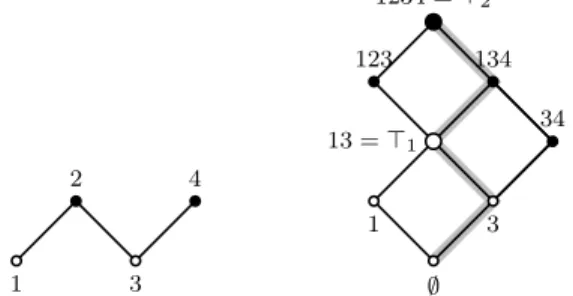
To avoid unboundedness, Grabisch and Xie (2009) have imposed further restrictions in the definition of the core, leading to the notion of restricted core. These additional constraints are built as follows. First, elements in (N,≤) of same heightiare put into the level set Qi+1. Hence, N is parti-tioned into level setsQ1, . . . , Qk , andQ1 contains all minimal elements of
N. The level setsQ1, . . . , Qk induce inF a partition whose blocks are level setsS1, . . . , Sk:
S1:=O(Q1), S2:=O(Q1∪Q2)\S1, . . . , Sq:=O(N)\(S1∪ · · · ∪Sq−1). EachSi has a top element⊤i=Sij=1Qi. Restricted maximal chains from ⊥to⊤inO(N) are those passing through all⊤1, . . . ,⊤k =⊤. They induce
restricted marginal vectors. These definitions are illustrated on Figure 5.2. Therestricted core of a gamev is defined as follows:
core∗(v) ={x∈core(v)|x(⊤i) =v(⊤i), i= 1, . . . , k}.
If nonempty, it is always a polytope. The restricted Weber set W∗(v) is defined as the convex hull of all restricted marginal vectors.
Theorem 5.22.For any gamev onF,core∗(v)⊆ W∗(v). Furthermore, if
v is convex, equality holds, and the restricted marginal vectors are vertices of the core.
The converse (core∗(v) =W∗(v) implies convexity ofv) is false.
1 2 3 4 ∅ 1 3 123 34 13 =⊤1 134 1234 =⊤2
Fig. 5.2. The poset (N,≤) (left) and the generated lattice O(N) (right). Level sets on (N,≤) are Q1 = {1,3} and Q2 = {2,4}, inducing level sets S1 = {1,3,13} and
S2={34,123,134,1234}inO(N). A restricted maximal chain is drawn in grey.
5.7 Coalition structures
Let B be a coalition structure and v on 2N being zero-normalized (i.e.,
v({i}) = 0 for all i ∈ N). The core is defined as follows (Aumann and Dr`eze, 1974):
core(v,B) :={x∈Rn|x(S)≥v(S), ∀S∈2N, andx(Bk) =v(Bk), k= 1, . . . , m}.
Theorem 5.23.Let B be a coalition structure and v on 2N being
zero-normalized, and letx∈core(v,B). Then
{y∈RBk|(y, x |N\Bk)∈core(v,B)}= core(Bk, v ∗ x, Xk), with core(Bk, vx∗, Xk) := {y ∈ RB+k |y(Bk) = v∗x(Bk), y(S) ≥vx∗(S),∀S ⊆ Bk,}.
6 Structure of the positive core
We first address the question of nonemptiness. Adapting the result of Bon-dareva, we say that a collectionBiscompletely balanced if there exist posi-tive coefficientsλB,B∈ Bsuch that
X
B∈B
λB1B ≤1N.
Then a game is completely balanced if PB∈BλBv(B) ≤ v(N) holds for every completely balanced collection, and core+(v)6=∅ if and only if v is completely balanced.
An equivalent definition of a completely balanced game is given by Faigle (1989). A game v is completely balanced if and only if for all families
A1, . . . , Ak inF andm∈Nit holds 1 m k X i=1 1Ai ≤1N implies 1 m k X i=1 v(Ai)≤v(N).
Above, F ∋ ∅is assumed, in order to get the condition v(N)≥0 by con-sidering the family reduced to∅. IfF is closed under intersection and com-plementation, a nonnegative balanced game is completely balanced.
Remark 6.1.The positive core is in general much smaller than the core, and could be empty even if the core is nonempty. In particular, ifv is not monotone, the positive core is likely to be empty. See also the discussion below on the equality between the core and the positive core.
An important question is to know when the core and the positive core coincide.
Theorem 6.2.(Faigle, 1989) Let v be a nonnegative balanced game on F
closed under intersection. Thencore(v) = core+(v)if and only ifF is
atom-istic. Moreover,core(v) is unbounded unlesscore(v) = core+(v).
F atomistic implies core(v) = core+(v) is obvious by nonnegativity of v. Also, if core(v)6= core+(v) thenF is not atomistic, and for{j} 6∈ F,x
jcan be taken arbitrarily negatively large, hence unboundedness.
6.1 The positive core for augmenting systems
This has been studied by Bilbao and Ord´o˜nez (2008). Given a (nonnegative) gamev onF, we consider its extension ˆv on 2N:
v(S) := X Tmaximal inF(S)
v(T).
(see Section 6.3). Recall that maximal sets inF(S) are pairwise disjoint. Since N does not necessarily belong toF, the definition of the core is slightly modified as follows:
core+(v) :={x∈Rn+|x(S)≥v(S) for allS∈ F andx(N) =v(N)}. A fundamental (but obvious) property is that core+(v) = core+(v) (see Section 7 for a close result, as well as Remark 6.7(v) for a more general result), and it is a polytope.
Suppose thatN ∈ F (hence it is a regular set system). Then any max-imal chain inF corresponds to an ordering onN (compatible orderings or permutations). For a maximal chain C, denote by φC the corresponding marginal worth vector. Then the Weber set is naturally defined by
W(v) := conv{φC|C∈ C(F)}.
Definev to beconvex if for all S, T∈ F such thatS∪T ∈ F,
v(S∪T) + X F maximal inF(S∩T)
v(F)≥v(S) +v(T)
(this is identical to supermodular games on weakly union-closed systems in Section 6.2).
Theorem 6.3.(Bilbao and Ord´o˜nez, 2008) Ifv is monotone and convex, thenW(v)⊆core+(v), and any marginal vector is a vertex of core+(v). The classical inclusion of the core in the Weber set does not hold in gen-eral: a counterexample is given in Bilbao and Ord´o˜nez (2008) (see also Remark 5.21).
A gamevis superadditive if for all disjointS, T ∈ Fsuch thatS∪T ∈ F,
v(S∪T)≥v(S) +v(T).
Theorem 6.4.(Bilbao and Ord´o˜nez, 2008) Letv be a game onF.
(i) If v is superadditive and monotone, thenv is superadditive and mono-tone.
(ii) Ifv is convex and monotone, thenv is convex.
(iii) Suppose v is monotone. Then v is convex if and only if v is convex if and only if core(v) =W(v).
6.2 The positive core and Monge extensions
It is possible to get more general results, valid for an arbitrary set system or a weakly-union closed system, by considering an approach closer to com-binatorial optimization, through the so-called Monge algorithm5. We refer the reader to Faigle et al. (2009) for details and proofs.
Consider an arbitrary set systemF, and a vectorc∈Rn, which will be the input vector of the Monge algorithm (MA). The idea of the algorithm is to take at each iteration the largest subsetF ofF contained in the current set X, and to select inF the first element pcorresponding to the smallest component of a vectorγ∈Rn. At initialization, X =N and γ=c, and at each iteration,pis discarded fromX, andγp is subtracted fromγi, for all
i∈F.
5 The original idea of the Monge algorithm goes back to Monge (1781). Monge studied
a geometric transportation problem in which a set of locationss1, . . . , snof mass points
has to be matched optimally (in the sense of minimizing the total cost) with another set of locationst1, . . . , tn, and proved that optimality was reached if the transportation lines
do not cross. This geometric fact can be expressed as follows: if the costscijof matching
objectssiwithtjhave the “uncrossing” property:
cij+ckℓ≥cmax(i,k),max(j,ℓ)+cmin(i,k),min(j,ℓ)
then the optimal matching is (s1, t1), . . . ,(sn, tn). This is also called the “north-west
corner rule”. Translated into the language of set functions, the uncrossing property is in fact submodularity:
v(A) +v(B)≥v(A∪B) +v(A∩B).
The output of the algorithm is the sequence of all selected subsets F, the sequence of all selected elements p, and a vectory ∈ RF recording at indexF the quantityγp.
We defineΓ(y) :=hv, yi. Letting for any inputc∈Rn ˆ
v(c) :=Γ(y),
ˆ
v is an extension of v since it can be proven that ˆv(1F) = v(F) for any
F ∈ F. Moreover,
core+(v) ={x∈Rn| hc, xi ≥ˆv(c),∀c∈Rn}.
The next step is to define marginal vectors, usually defined through permutations onN. The idea here is to take instead the sequence of selected elementspproduced by MA, which is not necessarily a permutation, because some elements ofNmay be absent. Let us denote byΠthe set of all possible sequences produced by MA, and consider a sequence π ∈ Π. Then the marginal vectorxπ associated toπis computed as follows: for each p∈π,
xπ
p is the difference betweenv(F) (where F is the smallest selected subset containing p) and PGv(G), where the sum is running over all maximal subsets of F belonging to the sequence. For each p 6∈ π, we put xπ
p = 0. Clearly, the classical definition is recovered if F is regular, since in this case, the sequence of selected subsets will form a maximal chain.
We define the Weber set as
W(v) := conv{xπ|π∈Π}.
Then it is proved in Faigle et al. (2009) that core+(v)⊆ W(v).
The last step is to relate equality of the Weber set and the core to convexity. This is done through the following definition. A gamev onF is
convex if ˆv is concave, i.e., it satisfies for all parameter vectors c, d∈ RN and real scalars 0< t <1,
tˆv(c) + (1−t)ˆv(d) ≤ vˆ(tc+ (1−t)d).
Theorem 6.5.Assume v is monotone. Then v is convex if and only if
core+(v) =W(v).
The above definition of convexity is done through the extension ˆv. How-ever, it is possible to relate it directly tov. A gamevonFisstrongly mono-toneif for anyF ∈ F and pairwise disjoint feasible setsG1, . . . , Gf ∈ F(F) we have
f
X
ℓ=1
v(Gℓ) ≤ v(F).
For any intersectingF, F′∈ F we put
v(F∩F′) :=X{v(G)|G∈ F(F∩F′) maximal}
A gamev onF issupermodular if for all intersectingF, F′∈ F, we have
v(F∪F′) +v(F∩F′)≥v(F) + (F′).
Theorem 6.6.A game v is convex if and only if v is strongly monotone and supermodular.
6.3 Extension ofv on2N
Let F be weakly union-closed, and v be a game on F. We introduce an extension ofv on 2N as follows:
v(S) = X T maximal inF(S)
v(T), ∀S⊆N.
Remark 6.7. (i) This way of extending a game on 2N appears in many dif-ferent works. For communication graphs, Myerson (1977b) used it for computingvG(S), the extension on 2N of a gamevonG, for anyS⊆N, decomposingS into its (maximal) connected components (in this con-text, see also Owen (1986), Borm et al. (1992), Potters and Reijnierse (1995)). It can be found also in Bilbao (2000, §5.2) with F a partition system, under the name ofF-restricted game, and in Bilbao and Ord´o˜nez (2008). In general, it is considered in all the literature on communication graphs. This extension has been studied by Faigle and Grabisch (2009), and arises naturally as the output of the Monge algorithm described in Section 6.2 (see (ii) and (iii) below).
(ii) Even if v is monotone, v need not be monotone. If v is monotone, it is not the smallest extension of v (for this replace P by max in the above equation). If F is union-closed, thenv is the smallest extension and preserves monotonicity ofv (Faigle and Grabisch, 2009).
(iii)vis given by the Monge algorithm, i.e.,v(S) = ˆv(1S) for allS ∈2N. (iv) The M¨obius transform (see Section 3) ofv vanishes for allS not inF
(easy fact, remarked by Owen (1986)). More precisely:
mv(S) =
(
mv(S), for allS∈ F
0, otherwise
where mv is the M¨obius transform ofv onF.
(v) For any game v, we always have core+(v) = core+(v). Indeed, the inclusion of core+(v) in core+(v) is obvious. Conversely, assume that
x∈core+(v) and take anyF6∈ F. Thenv(F) =P
Tmaximal inF(F)v(T). We havex(T)≥v(T) for allT maximal inF(F). Therefore, since these
T’s are disjoint and x is nonnegative, we find x(F) ≥v(F). Adapting the previous argument, core(v) = core(v) holds provided all singletons belongs toF. Then the maximal sets inF(F) form a partition ofF (F is a partition system).
Faigle and Grabisch (2009) have proved the following.
Theorem 6.8.Assume F is union-closed, and v is a game on F. Then v is supermodular on F (in the sense of Section 6.2) if and only if v is supermodular on2N.
7 Games on communication graphs 7.1 General definitions
Consider a (undirected) graphG= (N, E), where the vertices are players, and E is the set of links. A link between i, j exists if these players can communicate or are friends. Two players are connected if there exists a path between them. A connected coalition is a subset ofN where any two players are connected. The set of connected coalitions is denoted byCE(N). Maximal connected coalitions of Gare called connected components of G, and they partitionN. The set of connected components ofGis denoted by
N/E. Any coalitionS ⊆N, even if not connected, can be partitioned into maximal connected coalitions (i.e., connected components of the subgraph induced by S). The set of connected components ofS is denoted byS/E. This is the framework defined by Myerson (1977a).
Remark 7.1. (i) As said in Section 3.7, set collections induced by communi-cation graphs are exactly augmenting systems containing all singletons. If the graph is connected, then they are regular set systems containing all singletons (the converse is false). Recall also from Section 3.5 the char-acterization of van den Brink, and that these set collections are weakly union-closed.
(ii) A generalization of communication graphs is done through conference structures of Myerson, or equivalently through hypergraphs (see Sec-tion 3.5).
A game on the graph G= (N, E) is a TU-game onCE(N) (i.e., it is a game on the collection of feasible coalitionsF=CE(N)). Fromv we define
theextended game vG on 2N as follows (see Section 6.3; calledpoint game by Borm et al. (1992)) vG(S) = X T∈S/E v(T),∀S⊆N.
Since a communication graph may contain several connected compo-nents, and recalling Remark 3.5 (ii), a natural adaptation for the definition of the core is as follows:
core(v) :={x∈Rn|x(C) =v(C),∀C ∈N/E, andx(S)≥v(S),∀S∈ CE(N)}. This definition was considered, among others, by Demange (1994, 2004). As it is easy to show, core(v) = core(vG), which proves that when nonempty the core is a polytope.
Remark 7.2.Note that if the graph is connected, we recover the definition of the previous sections, hence all general properties given in Section 5.1 apply. Concerning the positive core, results in Section 6.2 apply under the same condition. Using again Remark 3.5 (ii), the above definition of the core amounts to take the intersection of all cores on the subsystems induced by the connected components ofG.
We consider below the main families of communication graph, most use-ful in applications.
7.2 Communication line-graphs
Let us assume that the players are ordered according to the natural ordering 1, . . . , n, and consider the set of edges connecting two adjacent players:
E0 = {(i, i+ 1), i = 1, . . . , n−1}. Then G = (N, E) is a line-graph if
E⊆E0, i.e., only some adjacent players can communicate. For convenience, we introduce the notation [i, j] :={i, i+ 1, . . . , j}fori < j inN.
These line-graphs often arise in applications, e.g., water distribution problem along a river (Ambec and Sprumont, 2002), and auctions situations (Graham et al., 1990), and have been studied by van den Brink et al. (2007). They show that a sufficient condition for the nonemptiness of the core is
linear convexity:
v([i, j])−v([i+ 1, j])−v([i, j−1]) +v([i+ 1, j−1])≥0 for all [i, j]∈ C(E)N.
van den Brink (2009) has characterized communication line-graphs in terms of the associated set system as follows.
Theorem 7.3.A collection F ⊆ 2N is the set of connected coalitions of
a line-graph if and only if F ∋ ∅, F is normal (i.e., SF = N), weakly union-closed, satisfies 2-accessibility (see Remark 3.4 (ii)) and path union stability.
To explain the last property, we need some definitions. Let∅ 6=S ∈ F and
i∈S. Theniis anextreme player in S ifS\i∈ F. Now,S is apath inF if it has exactly two extreme players. The name comes from the fact that a path in F corresponds to a path in the graph (although the converse is false). Path union stability means that the union of two nondisjoint paths inF is still a path inF.
7.3 Cycle-free communication graphs
A graph is cyle-free if it contains no cycle, in the usual sense of graph theory. Le Breton et al. (1992) have characterized this property by what they call strong balancedness: the collection F of connected coalitions is strongly balanced if every balanced collection contains a partition ofN.
Another characterization is due to van den Brink (2009).
Theorem 7.4.A collection F ⊆2N is the set of connected coalitions of a
cycle-free graph if and only if F ∋ ∅,F is normal (i.e.,SF =N), weakly union-closed, satisfies 2-accessibility (see Remark 3.4 (ii)) and weak path union stability.
Weak path union stability means that path union stability is required only for those pairs of paths having a common extreme player.
An important particular case of cycle-free communication graph is the case of connected graphs. Then the graph is called a tree. Games on trees have been studied by many authors, among them Demange (1994, 2004), Herings et al. (2008), Khmelnitskaya (2009), Baron et al. (2008) and B´eal et al. (2009). However, most of these works are more concerned with single-valued solution (as the average tree solution of Herings et al. (2008)) than the core.
7.4 Cycle-complete communication graphs
A communication graph iscycle-complete if for each cycle of the graph, the subgraph induced by the players in that cycle is complete (i.e., each player is connected to every player in the cycle).
van den Nouweland and Borm (1991) have studied this kind of commu-nication graph. They have shown that if the gamev is convex (assumingv
is defined on 2N, unlike our assumption), thenv
G is also convex.
van den Brink (2009) has characterized cycle-complete communication graphs as follows.