the former Yugoslav Republic of
MACEDONIA
An overview
May 2007
Small and Medium-Size Enterprise Development – Government and Private Sector
the former Yugoslav Republic of
MACEDONIA
An overview
May 2007
Small and Medium-Size Enterprise Development – Government and Private Sector
© 2006 European Commission
The findings, conclusions and interpretations expressed in this document are those of the authors and can in no way be taken to reflect the policies or opinions of the Government of the former Yugoslav Republic of Macedonia or
the European Commission and/or its agencies.
This publication has been produced by the Small and Medium-sized Enterprise Development Project (www.SMEDP.org.mk ), an EU-financed project managed
by the European Agency for Reconstruction and implemented by GFA Consulting Group.
Authors
Dr. Ricardo Pinto (research coordinator and author)
Stratagem Consulting International, www.stratagem-consulting.biz Mr. Zivko Dimov (data collection, analysis)
TED Consulting, www.tedconsulting.com Dr. Vesna Stojanova (data collection, analysis) Faculty of Business Economy, www.fbe.edu.mk Dr.-Ing. Heinrich Poell (conception and editor) Team leader SMEDP, [email protected]
Contents
1. The Policy Framework ...10
1.1 Macroeconomic situation ...10
1.2 SME dynamics ...11
1.3 The SME Strategy 2007 – 2013 ...1
1.4 The SME Programme 2007 – 2010 ...16
2. The Institutional Framework ...19
2.1 Actors on the National Level ...19
2.2 The SME support infrastructure ... 22
3. Agency for Entrepreneurship Support (APPRM) ... 24
3.1. Mandate and activities of APPRM ... 24
3.2. Special focus: Voucher Scheme ... 26
4. The Business Environment ...28
4.1 Introduction ... 28
4.2 Business Registration and De-Registration ... 28
4.3 One-stop Shop system ... 29
4.4 Licenses, Permits and Inspections ... 31
4.5 Business Development Services and Consultancy ... 32
5. Enterprise Competitiveness...36
5.1 Current Situation ... 36
5.2 Clusters... 39
6. Financial instruments for the SME sector ...1
6.1 Introduction ...1
6.2 Commercial Bank Lending... 42
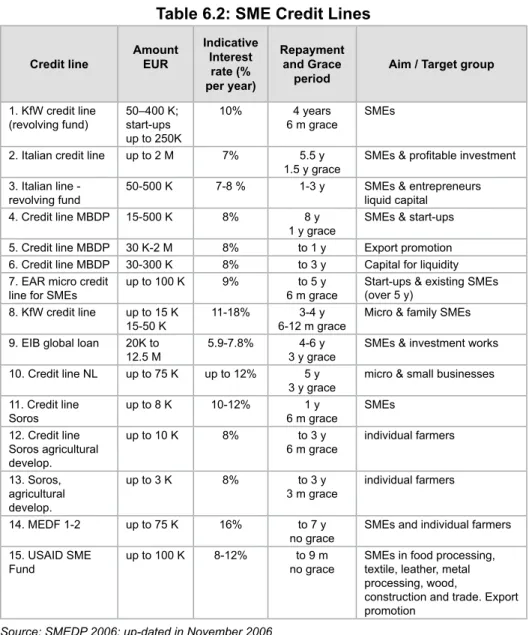
6.3 Special Credit Lines for the SME sector ... 6.4 Macedonian Bank for Development Promotion (MBDP) ... 6.5 Private Guarantee Funds...6
6.6 Other Financial Instruments... 47
6.7 Equity Finance and Business Angels... 47
6.8 Future Developments ... 48
7. Donor activities ...1 References ...
Annex: Addresses and Contact Details ...57
a) Government and State bodies ... 57
b) Donors and donor projects ...61
c) Domestic Banks ... 68
d) Other Financial Institutions ... 70
e) Business Associations relevant to SME sector... 72
f) Service providers for SMEs ... 77
Abbreviations
APPRM Agency for Promotion of Entrepreneurship BDS Business Development ServicesBSO Business Support Organisations CC Candidate Country (for EU accession)
CIP Competitiveness and Innovation Framework Programme CPI Consumer Price Index
EAR European Agency for Reconstruction EC European Commission
EICC Euro Info Correspondence Centre ESA Enterprise Support Agency
EU European Union
EU15 EU Member States prior to May 2004 EU25 EU Member States after May 2004 FDI Foreign Direct Investment
GDP Gross Domestic Product
GTZ Gesellschaft für Technische Zusammenarbeit (German Development Agency)
HRDF Human Resource Development Fund
ICT Information and Communication Technologies IPA Instruments of Pre-Accession (EU)
k Thousand(s)
LEDO Local Economic Development Office
m Million(s)
M+E Monitoring and Evaluation
MASIT Macedonian Association of IT enterprises MBDP Macedonian Bank für Development Promotion MCA Macedonian Competitiveness Activities MCA2000 Macedonian Consulting Association MoE Ministry of Economy
N/A not applicable
NBRM National Bank of the Republic of Macedonia
NECC National Entrepreneurship and Competitiveness Council PMO Prime Minister’s Office
PPD Public-Private Dialogue
RESC Regional Enterprise Support Centre SEE South East Europe
SME Small and Medium-size Enterprise
SMEDP Small and Medium-size Enterprise Development Project STI Science, Technology and Innovation
TA Technical Assistance
UNDP United Nations Development Programme UNER Unique National Electronic Register
USAID United States Agency for International Development VCS Voucher Scheme for SME support (APPRM)
PPD Public-Private Dialogue
RESC Regional Enterprise Support Centre SEE South East Europe
SME Small and Medium-size Enterprise
SMEDP Small and Medium-size Enterprise Development Project STI Science, Technology and Innovation
TA Technical Assistance
UNDP United Nations Development Programme UNER Unique National Electronic Register
USAID United States Agency for International Development VCS Voucher Scheme for SME support (APPRM)
WG Working Group
Introduction
The last few years have seen significant developments in the field of small and medium enterprise development in the former Yugoslav Republic of Macedonia.
The institutional architecture for the support of the SME sector has taken shape in the form of the Department for Entrepreneurship and Competitiveness in the Ministry of Economy and the Agency for Entrepreneurship Support (APPRM), responsible respectively for defining SME policies and their implementation. APPRM also coordinates the SME support infrastructure, which consist of a wide spectrum of institutions – business centres, consultancies, incubators, technology transfer centres, etc. – that offer services to small and medium enterprises on the local level. In addition, the recently established SME Forum provides a platform for dialogue and cooperation between the Government and private sector business organisations, and the wider civil society.
On the policy level there have also been major developments. The country has attained EU Candidate Country status in late 2005, and a new Government was elected in mid-2006 with a manifesto that focuses sharply on enterprise development and the promotion of foreign and domestic investment. This has decisively changed the nature of small enterprise policy, which in turn is reflected in the new SME Strategy 2007–2013 and the new SME Programme 2007–2010 that have been adopted by the Government in early 2007.
These changes, combined with the need to provide information in a succinct and informative manner, have led to the creation of the present publication. The brochure has been prepared with three target audiences in mind:
• Entrepreneurs wanting to gain an overview of the situation of the SME sector;
• Foreign businesspeople and visitors interested in understanding the SME structures in the country;
• Donor agencies interested in developing projects and programmes relevant to the local environment.
The aim of the publication is to summarise the developments and challenges for the SME sector, list key stakeholders and projects, and present an overview of the regulatory environment and of the available support and financing schemes for SMEs. The approach of the authors was to provide a summary and quick overview of all major issues affecting the SME sector, rather than detailed analyses of each dimension of SME development. However, each section
provides references, links to relevant websites and contact details that will enable the reader to obtain more detailed information, if so required.
For further information, two main points of contact are available: For general information and policy issues:
Mr. Blerim Zllatku Mr. Sasha Sindiloski State Advisor onEntrepreneurship Head, SME Department Ministry of Economy Ministry of Economy
Jurij Gagarin 15 Juri Gagarin 15
1000 Skopje 1000 Skopje
T: +389 2 309 3543 T: +389 2 309 3541
[email protected] [email protected]; For contacts and information on specific projects, etc.:
Mr. Avdija Pepic Director
Agency for Entrepreneurship Promotion Nikola Vapcarov 7
1000 Skopje
Tel: +389 2 312 0132
1. The Policy Framework
1.1 Macroeconomic situation
Following a decade of sluggish growth, due both to external shocks and internal difficulties, the economic performance of the country is now improving. Economic growth (in terms of real GDP) was 4% in 2005, driven primarily by strong exports which in 2004 and 2005 increased by 20% each year; for 2006, the growth rate is expected to be around 4.5 %. This represents the highest real growth rates in the country since its independence in 1991.
Macroeconomic stabilisation continued in 2005, and a conservative fiscal policy and a stable exchange rate have kept inflation largely under control. Since 2002, annual inflation has averaged less than 1%, but it increased to 3.4 % in mid-2006, largely due to external pressures. Putting this in context, the inflation in the Euro zone was 2.2% in 2005, and remained largely constant during 2006. In the past, persistent current account deficits created reserve shortages and led to rising external debt. The external position has strengthened now, with gross reserves rising from € 700 m at the end of 2004 to around € 1,200 m by mid-2006. This has enabled the National Bank (NBRM) to cut interest rates (prime lending) from 10% in October 2005 to below 6% in May 2006. Commercial banks have matched these rate cuts to a certain degree, and the credit volume has expanded, albeit from a low base. However, much of the increased lending goes into consumer credit and is denominated in foreign currency.
Despite these recent improvements, the country still faces considerable challenges in achieving sustained rapid growth and lowering unemployment. Unemployment was 37% in 2005 (EU25 average: 8.6%), and employment figures have remained more or less stagnant since 1995. With two-thirds of the unemployed being out of work for more than four years, high youth unemployment and a low labour force participation rate, much of the unemployment is structural in nature and reducing it is proving rather difficult. Nevertheless, the unemployment rate is starting to fall as the Agency for Employment has started to implement an active labour market policy.
Foreign Direct Investment (FDI) has been recovering since 2002 and reached US$151 million in 2004, after which it declined again somewhat to $113 million in 2005. Total FDI in the country is about US$ 2.2 b or less than US$ 600 per capita. This is lower than the regional average and substantially lower than in neighbouring Bulgaria and Romania. In late 2006, the Government embarked on an ambitious programme to attract more foreign investment into the country, focusing on specific growth sectors.
1.2 SME dynamics
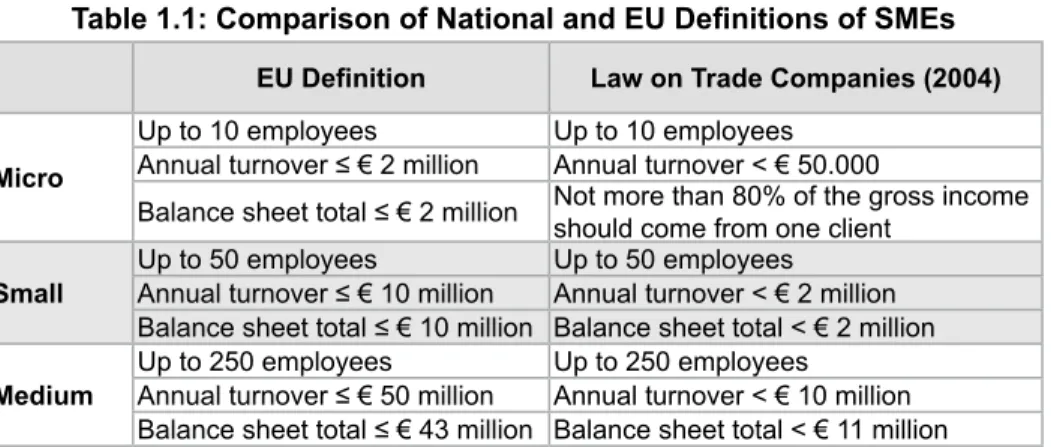
Small and medium enterprises (SMEs in the following) are defined by the Law on Trade Companies (2004). The National definition of SMEs is broadly, but not entirely, compatible with that of the EU (see Table 1.1 below). The Ministry of Economy is working to eliminate discrepancies between the national and the EU definition of SMEs as well as remaining discrepancies in the definition of SMEs in various National laws.
Table 1.1: Comparison of National and EU Definitions of SMEs
EU Definition Law on Trade Companies (2004)
Micro
Up to 10 employees Up to 10 employees Annual turnover ≤ € 2 million Annual turnover < € 50.000
Balance sheet total ≤ € 2 million Not more than 80% of the gross income should come from one client
Small Up to 50 employeesAnnual turnover ≤ € 10 million Up to 50 employeesAnnual turnover < € 2 million Balance sheet total ≤ € 10 million Balance sheet total < € 2 million
Medium Up to 250 employeesAnnual turnover ≤ € 50 million Up to 250 employeesAnnual turnover < € 10 million Balance sheet total ≤ € 43 million Balance sheet total < € 11 million Source: Ministry of Economy.
As shown in table 1.2, the number of private enterprises has been steadily increasing since independence. This reflects the increasing importance of the private sector’s contribution to GDP, employment, exports, etc.
Table 1.2: Number of Active SMEs (1990-2005)
1991 1994 1997 1999 2000 2001 2002 2003 2004 2005(e) SMEs 9,703* 28,551* 32,934* 31,204* 33,151 34,991 36,963 39,096 41,517 44,327
All 10,270 29,157 33,455 31,795 33,269 35,110 37,074 39,199 41,590 44,667
Source: 1991-2002: State Statistics; from 2003: Central Registry. Note: (e) …. Data for 2005 are preliminary.
The total number of registered enterprises in the country is ca. 180,000; however, only about 25 % of those are active in the sense of having undertaken economic
the vast majority of all enterprises. According to data from the Central Registry, of the almost 45,000 active firms in the country, 43,837 or 98.8% were small enterprises (as defined by the Law on Trade Companies), with the remaining number of 830 companies made up of 490 medium and 340 large enterprises. The number of active SMEs translates into an SME density of 22 per 1,000 inhabitants. This compares by and large with average figures for the SEE region (23 per 1,000 inhabitants), but is far below the EU15 average of 45 per 1,000 inhabitants. SMEs are also important in terms of employment creation, accounting for 80% of the total employment in the country in 2005.
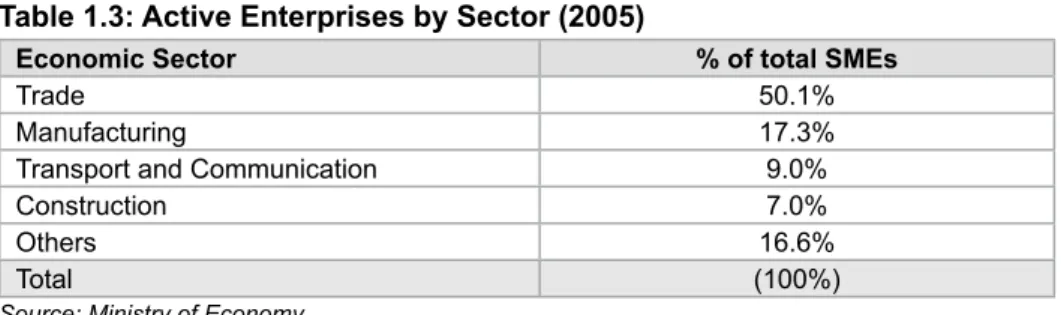
Slightly over half of the of active enterprises are in the wholesale and retail trade sector. Other important sectors include manufacturing (17.3%), transport, storage and communication (9%), and construction. These four sectors comprise over three-quarters of the total number of active enterprises. (See Table 1.3 below.) The four sectors in which most SMEs are operating are also the biggest contributors to employment (65%).
Table 1.3: Active Enterprises by Sector (2005)
Economic Sector % of total SMEs
Trade 50.1%
Manufacturing 17.3%
Transport and Communication 9.0%
Construction 7.0%
Others 16.6%
Total (100%)
Source: Ministry of Economy
The crafts sector comprises small scale production and service companies in construction and other sectors. Recent legislative changes to the Law on Craftsmanship (2004) have greatly simplified the conditions for start-ups in this category. For registration, it is only necessary to have a crafts diploma and office/ work facilities. There is a tax free period of three years after the establishment of a new crafts enterprise, and thereafter a simplified income tax involving progressive rates of 15%, 18% and 24% (Personal Income Tax Law, 44/2002). Moreover, the Government has announced that both Personal Income Tax and Corporate Tax will be levied at a flat rate of 12 % in 2007, to be reduced to 10 % from 2008.
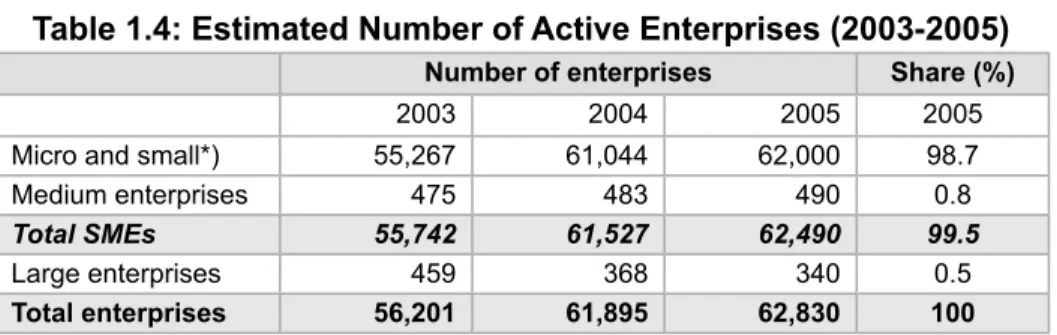
Crafts are organized in 11 regional Crafts Chambers, the most active of which are those located in Skopje, Strumica, Prilep, Bitola, Tetovo and Kumanovo. In 2005 a National Crafts Chamber was registered in Gevgelija, however, it is not yet operational. Under the old Law on Craftsmanship of 2001, 7,500 craft enterprises were registered. The annual growth rate of these figures was 1.4% during 1995-2001. More recent statistics do not exist for the crafts sector. Taking these figures together, the overall number of active enterprises in the categories micro, small, medium, crafts and small traders can be estimated at about 62,500 for the end of 2005, comprising 44,300 active SMEs, 8,200 crafts1
and an estimated 10,000 individual traders. Based on this estimate, the structure of all active business entities is illustrated in Table 1.4.
Table 1.4: Estimated Number of Active Enterprises (2003-2005)
Number of enterprises Share (%)
2003 2004 2005 2005
Micro and small*) 55,267 61,044 62,000 98.7
Medium enterprises 475 483 90 0.8
Total SMEs 55,742 61,527 62,490 99.5
Large enterprises 9 368 340 0.5
Total enterprises 56,201 61,895 62,830 100
Sources: MoE (SME Department), MoE (Unit for Handicraft Development), State Statistical Office and
Association of Handicrafts.
Note: ) …. Comprises estimated figures for crafts and small traders.
As previously discussed, the density of SMEs is 22 per 1,000 inhabitants if based on 44,100 active enterprises, but this figures increases to 32 per 1,000 inhabitants if the total number of active small business entities (62,500) is considered. Regarding SME mortality, each year about 5,000 to 6,000 new enterprises are created and some 2,000 are closed down (through bankruptcy, liquidation, voluntary termination, etc). At the same time, restructuring continues in the medium and large sector, where many “large” companies have entered the “medium” category, and former “medium” firms have become small.
1.3 The SME Strategy 2007 – 2013
Already in 2002 the Ministry of Economy has published an SME Strategy paper covering a ten year period (2002 to 2013), together with an action plan for implementation of the strategy for the period 2003 to 2006. The overall approach to the development and support for the SME sector that has been outlined in this Strategy paper remains valid. However, a number of developments have made it necessary to revise the SME Strategy and Programme:
• A new Government was elected in July 2006 with an election manifesto and programme which places strong emphasis on increasing the competitiveness of the economy, and on promoting domestic and foreign investment; the Government moreover recognises the important role that the SME sector must play in achieving these objectives.
• With attaining Candidate Country status for accession to the European Union (EU) in late 2005, the harmonization of the National legislation and regulatory framework with EU norms and standards has become a priority. This pertains in particular to numerous laws and regulations affecting the SME sector. Candidate Country status also requires that the Government implement the EU Charter for Small Enterprises, and pursues the goals of the Lisbon Agenda.
• New EU initiatives such as the EU Commission's Instruments for Pre-Accession Assistance (IPA) and the Competitiveness and Innovation Framework Programme (CIP) present new challenges, in particular in relation to Science, Technology and Innovation (STI) and Information and Communications Technology (ICT) as a means of enhancing the competitiveness of SMEs. The Government must respond proactively to these challenges, in order to create a business environment in which SMEs not just survive, but thrive and are enabled to compete within the EU markets.
Therefore, the SME Department undertook a major revision of the existing strategy paper in the course of 2006, leading to the revised SME Strategy 2007 – 2013. This document has identified the following key areas for policy improvements in relation to the SME sector:
♦ the legal, regulatory and institutional environment
♦ the business climate
♦ support to small businesses
♦ access to finance
♦ access to Information and Communication Technology (ICT)
♦ access to Science, Technology and Innovation (STI)
♦ education, training and promotion of entrepreneurship
The new SME Strategy was approved by the Government in early 2007, after a process of dialogue and consultation with private sector organisations and other stakeholders. The document is available at www.smedp.org.mk.
1.4 The SME Programme 2007 – 2010
The SME Strategy defines the broad policy framework for the development of the SME sector in the country, based on an analysis of the current situation and the vision the Government wants to pursue for the year 2013. The associated SME Programme covers the period from 2007 to 2010 and sets out a detailed analysis of the problems and challenges confronting the SME sector, and defines the measures that should be taken to overcome these challenges and foster growth and development of SMEs.
The requirements of the new SME agenda in turn call for a reorientation of the Government’s support activities for the SME sector; focusing now on the following components:
1. Institutional architecture 2. Business environment 3. Finance and taxation
4. Innovation and competitiveness
In addition, the new SME Programme seeks to ensure compatibility with the requirements of the Acquis Communautaire relating to SMEs, and pursues the implementation of the European Charter for Small Enterprises, in line with the renewed Lisbon agenda of the European Commission and with the EU’s
Competitiveness and Innovation Framework Programme 2007 – 2013. This programme emphasizes entrepreneurship, Science, Technology and Innovation (STI) and Information and Communication Technologies (ICT) as the major elements for economic growth.
The SME Programme (2007-2010) was prepared in conjunction with the revision of the SME Strategy during the second half of 2006, through a process of dialogue and consultation to ensure that the SME Programme reflects the real needs and priorities of the SME sector. The main steps in this process were:
• The SME Programme was drafted on the basis of detailed research on issues of particular importance for SME development, combined with the vision, analysis and reform agenda of the SME Strategy2;
• The new Programme incorporates the requirements of EU accession as far as SMEs are concerned, concentrating on the Acquis, the EU Charter for SMEs, the CIP and the new IPA financing programmes;
• The draft SME Programme was circulated to the relevant ministries and governmental bodies for comment, feedback and approval;
• Detailed feedback and input was also sought from the private sector via the SME Forum3, involving the key business associations in the country. The SME Forum established a dedicated working group specifically to provide input to the SME Strategy/Programme;
• The draft SME Strategy and Programme documents were discussed with businesspeople and other stakeholders in six "road show" events in November/December 2006 in the following locations: Tetovo (north-west), Prilep (centre), Ohrid (south-west), Stip (east) and Kumanovo (north). The Programme was finally adopted by the Government in early 2007, together with the corresponding SME Strategy. The document is available on
www.smedp.org.mk.
During the implementation period of the SME Programme (i.e., 2007 – 2010), Annual Action Plans will be prepared by the Ministry outlining the objectives, prioritised measures (projects) and institutional responsibilities, and the timelines for implementation of these measures. On the basis of these Action Plans, the MoE will adopt Annual Financial Plans, which will define the financial resources for the implementation of the proposed measures, as well as the sources of finance. The Action Plans will be implemented with financing from the state budget; in addition, the Government will also seek international support from bilateral and multilateral donors.
2 The reports and studies that have resulted from this research are available on www.smedp.org.mk.
2. The Institutional Framework
2.1 Actors on the National Level
a) MoE: SME policy making
The Department for Entrepreneurship and Creation of Competitiveness (SME Department in short) at the Ministry of Economy (MoE) is responsible for defining the national SME policy and for monitoring its implementation. Its overall remit is as follows:
• Reporting to the Government on all issues relating to SMEs; • Creating a favourable environment for SMEs;
• Reviewing the existing regulatory framework for SMEs and drafting new legislation or amending the existing legislation in order to improve it; • Coordinating with foreign institutions on SME development issues; • Monitoring support and technical assistance programmes for the SME
sector;
• Establishing and updating the National SME Strategy and Programme; • Liaising with other institutions involved in the improvement of the SME
environment.
The SME Department has at its disposal a staff of five and a budget of MKD 30 million (ca. € 500,000). The prospect of accession to the EU, combined with the new Government’s commitment to increase the competitiveness of private businesses – the vast majority of which are SMEs – will require a strengthening both of the staff and of the resources of the MoE that are devoted to SME issues.
b) APPRM: SME policy implementation
The Agency for Entrepreneurship Promotion (APPRM) is responsible for implementing the National SME policy, as set out in the SME Strategy and Programme. The main responsibilities of the APPRM are as follows:
• Implementing the SME Programme of measures and activities to support entrepreneurship and create competitiveness in the small business sector;
• Creating and developing the institutional infrastructure to promote and support entrepreneurship and competitiveness in small businesses; • Implementing and coordinating SME support from the public sector and
• Implementing financial and non-financial support measures for the SME sector.
At the moment, APPRM has a staff of seven and operates on an annual budget of ca. € 135,000. Both the staff and the budget of the agency should be enhanced in view of the emerging challenges of the EU accession process, the increasing levels of competition for the SME sector in both the domestic and the EU markets, and the complex tasks of accessing IPA funds and other EU support.
c) Policy Coordination and Public – Private Consultation
Two key bodies have been developed to ensure collaboration and coordination between the public and the private sector in the implementation of the SME Strategy and Programme:
• The SME Forum was established in 2005/2006 as a platform for a public-private dialogue in regard of the design and implementation of the SME policy. The members of SME Form include the MoE and APPRM, the Economic Chamber, the Union of Chambers, the NW Chamber, the Crafts Chamber, NECC, MASIT, several business associations, and a number of bilateral Chambers as observers.
The SME Forum focuses on all issues – political, strategic, legal, regulatory and other – that are of importance to the SME Sector. Working Groups have been established for (i) ICT and Competitiveness, (ii) promotion of entrepreneurship, (iii) contributions to the new Strategy and Programme. The SME Forum has organized over 15 meetings in 2006 to discuss various aspects of SME development and contributes directly to SME policy making.
For 2007, the SME Forum plans a number of concrete initiatives that will address important issues for the SME sector. The Forum will – in cooperation with MoE and APPRM – launch an Entrepreneurship Awareness Campaign, start a “GoDigital” programme for the SME sector, and will promote technology transfer and alternative financing instruments for the SME sector.
• The National Entrepreneurship and Competitiveness Council (NECC) was established in 2004 as a link between the Government and the business community; NECC thus represents business interests in general, not just those of SMEs. The mission of NECC is to promote a long-term partnership between the public sector, private sector organisations and civil society, and contribute through this to the economic prosperity of the country. NECC’s primary goals are (i) to prepare recommendations for improving the business environment; (ii) to assist individual companies, enterprise clusters and business associations to develop; (iii) to promote exports of high value
products and services, and (iv) to increase the economic well-being of the society.
Both the SME Forum and the NECC are relatively new organisations and further efforts are needed to increase their contribution to the development of the SME sector.
Moreover, the new SME Strategy proposes to address two further aspects of coordination that are known to require improvement:
• Inter-ministerial coordination: Several ministries and agencies of the Government define and implement policies, legislation, regulations, and specific programmes which have an impact upon the SME sector; relevant institutions comprise (a.o.) the PMO, the Ministries for Economy, Finance, Labour and Social Policy, Law, Education and Science, Transport and Communications, the tax administration and the various licensing, inspection and monitoring authorities. The implementation of the SME Programme requires effective inter-ministerial coordination for the proposed measures to be carried out as planned and to achieve their desired impact.
• Donor coordination: while substantial additional resources will have to be committed from the state Budget for SME development to implement the new SME Programme (an increase of the budget for the SME Department from € 330,000 to € 2.5 m per annum is mooted for this), donor funding will continue to play an important role in SME support in the foreseeable future. This will require improved coordination of donor activities in the future, especially in the project design stage. Another issue is the continuity of donor support, essential to generate lasting impact.
2.2 The SME support infrastructure
On the local and regional level, there are a number of institutions active in the SME sector:
• Business Centres: overall ten regional centres are in operation, including five Regional Enterprise Support Centres (RESCs) located in Skopje, Strumica, Veles, Kumanovo, Bitola, three Enterprise Support Agencies (ESAs) located in Ohrid, Tetovo, Gostivar, the Prilep Region Enterprise Development Agency (PREDA), and one Roma Business Centre in Skopje.
• Business Incubators: eight incubators are operating (Prilep, Stip, Makedonska Kamenica, Delcevo, Krushevo, Veles, Ohrid and Strumica) and a youth entrepreneurship incubator (YES) is about to be opened in Skopje. • EuroInfo Correspondence Centre (EICC): provides information and
assistance on EU business matters (e.g. EU markets, business cooperation, partner search, EU funding and tenders, EU legislation, EU standards, etc.).
• Human Resource Development Fund (HRDF) stimulates the deployment of modern and innovative management training and consulting, by collaborating with companies taking-up such services, with trainers and consultants delivering those services, and with government and international bodies commissioning them. The HRDF has private companies, professional and business associations, chambers and universities as its members, and operates under the guidance of the APPRM.
• Local Economic Development Centres (LED Centres): a total of 60 LED Centres are active in the country on the level of individual municipalities or (in some cases) groups of municipal administrations. These Centres are supported by the United States Agency of International Development (USAID) and by the United Nations Development Programme (UNDP). • Consultants: about 120 consultants deliver a wide range of business
consulting and business development services (as individuals and/or legal entities); in addition, there are some international consultants active in the country, primarily in auditing and tax advice.
• Business Associations: there are at least 15 business associations covering numerous sectors of economic activity, including four with national coverage (Economic Chamber, Chambers of Commerce, North-West Economic Chamber, Chamber of Crafts); some of these organisations have special sections for SMEs.
• Other organisations:
o four technology transfer centres (TTCs) – three in Skopje, one in Bitola;
o the Macedonian Business Resource Centre (MBRC)
It is these actors that will be primarily responsible for implementing the measures and projects proposed in the SME Programme for the period 2007 – 2010. In this process, they will have to interact with the MoE, APPRM and other government bodies, as illustrated in figure 2.1.
Government
SME Department, MoE Other Govt. Bodies
APPRM
RESCs,
ESAs Incubators LED offices EU InfoCentre Consultants
SMEs
HRDF SME FORUM
Figure 2.1: SME Institutional Architecture
Note that there are various types of interactions between the players that make-up the SME institutional architecture on the national and local levels. While APPRM operates directly under the supervision and guidance of the SME Department of the MoE, relations between APPRM and the RESCs, ESAs, LEDs etc. are more informal, as these are independent institutions that are pursuing their own agendas and objectives. It is APPRM’s task to manage the institutional network,
to coordinate the activities of the various actors, and to provide orientation and direction to all organisations concerned with SME development, thus ensuring a coherent and comprehensive approach to the problems the SME sector faces.
3. Agency for Entrepreneurship Promotion
(APPRM)
3.1 Mandate and activities of APPRM
The Agency for Entrepreneurship Support (APPRM) is responsible for implementing the Government’s SME policies; these are now set out in the new SME Strategy 2007 – 2013 and the SME Programme 2007 – 2010. APPRM’s
mission is the promotion of entrepreneurship and small businesses, through the implementation of priority projects that reflect demand-driven areas of intervention in SMEs and Government programmes for entrepreneurship support and SME competitiveness.
The main responsibilities of the APPRM are:
• Creating and developing the institutional infrastructure to support and develop entrepreneurship and competitiveness in the SME sector; • Implementing and coordinating state and international support for
SMEs;
• Promoting entrepreneurship through financial and non-financial forms of support measures;
• Implementing the programme of measures and activities to support entrepreneurship and create competitiveness in the small business.
APPRM currently focuses in its activities on two areas: • Management of the SME support infrastructure:
o Establishing and maintaining a database and electronic connection between the various regional support organisations (RESCs, ESAs, etc.)
o Organizing panel discussions, conferences and business forums
o Business networking in the country and abroad
o Conducting cooperation programmes with countries from the region and the wider area
• Support to SMEs and the SME sector:
o Business networking in the country and abroad
o Collecting, processing and delivering information on the SME sector
o Organizing specific training and consulting services
o Organizing panel discussions, conferences and business forums
o Implementing cooperation programs with donors and other foreign and National agencies
o Implementing national development projects through the institutional infrastructure of regional centres and other partners
o Co-financing of development projects in cooperation with national and foreign investors and donors
Taking the SME Strategy, SME Programme and Annual SME Programmes as the framework for its activities, APPRM prepares half yearly programmes which are submitted to its Supervisory Board / MoE for approval. The focus of its current activities is on the following:
• Preparation of an annual statistical compendium on the SME sector (the so-called SME Observatory)6
• Support to the Euro Information Centre and the Innovation Relay Centre • Support to the Human Resources Development Fund for Entrepreneurship • Provision of trainings and improvement of the entrepreneurship skills • Voucher system for subsidised consulting services for SMEs and
unemployed persons (see the box below) • Support to the business incubators
• Cooperation with domestic and international projects • Promotion activities in relation to the SME sector
3.2 SPECiAL foCuS: VouChER SChEME
The development of the APPRM’s “Voucher Scheme“ will be a continuing focus of its activities in the future. The idea behind a voucher scheme is to give smes additional purchasing power (in the form of a voucher) to buy business development services (BDS) from accredited providers of such services (mainly individual consultants). By providing SMEs with information on available BDS and a fixed financial incentive to use them, voucher schemes primarily address demand-side constraints, such as information deficits and reluctance on the part of smes to pay for BDS, typically resulting from scepticism about the usefulness of such services.
Voucher schemes, however, do not address fundamental weaknesses in the supply side for BDS, such as the lack of qualified consultants and the absence of services that are geared to the particular needs for the sme sector. Rather, a voucher scheme requires a basic level of BDS supply (both in terms of the number of existing BDS providers, and of the scope and quality of the BDS offered by them) to become effective.
In such a supply structure, well-designed voucher schemes can stimulate a networking of the BDS providers and an adjustment of services to actual demand. However, as with all transaction-level interventions, vouchers may distort the BDS market by promoting unrealistic price expectations by the users of the system. Such risks can be contained if, for example, voucher values are kept low and the programme is primarily geared at services that are not generally available or not generally accepted in the market.
Voucher programmes have been implemented in many transition economies, in the see region in Slovenia and Serbia. They have typically proved to be a useful and cost-effective instrument for developing training markets and the low-cost segment of the BDS market.
APPRM has already piloted its voucher scheme on more than 130 clients from the rank of unemployed persons and small enterprises in the municipalities of Strumica and Skopje. During this process, apprm staff and staff from its regional partners has undergone intensive training in the management and promotion procedures that are required for the expansion of the VCS to a wider target group, and APPRM has offered training to selected consultants in order to improve and expand the range of services that are offered under the voucher scheme.
In the next phase, APPRM will focus its activities on a much larger voucher scheme involving two components:
• National voucher scheme for SME development, designed to
O expand BDS activities to assist targeted smes in improving their overall competitiveness and productivity;
O to enhance the quality of services and service providers to better serve smes;
O to strengthen the capacity of intermediaries to better manage the implement the matching-grant scheme.
• From unemployment to self-employment: this scheme will assist aspiring entrepreneurs from among the registered unemployed with business start-up counselling, training and information; it also aims at enhancing the quality of services and service providers that are assisting this target group. These schemes have already been designed and work is underway to train APPRM staff, prepare the required procedures, databases and manuals, set up the it infrastructure, etc., As well as to obtain the financial resources to implement these projects.
4. The Business Environment
4.1 introduction
A healthy regulatory environment must encourage sustainable economic growth and help enterprises to become more competitive, while ensuring the functioning of a market economy. More specifically, it is now generally agreed that the SME sector needs special policies in order to overcome the inherent disadvantages for SMEs in a market economy. It is the essential role of the Government to create the right business environment for SMEs to thrive.
In this respect, the Government should create an enabling legal and regulatory environment that opens access to markets and reduces entry barriers for small firms, while at the same time providing public goods such as infrastructure, education and information services. In a market-oriented economy, the focus of the Government’s policy for the SME sector is on correcting or compensating market failures, rather than on direct interventions or on provision of goods and services that can be more efficiently provided by the market.
The legal and regulatory environment for SMEs has evolved rapidly ever since the transition to a market economy was started in 1991; this process has been accelerated in recent years, fostered by the beginning of the EU accession process and the resulting harmonization of National laws with EU legislation. SMEs are affected by these changes in many areas, including those that concern the establishment of a business, financial reporting, taxation, contract and dispute resolution, bankruptcy, technical standards, and banking and finance.
The rapid pace of policy change and changes in the accompanying legislation and its implementing provisions have doubtlessly improved the business environment and have pushed the country forward in its transition to a full-fledged market economy. At the same time, these changes have also led to a number of problems, and some omissions and contradictions in the legal and regulatory framework have created uncertainty for the SME sector. However, progress is being made to improve the business environment further, and to eliminate the remaining contradictions and gaps in the regulatory framework.
4.2 Business Registration and De-Registration
The company registration process has been significantly improved with the adoption of the new Law on Trade Companies and the Law on the One Stop Shop System and the Maintenance of Registers of Business and Other Legal Entities. Since January 2006, registration is done through the one-stop-shop
system, currently available in ten offices throughout the country. The process takes a maximum of five days and costs € 65 to € 135, depending upon the type of business being registered.
When benchmarked with the South-East European (SEE) average, this compares favourably both in terms of the time required and the costs involved. With some improvements (that are currently being implemented) the country will attain the OECD average in these matters. Of more concern is the still relatively high minimum capital requirement for registering a new business; this amounts to 110 % of average per capita income, significantly higher than the 36 % for the average OECD member country.
While significant progress has been made in relation to the registration of enterprises, the situation is not so positive for de-registration (i.e. formally closing down a business). Here, the process takes on average almost four years and costs 28% of the value of the estate. The country performs significantly worse in this respect than its neighbours in the SEE region, let alone the average for the OECD countries (where the process takes typically 1.4 years and costs 7 % of the value of the business).
If it is problematic to close a business, entrepreneurs will simply keep their enterprises inactive without closing them formally. (That this is clearly the case in the country is shown by the data on existing and active companies; see section 1.2.) This ties up resources in non-operating enterprises that could otherwise be used for more successful businesses. The process of closing a business must therefore be simplified and streamlined, and made to conform with legislation in the EU and international standards. The process has been initiated with the adoption of a new Law on Bankruptcy in 2006.
4.3 one-stop Shop system
The introduction of the “One-stop Shop” system for business registration in early 2006 has simplified the process of business registration significantly, reducing registration fees and time needed for registration. By doing this, faster and easier access to correct and valid information has been made possible.
Parallel to the one-stop shop system, the Trade Register introduced electronic registration of trade companies. Since the beginning of 2006, apart from the Trade Registry, the Central Registry is also registering other types of legal entities that are not defined by the Trade Company Law. The digitalization of the trade registry presents a basis for future use of the e-signature and e-registration of enterprises.
The costs for obtaining the company registration certificate are €135 for registering a limited company, € 85 for using the services of the one-stop-shop, and € 50 for verification of the company statements and applications papers. The official time required to register a company is five days; according to the Central Registry, it takes between 3 and 5 days in practice. The Central Registry has 28 regional registration offices throughout the country, of which 10 are currently part of the one-stop shop system.
The one-stop shop system has already improved the business climate for entrepreneurship significantly. However, the Government intends to undertake a number of further reforms such as:
• Registration of a Limited Liability Company within three days (and eventually one day)
• Combining registration and issuing of licenses and permits within the one-stop shop system7
• Including registration of crafts in the one-stop system • Coordination and streamlining the inspection services • Reduction of the registration fees
• Introduction of a Unified Electronic Database and a Unique Registration Number for all enterprises
• Introduction of the principle of “silent is consent” for registration
Furthermore, the SME Strategy and Programme envisages various other regulatory reforms as follows:
• Regulatory guillotine: streamlining unnecessary regulations that create obstacles for the normal functioning of enterprises. The regulatory guillotine is expected to be based on the best practice of the OECD countries, supported by the World Bank.
• Creation of the Unique National Electronic Register (UNER) for all existing permits, licenses and certificates, etc. Through UNER, the Government will eliminate the ability of public authorities to “interpret” regulations, thus increasing clarity and reducing abuse.
• Introduction of the principle of “positive confidence”: this will ensure that public authorities will be unable to enforce anything which is not listed in the UNER.
These regulatory reforms will be implemented by the State Council for Regulation of Business Activities, which shall have representatives of MoE and other Ministries, Economic Chamber, Union of Chambers, and other relevant private sector organisations.
4.4 Licenses, Permits and inspections
In addition to registration, many business activities must obtain additional working licenses and/or permits in order to start their operations. Such post-registration requirements entail a process of applying to the relevant authorities that deal with these issues in the respective business location. Licenses are required in many sectors of the economy, comprising, a.o., the construction, transport, health, tourism, catering sector, and all production enterprises.
Enterprises experience considerable barriers when trying to obtain the required licences and permits, reporting by and large the same set of problems with all public
authorities in charge of issuing licenses. The most frequently issues cited are non-transparent procedures, a lengthy and unpredictable approval process; political and/or business interests influencing the decision-making, different licensing procedures in the various regions of the country, administrative inefficiencies and delays, and a lack of adherence to the established procedures.
The costs of complying with these licensing requirements are very high, thus discouraging investment in new enterprises: on average, it costs 90% of per capita income and takes 222 days and 18 different steps to go through the process of obtaining the required operating licenses for an enterprise. Even though the country compares relatively well with other countries in the SEE region (particularly in terms of costs involved), it performs poorly in comparison with more advanced economies (where there are typically only half as many procedures requiring 30 % less time). This suggests that there is room for improvement in all relevant areas.
In addition to the difficulties in obtaining the required operating licenses, companies are also regularly inspected by a number of Government bodies, ranging from tax audits over safety, health and standards organisations to environmental audits and several others. The costs for complying with these inspections is considerable, and many enterprises complain about intransparent procedures, absence of clear information as to the mandate and authority of the inspection authorities, and abusive practices of certain officials. Of particular concern to the SME sector is the strict application of one uniform set of rules and regulations to all enterprises, be they large or small. This constitutes a manifest bias of the system against SMEs, as complying with these procedures is much more difficult (and burdensome) for a small company than for a larger enterprise.
The Government has certainly taken notice of this situation, and is committed to improve the existing procedures and to combat abuses and intransparent actions by the inspection bodies.
4.5 Business Development Services and Consultancy
Business Development Services (BDS) for SMEs are primarily available from the various regional business support centres and related organisations, most of them originally created with donor support. These are variable in terms of quality and type of business services delivered. In addition, various donor projects also provide BDS on a regional or sectoral basis, and private consultants are also increasingly offering these services on a commercial basis. However, many private consultants are not overly interested in BDS for the SME sector, as larger companies offer more lucrative opportunities for their work. What is still lacking in the country are BDS provided by Chambers and professional associations to their members.
Also, the market of BDS for SMEs remains relatively underdeveloped, as most SMEs are still unwilling and/or unable to pay for these services. In this context, the various regional centres encounter serious problems in attaining financial sustainability (as required by the phasing out of donor support). It will be an important task both for the APPRM and for the various business organisations to make the SME sector aware of the opportunities offered by the various BDS providers, and to encourage enterprises to make use of the available services. The gradual introduction of user charges for donor-funded BDS – as practiced by the HRDF – is an important element in this process.
The key institutions providing business development services are highlighted below9.
a) Business Support organisations and related BDS Providers • Five Regional Enterprise Support Centres (RESCs), three Enterprise Support
Agencies (ESAs) in Tetovo, Gostivar and Ohrid) and the Prilep Regional Enterprise Development Agency (PREDA) provide general business consultancy to SMEs.
• Seven business incubators established with World Bank support, plus newer incubators such as Gica (Ohrid) and YES (Young Entrepreneurs’ Support) provide consulting and advice principally to their tenants, i.e. to a limited number of start-up SMEs.
• Three GTZ-funded Technology Transfer Centres (TTCs) located at the University of Skopje and the University of Bitola design and implement R&D and other technical consulting and engineering services for new hi-tech SMEs. • The Euro Informative Correspondence Centre (EICC) acts as a “first-stop”
for SMEs for all matters involving EU issues (standards, market access, contact points in EU member states, …. .).
• The Human Resource Development Fund provides training for managers and owners of SMEs, and promotes the concept of management training and continued education in the country.
APPRM cooperates with all these institutions (and with other organisations dealing with entrepreneurship and SMEs, as well with business consultants and trainers)10 in order to integrate all these institutions and activities into an efficient
SME support infrastructure, and to build up the capacity and quality of these BDS providers.
b) Business Associations with a focus on BDS
There are numerous national, regional and bi-lateral business chambers and sector associations in the country (see the address lists in the annex). A number of these are of particular importance in delivering business advice and consultancy to SMEs, not least because of their role in building up the skills and knowledge base of trainers and consultants. The most important among these are:
• Macedonian Association of Companies in the IT industry (MACIT) coordinates the networking efforts of the ICT industry and cooperates with global ICT brands and value chains. MACIT is a business association within the Economic Chamber of Commerce and has about 60 members.
• Management Consultants Association (MCA-2000) represents professional management consultants and providers of business services; MCA-2000 is a member of the International Council of Management Consulting Institutes (ICMCI). Since 2002, MCA-2000 has initiated a process of certifying its members based on the internationally accepted Certified Management Consultant (CMC) model run by ICMCI. MCA-2000 has about 30 members. • Macedonian Trainers’ Network (MTN) comprises over 40 individuals working
as trainers. MNT plans to initiate a certification process for all trainers. • Other professional associations represent professionals providing services
these are important support services for the SME sector, these associations do not offer business advisory services per se.
c) Management Consultants and general consultancy
The Business Associations and other organisations listed in the previous section represent more than 100 member companies that provide professional services including business advisory, management consultancy, ICT services, HR development, financial management (e.g. accountants and auditors), legal advice (corporate governance and commercial law), PR and advertising, marketing, environmental advice, engineering support, quality assurance, etc. It is estimated that the business consultancy industry comprises about 600 to 800 consultants. However, out of this number only about 30 companies with about 100 to 120 consultants focus on advice and consultancy for SMEs. See the annex for a list of these consultants; as mentioned in the preceding section, the sector is represented by its own association MCA-2000.
d) Donor projects and activities
SME consulting services and initiatives are supported, directly or indirectly, by international donors, including the following:
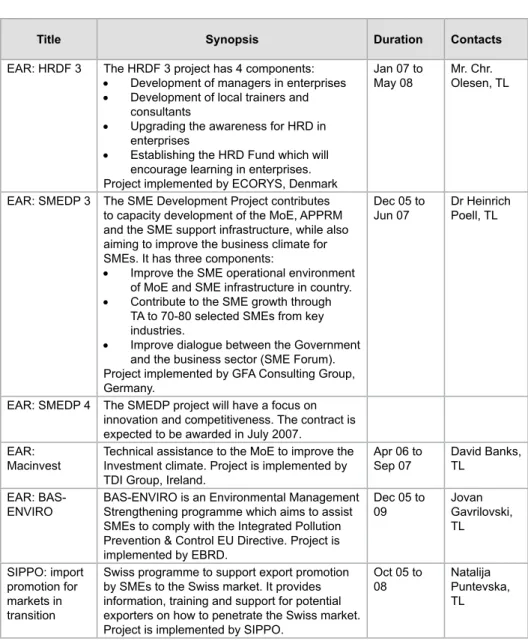
• EC/EAR: the Human Resources Development Fund (HRDF, www.hrdf3. org.mk) offers BAS and management training to production and export-oriented SMEs. The eligible firms co-finance the consulting and training services provided by international and domestic consultants. The SMEDP project (www.smedp.org.mk) has provided support to selected enterprises through local and international business consultants.
• IFC / PEPSE – Private Enterprise Promotion in SEE: Provision of technical assistance for promotion of the private sector
(www.ifc-pepse.org.mk).
• USAID: professional and information services to support enterprises in the sectors of textile/apparel, footwear, tourism, agribusiness (www.ebiz.org. mk).
• GTZ: support for the creation of three Technology Transfer Centres providing R&D and other technical/consulting/engineering services to new high-tech SMEs (www.gtztechno.com.mk).
• SINTEF: provides consulting services for technology transfer, export and QMS for over 100 production-oriented SMEs (www.sintef.org.mk).
• SIPPO: promotes SME export activities to Switzerland through information and training services (www.sippo.ch).
• EBRD: the Business Advisory Services (BAS) programme
(www.basprog.com.mk) covers 50% of the costs of services provided by private consultants in areas such as quality standards (ISO, HACCP, etc.), increased energy efficiency, higher productivity, etc. BAS Enviro, the Environmental Management Strengthening programme of BAS, helps SMEs to comply with the EU Integrated Pollution Prevention and Control Directive (IPPC) through improved management systems and attention to cost reduction.
5. Enterprise Competitiveness
5.1 Current Situation
Economic growth is closely connected with competitiveness which, in turn, is linked to enterprise-level productivity, since it is enterprises that drive economic growth, and it is the competitiveness of individual companies (in terms of innovation, human capital, marketing, technology, costs, etc.) that ultimately determines the competitiveness of a national economy.
According to the World Economic Forum’s 2005/06 Global Competitiveness Report, the country ranks 85 (out of 117 countries) in the Growth Competitiveness Index (GCI). Compared with 2004/05, the rankings have improved in terms of the business environment and macro-economic stability (the latter due to the strict fiscal discipline and the other stringent monetary policies of the Government). However, in other parameters of competitiveness – such as the Technology Index – the country’s position stagnated or even declined.
This is a reflection of the failure to take adequate measures to improve the technological readiness of businesses at a time when other economies are advancing in this area. Thus, while the overall situation has not deteriorated, the country’s competitiveness does not appear to have improved since 2004 either. This is mainly because planned and initiated reforms have not been fully implemented and carried to their logical conclusion.
This mixed picture is also reflected in the findings of the 2005/06 micro-level Business Competitiveness Index (BCI). The report notes certain improvements in the business environment; the availability of capital for investment, the quality of the available scientists and engineers, and the general level of education are seen as positive factors of the business environment. However, there has been a deterioration in the sophistication of the operations of local companies, and in the quality of their business strategies. Weaknesses are also manifest in the quality of managers, in the overall low customer orientation of businesses, and in the high dependence on foreign technologies and technology transfer. The rigidity of the new law on environmental protection and insufficient competition in the domestic market are also noted as negative factors.
The index puts the country ahead of Serbia, Montenegro, Bosnia and Herzegovina, and Albania, but gives it lower rankings than Bulgaria and Croatia. According to the GCI, the National economy is transiting from competitiveness based on the exploitation of available production factors (“stage 1”) to competitiveness based on efficiency (“stage 2”). The report points out that to support and accelerate this transition, attention must be paid to the following:
• Higher education and training (rank 62): in principle, there are adequate human resources to create and absorb the innovations required for new technological developments. More specifically, the potential to achieve this is there, but it requires a systemic approach that would lead to the promotion human capital as a growth factor.
• Market efficiency for goods, capital and labour (rank 97): Regarding the goods markets, issues of concern are the legal framework for ensuring a favourable business environment, the lack of domestic competition in certain sectors, and restrictions on foreign ownership of businesses. There are also concerns with the effectiveness of the anti-trust policies and the efficiency of the tax system. Regarding the labour markets, the most problematic issues are the extensive brain-drain, a lack of cooperation between employers and unions, and the general low quality of the available management staff. In regard of financial markets, the picture is mixed, with a good marks for the financial soundness of the banking sector, but with serious concerns about SMEs’ access to commercial financing.
• Technological readiness (rank 88): the country lags in all areas except cellular phones and PC density. Negative factors are the low degree of ICT penetration, poor firm-level technology absorption, and the low level of FDI in this field. An additional problem is the absence of adequate legal regulations on ICT (e.g., e-trade, digital signature, consumer protection and intellectual property rights).
Against this backdrop, the NECC's National Competitiveness Report 2005 has presented a set of recommendations that would enhance the competitiveness of the economy (see Box 1). Many of these recommendations have been integrated into the SME Strategy and Programme of the Government, and will thus be addressed in the future.
Box 1: Reform Agenda to Enhance Economic Competitiveness 01. On-going, intensified structural reforms, to be implemented in packages and with a faster
transfer of authority to local governments (decentralization). 02. Making the “one-stop-shop” system completely functional. 03. Promoting legislative and other benefits to attract foreign investors.
04. Providing incentives for innovation and transfer of technology to enable economic growth and creation of greater competitive advantage.
05. Eliminating double taxation in agriculture and adapting regulations related to farming and cattle breeding businesses, facilitating registration and start-up of small farmers’ businesses. 06. Allowing VAT return to individual farmers.
07. Stimulating and enabling the entry of first-class foreign banks into the country.
08. Implementing policies that will result in lowering the current interest rates and provide more favourable loans to stimulate economic investments.
09. Forming guarantee and investment funds to support the start-up of small businesses and farming initiatives.
10. Drafting and implementing a Technology Development Policy that is market oriented and focused on firms’ innovativeness.
11. Creating conditions for promotion of R&D as the key generator and instigator of innovation and technology.
12. Strengthening the institutional infrastructure for development and support of an innovation-friendly business climate; providing tax incentives and other benefits to investors that apply new technologies.
13. Supporting transfers of technology and setting up “learning companies.” 14. Establishing an annual national innovation award for companies and individuals.
15. Initiating a process of building a well educated and trained workforce to meet the needs of businesses; integration of education with business needs.
16. Implementing the European higher education credit-transfer system; developing proactive curricula; providing high quality teachers and scholarships that contribute to creating higher standards for students.
17. Promoting life-long education through campaigns directed at businesses and aimed at raising the awareness of the importance of permanent training and upgrading of the skills and knowledge of the workforce.
18. Introducing farmers / cattle-breeders to new technologies and international standards. 19. Implementing a national strategy to retain a highly skilled workforce and enable their further
development, thus preventing or reducing the “brain-drain.”
institutional support. The results so far do not appear to have lead to anything more than intensified promotional activities. Moreover, only a few clusters (such as the costal tourism clusters in Istria) were demand-driven, rather than donor-initiated.
These experiences have provided “food for thought” in relation to future plans for cluster development in the country. A new USAID funded programme for enhancing enterprises’ competitiveness (Macedonian Competitiveness Activity
– phase 2) is planned for a five year period, starting in 2007. The programme is expected to incorporate the recommendations of the evaluation report into its further support measures for the existing clusters, domestic supply chains, industry organisations, etc.
The Ministry of Economy and APPRM are also pursuing the development of new clusters in the following fields:
• IT sector: software development and export
• Agribusiness: cooperation among vegetable producers for organised sale and export
• Dairy: cooperation for restructuring and to compete with foreign brands pushing into the market
• Furniture: joint sales and promotion activities, shared services and workforce training
6. Financial instruments for the SME sector
6.1 introduction
There were a series of positive changes in the country’s banking sector in recent years. The credit rating – BBB+ (Standard & Poor) and BBB (Moody) – has improved and is slowly approaching investment grade, the macroeconomic situation is stable and ranks 30 out of the 127 countries covered by the World Economic Forum Report (2006). Interest rates are finally decreasing due to macroeconomic stabilisation, and a larger volume of credit is being made available to the enterprise sector as a result of the increasing competition and greater liquidity in the banking sector.
Despite these developments, SMEs still experience considerable difficulties in accessing commercial bank loans. As in other countries of the SEE region, commercial banks perceive SMEs as risky clients because of their limited assets and low managerial skills, while SMEs complain about commercial banks being overly conservative and risk adverse, and generally not interested in financing of SMEs.
The difficulties that SMEs experience when trying to obtain commercial credit are due to several factors. First, the banking sector in the country is still relatively underdeveloped, and suffers from low levels of competition and financial intermediation. Second, there are particular problems related to SME financing that discourage banks from lending to SMEs.
From the perspective of commercial banks, SMEs are considered as high-risk clients, due to their small size and their limited prospects of earning sufficient funds to service a loan. Moreover, insufficient and often unreliable credit information does not permit banks a proper assessment of the capabilities of SMEs to service their debts. The generally smaller loan amounts required by the SME sector lead to disproportionately high management costs that eat into the profitability of the banks. Finally, many commercial banks do not have sufficient experience to properly evaluate loan applications from the SME sector, even if sufficient credit information would be available. Most banks still find it more attractive to invest in tax free government bonds with relatively high returns or to extend loans to larger corporations11.
From the viewpoint of SMEs, cumbersome lending procedures and documentation requirements, and overly stringent collateral requirements make it difficult for SMEs to apply for a loan. SMEs are also frequently not very well informed about