STUDENT NURSES’ PERCEPTIONS OF PROFESSIONAL NURSES AS ROLE MODELS IN THE CLINICAL LEARNING ENVIRONMENT
by
MAGDALENA JOHANNA CUNZE
submitted in accordance with the requirements for the degree of
MASTER OF ARTS
in the subject
HEALTH STUDIES
at the
UNIVERSITY OF SOUTH AFRICA
SUPERVISOR: PROF GH VAN RENSBURG
Student number: 4608712
DECLARATION
I declare that STUDENT NURSES’ PERCEPTIONS OF PROFESSIONAL NURSES AS
ROLE MODELS IN THE CLINICAL LEARNING ENVIRONMENT is my own work and that all the sources that I have used or quoted have been indicated and acknowledged by means of complete references and that this work has not been submitted before for any other degree at any other institution.
15 September 2016 ... ...
SIGNATURE DATE
STUDENT NURSES’ PERCEPTIONS OF PROFESSIONAL NURSES AS ROLE MODELS IN THE CLINICAL LEARNING ENVIRONMENT
STUDENT NUMBER: 4608712
STUDENT: MAGDALENA JOHANNA CUNZE
DEGREE: MASTER OF ARTS
DEPARTMENT: HEALTH STUDIES, UNIVERSITY OF SOUTH AFRICA
SUPERVISOR: PROF GH VAN RENSBURG
ABSTRACT
This study explores and describes the perceptions of student nurses regarding professional nurses as role models in the clinical learning environment.
An exploratory-descriptive qualitative approach was followed. The population for this study was the final year students in the programme: Bridging course for enrolled nurses leading to registration as a general nurse. Nonprobability, quota sampling was done. The study was conducted at two Gauteng campuses of a private nursing education institution. Two “World Café” conversations were conducted where after data saturation was achieved.
The three major themes that emerged were professionalism of the professional nurse, the need for student support and the teaching and learning environment.
From the students’ feedback it was evident that professional nurses should be aware of the important role they play in the professional and personal development of students. Professional nurses as role models should portray the professional behaviours and attitudes required by the profession. Students have a vision of how they expect to be when they qualify as professional nurses.
Recommendations from this study relate to the three themes identified and clearly indicate that students have a realistic expectation of and a need for visible role models in the clinical learning environment.
Key concepts
Clinical learning environment; professional development; professional nurse; role model; student nurses.
ACKNOWLEDGEMENTS
The writing of this dissertation has been one of the most significant academic challenges I have ever had to face. Without the support, patience and guidance of the following people, this study would not have been completed. It is to them that I owe my deepest gratitude:
Professor Gisela van Rensburg, my supervisor and friend. Thank you for your patience during the writing of my dissertation. You have been extremely helpful to me during the entire period of my studies. Without your help and encouragement this dissertation would not have been written (or ever finished!). Most importantly, none of this would have been possible without the love and
patience of my family. Edu, my husband, without whom this effort would have been worth nothing. Thank you for your love, support and constant patience; for all the early morning working, coffee and snacks you so patiently brought to me. My two children, Eduard and Joanné, for your love and understanding during
times when I showed irritation and frustration and when I didn’t have time to listen. Thank you for our little joke of “ma ons wil jou nie weg jaag nie maar ons dink dit is tyd om te gaan werk”. I will always remember it.
To my brother Albrecht and his family, I know you are very proud of me and thank you for your constant reminder of how proud of me, mom and dad would have been. I love you.
My family and friends, for their continuous support and encouragement.
The librarians of the University of Pretoria, Myleen Oosthuizen, Monica van Schalkwyk, Magriet Lee and Emelia Minnaar. Ladies without you this study would not have been a reality. Thank you for all the articles and books you found and sent to me. Your cooperation and patience is highly appreciated.
To my colleagues:
Mrs Mariana Scheepers, who was the scribe during data collection, for your support.
Dr Irene Lubbe, for your support and encouragement.
The learning centre managers from the North and West Rand, for assisting during data collection.
The participants for voluntarily taking part in this study and sharing their experiences and perceptions.
Mrs Lesley Fletcher, for editing this dissertation with precision. Mrs Rina Coetzer, for doing the technical editing.
Life Healthcare, my employer, for allowing me to pursue my study.
My utmost gratitude to my Heavenly Father for the wisdom and perseverance that He bestowed upon me during this research study and throughout my life.
Dedication
This study is dedicated to my husband Edu, my children Eduard and Joanné and
to all the role models in nursing who are responsible for the teaching and
i
TABLE OF CONTENTS
CHAPTER 1 ... 1
ORIENTATION TO THE STUDY ... 1
1.1 INTRODUCTION ... 1
1.2 BACKGROUND INFORMATION ABOUT THE RESEARCH PROBLEM ... 2
1.3 RESEARCH PROBLEM ... 5
1.4 AIM OF THE STUDY... 7
1.4.1 Research purpose ... 7
1.4.2 Research objectives ... 7
1.5 SIGNIFICANCE OF THE STUDY ... 8
1.6 KEY CONCEPTS ... 9
1.6.1 Student nurse ... 9
1.6.2 Professional nurse ... 9
1.6.3 Perception ... 9
1.6.4 Role model ... 10
1.6.5 Clinical learning environment ... 10
1.6.6 Professional development ... 10
1.6.7 Private nursing college ... 11
1.6.8 Nursing education institution ... 11
1.7 THEORETICAL GROUNDING OF THE RESEARCH ... 12
1.8 OVERVIEW OF THE RESEARCH DESIGN AND METHODS ... 12
1.8.1 Research design ... 12 1.8.2 Research methods ... 13 1.8.2.1 Population ... 13 1.8.2.2 Sample selection ... 13 1.8.2.3 Data collection... 14 1.8.2.4 Data analysis ... 14 1.9 RESEARCH SETTING ... 15 1.10 TRUSTWORTHINESS ... 15 1.11 ETHICAL CONSIDERATIONS ... 15
1.12 SCOPE AND LIMITATIONS ... 16
1.13 STRUCTURE OF THE DISSERTATION ... 16
1.14 CONCLUSION ... 16
CHAPTER 2 ... 17
RESEARCH METHODOLOGY ... 17
2.1 INTRODUCTION ... 17
ii 2.4 RESEARCH DESIGN ... 18 2.4.1 Qualitative research ... 18 2.4.2 Explorative ... 18 2.4.3 Descriptive ... 19 2.5 RESEARCH METHODS ... 19 2.5.1 Population ... 19 2.5.2 Sample selection ... 20 2.5.2.1 Sampling ... 20 2.5.2.2 Sample size ... 21 2.6 DATA COLLECTION ... 22
2.6.1 Data collection approach and method ... 22
2.6.1.1 Data collection method ... 22
2.6.2 Data collection process ... 23
2.6.2.1 Preparation for the “World Café” conversations ... 23
2.6.2.2 Pre-testing of “World Café” conversation ... 25
2.6.2.3 Facilitation of the World Café” conversations ... 26
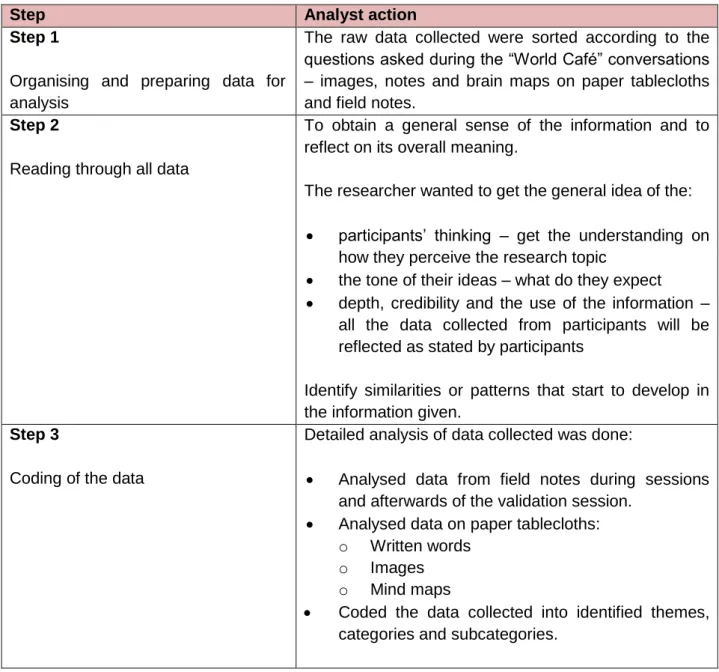
2.7 DATA ANALYSIS ... 28
2.8 MEASURES TO ENSURE RIGOUR – TRUSTWORTHINESS ... 30
2.8.1 Credibility ... 31 2.8.2 Confirmability ... 31 2.8.3 Dependability ... 32 2.8.4 Transferability ... 32 2.8.5 Authenticity ... 33 2.9 ETHICAL CONSIDERATIONS ... 33 2.9.1 Ethical principles ... 33
2.9.1.1 Respect for human dignity ... 33
2.9.1.2 Beneficence ... 34
2.9.1.3 Justice ... 35
2.9.1.4 Protecting the rights of the institution ... 35
2.9.1.5 Scientific integrity of the researcher ... 36
2.10 CONCLUSION ... 36
CHAPTER 3 ... 37
THE FINDINGS OF THE STUDY ... 37
3.1 INTRODUCTION ... 37
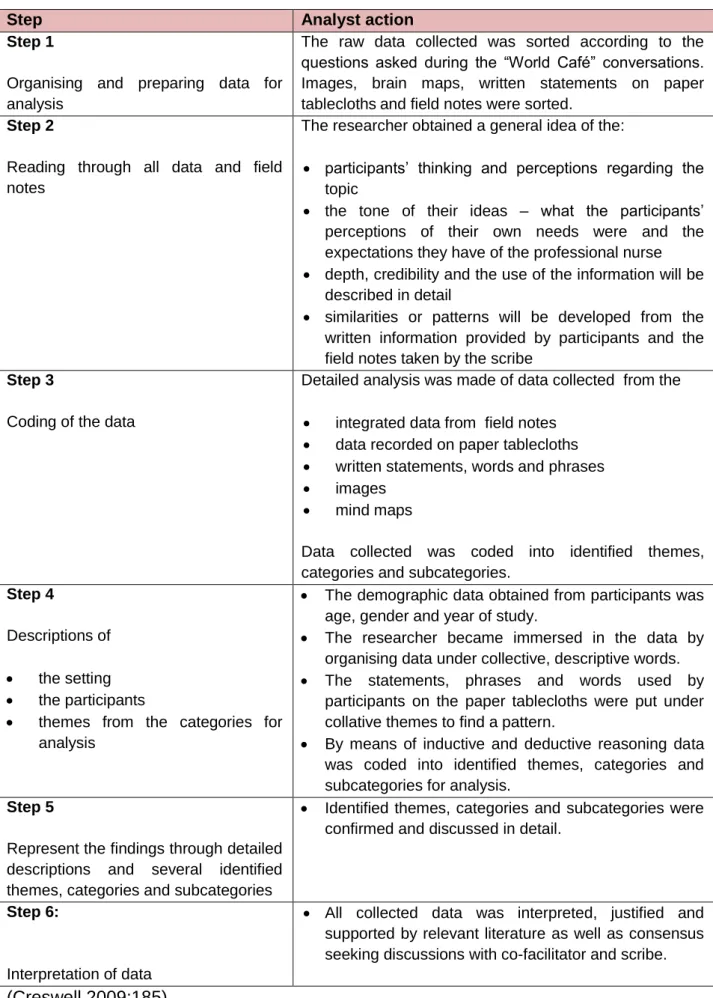
3.2 DATA ANALYSIS AND PRESENTATION ... 37
3.3 DEMOGRAPHIC INFORMATION ... 39
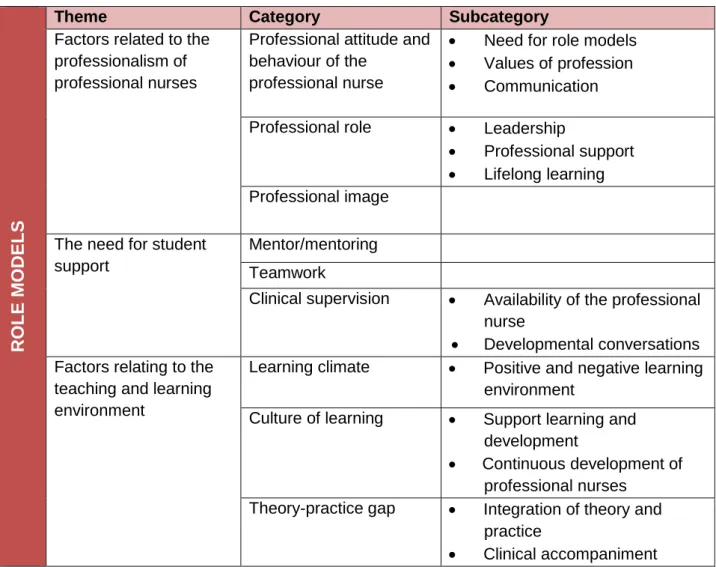
3.4 DISCUSSION OF THEMES, CATEGORIES AND SUBCATEGORIES ... 39
iii
3.4.1.1 Professional attitude and behaviour of the professional nurse ... 41
3.4.1.2 Professional role ... 44
3.4.1.3 Professional image ... 46
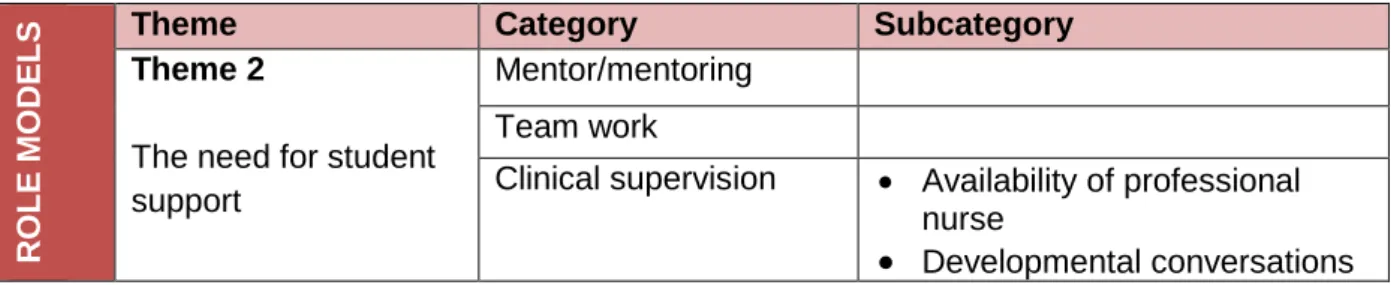
3.4.2 Theme 2: The need for student support ... 47
3.4.2.1 Mentor/mentoring ... 48
3.4.2.2 Teamwork ... 49
3.4.2.3 Clinical supervision ... 50
3.4.3 Theme 3: Factors related to the teaching and learning environment ... 51
3.4.3.1 Learning climate ... 52
3.4.3.2 Culture of learning ... 54
3.4.3.3 Theory-practice gap ... 56
3.4.3.4 When you are professional nurses and role models, how would you support students in the clinical environment? ... 57
3.5 CONCLUSION ... 61
CHAPTER 4 ... 62
DISCUSSIONS OF THE FINDINGS OF THE STUDY ... 62
4.1 INTRODUCTION ... 62
4.2 THEME 1: FACTORS RELATED TO THE PROFESSIONALISM OF PROFESSIONAL NURSES ... 62
4.2.1 Professional attitude and behaviour ... 63
4.2.1.1 Need for role models ... 63
4.2.1.2 Values of the profession ... 65
4.2.1.3 Communication ... 67 4.2.2 Professional role ... 68 4.2.2.1 Leadership ... 69 4.2.2.2 Professional support ... 70 4.2.2.3 Lifelong learning ... 71 4.2.3 Professional image ... 72
4.3 THEME 2: THE NEED FOR STUDENT SUPPORT ... 74
4.3.1 Mentor/mentoring ... 74
4.3.2 Teamwork ... 78
4.3.3 Clinical supervision ... 81
4.3.3.1 Availability of the professional nurse ... 81
4.3.3.2 Developmental conversations ... 82
4.4 THEME 3: FACTORS RELATED TO THE TEACHING AND LEARNING ENVIRONMENT ... 83
iv
4.4.2 Culture of learning ... 88
4.4.2.1 Support learning and development ... 88
4.4.2.2 Continuous development of professional nurses ... 91
4.4.3 Theory-practice gap ... 92
4.4.3.1 Integration of theory and practice ... 93
4.4.3.2 Clinical accompaniment ... 95
4.5 CONCLUSION ... 97
CHAPTER 5 ... 98
CONCLUSIONS, RECOMMENDATIONS AND LIMITATIONS ... 98
5.1 INTRODUCTION ... 98
5.2 SUMMARY OF THE METHODOLOGY ... 98
5.3 CONCLUSIONS ... 99
5.3.1 Objective 1: Explore the perceptions students have of professional nurses as role models in the clinical learning environment ... 99
5.3.2 Objective 2: Determine the role that role models could play in the professional development process of students in the clinical learning environment ... 101
5.3.3 Objective 3: Make recommendations that could enhance the value of role models in the clinical learning environment in student nurses’ professional development process ... 103
5.4 RECOMMENDATIONS ... 105
5.4.1 Recommendations regarding clinical practice ... 105
5.4.2 Recommendations regarding nursing education... 108
5.4.3 Recommendations regarding student support ... 109
5.4.4 Recommendations for future research ... 109
5.5 CONTRIBUTION OF THE STUDY ... 110
5.6 LIMITATIONS ... 110
5.7 CONCLUSION ... 111
v
ANNEXURES ... 124
ANNEXURE A ... 125
ETHICAL CLEARANCE FROM THE UNIVERSITY OF SOUTH AFRICA ... 125
ANNEXURE B ... 128
LETTER SEEKING PERMISSION FROM LIFE HEALTHCARE ... 128
ANNEXURE C ... 130
LETTER OF APPROVAL: LIFE HEALTHCARE ... 130
ANNEXURE D ... 132
“WORLD CAFÉ” COPYRIGHT ... 132
ANNEXURE E ... 134
“WORLD CAFÉ” GUIDELINES ... 134
ANNEXURE F ... 136
“WORLD CAFÉ” ETIQUETTE GUIDELINES ... 136
ANNEXURE G ... 138
“WORLD CAFÉ” BOOKMARK ... 138
ANNEXURE H ... 140
“WORLD CAFÉ” TABLECLOTHS ... 140
ANNEXURE I ... 150
“WORLD CAFÉ” VERIFICATION FIELD NOTES ... 150
ANNEXURE J ... 152
“WORLD CAFÉ” PROGRAMME ... 152
ANNEXURE K ... 154
INFORMED CONSENT FORM ... 154
ANNEXURE L ... 159
DEMOGRAPHIC INFORMATION... 159
ANNEXURE M ... 161
vi
LIST OF TABLES
Table 2.1 Creswell’s steps of data analysis ... 29
Table 3.1 Data analysis according to Creswell’s steps of analysis ... 37
Table 3.2 Identified of themes, categories and subcategories ... 40
Table 3.3 Theme 1: Factors related to the professionalism of professional nurses ... 41
Table 3.4 Theme 2: The need for student support ... 47
Table 3.5 Theme 3: Factors related to the teaching and learning environment ... 52
LIST OF PHOTOS Photo 1 “World Café” venue setup ... 26
vii
LIST OF ABBREVIATIONS
ICN International Council for Nurses
NEI Nursing Education Institution
NES Nursing Education Stakeholders
NLN National League for Nurses
NQF National Qualifications Framework
SANC South African Nursing Council
UNISA University of South Africa
CHAPTER 1
ORIENTATION TO THE STUDY
1.1 INTRODUCTIONNursing role models show enjoyment to nurses; they are professionally competent and provide excellent patient care (Murray & Main 2005:30). A role model interacts with students and structures an environment to ensure learning occurs. According to Jooste (2013:219), a role model is a practitioner who is competent and compassionate and who provides comprehensive healthcare within the legal and ethical parameters of the profession, displaying characteristics of integrity, trustworthiness and flexibility, has a sense of humour, shows respect for others, and creates a therapeutic and learning environment for clients, colleagues and students.
Professional nurses as role models play an integral part in the clinical learning environment and this is seen as an essential component in preparing students to become professional nurses. Practice and academic staff have an equal stake in nurse education; for students to see practice and academic staff equally as role models there has to be a partnership approach between these two very important components in nurse education. Both practice and academic staff are able to represent behaviours and attitudes that can directly influence the development of professionalism of students.
Cleary, Horsfall and Jackson (2013:636) stated that professional nurses play a significant role in students’ experiences of clinical placement because they have an ability to create a positive learning environment based on mutual trust and respect for student nurses. The ability of professional nurses to create a positive learning environment could ensure the professional development of student nurses. Therefore in this study the researcher will seek to conceptualise and explore the perceptions of student nurses regarding professional nurses as role models in the clinical learning environment.
1.2 BACKGROUND INFORMATION ABOUT THE RESEARCH PROBLEM
Role models are the teachers of professional thinking, behaviours and attitudes and the cornerstones of the profession. To be confronted with negative statements in social media from patients, submissions of cases of negligence and immoral conduct by nurses to the disciplinary committee of the South African Nursing Council (SANC), reports of bad behaviour, attitudes and lack of professionalism (Gallagher & Tschudin 2009:226; Jackson, Hutchinson, Everett, Mannix, Peters, Weaver & Salamonson 2010:103; Oosthuizen 2012:49-50), prompted the researcher’s curiosity to determine whether role models that student nurses can observe and imitate still exist in the clinical learning environment. This question, together with concerns expressed by students that there are few or no role models in the clinical learning environment, led to the researcher’s developing interest in the role of the professional nurse as a role model in the learning environment.
Role models exhibit certain skills or behaviours that are emulated by another. Wright, Wong and Newill (1997:53) defined a role model as “a person considered as a standard of excellence to be imitated”. Geyer (2013:248) stated that a role model is a person who sets an example to others through her or his behaviour. The status of role model could be awarded to an individual by someone else, often without their awareness. The encounters with such a person may be brief, intermittent or extended over a period of time. It is also possible to have several role models at the same time but also to be a role model to other individuals.
The importance of role models in the nursing profession, where the professional nurse has to portray a positive attitude and approachability, cannot be overemphasised (De Swardt 2012:57). Important learning, including the teaching of concepts, theory, critical thinking skills and research happens in the classroom but is best integrated with the skills learned in the clinical setting where the professional nurse is the manager in the ward and therefore has the ability to create a positive teaching and learning environment that will support students who are learning these skills. Perry (2008:37) maintained that a nursing role model is described as a professional nurse whose observed behaviour and attitudes are imitated by student nurses. These observed behaviours and attitudes support the integration of theory and clinical practice ensuring
Africa the National Qualifications Framework (NQF) for higher education has changed. As a result, nursing education has been placed in the band for higher education and new curricula aligned to the higher band will have to be developed. This has presented the opportunity for nursing education institutions to develop curricula that include content related to the importance of role models in the clinical learning environment.
Perry (2008:42) highlighted the importance of role models but did not comment on how students perceive professional nurses as role models. Role models are, according to Koontz, Mallory, Burns and Chapman (2010:244), an important aspect in the professional development of students in the clinical learning environment and therefore positive role models will have a constructive influence on student nurses’ development in the profession.
A study done by Brammer (2005:969) in Australia found that professional nurses do understand their roles in supporting students and acting as role models who provide information and guidance to students in developing knowledge and understanding of the reality of nursing. De Swardt (2012:84) indicated that professional nurses in a public hospital in South Africa have no clear understanding of their role in supporting students during the learning process in the clinical environment. De Swardt (2012:181) recommended that facilitation of and support to the professional nurse in being an exemplary role model might enhance the positive learning environment for students as the student nurse can imitate the professional nurses’ behaviour as role models.
Role modeling is “teaching by example and learning by imitation” (Murray & Main 2005:30). Skillful role models can enable students to discover knowledge embedded in clinical practice where they can work with and observe a role model that enables them through a process of reflection, to internalise the role model’s behaviour and build on previous knowledge and experiences. According to Cleary, Deacon and Hunt (2011:7), one of the criteria for being a role model is leading by example. These people are motivators and show respect to all who work with them. Role models inspire, teach and coach people, are team workers, have a vision and can be supportive and encouraging. Role models are resourceful and confident; approachable, available and friendly; helpful and understanding; welcoming and have the students’ interests at heart. The role model therefore is an advocate for students.
The need for role models in other health professions is evident from the literature and similar to the nursing profession (Higashi, Tillack, Steinman, Johnston & Harper 2013:14; Mossop, Dennick, Hammond & Robbé 2013:134). According to a study done by Mossop et al (2013:134), veterinary and medical students also identified the need for role models in their training. They were able to use negative role models as triggers for reflection of what was right and wrong in a manner that helped them to shape their own identity. These students regarded it as very important to develop a feeling of belonging to the profession and indicated that it could help their understanding of the profession as they assimilated the behaviour role-modeled by those around them.
Research done by Lamiani, Leone, Meyer and Moja (2011:989) found that the lack of role models during the training of medical students, compromised the standards taught in medical schools about doctor-patient relationships. In a study done by Wright et al (1997:53) it was reported that role models in medical education are not only important in enhancing learning in clinical practice but was also shown to affect students’ choice of speciality and career. Mossop et al (2013:135) stated that behaviours, values and attitudes related to the medical profession are not always taught in formal curriculums but are conveyed by the hidden curriculum practiced in the clinical environment. Student nurses experience the same difficulty during their training because formal curriculums do not include content on how to teach student nurses the culture of nursing (behaviours, values and attitudes). This is taught in clinical practice by people who should act as role models to the student nurses (Allan, Smith & O’Driscoll 2011:848).
In nursing, professional nurses are still key role players in the development of student nurses and they under-estimate the impact that their positive role modeling has on the student’s learning and professional development. The professional nurse plays a significant role in influencing staff attitudes and actions towards student nurses during clinical experience, and concurrently the quality of teaching encountered by the students (Andrews, Brodi, Andrews, Hillan, Thomas, Wond & Rixon 2006:865).
Koontz et al (2010:244) emphasised the influence professional nurses have as positive role models in the professional development of student nurses whereby they will evolve from being a new graduate or novice nurse to a knowledgeable and clinically competent nurse. In the study done by De Swardt (2012:89) the absence of exemplary role
often experienced the professional nurses’ behaviour as being unethical and that it breached rules and regulations, physically abusing patients and exploiting students’ goodwill. Student nurses in this particular study were disillusioned with the profession in terms of honesty of nurses, short cuts taken by nurses and failure by nurses to act as exemplary role models. Since the study by De Swardt (2012) was conducted in a public hospital, the researcher decided that there was a need to explore the perceptions that student nurses in private hospitals have of professional nurses as role models influencing their professional development. In the South African context there is a perception that nursing in the private healthcare industry is of a high quality because patients pay high fees for services rendered. Strong competition between the three main private healthcare groups in South Africa means that quality patient care, which is the only differentiator amongst the groups must be of a high standard, ensuring positive nursing care outcomes. Professional nurses as role models in the clinical environment are of crucial importance in promoting good nursing practices by role modeling professional behaviours, legal nursing practices and quality patient care. It is imperative that students are taught the professional qualities necessary not only to enhance the quality of care but also to meet patients’ expectations. When student nurses commence their training they have an expectation of what a nurse must do and how a nurse should behave. This expectation may influence who they choose as a role model and that may influence their professional development. Despite a wealth of literature regarding role models/role theory, literature on perceptions of professional nurses as role models by student nurses in the private healthcare sector could not be found.
1.3 RESEARCH PROBLEM
A research problem is an enigmatic or perplexing condition that can be investigated through disciplined inquiry (Polit & Beck 2012:741). After identifying a research problem the researcher follows a specific process whereby specific research methods are used to explore the problem identified and obtain a scientific solution.
During undergraduate training students spend long and many hours in the clinical setting working alongside professional nurses. Whilst this experience is perceived as highly valuable and an essential component of learning it is not always positive. Students on clinical placement expect to and are expected to learn by working with professional nurses. Work-integrated learning requires student support in a positive
clinical learning environment. According to regulations1 relating to the scope of practice of persons who are registered or enrolled under the Nursing Act 1978, Regulation R.2598, Section 2, the registered nurse is expected to teach (SANC 1991: Regulation R.2598). Although the scope does not specifically refer to the teaching or educating of nursing students, in practice the registered nurse is responsible for provision of safe patient care which implies supervision and teaching of students who are placed in the unit for the purpose of learning. Because of their involvement with students, the professional nurse is responsible for the student’s professional development (Meyer, Naude, Shangase & Van Niekerk 2010:82).
Botha (2006:134) stated that student nurses rely on role models to lead and support them in clinical practice. Students do measure their own attitudes and identities against those of their role models (Botha 2006:134). According to Botha (2006:134), role theory proposes that individuals perceive their identity in relation to those with whom they associate those related roles and those affecting or affected by the individuals’ identity and performance. In a study done by Cleary et al (2013:636) students observed poor role models during their clinical placements, for example colleagues who “don’t want to be bothered”, unprofessional practices and bullying. These are some practices that could create poor or negative role modeling for students during their professional development in the clinical learning environment.
Professional nurses as role models can play a significant role in students’ experiences of clinical placement because they have an ability to create a positive clinical learning environment based on mutual trust and respect for student nurses (Cleary et al 2013:636). The influence of the behaviour of positive role models must never be underestimated. Perry (2009:243) stated that it is easier to imitate behaviour rather than the spoken word. Student nurses may regard more than one professional nurse or even someone outside of the profession as a role model. To ensure that the student nurse adopts a practising professional nurse as a role model, the professional nurse is expected to establish and demonstrate the accepted norms of conduct and behaviour and not simply how the job must be done. Patients also expect to be cared for by nurses who are not only competent but who behave professionally.
The researcher found a significant volume of literature on role models, role modeling, professional development and experiences of students in clinical practice in the public sector (Felstead 2013; De Swardt 2012; Ousey 2009; Perry 2008). However, it was difficult to find literature supporting the importance of role models in the private healthcare sector. The reason may be that nurse training in the private sector only started in the late 1980s. Today private nursing education institutions play an important role in nursing education in South Africa. The private nursing education institution in which this study was conducted have received full registration as private healthcare education institution by the Department of Health: Education and Training, South Africa. By focusing on the perceptions of student nurses regarding professional nurses as role models in the private healthcare sector, the study aims to contribute data that will assist professional nurses in the professional development of student nurses in the clinical learning environment. In order to reach this aim the following question arose: what are student nurses’ perceptions of professional nurses as role models in the clinical learning environment?
1.4 AIM OF THE STUDY
In order to address the research problem identified, the research purpose and objectives of this study are as follows.
1.4.1 Research purpose
The purpose of the study is to explore and describe the perceptions of student nurses regarding the professional nurses as role models in their professional development in the clinical learning environment.
1.4.2 Research objectives
The objectives of the study are to
explore the perceptions student nurses have of professional nurses as role models in the clinical learning environment
determine the role that role models could play in the professional development process of students in the clinical learning environment
make recommendations that could enhance the value of role models in the clinical learning environment in their professional development process
1.5 SIGNIFICANCE OF THE STUDY
Nursing takes place in a dynamic social, economic, political and technological environment. Therefore the professional attitudes and values nurses display are of high significance. Positive role models in the learning environment will be an important contribution to the students’ learning of professional behaviours, attitudes and values of the nursing profession even if they are not clearly spelled out in the theoretical curriculum. The results of this study will provide authentic information that could be used to create a more positive environment in clinical practice. Through their awareness of student perceptions of their behaviour, professional nurses may commit to being better role models for students to observe and imitate, thereby enhancing their professional development and ultimately improving the quality of patient care. Role modelling involves portraying positive attitudes and behaviours and the living out of professional values. Student nurses will practice the behaviours they believe to be important because students have placed value on the behaviours of people they perceive as role models and are willing to imitate (Larsen 2013:138). The outcome of this study could contribute to continuous and integrated exposure of student nurses to positive role models across academic and practice settings.
By focusing on the student nurses’ perceptions of professional nurses as role models in the private healthcare sector, the study aims to contribute data that can assist nursing practice and nursing education in the development of a new curriculum which will include content on the importance of role models in nursing. This study can also contribute to the development of guidelines on how professional nurses can assist and support students in clinical practice to improve their teaching and learning and professional development. Finally the study may add to the body of knowledge on the importance of role models in the nursing profession.
1.6 KEY CONCEPTS
For the purpose of facilitating understanding of this study, key concepts have been identified. The conceptual definition of each concept is given first followed by the operational definition used in the study.
1.6.1 Student nurse
According to Kotzé (2008:187), a student nurse is a person who has successfully completed 12 years of schooling and has met the entrance requirements of an approved nursing school. SANC defines the term learner (student) as “a person registered with the Council as a learner or a learner midwife, (South Africa 2005:s32(1). In the context of this study and from here onwards, the term student will be used and will refer to a person studying at a private nursing college that is registered with SANC for the formal nursing programme: Bridging course for enrolled nurses leading to registration as a general nurse, R.683 (SANC 1989: Regulation R.683, Section 2 (a, b, c)).
1.6.2 Professional nurse
A professional nurse is a person who is qualified and competent to practice comprehensive nursing independently according to the scope of practice for registered nurses. The nurse is capable of assuming responsibility and accountability for such practice. Professional nurse – formerly known as a registered nurse, a professional nurse is a person registered in terms of Section 31(1)(a) of the Nursing Act (Act 33 of 2005) after having completed an approved programme at an accredited nursing education institution. In terms of Section 43(1) of this Act such a person may use the title “registered professional nurse” (South Africa 2005). For the purposes of this study registered nurses will be referred as professional nurses.
1.6.3 Perception
The meaning of perception is the ability to see, to hear, or to become aware of something through the senses. Perception is the translation of sensory impressions into a coherent and unified view of the world around them (Oxford Learners Dictionaries
[s.a.]: sv “perception”). In this study perception is the impression that student nurses have about professional nurses as role models.
1.6.4 Role model
A role model is a person looked to by others as an example to be imitated (Oxford Learners Dictionaries [s.a.]: sv “role model”). In this study a role model is a professional nurse whose observed behaviour and attitudes are imitated by students.
1.6.5 Clinical learning environment
The clinical learning environment is an interactive network of forces within the clinical setting which influence the students’ clinical learning outcomes (Dunn & Hansford 1996:1299). Clinical learning environment is where students are exposed to real patients, where they not only learn to apply their knowledge and skills but also learn the culture of the nursing profession (De Swardt 2012:158).
A clinical learning environment according to SANC is as follows:
(1) Clinical training must only be provided in clinical facilities that are accredited by the Council.
(2) Clinical learning must take place in a range of clinical settings that will facilitate the achievement of the programme outcomes, regulations relating to the approval of and the minimum requirements for the education and training of a nurse leading to registration as a registered professional nurse in the private hospitals where the students are placed for clinical learning (SANC 2013: Regulation R.171, Section 6 (1 & 2)). In this study the clinical learning environment will be the units in the hospitals accredited for the decentralised campuses of the nursing education institution.
1.6.6 Professional development
The professional development of students is a complex interactive process by which the content of the professional role (skills, knowledge, behaviour) is learned, and the values, attitudes and goals integral to the profession and sense of occupational identity
which are characteristic of a member of that profession are internalised (Mackintosh 2006:954). In this study professional development is the process whereby professional values, roles and behaviour learned in the classroom can be applied in clinical practice. Professional development ensures that the culture (values, attitudes) and identity of the profession are being internalised by students during clinical placement.
1.6.7 Private nursing college
An institution may be accredited as a nursing education institution if:
(a) It has a designated person in charge of the nursing education and training institution.
(b) It is registered with the Department of Higher Education and Training in terms of relevant legislation.
(c) The programme is accredited with the Council on Higher Education.
(d) The programme meets the accreditation requirements, criteria and any standards for nursing education and training as determined by the SANC from time to time (SANC 2013: Regulation R.173, Section 2 (1)(b)).
In this study a private nursing college is a private nursing education institution accredited by SANC to facilitate formal nurse training. The private nursing college used in this study is an institution with seven decentralised campuses in the Western Cape, Eastern Cape, KwaZulu-Natal and Gauteng, South Africa. Two of the campuses are situated in Gauteng and were used to conduct this study.
1.6.8 Nursing education institution
According to the Nursing Act, Act 33 of 2005, R.173 of 2013 a nursing education institution (NEI) is an institution with the capacity to offer a prescribed nursing programme, upon compliance with SANC’s prescribed accreditation requirements, criteria and standards for nursing education and training (South Africa 2005:s42). The NEI in this study refers to the private nursing education institution in Gauteng, South Africa, which offers nursing education to students registered for the programme: Bridging course for enrolled nurses leading to registration as a general nurse, R.683 (SANC 1989: Regulation R.683, Section 2 (a, b, c)).
1.7 THEORETICAL GROUNDING OF THE RESEARCH
A qualitative approach will be used in this study. Qualitative research is grounded in naturalism. The naturalistic paradigm encompasses studies designed to study people and situations in their natural state (Grove, Burns & Gray 2013:66). Following the naturalistic paradigm will enable the researcher to interact with participants and to obtain information as experienced by them in their natural environment. The researcher wants to understand the participants’ perceptions of the phenomenon as it happens by becoming a “participant” in the natural setting that is being researched. Becoming a “participant” will allow the researcher to gain insight into the participants’ perceptions of professional nurses as role models in the clinical learning environment. The value of role models during student nurses’ training in the clinical environment must not be underestimated; the role they play in teaching and learning and professional development of student nurses to ensure ethical practices and quality nursing care is of vital importance to the nursing profession.
1.8 OVERVIEW OF THE RESEARCH DESIGN AND METHODS
In this section an overview of the research design and methods is provided. The detailed discussion is provided in Chapter 2.
1.8.1 Research design
To explore student nurses’ perceptions of professional nurses as role models in the clinical learning environment, an exploratory-descriptive qualitative approach will be adopted. Exploratory-descriptive qualitative studies are conducted to address an issue or problem in need of a solution (Grove et al 2013:66). The researcher intends exploring the perceptions of student nurses regarding professional nurses in the clinical learning environment in order to identify the needs and gaps in their teaching and learning and professional development process. Recommendations will be made that may enhance the support given by professional nurses that will lead to the professional development of students. The research design will be discussed in detail in Chapter 2.
1.8.2 Research methods
Research methods refer to data gathering (sampling, role of the researcher and research methods for data gathering), data analysis and ensuring rigour in research (Botma, Greeff, Malaudzi & Wright 2010:199). The research method is discussed in the ensuing paragraphs and comprises population and sampling, the data collection plan, data analysis and trustworthiness.
1.8.2.1 Population
The population constituted for this study will be the final year nursing students registered for the programme, Bridging course for enrolled nurses leading to registration as a general nurse, R.683, at a private nursing education institution in South Africa (SANC 1989: Regulation R.683, Section 2 (a, b, c)). The nursing education institution consists of seven decentralised campuses in a number of provinces of South Africa. This study will be conducted in two of the campuses situated in Gauteng, South Africa. The two campuses were selected because they are situated in the vicinity in which the researcher is stationed and the population is easily accessible.
.
1.8.2.2 Sample selection
The sample selection will be non-probability, quota sampling and will be obtained from those participants who meet the eligibility criteria. The criteria used for this study are final year students completing the Bridging Course for Enrolled Nurses leading to registration as a general nurse, R.683 (SANC 1989: Regulation R.683, Section 2 (a, b, c)) in two of the nursing education institution’s decentralised campuses situated in Gauteng, South Africa. Quota sampling allows the researcher to draw a sample that has the same characteristics as the entire population and the researcher relies on the convenience choice of participant (Brink, Van der Walt & Van Rensburg 2012:140). As stated by Brink et al (2012:140) “the aim of quota sampling is to replicate the proportions of the subgroups present in the population”. The selected participants in this study have completed three years of study, are representative of both genders and represent placement in all the hospitals accredited as learning facilities for the two campuses. The researcher foresees this group as a source of rich information that can be used to explain the phenomenon under study.
1.8.2.3 Data collection
The researcher wants to interact with participants through an interactive process to ensure that the data obtained from them was how they perceived the phenomenon under study. In this study the researcher will apply the “World Café” conversation as method of data collection. The “World Café” conversation is a group interaction method focused on conversations between participants to gain insights into the perceptions of participants (Brown & Isaacs 2005:2). Group sessions will consist of five groups with six students per group in an environment set up to look like a café. Tables will be covered with paper tablecloths. During the “World Café” conversation sessions the participants will write their answers to the questions posed to them on the paper tablecloths. The answers will be analysed. Refreshments will be provided to promote the informal, conversational atmosphere of a café. At the end of the session a group discussion of sixty minutes will take place where the table host will summarise and present the data which will be verified by the participants. The co-facilitator, an experienced researcher, will facilitate the validation session and the scribe will keep record of the session. The number of “World Café” conversation group discussions will be determined by data saturation.
A pre-test of the processes to conduct “World Café” conversations will be done in order to ensure that the researcher is conversant with conducting a “World Café” conversation and that the questions posed to each table will stimulate relevant discussions. This will also enable the researcher to ensure that the process of data collection and venue are appropriate for the research topic.
1.8.2.4 Data analysis
All the data collected must be analysed in such a manner that allows the researcher to ascribe meaning to the information collected. For the purpose of this study, all the notes made on the paper tablecloths and field notes collected during the “World Café” conversations will be analysed by the researcher, then coded and analysed according to themes identified in the data. The detailed field notes will form an integral part of the data analysis.
The researcher will expand the literature review done during the conceptualisation phase after the data collection through the “World Café” conversations, when themes will be identified in order to integrate existing information on the topic.
1.9 RESEARCH SETTING
Two campuses (one in the north and the other in central Gauteng) of a private nursing education institution in South Africa will be used as the setting for this qualitative, non-probability research study. The setting was selected because of the accessibility of the campuses and the participants. The participants are students registered for the programme: Bridging course for enrolled nurses leading to registration as a general nurse, R.683 (SANC 1989: Regulation R.683, Section 2 (a, b, c)) at the nursing education institution and placed in hospitals accredited as clinical learning facilities for the nursing education institution by SANC.
1.10 TRUSTWORTHINESS
The quality of scientific data is very important and therefore the researcher must ensure the validity and reliability of the data. In qualitative research this is established through ensuring trustworthiness. Lincoln and Guba’s (1985:294) framework of trustworthiness will be used during this study. The criteria for this framework include credibility, dependability, conformability, transferability and authenticity. Ensuring trustworthiness confirms that all data collected in the field and the findings accurately reflect the experience and viewpoints of all the participants and that it is not the perception of the researcher (Polit & Beck 2012:62).
1.11 ETHICAL CONSIDERATIONS
Application of the three basic ethical principles must be considered by a researcher when conducting research, namely beneficence, respect for human dignity and justice. The researcher will respect these principles by ensuring that no harm is done to participants and related institutions by providing them with sufficient information and orientation regarding the process of data collection, data analysis and the dissemination of data, before they consent to participate in the study. To ensure scientific rigour the research proposal was reviewed by the Research and Ethics Committee of the
Department of Health Studies of the University of South Africa (UNISA) (Annexure A). A detailed discussion of the ethical considerations will follow in Chapter 2.
1.12 SCOPE AND LIMITATIONS
The researcher was a manager at one of the two learning centres included in this study. Because of her position at that time, some of the participants know the researcher and this may be regarded as a possible limitation. However, during the introduction of the “World Café” conversation the researcher will take special care to explain her role as researcher. Students will be reassured of their freedom to participate and express themselves without prejudice. Ethical issues are not anticipated since the researcher is no longer directly involved in teaching the students and because she is being assisted by two experienced researchers – one as a facilitator and the other as a scribe – during data collection session.
1.13 STRUCTURE OF THE DISSERTATION
The dissertation consists of five chapters. The content of the chapters are as follows:
Chapter 1: Orientation to the study Chapter 2: Research methodology Chapter 3: Findings of the study Chapter 4: Discussion of findings
Chapter 5: Conclusions, recommendations and limitations 1.14 CONCLUSION
Chapter 1 introduced the complexities of role models in the clinical learning environment. It reflected the importance of positive or good role models in the clinical learning environment and also the consequences of negative or bad role models. A justification for conducting this study was discussed, together with a clarification of key concepts. A brief overview of the research design, methodology and research setting was given. A short description of the relevant ethical principles and scope of the study was followed by a final outline of the dissertation.
CHAPTER 2
RESEARCH METHODOLOGY
2.1 INTRODUCTIONIn this chapter a detailed discussion on the research design and methods, including the data collection, population and sample, measures to ensure trustworthiness and ethical considerations will be provided.
The purpose of the study was to explore and describe the perceptions of student nurses regarding professional nurses as role models in the clinical learning environment.
2.2 RESEARCH SETTING
Two decentralised campuses (hereinafter referred to as the campuses) – one in the north and the other in central Gauteng – of a private nursing education institution in South Africa were used as the setting for this research study. The setting was selected because of the diversity of the population in the two regions, the accreditation by SANC of the healthcare facilities used for practical experience and because of where the campuses are situated. Students registered for the programme: Diploma in General Nursing (R.683) at the nursing education institution and placed in hospitals accredited by SANC for the campuses, participated in the study.
2.3 RESEARCH OBJECTIVES
The purpose of this study was to explore and describe student nurses’ perceptions of professional nurses as role models in the clinical learning environment.
The objectives of the study were to
explore the perceptions student nurses have of professional nurses as role models in the clinical learning environment
determine the role that role models could play in the professional development process of students in the clinical learning environment
make recommendations that could enhance the value of role models in the clinical learning environment in student nurses’ professional development process
2.4 RESEARCH DESIGN
According to Polit and Beck (2012:741), a research design is an overall plan for addressing a research problem, including specifications for enhancing the integrity of the study. A research design is a plan according to which the researcher must clearly specify what he wants to find out and to determine the best way of doing so. An exploratory-descriptive qualitative approach was adopted to explore student nurses’ perceptions of professional nurses as role models in the clinical learning environment.
2.4.1 Qualitative research
Qualitative studies are conducted to address an issue or problem in need of a solution (Grove et al 2013:66). Polit and Beck (2012:505) describe qualitative studies as presenting comprehensive summaries of a phenomenon or of events in everyday language. Qualitative designs tend to be eclectic and are based on the general premises of naturalistic inquiry (Polit & Beck 2012:14). The researcher not only wanted to observe and describe the phenomenon of interest but also wanted to investigate the full nature of the phenomenon and other factors that might be related.
2.4.2 Explorative
According to Grove et al (2013:370), the purpose of exploratory studies is to increase the knowledge of the field of study with the intent of describing the topic to promote understanding and not for generalisation to the larger population. Exploratory research provides promising insights and attempts to offer understanding of the underlying causes or full nature of a phenomenon. The researcher wanted to explore student nurses’ perceptions of professional nurses as role models in the clinical learning environment. Gaining insight into what people think or perceive facilitated mutual
led to recommendations that could enhance support to professional nurses as role models to enable them to support and assist students during their placement in the clinical environment.
2.4.3 Descriptive
Descriptive research provides new information by in-depth descriptions of a specific individual, event, groups or situation (Babbie & Mouton 2011:81). In order to create representations of the phenomenon – professional nurses as role models in the clinical learning environment – a detailed and accurate description of student nurses’ perceptions of professional nurses as role models, must be provided. According to Grove et al (2013:215), a descriptive design allows the researcher to recognise characteristics of a phenomenon in a specific field of study. In this study the researcher was able to explore and describe the student nurses’ perceptions of professional nurses as role models in the clinical learning environment. The researcher collected relevant information during the “World Café” conversations and analysed the data in conjunction with the field notes that were taken.
2.5 RESEARCH METHODS
Botma et al (2010:199) state that the research methods refer to data gathering, data analysis and ensuring rigour in research. This method aims, through rich discussions and descriptions, to provide insight into the perceptions that student nurses have of professional nurses as role models in the clinical learning environment.
2.5.1 Population
The population consists of all elements (individuals, objects or substances) that meet certain criteria for inclusion in a study which are theoretically specified aggregations of the elements in a study (Babbie 2010:199; Grove et al 2013:44).
The population constituted for this study was the final year nursing students registered for the programme: Bridging course for enrolled nurses leading to registration as a general nurse, R.683 (SANC 1989: Regulation R.683, Section 2 (a, b, c)) at a private nursing education institution in South Africa. The nursing education institution used in
this study consists of seven decentralised campuses in different provinces in South Africa. This study was conducted in two of the campuses situated in Gauteng, South Africa.
The researcher applied two guiding principles for the recruitment of the population and the determination of the sample size for this study (Botma et al 2010:199). Firstly, the identification and selection of participants who can best inform the research ensured that the population used for the study was appropriate. The accessible population for the study consisted of all final year students of the specific programme within the selected campuses of the institution. Secondly, adequacy refers to the fact that sufficient data are available to develop a full and rich description of the phenomenon under investigation. The population used in this study thus comprised final year nursing students registered for the programme: Bridging course for enrolled nurses leading to registration as a general nurse, R683 (SANC 1989: Regulation R.683, Section 2 (a, b, c)) from two decentralised campuses of a selected private nursing education institution.
2.5.2 Sample selection
A sample is a subset of the population that is selected for a particular study, and sampling is the process of selection of a group of people, events, behaviours or other elements with which to conduct a study (Grove et al 2013:44). Polit and Beck (2012:339) describe sampling as the process of selecting a portion of the population to represent the entire population so that inferences about the population can be made. This study made use of the non-probability sampling approach and specifically the quota sampling method.
2.5.2.1 Sampling
Non-probability sampling is usually used where the researcher is enable to ensure representation of the entire population and therefore leads to the possibility where the population may or may not be accurately represented. “Non-probability sampling therefore requires the researcher to judge and select those participants who know the most about the specific phenomenon and who will be able to articulate and explain the nuances” (Brink et al 2012:139). To be eligible for this study, students had to be in their
registration as a general nurse, R.683 (Regulation R.683, 1989), and studying at either of the selected nursing education’s two campuses used for the study.
Quota sampling was used because the researcher needed a sample that had the same proportions of characteristics as the entire population and aims to replicate the proportions of subgroups present in the population (Brink et al 2012:140). Quota sampling allowed the researcher to determine the specific group, the gender, and the geographic locations of the participants. The sample consisted of final year students – both male and female – registered for the programme: Bridging course for enrolled nurses leading to registration as a general nurse, R.683 (SANC 1989: Regulation R.683, Section 2 (a, b, c)). The researcher ensured that all the hospitals accredited by SANC for the nursing education institution’s two campuses were included in the sample. Quota sampling allowed the researcher to conveniently select participants who had already completed three years of study, who represented both genders and who was all placed in hospitals relevant to the study. The researcher believed that the data would be inclusive and a rich source of information that could be used to explain the phenomenon under study.
2.5.2.2 Sample size
In qualitative research there are no rules for sample size (Polit & Beck 2012:521). According to Polit and Beck (2012:521), the sample size will be determined by the quality of information obtained and until data saturation has been reached. The focus was on the quality of the data obtained from a person or the event rather than on the sample size. As stated by Grove et al (2013:371), the sample size will be determined by the depth of information needed to obtain insight into the phenomenon being researched. In this study 60 students – 30 from each of the selected campuses – constituted the sample size.
The important strategy in qualitative research is that sampling takes place until there is evidence of data saturation. Data saturation, according to Grove et al (2013:371), “occurs when additional sampling provides no new information, only redundancy of previous collected data”.
2.6 DATA COLLECTION
According to Grove et al (2013:45), data collection is the “precise, systematic gathering of information relevant to the research purpose or the specific objectives, questions, or hypotheses of a study”. Data collection methods in qualitative research are mostly unstructured or semi-structured.
2.6.1 Data collection approach and method
An unstructured approach, using the “World Café” conversations, was used to collect data. An unstructured approach involves the researcher’s “attempts to describe events or behaviours with no preconceived ideas of what he/she will see (Brink et al 2012:150). “World Café” methodology is a simple, effective and flexible format for hosting large group dialogue. The “World Café” methodology is an intentional way of creating a living network of conversations around questions asked and ensuring a creative process where knowledge is shared.
2.6.1.1 Data collection method
In this study the researcher used the “World Café” conversation as the method of data collection. The “World Café” conversation is seen as a brainstorming tool that generates ideas and comments about a specific topic (Brown & Isaacs 2005:2). The “World Café” conversation is a group interaction method focussed on conversations between participants to gain insights into the perceptions of participants. During the “World Café” conversation sessions questions are posed to the participants who write their answers for later analysis on the paper tablecloths. “World Café” conversations are designed to obtain the participants’ perceptions in a focused area and in a setting that is permissive and non-threatening. It is a creative process, leading to collaborative dialogue, sharing knowledge, experiences and can create possibilities for action from participants (“World Café”b).
In the setting used by the researcher, the venue was arranged to create a café atmosphere. Tables were set with paper tablecloths on which participants were to note their responses to questions in the form words, mind maps or drawings. Five groups of six participants each – a total of 30 participants – were placed at separate tables. Five
pre-determined questions were posed; each group had the opportunity to answer a question and then moved on to the next table until all five questions had been answered by each group. Refreshments were offered to promote the informal, conversational atmosphere of a Café. The number of “World Café” conversation group discussions was determined by data saturation.
Qualitative research does not limit data collection to one specific method but for the purposes of this study “World Café” conversation was the only method used because it satisfied the researcher’s need to interact with participants whose responses would be based on real experiences. The researcher was of the opinion that the method would be suitable since the Café atmosphere would appeal to the students because of their age group, and that it would stimulate creativity and openness in their thinking and their discussion.
2.6.2 Data collection process
The formal procedure for guiding the collection of the study data will be described as follows:
2.6.2.1 Preparation for the “World Café” conversations
Preparation for the “World Café” conversations started with obtaining permission and adhering to copyright requirements for the use of the “World Café” name, logo, method and materials (Annexure D). In this study the researcher adhered to the following design principles for a “World Café” conversation (“World Café”a).
Clarify the purpose
Create a hospitable space
Explore questions that matter
Encourage everyone’s contribution
Cross-pollinate and connect diverse perspectives
Listen together for patterns, insights, and deeper questions Harvest and share collective discoveries
Based on the research purpose and objectives the following questions were developed and used in the “World Café” conversations:
How would you describe a role model in the clinical learning environment?
What characteristics of a professional nurse contribute to her/him being regarded as a role model?
How could role models contribute to your professional development in the clinical learning environment?
How does a role model contribute to your experience in the clinical learning environment?
When you are a professional nurse how would you support students in the clinical environment?
“World Café” conversations were scheduled at times convenient for the participants and while they were in a college block. This ensured their availability. Specific dates and timeframes were distributed. A student name list was received from the learning centre managers of the campuses and the quota sampling method was applied in the selection of participants. A sample size of 30 students for “World Café” conversation sessions was established. A suitable venue at each campus in which a café setup could be arranged was identified and plans were made to create a relaxed but exciting atmosphere which was also safe and non-threatening in which data could be collected. According to Polit and Beck (2012:537), to promote comfortable group dynamics the researcher has to ensure that the groups participating in the “World Café” conversations were homogeneous (all from the same institution and same education group).
The purpose of the study, method of data collection and the participants’ rights regarding participation in the study were explained in writing and verbally (Annexure K). The participants were assured of confidentiality in the informed consent form which they signed (Annexure K). The purpose of the study was clarified to promote mutual understanding and trust between the researcher and the participants so that they were all working towards the same goal. The demographic data pertaining to the participants were collected to ensure that inclusive criteria were met (Annexure L). The researcher reassured participants that all data would be safely kept. Participants were informed that participation was voluntary and that at any time; they could withdraw from the study. In
facilitator and a scribe. The need for assistance was based on the number of participants – 30 during each “World Café” conversation session – the noise caused by interaction amongst participants, which did not allow for audio recording and the need for validation of data and member checking at the end of each session. The researcher facilitated the “Word Café” conversation session; the co-facilitator validated and checked the data with members and the scribe took field notes during the session. Field notes were also used to validate the data.
2.6.2.2 Pre-testing of “World Café” conversation
Prior to the actual data collection, the process of conducting “World Café” conversations was tested in order to ensure that the researcher was conversant with the methodology and that the questions elicited the relevant discussions. According to Grove et al (2013:703), pre-testing is a smaller version of a proposed study conducted to develop or refine the methodology, such as the instrument or data collection process. The purpose of conducting a pre-testing exercise is to ensure that the research questions and the method to be used will bring forth the required information from participants. The researcher took cognisance of the fact that it would be impossible to prevent all the problems that may emerge during the pre-testing of the data collection method, but would gain useful information during the exercise that would indicate the need for amendments that would contribute to a successful and scientific study.
Twelve students were used for the pre-testing exercise. They were taken through the data collection process and all five questions were asked to ensure that they were specific, understandable and that they would enable the researcher to obtain a large quantity of meaningful data over a short period of time. The questions were also expected to generate ideas and comments on the specific topic. The data collected during the pre-testing exercise were not included in the findings of this study. The outcome of the pre-testing exercise was positive; the questions were clear and understandable to the participants. The co-facilitator, an expert researcher, was of the opinion that the researchers’ facilitation skills were sound.
2.6.2.3 Facilitation of the World Café” conversations
Photo 1: “World Café” venue setup
The classrooms used were set up in similar fashion to that of a café in order to create an informal and relaxed atmosphere. The tables were arranged to accommodate five groups of six participants each. The tables were covered with paper tablecloths (Annexure H), and coloured markers and crayons were provided for each table. “World Café” guidelines (Annexure E) were placed on each table to assist and remind the participants of the process. “World Café” etiquette quotes (Annexure F) to generate creativity and interest were made available for each table and each participant was given a “World Café” bookmark (Annexure G) as a memento. The programme for the day (Annexure J) together with refreshments was placed on the tables. The seating at each table accommodated six participants each of whom participated in a series of five conversational rounds. After all the participants were welcomed the researcher commenced the session with an ice breaker. Participants were given an ornament and had to describe themselves in terms of the ornament. The icebreaker was a great success and set the scene for an informal atmosphere for the day. A pre-developed question for discussion of the topic under research was handed to each table. Participants at each table selected a host who would remain at the table when the others moved to the next table. The host’s responsibility was to welcome the new group and share the information and discussions held by the previous participants. The newly arrived group would then relate to any of the ideas presented and add their own. The participants randomly rotated between all the tables. At the tables they used the writing materials provided to record their ideas and key thoughts related to the questions presented on the table cloths. Their notes and answers could be in the form of written