Research issues in database schema evolution: the road not taken
Working Paper #2003-15
Sudha Ram Department of MIS The University of Arizona
G. Shankaranarayanan1
Information Systems Department Boston University School of Management
[email protected] Phone: (617) 353-4605
Fax: (617) 353-5003
Abstract
Dynamic schema evolution is the ability of the database schema to evolve by incorporating changes to its structure without loss of existing data and without significantly affecting the day-to-day operations of the database. A very large body of literature exists today reflecting the extensive work addressing schema evolution and its management. Schema evolution has three well-defined and inter-related activities: core schema evolution, version management, and application management. These activities have been examined using different databases and associated data models – the object-oriented, relational, and semantic data models. The first objective of this paper is to examine schema evolution research and present a comprehensive summary of the different research activities from both perspectives. Researchers have examined schema evolution in single stand-alone databases and schema evolution in an integrated
heterogeneous set of databases has received little attention. Such systems are common in organizations either as part of large information systems or in data warehouses. The second objective is to highlight the importance of schema evolution in heterogeneous database systems. Managing schema evolution in heterogeneous database systems is much more complicated than in single standalone databases and may therefore require automated support. The third objective is to critically examine the implications for automating schema evolution.
Categories and Subject descriptors: Database management, logical (conceptual) design,
database administration, heterogeneous databases, and information systems.
General Terms: Data models, database schema, data dictionary/directory, data translation, and
decision-support systems.
Key Words and Phrases: Database schema evolution, dynamic schema evolution,
object-oriented databases, relational databases, semantic data models, heterogeneous database systems, semantics of schema changes, propagation of schema changes, and metadata management.
1. Introduction
A database typically represents a view of some real world referred to as the world of reference of that database. A database schema is defined as the description of the database [Elmasri and Navathe 1994] and as the overall design of the database [Silberschatz et al. 1997]. A database schema describes the structure of the database and models the objects in its world of reference. Defining the database schema is an evolutionary activity requiring more than a single iteration to capture the complex world of reference represented by the database. Even after defining it, the database schema may continue to change and evolve [Zanilo et al. 1997]. When the world of reference of the database changes the schema must change to be consistent with its world of reference. User requirements change/increase over time and the database schema must change to support these changed/new requirements. The changes hence continue to occur even when the database is operational
The extent to which changes occur to a database schema has been well illustrated in the study conducted by Sjoberg [Sjoberg 1993]. This study is based on a health management system using a single relational database and the changes were studied during the development and operational phases of the system. During the development phase (5 months) there were 65 changes (additions and deletions) to relations and 470 changes (additions and deletions) to attributes. During the operational phase (11 months) the corresponding numbers were 299 and 2324 respectively. This study has brought out an important fact about schema evolution: schema changes are as common during the operational phase of the database as it is during the
developmental phase. The impact of schema changes has also been illustrated in many other application domains in organizations. Theses include office information systems [Gibbs and Tsichritzis 1983], [King and McLeod 1985], personal databases [Cattel 1983], [Lyngbaek and
McLeod 1984], design engineering databases [Afsarmanesh et al. 1985], [Batory and Kim 1985], and artificial intelligence systems [Kerschberg 1984], [Stefik and Bobrow 1984].
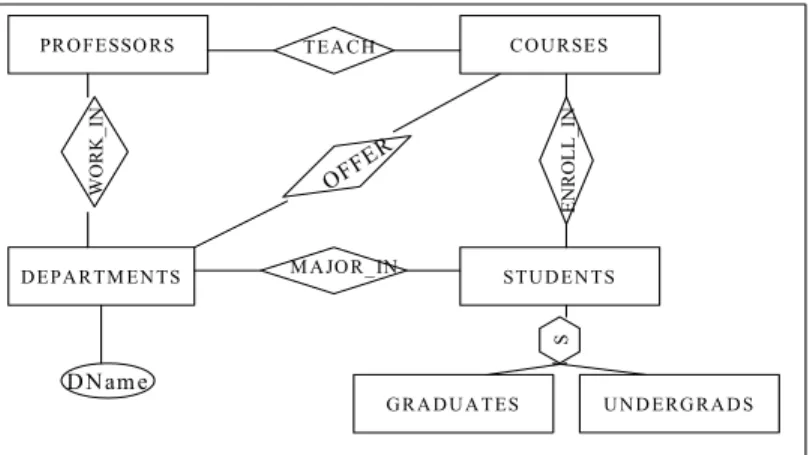
A database schema needs to change due to one or more of the following reasons: (1) Users do not know in advance (or are not able to specify) the desired functionality of a large application system and hence their perceptions and requirements change over time. The initial schema needs to change to accommodate the changing perceptions of the users. (2) The world of reference of the database is continually changing. The database schema must change to be consistent with it. There is yet another reason: databases design is more of an art than science and when performed by a designer unfamiliar with the domain results in a database that is simply incorrect [Borgida and Williamson 1985]. This can be treated as an extreme case under (1) were user requirements were captured (very) inaccurately. Consider for example a database called the University-Courses (U-C) database that currently stores data on the different courses offered in a (any) department in some university. A database schema modeled using the ERM is shown in figure 1. The components and relationships that exist in this real world include courses offered in the department, the Professors that teach these courses, and Students who enroll in the courses.
PROFESSORS STUDENTS COURSES TEACH EN RO LL I N
PROFESSORS TEACH COURSES
EN RO LL IN STUDENTS DEPARTMENTS WO RK _I N OFF ER MAJOR_IN
Figures 1 and 2: Database Schema Model for Course Information Example – Before and After Change
Changes to the real world: It may be necessary to expand the world of reference to include the
Professors are usually associated with one department and the database should capture this relationship. The students may each have a major department and so students must be related to departments. The schema must change to reflect the new structure shown in figure 2. The data must also change to conform to the new schema (new data may be added and data corresponding to relationships between the instances defined or redefined).
Changes to Users' perception of the real world: Administrative assistants need information on
graduate students supported by their department. Since the database has a single collection of students, it may now be necessary to classify students as graduate and undergraduate. It is necessary to add new information that classifies the students into the two categories. The semantic model of the changed schema is shown in figure 2.
PROFESSO RS COURSES
DEPARTM EN TS STUDENTS
UND ERG RADS GRADUATES WO RK_IN EN ROL L _I N M AJOR_IN TEACH S OFFE R DNam e
Figure 3: Database Schema Model for Course Information Example: After Classifying Students
These changes transform a database schema from an existing state to a modified new state. It is important these changes are managed to maintain the database consistent with its world of reference and accommodate user requirements. The data in a database is dependent on the schema of that database. When the schema changes, the data needs to be changed to “match” the changed schema. Therefore managing schema changes also implies managing changes to the associated data. Schema evolution may be defined as the ability of the database to respond to the
above changes without loss of the existing data and without significantly affecting the day-to-day operations of the database.
Reorganizing the database has been the solution to manage schema evolution. This is performed infrequently because during reorganization, part or all of a database is inaccessible to users. During the periods between reorganization, the consistency of the database with its world of reference is not guaranteed. Research addressing online reorganization of relational databases attempts to solve problems such as restoration of clustering, purging old data, creating back up copies, and online index creation [Sockut and Iyer 1996]. Sybase System 11 provides support for on-line database consistency checking and backup/restore operations [Rengarajan et al. 1996]. Algorithms for on-line clustering [Omiecinski 1996], and for on-line reorganization of the B+ trees used for clustering indexes in relational systems have been proposed [Zou and Salzberg 1996]. These address performance of online reorganization and not schema evolution. To ensure continuous access to data while incorporating schema changes the process must be managed dynamically. Dynamic schema evolution is defined as managing schema changes in a timely manner without loss of existing data while the database continues to be operational and without significantly impacting the day-to-day operations of the database.
Changing the database schema has a number of implications. First, a change to one part of the schema may require more changes to other parts of the same schema (cascading changes). All of these changes must be identified and incorporated. Second, when incorporating changes to the schema, the consistent state of the schema must be preserved. Procedures to define a
consistent state and mechanisms to preserve it must be defined. Third, the changes to the schema must be translated or propagated to the data in its corresponding database. When propagating changes, existing data in the schema may be lost. Also, when the schema is changed, external
application programs that are part of the information system will no longer be able to access the changed schema. To preserve existing data and support existing applications multiple versions of the schema must be maintained. Versions must be managed so that they are correct and
consistent. Based on these requirements three inter-related activities can be identified in schema evolution. Managing core schema evolution includes identifying and incorporating changes to the schema while preserving the consistent state of the schema as well as propagating the changes to the data associated with the schema. The issues that need to be addressed for managing core schema evolution are:
• Understanding all possible changes to the database schema • Understanding the implications of each change
• Incorporating changes to an existing schema while ensuring that the consistent (and correct) state of the schema is maintained.
• Determining how a change (may/may not) affects other parts of that schema
• Propagating changes to the data associated with the changed schema so that the data is consistent with the changed schema.
• Performing these changes dynamically without significantly impacting day-to-day operations of the database.
The management of changes to the schema is termed as semantics of schema changes [Banerjee et al. 1986][Peters and Özsu 1997] and as schema evolution [Zanilo et al. 1997]. Propagating the changes to the data in the database is termed as database evolution [Zanilo et al. 1997] and as propagation of schema changes [Banerjee et al. 1986][Peters and Özsu 1997]. Core schema evolution includes both schema evolution and database evolution.
The second research activity is version management. This deals with the management of the different versions of a database schema introduced by schema changes. Evolutionary changes to the schema may require retention of past states of the schema and managing multiple versions of the schema is essential. Version management must address the following:
• Defining the granularity of versioning (entire schema or just schema-objects)
• Identifying versions of the schema and associating each version with its parent (the base from which a version is created)
• Maintaining a mapping between available versions (what is different?)
• Conforming the existing data to a new version of the schema and associating the data with its corresponding schema version.
• Specifying the current or active (or default) version of the schema
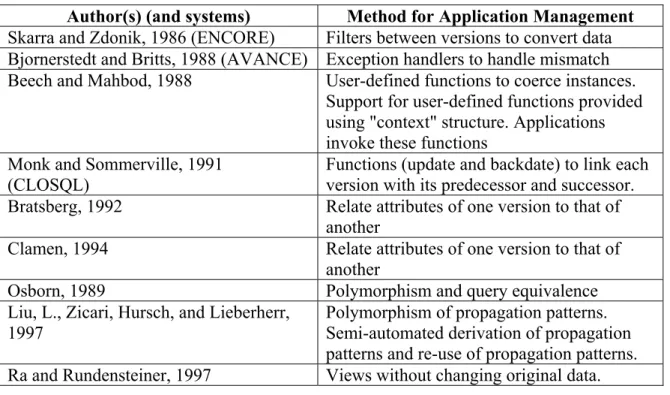
Management of applications is the third research activity and it examines how dependent
applications may continue to work when the schema is changed. Changes to the structure often result in existing applications becoming obsolete. Managing applications so that these might access the data despite changes to the database schema is the focus here. Management of applications is closely related to managing multiple schema versions. An application would continue to work if the schema version it is associated with continues to be accessible. Typical activities in application management include:
• Creating an interface for each schema version. As the interface identifies the set of all objects available in a given version applications must interact with a versions only via its interface. • Providing mechanisms associated with each version interface for translating data (instances)
between parent and child versions.
Schema changes can be identified based on a specific type of database (or a specific data model). Schema changes in an object-oriented database are different compared to changes in a relational schema and database. Based on this observation research in schema evolution can be classified based on the data model used. The majority of research in schema evolution is based on object-oriented databases and the associated object data model. This can be attributed to the fact that schema evolution may have had its origins in engineering design databases that are predominantly object-oriented databases. Relational data model has also been used though to a lesser extent. Besides these two semantic and other data models have also been studied.
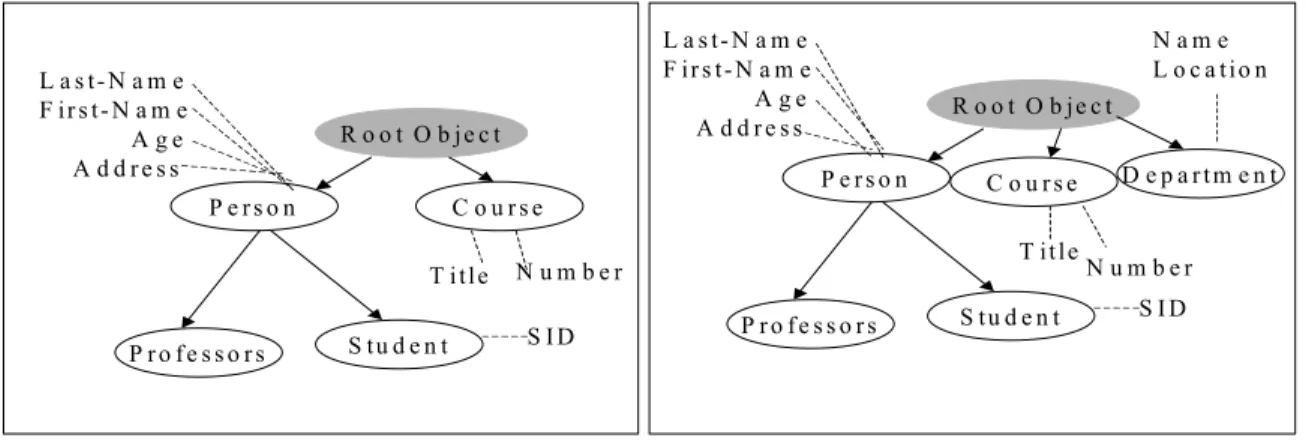
Consider the U-C example described in section 1.1.The semantic model representation of the schema(s) is shown in figures 1 and 2 and the class hierarchy representation for the same is shown in figure 4. If a relational model were used to represent the schema, the original schema would have relations for Professors, Students, Courses, and relations for the Teach and Enroll relationships (assuming that the cardinality is many-many for each). Adding Departments triggers a change to the current schema.
R o o t O b je c t C o u r s e P e r s o n S tu d e n t P r o f e s s o r s L a s t- N a m e F ir s t- N a m e A g e A d d r e s s T itle S I D R o o t O b je c t C o u r s e P e r s o n S tu d e n t P r o f e s s o r s L a s t- N a m e F ir s t- N a m e A g e A d d r e s s T itle S I D N u m b e r N u m b e r D e p a r t m e n t N a m e L o c a tio n
Figure 4: Class-hierarchy for the original and changed U-C database schema
Let us examine the implications of this schema change from the point of each of the research directions described earlier. Considering core schema evolution, depending on the data model used to describe the schema of the U-C database, a new relation (or a new object class or a new entity class) needs to be defined in the existing schema to hold the data on departments. This would also mean that a set of attributes must be defined for the relation (or object/entity class) based the data that needs to be stored. Adding department information will trigger some more changes to the schema. The new relation (object/entity) that is added must be related to one or more of the existing relations (objects/entities), Professors and Students in this case. These are relationships that exist in the real world and representing them in the schema is necessary to maintain the database consistent with its world of reference. Incorporating these relationships
may introduce new relations and/or extend existing relations in a relational model. In object models, these object associations are captured by defining methods (or behaviors) in one or more objects. If a semantic model is used to represent the schema these associations are captured by relationships between one or more entity classes. To make the above changes, operators (or functions) that help define new relations/objects/entities and new associations are needed. These operators must implement the changes dynamically and while doing so, must maintain the schema in a correct and consistent state. A framework that defines what is correct and consistent is needed to assist the operators implement schema changes. To complete the core schema evolution process, the data (or instances) must be changed to conform to the changed schema.
There may exist a set of database users who prefer (and demand) to use the original schema and data. To satisfy their needs and satisfy a different set of users that need the modified data (and its schema) simultaneously it is necessary to maintain both the original and the
changed schema versions. Each version must be uniquely identified. One must also decide whether to maintain two independent versions of the schema, one with the department
information (new version) and one without (old version). In some instances, it may be sufficient to maintain the incremental changes only as part of the new version along with the information that defines how this links to the old version. Yet another way of maintaining the two versions is to define the old version as a “view” of the new version. In this example, the old version would be a subset of the new version. The roles may be reversed if the change was a deletion instead of an addition. An important question arises when another schema change (classifying students as shown in figure 3) is needed. Should the change be implemented based on the old version or the new? In the former case, the old version is the parent of the third version created and in the latter case it is the second. A more general method would define an all-encompassing schema that
includes every relation/object/entity that ever existed, and define each version as a view of this schema. Version management would have to address all of the above requirements.
A set of application programs that were developed based on the old U-C schema will continue to work with the new schema. The addition of the department information does not affect these applications as Professor, Student, and Course information exists in both versions. On the other hand, if some information (say, Professors) were to be deleted, this would affect at least some of the applications in the set. Also, to retrieve the new information (about departments and departments associated with Professors, Courses, and Students) added to the database, a new set of applications must be created. This new set will be incompatible with the old version of the schema. So applications must be associated with versions or users must specify which version to access when submitting applications. Application management in schema evolution attempts to address these issues. An important reason for maintaining multiple versions might be to support the dependent applications besides satisfying user demands.
Schema evolution has been examined using a single, standalone database only. Managing schema evolution in a heterogeneous database system (or environment) has received little or no attention. Why is this important? Organizations today implement comprehensive information systems that include more than just one data source. Databases, of different types, are integrated together to provide the necessary storage support. Each database schema in this set of multiple databases may (and do) undergo changes and evolve due to reasons described earlier. The impact of schema evolution in this heterogeneous collection of databases is much stronger than in any single standalone database. The number of changes resulting from a single change is much larger because the impact is not restricted to that one database where a change is first identified. Due to the extensive inter-relationships between these heterogeneous databases a schema change,
besides affecting other parts of that schema, has the potential to affect parts of other database schemas as well. Identifying the changes completely including all cascading changes and propagating each schema change to its corresponding data (in the database) adds complexity. If one or more of these databases are distributed (as they often are), data associated with the changed schema object may be distributed across multiple locations. Each of these locations has to be identified and the changes must be made at all these multiple locations to maintain
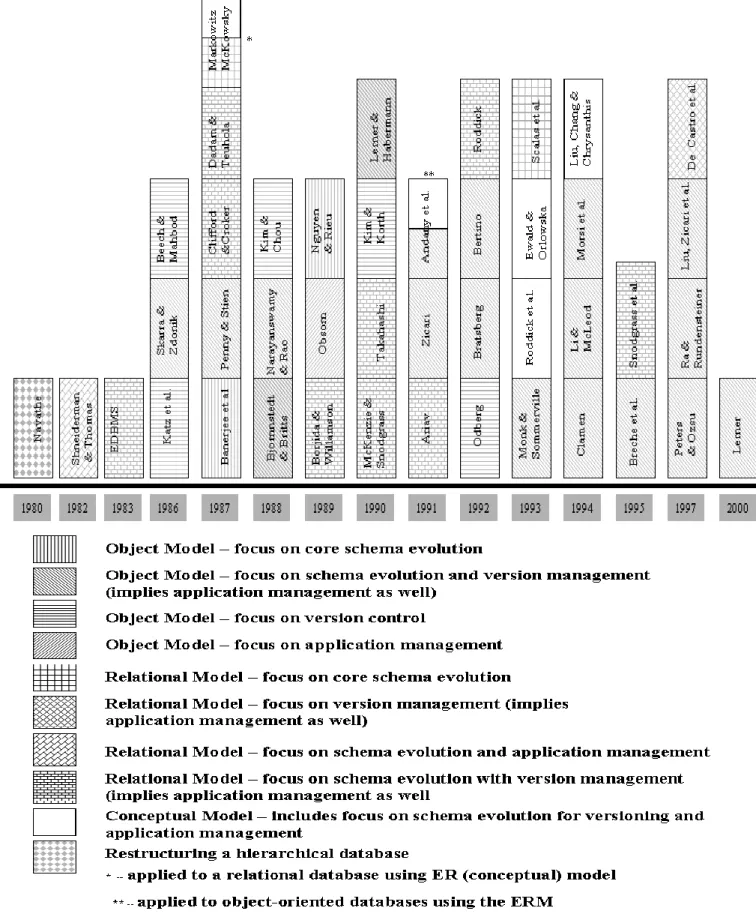
consistency. More than one database administrator (DBA) may be responsible for managing heterogeneous database systems. Each administrator is often responsible for one or more subsystem in the heterogeneous set. It is very difficult, and often impossible, for a database administrator to envisage the impact of a schema change and the many cascading schema changes that result. The difficulties arise not only in identifying all the possible changes but also in manually incorporating the changes. To ensure continuous access to data the schema changes must be managed dynamically. Hence dynamic schema evolution in heterogeneous database systems is an important research agenda and deserves a closer examination. Sections 2, 3, and 4 summarize schema evolution research based on the activities in schema evolution – core schema evolution (section 2), version management (section 3) and application management (section 4). Within each section, the organization follows the second perspective based on the data model used. The merits and drawbacks of each research are discussed. A schematic summary of the research examined here is shown in figure 5. Section 5 evaluates the requirements for managing dynamic schema evolution in a heterogeneous database system and a set of potential applications for dynamic schema evolution is described in section 6.
2. Core Schema Evolution
Management of core schema evolution involves identifying changes to the schema, incorporating the changes into the existing schema while maintaining the correctness and consistency of the schema, and reflecting these changes in the underlying set of database(s).
2.1 Core Schema Evolution and Object-Oriented Data Model
Object-oriented models offer some advantages for schema evolution when compared with relational data models. In an object-oriented model all conceptual entities are modeled using the single concept of an object. The state of the object is captured by the instances of the object and the behavior captured by the messages to which the object responds. The hierarchy of classes in oriented models defines properties of class hierarchies and inheritance. Objects in object-oriented models are represented using a lattice structure, known as the class 2lattice (for class objects and type lattice for type objects). The lattice provides a convenient way to determine the implications of the changes to itself and hence to the object schema. Thus the propagation of changes using the lattice structure is easier. Moreover, the object-oriented data model (and Object-Oriented Databases) is capable of modeling more details such as complex hierarchical objects and relationships about the real world compared to the relational data model.
In examining schema changes to the object model, one set of solution methods address the evolution of specific objects within the model such as class, type, or method objects [Penny and Stein 1987], [Skarra and Zdonik 1986], [Bjornerstedt and Britts 1988], [Narayanaswamy and Rao 1988], [Osborn 1989], [Bertino 1992], [Bratsberg 1992], [Monk and Sommerville 1993], [Morsi et al. 1994], [Li and McLeod 1994], [Liu et al. 1997], [Lerner 2000]. Others address
2 The terms class and type are used interchangeably in a majority of the research discussed here. A class (or type) is a template for all its instances [Zdonik and Maier, 1990]. However some literature use the two terms to mean
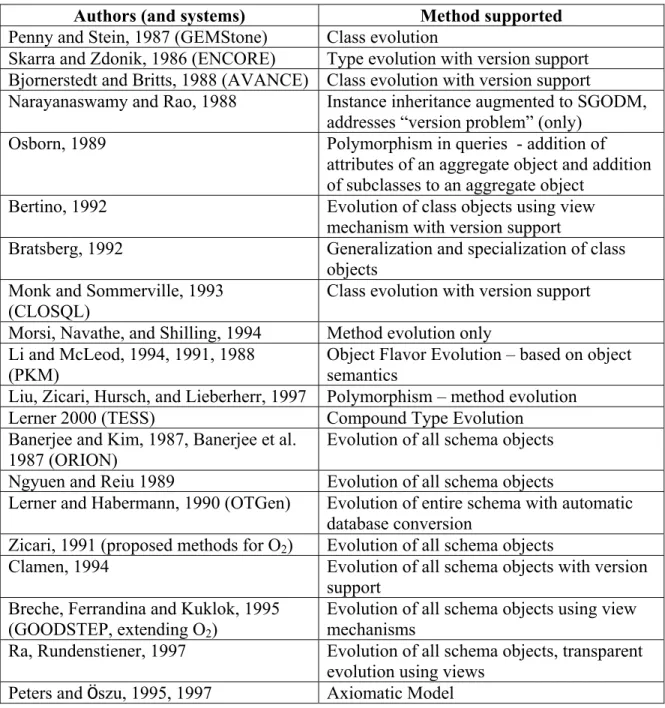
evolution of the complete schema [Banerjee et al. 1987a], [Banerjee et al. 1987b], [Lerner and Habermann 1990], [Zicari 1991], [Clamen 1994], [Peters and Öszu 1995, 1997], [Breche et al. 1995], [Ra and Rundensteiner 1997]. A summary list of research and methods employed for schema evolution using object-oriented model is in table 1.
Methods to propagate schema changes to the database include conversion on one side, and screening, filtering, or a hybrid on the other. Conversion coerces the existing data in the database to immediately conform to the changed / evolved schema. There is only one version of the database and schema available at any time. Data associated with an object that is no longer part of the new/evolved schema is not accessible from this schema and is “lost”. Screening and filtering methods for propagating schema changes are employed when multiple versions of the schema and data are maintained. Screening creates a new version of the schema along with a set of associated functions. When an application accesses this version of the schema, the functions coerce the data to conform to this schema version (delayed conversion). Filtering is similar to screening except it does not coerce the data. Instead the functions or filters associated with each version map the data to conform to that version.
Penny and Stein describe a method for class evolution in object-oriented databases by converting the existing instances to the modified version of the class in their prototype called GEMStone [Penny and Stein 1987]. GEMStone addresses the issue of modifications to the class and class definitions. It attempts to coerce the underlying database to conform to the new class definition adopting the early conversion method. GEMStone also uses a class hierarchy graph. Unlike the class lattice in ORION [Banerjee and Kim 1987], the graph in GEMStone is a tree where each class node has a unique super class. The consistency and correctness of this graph is
maintained by a set of six invariants and eight schema changes are defined based on the class- object. GEMStone does not version the class and maintains only the evolved or new class.
Authors (and systems) Method supported
Penny and Stein, 1987 (GEMStone) Class evolution
Skarra and Zdonik, 1986 (ENCORE) Type evolution with version support Bjornerstedt and Britts, 1988 (AVANCE) Class evolution with version support
Narayanaswamy and Rao, 1988 Instance inheritance augmented to SGODM, addresses “version problem” (only)
Osborn, 1989 Polymorphism in queries - addition of attributes of an aggregate object and addition of subclasses to an aggregate object
Bertino, 1992 Evolution of class objects using view mechanism with version support
Bratsberg, 1992 Generalization and specialization of class objects
Monk and Sommerville, 1993 (CLOSQL)
Class evolution with version support Morsi, Navathe, and Shilling, 1994 Method evolution only
Li and McLeod, 1994, 1991, 1988
(PKM) Object Flavor Evolution – based on object semantics Liu, Zicari, Hursch, and Lieberherr, 1997 Polymorphism – method evolution
Lerner 2000 (TESS) Compound Type Evolution Banerjee and Kim, 1987, Banerjee et al.
1987 (ORION) Evolution of all schema objects Ngyuen and Reiu 1989 Evolution of all schema objects
Lerner and Habermann, 1990 (OTGen) Evolution of entire schema with automatic database conversion
Zicari, 1991 (proposed methods for O2) Evolution of all schema objects
Clamen, 1994 Evolution of all schema objects with version support
Breche, Ferrandina and Kuklok, 1995 (GOODSTEP, extending O2)
Evolution of all schema objects using view mechanisms
Ra, Rundenstiener, 1997 Evolution of all schema objects, transparent evolution using views
Peters and Öszu, 1995, 1997 Axiomatic Model
Table 1: Summary of Core Schema Evolution using Object-Oriented Model
Skarra and Zdonik examine the problem of schema evolution in object-oriented databases by versioning the type (different from class) of the object [Skarra and Zdonik 1986]. They take the view that objects in a database are shared and are persistent. However, the type definitions of
the object do change and the solution method addresses type evolution in object databases, utilizing the type lattice structure. The changes to the type include addition or deletion of a type, or modifications to the type definitions. In modifying a type definition, the properties,
constraints, and operations that are defined by that type may be added, deleted, or changed. According to the authors, change to a type affects two groups of objects: objects of that type and its subtypes, and the program objects that use this type. An object takes on the properties and operations of its super type and hence programs that use super types of the changed type may also be affected. The first group of objects affected is handled by a version set mechanism. A new version of the type and subtype is generated whenever a type changes. All instances remain bound to one version and may be coerced to another version using screening. This methodology forms the basis of a prototype system, ENCORE, for type evolution.
AVANCE, another prototype system for schema evolution in object-oriented databases proposes general object versioning as the solution method [Bjornerstedt and Britts 1988]. Object versioning is extended to support class (or type) versioning. New version of the class is created following a change to the class. Changes to class object include changes to attributes or
properties, adding and deleting classes, and defining and removing subclasses. Changes to
methods are not addressed. Change propagation to databases is performed using a method similar to screening.
In engineering domains, one specific schema change is the "version problem". An object that is originally defined as an instance of a particular type now evolves into a type in itself. Narayanaswamy and Rao discuss a solution method to this problem using a simple, generic, object-oriented data model (SGODM) [Narayanaswamy and Rao 1988]. If an instance I of type T evolve to be a type in itself the solution using SGODM would be to create a new subtype ST that
is made a subtype of T. ST assumes the properties of I. Variations of I that triggered the change are made instances of ST. This method of incorporating the change affects the application programs that operate on the object schema. The solution method proposed augments SGODM with "instance inheritance" that solves this problem without introducing new subtypes. A new link, "has-version", is introduced into SGODM. This is a multi-valued attribute link that links an object to all its versions. Using this link, instance I can be linked to all its variations. Thus the original type-lattice structure remains unchanged (except for the addition of the new link(s)) and the application programs may continue to access the original lattice, which is preserved. The change is incrementally modeled in the schema by the introduction of this new abstraction. The proposed solution thus transforms an object schema and does conclusively state if multiple versions are needed and if so, how many versions to maintain. Method(s) for propagating changes to the data instances are not explicitly addressed.
Osborn presents an approach to schema evolution in object-oriented systems using polymorphic object algebra [Osborn 1989]. When the schema of an object database changes, the database is changed to conform to the changed schema. The notion of polymorphism is that certain queries or applications will return identical or equivalent results when applied to object databases, both before and after the change. Such polymorphic queries would be transparent to schema changes. Two types of changes are examined, modifying an attribute to an aggregate object (an object created by juxtaposing other objects of different types), and adding a set of subclasses to an aggregate object in a generalization hierarchy.
Bertino presents a schema evolution language that is an object-oriented adaptation of the view mechanism in relational database systems [Bertino 1992]. In particular, the definition language proposed permits definition of views that augment class definitions. This research
supports inheritance and object identifiers (OIDs) for view instances, two important
characteristics of object-oriented data models and databases that are not seen in relational models and relational databases. View instances with object identifiers are physically realized in the database. This enables the view mechanism to support schema changes that specify the addition of attribute(s). In addition, the view mechanism has been extended to support schema versions and experiment with schema changes before realizing each. In this research, views are also used to define dynamic sets and partitions of classes, without affecting the class hierarchy
organization. Two issues are not explicitly addressed here: instance adaptation (change propagation) and compatibility between versions.
Another research that implements oriented views for schema evolution in object-oriented systems is described in [Bratsberg 1992]. It supports changes to class objects like generalization and specialization, similar to the Bertino’s work. In addition, it also covers type versioning and class versioning to provide historical support for schema evolution. The class object is said to consist of its intent, a named set of properties, and its extent, a special set of objects. The intent is connected to an extent that has the same name as the intent. The extent is defined as being the set of objects created from the intent. The association between the intent of every object in the database is modeled as a graph called intent inheritance graph and the
association between the extents modeled as the extent graph. Evolutionary changes to classes are defined in terms of intent and extent evolution. Propagation of changes is not addressed.
CLOSQL adopts the class (or type) versioning method for schema evolution [Monk and Sommerville 1993]. Multiple versions of a class may exist and CLOSQL employs a conversion method for change propagation. Instances are converted when there is a version conflict. The class version to be used is determined by the program that tries to extract the instances from the
system. The only changes addressed are the class-definitions and this research is dealt with in more detail under version management (section 3).
Morsi et al. describe schema evolution operations exclusively for the evolution of
methods in object-oriented systems [Morsi et al. 1994]. This research supports addition, deletion, and modification of methods. It also supports certain schema change operations that would trigger changes to methods, such as renaming of classes, instance variables, and methods. The operations are captured in the prototype system GOOSE (Graphical Object Oriented Schema Environment). The schema information in GOOSE is maintained as a set of system objects belonging to system defined classes. Besides the fact that it is one of the few research works that address method evolution, GOOSE also provides methods for resolving inconsistencies that may arise during the evolution process. GOOSE maintains inconsistencies that arise during method evolution in system defined object classes and provides schema change operations to restore consistency by resolving the inconsistencies.
Li has described a system for schema evolution that incorporates machine-learning techniques [Li and McLeod 1994]. The prototype system, Personal Knowledge Manager (PKM), views evolution of the object schema in from the perspective of the evolution of object flavors. Object flavor is termed as the definition of the semantics of an object. A change to the
fundamental semantics of the object is object flavor evolution. Every object in the database of PKM is related to another object using a mapping. A three-tier object flavor graph is defined to manage evolution of objects. The nodes in this graph are the different object flavors (atomic in tier 1, open atomic, closed atomic, social, mapping, and procedural in tier 2, open social set, closed social set, compound mapping, and compound procedural in tier 3). The edges that link the nodes define the evolutionary paths for object flavor evolution. A set of operators (procedural
objects) is defined to create and evolve object based on this graph. PKM is an end-user database evolution tool that attempts to automate the evolution process by learning from the user. The manner in which the evolution is reflected in the data is not clear.
Liu et al. describe the role of polymorphism and reuse mechanisms based on
polymorphism for improving the adaptive capabilities of database application programs in an object-oriented environment [Liu et al. 1997]. The schema changes examined in this research are the changes to the behavior or method associated with the object classes. This is discussed further is section 4.1 under application management.
Lerner presents a model for type (or class) evolution in object databases [Lerner 2000]. Specifically, this research examines compound changes (moving or replacing attributes) to types that have thus far been treated as a sequence of simple changes. For example, moving an
attribute from one type to another would typically be executed as a sequence of adding the attribute to one type and deleting it from another. However, the problem is with changing the corresponding data (or instances). Default instance values are assigned to the new addition and deletion results in all the old data values being lost. Such compound changes to types are
supported by the model for type evolution presented in this research in which the attribute and its associated values are moved from one type to the other. It is important to note here that the maintainer (or administrator) needs to decide which operation (sequence of add/delete or move) is more appropriate for the specific change under consideration. The model is supplemented with a set of algorithms that compare the two or more types involved in the change and with the help of the maintainer, identify whether simple sequential changes are adequate or if compound changes are needed. The model is implemented in a system TESS (Type Evolution Software
System) that is then evaluated for its accuracy in detecting type similarities. The model (and system) does not support versioning.
The above discuss methods for incorporating changes to the object schema by identifying a set (or subset) of changes to one or more specific objects in the schema. The consistent state of the schema is defined using a formal structure such as a graph (the class lattice or object-flavor model) and this structure assists in determining operators and mechanisms for incorporating the changes. The propagation of these changes to the data instances is by conversion, or screening. Using views does not explicitly address how the data is changed but it is easy to envisage a method similar to filtering that maps the data for each view. Whether the evolution is
dynamically managed or not is not explicit except in [Li and McLeod 1994]. Further, automating the evolution is addressed by [Li and McLeod 1994] and by [Lerner 2000] who point out that administrators/users must be involved in the process. When using polymorphism to support schema evolution, the thrust appears to be in the management of application programs. Hence polymorphism in schema evolution has been included here for completeness and the details of implementation are described further under the section 4 (application management).
ORION is a prototype object-oriented system that provides support for schema evolution [Banerjee et al. 1987a], [Banerjee et al. 1987b]. An important part of this work is the
development of a formal taxonomy of schema changes and a framework for managing schema changes in object-oriented systems. The semantics of each schema change is examined and a set of invariant properties of the object-oriented schema is proposed which must be preserved across schema changes. In ORION, the authors describe an implementation method for schema
evolution that does not require database re-organization or shut down. In this research, an interesting property of object-oriented data model has been brought to light. The class (or type)
lattice structure is treated as a graph (PIG or the Property Inheritance Graph), which has a system generated class called Object as its root. It is a rooted, directed, acyclic graph. The taxonomy, invariant properties, and operators for implementing schema changes are described based on this graph. The taxonomy is listed under three major classifications: changes to a node in the PIG, changes to an edge in the PIG, and changes to the contents of a node. The final category includes changes to the attribute of an object and changes to the methods defined on the object. A
significant contribution of this work is that it provides a clear and systematic framework for managing schema evolution. Change propagation to the database is by screening.
Nguyen and Rieu present a set of schema changes similar to that in Orion [Nguyen and Rieu 1989]. While the semantics for schema changes is similar to Orion, the user is permitted to decide between screening and conversion for change propagation.
In OTGen, Lerner and Habermann describe a system that addresses the issues of complex schema evolutions that require major structural changes to the database [Lerner and Habermann 1990]. Similar to ORION and O2, OTGen is assisted by a set of invariants that maintain schema
consistency during the schema transformation process. The changes supported by OTGen deal with adding/deleting/renaming instance variables, changing types, adding/deleting superclass, and adding/deleting/renaming a class in the object schema. OTGen implements this using the schema modification method and does not support versions of schema. A very attractive feature of OTGen is that it modifies the structure and incorporates the existing data. Database
administrators can specify the mapping between objects created in an old version and their corresponding representation in the new version of the schema using a declarative language. OTGen transforms the existing database to the new version automatically.
Zicari has proposed a set of schema change operations to be incorporated in O2, an
object-oriented database system and programming environment [Zicari 1991]. O2 defines a
distinction between types and objects, which ORION does not. O2 has two distinct notions:
classes whose instances are objects encapsulating data and behavior, while types have values as its instances. Every class is associated with a type, describing the structure of its instances. The object schema in O2 is a set of classes related by inheritance links and / or composition links. The
objective of this research is to define a minimal set of primitive operations that can be used to update the schema in O2, while preserving the consistency of the schema. For this purpose two
types of consistencies are identified. The schema is said to be structurally consistent if the class structure is a directed, acyclic graph (DAG) and if attribute and method name definitions, attribute and method scope rules, and attribute and method signatures are all compatible. The object-oriented database is behaviorally consistent if each method respects its signature and its code does not result in run-time errors. The important contribution of this research is that it addresses the issue of completely automating schema change process. The research emphasizes the importance of involving the designer in the process. It suggests providing a set of tools to the designer/user for the purpose of performing schema changes instead of automating the process entirely. A key issue not addressed in this research is the issue of propagating changes to the database. However, it is the only known research that identifies the provision of an advisory program that would determine at evolution time if the evolution were consistent with class and method dependencies.
Clamen describes a schema versioning method for schema evolution for distributed and centralized object-oriented database systems [Clamen 1994]. This research extends the concept of class versioning to all schema objects but explicitly addresses attribute evolution only. This
method allows for multiple versions of the instances, called facets, to persist simultaneously. The programmer is given the specifications on how to adapt the instances as a package following changes to the schema and uses a method similar to screening, but only when the programmer invokes the package. The focus in this article appears to be versioning and application
management and not all schema changes are explicitly described.
Breche et al. further extend the schema change support for O2 by using views to simulate
schema changes, in the GOODSTEP project [Breche et al. 1995]. An important issue addressed here is the support for modification of the database following schema changes, instance
adaptation. Conversion functions are provided to the user, which take the old and new schema definitions as input and transform the objects of the database to conform to the new schema. This research adopts the lazy or delayed conversion similar to GEMStone and ORION. Views are treated as virtual schemas for simulating certain specific classes of schema changes. The designer has the option to test the change before materializing it.
The view mechanism in object-oriented databases has also been employed to create personal schemas from a base schema to assist in schema evolution [Ra and Rundensteiner 1997]. More specifically, by permitting “personal views”, changes requested by users are treated as changes to the personal schema instead of the database schema. Transparent Schema
Evolution (TSE) system, a prototype built on this notion, now regenerates the personal view incorporating the requested change(s). Schema changes described include adding/deleting of object classes, adding/deleting "is-a" relationship edges between two classes, adding/deleting methods associated with objects, changing the domain of attributes, and renaming class objects. By defining virtual classes a new view that incorporates one or more of these changes is
change. The propagation of changes is by filtering where the set of algorithms associated with each view determine how the data is to be mapped to that view.
TIGUKAT is an object-base management system that supports dynamic schema
evolution [Peters and Özsu 1997]. An axiomatic model for dynamic schema evolution forms the foundation of TIGUKAT. Traditional approaches to schema evolution in object-oriented systems involve the definition of invariant properties and rules to enforce them, which makes the
methodology system and model specific. An important contribution of this research is that it develops a formal model to which other object-oriented systems supporting schema evolution may be reduced to, especially for comparison purposes. The model is based on object type and uses the type-lattice graph to represent property inheritance, subtypes, and supertypes. The research does not address the propagation of the changes to the instances.
Examining the above research based on the steps involved in managing core schema evolution, the following observations can be made. All of the described research examines schema evolution in single standalone databases. First, for identifying possible changes to the schema based on the object model, some are very comprehensive in identifying changes while others focus on a specific subset of the changes. Second, for defining the consistent state of the schema, the preferred approach is to use a set of axioms to define the consistent state and further identify a set of rules to preserve the consistent state when changes are incorporated [Banerjee et al. 1987a]. Third, propagating the changes to the data instances is performed using conversion if multiple versions are not managed and is performed using screening/filtering if supporting multiple versions of the schema. The issue of dynamically managing schema evolution is addressed only in [Peters and Özsu 1997]. When using view mechanisms, the consistent state and its preservation are defined and controlled by algorithms associated with view generation
and materialization. For this reason, these are often not explicit. The thrust in research using view mechanisms appears to be on version and application management than on core schema evolution. Lerner and Harberman highlight the issue of automating schema evolution by automatically generating the change schema after the changes are identified [Lerner and Habermann 1990]. This is also one of the few to comprehensively examine schema evolution including propagation of schema changes.
2.2 Core Schema Evolution and the Relational Data Model
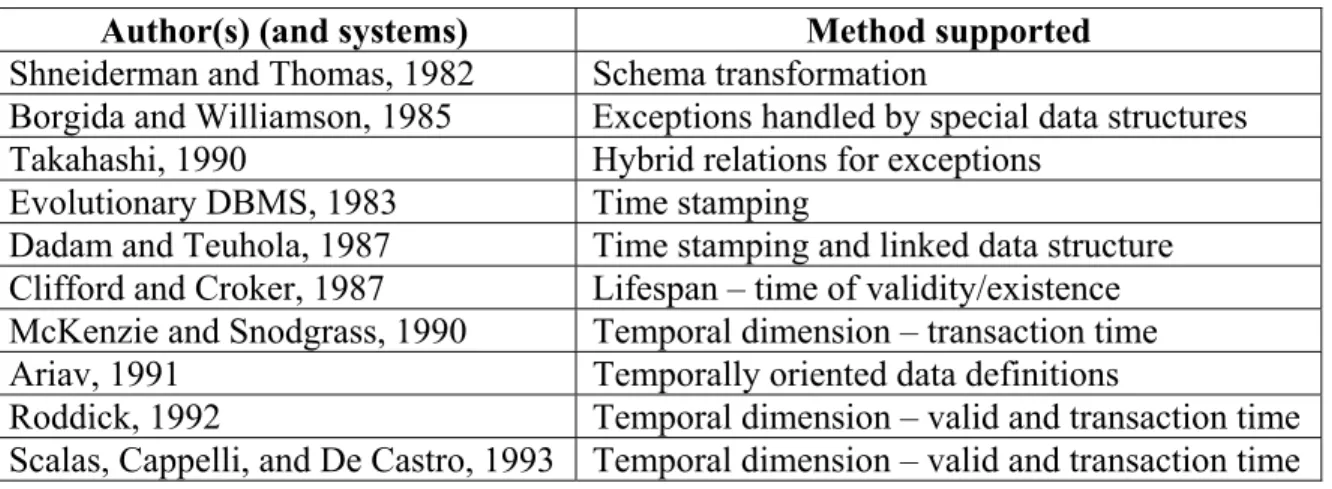
The relational data model is simple when compared with the object-oriented data model and hence only a limited number of schema changes can be identified based on the relational model is limited. A majority of the research on schema evolution using the relational model examines temporal dimensions [EDBMS 1983], [Dadam and Teuhola 1987], [Clifford and Croker 1987], [McKenzie and Snodgrass 1990], [Ariav 1991], [Roddick 1991], [Scalas et al. 1993]. Other perspectives to tackle schema evolution in relational databases include extending SQL to support schema evolution [Roddick 1992], [Snodgrass 1995], automated schema transformation [Shneiderman and Thomas 1982], and using hybrid relations and special structures [Borgida and Williamson 1985], [Takahashi 1990]. A complete list is in table 2.
Author(s) (and systems) Method supported
Shneiderman and Thomas, 1982 Schema transformation
Borgida and Williamson, 1985 Exceptions handled by special data structures Takahashi, 1990 Hybrid relations for exceptions
Evolutionary DBMS, 1983 Time stamping
Dadam and Teuhola, 1987 Time stamping and linked data structure Clifford and Croker, 1987 Lifespan – time of validity/existence McKenzie and Snodgrass, 1990 Temporal dimension – transaction time Ariav, 1991 Temporally oriented data definitions
Roddick, 1992 Temporal dimension – valid and transaction time Scalas, Cappelli, and De Castro, 1993 Temporal dimension – valid and transaction time
Shneiderman and Thomas examine a system and architecture for automatically converting relational databases following changes to its structure [Shneiderman and Thomas 1982]. This research classifies changes to the relational databases (transformations) based on three features. A transformation is information preserving if no information is lost. A
transformation is data dependent if the data stored must be checked to determine if the
transformation is consistent with the new structure. A transformation is program dependent if the application program must be checked to determine if the transformation is correct. Based on this taxonomy for transformations, a system for automatically transforming the database based on a given change is proposed. An important implication for automating such a process brought forth in this research is the need for the database administrator (DBA) to be involved in the conversion process especially when transformations do not meet consistency requirements. It further
highlights the fact that such conversions are viable and systems that support semi-automated conversions provide DBAs with an increased flexibility by easing the conversion process.
Borgida and Williamson discuss a method that incorporates exceptional facts. These are facts that are consistent with the real world (which has changed), but do not conform to the current structure of the database (which has not changed) [Borgida and Williamson 1985]. The exception facts are stored in a separate logical file of records, each record holding a single exception fact. Query language is augmented with application programs that combine the logical file with the existing relational schema as and when required.
Takahashi describes the concept of hybrid relations to support schema evolution [Takahashi 1990]. The research is relatively simple in that it only describes the change due to addition of new attributes to an existing relation. This is achieved by storing the new attribute(s) of an existing relation separately. The new attributes are stored in the form of ordered triples
consisting of <tuple identifier, attribute name, value>. The tuple identifier is the set of values corresponding to the set of key attributes for this relation. At query time, the hybrid relation is realized virtually by combining the existing relation with its set of triples.
A commercial relational database management system, Evolutionary DBMS (EDBMS) has been developed by Information Research Associates [EDBMS 1983]. This system uses temporal concepts to support schema evolution, specifically the evolution of data definitions and supports dynamic restructuring of the schema. The approach taken is the management of binding time: the binding of definitions to their type-names and the binding of data types in programs that run against the database. The set of possible schema changes is not well defined in the description. Structure Manipulation Language (SML) is provided to implement schema changes and to coordinate changes between schema, data, and programs. EDBMS does not permanently convert old data to conform to the changed schema structure.
Dadam and Teuhola's Non-First-Normal-Form (NF2) model examines schema evolution using temporal definitions [Dadam and Teuhola 1987]. The NF2 relational database permits the storage and manipulation of non-first-normal-form relations. The NF2 with temporal definitions handles time in the form of versions of data and schemas. Nine types of schema changes are addressed with the proposed method for implementing each using the storage structure described. Some complex schema changes addressed include nesting (Nest), undoing nesting operations (UnNest), Join, and Split operations which involve temporal restructuring of the schema.
Clifford and Croker introduce the concept of lifespan in their description of Historical Relational Data Model (HRDM) [Clifford and Croker 1987]. Each attribute value in HRDM is associated with a lifespan parameter that defines its period of existence. A group of such
attributes form a relation. A group of such relation schemes form the database schema. The lifespan attached to each attribute helps the model determine the period of time during which the attribute exists in the schema. This potentially permits evolution of the schema. Even though this research does not explicitly address the details of schema evolution, the lifespan concept
provides an elegant method to address schema evolution.
Schema evolution results in changes to the database. Each change is an event at a point in time when the database records this change. This notion forms the basis for supporting schema evolution in temporal relational databases, by including support for transaction time in the relational model [McKenzie and Snodgrass 1990]. The basic data model assumed here supports four classes of relations: snapshot, rollback, historical, and temporal relations. Besides other changes, the relation may change its class (along with data and signature) as well. The relational algebra has been extended to support four schema change operations: adding a new relation, modifying an existing relation, deleting a relation, and renaming a relation. Implementation of these changes is described in depth using relational algebra. To ensure semantic correctness of the algebraic expressions with respect to the database schema and to maintain consistency between the state (data) and schema following changes, a system for semantic type checking is described. An interesting feature is the support for multi-command transactions in which more than one relation of the schema may be changed. A transaction is treated as an atomic update operation.
Ariav examines schema evolution using the Temporally Oriented Data Model (TODM) [Ariav 1991]. The central data structure proposed in this research is the data cube. The data cube is a temporal data construct in which time, objects, and attributes form the primary dimensions of the stored data. The stability of the data is the focus in this research and data is permanently
converted to conform to the most recent schema structure. An important contribution of this research is its emphasis and explicit addressing of managing applications when schema evolution occurs. Schema changes are classified as temporally shallow changes and temporally deep
changes. The former includes changes that require relatively simple operations with minimal corrective steps to retrospectively apply the modified schema to existing data. The latter includes changes where retrospective application of the modified schema to existing data is difficult, and often requires substantial computations. Even though this research clearly outlines the
requirements of schema evolution using the TODM and data definitions, it does not explain the details of performing the schema changes.
Roddick describes a model that incorporates temporal support into the metadata of the relational database [Roddick 1991]. Specifically, the addition of this temporal support has been investigated with reference to semantics of null values, its effect on integrity constraints and its impact on query languages. The temporal support provided includes both valid time and
transaction time. Null values may pose serious problem in databases supporting schema
evolution. Particularly, when new relations are added, all attributes of this relation may have null values. This would violate the entity integrity constraint and may violate referential constraints. The research suggests that the metadata-base (system catalog) must have temporal support and that query languages must query the metadata to identify the structure of the database during time instants or time intervals. This suggestion has been implemented by developing a query language SQL/SE to support schema evolution [Roddick 1992]. It employs the notion of
complete relations. Every relation has an extension, its complete relation, with a set of attributes that is the union of all the attributes ever defined for that relation.
Scalas et. al. discuss another model for schema evolution in temporal relational databases [Scalas et al. 1993]. Changes are classified into two types: redefinition and revision. In
redefinition, the schema after the change is completely independent of the schema before the change. Applying changes to the most recent schema “revises” the schema. The specific changes to the relational model discussed here are classified into two categories: those that deal with attribute level changes and those that deal with relation changes. The first category includes adding and dropping attributes, renaming attributes, and redefining attribute domains. The second consists of adding and dropping relations. Implementation details of redefinition and revision changes are described.
Methods for schema evolution using the relational model include temporal support for the database including temporal support for metadata, view mechanisms, and handling exceptions using special data structures. Both temporal support and providing view mechanisms focus more on the versioning support than on core schema evolution. Also a majority of the research on schema evolution using relational model do not explicitly consider propagation of schema changes to the database(s). Of particular relevance to schema evolution, these provide language support for schema evolution by extending and modifying relational algebra. The types of schema changes that can take place in a relational model and in relational databases are small (changes to attributes and to relations) compared with object data model and database. Providing temporal support (transaction and/or valid time) in databases is an excellent method for
supporting schema versions. Extended SQL with added temporal support is essential for managing data as well as schema in these temporal databases [Snodgrass 1995]. View
mechanisms primarily support versioning and are easily supported by relational models. These are addressed more in detail in the section dealing with version management. The works of
Takahashi and Borgida -Williamson do not address core schema evolution as we have defined it. They are included because they examine methods for accommodating changes without shutting down or reorganizing the database, supporting dynamic management of schema changes.
2.3 Core Schema Evolution and Conceptual Data Models
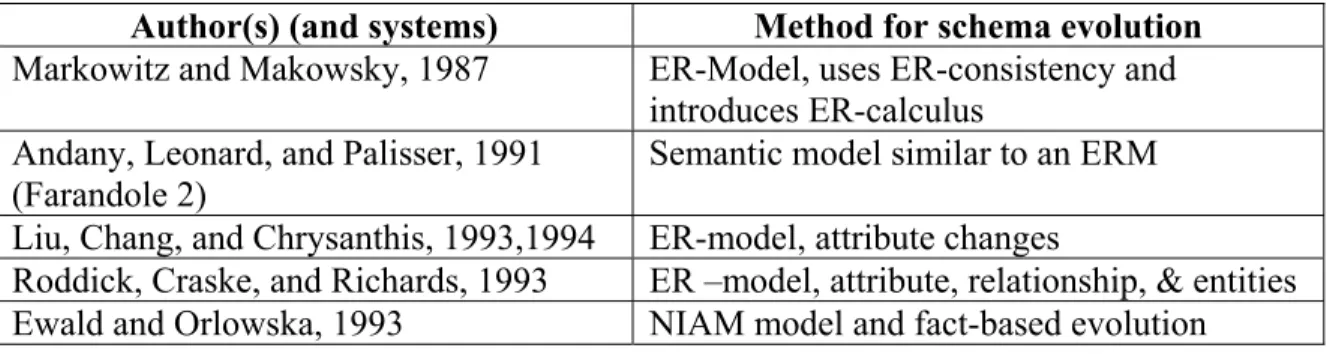
Solution methods for the management of core schema evolution have utilized conceptual data models such as the Entity Relationship Model (ERM) and NIAM. An important distinction between these models and the object-oriented and relational models is that the conceptual data models are not tiedto any one type of database though ERM and NIAM models have been extensively used as a basis for deriving the design or schema of relational databases. Research using these models is summarized in this section and a summary list is in table 3.
Author(s) (and systems) Method for schema evolution
Markowitz and Makowsky, 1987 ER-Model, uses ER-consistency and introduces ER-calculus
Andany, Leonard, and Palisser, 1991
(Farandole 2) Semantic model similar to an ERM Liu, Chang, and Chrysanthis, 1993,1994 ER-model, attribute changes
Roddick, Craske, and Richards, 1993 ER –model, attribute, relationship, & entities Ewald and Orlowska, 1993 NIAM model and fact-based evolution
Table 3: Summary of Schema Evolution using Conceptual Models
A methodology for implementing incremental and reversible schema change operations using the Entity Relationship (ER) model has been proposed by Markowitz and Makowsky [Markowitz and Makowsky 1987]. This research introduces the concept of ER-consistency and examines schema change operations in a relational database. It supports schema evolution by providing a method to incrementally restructure the relational database schema. A relational schema consisting of relational schemes, together with key and inclusion dependencies is said to ER-consistent if an ER model can be used to represent the relational schema. The changes in an
of key and inclusion dependencies. The authors have developed an ER-calculus (an ER-oriented adaptation of tuple relational calculus) to represent database state mappings. Database state mappings define an ER-consistent database state. Propositions that ensure ER-consistency of the database states are also defined using ER-calculus. The ER model is treated as a directed graph and the graph is restricted to having three types of nodes representing entity classes,
relationships, and attributes. The ER model (referred to as a role-free model) does not include cardinalities and assumes that relationships have no attributes. The schema restructuring operations are described as vertex-oriented changes to the ER model along with the database state mappings associated.
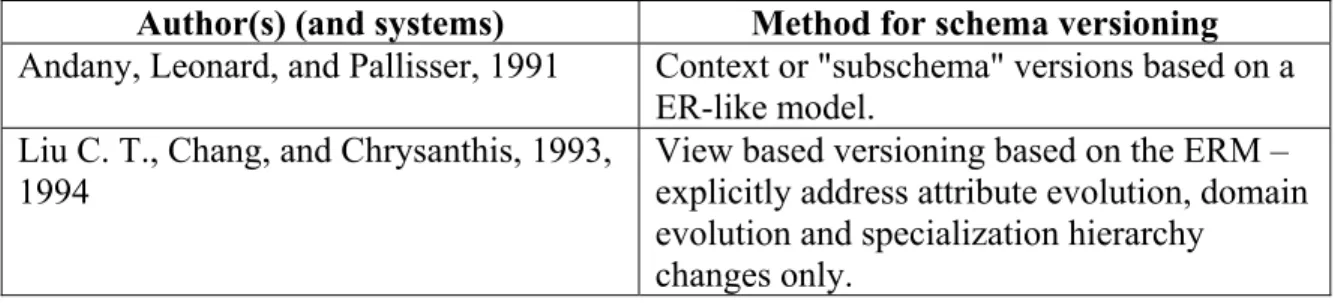
Farandole 2 is a prototype system that employs a semantic model that is similar to an ERM to manage schema evolution in object-oriented databases [Andany et al. 1991]. The model defines two types of classes, atomic and composite. Atomic classes are terminal classes (boolean, integer, strings, etc.) and every object in this class is identified by its value. Objects in composite classes are identified independent of their values and the value of each is made up of objects linked to it by roles. Roles are links that associate a composite class to another class that may be composite or atomic. The model permits specialization but not multiple-inheritance. The model is used to describe the entire schema or a context, which is a partial schema. A semantic context is an abstraction that permits regrouping of certain elements in the schema while excluding others. Any number of contexts may be defined on a database. A semantic context defined on a database is represented as a graph. Each node in this graph is a couple (n, C), where n is the node name, and C is the database class it is associated with. Each edge represents the role that links the classes associated with each node it is incident on. The evolutionary changes or
applied to contexts of a schema. At the schema level a context version may be added or suppressed. At the context level, the changes are described in terms of changes to the context graph, addition and deletion of nodes/edges, modification of nodes/edges. Changes to names of nodes are not permitted. An interesting contribution of this research is that changes to the relational schema are described as changes to a semantic model and changes to a model-based graph. This research supports multiple versions of the schema and contexts.
Roddick et al. describe a taxonomy for schema evolution based on the ERM [Roddick et al. 1993]. This taxonomy classifies schema changes based on the ER model into 3 primary classes: changes to entity classes, to relationships, and to attributes. There is a separate taxonomy of schema changes to a relation model (not described) that defines relational algebraic operators for implementing changes. The proposed solution aims to provide a comprehensive schema evolution system for relational databases by combining the two.
Liu et al. address schema evolution changes by translating them into changes to an ERM [Liu et al.1993]. The schema changes explicitly described here are the changes in attributes (addition and removal of attributes), or changes to other objects that result in changes to attributes like specialization of entity types and changes to domain of attributes. A scheme for managing attribute changes is proposed using a concept similar to that used by Clamen [Clamen 1994]. Clamen employed this method to define relations between attributes of existing and evolved versions of a class. The key contribution of this work is the management of application programs during the schema evolution process.
Ewald and Orlowska describe a procedural approach to schema evolution using NIAM (Nijssen Information Analysis Methodology) model applied to relational databases [Ewald and Orlowska 1993]. The NIAM model is used to represent the real world using a fact-based
approach. Fact-based approach permits representation of a rich variety of constraints and hence perceived as being semantically expressive. Two types of schema changes are considered in the NIAM model, addition of a fact and deletion of a fact. The research provides interactive
procedures to support the schema change operations. The interactive feature is essential as the NIAM model relies heavily on the expertise of the human designer. Interactive checking also preempts conflict problems associated with constraints and ensures that the semantics of the old schema is preserved.
Management of schema evolution has also been studied in hierarchical, network
databases as an automated process for data transformation and restructuring. For completeness, we will briefly address these. WAND is a system that is based on a network model that permits dynamic restructuring of the database [Gerritsen and Morgan 1976]. The authors employ the concept of Generation Data Structures (GDS). In GDS, instead of one schema, generations of schema are maintained. Each logical data record is associated with a generation of schema that was in force at the time of definition of the record. Hence several generation of schema is permitted. This corresponds to the case where each change generates a new entire schema. Data is modified to conform to each new schema. A generalized method for restructuring a
hierarchical database is described by [Navathe 1980]. In this model, the user needs to specify the source and target schemas. The model uses an internal representation, the schema diagram, which is represented as a graph. FORMAL is an application development system that permits automated transformation of data using an embedded Automatic Transformer [Shu 1987]. The user needs to specify the form of the output and the source of data via an interface provided.
Conceptual models have been used almost always in conjunction with relational
like ERM) for the purpose of describing the database and changes are described as
addition/deletion of nodes and links in the graph. However, the focus of this work is on using views or contexts that are defined on the graph for the purpose of managing versions of schema in an object database. The issue of mapping changes to data is not explicitly addressed. Roddick et al. (1993) have proposed a mechanism that uses an ERM specifically for the purpose of managing schema evolution in relational databases. While a taxonomy is presented,
implementation issues have not been addressed. Markowitz and Makowsky’s work is similarly restricted in that only changes to relational models (attribute and relation changes) are
considered. Liu et al. examine attribute level changes only.
After examining research dealing with core schema evolution it is evident that a solution method that addresses this problem should include a framework based on which schema changes can be comprehensively examined. Almost all of the research on core schema evolution using object oriented models employ a formal framework supported by a set of rules or axioms that define the consistent state for the schema. The solution method must also include mechanisms to maintain the consistency of the database when changes are being applied. Operators or
algorithms are used to make the changes to the schema and these enforce the consistency requirements defined in the framework. Further, changes to schema must be propagated to the data instances as well. It is also evident that research has not addressed schema evolution in multiple databases not to mention a heterogeneous set of databases.
3. Managing Schema Versions
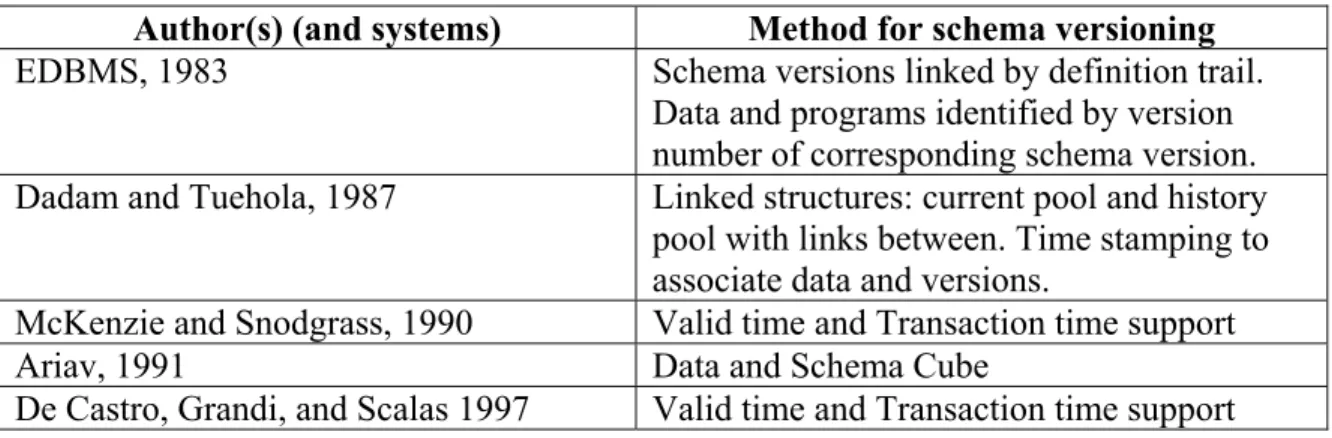
Schema versioning is accommodated when the database allows the accessing of all data, both retrospectively and prospectively, through user definable version interfaces [Roddick 1995].
schema following a sequence of changes, coercing data or mapping the existing data to the different versions, and identifying each schema version uniquely. A number of different strategies have been adopted for schema versioning. Versions of the entire schema may be maintained, or specific schema objects may be versioned and maintained (class or relation, type or domain). In addition, versions of the schema or of schema objects may be virtually created using views. Schema versioning strategies have been described using object-oriented systems, using relational database systems, and using conceptual models.
3.1 Management of Versions and Object-Oriented Data Model
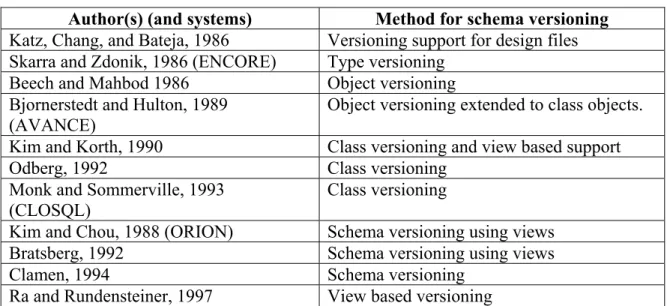
Management of versions in object-oriented databases is accomplished at two different levels of the schema: versioning schema objects (class and type), or versioning the entire
schema. In class or type versioning, the original schema is not modified. Instead a new version of the class or type is created. Using schema versioning, the entire schema is treated as a versioned object. A summary of these research methods is shown in table 4.
Author(s) (and systems) Method for schema versioning
Katz, Chang, and Bateja, 1986 Versioning support for design files Skarra and Zdonik, 1986 (ENCORE) Type versioning
Beech and Mahbod 1986 Object versioning Bjornerstedt and Hulton, 1989
(AVANCE)
Object versioning extended to class objects. Kim and Korth, 1990 Class versioning and view based support
Odberg, 1992 Class versioning
Monk and Sommerville, 1993 (CLOSQL)
Class versioning
Kim and Chou, 1988 (ORION) Schema versioning using views Bratsberg, 1992 Schema versioning using views
Clamen, 1994 Schema versioning
Ra and Rundensteiner, 1997 View based versioning
Table 4: Summary of Schema Versioning using Object-Oriented Model