MIDDLE LEVEL PRINCIPALS’ PARENT INVOLVEMENT PRACTICES
by
Tracie V. Tomichek-Michalowski
Bachelor of Arts, Chatham University, 1995 Master of Education, Duquesne University, 2002
Submitted to the Graduate Faculty of School of Education in partial fulfillment
of the requirements for the degree of Doctor of Education
UNIVERSITY OF PITTSBURGH SCHOOL OF EDUCATION
This dissertation was presented
by
Tracie Virginia Tomichek-Michalowski
It was defended on March 27, 2017 and approved by
William Bickel, Ph.D., Professor Emeritus, Administrative and Policy Studies Michael Gunzenhauser, Ph.D., Associate Dean, Administrative and Policy Studies
Mary Margaret Kerr, Ed.D., Professor, Administrative and Policy Studies Diane Kirk, Ph.D., Clinical Associate Professor, Administrative Policy and Studies Advisor: Charlene Trovato, Ph.D., Associate Professor, Administrative and Policy Studies
Copyright © by Tracie Virginia Tomichek-Michalowski 2017
The purpose of the exploratory research study was to identify middle level principals’ parent involvement practices. Parent involvement impacts students in positive ways, and a principal must have the ability to involve parents. The job description of a principal can be difficult to place on paper. Principals multitask throughout the day and often shift from leader to conflict resolver in a moment’s notice while also focusing on the safety and overall well-being of the entire school community. Principals play a significant role in making parents an integral part of the school by involving them in their child’s educational process. Principals need to develop a supportive and welcoming environment for both students and parents.
The review of literature examines reasons why teachers may or may not involve parents, explains different models of parent involvement, and identifies barriers to parent involvement. Knowing the principal plays a key role in facilitating parent involvement, the overall aim of the exploratory study is to examine middle level principals’ parent involvement practices.
Middle level principals in the western region of Pennsylvania were surveyed to determine how their current practices aligned with Joyce Epstein’s six parenting practices which include parenting, communicating, volunteering, learning at home, decision making, and collaborating with the community. Findings indicate middle level principals engage in using practices within
MIDDLE LEVEL PRINCIPALS’ PARENT INVOLVEMENT
Tracie Virginia Tomichek-Michalowski, EdD University of Pittsburgh, 2017
all six categories. Findings also indicate principals can improve practices that are more individualized for students and families. A need for professional development for principals and teachers in order to involve parents into the school community was identified.
TABLE OF CONTENTS
PREFACE ... XII
1.0 INTRODUCTION ... 1
1.1 PURPOSE OF THE STUDY ... 4
1.2 STATEMENT OF THE PROBLEM ... 6
1.3 RESEARCH QUESTION ... 7
1.4 SIGNIFICANCE OF THE STUDY ... 7
1.5 DEFINITIONS OF KEY TERMS ... 8
2.0 REVIEW OF THE LITERATURE ... 10
2.1 HOW DO TEACHERS’ SELF-EFFICACY AND PERSONAL BELIEFS CONTRIBUTE TO THEIR PRACTICES REGARDING PARENT INVOLVEMENT? ... 10
2.1.1 Bandura’s Social Cognitive Theory ... 11
2.1.2 Self-efficacy and Teachers ... 13
2.1.3 Benefits of Teacher Self-efficacy for Students and Schools ... 15
2.1.4 Personal Experience ... 17
2.1.5 Self-efficacy and Pre-service Teachers ... 19
2.2 WHAT MODELS/FRAMEWORKS OF PARENT INVOLVEMENT ARE USED IN THE FIELD OF EDUCATION? ... 21
2.2.1 Hoover-Dempsey and Sandler Model ... 22
2.2.2 The Reactive Hypothesis and Parent Involvement Findings ... 28
2.2.3 Epstein’s Typology ... 31
2.3 WHAT DOES RESEARCH SAY ABOUT PARENTS NOT GETTING INVOLVED? ... 36
2.3.1 Language Barriers for Minority and Immigrant Parents ... 37
2.3.2 Barriers ... 39
3.0 RESEARCH METHODOLGY ... 44
3.1 INTRODUCTION ... 44
3.2 STATEMENT OF THE PROBLEM ... 46
3.3 RESEARCH QUESTIONS ... 47 3.4 THEORETICAL FRAMEWORK ... 47 3.5 RESEARCH DESIGN ... 50 3.5.1 Survey Design ... 50 3.5.2 Survey Sampling ... 52 3.5.3 Data Collection ... 55 3.6 DATA ANALYSIS ... 55 4.0 FINDINGS ... 58 4.1 INTRODUCTION ... 58 4.2 PARTICIPANTS ... 59
4.3 ADDRESSING THE RESEARCH QUESTIONS ... 60
4.3.2 Middle Level Principals’ Responses to Epstein’s Six Parent Involvement
Categories... 64
Middle Level Principals’ Rank of Epstein’s Six Categories ... 71
4.3.2.1 4.3.3 Demographics and Socioeconomics ... 71
Years of Experience and Years in Current Position ... 72
4.3.3.1 Gender ... 75
4.3.3.2 Socioeconomics Based on Free and/or Reduced Lunch ... 75
4.3.3.3 Geographical Location ... 77
4.3.3.4 5.0 DISCUSSION ... 79
5.1 SUMMARY OF PERSONAL EXPERIENCE ... 80
5.2 MIDDLE LEVEL PRINCIPALS’ RESPONSES TO INDIVIDUAL PRACTICES ... 82
5.3 MIDDLE LEVEL PRINCIPALS’ RESPONSES TO THE SIX CATEGORIES ... 85 5.3.1 Parenting ... 85 5.3.2 Communicating ... 86 5.3.3 Volunteering ... 87 5.3.4 Learning at Home ... 89 5.3.5 Decision Making ... 90
5.3.6 Collaborating with the Community ... 91
5.4 VARYING RESPONSES DUE TO DEMOGRAPHICS ... 92
5.5 IMPLICATIONS FOR POLICY AND PRACTICE... 95
5.7 LIMITATIONS ... 99 5.8 CONCLUSIONS ... 100 APPENDIX A ... 103 APPENDIX B ... 106 APPENDIX C ... 114 APPENDIX D ... 119 APPENDIX E ... 123 APPENDIX F ... 125 APPENDIX G ... 126 APPENDIX H ... 127 BIBLIOGRAPHY ... 128
LIST OF TABLES
Table 1. Description of Epstein's typology ... 34
Table 2. Identified barriers and supporting research ... 40
Table 3. Middle schools in western region with middle school principals as participants ... 54
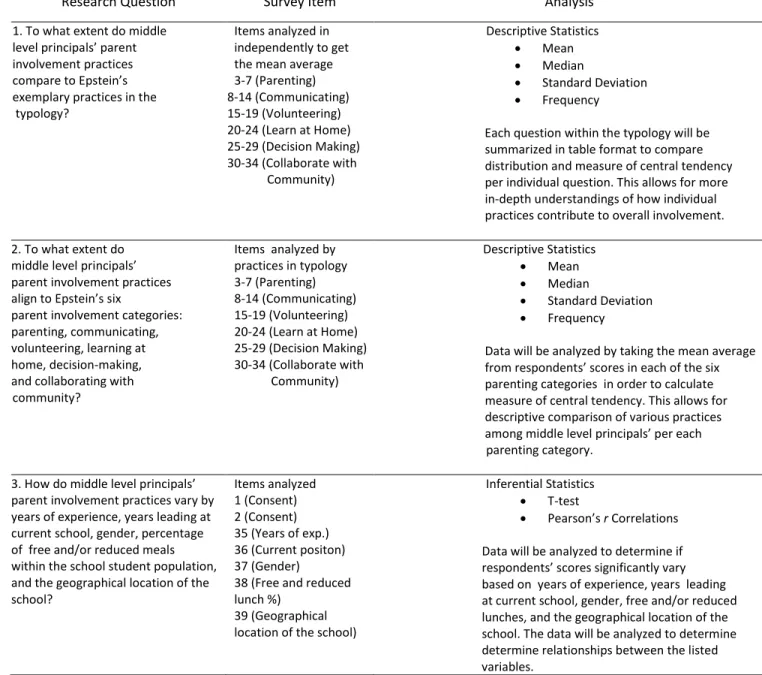
Table 4. Data analysis ... 56
Table 5. Frequency of responses per individual survey question ... 62
Table 6. Survey questions aligned to the six practices ... 64
Table 7. Responses grouped by the specific category ... 64
Table 8. Ranking of categories based on responses ... 71
Table 9. Significance of Shapiro-Wilk test ... 72
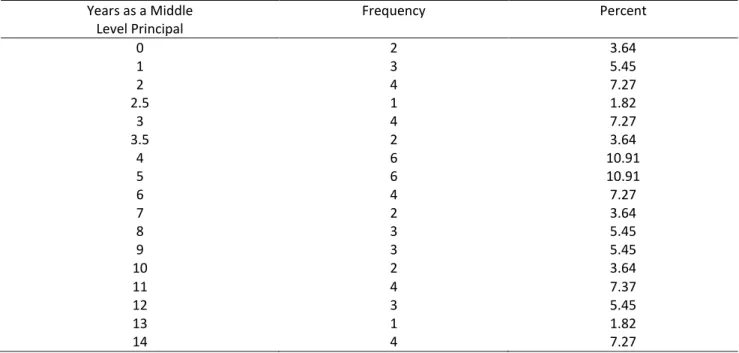
Table 10. Years of experience ... 73
Table 11.Years in current position ... 73
Table 12. Comparison of six categories, years of experience, and years in current position ... 74
Table 13. Free and or reduced lunch responses ... 76
Table 14. Mean score reported for free and or reduced lunch per category ... 76
Table 15. Geographical location data ... 77
LIST OF FIGURES
Figure 1. Social cognitive theory bidirectional relationship ... 12
Figure 2. Psychological factors contributing to parent involvement ... 22
Figure 3. School, family, community creating overlapping spheres of influence ... 32
Figure 4. Purpose of the study ... 45
Figure 5. School, family, community creating overlapping spheres of influence ... 49
Figure 6. Participant responses to individual parenting questions ... 65
Figure 7. Participant responses to individual communicating questions ... 66
Figure 8. Participant responses to individual volunteering questions ... 67
Figure 9. Participant responses to individual learning at home questions ... 68
Figure 10. Participant responses to individual decision making questions ... 69
Figure 11. Participant responses to individual collaborating with the community questions ... 70
Figure 12. Male and female responses per category ... 75
Figure 13. Original survey ... 113
Figure 14. Modified survey... 118
PREFACE
One does not accomplish anything alone, and I have never been alone in this process. Spike, thank you for always being encouraging and believing in me. It is hard to believe the 18 year girl you met almost 30 years ago has come this far! We still have a ways to go, together. To my family, especially my sister Johnna, and friends, I really was writing all those times you asked me to go out and having to call me Dr. Michalowski (all the time) proves it! I would like to thank my dissertation advisor, Dr. Trovato, whose supportive and kind guidance was exactly what I needed. To my committee, Dr. Bickel, Dr. Gunzenhauser, Dr. Kerr, and Dr. Kirk, thank you for sharing your expertise and knowledge and allowing me to flourish.
To my parents, how deeply I wish you were here so I could make you proud. You taught me kindness, love, compassion, resiliency, and perseverance. I have put these skills to good use through this journey. I know that you will always be a part of everything I do.
1.0 INTRODUCTION
There is no higher compliment than to be entrusted to positively shape the minds of young people who are the future leaders of this world. Parents entrust educators to do this every day while their children are in school. Parents need to know about the daily events taking place while their child is at school in order to follow-up at home and take an active role in the educational process. Ensuring the success of a child is a collaborative process; principals, teachers and parents must work together to support a child throughout his or her education. Parental support for education can be traced back to the colonial times when formal education was shaped in America. Parents were involved in various aspects of education including hiring of teachers and choosing topics of studies which included religious studies (Vinovskis, 1987). Parents were engaged in schooling and were able to make collaborative decisions about the educational process. Decisions regarding hiring and curricula are now assigned to school district personnel. A shift has occurred, and through the years parents have become less engaged and involved in the educational process. Engagement and involvement are not the same and need to be clearly defined as this study focuses of parent involvement.
Two terms used in discussions about parent-school relationships are parent engagement
and parent involvement. These terms are sometimes used interchangeably, but this dissertation focuses on the term, parent involvement. Ferlazzo (2011) stated parent involvement is a term
collaborating with the school. Ultimately, a partnership between parents and school personnel should exist. However, parents need to become involved in the educational process before they can truly be engaged in it. Therefore, the focus of literature in Chapter 2 is on parent involvement, because it leads to sustainable and meaningful parental inclusion.
Parents complement the school process. Parents know their children best and can assist in helping teachers know how to make learning meaningful and lead to a child’s success. Hoover-Dempsey, Sandler, and Walker (1995) recognized the importance of parent involvement and emphasized the need to study parent motivators. They wrote, “Educators, policy makers, and researchers have long focused on parental involvement as a complement to the fundamental importance of strong teaching and curricula to student achievement” (p. 40). Schecter and Sherry (2008) stated that “in recent years, the concept of parent involvement in education has become a common lens through which to explore and understand the relationships between schools and families” (p. 60).
Furthermore, teachers and parents working together can enhance the educational process by improving attendance, diminishing behavioral problems, improving reading and writing skills, and increasing test scores (Comer & Hayes, 1991; Epstein, 2008). Parental involvement in education is so critical that United States presidents have identified the importance of parent involvement and supported legislation such as Goals 2000 Educate America Act, Elementary and Secondary Act, and No Child Left Behind, which all encourage parent involvement (McNeal, 2012).
Parents may believe they are sufficiently involved in their child’s education, but several studies indicate over time parent involvement has decreased (Bakker, Dennessen, & Brus-Laeven, 2007; Halsley, 2005; Hindin, 2010). The difference in teacher and parent perceptions of
parent involvement creates a gap in the educational process, and it is important to understand what affects involvement on both the teacher and parent side of this collaboration. Therefore, the review of literature in Chapter 2 contributes to a better understanding of parent involvement in schools.
However, throughout the literature review there is also an emerging key factor in parent involvement which is the role of the principal. After noting the importance of parent involvement at the high school level, Dornbusch and Ritter (1988) concluded the role of the principal is crucial to the successful development and implementation of an effective parental involvement program, administrators must consider ways to promote parent activity in the school community. Griffith (2001) studied principals’ leadership in parent involvement and found the behavior of a principal influences the amount of parent involvement in a school, and principals who develop a supportive environment and positive school climate within a school had higher levels of parent involvement. Richardson (2009) studied principal’s perceptions of parent involvement and stated under the leadership of a principal who communicates the value of parents, school personnel can strengthen the appreciation parents have of their important role in the school.
The literature review begins by examining how practicing and pre-service teachers’ self-efficacy and their personal beliefs about parent involvement come to fruition based on Bandura’s social cognitive theory. In reading this, one will come to understand why some teachers may or may not believe in parent involvement practices. Next, parent involvement models are described to understand the various ways involvement can occur at home, school, and within the extended community. There is no perfect parent involvement model. However, reviewing the literature highlights various models used in education to facilitate or measure parent involvement. The
parent involvement. Literature regarding barriers that may impede parental involvement is also reviewed in order to understand and explain why parents may be hesitant or unable to become involved in their own child’s education. In addition, highlighting barriers as to why parents may not get involved in their child’s education allows teachers to move beyond the assumption that a parent does not care and develop practices that facilitate parent involvement.
The need for parent involvement is evident, as well as the key role principals play in facilitating parent involvement within the school community. The review of literature examines how teachers affect parent involvement, explains different models of parent involvement, and identifies barriers to parent involvement. Then by knowing the key role the principal plays in facilitating parent involvement, the overall aim of the exploratory study is to examine middle level principals’ parent involvement practices.
1.1 PURPOSE OF THE STUDY
The purpose of this study is to determine middle level principals’ parent involvement practices. A review of the literature indicates a gap in the research at the middle school level as many of the studies focusing on parent involvement have been conducted at the elementary level. In addition, parent involvement studies are often conducted with students, teachers and parents. Research indicates when parents are involved in their child’s education the attendance rate is high, behavioral problems diminish, reading and writing skills improve, and test scores increase (Comer & Hayes, 1991; Epstein, 2008). Research suggests a teacher’s ability to facilitate parent involvement can be affected by his or her personal beliefs, self-efficacy, confidence, and personal experiences. Parents do not always feel welcomed into schools, language barriers
prevent involvement, and psychological factors can keep parents from becoming involved in school (Hoover-Dempsey et al., 2005; Matuszny, Devender, & Coleman, 2007; Trotman, 2001). Griffith (2001) found principals play a role in facilitating parent involvement; principals who develop a supportive environment and positive school climate within a school had higher levels of parent involvement. This study allows the researcher to collect data to determine principals’ practices of parent involvement at the middle level. Joyce Epstein is a leading researcher on the topic of parent involvement. Epstein’s (1995, 2002, 2011) research focuses on creating a partnership between parents, teachers, students, and others in order to create a caring community around students. Her theoretical model, Overlapping Spheres of Influence, serves as a basis for creating a partnership in order to support a student. In addition, Epstein (1995) created a typology which identifies six parent involvement categories, each with specific practices, used to facilitate parent involvement:
1. Parenting 2. Communicating 3. Volunteering 4. Learning at home 5. Decision making
6. Collaborating with the community
Epstein and colleagues (1995) created a survey, Measures of School, Family, and Community Partnerships, in order to assist schools in collecting data to determine parent involvement. This survey collects data based on Epstein’s typology. Revising the existing Measures of School, Family, and Community Partnerships survey and administering it to middle
level principals allowed the researcher to identify principals’ practices of parent involvement at the middle level.
1.2 STATEMENT OF THE PROBLEM
Several key findings regarding parent involvement assist in shaping this study. Epstein et al. (2002) concluded schools’ lack of effort to implement partnerships with parents contribute to the decline of parent involvement across grade levels. They also found students entering adolescence prefer to have parents less visible. Parents are less familiar with the higher level curriculum which can contribute to them assisting less at home. In addition, secondary teachers are unsure how to include parents at the secondary level.
Research indicates attendance, academic achievement, behavior, attitude, and mental health of children improve when parents are involved in the educational process (Comer & Hayes, 1991; Epstein, 2008; Hornby & Lafaele, 2011). Since parent involvement impacts students in positive ways, a principal must have the ability to involve parents. However, studies on middle level principals’ parent involvement practices are lacking. This study looks to close the gap by studying middle level principals’ parent involvement practices by using Epstein’s typology.
1.3 RESEARCH QUESTION
This study uses three research questions as the basis to learn more about middle level principals’ parent involvement practices. The research questions are designed to collect in-depth data about middle level practices toward fostering parental involvement in education. The practices are aligned to Epstein’s typology. The research questions are as follows:
1. To what extent do middle level prinicpals’ parent involvement practices compare to Epstein’s exemplary practices in the typology?
2. To what extent do middle level principals’ parent involvement practices align to Epsteins’s six parent involvement categories: parenting, communicating, volunteering, learning at home, decision-making, and collaborating with community?
3. How do middle level principals parent involvement practices vary by years of experience, years leading at current school, gender, percentage of free and/or reduced meals within the school student population, and the geographical location of the school?
1.4 SIGNIFICANCE OF THE STUDY
This quantitative study examined middle level principals’ parent involvement practices. The theoretical framework from Epstein (1995) was used. Epstein developed a typology with six parent involvement categories including; parenting, communication, volunteering, learning at home, decision making, and collaborating with the community. The literature review details
understanding of the current practices middle level principals use to involve parents, especially when aligning the practices to Epstein’s typology. This study is significant because it allowed middle level principals to answer questions about their current practices of parent involvement.
The data collected aligned principals’ responses to Epstein’s individual practices and each category. This allows middle level principals to better understand current parent involvement practices being used or the lack of practices being used. This study will be useful to help current middle level principals change their current practices (if needed) to better involve parents which leads to a child’s overall academic and social success.
1.5 DEFINITIONS OF KEY TERMS
The following definitions assist the reader in becoming familiar with key terms used throughout various studies cited in this dissertation.
1. Parent Involvement-Refers to the teachers’, schools’, or child’s request to parents to assist at school or at home to benefit the educational process of the child (Epstein, 1985). 2. Parent Involvement at Home-Parent-child interactions on school-related or other learning
activities that represent the direct investment of a parent’s resources in his or her child’s education (Sheldon, 2002).
3. Parent Involvement at School-Parent interactions with teachers and other school personnel that can affect student achievement because parents are demonstrating to their child that education is important (Sheldon, 2002).
4. Self-efficacy-Beliefs in one’s capability to act in ways that will produce the desired
5. Role Construction- Defines parents’ beliefs about what they are supposed to do in their children’s education and appears to establish the basic range of activities that parents construe as important, necessary, and permissible for their own actions with and on behalf of their children (Hoover-Dempsey & Sandler, 1997).
6. Roles-Sets of expectations or beliefs held by individuals and groups for behaviors of individual members (Hoover-Dempsey & Sandler, 1997).
7. Reactive Hypothesis-“Any negative correlation or relationship between parent involvement and academic achievement stems from a reactive parent involvement strategy whereby a student having academic difficulty or behavioral difficulty leads to greater parent involvement i.e., checking in” (McNeal, 2012, p. 79).
8. Monitoring-Parent involvement in which parents monitor a child’s behavior out of
concern for their child’s well-being. This translates into improved educational performance (McNeal, 2012).
9. Parent-child communication-Parents convey to their child the importance of schooling. Discussions also allow a parent to identify when their child becomes disengaged in schooling (McNeal, 2012).
10. Educational support practices-Parents directly involved in educational practices in which they engage their child. Teachers identify that parents are involved, which may lead to greater attention from the teacher because they are aware the parent is involved (McNeal, 2012).
2.0 REVIEW OF THE LITERATURE
The review of literature was conducted to acquire a solid understanding of parent involvement including teachers’ practices of parent involvement and how self-efficacy affects their ability to involve parents, various models used to involve parents, as well as reasons why parents may not get involved in the educational process. Reviewing the literature on various aspects of parent involvement set the foundation for understanding the benefits students receive when parents are involved. Researching the various aspects of parent involvement framed the need for this study as it became evident principals play an integral role in facilitating parent involvement and a gap exists in research conducted at the middle level.
2.1 HOW DO TEACHERS’ SELF-EFFICACY AND PERSONAL BELIEFS
CONTRIBUTE TO THEIR PRACTICES REGARDING PARENT INVOLVEMENT?
Educators teach students academic, social, and moral lessons that guide them to become productive citizens in this world. Teaching these skills effectively is imperative. If an administrator walks into the classroom, he or she will look at the content being delivered, classroom management, and/or lesson structure to determine if the teacher is effective. Administrators may even collect data to note student involvement in learning. Additionally, it is
process. Measuring parent involvement is not as easy as observing student involvement since parent involvement occurs in many ways both inside and outside of the school setting. However, a keen principal can tell which teachers desire and value working with parents by noting newsletters going home, emails being sent to parents, classroom projects involving parents, effective parent-teacher conferences, and/or websites that ask for parent involvement in homework or other assignments. Principals collecting data to gauge parent involvement is as easy as requiring teachers to document emails and phone calls home. If a teacher does not involve parents on any level, principals must explore why.
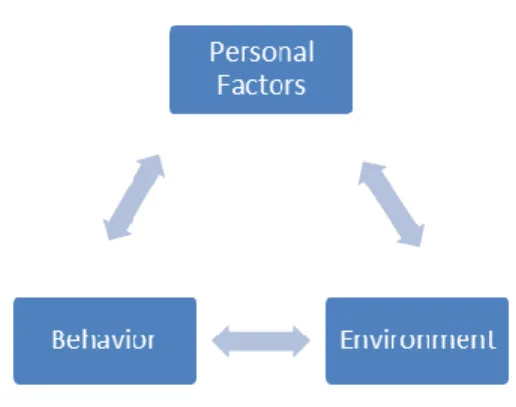
One major reason teachers may not involve parents is their own self-efficacy. Teachers’ personal beliefs and self-efficacy affect their own willingness and ability to involve parents, which can ultimately affect student outcomes (Tschannen-Moran & Hoy, 2001). Bandura’s (1989, 1997) social cognitive theory sheds light on the notion that behavioral, personal, and environmental factors contribute to why teachers may or may not feel comfortable involving parents.
2.1.1 Bandura’s Social Cognitive Theory
Bandura’s social cognitive theory stems from the field of psychology, but his work is accepted by many disciplines including the field of education. Bandura (1989, 1997) explained social cognitive theory as a triadic causal structure in which behavior, personal factors, and environment influence each other in a bidirectional manner, which in turn influences human functioning and learning. Human functioning and learning take place through observation of
Figure 1. Social cognitive theory bidirectional relationship
Bandura’s social cognitive theory, a framework for understanding human functioning, is broken down into five central concepts including observational learning/modeling, outcome expectations, goal setting, self-regulation, and perceived self-efficacy. Denier, Wolters, and Benzon (2014) concisely described the concepts in the framework. Observational learning/modeling is vicarious learning done through watching behavior and consequences of observable models within the environment. This type of learning is dependent on a four-step process of attention, retention, production, and motivation. Outcome expectations form the behaviors people perform or suppress based on consequences or valued responses. Goal setting is a cognitive process in which a person thinks about a desired outcome and then plans how to reach the goal. Through observation/modeling, one can develop a goal and put a plan into action. Self-regulation is one’s ability to manage his or her own action in order to reach a desired outcome (or goal). Self-regulation is done through observation, judgment, and/or self-reflection. The last central concept is perceived self-efficacy, which is a focus area of this literature review.
Each of these four concepts shape human behavior, thus each can be linked to teachers’ personal and professional lives. Focusing on perceived self-efficacy assists in understanding the
different beliefs teachers possess regarding parent involvement regardless of training or school interventions. Bandura (1997) defined perceived self-efficacy as “beliefs in one's capabilities to organize and execute the course of actions required to produce given attainments” (p. 3). A person who has a high level of perceived self-efficacy believes he or she can accomplish an activity based on his or her own capabilities. If a teacher has a high level of self-efficacy and believes there are benefits to parent involvement, he or she will try to execute the course of action required to attain parent involvement.
2.1.2 Self-efficacy and Teachers
Bandura (1997) provided an example of how self-efficacy affects an individual in order to understand the relationship between self-efficacy and a teacher’s belief that he or she can involve parents successfully (or complete other tasks):
People’s beliefs in their self-efficacy have diverse effects and influence the courses of action people choose to pursue, how much effort they put forth in given endeavors, how long they will persevere in the face of obstacles and failures, their resiliency to adversity, whether their thought patterns are self-hindering or self-aiding, how much stress and depression they experience in coping with taxing environmental demands, and the level of accomplishments they realize. (p. 3)
According to this framework, teachers who have a high level of self-efficacy possess the perseverance and resiliency to strategize ways to involve parents. Teachers who believe they are capable of involving parents do. A teacher’s self-efficacy directly impacts his or her ability and
Self-efficacy can change throughout a teacher’s career (Gibson & Dembo, 1984), and this change may lead to a decline in the ability or desire to involve parents. A teacher’s level of self-efficacy can change based on what they are teaching or can be content specific or content matter specific (Tschannen-Moran & Hoy, 2001). Teachers, who are knowledgeable about the content they deliver and feel capable to deliver it, most often experience a high level of self-efficacy. Tschannen-Moran and Hoy (2001) also found teachers may have a high level of self-efficacy while working with particular types of students. In contrast, teachers with a low level of self-efficacy were found to try less to reach the learning needs of their students (Pendegrast, Garvis, & Keogh, 2011). These findings about self-efficacy make a strong statement about placing teachers at the appropriate level teaching the content desired. Teachers are encouraged to have multiple certifications in order to sustain employment during job cuts and budgetary constraints. Placing teachers in areas in which they may not truly desire to teach (even though appropriate certification exists) can affect their self-efficacy and student achievement (Tschannen-Moran & Hoy, 2001). Findings on teachers’ self-efficacy shed light as to why a teacher may not want to involve parents.
It should be noted that a teacher with a high level of self-efficacy is different from a teacher with confidence, because self-efficacy and self-esteem are different concepts and should not be used interchangeably. Bandura (1997) stated, “self-esteem is concerned with judgments of self-worth” (p. 11). Self-efficacy is one’s belief in his or her abilities to do tasks to get something done. It is evident that a teacher’s self-efficacy can contribute to his or her desire to facilitate parent involvement. If a teacher desires to involve parents because they understand the benefits of parent involvement, a high level of self-efficacy can make the involvement process easier.
Bandura’s framework of social cognitive theory has been used by researchers to ground their own studies focusing on teacher self-efficacy (Dellinger et al., 2008; Erdme & Demirel, 2007; Gibson & Dembo, 1984; Hoover-Dempsey, Bassler, & Brissie, 1987; Stipnek, 2012). Research about teacher self-efficacy has occurred across grade levels, content matter, and countries. The common thread between these studies is a positive correlation between teacher self-efficacy and the ability to involve parents. Involving parents leads to positive outcomes for students.
2.1.3 Benefits of Teacher Self-efficacy for Students and Schools
Research links a teacher’s sense of self-efficacy to student outcomes. Teachers with a high level of self-efficacy positively affect student achievement and motivation (Midgley, Feldhaufer & Eccles, 1989; Ross, 1992). Teachers who develop a high sense of self-efficacy tend to embrace new ideas and experiment with new teaching methods to meet students’ needs (Berman et al., 1977; Guskey, 1988; Stein & Wang, 1988). Gibson and Dembo (1984) found classrooms are more conducive to learning and promote a positive culture when the teacher reports having a high level of sense of self-efficacy. Teachers who describe themselves as having a high level of efficacy are more likely to promote motivation and create learning opportunities that facilitate academic progress (Bandura, 1993). As stated above, students benefit in numerous ways when interacting with teachers who possess a high level of self-efficacy. A teacher who has a high level of self-efficacy and believes he or she is capable of getting a task done is likely eager to involve parents.
and Wang (1988) found that teachers with high levels of self-efficacy were more effective when implementing school change. Teachers who believe they are capable of implementing a program were able to do so with great success. Teachers continued to value the program as time passed. When reviewing program implementation over time, Stein and Wang also found, “star implementers exhibited marked gains in their perceptions of self-efficacy while the less successful teachers evidenced a decrease in their levels of self-efficacy” (1988, p. 182). In other words, as teachers believed in themselves and their ability to complete the implementation, self-efficacy levels increased.
In linking Stein and Wang’s theory to Bandura’s social cognitive theory, it becomes apparent that when a school identifies a need to implement programs, especially those initiating parent involvement, the success of the program may depend on the levels of self-efficacy teachers possess. The comfort level of working together is compromised when teachers believe they cannot build successful relationships when working with parents. Teachers need to be knowledgeable in what they teach students; they also need believe they can learn from parents. Teacher buy-in is one aspect related to the success of any new program. However, teachers also need to believe in their capabilities to implement the program.
Teachers interact with parents in various ways including phone calls to discuss grades, face-to-face meetings during parent-teacher conferences, and/or casually during school activities. Some teachers are comfortable creating projects and activities that take place in the home and involve parents interacting with their child. Other teachers balk at the thought of communicating with a parent for any reason. The need to involve parents can be challenging, and although self-efficacy can be directly related to a teacher’s ability or desire to include parents, there are additional reasons why teachers may not feel comfortable working with parents.
2.1.4 Personal Experience
Research shows personal experiences affect a teacher’s ability or willingness to involve parents. Caspe (2003) studied how teachers understood families and found that teachers use communication and observation to learn about students and their families. Teachers noted conversations with parents both formally and informally as well as observing parent-student interactions help them to understand families. Teachers noted resources brought to school (notebooks, backpacks, binders, etc.) and the cleanliness of students in their observations. Teachers also communicated with other staff members in the school to learn about the history of families. All the gathered data was measured against their personal beliefs and experiences with similar students and families to understand current students. Caspe (2003) also noted that it is possible that teachers then use their personal experiences to judge families in a positive or negative manner. If this does occur, teachers may then expect more or less parent involvement based on how other similar families have participated inside or outside of the classroom.
Caspe’s (2003) findings regarding how teacher’s come to understand families connects with Bandura’s triadic structure in which relationship behaviors, personal factors, and environment influence learning. The triadic structure can relate to how teachers learn about the benefits of parent involvement. Teachers who experienced positive interaction with their own parents being involved in their education or were raised in a family that values education are more likely to see the value in parent involvement and take steps to facilitate it within the classroom. By using the social cognitive theory, teachers who experience and believe parent involvement is positive would likely develop a high level of self-efficacy, and therefore, involve
In contrast, teachers who have only experienced the “traditional family structure” in their own lives may encounter struggles when dealing with less traditional family structures. Teachers need to be aware of the various family structures and be able to communicate effectively with all involved. Souto-Manning and Swick (2006) presented an argument to make it clear that the traditional family paradigm is not the only paradigm that should be recognized in schools. Many families have working mothers who interact with children over the phone due to night work schedules. Families also include grandparents or aunts and uncles acting as parents. Cultural differences are prevalent in schools, and resources make a difference in what families can and cannot do for their children (hire tutors, participate in outside activities, etc.).Teachers who have limited experience with non-traditional families may not know or understand how to involve parents in a positive and meaningful manner.
Epstein (1995) found that many teachers are trained in the traditional family involvement paradigm reminiscent of the 1950s. Mothers take the lead role in the educational process, students come from a two-parent home, and the economic status is middle class. This creates a clouded understanding of families and parent involvement for even the most veteran teachers. Many teachers are not adequately prepared to develop involvement strategies for the various family structures of the 21st century. If training does not shift, not only will practicing teachers struggle to involve parents, new teachers will also not be prepared to work with various types of families. In addition to in-service teachers, it is imperative to review literature to determine personal beliefs of pre-service teachers regarding parent involvement and the development of involvement practices.
2.1.5 Self-efficacy and Pre-service Teachers
All of the studies referenced thus far have all looked at parent involvement from the perspective of the practicing teacher. Pre-service teachers are an untapped sample. Far less research focuses on pre-service teachers and their beliefs about parent involvement. Although pre-service teachers may be limited in their direct experiences with students and families, college course work should prepare them for the collaborative role in facilitating parent involvement. Several studies of pre-service teachers noted that no standalone courses were offered at the college level; instead, parent involvement topics were touched upon in literary courses and introductory courses (Baum & Swick, 2008; Graue & Brown, 2003; Hindin, 2010; Uldag, 2008). Throughout coursework, pre-service teachers receive small doses of information regarding parent involvement strategies, but not much else. Uldag (2008) stated, “The failure to address parent involvement in both university and professional development contexts sends a message that it is unimportant” (p. 809). Since pre-service teachers are not learning about parent involvement in their coursework, one must look further into the literature to identify how pre-service teachers develop beliefs and knowledge about parent involvement.
The literature that states teachers develop beliefs through personal experiences is similar for pre-service candidates. Graue (2005) found pre-service teachers’ recollections of their own parents’ interactions with teachers shaped their beliefs about how teachers and parents should work together. Hindin (2010) surveyed pre-service teachers before and after student teaching. On completion of student teaching, pre-service teachers indicated cooperating teachers assisted them in developing beliefs as well as strategies. Most pre-service teachers indicated phoning home or
described negative family interactions more often than pre-service teachers placed with cooperating teachers in suburban settings. Data indicate pre-service teachers may enter the profession with negative feelings about parent involvement in urban settings purely based on the experiences had through the cooperating teacher (Hindin, 2010). Most importantly, Hindin found, “no candidates saw parents’ roles as informing teachers about home school educational practices” (p.86). This indicates the lack of understanding pre-service teachers have regarding the collaborative nature of parent involvement. Parents provide valuable information to teachers. Teachers need to welcome opportunities to involve parents to gather this information to best meet the needs of students. Perhaps the most alarming, yet most significant finding from Hindin was that two candidates completed student teaching noting no communication or involvement with parents.
The literature indicates pre-service teachers recognize the importance of parent involvement (Baum & Swick, 2008; Graue & Brown, 2003; Hindin, 2010; Patte, 2011; Uldag, 2008). It also indicates pre-service teachers form beliefs from their own childhood experiences and from their student teaching experience. Overall, pre-service teachers know the importance of building positive home-school relationships; however, they lack the knowledge and training to do it effectively. In fact, Patte (2011) indicated, “over 40% of pre-service teachers surveyed reported learning no specific skills or competencies concerning the development of family school partnerships in any of their coursework” (p. 153). Pre-service teachers need more training and development to learn and implement parent involvement practices. However, there are again those pre-service teachers who easily connect with students and families. Regardless of training, or lack thereof, they are able to establish strategies to involve parents with ease. This keen ability to connect with students and families with little formal training harkens back to Bandura’s social
cognitive theory. These pre-service teachers most likely have developed a high level of self-efficacy because they have experienced relationship behaviors, personal factors, and an environment, Bandura’s triadic structure, that contributed to their ability to positively relate to students and parents.
Research shows teachers’ self-efficacy, whether practicing or pre-service, impacts parent involvement. Research has shown students directly benefit from parents being involved in the educational process. Traditional involvement, such as conferences and volunteer work, has been broadened and extended to include home and community involvement. As education and the traditional family paradigm evolved, so has the research on parent involvement. Researchers developed various models that measure levels of involvement and define types of involvement. In the field of education various models have been used in research in order to study parent involvement.
2.2 WHAT MODELS/FRAMEWORKS OF PARENT INVOLVEMENT ARE USED
IN THE FIELD OF EDUCATION?
Parent involvement models are plentiful. Reviewing literature to learn about various models leads to a better understanding of parent involvement. As stated in the introduction, parent engagement is optimal, but before parent engagement can occur, parents need to be involved. Therefore, the focus for this section of the literature review is on parent involvement. Parent involvement has traditionally involved supervising field trips, baking cupcakes, or helping with
2.2.1 Hoover-Dempsey and Sandler Model
Hoover-Dempsey and Sandler (1995) created a multivariate model to better understand the psychological component to parent involvement process. Five levels of constructs were developed defining patterns of influence and critical points of parent involvement (Hoover-Dempsey & Sandler, 1997). In order to increase effectiveness of parent involvement, the psychological variables of parents’ decisions to become involved must be understood (Hoover-Dempsey et al, 2005). This review is of the revised model depicted in Figure 2.
In 2005, the revised Hoover-Dempsey and Sandler model represented psychological factors underlying parents’ involvement behaviors and the process used during this development (Walker, Wilkins, Dallaire, Sandler & Hoover-Dempsey, 2005). Hoover-Dempsey and Sandler (1997, 2005) explained the model is based on three imperative questions:
1. Why do parents choose to become involved?
2. How does their involvement, once engaged, influence student outcomes? 3. What student outcomes are associated with parent involvement efforts?
Although there are five levels to the model, Level 1 details specific motivations that lead parents to become involved in the educational process. Exploring what motivates a parent to become involved assists teachers in understanding why a parent may or may not engage in the educational process. When a better understanding exists, teachers develop better strategies and practices to support a higher level of parent involvement. The Hoover-Dempsey and Sandler model states parents become involved due to personal motivation, invitations to become involved, and life context (Hoover-Dempsey et al., 2005).
Parents’ personal motivations derive from parental role construction and self-efficacy. Bandura’s social cognitive theory, which is connected to a teacher’s desire and capability to involve parents, can also be a key factor in a parent’s desire and capabilities to become involved in the educational process. Parents’ beliefs about child-rearing and social factors shape their views about their own participation in the educational process. This leads parents to take an active or passive role in their child’s education (Stevenson, Chen, & Uttal, 1990). Hoover-Dempsey and Jones (1997) found two parts to role construction: active (personal behaviors to support child in school) or passive (school holds primary responsibility for child’s education).
depend on the school context that promotes or hinders partnership. Parents experiencing active role construction and a high level of self-efficacy are more likely to take an active role in their child’s education. A parent’s high level of self-efficacy facilitates the belief that he or she makes a difference in their child’s education. Environment, behavior, and personal factors shape self-efficacy.
As stated previously, self-efficacy refers to beliefs in one’s capability to act in ways that will produce desired outcomes (Bandura, 1997). According to Bandura, these beliefs are shaped by environment, behavior, and personal factors. When a person believes his or her actions bring a desired outcome, he or she follows through with the actions to get the desired outcome. Therefore, based on Hoover-Dempsey et al. (1995) and Bandura (1989, 1997) a parent’s desire to assist his or her child in the educational process is similar to that of a teacher’s desire to involve parents. In addition, parents who have had positive outcomes with helping his or her child in school, received support for helping, observed positive outcomes by supporting his or her child in school, and/or received encouragement for assisting with school involvement tend to build self-efficacy and stay involved (Hoover-Dempsey et al., 2005). A parent’s personal motivation to become involved provides a rationalefor involvement.
In addition to a parent’s personal motivation to become involved, a parent’s perception of invitations affects his or her overall desire to be involved. Invitations can be general, school-specific or child-school-specific. Hoover-Dempsey et al. (2005) state the most influential others in parents’ decisions about involvement are the school, the child’s teachers, and the child. For example, a general invitation would be an administrator’s invitation to the entire school population to attend a fundraising event. A more specific invitation could be inviting a parent to attend a parent-teacher conference. A child asking for assistance with homework is also an
invitation to become involved. The development of a positive school climate allows for these invitations to occur frequently. Although parents desire to support his or her child, the teacher and administrator must provide opportunities for parents to become involved. Teachers play a role in educating the child to ask for a parent to support him or her at home. However, even with clear invitations to become involved, parents have factors leading them to be hesitant to get involved.
There are variables within the life context of a parent that can affect parent involvement. Walker et al. (2005) described that one variable identified is a parent’s own knowledge and skill level. Parents who are less educated may find it more difficult to assist a child with homework or communicate effectively with teachers (Lareau, 1989). Time and energy spent working is another variable that can affect parent involvement. The more a parent works, the less time he or she has to become involved at school or assist at home. However, Smock and McCormick (1995) found that employment status is not significantly related to involvement. A third variable within the context of a parent’s life that can affect parent involvement is family culture. Culture can shape beliefs about parent involvement. While some cultures may suggest parents stay on the sidelines, other cultures believe parents should have direct engagement with their children at home, teachers, and school activities and events (The Parent Institute, 2012).
This review of the Hoover-Dempsey Sandler model focuses only on Level 1, because it is imperative to understand the motivation of parents to become involved in order to develop solid questions used for research regarding perceptions of parent involvement. The Hoover-Dempsey and Sandler model has been used in the field of education to determine parents’ involvement decisions.
Anderson and Minke (2007) developed a survey based on the Hoover-Dempsey Sandler model and hypothesized, “the relationship between parent’s role construction and sense of efficacy and their own involvement behaviors would be mediated by their perceptions of time and energy demands and invitations from specific teachers” (p. 314). In other words, characteristics in Level I of the model, personal motivation, invitation, and life context, should directly affect parental decisions to become involved.
Elementary minority parents from a Southwest urban district were given the survey developed by Anderson and Minke (2007). Results showed that role construction was positively related to parents’ involvement behaviors. However, role construction was reported to be high, which make it difficult to analyze the data. A range in role construction beliefs would allow for a more thorough analysis. Parents’ sense of self-efficacy showed a limited direct effect on them becoming involved. However, self-efficacy was linked to parent’s involvement at home. Parents who felt good about helping their child at home and noted results continued to support his or her child at home.
The most notable findings were in the areas of resources (e.g., time and energy) and specific invitations. Anderson and Minke (2007) found that “specific teacher invitations had the strongest relationship with parents’ involvement behaviors and were associated relatively equally with the three PI variables (home, events at school, and ongoing involvement at school) across home and school” (p. 319). Parents reported that resources (e.g., time, transportation, and child care) did not affect their overall involvement. In reference to Bandura’s social cognitive theory, teachers with a high level of self-efficacy are likely the ones who are inviting parents. The parents accepting invitations are most likely parents with high levels of self-efficacy.
Limitations to this study were that participants were of lower income, attended an urban school, and were mostly African-American. This does not allow for the study to be generalizable. However, minority parents are often underrepresented, so this study brought new analysis of parent involvement. The data were based on self-reports and cannot be confirmed via other sources. It should be noted that parents who do not get involved are most likely not completing the survey. Therefore, involved parents’ answers may be significantly different than those of uninvolved parents.
Parents’ decision to get involved is important to students’ academic success; however, research on this topic is limited. Teachers’ specific invitations to parents play a significant role in the involvement process. Little information is known about parent perceptions regarding the types of communication used to initiate involvement (Anderson & Minke, 2007). In addition, the need for data collection from uninvolved parents is significant as this sampling is likely untapped. The data clearly show that there are implications for school leaders. Teachers’ efforts to involve parents are critical. Creating initiatives to support teachers to feel comfortable inviting parents to become involved will benefit students and the home-school relationship.
Anderson and Minke (2007) studied parents of elementary school aged students. The results could be very different if this study were conducted or repeated at a secondary level. It becomes more difficult to obtain results for secondary level parents, because research indicates there is a drop-off of parent involvement at the secondary level (Borough & Irvin, 2001; Dauber & Epstein, 1989).
2.2.2 The Reactive Hypothesis and Parent Involvement Findings
The Hoover-Dempsey and Sandler model identifies parents’ decision making when getting involved in their children’s education. Bandura’s social cognitive theory links behavior, personal factors, and environment to learning and emphasizes that learning takes place through observation in a social context. Another framework, the reactive hypothesis theory, posits that parents are prompted to become involved in their child’s education when they observe behaviors that are not positive and lower levels of academic achievement are noted (McNeal, 2012).
Up until this point, parent involvement has been linked to positive student outcomes, but not all parent involvement brings desired student outcomes. Furthermore, student achievement does not always increase when parents are involved. Other factors in a student’s life may contribute to student achievement more than parent involvement. Teachman (1987) found that resources at home and the home environment itself contribute to a student’s higher level of academic achievement. Identifying that there are various factors that can lead to student achievement (other than parent involvement) presents an opportunity to examine if parent involvement is always a key component to student achievement. Further investigation can determine if parent involvement is always positive. For instance, one theoretical framework for parent involvement, the reactive hypothesis, indicates that parent involvement can be negative. However, it is unclear if the negative involvement truly improves or hinders academic achievement or only facilitates negative behaviors.
When one experiences something he or she does not like, he or she most likely reacts in a manner to better the situation. Parents react to their child’s behaviors in the same reactive manner at times. Bandura’s social cognitive theory posits that when parents note observable
behaviors. For example, a parent’s reaction to low achievement (which is observable through grades) can create an emotional reaction prompting him or her to become involved in their child’s education. The reactive behavior by the parent to improve academic achievement may ultimately result in the child changing behavior, but the change in behavior may not be positive. McNeal (1999) contended that in his study, parent involvement should primarily affect behavioral outcomes not academic achievement outcomes, and these findings should be contingent on students’ social class, race, and gender. Parents noting their child’s academic achievement is low may become involved as a reactive behavior to support their child, especially given the correlation between low achievement and behavioral issues. This reactive behavior may not produce improved academic achievement and may have a negative impact on student behavior.
Epstein (1988) found that when students need assistance, especially in math and science, parent involvement can result in a negative relationship between homework and student achievement. Sudden support from the parent can create tension for the parent-child relationship. Becoming involved reactively and not proactively is not necessarily beneficial to raising student achievement. Rather, parents who consistently stay involved most likely will not experience this type of negative interaction while offering support.
To further study the reactive hypothesis, McNeal (2012) used previously collected data from the National Educational Longitudinal Study, NELS (Department of Education, 1988). This longitudinal data allowed for parent involvement analysis for grades 8, 10, and 12. The study allowed McNeal to look at several parent involvement behaviors, parent child discussion, monitoring, and educational support practices, to identify how these types of involvement affect
student performance and behaviors, specifically science achievement and truancy. McNeal’s findings did not support the reactive hypothesis since no negative correlation or relationship between parent involvement and academic achievement was present. In fact, students who were poorly performing in school or being truant were more likely to have parents who were less likely to become involved due to these behaviors. McNeal (2012) writes:
For the reactive hypothesis to be valid there needs to be a positive relationship between truancy and parent involvement. In other words, increased levels of truancy would have to be associated with increased levels of educational support practices. Just the opposite is true: The analysis found that there was a negative relationship between Grade 8 truancy and Grade 10 educational support practice. In other words, higher truancy was associated with lower levels of parental support. (p. 87)
Although McNeal’s (2012) findings did not support the reactive hypothesis, he does identify that certain types of parent involvement can have negative impacts on student achievement. However, it is more likely parents who get involved and see negative academic achievement do so because the child’s behaviors changed, thus affecting academic success. Furthermore, parents of adolescents need to approach parent involvement differently than parents of younger children. McNeal states, “It may be that most of what is known about parent involvement was developed after studying younger children, and these forms of involvement are less likely effective, and quite damaging for adolescents” (2012, p.88). Also, McNeal acknowledges that teenagers are less likely to embrace parent involvement, and therefore parents engage less in school.
Domina (2005) conducted a study using data from The National Longitudinal Survey of Youth (1979), and found both positive and negative aspects of parent involvement at the
elementary level. Attending Parent Teacher Association meetings (PTA), helping with homework, and volunteering in the school were positively associated with scores on academic tests, but, once background and prior academic achievement were controlled, the effect was negative or non-significant (Domina, 2005). It was also found that parent involvement activities do not always increase a child’s learning, but likely will prevent behavior issues. Similar to McNeal (2012), Domina concluded parents who were involved in their child’s schooling most likely encouraged positive behavior outcomes rather than academic success.
Parent involvement does not necessarily encourage learning, but it does prevent misbehavior. However, the positive behavior can improve attitude and learning at school which ultimately can lead to cognitive advantages. Domina (2005) stated, “The behavioral improvements that are associated with parental involvement may translate into cognitive advantages in the long run. As students progress through school their attitudes and behavior can have important implications for their future academic success (p. 264). Domina presents a different perspective about parent involvement reiterating academic success may occur due to a change in a child’s behavior vs. a change in learning.
2.2.3 Epstein’s Typology
McNeal’s (2012) claim reminds us that much of the research is geared toward parent involvement during the elementary years. Elementary students naturally need more support due to age and correlating development. The natural setting in elementary schools allows for more parent involvement in plays, parties, field trips, and fund-raising, which are usually volunteer
involvement model details how the spheres of influence and six parenting categories affect involvement. Figure 3 depicts how school, family, and community all influence the outcome of a child.
Figure 3. School, family, community creating overlapping spheres of influence
In essence, family, community, and school are integral parts of the support system for students. Epstein labels this model the spheres of influence. The benefit of these three spheres overlapping impacts students. High-quality communication between all spheres “gives a consistent message to students regarding the importance of school and helps youngsters succeed in school and later in life” (Epstein, 1995, p.82).
Because the term, parent involvement, is broad, it can be challenging to clearly define what activities fall into the realm of parent involvement. Volunteering is one way parents get involved. However, other activities such as assisting with homework or studying can also be a way for parents to get involved. Parent involvement does not just occur at school; involvement can take place at home. A partnership between home and school is best when supporting a child. Support is also best when extended in to the community. Epstein’s spheres of influence are valuable, because they give a more definitive way collaboration can be done in a successful partnership. In addition, there are internal and external components to this model. Epstein (1995)
Child
School
Community
explained that the external model allows for some school, family, and community practices to be conducted separately and some to be conducted together. All of these practices support a
student’s learning. “The internal model, which is an interaction among the spheres, shows the complexity and essential interpersonal relations and patterns of influence that occur between school, family and the community” (Epstein, 1995, p.82). It must be noted the student is always in the center as he or she plays the most important role in the educational process. Desandles (2001) describes Epstein’s model as a reciprocal relationship among teachers, families, and students in which the students are active agents in the school-family relationship.
Characteristics indicative of the overlapping spheres of influence are seen throughout a school. The characteristics are experienced daily and schools are “family friendly,” which means they take into account the realities of family life such as working parents (Epstein, 1995). In order for school, parent, and communities to work together schools will have programs in place to create practices that meet the individual needs of the entire school community. Because programs are developed based on the needs of the school community, these programs can look different from site to site. Parent involvement can occur in various ways. To better define parent involvement, Epstein (1995) also created a framework of six major types of parent involvement that allow students at the elementary, middle, and high school level to be successful because school, family, and community work together. This framework advocates for teachers and schools to involve parents. Schools may determine to emphasize one type of involvement more than another based on the desired practices of the teachers and the culture of the school.
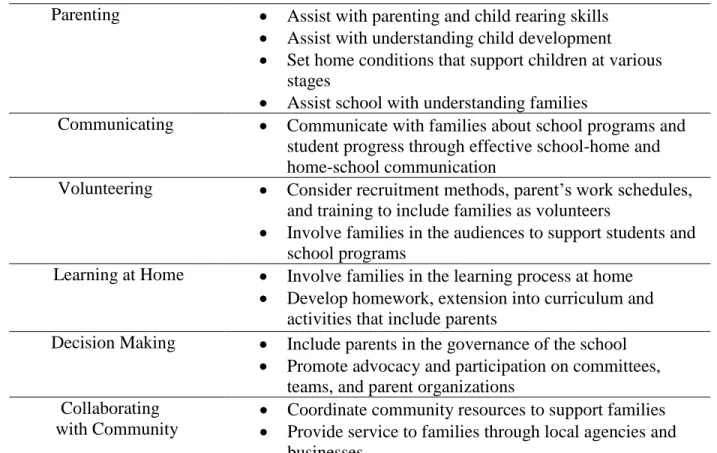
Table 1 details each of Epstein’s parenting categories and indicates the types of practices that fall into each category as defined by Parent Education Bridge for Student Achievement
Table 1. Description of Epstein's typology
Categories Exemplary Practices
Parenting Assist with parenting and child rearing skills
Assist with understanding child development
Set home conditions that support children at various stages
Assist school with understanding families
Communicating Communicate with families about school programs and student progress through effective school-home and home-school communication
Volunteering Consider recruitment methods, parent’s work schedules, and training to include families as volunteers
Involve families in the audiences to support students and school programs
Learning at Home Involve families in the learning process at home
Develop homework, extension into curriculum and activities that include parents
Decision Making Include parents in the governance of the school
Promote advocacy and participation on committees, teams, and parent organizations
Collaborating with Community
Coordinate community resources to support families
Provide service to families through local agencies and businesses
Through the use of Epstein’s typology model, researchers can determine parent involvement in schools and determine strengths and areas to improve. Benefits such as increased student achievement, fewer behavior issues, and less truancy are experienced within the school community. Ingram, Wolfe, and Lieberman (2007) used Epstein’s typologies to investigate elements of parent involvement and children’s academic achievement at the elementary level. Epstein’s typology measured the types of involvement prevalent at high achieving, low socio-economic schools. Results indicated parents most often participated in two of the six categories, parenting and learning, at home. Further investigation found barriers to the remaining four types of parent involvement. For example, barriers to volunteering included working parents’