SCALE STRUCTURE, DEGREE MODIFICATION, AND THE SEMANTICS OF GRADABLE PREDICATES
Christopher Kennedy Louise McNally Northwestern University Universitat Pompeu Fabra
First author contact information Department of Linguistics
2016 Sheridan Rd. Evanston, IL 60208 USA [email protected] +1-773-665-1536
Second author contact information Departament de Traducci´o i Filologia, UPF La Rambla, 30-32
08002 Barcelona, SPAIN [email protected] +34-93-542-16-17
SCALE STRUCTURE, DEGREE MODIFICATION, AND THE SEMANTICS OF GRADABLE PREDICATES
In this paper we develop a semantic typology of gradable predicates, with special emphasis on deverbal adjectives. We argue for the linguistic relevance of this
typology by demonstrating that the distribution and interpretation of degree modifiers is sensitive to its two major classificatory parameters: (1) whether a gradable
predicate is associated with what we call an open or closed scale and (2) whether the standard of comparison for the applicability of the predicate is absolute or relative to a context. We further show that the classification of an important subclass of
adjectives within the typology is largely predictable. Specifically, the scale structure of a deverbal gradable adjective correlates either with the algebraic part structure of the event denoted by its source verb or with the part structure of the entities to which the adjective applies. These correlations underscore the fact that gradability is characteristic not only of adjectives but also of verbs and nouns, and that scalar properties are shared by categorially distinct but derivationally-related expressions.∗
1. DEGREE MODIFICATION IN DEVERBAL GRADABLE ADJECTIVES Among the many
observations made in Bolinger’s (1972) classic study of degree expressions in English, two stand out. First, degree modifiers in English have distributions which cannot be given a purely syntactic explanation. Consider, for example, the behavior of well, much and very. At a superficial level, these three modifiers appear to have very similar syntactic and semantic properties: they all apply to deverbal gradable adjectives, and they all raise the degree to which the deverbal adjective holds of its subject. In 1, for example, the addition of the degree modifiers increases the degree to which the properties are claimed to hold of their respective subjects in roughly the same way.
(1) a. Martin Beck was (well) acquainted with the facts of the case. b. Their vacation was (much) needed.
c. Al was (very) surprised by the results of the election.
Despite these similarities, however, according to our intuitions and those of other speakers we have consulted, these modifiers differ in terms of their acceptability with different adjectival participles. In fact, as shown by the following examples, their distributions are largely
complementary (see Knowles (1974) for discussion of the complementarity of very and much):1
(2) a. Beck is well/??very/??much acquainted with the facts of the case.
b. We’ll be surrounded by dozens of people – you’ll be well/??very/??much protected. c. By the time it reached the Manchester Palace, it had become a well/??very/??much
documented tour.
d. But that was no longer true at election time: as the election approached, the highly educated became less interested, and those who were not well/??very/??much
educated became more interested.
(3) a. But the heavy rain has been welcomed by the British Waterways, as a
much/??well/??very needed boost for its canals and reservoirs which have been kept low during this year’s long, hot summer.
b. When the results for beech trees were disclosed, they were nearly identical to the much/??well/??very criticised FoE survey of 1985.
c. Even at the then much/??well/??very praised Alfort school, their four-year course was considered to be too long.
d. Fortunately, with much/??well/??very appreciated financial help...the workshop was organised and held successfully.
(4) a. A very/??well/??much surprised face peered out of the window. b. Kim was very/??well/??much worried by the diagnosis.
c. Ron Weasley is very/??well/??much frightened of spiders.
d. ‘We have people very/??well/??much interested in the site,’ he told the committee.
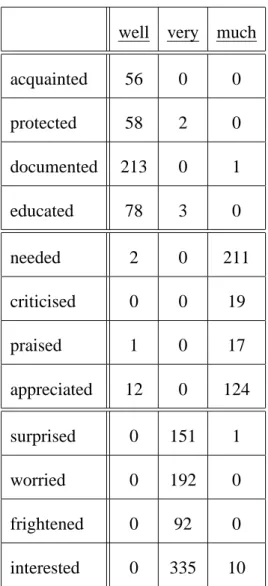
These judgments are mirrored by distributional asymmetries in corpus data, as illustrated by the numbers in Table 1. These counts are from the first edition of the British National Corpus (BNC; http://info.ox.ac.uk/bnc), and reflect the number of hits in a search of approximately 100 million words. While the distributions are not absolutely complementary (a fact about which we have more to say in section 6), the contrasts are striking:
A first hypothesis to explain these facts, or at least the unacceptability of very in 2-3, would be that these participles are either not adjectives or are not gradable. As shown by the examples in 5 and 6, very is restricted to modifying expressions that are both adjectives and gradable. The modifier much also requires its argument to be gradable (Doetjes 1997), though it does not show the same sorts of categorial restrictions.
(5) a. *He is very a boy/a very boy. (cp. He is very much of a boy.)
b. *That candidate is very to the left of the center. (cp. That candidate is very far/well to the left of the center.)
(6) a. ??That bomb is very atomic.
b. ??Richard Nixon, a very former president, resigned before he was impeached.
This hypothesis cannot be correct, however. First, the facts in 7 show that many participles that do not co-occur with very allow negative un-prefixation, a property of adjectives but not verbs.
(7) a. unacquainted, unprotected, undocumented, uneducated b. unneeded, uncriticised, unpraised, unappreciated
Second, they can appear as complements to copular verbs such as seem, feel or become, yet another property of adjectives but not verbs (data from the BNC):
(8) a. I became acquainted with her brother Pavel Sergeevich Popov, a uvniversity professor.
b. And in the delirium of recognising her power she felt protected, safe in his arms. c. Second, this cladogram is an exercise in inference because many of the extinct groups
remain poorly documented...
d. An alternative to the traditional means of funding social services seems needed. e. But Louisa...grew up with a very unreal need to feel praised....
f. However, as the role of radioactive decay in generating heat in the Earth’s interior became appreciated, the notion of a contracting Earth was rejected.
Finally, the fact that these participles are gradable is shown by their appearance in comparative constructions, a property that holds only of gradable predicates. This is illustrated by the BNC data in 9.
(9) a. But as I became more acquainted with this set and stopped rushing from impossible passage to impossible passage, hoping against hope that at some point he would lose his balance and tumble like a second-rate trapeze artist off his swing, I was
unwittingly dragged in to a more sinister, melancholic side to his playing. b. The darker your skin, the more protected it is....
c. Except for the Baptists, the influx did not lower the trend towards a more educated ministry: the total of all Baptist ministers without any formal higher education was only eighteen percent by 1901.
d. Not surprisingly one finds a greater number of narratives of the miracles of dead saints in France than in Germany, because they were more needed there.
more criticised, especially in environments where there are fewer of them and where historically there have been fewer.
f. It seems that staff often feel less appreciated than in fact they are by parents, and probably vice versa.
We therefore conclude that the facts in 2-4 can be explained neither in terms of a category mismatch nor in terms of the non-gradability of the predicate: these deverbal expressions are gradable adjectives (see also Borer 1998:92-93).
Bolinger’s second important observation, which echoes an earlier point made by Sapir (1944), is the obvious but mostly neglected fact that gradability is a property not just of adjectives, but of nouns, verbs, adverbs, and prepositions as well, though see Doetjes (1997), Kennedy and McNally (1999), Hay, Kennedy, and Levin (1999), Tsujimura (2001), Vanden Wyngaerd (2001), Paradis (2001), and Wechsler (to appear) for examples of recent work exploring these
connections. Given the fact that the adjectival expressions we are interested in here are derived from (or related to) verbs, we should ask whether there is some regular correspondence between aspects of verb meaning and aspects of adjective meaning. In particular: are there underlying similarities in the kind of gradability they manifest? Put another way, is it accidental that the various participles in 2-4 show the behavior that they do, or does some property of the source verb determine the behavior of the adjectival form with respect to degree modification?
The purpose of this paper is twofold. First, we use the distribution of degree modifiers as a departure point for developing a semantic analysis of gradable predicates that supports a typology parameterized along two core features. The first is the structure of the scale that a gradable
particular, whether the scale is fully closed (has a minimum and maximum value), partly closed (has only a minimum or maximum value, but not both), or fully open (has no minimum or maximum value). The second feature is the nature of the standard of comparison with respect to which a particular use of a gradable property is evaluated: put roughly, whether it is fixed
contextually (as with an adjective like tall, which may be true of an object in one context and false in another), or whether it is determined without reference to context (as in the case of empty, which simply requires its argument to be devoid of contents). The fact that degree modifiers are sensitive to these features is evidence that they are significant components of the lexical semantic representations of gradable expressions.2
Our second goal in this paper is to demonstrate that the scalar properties of gradable expressions are largely predictable from properties of the events to which they are related or of the individuals to which they apply. This result reinforces the larger claim advanced by Bolinger and Sapir: gradability is a fundamentally important semantic property, whose influence extends beyond adjectives to other lexical categories. Although our discussion is limited to English, we consider the elements of the proposed typology fundamental enough that we would expect to find them relevant for the analyses of other in other languages as well, and studies such as Tsujimura (2001) for Japanese and Demonte (2004) for Spanish indicate that this is in fact the case. In short, the generality of scale structure, its importance for a wide range of linguistic phenomena, and the relative simplicity of the typology of scales that we develop thus justify a prominent place for scale structure in natural language semantics.
2. THE SEMANTIC TYPE OF GRADABLE PREDICATES We begin by laying out our basic
predicative uses of gradable adjectives like tall and expensive is that their interpretations are context dependent: what counts as tall or expensive may vary from context to context. One way to account for this variation is to characterize the truth conditions of such predicates in terms of a contextually defined standard of comparison, as in the paraphrases of 10a-b given in 11a-b (see e.g. Sapir 1944, Wheeler 1972, McConnell-Ginet 1973, Bartsch and Vennemann 1973, Kamp 1975, Lewis 1979, Klein 1980, 1991, Bierwisch 1989, Ludlow 1989, Kennedy 1999b, Graff 2000, Barker 2002).
(10) a. Michael Jordan is tall.
b. The Mars Pathfinder mission was expensive.
(11) a. Michael Jordan’s height exceeds a standard of tallness.
b. The cost of the Mars Pathfinder mission exceeded a standard of expensiveness.
The standard of comparison is itself determined relative to a comparison class of objects that are similar in some way to whatever is being discussed (Klein 1980); the result is that the truth conditions of sentences like those in 10 may vary. For example, in a conversation about the cost of various missions to outer space, the comparison class for expensive might include many things that are quite a bit more expensive than the Mars Pathfinder mission. (One of the successes of the Pathfinder mission was that its cost was low relative to comparable NASA projects.) If the standard of comparison is set correspondingly high, then 10b is false. In contrast, in a discussion about things with the name ‘Pathfinder’, the comparison class might include compasses, mountain bikes, and sport utility vehicles, as well as missions to Mars. The standard of comparison should therefore be quite a bit lower, and 10b is true.
There are different ways in which this basic analysis can be implemented. The approach that we assume here is one in which gradable adjectives map their arguments onto abstract representations of measurement, or degrees, which are formalized as points or intervals partially ordered along some dimension (e.g., height, cost, weight, and so forth; we provide a more detailed account below). The set of ordered degrees corresponds to a scale, and propositions constructed out of gradable adjectives define relations between degrees with truth conditions analogous to the paraphrases in 11. (See Kennedy (1999a,b) for an overview of scalar analyses of gradable adjectives and for arguments that a scalar approach is empirically superior to analyses that do not make use of scales or degrees.)
For the semantic type of gradable adjectives, we follow a well-established tradition and analyze them as relations between individuals and degrees (see Seuren 1973, Cresswell 1977, Hellan 1981, von Stechow 1984a, Heim 1985, Bierwisch 1989, Klein 1991). Specifically, a gradable adjective like expensive has the denotation in 12, where
::::::::::
expensive represents a measure function that takes an entity and returns its cost, a degree on the scale associated with the
adjective.3
(12) [[expensive]]=λdλx.
::::::::::
expensive(x) =d
The adjective expensive thus denotes a relation between degrees of cost d and objects x such that the cost of x equals d.4
In this type of approach, the value of the degree argument is determined by degree morphology — in English, comparatives, degree modifiers, and measure phrases — which saturate and impose restrictions on the degree argument. The comparative morphology more ...
than, for example, requires the degree argument of a gradable adjective to exceed some other degree (introduced by the than-constituent). We return to a detailed discussion of degree morphology in section 6.1; here we focus on predicates formed out of unmodified gradable adjectives, such as those in 10.
To keep things fully explicit and compositional, we will follow von Stechow (1984a) and assume that unmodified APs actually contain a null degree morpheme pos (for positive form) whose function is to relate the degree argument of the adjective to an appropriate standard of comparison (see also Cresswell 1977, Bierwisch 1989 and Kennedy 1999b).5 Specifically, we assume that pos encodes the relation
:::::::::
standard, which holds of a degree d just in case it meets a standard of comparison for an adjective G with respect to a comparison class determined by
:: C, a variable over properties of individuals whose value is determined contextually (cf. von Stechow 1984a:60; see Kennedy 1999b for arguments that the comparison class variable corresponds to a property rather than a set).
(13) [[pos]]=λGλx.∃d[:::::::::standard(d)(G)(::C)∧G(d)(x)]
We will not attempt to provide a full specification here of the requirements imposed by the :::::::::
standard relation, since we will argue in section 4 below that it must vary depending on lexical features of the adjective (see also Graff 2000 for relevant discussion). In the case of typical examples such as those in 10, however, we assume that this relation requires a degree d to exceed a norm or average on the scale associcated with G that is computed based on the comparison class identified by
:: C. Since
::C is a free variable whose value must be fixed contextually (possibly by a specialized assignment function; see Lewis 1979, Barker 2002, Stanley 2000, 2002), whether a
particular degree exceeds the norm or not is a function of context. This allows for the sort of truth conditional variability observed above.
For example, composition of pos with expensive returns 14 as the denotation of the predicate (is) expensive.
(14) [[pos]]([[expensive]]) =λx.∃d[:::::::::standard(d)([[expensive]])(::C)∧[[expensive]](d)(x)]
If the context determines that
::C is the propety of being a mission to outer space, then the cost of the Mars Pathfinder mission is required to be quite high (greater than a norm for missions to outer space), and so 10b would be judged false. If instead the context determines that
::
C is the propety of being a thing named ‘Pathfinder’, then the cost of the Mars Pathfinder mission is allowed to be quite low (greater than a norm for things named ‘Pathfinder’), so 10b would be judged true.
Much of the research cited above has been directed towards demonstrating that the
assumptions outlined here provide a framework for handling the vagueness of sentences like those in 10, as well as more complex constructions involving various kinds of degree morphology. Our focus in this paper is on a different set of questions: What exactly are the scales associated with gradable adjectives like? How might they vary? Is the standard of comparison for an adjectival predicate always determined in the same way? Can an adjective be associated with more than one type of scale? What factors determine the sort of scale a given adjective uses? In the following sections, we offer preliminary answers to these questions.
We begin by identifying and providing evidence for one crucial structural property of scales: whether they have minimal and maximal elements. We then show that this property correlates to a large degree with the way in which the standard of comparison is determined, and
subsequently consider in further detail some of the factors which determine the type of scale and standard value with respect to which an adjective is interpreted. Finally, we show that both the nature of the scale and that of the standard of comparison play a crucial role in the analysis of the degree modifiers very, much and well.
3. SCALE STRUCTURE Adjectival scales have three crucial parameters, each of which must be specified in the lexical entry of any particular gradable adjective: a set of degrees, which represent measurement values; a dimension, which indicates the kind of measurement (cost, temperature, speed, volume, height, and so forth); and an ordering relation. This means that scales may in principle be distinguished from each other — with linguistic consequences — in three different ways: in terms of properties of the set of degrees, in terms of the dimensional parameter, or in terms of the ordering relation.
A large body of research has established the linguistic significance of the latter two parameters. The ordering relation is the crucial factor distinguishing between antonym pairs like tall/short, empty/full, expensive/inexpensive, accurate/inaccurate, pure/impure and so forth, which crucially make use of the same dimension and degrees (e.g., both tall and short map their arguments onto corresponding degrees of height) but express inverse ordering relations. This distinction has a number of well-known empirical reflexes, including markedness, the
acceptabilty of measure phrases, and entailment patterns, and explains why examples like 15 are tautologous (see e.g. Seuren 1978, von Stechow 1984b, Cruse 1986, Bierwisch 1989, Rullmann 1995, Kennedy 2001).
Building is shorter than the Sears Tower.
The dimensional parameter is the primary feature that distinguishes (non-antonymous) gradable adjectives from each other: tall and flexible both express positive orderings, but the first involves one with respect to height (or perhaps something more abstract, like linear extent) and the second one with respect to flexibility. An empirical reflex of this distinction is the
phenomenon of incommensurability (see Klein 1991, Kennedy 1999b). As shown by the examples in 16, it is possible to construct possibly quite complex comparisons out of distinct gradable adjectives as long as they map their arguments onto scales that share the same ordering relation. Thus wide and tall in 16a both involve orderings along a dimension of linear extent, and long and old in 16b both involve orderings with respect to temporal extent.6
(16) a. They call him ‘The Bus’ because he’s kind of as wide as he is tall. (National Public Radio broadcast, 1/26/02)
b. [This comparison] is unfair both to him and the quarterbacks like Dan Marino and John Elway who excelled for almost as long as [Peyton] Manning is old. (Chicago Tribune, 11/2/00)
In contrast, comparatives formed out of adjectives that do not use the same dimension are anomalous:
(17) a. ??They call him ‘The Bus’ because he’s kind of as wide as he is punctual. b. ??These quarterbacks excelled for almost as long as Peyton Manning is talented.
This follows if different dimensions entail different scales, and if comparative morphemes presuppose that the degrees they order come from the same scale (Kennedy 2001).
A central goal of this paper is to establish that the structure of the (ordered) set of degrees — the scale itself — is also linguistically significant. In theory, several different structural
features could be important, including whether a scale is finite or infinite, whether it is dense or discrete, whether it contains minimal or maximal elements or not, and so forth. Determining the full range of structural variation in scales that natural languages are sensitive to would require an empirical investigation that goes beyond the scope of a single paper, however, so our strategy here is to focus on just one of these parameters: whether a scale is open (lacks a minimal element, a maximal element, or both) or closed (has minimal and maximal elements).
This distinction appears to be exactly what we need to characterize the difference between the adjective pairs in 18a and those in 18b: the former describe properties that have maximal and minimal values, while the latter describe propeties that do not.7
(18) a. full, closed, invisible b. long, expensive, old
Empirical evidence in favor of this distinction comes from the distribution of proportional
modifiers like half and mostly or most of the way, which are acceptable with adjectives like those in 18a and unaceptable with adjectives like those in 18b. This is illustrated by the contrasts in 19 and 20 (see Lehrer 1985, Cruse 1986, Hay 1998, Kennedy and McNally 1999, Paradis 2001). (Note that the choice of individual to which the adjective is applied is crucial, about which we say more in section 5.)
(19) Closed scale adjectives
a. The glass is half/mostly full.
b. Her eyes were half/most of the way closed. c. These images are half/mostly invisible. (20) Open scale adjectives
a. ??The rope is half/mostly long.
b. ??A 15-year-old horse is half/mostly old. c. ??That car was half/mostly expensive.
The contrasts in 19-20 can be accounted for via semantic requirements imposed by the proportional modifiers. Assuming that half and mostly/most of the way have interpretations along the lines of those in 21, where SG represents the scale associated with a gradable adjective G and ::::
diff is a function that returns the difference between two degrees, they are compatible only with adjectives that map their arguments onto scales with maximal and minimal elements. (There are slight differences in the distributions of mostly and most of the way, but for the purpose of making this point about closed scales we can treat them as synonymous.)
(21) a. [[half]]=λGλx.∃d[ :::: diff(
:::::max(SG))(d) =::::diff(d)(::::min(SG))∧G(d)(x)] b. [[mostly/most of the way]]=
λGλx.∃d[::::diff(:::::max(SG))(d)<
::::
diff(d)(::::min(SG))∧G(d)(x)]
A derivation for half full, for example, would thus be as shown in 22 (where Sf represents the scale associated with full); what we end up with is a property that is true of an object if its degree
of emptiness corresponds to the midpoint of the scale.
(22) [[half]]([[full]])
= λGλx.∃d[::::diff(max(:::::SG))(d) =::::diff(d)(::::min(SG))∧G(d)(x)]([[full]]) = λx.∃d[::::diff(:::::max(Sf))(d) =::::diff(d)(::::min(Sf))∧[[full]](d)(x)]
= λx.∃d[
::::diff(:::::max(Sf))(d) =::::diff(d)(::::min(Sf))∧[λd’λy.::::full(y) =d’](d)(x)] = λx.∃d[::::diff(:::::max(Sf))(d) =::::diff(d)(::::min(Sf))∧::::full(x) =d]
The reason why the adjectives in 19 must have closed scales should be obvious: if the scale associated with the adjectives accepting e.g. half lacked either a minimal or maximal element, it would be impossible to calculate the difference between the minimum and maximum values on the scale and thus to identify the midway point required by the degree modifier.
Having shown evidence for the existence of totally closed scales, we now turn to the other logical possibilities. Starting from the assumption that scales may or may not have maximal and minimal elements, there are three additional variations to consider: a scale may have neither a minimal nor maximal element, it may have a minimal but no maximal element, or it may have a maximal but no minimal element. The first option corresponds to a totally open scale; the second and third options are lower closed and upper closed, respectively.
To make things precise, let us assume that degrees are values that are isomorphic to the real numbers between 0 and 1. Note that we do not need to assume that scales are actually constructed out of numbers (i.e., that gradable adjectives actually map their arguments onto numerical values), though this is one way of formalizing them (see Klein 1991 for discussion). What is important is that whatever the ontological status of degrees — whether they correspond to
numbers, equivalence classes of objects in a model (Cresswell 1977), mental constructs (Bierwisch 1989), or something else — they can vary with respect to (at least) the open/closed distinction.
We represent the four hypothesized scale structures as in 23, where R and∆represent the ordering relation and dimension for the scale, respectively.
(23) A typology of scale structures
a. hD(0,1),R,∆i (totally) open scale
b. hD[0,1),R,∆i lower closed scale
c. hD(0,1],R,∆i upper closed scale
d. hD[0,1],R,∆i (totally) closed scale
Scales which are open on the lower end include all of those degrees which approach the limit of 0 but lack a degree whose value is less than that of all the others in the set; scales which are closed on the lower end include such a minimal value, equal to 0. Analogously, scales which are open on the upper end include all of those degrees which approach the limit of 1 but lack a degree which is greater than all the others in the set; those which are closed on the upper end have a maximal degree whose value is 1.
Just as we used proportional modifiers to identify adjectives associated with closed scales, we can use the distribution of maximality modifiers such as 100%, completely, and fully to identify those adjectives which manifest the other scale types. However, in order to get full use out of this diagnostic, we need to take adjectival polarity into account. Recall that positive and negative pairs of adjectives make use of the same set of degrees and an ordering along the same
dimension, but the orderings are the inverse of each other.8
The feature of polarity that we are concerned with here is the following: if the positive member of an antonym pair has a maximal degree, then this corresponds to the minimal degree for the negative adjective, and vice-versa. This is most clearly illustrated by a pair like full/empty: if a cup is maximally full, then it is minimally empty (not empty at all); likewise, if it is
maximally empty, then it is minimally full (not full at all).
With this in mind, we can now use endpoint-oriented modifiers to determine whether all of the scale types listed in 23 are attested. Given the assumptions about polarity outlined above, we predict that modifiers that pick out maximal degrees should be acceptable with positive adjectives only if they use a scale with a maximal element, and with negative adjectives only if they use a scale with a minimal element. In other words, the four scale types should give rise to the pattern of acceptability in 24 for the indicated degree modifier/polar adjective collocations.
(24) open l-closed u-closed closed
[Deg :::::max Apos] ?? ?? √ √ [Deg ::::: max Aneg] ?? √ ?? √
As shown by the following examples, we find pairs of antonyms which share the same scale and which manifest each of the patterns predicted to exist:9
(25) Open scale pattern
a. Her brother is completely ??tall/??short. b. The pond is 100% ??deep/??shallow. c. Max is fully ??eager/??uneager to help.
(26) Lower closed scale pattern
a. The pipe is fully ??bent/straight. b. The roome became 100% ??loud/quiet.
c. That author is completely ??famous/unknown. (27) Upper closed scale pattern
a. We are fully certain/??uncertain about the results. b. This product is 100% pure/??impure.
c. The treatment is completely safe/??dangerous. (28) Closed scale pattern
a. The room was 100% full/empty. b. The flower was fully open/closed.
c. The figure was completely visible/invisible.
Future research should be directed towards fleshing out these distinctions and their consequences in greater detail. For now, however, these modifier facts serve as initial evidence that scale structure is a linguistically significant parameter of variation in gradable adjective meaning.
4. SCALE STRUCTURE AND STANDARD OF COMPARISON
4.1. RELATIVE VS. ABSOLUTE GRADABLE ADJECTIVES The distributions of endpoint-oriented and proportional modifiers are not the only area in which we see the significance of scale structure. A number of recent works have uncovered other empirical consequences of the open/closed scale distinction in several different empirical domains. For
example, Vanden Wyngaerd (2001) argues that the open/closed scale distinction is relevant to the licensing of resultative predicates in Dutch, and Wechsler (to appear) makes similar claims for English. Of particular relevance to us is the work of Rotstein and Winter (2004), who argue that this aspect of scale structure correlates with the ‘total’ vs. ‘partial’ predicate distinction identified by Yoon (1996). Roughly speaking, a total predicate is one like (is) clean, which is true of an object if it has a maximal degree of cleanliness, while a partial predicate is one like (is) dirty, which is true of an object just in case it has some degree of dirtiness.
Here we would like to claim that the correlation observed by Rotstein and Winter arises specifically because scale structure influences a crucial feature of the interpretation of gradable adjectives in context: the determination of the standard of comparison. As described in section 2, scalar analyses of gradable predicates assume that the standard of comparison is determined contextually, as a function of some variable in the semantic representation; under our assumptions, this is the comparison class variable introduced by the pos morpheme. An expectation of this type of analysis is that all predicates headed by (unmodified) gradable adjectives should give rise to the sort of vagueness observed with tall and expensive. This is not the case, however: there are many adjectives that are demonstrably gradable but whose standards of comparison are not context-dependent in the way discussed above.
For example, the adjectives in 29 simply require their arguments to possess some minimal degree of the gradable property they introduce; they do not require that the degree to which the arguments possess this property be greater than some contextually determined standard. (These correspond to the Yoon/Rotstein/Winter partial predicates.)
a. The baby is awake. b. The spot is visible. c. The door is open. d. The rod is bent.
Under normal usage, 29a does not mean that the degree to which the baby is awake surpasses some standard of comparison (for babies), but rather simply means that the baby has a non-zero level of awakeness. Likewise, 29b is true as long as even just a small part of the spot can be seen, no matter how faintly, 29c just requires some minimal positive aperture of the door, and 29d is true of a rod that is minimally bent.
The adjectives in 30 are similar in not introducing a context-dependent standard, but their arguments are required to possess a maximal degree of the property in question. (These
correspond to total predicates.)
(30) Maximum standards a. The glass is full. b. The road is flat. c. The door is closed. d. The rod is straight.
30a typically means that the glass is completely full, not that its contents fall above some standard of fullness, 30b is an assertion that the road has no bumps, 30c requires the door to be completely closed, and 30d requires a completely straight rod.
Crucially, these facts do not indicate that these adjectives are not gradable. As shown by 31, they are perfectly felicitous in comparatives, in contrast to what we find with true nongradable adjectives such as those in 32.
(31) a. The baby is more awake now than it was a few minutes ago.
b. The sign for the Main Street exit is less visible than the one for the Spruce Street exit.
c. The glass isn’t as full as I would like it to be. d. Rod A is straighter than Rod B.
(32) a. ??The energy we use these days is more nuclear than it was before they built that plant down the road.
b. ??Dinosaurs are more extinct than spotted owls.
We therefore assume that adjectives like those in 29 and 30 have the same semantic type as all gradable adjectives: they are relations between degrees and individauls (typehd,he,tii).
Following Unger (1975), we refer to adjectives like those in 29 and 30 as absolute adjectives, and ‘ordinary’ gradable adjectives with context-dependent standards as relative adjectives.10 There has been little discussion of absolute adjectives in the semantics literature, possibly because there is a strong initial intuition that our characterization of the facts is both too strong and too weak: the adjectives in 29 seem to actually require something significantly more than a minimum standard, and those in 30 seem to actually allow something less than a maximum standard. These intuitions seem to be supported by examples like those in 33.
(33) a. I’m not awake yet.
b. The gas tank is full, but you can still top it off. It’s not completely full yet. c. The theater is empty tonight.
33a can be felicitously uttered by someone who is not talking in his sleep. Likewise, most speakers we have consulted feel that full only requires its arguments to fall near the maximal value on the scale, pointing to examples like 33b, which does not sound contradictory (but see the examples discussed below in 37). Similarly, 33c can be used to describe a situation in which only a very few people show up to a film in a very large movie theater.
On the whole, it is fairly easy to come up with other ‘imprecise’ uses of absolute
adjectives, calling into question our claim that these adjectives represent a semantic class distinct from relative gradable adjectives. While it is arguably true that in some cases imprecise uses reflect a semantic shift away from a ‘default’ absolute meaning towards a purely relative one (a point to which we return in section 4.3 below), we nevertheless contend that there are both theoretical and empirical arguments for maintaining the claim that absolute adjectives are semantically distinct from relative adjectives. We address the latter in the next section; here we focus on the former.
From a purely theoretical perspective, it is fairly straightforward to account for imprecise uses of absolute adjectives such as those in 33 while still maintaining the claim that they have maximum or minimum standards. The simplest strategy would be to claim that the propositions conveyed by sentences like these are strictly speaking false, and explain their felicity and
informativity in terms of general pragmatic principles governing the interpretation of ‘loose talk’. (This is essentially Unger’s (1975) position, which he invokes as part of a broader philosophical
argument for a skeptical epistemology.)
Formally, we could implement this approach in terms of Lasersohn’s (1999) theory of pragmatic halos, which provides a framework for determining how much deviation from what is actually true still counts as ‘close enough to the truth’ in any context to be acceptable and informative. Lasersohn proposes that the context can associate with any expression of the language a set of denotations of the same type as its actual denotation which differ only in some respect that is pragmatically ignorable in the context; this is its pragmatic halo. Any value in the pragmatic halo of an expressionαcounts as an acceptable and informative approximation ofα
even if this leads to a proposition that is strictly speaking false. In the case of 33c, for example, we can maintain our claim that the actual denotation of the predicate headed by empty is a
property that is true only of objects that are completely empty, but that its pragmatic halo includes properties that are true of objects that are just a little bit less than empty. How much less is
determined by context; in this case, by non-linguistic factors such as the size of the theater, expectations about attendance, and so forth.11
4.2. ENTAILMENTS OF ABSOLUTE VS. RELATIVE ADJECTIVES Clear empirical evidence in support of a semantic distinction between relative and absolute adjectives comes from entailment patterns. If the standards associated with absolute adjectives involve maximum and minimum values, then the APs they head should denote properties with the truth conditions shown in 34a-b, where SA stands for the scale associated with the adjectival head, and::m
::
A is the measure function introduced by the adjective.
(34) a. [[APmin]]=λx.∃d[d≻::::min(SA)∧::m ::
b. [[APmax]]=λx.∃d[d=:::::max(SA)∧::m ::
A(x) =d]
34a is true of an object as long as it has a non-minimal degree of the gradable property described by the adjectival head, while 34b requires its argument to have a maximal degree of the relevant property. These truth conditions are clearly distinct from the ones we discussed for APs headed by relative adjectives in section 2, which require their arguments to exceed a norm or average of the relevant property for some contextually determined comparison class. We therefore expect that absolute adjectives should give rise to entailments that are distinct both from each other and from relative adjectives.
However, before moving to an examination of the entailment patterns of absolute adjectives, we need to say a few words about how we derive the truth conditions in 34a-b in the first place. Recall that we are assuming that unmodified gradable adjectives must combine with a null degree morpheme pos to derive a property of individuals. Since absolute adjectives have the same semantic type as relative ones (as shown by their acceptability in comparatives; see 31 above), we assume that they must also combine with pos. According to the semantics for pos that we gave in 13, then, what we should derive for minimum and maximum AP denotations are 35a-b, respectively.
(35) a. [[pos]]([[Amin]]) =λx.∃d[:::::::::standard(d)([[Amin]])(::C)∧[[Amin]](d)(x)] b. [[pos]]([[Amax]]) =λx.∃d[:::::::::standard(d)([[Amax]])(::C)∧[[Amax]](d)(x)]
In section 2, we left open the question of what it actually means for a degree to satisfy the :::::::::
standard relation. However, if our empirical claims about absolute adjectives are correct, then it must be the case that the nature of this relation is dependent on the adjectival argument of pos. If
G is a relative adjective, then the
:::::::::
standard relation is as we stated in section 2: it requires a degree to exceed a norm or average on the G-scale based on the comparison class provided by
: C. However, if G is a minimum standard absolute adjective, then a degree d satisfies the
:::::::::standard relation just in case it meets the conditions in 34a (it must be greater than the minimum value of the G-scale), and if G is a maximum standard absolute adjective, d must meet the conditions in 34b (it must equal the maximum of the G-scale). How to ensure that the
:::::::::
standard relation imposes the right conditions for the right adjectives is a project that goes beyond the scope of this paper (see Kennedy 2003 for a proposal), so we will make the simplifying assumption here that absolute and relative adjectives include lexical information that ensures that their standards are fixed appropriately in the positive form. If this proposal is correct, then the value of the comparison class variable is irrelevant to the calculation of the truth conditions of absolute adjectives. We return to this prediction in section 6.2, arguing that it is responsible for the distribution of very.
We are now in a position to examine the entailment patterns of absolute adjectives. First, 34a predicts that for a minimum standard absolute adjective adj, a denial x is not adj should entail that x has a zero degree of adj-ness, i.e., that x posesses no amount of adj-ness at all. The
contradictory statements in 36 illustrate that this prediction is borne out.
(36) a. #My hands are not wet, but there is some water on them. b. #The door isn’t open, but it is ajar.
c. #The spot is not visible, but I can see a little bit of it.
Second, 34b predicts that for a maximum standard absolulte adj, an assertion of x is adj should entail that x has a maximal amount of adj-ness, i.e., that nothing can be more adj than x.
This sort of entailment is difficult to test, since maximum standard adjectives readily allow imprecise uses (see the discussion of 33 above), but the examples in 37 involve cases in which an imprecise interpretation is highly unlikely (and see Unger (1975) for arguments that it is possible to force a precise interpretation by adding focal stress to the adjective). B’s response in 37a is readily understood as a joke, but note that the joke wouldn’t be possible if A’s assertion didn’t, strictly speaking, entail that B’s glass was 100% empty. And according to our intuitions, dead and complete, unlike e.g. full, are rarely (if ever) used imprecisely, hence the outright oddness of 37b and the sense of correction or exception in 37c.12
(37) a. A: Your glass is empty; let me get you another beer. B: No it’s not – there are still a few drops left in it.
b. #The plant is dead, though one part of it still appears to be alive. c. #The paper is complete. I just have to write the conclusion.
In contrast, since the truth conditions for a relative adjective entail only that its argument falls above a contextually determined standard of comparison, neither of these entailments should hold. This is correct:
(38) a. Sam is not tall, but his height is normal for his age. b. That film is interesting, but it could be more interesting.
A related argument involving entailments is discussed in Cruse (1986) and Rotstein and Winter (2004). As shown by the examples in 39, there exist pairs of antonyms such that negation of one form entails the assertion of the other:
(39) a. The door is not open (closed). |=The door is closed (open). b. The table is not wet (dry). |=The table is dry (wet).
c. The baby is not awake (asleep). |=The baby is asleep (awake).
The explanation for this is straightforward: both members of the pairs in 39 are absolute adjectives, but the positive adjectives impose minimum standards while the negative adjectives impose maximum standards. Since a minimal positive degree corresponds to a maximal negative degree on the same scale, the entailment relations in 39 follow from the truth conditions in 34 (recall the discussion of polarity in section 3).
Relative antonyms do not give rise to the same entailment patterns, as illustrated by 40.
(40) a. The door is not large (small).6|=The door is small (large).
b. The table is not expensive (inexpensive).6|=The table is inexpensive (expensive). c. The baby is not energetic (lethargic). 6|=The baby is lethargic (energetic).
Again, this follows from the fact that the standards for both positive and negative relative gradable adjectives are contextually identified, and crucially need not be endpoints (in fact, cannot be endpoints if the scales are open). Since a context dependent standard is determined for particular uses of particular adjectives, it need not be the case that the standard for e.g. large be the same as that of its antonym small, and we allow for the possibility of a ‘grey area’ between the standards onto which fall objects that are neither large nor small (Sapir’s (1944) zone of indifference; Klein’s (1980) extension gap). Indeed, the possibility of such ‘borderline cases’ is one of the defining properties of vague predicates; see Williamson (1994) for further discussion.
A version of the same entailment test can be used to determine whether the standard corresponds to the upper or lower end of a scale, though this test presupposes that the adjectives being tested have absolute standards, however; cf. Knowles (1974:23-24). If the standard is a maximal degree, then an affirmation such as x is half/partially adj entails that x is not adj, as shown by 41a-b.
(41) a. The plant is half dead.|=The plant is not dead. b. The glass is partially full.|=The glass is not full.
If the standard corresponds to the lower endpoint, however, then such an affirmation entails that x is adj. This is illustrated by the examples in 42.
(42) a. The door is half open.|=The door is open. b. The table is partially wet.|=The table is wet.
Finally, relative and absolute adjectives trigger different kinds of entailments in comparative constructions. If the truth conditions associated with minimum and maximum standard absolute adjectives are as in 34, we expect them to generate positive and negative
entailments to the unmarked form, respectively (depending on which argument of the comparative we use). This prediction is borne out, as shown by the examples in 43.
(43) a. The floor is wetter than the countertop.|=The floor is wet.
Assuming that the comparative imposes an asymmetric ordering on its arguments (see the truth conditions for the comparative in section 6.1), The comparative in 43a requires the floor to have at least a non-minimal degree of wetness, since otherwise it could not possibly have a greater
wetness than the countertop. The truth of the positive then follows directly from the minimum standard truth conditions in 34a. Similarly, in order for the comparative in 43b to be true, it must be the case that the countertop is not maximally dry, since otherwise the floor could not be drier than it. If the standard for dryness is the maximum value on the scale, as stated in 34b, then it follows that the countertop is not dry.
In comparison, a canonical property of comparatives with relative adjectives is that they do not give rise to positive or negative entailments in the comparative form, as illustrated by 44a-b.
(44) a. Rod A is longer than rod B.6|=Rod A/B is (not) long. b. Rod A is shorter than rod B.6|=Rod A/B is (not) short.
This also follows, since the mere fact that one object exceeds another with respect to some relative property tells us nothing about how the objects stand in relation to a contextually determined standard of comparison.
4.3. RELATING SCALES AND STANDARDS The conclusion to be drawn from these facts is that there is a semantic distinction between gradable adjectives with absolute and relative standards. Even though the former have imprecise uses that sometimes make them appear superficially similar to relative adjectives, the data discussed above show that the absolute/relative distinction — whether a gradable adjective has a context-sensitive or context-insensitive standard — affects entailment patterns, and so is linguistically significant.
This conclusion raises the following question: is there a principled relationship between an adjective’s scale structure and its standard value? The data discussed so far suggest the following generalization: gradable adjectives associated with totally open scales have relative standards; gradable adjectives that use totally or partially closed scales have absolute standards. The first of these two generalizations is exceptionless: since open scales lack endpoints, it is impossible for open scale adjectives to have endpoint standards. While we observe below that the second of these two generalizations is not exceptionless, it does appear that the standards for closed-scale adjectives default to an endpoint of the scale: the minimum in some cases (e.g., awake and open); the maximum in others (e.g., asleep and straight).
There are at least two, mutually compatible, explanations for such a default. The first is primarily functional. The endpoints of a totally or partially closed scale provide a fixed value as a potential standard, which in turn makes it possible to assign context-independent truth conditions to the predicate (greater than a minimum, equal to a maximum). The alternative — and the only option available for adjectives with open scales — is to compute the standard based on some context-dependent property of degrees, as discussed in section 2. If we assume that
interpretations that minimize context-dependence are in general preferred, then closed-scale adjectives should favor an absolute interpretation.
The second explanation has to do with the way in which adjectival properties come to hold of entities. In many cases, an adjectival property comes to be true of an entity in virtue of that entity having participated in some kind of event or state. As we explain in further detail in the next section, there is a strong correlation between the structure of such an event, the role played by the relevant entity in it, and the satisfaction conditions (including the nature of the scale structure) for the adjectival predication whose truth is supported as a result of the event or state
transpiring. The result, as we will see below, is a maximal or minimal absolute standard, depending on the relation of the argument to the event.
5. FACTORS DETERMINING SCALES AND STANDARDS We now turn to the issue of whether an adjective can be associated with more than one kind of scale, and, more generally, to the issue of whether we can predict for an arbitrary adjective what kind of scale structure and standard value it will use. In this section we argue that the scale structure of deverbal adjectives can be predicted based on the event structure associated with the source verb, and that in the case of all adjectives a crucial factor is the boundedness of the adjective’s argument (cf. Paradis 2001). We further show that the orientation of an absolute standard — whether it is maximum or minimum — also depends on properties of the aspectual and argument structure of the source verb. Our focus here is on derived adjectives because we believe that these are the best candidates for observing the way that scale structure is determined ‘on the fly’. Whether our observations can be extended to an explanation of why different lexical adjectives have the scales they do is an issue we must leave for future work; for now, we assume that the scalar properties of lexical adjectives are encoded in their lexical entries.
5.1. EVENT STRUCTURE AND SCALE STRUCTURE Taking as a starting point the class of deverbal gradable adjectives with totally closed scales (those that are acceptable with proportional and endpoint-oriented modifiers), the data that we have observed indicate that this class
corresponds very closely to the class of verbs that introduce incremental arguments. As pointed out by Krifka (1989, 1992) (see also Dowty 1991, Tenny 1995, Jackendoff 1996, Ramchand 1997), what is unique about this class of verbs is that it is possible to establish a homomorphic
relationship between the events they denote and their incremental arguments. This
homomorphism is captured formally by Krifka in terms of his notion of mapping to objects, defined as a characteristic of thematic roles R as follows (Krifka 1989:92):
(45) ∀R[::::::::MAP-O(R)↔ ∀e∀e’∀x[R(e,x)∧e’⊆E e→ ∃x’[x’⊆O x∧R(e’,x’)]]]
In prose,
::::::::
MAP-O guarantees that all subevents e’ of a given event e with participant x in role R (what Dowty 1991 refers to as the ‘incremental theme’) involve a part x’ of x. A typical
incremental theme is the object of the verb eat: for all subevents of a given event of eating an orange, for example, we can identify unique parts of that orange which were eaten during each of those subevents. Conversely, we know how much of the eating-an-orange event has been
completed by examining how much of the orange has disappeared; the homomorphism in this direction is captured by Krifka’s analogous notion of mapping to events (see Krifka 1989:92). As pointed out by Ramchand (1997), however, there are at least two additional types of incremental arguments: what she calls Pat(ient)+/- and Patloc (see also Jackendoff 1996, Krifka 1998 and Hay et al. 1999). Pat+/- arguments are those which undergo an incremental change of state, such as the subject of the verb cool in a sentence like The soup cooled. Those verbs for which a homomorphism can be established between the progress of the event and the location of one of its participants have Patloc arguments. For example, the verb descend in Max descended the staircase entails incremental movement of the subject along a path defined by the direct object.13
We claim that it is precisely the homomorphic relation between the incremental theme argument and the corresponding event that is responsible for the scalar properties of adjectives
derived from this class of verbs. Specifically, since such adjectival participles measure the degree to which their arguments have participated in the event described by the source verb, their scales should have minimal and maximal values defined as follows: the minimal degree on the scale represents participation in a minimal (sub)event of the appropriate sort by (a minimal part of) the incremental theme (or a minimal degree of the relevant measurable property for Pat+/- arguments, or a minimal movement along the relevant path for Patloc arguments); the maximal degree on the scale represents participation in the maximal event involving (all of) the incremental
theme/property/path.
As an example, consider loaded, as in 46.
(46) The truck is loaded with hay.
Let us assume, generalizing Dowty’s (1991) analysis of spray/load verbs, that the truck is the incremental theme in the loading event described in 46. We can define a mapping between the progress of the event of loading and a property of the truck, namely, the volume of the material that it holds; the degree to which the truck can be said to be loaded corresponds to the degree to which it has progressed through a loading event. Since we can define a beginning point and endpoint for this event (corresponding to when the truck is unloaded and loaded, respectively), we can identify minimal and maximal values for the scale of ‘loadedness’ of the truck.
The following examples support the generality of the claim that if an adjective is derived from a verb with an incremental argument, that adjective will have a closed scale: these adjectives are compatible with proportional and endpoint-oriented degree modifiers.14
a. half eaten cookies b. a partially written novel c. a fully paid bill
d. a half prepared talk
e. a completely severed connection (48) Pat+/- arguments
a. partially documented allegations
b. an individual fully acquainted with the facts c. fully straightened teeth
d. partially frozen liquid e. a completely covered terrace (49) Patloc arguments
a. a partially crossed desert b. a half descended staircase c. fully raised blinds
d. a completely traversed distance
Now let us consider the implication that, if a participial adjective has a totally closed scale, it is derived from a verb with an incremental argument. If this implication is correct, then those adjectives derived from verbs lacking such arguments should not have closed scales, and it should be impossible to combine them with proportional/endpoint-oriented modifiers. And indeed, the examples we have found, such as those illustrated in 50, systematically bear out this
prediction. Note that these participles are derived from atelic verbs (whether stative or nonstative, as in 50a-50d) or from verbs which are telic but in which the theme or experiencer argument is affected wholistically (as in 50f) or experiences a change in property which is necessarily mapped onto an open scale (as in 50g).
(50) Adjectives derived from non-incremental theme verbs a. ??a completely hated/loved/envied/admired neighbor b. ??fully needed/wanted rest
c. ??a partially regretted action d. ??a completely looked for reaction e. ??a completely watched suspect
f. ??a partially kissed/met/punched young man g. ??a fully worried mother
If telic verbs with incremental arguments map onto totally closed scales, what should we expect from adjectives derived from atelic verbs such as needed or looked for? If the same sort of homomorphic relation exists between the event structures of atelic verbs and the scale structures of the corresponding adjectives, then such adjectives should have partially closed scales. The minimal (sub)event or state which supports the truthful application of the adjectival property to its argument will map onto the lower endpoint of the scale. Progressively larger subevents will map onto progressively higher points on the scale. However, since atelic verbs describe situations with no natural endpoint, there is no obvious maximal event or state which could correspond to an upper endpoint of the corresponding adjectival scale. The scale should thus be open on the upper
end.
Consider for example needed. If the Mediterranean coast needs even just a tiny bit of rain (for example, because it’s rained just slightly less than normal for the season), it is entailed that rain is needed. If the drought continues, the degree to which the rain is needed will increase. But just as it makes no sense to talk about the culmination of this need relation (as opposed to its end), it makes no sense to talk about the rain being ‘completely needed’.
Observe that the ordering of entities (or events, since they can be needed too) on the need scale in this example is determined by the temporal duration of the need relation that supports the truthful ascription of the adjective. Similarly, most of the modified APs in 51 can be paraphrased as APed for a long time.
(51) a. a much admired statesman b. much needed rain
c. a much regretted action d. a much praised piece of work e. a much looked for treasure f. a much talked about program
These examples anticapte the analysis of much to be presented in section 6.3, which requires the adjective to have a lower closed scales. Our interest here is that they also show that temporal duration is not the only way to measure neediness, admiration, etc.; in fact, the mapping from (verbal) events to (adjectival) scales can be influenced by other other aspects of the source verb’s meaning.
For example, arguably the most natural reading of much admired is paraphrasable as admired by many people, without necessarily entailing that the admiration has been long lasting; at the same time, a much talked about program might well be one which has been talked about many times, though not necessarily by many different people or for a particularly long time on any given occasion. Adjectives denoting the property of being the object of an emotion, such as admired, loved, or hated, or the experiencer of an emotion, such as worried, also permit readings on which the scalar dimension along which they are measured is one of intensity. For example, a much despised neighbor might be despised by only one individual, but with a passion.
What these facts indicate is that the dimensional parameter of the derived scale, like the structure of the scale, is also a function of the meaning of the source verb. Specifically, any of the various aspects of verb meaning that support measurement (temporal extent, number of
occurrences, number of participants, intensity, etc.) can be used to fix the dimensional parameter of the derived adjective’s scale. We may assume that any particular adjectival form (needed, admired, etc.) is compatible with several dimensions, one of which must be settled upon in a context of utterance. In the domain of lexical adjectives, this phenomenon is known as
indeterminacy, and is illustrated by the dual uses of e.g. long as a measure of temporal or linear extent (see McConnell-Ginet 1973, Kamp 1975, Kennedy 1999b).
In all of these cases, however, the structure of the scale for the derived adjective is constructed in the same way: by mapping from a set of potentially complex events which can be ordered in an algebraic structure as proposed in e.g. Link (1983), Landman (1989), or Lasersohn (1995). Such algebraic structures are formed by summing together larger events out of smaller ones–for instance, various atomic events in which the same statesman is the object of admiration, possibly by a different person each time, or in which the same program is talked about. These
events are ordered by increasing size (and complexity), and this ordering, in turn, can map onto a scale which is bounded on the lower end but not on the upper end, since there is in principle no limit to the number of individuals that can admire someone, nor to the number of times an event such as talking about something can be iterated, and so on.
The hypothesis that event structure correlates with scale structure makes an additional prediction: no deverbal adjective should be associated with a scale which is open on the lower end, whether or not it is bounded on the upper end. The reason is that there should always be a minimal event which supports the truth of the adjectival predication and which is
homomorphically related to the lower bound on the scale. Evidence that this prediction is correct comes from the fact that, to the best of our knowledge, all deverbal adjectives prefixed with un-, which reverses the polarity of the adjectival scale, accept modification by endpoint-oriented modifiers such as completely (see section 3, above).
5.2. BOUNDED ARGUMENTS, BOUNDED SCALES Although the generalizations described in
the previous section are quite robust, one also finds some prima facie counterexamples. One is known. The verb know is stative, and thus atelic, in English. Given what was said in the previous section, we would predict that known would be associated with a scale that is bounded on the lower end but open on the upper end. Nevertheless, examples such as 52, in which the adjective cooccurs with an (upper) endpoint-oriented modifier, are felicitous:
(52) The effects of that drug are not fully known.
How does know come to be associated with a closed scale? More specifically, what might provide the basis for a homomorphic mapping to that closed scale?
There are two possible answers to this question in the case of known. One would be that the scale structure of known is based on an implicit event of ‘coming to know’, which has as its culmination the state described by the verb. However, a more interesting and, we think, much more likely answer is that the extension of the adjective’s argument provides the basis for building the closed scale. If, for example, an object x is partially known, then one or more individuals stand in a knowing relation to at least some part of x; if x is fully known, then one or more
individuals stand in a knowing relation to all parts of x; and so on. In general, any adjective which can apply not only to the whole of an entity but also to its parts could also be associated with a scale whose structure is based on the part structure of that entity.
A look at the facts supports the systematic ability of an adjective’s argument to determine the scale used for interpreting that adjective, including with adjectives which are not deverbal. Consider the adjective hot for example. Although it rejects modification by an endpoint-oriented adjective when its argument is not easily considered bounded, as in 53a, such modification becomes possible when the adjective is applied to something clearly bounded, as in 53b, which is paraphrasable as ‘All of the baby’s face is hot.’
(53) a. ??Outside it’s completely hot. b. The baby’s face is completely hot.
A second source of evidence comes from the vagueness observable in 54, in which we find the modifier half, which, like completely, requires an adjective with a closed scale:
(54) a. The meat is half cooked. b. The crops are partially frozen.
54a can be understood as entailing that all of the meat is half cooked, but it also can be true in situations in which half of the meat is entirely cooked. In other words, in addition to the scale made available by the event structure of cook — the scale relevant for the first construal of the sentence — cooked can also be associated with a closed scale made available by the part structure of the meat, which is relevant for the second construal of the sentence.
Though we must leave for future research a full analysis of the effects of event structure and the boundedness of the adjective’s argument on the determination of scale type, the above examples are sufficient to demonstrate that the scale type of adjectives is often predictable, and that regularities can be established not only between the algebraic part structure of events and scale structure, but also — in a parallel fashion — between the algebraic part structure of individuals and scale structure.
5.3. PREDICTING THE ORIENTATION OF ABSOLUTE STANDARDS We close this section with one final example of the tight relationship between event structure and scale structure: the role that the former plays in determining whether a derived absolute adjective defaults to a minimum or maximum standard.
The data show that in the case of deverbal adjectives, the orientation of the standard depends on the role of the adjective’s argument in the event associated with the corresponding verb. Adjectives whose arguments satisfy Mapping to Objects (see 45, above), such as cut and written, systematically have upper endpoints as standards, while those whose arguments do not, such as acquainted and documented, have lower endpoints as standards. This correlation is exemplified in 55 and 56. The fact that 55a and 55b are mutually entailing supports the claim that the argument of cut satisfies Mapping to Objects. The fact that 55a does not entail 55c shows that
the standard for cut is the maximum value on the scale (see the discussion in section 4.2).
(55) a. The grass is half cut. b. Half of the grass is cut. c. The grass is cut.
A different pattern appears in 56. Here we see that 56a and 56b are not mutually entailing; rather, 56a entails 56c. This indicates that the (external) argument of acquainted does not satisfy Mapping to Objects. And again in contrast to what happens with cut, 56a entails 56d, as expected if the adjective has a minimum standard.
(56) a. Beck is partially acquainted with the facts. b. ??Part of Beck is acquainted with the facts. c. Beck is acquainted with part of the facts. d. Beck is acquainted with the facts.
The explanation for these correlations can be traced to the relationship between the truth conditions for the adjective and those for the related verbal predication. Consider first the case of the argument satisfying Mapping to Objects. Because it cannot be asserted that the eventuality corresponding to the participle is completed until the argument has been totally affected in the relevant way, it follows that an adjectival participle truthfully applies to such an argument only if that argument possesses a maximal amount of the relevant (deverbal) property. The result is a maximum standard.
the eventuality corresponding to the participle does not depend on affecting all of the relevant argument, or affecting that argument in its entirety, it may be asserted that the eventuality is completed even when that argument has been minimally affected. As a result, the adjectival participle may be truthfully applied to such an argument as long as the argument possesses a minimal degree of the relevant property. This derives a minimum standard.
6. THE DISTRIBUTION OF DEGREE MODIFIERS The central conclusion of sections 3 and 4 is that scale structure (open vs. closed) and standard value (relative vs. absolute) are grammatically significant properties of individual gradable adjectives. We now return to the issue we started this paper with — the distribution of the modifiers very, much and well in adjectival participles — and show that the facts can be explained in terms of these two semantic features.
6.1. THE SEMANTICS OF DEGREE MODIFICATION Recall from the discussion in section 2 that we are assuming that gradable adjectives — both the relative and absolute varieties — denote relations between individals and degrees with interpretations along the lines of 57, where
:: m
::A(x) represents the projection of x onto the scale associated with the adjective A.
(57) [[A]]=λdλx.
:: m
::A
(x) =d
We further assume that degree morphemes denote functions from (gradable) adjective meanings to properties of individuals (they are of typehhd,he,tii,he,tii) whose role is to saturate the degree argument of the adjective, and we will characterize the meanings of degree morphemes in terms of the template in 58, where
::R is some restriction on the degree argument of the adjective. 15