The author of this thesis has granted the University of Calgary a non-exclusive
license to reproduce and distribute copies of this thesis to users of the University
of Calgary Archives.
Copyright remains with the author.
Theses and dissertations available in the University of Calgary Institutional
Repository are solely for the purpose of private study and research. They may
not be copied or reproduced, except as permitted by copyright laws, without
written authority of the copyright owner. Any commercial use or publication is
strictly prohibited.
The original Partial Copyright License attesting to these terms and signed by the
author of this thesis may be found in the original print version of the thesis, held
by the University of Calgary Archives.
The thesis approval page signed by the examining committee may also be found
in the original print version of the thesis held in the University of Calgary
Archives.
Please contact the University of Calgary Archives for further information,
E-mail:
[email protected]
Telephone: (403) 220-7271
UNIVERSITY OF C A L G A R Y
Social Anxiety in University Students: Perceptions of Parenting, Perceived Control,
and Psychosocial Adjustment
by
Christy Bryceland
A THESIS
SUBMITTED TO THE F A C U L T Y OF G R A D U A T E STUDIES IN P A R T I A L F U L F I L M E N T OF T H E REQUIREMENTS FOR T H E D E G R E E OF M A S T E R OF SCIENCE D E P A R T M E N T OF P S Y C H O L O G Y C A L G A R Y , A L B E R T A SEPTEMBER, 2001 © Christy Bryceland 2001
Abstract
This study tested a structural equation model of a) the relationships between young adult students' perceptions of their parents' social anxiety and parenting styles and their own social anxiety, b) the mediation of the relationship between parenting style and social anxiety by perceived control, and c) the relationship between students' social anxiety and their psychosocial adjustment. There were differences between Asian and Caucasian participants for several of the proposed relationships. A direct pathway from parenting style to social anxiety was supported for the Caucasian mothers. The mediated pathway was not supported. Social anxiety was a significant negative predictor of psychosocial adjustment for both ethnic groups. These results are discussed in terms of their
implications for future research and ethnic diversity.
Acknowledgements
I would like to acknowledge and express my appreciation for the ongoing support and guidance of my supervisor, Eric Mash, as well as the advice and support of my committee members, Susan Boon, Deborah Dobson and Jackie Sieppert. My thanks go to Theresa Kline and Tak Fung for their much appreciated guidance with the use of LISREL. I would also like to thank Debby Armstrong for her creation of the website used in this project. Finally, I would like to thank the students and their parents who took the time to participate in this research project.
T A B L E OF CONTENTS Approval page ii Abstract iii Acknowledgements iv Table of Contents v List of Tables vi List of Figures vii TITLE P A G E 1 INTRODUCTION 2
Social Anxiety and College Adjustment 3 Family Environment and Social Anxiety 4
Rationale for the Current Study 8
M E T H O D 9 Participants 9
Measures 10 The Brief Social Phobia Scale - Parent Rating 10
Parental Attitudes during Child-Rearing Years Scale 10 Children's Report on Parental Behavior Inventory Revised 11 The Adult Nowicki-Strickland Internal/External Control Scale 11
The Brief Fear of Negative Evaluation Scale 12 The Social Avoidance and Distress Scale 12
The Brief Social Phobia Scale 12 The Student Developmental Task and Lifestyle Assessment 13
Procedure 14
RESULTS 15 Test of the Model for Asian Mothers 21
Test of the Model for Caucasian Mothers 23 Test of the Model for Asian Fathers 25 Test of the Model for Caucasian Fathers 26
DISCUSSION 27 R E F E R E N C E S 38 FOOTNOTES 45 A P P E N D I X A Instructions and Sample Items for the Brief Social Phobia Scale
- Parent Rating 68
A P P E N D I X B Instructions and Sample Items for Parental Attitudes during
Child-Rearing Years Scale 69 A P P E N D I X C Instructions and Sample Items for the Children's Report on Parental
Behavior Inventory Revised - Short Form 70 A P P E N D I X D Instructions and Sample Items for the Adult Nowicki-Strickland
Internal/External Control Scale 71 A P P E N D I X E Instructions and Sample Items for the Brief Fear of Negative
Evaluation Scale 72 A P P E N D I X F Instructions and Sample Items for the Social Avoidance and
Distress Scale 73 A P P E N D I X G Instructions and Sample Items for the Brief Social Phobia
Scale - Student 74 A P P E N D I X H Instructions and Sample Items for the Student Developmental
Task and Lifestyle Assessment 75 A P P E N D I X I Data Collected From Parents of Participants: Method and Results
76
A P P E N D I X J Debriefing and Resources 80
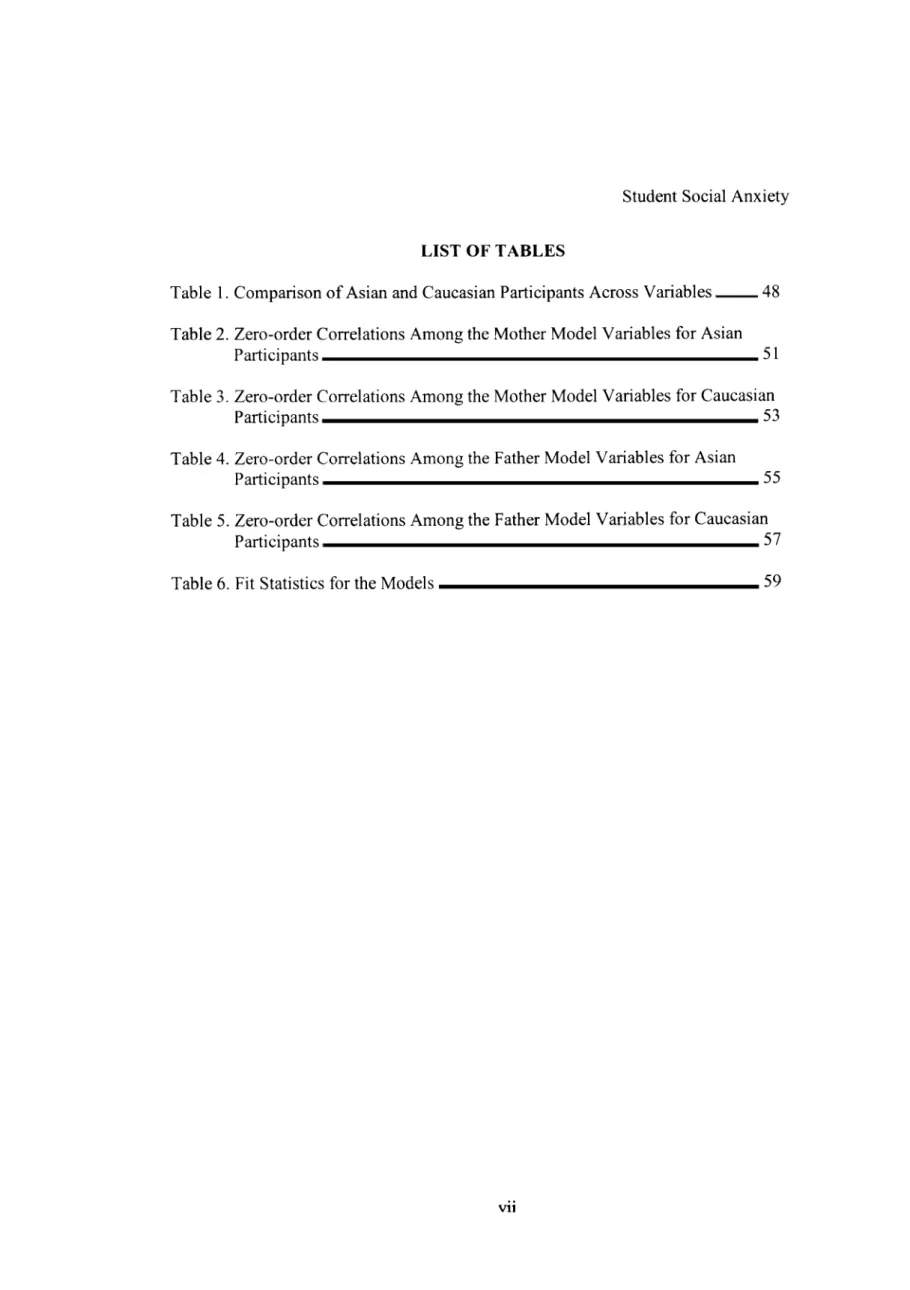
LIST OF TABLES
Table 1. Comparison of Asian and Caucasian Participants Across Variables 48 Table 2. Zero-order Correlations Among the Mother Model Variables for Asian
Participants 51 Table 3. Zero-order Correlations Among the Mother Model Variables for Caucasian
Participants 53 Table 4. Zero-order Correlations Among the Father Model Variables for Asian
Participants 55 Table 5. Zero-order Correlations Among the Father Model Variables for Caucasian
Participants 57 Table 6. Fit Statistics for the Models 59
LIST OF FIGURES
Figure Captions 60 Figure 1. Hypothesized structural equation and measurement models 63
Figure 2. LISREL test of the model for mothers of Asian Participants 64 Figure 3. LISREL test of the model for mothers of Caucasian Participants 65 Figure 4. LISREL test of the model for fathers of Asian Participants 66 Figure 5. LISREL test of the model for fathers of Caucasian Participants 67
Running head: SOCIAL A N X I E T Y IN UNIVERSITY STUDENTS
Social Anxiety in University Students: Perceptions of Parenting, Perceived Control,
and Psychosocial Adjustment Christy Bryceland University of Calgary
Fears in social situations appear to be universal (Beidel & Randall, 1994), with over 90% of Americans reporting that they sometimes feel shy (Zimbardo, 1977). Between 11 and 37 percent of college students report feeling anxious while interacting with the opposite sex, and at least 20 percent report excessive apprehension about public speaking (Leary & Kowalsky, 1995). In addition, a subset of people experience fear of social interaction that interferes with their daily functioning. This can impede social-emotional development, particularly during key developmental periods such as late adolescence and early adulthood (Ballenger, Davidson, Lecrubier, & Nutt, 1998).
Many factors, both biological and social, contribute to the development of social anxiety. In a large-scale twin study it was found that the concordance for social phobia was greater in monozygotic than dizygotic twins. Statistical analyses of the variance in liability for social phobia disorder indicated that about one third was due to genetic factors and two thirds to environmental factors (Kendler, Neale, Kessler, Heath, & Eaves, 1992). A behaviourally inhibited temperament in young infants has been found to predict later social anxiety (Rosenbaum, Biederman, Hirshfeld, Bolduc, & Chaloff, 1991). Research generally supports a familial transmission of social anxiety and social phobia, attributed in part to a genetic component (Kendler et al., 1992). However, at least part of this transmission can be attributed to the family environment (Bogels, van Oosten, Muris, & Smulders, 2001). For example, individuals with social phobia report experiencing more overprotective, isolating, and critical parenting (Bruch, 1989).
Bogels et al. (2001) argued that there are two reasons why family environment may be important in the etiology of social phobia. First, it is in the family where people
begin to learn social behaviour and develop their sense of themselves as social beings. Second, the mean age of onset for social phobia falls between adolescence and early adulthood, when the family still has an important influence. Cognitions such as
perceived control may also play an important role in the development, maintenance, and exacerbation of anxiety and may mediate such experiences as parenting (Chorpita, Brown, & Barlow, 1998). This study examined the relationship between parenting styles and social anxiety in university students, and the possible mediating role of perceived control.
Social Anxiety and College Adjustment
Early adulthood is a critical formative period, when peer groups and interpersonal relationships assume great importance (Ballenger et al. 1998). Chickering (1969)
suggested that the tasks of late adolescent and early adult college students are both intrapersonal (developing autonomy) and interpersonal (developing intimacy). Social anxiety can interfere with social functioning and result in the development of harmful coping mechanisms, such as avoidance, which only serve to perpetuate future anxiety. Social anxiety has the potential to interfere with the normal development of autonomy, as is evidenced by the fact that people with social anxiety disorder are more likely to be unemployed, show reduced productivity, are less likely to marry, and more likely to divorce (Ballenger et al., 1998). Social anxiety and social phobia have also been linked to excessive alcohol consumption and substance abuse problems in college students (Burke & Stephens, 1999; Kushner & Sher,1993). Clearly social anxiety can have a disabling
impact on interpersonal development, educational attainment, and career progression (Westenberg, 1998).
Family Environment and Social Anxiety
A growing body of research has considered the relationship between family environment and social anxiety (see Hudson & Rapee, 2000; Masia & Morris, 1998; and Rapee,1997 for reviews). Retrospective studies have found that adults with social phobia rated their parents as more socially anxious and less sociable, and as stressing the
opinions of others more than the parents of agoraphobics or non-clinical controls (Bruch, 1989; Bruch, Heimberg, Berger, & Collins, 1989). Those with social phobia also
reported that their families were more isolated, and used more shame as discipline as compared to normal controls (Bruch, 1989; Bruch et al., 1989). Parents of social phobics were rated as being more critical of their children's social behaviours (Bruch &
Heimberg, 1994). Further, socially phobic adults perceive their parents to be more controlling, more rejecting and overprotective, and less emotionally warm and expressive of affection compared to agoraphobics or normal controls (Arrindell, Emmelkamp,
Monsma, & Brilman,1983; Arrindell et al., 1989; Parker, 1979).
Muris and Merckelback (1998) studied the perceptions of parental rearing behaviours and anxiety symptoms in a sample of normal children aged 8 to 12 years. They found significant positive relationships between symptoms of anxiety and both anxious parenting behaviours and parental control. Bogels et al. (2001) considered the parenting experiences reported by clinically referred and non-referred children aged 8 to
found that mothers' and children's reports of low family sociability and children's reports of mother's overprotection predicted social anxiety, but father reports did not. Reports of parental rejection, low emotional warmth and low family sociability were greater for socially anxious vs. normal children, but socially anxious children did not differ from clinically referred children with other problems.
Caster, Inderbitzen, and Hope (1999) looked at the relation between adolescents' social anxiety and their parents' child rearing styles. Adolescents with higher levels of social anxiety described their parents as more socially isolating, overly concerned with the opinions of others, more ashamed of their child's shyness and poor performance, and less socially active. However, there were no differences in child rearing styles as
reported by the parents of socially anxious versus non socially anxious adolescents. Research on shyness has also contributed to our understanding of the role of parenting styles in the etiology of social anxiety. Eastburg and Johnson (1990) found shyness to be related to decreased maternal acceptance, and increased maternal control. Mills and Rubin (1993) found that mothers of shy children believed more strongly that social skills were best taught in a directive manner, and that their children's unskilled behaviours should be responded to in a directive or coercive manner. They were also more likely to feel angry, disappointed, guilty, or embarrassed by their child's unskilled behaviours.
Studies of anxious individuals as parents suggest that they tend to avoid social situations, thereby limiting their child's opportunities to engage socially (Beidel & Morris, 1995). Also, they display increased criticism, especially of behaviourally
inhibited children (Hirshfeld, Biederman, Brody, Faraone, & Rosenbaum, 1997), and a style that fosters dependence and self-criticism in their children (Thompson & Zuroff, 1998). Thus, the parenting styles of anxious individuals seem consistent with the parenting experiences reported by people with social anxiety. The findings suggest that parents' social anxiety may be related to behaviours such as a concern with others' opinions, the use of increased control, and family isolation.
There are a number of gaps in the research on the parenting styles of socially anxious individuals. Many of the studies report retrospective ratings by adults of remembered parenting and adolescent experiences. In the few studies that have considered the concurrent family experiences of children and adolescents in relation to their social anxiety, the findings are somewhat less clear-cut than those from the adult retrospective studies, for example, the distinctions in parenting styles reported by adults with social anxiety versus other anxiety problems have not consistently been found in younger people. Research has looked at the experiences of children and young
adolescents but needs to be extended to consider the experiences of older adolescents and young adults who are still living with their families. In addition, most studies have focused on the family experiences of individuals with social phobia, to the exclusion of people with sub-clinical levels of social anxiety. The research needs to be further extended to study the family experiences of people with sub-clinical levels of social anxiety. Finally, although there is initial support for the hypothesis that people with social anxiety parent in a way that fosters social anxiety in their children, further exploration of this hypothesis is needed.
It has been suggested that parenting styles characterized by high protection and limited autonomy can foster a diminished sense of control which can in turn produce chronic anxiety (Chorpita & Barlow, 1998). Chorpita and Barlow (1998) suggested that perceived control may be a cognitive mediator of the relationship between a controlling parenting style and child anxiety. It has been found that parents who provide their children with less stimulation, are less responsive, and more authoritarian, intrusive, overprotective, rejecting or neglectful, are more likely to have children with an external control orientation (Schneewind, 1995). This pattern of parenting is similar to the
parenting behaviours experienced by socially anxious people. It is plausible then, that the link between overprotective, critical, and isolating parenting, and the development of social anxiety in children, is mediated by the child's perceived control. Chorpita et al. (1998) found that diminished control over events was a vulnerability factor for anxiety disorders in school-age children, and demonstrated the association between a parenting style that limits personal control, and anxiety. This relationship needs to be further examined more specifically in relation to social anxiety and the associated parenting patterns of isolation, control, and rejection.
Rationale for the Current Study
This study had several goals. The first was to look at the relationship between parent social anxiety and the social anxiety of their young adult children who were still living at home. The second was to examine whether the relationship between parent anxiety and child anxiety was mediated by a parenting style characterized by high levels of psychological and behavioural control, concern with others' opinions, shame and
isolation, and by low family sociability and acceptance. A third goal was to consider whether the relationship between the parenting styles reported by anxious people and their social anxiety, is mediated by their perceived sense of control over events. The final goal was to consider the impact of social anxiety on meeting the important developmental milestones of the college years, by considering the relationship between social anxiety and achievement of appropriate peer relationships, emotional autonomy, and a healthy lifestyle.
This study set out to test a structural equation model of the above-described relationships (see Figure 1). Although relationships for mothers and fathers were tested separately, the same pattern of relationships was predicted to fit for both groups, so only one hypothesized model is shown. Parent social anxiety was indexed by the child's report of parent fear and avoidance in social situations. Parenting style was indexed by children's reports of their perceptions of a number of parenting variables found to be relevant in previous research: family isolation, concern with others' opinions, family sociability, shame, acceptance/ rejection, psychological control and behavioural (firm) control (Arrindell et al.,1983; Arrindell et a l , 1989; Bruch, 1989; Bruch et a l , 1989; Parker, 1979). Perceived control was indexed by locus of control, following the research of Chorpita et al. (1998). Student social anxiety was indexed by three measures of social anxiety including scales measuring fear of negative evaluation, avoidance and distress of social situations, and fear, avoidance and physiological reactivity in a specified set of social situations. The latent construct of psychosocial adjustment was indexed by the measured constructs of healthy lifestyle, emotional autonomy, and adjustment in peer
relationships, representing areas of psychosocial adjustment thought to be most impacted by social anxiety during early adulthood.
Insert Figure 1 about here
This study proposed to examine a pathway, from parent social anxiety, to child social anxiety and decreased psychosocial adjustment, mediated by perceived parenting style and perceived control. It was hypothesized that higher levels of parent social anxiety would foster a parenting style that is higher in control, concern with others' opinions, isolation and rejection. These types of parenting styles were in turn
hypothesized to foster the development of greater social anxiety in children, which was expected to be related to poorer psychosocial adjustment during the college years. It was also hypothesized that parent social anxiety would directly predict student social anxiety, due at least in part, to the genetic component of social anxiety and factors such as parent modelling. Locus of control was expected to mediate the relationship between parenting style and student social anxiety. A direct relationship between parenting style and
student social anxiety was also expected, given that parenting style as conceptualized in this study includes parenting styles in addition to control that may directly influence child social anxiety, such as family isolation.
Method Participants
Participants were 108 female and 29 male university students ages 18-22 years (M=19.6, SD=1.09), who were living at home with at least one parent. Twelve of the participants reported living with one parent, while the remaining reported living with both parents,
although no information was collected on whether these were blended versus biological families. Of the 12 participants from single parent homes, 3 were of Asian background and 9 were Caucasian. The ethnic background of the participants consisted of 46% Asian descent, 40% Caucasian, 4% Middle Eastern, 1% Latin American and 8% of other
backgrounds, primarily East Indian/Punjabi. Of the entire sample 67% spoke English as a first language. Of the Asian participants, 60% spoke English as a second language, whereas only 6% of the Caucasian participants were ESL. Approximately 70% of all participants were in their second or third year of university studies.
Measures
The Brief Social Phobia Scale - Parent Rating (BSPS-M, mothers; BSPS-F, fathers). For the purposes of this study, the 7-item fear and avoidance scales of the Brief Social Phobia Scale (Davidson et al., 1991) were adapted for students' ratings of their parents' reactions to several social situations (see the description of the BSPS below for more detail). Students rated their mothers' and fathers' fear and avoidance in 7 social situations for fear from 0 (none) to 4 (extreme), and their avoidance from 0 (never) to 4 (always). This adaptation was developed for this study therefore no reliability or validity data were available from previous research (see Appendix A for sample instructions and questions).
Parental Attitudes during Child-Rearing Years Scale (PACR; Bruch, Heimberg, Berger, & Collins, 1989).
This 19-item scale assesses child reports of family environment on four subscales: isolation (ISOL) (5 items), concern with others' opinions (OPNS) (5 items), shame
(SHAME) (5 items), and family sociability (FAM-SOC) (4 items). Respondents rated each item for mother and father separately on a 5-point Likert scale from 1 (Not at all characteristic) to 5 (Very characteristic). Cronbach alphas for the subscales isolation, concern with others' opinions, shame, and family sociability were reported to be .71, .68. 75, and .75 respectively (Bruch & Heimberg, 1994). (See Appendix B for sample instructions and questions).
Children's Report on Parental Behavior Inventory Revised - Short Form (CRPBI-30; Schludermann & Schludermann, 1983).
This 30-item questionnaire assesses children's and adolescents' reports of their parents' child-rearing behaviours and attitudes. There are three factor-derived subscales, each with ten items: Acceptance/Rejection (ACP-REJ), Psychological
Control/Psychological Autonomy (PSYC-CN), and Firm Control/Lax Control (BEHV-CN). Ratings are made on a three-point scale: like, somewhat like, not like. Fathers and mothers are rated separately. Cronbach alphas for each of the subscales were reported to be: Acceptance/Rejection, .75 for mothers and .73 for fathers; Psychological
Control/Autonomy, .72 for mothers and .63 for fathers; and Firm Control/Lax Control, .65 for mothers and .63 for fathers (Schludermann & Schludermann, 1983). (See Appendix C for sample instructions and questions).
The Adult Nowicki-Strickland Internal/External Control Scale ( L O C - C N ; Nowicki & Duke, 1974).
This 40-item questionnaire measures the extent to which individuals feel that events are contingent on their behaviour (internal locus of control) and the extent to
which they feel events are controlled externally (external locus of control). Questions are responded to with yes or no answers. High scores on the scale are indicative of a more external locus of control, and low scores are indicative of a more internal sense of
control. Split-half reliabilities ranged from .74 to .86, with a 6 week test-retest reliability of .83 (Nowicki & Duke, 1974). (See Appendix D for sample instructions and questions) The Brief Fear of Negative Evaluation Scale (Brief FNE; Leary. 1983).
The Brief FNE is a 12-item scale that measures repondents' apprehension of negative evaluations by others. It is scored on a 5-point Likert scale ranging from 1 (not at all characteristic of me) to 5 (extremely characteristic of me). The Brief F N E was reported to have a Cronbach's alpha of .90 and to correlate .96 with the full-scale version (Leary, 1983). (See Appendix E for sample instructions and questions).
The Social Avoidance and Distress Scale (SAD; Watson & Friend, 1969).
The SAD is a 28-item self-report measure of social distress or anxiety and
avoidance of social situations. The response format in the original version was true-false, but because the distribution was quite skewed (modal score of 0) many researchers have used a 5-point Likert format instead (Okazaki, 1997). A 5-point Likert scale ranging from
1 (not at all characteristic of me) to 5 (extremely characteristic of me) was used in the current study. The 5-point scale version of this scale has a Cronbach's alpha of .90 (Leary, 1991). (See Appendix F for sample instructions and questions).
The Brief Social Phobia Scale (BSPS- Student; Davidson et al.. 1991).
The BSPS is an 11-item scale used to assist with diagnosis of social phobia. For the purposes of this study, respondents rated their own fear and avoidance in seven social
situations (e.g. speaking in public, being criticized, social gatherings), for fear from 0 (none) to 4 (extreme), and for avoidance from 0 (never) to 4 (always). In addition, there are four questions regarding physiological symptoms of anxiety in social situations or when thinking about such situations. These symptoms are rated from 0 (none) to 4 (extreme). Cronbach alphas for the fear, avoidance, physiologic, and overall scales were reported as .78, .86, .34, and .86 respectively (Davidson et al., 1991). (See Appendix G for sample instructions and questions).
The Student Developmental Task and Lifestyle Assessment (SDTLA; Winston, Miller, & Cooper, 1999).
The S D T L A is a measure of students' developmental progress during the college years. The measure assesses a variety of early adulthood adaptive functioning issues including: developing emotional autonomy from parents, peer relationships, and drug and alcohol use. Three subscales from this measure were used. (See Appendix H for sample instructions and questions).
Emotional Autonomy Subtask (EMOT-AUT). High scores on this task are
indicative of freedom from the need for continuous reassurance and approval from others, trusting one's own ideas and feelings and having the self-assurance to be a confident decision maker and voice dissent in groups. There are 17 items, 7 which are rated on a 4-point Likert scale from never true of me to always true of me, 6 which are rated
according to frequency on a 4-point scale from never to often and 4 which are rated true-false or with a variety of qualitatively distinct options. This scale was reported to have a
Cronbach's alpha of .71 and a one-month test-retest reliability of .75 (Winston, Miller, & Cooper, 1999).
Peer Relationships Subtask (PEER R E D . High scores on this subtask are
indicative of peer relationships shifting toward greater trust, independence, frankness and individuality, and feeling less need to conform to friends' standards. There are 10 items, 5 of which are rated on a 4-point Likert scale from never true of me to always true of me, and 5 which are rated true-false or with a variety of qualitatively distinct options. This scale was reported to have a Cronbach's alpha of .65, and a one month test-retest reliability of .73 (Winston, Miller, & Cooper, 1999).
Salubrious Lifestyle Scale (HLTH LF). High scores on this scale indicate the degree to which the student's lifestyle promotes good health and wellness, relating to alcohol, tobacco and drug consumption, dietary habits, sleep, stress reduction and exercise. There are 17 items, 3 which are rated with a true-false format, 10 which are rated on a 4-point Likert scale from never to always true of me, and 4 which are rated with a variety of qualitatively distinct options or frequency of activity. This scale was reported to have a Cronbach's alpha of .71 and a one month test-retest reliability of .77 (Winston, Miller, & Cooper, 1999).
Procedure
Three students were recruited through posters advertising the study, placed around the campus of a large university in Western Canada. The remaining 134 students were recruited through a system for which they received bonus credit for psychology courses through participation in research. A description of the study with contact
information was posted on a bulletin board. A n internet-based administration was used with the intent to increase accessibility for socially anxious students.1 Student participants
responded to a dedicated E-mail address to receive more information about the study. They were sent an E-mail outlining the nature of participation and asking questions to determine their eligibility, based on falling between the ages of 18 and 22 years, and currently living at home with one or both parents . If eligible, students were sent the website address, a website access code and participant number, and procedural information on deadlines, and how best to access the site. Students logged on to the website, completed the consent form, provided parental contact information i f desired,3
completed the bonus credit registration form (or draw entry form to win a $200 gift certificate to the University bookstore, for those not eligible for bonus credit), and questionnaires. Participants had the option to withdraw from the study at any time. When the questionnaires were completed, or i f the participant decided to withdraw, the debriefing information appeared on screen. This consisted of a description of the goals of the study and hypothesized findings in relation to past literature, and included
information on available counseling should participants experience distress as a result of their participation in the study (See Appendix J).
Results
LISREL analyses (Joreskog & Sorbom, 1996) were used to test the model of hypothesized relationships for mothers and fathers separately. Since there were no
differences found between male and female participants on the measured constructs in the model, their data were combined in testing the models.4 However, differences were
found between participants of Asian and Caucasian descent, which required further investigation before the model could be tested for the sample as a whole.
Participants were primarily of Asian and Caucasian descent (46% and 40% of the total sample, respectively). By gender, this included 52 Asian females (82.5%) and 11 Asian males (17.5%), 40 Caucasian females (75.5%) and 13 Caucasian males (24.5%). A l l analyses were conducted using pairwise deletion of missing data5, and sample sizes
therefore vary for each analysis. Independent samples t-tests were conducted to compare participants of Asian and Caucasian descent. For mother social anxiety, father social anxiety, and locus of control, the significance level was set at p=.05. Bonferroni corrections were calculated to correct for the familywise error rate of each family of subscales: mother parenting style, father parenting style, social anxiety, and student adjustment. Significance levels were set at .007, .007, .017, and .017, respectively. The groups differed on measures of parent social anxiety, parenting style, locus of control, social anxiety, and student adjustment. The means, standard deviations, t values, and scale reliabilities are presented in Table 1. The descriptive values are provided for the overall sample as well as for Asian and Caucasian participants separately. Mean scores and standard deviations on the FNE and SAD for the Asian and Caucasian participants were consistent with those reported by Okazaki (1997) with university students of similar ethnic backgrounds. The mean score on the BSPS for the whole sample was well below that reported for a group of patients diagnosed with social phobia (Davidson et al., 1991), as would be expected for a normal college population. The internal consistencies of the scales ranged from a low Cronbach's alpha of .53 for isolating parenting style of fathers,
to a high of .95 for the SAD. The four subscales of the P A C R had the lowest reliabilities, ranging from .53 to .74. Findings involving these measures of parenting style should therefore be interpreted with caution.
Insert Table 1 about here
Zero-order correlations among all measures for mothers of Asian and Caucasian participants are presented in Tables 2 and 3 respectively. For mothers of both Asian and Caucasian descent, significant correlations were found among many of the variables, with somewhat fewer significant correlations for the Caucasian participants. For the mothers of Asian descent, mother social anxiety was positively correlated with two of the three indicators of student social anxiety (SAD and BSPS), and with the majority of the
indicators of parenting style. In contrast to these findings for Asian participants, mothers' social anxiety for Caucasian participants did not significantly correlate with the majority of parenting style or student social anxiety measures (positively correlated only with the FNE). Significant relationships between parenting style and locus of control were found for both groups: all of the parenting style indicators for mothers of Asian participants, except for concern with opinions and family sociability, correlated positively with student locus of control; the parenting measures of shame, psychological and behavioural control were significantly positively correlated with locus of control for the Caucasian
participants.
For Asian participants, there was a positive correlation between locus of control and the measures of student social anxiety. Two of the three measures of student social anxiety were positively correlated with locus of control for the Caucasian participants.
For Caucasians, the measures of student social anxiety were significantly positively correlated with most of the measures of parenting style, whereas for Asians parenting style correlated positively with about half with measures of student social anxiety. The three most reliable measures of parenting (acceptance-rejection, psychological control, and behavioural control) were positively correlated with student social anxiety for the Caucasian, but not the Asian participants. For both the Asian and Caucasian participants there was a negative correlation between locus of control and the measures of student adjustment, as well as between student social anxiety and student adjustment.
These findings indicate that although there are many similar patterns of
correlation between the two groups, there may be some differences that would impact the fit of the mother model and the significance of the model pathways for Asian versus Caucasian participants. In particular, it appears that there may not be a relationship between mother social anxiety and parenting style or student social anxiety for the Caucasian participants, while these relationships seem quite clear for the Asian
participants. The patterns of correlations also suggest that mother parenting style may not directly predict student social anxiety for the Asian participants, but there is a clearer direct relationship for Caucasian participants. These differences suggested that it would be best i f the mother model was tested separately for these groups.
Insert Table 2 and 3 about here
The zero-order correlations for fathers of Asian and Caucasian participants are presented in Tables 4 and 5 respectively. For the Asian participants, father social anxiety correlated positively with only one measure of student social anxiety, and with half of the
measures of parenting style. For the Caucasian participants, father social anxiety was not positively correlated with any of the student social anxiety measures, and correlated positively with two of the measures of parenting style.
For Asian participants half of the parenting style measures correlated positively with locus of control, and student social anxiety. For Caucasian participants only one of the measures of parenting correlated significantly with locus of control, and half of the parenting subscales correlated with the measures of student social anxiety. Locus of control was positively correlated with all three measures of student social anxiety for Asian participants, and with two out of the three social anxiety scales for Caucasian participants. For both groups, locus of control and student social anxiety were negatively correlated with the measures of student adjustment. The differences in patterns of
correlation were not as clear as with the mother model, however it was decided to test the father model separately for these groups in order to maintain a consistent approach, and to clarify any ethnic group differences with the father model.
Insert Tables 4 and 5 about here
Given the ethnic group differences found in the patterns of correlations, instead of testing the single hypothesized models for mothers and fathers as originally proposed, four models were tested, each for mothers and fathers of Asians and Caucasians. Due at least in part to the small sample sizes of each ethnic group6, there was a large degree of
error in the estimation of the pathways, and none of the models provided a good fit to the data. However, it was decided to proceed with testing the separate models, given the between group differences indicated by the correlations for each subgroup that might
otherwise have been obscured by combining the data for the ethnic groups together in one model.
For each of the models, the exogenous variable of parent social anxiety was measured by one indicator (parent rating on the adapted Brief Social Phobia Scale). In the mother model this was measured with the child's rating of mother's social anxiety M), and in the father model, with the child's rating of father social anxiety (BSPS-F). Four endogenous variables were included in the models. The first variable was parenting style of mothers in the mother model and of fathers in the father model (indicators are designated with M for mothers and F for fathers). Parenting styles of mothers and of fathers were each measured with six indicators: isolation (ISOL), concern with others' opinions (OPNS), shame, acceptance-rejection (ACP-REJ), psychological control (PSYC-CN) and behavioural or firm control (BEHV-CN). The second
endogenous variable was perceived control, measured with one indicator (locus of control, LOC-CN). The third endogenous variable, student social anxiety, was indexed by three measured variables (Fear of Negative Evaluation, FNE; Social Avoidance and Distress, SAD; and the Brief Social Phobia Scale, BSPS). The fourth endogenous variable, psychosocial adjustment, was measured by two indicators (peer relationships, PEER-REL; and emotional autonomy, EMOT-AUT).
In order to provide a metric for the latent constructs and to identify the
measurement model, we set the first indicator loading for each latent construct to 1.0 in the unstandardized solution. Thus it was not possible to provide significance tests for these values. Because a single indicator was used for parent social anxiety, it was
possible to fix the error term (delta) for this measured construct, using the scale
reliabilities. The term was set to 1 - Cronbach's alpha (for Asian mother social anxiety .07, for Caucasian mother social anxiety .08, for Asian father social anxiety .06 and for Caucasian father social anxiety .08). A single indicator was also used to measure
perceived control. This error term was fixed to 1 - Cronbach's alpha for the scale (.26 for Asians and .20 for Caucasians). A decision rule was applied for inclusion of measured constructs in the model. Measured constructs that correlated above .30 with the other constructs thought to assess the given factor, were included in the model. Two measured scales did not meet this criterion and were therefore dropped from the tested models. The sociability subscale (FAM-SOC) of both mother and father parenting was not included in the model. For both the sample as a whole and for the ethnic groups, it correlated above
.30 only with the isolation and acceptance-rejection subscales, but not with the other measures of parenting. The healthy lifestyle subscale (HLTH-LF) measuring student adjustment regarding health behaviours, did not correlate well with the other two measures of student adjustment for the sample as a whole or for the ethnic groups (although the relationships were significant for the Asian but not the Caucasian
participants), and was therefore dropped from the model. Correlation matrices were used in the LISREL analyses.
Test of the Model for Asian Mothers
The model to test the relationships between perceived mother social anxiety, mother parenting style, locus of control, student social anxiety and psychosocial adjustment for Asian participants is presented in Figure 2. LISREL provides results of
univariate Lagrange multiplier tests (i.e., modification indices) indicating i f the model would be significantly improved by the addition of paths. The results indicated that the addition of a pathway between perceived control and psychosocial adjustment would improve the fit of the model. The results for the adjusted model including this path are shown in Figure 2. This model includes standardized estimates of parameters in the measurement and structural models. The model chi-square was significant, X"(60) = 83.59, p=.02, indicative of a significant amount of unexplained variance in the model's fit to the data. A non-significant model chi-square is desired and the significant result suggests a poorly fitting model. It should be noted that with complex models using a number of indices, it is difficult to achieve a non-significant chi-square. However, a number of other fit indices taken together also suggest a poor fit of the model. These results are presented in Table 6. Overall, the findings indicate that the hypothesized model is not a good fit to the data
Insert Figure 2 and Table 6 about here
A l l of the measures loaded significantly on the latent constructs. A l l of the pathways were significant, except for the pathway from parenting directly to student social anxiety and the pathway from perceived control to student social anxiety. The significant positive pathway between parent and child social anxiety provides indirect support for factors such as modelling and a genetic transmission of social anxiety. As hypothesized there was a significant positive pathway from mother social anxiety to mother parenting style, suggesting that higher levels of mother social anxiety lead to a parenting style that is higher in control, isolation, rejection, shame and concern with
others' opinions. The expectation that there would be a significant direct pathway from mother parenting style to student social anxiety, was not supported, indicating that for Asian participants, a mother parenting style characterized by factors such as control, isolation, and rejection did not predict their social anxiety. Parenting style did
significantly positively predict locus of control, as expected, but locus of control was not in turn, a significant predictor of student social anxiety. Thus for the Asian participants neither the direct nor the mediated relationships between parenting and social anxiety were supported. The significant negative pathway between student social anxiety and psychosocial adjustment, supports the hypothesis that increased social anxiety predicts decreased psychosocial adjustment in the college years. The added pathway indicated significant negative prediction of psychosocial adjustment by locus of control, such that a more external locus of control is related to poorer adjustment. Although no specific hypothesis was made about this pathway, the results are consistent with expectation.
Test of the Model for Caucasian Mothers
The model to test the relationships between perceived mother social anxiety, mother parenting style, locus of control, student social anxiety and psychosocial adjustment for Caucasian participants is presented in Figure 3. Unlike for the Asian participants, the LISREL modification indices did not suggest the addition of a pathway between control and adjustment to improve model fit, nor the addition of other significant pathways, so the original hypothesized model was tested. The model chi-square was significant, X2(61) = 99.38, g=.00T, indicative of a significant amount of unexplained
Caucasian participants. A number of other fit indices taken together also suggest a poor fit of the model: only one of the three indices indicated a good fit. These results are presented in Table 6. Overall, the findings indicate that the hypothesized model is not a good fit to the data.
Insert Figure 3 about here
A l l of the measures loaded significantly on the latent constructs. Only the pathways from mother parenting to student social anxiety and to perceived control, and from student social anxiety to psychosocial adjustment were significant. The expected relationship between mother social anxiety and student social anxiety was not supported, suggesting that direct factors such as modelling and genetics did not impact the
relationship between mother and child social anxiety for the Caucasian participants. Nor was the relationship between mother social anxiety and mother parenting style supported, suggesting that for this sample mother social anxiety is unrelated to a parenting style characteristic of greater control, isolation, rejection and concern with others' opinions. Mother parenting style was directly positively predictive of student social anxiety, as hypothesized. However, although parenting style positively predicted perceived control, perceived control did not in turn predict student social anxiety, so the expected mediated relationship was not supported. This finding goes against the hypothesis that the
influence of parenting on child social anxiety is mediated by perceived control, and seems to support instead a direct relationship between mother parenting style and student social anxiety, for the Caucasian participants. The significant negative pathway between student social anxiety and psychosocial adjustment, supports the hypothesis that
increased social anxiety predicts decreased psychosocial adjustment in the college years. This seems to be a clear relationship across ethnic groups.
Test of the Model for Asian Fathers
The hypothesized model to test the relationships between perceived fathers' social anxiety, father parenting style, locus of control, student social anxiety and psychosocial adjustment for Asian participants is presented in Figure 4. LISREL provided results of univariate Lagrange multiplier tests (i.e., modification indices) indicating that the model would be significantly improved by the addition of a pathway from perceived control to psychosocial adjustment. The results for the adjusted model including this path are shown here. This model includes standardized estimates of parameters in the
measurement and structural models. The model chi-square was significant, %2(60) =
129.15, p<.001, suggestive of a poorly fitting model. A number of other fit indices also suggest that the model is a poor fit as none reached significance. These results are presented in Table 6.
Insert Figure 4 about here
A l l of the measures loaded significantly on the latent constructs. The pathways between father parenting and perceived control, between perceived control and
psychosocial adjustment, and between student social anxiety and psychosocial adjustment were significant. The expected relationship between father social anxiety and student social anxiety was not supported, suggesting that direct factors such as modelling and genetics did not impact the relationship between father and child social anxiety for the Asian participants. Nor was the expected relationship between father social anxiety and
father parenting style supported, suggesting that for this sample father social anxiety is unrelated to a parenting style characteristic of greater control, isolation, rejection and concern with others' opinions. Counter to hypothesis, father parenting style did not directly positively predict student social anxiety, and although parenting style positively predicted perceived control, perceived control did not in turn predict student social anxiety. Thus neither the direct nor the expected mediated relationships between parenting style and social anxiety were supported. The significant negative pathway between student social anxiety and psychosocial adjustment, supports the hypothesis that increased social anxiety predicts decreased psychosocial adjustment in the college years. The pathway from perceived control to psychosocial adjustment was significant and the direction of the results are consistent with expectation such that a more external locus of control is related to poorer adjustment.
Test of the Model for Caucasian Fathers
The hypothesized model to test the relationships between perceived fathers' social anxiety, perceived parenting by fathers, locus of control, student social anxiety and psychosocial adjustment for Caucasian participants is presented in Figure 5. As with the Caucasian mothers, the LISREL modification indices did not suggest the addition of a pathway between control and adjustment to improve model fit, nor the addition of other significant pathways, therefore the original hypothesized model was tested. The model chi-square was significant, %2(61) = 92.60, p=.006, suggestive of a poorly fitting model,
overall of a poor fit of the father model to the data for Caucasian participants. The fit indices are presented in Table 6.
Insert Figure 5 about here
A l l of the measures loaded significantly on the latent constructs, except for the Acceptance-Rejection subscale on the parenting construct. Only the pathway between student social anxiety and psychosocial adjustment was significant. The expected relationship between father social anxiety and student social anxiety was not supported, suggesting that direct factors such as modelling and genetics did not impact the
relationship between father and child social anxiety for the Caucasian participants. Nor was the expected relationship between father social anxiety and father parenting style supported, suggesting that for this sample, father social anxiety is unrelated to the hypothesized parenting style. Counter to hypothesis, father parenting style did not directly positively predict student social anxiety, nor did father parenting style positively predict perceived control, and perceived control did not predict student social anxiety. Thus neither the direct nor the expected mediated relationships between father parenting style and social anxiety were supported. The significant negative pathway between student social anxiety and psychosocial adjustment, supports the hypothesis that
increased social anxiety predicts decreased psychosocial adjustment in the college years. Discussion
The goals of this study were to integrate and expand on previous work on the relationships between parent social anxiety and child social anxiety, between specific
parenting styles and child social anxiety, and the role of perceived control as a possible mediator between such parenting styles and child social anxiety. A final goal was to assess the relationship between social anxiety and psychosocial adjustment during the college years. The original intention was to test these relationships simultaneously using structural equation modelling to consider the impact of mother and father social anxiety and parenting style in two separate models. However, an over-representation of Asian participants in a sample that was drawn from a predominantly Caucasian university population, allowed for the comparison of relatively equal-sized Asian and Caucasian groups. This comparison highlighted differences between Asian and Caucasian participants such that Asian participants scored significantly higher on many of the variables of interest, and evidenced different patterns of relationships between the variables. These differences suggested that it would be appropriate to consider the two ethnic groups separately in the models such that any differences in the fit of the structural equation models would be highlighted.
There are several possible reasons for the large and unrepresentative proportion of ethnic minorities in this sample. First, this study was conducted over the internet. There may be something about the internet methodology that attracted a greater number of ethnic minority and particularly Asian participants. For example, the absence of face-to-face interaction in the study may be preferable to participants who speak English as a second language. Alternatively, there may be something about the study of social anxiety that attracts more ethnic minority participants, although this has not been noted in other research in this area. Given that Asian participants scored higher on measures of social
anxiety, this may be generally a more salient source of distress for people of Asian background. Students of Asian background may therefore be more attracted to
participating in studies about social anxiety than their Caucasian counterparts. Another potential contributing factor to the large proportion of Asian participants, was the requirement that participants be living at home with their parents. It is plausible that more students of Asian background than of Caucasian background continue to live with their families of origin into adulthood, given that many young adults of Asian heritage are expected to live with their families until they marry (Johnson, 1977).
The literature supports the finding of greater social anxiety among Asian
participants. Leong (1985) reviewed studies of Asian Americans on constructs related to social anxiety such as assertion, social introversion, social deference and abasement, and concluded that Asian Americans report being more emotionally withdrawn, socially isolated, verbally inhibited and socially introverted, as compared to Caucasian
Americans. Sue, Ino, and Sue (1983) found that Chinese American male college students reported greater social anxiety on the Social Avoidance and Distress Scale (SAD) and the Fear of Negative Evaluation Scale (FNE), than their Caucasian counterparts. Okazaki (1997) examined the relationship between interdependent versus independent self-construal and reports of social anxiety in Asian as compared to Caucasian American college students. Asian students reported significantly higher scores on both the Brief FNE and S A D , lower scores on independent self-construal, and higher scores on interdependent self-construal, as compared to Caucasian college students. Using hierarchical multiple regression, it was found that self-construal and ethnicity played
some role in the level of reported social anxiety. Lower independent self-construal was found to be related to higher reports of social anxiety, such that those who were more concerned with asserting their own judgement and emphasizing autonomy from others were less likely to be avoidant, distressed or fearful in social situations.
Findings have also indicated that Asian Americans tend to score lower on
measures of autonomy, and higher on dependence and obedience to authority (Meredith, 1966; Sue & Kirk, 1972; Sue & Kirk, 1973), consistent with a more interdependent self-construal. Sue and Kirk (1972) attributed their findings with Chinese Americans of increased conformity and social introversion, to traditional Chinese cultural values of respect for authority and submergence of individuality. Leong (1985) interpreted these findings as indicative of a more external locus of control among people of Asian descent, and studies with locus of control scales have supported this hypothesis, indicating that Asian Americans tend to rate themselves as having a more external locus of control. The findings of the current study of both lower scores on emotional autonomy and peer relationships (primarily conceptualized as independence in peer relationships), and higher scores on locus of control, indicative of a more external locus of control for Asian as compared to Caucasian participants, are consistent with previous research.
Asian participants in this study rated their parents as significantly higher on several measures of parenting style including isolation, concern with other' opinions, and rejection. A number of studies have considered the parenting styles of Asian or Asian-American as compared to Caucasian families and have reported similar findings. Asian families have typically been characterized as more authoritarian (Dornbusch, Ritter,
Leiderman, Roberts, & Fraleigh, 1987), controlling, restrictive, and rejecting or hostile (Chiu, 1987; Lin & Fu, 1990). Chao (1994) critiqued this as an ethnocentric and misleading interpretation of Chinese parenting. Chao argued that the Chinese or Asian approach to parenting is founded on Confucian principles such as respect for elders and an emphasis on family, and that for Asians, parental obedience and strictness may be equated with parental concern, caring and involvement. Chao also argued that the Asian parenting style that has been considered authoritarian from a Western perspective, should be looked at from the perspective of the Chinese principle of chiao shun or training children in appropriate behaviour. Unlike the Western conceptualization of authoritarian parenting, chiao shun takes place in the context of a supportive, highly involved and physically close parent child relationship.
Chao (1994) found that Chinese American mothers were significantly higher than European American mothers on parental control, and authoritarianism, but the Chinese mothers also scored higher than European American mothers on Chinese child-rearing ideologies representing the concept of training (teaching children in appropriate and expected behaviour in an environment characterized by both control and support). These findings indicate that the notion of chiao shun may be a more appropriate representation for the parenting of Asian immigrant mothers, than authoritarianism which is applied out of sociocultural context.
Gorman (1998) further considered the "authoritarian" conceptualization of
Chinese parenting in a qualitative study of the parenting of Chinese immigrant parents of young adolescents. The results revealed themes of a watchful and subtle influence to
conform with parental expectations for their children to succeed. Gorman argued that the aspects of Chinese parenting that have been ascribed to an authoritarian style may
actually derive from a unique set of parenting attitudes that are culturally based. While we must be careful not too overinterpret or pass ethnocentric judgement on the parenting style that was reported of the Asian parents, it seems that the parenting style reported of Asian parents in this study is generally consistent with those parenting characteristics that have been linked to social anxiety in previous studies using primarily Caucasian
participants.
The models for mothers provided the best fit to the data with the greatest number of significant pathways, suggesting that the relationships described are strongest in
relation to mother social anxiety and mother parenting style patterns. Given that much of the research on which the model was developed has studied mothers and their parenting styles, it follows that the findings with mothers would provide the best fit with the hypothesized relationships. These findings support the idea that research that has been primarily conducted with mothers cannot simply be extrapolated to apply to fathers, and that both mothers and fathers need to be studied. However, it is also important to keep in mind that the data sets used in the mother and father models are not independent. The student participants rated both their mothers and their fathers on social anxiety and parenting. It is likely that a test of these models with parent reports regarding their own social anxiety and parenting would produce different results, although it is difficult to hypothesize in which direction.
The small sample sizes used to test the four models were clearly problematic in terms of their impact on the fit of the models and the significance of the pathways. It is likely that some of the apparently substantive pathway coefficients in the models were not found to be significant because of the large standard error terms resulting from the small samples used to test the models. This should be borne in mind when interpreting the findings, and conclusions must be drawn with caution.
The ethnicity differences that were found, placed in question the equivalent fit of the model for both Asian and Caucasian participants. The findings seem to indicate that overall, the model best fits the pattern of relationships found regarding the mothers of Asian participants, given that most of the hypothesized pathways were supported for this group.
For Asian participants, mother social anxiety appeared to be a salient predictive factor of both their children's social anxiety and the way in which they parent. It was not a significant predictive factor for Caucasian participants. The pathways from father social anxiety to student social anxiety and to father parenting style were not significantly predictive for either the Asian or the Caucasian participants. Although caution is
required in interpreting these findings, one interpretation is that there is a stronger direct transmission of social anxiety from mothers to children through factors such as genetics and modelling in Asian than in Caucasian participants. This requires further study with methodologies designed to clearly elucidate such components with a specific comparison of Asian and Caucasian people. The hypothesis that the transmission of social anxiety from parent to child through factors such as modelling may be stronger for Asian
participants, may make sense given the more interdependent nature of Asian cultures, possibly making at least some social anxiety a more adaptive emotional response for Asian people. For people of Asian heritage, social anxiety at some level may represent more of a normative set of behaviours and feelings, that are directly transmitted to children through means such as parent modelling and teaching. The lack of a predictive relationship between parent social anxiety and parenting style for all groups except Asian mothers, is more difficult to explain. It is possible that the hypothesized relationship between parent social anxiety and parenting style may come into play for people with high levels of social anxiety but may not be salient at lower levels for Caucasian parents or for Asian fathers.
For Asian mothers, the direct relationship between mother parenting style and student social anxiety was not supported, nor was the pathway mediated by perceived control. There was a different pattern of results for the Caucasian participants, such that mothers' parenting style directly positively predicted student social anxiety, but the pathway mediated by perceived control was not supported. For both the Caucasian and Asian models, father parenting style did not directly positively predict student social anxiety. With the Asian participants, father parenting style positively predicted locus of control, but locus of control did not in turn predict student social anxiety. Thus the mediated pathway was not supported for either Asian or Caucasian father models. From these results it appears that a maternal parenting style high in control, isolation, concern with others' opinions, and rejection, directly predicts the social anxiety of Caucasian but not Asian students. Regardless of ethnicity, father parenting style did not directly predict
student social anxiety. In no model was the pathway from parenting style to student social anxiety mediated by locus of control supported. The finding of support for the predictive relationship between the parenting style of Caucasian mothers and their children's social anxiety makes sense in that the hypothesized model was based on a literature derived primarily from the study of Caucasian people and their experiences of parenting behaviour, most often of their mothers. It is plausible that this relationship was not supported for Asian participants because an entirely different set of cultural norms and expectations apply. In any case, this finding extends previous findings regarding the relationship between parenting style, particularly for mothers, and social anxiety, to the young adult age group and provides more prospective evidence of this relationship.
The positive predictive relationship between parenting style and locus of control was present for all groups except Caucasian fathers. This supports the hypothesis that a parenting style high in control, rejection, isolation and concern with others' opinions fosters a more external locus of control. It is possible that the lack of a mediated
relationship may be explained in part by the fact that this study examined social anxiety specifically rather than negative affect and anxiety generally, as was done in the Chorpita et al. (1998) model. In addition, Chorpita et al. studied a different age group and used different methods to collect information on parenting, so different findings on this basis are understandable. However, the lack of support for the pathway mediated by locus of control must be interpreted with caution: the pathway coefficients representing the mediated relationship all appear as though they may have been substantive if tested with larger sample sizes.
A l l of the models supported the significant negative relationships between social anxiety and adjustment. This indicates that the relationship between student social anxiety and poorer psychosocial adjustment on measures of emotional autonomy and peer relationships, is a strong one that holds across ethnic groups and small sample sizes. It is interesting that the pathway from perceived control to adjustment significantly improved model fit only for Asian participants. It seems generally that perceived control may be a more salient predictive factor of adjustment for Asian participants.
This study suffered from a number of limitations. Clearly, sample size was an issue which impacted the interpretability of the findings. The unforeseen ethnic make-up and differences of the sample reduced the sample sizes used in the testing of the models to well below recommended levels. Also, the use of student report of parents' anxiety is problematic. A n attempt was made to acquire parent reports on their own anxiety
experiences, but this was unsuccessful as the return rate of parent questionnaires was very low. Future research needs to address this problem, and find ways to involve a sufficient number of parents. Another possible limitation was the exclusive use of student reports about their family environments, rather than using parent reports. However, previous research has found limited agreement between parents' and youths' perceptions of the family environment (Kazdin, French, Unis, & Esveldt-Dawson, 1983), and making sense of disparate parent and youth reports seemed problematic. It was therefore decided that the youth's perceptions of their family environments were more important than those of their parents, in terms of the impact on their experience of perceived lack of control and social anxiety.
Future research will need to be conducted to further consider the ethnicity differences found in this study. It is recommended that large, relatively homogeneous samples be used to test the models, particularly the mediational versus the direct model relating parenting, perceived control and social anxiety, as there appears to be an
interaction between parenting style and ethnicity in terms of how these relationships are manifested. In addition, further research should address the potential 'pathologizing of culture' that has arisen in this study. While it may be the case that Asian students experience greater social anxiety and resultant distress than Caucasian students, it may also be the case that our measurement devices are not accurately representing their experiences. Their reports of greater social anxiety and greater parental control may at least in part represent a cultural difference based on a more interpersonally oriented or collective, and therefore socially sensitive culture, rather than problems to be
References
Arrindell, W. A . , Kwee, M . G. T., Methorst, G. J., Van Der Ende, J., Pol, E., & Moritz, B. J. M . (1989). Perceived parental rearing styles of agoraphobic and socially phobic inpatients. British Journal of Psychiatry, 155, 526-535.
Arrindell, W. A., Emmelkamp, P. M . G., Monsma, A., & Brilman, E. (1983). The role of perceived parental rearing practices in the aetiology of phobic disorders: A controlled study. British Journal of Psychiatry, 143, 183-187.
Ballenger, J. C , Davidson, J. R. T., Lecrubier, Y . , & Nutt, D. J. (1998). Consensus statement on social anxiety disorder from the International Consensus Group on
Depression and Anxiety. Journal of Clinical Psychiatry, 1998, 54-60.
Beidel, D. C , & Morris, T. L. (1995). Social phobia. In John S. March et al. (Eds.), Anxiety disorders in children and adolescents (pp. 181-211). New York: Guilford Press.
Beidel, D. C , & Randall, J. (1994). Social phobia. In T. H . Ollendick, & N . J. King (Eds.), International handbook of phobic and anxiety disorders in children and
adolescents. Issues in clinical child psychology (pp. 111-129). New York: Plenum Press. Bogels, S. M . , van Oosten, A., Muris, P., & Smulders, D. (2001). Familial correlates of social anxiety in children and adolescents. Behaviour Research and Therapy, 39, 273-287.
Bruch, M . A . (1989). Familial and developmental antecedents of social phobia: Issues and findings. Clinical Psychology Review, 9, 37-47.
Bruch, M . A . , & Heimberg, R. G. (1994). Differences in perceptions of parental and personal characteristics between generalized and nongeneralized social phobics. Journal of Anxiety Disorders, 8, 155-168.
Bruch, M . A . , Heimberg, R. G., Berger, P., & Collins, T. M . (1989). Social phobia and perceptions of early parental and personal characteristics. Anxiety Research, 2, 57-65.
Caster, J. B., Inderbitzen, H . M . , & Hope, D. (1999). Relationship between youth and parent perceptions of family environment and social anxiety. Journal of Anxiety
Disorders, 13, 237-251.
Chickering, A . W. (1969). Education and identity. San Francisco: Jossey-Bass. Chao, R. K . (1994). Beyond parental control and authoritarian parenting style: Understanding Chinese parenting through the cultural notion of training. Child Development. 65. 1111-1119.
Chorpita, B. F., & Barlow, D. H . (1998). The development of anxiety: The role of control in the early environment. Psychological Bulletin, 124, 3-21.
Chorpita, B . F., Brown, T. A., & Barlow, D. H . (1998). Perceived control as a mediator of family environment in etiological models of childhood anxiety. Behavior Therapy, 29, 457-476.
Chiu, L. H . (1987). Child-rearing attitudes of Chinese, Chinese-American and Anglo-American mothers. International Journal of Psychology, 22, 409-419.
Davidson, J. R., Potts, N . L., Richichi, E. A., Ford, S. M . , Krishnan, R. R., Smith, R. D., & Wilson, W. (1991). The Brief Social Phobia Scale. The Journal of Clinical