Harsanyi support levels solutions
Besner, Manfred
HFT Stuttgart, University of Applied Sciences, Department of
Geomatics, Computer Science and Mathematics
7 July 2020
Online at
https://mpra.ub.uni-muenchen.de/101674/
MPRA Paper No. 101674, posted 16 Jul 2020 17:25 UTC
Manfred Besner
∗July 7, 2020
Abstract
We introduce a new class of values with transferable utility for level structures. In these hi-erarchical structures, each level corresponds to a partition of the player set, which becomes increasingly coarse from the trivial partition containing only singletons to the partition con-taining only the grand coalition. The new values, called Harsanyi support levels solutions, extend the Harsanyi solutions to level structures. As an important subset of these values, we present the class of weighted Shapley support levels values as a further result. The val-ues from this class extend the weighted Shapley valval-ues to level structures and contain the Shapley levels value as a special case. Axiomatizations of the studied classes are provided.
Keywords
Cooperative game · Level structure · (Weighted) Shapley (levels) value · Harsanyi set · Dividends1 Introduction
Many institutions, companies, governments, and so on are organized in hierarchical struc-tures. Typically, there is one unit at the top. In the following levels, each unit of the parent level is divided into two or more subordinate units, which usually have a lower rank than the higher ones. We can see a similar organizational structure in supply chains in some respects. Effectiveness increases by sharing or pooling physical objects, resources, and information. Queuing problems or electricity and other networks have a related background. A central characteristic of all these forms of organization is that a cooperating unit can itself be an actor to gain advantages of cooperation for the members of the unit. The question arises: how should we share the benefits and allocate the costs?
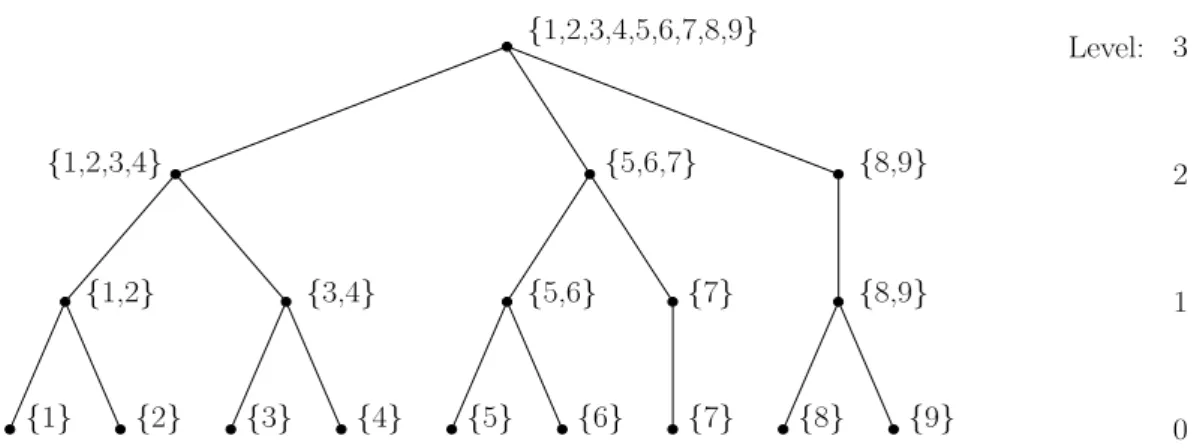
To distribute the profits of cooperating coalitions, the application of a cooperative game seems to be a natural approach. Winter (1989) defined a model for cooperative games with a hierarchical structure, called level structure, which comprises a sequence of coalition structures (the levels). At each level, the player set is partitioned into components where each higher level is coarser than the previous one (see also Figure 1). Winter’s value
(Winter, 1989) for such a model, we call it Shapley levels value, extends the Owen value *
M. Besner
Department of Geomatics, Computer Science and Mathematics, HFT Stuttgart, University of Applied Sciences, Schellingstr. 24 D-70174 Stuttgart, Germany
Tel.: +49 (0)711 8926 2791
(Owen, 1977), which is itself an extension of the Shapley value (Shapley, 1953b). Thus, this value satisfies adaptions of the symmetry axioms, satisfied by the Owen value, to level structures.
To treat symmetric players differently when there are exogenous weights for the players,
Shapley (1953a) introduced the weighted Shapley values. Vidal-Puga (2012) established
a value for coalition structures with weights given by the size of the coalitions. With a step by step top-down algorithm, G´omez-R´ua and Vidal-Puga (2011) extended it to level structures. Besner (2019) generalized this value to the class of the weighted Shapley hierarchy levels values for arbitrary, exogenously given, weights. These values satisfy an extension of the consistency property of the weighted Shapley values inHart and Mas-Colell (1989). Interestingly, the weighted Shapley hierarchy levels values contain the Shapley levels value but do not satisfy the null player axiom in general.
The weighted values for coalition structures in Levy and McLean (1989) and McLean (1991) behave the other way round; they satisfy the null player property but do not cor-respond to a consistency property in the above sense. Levy and McLean (1989) examine several classes of weighted values for coalition structures which use the same weight system as the weighted Shapley values: either for the players within a component or the compo-nents themselves if the compocompo-nents act as players. The combined use of such a weight system, both for players and components, is only mentioned. This latter class of extensions of the weighted Shapley values and an extension of the class of random order values(Weber, 1988)to coalition structures is discussed inMcLean (1991). Dragan (1992)called McLean’s extensions of the weighted Shapley values McLean weighted coalition structure values. He presented a formula for them related to that of the Owen value. For a fixed coalition structure, these values coincide with a multiweighted Shapley value (Dragan, 1992).
Harsanyi (1959) introduced a new perspective on coalition functions. He used so-called (Harsanyi) dividends, assigned to all feasible coalitions of a player set according to the coalition function. Singletons receive the singleton worth as their dividend and the dividend of each larger coalition S amounts to the worth of S minus the sum of all dividends of the proper subcoalitions of S. The weighted Shapley values give the players as payoffs a share of the dividends from the coalitions in which they are members. Two players’ shares of dividends from coalitions containing both players are always in the same ratio. In comparison, the Harsanyi solutions (Hammer, 1977;Vasil’ev, 1978), are more flexible. By these values, two players can receive dividend shares from coalitions, containing both, in various ratios for each coalition.
In this article, we introduce the Harsanyi support levels solutions. To the best of our knowledge, these are the first values for level structures (LS-values) that extend the Harsanyi solutions. We represent each value of the new class by a formula with dividends. The coefficients in the formulas constitute a dividend sharing system, i. e., all coefficients are non-negative and amount to one for each coalition. According to the definition of a Harsanyi solution, the LS-values from this class correspond to a Harsanyi solution for a fixed level structure. Therefore, they inherit all properties (adapted to level structures) of these values for a fixed level structure.
Within the framework of level structures, we can also consider the components of a level as players in so-called induced LS-games. Winter (1989)has shown that the Shapley levels value satisfies the level game property. This property means that the payoff to a component in an induced LS-game is equal to the sum of the payoffs to all players included in the component. We show that if a value for level structures satisfies the level game property and coincides for a fixed level structure with a Harsanyi solution, the value is a member
of the class of the Harsanyi support levels solutions. A corollary, our main result, extends an axiomatization of the class of the Harsanyi solutions by Vasil’ev (1981)and Derks et al. (2000) to a characterization of the class of the Harsanyi support levels solutions.
Since the Harsanyi solutions are no random order values in general, we cannot adopt the proof procedures for characterizations, e.g., in Winter (1989) or McLean (1991). We base our proofs on dividends where two new lemmas are a significant help.
As a further result, we present the class of the weighted Shapley support levels values as a proper subset of the class of the Harsanyi support levels solutions. The LS-values from this class coincide with the McLean weighted coalition structure values on a level structure with only three levels if we count the partition containing all singletons and the partition containing only the grand coalition as levels. To offer characterizations for this class, we adapt axiomatizations of the weighted Shapley values in Nowak and Radzik (1995).
In the concluding section, it is briefly explained that the values presented in this article can have an interesting solidarity characteristic: players who have formed a group support the other group members even in situations where they are not active and do not expect any direct reward for their support, as with the weighted Shapley Hierarchy levels values. In this way, they differ fundamentally from solidarity-based solution concepts such as the equal division value, the equal surplus division value(Driessen and Funaki, 1991), the egalitarian Shapley values (Joosten, 1996) or the solidarity value (Nowak and Radzik, 1994) and the Shapley-solidarity value(Calvo and Guti´errez, 2013).
The outline of the paper is structured as follows. Section2 contains preliminaries, as the main part, we introduce in Section3 the Harsanyi support levels solutions with an ap-propriate class axiomatization. In Section4, we offer the weighted Shapley support levels values as a further result. Examples in Section5 illustrate the axioms of the characteri-zations and a numerical example compares different values. Section6discusses the results and concludes with a fundamental principle of group solidarity which is satisfied by our new values. The Appendix (Section7) provides all the proofs, related properties and lemmas, and shows the logical independence of the axioms in our axiomatizations.
2 Preliminaries
2.1 TU-gamesLetRbe the real numbers andR++ the set of all positive real numbers. We fix a countably
infinite set U, the universe of players, and denote byN the set of all non-empty and finite
subsets of U. A cooperative game with transferable utility (TU-game) is a pair (N, v)
such thatN ∈ N is a set of players andv: 2N→R, v(∅) = 0, acoalition functionwhere
2N is the power set of N. The subsets S ⊆ N are called coalitions, v(S) is the worth
of coalition S, the set of all nonempty subsets of S is denoted by ΩS, and the set of all
TU-games with player set N is denoted byVN.
Let N ∈ N,(N, v) ∈ VN and S ⊆ N. The dividends ∆
v(S) (Harsanyi, 1959) are defined inductively by ∆v(S) := ( v(S)−P R(S∆v(R), if S ∈Ω N, and 0, if S =∅. (1)
A TU-game (N, uT)∈VN, T ∈ΩN, withuT(S) := 1 ifT ⊆S and uT(S) := 0 otherwise for
N has a unique representation
v = X
T∈ΩN
∆v(T)uT. (2)
(N, v) is called totally positive (Vasil’ev, 1975) if ∆v(T) ≥ 0 for all T ⊆ N. Player
i ∈ N is called a null player in (N, v) if v(S ∪ {i}) = v(S) for all S ⊆ N\{i}; players
i, j ∈ N, i 6= j, are called (mutually) dependent (Nowak and Radzik, 1995) in (N, v) if
v(S∪ {i}) =v(S) =v(S∪ {j}) for all S ⊆N\{i, j}, which is equivalent to
∆v(S∪ {k}) = 0, k∈ {i, j}, for all S ⊆N\{i, j}. (3)
For all N ∈ N, a TU-value orsolutionφ is an operator that assigns to any (N, v)∈VN
a payoff vector φ(N, v)∈RN.
ByW :={f:U→R++}, wi :=w(i) for all w∈W, i∈U, we define the collection of all
positive weight systemson U.
The following TU-values distribute the dividends of the coalitions proportionally to the weights of the players included in this coalitions. For all N ∈ N,(N, v) ∈ VN, and each
w∈W, the (positively) weighted Shapley value Shw (Shapley, 1953a) is defined by
Shwi (N, v) := X S⊆N, S∋i wi P j∈Swj ∆v(S) for all i∈N. (4)
As a special case of a weighted Shapley value, all weights are equal, the Shapley value
Sh (Shapley, 1953b)is defined by Shi(N, v) := X S⊆N, S∋i ∆v(S) |S| for all i∈N.
For all coalitions that include the same two players, for the weighted Shapley values, the dividend shares for these players are always in the same ratio. This need not be the case for the following TU-values, using sharing systems, where the ratio of the dividend shares of two players may also be different for two different coalitions containing both players. The collection Λ of all sharing systems λ∈Λ onN is defined by
Λ :=nλ= (λS,i)S∈N, i∈S X i∈S
λS,i= 1 andλS,i≥0 for each S ∈ N and alli∈S
o
.
Hammer et al. (1977) and Vasil’ev (1978), independently of each other, defined a class of TU-values. While Hammer et al. (1977) and, e. g., Derks et al. (2000) this class call
selectope, Vasil’ev (1978), Vasil’ev and van der Laan (2002), and, e. g., del Pozo et al. (2011)refer to this class as Harsanyi set, abbreviated toH. For all N ∈ N, (N, v)∈VN, and each sharing systemλ ∈Λ, we have a Harsanyi solutionHλ ∈ H, defined by
Hiλ(N, v) := X
T⊆N, T∋i
λT,i∆v(T) for all i∈N.
By (4), it is immediate that the class of the weighted Shapley values is a proper subset of the Harsanyi set.
2.2 LS-games
In the following, we also look at games where coalitions of players of a player setN ∈ N are regarded as players. Also in TU-games players can be coalitions or representatives of them respectively (see, e.g., Kalai and Samet (1987, Section 7)). Note, therefore, that for any
player set N ∈ N, our universe U also contains all coalitions as players that the elements
from the player set N can form.
We denote the subset of all individuals ofUbyUI. An individuali∈UI is called a sub-member of a playerj ∈Uifi=j orj is a set which contains as elements “individuals”, or
“sets of individuals”, or “individuals and sets of individuals”, or “sets of sets of individuals”, and so on, and i is an element of one of these possibly nested sets. A player set N ∈ N is called sub-member-disjoint if no individual i ∈ UI is a sub-member of any two players
j, k ∈ N. To exclude from the outset inconsistencies in the worths or in the weighting of coalitions and associated coalitions with the same sub-members, we will only consider sub-member-disjoint player sets.1 The subset of all sub-member-disjoint player setsN ∈ N
is denoted byNdis . For anyN ∈ Ndis
, acoalition structure BonN is a partition of the player setN, i.e., a collection of nonempty, pairwise disjoint, and mutually exhaustive subsets of N. Each
B ∈ B is called a component and B(i) denotes the component that contains a player
i ∈N. A level structure (Winter, 1989)on N is a finite sequence B:={B0, ...,Bh+1} of
coalition structures Br,0≤r≤h+ 1, onN such that (see also Figure1):
• B0 =
{i}:i∈N , • Bh+1 ={N}, and
• for each r, 0≤r ≤h,Br is a refinement of Br+1, i. e., Br(i)⊆ Br+1(i) for all i∈N.
Br is called the rth level of B, B is the set of all components B ∈ Br of all levels Br ∈
B, 0≤r≤h, and LN denotes the set of all level structures on the player set N.
For each B ∈ Bℓ, 0 ≤ ℓ ≤ r ≤ h+ 1, we denote by Br(B) the component of the rth
level containing B as a (not necessary proper) subset; Br(B) is called an ancestor of B; if
r =ℓ+ 1, Br(B) is also called parent of B. We call all components with the same parent
B ∈ Br, 1≤ r ≤h+ 1, children of B and two different children of B are called siblings
inBr−1. We explicitly point out that a component, for different levels, can be its own child
or parent at the same time.
If we regard the components of the rth level, 0≤ r≤ h, as players and cancel all levels below the rth level, we get the induced rth level structure Br :=Br0, ...,Brh+1−r ∈
LBr from B={B0, ...,Bh+1}. We give an illustrating example.
Example 2.1. LetN ={1,2,3}andB={B0,B1,B2}be given byB0={{1},{2},{3}},B1=
{{1,2},{3}}, and B2= {N}. We regard, e.g., the components of the first level as
play-ers. Then, the induced first level structure B1 = {B10,B11} from B is given by
B10= {1,2} , {3} , and B11= {1,2},{3} .
For each N ∈ Ndis
, a TU-game (N, v) ∈ VN together with a level structure B ∈ LN is an LS-game which is denoted by (N, v, B). We denote the set of all LS-games onN byVLN.
If we want to stress the property that a coalitionT ∈ΩN, T =S
B⊆T, B∈BrB, is the union of components of the rth level fromB, we denote T byTr. Each suchTr is an associated coalition to a coalition of all players B∈ Br, B ⊆ Tr, in the induced rth level structure,
denoted by Tr:={B ∈ Br: B ⊆ Tr} and vice versa. This means that a coalition and its
1
E.g., let N :=
i, j,{i, j} be a player set with three players where the third player is a coalition. In a TU-game (N, v) ∈ VN, it does not matter if the worth v({i, j}) of the coalition {i, j} differ from the worthv({{i, j}}) of the singleton{{i, j}}. For a game on level structures, we have an inconsistency in the induced first LS-game (see the definition below) if the coalition{i, j} is there a player and we require that the induced first LS-game is given by (5).
associated coalition have the same sub-members. Thus, for each N ∈ Ndis
, each LS-game (N, v,B)∈VLN, and each inducedrth level structureBr, 0≤r≤h,we have an associated
LS-game (Br, vr,Br) ∈ VLBr
, called induced rth LS-game2, with a coalition function vr
which is given by
vr(Tr
) :=v(Tr) for all Tr∈
ΩBr. (5)
This means that a coalition in an induced LS-game that has the same sub-members as a coalition from the original game also has the same worth as this associated coalition. E.g., for the TU-game (N, v)∈VLN and B ∈LN in example2.1, we have v1 {1,2} =
v({1,2}).
Also induced LS-games for induced LS-games and so on are possible. We will not go into this in detail. Note that, for all N ∈ Ndis
, each TU-game (N, v) ∈ VN corresponds to an LS-game (N, v,B0) ∈ VLN with a trivial level structure B0 := {B0,B1} and we would
like to point out that each LS-game (N, v,B)∈VLN corresponds to a game with coalition structure (Aumann and Dr`eze, 1974; Owen, 1977) if B:={B0,B1,B2}.
For all N ∈ Ndis
and all B ∈ LN, an LS-value ϕ is an operator that assigns to any (N, v, B)∈VLN a payoff vector ϕ(N, v, B)∈RN.
By Wdis
⊆ W, we define the collection of all positive weight systems on U where, for
each w ∈Wdis
, we have wi =wj for all i, j ∈ U if i has the same sub-members as j. This
means that, e.g., for an LS-game (N, v,B)∈VLN, N ∈ Ndis
,we have that the weight wi of
a player i∈N is equal to the weight w{i} of the singleton {i} ∈ B0 in the zeroth LS-game.
We also want a corresponding relationship for sharing systems. The collection Λdis ⊆Λ of all sharing systems λ∈Λdis
onNdis
is defined by Λdis:=nλ = (λS,i)S∈Ndis, i∈S
X
i∈S
λS,i= 1 and λS,i≥0 for each S ∈ N
dis
and alli∈S
such that for all S′ ∈ Ndis with |S|=|S′| and for eachi∈S we have a j ∈S′
which has the same sub-members as i, we have λS,i=λS′,j
o
.
This means that if we have two coalitions with the same number of players, and for every player in the first coalition we have a player in the second coalition with the same sub-members, then the related players should also have the same weight for their respective coalitions.
2.3 Axioms
We refer to the following axioms for LS-values ϕ which are mostly simple adaptions of standard axioms for TU-values. All axioms below apply for allN ∈ Ndis
. We do not repeat this phrase at the beginning of each axiom.
Efficiency, E. For all (N, v,B)∈VLN, we have P
i∈Nϕi(N, v,B) =v(N).
Efficiency requires that the sum of the payoffs should result in the total worth of the game. The next property means that a player who contributes nothing to any coalition should obtain no payoff.
Null player, N. For all (N, v,B) ∈VLNand i∈N such that i is a null player in (N, v), we have ϕi(N, v,B) = 0.
2
InOwen (1977), a corresponding game, for the special case r= 1 and a level structureB={B0
,B1
,B2
}, is called a quotient game.
Additivity, A. For all (N, v,B),(N, v′,B)∈VLN, we have
ϕ(N, v,B) +ϕ(N, v′,B) =ϕ(N, v+v′,B).
Additivity states that a player’s payoff from the sum of two games is the sum of the player’s payoff for the two games. By the following axiom, all players receive a non-negative payoff if all coalitions have non-negative dividends.
Positivity, Pos(Vasil’ev, 1975). For all (N, v,B)∈ VLN such that (N, v) is totally posi-tive, we haveϕi(N, v,B)≥0 for all i∈N.
Strict monotonicity, SMon(Megiddo, 1974). For all (N, v,B)∈VLN and α∈R++,we have ϕi(N, v+α·uN,B)> ϕi(N, v,B) for all i∈N.
This property means that if the grand coalition improves its performance and the perfor-mance of all other coalitions remains the same, all players should receive a higher payoff. In our investigations, the next axiom plays an important role. It claims that the sum of all players’ payoffs of a component coincides with this component’s payoff in an induced LS-game where the component is regarded as a player.
Level game property, LG (Winter, 1989). For all (N, v, B)∈VLN, B ={B0, ...,Bh+1}, B∈ Br, 0≤r≤h, we have
X
i∈B
ϕi(N, v,B) =ϕB(Br, vr,Br). (6)
The following axiom says that if two siblings are symmetric in the induced rth LS-game, the total payoff to all players of the first sibling is equal to the total payoff to all players of the second sibling.
Symmetry between components, S3(Winter, 1989). For all (N, v,B) ∈ VLN,B = {B0, ...,Bh+1}, two siblings B
k, Bℓ ∈ Br, 0 ≤ r ≤ h, such that Bk, Bℓ are symmetric in
(Br, vr)∈VBr , we have X i∈Bk ϕi(N, v,B) = X i∈Bℓ ϕi(N, v,B).
2.4 The Shapley levels value
The following formula is presented inCalvo et al. (1996, Eq. (1)). For allN ∈ Ndis
, (N, v, B)∈VLN, B={B0, ...,Bh+1}, and T ∈ΩN, T ∋i,define KB,T(i) := h Y r=0 KBr,T(i), where KBr,T(i) := 1 |{B ∈ Br:B⊆ Br+1(i), B∩T 6=∅}| (7)
be the reciprocal cardinality of the set that contains all children of the component of the (r+ 1)th level containing playeri, which contain at least one player from coalitionT. Then, the Shapley levels value4 (Winter, 1989) ShL is given by
ShLi(N, v,B) := X
T⊆N, T∋i
KB,T(i)∆v(T) for all i∈N. (8)
3
This axiom is called coalitional symmetry inWinter (1989).
4
The value is also known as level(s) structure value or Winter’s (Shapley type) value. Our designation is used, e. g., inAlvarez-Mozos et al. (2017).´
It is easy to see thatShL coincides with Shif B=B
0. Winter (1989) used the Owen value
(Owen, 1977) as a starting point for his LS-value. Therefore, Winter has extended the
efficiency, null player, symmetry and additivity axioms to axioms for level structures. He splits symmetry into symmetry between components and an individual symmetry axiom. If we define a level structure as above, i. e., the singletons are the elements of the lowest level,
Winter (1989, remark 1.6) pointed out that we can omit the individual symmetry axiom.
In this sense, we present Winter’s first axiomatization of the Shapley levels value5.
Theorem 2.2. (Winter, 1989) ShL is the unique LS-value that satisfies E, N, S, and A. It should be noted that there exist some further axiomatizations of the Shapley levels value by Calvo et al. (1996), Khmelnitskaya and Yanovskaya (2007), Casajus (2010), Alvarez-Mozos and Tejada (2011), and Besner (2019).
3 Harsanyi support levels solutions
With the Shapley levels value, symmetric siblings always get the same payoff. But some-times there are compelling reasons, not included in the coalition function itself, to treat symmetric siblings differently. We can have fixed, but for each coalition possibly different, metrics for each player, representing, e. g., the effort, commitment, qualification, or power of a player. Sometimes a player’s influence on other partners is stronger when another player is not on the team. Or a player can only exert its influence if specific other players have joined the coalition to support this player. The following values give the possibility to deal with such situations.
Before we give a formal definition, we describe the payoff algorithm: Let N ∈ Ndis
, (N, v,B) ∈ VLN, B = {B0, ...,Bh+1}, and λ ∈ Λdis
. By (2), v can be expressed as a linear combination of unanimity games. This means that we have a game vT for each
coalition T ∈ ΩN such that ∆
vT(T) = ∆v(T), ∆vT(S) = 0 for all S ⊆ N, S 6= T, and
v =P
T∈ΩNvT.
In the game vT, each component Bh of the hth level that contains at least one player
i ∈ T receives a share of ∆v(T), proportional to its sharing weight λCh
T, Bh, where C
h T is
the coalition that contains all such components Bh as elements. Then the share of each
component Bh involved is distributed among all its children Bh−1 ⊆ Bh of the (h−1)th
level, containing at least one playeri∈T, proportional to their sharing weightsλCh−1
T , Bh−
1,
where Ch−1
T is the coalition that contains all such siblings Bh−1 as elements, and so on for
all levels. In the end, each player i∈T gets its share, “supported” by the sharing weights of all its ancestors. To receive the total payoff of a player, these payoffs are finally added up over all games vT where the player is not a null player.
Definition 3.1. For all N ∈ Ndis
, (N, v, B) ∈ VLN, B = {B0, ...,Bh+1}, λ ∈ Λdis , and T ∈ΩN, T ∋i, 0≤r≤h, let Cr T(i) := B :B ∈ Br, B ⊆ Br+1(i), B∩T 6=∅ (9)
be the set that contains all children of the component of the(r+ 1)th level containing player
i, which contain at least one player from coalition T. Define
5
KBλ,T(i) := h Y r=0 λCr T(i),Br(i). (10)
Then, for each λ∈Λdis
, the Harsanyi support levels solution HλSL
is given by
HiλSL(N, v,B) =
X
T⊆N, T∋i
KBλ,T(i)∆v(T) for all i∈N. (11)
The class of all Harsanyi support levels solutions is called Harsanyi support levels set
and is denoted by HSL.
Remark 3.2. We see that the Shapley levels value is a Harsanyi support levels solution with a λ ∈Λdis
such that we have for each λCr
T(i),Br(i) in (10) a K
r
B,T(i) in (7) with λCTr(i),Br(i)=
Kr
B,T(i).
Remark 3.3. For each N ∈ Ndis
, (N, v,B) ∈ VLN, λ ∈ Λdis
, and for all T ∈ ΩN, T ∋i,
we have P
i∈T K λ
B,T(i) = 1 and KBλ,T(i) ≥ 0. Therefore, for fixed N and B ∈ LN, each
HλSL
∈ HSL on (N, v, B) coincides with a Hλ′
∈ H, λ′ ∈ Λ, on (N, v) ∈ VN, where
λ′T,i =Kλ
B,T(i) for each T ∈ΩN and all i∈T and the level structure is disregarded.
To prepare our main result, we first assume that a sharing system λ∈ Λdis
is exogenously given. We use a more or less technical property for unanimity games with some factor.
λ-balanced sharing between components in unanimity games (with some factor),
SCUλ. For each N ∈ Ndis
, (N, v,B) ∈ VLN, λ ∈ Λdis
, and for all α ∈ R and T ∈ ΩN,
two siblings Bk, Bℓ ∈ Br, 0 ≤ r ≤ h, Bk, Bℓ ∩T 6= ∅, and CTr(Bk) :=
B : B ∈ Br, B ⊆ Br+1(B k), B∩T 6=∅ , we have λCr T(Bk), Bℓ X i∈Bk ϕi(N, α·uT,B) =λCr T(Bk), Bk X i∈Bℓ ϕi(N, α·uT,B). (12)
This property says that for two siblings which contain both at least one player from T the ratio of the payoff totals to all players of the two siblings in the unanimity game is equal to the ratio of the sharing weights of both siblings. The sharing weights refer to the partition that has as elements all siblings containing players from T.
The following proposition lists some axioms that are satisfied by a Harsanyi support levels solution.
Proposition 3.4. Let λ ∈Λdis . HλSL
satisfies E, N, A, Pos, SCUλ, and LG.
We present a first axiomatization that replaces S in Theorem 2.2 by SCUλ. Proposition 3.5. Let λ ∈ Λdis
. HλSL is the unique LS-value that satisfies E, N, SCUλ, and A.
It follows that the Harsanyi support levels solutions have an exceptional status among extensions of Harsanyi solutions to LS-values.
Theorem 3.6. An LS-value ϕ coincides for fixed N andB ∈LN with a Harsanyi solution and satisfies LG if and only if ϕ ∈ HSL.
By Theorem 3.6 and the probably most famous characterization of the Harsanyi set in
Vasil’ev (1981) and Derks et al. (2000), the following corollary is immediate.
4 Further results
For applications, the class of weighted Shapley values is an important subset of the Harsanyi set. Therefore, we would like to highlight the following subset of the Harsanyi support levels set that extends the class of weighted Shapley values for level structures. Each possible coalition is assigned a positive weight. In contrary to the weighted Shapley hierarchy levels values, these values satisfy the null player property in general.
Again, we briefly describe how the dividends are distributed by the following LS-values. Let N ∈ Ndis
, (N, v, B) ∈ VLN, B = Bh, and w ∈ Wdis. The dividends of each coalition
T ∈ΩN are divided as follows: Each component Bh of thehth level that contains at least
one player i∈T receives a share of ∆v(T), proportional to its weightwBh. Then the share of each component Bh involved is distributed among all its children Bh−1 ⊆Bh containing
at least one player i ∈ T, proportional to their weights wBh−1, and so on for all levels. In
the end, each player i∈T gets its share, “supported” by the weights of all its ancestors.
Definition 4.1. For all N ∈ Ndis
, (N, v,B)∈VLN,B ={B0, ...,Bh+1}, w ∈Wdis , and for all T ∈ΩN, T ∋i, define KBw,T(i) := h Y r=0 wBr(i) P B∈Br:B⊆Br+1(i), B∩T6=∅ wB . (13)
Then, for each w ∈ Wdis
, the weighted Shapley support levels value ShwSL
is given by ShwSLi (N, v, B) = X T⊆N, T∋i KBw,T(i)∆v(T) for all i∈N. (14)
The class of all weighted Shapley support levels values is denoted by WSSL
.
Remark 4.2. If the weights for all coalitions are equal, (13) coincides with (7). Therefore, the Shapley levels value is also a member of the class of the weighted Shapley support levels values.
Remark 4.3. For allN ∈ Ndis
and level structures B ∈LN, B={B0, ...,Bh+1}, a weighted
Shapley levels value ShwSL coincides with a Harsanyi support levels solution HλSL
where we have λCr T(i),Br(i)= wBr(i) P B∈Br:B⊆Br+1(i), B∩T6=∅ wB for all T ∈ΩN. ShwSL coincides with Shw if B =B
0 and, if B={B0,B1,B2}, the KBw,T(i) coincide with the
“λS
i” given in Dragan (1992, Sec. 2(e)). Therefore, in this case, the Sh
wSL
coincide with the McLean weighted coalition structure values (Levy and McLean, 1989; McLean, 1991;
Dragan, 1992).
Dependent players are always symmetric but not vice versa. Therefore, our next axiom can be seen as a weighted weakening of S. The TU-version of this axiom comes from Nowak
and Radzik (1995, Axiom A4 (w-Mutual Dependence)).
w-weighted dependence between components, Depw. For allN ∈ Ndis
, (N, v, B)∈
VLN, B = {B0, ...,Bh+1}, w ∈ Wdis
are dependent in (Br, vr)∈VBr , we have X i∈Bk ϕi(N, v,B) wBk = X i∈Bℓ ϕi(N, v,B) wBℓ .
The meaning of this axiom is that if two siblings are dependent in the rth LS-game the ratio of the sum of all players’ payoffs from the two siblings is equal to the ratio of the weights of both siblings. It follows an extension of the mutual dependence axiom inNowak and Radzik (1995, Axiom 7).
Mutual dependence between components, MDep. For all N ∈ Ndis
,(N, v,B), (N, v′,B) ∈VLN,B ={B0, ...,Bh+1}, two siblings B k, Bℓ ∈ Br, 0≤r ≤ h, such that Bk, Bℓ are dependent in (Br, vr)∈VBr and (Br, v′r )∈VBr, we have X i∈Bk ϕi(N, v,B) X i∈Bℓ ϕi(N, v′,B) = X i∈Bℓ ϕi(N, v,B) X i∈Bk ϕi(N, v′,B).
This axiom considers games where two siblings are dependent in two inducedrth LS-games. Then this axiom states that the ratio of the payoff totals to all players of the siblings remains invariant for such games if none of the sums is zero. The following proposition lists some axioms that are satisfied by a weighted Shapley support levels value.
Proposition 4.4. Let w ∈ Wdis
. ShwSL
satisfies E, N, A, LG, SMon, Depw, and MDep.
The following proposition can be seen as an extension of characterizations of the weighted Shapley values with exogenously given weights in Nowak and Radzik (1995).
Proposition 4.5. Let w∈Wdis
. ShwSL is the unique LS-value that satisfies E, N, Depw,
and A.
Our last theorem axiomatizes the class of weighted Shapley support levels values in general. It is closely related to an axiomatization of the class of weighted Shapley values in Nowak and Radzik (1995, Theorem 2.4, Remark 2.3).
Theorem 4.6. An LS-value ϕ satisfies E, N, SMon, A, and MDep if and only if ϕ ∈ WSSL.
5 Examples
Laura is the proprietor of an independent owner-managed and medium-sized software com-pany. Her company is active as an IT specialist at two locations in Europe and one in East Asia. She places her trust in innovative software engineering, and almost all orders are carried out as agile projects. That is why each location has several agile teams, each made up of all-rounders and highly specialized software developers, supported by local lean management. Since projects have different scope and specialization requirements, the indi-vidual teams do not only work together within their locations. Especially for larger projects, the teams from Europe and East Asia complement each other by the different time zones and create more releases in less time. Sometimes certain specialists from one team work together with other (parts of) teams, and in small projects also only a few employees can work together.
Laura’s business has been going well for years. After deduction of all costs such as office expenses, buildings, equipment acquisition and maintenance, software licenses, employees’ fixed salaries, marketing, taxes, management bonuses, and own profit share, a positive share of total turnover, let’s say five percent, remains as a year’s profit. To motivate and to build loyalty among her highly qualified IT staff, Laura wants to pay this amount to her developers.
Laura is an enthusiastic cooperative game theorist. She defines a coalition function in which each possible coalition of developers has a worth of five percent of the sum of all revenues from all projects in which only members of that coalition were involved as developers. To give all developers a “fair” share, Laura wants to include certain conditions (axioms) in the payoff calculation. The worth of the grand coalition (that is exactly the amount she wants to pay out), nothing more and nothing less, should be fully shared (E). If a developer has been in training or has been ill all year and so has not taken part in a single project, he/she should not receive any bonus (N). Under no circumstances should any employee receive deductions from his or her salary. Hence,Posmust be satisfied, since the game constructed here is totally positive. Laura wants to make sure that it doesn’t matter to the developers whether it’s a monthly or annual billing as long as the staff doesn’t change. Furthermore, the total amount paid to an individual developer should not depend on whether a project is calculated for this year or next (A).
The development teams and the locations each have a high degree of self-responsibility, for example, in the distribution of work or the recruitment of new employees. Laura wants to take this into account by considering these units (components) to be largely independent within this framework. Therefore, the payoff to the locations/teams in a modeled game where the locations/teams are the players (induced level game) should be equal to the sum of the payoffs to all players of the respective locations/teams (LG). Thus all axioms of Corollary3.7must be satisfied, and Laura should use a value of the Harsanyi support levels set for the payoff of the bonuses.
If Laura has key figures for the players/teams/locations and wants to check them or set them first, SCUλ can be useful. For example, she could conclude that due to possible
higher costs of living, the weights for the European locations should be higher as for the East Asian locations. However, if all three locations are involved in the same project, the workload of the Asian location can increase. In this case, the weights for all three locations could converge.
In Laura’s view, if the revenues for projects in which all her employees are involved increase and the revenues from all other projects remain the same, then all employees should have more in their pockets than before (SMon). Let two teams at the same location or members of the same team always jointly work on projects (they are dependent in (N, v)). Provided the total workforce does not change, Laura should choose a weighted Shapley support levels value if she believes that the total payoff to both teams or both team members should always be in the same ratio (MDep).
We give a numerical example to compare the distributions for different values in such situations. Let (N, v, B)∈VLN, N :={1,2,3,4,5,6,7,8,9}, andB={B0,B1,B2,B3},with
B1:={{1,2},{3,4},{5,6},{7},{8,9}},B2:={{1,2,3,4},{5,6,7},{8,9}} (see Figure1).
The coalition function v is given by the following dividends:
∆v({3}) = 1, ∆v({1,2}) = 2, ∆v({1,2,3}) = 6,
∆v({5,6,7}) = 6, ∆v({1,2,5,7}) = 2, ∆v({1,2,3,8,9}) = 5,
{1} {2} {3} {4} {5} {6} {7} {8} {9} {1,2} {3,4} {5,6} {7} {8,9} {1,2,3,4} {5,6,7} {8,9} {1,2,3,4,5,6,7,8,9} Level: 3 2 1 0
Figure 1: Structure of the components in different levels
and all other coalitions have zero dividends in v.
For reasons of simplicity, we choose a weight system w ∈ Wdis
such that wS := |S| for
allS ∈ΩN.
Furthermore, we denote byi# the number of all sub-members of a player i∈U. We use
a level sharing system λ∈Λdis
, given by λB2,{1,2,3,4} := 0.4, λB2,{5,6,7} := 0.3, λB2,{8,9} := 0.3,
and, for all other S ∈ Ndis
, S 6= S′ such that |S′| = |B2| and for each i ∈ S′ we have a
j ∈ B2 which has the same sub-members asi, we have λS,i:=
i#
P
j∈Sj#
for all i∈S.
Therefore our numerical example mimics the situations in Laura’s company described above, very simplified of course. It should be mentioned that here the weighted Shapley hierarchy levels value ShwHL
coincides with the LS-value presented in G´omez-R´ua and Vidal-Puga (2011). We obtain Table1. Note that player 4 is a null player, players 1 and 2 and players 8 and 9 respectively are dependent in (N, v), and components{5,6}and{7}are dependent in (B1, v1).
Table 1: Comparison of different values
Value Payoff to the players (rounded)
1 2 3 4 5 6 7 8 9 Sh(N, v) 6 6 5.5 0 5.2 4.7 5.2 3.7 3.7 ShL(N, v,B) 4.625 4.625 7.25 0 3.75 3.25 7 4.75 4.75 ShwHL (N, v,B) 5.1524 5.1524 7.1690 1.3357 4.9847 4.6524 4.8190 3.3667 3.3667 ShwSL (N, v,B) 5.2381 5.2381 8.3333 0 5.1048 4.5333 4.8190 3.3667 3.3667 HλSL (N, v,B) 5.1048 5.1048 8.0667 0 4.9714 4.4 4.6857 3.8333 3.8333
The payoffs to the dependent players in (N, v) are equal, they have the same weights. The dependent components in (B1, v1) have different weights. Thus, the payoffs to players 5 and
6 do not sum up to the payoff to player 7 for ShwHL
, ShwSL
or HλSL
. We see that the Shapley levels value prefers player 7 who has not joined a team with other players in the first level. The payoffs to players 8 and 9 are higher byHλSL
than byShwHL
orShwSL since
6 Conclusion and discussion
The rapidly increasing volume of collected data and global networking make it possible and necessary to share benefits between cooperating actors, often hierarchically structured. According to the above examinations, for the distribution of the generated surpluses, the presented new classes of LS-values provide an alternative to the Shapley levels value and the weighted Shapley hierarchy levels values. A close examination of the Shapley levels value definition, given by (8), shows that in unanimity games, it is not advantageous for the individual player to merge into components: all components which are siblings have the same weight, even if a sibling is a singleton (see also the payoff to player 7 in Table 1). The same need not apply to our new classes of LS-values and the weighted Shapley hierarchy levels values: the greater the weight of a component, the higher the payoff in an unanimity game. By the weighted Shapley hierarchy levels values, null players also receive a positive payoff if they contribute to the weight of the components involved (see Table1). On the contrary, the LS-values of the Harsanyi support levels set (and, thus, also the weighted Shapley support levels values) always leave null players without benefits. Again, it can be a great competitive advantage for the players to join forces. First, for those who form a cooperating subgroup within the carrier of an unanimity game. And then for all players who belong to coalitions with positive dividends within the whole coalition function. Here, the players of a component can “support” each other in changing unanimity games, even if they do not belong to the carrier. Nevertheless, null players do not receive any payoff, even if they contribute to the total weight of components. However, we can also interpret this in the spirit of cooperative game theory, which is in complete contrast to non-cooperative game theory:
“As a null player in this game, I support you with all my power, even if I have nothing of it at first. But I know that you as a null player in another game will support me with all your power, even if you have nothing of it there.”
This “support” is a fundamental principle of solidarity in all societies. E.g., it forms the business model of all associations and insurance companies. It can be disadvantageous, to kick a null or dummy player out of a group where everyone can rely on each other! This also means that an adaption to LS-games of the well-known null player out property in Derks and Haller (1999) is violated, which stays that removing a null player from the game does not change the payoff to the other players. An exception is the Shapley levels value. Although it belongs to both the weighted Shapley support levels values and the weighted Shapley hierarchy levels values, null players are not paid and cannot support the corresponding group with their power (weight). Here the groups are powerless in the sense that each group, regardless of size and importance, has the same weight. Despite the fact that additivity is usually considered to be of little economic importance (see, e.g., Casajus and Huettner (2014)), it takes on a new quality in the context of group formation, group solidarity, and the Harsanyi support levels solutions.
7 Appendix
7.1 Logical independence
Proof. • E, N, Pos, A: The axiomatization must also be valid for B =B0. In this case,
the axioms in Corollary3.7coincide with the corresponding axioms for TU-values (and an always satisfied axiom LG). It is well-known that these axioms for TU-values are logically independent and, therefore, none of the corresponding axioms can be redun-dant.
• LG: For all N ∈ Ndis
, (N, v, B) ∈ VLN, B = {B0, ...,Bh+1}, w ∈ Wdis
, and for all
T ∈ΩN, T ∋i,define AwB,T(i) := h Y r=0 wBr(i)∩T P B∈Bℓ:B⊆Bℓ+1 (i), B∩T6=∅ wB∩T .
Then, the LS-values ShwAL
, given by
ShwALi (N, v, B) = X
T⊆N, T∋i
AwB,T(i)∆v(T) for all i∈N,
satisfy obviously E, N, Pos, and A, but not LGin general6.
Remark 7.2. The axioms in Proposition 4.5 and Theorem 4.6 are logically independent: Proof. The proof is omitted since it is analogous to the proof of Remark 7.1.
7.2 Additional axioms and lemmas, used in the proofs
The first axiom is defined on TU-games, coincides with SCUλ in the case of a trivial level
structure, and is used in the proof of Theorem 3.6.
λ-balanced sharing in unanimity games (with some factor), SUλ
T U. For all N ∈ N,
(N, v)∈VN, α∈R, λ∈Λ, T ∈ΩN, and i, j ∈T, we have
λT, jφi(N, α·uT) =λT, iφj(N, α·uT).
The following axiom is a weakening of SCUλ and is also used in the proof of Theorem 3.6.
Property (12) has to be satisfied only for singletons.
λ-balanced sharing between singletons in unanimity games (with some factor),
SSUλ. For each N ∈ Ndis
, (N, v, B) ∈ VLN, λ ∈ Λdis
, and for all α ∈ R and
T∈ ΩN, i, j ∈T such that j ∈ B1(i), and C0
T({i}) := B :B ∈ B0, B ⊆ B1(i), B ∩T 6=∅ , we have λC0 T({i}),{j}ϕi(N, α·uT,B) =λC 0 T({i}),{i}ϕj(N, α·uT,B). 6
Let (N, uS,B)∈VLN, w∈Wdis such that the weights are given as in Table2, N :={1,2,3,4,5}, and B={B0 ,B1 ,B2 ,B3 }withB1 :={{1,2},{3,4},{5}},B2
:={{1,2,3,4},{5}}, anduS be the unanimity game with carrierS:={1,2,3,5}.
Table 2: Weights of the coalitions
S {1} {2} {3} {4} {5} {1,2} {1,3} {1,4} {2,3} {2,4} {3,4} {1,2,3} {1,2,4} {1,3,4} {2,3,4} {1,2,3,4} wS 1 1 1 1 5 3 3 3 3 3 3 5 5 5 5 7 It follows,ShwAL{1,2,3,4}(B 2 , v2,B2 ) = 7 12 6= 1 2 = P i∈{1,2,3,4}Sh wAL i (N, v,B).
Our first lemma states that each non-empty coalitionS for each level is a subset of only one coalition that is a union of components from this level which have a non-empty intersection with S.
Lemma 7.3. Let N ∈ Ndis
, (N, v,B)∈VLN, B={B0, ...,Bh+1}, Br∈ B, 0≤r ≤h. Each
S ∈ΩN is a subset of exactly one coalition Tr∈ΩN, Tr=S
B⊆Tr, B∈Br,
B∩S6=∅
B. Thus, we can also uniquely designate each S∈ΩN as S
Tr.
Proof. Each coalition Tr∈ΩN is a union of components B ∈ Br. Br is a partition, and so
each playeri∈S, S ∈ΩN, is contained in only one component B ∈ Br. Therefore, for each
coalition S ∈ΩN there is exactly one coalition Tr∈ΩN which is a union of all components
B ∈ Br containing at least one player i∈S.
The second lemma shows that for each coalitionT in an induced level structure the dividend in the induced LS-game is equal to the sum of the dividends in the original game from all coalitions S of the original level structure which are subsets of a coalition T associated to T and have the property of the previous lemma with respect to coalition T.
Lemma 7.4. Let N ∈ Ndis
, (N, v, B)∈ VLN, B ={B0, ...,Bh+1}, Br∈ B, 0≤ r ≤ h, and
STr be the coalitions from lemma7.3 with associated coalition Tr. Then, we have in the rth LS-game (Br, vr,Br ) for each Tr∈ΩBr , associated to a Tr∈ΩN, ∆vr(Tr) = X ST r⊆Tr ∆v(STr). (15)
Proof. Let t = |{B ∈ Br : B ⊆ Tr}| the number of components B ∈ Br which are
subsets from a coalition Tr∈ ΩN with associated Tr∈ ΩBr
. We use induction on the size
t, 1≤t≤ |Br|.
Initialization: Lett = 1. Tr is a component B ∈ Br. We have
∆vr(Tr) = (1)v r(Tr ) = (5)v(T r ) = (1) X S⊆Tr ∆v(S) = Lem. 7.3 X ST r⊆Tr ∆v(STr).
Induction step: Assume that (15) holds for an arbitrary ˆt ≥ 1 (IH). Let now ˆTr∈ ΩBr with associated ˆTr ∈ ΩN, tˆ=|{B ∈ Br:B ⊆Tˆr}| and Tr = ˆTr∪B,ˆ Bˆ ∈ Br, Bˆ 6⊆ Tˆr. We
have t= ˆt+ 1 and it follows ∆vr(Tr) = (1) X Qr⊆Tr ∆vr(Qr) = (1) (5) v(Tr)− X Qr(Tr ∆vr(Qr) = (1) (IH) ∆v(Tr) + X S(Tr ∆v(S)− X Qr(Tr, Qr⊆Br X SQr⊆Qr ∆v(SQr) = Lem. 7.3 ∆v(Tr) + X S(Tr ∆v(S)− X S(Tr, S6=ST r ∆v(S) = ∆v(Tr) + X ST r(Tr ∆v(STr) = X ST r⊆Tr ∆v(STr).
7.3 Proofs 7.3.1 Proof of Proposition 3.4 Let N ∈ Ndis , (N, v, B) ∈ VLN,B ={B0, ...,Bh+1}, λ ∈Λdis , and Kλ B,T be the expressions according to Def. 3.1.
• E, N, A, Pos: It is well-known that all Hλ∈ H, λ∈ Λ, satisfy the mentioned axioms
for TU-values. Thus, the claim follows by Remark 3.3.
• LG: Let B ∈ Br, 0 ≤ r ≤ h. If r = 0, (6) trivially is satisfied because the zeroth
LS-game corresponds to the original LS-game.
Let now 1≤r ≤h. Obviously, by (9), we have for all S ⊆N, S ∩B6=∅,
X j∈B, j∈S r−1 Y ℓ=0 λCℓ S(j),Bℓ(j) = 1. (16)
In the game (Br, vr,Br), we have for all Tr∈ ΩBr
,Tr∋ B, associated Tr, and an arbitrary
i∈B, KBλr,Tr(B) = (9) (10) h Y ℓ=r λCℓ T r,Bℓ(i). (17)
Leti∈B be fixed andSTr ∈ΩN the coalitions from Lemma7.3 with related coalitions Tr. Note, ifi∈STr, we have B⊆Tr. For all STr, STr ∋i, r ≤ℓ≤h, we have
λCℓ
ST r(i),Bℓ(i) (=9)
Lem.7.3
λCℓ
T r(i),Bℓ(i). (18)
It applies, Bℓ(i) =Bℓ(j) for all j ∈B and r≤ℓ≤h. For all S
Tr ∋i, it follows, X j∈B, j∈ST r KBλ,ST r(j) (=10) X j∈B, j∈ST r h Y ℓ=0 λCℓ ST r(j),Bℓ(j)(=18) X j∈B, j∈ST r r−1 Y ℓ=0 λCℓ ST r(j),Bℓ(j) h Y ℓ=r λCℓ T r(i),Bℓ(i) = (16) h Y ℓ=r λCℓ T r(i),Bℓ(i) (=17)K λ Br,Tr(B). (19)
Finally, we get the following:
X j∈B HjλSL(N, v,B) = (11) X j∈B X S⊆N, S∋j KBλ,S(j)∆v(S) = Lem. 7.3 X j∈B X ST r⊆N, ST r∋j KBλ,S T r(j)∆v(STr) = X ST r⊆N X j∈B, j∈ST r KBλ,ST r(j)∆v(STr) =(19) X ST r⊆N, Tr∋B KBλr,Tr(B)∆v(STr) = Lem. 7.3 X Tr⊆Br,Tr∋B KBλr,Tr(B) X ST r⊆Tr ∆v(STr) = Lem. 7.4 X Tr⊆Br,Tr∋B KBλr,Tr(B)∆vr(Tr) = (11)Sh λSL B (B r, vr,Br). •SCUλ: Let α ∈R, T∈ΩN, k, ℓ∈N, Br(ℓ)⊆ Br+1(k), 0≤r≤h, Br(k),Br(ℓ)∩T 6=∅, and Cr T(Br(k)) := B : B ∈ Br, B ⊆ Br+1(Br(k)), B ∩T 6= ∅ . If λ Cr T(Br(k)),Br(k) = 0 or
λCr
T(Br(k)),Br(ℓ)= 0, (12) is satisfied by (10) and (11). Otherwise, ifr = 0, we have,
HλSL k (N, α·uT,B) λC0 T({k}),{k} = (11) Kλ B,T(k) λC0 T({k}),{k} α = (9) (10) Kλ B,T(ℓ) λC0 T({k}),{ℓ} α= H λSL ℓ (N, α·uT,B) λC0 T({k}),{ℓ} .
Analogously, in the rth LS-game, 0≤r≤h, we have
HλSL Br(k)(Br,(α·uT)r,Br) λCr T(Br(k)),Br(k) = Lem.7.3 Lem.7.4 HλSL Br(ℓ)(Br,(α·uT)r,Br) λCr T(Br(k)),Br(ℓ) and the claim follows by LG.
7.3.2 Proof of Proposition 3.5
Let N ∈ Ndis
,(N, v, B) ∈ VLN, B = {B0, ...,Bh+1}, λ ∈ Λdis
, S ∈ ΩN, and ϕ be an
LS-value that satisfies all axioms of Proposition 3.5. Due to Proposition 3.4, (2), and A, it is sufficient to show that ϕ is uniquely defined on the game vS := ∆v(S)·uS.
IfB ∈ Br, B∩S =∅, we have, by N,
X
i∈B
ϕi(N, vS,B) = 0 for all r, 0≤r≤h. (20)
We use induction on the size m, 0≤m ≤h, for all levels r, 0≤r≤h, with m:=h−r. Initialization: Let m = 0 and sor =h. It follows for all i∈ S with Qh
ℓ=rλCℓ
S(i),Bℓ(i) >0, a such i always exists, and all B ∈ Br, B∩S6=∅, and B ⊆ Br+1(i),
X j∈B ϕj(N, vS,B) = SCUλ λCr S(i), B λCr S(i),Br(i) X j∈Br(i) ϕj(N, vS,B) ⇒ X B∈Br, B∩S6=∅ X j∈B ϕj(N, vS,B) = X B∈Br, B∩S6=∅ λCr S(i), B λCr S(i),Br(i) X j∈Br(i) ϕj(N, vS,B) = (20) E ∆v(S) ⇒ X j∈Br(i) ϕj(N, vS,B) = h Y ℓ=r λCℓ S(i),Bℓ(i)∆v(S). (21)
By SCUλ and (21), we have for all B ∈ Br, B ∩ S 6= ∅, and B ⊆ Br+1(i) with
Qh ℓ=rλCℓ S(i),Bℓ(B)= 0, X j∈B ϕj(N, vS,B) = 0 = h Y ℓ=r λCℓ S(i),Bℓ(B)∆v(S). (22)
h−1 (IH). It follows for alli∈S with Qh ℓ=rλCℓ S(i),Bℓ(i)>0, X B∈Br, B∩S6=∅, B⊆Br+1(i) X j∈B ϕj(N, vS,B) = SCUλ X B∈Br, B∩S6=∅, B⊆Br+1(i) λCr S(i), B λCr S(i),Br(i) X j∈Br(i) ϕj(N, vS,B) = (20) (IH) h Y ℓ=r+1 λCℓ S(i),Bℓ(i)∆v(S) ⇒ X j∈Br(i) ϕj(N, vS,B) = h Y ℓ=r λCℓ S(i),Bℓ(i)∆v(S). Analogously, for all B ∈ Br, B∩S6=∅, with Qh
ℓ=rλCℓ S(i),Bℓ(B)= 0,we have X j∈B ϕj(N, vS,B) = 0 = h Y ℓ=r λCℓ S(i),Bℓ(B)∆v(S). Therefore,ϕ is uniquely defined on vS (take m=h and so r= 0). 7.3.3 Proof of Theorem 3.6
Let N ∈ Ndis
and B ∈LN be fixed.
⇒: By Remark 3.3 and Proposition 3.4, each ϕ ∈ HSL on (N, v,B) ∈ VLN coincides
with a Harsanyi solution φ∈ H on (N, v)∈VN and satisfies LG.
⇐: Obviously, if we use the coinciding axioms for TU-values (with the exception of
LG) in Proposition 3.4, we have characterizations of Harsanyi solutions with exogenously given sharing systems λ ∈ Λ. Note that these axiomatizations hold for all N ∈ N and, especially, for games which are defined on the same player sets as used for induced LS-games of the original LS-game on a fixedN ∈ Ndis
, B ∈LN. Thus, each φ∈ H satisfies the standard axioms ET U,NT U,AT U for TU-values, and SUλT U for someλ∈Λ. Any LS-value
ϕ that coincides with a Harsanyi solution onN ∈ Ndis
, B ∈LN, must also coincide with a Harsanyi solution in the induced LS-games. Therefore, any LS-value ϕ that coincides with a Harsanyi solution must satisfy the simply transferred LS-versions of these axioms: E,N,
A, and SSUλ′ for some λ′ ∈Λdis
and also in corresponding induced LS-games. Note that
SSUλ′
is implied by SUλ, andSCUλ is implied by SSUλ′
and LGfor some λ, λ′ ∈Λdis for a fixedN ∈ Ndis
, B ∈LN. Thus, all the axioms of Proposition3.5 must be satisfied and we
have ϕ∈ HSL.
7.3.4 Proof of Corollary 3.7
The claim follows immediately due to the axiomatization of the Harsanyi set (Vasil’ev, 1981) by the TU-versions of E, N,Pos, and A and Theorem 3.6.
7.3.5 Proof of Proposition 4.4 Let N ∈ Ndis , (N, v, B)∈VLN, B={B0, ...,Bh+1}, w ∈Wdis ,and Kw B,T be the expressions according to Def.4.1.
•E, N, A, LG: The claim follows directly by Remark4.3 and Proposition3.4. •SMon: The claim follows immediately by (14).
(Br, vr)∈VBr
. If r = 0, then k, ℓ are dependent in (N, v)∈VN and we get
ShwSL k (N, v,B) w{k} = (14) X T⊆N, T∋k Kw B,T(k) w{k} ∆v(T) = (3) X T⊆N,{k,ℓ}⊆T Kw B,T(k) w{k} ∆v(T) = Def. 4.1 X T⊆N,{k,ℓ}⊆T Kw B,T(ℓ) w{ℓ} ∆v(T) = ShwSL ℓ (N, v,B) w{ℓ} .
Thus, we have also in the rth LS-game, 0≤r≤h,
ShwSL Br(k)(Br, vr,Br) wBr(k) = Sh wSL Br(ℓ)(Br, vr,Br) wBr(ℓ) and the claim follows by LG.
•MDep: The claim follows immediately by Depw.
Convention 7.5. In order to avoid cumbersome case distinctions in the proof of Propo-sition 4.5, if we consider only one single component isolated as a player, we define the component dependent on itself. Then Depw is trivially satisfied.
7.3.6 Proof of Proposition 4.5
Let N ∈ Ndis
, (N, v, B) ∈ VLN, B = {B0, ...,Bh+1}, w ∈ Wdis
, S ∈ ΩN, and ϕ be an
LS-value that satisfies all axioms of Theorem 4.5. Due to Proposition 4.4, (2), and A, it is sufficient to show that ϕ is uniquely defined on the game vS := ∆v(S)·uS.
By Lemma7.3, for each levelr, 0≤r≤h,exists exactly one coalitionTr
S with associated
Tr
S ⊆ Br, which is the smallest coalition of all Rr, Rr ⊇S, with associated Rr⊆ Brand so
in each game Br, vr S,Br ∈ VLBr, we have ∆vr S(T r S) = ∆v(S) and ∆vr S(R r) = 0 for Rr ⊆ Br, Rr 6=Tr
S. Therefore, by (3), possibly using Conv. 7.5, all componentsB ∈ Br, B∩S 6=∅,
are dependent in (Br, vr
S). If B ∈ Br, B∩S =∅, we have, by N,
P
i∈Bϕi(N, vS,B) = 0.
We use induction on the size m, 0≤m ≤h,for all levels r, 0≤r ≤h, withm :=h−r. Initialization: Letm = 0 and so r=h. For an arbitrary i∈S, we get
X B∈Bh, B∩S6=∅ X j∈B ϕj(N, vS,B) = Depw X B∈Bh, B∩S6=∅ wB wBh(i) X j∈Bh(i) ϕj(N, vS,B) = E ∆v(S) ⇒ X j∈Br(i) ϕj(N, vS,B) = h Y k=h−m wBk(i) P B∈Bk:B⊆Bk+1 (i), B∩S6=∅ wB ∆v(S). (23)
Induction step: Assume that (23) holds to ϕ with an arbitrarym−1, 0≤m−1≤h−1 (IH). It follows, for an arbitrary i∈S,
X B∈Br, B∩S6=∅, B⊆Br+1(i) X j∈B ϕj(N, vS,B) = Depw X B∈Br, B∩S6=∅, B⊆Br+1(i) wB wBr(i) X j∈Br(i) ϕj(N, vS,B) = (IH) h Y k=h−m+1 wBk(i) P B∈Bk:B⊆Bk+1(i), B∩S6=∅ wB ∆v(S) ⇒ X j∈Br(i) ϕj(N, vS,B) = h Y k=h−m wBk(i) P B∈Bk:B⊆Bk+1(i), B∩S6=∅ wB ∆v(S).
Therefore,ϕ is uniquely defined on vS (take m=h and so r= 0). 7.3.7 Proof of Theorem 4.6
By Proposition 4.4, we only have to show the way back. Let N ∈ Ndis
, (N, v,B) ∈ VLN,B = {B0, ...,Bh+1}, and ϕ be an LS-value that satisfies
E, N, SMon, A, and MDep. By SMon and N, we have ϕi(N, uN,B) >0 for alli ∈N.
Take a w ∈ Wdis
such that wB :=
P
i∈Bϕi(N, uN,B) for all B ∈ B. By MDep, we have
for all Bk, Bℓ ∈ Br, 0 ≤ r ≤ h, such that Bℓ ⊆ Br+1(Bk), and Bk, Bℓ are dependent in
(Br, vr)∈VBr , X i∈Bk ϕi(N, v,B) wBk = X i∈Bℓ ϕi(N, v,B) wBℓ and Depw is satisfied. The claim follows by Proposition 4.5.
References
´Alvarez-Mozos, M., & Tejada, O. (2011). Parallel characterizations of a generalized Shapley value and a generalized Banzhaf value for cooperative games with level structure of cooperation. Decision Support
Systems, 52(1), 21–27.
´
Alvarez-Mozos, M., van den Brink, R., van der Laan, G., & Tejada, O. (2017). From hierarchies to levels: new solutions for games with hierarchical structure.International Journal of Game Theory,1–25. Aumann, R.J., Dr`eze, J., 1974. Cooperative games with coalition structures. International Journal of
Game Theory 3,217–237.
Besner, M. (2019). Weighted Shapley hierarchy levels values.Operations Research Letters 47,122–126. Calvo, E., Lasaga, J. J., & Winter, E. (1996). The principle of balanced contributions and hierarchies of
cooperation.Mathematical Social Sciences, 31(3), 171–182.
Calvo, E., & Guti´errez, E. (2013). The Shapley-solidarity value for games with a coalition structure.
In-ternational game theory review, 15(01), 1350002.
Casajus, A. (2010). Another characterization of the Owen value without the additivity axiom.Theory and
decision, 69(4), 523–536.
Casajus, A., & Huettner, F. (2014). Weakly monotonic solutions for cooperative games. Journal of
Eco-nomic Theory, 154, 162–172.
Derks, J. J., & Haller, H. H. (1999). Null players out? Linear values for games with variable supports.
International Game Theory Review, 1(3–4), 301–314.
Derks, J., Haller, H., & Peters, H. (2000). The selectope for cooperative games. International Journal of
Game Theory, 29(1), 23–38.
Dragan, I. C. (1992). Multiweighted Shapley values and random order values. University of Texas at Ar-lington.
Driessen, T. S. H., & Funaki, Y. (1991). Coincidence of and collinearity between game theoretic solutions.
Operations-Research-Spektrum, 13(1), 15–30.
G´omez-R´ua, M., & Vidal-Puga, J. (2011). Balanced per capita contributions and level structure of coop-eration.Top, 19(1), 167–176.
Hammer, P. L., Peled, U. N., & Sorensen, S. (1977). Pseudo-boolean functions and game theory. I. Core
elements and Shapley value. Cahiers du CERO, 19,159–176.
Harsanyi, J. C. (1959). A bargaining model for cooperative n-person games. In: A. W. Tucker & R. D.
Luce (Eds.), Contributions to the theory of games IV (325–355). Princeton NJ: Princeton University
Press.
Hart, S., & Mas-Colell, A. (1989). Potential, value, and consistency.Econometrica: Journal of the
Econo-metric Society, 589–614.
Joosten, R. (1996). Dynamics, equilibria and values, PhD thesis, Maastricht University, The Netherlands. Kalai, E., & Samet, D. (1987). On weighted Shapley values.International Journal of Game Theory 16(3),