No. 2009–17
A CHARACTERIZATION OF THE AVERAGE TREE SOLUTION
FOR CYCLE-FREE GRAPH GAMES
By Debasis Mishra, Dolf Talman
January 2009
A Characterization of the Average Tree Solution
for Cycle-Free Graph Games
∗
Debasis Mishra
†and Dolf Talman
‡January 17, 2009
Abstract
Herings et al. (2008) proposed a solution concept called the average tree solution for cycle-free graph games. We provide a characterization of the average tree solution for cycle-free graph games. The characteration underlines an important difference, in terms of symmetric treatment of agents, between the average tree solution and the Myerson value (Myerson, 1977) for cycle-free graph games.
JEL Classification: C71
Keywords: average tree solution, graph games, Myerson value, Shapley value
∗Stimulating conversations about the average tree solution with Gerard van der Laan and Zaifu Yang are
sincerely acknowledged. The first author thanks CentER and NWO for financial support and hospitality at Tilburg University.
†Corresponding author. D. Mishra. Planning Unit, Indian Statistical Institute, 7 Shahid Jit Singh Marg,
New Delhi 110016, India, E-mail: [email protected]
‡A.J.J. Talman. CentER, Department of Econometrics and Operations Research, Tilburg University,
1
Introduction
A cooperative game is defined by a set of agents and a worth function on coalitions of agents. Often agents have positional structure, e.g., computers on Internet, shops along a street. In many settings, not every agent can communicate with every other agent. Such a setting can be represented by a graph, where nodes represent the agents and a link between a pair of agents represents that the agents are able to communicate.
A graph game is defined by a set of agents, a set of links among agents, and a worth function on coalitions of connected agents, where a set of agents is connected if every agent in that set can directly or indirectly (via other agents in the set) communicate with every other agent. The study of graph games was pioneered by the seminal paper of Myerson (1977). He defined a solution concept called the Myerson value for graph games, and characterized it using two axioms: efficiency and fairness. While efficiency is the standard axiom of total allocation being equal to the worth of the grand coalition 1, fairness is the following requirement. If a particular link is broken in the graph, the loss in payoff of the agents which are endpoints of the link must be the same. Further, Myerson(1977) showed that the Myerson value is the Shapley value of a restricted cooperative game. Other characterizations of Myerson value can be found in Myerson(1980); Borm et al. (1992).
A special subclass of graph games is the class of cycle-free graph games, i.e., graph games in which the underlying graph has no cycles. A line graph, where agents are nodes on a straight line and every agent has a link with his neighbor(s) is a cycle-free graph. So is a
star graph, where there is a center agent and every other agent is only linked to the center
agent. Notice that a cycle-free graph is asymmetric by definition. For example, an agent
i can communicate with j and j in turn can communicate with k but k cannot directly communicate with i because of cycle-freeness. Hence, j has more communication power than i and k.
Herings et al.(2008) use such specific properties of cycle-free graph games to define a new
solution concept, called the average tree solution, for such games. The average tree solution considers a set of trees, each tree corresponding to some unique agent as the root node. For each tree, it defines a marginal contribution vector over agents. The average tree solution is the average of these marginal contribution vectors. Herings et al. (2008) characterize the average tree solution using efficiency and component fairness. Note that if a link is broken in a (connected) cycle-free graph, it creates two components. Component fairness requires that the average loss in payoff of agents in both the components must be the same.
Besides this axiomatic interpretation, the average tree solution is easy to compute, cause the number of marginal vectors involved is equal to the number of agents, and
be-1
We assume in the paper that the grand coalition is connected. If one drops this assumption, efficiency needs to be replaced by component efficiency, which requires that the allocation be efficient in every compo-nent (a set of maximally connected nodes) of the graph.
longs to the core of the game if the game is superadditive. The latter result is proved in
Herings et al.(2008), and follows from earlier results inDemange(1994,2004);Kaneko and Wooders
(1982);Le Breton et al. (1992).
Since the Myerson value is the Shapley value of a restricted game, there is a close con-nection between the Myerson value and the Shapley value. This begs the natural question:
How does the average tree solution differ from or relate to the Shapley value? To answer
this question, we give a characterization of the average tree solution for cycle-free games using five axioms: (a) efficiency, (b) dummy, (c), linearity, (d) strong symmetry, (e) inde-pendence in unanimity games. Efficiency, dummy, and linearity are simple generalizations of the corresponding axioms used by Shapley (1953) for the characterization of the Shapley value. Strong symmetry requires that if all coalitions except the grand coalition have worth zero, then every agent should get the same payoff. Independence in unanimity game requires that if we consider two unanimity games, one corresponding to coalition T and the other corresponding to coalition T ∪ {j}, then the payoff of all agents i ∈ T such that there is no link between i and j must be the same in both games. The independence in unanimity game axiom has the following interpretation. Consider a cycle-free unanimity graph game corresponding to coalition T. An agent i ∈ T can be thought to represent an agent j /∈ T
in this unanimity game if the unique path from i to j does not contain any other agents from T. 2 Of course i ∈T also represents himself. Independence in unanimity game axiom implies then that if the number of agents an agent represents is the same in two unanimity games, then his payoffs are the same also. Herings et al. (2008) show that in a unanimity game corresponding to coalitionT, the payoff of every agent inT is the fraction of the total number of agents the agent represents. Hence, the average tree solution clearly satisfies this axiom. We show that this axiom along with efficiency, dummy, strong symmetry, and linearity gives rise to a unique allocation, namely the average tree solution. For a unanimity game corresponding to coalition T, the Myerson value treats all agents in T symmetrically, whereas the average tree solution treats them in proportion to the number of agents they represent. Using our characterization, we find this to be the main difference between the average tree solution and the Myerson value.
2
The Model
LetN ={1, . . . , n}be a set of agents. An agent may be able to communicate directly with a limited set of agents. This situation is represented by an undirected graph, where the set of nodes is N, one for every agent, and the set of edges is L⊆ {{i, j}:i6=j, i, j ∈N}. Thus,
G= (N, L) is an undirected graph. Two agentsi and j in N can communicate if {i, j} ∈L. 2
Because we focus on cycle-free graphs, there cannot be more than one path between two nodes in such graphs.
A distinct sequence of nodes (i1, . . . , ik) is called a path in a graph (N, L) if k ≥ 2 and {i1, i2},{i2, i3}, . . . ,{ik−1, ik} ∈L. If (i1, . . . , ik) is a path, then we call it a path between i1 and ik using edges {i1, i2},. . .,{ik−1, ik}. A sequence of nodes (i1, . . . , ik, i1) is called a cycle in (N, L) if k ≥ 3, (i1, . . . , ik) is a path and {ik, i1} ∈ L. We say a graph G = (N, L) is
cycle-freeif G contains no cycles. Our focus in this paper is on graphs which are cycle-free.
Note that the following two important class of graphs are cycle-free.
• Line graphs: In this graph L = {{1,2},{2,3}, . . . ,{n−1, n}}. So, agents are in a line and every agent can only communicate with hisneighbor(s). Cities along a river is an example of such a setting, where a city may only communicate with its neighboring cities.
• Star graphs: In this graph, there is a center agent, say agent 1. Every other agent is only connected to the center agent, i.e., L = {{1,2},{1,3},{1,4}, . . . ,{1, n}}. For example, consider a marketplace on the Internet where a seller is selling some goods to a set of buyers who are able to communicate to the seller (marketplace) but do not know the identities of other buyers to communicate.
We fix a graph G = (N, L). We say a set of agents S ⊆ N is connected if for every
i, j ∈ S there exists a path (i, i1, . . . , ik, j) between i and j such that i1, . . . , ik ∈ S. We assume that a coalition S can be formed only ifS is connected. Hence, the set of coalitions is the following set:
C(N, L) ={S⊆N :S is connected}.
We assume that N ∈C(N, L), i.e., the grand coalition can always be formed. The worth of a coalition is defined in the usual manner except that we only restrict attention to coalitions inC(N, L). Let v :C(N, L)→Rbe the worth function. The triple (N, L, v) defines agraph game. In particular, it defines acycle-free graph game since we assume G = (N, L) to be a cycle-free graph.
For anyT ⊆N, defineLT to be the set of edges fromLwhich uses nodes inT only. Note that (T, LT) also defines a graph, which is a subgraph of (N, L). Also, define C(T, LT) = {S ⊆T :S is connected}. A set of agents S ⊆T is maximally connected or a component in the graph (T, LT) ifS is connected and there exists no agent i ∈T \S such that S∪ {i} is connected. Let Cm(T, L
T) denote the set of components in the graph (T, LT). Note that if
S1, S2 ∈ Cm(T, L
T) are different components, then S1∩S2 =∅. Hence, Cm(T, LT) gives a partitioning of the set of nodes in T.
3
The Axioms
LetGbe the set of all cycle-free graph games. An allocation is a mappingπ :G→Rn. For a
axioms for any allocation function. The first three axioms are standard or generalizations of standard axioms in the cooperative game literature. The first axiom is efficiency.
Definition 1 An allocation π is efficient if for any game (N, L, v)∈G, X
i∈N
πi(N, L, v) = v(N).
Efficiency says that the worth of the grand coalition is always allocated. The following notion of marginal contribution is standard in graph games (Myerson, 1977). Consider a coalition S ∈C(N, L) with i∈S. If we remove agenti from S, then components ofS\ {i} will form coalitions of their own. So, marginal contribution of agenti to coalition S may be defined as:
∆N,L,vi (S) = v(S)− X K∈Cm(S\{i},L
S\{i})
v(K) ∀ S∈C(N, L), ∀ i∈S.
The next axiom generalizes the dummy axiom of cooperative games.
Definition 2 An allocation π satisfies dummy if for any game (N, L, v) ∈G it holds for all i∈N that πi(N, L, v) = 0 whenever ∆N,L,vi (S) = 0 for all S ∈C(N, L) and S3i.
The dummy axiom says that if an agent never contributes in forming a coalition, then his payoff should be zero. The next axiom is the linearity axiom.
Definition 3 An allocationπ satisfieslinearityif for any two games(N, L, v)and(N, L, w)
in G and any a, b ∈R,
πi(N, L, av+bw) =aπi(N, L, v) +bπi(N, L, w) ∀ i∈N,
where av+bw is defined as (av+bw)(S) = av(S) +bw(S) for all S ∈C(N, L).
In the cooperative game literature, a standard axiom is the symmetry axiom. Because of cycle-free graphs, agents are inherently asymmetric in these games. For example, in the star graph games, the center and other agents are not symmetric since the center is connected directly to every other agent. So, we replace the standard symmetry axiom inShapley(1953) by some basic axioms which are suitable for cycle-free graph games.
Definition 4 An allocation π satisfies strong symmetry if for any game (N, L, v) ∈ G with v(S) = 0 for all S ∈ C(N, L) and S 6= N, we have πi(N, L, v) = πj(N, L, v) for all
The strong symmetry axiom says that if all coalitions, except possibly the grand coalition, have worth equal to zero, then every agent should get the same payoff. Together with efficiency this implies that when v(S) = 0 for all S ∈C(N, L) and S6=N, then each player gets a payoff of v(nN). The next axiom is on the class of unanimity games. For a coalition
T ∈ C(N, L), define the worth function uT of unanimity game (N, L, uT) as follows: for all
S ∈C(N, L)
uT(S) =
1 if S ⊇T
0 otherwise.
The triple (N, L, uT) defines a unanimity game corresponding to coalition T ∈C(N, L). We now introduce an axiom for unanimity games which is the following requirement. Suppose we have a unanimity game corresponding to coalition T ∈ C(N, L) with T 6= N. Consider
j /∈ T such that T ∪ {j} ∈C(N, L). Also, consider i∈ T such that {i, j}∈/ L. We require that the payoff for ishould be the same in both games (N, L, uT) and (N, L, uT∪{j}).
Definition 5 An allocation π satisfies independence in unanimity games if for any game (N, L, v)∈ G it holds for all T, T ∪ {j} ∈ C(N, L) with j /∈T and for all i∈ T with
{i, j}∈/ L that
πi(N, L, uT) =πi(N, L, uT∪{j}).
Independence in unanimity games says that if agent j joins coalition T in the unanimity game with respect toT, each agent i∈T not linked toj should get the same payoff. Since the graph is cycle-free, j is linked to just one player inT. Only for this player inT the payoff might change.
We conclude this section with two axioms on fairness. The first one, called fairnessis due
toMyerson(1977). The second one, calledcomponent fairnessis due toHerings et al.(2008).
To describe the axioms, we need some notation. Suppose in the cycle-free graph (N, L, v), we delete a link {i, j} ∈ L. Then, the graph is partitioned into two cycle-free graphs, one containing i and the other containing j. We denote these graph games as (Ni, Li, vi) and (Nj, Lj, vj), respectively.
Definition 6 An allocation π satisfiesfairness if for any cycle-free game (N, L, v)∈G it holds for all {i, j} ∈L that
πi(N, L, v)−πi(Ni, Li, vi) =πj(N, L, v)−πj(Nj, Lj, vj).
Fairness requires that if a link in L is deleted, then the loss by the agents involved in that link is the same. Herings et al. (2008) introduced component fairness.
Definition 7 An allocation π satisfies component fairness if for any cycle-free game
(N, L, v)∈G it holds for all {i, j} ∈L that
1 |Ni| X k∈Ni πk(N, L, v)−πk(Ni, Li, vi) = 1 |Nj| X k∈Nj πk(N, L, v)−πk(Nj, Lj, vj) .
Component fairness requires that by deleting a link {i, j} ∈ L the average loss of both coalitions Ni and Nj should be the same.
4
The Average Tree Solution and the Myerson Value
In this section, we describe the average tree solution and the Myerson value. First, we describe the average tree solution proposed by Herings et al. (2008) for cycle-free graph games. It requires construction ofdirected graphsfrom the given cycle-free graph. Adirected graphis a pair (N, D), whereN is the set of nodes andDis the set of directed edges (ordered pairs of nodes), i.e., D ⊆ {(i, j) : i ∈ N, j ∈ N}. If directed edge (i, j) ∈ D, then i is a
predecessorofj andj is asuccessorofi. Like in the undirected graph case, we can define the notion of path and cycle, the only modification being we now have to respect the direction of edges. A node j is a subordinate of node i 6= j in graph (N, D) if there is a (directed) path from i to j in (N, D). Let SD(i) denote the set of subordinates of i in the directed graph (N, D). LetSD+(i) =SD(i)∪ {i}. For any K ⊆N, the directed graph (K, DK), where
DK = {(i, j) ∈ D : i, j ∈ K}, is called the directed subgraph of (N, L) on K. A directed graph is a tree if there is a node i, called the root node with no predecessors and there is a unique path from i to every other node j 6=i.
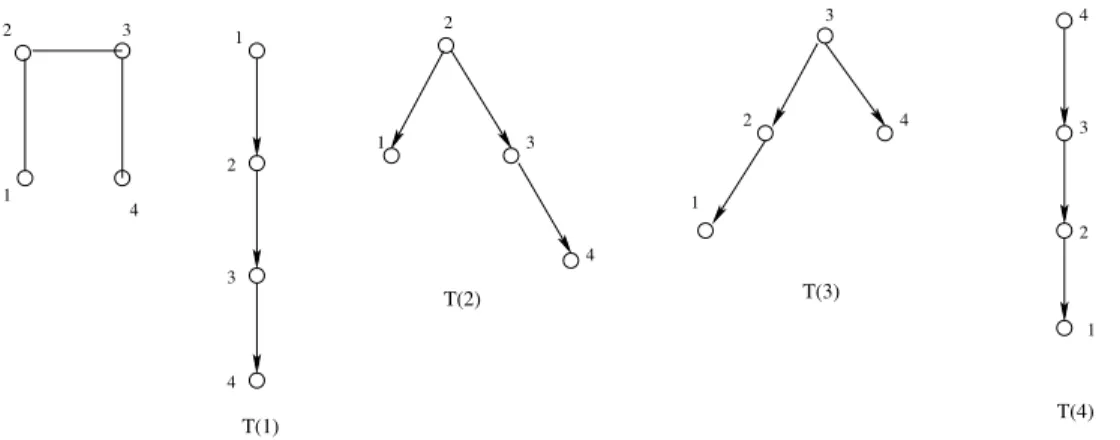
For a cycle-free graph (N, L), every node i ∈N induces a tree in the following manner. For any j 6=i and j ∈N, take the unique path between i and j in (N, L), and then change every edge in that path to a directed edge such that the first node in any ordered pair is the node that comes first in the path fromi toj. Denote such a tree with ibeing the root node as T(i). Define LT(i)(j) = {k ∈N : (j, k) ∈T(i)} as the set of successors ofj in tree T(i). Note that LT(i)(j)⊆ST(i)(j). Figure1 shows an undirected line graph with four nodes, and the four directed trees, one corresponding to each agent, of this graph. We now associate a payoff to every player in every tree on N. Let (N, L, v) be a cooperative game. Associate player j ∈N a payoff ti j(N, L, v) in tree T(i) as ti j(N, L, v) =v(S + T(i)(j))− X k∈LT(i)(j) v(ST+(i)(k)) = ∆jN,L,v(ST+(i)(j)). (1)
So, in treeT(i), we assign playerj a payoff which equals the worth of the coalition consisting of j and his subordinates minus the sum of the worth of the coalitions consisting of each of his successors and their subordinates, i.e., the marginal contribution ofj to coalitionST+(i)(j).
1 2 3 4 4 3 2 1 2 1 3 4 3 2 1 4 T(1) T(2) T(3) T(4) 1 2 3 4
Figure 1: A line graph and its directed trees
Note that there are exactlyn such trees - one tree corresponding to every agent as root node. The average tree solution is the average of such payoffs over all trees.
Definition 8 To any cycle-free graph game (N, L, v) ∈ G, the average tree solution
assigns the following payoff to every agent j ∈N:
ATj(N, L, v) = P i∈Nt i j(N, L, v) n . (2)
Herings et al. (2008) showed that for the class of cycle-free graph games the average tree
solution is the unique allocation satisfying efficiency and component fairness in cycle-free graph games.
The Myerson value (Myerson, 1977) is defined as follows. For a graph game 3 (N, L, v), the corresponding restricted cooperative game is the cooperative game (N, vL), where the function vL: 2n→R is defined as:
vL(S) = X
T∈Cm(S,L S)
v(T) ∀ S⊆N.
The Myerson value, denoted asM V(N, L, v), is then the Shapley value of the game (N, vL), i.e.,
M Vj(N, L, v) =Shj(N, vL) ∀ j ∈N.
The Myerson value is the unique allocation satisfying efficiency and fairness. 3
5
Characterization
We give an alternate characterization of the average tree solution. The objective of the characterization is to use axioms similar to the axioms used inShapley(1953). In a cycle-free graph agents are inherently asymmetric - for example, in a game with three agents, there is only one type of cycle-free graph, namely the line graph where the central agent looks somewhat more powerful than the other two agents. Hence, we cannot use the symmetry axiom in Shapley (1953). The symmetry axiom will be replaced by two axioms, strong symmetry and independence in unanimity games. The other axioms are the same or direct generalizations of axioms used in Shapley (1953).
We first motivate the characterization for unanimity games. For this, we use a result of
Herings et al.(2008). Consider any S ∈C(N, L). For j ∈S we say agent j representsagent
k /∈S for coalition S if j is connected to k and in the unique path connecting j to k, every agent except agent j is outside S. Let pL
S(j) be the number of agents that j represents for coalition S.
Herings et al. (2008) showed that for any cycle-free unanimity graph game (N, L, uT),
where T ∈C(N, L), we have ATj(N, L, uT) = ( 1+pL T(j) n ∀j ∈T 0 otherwise.
The result has the following interpretation. Consider an unanimity game (N, L, uT). The number 1 +pL
T(j) is the total number of agents that agent j represents for coalition T including himself. By definition of pL
T(j),
P
j∈T pLT(j) = n− |T|. Hence, the ratio, 1+pL
T(j)
n reflects the representation power of agentj for coalitionT. The average tree solution shares the payoff of a unanimity game in terms of representation power of the agents. Hence, if in a cycle-free graphi represents the same number of agents for coalitionT as agentj does for coalition S, then agent i gets the same payoff in game (N, L, uT) as agent j gets in game (N, L, uS). Agents with the same representation power get the same in the corresponding unanimity games.
On the other hand, the Myerson value for a cycle-free unanimity graph game (N, L, uT), where T ∈C(N, L) is the following:
M Vj(N, L, uT) =
( 1
|T| ∀ j ∈T 0 otherwise.
Thus, the Myerson value treats agents within T symmetrically in the cycle-free unanimity graph game (N, L, uT), whereas the average tree solution treats them on the basis of how many agents each of them represents. Our characterization of the average tree solution for cycle-free graph games underlines this important difference between the two solution concepts.
Theorem 1 On the class of cycle-free graph games, the average tree solution is the unique solution satisfying efficiency, dummy, strong symmetry, independence in unanimity games, and linearity.
Proof: We do the proof in three steps.
Step 1: First, we show that the average tree solution satisfies all the axioms mentioned in the statement of the theorem. By definition, it satisfies efficiency. Since the average tree solution is a linear function of the marginals, it also satisfies the dummy axiom and linearity. For strong symmetry, note that if v(S) = 0 for all S ∈ C(N, L) and S 6= N, then for every agentj ∈N the only tree that matters in the average tree solution computation is the tree in which j is the root node. The marginal contribution of j corresponding to this tree is
v(N), which is independent of j. Hence, the average tree solution satisfies strong symmetry. For independence in unanimity games, consider two unanimity games (N, L, uT) and (N, L, uT∪{j}) such that i ∈ T, j /∈ T, and {i, j} ∈/ L. Since {i, j} ∈/ L and T ∪ {j} is connected, there exists a path from (i, i1, . . . , ip, j) with i1, . . . , ip ∈ T and p≥1. Since the graph is cycle-free, this is the unique path between i and j. Hence, there exists no path (i, j1, . . . , jq, j) such thatj1, . . . , jq ∈/T. So, idoes not represent j for coalitionT. Consider anyk /∈T but connected toisuch that the unique path fromitokdoes not contain an agent from T. Since i does not represent j, no such path can contain j. Hence, pL
T(i) =pLT∪{j}(i). This implies thatATi(N, L, uT) = ATi(N, L, uT∪{j}).
Step 2: Second, we show that the average tree solution is the unique solution satisfying efficiency, dummy, strong symmetry, and independence in unanimity games for any cycle-free unanimity graph game. Letπ be an allocation which satisfies all these axioms. Consider the unanimity game (N, L, uN). By efficiency and strong symmetry,
πk(N, L, uN) = 1
n ∀ k∈N.
Since pL
N(j) = 0 for all j ∈N, we have
ATk(N, L, uN) = 1
n ∀k ∈N.
Therefore, π is the average tree solution for (N, L, uN). Let T be a connected set of agents and let |T| = t. We use induction on t. We have already shown that π is the average tree solution for t = n. Let t < n. Suppose π is the average tree solution for any uananimity game (N, L, uS) with |S| > t. We show that π is the average tree solution for (N, L, uT). Since N is connected and t < n, there exists j /∈ T such that T ∪ {j} is connected. Let
S =T ∪ {j}. By our induction hypothesis,
πk(N, L, uS) =ATk(N, L, uS) =
1 +pL S(k)
Consider any k /∈T. By definition, for every S ∈C(N, L) andS 3k, we have ∆N,L,uT
k (S) = 0. Hence, by dummy
πk(N, L, uT) = 0 =ATk(N, L, uT). (4)
Leti be the unique agent inT such that {i, j} ∈L. Consider k∈T \ {i}. By independence in unanimity games and equation (3),
πk(N, L, uT) =πk(N, L, uS) =ATk(N, L, uS) =
1 +pL S(k)
n . (5)
We show that pL
S(k) = pLT(k). Denote the set of agents who k represents for S as PSL(k). Clearly,PL
S(k)⊆PTL(k). Assume for contradiction, there existsk0 ∈PTL(k)\PSL(k). Since the graph is cycle-free, there exists a unique path (k, k1, k2, . . . , kq, k0) such thatk1, . . . , kq ∈/ T. Since k0 ∈/ PL
S(k),j ∈ {k1, . . . , kq}. This implies that there is a path (k, k1, . . . , kr, j) fromk to j such that k1, . . . , kr ∈/ T. Clearly, r ≥1, since {k, j} ∈/ L. Since T ∪ {j} is connected, there also exists another path (k, i1, . . . , ip, j) from k toj such thati1, . . . , ip ∈T. Since the graph is cycle-free, two distinct paths from k to j is not possible, yielding a contradiction. Hence, equation (3) implies that
πk(N, L, uT) = 1 +pL S(k) n = 1 +pL T(k) n =ATk(N, L, uT). (6)
By equations (6) and (4), for every k 6=i, we have
πk(N, L, uT) =ATk(N, L, uT). By efficiency, πi(N, L, uT) =ATi(N, L, uT).
Step 3: Finally, we show that the average tree solution is the unique solution satisfy-ing efficiency, dummy, strong symmetry, independence in unanimity games, and linearity.
Herings et al. (2008) show that every cycle-free game can be written as a linear function of
cycle-free unanimity graph games, and the average tree solution for a cycle-free unanimity graph game (N, L, uT) is given by
1+pL T(j)
n if j ∈T and zero otherwise. In Step 2, we showed that the unique solution satisfying efficiency, dummy, strong symmetry, and independence in cycle-free unanimity graph games is the average tree solution. By linearity, the result then
follows.
We now show that the axioms used in Theorem 1 are independent. The Myerson value satisfies efficiency, dummy, strong symmetry, and linearity, but fails independence in una-nimity games. This follows from the facts that (a) the Myerson value is the Shapley value of the cooperative game (N, vL) and (b) for any unanimity game (N, L, u
T), the Myerson value assigns every agent i∈T a payoff equal to |T1| whereas agents outside T get zero payoff.
Equal sharing, where every agent gets v(nN), satisfies efficiency, strong symmetry, linearity, and independence in unanimity games, but fails dummy. The zero allocation, where every agent gets zero payoff, satisfies strong symmetry, linearity, dummy, and independence in unanimity games, but fails efficiency.
Consider the allocation πd where for some i∈ T we consider the tree T(i) with i as the root node, andπd
j(N, L, v) = tij(N, L, v) for allj ∈N. Clearly,πd satisfies efficiency, dummy, and linearity. For a cycle-free unanimity graph game (N, L, uS) call agent k ∈S adictator inS if k is the first agent in any path inT(i) from root node i to any agent inS. It is clear that for dictator agentk inS,πd
k(N, L, uS) = 1 andπjd(N, L, uS) = 0 ifj 6=k. Now, consider two cycle-free unanimity graph games (N, L, uS) and (N, L, uS∪{j}). Let k ∈ S such that {k, j}∈/ L. There are two cases to consider.
Case 1: Agent k is not a dictator in S. Clearly, he cannot be a dictator agent in S∪ {j} either. Hence, his allocation is zero in both games.
Case 2: Agent kis a dictator in S. Since{k, j}∈/ L,k will still come first in any path from root node to any node in S ∪ {j}. Hence, k will remain a dictator in S∪ {j}. Hence, his allocation is one in both games.
This shows that πd satisfies independence in unanimity games. Now consider a game (N, L, v) such that v(S) = 0 for all S ∈ C(N, L) and S 6= N. In that case, πd
i(N, L, v) =
ti
i(N, L, v) =v(N) and πdj(N, L, v) = 0 for all j 6=i. Hence, πd fails strong symmetry. Thus, allocation πd satisfies efficiency, dummy, linearity, and independence in unanimity games, but fails strong symmetry.
Finally, consider the following allocation: for cycle-free unanimity graph games it is the average tree solution and for every other cycle-free game it is the Myerson value. Clearly, the allocation satisfies efficiency, dummy, independence in unanimity games, and strong symmetry, but fails linearity.
References
Borm, P., G. Owen, and S. Tijs (1992): “On the Position Value for Communication Situations,”SIAM Journal of Discrete Mathematics, 5, 305–320.
Demange, G. (1994): “Intermediate Preferences and Stable Coalition Structures,”Journal
of Mathematical Economics, 23, 45–58.
——— (2004): “On Group Stability in Hierarchies and Networks,”Journal of Political Econ-omy, 112, 754–778.
Herings, P. J. J., G. van der Laan, and D. Talman (2008): “The Average Tree
Kaneko, M. and M. Wooders (1982): “Cores of Partitioning Games,” Mathematical Social Science, 3, 313–327.
Le Breton, M., G. Owen, and S. Weber (1992): “Strongly Balanced Cooperative
Games,”International Journal of Game Theory, 20, 419–427.
Myerson, R. (1977): “Graphs and Cooperation in Games,” Mathematics of Operations
Research, 2, 225–229.
——— (1980): “Conference Structures and Fair Allocation Rules,”International Journal of
Game Theory, 9, 169–182.
Shapley, L. (1953): “A Value for n-person Games,” in Contributions to the Theory of