Data Quality Aspects
Michael Gertz
Department of Computer Science University of California, Davis
One Shields Avenue Davis, CA 95616, USA
Ingo Schmitt
Institut fur Techn. Informationssysteme Otto-von-Guericke-Universitat Magdeburg
Universitatsplatz 2 D-39106 Magdeburg, Germany
Abstract
In multidatabase systems, a major data integration problem is to resolve data conicts where two objects having the same denition and representing the same real world object have dierent extensions. Traditional data integration approaches suggest static conict resolution functions that perform a computation over con-icting attribute values, thus assuming a unique and time-independent resolution.
In this paper, we argue that such type of data conict often arises due to hetero-geneities among the data capturing and processing techniques and methods used by component databases. That is, component database dier in how and when they map real world data into local data structures. This diversity results in the fact that the quality of the data stored at dierent sites can be dierent and that the quality can also vary over time, thus requiring dynamic data integration methods, depending on which data quality goal is required at the global level. We outline a novel framework that allows to formalize, model and utilize diverse and in particular orthogonal data quality aspects such as timeliness, accuracy, and completeness in database integration. By making the notion of data quality aspects explicit both in modeling and querying a multidatabase system, existing approaches to database in-tegration cannot only be extended, but also tools can developed that ensure dierent types of \high quality data" at the integration level and for global applications.
1 Introduction
The integration of previously independent but semantically related database systems into globally accessible multidatabase systems (MDBS) has been one of the most active ar-eas in database research over the past 15 years. Most of the work has been devoted to approaches and techniques that allow designers to identify and resolve structural and se-mantic conicts between meta-data objects (tables, classes,::: ) and data items (records, tuples, objects,::: ) located at local databases participating in the multidatabase system [BE96, KCG95, KS91, She91]. Despite the known diculties in detecting semantic equiv-alences and resolving semantic conicts and heterogeneities, many products have emerged that realize some kind of a multidatabase system.
The most prominent type of such systems are data warehouses [Kim96, BA97]. Data warehouses typically restrict access to local databases to read-only accesses, providing
global users and applications a means to integrate data from dierent resources for, e.g., decision support systems, hospital information systems or environmental information sys-tems. Although the issue we discuss in this paper is not specic to data warehouses but any system that provides access to integrated data, most of the problems related to integrated data have been reported for data warehouses. As recent studies and reports show, in par-ticular applications build on top of data warehouses often experience several problems with regard to the reliability and quality of the integrated data [Kim96b, Huf96, BA97, JV97]. The main reason for this is that often already the local databases participating in the multidatabase system contain incorrect, inaccurate, outdated or simply poor quality data. The quality of integrated data then becomes even worse unless suitable methods and tech-niques for modeling and managing these issues are employed during multidatabase design time. Despite the amount of work that focuses on semantic heterogeneity among meta-data and meta-data items, aspects of the quality of integrated meta-data have not been addressed so far. Data quality mainly has been and still is an important research topic independent of database integration [Red96, Wan98, WS96, WSF96].
In this paper we explicitly introduce the notion of data quality in database and data integration. We claim that often data conicts between local data items occur due to dis-crepancies among how the data are gathered, processed and maintained at local databases. This type of heterogeneity, called operational heterogeneity, then can result in the fact that the quality of information stored about real world objects or artifacts in dierent local databases may be dierent and vary over time. We show that data quality can be dened as orthogonal aspects, referring to timeliness, accuracy and completeness of data. The orthogonality of these aspects indicates that there is not always a unique resolution of data conicts. For example, if the attribute values of two objects referring to the same real world object dier and one value is know to be more accurate and the other is known to be more up-to-date, one cannot give a unique resolution (or data integration rule) for this conict. More importantly, accurate data does not necessarily imply up-to-date data or vice versa. Therefore, in this paper we suggest some kind of measurement for dierent data quality aspects. These measurements are used to model data quality aspects of local and global classes at multidatabase design time. We present a technique called infor-mation proling that allows designers to associate and relate data quality aspects with dierent portions of semantically equivalent classes for which data conicts can occur.
Information about data quality measurements as well as preferences among local ob-jects and attribute values with respect to dierent data quality aspects are recorded as metadata at the integration level. The transparency of global query processing is weak-ened by that a global user or application can specify a data quality goal for the result of a global query. Based on such data quality goals and the recorded metadata, data integration rules are generated dynamically by the global query processor to ensure the retrieval of \high quality data" from local databases.
A typical data integration scenario which reveals the dierent aspects of data quality and also the need for dynamic data integration rules is discussed in the next section. Throughout the paper we adopt a simple object-oriented data model, not focusing on aspects like complex objects, methods or object/method inheritance.
1.1 Motivating Example
Suppose two classes at two local databasesDB1 andDB2which store environmental data.
Both classes (namedPollution) contain data about the quantity of some toxic materials
Mat1andMat2recorded for dierent regions. We assume that schematic conicts between
the two classes have been resolved and now a data integration rule for the global class, say G pollution, needs to be specied. Below are the extensions of the two classes:
Pollution@DB1 (C 1)
Region Area Mat1 Mat2
R1 A1 10 2 R1 A2 14 3 R1 A3 15 3 R1 A4 8 1 R2 B1 6 1 R2 B2 7 3 R4 A1 21 8 Pollution@DB2 (C 2)
Region Area Mat1 Mat2
R1 A1 12 2
R1 A2 17 2
R1 A3 19 3
R2 B1 7 2
R2 B2 7 1
In order to dene an appropriate data integration rule for these two classes, obviously a data conict has to be resolved due to the dierent quantities recorded for same regions. Traditional data integration approaches suggest a conict resolution function that either chooses one class (or attribute) over the other or that computes the average of the values recorded for the same region. A global query against G Pollution then always retrieves
the data from the two class extensions according to the specied data integration rule. Now assume the following scenarios where additional information about the two classes and their extensions has been obtained:
Scenario 1:
DB1 updates its class C1 on Mondays, Thursdays, and Saturdays, andDB2 updates its class C2 on Tuesdays, Fridays, and Sundays. In this case, the time
a global query is issued against the global class G Pollution determines from which
extension up-to-date data are retrieved.
Scenario 2:
While the quantity of Mat1inC1 is recorded using some kind of sensors,
the values for Mat1 in C
2 are recorded on a manual basis. Thus the values for
Mat1:C 1
may be more accurate then the values recorded in Mat1:C 2.
Scenario 3:
DB1 covers more regions in C1 than DB2 does in C2. That is, theinformation in C2 is less complete than the information in C1.
The above three simple scenarios, which will be formalized in the next section, show that the way of how and when data is populated into local classes plays an important role in integrating local data for global queries. Interestingly, the above scenarios also describe orthogonal aspects of data quality. That is, for example, up-to-date data does neither necessarily imply most accurate nor most complete data. More importantly, while one global user (or application) might be interested in most complete data, another user might be interested in most accurate data. In both cases there must be the possibility for a user to specify certain data quality goals or, at least, the global query interface should reect that the data retrieved from dierent sources in response to a global query have dierent quality, e.g., trough tagging or grouping retrieved records.
Furthermore, the above data quality aspects are not only of interest in case of over-lapping (and conicting) extensions of local classes, but also if semantically equivalent classes are disjoint. Thus the above scenarios describe more than just data conicts.
1.2 Comparison with other Work
The methods and techniques described in this paper are inuenced by two areas: database integration and data quality management. In the area of database integration most of the work focus on resolving structural conicts on the schema level (schematic conicts)
including class and attribute conicts, e.g., [BLN86, SPD92, GSC96, KCG95]. Less work has been done on detecting and resolving so-called semantic data conicts and semantic heterogeneities at the data level, typically because it is dicult to formalize and compare semantics associated with data items and data values. Classications and discussions on semantic issues in multidatabase systems can be found in [She91, SK93, KS96] and in particular [BE96]. Special types of semantic conicts, in particular the resolution of dierent object identiers, have been discussed in [CTK96, Pu91, SS95, DeM89]. Recent and very promising work addressing semantic issues in database interoperability focus on context-based approaches, e.g., [GMS94, KS96]. Semantic conicts of types like inconsis-tent data or outdated data have been listed in some work (e.g., [SK93, BE96]), but their identication and resolution has not been discussed in detail.
In the area of data quality management there has been no particular focus on in-tegrated data or multidatabase systems in general. Most of the work focuses on de-nitions and measurements of data quality aspects in database and information systems [Red96, Wan98, WS96, WSF96]. Only [RW95] discusses the estimation of the quality of data in federated database systems, thus not considering the integration aspect or task but only the already integrated data. In [JV97, JJQ98] the aspect of data quality is ad-dressed in the context of data warehouses but neither formal denitions or measurements for data quality nor design methodologies focusing on dierent data quality aspects are given.
1.3 Paper Outline
In Section 2 we show how the data quality aspects timeliness, accuracy and completeness can be formally dened using the notion of virtual classes. Because virtual classes and their properties are not directly accessible at multidatabase design time, in Section 3 we present an approach called information proling that allows to identify and compare dif-ferent data quality aspects associated with local classes and their possible extensions. The result obtained through information proling is recorded as metadata at the integration layer and is used for global query processing, which is outlined in Section 4.
2 Formalization of Data Quality in MDBS
The quality of data stored at local databases participating in a multidatabase system typ-ically cannot be described or modeled by using discrete values such as \good", \poor" or \bad". In this section, we suggest a specication of (time-varying) data quality assertions based on comparisons of semantically related classes and class extensions. In Sections 2.1 and 2.2 we give formal denitions of dierent data quality aspects using virtual classes.
2.1 Virtual and Conceptual Classes
In order to analyze and determine the conicts or semantic proximity of two objects, object attributes or even complete classes, one needs to have some kind of a reference point for comparisons. In this paper, such comparisons are based on virtual classes. A virtual class is a description of real world objects or artifacts that all have the same - not necessarily completely instantiated - attributes. The extension of a virtual class is assumed to be always up-to-date, complete and correct, i.e., only current real world objects and data are reected in the extension of a virtual class.
Assuming such type of classes is quite natural in database design and they are also used to describe semantic issues in database interoperability, e.g., in [SG93, GSC96]. The reason for this is that the development of local database schemas is typically driven by what information about real world objects and classes is needed for local applications and what information is available about these classes and objects.
Given a description of real world objects in terms of a virtual classCvirt, local databases
DB1;::: ;DBm typically employ only a partial mapping of real world data into local data
structures, i.e., only information relevant to local applications is mapped into local classes
C1;::: ;Cn. More importantly, the mappings1;::: ;n adopted by local databases dier
in the underlying local data structures (schemata) and how real world data is populated into these structures. Dierent mappings then result in schematic and semantic hetero-geneities among the local classes C1;::: ;Cn that refer to the same virtual class Cvirt.
While a local class Ci typically maps only a portion of the information associated with
Cvirt, a conceptual (or global) class Ccon integrates all aspects modeled in semantically
equivalent or similar local classes (Figure 1).
Schema Integration .... virtual class local mappings semantically equivalent local classes PSfrag replacements Ccon Cvirt C1 Cn 1 n
Figure 1: Relationship between virtual, conceptual and local classes
Determining conceptual classes as components of, e.g., a federated or multidatabase schema, is the main task in database integration. One main goal in database integration is that the specication of a conceptual class Ccon comes as near as possible to the
spec-ication of the associated virtual class Cvirt from which the local classes C1;::: ;Cn are
derived. Beside these structural aspects of conceptual classes, the other aspect is how to integrate data from (now structurally equivalent) local classes into global classes. That is, data integration rules need to be specied. If the (possible) extensions of local classes are known to be disjoint, then the data integration rule basically consists of joining the extensions of these local classes. In case of possible object or data conicts, that is, for an object of the global class there are at least two local objects corresponding to that object but with dierent attribute values, data integration rules additionally describe conict resolution. Such resolutions ensure that only one object is retrieved from local classes or local attribute values from same objects are combined appropriately into one global object.
2.2 Basic Data Quality Aspects
A basic property of real world objects is that objects as instances of virtual classes evolve over time. Objects are added and deleted, or properties of objects change. At local sites dierent organizational activities are performed to map such time-varying information into local classes, thus resulting in a type of heterogeneity among local databases we call operational heterogeneity. We consider operational heterogeneity as a non-uniformity in the frequency, processes, and techniques by which real world information is populated
into local data structures. For example, while at one local database the stored data are updated manually on a weekly basis, at another database storing related information updates are performed automatically (e.g., sensor-based) on a monthly basis. In such cases, operational heterogeneity can lead to the fact that similar data referring to same properties and attributes of real world objects have dierent quality and thus may have varying reliability. Based on the used data capturing and processing approaches, the quality of data at a local database can even vary over time, for example, data can be outdated, as discussed in Section 1.1. More importantly, we have also shown that oper-ational heterogeneity cannot be resolved on the schema integration level but requires a suitable approach to data integration.
These observations raise the question whether existing approaches to resolving seman-tic data conicts are appropriate or rich enough to handle aspects such as outdated data or wrong data. In this paper we consider operational heterogeneity and data quality in particular as a type of semantic data conict which requires a not necessarily unique resolution at run-time by means of (time-varying) data integration rules.
We rst give a formal denition of time-varying data quality aspects we consider as most important in database integration and resolving semantic data conicts. For this we make the following (simplied) assumptions.
There are two classesC 1 hA 1;::: ;An iand C 2 hA 1;::: ;An
ifrom two local databases
DB1andDB2. C1andC2refer to the same virtual classCvirtand schema integration
has been performed for C1 and C2 into the conceptual class Ccon hA
1;::: ;An i. We
assume that the two classes are represented in the global data model. The resolution of heterogeneous representations of the original local class structures is a topic of schema integration and is therefore outside the scope in this paper.
Using the predicate same it is possible to determine whether an object o
1 from
the extension of C1, denoted by Ext(C1), refers to the same real world object o 2
Ext(Cvirt) as an object o2
2 Ext(C
2). The resolution of dierences among key
representations is assumed to be resolved during schema integration by appropriate methods as suggested in, e.g., [Pu91, CTK96, SS95].
As motived in Section 1.1, the aspect of time plays an important role in operational heterogeneity. For this, we assume a discrete model of time isomorphic to natural numbers. In this model time is interpreted as a set of equally spaced time points, each time point
t having a single successor. The present point of time, which advances as time goes by, is denoted by tnow. The extension of a class C at time point t is denoted by Ext(C;t),
the value of an object o for an attribute A 2 schema(C) at time point t is denoted by
V alC(o;A;t). If no time point is explicitly specied, we assume the time pointtnow. We
furthermore assume a function TimeC(o;A;t) that determines the time point t0
t the
valueA:o of attribute A of object o2Ext(C;t) was updated the last time beforet.
The above denitions and assumptions now provide us a suitable framework to dene the data quality aspects timeliness, completeness, and accuracy in a formal way.
Denition 2.1 (Timeliness)
Given two classes C1 and C2 with schema(C1) =schema(C2). Class C1 is said to be more up-to-date than C2 at time point t
tnow
with respect to attribute A2schema(C
1), denoted by C1 > time A;t C2, i countfo 1 jo
1: Ext(C1;t);o2: Ext(C2;t) :same(o1;o2)
^timeC(o
1;A;t)> timeC(o2;A;t)
g
countfo 2
jo
1: Ext(C1;t);o2: Ext(C2;t) :same(o1;o2)
^timeC(o
2;A;t)> timeC(o1;A;t) g
In other words, class C1 is more up-to-date than C2 at time point t with respect to
attributeA if its extensionExt(C1;t) contains more recent updates on AthanExt(C2;t)
does. Note that for t = tnow this property may ip since tnow advances as time goes
by. It should also be noted that there are alternative denitions for timeliness. Possible denitions depend on how much information about update strategies is available for local databases and classes at integration time. For example, focusing more on the distances between the time points where the attribute values of the same objects were updated, would give rise to the following condition:
sumftimeC(o 1;A;t)
?timeC(o 2;A;t)
jo
1: Ext(C1;t);o2:Ext(C2;t) :same(o1;o2)
g sumftimeC(o 2;A;t) ?timeC(o 1;A;t) jo
1: Ext(C1;t);o2:Ext(C2;t) :same(o1;o2) g
The following example shows the dierence between the two conditions.
Example 2.2
Assume that the following values fortimeC1 and timeC2 have beendeter-mined at t =tnow = '10-14-98' for the attribute A. The attribute values A:C1 and A:C2
shown in each row are assumed to be values of objects from Ext(C1;t) and Ext(C2;t)
and both objects refer to the same object in Cvirt.
A:C1 timeC 1(o 1;A;t) 120 10-9-98 156 10-9-98 123 10-7-98 108 10-7-98 A:C2 timeC 2(o 2;A;t) 125 10-3-98 156 10-3-98 130 10-8-98 111 10-8-98 Applying the rst condition would yield that C1 =
time
A;t C2 holds, while for the second
condition we have C1
timeA;t C
2 (12 > 2).
Although at a local database modications of real world objects are mapped in a timely manner using a certain data capturing approach, this does not necessarily mean that this approach suitably propagates information about deleted or new objects of the virtual class. While timeliness essentially refers to properties of attributes, the data quality aspect completeness focuses on the extensions of the two classes C1 and C2 as a
whole.
Denition 2.3 (Completeness)
ClassC1 is said to be more complete than the classC2at time pointt tnow, denoted by C 1 > comp t C2, i countfo 1 jo 1 2Ext(C 1;t) ^:9o 0
2Ext(Cvirt;t) :same(o 1;o 0) g < countfo 2 jo 2 2Ext(C 2;t) ^:9o 0
2Ext(Cvirt;t) :same(o 2;o
0)
g
In other words, although the extension of C2 may contain more objects at time point
t, this does not necessarily mean that these objects still exist in the corresponding virtual class. C2 can contain numerous objects which already have been deleted in reality at a
time pointt0 < t. The above denition thus nicely reects the aspect of outdated objects.
Note that we have not included the aspect that C1 must also contain more information
about any real world object from Cvirt than C2 does. Including this aspect would imply
that at a local database one is always interested in all objects that belong to a virtual class. This, however, is often not the case because the working scope of local classes and applications is typically restricted to a subset of such real world objects.
The third data quality aspect, which is orthogonal to timeliness and completeness, is the aspect of data accuracy which focuses on how well properties or attributes of real world objects are mapped into local classes.
Denition 2.4 (Data Accuracy)
Given two classes C1 and C2 with schema(C1) =schema(C2) and attribute A
2 schema(C
1). Class C1 is said to be more accurate than
C2 with respect toA at time pointt, denoted by C1 >
acc A;tC2, i countfo 1 j o 1 2 Ext(C 1;t);o2 2 Ext(C 2;t);o
2 Ext(Cvirt;t) : same(o 1;o2) ^ same(o1;o) ^ jV alC virt(o;A;t) ? V al C1(o 1;A;t) j jV alC virt(o;A;t) ? V al C2(o 2;A;t) j g> countfo 2 jo 1 2Ext(C 1;t);o2 2Ext(C 2;t);o
2Ext(Cvirt;t) :same(o 1;o2) ^same(o 2;o) ^ jV alC virt(o;A;t) ? V al C1(o 2;A;t) j jV alC virt(o;A;t) ? C2 (o 1;A;t) j g
In the above denition?
denotes a generic minus operator which is applicable to either
a pair of strings, numbers or dates. In order to suitably incorporate the aspect of possible null values, one can dene a value amax that is used if V alCi(oi;A;t) is null. It is even
possible to give a denition for data accuracy that takes only the number of objects into account that have the value null for the attribute A.
Determining the timeliness and accuracy of data makes only sense for certain at-tributes. For example, object identiers are typically time-invariant and thus cannot cause any data quality problems (unless a property of real world objects designates the object identier). We will discuss the aspect of time-varying and time-invariant attributes in more detail in Section 3. The important point with the above denitions is that they describe orthogonal data quality aspects. That is, in case of a data conict among two objects referring to the same real world object, it is possible to choose either the most accurate or the most up-to-date data about this object, depending on whether respec-tive specications exist for the two objects. Also in case of non-conicting object classes and extensions (i.e., the extensions of semantically equivalent local classes are disjoint), a data quality aspect might give a reason to choose one extension over the other or, at least, to distinguish or group the results retrieved from these classes. Both scenarios, of course, require to weaken the transparency property of integrated classes and objects at the global level.
In practice it is rather unlikely that there is one class among several semantically equivalent classes such that this class satises all three data quality aspects best. That is why these, possibly time-varying, aspects need to be modeled suitably and utilized for global query processing.
3 Modeling Data Quality Aspects
In the previous section we have shown that it is possible to formally dene data quality aspects using virtual classes. In practice, however, virtual classes are not explicitly pro-vided in a way that they can easily be used to evaluate the conditions given in Denitions 2.1, 2.3, and 2.4. In this section we discuss how statements about data quality can be extracted from local database participating in a multidatabase system. We show how these statements can be modeled as metadata available for global query processing. The underlying concept for this is information proling.
3.1 Information Proling
Information proling essentially refers to the activity of describing the information cap-turing and processing techniques used to populate real world data into a local data model and data structures, respectively, classes. Information proling is not peculiar to database
integration, but is an integral task in database and application design. An information prole, e.g., for a class, describes not only the schema of that class (static properties) but also how real world data or artifacts are mapped as objects into this class (dynamic prop-erties). This includes a description of (sets of) object methods and how these methods interact with the database and application environment. Most information for proling can be obtained while structural and semantic conicts are investigated at multidatabase design time. As any other proposal to database integration and resolving semantic con-icts, resolving operational heterogeneity through information proling requires not only a good knowledge about particular local database schemas but also about the environments in which the local databases operate.
Given a local class C with attributes hA
1;::: ;An
i and a data quality aspect Q 2 ftimeliness, completeness, accuracyg. The basic idea for information proling is to
parti-tion C and its possible extensions PExt(C) into a set UC of information units such that
all (possible) data in a unit u2UC show the same properties (see below) with respect to
Q. A basic information unit u for a class C and its possible extensions PExt(C) can be one of the following types. We assume that the object identier is part of every unit. (U1) an attribute A 2fAi;::: ;Akg, i.e., uA=A
(U2) a subset of possible attribute values for an attribute A2fAi;::: ;Akg,
i.e., uA=fA(o)jo 2PExt(C)^p(o)g with pbeing a selection predicate.
The set of basic information units uA
1;u
A
2;::: ;uAk associated with an attribute A 2
schema(C) is denoted by UAC. Partitioning a class C into basic information units can be optimized by building composed information units that consider more than one attribute, i.e., u = fAi
1;::: ;Aik
g or u = fA
i1;:::;Aik(o)
j o 2 PExt(C) ^ p(o)g, where Aij 2 fAi;::: ;Akg, if all the constituting basic units have the same properties with respect to
the data quality aspect Q. In order to discuss the basic idea of information proling and also later the global query processing in the presence of information units (Section 4), we do not consider these optimization issues in the rest of the paper.
With an information unit a prole is associated, describing how and when the data in this unit are captured, processed and maintained. Such descriptions, of course, depend on the type of data quality aspects Q for which the class C has been partitioned (Q-prole, Q-partitioning). From a practical point of view, we think that it is rather unlikely to have a formal specication for proles. Depending on the type of data quality aspect, a prole should consider, respectively address, the following issues:
Timeliness Given an attribute A 2 schema(C). What is the (average) update
frequency of that attribute? Do updates occur on an event-based basis? Are update frequencies time-dependent?
Completeness How do data processing techniques ensure that real world objects
relevant for that class are recorded? Are the employed processing techniques time-dependent?
Data Accuracy What type of technique is used to record real world data? Are data
entered manually or are they read, e.g., by sensors? Are the data extracted from other resources? How many data processing units (applications) are involved in reading real world data into local data structures? Are the employed techniques time-dependent?
We are fully aware of the fact that not having a formal specication for data quality proles can be a critical point. It should, however, be noted that formal specications often do not exist where structural or certain semantic relationships and heterogeneities among classes and attributes need to be discovered and resolved at the database schema level. We think that system descriptions such as data ow diagrams, workow diagrams, or even information obtained through system analysis can often provide useful and su-cient data for information proling.
Beside the information units UAC that can be associated with an attribute A 2
schema(C) there are two special types of units. The rst one we call default unit, denoted by uAd, and it corresponds to the partition of A for which data is (or will be) recorded but no Q-prole can be given. The second type, denoted by uA
0, is the description of
the partition for which data in PExt(C) exist, but for which data are never recorded because, e.g., they are not admissible due to some integrity constraints. Note that (1) the specication of u0
A can always be determined based on the specications of the other
units, and (2) the specication of uA
0 is always of type (U2). Adding these two types of
units toUAC for which proles have been determined leads to the fact that for an attribute
A and associated domain D always a complete partitioning can be given, which, in the worst case (no proles available), consists only of the default unit uAd.
3.2 Class Partitioning and Quality Assertions
Partitioning and information proling is applied to all attributes of a classC. That is, for
C a setUA
C =UA1
C [:::[U
An
C of information units is determined. Applying this technique
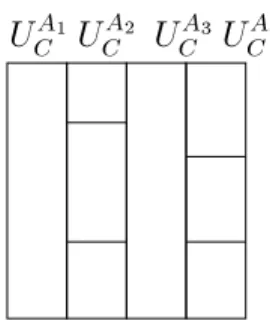
to some sample classes and their possible extensions shows that time-invariant attributes typically are all partitioned in the same way (i.e., same specication ofpfor basic units of type (U2)) while partitions for time-variant attributes (i.e., attributes that are updated frequently) dier. Figure 2 illustrates an example result of partitioning a class C with time-invariant attributes A1;A3 and time-variant attributes A2;A4.
PSfrag replacements UA1 C UA2 C UA3 C UA4 C
Figure 2: Partitioning of a class C
Having at least two partitions uAi and uAj dierent fromuA
0 and uAd for an attributeA
indicates that even within possible extensions of C, the quality of the data values for A
diers. This is quite natural since we cannot expect all objects and attributes in a class to have the same quality with respect to a data quality aspect Q. Because the partitions itself do not say much about how the quality of the data in these units is related, attribute quality assertions are determined among the units inUACand associated proles such that a complete order among the units in UAC is obtained. Determining this order is done by pairwise comparing the Q-proles associated with each unit uAi2UACnfuA
0;uAd g.
Denition 3.1 (Attribute Quality Assertions)
Given two information unitsuAi;uAj2UACnfuA 0;uAd
g which have been determined based on a Q-partitioning of A. If the proles
associated withuAi;uAj reveal that the data contained inuAi has a better quality than the data contained in uAj, then the attribute quality assertion uAi>QuAj is said to be valid.
The goal of pairwise comparing proles associated with the uAis is to determine a complete order among the units in UAC. Not having a complete order but only a partial order introduces some kind of vagueness in the assertions which then has to be dealt with in special way. For the sake of simplicity and also due to space limitations, in the remainder of the paper we assume that always a complete order can be determined. Note that uAd cannot be compared with any other unit from UAC because no prole for uAd is given, thus there are no assertions referring to uAd. Furthermore, there is no need to specify any assertion involvinguA
0 because corresponding data is never recorded for that
unit in C.
Before we discuss comparisons of attribute quality assertions of semantically equivalent classes, we rst focus on the aspect of time which we explicitly introduced in Section 2.2. Time plays an important role when determining quality assertions among units that have been obtained based on a timeliness-partitioning (see also scenario 1 in Section 1.1). It is easy to see that if time plays a role, the total order among information units in UAC is time-dependent, too. While a time-dependent order can be optional with respect to the data quality aspects completeness and accuracy, it is intrinsic to the aspect of timeliness. This means that for each possible time point t, we have to specify a total order among the units in UAC. This can be done in dierent ways. Assuming a nite domain for time, e.g., number of the week in a year or day of the week, it is possible to give a complete specication of time-dependent orders. Thus with each order a set of days or numbers of weeks can be associated. More complex temporal quantiers for time-dependent orders, of course, can be useful and need to be investigated in future research. Here we assume that with each order a set of time intervals or time points is associated and that, given a partitioning UAC and order among the informations units in UAC , with each time point t
an order can be associated.
3.3 Inter-Class Considerations
Assume that two semantically equivalent classes C1 hA 1;::: ;An i and C 2 hA 1;::: ;An i
have been Q-partitioned and that all total orders have been determined for the units in UA1 C1;::: ;U An C1 and U A1 C2;::: ;U An
C2 . The task now is to combine the partition sets U
Ai
C1
and UAi
C2 into a new partitioning U
Ai
C such that C is the global class integrating C1 and
C2. In building U A
C the task is not to dene the structure of C but the data integration
rules associated with C at the global level. The main idea for this is to resolve possi-ble data conicts among semantically equivalent objects in C1 and C2 by comparing and
ordering the information units and proles that may contain (attributes of) conicting objects. Also in case no data conicts will exist among possible extensions of C1 and C2,
the information units and proles are used to establish an order (with respect to a data quality aspect Q) among possible objects in the global class C.
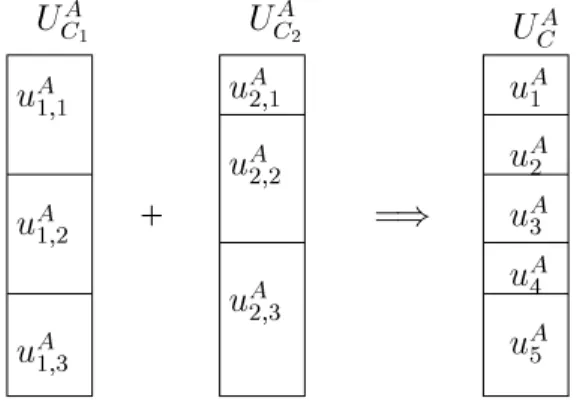
Given two information unitsUAi
C1 andU Ai C2, a portioningU Ai C is obtained by overlapping the units in UAi
C1 with the units U
Ai
C2 as illustrated in Figure 3.
Note that the specication of the units in UAC can easily be obtained from the speci-11
+ PSfrag replacements uA 1;1 uA 1;2 uA 1;3 uA 2;1 uA 2;2 uA 2;3 uA 1 uA 2 uA 5 uA 3 uA 4 =) UAC1 UAC2 UAC
Figure 3: Overlapping of local information units
cation of the units in UAC1 andUAC2. Furthermore, the partitioning UAC is always complete
because of the default units in UAC1 and UAC2. Given the specications of the partitions in
UAC, the next step is to compare the proles associated with the (local) units that con-tribute to a unituAi 2UAC. In Figure 3, for example, the units that contribute touA
1 2UAC are uA 1;1 2 UAC 1 and u A 2;1 2 UAC 2, and for u A 2 they are u A 1;1 and u A
2;2. Because the proles
associated with the local units all refer to the same data quality aspect Q, it is possible to determine a preference among two local units that contribute to a global unit in UAC. Determining preferences essentially corresponds to resolving data conicts in case for a global object there is a corresponding object in each local unit. Again, the two types of local information units uAi;d and uAi;O;i 2 f1;2g need special consideration. We consider
the dierent cases assuming that uAi;d =uA
1;d and uAi;0 = u
A
1;0 and that either of these two
units is compared with a unituA
2;j 2UAC 2: 1. uA 1;d and u A 2;j 2UAC 2 nfuA 2;d;u A 2;0
g: because no prole is associated with uA
1;d, no
prefer-ence can be given unless it is known that, for example, uA
2;j has the highest quality
among the local units in UAC2 with respect to the data quality aspectQ.
2. uA
1;d and u
A
2;d: no preference can be given, meaning that it is possible at the global
level to return two local objects (or attributes) that correspond to the same global object and there (perhaps) is a data conict among the two objects (attributes) in
uA 1;d and u A 2;d. 3. uA 1;0 and u A 2;j 62fuA 2;d;u A 2;0 g: Because uA
1;0 never contains data,u
A 2;j is chosen. 4. uA 1;0 and u A 2;d: Same as for 3. 5. uA 1;0 and u A
2;0: There are never data in either of the two units. Thus there will never
be a conict that needs to be resolved based on the proles associated with the two units.
Once a preference among the units building the global information units in UAC has been determined, again a complete order among the information units in UACnfuAd;uA
0 g is
determined. Note that in case the two local classesC1 and C2 have been partitioned with
respect to a data quality aspectQand the total order among the units inUAC1, respectively
UAC2, is time-dependent, the total order among the units inUACcan be time-dependent, too.
More importantly in this case, comparisons of the proles of local units must occur for each time pointt. It remains to be investigated to what extent the process of determining
a (time-dependent) total order among the units in UAC can be determined automatically, given the attribute quality assertions for UAC1 and UAC2.
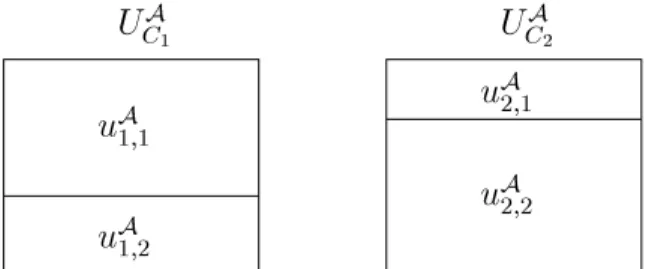
Before we conclude this section by describing how information units and proles are recorded as metadata for global query processing, we rst take a closer look at the data quality aspect completeness. As described in Section 2.2, completeness refers to complete extensions of classes rather than on possible data conicts covered by the aspects time-liness and accuracy. Partitioning a class and its possible extensions with respect to the aspect completeness often reveals a very simple pattern. Figure 4 illustrates an optimized completeness-partitioning UA
C1 and U A
C2 for two semantically equivalent local classes C 1 and C2. PSfrag replacements uA 1;1 uA 1;2 uA 2;1 uA 2;2 UA C1 U A C2
Figure 4: Partitioning based on the data quality aspect completeness
Note that for all attributes inAthe same partitioning is adopted. This is quite natural
because completeness refers to objects as a whole and not to single attributes. For this particular data quality aspect thus dening local attribute quality assertions as well as dening the information obtained through overlapping of local units can be done easily.
3.4 Data Quality Information as Metadata
As mentioned earlier, information about partitioning and overlapping semantically equiv-alent classes is used by the global query processor to deal with resolving data conicts and ordering objects and attributes of dierent quality.
The metadata repository utilized by the query processor already contains information about the structure of global (conceptual) classes and the (structural) mappings of local classes and attributes into global classes. Beside this structural information about meta-data at the global level, the repository also has to record information about how to actually integrate data contained in local class extensions into global class extensions. Such data integration rules are typically specied by using local class structures formulated in the global data model. Assume two semantically equivalent classesC1andC2where structural
and (certain) semantic conicts have been resolved, and C1;C2 are specied in the global
data model. A simple data integration rule for the global class C then might look like
Ext(C) := Ext(C1)
[ Ext(C
2) (using the relational operator union). Depending on
possible data conicts among objects in Ext(C1) and Ext(C2), a data integration rule
can be more complex because conict resolution functions are encoded in the rule. How do data integration rules look like in the presence of various information about data quality of local classes, information units etc? While for traditional approaches to query processing in multidatabase systems the global query processing engine simply utilizes the specied data integration rule, for the scenario presented in this paper it is the task of the query engine to form a data integration rule. For this, the following information is recorded in the metadata repository at the integration layer.
For each local class Ci and each data quality aspect Q, the specication of the
Q-partitions, the associated Q-proles, the description of the attribute quality as-sertions, and their (time-dependent) total order.
For each global class C and each attributeA2schema(C), the specication of the
partitioningUAC and the description of the total order among the units in UAC. A more precise denition of the information recorded in the metadata repository de-pends on the underlying global data model, the type of expressions allowed in building information units of type (U2), and the type of temporal quantiers that can be associated with total orders among information units. For the sake of simplicity, in the following section we assume the abstract description of the metadata as above.
4 Query Processing
In this section we give a short outline of the aspect of global query processing in a multidatabase system in the presence of data quality information. Because of the various features and possible optimization techniques that can be applied in this scenario, we only give the basic idea of global query processing. For example, we do not consider complex queries (nested queries, subqueries). We also assume that the reader is familiar with the basic tasks and methods in query processing in multidatabase systems (see, e.g., [MY95] or [EDN97]).
4.1 Global Query Language
A main feature of a global query language for a MDBS should be to provide global users, designers and applications a transparent access to local data. That is, the user should be unaware of possible structural and semantic conicts among local meta-data, and s/he should also not be responsible for resolving such conicts (some approaches, e.g., [SRL93, MR95] adopt exactly the opposite strategy).
In the presence of dierent data quality aspects, which are encoded in the metadata, it is quite obvious that global queries cannot simply be decomposed solely based on a prespecied unique data integration rules. But what does this mean when there are local data of dierent quality and the data need to be integrated at run-time? First, as discussed extensively, data quality aspects are orthogonal. That is, there does not exist a unied or unique view on the integrated data. Assuming that the user is aware of the fact that local data have dierent quality, query language constructs are necessary that support the specication of a data quality goal for global queries and thus integrated data. Such an approach then supports the following two aspects:
1. In case there are data conicts among two or more semantically equivalent local objects, the object (or attributes) satisfying the specied data quality goal best is chosen. Note that in this case the metadata about local information units and preferences among these units (with respect to a global class) are utilized.
2. In case there are no conicts among objects of local classes but the quality of the objects (with respect to a data quality aspectQ) is dierent, the integrated objects need to be grouped or tagged to indicate this aspect at the global query interface.
In order to support querying objects and attributes with possibly dierent quality, we suggest an extensions of a global query language, say OQL, by a data quality goal clause:
select
<list of attributes>from
<list C 1;::: ;C
n of global classes>
where
<selection condition>with goal
<data quality goal>;A simple data quality goal can either be most accurate, most up-to-date, or most complete. It is also possible to allow a list of data quality goals, meaning that among two conicting objects (attributes) which have the same quality with respect to the rst goal, those attributes are chosen which satisfy the second goal best.
4.2 Querying a Global Class
Assume a global class ChA
1;::: ;A4
i composed of local classes C
1;::: ;Cm. In the most
simple case, a query of the type
select
C:from
Cwith goal
most-accurate;could retrieve local data following the data integration rule Ext(C) = Ext(C1)
[:::[
Ext(Cm) (Ci being specied in the global data model). Now assume that information
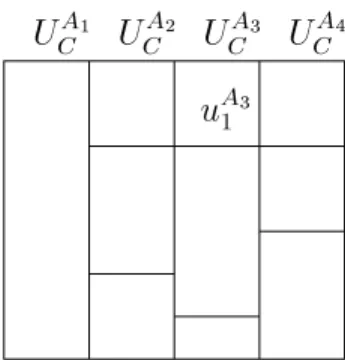
proling has been performed for the local classes with respect to the data quality aspect accuracy and the following pattern has been obtained for the global classC:
PSfrag replacements UA1 C UA2 C UA3 C UA4 C uA3 1
Figure 5: Global ClassC with its information units
For the above query, the query processor then utilizes the specication of each infor-mation unit in UA
C in order to compose global objects in Ext(C) from local objects and
attributes inExt(Ci). For example, for attribute values in the unituA3
1 , the query
proces-sor chooses those values from corresponding local units that satisfy the aspect accuracy best (according to the attribute quality assertions specied for the unit uA3
1 ). Roughly
speaking, for each object identier known to be inExt(C), corresponding attribute values are selected from possibly dierent local information units. Note that the object identier is contained in each local information unit (see Section 3.1).
Note also that for another data quality aspect the partitioning UA
C might look
com-pletely dierent. In particular, if the data quality goal timeliness has been specied in a global query, the point in time the global is issued determines which of the dierent time-dependent orders among the partitions in UA
C is chosen.
In any case, if for an attribute A there exist multiple units within a global class and for these units attribute quality assertions have been specied, displaying attribute values suggests to indicate the variances among the quality of the attribute values. This, for
example, can be done by using certain coloring schemas or object grouping structures. This feature is in particular necessary if a global user wants to compare the dierent results of the same queries with dierent data quality goals.
4.3 Joining Global Objects
In the presence of data quality information one would like to avoid simply combining ob-jects that have dierent qualities (that is also why we suggest certain grouping structures in the previous section). For example, it should be avoided - or alternatively indicated in the query result - that an \up-to-date" object is joined with an outdated object (based on the relational join operator). Because joining object occurs in a similar way as joining tuples in relational databases, based on primary key and foreign key relationships, ensur-ing this property is quite trivial under the followensur-ing assumption: Primary and foreign key attributes (or object references) always have the same quality for all data quality aspects. Obviously, this assumption can easily be veried during modeling data quality aspects as shown in Section 3. Suppose the query
select
C1: , C2:
from
C 1;C2where
C1.primary-key = C2.foreign-keywith goal
most accurate;where the join condition is based on a primary-foreign key relationship. For this query, the query processor rst builds the extension of the global classC2 according to the
spec-ied data quality goal. Then, for each referenced object, the respective (subset of the) extension of C1 is built according to the same data quality goal, but restricted to the
objects needed forExt(C1).
5 Conclusions and Future Work
In this paper we have presented a novel framework to handling diverse data quality aspects in database integration. We have shown that there is a strong need for supporting data quality in data integration, ensuring that applications built on top of a multidatabase system can rely on \high-quality data".
The important contribution to database integration approaches in this paper is that we have shown (1) how to formalize the basic data quality aspects timeliness, completeness and accuracy, and (2) how to model diverse data quality properties of local and global class extensions using information units, information proling, and attribute quality assertions. We are convinced that the used concept of information proling plays an important role in designing a multidatabase system, in particular for designing data quality dependent data integration strategies and rules. In our future work we aim to develop specications of information proles which are more formal, ideally allowing to compare proles and determining attribute quality assertions on an automated basis, supported by tools of, e.g., a multidatabase system design environment. Another aspect which needs more investigations is the use of a temporal logic framework for specifying time-dependent orders among attribute quality assertions.
Making the notion of data quality explicit at the multidatabase query language level opens up a completely new area of research in multidatabase query processing:
How to exploit data quality features recorded for local and global classes and their
extensions at the global query level? What are useful query language features? 16
How to perform multidatabase query optimizations in the presence of data having
dierent quality?
How to represent data of dierent quality at the global query interface level?
Having a global query processing engine that utilizes metadata about information pro-les, attribute quality assertions and preferences among information units provides a very exible means to cope with dynamic database environments. That is, if proles for local databases and information units change, these changes need only to be described at the metadata level. More precisely, no new data integration rules need to be specied at that level but they are dynamically determined by the query processing engine.
Further weakening the transparency of the existence of local databases at the global level can provide application designers and users a sophisticated means to perform data cleansing. Because dierences among the quality of local data is suitably represented at the global level, query language constructs might be useful to investigate the source of poor quality data. Thus, the framework presented in this paper furthermore provides a suitable basis for applying data cleansing techniques to local database. The development of such environments and underlying strategies in the context of multidatabase systems and in particular data warehouses are subject to our future research.
References
[BA97] J. Bischo, T. Alexander: Data Warehouses: Practical Advice from the Experts. Prentice-Hall, 1997.
[BE96] O. Bukhres, A. Elmagarmid: Object Oriented Multidatabase Systems. Prentice-Hall, 1996.
[BLN86] C. Batini, M. Lenzerini, S. B. Navathe: A Comparative Analysis of Methodologies for Database Schema Integration. ACM Computing Surveys 18:4 (December 1986), 323{364.
[CTK96] A. L. P. Chan, P. Tsai, J.-L. Koh: Identifying Object Isomerism in Multidatabase Systems. Distributed and Parallel Database Systems 4:2 (April 1996), 143{168. [DeM89] L.G. DeMichiel: Resolving Database Incompatibility: An Approach to Performing
Relational Operations over Mismatched Domains. IEEE Transactions on Knowledge and Data Engineering, 1(4), December 1998 485{493.
[EDN97] C. Evrendilek, A. Dogac, S. Nural, F. Ozcan: Multidatabase Query Optimization. Distributed and Parallel Databases 5 (1997), 77{114.
[GMS94] C.H. Goh, S.E. Madnick, M. Siegel: Context Interchange: Overcoming the Chal-lenges of Large-Scale Interoperable Database Systems in a Dynamic Environment. In Proceedings of the Third International Conference on Information and Knowledge Management (CIKM'94), ACM Press, 1994, 337-346.
[GSC96] M. Garcia-Solaco, F. Saltor, M. Castellanos: Semantic Heterogeneity in Multi-databases. Invited chapter in: O. Bukhres and A. Elmagarmid (eds.) Object Oriented Multidatabase Systems. Prentice-Hall, 129{202, 1996.
[Huf96] D. Huord: Data Warehouse Quality, Data Management Review, Feb/Mar 1996
[JJQ98] M. Jarke, M.A. Jeusfeld, C. Quix, P. Vassiliadis: Architecture and Quality in Data Warehouses. 93-113 In Advanced Information Systems Engineering { CAiSE'98. LNCS Vol. 1413, Springer, 1998, 93-113.
[JV97] M. Jarke, Y. Vassiliou: Data Warehouse Quality Design: A Review of the DWQ Project. Invited Paper, Proc. of the 2nd Conference on Information Quality. Mas-sachusetts Institute of Technology, Cambridge, 1997.
[Kim95] W. Kim: Modern Database Systems: The Object Model, Interoperability, and Be-yond, 649{663. ACM Press, New York, 1995.
[Kim96] R. Kimball: The Data Warehouse Toolkit, John Wiley, 1996.
[Kim96b] R. Kimball: Dealing with Dirty Data. DBMS Magazine 9:10, September 1996, Miller Freeman, Inc., 1996.
[KCG95] W. Kim, I. Choi, S. Gala, M. Scheevel: On Resolving Schematic Heterogeneity in Multidatabase Systems. In [Kim95], 521{550.
[KS91] W. Kim, J. Seo: Classifying Schematic and Data Heterogeneity in Multidatabase Systems. IEEE Computer 24:12 (December 1991), 12{18.
[KS96] V. Kashyap, A. Sheth, Semantic and Schematic Similarities Between Database Ob-jects: A Context-Based Approach. The VLDB Journal, 5(4), Dec 1996, 276{304. [MR95] P. Missier, M. Rusinkiewicz: Extending a Multidatabase Manipulation Language
to Resolve Schema and Data Conicts. In R. Meersman, L. Mark (eds.), Database Applications Semantics, Proceedings of the Sixth IFIP TC-2 Working Conference on Data Semantics (DS-6), 93{115, Chapman & Hall, London, 1995.
[MY95] W. Meng, C. Yu: Query Processing in Heterogeneous Environment. In [Kim95], 551{572.
[Pu91] C. Pu: Key Equivalence in Heterogeneous Databases. In Y. Kambayashi and M. Rusinkiewicz and A. Sheth (eds.), Proc. of the 1st Int. Workshop on Interop-erability in Multidatabase Systems (IMS'91), Kyoto, Japan, IEEE Computer Society Press, 314{316, 1991.
[Red96] T.C. Redman: Data Quality for the Information Age. Artech House, Boston, 1996. [RW95] M. P. Reddy, R. Y. Wang: Estimating Data Accuracy in a Federated Database Environment. In S. Bhalla (ed.), Information Systems and Data Management, Proc. of the 6th Conf., CISMOD'95, LNCS 1006, Springer-Verlag, 115{134, 1995.
[She91] A. Sheth: Semantic Issues in Multidatabase Systems, SIGMOD Record 20(4), Spe-cial Issue, December 1992.
[SG93] F. Saltor, M. Garcia-Solaco: Diversity with Cooperation in Database Schemata: Se-mantic Relativism. Proceedings of the 14th International Conference on Information Systems (ICIS'93, Orlando 1993), 247-254.
[SK93] A. Sheth, V. Kashyap: So Far (Schematically) Yet. So Near (Semantically). In D. Hsiao, E. Neuhold, R. Sacks-Davis (eds.), Interoperable Database Systems (DS-5), North-Holland, Amsterdam, The Netherlands, 1993.
[SL90] A. Sheth, J. Larson: Federated Database Systems for Managing Distributed, Het-erogeneous, and Autonomous Databases. ACM Computing Surveys 22:3 (1990), 183{236.
[SRL93] L. Suardi, M. Rusinkiewicz, W. Litwin: Execution of Extended Multidatabase SQL. In A. Elmagarmid, E. Neuhold (eds.), Proc. of the 9th International Conference on Data Engineering - 1993, 641{650, IEEE Computer Society Press, 1993.
[SPD92] S. Spaccapietra, C. Parent, Y. Dupont: Model Independent Assertions for Integra-tion of Heterogeneous Schemas. VLDB Journal 1:1 1994), 81{126, 1992.
[SS95] I. Schmitt, G. Saake: Managing Object Identity in Federated Database Systems. In M. Papazoglou (ed.), OOER'95: Object-Oriented and Entity-Relationship Modeling, Proc. of the 14th Int. Conf., Gold Coast, Australia, LNCS 1021, Springer-Verlag, Pages 400-411, December 1995.
[Wan98] R.Y. Wang: A Product Perspective on Total Data Quality Management. Commu-nications of the ACM 41:2, 58{65, 1998.
[WS96] R.Y. Wang, D.M. Strong: Beyond Accuracy: What Data Quality Means to Data Consumers. Journal of Management Information Systems 12:4, 5{34, 1996.
[WSF96] R.Y. Wang, V.C. Storey, C.P. Firth: A Framework for Analysis of Data Quality Re-search. IEEE Transactions on Knowledge and Data Engineering 7:4 (August 1995), 623{640, 1996.