Digital Object Identifier 10.1109/ACCESS.2018.2881723
Visual Tracking Based on Correlation Filter and
Robust Coding in Bilateral 2DPCA Subspace
B. K. SHREYAMSHA KUMAR , (Student Member, IEEE), M.N.S. SWAMY , (Fellow, IEEE), AND M. OMAIR AHMAD , (Fellow, IEEE)Center for Signal Processing and Communications, Department of Electrical and Computer Engineering, Concordia University, Montreal, QC H3G 1M8, Canada
Corresponding author: B. K. Shreyamsha Kumar ([email protected])
This work was supported in part by the Natural Sciences and Engineering Research Council (NSERC) of Canada, in part by the Regroupement Stratégique en Microsystèmes du Québec (ReSMiQ), and in part by the Ministère de l’Éducation, de l’Enseignement Supérieur et de la Recherche (MEESR) du Québec.
ABSTRACT The success of correlation filters in visual tracking has attracted much attention in computer vision due to their high efficiency and performance. However, they are not equipped with a mechanism to cope with challenging situations like scale variations, out-of-view, and camera motion. With the aim of dealing with such situations, a collaborative scheme of tracking based on the discriminative and generative models is proposed. Instead of finding all the affine motion parameters of the target by the combined likelihood of these models, the correlation filters, based on discriminative model, are used to find the position of the target, whereas 2D robust coding in a bilateral 2DPCA subspace, based on generative model, is used to find the other affine motion parameters of the target. Further, a 2D robust coding distance is proposed to differentiate the candidate samples from the subspace and used to compute the observation likelihood in the generative model. In addition, it is proposed to generate a robust occlusion map from the weights obtained during the residual minimization and a novel update mechanism of the appearance model for both the correlation filters and bilateral 2DPCA subspace is proposed. The proposed method is evaluated on the challenging image sequences available in the OTB-50, VOT2016, and UAV20L benchmark datasets, and its performance is compared with that of the state-of-the-art tracking algorithms. In contrast to OTB-50 and VOT2016, the dataset UAV20L contains long duration sequences with additional challenges introduced by both the camera motion and the view points in three dimensions. Quantitative and qualitative performance evaluations on three benchmark datasets demonstrate that the proposed tracking algorithm outperforms the state-of-the-art methods.
INDEX TERMS Visual tracking, weighted least squares, principle component analysis (PCA), bilateral 2DPCA (B2DPCA), occlusion map, correlation filters.
I. INTRODUCTION
In the last two decades, visual object tracking has seen a flurry of research due to its wide range real-life applica-tions including vehicle navigation, robotics, human behavior analysis, action recognition, human computer interaction, video indexing and retrieval, medical imaging, security and surveillance [1], [2]. In spite of much progress in the last two decades, it still remains a challenging problem due to the complexity in target searching as well as intrin-sic (e.g., pose changes, shape deformation) and extrinintrin-sic (e.g., varying viewpoints, rotation and scaling due to cam-era motion, illumination changes, occlusions, cluttered and moving backgrounds) object appearance variations [3], [4]. These appearance variations should be handled carefully for
a reliable tracking performance for which the appearance model should adapt to the intrinsic appearance variations and be robust enough for extrinsic appearance variations.
In the literature, based on the representation scheme used to model the appearance of the object, the tracking algo-rithms are categorized into either generative or discrim-inative methods. Generative methods extract information only from the target region to model the object appear-ance and search for a region that is most similar to the target model. These methods are based on templates [5]–[7], local patches/fragments [8]–[12], subspace models [13]–[17] or local subspace models [18], [19]. Since the genera-tive methods consider information from the target region alone for object appearance, they are not efficient in
73052
2169-35362018 IEEE. Translations and content mining are permitted for academic research only.
cluttered environments, but they achieve higher general-ization with limited data. On the other hand, discrim-inative methods extract information not only from the target region, but also from the background to differenti-ate the target from the background (e.g., using boosting algorithms [20], semi-supervised learning [21] and support vector machines [22]). In contrast, the discriminative meth-ods perform better if the training set is large due to its capability of differentiating the target from the background. The advantages of these individual methods are exploited by collaborating both generative and discriminative methods for object appearance model in [23]–[26]. Similar to these tracking algorithms, the proposed method also collaborates both these methods to improve the tracking performance, but in a different manner.
Recently, Ma et al.[27] proposed a visual tracking algorithm using hierarchical convolutional features for target representation, where both the semantics and fine-grained details are simultaneously exploited to handle large appear-ance variations. Similar to [27], Qi et al.[28] proposed a hedged deep tracking, where the features from different con-volutional layers are convolved with the corresponding cor-relation filters to generate response maps that are combined by adaptive hedging to obtain the tracking result. In [29], Danelljanet al. proposed efficient continuous convolution operators for visual tracking, where the multiple continuous convolution filters are learned jointly using multi-resolution deep feature maps, and the object is tracked by finding the maximum of the final continuous confidence output function. Nam and Han [30] proposed a multi-domain net-work for visual tracking by learning generic target repre-sentations from multiple annotated sequences, considering each sequence as a separate domain, and then the object is tracked by a binary classifier constructed using shared layers of pre-trained CNN with a classification layer. The deep learning-based trackers are required to train using large-scale data specialized for visual tracking covering a wide range of variations in the target and background in order to exploit the power of deep representation. Due to lack of a-priori information of the object, most of the deep learning-based trackers [27]–[29] have adapted pre-trained deep networks, which are learned for classification task, to obtain the deep features for visual tracking. But the deep feature represen-tation thus obtained are not effective due to the fundamen-tal difference between classification and tracking. Moreover, the feature representations obtained by the pre-trained deep networks may be less discriminative for tracking specific objects. The combination of features from different layers for better representation of the object from that of the back-ground increases the computational complexity and memory required to learn and update the object appearance model for tracking. This is in addition to the existing complexity and memory required in training to obtain large set of hyper parameters of the deep networks. The deep learning-based trackers perform well; however, this superior performance is achieved at the cost of excessive complexity and memory
requirements. In contrast to deep learning-based methods, non deep learning-based methods do not rely on any external source of information or pre-trained model to obtain the features, but instead use the features obtained from the object itself to learn and update the object appearance model for tracking.
The correlation filter-based visual tracking has achieved great success due to its high efficiency and performance, and hence, has attracted much attention among research com-munity. Despite its good performance, there are still some issues, such as scale variations and out-of-view problems, that need to be addressed. On the other hand, visual tracking based on particle filters perform well in occlusions, noisy and cluttered background with robust appearance model and more particle samples. However, it suffers from high computational cost as the number of particles increases, and tracking failure when the objects move rapidly with high speed and large accelerations. Also, the predicted state may not be correct if the sampled particles do not cover the object states well.
In this paper, a scheme with collaboration of discriminative and generative models for visual tracking is proposed. The position of the target is found using correlation filters, which are based on discriminative model, and other affine motion parameters of the target using 2D robust coding (2DRC) in a bilateral 2DPCA (B2DPCA) subspace, which is based on generative model. This is motivated by the idea that the discriminative capability of the tracker plays an important role while finding the location of the target rather than while finding the other affine motion parameters of the target. On the other hand, the generative capability of the tracker plays a prominent role while finding the other affine motion parameters of the target. In order to find the position of the target, it is proposed to use two correlation filters each with its own target appearance and learned coefficients’ model. Then, in the generative model, 2DRC is introduced into the B2DPCA reconstruction to develop an iterative reweighted coding algorithm. The introduction of the robust coding takes care of non-Gaussian or non-Laplacian noise and avoids the effect of outliers (e.g. occluded or corrupted pixels) while computing the projection coefficients of the B2DPCA projec-tion matrices. Also, a 2DRC distance measure is introduced to find the similarity between the candidate and the subspace, and is used to find the observation likelihood. Further, it is proposed to use the weights computed during the process of residual minimization to capture the occlusion information, thereby generating an occlusion map. In addition, a novel appearance model update mechanism is proposed for both the correlation filters and the B2DPCA subspace. Experiments conducted on three popular benchmark datasets and compar-ison with the state-of-the-art tracking methods bear out the competency and effectiveness of the proposed method for visual tracking.
The paper is organized as follows. Section II gives the background information and reviews the related work avail-able in the literature. The object representation based on the B2DPCA projection matrices and 2D robust coding is
explained in Section IIIfollowed by the proposed tracking algorithm in Section IV. Experimental results for the three popular benchmark datasets are discussed in SectionV fol-lowed by concluding remarks in SectionVI.
II. BACKGROUND AND RELATED WORK
A. CORRELATION FILTERS
Recently, correlation filters have attained significance in visual tracking due to its computational efficiency and track-ing accuracy. In [31], adaptive correlation filters are learned to model the target appearance by minimizing the output sum of the squared error. Henriques et al.[32] have exploited the circulant structure of adjacent image patches in a kernel space based on intensity features, and HOG features [33] for visual tracking. Also, Danelljan et al.[34] have exploited adaptive color attributes in, and in [35] adaptive multi-scale correlation filters have been used to handle scale variations of the object. In [36], Zhang et al. have incorporated the circulant property of target template to improve sparse based trackers.
The Kernelized Correlation Filters (KCF) [33] employ numerous negative samples to enhance the discriminative capability of the tracking-by-detection scheme by exploit-ing the structure of the circulant matrix for computational efficiency. In KCF, the object appearance is modeled using correlation filter w trained on an image patch x of M × N pixels, where all the circular shifts of xm,n,(m,n) ∈ {0,1, ...,M −1} × {0,1, ...,N −1}are generated as train-ing samples with Gaussian function labelym,n. The optimal
weightsware then obtained as w=arg min
w
X
m,n
|hφ(xm,n),wi −ym,n|2+ξkwk2 (1)
where φ denotes the mapping to a kernel space and ξ is a regularization parameter. By using the Fourier transform, the objective function in Eq. (1) is minimized as w = P
m,nαm,nφ(xm,n), and the coefficientαis given by
α=F−1 F( y) F(hφ(x), φ(x)i)+ξ (2)
whereFandF−1denote, respectively, the Fourier transform and its inverse. The learned coefficients αˆ and the target appearance modelxˆalong with an image patchzcropped out in the new frame are used to find the response map as
y=F−1 F(αˆ)F hφ(z), φ(x)ˆ i
(3) whereis the Hadamard product. The maximal value of the response mapygives the position of the target.
B. PCA SUBSPACE
In incremental visual tracking (IVT) [13], the object is repre-sented by a low dimensional PCA subspace, which is learned and updated efficiently to adapt the appearance variations of the object. Further, incremental B2DPCA has been used for object appearance model in visual tracking based on maximum likelihood estimation (MLE) [37]. Wanget al.[3]
and Wang and Lu [16] have exploited the strength of both the subspace and sparse representations by introducingl1 regu-larization into the PCA and B2DPCA reconstruction, respec-tively. Even though the subspace-based trackers [13], [37] are robust to in-plane rotation, illumination variation, scale change and pose change, they are sensitive to partial occlu-sion due to their underlying assumption that the residual is Gaussian distributed with small variances. This is not valid as the residual cannot be modeled with small variances during partial occlusion. On the other hand, if the residual is assumed to be Laplacian distributed, then it aims to handle outliers. To account for non-Gaussian or non-Laplacian residual, 2D robust coding along with the B2DPCA subspace for object representation for visual tracking is presented in the next section.
III. OBJECT REPRESENTATION BASED ON B2DPCA PROJECTION MATRICES AND 2D ROBUST CODING In this paper, the strengths of both the B2DPCA subspace learning and the 2D robust coding are exploited for object appearance modeling. Weighted least squares are introduced into B2DPCA reconstruction, thus avoiding the very complex
l1-norm constraint on the projection coefficients. The object appearance is modeled by two separate B2DPCA projection matrices as [38]
Y=UZVT (4)
whereY∈ Rdl×dr = Y−µrepresents the centered image observation matrix, µ ∈ Rdl×dr represents mean matrix, U ∈ Rdl×kl andV ∈
Rdr×kr represent orthogonal left- and
right-projection matrices, respectively,Z ∈ Rkl×kr denotes the projection coefficients, dl ×dr the size of the
obser-vation matrix, and kl and kr are the number of B2DPCA
left- and right-projection basis vectors, respectively. Given a set of image observationsY = {Y1, ...,YK}, the projection
matricesU,V are computed using [37], and then, the pro-jection coefficient is computed as Zi = UTYiV. As the
target templates are coherent in [6] and [7], the coding coef-ficients should be sparse and hence, there is a requirement ofl1-norm constraint on the coding coefficients. But in the proposed method, the projection coefficients are not sparse due to the orthogonality of the B2DPCA projection matrices and hence, it is not required to impose complex l1-norm constraint on the projection coefficients. This is in contrast to [39], where the unnecessary complexl1-norm constraint is imposed on the projection coefficients in spite of using the B2DPCA projection matrices.
Expressing the left- and right-projection matrices as U = [u1;u2;...;udl] and V = [v1;v2;...;vdr] respec-tively, where the vectors ui and vj are the i-th and j-th
rows of U and V, respectively, and denoting the coding residual matrix as E = Y − UZVT, each element of the residual matrix E is written as eij = yij − uiZvTj .
Assume that the residuals e11, ....,edldr are independently and identically distributed (i.i.d) according to some proba-bility density functionfθ(eij), whereθdenotes the parameter
set that characterizes the probability distribution. Then, maximizing the likelihood function Lθ(e11, ....,edldr) =
Qdr
j=1
Qdl
i=1fθ(eij) is equivalent to minimizing the objec-tive function: −lnLθ(e11, ....,edldr) =
Pdr
j=1
Pdl
i=1ρθ(eij), whereρθ(eij)= −lnfθ(eij). From this discussion, MLE ofZ,
referred to as 2D robust coding (2DRC), can be formulated as the following minimization problem
min Z dr X j=1 dl X i=1 ρθ(eij)=min Z dr X j=1 dl X i=1 ρθ(yij−uiZvTj ) (5)
Now, MLE of Z can be obtained by solving Eq. (5), but the problem is as to how to find the distributionρθ (orfθ). Explicitly taking fθ as Gaussian or Laplacian distribution is simple, but not effective during occlusion. Based on the assumptions onρθ specified in [40], the above minimization problem is transformed into a weighted least squares (WLS) problem, given by
min
Z
kA12 (Y−UZVT)k2F (6)
where A ∈ Rdl×dr is a weight matrix to model different types of noise, and its elementaij is the weight assigned to
each pixel of the observed imageYdepending on the value of the residual eij, and is the Hadamard product. Since
the weight matrixAis unknown and needs to be estimated, WLS in Eq. (6) is a local approximation of RC in Eq. (5). Therefore, the RC minimization procedure can be converted to an iterative coding problem withAbeing updated using the residuals in the previous iteration. Since the distributionρθis unknown, it is difficult to find the weight matrixA. Thus, a logistic function given by
aij= expδ[β−e2ij] 1+exp δ[β−e2ij] , (7)
where δ controls the decreasing rate from 1 to 0, and β controls the location of the demarcation point, is chosen as the weight function, as it satisfies the following properties: (1) weight assigned to each pixel of the observed imageY depends on the corresponding value of the residualEand (2) the weight function has higher capability to classify inliers and outliers [40]. This weight function is bounded in [0,1] and adaptively assigns low weights to the outliers (usually the pixels with large residuals) to reduce their effect on the estimation of the projection coefficients Z so that the sensitivity to outliers can be greatly reduced. Even though the methods in [39], [41], and [42] use robust sparse coding, they differ from the proposed method in a number of ways. The methods in [41] and [42] use a target template-based appearance model, and hence, usel1-norm constraint on the coding coefficients, and are computationally complex. Also, they differ in the way the observation model is updated. Even though the appearance model of [39] is based on B2DPCA, it imposes l1-norm constraint on the projection coefficients thereby increasing the computational complexity. Further, its
weight function and the observation model update mecha-nism are different from that of the proposed method.
The minimization problem in (6) can be solved by estimat-ing the projection coefficientsZoptand the weight matrixA
iteratively using Eqs. (8) and (7), respectively, and is referred to as iteratively reweighted coding (IRC) algorithm, which is summarized in Algorithm1.
Zopt=UT(AY)V (8)
The IRC algorithm is terminated when the following criterion is satisfied: kAk−Ak−1k F kAk−1k F < ψ , (9)
whereψis a small positive scalar constant.
Algorithm 1IRC Algorithm for ComputingZoptandA
Input: Centered image observation matrix Y, left- and right-projection matrices U and V, previous weight matrixAt−1corresponding to the tracking result at time
t−1, constantsδandβ 1: Initializek=0 andAk =At−1
2: Compute basis coefficientsZk =UT(AkY)V
3: Iterate
4: k←k+1
5: Compute residualEk =Y−UZk−1VT
6: Compute the weights using
akij = exp δ[β−(ekij)2] 1+expδ[β−(ekij)2] ; i=1,2, ..,dl j=1,2, ..,dr 7: 8: RecomputeZk =UT(AkY)V 9: Until convergence or termination
Output: Basis coefficientsZopt, weight matrixA
IV. PROPOSED TRACKING ALGORITHM
Most of the collaborative methods [23]–[26] find all the affine motion parameters of the target by combining the individual scores of both the generative and discriminative models, whereas the proposed method uses the discriminative model to find the target location (xt,yt) and the particle
filter-based generative model for the remaining affine param-eters of the target such as scale and aspect ratio. This is based on the intuition that the discriminative capability of the tracker plays a prominent role while finding the location of the target rather than while finding the other affine motion parameters of the target. On the other hand, the generative capability of the tracker plays a prominent role while finding the other affine motion parameters of the target. The proposed method of tracking is summarized in Algorithm 2 and its block diagram is shown FIGURE1.
FIGURE 1. Block diagram of the proposed method.
A. TARGET LOCATION ESTIMATION USING CORRELATION FILTERS
In this paper, it is proposed to use two correlation filters, KCF-1 and KCF-2, each with its own target appearancexˆk
and learned coefficients modelαˆk, wherek =1,2 indicates which correlation filter the model belongs to. An image patch zt of new window size, which is estimated in the previous framet−1, is cropped out from the previous target position (xt−1,yt−1) in the current frame t and then resized to the initial window size in order to preserve the consistency of the object representation in the scale space. This patch along with their respective modelsxˆtk−1andαˆt−1
k is used to find the
response mapsytkof the two correlation filters using Eq. (3). The resulting response maps ytk are energy normalized to scale the peak value according to the total energy in the respective response map. This helps to normalize low/high peak values when the entire response map is low/high due to the image characteristics such as illumination [43]. Finally, the location of the maximum value of the response mapeytthat
is computed employing Eq. (10) is used to find the position of the target (xt,yt). ey t = ( yt1, if max(yt1)>max(yt2) yt2, otherwise (10)
B. TARGET STATE ESTIMATION USING B2DPCA AND 2DRC
In the generative model of the proposed method, the affine parameters are estimated using a Markov model with hidden state variables [44]. Letst denote a state variable describing
the affine motion parameters of a target at timet. Given a set
of image observationsYt = {Y1, ...,Yt}at timet, the
poste-rior probability is inferred recursively by the Bayesian theo-rem:
p(st|Yt)∝p(Yt|st)
Z
p(st|st−1)p(st−1|Yt−1)dst−1 (11) wherep(st|st−1) represents the dynamic model, andp(Yt|st)
represents the observation model. In this work, an affine transformation with four parameters is adopted to model the target statest =(θt,st, αt, φt), whereθt,st, αt, φtdenote the
rotation angle, scale, aspect ratio and skew direction at timet, respectively. The dynamic model describes the target motion between two consecutive frames and is modeled by Gaussian distribution assuming the affine parameters to be indepen-dent, i.e.,p(st|st−1) = N(st;st−1,6), where6 denotes a diagonal covariance matrix whose elements are the variances of the affine parameters. These four affine parameters of the target statestalong with location parameters (xt,yt) obtained
from KCF for the current frame are used to crop a sub-image from the current frame and then normalized to the sizew×h. The dynamic model randomly selectsMsamples of the state variablestgiven the state att−1, which are used to generate
the target candidatesYm
t , wherem=1,2, ...,M. The optimal
state of the tracked targetst is determined by the following
MAP estimation: ˆ st =arg max sm t p(Ymt |smt )p(smt |st−1), m=1,2, ...,M (12) wheresmt denotes the m-th sample of the statest, and Ymt
For some of the vision applications, like visual tracking, in addition to an accurate estimation of the coefficients, it also requires a distance metric to find the similarity between a noisy observation and the dictionary or the sub-space [13], [45], [46]. In general, the distance metric is inversely proportional to the maximum joint likelihood with respect to the coefficientZ[13], [46],
d(Y;U,V,µ)∝ −ln max
Z p(Y,Z)
∝ −ln max
Z p(Y
|Z)p(Z)
Assuming a uniform prior, the distance metric is written as
d(Y;U,V,µ)∝ −ln max Z exp −1 2kY−UZV Tk2 F
This distance metric is sensitive to occlusion/outliers as it considers the occluded/outlier pixels for the similarity mea-surement. In order to make the distance metric robust to occlusion/outliers, it should give less importance to the recon-struction error due to the occluded pixels or outliers, and hence, in this paper, a new 2DRC distance, defined as
d2DRC(Y;U,V,µ)= kA
1
2Ek2F+λk1−A12k2F (13) where E = Y− UZVT and λ is a penalty constant, is proposed.
In visual tracking based on Bayesian inference framework, the confidence of each particle is given by its observation likelihood, and in the proposed method, it is defined as
p(Ymt |smt )=exp −1 γ d2DRC(Ymt ;U,V,µ) (14)
where γ is a constant. As the observation likelihood in the proposed method considers the distance metric
d2DRC(Y;U,V,µ), the effect of occlusion/outliers on the
likelihood is reduced thereby making the likelihood robust to occlusion/outliers.
Finally, the observation models are adapted to handle the appearance change of the target by incrementally updating both the KCF models (xˆ1,αˆ1,xˆ2,αˆ2), and the B2DPCA sub-space model (U,V,µ), as discussed in the next subsection.
C. OBSERVATION MODEL UPDATE
The update of the observation model is very much essential to handle the appearance variations of the object, but the update with imprecise samples will cause tracking drift due to the model degradation. Therefore, the imprecise samples should be avoided during the model update.
1) B2DPCA
The appearance variations of the object are handled by incre-mentally updating the B2DPCA projection matricesUandV, and the mean µ. In order to avoid update with imprecise samples having occlusion/outliers, it is very important to extract the occlusion/outliers information from the tracking results. As the occluded/outlier pixels have low weights in the proposed method, the occlusion/outliers information is extracted from the weights. This is unlike in SPT [3], where
it is extracted from the coefficients of the trivial templates. In the proposed method, a pixel is considered either noisy or occluded, if the corresponding weightaij<0.5 while
gener-ating a binary occlusion mapO. Using the weight matrixA, the occlusion mapO, with an entry of unity indicating outlier and an entry of zero indicating inlier pixel, is generated according to the following rule:
Oij= ( 1, ifaij<0.5 0, otherwise i=1,2, ..,dl j=1,2, ..,dr (15)
Usually the occluded region is a large connected area com-pared to that of random noises or object appearance varia-tions, which are comparatively very small. Hence, to retain the large connected area, and to fill the small hole between the regions and to remove the small regions, morphological operations and connected component analysis are performed on the occlusion map. This updated occlusion mapOˆ is used to find the occlusion ratioτ, which is the ratio of the number of ones inOˆ to the total number of elements in O. Now,ˆ with the help of two thresholds,τ1andτ2, the occlusion ratio τ is used to decide whether the tracked sample is utilized fully, or partially, or not utilized at all, in the observation model update. In the absence of occlusion (whenτ < τ1), the tracked sample is used directly for the model update (full update). During a partial occlusion (whenτ1 < τ < τ2), the occluded pixels in the tracked sample are replaced with the corresponding pixels from the previously updated mean
µto get an updated sample, which is free from occlusion, and is used in a model update. Otherwise, the tracked sample is not used for the model update due to severe occlusion (when τ > τ2). These updated new observations are accumulated and used to update the observation model (U,V,µ) by incre-mental subspace learning [37].
2) CORRELATION FILTERS
In the proposed method, the model of each correlation filter consists of its own target appearance xˆk and the learned
coefficients model αˆk, where k = 1,2 indicates which correlation filter the model belongs to. In order to preserve the consistency of the object representation in the scale space, the optimal state sˆt of the tracked target, obtained from
Eq. (12), is used to find the new target and window sizes, and then an image is cropped out from the current frame corresponding to the new window size and position (xˆt,yˆt),
and it is resized to the initial window size to obtain the target appearancext. The model of the first correlation filter KCF-1
is updated by the linear interpolation, given by
F(αˆt1) = ( (1−η)F(αˆt−1 1 )+ηF(αt1), ifτ ≤τKCF F(αˆt−1 1 ), otherwise F(xˆt1) = ( (1−η)F(xˆt1−1)+ηF(xt), ifτ ≤τ KCF F(xˆt1−1), otherwise (16) whereαt1 is the learned coefficient obtained from Eq. (2) using the target appearancext at timet,ηis the learning rate
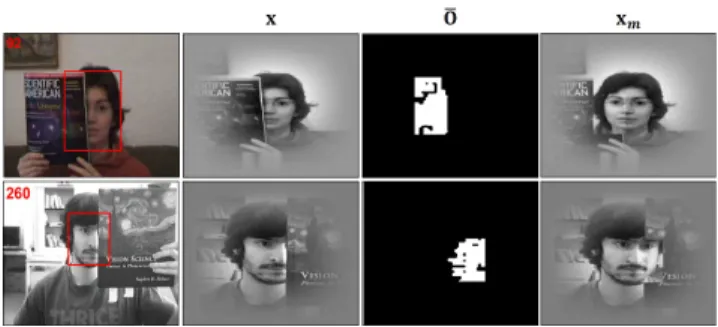
FIGURE 2. Some representative cases ofFaceocc1(#92) andFaceocc2 (#260) sequences showing the resized occlusion mapOgenerated from 2DRC in B2DPCA subspace and the modified target appearancexm.
parameter andτKCF is a threshold. Note that both the target
appearance modelxˆt1and the learned coefficients modelαˆt
1 of KCF-1 are not updated when the occlusion ratioτ > τKCF.
This prevents the model from getting degraded during severe occlusion, and hence, the tracking drift. Further, with the help of occlusion mapOˆ and the previous target appearance model
ˆ
xt2−1of KCF-2, the modified target appearancextmis obtained from the target appearancextas
xmt =O ˆx2t−1+(1−O)xt (17) whereO is the resized occlusion map obtained fromOˆ to match the matrix dimensions ofxˆt2−1. Note that the modified target appearancext
mis free from the occlusion only inside
the target region but not outside, since the occlusion mapsO andOˆ are obtained only for the target region in a generative appearance model of B2DPCA as observed in FIGURE 2. Now, the models of KCF-2 are updated as
F(αˆt 2)=(1−η)F(αˆ t−1 2 )+ηF(αt2) F(xˆt2)=(1−η)F(xˆt2−1)+ηF(xt m) (18)
whereαt2is the learned coefficients obtained from the mod-ified target appearancextmusing Eq. (2). By employing the modified target appearance xtm instead of xt in both the learned coefficients αt2 computation and the target appear-ance model xˆt2 update, the models of KCF-2 are prevented from degradation due to occlusion.
V. EXPERIMENTAL RESULTS
The proposed algorithm is implemented in MATLAB and its performance is evaluated using 50, 60 and 20 challenging sequences available in the OTB-50 [4], VOT2016 [47] and UAV20L [48] datasets,1respectively, by following their eval-uation protocols. These sequences cover most of the real-life challenging situations in object tracking, such as pose varia-tion, complex background, motion blur due to fast movement, varying lighting conditions, scale change, low contrast and
1There are 18 and 14 sequences with more than 500 frames, and 7 and
2 sequences with more than 1000 frames in OTB-50 and VOT2016 datasets, respectively. In UAV20L dataset, there are 11 sequences with more than 2500 frames and 4 sequences with more than 4000 frames totaling 58670 frames for 20 sequences.
Algorithm 2Proposed Tracking Algorithm
Input: Target object is labeled in the first frame, and its initial state and location ares1and (x1,y1), respectively. 1: An image patchx1is cropped out from the target object location (x1,y1) in the first frame and use it to initialize bothxˆ11andxˆ12.
2: Compute the coefficientsα11using Eq. (2), and initialize
ˆ α1 1andαˆ 1 2withα11. 3: fort >1do
4: An image patch zt of new window size is cropped
out from the position (xt−1,yt−1) in framet, and then resized to match the initial window size.
5: Compute ytk from Eq. (3) using xˆkt−1,αˆt−1
k andzt,
wherek=1,2.
6: Computeeytusing Eq. (10) after energy normalization of the response mapsytk, and the location of its max-imum value is used to find the position of the target (xt,yt).
7: SampleMcandidate states{s1t,s2t, ...,sM
t }fromst−1. 8: Extract the candidate sampleYmt from the candidate
statesmt and position (xt,yt),∀m=1,2, ...,M.
9: For all the candidate samplesYmt , computeZmt and Amt according to Algorithm1.
10: Find the optimal state of the tracked target ˆst using Eqs. (13), (14) and (12).
11: The observation models of KCF (xˆ1,αˆ1,xˆ2,αˆ2) and B2DPCA (U,V,µ) are updated incrementally for every one and five frames, respectively, as described in sectionIV-C.
12: end for
Output: Target stateˆstand position (xt,yt) at timet
heavy occlusion. In addition to these challenges, UAV20L dataset captured by the camera mounted on UAV contains long duration sequences with large variations both in camera motion and the view points in three dimensions, resulting in out-of-view or full occlusion, in-plane and out-of-plane rotations of the object with respect to camera axes.
The parameters of both of the correlation filters are set the same as in KCF [33]. In the proposed method for B2DPCA representation, each image observation is resized to 32×32 pixels, andkl=4 left- andkr =4 right-projection
basis vectors are used in all the experiments. Considering the trade-off between the effectiveness in tracking and the computational efficiency, 400 particles are sampled using a particle filter and the parameter 6 of the particle filter is set to 6 = (0.01,0.0,0.005,0)2. The positive scalar ψ used to terminate the IRC algorithm in Eq. (9) is set to 0.1. The penalty constantλused in the computation ofd2DRC in
Eq. (13) is set to 0.1. The B2DPCA observation model is incrementally updated for every 5 frames, and the occlusion ratio thresholdsτ1andτ2used in B2DPCA observation model update are set to 0.1 and 0.6, respectively. The occlusion ratio thresholdτKCF used in model update of KCF-1 (Eq. (16))
the cell size of 4×4 pixels with 9 orientations are adopted for extracting the HOG feature.
The computation of the two parametersβandδused in the weight function (Eq. (7)) of the IRC algorithm is explained below. In order to compute the value ofβ, which controls the location of the demarcation point, the coding residualseijat
all locations are assumed to be in the ‘‘normal range’’ and follow the Gaussian distribution in the absence of occlusions in the tracked sample. But during occlusions, they will prob-ably exceed the ‘‘normal range’’ at the occluded locations. Hence, by knowing the ‘‘normal range’’ of the residualseij
in the initial frames (from 2 toF) of the respective sequence, the value ofβis computed as
β = 1 F−1 F X f=2 mean(Ef)+c1std(Ef) 2 (19)
wherec1is a constant andFis the frame number at which the number of the left- and right-projection basis vectorsklandkr
become 4 for the first time. Note that the residual matrixEis vectorized while computing the mean and standard deviation in Eq. (19). The first frame is manually labeled, due to which all the elements of the residual will be zero, and hence, the first frame is not considered in the computation ofβ. Now, the square of the residualeijthat is larger than the computedβ
will be considered as occluded/outlier and the value of weight
aij will be less than 0.5. Further, the parameter δ, which
controls the rate of the weight between 1 and 0 is computed usingδ=c2/β, wherec2is a constant. The constantsc1and
c2are set as 2 and 7, respectively, for all the sequences. In the proposed method, the IRC algorithm starts functioning after the number of the left- and right-projection basis vectorskl
andkr become 4 for the first time. At the end of frameF,
the number of the left- and right-projection basis vectorskl
andkr are 4, and then, the parametersβ andδare computed,
which are then used by the IRC algorithm from frameF+1 onwards for the calculation of weights in Eq. (7).
The performance of the proposed method is evalu-ated against several recent state-of-the-art algorithms for comparison. The algorithms considered are visual track-ing via least soft-threshold squares (LSST) [46], weighted residual minimization in PCA subspace for visual track-ing (WRMPCA) [14], visual tracktrack-ing via bilateral 2DPCA and robust coding (B2DPCA) [17], visual tracking via dis-criminative low-rank learning (DLR) [49], visual track-ing via weighted local cosine similarity (WLCS) [50], locally weighted inverse sparse tracker (LWIST) [51], robust object tracking via probability continuous outlier model (PCOM) [52], visual tracking by learning a deep compact image representation (DLT) [53], tracking via structured discriminative dictionary learning (DDL) [54], ACT [34], KCF [33], visual tracking via locally structured Gaus-sian process regression (LSGPR) [55] and discriminative low-rank tracking (DSL) [56]. Note that the codes of all the trackers are downloaded from the respective authors’ web-site and evaluated on the OTB-50, VOT2016 and UAV20L
benchmark sequences for a fair comparison with the pro-posed method except DDL [54], DLR [49], LSGPR [55] and DSL [56] as the codes of these trackers are not available. As the OTB-50 results of these trackers are available on the respective authors’ website, they have been used to compare with that of the proposed method.
A. PERFORMANCE EVALUATION ON OTB-50
Generally, the performance of a tracker in a given frame is evaluated using two frame-based metrics, namely, overlap rate (OR) and center location error (CLE). Based on these two basic metrics, Wuet al.[4] and Kristanet al.[47] have derived other performance measures to analyze the perfor-mance of some existing trackers on their benchmark datasets, OTB-50 and VOT2016, respectively.
The performance of a tracker for a given sequence is evaluated using thesuccess rateand theprecision scoreon OTB-50 dataset [4]. The former is the ratio of successful frames whose OR is larger than a given threshold value to the total number of frames in a sequence, whereas the later is the percentage of frames whose CLE is less than a given threshold distance of the ground truth. By using these two metrics with multiple thresholds, two curves are obtained showing how the threshold value affects the success rate
and the precision score, and are, respectively, called suc-cess plotandprecision plot, for a given sequence. Further, thesesuccessandprecision plotsare averaged over all the sequences to obtain the overallsuccessandprecision plots, respectively. In order to quantify the overall performance of a tracker, the area under curve (AUC) of thesuccess plotor the
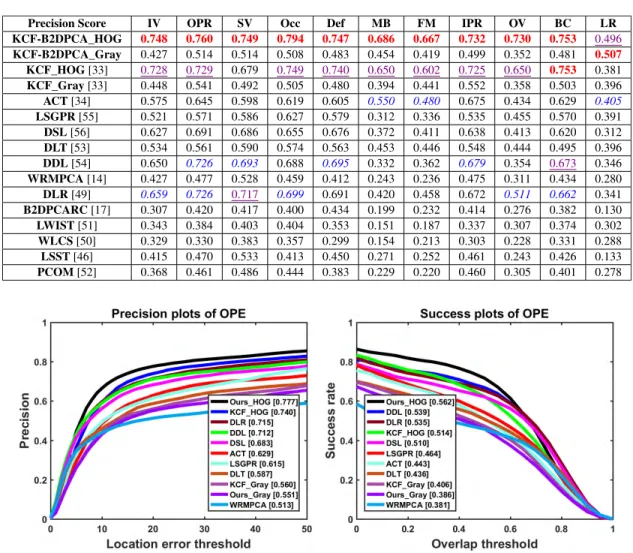
precision plotfor the threshold of 20 pixels, is employed [4]. The proposed method is evaluated on the OTB-50 benchmark [4] consisting of 50 sequences with fully anno-tated attributes and compared with the state-of-the-art track-ing algorithms ustrack-ing one-pass evaluation (OPE). In OPE, the tracker is initialized with the ground truth object location in the first frame and then allowed to run through the rest of the sequence, and the averageprecision scoreor success rateis reported at the end. Table1 shows the performance comparison of the proposed method in terms of theprecision scoresfor the threshold of 20 pixels with that of the other state-of-the-art trackers for different attributes such as illu-mination variation (IV), out-of-plane rotation (OPR), scale variation (SV), occlusion (Occ), deformation (Def), motion blur (MB), fast motion (FM), in-plane rotation (IPR), out-of-view (OV), background clutter (BC) and low resolution (LR). It can be observed from Table1 that KCF-B2DPCA_HOG outperforms the other trackers in all the challenging attributes except LR, where the variant of the proposed method with gray features (KCF-B2DPCA_Gray) performs the best. The LR images suffer from lack of details due to which the efficient representation of target is not possible with HOG features resulting in inferior performance to that of gray features. The same reason holds good even for KCF with HOG and gray features, where KCF_Gray performs bet-ter than KCF_HOG does for the LR sequences. Further,
TABLE 1. Precision scores of the proposed method with that of the compared trackers for different attributes of OTB-50. (red, bold), (violet, underline) and (blue, italic) indicate first, second and third rankings, respectively.
FIGURE 3. Overall performance evaluation of the proposed method on OTB-50 (50 videos with 51 target objects) using precisionandsuccess plotsof OPE. Theprecision scorefor the threshold of 20 pixels and AUC of thesuccess plotare used to rank the trackers in the respective plots and their values have been shown along with the tracker name.
KCF-B2DPCA_HOG outperforms KCF_HOG in all the attributes especially in SV, FM, OV and LR attributes by 10.3%, 10.8%, 12.3% and 30.1%, respectively.
The precision and success plotsof OPE for the various trackers averaging over the OTB-50 benchmark sequences are shown in FIGURE 3. To rank the tracker, the pre-cision score for the threshold of 20 pixels is used in the precision plot, whereas AUC is used in the success plot, and their values are shown along with the tracker name. From FIGURE 3, it is observed that the proposed method (KCF-B2DPCA_HOG) outperforms the state-of-the-trackers KCF_HOG, DLR, DDL, DSL, ACT, LSGPR, DLT, KCF_Gray and WRMPCA by 5%, 8.6%, 9.1% 13.7%, 23.5%, 26.3%, 32.3%, 38.7% and 51.4%, respectively, in terms of the precision score. Similarly in terms of thesuccess scores, KCF-B2DPCA_HOG outperforms DDL, DLR, KCF_HOG, DSL, LSGPR, ACT, DLT, KCF_Gray and WRMPCA, by 4.2%, 5%, 9.3%, 10.2%,21.1%, 26.8%, 28.9%, 38.4% and 47.5%, respectively.
TABLE 2.Performance comparison of the variants of the proposed method in terms of precision score and AUC on OTB-50.
Variants of the Proposed Method:The performance com-parison of the variants of the proposed method in terms of the
precision scoreand AUC on OTB-50 are given in Table2. The methods, Proposed_KCF-1 and Proposed_KCF-2, use only one correlation filter, KCF-1 and KCF-2, respectively, to find the location of the target. It is observed from this table that the Proposed_KCF-1 performs better than KCF and Proposed_KCF-2 do in terms of theprecision scoreand AUC. Further, the Proposed_KCF-2 performs better than KCF does in terms of AUC but not in terms of theprecision score, where
TABLE 3. Accuracy rank and average overlap comparison of the proposed method with that of the compared trackers for different attributes of VOT2016. (red, bold), (violet, underline) and (blue, italic) indicate first, second and third rankings, respectively.
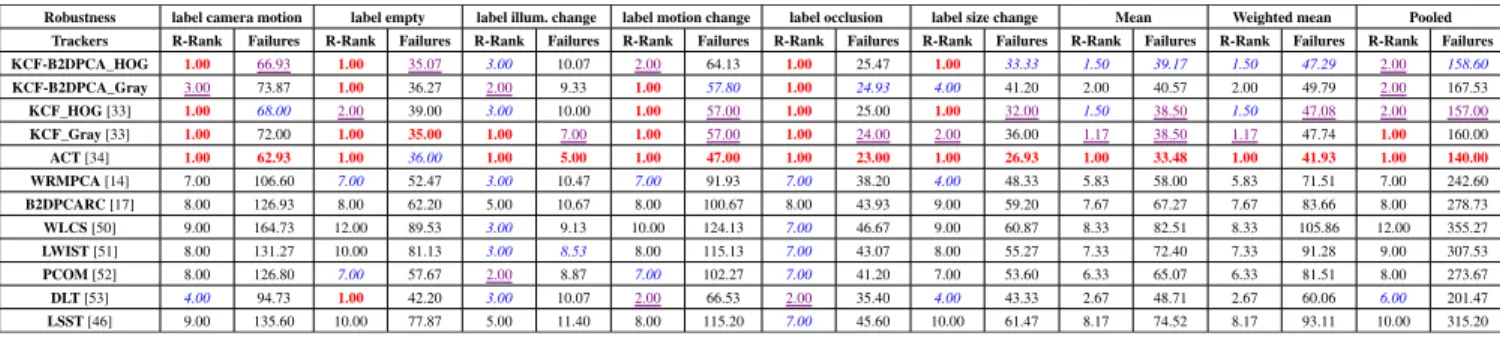
TABLE 4. Robustness rank and average failures comparison of the proposed method with that of the compared trackers for different attributes of VOT2016. (red, bold), (violet, underline) and (blue, italic) indicate first, second and third rankings, respectively.
KCF performs better. The combination of the two correlations filters, KCF-1 and KCF-2, further enhances the performance of the proposed method both in terms of theprecision score
and AUC.
B. PERFORMANCE EVALUATION ON VOT2016
In VOT2016, the performance of a tracker is analyzed using accuracy (A) and robustness (R). The accuracy is the average overlap between the predicted and ground truth bounding boxes during successful tracking periods, whereas the robust-ness measures the number of times the tracker fails to track. In VOT2016, whenever a tracker predicts a bounding box with zero overlap with the ground truth, a failure is detected and the tracker is re-initialized. The per-frame accuracy is obtained as an average over these runs. Averaging per-frame accura-cies gives per-sequence accuracy, whereas the per-sequence robustness is computed by averaging the failure rates over different runs [47].
The average accuracy and robustness are used to eval-uate the performance of the proposed method using the VOT2016 benchmark [47] consisting of 60 sequences, which are per-frame annotated with several visual attributes. Fur-ther, the tracking results are ranked according to the accu-racy and robustness performance metrics, and are named as accuracy rank (A-Rank) and robustness rank (R-Rank), respectively. Table3shows the A-Rank and overlap compar-ison of KCF-B2DPCA with that of the recent state-of-the-art tracking algorithms averaging over the VOT2016 sequences
having challenging situations such as camera motion, illumination change, motion change, occlusion and size change. Likewise, Table 4 shows the R-Rank and failures comparison of the proposed method (KCF-B2DPCA) aver-aging over the same challenging sequences. Also, the respec-tive measures with different averaging methodologies are shown in the last six columns of these two tables. The averages of the attributes in an equal or weighted manner are denoted as mean and weighted mean, and the per-frame averaging of the super-sequence obtained by concatenat-ing all of the sequences as pooled. Note that as the track-ers with statistically equivalent results are merged while ranking, the different trackers may have the same A-Rank and R-Rank [47]. The best three results are shown in (red, bold), (violet, underline) and (blue, italic) fonts for better comparison of KCF-B2DPCA with the other state-of-the-art trackers. From Table 3, it is observed that in terms of the overlap KCF-B2DPCA_HOG ranks first for the attribute empty, size change and averages of attributes (Mean, Weighted mean and Pooled), and stands second and third for the attributes camera motion and motion change, and for the attributes illumination change and occlusion, respec-tively. Also, KCF-B2DPCA_Gray ranks third for the attribute empty. Further, in terms of the overlap, KCF_HOG ranks first and second for the attributes camera motion and occlusion, and for the attributes Weighted mean, Pooled, respectively. On the other hand, DLT ranks second and third for the attributes empty, size change and Mean, and for the attributes Weighted mean and Pooled, respectively. Also, ACT ranks
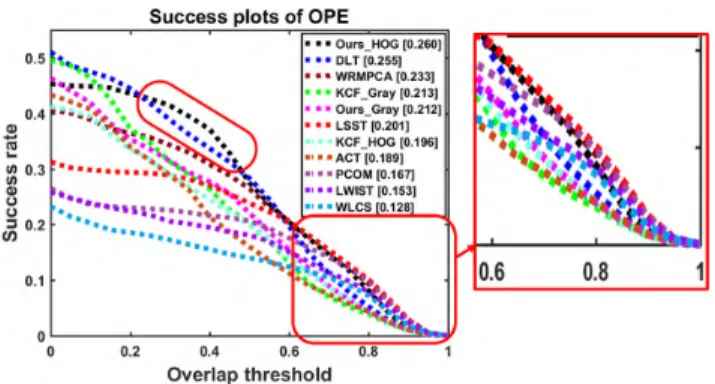
FIGURE 4. Overall performance evaluation of the proposed method on UAV20L (20 sequences) usingsuccess plotsof OPE. AUC of thesuccess plotare used to rank the trackers and their values have been shown along with the tracker name.
first, second and third in terms of overlap, for the attributes motion change and occlusion and for the attribute camera motion, respectively. In addition, LWIST ranks first and third for the attributes illumination change and size change and for the attribute Mean, respectively. Also, WLCS and KCF_HOG ranks second and third for the attributes illumination change and motion change, respectively. Further, it is observed from Table4that ACT ranks first in all the attributes in terms of failures except empty in which KCF_Gray ranks first. On the other hand, KCF_HOG ranks second in the attributes motion change, size change, Mean, Weighted mean and Pooled. Further, KCF-B2DPCA_HOG ranks second and third in the attributes camera motion and empty, and in the attributes size change, Mean, Weighted mean and Pooled, respectively. Also, KCF-B2DPCA_Gray and LWIST rank third in the attributes motion change and occlusion, and in the attribute illumination change, respectively. It is also noted that even though the overall performance of ACT is good in terms of Robustness, it is not so in terms of Accuracy. Similarly, even though the overall performance of the proposed method is inferior in terms of Robustness, it outperforms in terms of Accuracy.
C. PERFORMANCE EVALUATION USING UAV20L
As in OTB-50 evaluation, the success plot is used to evaluate the performance of the proposed method on UAV20L. The success plot of OPE for various trackers averaged over UAV20L benchmark sequences is shown in FIGURE4. From FIGURE4, it is observed that the proposed KCF-B2DPCA_HOG exhibits the best performance in terms of AUC followed by DLT, WRMPCA, KCF_Gray, KCF-B2DPCA_Gray, LSST, KCF_HOG, ACT, PCOM, LWIST and WLCS in the that order. Even though thesuccess rateof DLT is more than that of KCF-B2DPCA_HOG for overlap threshold<0.2, the latter method performs better than DLT does, when the overlap threshold approaches unity (this can be observed in the zoomed window of FIGURE 4). Even though KCF-B2DPCA_HOG performs better for challenges that are considerably difficult, it loses the target, as the
other trackers do, for challenges that are extremely diffi-cult or for sequences where the target undergoes several changes simultaneously, especially in long duration tracking. Further from thesuccess plots of OPE in FIGURE 3 and FIGURE 4, it is observed that the performance of all the trackers deteriorates for UAV20L dataset compared to that with OTB-50 dataset due to the additional complexity and challenges in the sequences of UAV20L that are introduced by the camera motion and view point variations in three dimensions along with long duration of the sequences. Hence, tracking on the sequences of UAV20L is a difficult challenge and there is much room for improvement desired in long duration tracking.
D. QUALITATIVE EVALUATION
For qualitative evaluation of the trackers, some tracking results on a subset of the OTB-50 benchmark sequences are obtained, and shown in FIGURE 5 and FIGURE 6; FIGURE5 shows the results for the five sequences,Car4,
CarScale, Fleetface, Freeman3 and Freeman4, whereas FIGURE6the results for the sequencesJogging-1,Lemming,
Singer1,SuvandTrellis. The tracking results of the various trackers on the six exemplar image frames are shown for each selected sequence. The six frames are selected at regular intervals without any bias. For each of the sequences in FIGURE5and FIGURE6, the first row shows the tracking results of the proposed methods, KCF-B2DPCA_HOG and KCF-B2DPCA_Gray, with that of KCF_HOG, KCF_Gray and ACT, and the second row shows the results of the remain-ing trackers, LSGPR, DSL, DLT, DDL, WRMPCA and DLR. The proposed KCF-B2DPCA_HOG tracker success-fully tracks the target in all the frames of theCar4,CarScale,
Fleetface,Freeman3,Freeman4,Jogging-1,Singer1,Suvand
Trellissequences, which contain most of the real-time chal-lenges such as pose change, partial occlusion, illumination change, scale change and out-of-plane rotation. This indi-cates the strong capabilities of the proposed method in han-dling these challenges. Even though KCF-B2DPCA_HOG performs better for the challenges that are considerably dif-ficult, it loses the target for challenges that are extremely difficult or for the sequences where the target undergoes several changes simultaneously. This can be observed in the last image of the Lemming sequence, one of the longest and most challenging sequences, where the target under-goes severe occlusion, scale change, out-of-plane rotation, motion blur, fast motion either individually or simultane-ously. In addition to KCF-B2DPCA_HOG, other methods have also failed in the Lemming sequence but at differ-ent frames of the sequence. For example, in frame #0666, all the trackers, DDL, DLR, ACT, KCF_HOG, KCF_Gray, LSGPR, DSL, WRMPCA and KCF-B2DPCA_Gray, have failed except KCF-B2DPCA_HOG and DLT, whereas in #0888, all the trackers have started to track the target again except DDL, LSGPR, DLT and WRMPCA. So, none of the trackers has tracked the target through the entire Lem-mingsequence successfully. Even though some trackers fail
FIGURE 5. Examples of tracking results of the compared methods on five OTB-50 sequences, (a)Car4, (b)CarScale, (c)Fleetface, (d)Freeman3and (e)Freeman4.
in some frames, they are able to track the object once again by chance as the object reappears at the same loca-tion due to camera pan or due to repetitive moloca-tion of the
object. All the trackers perform well in theCar4sequence except KCF_Gray, KCF-B2DPCA_Gray and ACT, where the tracker drifts away slightly but with imprecise estimation of
FIGURE 6. Examples of tracking results of the compared methods on five OTB-50 sequences, (a)Jogging-1, (b)Lemming, (c)Singer1, (d)Suvand (e)Trellis.
scale. In the CarScalesequence, all the methods track the target, but fail to estimate the scale information effectively, except WRMPCA that drifts away towards the end of the
sequence. Similar observations can be made even in the
Fleetfacesequence, where WRMPCA and ACT fail towards the end of the sequence. KCF-B2DPCA_HOG and DLT
estimate both the scale and location of the target effectively in Freeman3, whereas DSL, WRMPCA and DLR fail to estimate the scale of the target. The only method that tracks the target effectively until the end in theFreeman4sequence is KCF-B2DPCA_HOG. Further, in theJogging-1sequence, LSGPR, DDL and KCF-B2DPCA_HOG track the object successfully, whereas the other trackers fail to track the object after a few initial frames. In Singer1, even though all the methods track the target to some extent, they fail to estimate the scale accurately except DDL, DSL, WRMPCA, DLT, DLR, LSGPR and KCF-B2DPCA_HOG, which estimate the scale more precisely than the others. Also, KCF_HOG, KCF-B2DPCA_HOG and LSGPR track the object success-fully in Suv except DDL, DLT, DLR, WRMPCA, DSL, ACT and KCF_Gray, which fail to track the object towards the end of the sequence. Further, KCF_HOG, DLR, DDL, KCF-B2DPCA_HOG, KCF-B2DPCA_Gray and ACT suc-cessfully track the target in Trellis, but fail to estimate the scale precisely except KCF-B2DPCA_HOG. Thus, from these qualitative analyses, it is observed that the proposed KCF-B2DPCA_HOG tracker performs favorably in most of the challenging sequences.
VI. CONCLUSION
In this paper, a collaborative tracking algorithm based on the discriminative and generative models has been proposed. The correlation filters, based on the discriminative model, have been used to find the target position, and a robust coding in the B2DPCA subspace appearance model, based on generative framework, has been used to find the remaining affine motion parameters of the target. This is motivated by the idea that the discriminative capability of the tracker plays a important role while finding the location of the target rather than while finding the other affine motion parameters of the target. On the other hand, the generative capability of the tracker plays a prominent role while finding the other affine motion parameters of the target. Also, the robust cod-ing (RC) has been extended to 2D residuals, to account for non-Laplacian or non-Gaussian noise, and introduced into B2DPCA reconstruction. In addition, a 2D robust coding (2DRC) distance metric has been introduced to find the can-didates having appearance similar to that of the subspace and used to compute the observation likelihood in the generative model. Further, a robust occlusion map has been generated from the weights obtained during the residual minimization and used to obtain occlusion-free observation samples, which are then accumulated for the B2DPCA appearance model update. The occlusion map thus obtained has also been used in the appearance model update of both the correlation filters in different ways to avoid the degradation of their appear-ance models. Extensive experiments have been conducted on three popular tracking benchmark datasets, namely, OTB-50, VOT2016 and UAV20L, to analyze the performance of the proposed method. Quantitative and qualitative performance of the proposed method has been compared with that of sev-eral recent state-of-the-art algorithms using these benchmark
datasets, and it has been shown that the proposed method outperforms the state-of-the-art methods. Finally, it needs to be pointed out that despite the fact that the UAV20L dataset is extremely challenging in that it contains long duration sequences with large variations both in the camera motion and view points in three dimensions, the proposed method performs well and better than other state-of-the-art methods do, when it is applied to the sequences of this dataset.
ACKNOWLEDGMENT
The authors would like to thank the authors of [33], [34], [46], and [48]–[56]who have made their codes/results available for comparison with the proposed method.
REFERENCES
[1] A. Yilmaz, O. Javed, and M. Shah, ‘‘Object tracking: A survey,’’ACM Comput. Surv., vol. 38, no. 4, pp. 1–45, 2006.
[2] H. Yang, L. Shao, F. Zheng, L. Wang, and Z. Song, ‘‘Recent advances and trends in visual tracking: A review,’’Neurocomputing, vol. 74, no. 18, pp. 3823–3831, Nov. 2011.
[3] D. Wang, H. Lu, and M.-H. Yang, ‘‘Online object tracking with sparse prototypes,’’IEEE Trans. Image Process., vol. 22, no. 1, pp. 314–325, Jan. 2013.
[4] Y. Wu, J. Lim, and M.-H. Yang, ‘‘Online object tracking: A benchmark,’’ inProc. IEEE Comput. Soc. Conf. Comput. Vis. Pattern Recognit. (CVPR), Jun. 2013, pp. 2411–2418.
[5] D. Comaniciu, V. Ramesh, and P. Meer, ‘‘Kernel-based object tracking,’’
IEEE Trans. Pattern Anal. Mach. Intell., vol. 25, no. 5, pp. 564–577, May 2003.
[6] X. Mei and H. Ling, ‘‘Robust visual tracking using `1
minimiza-tion,’’ in Proc. IEEE Int. Conf. Comput. Vis. (ICCV), Sep./Oct. 2009, pp. 1436–1443.
[7] C. Bao, Y. Wu, H. Ling, and H. Ji, ‘‘Real time robust`1tracker using
accelerated proximal gradient approach,’’ inProc. IEEE Conf. Comput. Vis. Pattern Recogn. (CVPR), Jun. 2012, pp. 1830–1837.
[8] B. K. S. Kumar, M. N. S. Swamy, and M. O. Ahmad, ‘‘Structural local DCT sparse appearance model for visual tracking,’’ inProc. IEEE Int. Symp. Circuits Syst. (ISCAS), May 2015, pp. 1194–1197.
[9] X. Jia, H. Lu, and M.-H. Yang, ‘‘Visual tracking via adaptive structural local sparse appearance model,’’ inProc. IEEE Comput. Soc. Conf. Com-put. Vis. Pattern Recognit. (CVPR), Jun. 2012, pp. 1822–1829.
[10] A. Adam, E. Rivlin, and I. Shimshoni, ‘‘Robust fragments-based tracking using the integral histogram,’’ inProc. IEEE Conf. Comput. Vis. Pattern Recognit., New York, NY, USA, Jun. 2006, pp. 798–805.
[11] J. Yang, R. Xu, J. Cui, and Z. Ding, ‘‘Robust visual tracking using adaptive local appearance model for smart transportation,’’Multimedia Tools Appl., vol. 75, no. 24, pp. 17487–17500, Dec. 2016.
[12] B. K. S. Kumar, M. N. S. Swamy, and M. O. Ahmad, ‘‘Visual tracking using structural local DCT sparse appearance model with occlusion detection,’’
Multimedia Tools and Applications. Cham, Switzerland: Springer, 2018, pp. 1–24.
[13] D. A. Ross, J. Lim, R.-S. Lin, and M.-H. Yang, ‘‘Incremental learn-ing for robust visual tracklearn-ing,’’Int. J. Comput. Vis., vol. 77, nos. 1–3, pp. 125–141, 2008.
[14] B. K. S. Kumar, M. N. S. Swamy, and M. O. Ahmad, ‘‘Weighted residual minimization in PCA subspace for visual tracking,’’ inProc. IEEE Int. Symp. Circuits Syst. (ISCAS), May 2016, pp. 986–989.
[15] H. Wang, H. Ge, and S. Zhang, ‘‘Object tracking via 2DPCA and
`2-regularization,’’ J. Elect. Comput. Eng., vol. 2016, Jul. 2016,
Art. no. 7975951.
[16] D. Wang and H. Lu, ‘‘Object tracking via 2DPCA and`1-regularization,’’
IEEE Signal Process. Lett., vol. 19, no. 11, pp. 711–714, Nov. 2012. [17] B. K. S. Kumar, M. N. S. Swamy, and M. O. Ahmad, ‘‘Visual tracking
via bilateral 2DPCA and robust coding,’’ inProc. IEEE Can. Conf. Elect. Comput. Eng. (CCECE), May 2016, pp. 1–4.
[18] P. Qu, ‘‘Visual tracking with fragments-based PCA sparse representation,’’
Int. J. Signal Process., Image Process. Pattern Recognit., vol. 7, no. 2, pp. 23–34, Feb. 2014.
[19] M. Sun, D. Du, H. Lu, and L. Zhang, ‘‘Visual tracking with astructured local model,’’ inProc. IEEE Int. Conf. Image Process. (ICIP), Sep. 2015, pp. 2855–2859.
[20] B. Babenko, M.-H. Yang, and S. Belongie, ‘‘Visual tracking with online multiple instance learning,’’ inProc. CVPR, Jun. 2009, pp. 983–990. [21] H. Grabner, C. Leistner, and H. Bischof, ‘‘Semi-supervised on-line
boosting for robust tracking,’’ inProc. Eur.Conf. Comput. Vis. (ECCV), Oct. 2008, pp. 234–247.
[22] F. Wang, J. Zhang, Q. Guo, P. Liu, and D. Tu, ‘‘Robust visual tracking via discriminative structural sparse feature,’’ inProc. Chin. Conf. Image Graph. Technol., Jun. 2015, pp. 438–446.
[23] W. Zhong, H. Lu, and M.-H. Yang, ‘‘Robust object tracking via sparse collaborative appearance model,’’IEEE Trans. Image Process., vol. 23, no. 5, pp. 2356–2368, May 2014.
[24] C. Xie, J. Tan, P. Chen, J. Zhang, and L. He, ‘‘Collaborative object tracking model with local sparse representation,’’J. Vis. Commun. Image Represent., vol. 25, no. 2, pp. 423–434, 2014.
[25] B. Zhuang, L. Wang, and H. Lu, ‘‘Visual tracking via shallow and deep collaborative model,’’Neurocomputing, vol. 218, pp. 61–71, Dec. 2016. [26] H. Zhang, F. Tao, and G. Yang, ‘‘Robust visual tracking based on structured
sparse representation model,’’Multimedia Tools Appl., vol. 74, no. 3, pp. 1021–1043, 2015.
[27] C. Ma, J. Huang, X. Yang, and M. Yang, ‘‘Hierarchical convolutional features for visual tracking,’’ inProc. IEEE Int. Conf. Comput. Vis. (ICCV), Jun. 2015, pp. 3074–3082.
[28] Y. Qi, S. Zhang, L. Qin, H. Yao, Q. Huang, J. Lim, and M.-H. Yang, ‘‘Hedged deep tracking,’’ inProc. IEEE Conf. Comput. Vis. Pattern Recog-nit., Jun. 2016, pp. 4303–4311.
[29] M. Danelljan, A. Robinson, F. S. Khan, and M. Felsberg, ‘‘Beyond corre-lation filters: Learning continuous convolution operators for visual track-ing,’’ inProc. Eur. Conf. Comput. Vis. (ECCV), Oct. 2016, pp. 472–488. [30] H. Nam and B. Han, ‘‘Learning multi-domain convolutional neural
net-works for visual tracking,’’ inProc. IEEE Conf. Comput. Vis. Pattern Recognit., Jun. 2016, pp. 4293–4302.
[31] D. Bolme, J. Beveridge, B. Draper, and Y. Lui, ‘‘Visual object tracking using adaptive correlation filters,’’ inProc. Int. Conf. Comput. Vis. Pattern Recognit., Sep. 2010, pp. 2544–2550.
[32] J. F. Henriques, R. Caseiro, P. Martins, and J. Batista, ‘‘Exploiting the circulant structure of tracking-by-detection with kernels,’’ inProc. Eur. Conf. Comput. Vis. (ECCV), Oct. 2012, pp. 702–715.
[33] J. F. Henriques, R. Caseiro, P. Martins, and J. Batista, ‘‘High-speed tracking with kernelized correlation filters,’’IEEE Trans. Pattern Anal. Mach. Intell., vol. 37, no. 3, pp. 583–596, Mar. 2015.
[34] M. Danelljan, F. S. Khan, M. Felsberg, and J. van de Weijer, ‘‘Adaptive color attributes for real-time visual tracking,’’ inProc. IEEE Conf. Comput. Vis. Pattern Recogn. (CVPR), Jun. 2014, pp. 1090–1097.
[35] M. Danelljan, G. Häger, F. Khan, and M. Felsberg, ‘‘Accurate scale estima-tion for robust visual tracking,’’ inProc. Brit. Mach. Vis. Conf. (BMVC), Sep. 2014, pp. 1–11.
[36] T. Zhang, A. Bibi, and B. Ghanem, ‘‘In defense of sparse tracking: Cir-culant sparse tracker,’’ inProc. IEEE Conf. Comput. Vis. Pattern Recog-nit. (CVPR), Jun. 2016, pp. 3880–3888.
[37] T. Wang, I. Y. H. Gu, and P. Shi, ‘‘Object tracking using incremental 2D-PCA learning and ML estimation,’’ inProc. IEEE Int. Conf. Acoust., Speech Signal Process. (ICASSP), Apr. 2007, pp. I-933–I-936.
[38] H. Kong, L. Wang, E. K. Teoh, X. Li, J.-G. Wang, and R. Venkateswarlu, ‘‘Generalized 2D principal component analysis for face image represen-tation and recognition,’’Neural Netw., vol. 18, nos. 5–6, pp. 585–594, Jul. 2005.
[39] M.-X. Jiang, M. Li, and H.-Y. Wang, ‘‘Visual object tracking based on 2DPCA and ML,’’ Math. Problems Eng., vol. 2013, May 2013, Art. no. 404978.
[40] M. Yang, L. Zhang, J. Yang, and D. Zhang, ‘‘Robust sparse coding for face recognition,’’ inProc. IEEE Conf. Comput. Vis. Pattern Recogn. (CVPR), Jun. 2011, pp. 625–632.
[41] J. Yan and M. Tong, ‘‘Weighted sparse coding residual minimization for visual tracking,’’ inProc. Vis. Commun. Image Process. (VCIP), Nov. 2011, pp. 1–4.
[42] M. Jiang, H. Wang, and B. Wang, ‘‘Robust visual tracking based on maximum likelihood estimation,’’Int. J. Digit. Content Technol. Appl., vol. 6, no. 22, pp. 467–474, Dec. 2012.
[43] S. A. Siena, ‘‘Improving the design and use of correlation filters in visual tracking,’’ Ph.D. dissertation, Dept. Elect. Comput. Eng., Carnegie Mellon Univ., Pittsburgh, PA, USA, 2017.
[44] M. Isard and A. Blake, ‘‘CONDENSATION—Conditional density propa-gation for visual tracking,’’Int. J. Comput. Vis., vol. 29, no. 1, pp. 5–28, Aug. 1998.
[45] M. J. Black and A. D. Jepson, ‘‘EigenTracking: Robust matching and track-ing of articulated objects ustrack-ing a view-based representation,’’Int. J. Com-put. Vis., vol. 26, no. 1, pp. 63–84, 1998.
[46] D. Wang, H. Lu, and M.-H. Yang, ‘‘Robust visual tracking via least soft-threshold squares,’’IEEE Trans. Circuits Syst. Video Technol., vol. 26, no. 9, pp. 1709–1721, Sep. 2016.
[47] M. Kristan, A. Leonardis, J. Matas, M. Felsberg, and R. Pflugfelder, ‘‘The visual object tracking VOT2016 challenge results,’’ inProc. Eur. Conf. Comput. Vis. (ECCV), Oct. 2016, pp. 777–823.
[48] M. Mueller, N. Smith, and B. Ghanem, ‘‘A benchmark and simulator for UAV tracking,’’ inProc. Eur. Conf. Comput. Vis. (ECCV), Oct. 2016, pp. 445–461.
[49] Y. Sui, Y. Tang, L. Zhang, and G. Wang, ‘‘Visual tracking via subspace learning: A discriminative approach,’’Int. J. Comput. Vis., vol. 126, no. 5, pp. 515–536, 2018.
[50] D. Wang, H. Lu, and C. Bo, ‘‘Visual tracking via weighted local cosine similarity,’’IEEE Trans. Cybern., vol. 45, no. 9, pp. 1838–1850, Sep. 2015. [51] D. Wang, H. Lu, Z. Xiao, and M.-H. Yang, ‘‘Inverse sparse tracker with a locally weighted distance metric,’’IEEE Trans. Image Process., vol. 24, no. 9, pp. 2646–2657, Sep. 2015.
[52] D. Wang, H. Lu, and C. Bo, ‘‘Fast and robust object tracking via probability continuous outlier model,’’IEEE Trans. Image Process., vol. 24, no. 12, pp. 5166–5176, Dec. 2015.
[53] N. Wang and D.-Y. Yeung, ‘‘Learning a deep compact image representa-tion for visual tracking,’’ inProc. Adv. Neural Inf. Process. Syst., 2013, pp. 809–817.
[54] Y. Sui, G. Wang, L. Zhang, and M.-H. Yang, ‘‘Exploiting spatial-temporal locality of tracking via structured dictionary learning,’’IEEE Trans. Image Process., vol. 27, no. 3, pp. 1282–1296, Mar. 2018.
[55] Y. Sui and L. Zhang, ‘‘Visual tracking via locally structured Gaussian process regression,’’IEEE Signal Process. Lett., vol. 22, no. 9, pp. 1331– 1335, Sep. 2015.
[56] Y. Sui, Y. Tang, and L. Zhang, ‘‘Discriminative low-rank tracking,’’ in
Proc. IEEE Int. Conf. Comput. Vis., Dec. 2015, pp. 3002–3010.
B. K. SHREYAMSHA KUMARreceived the B.E. degree in electronics and communication engi-neering from Bangalore University, India, in 2000, and the M.Tech. degree in industrial electron-ics from the National Institute of Technology Karnataka, Surathkal, India, in 2004. He is cur-rently pursuing the Ph.D. degree in electrical and computer engineering with Concordia University, Montreal, QC, Canada. He has been a Research Associate with the Signal Processing Group, Con-cordia University, since 2012. Before joining ConCon-cordia, he was with the Central Research Laboratory (A Corporate Research Facility of Bharat Electronics, India) as a member (Research Staff) from 2004 to 2012. He is a recipient of the R&D Excellence Award conferred by Bharat Electron-ics. His research interests include visual tracking, computer vision, image fusion, image denoising, image encryption, and document image processing. He has served as a reviewer for several peer-reviewed journals and major conferences.