European Online Journal of Natural and Social Sciences 2015; www.european-science.com Vol.4, No.1 Special Issue on New Dimensions in Economics, Accounting and Management
ISSN 1805-3602
Openly accessible at http://www.european-science.com 230
Bayesian Nonlinear Regression Models based on Slash Skew-t Distribution
Siavash Pirzadeh Nahooji 1, Rahman Farnoosh2*, Nader Nematollahi3
1Department of Statistics, Science and Research Branch, Islamic Azad University, Tehran, Iran; 2School of Mathematics, Iran University of Science and Technology, Narmak, Tehran, Iran;
3Department of Statistics, Allameh Tabataba'i University, Tehran, Iran. *E-mail: [email protected].
Abstract
This paper considers the Bayesian analysis for estimating the parameters of nonlinear regression model when the error term has a slash skew-t distribution. This model is an asymmetric nonlinear regression model which is suitable for fitting the data sets with heavy tail and skewness. The properties of this model are derived and a hierarchical representation of this model based on the stochastic representation of slash skew-t distribution is given. This representation allows us to use Markov Chain Monte Carlo method to estimate the parameters of model. To compare this model with other asymmetric nonlinear regression models, we use conditional predictive ordinate statistic and deviance information, expected Akaike information and expected Bayesian information criterions, and show the performance of the proposed model by a simulation study. Also an application of the new model to fitting a real data set is discussed.
Keywords: Bayesian analysis, Nonlinear regression models, Slash skew-t distribution, Skew slash distribution, Skew-t distribution.
Introduction
Nonlinear regression model usually applied when response variable is a nonlinear function of explanatory variable. One of the fundamental assumptions of these models is the normality of the error terms. But this assumption does not hold when the data under study have skewness and/or heavy tail. For solving this problem some authors use heavy tail distributions for error terms such as Student-t, logistic and exponential power family which are symmetric and have heavy tail than the normal distribution. See for example Cysneiors and Vanegas (2008) and Cysneiors et al. (2010) in this regard. Some authors used asymmetrical distribution such as skew-normal distribution for error terms to overcome the skewness property of the data sets, for example see Cancho et al. (2010) and Xie et al. (2009 a, b). Montenegro et al. (2009) have shown that the estimation of the parameters of a nonlinear regression model with skew-normal random error can be sensitive to outliers. To solve the effect of outliers, Garay et al. (2011) and Lachos et al. (2010) considered the scale mixture of skew-normal distribution for random errors. They found the ML estimates of the model parameters and showed that these estimates did not sensitive to outlier observations when the distributions of random errors are skew-t or skew-slash distribution. Also, Cancho et al. (2011) developed a Bayesian estimation of the parameters of a nonlinear regression model with scale mixture of skew-normal distribution for its error term.
Recently Farnoosh et al. (2013) introduced a new slash skew-elliptical distribution which contains many of skew and heavy tail distributions such as slash skew-t distribution. They showed that slash skew-t distribution is more skewed and heavy tail than skew-normal and skew-t distribution. In this paper we use slash skew-t distribution as the distribution of the random error of a nonlinear regression model. We use the stochastic representation of slash skew-t to find a hierarchical representation of the proposed model and find the Bayes estimate of the model
Siavash Pirzadeh Nahooji, Rahman Farnoosh, Nader Nematollahi
Openly accessible at http://www.european-science.com 231 parameter by employing a Markov Chain Monte Carlo (MCMC) method. Also by using a simulation study, we show the performance of the proposed model to other existing models by applying Conditional Predictive Ordinate (CPO) statistics, Deviance Information Criterion (DIC), Expected Akaike Information Criterion (EAIC) and Expected Bayesian Information Criterion (EBIC).
This paper has been arranged as follows. In Section 2, we will briefly introduce slash skew-t distribution and state its important properties. In Section 3 we give a rough idea of nonlinear regression model with random errors that have slash skew-t distribution. In Section 4, we will describe Bayesian method to estimate model parameters and introduce some measures of model selection which we will use to compare the models. In Section 5, for comparing the proposed model to other existing models, we conduct a simulation study and apply a real example. A discussion is given in Section 6.
Slash skew-t distribution
In this section we discuss some properties of slash skew-t distribution which has been introduced by Farnoosh et al. (2013). A random variable Y has slash skew-t (SLST) distribution if it
can be written as 1 , q X Y U (1)
whereis the location parameter, is a scale parameter, q 0 is the tail parameter and X is a skew-t random variable with location 0, scale 1, skewness
, degree of freedomr
(X ~ST(0,1, , ) r ) and U is a uniform random variable (U ~U(0,1)),X and U are
independent. Thus, the probability density function (pdf) of Y is given by 2 1 ( ) 2 1 0 ( ) ( ( )) | | ( ) (0) ( 1) y q q g q Y q u g u F uh y du y y y q g y q
f
(2) where ( ) | | t h t t and (1 ) (1 ) 2 2 2 ( ) ( ) (1 ) ( ) r r r t g t r r is the density generator function of
Student-t distribution and Fg(.) is cumulative distribution function (cdf) of Student-t distribution. We denote it by ~ ( , 2, , , )
Y SLST r q .
Now, we demonstrate the subsequent results of Slash skew-t distribution. First, we present the stochastic representation of SLST. This representation will be employed to simulate random variableY . The indicated representation will also be employed to transact Gibbs sample algorithm
for hierarchical representation of random variableY . For a proof of the following theorems see
Farnoosh et al. (2013).
Theorem 2.1 Let ~Y SLST( , , , , ) q r , then Y has the following stochastic representation
(3) 1 1 1 1 1 2 2 2 2 0 1 1 1 1 2 2 1 | | (1 ) , q q q Y U V T U V T T U V T
Special Issue on New Dimensions in Economics, Accounting and Management
Openly accessible at http://www.european-science.com 232 where 2 1 , , 2(1 2 2) , 1 2 ~ r V r , U ~U(0,1) , 1 1 2 0 | | q T U V T and 0
T and T1are independent standard normal random variables.
Theorem 2.2 Let ~ ( , 2, , , ) Y SLST r q 1) If q 1,r 1,then ( )E Y c ; 2) If q2,r 2,then ( ) 2 ( )2 2 2 q r Var Y c q r
; where 2 1 and 1 ( ) 2 1 ( ) 2 r q r c r q .The slash skew-t nonlinear regression model
In this section, we assume that the random error of a nonlinear regression model is distributed as SLST distribution. So, our nonlinear regression is given by
( , ) , 1, ,
i i i
Y β
x
i n (4)where Yi are responses, (.) is an injective and twice continuously differentiable function with respect to the parameter vector ( , ,1 )T
p
β , xi is a vector of explanatory variable values and
the random errors 2
1 ~ ( , , , , ) i SLST c r q for q2 , r2 and 1 ( ) 2 1 ( ) 2 r q r c r q , which
corresponds to regression model where the error distribution has mean zero. From Theorem 2.2, the following result can be deduced
So, we have
1
~ ( ( , ) , , , , )
i i
Y SLST β
x
c q r fori 1, , n.From (2) and (4) the log-likelihood function for ( T, 2, , , )T
r q
θ , given the observed
sample ( 1, , )T n y y y is given by 1 1 1
( ) log log log log log( ) log( )
2 2 2 n i i r r n n q nq n n r S
(5) where 2 1 1 2 ( ) 2 1 0 1 1 ( ( )) | | r y q i q g i u S u F uh y du y r
.In this paper we will use the Bayesian method to estimate model parameters. This method has been built based on MCMC algorithms that would achieve posterior inference for the parameters. 2 2 ( ) ( , ), ( ) ( ) , 2, 2. 2 2 i i i q r E Y Var Y c q r q r x β
Siavash Pirzadeh Nahooji, Rahman Farnoosh, Nader Nematollahi
Openly accessible at http://www.european-science.com 233 Bayesian model parameter estimation
In this section we use Bayesian analysis to estimate the parameters of the nonlinear regression model with SLST random error (SLST-NLM). We use MCMC techniques. From theorem 2.1 we can obtain the following hierarchical representation which helps us to write BUGS cods simply.
2 1 2 1 2 | , , ~ ( ( , ) , ), | , ~ ( , ) ( , ), ~ (0,1), 1 ~ ( , ), 2 2 q i i i i i i i i i i i q i i i i i i i i i r Y U u V v T t N t u v T U u V v TN c u v c U U r r V gamma r
x
β (6) where ( , 2) ( , )TN a b r s denote the truncated normal distributionN a b( , )2 on ( , )r s . Let ( , , )1 T n y y y , ( , , )1 T n x x x , ( , , )1 T n t t t , ( , , )1 T n u u u and ( , , )1 T n v v v , so the complete likelihood function ofθ based on (y, x, t,u) is given by
2 1 1 1 2 2 1 1 ( | , , , , ) [ ( ; ( , ) , ) ( , ) ( ; , )I( , ) ( ;0,1) ] n q i i i i i i q i i i i i L y x t u v y t u v v r t c u v c U u r x
θ βTo conduct a Bayesian analysis, we need to determine the prior distribution for all unknown parameters,
, 2, rand q . Because there is no previous information about unknown
parameters, we consider conjugate prior distributions to these parameters. For the sake of avoiding improper posterior, we select proper priors with known hyper-parameters. Therefore, we choose a normal prior distribution for the elements of with pdf given by ( ) j . For parameter, normal prior distribution with mean and variance 2
has been selected. The inverse Gamma prior distribution is considered for , i.e.,
( , ). 2 2 IGamma
For degrees of freedom parameter r and tail parameter q we consider truncated exponential
prior distributions on the interval (2, ) which are given by
(2, ) exp( ) 2 r I , exp( ) (2, ) 2 q I .
These truncation points were chosen to persuade that the variance of yibe finite.
We assume that prior distributions are independent. Therefore, the complete prior can be written as follows 2 2 1 ( ) ( ; , ) ( ; , ) ( | , ) ( ) ( ). j j p j j q r
θ (7)By mixing the likelihood function and the prior distribution (7), the joint posterior can be achieved as follows
Special Issue on New Dimensions in Economics, Accounting and Management
Openly accessible at http://www.european-science.com 234
2 2 1 1 1 1 1 2 ( , , , | , ) [ ( ; ( , ) , ) ( ; , ) ( , ) I( , ) ( ;0,1) ] ( ). n q q i i i i i i i i i i i t u v y x y t u v t c u v v r c U u r
x
θ β θFor inferring and estimating the parameter of the above distribution, MCMC method such as Gibbs sampler can be used. The full conditional distributions which need the Gibbs sampler can be written as follows 2 1 2 1 | , , , , , , ( , )I( , ), i=1, ,n; i q i T i i T T r q TN c u v M c β y u, v where 2 ( ( , ) ) i T yi
x
i c β , 2 2 T M , where 2 1 ( ( , )) n q i i i i i iu v t y x
β , 2 1 n q i i i iu v t
, 2 2 1 1 1 | , , , , , , ~ ( ), ( ( ( , ) ) ) 2 2 n q i i i i i r q t IGamma n u v yx
c n
β y u, v β 2 1 1 1 | , , , , , , ( ; ) n ( ( , ); ( ), q ) p i i i i i i r q tx
y t u v y u, v μ , Dβ
where 1 ( , , ) p T β μ , 1 2 2 ( , , ) p diagonal D .For generating samples from we use Metropolis-Hasting algorithm as follows a) We choose initial value for β0at the first step
b) At the (r1)thstep β* and U are generated from ( ( )r , ) p
N β S and (0,1)U distributions, respectively. Then β(r1)is given by
* * ( ) ( 1) ( ) ( , r ) r r if U otherwise β β β β β where 2 1 2 1 * * ( ) ( ) ( ) ( ) ( ) 1 * ( ) 1 ( ) ( ) ( ) ( ) ( ) ( ) ( ) 1 1 ( ; ) ( ( , );( ), ) ( , ) . ( ; ) ( ( , );( ), ) q q n r r r r r p i i i i i r i n r r r r r r r p i i i i i i y t u v y t u v
x
x
β β β μ ,D β β β β μ ,D βThe matrix S is selected after generating and initial MCMC chain which would help to achieve a good convergence. Similar technique used to update and.
For completing Gibbs sampler scheme, we need the full conditional posterior distributions of u,v, r and q. For each element ofu, the pdf is:
2 2 1 2 2 | , , , , ,r q , ~t N( , ), β y u, v
Siavash Pirzadeh Nahooji, Rahman Farnoosh, Nader Nematollahi
Openly accessible at http://www.european-science.com 235
2 2 2 2 ( ( , ) ) (u | , , , , , , , ) exp ( ( ) ) (0,1 2 q q i i i i i i i i u v y t r q u
x
t c β β y v t (8) fori1, , n.For each element of v, the pdf is:
2 2 2 2 ( ( , ) ) (v | , , , , , , , ) exp ( ( ) ) 2 r q i i i i i i i i v y t r q v u
x
t c r β β y u t (9)fori1, , n. So we can suppose that v | , , , , , , ,i β
r q y u t has ( 1, )2 i r Gamma w , where 2 2 2 ( ( , ) ) ( ( ) ) 2 q i i i i i i i v y t w u x t c r β fori1, , n.
The conditional posterior density of ris:
2 1 ( | , , , , , , , ) ( 2) ( ( 2)) exp ( ln ) (2, ). 2 nr n n i i i r q n r r v v
β y u v t (10) The conditional posterior density of qis:2 2 1 1 ( | , , , , , , , ) exp (2, ), 2 n n q q i i i i i q r u u v z q
β y u v t (11) where 2 2 ( ( , ) ) ( i i i ( ) ) i i y t z x t c β .Note that (8), (9), (10), (11) does not have a closed form, but a Metropolis-Hasting algorithm can be embedded in the MCMC scheme to obtain draws ofui, vi , rand q.
Finally, since ( , ) has a one to one correspondence to( 2, ), then 2and can be
calculate
2
2 and . Model selection methodFor comparing several models and finding the best model that fits to the given data, there are several criterions for selecting the best model. In this section we introduce some of these criterions to compare SLST-NLM to other existing models.
The first criterion is based on Conditional Predictive Ordinate (CPO) statistic which is one of the applicable model comparison criteria and recommended by Gelfand et al. (1992). Let be the full data and ( )i denote the data without
i observation.
In SLST-NLM model for an observed data, we have 2 1 ( ) 2 1 0 ( | ) ( ) ( ( )) | | i i y q q i q g i i i i q g y u g u F uh y du y
,Special Issue on New Dimensions in Economics, Accounting and Management
Openly accessible at http://www.european-science.com 236
where (1 )2 (1 )2 2 ( ) ( ) (1 ) ( ) r r r t g t r r
is the density generator function of Student-t distribution, (.)
g
F is cdf of Student-t distribution and
i ( , )βx
i c
. The posterior density of
given( )i is denoted by ( |( )i ). For thei observation, the CPOiis given by
1 ( ) ( | ) CPO ( | ) ( | ) , 1, , . ( | ) i i i i g y d d i n g y
In SLST model we could not find a closed form for CPOi statistics. Therefore, a Monte Carlo estimate of CPOi can be obtained by using a MCMC sample from the posterior distribution
( | )
. Let 1, ,Qbe a sample of size Q of ( | ) after the burn in. A Monte Carlo estimate of CPOi(Chen et al., 2000) is given by
1 1 1 1 CPO . ( | ) Q i t i t Q g y
Now a statistic based on CPOi's is n1log( )
i i
B
CPO . Since large value of CPOi show a better fit of the model, then large value of B imply a better fit of the model too.We use other criteria, including the Deviance Information Criterion (DIC) introduce by Spiegelhart et al. (2002), the Expected Akaike Information Criterion (EAIC) (Brooks, 2002) and Expected Bayesian Information Criterion (EBIC) (Carlin and Louis, 2001). These criteria can by approximated by the MCMC output as follows: estimate of DIC isDIC 2D D , where
1 ( ) 2 n log[ ( | )] i i D
g y , 1 ( ) Q t t D D Q
and Dcan be estimated by 2 1 1 1 1 1 1 1 1 1 1 , , , , . Q Q Q Q Q t t t t t t t t t t D D r q Q Q Q Q Q
The EAIC and EBIC can be estimated by means of EAIC D 2#( )l and
2#( )log( )
EBIC D l n , where #( )l is the number of model parameter. Simulation and real data analyses
In this section, we investigate properties of SLST-NLM model by a simulation study and the performance of this model with other models such as nonlinear regression model based on skew-t random error (ST-NLM) and nonlinear regression model based on skew-slash random error (SSL-NLM) introduced by Cancho et al. (2011). Also an application to a real data set is discussed.
Frequentist properties
At first by using simulated SLST-NLM data we study the frequntist properties of the parameter estimates. In this simulation we study the behavior of Bayesian estimates, based on frequentist Mean Squared Error (MSE) and the frequentist Mean. We implement the simulation study by the following logistic model:
1 2 3 , 1, ,50, 1 exp( ) i i i Y i x (13)
where the variable xihas a range between 1 to 50. For comparing our proposed model with other
models, we use model parameters that have been applied by Cancho et al. (2011), thus we consider the values,
130,
2 5,
3 0.7,2 2,
4, q3and r4. The error terms areSiavash Pirzadeh Nahooji, Rahman Farnoosh, Nader Nematollahi
Openly accessible at http://www.european-science.com 237 independent with ( , 2, , , )
i SLST c r q
. In this simulation we consider the number of iterations equal to 100 and the fitted nonlinear regression model with three different distribution for random errors
i. These random errors are skew-t, skew slash and slash skew-t.For implement the Gibbs sampler the following independent prior has been considered. For 1, 2,3
i ,
i N1(0,1000), N(0,1000),IG(0.01,0.01), ~ exp(0.1)I(2, )r and ~ exp(0.1)I(2, )q .
For each generated data sets we simulate two chain of size 60000 for each parameter, for burning in, we exclude the first 10000 iterations. Also for decreasing autocorrelation, we consider thin size 10, hence the effective sample size are 5000. For each sample the posterior mean of the parameter and the DIC, EAIC, BIC and B are calculated.
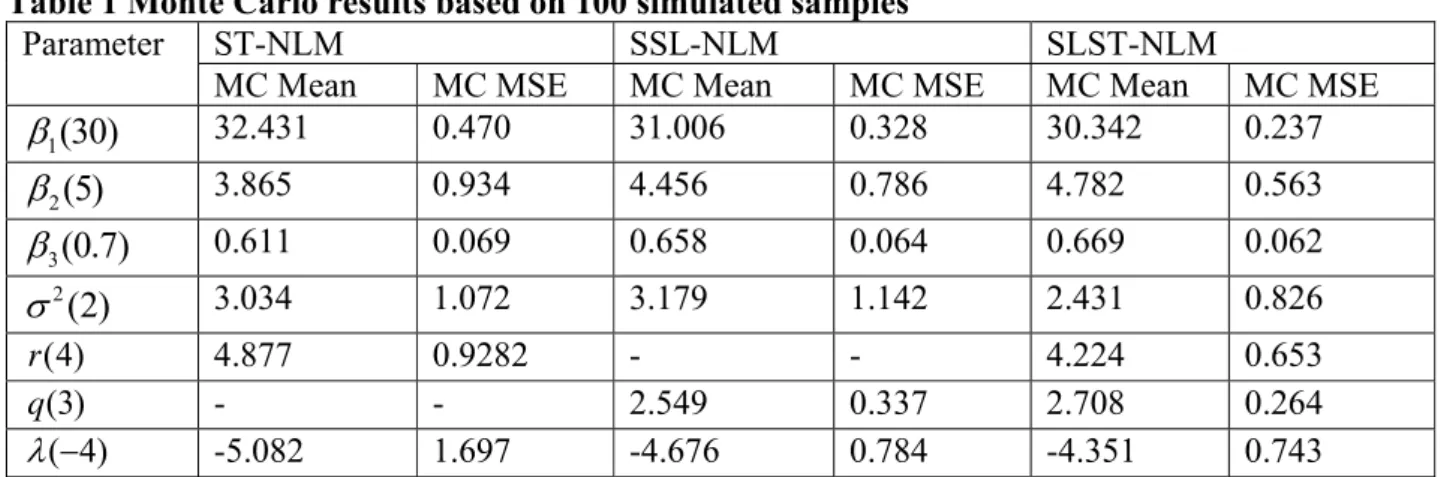
The result of simulation study for ST, SSL and SLST random error distributions with estimated MSE and Mean are given in Table 1. In this table the true values have been put in to the parenthesis, MC Mean has been calculated according to 100
1ˆ 100kj j
and MC MSE which has been determined by 100 21(ˆkj k) 100
j
is the empirical mean squared error. In the indicated formula ˆk is the estimated parameter of true parameter
k.The values in Table 1 indicated that the MC MSE for model parameters are smaller in SLST model than ST and SSL models. Thus SLST-NLM would be better fitted rather than ST-NLM and SSL-NLM for nonsymmetrical data.
This statement has been approved by the values in Table 2. In this table the arithmetic average of the measurements for comparing the models (DIC, EAIC, EBIC, B) are given. These measurements would be smaller in SLST-NLM than the mentioned models. Thus, this particular model has better fitted than the competitor models.
Table 1 Monte Carlo results based on 100 simulated samples
Parameter ST-NLM SSL-NLM SLST-NLM
MC Mean MC MSE MC Mean MC MSE MC Mean MC MSE
1(30)
32.431 0.470 31.006 0.328 30.342 0.237 2(5)
3.865 0.934 4.456 0.786 4.782 0.563 3(0.7)
0.611 0.069 0.658 0.064 0.669 0.062 2(2)
3.034 1.072 3.179 1.142 2.431 0.826 (4) r 4.877 0.9282 - - 4.224 0.653 (3) q - - 2.549 0.337 2.708 0.264 ( 4) -5.082 1.697 -4.676 0.784 -4.351 0.743Table 2 Comparison between ST-NLM , SSL-NLM and SLST-NLM fitting by using different Bayesian criteria
Model Criterion
MC DIC MC EAIC MC EBIC MC B
ST 138.485 88.977 87.173 -376.067
SSL 135.955 82.918 81.114 -373.054
Special Issue on New Dimensions in Economics, Accounting and Management
Openly accessible at http://www.european-science.com 238 Real Data
We use a Bayesian analysis of the ultrasonic calibration data, which has been described in Lin et al. (2007) and Lachos et. al. (2011), to investigate our method. These data are generated from National institutes of Standards and Technology (NIST) study by Chwirut (1979) involving ultrasonic calibration, where the response variableyand the predictor variable is metal distancex.
The data consists of 214observations and is available freely in the R package Nlsmsn. We consider
. . 1 1 2 3 exp( ) , i i d ( , , , , ). i i i i i x Y SLST c q r x (14)
We will use the ST , SSL and SLST distributions to make a comparison.
We consider the following independent priors to apply the Gibbs sampler algorithm: For 1, 2,3
i ,
i N1(0,1000), N(0,1000),IG(0.01,0.01), ~ exp(0.1)I(2, )r for skew-t model and ~ exp(0.1)I(2, )q for SSL model and SLST model. By considering the above priors, we generate two parallel independent runs of the Gibbs sampler chain with size 100,000 for each parameter, for burning in, we exclude the first 10000 iterations. Also to avoid correlation problem we consider thin size 10, hence, the effective sample size are 9000. For each sample the posterior mean of the parameter and the DIC, EAIC, BIC and B are calculated.Posterior mean and standard deviation of parameter under the distributions ST, SSL and SLST have been demonstrated in Table 3. Also, in Table 4 the values of model selection criteria are given. From this table we see that the SLST-NLM has a better fit to this data than ST-NLM and SSL-NLM.
Table 3 Ultrasonic calibration data set. Summary result from the posterior distribution, Mean and Standard Deviation (SD) for parameter under ST, SSL and SLST distributions
parameter ST-NLM SSL-NLM SLST-NLM
Mean SD Mean SD Mean SD
1
0.1694 0.1165 0.3735 0.0491 0.3899 0.02442
0.0059 4.134e-04 0.0091 3.794e-04 0.0073 2.707e-043
0.0112 0.00061 0.0082 0.00023 0.0076 0.00012 2 4.4581 1.4371 4.6132 1.4526 2.9144 0.856
0.5360 0.8524 1.2443 0.3304 1.4185 0.3243 r 2.7652 0.5422 - - 2.9288 0.4962 q - - 2.1199 0.1861 2.9324 0.1215Table 4 Ultrasonic calibration data set. Comparison between ST-NLM, SSL-NLM and SLST-NLM by using different Bayesian criteria.
Criterion ST-NLM SSL-NLM SLST-NLM
B -588.004 -581.554 -574.391
DIC 1319.090 1270.850 1235.340
EAIC 1256.841 1171.952 1168.962
Siavash Pirzadeh Nahooji, Rahman Farnoosh, Nader Nematollahi
Openly accessible at http://www.european-science.com 239 Conclusion
In this paper, we suggest a new nonlinear regression model based on an asymmetric distribution of random error of the model. We employ a MCMC method to obtain the Bayes estimate of the model parameters.
To show the performance of the new model to the existing models, we perform a simulation study. By using B, DIC, EAIC and EBIC criteria, we see that SLNLM has better fit than ST-NLM and SSL-ST-NLM for simulated data and a real data set.
References
Brooks, S.P. (2002). Discussion on the paper by Spiegelhalter, Best, Carlin, and van der Linde. Journal of the Royal Statistical Society. Series B. 64 (3):616-618.
Cancho, V.C., Lachos, V.H., & Ortega, E.M.M. (2010). A nonlinear regression model with skew-normal errors. Statistical Papers. 51:547-558.
Cancho, V. C., Dey, D. K., Lachos, V. H., & Andrade, M. G. (2011). Bayesian nonlinear regression models with scale mixtures of skew-normal distributions: Estimation and case influence diagnostics. Computational Statistics and Data Analysis. 55:588-602.
Carlin, B. P., & Louis, T. A. (2001). Bayes and Empirical Bayes Methods for Data Analysis, 2nd ed. New York, Chapman & Hall.
Chen M. H., Shao Q. M., & Ibrahim, J. (2000). Monte Carlo Methods in Bayesian Computation. New York, Springer-Verlag.
Chwirut D. (1979). Ultrasonic Reference Block Study. Available from: http://www.itl.nist.gov/div898/strd/nls/data/chwirut2.shtml.
Cysneiros, F. J. A., & Vanegas, L. H. (2008). Residuals and their statistical properties in symmetrical nonlinear models. Statistics and Probability Letters. 78:3269-3273.
Cysneiros, F., Cordeiro, G. M., & Cysneiros, A. (2010). Corrected maximum likelihood estimators in heteroscedastic symmetric nonlinear models. Journal of Statistical Computation and Simulation. 80:451-461.
Farnoosh, R., Nematollahi, N., Rahnamaei. Z., & Hajrajabi, A. (2013). A family of skew-slash distributions and estimation of its parameters via an EM Algorithm. Journal of the Iranian Statistical Society. 12(2):271-291.
Garay, A.M, Lachos, V.H., & Abanto-Valle, C. A. (2011). Nonlinear regression models based on scale mixtures of skew-normal distributions. Journal of the Korean Statistical Society. 40:115-124.
Gelfand, A.E, Dey, D. K, & Chang, H. (1992). Model determination using predictive distributions with implementation via sampling-based methods In: Bayesian Statistics. New York, Oxford Univ Press.
Lachos, V.H., Ghosh, P., & Arellano-Valle, R.B. (2010). Likelihood based inference for skew-normal independent linear mixed models. Statistica Sinica. 20:303-322.
Lachos, V.H., Bandyopadhyay, D., & Garay, A.M. (2011) Heteroscedastic nonlinear regression model based on scale mixtures of skew-normal distributions. Statistics and Probability Letters. 81:1208-1217.
Lin, T. I., Lee, J. C., & Hsieh, W. J. (2007). Robust mixture modeling using the skew-t distribution. Statistics and Computing. 17:81-92.
Montenegro, L. C., Lachos, V., & Bolfarine, H. (2009). Local influence analysis of skew-normal linear mixed models. Communications in Statistics. Theory and Methods. 38:484-496.
Special Issue on New Dimensions in Economics, Accounting and Management
Openly accessible at http://www.european-science.com 240 Spiegelhalter, D. J., Best, N. G., Carlin, B. P., & Van Der Linde, A. (2002). Bayesian measures of model complexity and fit. Journal of the Royal Statistical Society. Series B. 64(4):583-639. Xie, F., Lin, J., & Wei, B. (2009a). Diagnostics for skew-normal nonlinear regression models with
AR.1/ errors. Computational Statistics and Data Analysis. 53(12):4403-4416.
Xie, F. C, Wei, B. C., &Lin, J. G., (2009b) Homogeneity diagnostics for skew-normal nonlinear regression models. Statistics and Probability Letters. 79:821-827.