Procedia Computer Science 93 ( 2016 ) 292 – 298
1877-0509 © 2016 The Authors. Published by Elsevier B.V. This is an open access article under the CC BY-NC-ND license (http://creativecommons.org/licenses/by-nc-nd/4.0/).
Peer-review under responsibility of the Organizing Committee of ICACC 2016 doi: 10.1016/j.procs.2016.07.213
ScienceDirect
6th International Conference On Advances In Computing & Communications, ICACC 2016, 6-8
September 2016, Cochin, India
Scalable Information Gain variant on Spark Cluster for Rapid
Quantification of Microarray
Ransingh Biswajit Ray
a,∗, Mukesh Kumar
a, Anand Tirkey
a, Santanu Kumar Rath
aaDepartment of Computer Science&engg. National Institute of Technology
Rourkela, Odisha, India 769008
Abstract
Microarray technology is one of the emerging technologies in the field of genetic research, which many researchers often use to monitor expression levels of genes in a given organism. Microarray experiments have wide range of applications in health care sector. The colossal amount of raw gene expression data often leads to computational and analytical challenges including feature selection and classification of the dataset into correct group or class. In this paper, mutual information feature selection method based on spark framework (sf-MIFS) is proposed to determine the pertinent features. After completion of feature selection process, various classifiers i.e., Logistic Regression (sf-LoR) and Naive Bayes (sf-NB) based on Spark framework has been applied to classify the microarray datasets. A detailed comparative analysis in terms of execution time and accuracy is enumerated on the proposed feature selection and classifier methodologies, based on Spark framework and conventional system respectively.
c
2016 The Authors. Published by Elsevier B.V.
Peer-review under responsibility of the Organizing Committee of ICACC 2016.
Keywords: Big data; Hadoop; Spark; Microarray; Resilient Distributed Dataset; sf-NB; sf-MIFS; sf-LoR
1. Introduction
Microarray innovation has helped the researchers to quantify expression level of large number of genes in a single experiment. The multi-step, information intensive nature of this innovation has made an uncommon informatics and expository challenge. The ‘curse of dimensionality’ problem is the major obstacle in microarray data analysis, which often leads to compuational uncertainity or instability1. Therefore, selection of pertinent features (genes) continues to remain as a core task in analysis of diseases like cancer.
Big Data applications are gradually gaining focus, on account of the immense augmentation of information and storage that has occurred in the most recent decade. Traditional data mining techniques are facing huge computational and analytical challenges while handling these huge data. Reducing the execution time is extremely important for Big Data, which has a high computational resource demand on memory and CPU time. Distributed computing is a concept, where informations are processed independently in a distributed environment by using various parallel processing
∗Corresponding author. Tel.:+91-898-451-7032
E-mail address:[email protected]
© 2016 The Authors. Published by Elsevier B.V. This is an open access article under the CC BY-NC-ND license (http://creativecommons.org/licenses/by-nc-nd/4.0/).
paradigm2,3,4,5. This idea has been embraced to achieve rapid processing and solve Big Data issue. Hadoop, which is based on MapReduce framework, has been exceptionally instrumental in executing high dimensional data applications on commodity clusters. While this framework is valuable for a wide range of applications, there are few which cannot be expressed productively as non-cyclic data flows. This includes numerous iterative machine learning algorithms, and also interactive data analysis tools. Spark is a new cluster computing frame-work, which bolsters applications with working sets while giving similar scalability and fault tolerance properties as MapReduce, and can outperform Hadoop by running 10-100 times faster.
In this paper Mutual Information feature selection method based on Spark framework (sf-MIFS) has been designed to select pertinent features from large microarray datasets. The classification of these datasets are performed using classifiers viz. Logistic Regression and Naive Bayes based on same Spark framework. The performance and efficiency of the proposed algorithms has been evaluated using Spark cluster with three worker nodes and one driver node.
2. Proposed Methodology
Large number of insignificant features reduces the analysis aspect of diseases like ‘cancer’. This issue could be resolved by analyzing only the significant or relevant features from vast microarray data. The proposed methodology comprises of three stages:
• Missing data imputation and normalization methods, which are used for preprocessing of input data.
• MIFS based on Spark framework has been used for selecting relevant features.
• After selecting the pertinent features, classifiers, i.e., Logistic Regression (sf-LoR), Naive Bayes (sf-NB) based on Spark framework has been applied to classify (binary/multi-class) microarray dataset.
3. Basic concepts of Spark
3.1. Spark Architecture
SparkContext object defined in main program (called the driver program) is responsible for coordinating the inde-pendent sets of processes running on a Spark cluster6. The SparkContext can associate to any of the several cluster managers (Yarn, Mesos or Sparks own standalone cluster) that are responsible for allocating resources across applica-tions. Once the connection is established Spark tries to acquire executors on nodes in cluster that computes processes and stores data for Spark applications. The application code (defined by Python or JAR files passed to SparkContext) is then sent to executors. Finally, SparkContext sends tasks to the executors to run.
3.2. Resilient Distributed Dataset (RDD)
RDD is a read-only distributed collection of objects partitioned across multiple machines that can be rebuilt in case a partition is lost. Elements of an RDD do not reside in reliable or physical storage; instead, Spark computes them only in a lazy fashion that is, the first time they are used in an action. This means that RDDs are by default reconstructed each time, when an action operation is performed on them. It is the core concept in Spark framework, which is a fault-tolerant collection of elements that can be operated on in parallel. RDDs are also immutable i.e., it can be modified with a transformation. Each transformation operation on RDD returns a new RDD without changing the original RDD. Transformation and Action are the two types of operations supported by RDD7.
4. Implementation
4.1. Feature Selection Methodology
The input file, which is stored in Hadoop Distributed File System (HDFS) is a matrix of the formN×M, where
one is the driver program and another is the method used for RDD transformation. The driver program is responsible for creating a SparkContext, RDDs, and performing transformations and actions. In RDD transformation method, the distributed dataset (RDD) is transformed by reading a line (fi), calculating the required Information Gain and returning the result in form of key-value pair< f eatureMIFSi,f eatureIdi >. Parallel transformation operation on RDDs are performed by worker nodes and the key-value pair results are returned to the driver program. The driver performs RDD action operation by collecting the results from all worker nodes.
Mutual Information Feature Selection (MIFS) is applied to compare the ‘mutual dependence’ of features in the dataset. The mutual information of two discrete random variables A and B is expressed as:
I(X;Y)=H(X)+H(Y)−H(X,Y) (1) where H(X) and H(Y) are the marginal entropies (shannon entropies) and H(X,Y) is the joint entropy of X and Y. The MIFS of a given feature fiis expressed as:
MIFS(fi)=I(C;fi)−β
fs∈S
I(fs;fi) (2)
where C is the class vector,S is the set of selected features and fsis the selected feature vector. Initially, the feature that returns maximum value for I(C;fi), is added to set S. The algorithm then follows a greedy approach, where the feature that maximizes Equation 2, is added to set S in an iterative manner until it meets the stopping criteria8. Algorithm 1 shows the implementation of Mutual Information Feature Selection method based on Spark framework. Algorithm 1sf-MIFS
Input:N×MInput Matrix.
Output: TopPfeatures.
1: TransformMIFS ( )
2: foreach featurefido
3: Calculate Shannon entropy offi
4: Calculate Shannon entropy of class label vectorY 5: Calculate joint Shannon entropy offiandY
6: Calculatef eatureMIFSiusing Equation 1
7: ifIsEmpty (S electedFeatures)then
8: Return< f eatureMIFSi,f eatureIdi>
9: else
10: Calculatef eatureMIFSiusing Equation 2
11: Return< f eatureMIFSi,f eatureIdi>
12: end if
13: end for
14: Driver Main ( )
15: ReadN×MMatrix file from HDFS
16: Create RDD of InputN×MMatrix
17: S electedFeatures={ }
18: Broadcast class label vectorYandS electedFeaturesto worker nodes
19: S electedFeatures←RDD.map (TransformMIFS ( )).sortByKey(false).take(1)
20: whilef eatureMIFSi≥Threshold Valuedo
21: Printf eatureIdi
22: BroadcastS electedFeaturesto worker nodes
23: S electedFeatures.append(RDD.map(TransformMIFS ( )).sortByKey(false).take(1))
4.2. Classification Methodology
Classification is a common form of supervised learning, where algorithms attempt to predict a variable from fea-tures of objects using labeled training data. ’Spark’ is observed to be suitable for running parallel classification algorithms on a large dataset. The basic classifiers supports only binary classification, but can be extended to handle multiclass classification by using either One-versus-all (OVA) or All-versus-all (AVA).
• Naive Bayes (sf-NB) based on Spark Framework
Naive Bayes method is a supervised learning algorithm applying Bayesian theorem with the assumption of independence between every pair of features. The Bayes theorem is expressed as
P(A|B)=P(B|A)∗P(A)/P(B) (3) For a given sampleXwith attribute valueX=(a1,a2, ...,aN) and classVj, the probability value thatXbelongs to classVjcan be calculated as:
P(Vj|X=(a1,a2, ...,aN))= P(X|Vj)P(Vj)/P(X) (4)
=P(Vj)Ni=1(P(ai|Vj))/P(X) (5) whereP(Vj) is the prior probability for each class andP(ai|Vj) is the likelihood probability for each attribute, wherei = 1, ...,N and j = 1, ...,C. In the testing phase, the likelihood for each attribute of a given class is calculated, and a new instancexthaving attributes (at
1,a t 2, ...,a t N) is classified as: ˆ P(ati|Vj)=(phi at i i j)∗(1−phii j)(1−a t i)) (6)
where,phi, which is the weight of each attribute of a given class and is calculated using Equation 7.
phi=X∗Y/M (7)
where X is the matrix of training samples (M×N), Y is a matrix of dimensionM×C. Mis the number of training samples,Nis the number of attributes, andCis the number of classes. Each row of Y consists of zeros except for the position that indicates the class label. After calculating the value ofP(xt
i|Vj), the new instancext is labeled as the following equation
Vnb=argmax Vj∈V P(Vj) N i=1 ˆ P(ati|Vj) (8)
• Logistic Regression (sf-LoR) based on Spark Framework
Logistic regression is a parametric form for the distribution P(Y|X) where Y is a discrete value and X =
{x1, ...,xn}is a vector containing discrete or continuous values. The parametric model of logistic regression
can be written as:
P(Y=1|X)= 1 1+exp(w0+ n i=1wiXi) (9) and P(Y=0|X)= exp(w0+ n i=1wiXi) 1+exp(w0+ n i=1wiXi) (10) The parameterWof the logistic regression is chosen by maximizing the conditional data likelihood. It is the probability of the observed Y values in the training data. The constraint can be written as:
W←argmax W
l
5. Results and interpretation
5.1. Experimental Setup
The detail system configurations of both Spark cluster and conventional machine are mentioned in Table 1. In Spark cluster 10/100M switch has been used to connect four commodity PCs, which comprises of one name node and three data nodes. The softwares that have been used in proposed approach are Spark 1.5.0, Python 2.7, Hadoop 2.6, JDK 1.7 and Ubuntu 14.04.
Table 1. System Configurations
Setup Type Machine Name Machine Purpose Processor RAM Hard Disk
Master Node Name Node CPU Intel core i5, 3.2 GHz x 4 14 GB 250GB
Spark Cluster Slave Node Data Node 1 CPU Intel core i7, 3.4 GHz x 8 16 GB 500GB
Slave Node Data Node 2 CPU Intel core i7, 3.4 GHz x 8 16 GB 500GB
Slave Node Data Node 3 CPU Intel core i5, 3.2 GHz x 4 16 GB 500GB
Conventional Machine Conventional User Specific CPU Intel core i7, 3.4 GHz x 8 32 GB 500GB
5.2. Dataset Used
The dataset used for classification analysis is obtained from National center of Biotechnology Information (NCBI GEO,http://www.ncbi.nlm.nih.gov/gds/). Accession number GSE13159 LEukemia raw dataset (data size= 9.3 GB) contains expression profiles of 2096 samples, and each sample is having 54675 features. GSE13159 dataset is grouped into 18 classes9. Accession number GSE13204 raw dataset (data size=9.5GB) is a super-series of two subseries of MILE study. This super-series is composed of the following SubSeries:
• GSE13159 Microarray Innovations in LEukemia (MILE) study: Stage 1 data
• GSE13164 Microarray Innovations in LEukemia (MILE) study: Stage 2 data
After combining these two datasets with suitable genes, GSE13204 has 3248 samples, and each sample is having 1480 features. GSE13204 dataset is grouped into 18 classes10. Accession number GSE15061 ’subset of LEukemia’ raw dataset (data size=3.8 GB) contains expression profiles of 870 samples, and each sample is having 54675 features. GSE15061 dataset is grouped into 3 classes11. The summary of the datasets is tabulated in Table 2.
Table 2. Microarray dataset information.
Dataset #Samples #Features #Classes Data size #Training samples #Testing samples
GSE131599 2096 54675 18 9.3 GB 1397 699
GSE1320410 3428 1480 18 9.5 GB 2165 1083
GSE1506111 870 54675 3 3.8 GB 580 290
5.3. Analysis of sf-MIFS method
Mutual Information Feature Selection method is applied on training dataset in order to remove irrelevant informa-tion, thus avoiding ‘curse of dimensionality’ problem. The Information gain (MIFS value) of all features with respect to other selected features are determined in a distributed environment. The features having MIFS value greater than equal to the selected threshold value are accepted, while the rest are discarded.
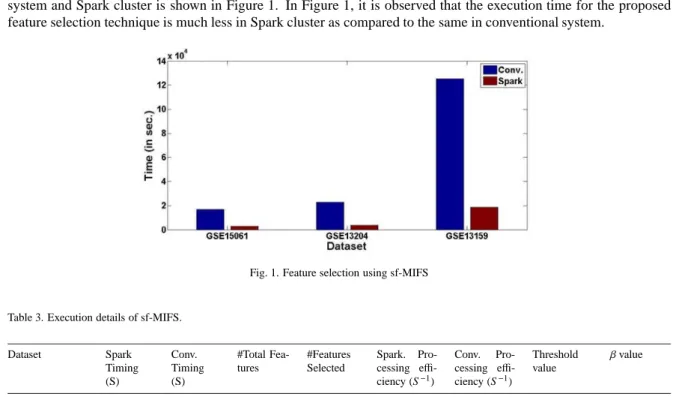
sf-MIFS is processed on both Spark cluster and Conventional system respectively. The overall execution details of the feature selection technique on all three datasets is tabulated in Table 3. Processing efficiency in Table 3 is characterized as the number of features processed per second. Comparison of execution time in both conventional system and Spark cluster is shown in Figure 1. In Figure 1, it is observed that the execution time for the proposed feature selection technique is much less in Spark cluster as compared to the same in conventional system.
Fig. 1. Feature selection using sf-MIFS
Table 3. Execution details of sf-MIFS.
Dataset Spark Timing (S) Conv. Timing (S) #Total Fea-tures #Features Selected Spark. Pro-cessing effi -ciency (S−1) Conv. Pro-cessing effi -ciency (S−1) Threshold value βvalue GSE13159 18618.36 125252.15 54675 18894 2.93 0.43 -100 0.3 GSE13204 3916.58 22642.29 1480 964 0.37 0.06 -100 0.3 GSE15601 3079.34 16933.00 54675 8987 17.75 3.22 -100 0.3 5.4. Analysis of Classifiers
After feature selection, classifiers based on Spark framework i.e., Naive Bayes NB) and Logistic Regression (sf-LoR) are applied to classify the microarray datasets with reduced number of features. ’3-fold cross validation (CV)’ technique is applied to assess the performance of classifiers, as it provides a more realistic assessment by generalizing significantly to unseen data. The overall execution details of Naive Bayes and Logistic Regression classifiers based on Spark framework are tabulated in Table 4. Processing efficiency in Table 4 is characterized as the number of samples processed per second. The amount of time consumed by Naive Bayes and Logistic Regression classifiers on conventional system and Spark cluster is shown in Figure 2. In Figure 2 it is observed that the time taken by the classifiers based on Spark framework, to analyze the datasets is much less as compared to the same in conventional system.
6. Conclusion
In this paper, Mutual Information Feature Selection method based on Spark framework (sf-MIFS) is suggested for selection of pertinent features from large microarray datasets. After feature selection classifiers, i.e., Naive Bayes and Logistic Regression based on Spark framework are proposed to classify microarray datasets. The proposed methodology runs on scalable cluster in a distributed environment , which is configured using low cost commodity hardware, and its performance increases with increase in data size. From the obtained result it is inferred that sf-MIFS provides better accuracy with sf-NB as compared to sf-LoR.
Fig. 2. (a) Execution time of Naive Bayes classifier on Spark cluster (Spark) and Conventional system (Conv.); (b) Execution time of Logistic Regression classifier on Spark cluster (Spark) and Conventional system (Conv.)
Table 4. Classification Results.
Classification Technique Dataset Conv. Timing (S) Spark Timing (S) Train Ac-curacy Test Ac-curacy Regularization Parameter Conv. Pro-cessing effi -ciency (S−1) Spark Process-ing efficiency (S−1) GSE13159 113.47 27.84 80.83 % 81.57 % NA 6.16 25.10
Naive Bayes GSE13204 24.28 10.41 80.21 % 83.29 % NA 44.60 104.03
GSE15061 19.97 9.38 65.78 % 68.42 % NA 14.52 30.91
GSE13159 2614.78 558.27 63.86 % 67.28 % 0.001 0.26 1.25
LoR GSE13204 99.27 49.74 76.21 % 79.99 % 0.001 10.90 21.77
GSE15061 35.58 14.84 70.28 % 71.34 % 0.5 8.15 19.54
References
1. George Lee, Carlos Rodriguez, and Anant Madabhushi. Investigating the efficacy of nonlinear dimensionality reduction schemes in classi-fying gene and protein expression studies.Computational Biology and Bioinformatics, IEEE/ACM Transactions on, 5(3):368–384, October 2008.
2. AKM Tauhidul Islam, Byeong-Soo Jeong, ATM Golam Bari, Chae-Gyun Lim, and Seok-Hee Jeon. Mapreduce based parallel gene selection method.Applied Intelligence, pages 1–10, July 2014.
3. Shicai Wang, Ioannis Pandis, David Johnson, Ibrahim Emam, Florian Guitton, Axel Oehmichen, and Yike Guo. Optimising parallel r correlation matrix calculations on gene expression data using mapreduce.BMC bioinformatics, 15(1):351, November 2014.
4. Qing He, Fuzhen Zhuang, Jincheng Li, and Zhongzhi Shi. Parallel implementation of classification algorithms based on mapreduce. In Rough Set and Knowledge Technology, pages 655–662. Springer, 2010.
5. Mukesh Kumar and Santanu Kumar Rath. Classification of microarray using mapreduce based proximal support vector machine classifier. Knowledge-Based Systems, 89:584–602, 2015.
6. Matei Zaharia, Mosharaf Chowdhury, Michael J Franklin, Scott Shenker, and Ion Stoica. Spark: cluster computing with working sets. In Proceedings of the 2nd USENIX conference on Hot topics in cloud computing, volume 10, page 10, 2010.
7. Matei Zaharia, Mosharaf Chowdhury, Tathagata Das, Ankur Dave, Justin Ma, Murphy McCauley, Michael J Franklin, Scott Shenker, and Ion Stoica. Resilient distributed datasets: A fault-tolerant abstraction for in-memory cluster computing. InProceedings of the 9th USENIX conference on Networked Systems Design and Implementation, pages 2–2. USENIX Association, 2012.
8. Roberto Battiti. Using mutual information for selecting features in supervised neural net learning.Neural Networks, IEEE Transactions on, 5(4):537–550, 1994.
9. Torsten Haferlach, Alexander Kohlmann, Lothar Wieczorek, Giuseppe Basso, Geertruy Te Kronnie, Marie-Christine B´en´e, John De Vos, Jesus M Hern´andez, Wolf-Karsten Hofmann, Ken I Mills, et al. Clinical utility of microarray-based gene expression profiling in the diag-nosis and subclassification of leukemia: report from the international microarray innovations in leukemia study group. Journal of Clinical Oncology, 28(15):2529–2537, May 2010.
10. Alexander Kohlmann, Thomas J Kipps, Laura Z Rassenti, James R Downing, Sheila A Shurtleff, Ken I Mills, Amanda F Gilkes, Wolf-Karsten Hofmann, Giuseppe Basso, Marta Campo DellOrto, et al. An international standardization programme towards the application of gene expression profiling in routine leukaemia diagnostics: the microarray innovations in leukemia study prephase. British journal of haematology, 142(5):802–807, 2008.
11. Ken I Mills, Alexander Kohlmann, P Mickey Williams, Lothar Wieczorek, Wei-min Liu, Rachel Li, Wen Wei, David T Bowen, Helmut Loeffler, Jesus M Hernandez, et al. Microarray-based classifiers and prognosis models identify subgroups with distinct clinical outcomes and high risk of aml transformation of myelodysplastic syndrome.Blood, 114(5):1063–1072, 2009.