Web Users' Optimal On-line Experience:
An Examination of the Effects of Web Navigation Design and Web User Motive
Fang Wan
e-Lab, Owen Graduate School of Management Vanderbilt University
Ning Nan
School of Journalism and Mass Communication University of Minnesota
Contact person: Fang Wan
e-Lab, Owen Graduate School of Management Vanderbilt University, Nashville, TN 37203
Email: [email protected]
Manuscript under review by Experimental Psychology: Internet-based psychological
experiments (special issue). Theauthors contributed to the paper equally. An earlier version of this paper was presented at the Experiential 3-D E-commerce Conference, September 27-29, 2001, in East Lans ing, Michigan, USA.
Web Users' Optimal On-line Experience:
An Examination of the Effects of Web Navigation Design and Web User Motive
Abstract
This study examines whether a congruency effect exists if Web features (such as navigation design) and surfing motives (information seeking and entertainment seeking) match up. We hypothesized that a static Website design would best combine with the information-seeking motive, while a dynamic navigation design best matches the entertainment-seeking motive. These combinations, we predicted, would create optimal experiences—more positive emotions after surfing the Website, a higher evaluation of the structure and efficiency of the Web, and a higher likelihood of using the Web (buying a product, recommending a site to friends, or revisiting the site). A 2 by 2 (dynamic vs. static Website designs and information seeking vs. entertainment seeking motives) on- line experiment was conducted. While we found an interaction effect of surfing motive and Web design on some of the dependent variables, the congruency effect is not symmetric. That is, people in the experiential surfing motive and dynamic website design condition seemed to have an optimal experience while people in the information-seeking motive and static website design condition did not. Explanations for the findings and recommendations for future research were included in the final part of the paper.
Web Users' Optimal On-line Experience:
An Examination of the Effects of Web Navigation Design and Web User Motive
“Sometimes when I am at my computer, I say to my wife, ‘ I'll be done in just a minute" and the next thing I know she's standing over me saying, ‘It's been an hour!’” (Collins, 1989)
Introduction
Today, globally, 350 million people are on- line (McGarvey, 2001). On- line sales are expected to soar 57 percent this year, reaching $65.9 billion (McGarvey, 2001). Facing these facts, all on- line companies have to fight the battle of "customer acquisition" (Hoffman and Novak, 2000). In order to retain the attention of potential buyers, e-commerce companies have invested heavily to create a compelling on- line experience for their customers.
Though marketers are aware that different on- line marketing strategies are crucial to attract visitors to websites (Hoffman et al. 1995, Morr 1997, Schwartz 1996, Tchong 1998), very little is known about what factors make the Web use a compelling customer experience, or about the outcomes of such an experience. Hoffman and Novak (1996a) recently argued that a
compelling customer experience online should facilitate a state of flow for its customers. In their conceptual framework, flow on the Web is a cognitive state experienced during online navigation that consumers are so acutely involved in the act of online navigation that thoughts and
perceptions not relevant to navigation are screened out, and the consumers focus entirely on the interaction (Novak, Hoffman and Yung, 2000). This cognitive state has been characterized as an “optimal experience” (Csikszentmihalyi, 1997).
However, most previous work conceptualized flow within the general Web environment (e.g., Hoffman & Novak, 1996a; Novak, Hoffman and Yung, 2000). This paper examines how
specific Website characteristics, together with Web user characteristics, can create an optimal surfing experience.
Literature Review
In general, Web surfers' experience has been identified as one of the most important factors influencing consumers’ attitudes toward, and behaviors on, e-commerce sites. Doubtless, an optimal or at least positive experience on a website is desirable because it may lead to
frequent site visits, more focused attention on the product promoted by the site, or even on- line purchases. Hoffman and Novak (1996a) argued that an optimal experience in a computer-mediated environment, or an online flow experience, is the desirable consequence of the exchanges between the Web user and the website. In an empirial study, Novak et al. (2000) found that skills of using the web (e.g., the number of years and amount of time a person had used the web), challenge and arousal of the web and telepresence are antecedents of an online flow experience. However, Novak et al. (2000) were concerned with flow experienced while using the Web in general, as opposed to flow experienced on a specific Website. As stated earlier, an understanding of the determinants of flow in a particular Web activity can help Internet marketers and e-commerce developers effectively attract target audience to their
websites. It is therefore the task of this study to identify the specific characteristics of Web users as well as particular websites that would induce online optimal experience.
Navigation Design
Among the elements of a website, navigation design is recognized as important, as it partially determines the success of a website. Navigation refers to the tools that allow the consumer to move through the site at his/her own discretion, through a series of self- initiated searching, accessing and retrieving activities (Schlosser and Kanfer, 1999). In general,
navigation instruments include search engines, search agents and hyperlinks; if employed successfully, they give rise to a feeling of connectedness (Ha and James, 1998). For most
people, navigation is a purposeful action; they see it as moving them toward a final destination or goal.
A growing body of literature on navigational tools suggests that the availability of navigational tools for compiling and sorting product information has positive effects on
consumers' attitudes toward the Website and the quality of their purchase decision (Haeubl and Trifts, 2000; Lynch and Ariely, 2000; Schlosser and Kanfer, 1999). Up to date, few researchers explored how the context of navigation design would induce positive attitude or optimal online experience.
Whitaker (1998) argued that different cognitive skills are required for different navigation purposes in different environments. He sees the design of a navigation device as crucial for Web users. When these navigation devices are salient and clear enough to help users' cognitive processing of their movement in cyberspace, users are more likely to have an optimal experience when surfing. Conversely, if these devices are ambiguous and user-unfriendly, users are more likely to get lo st in cyberspace and consequently feel anxious. Alternatively, when navigation focuses on the value of the journey itself, that is, when the process of moving through space is its own goal, sites may end up with unintended or surprising paths, and ambiguous visual cues. In fact, Whitaker (1998) was tackling an important structural distinction in website navigation: that between the traditional design, which is static and brochure- like, and a newer dynamic, animated navigation design. However, Whitaker did not empirically test his argument.
Concerning Website navigation, Steuer (1992) made a similar argument, asserting that certain Website features can bring out a more human experience, rather than mere technological
interactions. Such on-line experiences mimic real-world experiences, and are therefore defined as virtual reality (Steuer, 1992). He emphasized two Web features that could enhance the creation of virtual reality—vividness and interactivity (Steuer, 1992). Vividness refers to the richness of a mediated environment’s formal features (e.g., animation, color); and interactivity refers to the extent to which users can participate in modifying the form and content of a mediated environment (e.g., chat rooms and video games).
Taking Whitaker’s (1998) and Steuer’s(1992) work as our base, in this study we focus on one Web feature—dynamic (vivid and animated) or static (brochure-like) navigation design. Surfer’s Motive
As noted earlier, an on- line optimal experience is a result of both user characteristics and Web features. For example, one user characteristic is Web usage (Novak et al., 2000). Another user characteristic is the motive for surfing the Web. Two main motives for using the Internet are achieving an end goal (e.g., finding useful information about commercial products and services) and exploring for the sake of exploration (e.g., browsing for entertainment) (Gupta & Gramopadhye, 1995; Whitaker 1998).
Goal-oriented Web surfing has been labeled “searching” or “information seeking.” When a Web user is engaged in searching, he/she looks for particular information while expending minimal time and energy. This instrumental, goal-directed orientation has been said to reflect purposive, task-specific behavior and such directed search has been called pre-purchase
deliberation (Hoffman and Novak, 1996). Thus, searchers may surf a website with the deliberate goal of efficiently and effectively processing or evaluating information (Schlosser and Kanfer, 2000).
Browsing, or surfing, for fun, on the other hand, is less task-oriented and more
entertainment-oriented than searching. The experiential, hedonic orientations of browsing reflect recreational behaviors and non- linear searches (Hoffman and Novak, 1996). Thus, whereas searchers may be motivated to find relevant information and process it quickly without being diverted, browsers may be motivated by the prospect of being delighted and entertained by the Website experience (Schlosser and Kanfer, 2000).
A Matching effect of Navigation Design and Surfer Motive on On-line Experience
Congruency framework could explain how the navigation design and the surfers’ motives would interact during the on- line experience. Congruency theory was first introduced by Osgood and Tannenbaum (1955). They posited a simple principle of congruity—“changes in evaluation are always in the direction of increased congruity with the existing frame of reference” (p. 43). Following their work, a number of scholars and researchers applied congruence theory to a wide variety of research topics, including advertising and consumer psychology (Nevite, 1999;
Stafford, 1998; Graeff, 1996; Leigh, 1992; Solomon, Ashmore and Longo, 1992; Kamins, 1990). The central hypothesis at work is that the perception of and attitude toward advertising messages, or products, will be enhanced if there is a “match-up” between advertising strategies and viewer characteristics, between product features and consumer characteristics, and between sources of the message and product features.
For example, Graeff (1996) examined the impact on brand evaluation of the congruence between brand image and a consumer’s self- image. In his study, subjects evaluated a brand more favorably if there was congruence between brand image and the subjects’ self- image. Stafford (1998) also employed congruence theory to study the match-up effects of the source characteristics and the service characteristics on consumer attitudes toward advertising. The
results indicate that congruence between source and service characteristics in advertising results in more favorable cognitive attitudes toward the advertising.
Using a similar perspective, Bezjian-Avery, Calder and Iacobucci (1998) examined the effectiveness of internet advertising compared to the traditional linear format of advertising. They found that congruence between system properties (being predominantly visual or verbal) and consumer segment needs (preferring their information in a visual or verbal form) has a positive impact on attitude toward the ad.
Implicitly adopting congruency theory framework, Rodgers and Thorson (2000) proposed an integrative processing model of internet advertising. The basic assumption of the model is that an individual is an active initiator and participator in the on-line experience. Therefore, a surfer’s evaluation and perception of internet advertising is dependent not only on advertiser-controlled aspects (such as color, animation, size of the ad), but also on consumer-advertiser-controlled aspects (such as internet uses, motive for surfing). For example, they argued that the presence of sound and animation in Internet advertising may have an impact on consumers’ attitudes toward the ad and on their intention to purchase. However, such an impact is contingent upon a
consumer’s motive and task. A consumer may react negatively to ad features (e.g., color, animation) because they may make searching for information and ordering the product more difficult (Rodgers and Thorson, 2000).
The congruence framework also shed light on our study of the interaction effect of Web characteristics and Web users’ characteristics. In this study, we specifically focus on one aspect of Web users’ characteristics—surfing motive (or surfing mode) and one aspect of a website — navigation design. Different surfing motives require different navigational and cognitive skills, which are constrained by different navigation designs. Users generally employ devices such as
frames, a table of contents, navigation bars, hierarchical maps, site maps or a search engine to move toward their surfing goals (Wickens, 1992). Therefore, a static, brochure- like navigation design will serve the information seeker’s purpose by presenting a clear structure, allowing the user to achieve his goal and ultimately bringing him an optimal on- line experience. In
congruence framework, a static and brochure- like navigation design is congruent with the information seeker’s searching goals.
In contrast, surfers, whose purpose is to enjoy the process of exploration itself, expect interesting sites that include unintended paths and unexpected or hidden links. In a browsing situation, Web surfers may prefer unobtrusive and ambiguous visual cues over clear ones. Therefore, a non user- friendly navigation design is more likely to generate an optimal experience because it serves the experiential and hedonic orientation of surfing. In this case, dynamic Websites with animation and hidden links are congruent with the goal of browsers. Therefore, we would expect:
H1: Web surfers in either the information-seeking and static Website condition or the entertainment-seeking and dynamic Website condition are more likely to achieve an optimal experience than Web users in the other two conditions.
Method: Subjects and Design
A convenience sample of college students at a Midwestern university was used in this study. Two hundred and fifty- five students were recruited from different undergraduate
journalism classes. As an enticement, all participants received extra credit in their classes upon completion of the study. However, thirty students did not complete the study, therefore, were excluded from the final analysis. Among the 225 participants who completed the study, 91 were male and 134 were female. The ages ranged from 18 to 40, with both a mean and a median of
20. Most of them (83.1%) have more than three years’ experience using the Web and spend 10 hours each week on the Web.
A 2 (navigation design: static versus dynamic) by 2 (surfer’s motive: information
seeking versus browsing) on- line experiment was designed for this study. The navigation design site used in this research was developed from an actual e-commerce website. The selection of the sample site was based on a review of a number of website critique articles and of a pool of e-commerce websites. A newly-developed e-e-commerce website for a well-known cosmetic brand was selected as the commercial Website in the study based on two criteria: (1) the site was totally designed by using Macromedia Flash, a widely-adopted software for animated na vigation design; and (2) animation, rollover images, swap menu and audio signals are the major features of its navigation design. Therefore, the original e-commerce website served as the dynamic navigation site (URL: http://www.lorealpro.net).
In static navigation condition, all the animation, rollover images, swap menu, audio signals and hidden hyperlinks in the dynamic site were transformed into static image and text. In this way, another website with the identical content but a static navigation design was created and used as static navigation site in the study (URL:
http://www.tc.umn.edu/~nanx0004/experimentWeb/initial.html).
Participants were also randomly given one of the two tasks of surfing the site: 1) look for product information and will be tested later on product information (information-seeking); 2) explore the Web site and have fun with it (entertainment seeking).
Procedure:
Three hundred fliers describing the study and including the URL of the study were distributed to undergraduate students from different classes at the end of their class sessions. No
specific request regarding where they should participate the study was made. However, they were told that they would have to complete the study within one week in order to receive extra credits.
All participants were given an identical URL of the study. Once they requested the URL from a computer, they would access the first page containing the cover story of the study. The participants were told to help assess a new e-commerce website and to follow the instructions they would be given later. The first access page was followed by an informed consent page. Participants were asked to check “Agree to participate in this study” to proceed or to check “Quit the study now” if they wished to stop the study right away. When participants filled out the consent form and chose to proceed, they were directed to the next page, where they were requested to input their student ID number (for identifying the participants and granting extra credits). By clicking on “continue,” participants would be led to the instruction page. Here, the CGI program on the server would randomly assign them to one of the four experiment conditions and display the corresponding instruction page in the Internet browser. On the instruction page, participants were first asked to indicate their previous attitude toward the cosmetic brand on a 5-point semantic scale. In addition, they were told that they would see a newly developed
ecommerce site. Some of them were asked to “pay specific attention to product information” and they were told that they would be tested on some product information later; others to “explore the website and have fun with it.” Then, they were directed to either dynamic website or static website.
At any time of the study, participants could click on “Email the researcher” button if they experienced any problem in completing the study. Participants were also asked at the end of the
question whether they experienced any technical difficulty in participating the study. No report of problem was received.
There was no time constraint regarding to how long participants should browse the web site. After navigating a correspondent website, participants could click on “Continue” button and would be directed to a page with a questionnaire measuring their evaluation, experience and emotional response of the Website, as well as demographic information. The CGI program on server received the data and transformed them into a text file. Later, the data in the text file were directly imported into SPSS spreadsheet for statistical analysis.
Manipulation check
Dynamic vs. static Website. After surfing the website randomly assigned to them,
participants were asked to rate the site using a five-point scale, where 5 equaled “dynamic” and 1 equaled “static.” Participants who surfed the dynamic website (with animation and hidden links) reported a higher mean score on the scale than those who surfed the static site (4.21 versus 2.12; F (1, 221)=11.86, p<.01).
Surfing motive. Participants were randomly assigned surfing motives. In the
information-seeking conditio n, they were told to pay attention to specific product information which they would be tested on. Participants in the experiential surfing condition were told to explore the Website and have fun. After surfing the Website, participants in both conditions were given four brand-related questions (i.e., “When did L’Oreal invent hair color as we know it today?” “Where does L’Oreal launch its products, formulas and techniques?” “How many brands are introduced in the site?” and “Which brand is the only pure tone color line available on the market today?”) An index of brand-related questions was created by summing up four items (1=correct answer; 0=wrong answer). The maximum value for the knowledge index is 4 and the
minimum is 0. Compared to participants in the experiential surfing condition, information-seeking participants yielded more correct answers to brand questions (3.27 versus 1.89, F (1, 221)=10.54, p<.01.).
Measures
Participants were asked to indicate their attitude toward the brand using 5-point bipolar scales: bad versus good, positive versus negative (reverse coded) and unfavorable versus favorable. Attitude toward the brand was measured twice—before and after the participants surfed the site. Two indices of brand attitude were created by taking the average of three items for pre- and post-test respectively—pre-test attitude (alpha=.89, mean=3.30) and post-test attitude (alpha=.90, mean=3.29). T-test comparing pre- and post-brand attitude was performed, yielding an insignificant mean difference (t=.26, df=224, p>.10). Therefore, in the later
ANCOVA analysis, only the pre-test attitude toward the brand was entered as a covaria te. The questionnaire also measured respondents’ attitude toward the Website, their surfing experience, their emotional reaction after the surfing experience and their behavior intentions. Most items measuring attitude toward the Web and surfing experience were borrowed from the literature on flow and Web navigation (e.g., Novak et al., 2000; Jackson & Marsh, 1996) as well as from general website evaluation (Chen & Wells, 2000). The respondents were asked to indicate how well each of the adjectives or statements described the Website they just visited and their emotional response to the site. For all items, a five-point scale was used, where 1 equaled “The adjective (or statement) does not describe my reaction toward the Website (or my
experience of surfing the site) at all” and 5 equaled “The adjective (or statement) does describe … very much.”
Forty-five items were subjected to an exploratory factor analysis with Principal
Component extraction and Varimax rotation method. Factor analysis yielded seven factors with factor loadings higher than .50 and eigenvalue of each factor higher than 1.00 and explained 67.45% of the total variance.
The first factor, labeled “Web excitement,” consists of 12 items measuring respondents’ flow experience on the Web—“the Website is cool,” “…entertaining,” “…exciting,” “…flashy,” “…lively,” “…unique,” “…attractive,” “…appealing,” “It is exciting to surf this site,” “Time flew by while on this site,” “Surfing the site is enjoyable,” “I found the site is interesting.” The first factor has an eigenvalue of 17.13, explaining 35.08% of the total variance. The factor loadings of the items for the first factor ranged from .54 to .78. In addition, a reliability test was performed to examine the internal consistency of the items and the alpha is quite high
(alpha=.95). Therefore, we created an index of Web excitement by taking the average of the items.
The second factor explained 10.22% of the total variance with an eigenvalue of 4.9. The factor loadings of the constituent items range from .63 to .80. The factor is labeled “Web
Structure,” and is composed of items measuring how the Website is structured—“I got lost while navigating this site, ” (reverse coded) “This site is well-organized,” “the navigation of this site is easy to use,” “this site has a clear layout,” “I experienced the feeling of being in control during Web navigation,” “It is easy to get around on this site,” “This site provides clear directions on where to go,” “I feel confused by the structure of the site.” Again, a reliability test of all the items yielded a high alpha value (.90). A final index of Web Structure was created by taking the average of the eight items.
The third factor, labeled “Web Efficiency,” was composed of five items—“the website is helpful,” “…informative,” “…resourceful,” “…useful,” “…efficient,” all of which measured whether the site is efficient in terms of facilitating information gathe ring. This factor has an eigenvalue of 2.7, explaining 5.65% of the total variance. Factor loadings of the constituent items ranged from .57 to .81. Reliability tests yielded an alpha value of .88. A Web efficiency index was created by taking the average of the five items.
The fourth factor was labeled “Web Action,” or behavior intentions. It was composed of three behavioral intention measures—“I would like to visit this Website again;” “I will
recommend this Website to my friends;” “I will purchase products from this Website for myself or my friends.” This factor explained 4.82% of the total variance, with an eigenvalue of 2.32. Reliability test yields an alpha value of .89. A Web behavior variable was constructed by taking the average of the three items.
The fifth factor indicated a negative experience with the site. It consisted of five items— “The site is messy,” “…irritating,” “…dull,” “I was frustrated with the site,” “I was bored when visiting the site.” This factor explained 3.36% of the total variance, with an eigenvalue of 1.61. The alpha value from the reliability test of the five items is .78. Similarly, an index of negative Web experience was created by taking the average of the five items. All the items were reverse coded, therefore, a larger value of the variable indicates a more positive Web experience.
The last two factors, derived from factor analysis, indicated the emotional reactions of the respondents after surfing the Website. The sixth factor reflected positive emotions and consisted of five items—“interested,” “excited,” “stimulated,” “attentive,” “enthusiastic.” This factor explained 3.10% of the total variance, with an eigenvalue of 1.48. The alpha score for the reliability test of the positive emotion items is .90. The last factor denoted the negative emotions
of surfing the site. It was composed of six items—“distressed,” “frustrated,” “upset,” “irritable,” “nervous,” “hostile.” This factor explained 2.53% of the total variance and had an eigenvalue of 1.22. The alpha value for the reliability test of the six items is .89. Separate indexes of positive emotion and negative emotion were created by averaging the constituent items of each factor. The index of negative emotion variable was constructed before all the items were reverse coded. Therefore, a larger value for the negative emotion variable signifies a less negative emotion.
All variables created above range from 1 to 5. They were subjected to an ANCOVA analysis, with brand attitude (pre- measure) treated as covariate and surfing motive and Web design as independent variables. Gender was not entered as a covariate because, for all the dependent variables yielded from the factor analysis, there was no significant difference between male and female respondents (t-ranges from .19 to 1.50, p>.10).
Findings The impact of Website design and surfing motives
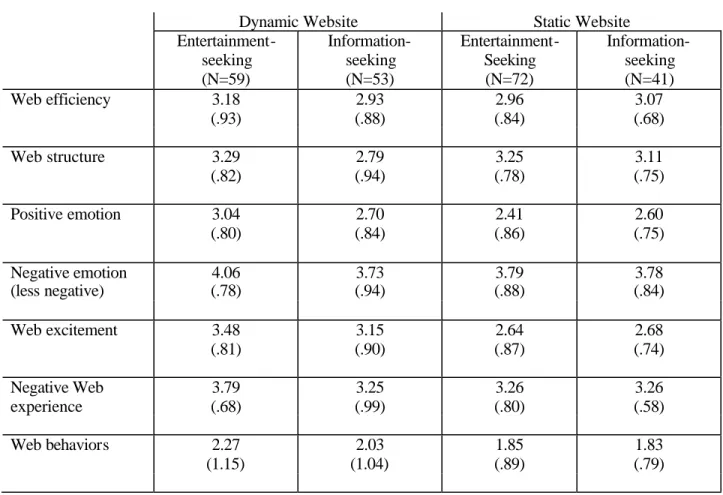
In the first part of the analysis, we examined the impact of Website design and surfing motives on Web efficiency, Web structure, positive emotion and negative emotion after surfing the Web, Web excitement, negative Web experience, and Web actions and change of brand attitude. The mean scores of each dependent variable in each experimental condition are included in Table 1.
(Insert Table 1 about here)
First, when looking at Web efficiency, ANCOVA yielded an insignificant interaction effect of Web design and surfing motive (F (1, 220) =2.56, p>.05). In addition, the main effects of Web design (F(1, 220) =.123, p>.05) and of surfing motive (F(1, 220) =.26, p>.05) were not
experimental conditions were performed. Participants in dynamic and entertainment-seeking condition reported a significant higher evaluation of Web efficiency than those in the other three conditions (mean difference ranging from .32 to .83, p<.05). However, participants in static and information-seeking condition reported a significantly lower evaluation of web efficiency than those in dynamic and information-seeking condition (p<.01). Therefore, H1 is partly supported.
In addition, covariate brand attitude has a marginal effect on Web efficiency (F(1, 220) =3.77, eta squared=.02, p=.053). In a regression analysis with Web efficiency as the dependent variable and brand attitude as independent variable, brand attitude turned out to be a significant predictor of web efficiency (B=.168, p<.05). In other words, those who had a more favorable attitude toward the brand were more likely to think that the website they were surfing was an efficient source of information (B=.168, p<.05).
In regard to Web structure, the interaction effect of Web design and surfing motive is not significant (F(1, 220) =1.84, p>.05). In addition, the main effect of Website design is insignificant (F(1, 220) =2.80, p>.05). However, the main effect of the surfing motive is significant (F(1, 220) =8.64, p<.01). The findings of post-hoc tests suggested that participants in dynamic and entertainment seeking condition evaluated the Web structure more positively than those in dynamic and information-seeking condition (mean difference=.47, p<.01); yet participants in static and information-seeking condition reported similar attitudes toward Web structure
compared to participants in other conditions (mean differences ranging from -.15 to .32, p>.05). Again, H1 was only partly supported. Furthermore, brand attitude has no significant impact on the evaluation of the Web structure (F(1, 220) =1.05, p>.05).
As to positive emotions derived from surfing experience, a significant interaction effect of Web design and surfing motive was found (F(1, 220) =4.67, p<.05, eta squared=.02). In
addition, Website navigation design has a significant impact on positive emotion (F(1, 220) =11.51, p<.01, eta squared=.05). The main effect of the surfing motive is not significant (F(1, 220) =.39, p>.10). Results from post hoc contrast tests demonstrated that participants in dynamic and entertainment-seeking condition experienced more positive emotions after sur fing the website than those either in dynamic and information-seeking condition (mean difference=.34, p<.05) or in static and entertainment-seeking condition (mean difference=.64, p<.01). This finding
confirmed H1. However, post-hoc contrast results also indicated that participants in static and information seeking condition did not differ from participants in either dynamic and information-seeking or static and entertainment-information-seeking conditions, which failed to support H1. Moreover, participants in dynamic and entertainment-seeking condition reported a significantly more positive emotions after surfing the website than those in static and information-seeking condition (mean difference=.45, p<.01). In addition, the covariate brand attitude has a significant impact on positive emotion (F(1, 220) =5.61, p<.05).
In regard to negative emotion, neither the interaction nor the main effects of website design and surfing motive were significant (F ranges from .87 to 2.09, p>.10). Post-hoc contrast analysis suggested that participants in dynamic and entertainment condition reported less
negative emotions than those in dynamic and information-seeking condition. It seemed that a mismatch between web user surfing motive and web site design could yield more negative emotional experiences. However, this mismatch effect was evident only in dynamic website condition. The impact of covariate brand attitude on negative emotions is also insignificant.
ANCOVA analysis yielded a significant main impact of website design on Web
excitement (F(1, 220) =33.44, p<01, eta squared=.13), indicating that respondents in the dynamic site conditions reported a higher level of excitement with the Web. However, such main effect
was not conditioned by whether respondents were in the information seeking or in the
experiential motive condition, as indicated by the insignificant interaction effect (F(1, 220) =1.84, p>.05). The surfing motive has no impact on Web excitement (F(1, 220) =1.36, p>.10).
Specifically, participants in dynamic and entertainment-seeking condition reported a
significantly higher level of excitement than those either in static and entertainment seeking or in dynamic and information-seeking condition (mean difference=.83 and .32 respectively, p<.05). However, this congruency effect engendered by the match between dynamic web design and entertainment-seeking surfing motive was not replicated in static and information seeking condition. This was indicated by the post-hoc finding that participants in static and informa tion-seeking condition reported a lower level of excitement than participants in dynamic and
information-seeking condition, contrary to what H1 expected. Again, covariate brand attitude has a significant main effect on the excitement experienced during browsing the website (F(1, 220) =5.96, p<.05).
Again, H1 was partly supported in the context of negative web experience. Specifically, according to post- hoc tests, participants in dynamic and entertainment-seeking condition
(matching condition) reported a less negative Web experience than those either in dynamic and information-seeking or static and entertainment-seeking conditions (mismatching conditions) (mean difference=.55 and .53 respectively, p<.01). However, participants in static and information-seeking condition did not demonstrate such superiority in terms of their Web experience compared to these two mismatching conditions. The differential patterns mentioned above were confirmed by the significant interaction effect of the surfing motive and Website design (F(1, 220) =6.82, eta squared=.03, p<.05). The covariate brand attitude has a significant main effect on negative web experience (F(1, 220) =5.13, p<.05). It implies that those who held a
favorable attitude toward the brand would report a less negative experience with the website of the brand.
In terms of Web behaviors, the respondents in the dynamic site conditions were more likely to buy products on the site, revisit the site and recommend the site to a friend, compared to those in the static site conditions, as indicated by the significant main effect of site design (F(1, 220) =5.61, p<.05). However, the Web behaviors were not influenced by surfing motive (F(1, 220) =.80, p>.10), nor by the interaction of the surfing motive and Website design (F(1, 220) =.33, p>.10). Results of post hoc tests suggested that participants in dynamic and entertainment-seeking condition were more likely to buy the product, recommend and revisit the site than those either in static and information seeking or in static and entertainment-seeking conditions.
However, participants in the information-seeking and static site condition did not demonstrate any difference in terms of behavioral intention from those in static and entertainment seeking or in dynamic and information seeking conditions. The covariate brand attitude was found to have a significant main effect on behavioral intentions, suggesting that a more positive attitude toward the brand would lead to a greater likelihood of acting (F(1, 220) =5.15, B=.23, p<.05).
Correlations among the dependent variables
Lastly, in order to explore how various dependent variables relate to each other, correlation analysis was performed and the results are included in Table 2.
(Insert Table 2 about here)
Conceptually, the dependent variables fell into four groups—cognitive evaluations of the website (i.e., web structure and web efficiency), affective evaluations of the website (i.e., web excitement, negative experience with the website), affective evaluations of the surfing
experience (i.e., positive emotions and negative emotions generated by surfing experience) and behavioral intentions related to the website and the product (i.e., web behaviors).
A quick look at Table 2 could tell us that these cognitive, affective and behavioral
outcome variables are correlated with each other. Noticeably, both cognitive factors such as web efficiency and emotional factors such as positive emotions generated by surfing experience and web excitement have moderately strong correlation with web-related behaviors.
Conclusions and Implications
The major task of the study is to examine whether a match between Web features (such as navigation design) and surfing motives (information seeking and entertainment seeking) would result in an optimal web experience. We hypothesized that the pairing of an information-seeking motive and a static website design, or of an entertainment-information-seeking motive and a dynamic navigation design, should create optimal experiences—more positive emotions after surfing the Website, a more positive experience with the website and a higher evaluation of the structure and efficiency of the Web and higher likelihood of acting on the Web (buying a product,
recommending the site to friends and revisiting the site).
Altho ugh we spotted a matching effect of surfing motive and Web design on web excitement and on positive emotions generated by surfing experience, the congruency effect is not symmetric. Dynamic Web design and entertainment-seeking motive are more capable of resulting in optimal experiences than static Web design and information-seeking motive. The lack of symmetry of effects could be due to the strong main effect of website design.
Participants in the dynamic website conditions were more likely to experience positive outcomes, regardless of their surfing motive. That is probably why the matching effect of
that the dynamic Website design is far more appealing to our participants than the static one. Though we tried our best to make the two websites compatible in all dimensions, with the
exception of animation and hidden hyperlinks, the impact of the dynamic site was much stronger. Moreover, cognitive evaluations of the website such as web efficiency and web structure could hardly be enhanced by a match between static web design and information-seeking motive. For example, our findings suggested that perceptions of web efficiency were not enhanced by either the match of static design and information-seeking motive or the match of dynamic and entertainment-seeking motive. This may suggest that perception of web efficiency is determined by factors other than web design and surfing motive. At the same time, different from what was expected, the match between dynamic web design and entertainment-seeking motive, not the match between static design and information-seeking motive, resulted in a stronger perception that the web site was structured enough to facilitate information search. This finding could be explained by the reasoning that the global and positive emotions, engendered by the match between dynamic web design and entertainment-seeking motive, might influence the perceptions of web structure. However, future research is needed to test the speculations derived from our findings.
The study also found that positive emotion generated by the surfing experience, web excitement and web efficiency were strongly correlated with Web purchasing behaviors as well as site stickiness (revising the site). Web-related behaviors may have both cognitive and affective basis. Consumers make online purchases or revisit an ecommerce web site not only because they surfing experience generates positive emotions and the website has exciting and interesting characteristics (e.g., dynamic and animated), but also because the website has features which could efficiently facilitate information search. This has important implications for web
developers or ecommerce marketers. As noted earlier, a compelling customer experience, in this context, surfing experience with the ecommerce site, could generate desirable marketing
outcomes such as online purchase and site stickiness. Moreover, a website designed with interesting and exciting features might facilitate consumers’ experiential interactions with the website, evoke excitement, therefore, prompt online purchase and site revisits. However, these implications should be taken with caution because of the small effect size observed in this study.
Compared to a true Internet experiment (e.g., Reips, 2001; Reips & Bosnijak, 2001), our study has several limitations. First, the measure of web behavior was subjectively reported rather than unobtrusively observed. One of the greatest adva ntage of Internet experiment is to obtain data via log files (Reips, 2001), which can unobtrusively record participants’ movement on the web. In future study, we could create an ecommerce site with a more realistic touch. For example, participants could add products to their shopping cart. Then, CGI program could record whether participants click on “add to shopping cart” button. This data is more
unobtrusive, therefore, more predictive of actual behavior than self-reported measures as the ones used in this study.
Second, log file data could also provide a better manipulation check measures than the ones adopted in this study. As the reviewers of the paper suggested, participants in the two surfing style conditions should show distinct patterns in their movements through the Web sites, which could be measured by log file data. Furthermore, log file data may also be capable of distinguishing different patterns of retrieving information from the Web when the Web design differs (e.g., dynamic versus static). Therefore, future research, equipped with the capacity to record consumers’ online behaviors unobtrusively, is needed to test the generalizability of the findings reported in this study.
Compared to traditional shopping channels (e.g., a physical store), the Web is diagnosed as incapable of evoking the affective aspect of the shopping experience, and is therefore
perceived as inferior (e.g., Wan and Nan, 2001). In this study, however, our findings suggested that certain features of a website design could evoke positive emotions of surfing experience or web excitement, which may facilitate purchase actions. However, how does this affective component of the surfing experience influence consumers’ information-processing strategies? What are the underlying mechanism of the impact of web design features on emotions and web experience? Future research is needed to address these questions.
References
Bezjian-Avery, A., Calder, B. and Iacobussi, D. (1998). New media interactive advertising vs. traditiona l advertising. Journal of Advertising Research, 38(4), 23-32.
Collins, J. (1989). Creativity and the personal computer. The Wall Street Journal National Business Employment Weekly, 10-11.
Csikszentmihalyi, M. (1997). Finding flow. Psychology Today, 30 (4), 46-50.
Graeff, T. R. (1996). Image congruence effects on product evaluations: The role of self-monitoring and public/private consumption. Psychology and Marketing, 13(5), 481-499. Gupta, M. and Gramopadhye, A (1995). An evaluation of different navigational tools in using
hypertext. Computers & Industrial Engineering, 29, 437-442.
Ha, L. and James E. L. (1998). Interactivity reexamined: A baseline analysis of early business Web sites. Journal of Broadcasting & Electronic Media, 42(4), 457-474.
Haubl, G. and Trifts, V. (2000). Consumer decision making in online shopping environment: The effects of interactive decision aids. Marketing Science,19 (Winter), 4-21.
Hoffman, D. L., Novak, T. P. and Chatterjee, P. (1995). Commercial scenarios for the Web: Opportunities and challenges. Journal of Computer Mediated Communication: Special Issue on Electronic Commerce, 1(3).
Hoffman, D. L. and Novak, T. P. (1996). Marketing in Hypermedia computer- mediated environments: Conceptual foundations. Journal of Marketing, 603, 50-69.
Hoffman, D. L. and Novak, T. P. (2000). How to acquire customers on the Web
Harvard Business Review, 78 (3),179-183.
Jackson, S.A. & Marsh, H. (1996). Development and validation of a scale to measure optimal experience: The Flow State Scale. Journal of Sport & Exercise Psychology, 18, 17-35.
Kamins, M. A. (1990). An investigation into the 'match-up' hypothesis in celebrity advertising: When beauty may be only skin deep. Journal of Advertising, 19 (1), 4-13.
Lieigh, J. H. (1992). Modality congruence, multiple resource theory and intermedia broadcast comparisons: An elaboration. Journal of Advertising, 21(2), 55-63.
McGarvey, R. (2001). Fast facts. Entrepreneur, 29(5), 22.
Morr, T. (1997). You can build it, but will they come back On The Highway. SEMA News, June Specialty Equipment Market Association.
Neviite, N and Kanji, M. (1999). Orientations towards authority and congruency theory.
International Journal of Comparative Sociology, 40(1), 160.
Novak, T. P., Hoffman, D. L. and Yung, Y. (2000). Measuring the customer experience in on-line environments: A structural modeling approach. Marketing Science, 19(1), 22-42. Osgood, C. K. and Tannenbaum, P. H. (1955). The principle of congruity in the prediction of
attitude change, The Psychological Review, 62, 42-55.
Reips, U.-D. (2001). The Web Experimental Psychology Lab: Five years of data collection on the Internet. Behavior Research Methods, Instruments, and Computers, 33, 201-211. Reips, U.-D., & Bosnjak, M. (Eds.) (2001). Dimensions of Internet Science. Lengerich: Pabst. Rodgers, S. and Thorson, E. (2000). The interactive advertising model: How users perceive and
process on- line ads. Journal of Interactive advertising, 1(1), Journal available at: http://www.jiad.org
Schlosser, A. and Kanfer, A. (2000). Impact of product interactivity on searchers’ and browsers’ judgements: Implications for commercial Web site effectiveness. Working paper, University of Washington.
Schlosser, A. and Kanfer, A. (1999). Current advertising on the Internet: The benefits and usage of mixed- media advertising strategies. In D. Schumann and E. Thorson (Eds.), Advertising and The World Wide Web (pp. 41-60). Mahwah, NJ: Lawrence Erlbaum Associates. Schwartz, E. I (1996). Advertising Webonimics 101. Wired, 4.02 Electrosphere section,
February.
Solomon, M. R., Ashmore, R. D., and Longo, L. C. (1992). The beauty match- up hypothesis: Congruence between types of beauty and product images in advertising. Journal of Advertising, 21, 23-34.
Stafford, M. R. (1998). Advertising sex-typed services: The effects of sex, service type, and employee type on consumer attitude. Journal of Advertising, 27(2), 65-82.
Steuer, J. (1992). Defining virtua l reality: Dimensions determining telepresence. Journal of Communication, 42(2), 73-93.
Tchong, M. (1998). ICONOCAST. Imagine Media, Inc. Available at: http://www.iconocast.com/.
channel for a perceived gratification niche: Two exploratory studies of young consumers. In Heckler, Susan, E and Stewart Shapiro (Eds). Proceedings of Society for Consumer
Psychology Winter Conference 2001, p3-16.
Whitaker, L. A. (1998). Human navigation. In Forsythe, C., Grose, E. and Ratner, J. (Eds.)
Human Factors and Web Development. Lawrence Erlbaum Associations.
Wickens, C. D. (1992). Engineering psychology and human performance(2nd Ed.) New York: Harper Collins.
Table 1. Means of experiences with the Website, emotional reactions, attitude change and Web behaviors by navigation design and search motive
Dynamic Website Static Website Entertainment-seeking (N=59) Information-seeking (N=53) Entertainment-Seeking (N=72) Information-seeking (N=41) Web efficiency 3.18 (.93) 2.93 (.88) 2.96 (.84) 3.07 (.68) Web structure 3.29 (.82) 2.79 (.94) 3.25 (.78) 3.11 (.75) Positive emotion 3.04 (.80) 2.70 (.84) 2.41 (.86) 2.60 (.75) Negative emotion (less negative) 4.06 (.78) 3.73 (.94) 3.79 (.88) 3.78 (.84) Web excitement 3.48 (.81) 3.15 (.90) 2.64 (.87) 2.68 (.74) Negative Web experience 3.79 (.68) 3.25 (.99) 3.26 (.80) 3.26 (.58) Web behaviors 2.27 (1.15) 2.03 (1.04) 1.85 (.89) 1.83 (.79) Note:
1. All dependent variables are indices created by taking the average of multiple items. The maximum value of all dependent variables is 5.
Table 2. Correlation matrix of the dependent variables Web efficiency Web structure Positive emotion Negative emotion Web excitement Negative Web experience Web efficiency Web structure .513** Positive emotion .501** 302** Negative emotion (less negative) .310** .538** .174** Web excitement .536** .362** .790** .285** Negative Web experience (less) .417** .556** .484** .597** .539** Web behaviors .542** .385** .619** .193** .579** .447** Note: Pearson correlation coefficients were reported in the cells. ** indicates that the coefficients are significant at p<.01 (two-tailed).