Scholars Commons @ Laurier
Scholars Commons @ Laurier
Theses and Dissertations (Comprehensive)2019
Explainable Neural Attention Recommender Systems
Explainable Neural Attention Recommender Systems
Omer TalFollow this and additional works at: https://scholars.wlu.ca/etd
Part of the Artificial Intelligence and Robotics Commons
Recommended Citation Recommended Citation
Tal, Omer, "Explainable Neural Attention Recommender Systems" (2019). Theses and Dissertations (Comprehensive). 2146.
https://scholars.wlu.ca/etd/2146
This Thesis is brought to you for free and open access by Scholars Commons @ Laurier. It has been accepted for inclusion in Theses and Dissertations (Comprehensive) by an authorized administrator of Scholars Commons @ Laurier. For more information, please contact [email protected].
Systems
By:
Omer Tal
Master of Applied Computing, Wilfrid Laurier University, 2018
THESIS
Submitted to the Department of Physics and Computer Science Faculty of Science
in partial fulfillment of the requirements for the Master of Applied Computing
Wilfrid Laurier University
Recommender systems, predictive models that provide lists of personalized sugges-tions, have become increasingly popular in many web-based businesses. By presenting potential items that may interest a user, these systems are able to better monetize and improve users’ satisfaction. In recent years, the most successful approaches rely on capturing what best define users and items in the form of latent vectors, a nu-meric representation that assumes all instances can be described by their respective affiliation towards a set of hidden features.
However, recommendation methods based on latent features still face some real-world limitations. The data sparsity problem originates from the unprecedented va-riety of available items, making generated suggestions irrelevant to many users. Fur-thermore, many systems have been recently expected to accompany their suggestions with corresponding reasoning. Users who receive unjustified recommendations they do not agree with are susceptible to stop using the system or ignore its suggestions.
In this work we investigate the current trends in the field of recommender systems and focus on two rising areas, deep recommendation and explainable recommender systems. First we present Textual and Contextual Embedding-based Neural Recom-mender (TCENR), a model that mitigates the data sparsity problem in the area of point-of-interest (POI) recommendation. This method employs different types of deep neural networks to learn varied perspectives of the same user-location interac-tion, using textual reviews, geographical data and social networks.
We then suggest two novel, explainable, frameworks. Dual Attention Recom-mender with Items and Attributes (DARIA) is based on the emerging neural atten-tion technique, where latent representaatten-tions are effected by the importance of items’ features and users’ past preferences. Self-Attention Recommender based on Attributes and History(SARAH) further adopts self-attention, an extension to the standard neu-ral attention paradigm. By utilizing this latest concept, SARAH is able to represent users and items by their most relevant input features.
A series of experiments demonstrate that both DARIA and SARAH consistently outperform state-of-the-art baselines in diverse recommendation scenarios, while be-ing able to justify their suggestions. Furthermore, we analyze the effects of different hyper-parameters and design selections, shedding light on the impact attention net-works have in the area of recommender systems.
I would like to express my very great appreciation to Dr. Yang Liu for her support and guidance throughout the research work as my advisor. Her broad knowledge, vast experience and valuable feedback allowed me to pursue the topics I am most interested in, and to greatly expand my professional horizons. I would further wish to thank our collaborators, Dr. Jimmy Huang and Dr. Xiaohui Yu from York University for their helpful comments.
In addition, I like to express my gratitude to Dr. Ch´ınh T. Ho`ang and Dr. Hongbing Fan for their work in creating the Master of Applied Computing program that provided me a great learning opportunity. Finally, my family and friends deserve a special thanks for their encouragement and moral support throughout this period. Various chapters in this thesis include material that has been submitted for pub-lications as it may appear in 2018 ICDM Workshops, 2019 Complexity journal special edition and SIGIR 2019. The thesis author was the primary author of these papers.
List of Tables VII
List of Figures VIII
1 Introduction 1
1.1 Problem Definition . . . 1
1.2 Major Challenges . . . 2
1.3 Our Method and Contribution . . . 3
2 Literature Review and Background 5 2.1 Collaborative Filtering . . . 6
2.2 Deep Recommender Systems . . . 8
2.2.1 Multi Layer Perceptrons . . . 9
2.2.2 Auto Encoders . . . 10
2.2.3 Recurrent Neural Networks . . . 11
2.2.4 Convolutional Neural Networks . . . 13
2.3 Point-Of-Interest Recommendation . . . 15
2.3.1 Challenges in POI Recommendation . . . 15
2.3.2 Solutions and Limitations . . . 16
2.4 Neural Attention . . . 18
3 Deep POI Recommendation 24
3.1 Recommendations In LBSNs . . . 24
3.2 Textual And Contextual Neural Recommender . . . 26
3.2.1 Context-based network layers . . . 27
3.2.2 Textual modeling network layers . . . 29
3.3 Training the Network . . . 32
3.4 Textual Modeling Using Word Sequences . . . 34
3.5 Model Evaluation . . . 36
3.5.1 Experimental Setup . . . 36
3.5.2 Baselines . . . 37
3.5.3 Performance Evaluation . . . 39
3.5.4 Model Design Analysis . . . 41
4 Explainable Neural Attention Frameworks 45 4.1 Motivation . . . 46
4.2 Self-Attention With Attributes And History . . . 48
4.2.1 Item Self-Attention . . . 51
4.2.2 User Self-Attention . . . 53
4.2.3 Rating Prediction . . . 54
4.3 Dual Attention Recommender . . . 55
4.3.1 Past Items Importance . . . 58
4.3.2 Item Features Attention . . . 59
4.3.3 Comparison to SARAH . . . 61 4.4 EXPERIMENTAL SETTINGS . . . 62 4.4.1 Datasets . . . 62 4.4.2 Evaluation Metrics . . . 63 4.4.3 Baselines . . . 64 4.4.4 Parameters Settings . . . 66
4.5 EXPERIMENTS AND EVALUATION . . . 66
4.5.1 Overall Performance (RQ1) . . . 67
4.5.2 Hyperparameter Analysis (RQ2) . . . 69
4.5.3 Case Studies (RQ3) . . . 75
4.5.4 Comparison To TCENR (RQ4) . . . 78
5 Conclusion and Future Work 80
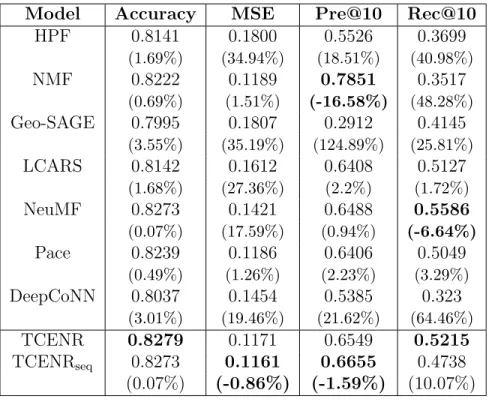
3.5.1 Performance Comparison for TCENR . . . 39
3.5.2 TCENR Accuracy with Different Layer Designs . . . 43
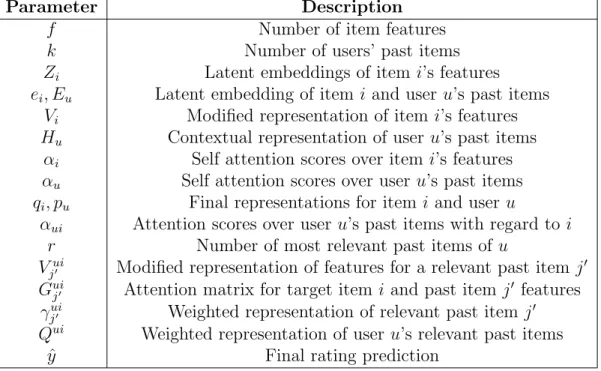
4.1.1 Parameter notations used in Chapter 4 . . . 48
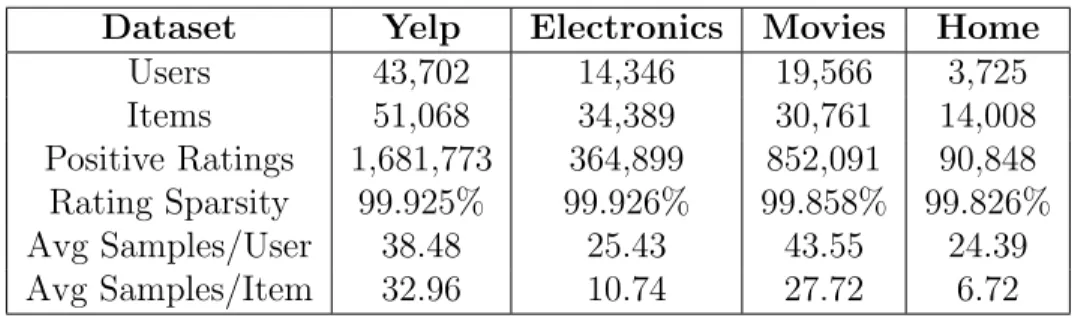
4.4.1 Datasets’ Statistics for Attention Experiments . . . 63
4.5.1 Performance Comparison for Attention Models . . . 67
3.2.1 TCENR Framework Architracture . . . 27
3.4.1 Textual Modeling Alternatives In TCENR . . . 35
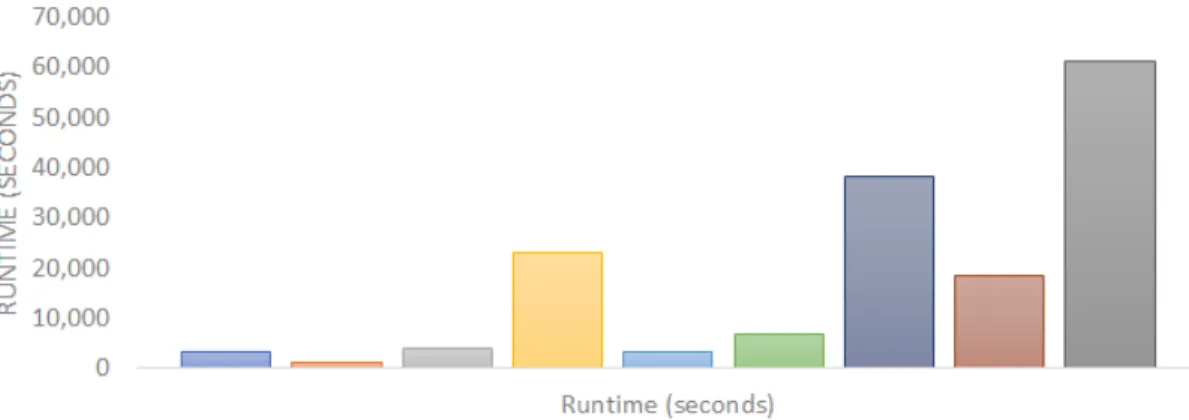
3.5.1 Runtime Analysis for TCENR . . . 41
3.5.2 TCENR Merging Layer Comparison . . . 43
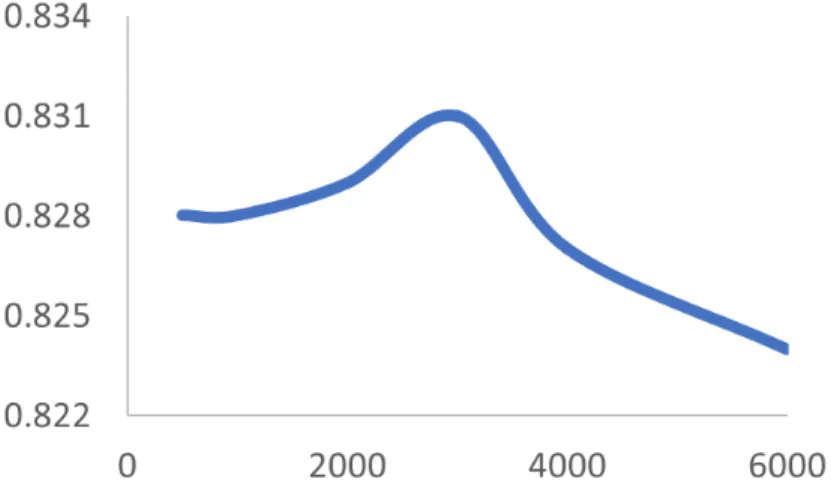
3.5.3 Number Of Words Impact In TCENR . . . 44
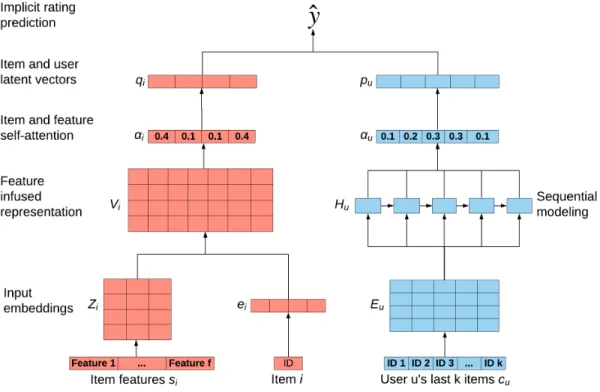
4.2.1 SARAH Framework . . . 49
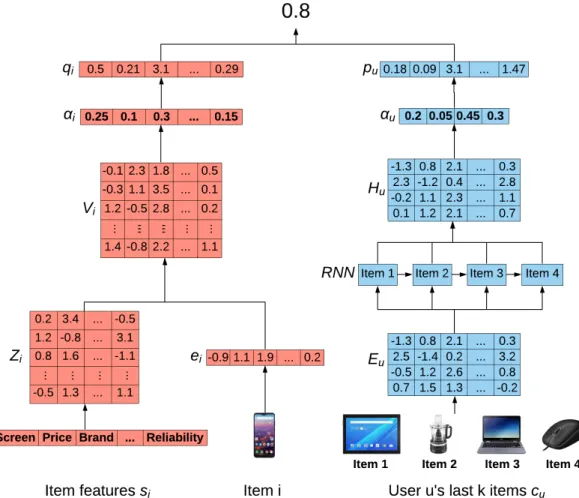
4.2.2 SARAH Sample Scenario . . . 50
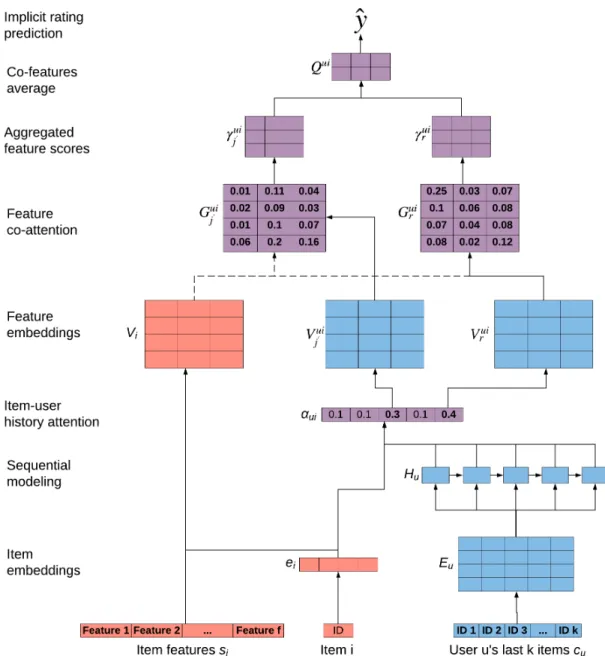
4.3.1 DARIA Framework . . . 57
4.5.1 Runtime Analysis for SARAH . . . 69
4.5.2 Number Of Features Analysis in SARAH . . . 71
4.5.3 Number Of Past Items Comparison in SARAH . . . 73
4.5.4 Item Embedding Size Evaluation in SARAH . . . 74
4.5.5 RNN Layer Units in SARAH . . . 75
4.5.6 Item Attention Scores Case Study . . . 76
4.5.7 User Attention Scores for a Positive Sample . . . 77
Introduction
1.1
Problem Definition
In today’s age of information, it has become a prerequisite to have reliable data prior to making any decision. Preferably, we expect to obtain opinions from like-minded users before investing our time and money in any product or service. However, with increasing variety of available items it is extremely tiresome for customers to rely on methods such as browsing or searching in order to find these opinions. Such is the case for e-commerce websites as eBay with 1.1 Billion listings1 or location-based
social networks as Yelp with 171 million reviews2.
Personalized recommender systems (RS) are therefore a vital component in many on-line businesses, websites, social networks and media services. They consist of proposing a tailored list of relevant items, such as movies, songs, products, locations and more, to an end user, allowing her to make the best selection out of an almost endless list of possibilities. More specifically, a recommender system is a method of supervised learning, that usually takes tuples of users and items as input and predicts the probability a user will be interested in the given item. It is trained and tested
1https://www.ebayinc.com/our-company/who-we-are/ 2https://www.yelp.ca/factsheet
by having ratings given by the users (e.g. 5 stars scale, 1-10 numeric grade, binary score, etc) alongside the reviewed item and user data.
1.2
Major Challenges
A prominent technique partly responsible for the rising success of recommender sys-tem is collaborative filtering (CF). An item-based CF model attempts to identify similar items to those previously liked by the user. User-based methods, on the other hand, assume that users who shared resembling interests in the past are likely to do so in the future. The availability of many distinct items, however, results in few users who share the exact same past experiences. It is more likely that similar users interact with resembling items (e.g. watched an action movie created by the same director). Latent-based collaborative filtering, therefore, is a recommendation paradigm that attempts to represent users and items in a way that captures their preferences and attributes, respectively, in a way that is both accurate and allows generalization.
Latent CF-based methods, however, have some drawbacks making their imple-mentation challenging in many scenarios. First is data sparsity, usually referred to as the cold-start problem, due to the missing data for new users and items. This issue however is not limited to new components in the system. As the range of available items and the size of systems’ user base increases, less similar they become. The more varied past activities are, the fewer users and items have sufficient data to result in meaningful representations. In addition, methods based on latent-features are com-monly perceived as a ”black-box” that is only responsible for outputting recommen-dations. In case an end user does not agree with the given suggestion, she is unable to learn the reasoning behind it and her motivation to use the system decreases.
The rise of deep learning has had a broad impact over recommender systems in general, and specifically over latent-based CF methods. The ability to
repre-sent users and items using vectors allows deep neural networks to be employed by stacking multiple layers, in order to learn the user-item interactions [20, 65] or to learn the representations themselves [15, 60]. Along with the explosion of available data, these methods achieved a great success in previous years. Different deep neural network architectures have been introduced to improve the recommendation perfor-mance, such as multi-layer perceptrons (MLP) [12, 32],convolutional neural networks (CNN) [25, 71] and recurrent neural networks (RNN) [1, 3]. However, by applying multiple nonlinearities over its inputs, recommendation techniques based on deep learning are usually considered extremely prone to the explain-ability problem.
1.3
Our Method and Contribution
In this work we start from reviewing recent developments in deep recommender sys-tems, and then introduce multiple frameworks that attempt to mitigate the aforemen-tioned challenges. To tackle the data sparsity and cold-start problems we will first focus on the area of points-of-interest (POI) recommendation. In this field, locations are suggested to users oflocation-based social networks (LBSN), such as Yelp and Tri-pAdvisor. We presentTextual and Contextual Embedding-based Neural Recommender (TCENR), a framework that takes users’ social network, locations’ geographical data and textual reviews along with historical activities, to produce personalized POI rec-ommendations. While most works focus on only a single type of deep neural network, TCENR combines multiple techniques, i.e., MLP, CNN and RNN, to provide sugges-tions using various types of inputs. By successfully integrating relevant paradigms, TCENR is shown to outperform multiple key baselines over the Yelp dataset for restaurant recommendations in terms of accuracy, MSE, precision and recall.
We further adopt the novel technique of neural attention networks, where dedi-cated layers are responsible for identifying the most important components of their
inputs [2, 43], and propose two frameworks meant to produce relevant explanations along with accurate suggestions: i) Dual Attention Recommender with Items and Attributes (DARIA) utilizes two neural attention mechanisms, where each user is represented by her most relevant past items with regard to the recommended item, while a second attention layer determines which attributes best contributed to the reported items’ similarity. ii) Self-Attention Recommender based on Attributes and History (SARAH) attempts to solve the same task as DARIA by employing the self--attention paradigm, a recent extension to neural attention. Based on identifying the most important components depicting an input, self-attention is applied to construct items’ and users’ latent vectors. The use of self-attention allows SARAH to determine which historical activities are most relevant to represent each user, independently of the candidate item, along with identifying the input features that best capture a suggested item.
Our proposed methods are evaluated in various settings by utilizing four datasets and demonstrate significant improvement over six varied baselines, including methods of classic CF [36, 58], deep learning [20, 25] and neural attention [11, 16], using the popular metrics hit ratio and normalized discounted cumulative gain.
This thesis is organized as follows. In Chapter 2 we review notable works in deep recommender systems history, and describe recent developments related to the sug-gested methods. Chapter 3 extends the discussion on POI recommendation and presents TCENR along with its sequential variation. In Chapter 4 we focus on explainable recommender systems and introduce our two novel attention-based ap-proaches, SARAH and DARIA. We further perform extensive empirical evaluation on our proposed methods and provide case studies to demonstrate their explain-ability. Chapter 5 concludes this work along with directions to future research. In the fol-lowing chapters, we denote matrices in upper-case letters, while vectors and scalars are presented as lower-case.
Literature Review and Background
In this chapter we discuss relevant background and present notable advancements in the area of recommender systems.
Recommender system is a sub-field of machine learning, where a model is devel-oped to provide item suggestions for a given user. As a method of supervised learning, recommender systems are given past user-item interactions to learn from, and based on the type of target feature can be classified as having either explicit [25, 67, 71] or implicit feedback [3, 64, 69]. Algorithms that take input ratings based on a numeric scale, such as 1-5 stars or 1-10 score, are considered explicit, since this preference was directly given by the user as part of a rating or review. A distinction between liked and disliked samples can be then determined according to a predefined range (e.g. items with an estimated scores of 4-5 stars should be recommended).
On the other hand, methods based on implicit data adopt input features collected as part of a user’s usage, such as clicking on an item or making a purchase. While implicit-based methods usually have more available data, they are only aware of items the user interacted with and lack indication towards the disliked or negative instances. Recommender systems can be further classified by their type of output. Models that estimate a score for a given user-item tuple are defined aspoint-wise ranking[12,20,62]
while methods that attempt to rank relevant items over irrelevant ones are denoted aspair-wise ranking [35, 53, 70]. Nonetheless, the goal for most recommender systems is to generate a list of personalized recommendations with as many relevant items.
An important factor in classifying different recommender systems is the type of architecture, where the two most popular categories arecontent-based and collabora-tive filtering (CF) [47–49],. While a content-based system relies on the similarity of items using their attributes, in this work we will focus on its more popular alternative.
2.1
Collaborative Filtering
CF-based recommender systems have become extremely common [22,56], due to their ability to outperform competitive methods while being efficient and easy to imple-ment. They are based on the assumption that users who shared similar preferences in the past will continue to do so in the future. Collaborative filtering approaches can be further divided to neighborhood-based and model-based methods [28]. Neighborhood-based recommender systems explicitly compute the similarities between different users. In prediction time, they produce an estimation based only on the likings of users that most resemble the target user. In contrast, the model-based approach constructs latent representations of users and items using a machine learning algo-rithm. These latent descriptions are used to provide a concise representation for users’ preferences and items’ attributes.
A well-known implementation of the model-based approach is theMatrix Factor-ization (MF). This method gained much popularity due to its simplicity and success in the famous Netflix challenge [29]. Using MF, the predicted rating for a given user
u and item i can be defined as:
ˆ
where· is the dot-product operation, µis the mean rating, qi and pu are itemi’s and
user u’s latent vectors, respectively, while bi and bu are their bias factors. These five
parameters are learned using the following point-wise loss function:
min
b∗,q∗,p∗ X
u,i∈Y
(ru,i−rˆu,i)2 , (2.1.2)
where Y is the test set, ru,i is the ground truth and the model is penalized for
differences between it and the predicted score ˆru,i. Alternatively, the same model
could be optimized by employing pair-wise ranking:
min b∗,q∗,p∗ X u X i∈Y X j∈Y−
logα(ˆru,i−ˆru,j)2 , (2.1.3)
where j ∈ Y− is a negative item and therefore should be ranked lower than the
positive item i∈Y. The advantage of pair-wise ranking is that we are only required to know what items are preferred by the user compared to others, rather than an explicit ground truth. However, unlike models based on point-wise ranking, following the pair-wise technique does not allow a recommender system to generate a score for a single given item. This can limit the ability to properly evaluate the model. Either way, the two alternatives can be optimized similarly using a method based on gradient descent.
While the inclusion of bias vectors allows methods such as MF to consider vari-ations between estimated latent representvari-ations and real life scenarios, probabilistic methods [1,13,58] further extend the assumption of uncertainty in the learned model. Probabilistic matrix factorization [42] assumes the user and item latent vectors can
be drawn from a normal distribution, as well as their estimated rating:
pu ∼ N(0, λ−u1IK) ,
qi ∼ N(0, λ−v1IK) , (2.1.4)
ˆ
ru,i =N(qiTpu, c−u,i1) ,
where I is the identity matrix and c is a confidence parameter set to distinguish between different rating classes according to the certainty we have towards them.
Although methods based solely on user-item interactions achieve relative success, some recommendation scenarios can be too complex for such an approach. In the case of a sparse dataset, an unbalanced distribution of items per user or simply lack of scores, ratings can be insufficient in capturing an accurate representations for users and items. Additional features such as time [38], spatial location [10], users’ demographic data [12] or items’ meta-data [32] provide additional insight towards the factors that contribute to a user’s interest or define an item. [58] extends the probabilistic MF method and samples an item latent vector where the mean is derived from its respective topics distribution. The topics in turn, are learned from textual inputs (e.g. reviews or description) using the popularlatent dirichlet allocation(LDA) model [6].
2.2
Deep Recommender Systems
Deep learning is a sub-field of machine learning where latent input representations are developed using multiple layers of non-linearities. Due to the vast availability of data and computational resources, methods based on deep learning paradigms have become increasingly popular in recent years. The use of latent vectors to represent users and items proved recommender systems to be a highly relevant field to adopt
deep learning techniques.
2.2.1
Multi Layer Perceptrons
Probably the most general approach to implement a deep recommender system is based on multi-layer perceptrons (MLP), where a neural network with multiple hidden layers is employed. In [12], a ”wide” component, a simple linear transformation on various input features, is combined with a ”deep” component that learns a concise representation of a given user-item interaction. The model is fed with tuples of N
users and M items, each in the form of a one-hot encoding. Such encoding is a transformation of the categorical value to a vector in the size of N or M, where 1 indicates the given user or item, respectively, while 0 denotes the rest. The deep component then transform each input to a latent vector using a lookup function denoted as its embedding, eu for the user and ei for the given item. A combined
vector with all the user and item latent factors is formed by concatenating the two embeddings. To estimate whetheruis interested ini, the model learns the interactions between different factors:
H0 = [eu, ei], H1 =a1(W1×H0+b1) , .. . Hl =al(Wl×Hl−1+bl), (2.2.1) .. . HL =WL×HL−1+bL , ˆ ru,i =σ(HL),
where [ ] is the symbol for concatenation, while W∗ and b∗ are the weight and bias
terms, respectively, optimized by the model as parameters. a∗is a nonlinear activation
function, which is commonly either the sigmoid, hyperbolic tangent (tanh) or the rectified linear unit (ReLU):
σ = 1 1 +e−x . (2.2.2) tanh= sinhx coshx . (2.2.3) ReLU =max(0, x). (2.2.4)
By setting WL in Eq. 2.2.1 to be a one-dimensional vector and adopting the
sigmoid function, the MLP last hidden layer transforms its concise input to a predicted score in the range of [0,1]. In a similar fashion, [20] utilizes MLP to learn a concise representation of the given user-item interaction. The authors further concatenate the resulting vector with the dot product of the two embedding, before feeding it into another neural network with one layer. By doing so, they are able to combine the strengths of the deep MLP and vanilla MF. A different adoption of multi-layer perceptrons is demonstrated in [15]. By applying multiple ReLU layers over the concatenated embeddings of various user attributes, a user latent vector is learned. A softmax function transforms the user representation to a distribution over the number of items to determine the most probable recommendations.
2.2.2
Auto Encoders
A common alternative to MLP for the task of learning user or item representations is the use of auto-encoder (AE). This technique attempts to reconstruct the input using hidden layers in a neural network, while the input and output layer are of the same structure. By penalizing the network for differences between its output and input, the more concise hidden layer is optimized to store an accurate representation
of its input. A denoising auto-encoder assumes the input is noisy or corrupt, and its goal is to learn a clean version of it using the AE framework. Due to the partial availability of data and the method’s robustness, denoising auto-encoder have found relative success in learning user or item embeddings in recommender systems. [59] extend the probabilistic method developed in [58], by stacking multiple hidden layers within the denoising AE. The model’s first half encodes the item textual attributes while the remaining layers are responsible do decode it and reconstruct the item. The middle layer is therefore the most concise item representation. While [59] adopts a probabilistic approach, [33] utilizes a similar architecture to learn both the user and item latent vectors simultaneously.
Some methods however apply auto-encoders to learn the full user-item interaction. [64] first modifies its inputs to introduce real-world noise to the system before feeding the corrupted items and user vector to an AE, responsible to reconstruct the original input. By combining both user and item data in the auto-encoder, the method is able to regard the output layer as the list of recommended items.
2.2.3
Recurrent Neural Networks
While MLP and AE based methods were proven to be successful in learning latent representations from past activities, they are not optimized to capture dependencies between different inputs. Moreover, treating user purchases independently might not be suitable in all scenarios and may lead to data loss. For example, a system able to recognize that users usually go to the cinema right after visiting a restaurant might provide more relevant suggestions following a user interest in a movie. Recurrent neural networks (RNN) however, are based on a specialized architecture capable of capturing such sequentiality by including an internal hidden state in each input and considering the impact of its predecessors.
each user and item by their latest activity sequence. Assuming inputs are fed to an LSTM model as {z0, z1, ..., zt−1, zt, zt+1, ..., zT}, a time statet will be updated by the
following operations: ft =σ[Wf[ht−1, zt] +bf], it =σ[Wi[ht−1, zt] +bi] , ot =σ[Wo[ht−1, zt] +bo] , (2.2.5) lt =tanh[Wl[ht−1, zt] +bl] , ˜ ct =ft·c˜t−1+it·lt , ht =ot·tanh(˜ct) ,
whereW∗ andb∗ are the weight and bias parameters,σ the Sigmoid activation andft
the forget gate that indicates to which degree should previous inputs be integrated into the current input, zt. it is the input gate that determines the current input’s impact
and ot the output gate which effects the current hidden state, ht, signal strength.
Finally, ˜ct represents the current candidate state, before applying the output gate.
Employing these multiple gates allow inputs in different states to have a respective weight in the representations of successive inputs. In [63] LSTM units are used to learn user and item representations, where the latent vectors are the final states, hT,
allowing important past interactions to be captured while potentially giving more weight to recent activities.
While LSTM is highly capable in capturing the most significant states of an input, it is extremely inefficient due to its reliance on a large number of learned parameters. A more common alternative is the gated reccurent units (GRU) [14]:
˜
ct=tanh(Wzzt+ft·Whht−1+b˜c) , (2.2.6)
where ft and ot are the same formulas as in Eq. 2.2.5. GRU ignores the input gate
and its parameters, and therefore allows faster convergence.
Following its original success in tasks of textual modeling [41], recurrent neural network are a popular solution to recommender systems aiming to utilize available textual data. Since words are sequential by nature, treating each word as an input state allows the RNN to capture semantics found in the original text, whether it is an item description or a user written review. In some cases, however, the meaning of a word can only be realized by other words following it rather than preceding it. [3] adopts the bi-directional GRU where one layer learns to represent each word in an item description by maintaining the context from previous words to its left, while a second GRU layer process the same text from right to left. Concatenating the two representations for each word allows the network to fully capture the semantic meaning found in the text. The model exploits the resulting word vectors to learn an item representation derived solely from text, before enriching it with additional attributes and user data.
2.2.4
Convolutional Neural Networks
Originating from tasks of image processing [30, 31], a convolutional neural networks (CNN) treats its input as pixels and attempts to identify the most relevant sliding windows over it. While images are not a common input feature in recommender systems, integrating the CNN framework is considered a common alternative to RNN in textual modeling tasks [26]. First, a convolution operation is applied on a sliding window of concatenated words to generate a feature map:
D1:n = [w1, w2, ..., wl, ...wn] ,
zlj =a(Wj ∗Dl:l+ws−1+bj), (2.2.7)
wherewlis the latent embedding of a word in position l, ∗the convolution operation,
ws the window size hyper-parameter, zjl a contextual feature, Wj the filter and bj
the bias.
Eq. 2.2.7 results in zj which represents a single feature vector, determined by
the filter Wj. To extract multiple features from the given text, more filters can be
added soZ = [z1, ..., zj, ..., zm]. Since CNN usually takes the full text as input, it can
identify many signals as part of each feature vector, where some can be redundant or even contradicting. Therefore it further requires a max-pooling operation, that enables it to keep only values with the highest scores:
of = [max(z1),max(z2), ..., max(zj), ..., max(zm)] . (2.2.8)
To fit the high level textual representation to the recommendation task, [25] feed
of, learned from an item description, to a two layer neural network, activated by
the tanhfunction. The resulting vector is employed as the item latent representation integrated into the probabilistic MF approach. In [71], two CNN layers are integrated to learn both the user and item representations jointly. All words written in useru’s reviews are concatenated and kept in their original order, as well as all words written about item i. The two word vectors are fed each to separate CNNs, following the operations in Eq. 2.2.7 and Eq. 2.2.8. After applying the hidden layers to each vector, the user and item representations are combined in a shared layer to generate a point-wise prediction.
Although [71] is able to produce relevant latent representations from text, it intro-duces a bias by feeding all words written by the user and about the item, including those that describe the trained object. In other words, the network is exposed to data that is only available in training, resulting inferior performance in test time. [7] proposes to separate the words describing each trained interaction and learn two
net-works simultaneously. A source network is based on [71] without the current review, while the target network utilizes standard CNN over the specific review. By penaliz-ing the difference between the learned representation in the source network and the vector produced by the target, the model learns to predict the review written by the user on the candidate item and therefore its respective rating.
In our proposed methods we intend to rely on multiple deep learning techniques to fit each recommendation scenario and data type with the according paradigm. We will utilize multi-layer perceptrons to model past user-item interactions, convolutional neural networks to represent textual reviews and recurrent neural networks to capture the sequentiality of both words and user activities.
2.3
Point-Of-Interest Recommendation
Locations-based social networks (LBSN), such as Yelp, TripAdvisor and Foursquare are environments that allow users to share experiences about the places they visit. Point-of-interest (POI) recommendation, a sub-field of RS, attempts to provide LBSN users with personalized suggestions. Properly exploited, it can save time and effort for the end user, and encourage her to make future use in the location-based social network both as a consumer and content provider.
2.3.1
Challenges in POI Recommendation
Similar to standard recommender system, POI recommendation takes tuples of users and items as input and estimates their rating. There are, however, some challenges that exist to a higher degree in this scenario, making it a dedicated research field. While data sparsity is a recurring issue in all RS, LBSN users are unable to physically visit most locations due to geographical distance, an issue that is even worsened for out-of-town users [61]. Second, in contrast to other recommendation scenarios, the
decision whether to visit a location depends not only on the target user’s preferences, but on the that of her friends [32]. They might share different interests that are unknown to the system, resulting in a more complex decision process for the RS to learn. Finally, most location-based social networks rely on implicit feedback, derived from geo-spatial coordinates and defined as check-in. It allows the POI recommender to learn a user has visited a location but not the extent to which she liked it. The lack of explicit data requires the RS to identify what locations should be regarded as the negative instances for each user.
2.3.2
Solutions and Limitations
The availability of contextual data within LBSNs provides an opportunity to utilize features such as social networks [37], geo-spatial locations [10] and time [38] to miti-gate the data sparsity issue and to gain insights towards users’ interests and locations’ attributes. These contextual features are usually incorporated into RS either as part of the input or as a regularizing factor. Following previous RS techniques, MLP-based networks are a popular choice in modeling contextual data by concatenating respec-tive embeddings before stacking the non-linear layers [15], while sequential data is often introduced by utilizing recurrent neural networks [5].
The use of spatial data is often done by dividing the input space into roles and regions. Assuming users’ behavior varies when traveling far from home, previous works [61, 66] generated two profiles for each user, one to be used in her home region while another in more distant locations. A recent approach [67] attempts to divide the input space into geographical regions before incorporated into the model, often by hierarchical structures. Although methods based on regions and roles are able to better distinguish user behaviors in varied locations, they do not provide a personal-ized user representation and can ignore potential shifts of preferences from one region to another. For example, a user might prefer to visit a Starbucks location in different
regions, close or far from home. Enriching geographical features with additional data is demonstrated in [68] where the next location prediction is partially determined by past sequences of check-ins. However, these methods are not generic and cannot be extended to include additional features, derived from social networks or textual data. Furthermore, in case of tasks in highly sparse environments, such as POI rec-ommendation, adding user or item specific inputs may diminish the model’s ability to generalize. However, applying the same data as a regulating factor can enhance the model’s performance and reduce over-fitting. Such has been done in [37], where the similarity between connected users in the social network was used to constrain a matrix factorization model. [65] utilized social networks and geographical distances to enforce similar embeddings for users and locations in an MLP, thus improving the model’s ability to generalize for users and locations with few historical records.
Since many websites encourage users to provide a written explanation to their numeric ratings, textual reviews are one of the most popular types of data to be inte-grated into RS. By expressing each review as a bag of words, LDA-based models are able to extract topics which can be used to represent users’ interests and locations’ characteristics [66]. These probabilistic methods are usually successful in handling issues that standard CF approaches struggle with, such as out-of-town recommenda-tions where similar users lack sufficient historical data. However, as demonstrated in recent works [52], failing to preserve the original order of words and ignoring their semantic meaning prevents the successful modeling of a given review. On the other hand, adopting deep methods such as RNN [1] and CNN [25] over reviews allows such learning without the loss of data.
In this work we claim that by jointly learning contextual and textual based deep models a POI recommender system can better exploit the strengths of collaborative filtering, while being more resilient to its shortcomings in sparse scenarios. This will be achieved by proposing TCENR, which learns users’ and locations’
represen-tations as similarities in direct interactions, along with the correlation in underlying features extracted from their written reviews. The notable work of [70] proposed JRL, a framework that similarly attempts to jointly optimize multiple models, where each is responsible for learning a unique perspective of the same task by focusing on different inputs. However, while JRL is a general framework, focused on extend-ability to many types of input, we propose a dedicated framework for the task of POI recommendation.
2.4
Neural Attention
Defined in the field of neural science [23], attention describes the ability to focus on what perceived as the important part of an input. By integrating attention in neural networks, this concept has seen rising success in computational tasks such as image processing [43], textual translation [2], summation [45] and additional language modeling tasks [50].
Recent works have been introducing attention-based neural networks to recom-mender systems. In [18], the authors computed attention weights to identify the most important words in an input micro-blog within a CNN. [54] reasoned that users are interested in various features of the same product, represented as different keywords in its reviews. The authors therefore employed attention to identify the most impor-tant reviews and words written on a candidate item, based on their relevance to the user. This was achieved by first representing each user and item as three-dimensional matrices, denoted as ai and bj, respectively, that hold the word embeddings for each
review. Important reviews were extracted by calculating an affinity matrix between
ai and bj and taking only the maximum row to represent the most important review
written by the user and column for the item. This process was done again over the selected reviews’ word embeddings to identify the most important words.
The use of attention networks is not limited to textual modeling, though. In [11], a memory matrix saves the lastk items each useru interacted with. The model then recognizes which of a user’s past interactions can best help to predict the preference towards a candidate item i:
wi,j =qiT ·m u
j , (2.4.1)
zi,j =sof tmax(wi,j) =
exp(βwi,j)
P
lexpβwi,l
,∀j = 1,2, ..., k , (2.4.2)
where qi is the candidate item embedding, muj the j’s item embedding in user u’s
memory matrix and β a strength parameter. zi,j is therefore an importance weight,
indicating the level of similarity between a candidate item i and each past item the user interacted with. These scores are normalized as an importance distribution and used to weight the k past items impact when constructing the user latent vector, pu:
pu = k
X
j=1
zi,j·muj , (2.4.3)
By applying the attention mechanism, the model generates a user latent representa-tion dedicated to suit the candidate item. The embeddings of past items that are closely related to item i will be further emphasized in the user representation.
In a similar fashion, [60] constructs a user embedding by focusing on the most relevant historic news items compared to a candidate article. The attention weights, however, are generated by feeding the concatenated item embeddings to an MLP:
wi,j =H([qi, qj]) , (2.4.4)
where q∗ is an item embedding and H a multi-layer perceptron that outputs a score
in the range of [0,1]. The resulting weights are normalized and used to generate the user embedding as done in Eq. 2.4.1 and 2.4.2. A different weighting function is
introduced in [16], where the authors integrate opinions from other users regarding the candidate item. Instead of combining past interactions to construct a user latent vector, attention scores are learned based on the similarity between user uand other users in her neighborhood, along with the opinion of these users:
wi,u,v =mTumv +eTi mv , (2.4.5)
wherem∗ is a user memory matrix withk past items,ei the candidate item’s
embed-ding and v is a user who had a previous interaction with i.
While the standard attention network is based on comparing tuples of inputs one at a time to determine importance, self-attention, the most recent development in attention-based learning, is composed of measuring the internal components of the input to identify the most valuable ones [34, 57]. Originally introduced in tasks of textual summation [45] and translation [2, 14], this technique was successfully im-plemented in encoder-decoder models, where one network is responsible to encode a textual input as a concise vector while the other to decode it as a different output. However, self-attention was found to be applicable in other frameworks as well. In [34], it was used to label important words in tasks involving textual embedding. By apply-ing self-attention over the collection of n word embeddings, denoted as V ∈ Rn×d1,
the following importance distribution of words can be learned:
a=sof tmax(w2tanh(W1VT)). (2.4.6)
The use of W1 ∈ Rd2×d1 and w2 ∈ Rd2 transforms the input matrix V to the vector
a of size n, where each cell represents the importance weight of the respective word. Due to its novelty, there are only few works using self-attention in recommender systems. [72] generates a user embedding vector by employing self-attention in an encoder framework over the sequence of items the user interacted with. However, the
model does not output an item recommendation, but only the user latent vector. [24] utilizes self-attention to identify the most important past items in the user’s history. The authors adopt a similar method to the one proposed in [57] by generating three transformations of the input embedding and performing a weighted average.
In this work, we propose two self-attention frameworks, SARAH and DARIA. While the former implements self-attention to learn the user and item latent rep-resentations, the latter captures their combined interaction by employing standard neural attention. Although each suggested method adopts a different technique, both introduce a novel approach. To the best of our knowledge, SARAH is first to rep-resent each user and item by feeding past interactions and attributes to separate self-attention layers. Unlike other works that utilize attention to construct latent representations, the use of self-attention allows SARAH to model users and items independently. DARIA on the other hand, will be composed of two stacked neural attention layers, where one identifies the most relevant user past items with regard to a candidate item and the other compares these items’ attributes.
2.5
Explainable Recommendations
Although matrix factorization based recommender systems are getting more accu-rate and are able to efficiently process more data, the heavy use of latent factors results them in being perceived as a black box, only able to predict a recommenda-tion. However, as found in previous work [21], the ability to justify a suggestion is vital and improves the trust users have in the system and the likelihood to retain them. Explainable recommender systems are therefore an important component of RS, dedicated to generating recommendations along with human-interpretable rea-soning. They are often classified as either post-hoc or embedded models. Post-hoc methods [55] are usually model-agnostic and based on generating explanations from
an already trained model using pre-defined candidates, extracted from external data, i.e. tags and text. Embedded models [39] learn explainable factor while simultane-ously providing recommendations. Although they are less flexible, embedded methods have a broader range of explainable factors to choose from, and they can not only optimize the given suggestions, but also the accompanying reasoning. We therefore intend to focus on embedded explainable models in this work.
Facing with the increasing popularity of deep learning, the challenge of explainable deep recommender systems is to utilize the strengths of neural networks in modeling users and items using multiple layers, while retaining enough data to explain the system’s output. An approach that was found to be successful in previous works [4, 44] is the use of knowledge graphs to define the system’s inputs and their relation. This is usually done by extracting known entities from the input and representing their relations in the form of graph edges. However, knowledge graphs cannot be successfully applied to all fields in an equal manner. For example, while it may be possible to extract entities from news items, it is considerably more challenging to do so for restaurants and venues.
The successful implementation of attention networks in recommender systems introduced a new opportunity for providing explanations, by enabling a deep model to be composed of vectors representing the importance of various inputs. [8] identifies the most valuable user reviews to be accompanied with the recommended items. First, a concise representation of each past review is learned using CNN. Then, attention scores are generated by combining each review with the user who wrote it. The resulting importance distribution is used to construct an item representation, where the embeddings of valuable reviews get the higher impact.
In [62], the authors embed user and item properties using a tree-based model. The most relevant attributes to the given interaction are then determined by an attention network. User and item features are therefore compared jointly, resulting
some recommendations generated from user preferences, while some rely strongly on the item attributes. Similarly, [9] compares item features along with the target user to find the traits that are most important to her. These features are then presented to the end user either as an importance distribution to justify generated recommendations or as a personalized message. [17] integrates neural attention and a neighborhood-based CF technique, by replacing the similarity parameter between two items with an attention score. More specifically, it generates attention weights between the candidate item and each of the target user’s past items. The obtained weights are multiplied by the rating previously given by the user for each respective item, to result in a weighted average of past ratings, altered by the degree of relevance to the candidate item.
Unlike previously described models, in this work we introduce two explainable recommender systems composed of neural attention and self-attention layers over the user’s context and the item’s attributes. By implementing self-attention, SARAH is able to learn an interpretable representation of its inputs with no direct dependence to the current interaction, while DARIA utilizes neural attention to explain its rec-ommendations. To the best of our knowledge, SARAH is the first method to exploit self-attention over users and items for the task of explain-ability. A resembling work is [51], where the model’s reasoning is based on a movie’s content and user’s past ac-tivity, however this is done by clustering and not by methods of collaborative filtering or deep learning.
Deep POI Recommendation
In this chapter we extend the focus on point-of-interest recommendation and propose Textual and Contextual Embedding-based Neural Recommender (TCENR), a frame-work for deep recommendation in location-based social netframe-works. TCENR attempts to learn two perspectives of the same user-location interaction, where one is centered around past interactions while the other adopts textual reviews. Although numerous works established the potential of recommender systems based on deep learning, most have focused on only a single type of neural network that best suited their given task. However, in this work, we intend to incorporate multiple paradigms, each best suited to its given input, to provide POI recommendation.
Section 3.1 presents the motivations for developing TCENR, which is described in Sections 3.2 and 3.3. An extension that employs recurrent neural networks is developed in Section 3.4, before providing experimental results and intermediate con-clusions in 3.5.
3.1
Recommendations In LBSNs
While POI recommendation methods usually attempt to solve a similar problem as the standard recommender system, they are required to overcome additional challenges.
Due to the physical distance between users and most locations, the list of possible recommendations is extremely narrow. However, when users go to infrequently visited areas, their representation might not be suited to the new environment. This is in fact a worsened case of the data sparsity and cold-start problems.
A common method to mitigate the sparsity issue is data extraction from additional sources. External inputs can allow a model to learn more general representations of users and items, while focusing on available features. Our proposed framework will take as input the historical user visits, reviews written by the user and about the loca-tion, user’s friends in the social network and locations’ geographical area. By fitting the different inputs to appropriate sub-models that are optimized jointly, TCENR learns more accurate representations for users and locations. In addition, implement-ing different techniques allows the network to focus on the more significant inputs in diverse scenarios. More specifically, textual reviews are described as word vectors, while the data from social networks and geo-spatial distances is captured in the form of a graph. Each user or location is defined as a graph node and edges determine the social connection between two users or locations’ geographical proximity.
We adopt implicit feedbacks as the trained target feature, allowing TCENR to be applied in various recommendation scenarios. This enable our framework to make recommendations when no rating data is available, by defining a user visit as the positive instance in a two-class prediction scenario. In other words, we will attempt to determine whether a given location is likely to be visited by the target user or not. However, this results in another challenge to the POI recommender. While all observed interactions are positive, training a two-class model requires negative instances as well. Defining all unobserved interactions as negative, though, will result in an unrealistic distribution, due to the high concentration of such instances in our sparse setting. We therefore follow previous work [53, 70] and apply negative sampling, where a pre-determined number of unobserved items are sampled for each
known user-item interaction.
The main contributions of the work described in this chapter are as follows: 1. We present TCENR, a framework that jointly trains MLP and CNN to provide
POI recommendations, as well as a variation, TCENRseq, that performs the
same task while adopting RNN instead of the CNN component.
2. To the best of our knowledge, no work has been done in jointly training MLP and CNN for the task of POI recommendation using social networks, geograph-ical locations and natural language reviews as inputs.Although the proposed solution has been developed to provide recommendations for specific types of inputs (i.e. reviews, social network and geo-spatial), we claim it can be easily generalized to a framework able to support additional features.
3. Evaluated over our the Yelp dataset, our proposed frameworks were found to consistently outperform seven state-of-the-art baselines in terms of accuracy, MSE, precision and recall. By comparing the two alternatives to our suggested model, we provide insight towards the impact gained by analyzing textual re-views as a secondary input to the common past interactions, as well as a com-parison of CNN and RNN for the task of sentiment analysis in the same ex-perimental settings. We further present comprehensive analysis over the most important hyper-parameters and design selections of our proposed networks, shedding some light over the different components of deep neural networks in the task of POI recommendation.
3.2
Textual And Contextual Neural Recommender
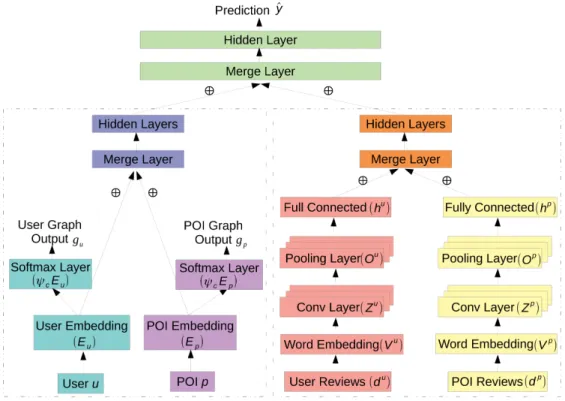
The following recommender system aims to improve the POI recommendation task by learning user-location interactions using two parallel neural networks, as shown
in Fig. 3.2.1. The context-based network, presented in the left part of the figure, is designed to model the user-POI preferences using social and geographical attributes as regularizing factors [37,65] and based on a multi-layer perceptron structure [12,20]. Shown in the right side of Fig. 3.2.1, the convolutional neural network is responsible for the textual modeling unit [25, 71]. It attempts to learn the same preference by analyzing the underlying meaning in users’ and locations’ reviews. Each of the two networks is based on modeling the user and POI input individually with regard to their shared interaction, defined in the merge layers. The resulting concise vectors, representing the user-location interaction learned from each perspective, are then combined in a final layer, responsible for generating a recommendation.
Figure 3.2.1: TCENR Framework
3.2.1
Context-based network layers
To better capture the complex relations between users and locations in a LBSN, we chose to adopt the multi-layer perceptron architecture. By stacking multiple layers
of nonlinearities, MLP is capable of learning relevant latent factors of its inputs. It is first fed with user and location vectors of sizes N and M, where each input tuple < u, p > is transformed into sparse one-hot encoding representations. The two fully connected embedding layers, found on top of the input layer, project the sparse representations of users and locations into smaller and denser vectors. For u and p, the respective embedding matrices are Eu ∈Rku×N and Ep ∈ Rkp×M, where ku and
kp are the corresponding dimensions.
We assume that friends usually share similar preferences towards places they visit, and therefore exploit the users’ social networks to constrain their representa-tions within the network. The same reasoning is inferred for locarepresenta-tions in the same geographical region, as they might be different, but yet share many attributes in common compared to far away venues. We apply this logic to the contextual MLP in the form of smoothing, where the embeddings of connected users and locations in their respective graphs are constrained to be relatively similar. Two softmax layers take the user and location representations, Eu and Ep, as input and transform them
back to N and M sized vectors, respectively. The user output layer, ψcEu ∈RN can
be formally described as:
ψcEu =a(Wcu×Eu+buc) , (3.2.1)
where Wu
c and buc are the layer’s weight matrix and bias vector and a is a non-linear
activation function. Due to the similarity between the user and POI specific layers, the location output layer, ψcEp, will not be developed in this section. As part of its
optimization, the proposed network will penalize differences between the two softmax outputs,ψcEu and ψcEp, to the user and location respective graphs,gu, andgp. This
in turn enforces the smoothing and similarity between connected embeddings. The two representations main purpose is, however, to learn the user-location
interaction, and in turn provide an implicit prediction. The two embeddings are therefore projected to a merge layer and combined by the concatenation operator. Using concatenation instead of dot-product allows the embeddings to be in different dimensionality, which in turn improves the generated representation [20]. By feeding the two latent vectors to an MLP, the network attempts to learn the interactions be-tween different user and location hidden features. This in turn, allows it to eventually describe the interaction using a small number of parameters. As the input for the following neural network, the merge layer can be represented as H0 where:
H0 = [Eu, Ep]. (3.2.2)
Since simple concatenation of the user-location embedded vectors does not allow for interactions to be modeled, hidden layers are added to learn these connections. We adopt the MLP structure described in Eq. 2.2.1, where the ReLU is employed as the activation function for its layers. More formally, the l-th hidden layer can be defined as:
Hlcontext(x) = ReLU(WlHl−context1 (H0) +bl) , (3.2.3)
where Wl and bl are the l-th layer parameters. Unlike the standard MLP model,
described in section 2.2, the final hidden layer’s output, Hcontext
L will not be directly
used as the model’s output, but will be combined with the second sub-network of our framework.
3.2.2
Textual modeling network layers
To improve the model’s coverage and gain further insight towards the interests of users and what defines locations, a textual-based network is introduced. It simul-taneously learns the same interaction as the contextual-based network, but with a natural language input. Two additional vectors du and dp, representing user u’s and
locationp’s textual reviews, respectively, are applied as inputs for this network. Each vector is comprised of all n words written by the user or about the location merged together, kept in their original order. These words are then mapped toc-dimensional vectors defining their semantic meaning in the following embedding layers. The out-put of the user embedding layer is the representation of all words used by a user uin the form of a matrix, and can be denoted as:
Vu = [φ(du1), ..., φ(dul), ..., φ(dun)] , (3.2.4)
whereφ:D→Rkw is a lookup function to a pre-trained textual embedding layer [46]
that represents each word in vocabularyDas a vector in sizekw. Similarly,Vpdenotes
the word embedding matrix for location p.
Due to the large amount of parameters required to train the aforementioned con-textual model, the con-textual network is implemented using a CNN-based architecture which is usually more computationally efficient than RNN. The semantic representa-tions of users’ and locarepresenta-tions’ reviews are fed to convolution layers, to detect parts of the text that best capture the review’s meaning. These layers produce feature maps over the embedded word vector, using a window size ofws and filter K ∈Rkw×t. As
suggested by [71], ReLU is used as an activation function for this layer:
zjlu =ReLU(Vlu:l+ws∗Kju+buj) , (3.2.5)
zju = [zju1, ..., zjlu, ..., zjnu ] ,
where Vlu is user u’s l-th input word embedding and zuj the j-th feature, extracted
from the complete text.
produced by the convolution layers are reduced using a pooling layer:
ouj =max(zju) , (3.2.6)
Ou = [ou1, ..., ouj, ..., out],
where max-pooling is selected to identify the most relevant words. These are followed by hidden layers that jointly model the different feature maps to result in the latent representations of the user and location, denoted respectively ashu and hp :
hu =ReLU(W1u×Ou+bu1) . (3.2.7)
Similarly to the contextual sub-network, presented in section 3.2.1, we aim to learn a vector describing the user-location interaction rather than the two components separately. We therefore utilize yet another ReLU layer to combine the two repre-sentations, where the user and location vectors are concatenated:
hreviews =ReLU(W2×[hu, hp] +b2) . (3.2.8)
The outputs generated from the two neural networks are then finally merged to produce a prediction ˆyup∈[0,1]. The last layers of the two networks, each
represent-ing a different view of the same user-location interaction, are concatenated and fed to an hidden layer, responsible to blend the learning and transform it to an implicit score:
ˆ
yup =σ(W3 ×[hcontext, hreviews] +b3), (3.2.9)
where W3 and b3 are the layer’s parameters and determine the impact of each
con-textual and con-textual feature over the output. The sigmoid function was selected to transform the hidden layer output to the desired range of [0,1].
3.3
Training the Network
To train the recommendation models, we adopt the point-wise loss objective function, as done in [20, 65, 71], where the difference between the prediction ˆyup and the actual
value yup is minimized. To address the implicit feedback nature of LBSNs, for each
positive case in the given training set, Y, we sample a set of negative instances, denoted as Y .
Due to the implicit feedback nature of the recommendation task, the algorithm’s output can be considered as a binary classification problem. As the sigmoid activation function is being used over the last layer, the output probability can be defined as:
p(Y, Y |Eu, Ep, Vu, Vp,Θf) = Y (u,p)∈Y ˆ yup Y u,p0∈Y (1−yˆup0) , (3.3.1)
where Eu and Ep are the embedding layers for all users and locations, respectively.
Similarly, Vu and Vp are the textual reviews embedding layers and Θf represents
the model parameters. Taking the negative log-likelihood of p results in the binary cross-entropy loss function for the prediction portion of the model:
Lpred =−
X
(u,p)∈Y∪Y
yuplog(ˆyup) + (1−yup)log(1−yˆup) . (3.3.2)
Minimizing Eq. 3.3.2 will optimize the model parameters to result in more accu-rate predictions. However, there are two more outputs in the model, the users’ social network ψcEu and the locations’ distance graph ψcEp. We further wish to penalize
the model when embeddings of connected users or locations are different. Two addi-tional loss functions are therefore required to train the contextual sub-network and the whole model as a result. We follow derivations presented in [65] and employ the categorical cross-entropy loss to minimize the difference between the softmax and the
user graph distributions: Lu context =− X (u,uc) log(ψcEu−log X uc0∈Cu exp(ψc0Eu)), (3.3.3)
whereucis useru’s context, Cu is the set of all possible contexts andψcEu is the user
embedding softmax, as defined in Eq. 3.2.1. Taking the binary class label into account prompts the following loss function, corresponding with minimizing the cross-entropy loss of user uand context cwith respect to the y class label:
Lu context =−I(y∈Y)logσ(ψcEu)−I(y∈Y )logσ(−ψcEu) , (3.3.4)
whereIis a function that returns 1 if yis in the given set, and 0 otherwise. The same logic is used to formulate the loss function for the POI context:
Lp context=−I(y ∈Y)logσ(ψcEp)−I(y∈Y )logσ(−ψcEp), (3.3.5)
We simultaneously minimize the three loss functionsLpred,Lu contextandLp context.
The joint optimization improves the recommendation accuracy while enforcing similar representations for locations in close proximity and users connected in the social network. The loss functions are combined using two hyper-parameters, λ1 and λ2 to
weight the contextual contribution:
L=Lpred+λ1Lu context +λ2Lp context . (3.3.6)
To optimize the combined loss function, a method of gradient descent can be adopted, and more specifically we utilize the Adaptive Moment Estimation (Adam) [27]. This optimizer automatically adjusts the learning rate and yields faster conver-gence than the standard stochastic gradient descent in addition to making the learning
rate optimization process more efficient. In order to avoid additional over-fitting when training the model, an early stopping criteria is integrated. The model parameters are initialized with Gaussian distribution, while the output layer’s parameters are set to follow uniform distribution.
3.4
Textual Modeling Using Word Sequences
To further investigate the gain achieved by integrating a textual modeling component over reviews in TCENR, we suggest an extension, denoted as TCENRseq. Following
its success in previous language modeling tasks [1, 63] and its ability to capture sen-tences’ sequential nature, we employ an RNN component to learn latent features from reviews. An illustration of the proposed extension is presented in Figure 3.4.1b, while the CNN method used in the vanilla TCENR is shown in Figure 3.4.1a, to provide a convenient base for comparisons. More specifically we follow the findings of previous works [3, 5] and implement our recurrent network using GRU, an architecture that achieves competitive performance compared to LSTM, but with fewer parameters, making it more efficient.
Since the context of a word can be determined by other preceding and successive words or sentences, our proposed method employs a bi-directional GRU over the user embedding, Vu, and the location, Vp. Each word l’s hidden state is learned by
forward and backward GRU layers, denoted as −→h1
l and
←− h1
l, respectively. While the
(a) Textual modeling component using CNN (b) Textual modeling component using RNN
Figure 3.4.1: Proposed alternatives to learn user and location representations from textual reviews. 3.4.1a is a CNN-based solution employed in TCENR, while 3.4.1b illustrates the suggested extension using RNN
requires the hidden state of successive words and can be fully defined as: ←− fl =σ[Wf[ ←− hl+1, Vlu] +bf], ←−s l =σ[Ws[ ←− hl+1, Vlu] +bs], (3.4.1) ←− ˜ cl =tanh(WzVlu+fl·Wh ←− hl+1+b˜c) , ←− hl = (1− ←−sl)· ←− ht+l+←−sl· ←− ˜ cl ,
wherefl is the forget gate, sl is the output gate, ˜cl is the new candidate state and hl
is current state for word l.
To learn a more concise and combined representation of a word while taking into account the context of all surrounding words, we feed the concatenation of −→h1
l and
←− h1
l to an additional bi-directional GRU layer, such that its input for every word l
is e2l = [−→hl1,←h−1l]. The second recurrent unit will output n latent vectors, each is a
sequentially infused representation of a word written by the target user or about the candidate item.
presented in Equations 3.2.6 and 3.2.7, respectively. By doing so, we allow the method of textual modeling to be the only variant between TCENR and TCENRseq, and
further reduce the number of learned parameters. Replacing only the convolutional layer with that of the GRU, enables us to directly determine the effect RNN has on textual modeling for POI recommender systems compared to CNN, as well as enabling the model to learn a more concise user and location representations. As in TCENR, the resulting vectors will be merged in order to learn the user-location interaction.
3.5
Model Evaluation
In this section we perform empirical experiments to evaluate TCENR and its ex-tension, TCENRseq. We further present multiple design selections to the proposed
frameworks along with their impact.
3.5.1
Experimental Setup
To evaluate our suggested model, we use Yelp’s real-world dataset1. It includes a
subset of textual reviews along with the users’ friends, and the businesses’ geograph-ical locations. Due to the limited resources used in the model evaluation, we chose to filter the dataset and keep only a concise subset, where all users and locations with less than 100 written reviews or less than 10 friends are removed. The filtered dataset includes 141,028 reviews, and 98.08% sparsity for the rating matrix. The social and geographical graphs were constructed by random walks. 10% of the original vertices were sampled as base nodes, while 20 and 30 vertices were connected to each base node for users and locations, respectively, with a window size of 3. To build the POI graph, two locations are considered directly connected if they are up to 1 km apart.
We test our framework’s performance by splitting the original data to
validation-test sets using random sampling, with the respective ratios of 56%-24%-20%, resulting 78,899 training instances. In addition, the input data was negatively sampled with 4 negative locations for every positive one.
To effectively compare our proposal with other alternatives, we adopt the same settings as applied in [20, 65]. The MLP input vectors are represented with an em-bedding size of 10, while two layers are added on top of the merged result. Following the tower architecture, where the size of each layer is half the size of its predecessor, the number of hidden units are 32 and 16 for the first and second layers, respectively. In the CNN component each word is represented by a pre-trained embedding layer with 50 units, while the convolutional layer is constructed with a window size of 10 and a stride of 3. It results 3 feature maps that are flattened after performing the max-pooling operation with a pool size of 2. The results are further modeled by a hidden layer with 32 units. Following the merge of the two hidden units, their interaction is learned using another layer with 8 units. To combine the three loss functions as described in Eq. 3.3.6, we follow the results of [65] and set the hyper-parameters λ1 = λ2 = 0.1. For the training phase of the model, a learning rate of
0.005 was used over 50 maximum epochs and a batch size of 512 samples.
3.5.2
Baselines
To evaluate our algorithm, we chose to compare it to these seven, empirically proven, frameworks:
• HPF [19]. Hierarchical Poisson matrix Factorization. A Bayesian framework for modeling implicit data using Poisson Factorization.
• NMF [36]: Non-negative Matrix Factorization, a CF method that takes only the rating matrix as input.
using geographical data and crowd behaviors.
• LCARS [66]: Location Content Aware Recommender System. A probabilistic model that exploits local preferences in LBSN and content information about POIs.
• NeuMF [20]. Neural Matrix Factorization. A state-of-the-art model combining MF with MLP on implicit ratings.
• PACE [65]. Preference And Context Embedding. A MLP-based framework with the addition of contextual graphs’ smoothing for POI recommendation. • DeepCoNN [71]. Deep Cooperative Neural Networks. A CNN-based method
that jointly learns an explicit prediction by exploiting users’ and locations’ natural language reviews.
For the task of evaluating our model and the baselines, we chose to apply the following popular metrics:
• Accuracy - Presents the ratio of correct predictions: T1 P
I(ˆyup =yup). T is
the test set size and I returns 1 if the prediction and groun