K N O W L E D G E E X T R A C T I O N F O R H Y B R I D
Q U E S T I O N A N S W E R I N G
Von der Fakultät für Mathematik und Informatik der Universität Leipzig angenommene
DISSERTATION
zur Erlangung des akademischen GradesDoctor rerum naturalium
(Dr. rer. nat.)im Fachgebiet Informatik vorgelegt von
Ricardo Usbeck, M.Sc.
geboren am 01.04.1988in Halle (Saale), Deutschland
Die Annahme der Dissertation wurde empfohlen von:
1. Professor Dr. Klaus-Peter Fähnrich (Leipzig) 2. Professor Dr. Philipp Cimiano (Bielefeld)
Die Verleihung des akademischen Grades erfolgt mit Bestehen
der Verteidigung am17. Mai2017mit dem Gesamtprädikatmagna cum laude.
b i b l i o g r a p h i c d ata
t i t l e:
Knowledge Extraction for Hybrid Question Answering au t h o r:
Ricardo Usbeck
s tat i s t i c a l i n f o r m at i o n:
10chapters, 169pages,28figures,32 tables,8 listings,5algorithms,178literature references,1appendix part
s u p e r v i s o r s:
Prof. Dr.-Ing. habil. Klaus-Peter Fähnrich Dr. Axel-Cyrille Ngonga Ngomo
i n s t i t u t i o n:
Leipzig University, Faculty for Mathematics and Computer Science t i m e f r a m e:
A B S T R A C T
Over the last decades, several billion Web pages have been made available on the Web. The growing amount of Web data provides the world’s largest collection of knowledge.1
Most of this full-text data like blogs, news or encyclopaedic informa-tion is textual in nature. However, the increasing amount of structured respectively semantic data2
available on the Web fosters new search paradigms. These novel paradigms ease the development of natural language interfaces which enable end-users to easily access and benefit from large amounts of data without the need to understand the underlying structures or algorithms.
Building a natural language Question Answering (QA) system over heteroge-neous, Web-based knowledge sources requires various building blocks. These build-ing components include (a) knowledge extraction approaches over textual data such as blogs, news, templated websites or product descriptions to capture the semantics of the content of a document, (b) linguistic parsing modules for natural language and (c) efficient query execution and ranking functions. However, ex-isting knowledge extraction building blocks lack comparable evaluation settings, performance or quality. In this thesis, three main research challenges are identified and addressed:
1. The ongoing transition from the currentDocument Webof textual data to the
Web of Data requires scalable and accurate approaches for the extraction of structured data in Resource Description Framework (RDF) from Web-based documents. We address this key step for bridging the Semantic Gap, i.e., ex-tracting RDF from text, with three approaches. First, this thesis presents CE-TUS, an approach for recognizing entity types in textual documents to popu-late RDF knowledge bases. Second, we describe the knowledge base-agnostic, multi-lingual, high-quality and efficient named entity disambiguation frame-work AGDISTIS. Third, we tackle the scalable extraction of consistent RDF data from highly templated websites via our framework REX.
2. The need to bridge between the textual Document Web and the structured data on the Web of Data has led to the development of a considerable number of annotation tools and frameworks. However, these approaches are currently hard to compare since the published evaluation results are calculated on diverse datasets and evaluated based on different measures The resulting
Evaluation Gap is tackled by a novel set of benchmarking corpora as well as with GERBIL, our evaluation framework for semantic entity annotation. The rationale behind our framework is to provide developers, end users and researchers with easy-to-use interfaces that allow for the agile, fine-grained and uniform evaluation of annotation approaches on multiple datasets. 3. The decentral architecture behind both Webs generated a distributed
infor-mation landscape across data sources with varying structure. Furthermore, current keyword-based search paradigms contradict the human demand for expressing information needs in natural language. Especially, complex infor-mation relationships are often expressed as complex questions by humans.
1 http://www.worldwidewebsize.com/ 2 http://stats.lod2.eu/
The author will make use of the we-form as narrative.
These observations describe an Information Gap, i.e., the user generated de-mand for natural language interfaces based on the structured Web of Data and the Document Web. Thus, we introduce HAWK, a novel natural language search framework for hybrid QA. Our framework is able to combine struc-tured and textual data sources to answer complex natural language ques-tions.
P U B L I C AT I O N S
This thesis is based on the following publications and proceedings. References to the appropriate publications are included at the respective chapters and sections.
awa r d s a n d n o ta b l e m e n t i o n s
• Best Research Paper Awardfor Ricardo Usbeck, Axel-Cyrille Ngonga Ngomo, Lorenz Bühmann, Michael Röder, Daniel Gerber, Sandro Athaide Coelho, Sören Auer, and Andreas Both. AGDISTIS - Graph-Based Disambiguation of Named Entities Using Linked Data. In International Semantic Web Confer-ence (ISWC), pages457–471,2014
• 2nd prize at Question Answering over Linked Data (QALD)5for Ricardo Usbeck and Axel-Cyrille Ngonga Ngomo. HAWK@QALD5 – Trying to An-swer Hybrid Questions with Various Simple Ranking Techniques. In CLEF
2015Labs and Workshops, Notebook Papers. CEUR Workshop Proceedings (CEUR-WS.org/Vol-1391),2015
• Best Demo Award for Ricardo Usbeck, Michael Röder, and Axel-Cyrille Ngonga Ngomo. Evaluating entity annotators using GERBIL. In The Seman-tic Web: ESWC 2015 Satellite Events, Revised Selected Papers, Demos & Posters, pages159–164,2015
• 1st prize at Task 2 of Open Knowledge Extraction (OKE) Challenge for Michael Röder, Ricardo Usbeck, René Speck, and Axel-Cyrille Ngonga Ngomo. CETUS – A Baseline Approach to Type Extraction. In1st Open Knowledge Ex-traction Challenge at International Semantic Web Conference,2015
• Best of Workshop (WASABI) for Didier Cherix, Ricardo Usbeck, Andreas Both, and Jens Lehmann. CROCUS: Cluster-based Ontology Data Cleansing. In Joint Second International Workshop on Semantic Web Enterprise Adoption and Best Practice and Second International Workshop on Finance and Economics on the Semantic Web at ESWC,2014
• Best of Workshop (LD4IE)for Axel-Cyrille Ngonga Ngomo, Michael Röder, and Ricardo Usbeck. Cross-document coreference resolution using latent features. In2nd International Workshop on Linked Data for Information Extraction at the International Semantic Web Conference, pages33–44,2014
c o n f e r e n c e s, p e e r-r e v i e w e d
1. Ricardo Usbeck, Axel-Cyrille Ngonga Ngomo, Lorenz Bühmann, Michael Röder, Daniel Gerber, Sandro Athaide Coelho, Sören Auer, and Andreas Both. AGDISTIS - Graph-Based Disambiguation of Named Entities Using Linked Data. InInternational Semantic Web Conference (ISWC), pages457–471,2014
2. Ricardo Usbeck, Michael Röder, Axel-Cyrille Ngonga Ngomo, Ciro Baron, Andreas Both, Martin Brümmer, Diego Ceccarelli, Marco Cornolti, Didier Cherix, Bernd Eickmann, Paolo Ferragina, Christiane Lemke, Andrea Moro, Roberto Navigli, Francesco Piccinno, Giuseppe Rizzo, Harald Sack, René Speck, Raphaël Troncy, Jörg Waitelonis, and Lars Wesemann. GERBIL – Gen-eral Entity Annotation Benchmark Framework. In 24th International Confer-ence on World Wide Web,2015
3. Ricardo Usbeck, Axel-Cyrille Ngonga Ngomo, Lorenz Bühmann, and Chris-tina Unger. HAWK – Hybrid Question Answering Using Linked Data. In
Extended Semantic Web Conference, pages353–368,2015
4. Michael Röder, Ricardo Usbeck, Daniel Gerber, Sebastian Hellmann, and An-dreas Both. N3 - A Collection of Datasets for Named Entity Recognition and Disambiguation in the NLP Interchange Format. In Conference on language resources and evaluation (LREC),2014
5. Lorenz Bühmann, Ricardo Usbeck, Axel-Cyrille Ngonga Ngomo, Muham-mad Saleem, Andreas Both, Valter Crescenzi, Paolo Merialdo, and Disheng Qiu. Scale Extension of RDF Knowledge Bases from Templated Web-sites. InInternational Semantic Web Conference (ISWC), pages66–81,2014
b o o k c h a p t e r s, p e e r-r e v i e w e d
6. Anja Jentzsch, Ricardo Usbeck, and Denny Vrandecic. An Incomplete and Simplifying Introduction to Linked Data. In Jens Lehmann and Johanna Voelker, editors, Perspectives on Ontology Learning, pages 21–33. AKA / IOS Press,2014
w o r k s h o p s, p e e r-r e v i e w e d
7. Ricardo Usbeck, Erik Körner, and Axel-Cyrille Ngonga Ngomo. Answering Boolean Hybrid Questions with HAWK. InNLIWOD workshop at International Semantic Web Conference (ISWC),2015
8. Michael Röder, Ricardo Usbeck, René Speck, and Axel-Cyrille Ngonga Ngomo. CETUS – A Baseline Approach to Type Extraction. In1st Open Knowledge Ex-traction Challenge at International Semantic Web Conference,2015
9. Ricardo Usbeck. Combining Linked Data and Statistical Information Re-trieval - Next Generation Information Systems. In The Semantic Web: Trends and Challenges -11th International Conference ESWC2014, pages845–854,2014 10. Michael Röder, Ricardo Usbeck, and Axel-Cyrille Ngonga Ngomo.
Develop-ing a Sustainable Platform for Entity Annotation Benchmarks. InDevelopers Workshop2015at ESWC,2015
11. Ricardo Usbeck and Axel-Cyrille Ngonga Ngomo. HAWK@QALD5– Trying to Answer Hybrid Questions with Various Simple Ranking Techniques. In
CLEF 2015 Labs and Workshops, Notebook Papers. CEUR Workshop Proceedings (CEUR-WS.org/Vol-1391),2015
d e m o s a n d p o s t e r s, p e e r-r e v i e w e d
12. Ricardo Usbeck, Axel-Cyrille Ngonga Ngomo, Michael Röder, Daniel Gerber, Sandro Athaide Coelho, Sören Auer, and Andreas Both. AGDISTIS - Agnostic Disambiguation of Named Entities Using Linked Open Data. In21st European Conference on Artificial Intelligence, pages1113–1114,2014
13. Ricardo Usbeck, Michael Röder, and Axel-Cyrille Ngonga Ngomo. Evaluat-ing entity annotators usEvaluat-ing GERBIL. InThe Semantic Web: ESWC2015Satellite Events, Revised Selected Papers, Demos & Posters, pages159–164,2015
14. Ricardo Usbeck, Axel-Cyrille Ngonga Ngomo, Wencan Luo, and Lars Wese-mann. Multilingual Disambiguation of Named Entities Using Linked Data. InInternational Semantic Web Conference (ISWC), Demos & Posters,2014
u n p u b l i s h e d pa p e r s
15. Konrad Höffner, Sebastian Walter, Edgard Marx, Jens Lehmann, Axel-Cyrille Ngonga Ngomo, and Ricardo Usbeck. Survey on Challenges of Question Answering in the Semantic Web. Semantic Web Journal
m i s c e l l a n e o u s pa p e r
The following publications (ordered alphabetically) originated during and are re-lated to this thesis but are not part of the thesis itself.
1. Andreas Both, Axel-Cyrille Ngonga Ngomo, Ricardo Usbeck, Denis Lukov-nikov, Christiane Lemke, and Maximilian Speicher. A Service-oriented Search Framework for Full Text, Geospatial and Semantic Search. In SEMANTiCS, pages65–72,2014
2. Ricardo Usbeck. Analyse von Mikro-Blogging-Daten. Informatik-Spektrum,38 (5):400–405,2014
3. Lorenz Bühmann, Ricardo Usbeck, and Axel-Cyrille Ngonga Ngomo. AS-SESS - Automatic Self-Assessment Using Linked Data. InInternational Seman-tic Web Conference (ISWC). Springer International Publishing, 2015
4. Didier Cherix, Ricardo Usbeck, Andreas Both, and Jens Lehmann. CROCUS: Cluster-based Ontology Data Cleansing. InJoint Second International Workshop on Semantic Web Enterprise Adoption and Best Practice and Second International Workshop on Finance and Economics on the Semantic Web at ESWC,2014
5. Axel-Cyrille Ngonga Ngomo, Michael Röder, and Ricardo Usbeck. Cross-document coreference resolution using latent features. In 2nd International Workshop on Linked Data for Information Extraction at the International Semantic Web Conference, pages33–44,2014
6. Daniel Gerber, Diego Esteves, Jens Lehmann, Lorenz Bühmann, Ricardo Us-beck, Axel-Cyrille Ngonga Ngomo, and René Speck. DeFacto - Temporal and Multilingual Deep Fact Validation. Web Semantics: Science, Services and Agents on the World Wide Web,2015
7. Michael Röder, Maximilian Speicher, and Ricardo Usbeck. Investigating Qual-ity Raters’ Performance Using Interface Evaluation Methods. In Informatik
2013, 43. Jahrestagung der Gesellschaft für Informatik e.V. (GI), pages 137–139, 2013
8. Didier Cherix, Ricardo Usbeck, Andreas Both, and Jens Lehmann. Lessons learned - the case of CROCUS: cluster-based ontology data cleansing. In
The Semantic Web: ESWC 2014 Satellite Events - ESWC 2014 Satellite Events, Anissaras, Crete, Greece, May 25-29,2014, Revised Selected Papers, pages14–24, 2014
9. Diego Esteves, Diego Moussallem, Ciro Baron Neto, Tommaso Soru, Ricardo Usbeck, Markus Ackermann, and Jens Lehmann. MEX Vocabulary: A Light-weight Interchange Format for Machine Learning Experiments. In SEMAN-TiCS, pages169–176,2015
10. Mohamed Ahmed Sherif, Sandro Coelho, Ricardo Usbeck, Sebastian Hell-mann, Jens LehHell-mann, Martin Brümmer, and Andreas Both. NIF4OGGD -NLP Interchange Format for Open German Governmental Data. In Confer-ence on language resources and evaluation (LREC), pages3524–3528,2014
11. Daniel Gerber, Sebastian Hellmann, Lorenz Bühmann, Tommaso Soru, Ri-cardo Usbeck, and Axel-Cyrille Ngonga Ngomo. Real-Time RDF Extraction from Unstructured Data Streams. In International Semantic Web Conference (ISWC), pages135–150,2013
12. Edgard Marx, Ricardo Usbeck, Axel-Cyrille Ngonga Ngomo, Konrad Höffner, Jens Lehmann, and Sören Auer. Towards an Open Question Answering Ar-chitecture. InSEMANTiCS, pages57–60,2014
A C K N O W L E D G M E N T S
This thesis has only been possible due to all the people helping, supporting and bearing me. This section does not raise any claims on completeness due to the complexity and duration of this work. First of all, I would like to thank Majura, my wonderful fiancée, she is my girl Friday and provided me with the energy to fulfill my work, even at night. Next, Axel deserves credit for his role as being more than just a supervisor. Of course, I would like to thank Prof. Dr. Ing. habil. Klaus-Peter Fähnrich for granting me this opportunity.
Without any particular order I like to thank my colleagues and friends Michael Röder and Maximilian Speicher for scientific advise, better advises than stakeover-flow and bearing me in the process as well as Andreas Both for giving me this chance. Professors Lehmann and Auer deserve respect for the sharing their scien-tific experience and efficient organization skills. I am grateful for all AKSW col-leagues for their advice, discussions and provided distractions to survive the PhD process. Special thanks goes to my parents Gunter and Bettina for raising me to who I am now.
This work has been supported by the European Social Fund, the Unister GmbH and the Free State of Saxony as well as the FP7project GeoKnow (GA No.318159), the BMWI Project SAKE (Project No.01MD15006E), LIDER (GA No.610782), LinkedTV (GA No.287911), the European Union’s7th Framework Programme, the Eurostars projects DIESEL (E!9367) and QAMEL (E!9725) as well as the HOBBIT project funded by the European Union’s H2020research and innovation action program (GA No.688227).
A C R O N Y M S
EL Entity Linking
HITS Hypertext-Induced Topic Search
KB Knowledge Base
LD Linked Data
LOD Linked Open Data
NER Named Entity Recognition
NED Named Entity Disambiguation NLP Natural Language Processing
QA Question Answering
QALD Question Answering over Linked Data
RE Relation Extraction
RDF Resource Description Framework
RDF Prefixes rdf http://www.w3.org/1999/02/22-rdf-syntax-ns# rdfs http://www.w3.org/2000/01/rdf-schema# dbr http://dbpedia.org/resource/ dbo http://dbpedia.org/ontology/ foaf http://xmlns.com/foaf/0.1/ yago http://yago-knowledge.org/resource/ dul http://www.ontologydesignpatterns.org/ont/dul/ scmsann http://ns.aksw.org/scms/annotations/ nif http://persistence.uni-leipzig.org/nlp2rdf/ontologies/nif-core# itsrdf http://www.w3.org/2005/11/its/rdf# dc http://purl.org/dc/elements/1.1/ ex http://www.example.org/ xiii
L I S T O F F I G U R E S
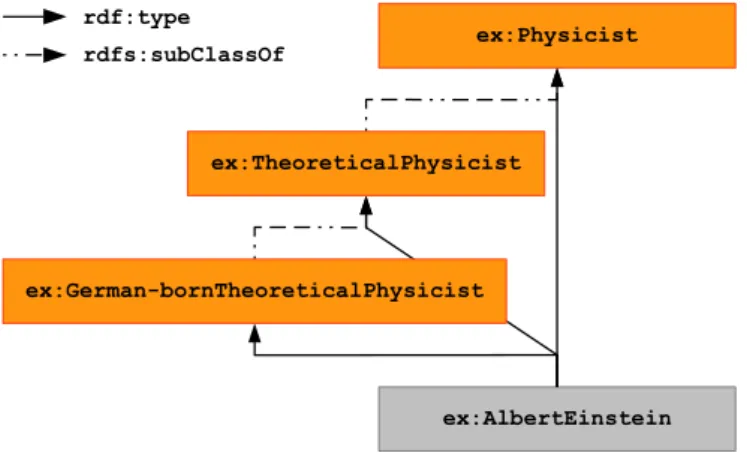
1 Example of Linked Data used for the calender application. . . 9 2 Schema of the generated local hierarchy of the example. . . 30 3 Resulting type hierarchy that is created based on the YAGO ontology. 32 4 Resulting type hierarchy that is created based on the results of FOX. 32 5 Architecture of AGDISTIS. . . 39 6 One possible graph for the example sentence, with candidate nodes
in grey. . . 43 7 F-measure on the Reuters-21578 corpus using DBpedia as
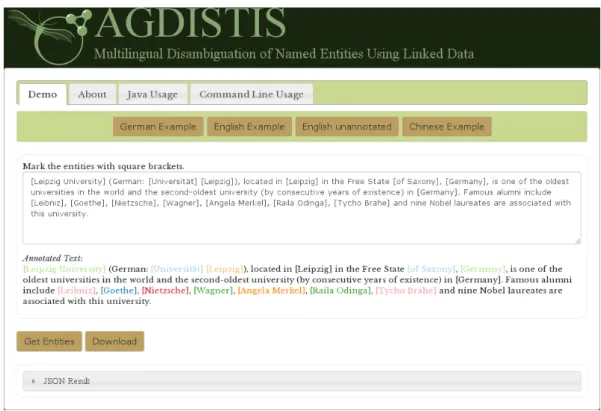
Know-ledge Base (KB). . . 46 8 Screenshot of the demo with an English example which is already
annotated. . . 49 9 Architecture of REX. . . 54 10 (a) DOM trees of three pages (in a fictional set I), (b) a page in Q
(with a template that differs from those of the pages in I),(c)some rules to extract the movie title, and(d)a page inW(with a template that differs from those of the pages inQ). . . 58 11 Overall evaluation results of REX . . . 62 12 Distribution of NEs per document. We omitted two outliers from the
News-100corpus containing55and63NEs. . . 69 13 User interface of the annotation tool. . . 70 14 Overview of GERBIL’s abstract architecture. Interfaces to users and
providers of datasets and annotators are marked in blue. . . 75 15 Example spider diagram of recent A2KB experiments with weak
an-notation matching. . . 87 16 Example spider diagram of correlations between annotation results
and dataset features. . . 87 17 Comparison of effort needed to implement an adapter for an
anno-tation system with and without GERBIL. . . 88 18 Runtime per document of different approaches in GERBIL for the
A2KB experiment type on the MSNBC dataset. . . 89 19 Architecture of HAWK. . . 96 20 Predicate-argument tree for the example question ‘Which recipients
of the Victoria Cross died in the Battle of Arnhem?’ . . . 104 21 Tree after pruning. Argument edges are ordered from left to right. . 105 22 Entity annotations systems performance with optimal ranking. . . . 110 23 F-measures on training dataset usingN= [1,. . .,10]and one feature. 111 24 F-measures on training dataset usingN= [1,. . .,10]and two features.111 25 Accuracy of AGDISTIS on theRSS500corpus. . . V 26 Accuracy of AGDISTIS on thenews.decorpus. . . V 27 Comparison of the average runtime of AGDISTIS and AIDA on
Reuters-21578corpus with respect to the number of entities per sen-tence. AGDISTIS is cleary more time-efficient than AIDA. . . VI 28 Influence of surface forms. . . VI
L I S T O F TA B L E S
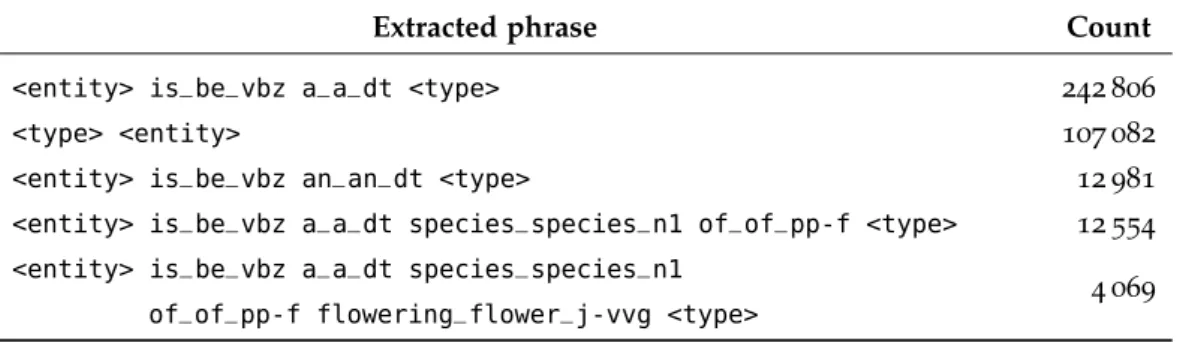
1 Examples of sentence parts found between an entity and its type. . . 28
2 Mapping from YAGO to DOLCE+DnS Ultra Lite classes. . . 31
3 Mapping from FOX classes to DOLCE+DnS Ultra Lite classes. . . 33
4 Results of the OKE Challenge2015task1 . . . 34
5 Results for the different sub tasks of task1 . . . 34
6 Results of the OKE Challenge2015task2 . . . 34
7 Results for the different sub tasks of task2 . . . 34
8 DBpedia and YAGO2classes used for disambiguation classes. . . 40
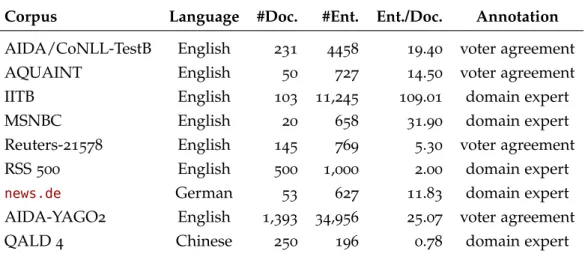
9 Nodes and their according authority weights for the example graph. 43 10 Test corpora specification including the number of documents (#Doc.) and the number of named entities (#Ent.) per dataset . . . 45
11 Evaluation of AGDISTIS against AIDA and DBpedia Spotlight. Bold indicates best F-measure. . . 46
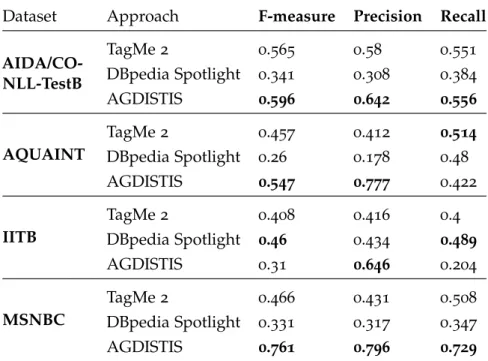
12 Performance of AGDISTIS, DBpedia Spotlight and TagMe 2on four different datasets using micro F-measure (F1). . . 47
13 Average evaluation results using all available pairs as training data. 61 14 Triples generated by 100randomly sampled pages, number of pos-sible triples generated by using gold standard rules . . . 63
15 Features of the corpora and their documents. . . 68
16 Number of single entities and unique URIs in the corpora. . . 68
17 Overview of implemented annotator systems. Brackets indicate the existence of the implementation of the adapter but also the inability to use it in the live system. . . 82
18 Features of the datasets and their documents. Every dataset can be used for the Sa2KB experiment except Meij which is only suitable for the Rc2KB experiment family. . . 82
19 Comparison of annotators and datasets within diverse frameworks. 83 20 Results of an example experiment from the 10th November 2014 (http://gerbil.aksw.org/gerbil/experiment?id=201411100001) . 85 21 Features of novel datasets and their documents. . . 90
22 Novel datasets and their availability to the experiments types. . . 90
23 Overview of annotators in GERBIL1.2.2. . . 91
24 Number of tasks executed per annotator. . . 91
25 Triple patterns for generating SPARQL queries while traversal. . . . 101
26 Indicator Word for classifying ASK queries in English questions. . . 102
27 Examples for full-text query types. . . 105
28 Generated triple patterns for example. . . 105
29 QALD4training set performance. . . 108
30 Results of Question Answering over Linked Data (QALD)-5 for dif-ferent ranking methods. Number in brackets show the amount of generated answers, i.e., HAWK outputs at least one result set. . . 109
31 Results with and without theASK-extension of HAWK. . . 109 32 Detailed results of HAWK at the QALD-5 challenge. R stands for
Recall, P for Precision and F1for F-measure. . . VIII
L I S T O F L I S T I N G S
1 The grammar rule defining a type surface form. . . 29
2 First simple version of theis-apattern.ENTITYmarks the position of an entity. . . 29
3 Extended version of theis-apattern. . . 29
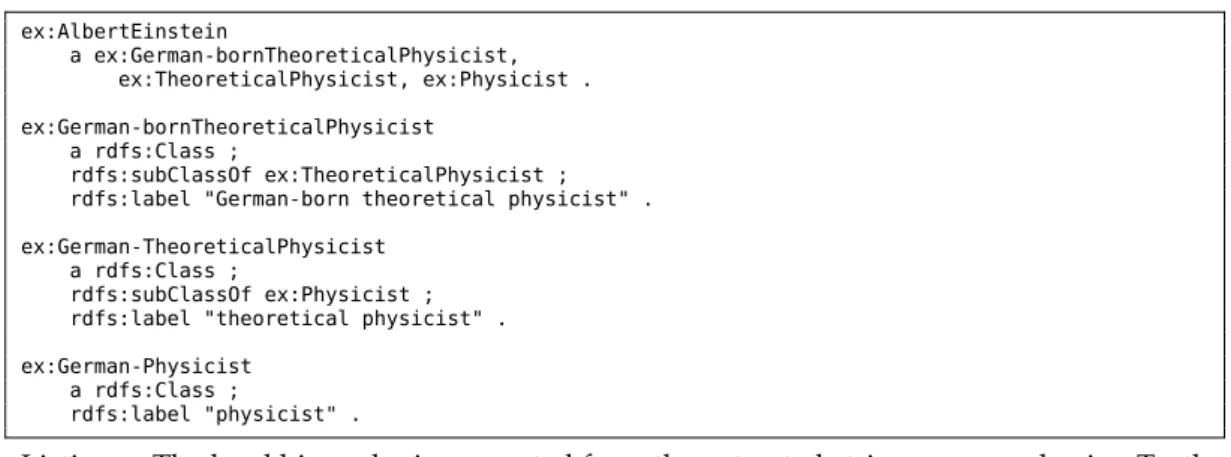
4 The local hierarchy is generated from the extracted string expressed using Turtle as Resource Description Framework (RDF) serialization. 31 5 Example of the resulting N3-triples. . . 71
6 Example input text. . . 71
7 SPARQL query to get all NEs. . . 71
8 Example JSON-LD for an GERBIL experiment. . . 86
L I S T O F A L G O R I T H M S 1 Searching candidates for a label. . . 41
2 Disambiguation Algorithm based on Hypertext-Induced Topic Search (HITS) and Linked Data. . . 42
3 AlfREX: Extract subject-object pairs from a website. . . 57
4 Algorithm for combining noun phrases. . . 98
5 Algorithm for pruning noisy nodes. . . 99
C O N T E N T S
i i n t r o d u c t i o n 1
1 i n t r o d u c t i o n 3
2 p r e l i m i na r i e s - a n i n t r o d u c t i o n t o l i n k e d d ata 7
2.1 Vision of the Semantic Web . . . 7
2.2 RDF: The basics . . . 8
2.3 URIs: The words of the language . . . 9
2.4 HTTP: Distributed knowledge . . . 10
2.5 RDFS, OWL and others: Adding expressivity . . . 11
2.6 SPARQL: Querying RDF . . . 12
2.7 Serializations of RDF . . . 13
2.8 Conclusions and outlook . . . 14
3 r e l at e d w o r k 17 3.1 Semantic Gap - RDF Extraction . . . 17
3.2 Evaluation Gap - Benchmarking Semantic Annotation Systems . . . 20
3.3 Information Gap - Hybrid Question Answering . . . 21
ii s e m a n t i c g a p 25 4 e x t r a c t i o n o f s e m a n t i c t y p e a n n o tat i o n s f r o m u n s t r u c -t u r e d -t e x -t s 27 4.1 Pattern Extraction . . . 27
4.2 Type Extraction . . . 29
4.3 Entity Type Linking using YAGO . . . 31
4.4 Entity Type Linking using FOX . . . 32
4.5 Evaluation . . . 33
5 l i n k i n g o f s e m a n t i c na m e d e n t i t i e s 37 5.1 The AGDISTIS Approach . . . 38
5.2 Evaluation . . . 42
5.3 Demonstration . . . 48
6 e x t r a c t i o n o f r d f k n o w l e d g e f r o m t e m p l at e d w e b s i t e s 51 6.1 Notation and Problem Statement . . . 53
6.2 The REX Framework . . . 54
6.3 Evaluation . . . 60
iii e va l uat i o n g a p 65 7 N3 - a c o l l e c t i o n o f d ata s e t s f o r n e r a n d n e d i n n i f 67 7.1 Corpora . . . 67
7.2 Using NIF for publishing corpora . . . 70
8 g e r b i l– g e n e r a l e n t i t y a n n o tat o r b e n c h m a r k i n g f r a m e w o r k 73 8.1 The GERBIL Framework . . . 75
8.2 Evaluation . . . 88
8.3 Current development of GERBIL . . . 89
iv i n f o r m at i o n g a p 93
9 h aw k – h y b r i d q u e s t i o n a n s w e r i n g u s i n g l i n k e d d ata 95
9.1 Method . . . 96 9.2 Explaining HAWK via examples . . . 104 9.3 Evaluation . . . 107
v s y n o p s i s 113
10 s y n o p s i s 115
10.1 Summary . . . 115 10.2 Conclusion and Future Work . . . 117
vi a p p e n d i x 121 a c u r r i c u l u m v i ta e I b k n o w l e d g e-b a s e a g n o s t i c, m u lt i l i n g ua l e n t i t y l i n k i n g V c h aw k - h y b r i d q u e s t i o n a n s w e r i n g u s i n g l i n k e d d ata VII b i b l i o g r a p h y IX xxii
Part I
I N T R O D U C T I O N
In the first part, we introduce the core topic of this thesis and motivate its relevance to the research community. That is, we want to tackle three research challenges to overcome the separation of the Document Web and the Web of Data to allow users to search both knowledge sources via asking natural language questions. Furthermore, we introduce the required preliminaries to comprehend the underlying technologies. At the end, this part examines the state of the art related to this thesis’ topic. This part covers a wide range of research topics from information extraction and retrieval, to open-science benchmarking and question answering.
1
I N T R O D U C T I O NThis chapter is partially based on the author’s PhD symposium paper [166] and presents the overall motivation, structure and scientific contribution of this thesis.
m o t i vat i o n
Since the proposal of hypertext by Tim-Berners Lee to his employer CERN on March 12, 19891 the World Wide Web has grown to more than one billion Web pages and still grows.2
With the later proposed Semantic Web vision [13], Lee et al. suggested an extension of the existing (Document) Web to allow better reuse, sharing and understanding of data.
Both the Document Web and the Web of Data (which is the current implemen-tation of the Semantic Web) grow continuously. This is a mixed blessing, as the two forms of the Web grow concurrently and most commonly contain different pieces of information. Modern information systems must thus bridge a Semantic Gap to allow a holistic and unified access to information about a particular infor-mation independent of the representation of the data. One way to bridge the gap between the two forms of the Web is the extraction of structured data, i.e., RDF, from the growing amount of unstructured3
and semi-structured information (e.g., tables and XML) on the Document Web.
The dire need for such approaches has led to the development of a multitude of annotation frameworks and tools. However, most of these approaches are not eval-uated on the same datasets or using the same measures. The resultingEvaluation Gap needs to be tackled by a concise evaluation framework to foster fine-grained and uniform evaluations of annotation tools and frameworks over any Knowledge Base (KB).
Moreover, with the constant growth of data and the ongoing decentralization of knowledge, intuitive ways for non-experts to access the generated data are required. Humans adapted their search behavior to current Web data by access paradigms such as keyword search so as to retrieve high-quality results. Hence, most Web users only expect Web documents in return [25]. However, humans think and most commonly express their information needs in their natural language rather than using keyword phrases [175]. Answering complex information needs often requires the combination of knowledge from various, differently structured data sources. Thus, we observe anInformation Gap, i.e., a user-generated demand for natural language interfaces based on the structured Web of Data and the Docu-ment Web, between natural-language questions and current keyword-based search paradigms, which do not make use of the available structured and unstructured data sources. Question Answering (QA) systems provide an easy and efficient way to bridge this gap by allowing to query data via natural language, thus reducing (1) a possible loss of precision and (2) potential loss of time while reformulating the search intention to transform it into a machine-readable way. Furthermore, QA systems enable answering natural language queries with concise results instead of links to verbose Web documents. Additionally, they allow as well as encourage the
1 http://www.w3.org/People/Berners-Lee/Longer.html
2 http://www.internetlivestats.com/total-number-of-websites/
3 Note, that unstructured data stands for any type of textual information like news, blogs or tweets.
4 i n t r o d u c t i o n
access to and the combination of knowledge from heterogeneousKBs within one answer.
Consequently, three main research gaps will be considered and addressed in this work:
1. First, addressing the Semantic Gap between the unstructured Document Web and the Semantic Gap requires the development of scalable and accurate ap-proaches for the extraction of structured data in Resource Description Frame-work (RDF) [107]. This research challenge is addressed by several approaches within this thesis. This thesis presents CETUS [141], an approach for recog-nizing entity types to populateRDF KBs. Furthermore, our knowledge base-agnostic disambiguation framework AGDISTIS [168] can efficiently detect, i.e., in polynomial run-time, the correct URIs for a given set of named en-tities. Additionally, we introduce REX [29], a Web-scale framework forRDF extraction from semi-structured (i.e., templated) websites which makes use of the semantics of the reference knowledge based to check the extracted data.
2. The ongoing research on closing the Semantic Gap has already yielded a large number of annotation tools and frameworks. However, these approaches are currently still hard to compare since the published evaluation results are calculated on diverse datasets and evaluated based on different measures. On the other hand, the issue of comparability of results is not to be regarded as being intrinsic to the annotation task. Indeed, it is now well established that scientists spend between 60% and 80% of their time preparing data for experiments [69; 89; 130]. Data preparation being such a tedious prob-lem in the annotation domain is mostly due to the different formats of the gold standards as well as the different data representations across reference datasets. We tackle the resulting Evaluation Gap—large number of systems, unavailable datasets and incomparable experiments as well as metrics—in two ways: First, we introduce a collection of three novel datasets, dubbed N3, to leverage the possibility of optimizing NER and NED algorithms via Linked Data (LD) and to ensure a maximal interoperability to overcome the need for corpus-specific parsers. Second, we present GERBIL [174], an eval-uation framework for semantic entity annotation. The rationale behind our framework is to provide developers, end users and researchers with easy-to-use interfaces that allow for the agile, fine-grained and uniform evaluation of annotation tools and frameworks on multiple datasets.
3. The decentral architecture behind the Web has led to pieces of information be-ing distributed across data sources with varybe-ing structure. Moreover, the in-creasing the demand for natural-language interfaces4
as depicted by current mobile applications requires systems to deeply understand the underlying user information need. In conclusion, the natural language interface for ask-ing questions requires ahybrid approach to data usage, i.e., simultaneously performing a search on full-texts and semanticKBs. To close the Information Gap, this thesis presents HAWK [172], a novel entity search approach devel-oped for hybrid QA based on combining structured RDF and unstructured full-text data sources.
i n t r o d u c t i o n 5
t h e s i s s t r u c t u r e
This thesis is divided into three main parts, i.e., parts two to five. Every part of the thesis is based on at least one peer-reviewed publication which was mainly authored by the author of this thesis. The author marked all content which stems from other works as clearly and thoroughly as possible. However, the author will swiftly publish an online erratum addressing any mistake or missing references if any were to be discovered in the work after publication. Each chapter contains a graffito as well as list with the author’s research contributions with respect to each presented approach. In the following, we will explain the thesis structure in more detail.
The aim of the first part is to introduce the problems and the research challenges of this thesis to the reader. First, we discuss drawbacks and research directions to-wards a novel hybrid QA system as well as frameworks for extracting semantic knowledge from non-structured data and benchmarking existing semantic annota-tion approaches. Second, we introduce the basic standards, technologies and sym-bols necessary to understand the research problems and solutions as well as the formal framework used throughout this work. At the end, related publications are analyzed.
We introduce the solutions we developed to tackle the Semantic, Evaluation and Information Gaps in parts two, three and four. We present our approaches to extractRDFdata form unstructured and semi-structured sources, as well as datasets and a benchmark framework to achieve comparable evaluations. Afterwards, we detail our hybridQAframework and evaluate it on state-of-the-art benchmarks. In each chapter, we highlight the scientific contributions of this thesis.
We summarize the presented approaches and contributions to science conclude in part five. Additionally, we present resulting future research directions. Finally, part six presents an appendix consisting of a curriculum vitae as well as different supplementary material to the presented research content of AGDISTIS (Chapter5) as well as HAWK (Chapter9).
2
P R E L I M I N A R I E S - A N I N T R O D U C T I O N T O L I N K E D D ATAThis chapter introduces the basic Linked Data principles and points towards advanced literature. The foundation for this chapter is a part [88] from the book ’Perspectives on
Ontology
Learning’ [101]. The thesis author co-wrote (2nd author) and edited large parts of the original chapter, aligned technologies and examples for a smooth reading experience, pointed carefully towards further literature and finalized the overall chapter. The initial outline was written by Anja Jentzsch and Denny Vrandeˇcic.
Linked Data is becoming an increasingly popular method to publish data. It is based on a simple set of rules and a number of widely adopted standards. This introductory chapter aims at capturing the simplicity of Linked Data, and the con-cepts behind the related standards. It will help the reader to get familiar with the basic elements of Linked Data and its related technologies required to understand this thesis.
Linked Data is a method to publish data on the Web, so that it can be connected to other datasets and create a Web of Data. Four rules need to be followed in order to publish data as Linked Data [11]:
1. Use URIs to name things
2. Use HTTP URIs so that they can be looked up
3. On lookup, provide useful information in standard formats
4. Provide links to other things
This preliminary chapter will refer to more comprehensive primers and the tech-nical specifications in each section, so that the reader interested in more details can further deepen their knowledge.
Prerequisites for this chapter are merely a basic understanding of how the Web works. It would be helpful if the reader was exposed to some basic ideas from data management, data structures, and knowledge representation.
Throughout the chapter we will use the example of writing a calendar applica-tion. Our app will be able to deal with different time zones: if the user enters a meeting like"Meeting at 9am in Atlanta"the calendar tool should be able to trans-late the time to the local time zone, even if the meeting is being entered in Istanbul and shared with participants in Athens.
The chapter is structured as follows: Section2.1explains the connection between Linked Data and the Semantic Web Vision. Section2.2introduces the basic notions of Resource Description Framework (RDF), especially the idea of anRDFgraph and RDFtriples. Section 2.3 describes URIs, the basic building blocks for such triples, and how they refer to the Web. Section2.4 then discusses how the Web is used for the distributed publishing of knowledge using the HTTP standard. Secton2.5 extends the very simple expressivity of RDF, and discusses how languages like RDFS, OWL, and RIF are layered on top of it. Section2.6 introduces SPARQL, a query language forRDFgraphs. In Section2.7we then go into more detail about the question how RDFis and can be serialized. We close in Section 2.8 with a resumé on the state of Linked Data and an outlook on current developments.
2.1 v i s i o n o f t h e s e m a n t i c w e b
Linked Data and Semantic Web are sometimes used synonymously, although these two are rather different concepts.
8 p r e l i m i na r i e s - a n i n t r o d u c t i o n t o l i n k e d d ata
The Semantic Web [13] is a movement from theWeb of Documentsto theWeb of Data. The intention is to develop a Web that enables humans as well as machines to interact and work on existing data in way that creates an additional value. To achieve this the data needs to be machine understandable, human manageable, linkable and storable in a standardized way. It is foreseen that this technology will foster richer information access methods like Semantic Search or Question Answering [166]. Linked Data is the materialized implementation of the Seman-tic Web vision, executed by technologies likeRDF, SPARQL, ontologies and many more described below.
Further readings: To get to know more about the Semantic Web vision we re-fer to the book [3] or the W3C Semantic Web website at http://www.w3.org/
standards/semanticweb/.
2.2 r d f: t h e b a s i c s
RDFis a standardized model used for representing knowledge on the Web. Know-ledge representation separates what a system does from what it knows [23], i.e., divides the knowledge of a system from its utilization. Decoupling knowledge, e.g., from a program, has several advantages. For instance, it allows the Know-ledge Base (KB) to be maintained externally, so that changes in the world may not even affect the code.
Using the example of a calendar app, we will highlight the practical advantages of using Linked Data andRDFfor writing apps and publishing data in a completely decoupled manner. In the calendar app, one way to deal with the different time zones would be to code the information into the program itself. We could simply have a function that, given a country or city name, returns the offset, implemented with a lot of switch or if then else statements. Additionally, a change in the timezone of a country would require rewriting the function and recompiling the whole application. Instead, we could externalize the knowledge about countries and cites and their time zones. The application would then load theKB whenever it is needed, and behave accordingly.
There are many different forms of representing the knowledge . For example, we could have a database with tables of cities and countries and associated time zones. We could have comma separated lists of cities for each time zone. Or we could gather a consortium and define a standard for expressing time zone information, so that different developers can independently access this knowledge in their apps. RDFprovides a generic, standardized model for representing knowledge. That is, it can be used in any domain, such as time zones, geographic data, genes, books, or anything else. Standardized means that RDF has been specified in an explicit, re-implementable way, so that everyone can create software that can correctly read and writeRDFdocuments.
The basic components ofRDFare triples and graphs. Triples are used to express the given knowledge. Each triple has three elements: a subject, a predicate, and an object. In our example, a piece of knowledge could be expressed with the following triple:
2.3 u r i s: t h e w o r d s o f t h e l a n g ua g e 9
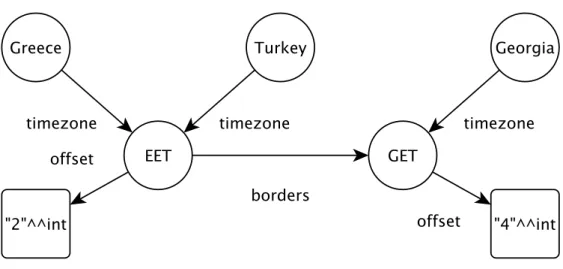
Figure1: Example of Linked Data used for the calender application.
The subject in this triple isTurkey, the predicate istimezone, and the objectEET. The triple can intuitively be understood as having the same meaning as the English sentence"Turkey is in the timezone EET.".
A graph consists of a set of triples. The nodes consists of the set of subjects and objects which are connected with directed edges labeled by the corresponding property. Subject nodes are also known as entities. The following example graph is visualized in Figure1.
Turkey timezone EET . Greece timezone EET . Georgia timezone GET . EET borders GET . EET offset "2"^^int . GET offset "4"^^int .
The last two triples in the example graph demonstrate the use of literal values in the object position: instead of a named node, that refers to an entity, we have a typed literal value. In this case, the type isint and thus values should be inter-preted as integers. The types available in RDFinclude numbers, strings, booleans, dates, time durations, URIs, XML, and others.
Further readings: To deepen your knowledge w.r.t. the formalisms of RDF you may read the RDF specification [98], the RDF primer [107] or the specification for XSD datatype [131]. Relevant concepts we did not introduce are blank nodes, reifi-cation, named graphs and extensible datatypes cf. [36;107].
2.3 u r i s: t h e w o r d s o f t h e l a n g ua g e
The major advantage of a graph-based model is its ability to be merged by simply regarding a merger as a union of the triples in both graphs. Many other models for knowledge representations, like tables or XML files, do not allow such a generic merging. But in order to provide a knowledge representation language that allows these kind of mergers, naming conflicts must be avoided. In contrast to our
exam-10 p r e l i m i na r i e s - a n i n t r o d u c t i o n t o l i n k e d d ata
ple above whereGeorgiarefers to a caucasian country, consider a secondKBabout U.S. states:
Georgia timezone EST . SouthCarolina timezone EST . EST offset "-5"^^int .
Since both Georgias – the caucasian country and the U.S. state – have the same name, we are not able to differentiate between them. Georgia now seems to be both in the timezoneGETandEST!
To avoid this situation, all entities in Linked Data have to be referred to by unique names. To achieve this, the names are given as URIs, most often HTTP URIs (just like websites). The main advantage of URIs is that anyone can register a prefix, and then create a set of new names with this prefix. The owner of the prefix is responsible for the interpretation of the given name. Thus, the country Georgia could be namedhttp://example.org/countries#Georgiaand the U.S. state could behttp://example.org/usstates#Georgia. The basic intuition behind the idea is that everyone can define their own namespace so that naming conflicts can be avoided without constant coordination between different parties.
As URIs can be lengthy, often qualified names (orQNames) are used. They have the form prefix:localName. Prefixes are defined locally to expand to a certain namespace, e.g., in our example we could define that the prefix us refers to the namespacehttp://example.org/usstates#, and thus we could use the qualified name us:Georgia to refer to the complete URI http://example.org/usstates# Georgia.
Further readings: For deeper insights, please refer to the specification of URIs [10] and the URI registration scheme [73]. We did not cover IRIs [54] and other proto-cols besides HTTP, like FTP [133] or URN [152].
2.4 h t t p: d i s t r i b u t e d k n o w l e d g e
The second rule for publishing Linked Data is to use HTTP URIs. HTTP is a widely implemented protocol, that can be used over Internet for accessing resources with a given HTTP URI. For example, the aboveKBcould have the namehttp://example. org/countries. Now a simple HTTP command like
GET http://example.org/countries
will return the KB(it can be tried by entering the URI in a browser, but it is sug-gested for later as the result might be confusing at this point).
All RDF entities are identified by URIs, and the third rule of Linked Data de-mands to return information about the entity identified with a given URI when the URI is being dereferenced via HTTP. This way, the Web can be used as vast knowledge space, where everyone can publish their knowledge about a given en-tity.
Since entities are uniquely identified, we can avoid to publish our own URIs for existing entities. For example, DBpedia is a widely used resource that publishes Linked Data based on Wikipedia’s infoboxes [102]. DBpedia offers URIs for all entities that have a Wikipedia page. For example, Greece’s Wikipedia page ishttp: //en.wikipedia.org/wiki/Greeceand, based on that, DBpedia defines the URI for
2.5 r d f s, o w l a n d o t h e r s: a d d i n g e x p r e s s i v i t y 11
Greece to behttp://dbpedia.org/resource/Greece. When entering the URI into a browser, the browser redirects the user to a Web page about Greece in DBpedia. If a Semantic Web application would have asked, DBpedia (prefix dbpedia) would have returned theRDFdata instead.
So we could replace
countries:Greece tz:timezone tz:EET . with using the DBpedia URI for Greece and get
dbpedia:Greece tz:timezone tz:EET .
Following the second Linked Data rule, we can enhance our knowledge about Greece: the name of the country in different languages and alphabets, its popula-tion, the name of the head of state, etc. Thus, our application can use knowledge from all over the Web.
Instead of simply replacing the URI, in our case we actually state that the URIs refer to the same entity:
countries:Greece owl:sameAs dbpedia:Greece .
Note, properties can be reused from all over the Web. In this case, we use the termsameAsfrom the OWL vocabulary [8] which we will look at in the next section.
One advantage of using the Web as aKBis that much knowledge is already pub-lished, whereas our knowledge bases had information on some countries. Websites like LinkedGeoData [155] or DBpedia offer lists of cities, and information about the countries or states they are located. Regarding cities, the Web already offers the following pieces of knowledge:
dbpedia:Istanbul dbo:country dbpedia:Turkey . dbpedia:Athens dbo:country dbpedia:Greece .
dbpedia:Atlanta dbo:isPartOf dbpedia:Georgia_(U.S._state) .
This allows to reuse the knowledge about cities from the Web of Data in a non-costly manner.
Further readings: For a deeper introduction of the HTTP protocol have a look at the HTTP specification [60].
2.5 r d f s, o w l a n d o t h e r s: a d d i n g e x p r e s s i v i t y
So far we have seen thatRDFallows us to express semantic knowledge via triples. A very powerful method is the use of implicit triples by using more expressive semantics. We have introduced one example already:owl:sameAs states that two URIs refer to the same entity. That is, anything we say aboutdbpedia:Greeceis also true aboutcountries:Greece. We learnt thatdbpedia:Athensis indbpedia:Greece, thus we know that it is also incountries:Greece.
A number of languages are built on top ofRDFand extend it with more expres-sive semantics. We will look at two of them, that are standardized by the W3C: RDFS and OWL.
RDFS allows us to describe class and property hierarchies. For example, we have found on the Web cities connected to countries, resp. U.S. states. The connection
12 p r e l i m i na r i e s - a n i n t r o d u c t i o n t o l i n k e d d ata
to a country was done by using the property dbo:country and to the state by dbo:isPartOf. Now, we can also define that everything that is connected via the former should also be connected through the latter. With RDFS, it is expressed by:
dbo:country rdfs:subPropertyOf dbo:isPartOf .
Now a reasoner that follows the RDFS semantics can infer that
dbpedia:Istanbul dbo:isPartOf dbpedia:Turkey . is true, even though it had never been stated explicitly.
OWL is much more expressive regarding the description of classes and proper-ties. For example, we can state that every city has to be in exactly one time zone or that no entity can be both a U.S. state and a country, which could have helped to discover the error with the two Georgias automatically.
Since RDF allows only triples, more complex statements need to be dissolved into triples. The statement"Every city is in exactly one time zone."translates inRDF to the following four triples:
x:statement1 rdf:type owl:Restriction . x:statement1 owl:onProperty tz:timezone .
x:statement1 owl:qualifiedCardinality "1"^^xsd:nonNegativeInteger . x:statement1 owl:onClass dbo:City .
Although this might seem a bit daunting, in reality these kind of triples are hidden either by more high-level syntaxes (see Section 2.7) or query tools (see Section2.6).
RDFS and OWL can be used together theoretically. However, it depends on the used tools if a given semantics is understood: some reasoners support parts of OWL (so called fragments), some support only RDFS and a very few claim to support interesting combinations of all three languages (including the RIF Rule language), and sometimes beyond.
Further readings: Full formalism can be found in the specifications for RDFS [24], OWL [8], and RIF [20]. We point to the DL Handbook as an entry point into this topic [7]. We also did not mention the different fragments of OWL, RIF, and the differences between OWL and OWL2, which can all be found in detail in the re-spective standards. Besides the languages presented here, other languages like SKOS [115] or WSML [99] exist, that can define other semantics.
2.6 s pa r q l: q u e r y i n g r d f
So far, we have described how to express knowledge: simple facts (withRDF) and more expressive statements that enrich theKB (in the previous section). SPARQL provides a structured query language forRDFknowledge bases.
For example, assume that all the triples mentioned so far are in one graph that can be queried via SPARQL. Assume also that the system providing the SPARQL endpoint interprets the semantics of RDFS, OWL, and RIF. Now we can retrieve the time offset for Athens as follows:
2.7 s e r i a l i z at i o n s o f r d f 13
SELECT ?offset WHERE {
dbpedia:Athens tz:timezone ?tz . ?tz tz:offset ?offset .
}
The system will return as a result the integer2. The web provides us with the data that Athens is a city located in the country Greece. Due to the OWL sub-property triple, we also know that to be in a country means to be part of it. Because of the RIF rule, we can infer that if something is part of something else, it also has the same timezone. Based on this, the following two triples, the first one implicitly, the second given explicitly, are in ourKB:
dbpedia:Athens tz:timezone tz:EET . tz:EET tz:offset "2"^^xsd:int .
A SPARQL query describes a triple pattern (similar to the one in the if-part of RIF), where symbols with a leading question mark are variables. A SPARQL processor now tries to find values for the variables, so that the whole SPARQL pattern can be fulfilled by the KB. The SPARQL processors then returns a list of all possible answers for the selected variables, i.e., in this case for all values that ?offsetcan have so that the SPARQL query pattern matches in theKB. That is, all variables following the introductorySELECTkeyword, in this case?offset.
Given our query pattern, the two triples above are the only match in our KB, and thus the result,"2"^^xsd:int will be returned as the only possible value for ?offset.
SPARQL can be regarded as the main interface for machines to access knowledge on the Web of Data. The usual workflow to query Linked Data is to find and gather trustworthy data from the Web, include some knowledge created for the task or tying together the data from the Web, put it all in one KB, and then use SPARQL to get answers to the queries of interest to the given task. Currently, we observe an upcoming trend of natural language interfaces to provide also laymen the possibility to access the Web of Data without knowing any of the underlying systems, seehttps://www.w3.org/community/nli/.
Further readings: To find out more about SPARQL look at the specification for SPARQL [75]. We did not discuss that SPARQL is not only a query language but also a protocol of how to acccess SPARQL endpoints. We also did not discuss other types of queries:DESCRIBE,ASK, andCONSTRUCT, nor the powerful features of SPARQL to count, do math, regular expressions, named graphs, etc.
2.7 s e r i a l i z at i o n s o f r d f
What is a serialization? In order to provideRDFgraphs through the Web, we need to serialize them in a sequence of tokens. Throughout this chapter, we have used a slightly simplified, triple-based serialization, N3[12]. N3has the advantage, that the triple structure of the graph can be easily inferred. Although, it is widely used, it has the disadvantage of not being standard.
There are a number of serializations of RDF around, mostly due to the fact that the originally standardized serialization in RDF/XML is considered to be not very convenient. Soon, further syntaxes were created, some of them also in XML (like TriX [35]) or in even novel formats like N3and its constrained version
14 p r e l i m i na r i e s - a n i n t r o d u c t i o n t o l i n k e d d ata
N-Triples [71]. Expressions in other languages like OWL and RIF are often hard to translate to RDF (as shown in Section 2.5), and thus introduced serializations of their own, like the OWL Functional Syntax [120], the OWL XML presentation syntax (a serialization of OWL directly in XML, instead of going throughRDF[87]), the RIF syntaxes [20], etc. Lately, JSON-LD became a more prominent serialization format on the Web, and standards to represent the RDF data model in JSON are being worked on [154].
Further readings: If you want to find more serializations have a look at the specifications of RDFa [1], RDF in JSON [154], and RDF/XML [9]. Also relevant is the ongoing conversation between the communities supporting Microformats [14], Microdata [142], and RDFa.
2.8 c o n c l u s i o n s a n d o u t l o o k
RDF is increasingly becoming the standard way to share data on the Web, espe-cially in embedded-HTML formats1
. Using and publishingRDFis not an academic privilege anymore. The flexibility and extensibility ofRDF, along with the possibil-ity to merge arbitraryRDFgraphs, gives it a unique advantage compared to other wide spread data models. The plurality of serializations, especially the ill-received standard RDF/XML-serialization, a over-emphasized focus on OWL, and the de-layed availability of SPARQL hindered the early growth ofRDF. Meanwhile, simple standards, like Microformats and JSON-LD, have received considerable uptake.
The advantages and the availability of Linked Data standards are being in-creasingly recognized. Instead of introducing hundreds of APIs and heteroge-neous formats, one common data model and query language can substantially decrease costs of data integration and data reuse. Thus, recent approaches such as Triplify [6], D2R [16] and SPARQLMap [159] try to built a RDFlayer on top of heterogeneous data sources.
End user interfaces to the Web of Data are still limited. However, the uptake of Linked Data and its combination with novel, powerful natural language tech-nologies – like hybrid question answering, c.f. Part iv – allows the implementa-tion of end user interfaces without the need to know the underlying standards or mechanisms. Thus, laymen and professional users can benefit from the wealth of knowledge rising from the Semantic Web implementation.
Still several practical issues remain unresolved:
• The multitude of serialization formats in practical use combined with the lack of standard formats besides RDF/XML hampers teaching aboutRDFand its uptake.
• For a number of wide-spread use cases, no standards or widely accepted practices exists: how to express numbers with units, especially imperial units? How to express data that was valid at a given point in time?
• The semantics can break down under inconsistencies. There is currently no accepted way to deal with diversity in knowledge bases, even though this will play a crucial role on the Web. This ties in with questions of trust that have not yet been sufficiently tackled: given diverse data about an entity, maybe even contradictions, how to choose which sources to trust?
2.8 c o n c l u s i o n s a n d o u t l o o k 15
The Web of Data, as part of the Web, is getting increasingly tangled with all aspects of our lives. The growing number of intelligent apps and devices in our en-vironment will have an ever-growing need to communicate with each other. Imag-ining a future where our calendar app can support the flight finder app by restrict-ing the departure and arrival times based on our agenda and the locations of our meetings and the airport, has become much easier today than it used to be only a few years ago. Such a future is much easier to achieve when the applications and devices can all communicate in the same common and standard data model, and using the same interfaces.
3
R E L AT E D W O R KThis chapter introduces the state of the art in the research areas related to this thesis. This overview is based on the thesis author’s publications [29;85;88;139;140; 141;166;167;170;168; 169;171;172;173;174]. Especially, theQA survey [85] was co-authored by the author of this thesis.
In this chapter, we give an overview of related research required to bridge the Semantic Gap, i.e., the areas of Resource Description Framework (RDF) type anno-tation, Named Entity Disambiguation (NED) and extraction of semantic data from templated websites, as well as the Evaluation Gap and the Information Gap.
3.1 s e m a n t i c g a p - r d f e x t r a c t i o n
3.1.1 RDF Type Annotation
In2015, the Open Knowledge Extraction Challenge had its first installation at the Extended Semantic Web Conference [127]. As part of this challenge, the goal of the second task was to identify entity types (rdf:typeinformation) given an entity included in a given text and to link this type to a Knowledge Base (KB), i.e., to the subset of the DOLCE+DnS Ultra Lite ontology classes1
.
The winner of the challenge was CETUS [141], a pattern-based approach in-spired by Hearst Patterns [76], presented in Chapter4. The foretold Hearst Patterns match text parts describing hyponym relations between two nouns. In contrast to CETUS’ patterns, the Hearst Patterns have been extracted from a large corpus us-ing a bootstrappus-ing approach. As described in Section4.1, our patterns are defined for matching text parts describing the type relation of a given entity and have been created manually during an iterative, incremental process.
Another approach is FRED [44], which is a machine reader, i.e., a holistic ap-proach towards representing the text asRDF. FRED reuses various frameworks like Boxer [21] and TagMe2 [58] to spot not only the common types like person, orga-nizations and places but also events.
The third challenge participant was implemented by Gao et al. [64]. Their un-supervised system for entity typing is based on a rich feature set, e.g., words, named entities, gazetteer tokens and semantic distance, to identify the type evi-dence string. They match and align the string to DBpedia before transferring this information to the DOLCE+DnS Ultra Lite ontology. For non-matchable entities, the authors compute a semantic distance and match the closest possible type class.
3.1.2 Named Entity Disambiguation
The research area of Information Extraction [121] in general and toNEDin particu-lar. We will briefly present several approaches towardsNEDand highly their novel contributions to the field.
Wikipedia Miner [117] is the oldest approach in the field of wikification. Based on different machine learning algorithms, the systems disambiguates w.r.t. prior probabilities, relatedness of concepts in a certain window and context quality. The authors evaluated their approach based on a Wikipedia as well as an AQUAINT
1 http://www.ontologydesignpatterns.org/ont/dul/DUL.owl
18 r e l at e d w o r k
subset. Unfortunately, the authors do not use the opportunities provided by Linked Data (LD) like DBpedia.
Cucerzan presents an approach based on extracted Wikipedia data towards dis-ambiguation of named entities [48]. The author aims to maximize the agreement between contextual information of Wikipedia pages and the input text. This ap-proach uses only a local algorithm, i.e., is based only document features but not on features present in the document collection.
Ratinov et al. [136] describe an approach for disambiguating entities from Wiki-pedia. They introduce the notion of global approaches, i.e., using information from corpus data such as document context or interlinks. The authors argue that using global approaches improves performance significantly. They discuss that local algo-rithms, which disambiguate each mention separately, e.g., using string similarity, miss important information and thus loose quality.
Kleb et al. [93;92] develop and improve an approach using ontologies to mainly identify geographical entities but also people and organizations in an extended version. Their approaches are based Wikipedia and otherLD KBs.
LINDEN [147] is an Entity Linking (EL) framework that aims at linking identi-fied named entities to aKB. To achieve this goal, LINDEN collects a dictionary of the surface forms of entities from different Wikipedia sources, storing their count information. Using this data the approach constructs candidate lists and assigns link probabilities and global coherence for each resource candidate.
One of the most The AIDA approach [81] forNEDtasks is based on the YAGO2 KB and relies on sophisticated graph algorithms. More precisely, this approach uses dense sub-graphs to identify coherent mentions using a greedy algorithm en-abling Web scalability. Additionally, AIDA disambiguates w.r.t. similarity of con-texts, prominence of entities and context windows.
Another approach is DBpedia Spotlight [112], a framework for annotating and disambiguating LD resources in arbitrary texts. In contrast to other approaches, Spotlight is able to disambiguate against all classes of the DBpedia ontology. Fur-thermore, it is well-known in theLDcommunity and used in various projects show-ing its wide-spread adoption.2
Based on a vector-space model and cosine similarity DBpedia Spotlight is publicly available via a Web service3
.
Ferragina et al. described a revised version of their disambiguation system called TagMe 2 in 2012. The authors claim that it is tuned towards smaller texts, i.e., comprising around 30 terms. TagMe 2 is based on an anchor catolog (<a> tags on Wikipedia pages with a certain frequency), a page catalogue (comprising all original Wikipedia pages, i.e., no disambiguations, lists or redirects) and an in-link graph (all in-links to a certain page within Wikipedia). First, TagMe 2 identi-fies named entities by matching terms with the anchor catalog and second disam-biguates the match using the in-link graph and the page catalog via a collective agreement of identified anchors. Last, the approach discards identified named en-tities considered as non-coherent to the rest of the named enen-tities in the input text.
The approach of Babelfy [119] is multilingual. Based on random walks and dens-est subgraph algorithms Babelfy tacklesNEDand is evaluated with six datasets, one of them the later here used AIDA dataset. Babelfy clearly differentiates between
2 https://github.com/dbpedia-spotlight/dbpedia-spotlight/wiki/Known-uses 3 https://github.com/dbpedia-spotlight/dbpedia-spotlight/wiki/Web-service
3.1 s e m a n t i c g a p - r d f e x t r a c t i o n 19
word sense disambiguation, i.e., resolution of polysemous lexicographic entities likeplay, andEL, i.e., matching strings or substrings toKBresources.
Unfortunately, the approaches are hard to compare and lack repeatability w.r.t. experiments. For a deeper analysis, please refer to Usbeck et al. [174] where we try to improve the comparability of approaches. Furthermore, we present our ap-proach, dubbed AGDISTIS [168], in Chapter5.
3.1.3 RDF Extraction from Semi-Structured Websites and Wrapper Induction
In Chapter6, we present our approach, dubbed REX, towardsRDFextraction from templated websites which relies onNED, see above, and data validation based on automatically extracted axioms [27] and wrapper induction.
First, the extraction of axioms fromKBs using statistical information [27;28] has also flourished over the last years. The main idea underlying these approaches is to use instance knowledge fromKBs, without expressive schemas to compute the axioms which underlie the saidKBs. For further reading, the reader should take a look at the publications mentioned above for an overview of these two research areas.
Second, we have a look at the main research area of REX which is wrapper induc-tion. Early approaches to learning Web wrappers were mostly supervised [62;86]. These systems were provided with annotated pages out of which they infer extrac-tion rules that allow extracting data from other unlabeled pages with the same structure as the annotated pages). For example, Hogue et al. [86] presents Tresher, a supervised system that allows non-technical end-users to teach their browser how to extract data from the Web. Supervised approaches were yet deemed costly due to the human effort needed to annotate the input websites. Thus, unsupervised wrapper induction methods have been explored [4; 46] to reduce the annotation costs. However, the absence of a supervision often lead these systems to produce wrappers of accuracy not suitable for production level usage. Therefore, novel ap-proaches aim to minimize the annotation costs while keeping a high precision. For example, the approach presented by Davi et al. [50] relies on the availability of a KB in the form of dictionaries and regular expressions to automatically obtain training data.
Recently, Crescenzi et al. [47] describes a supervised framework that is able to profit from crowd-provided training data. The learning algorithm controls the cost of the crowd sourcing campaign w.r.t. quality of the output wrapper. However, these novel approaches do not target the generated ofRDFdata.
LDhas been used to learn wrappers to extractRDFfrom the Web in recent years. For example, Gentile et al. [65] exploits LD as a training data to find instances of given classes such as universities and extract the attributes of these instances while relying on the supervised wrapper induction approach presented by Hao et al. [74]. However, they require a manual exploration of theLDsources to generate their training data, which leads to a considerable amount of manual effort.
The Deimosproject [128] is similar to REX, as it aims at bringing to the Semantic Web the data that are published through the rest of the Web. However, it focuses on the pages behind Web forms.
OntoSyphon [109] operates in an ontology-driven manner: taking any ontology as input, OntoSyphon uses the ontology to specify Web searches that identify pos-sible semantic instances, relations, and taxonomic information, in an unsupervised
20 r e l at e d w o r k
manner. However, the approach makes use of extraction patterns that work for tex-tual documents rather than structured websites.
To the best of our knowledge, none of the existing approaches covers all steps that are required to extract consistent RDF from the Web. Especially, only Parun-dekar et al.’s work [128] is able to generateRDFbut does not check it for consistency. In contrast, REX [29] is the first approach that is scalable, low-cost, accurate and can generate consistentRDF.
3.2 e va l uat i o n g a p - b e n c h m a r k i n g s e m a n t i c a n n o tat i o n s y s t e m s
Named Entity Recognition (NER) and EL respectively NED gained significant mo-mentum with the growth of LD and structured KBs. Over the last few years, the problem of result comparability has thus led to the development of more than a dozen datasets and a hand full of frameworks. However, most of the datasets are not freely available, e.g., the full CoNLL2003shared task [158] used in [81]. Others are not yet annotated withLD from DBpedia like the WePS (Web people search) evaluation dataset [5].
Steinmetz et al. [156] describe a statistical benchmark evaluation already in2013. Three datasets are described of which two are freely available4
. The authors ana-lyze the aim of each dataset according to four baseline algorithms and respective underlying dictionaries for NED. Furthermore, the two available datasets,KORE50 andDBpedia Spotlight, are published using NLP interchange format (NIF) [77] and have been part of the original benchmarks of [81; 112]. Both datasets do not inherit a clear license or contain a large number of documents typically needed for optimization problems. KORE50 comprises 50 sentences overall whereas DBpedia Spotlightconsists of58sentences only.
In contrast, N3 provides larger and more insightful datasets, published5
in NIF, to leverage the possibility of optimizing NER and NED algorithms via LD and to ensure a maximal interoperability to overcome the need for corpus-specific parsers. All three datasets contain high-quality, manual annotations of named en-tities which are linked to the DBpedia [102] KB. These datasets have already been used to evaluate [81; 112] as well as [67; 168; 174]. We present N3 in more detail in Chapter7.
Over the course of the last 25 years, several challenges, workshops and confer-ences focused on the comparable evaluation of information extraction (IE) systems. Starting in1993, the Message Understanding Conference (MUC) introduced a first systematic comparison of information extraction approaches [157]. Ten years later, the Conference on Computational Natural Language Learning (CoNLL) started to offer a shared task onNERand published the CoNLL corpus [158]. In addition, the Automatic Content Extraction (ACE) challenge [52], organized by NIST, evaluated several approaches but was discontinued in 2008. Since 2009, the text analytics conference hosts the workshop onKB population (TAC-KBP) [110] where mainly linguistic-based approaches are published. The Senseval challenge, originally con-cerned with classical NLP disciplines, has wided it focus in 2007 and changed its name to SemEval to account for the recently recognized impact of semantic
4 http://www.yovisto.com/labs/ner-benchmarks/ 5 http://aksw.org/Projects/N3nernednif