Graduate Theses, Dissertations, and Problem Reports 2019
Automatic Kinship Verification in Unconstrained Faces using Deep
Automatic Kinship Verification in Unconstrained Faces using Deep
Learning
Learning
Naman KohliWest Virginia University, [email protected]
Follow this and additional works at: https://researchrepository.wvu.edu/etd
Recommended Citation Recommended Citation
Kohli, Naman, "Automatic Kinship Verification in Unconstrained Faces using Deep Learning" (2019). Graduate Theses, Dissertations, and Problem Reports. 3938.
https://researchrepository.wvu.edu/etd/3938
This Dissertation is protected by copyright and/or related rights. It has been brought to you by the The Research Repository @ WVU with permission from the rights-holder(s). You are free to use this Dissertation in any way that is permitted by the copyright and related rights legislation that applies to your use. For other uses you must obtain permission from the rights-holder(s) directly, unless additional rights are indicated by a Creative Commons license in the record and/ or on the work itself. This Dissertation has been accepted for inclusion in WVU Graduate Theses, Dissertations, and Problem Reports collection by an authorized administrator of The Research Repository @ WVU. For more information, please contact [email protected].
Automatic Kinship Verification in Unconstrained
Faces using Deep Learning
Naman Kohli
Dissertation submitted to the
Benjamin M. Statler College of Engineering and Mineral Resources at West Virginia University
in partial fulfillment of the requirements for the degree of Doctor of Philosophy
in
Computer Science Afzel Noore, Ph.D., Chair
Mayank Vatsa, Ph.D. Richa Singh, Ph.D. Victor Fragoso, Ph.D. Keith B. Morris, Ph.D.
Lane Department of Computer Science and Electrical Engineering Morgantown, West Virginia
2018
Keywords: Kinship Verification, Face Recognition, Deep Learning Copyright 2018 © Naman Kohli
Abstract
Automatic Kinship Verification in Unconstrained Faces using Deep Learning by
Naman Kohli
Kinship verification has a number of applications such as organizing large collections of images and recognizing resemblances among humans. Identifying kinship relations has also garnered interest due to several potential applications in security and surveillance and or-ganizing and tagging the enormous number of videos being uploaded on the Internet. This dissertation has a five-fold contribution where first, a study is conducted to gain insight into the kinship verification process used by humans. Besides this, two separate deep learn-ing based methods are proposed to solve kinship verification in images and videos. Other contributions of this research include interlinking face verification with kinship verification and creation of two kinship databases to facilitate research in this field. WVU Kinship Database is created which consists of multiple images per subject to facilitate kinship ver-ification research. Next, kinship video (KIVI) database of more than 500 individuals with variations due to illumination, pose, occlusion, ethnicity, and expression is collected for this research. It comprises a total of 355 true kin video pairs with over 250,000 still frames.
In this dissertation, a human study is conducted to understand the capabilities of hu-man mind and to identify the discriminatory areas of a face that facilitate kinship-cues. The visual stimuli presented to the participants determines their ability to recognize kin relationship using the whole face as well as specific facial regions. The effect of participant gender, age, and kin-relation pair of the stimulus is analyzed using quantitative measures such as accuracy, discriminability index d′, and perceptual information entropy. Next, uti-lizing the information obtained from the human study, a hierarchical Kinship Verification via Representation Learning (KVRL) framework is utilized to learn the representation of different face regions in an unsupervised manner. We propose a novel approach for feature representation termed as filtered contractive deep belief networks ( fcDBN). The proposed feature representation encodes relational information present in images using filters and contractive regularization penalty. A compact representation of facial images of kin is ex-tracted as the output from the learned model and a multi-layer neural network is utilized to verify the kin accurately. The results show that the proposed deep learning framework (KVRL-fcDBN) yields state-of-the-art kinship verification accuracy on the WVU Kinship database and on four existing benchmark datasets.
Additionally, we propose a new deep learning framework for kinship verification in unconstrained videos using a novel Supervised Mixed Norm regularization Autoencoder (SMNAE). This new autoencoder formulation introduces class-specific sparsity in the weight
matrix. The proposed three-stage SMNAE based kinship verification framework utilizes the learned spatio-temporal representation in the video frames for verifying kinship in a pair of videos. The effectiveness of the proposed framework is demonstrated on the KIVI database and six existing kinship databases. On the KIVI database, SMNAE yields video-based kinship verification accuracy of 83.18% which is at least 3.2% better than existing algorithms. The algorithm is also evaluated on six publicly available kinship databases and compared with best reported results. It is observed that the proposed SMNAE consistently yields best results on all the databases.
Finally, we end by discussing the connections between face verification and kinship veri-fication research. We explore the area of self-kinship which is age-invariant face recognition. Further, kinship information is used as a soft biometric modality to boost the performance of face verification via product of likelihood ratio and support vector machine based ap-proaches. Using the proposed KVRL-fcDBN framework, an improvement of over 20% is observed in the performance of face verification. By addressing several problems of limited samples per kinship dataset, introducing real-world variations in unconstrained databases and designing two deep learning frameworks, this dissertation improves the understanding of kinship verification across humans and the performance of automated systems. The algo-rithms proposed in this research have been shown to outperform existing algoalgo-rithms across six different kinship databases and has till date the best reported results in this field.
Dedication
∥जय ी राम∥
Dedicated to,
my parents Kavita and Adarsh,
my sister and brother-in-law Jalaj and Gaurav,
my loving nephew Nevaan,
my paternal grand-parents, Usha and Onkar,
and my maternal grand-parents, Krishna and Satya Pal
Acknowledgements
I would like to take the opportunity to thank the people who I have met during this phase of my career and who have helped me in achieving this doctorate degree. There are many whom I will be unable to mention here but do know, that each and every interaction has helped me in maturing and becoming the person who I am now.
Foremost, I will begin by thanking my advisor Dr. Afzel Noore. I have been blessed to have a Ph.D advisor who has not only provided me with a great atmosphere for conducing research, but who has also shown me how to be a good human being. From the beginning, he considered this a symbiotic relationship where he also wanted to learn alongside me. His support at every step of my Ph.D life including research discussions, freedom to call at anytime and guidance towards my career goals is genuinely appreciated. I would also like to deeply thank my mentors Dr. Richa Singh and Dr. Mayank Vatsa as this Ph.D. degree would not have been possible without them. My interaction with them since my undergraduate days has instilled in me passion for research and I know that I can always count on them for their guidance and support. Their vision and mentor-ship has shaped my life and inculcated in me a deep appreciation for the role of an advisor. I would also like to thank Dr. Keith Morris and Dr. Victor Fragoso for serving in my committee and for their willingness to accommodate me. My summer internship withDr. Keith Morris was a very memorable part of my stay here in Morgantown.
Over the past six years, I have met many people who have provided support in various forms. I want to give my special thanks to my co-authors Maneet, Shruti, Prateekshit, Akshay, Ekampreet and Shivangi who have helped me in growing as a person. I also want to thank Anush, Tejas, Gaurav, Himanshu, Samarth, Rohit, Brian and Soumyadeep whom I have interacted with which has resulted
in broadening my perspective in life. My friends Gaurav and Bisleshana provided a safe and friendly environment for living in Morgantown and I would like to thank them for it. I want to specially thank Daksha who has proved to be a safety belt along this roller coaster ride over the past few years. I have shared my entire Ph.D. journey with her as a lab mate and a friend and her support does not deserve a simple thanks.
Finally, I thank my parents, sister, and brother-in-law whose sacrifices and prayers deserve a special mention. My mother, Kavita, has always backed me to go for what I dream and has always kept a brave face on for me. My father, Adarsh, whose resolute confidence in me has always guided me back to my path. My sister, Jalaj, has been a strength of pillar for me. I could not have reached this stage without their faith in me and their unwavering support. I also want to thank my relatives back in India who have always been considerate and ever ready to provide their guidance.
Contents
Dedication iv
Acknowledgements v
List of Figures x
List of Tables xiii
Publications xv
1 Introduction 1
1.1 Motivation . . . 4
1.2 Relationship with Face Verification . . . 5
1.3 Characteristics and Covariates of Kinship Verification . . . 7
1.3.1 Images in the Wild . . . 8
1.3.2 Age Gap between Kin Pairs . . . 10
1.3.3 Gender Differences . . . 10
1.3.4 Hierarchy in Kinship Verification . . . 10
1.4 Contributions and Dissertation Structure . . . 12
2 Literature and Databases 13 2.1 Image-Based Kinship Verification Research . . . 13
2.1.1 Non-Deep Learning Research . . . 13
2.1.2 Deep Learning Research . . . 18
2.2 Video-Based Kinship Verification Research . . . 19
2.3 Kinship Verification Databases . . . 20 vii
3 Understanding Human Performance for Kinship Verification 24
3.1 Introduction . . . 24
3.2 Experimental Design of the Study . . . 25
3.3 Results and Analysis . . . 27
3.4 Conclusion . . . 32
4 Image-Based Kinship Verification 34 4.1 Introduction . . . 34
4.2 Representation Learning Framework . . . 35
4.2.1 Stacked Denoising Autoencoder (SDAE) . . . 35
4.2.2 Deep Belief Network (DBN) . . . 36
4.2.3 Proposed Filtered Contractive DBN ( fcDBN) . . . 37
4.2.4 Kinship Verification via Representation Learning (KVRL) Frame-work . . . 39
4.3 Experimental Evaluation . . . 42
4.3.1 Datasets . . . 42
4.3.2 Implementation Details . . . 43
4.3.3 Experimental Protocol . . . 45
4.3.4 Results of Kinship Verification . . . 46
4.4 Conclusion . . . 52
5 Video-Based Kinship Verification 54 5.1 Introduction . . . 54
5.2 Kinship Verification using SMNAE . . . 55
5.2.1 Supervised Mixed Norm Autoencoder (SMNAE) . . . 55
5.2.2 SMNAE for Kinship Verification in Unconstrained Videos . . 60
5.2.3 Implementation Details . . . 63
5.3 Kinship Video (KIVI) Database . . . 63
5.4 Experimental Evaluation . . . 65
5.4.1 Video-based Kinship Verification Results . . . 66
5.4.2 Image-based Kinship Verification Results . . . 73
5.4.3 Performance on Existing Databases . . . 75
5.5 Conclusion . . . 75
6 Relationship between Kinship Verification and Face Verification 77 6.1 Introduction . . . 77
6.2 Self-Kinship Problem (Age-Invariant Face Verification) . . . 78 viii
6.2.1 Self-Kinship Experimental Results . . . 78 6.3 Boosting Face Verification using Kinship . . . 80 6.3.1 Experimental Protocol . . . 83 6.3.2 Results of Boosting Face Verification using Kinship as Context 83 6.4 Conclusion . . . 83
7 Conclusion and Future Work 85
7.1 Conclusion . . . 85 7.2 Future Research . . . 86
8 Appendix 88
Bibliography 89
List of Figures
1.1 Common examples of lineal kin relationships. . . 1 1.2 Diverse research areas where kinship has been explored. . . 2 1.3 Illustrating the problem of kinship verification in facial images. . . 3 1.4 Similarities in stages involved in kinship verification and face verification. 6 1.5 Images captured in real-world unconstrained environment. . . 7 1.6 Kin pairs captured in unconstrained environment. . . 8 1.7 Kin pairs can have considerable age gap (a) image of younger child, (b)
image of parent at similar age as child, (c) image of parent at older age. . 9 1.8 Kin pairs can have considerable gender variations due to different kin
relationships. . . 11 2.1 Progression of research in automatic kinship verification: (a) Cornell
Kin-Face [1] database (2010), (b) Family 101 database [2] (2013), and (c) proposed KIVI database (2018). . . 22 3.1 Sample images from databases considered in this research: (a) Vadana
DB, (b) KinFace DB, and (c) UB Kin DB. . . 26 3.2 Sample images demonstrating face regions considered in this research. . . 27 4.1 Two-stage kinship verification via representation learning (KVRL) with
three-level Stacked Denoising Autoencoder (SDAE) approach [3]. . . 40 4.2 Challenges of pose, illumination, and occlusion in multiple images of the
same kin-pair. . . 44 4.3 ROC Curve for Cornell KinFace Database. . . 46 4.4 ROC Curve for KinFaceW-I Database. . . 47
4.5 ROC Curve for KinFaceW-II Database. . . 48 4.6 ROC Curve for UB-KinFace Database. . . 48 4.7 ROC Curve for WVUKin Database. . . 49 4.8 Variations in the performance of KVRL-fcDBN with respect to number
of filters and type of facial regions on the WVU kinship database. . . 51 5.1 Proposed kinship verification framework where two input videos are
di-vided into non-overlapping group of frames (vidlets). For every vidlet, features are learned using the proposed SMNAEs and the final video clas-sification is performed by fusion of all the vidlet pair scores. . . 56 5.2 Proposed three-stage kinship verification in unconstrained videos
frame-work by utilizing mixed norm supervised autoencoder (SMNAE). In the first stage, a pair of videos is split into vidlets which are provided as in-put to stacked SMNAE. The spatial representations learned from the first stage are concatenated in a pairwise fashion and provided to the second stage stacked SMNAE. The third stage learns the kinship-specific represen-tation of the vidlets using stacked SMNAE to encode the spatio-temporal information which is employed as the input to SVM for kin vs. non-kin video classification. . . 59 5.3 Sample kin-pair subjects from Kinship Video (KIVI) face database
com-prising of seven kin-relations. The number of respective kin pairs present in each kin-relations category in KIVI database is also indicated. . . 64 5.4 Video-based kinship verification performance of (a) existing image-based
algorithms using frame level aggregation and (b) proposed framework us-ing 3-Stage existus-ing SDAE, 3-Stage ℓ2,p AE with mixed norm regulariza-tion, and the proposed 3-Stage SMNAEs on the KIVI database. . . 68 5.5 Sample video pairs from kin and non-kin classes which are correctly and
incorrectly classified by the proposed SMNAE framework. . . 69 5.6 Variations across the pivot frame with respect to number of neighbors (z). 70 5.7 Image-based kinship verification performance of (a) existing image-based
algorithms (b) first stage of SDAE, L2,p AE, and proposed SMNAE on still frames of KIVI database. . . 72 6.1 An example of age-progressed pair of images of an individual. This is
also an example of self-kinship as these age-separated face images can be verified using kinship verification algorithms. . . 78
6.2 ROC curves demonstrating the performance of Self-Kinship (age-invariant face verification) using the KVRL algorithm. . . 79 6.3 Humans utilize kinship as a context to identify siblings of famous
person-alities. . . 80 6.4 Illustrating the steps involved in the proposed context boosting algorithm
where kinship verification scores generated from the KVRL framework are used to improve the face verification performance. . . 81 6.5 A probe image can have a match score (s) with an image in the gallery
and a kin score (k) with the associated kin in the gallery to boost the face verification performance. . . 82 6.6 ROC curves summarizing the results of Kinship aided Face Verification
using PLR and SVM. . . 84
List of Tables
2.1 Non deep-learning image-based kinship verification algorithms and databases used in their corresponding research published in the literature. The databases in order are A: Cornell Kin, B: UB KinFace, C: KinFaceW-I and KinFaceW-II and D: Other databases . . . 14 2.2 Deep learning image-based kinship verification algorithms and databases
used in their corresponding research published in the literature. The databases in order are A:Cornell Kin, B: UB KinFace, C: KinFaceW-I and KinFaceW-II and D: Other databases. . . 17 2.3 Video-based kinship verification research published in literature. . . 19 2.4 Summary of kinship databases in the literature. Databases highlighted
have been created as part of this research. . . 21 3.1 Quantitative analysis of human performance on kinship verification. . . . 29 4.1 Characteristics of the five databases used in this research. . . 43 4.2 Kinship verification performance of the proposed KVRL framework on 5
different datasets. . . 46 4.3 Comparing the kinship verification performance (%) of the proposed KVRL
framework with existing kinship verification algorithms on multiple datasets. 50 5.1 Characteristics of the unconstrained KIVI database. . . 65 5.2 Video-based kinship verification accuracy (%) of existing image-based and
proposed kinship verification algorithms on KIVI face database. . . 67 5.3 Video-based kinship verification performance on the seven kin-relations in
the KIVI database using the proposed SMNAE based framework. . . 73
5.4 Image-based kinship verification accuracy of existing image-based and proposed kinship verification algorithms on still frames of the KIVI face database. . . 74 5.5 Kinship verification accuracy (%) of existing and proposed kinship
verifi-cation algorithms on existing kinship datasets. - denotes that the results are not reported in the original paper. . . 74 8.1 Performance of the proposed SMNAE, KLD, and GSAE autoencoders on
MNIST and CIFAR-10 databases. . . 88
Publications
1.
Journal Publications
a) Naman Kohli, Daksha Yadav, Mayank Vatsa, Richa Singh, and Afzel Noore. Supervised mixed norm autoencoder for kinship verification in unconstrained videos. IEEE Transactions on Image Processing, 2018. b) Naman Kohli, Mayank Vatsa, Richa Singh, Afzel Noore, and Angshul
Majumdar. Hierarchical representation learning for kinship verification.
IEEE Transactions on Image Processing, 26(1):289–302, 2017.
c) Naman Kohli, Daksha Yadav, and Afzel Noore. Multiple projective dictionary learning to detect plastic surgery for face verification. IEEE Access, 3:2572–2580, 2015.
2.
Book Chapters
a) David Yambay, Adam Czajka, Kevin Bowyer, Mayank Vatsa, Richa Singh, Afzel Noore, Naman Kohli, Daksha Yadav, and Stephanie Schuckers. Review of iris presentation attack detection competitions. In Handbook of Biometric Anti-Spoofing, pp. 169-183. Springer, Cham, 2019.
b) Naman Kohli, Daksha Yadav, Mayank Vatsa, Richa Singh, and Afzel Noore. Deep face-representation learning for kinship verification. In Mayank Vatsa, Richa Singh, and Angshul Majumdar, editors, Deep learning in bio-metrics. CRC Press, 2018.
3.
Conference Publications
a) Naman Kohli, Daksha Yadav, Mayank Vatsa, Richa Singh, and Afzel Noore. Face verification with disguise variations via deep disguise
nizer. In IEEE Conference on Computer Vision and Pattern Recognition Workshops, pages 1–8, 2018.
b) Daksha Yadav, Naman Kohli, Agarwal Akshay, Mayank Vatsa, Richa Singh, and Afzel Noore. Fusion of handcrafted and deep learning features for large-scale multiple iris presentation attack detection. In IEEE Confer-ence on Computer Vision and Pattern Recognition Workshops, pages 1–6, 2018.
c) Daksha Yadav, Naman Kohli, Ekampreet Kalsi, Mayank Vatsa, Richa Singh, and Afzel Noore. Unraveling human perception of facial aging using eye gaze. In IEEE Conference on Computer Vision and Pattern Recognition Workshops, pages 1–6, 2018.
d) Daksha Yadav, Naman Kohli, Shivangi Yadav, Mayank Vatsa, Richa Singh, and Afzel Noore. Iris presentation attack via textured contact lens in unconstrained environment. In IEEE Winter Conference on Applica-tions of Computer Vision, pages 1–8, 2018.
e) Akshay Agarwal, Daksha Yadav, Naman Kohli, Richa Singh, Mayank Vatsa, and Afzel Noore. Face presentation attack with latex masks in mul-tispectral videos. In IEEE Conference on Computer Vision and Pattern Recognition Workshops, pages 275–283, 2017.
f) Daksha Yadav,Naman Kohli, Shruti Nagpal, Maneet Singh, Prateekshit Pandey, Mayank Vatsa, Richa Singh, Afzel Noore, Gokul Prabhakaran, and Harsh Mahajan. Region-specific fMRI dictionary for decoding face verification in humans. In International Joint Conference on Neural Net-works, pages 3814–3821, 2017.
g) Naman Kohli, Daksha Yadav, Mayank Vatsa, Richa Singh, and Afzel Noore. Synthetic iris presentation attack using iDCGAN. In International Joint Conference on Biometrics, pages 1–7, 2017.
h) Daksha Yadav, Naman Kohli, Mayank Vatsa, Richa Singh, and Afzel Noore. Unconstrained visible spectrum iris with textured contact lens variations: Database and Benchmarking. In International Joint Confer-ence on Biometrics, pages 1–7, 2017.
i) David Yambay, Benedict Becker, Naman Kohli, Daksha Yadav, A. Cza-jka, K. W. Bowyer, S. Schuckers, R. Singh, M. Vatsa, A. Noore, D. Grag-naniello, C. Sansone, L. Verdoliva, L. He, Y. Ru, H. Li, N. Liu, Z. Sun, xvi
and T. Tan. Livdet iris 2017 - Iris liveness detection competition. In IEEE International Joint Conference on Biometrics, pages 733–741, 2017. j) Naman Kohli, Daksha Yadav, Mayank Vatsa, Richa Singh, and Afzel
Noore. Detecting medley of iris spoofing attacks using DESIST. In IEEE International Conference on Biometrics Theory, Applications and Systems, pages 1–6, 2016.
k) Daksha Yadav,Naman Kohli, Prateekshit Pandey, Richa Singh, Mayank Vatsa, and Afzel Noore. Effect of illicit drug abuse on face recognition. In IEEE Winter Conference on Applications of Computer Vision, pages 1–8, 2016.
Chapter
1
Introduction
Kinship refers to sharing of selected genetic characteristics and features between fam-ily members. Some examples of kin relations are shown in Figure 1.1. Kinship verification is the task of judging if two individuals are kin or not. The traditional way to determine kinship in humans uses DNA (Deoxyribonucleic Acid) testing which reveals the similarity of genetic material between two individuals. The result of this technique is highly accurate and is also utilized for locating genetic relatives and gathering family genealogical details. However, this reliable process is intrusive and currently may require several hours for processing. Thus, techniques utilizing DNA for kinship verification cannot be used in situations which require real-time processing or applications where we have non-cooperative users.
Faces are valuable visual stimuli and it has been observed that humans have excellent face processing and cognition skills [4]. Faces can convey ethnicity, gender,
Brother-Sister Sister-Sister Mother-Daughter Brother-Brother
Father-Daughter Father-Son Mother-Son
Figure 1.1: Common examples of lineal kin relationships.
Naman Kohli 2
Anthropology
Psychology
Neuroscience
Computer Vision
Kinship Research
Figure 1.2: Diverse research areas where kinship has been explored.
age, and emotions of an individual. In the real world, kinship can often be estimated by measuring the similarity between facial regions between kin. Thus, it is intuitive to hypothesize if faces can be utilized to automatically determine kinship. In this research, kinship refers to at most one generation direct blood descendants. It has been demonstrated that these descendants share similarities in face structure as well. These similarities have been called familial traits by Hogben [5].
Kinship and its characteristics have been widely studied in diverse scientific dis-ciplines such as anthropology, psychology, neuroscience, and computer vision (as displayed in Figure 1.2). The study of kinship is valuable from various perspectives. Kinship was the central idea of anthropology research for over a century [6]. The research on kinship systems and their anthropological aspect was pioneered by Mor-gan [7] and has gathered significant attention over the years. Looking at kinship from a social perspective, organisms tend to form groups based on kinship relations. There have been several studies that aim to unravel the process of kinship recognition among organisms. This ability is observed across all primates in terms of living in groups, forming bonds with offspring, and recognition of kin [8].
In the domain of psychology, the hypothesis that similarity among human faces can be a cue for kinship was first formulated by Daly and Wilson [9]. Since then, facial similarity/resemblance has been utilized to determine kinship in various research ex-periments [10,11,12,13,14]. In these experiments, participants were presented with the face images and were asked to judge if a kin relationship existed. Maloney and Martello [15] examined the relation between similarity and kinship detection among siblings and concluded that observers look for similarity in judging kinship among children. Martello and Maloney [16] concluded that the upper portion of the face has
Naman Kohli 3
Kin or
Non-Kin
Figure 1.3: Illustrating the problem of kinship verification in facial images. more discriminating power as compared to the lower half in kinship recognition. In a different study, to determine the effect of lateralization on allocentric kin recognition, they concluded that the right half portion of the face is equal to the left half portion of the face [17]. Kaminsky et al. [18] demonstrated that humans can identify kin gen-erations apart with varying success ratio. They also deduced that children resemble their mothers more as compared to their fathers, a result which is also presented in [19] and [20].
Various neurological studies have been conducted to examine the reasons behind the ability of humans to detect genetic relatedness. Lieberman et al. [21] proposed the existence of Kinship Model Index (KIi) which allows humans to detect kin. Kamin-sky et al. [22] established that later-born children are better at kin recognition as compared to first-born which further substantiated the effect of MPA given by [21]. Platek and Kemp [23] performed a fMRI study to investigate the differences among humans between viewing kin-images as compared to other classes of the face. Their findings suggest that the pre-existing facial network learned by humans from their birth is used to discriminate between kin and non-kin with the presence of an estab-lished neuro-cognitive system.
In the field of computer vision, kinship verification research started in 2011 and has gathered enthusiasm from both computer vision and machine learning commu-nities. The focus of the research in this field has been on automatically identifying kinship characteristics from images and more recently, videos. In this dissertation,
Naman Kohli 1.1. Motivation 4 the problem of automatic kinship verification is defined as determining if the indi-viduals in the given pair of media are kin or not. This research area is particularly challenging due to the large intra-class variations among different kin pairs and dif-ferent kin relations. Figure 1.3 showcases the problem of kinship verification where given a pair of images/videos, the objective is to classify it as kin or non-kin. A detailed literature review of the algorithms proposed for dealing with this challenging problem is conducted in Chapter 2.
1.1
Motivation
Automatic kinship verification using facial images has several applications such as locating relatives in public databases, determining the kin of a victim or suspect by law enforcement agencies, screening asylum applications where kinship relationships are to be determined, organizing and resolving identities in photo albums. There are several security aspects of kinship verification where kin of people identified as a security threat can be identified by using an automatic kinship verification framework. Automatically determining kinship information can also be used to boost automatic face recognition capabilities by utilizing the kinship characteristics as soft biometrics.
On the other hand, automatic kinship verification in videos is a relatively un-explored research area and can be highly valuable in diverse settings such as secu-rity, surveillance, and immigration control. For instance, during the investigation of surveillance footage in the Boston Marathon bombing, two male suspects were deter-mined as the bombers. Later, it was established that the two males were brothers which led to their identification. An automatic kinship verification system that de-termines kin in a video could have expedited this investigation. Another application of kinship verification using videos is for border control where surveillance videos can be applied to validate the relationship between an adult and the child, thereby preventing illegal child trafficking.
Additionally, video-based kinship verification can validate or disprove kinship claims of refugees and asylum seekers. Currently, as part of its reunification program, the U.S. State Department conducts DNA testing to allow people who have relatives in the U.S. to enter as refugees [24]. Rapid-DNA is being used for this purpose; how-ever, an automatic kinship verification algorithm can produce cost-effective results in real-time. In these instances, automatic kinship verification can be beneficial in screening possible fraudulent cases in a non-intrusive manner.
Naman Kohli 1.2. Relationship with Face Verification 5 websites such as Facebook and Youtube. According to Wagner [25], in 2016, 500 million people watched Facebook videos every day. In many cases, family members have different Youtube channels where they upload daily videos. Kinship information can be applied for automatically tagging such videos and identifying the kin present in them. Kinship context in videos can also be used for automatic indexing and organization of videos, making them easily searchable.
1.2
Relationship with Face Verification
The problem of kinship verification shares commonalities with face verification. As can be seen from Figure 1.4, the stages of both the frameworks involve similar steps. Both the problems involve binary classification and require an input of two face pair media. A face detection and normalization module are typically involved to detect the face in the images which are used by the feature extraction module. A classifier at the end is used to classify if a face pair is the same subject in the case of face verification, or if it is a kin/non-kin in the case of kinship verification.
Both the problems rely on the presence of similarities in facial regions between the positive pairs. This is easily evident in the problem of face verification where the person in the positive pair is same. It is also observed that kin pairs exhibit similarities in facial regions such as similar jawline or similar eye shape. However, as is evident from Figure 1.4, the positive pairs in the problem of face recognition belong to the same individual. In the scenario of kinship verification, the positive pairs belong to two different individuals that are kin. Thus, there is an implicit challenge in the problem of kinship verification where the individuals present in the face images can have a lot of variations.
Kinship verification can also be considered as a superset of face verification. Face images belonging to the same individual but separated by age-gap would also be considered as kin by an ideal kinship verification algorithm. The problem of age-invariant face verification is called the problem of self-kinship and has been given attention. Additionally, kinship verification framework can also be used in a face verification system by using it as a soft biometric. Corresponding kin of the gallery image can be matched with the probe image to retrieve a kinship verification score, which should be high if the probe image and the gallery image belong to the same individual. The above two scenarios are studied in Chapter 6.
Naman Kohli 1.2. Relationship with Face Verification 6 Ki n or Non Ki n St ag e s of Kin sh ip V e rif ic ation s ys te m Fac e De tect ion Modul e Fea tur e Extr act ion Cl as sifier Sam e or Di ff er en t Sub je ct St ag e s of Face V e rif ic ation s ys te m Face De tecti on Modul e Fea tur e Extr act ion Cl as sifier
Naman Kohli 1.3. Characteristics and Covariates of Kinship Verification 7
Figure 1.5: Images captured in real-world unconstrained environment.
1.3
Characteristics and Covariates of Kinship
Verification
Kinship verification is a challenging research problem due to the lack of standardized experimental protocol in classifying kin in the published literature. At the same time, a small number of images in publicly available datasets lead to difficulties in training deep learning based kinship verification models. Covariates can also affect the performance of any machine learning algorithm and it is important to identify and deal with them. For instance, covariates for face recognition such as unconstrained pose, illumination, and expression can lead to a large increase in intra-class variation and decrease the inter-class separation between different subjects. In this section, we identify four different covariates of kinship verification which makes the problem more challenging.
Naman Kohli 1.3. Characteristics and Covariates of Kinship Verification 8
Figure 1.6: Kin pairs captured in unconstrained environment.
1.3.1
Images in the Wild
As can be seen from Figure 1.5, real-world applications do not have any constraints with respect to the acquisition of the image. The type of face images depends a lot on the acquisition location and user co-operation. In locations such as border control, visa stations can ensure that the acquisition environment of the images is within the measures required for the obligatory applications. However, locations like airports and railways, cannot ensure that the subject image is always captured in the frontal pose with limited illumination and expression variations. Similarly, images acquired of uncooperative users can be difficult to identify as there are no constraints. For law enforcement applications and surveillance applications, images can be acquired in a non-ideal environment with faces captured at long distances, at lower resolution or occluded in certain facial regions.
Face images acquired in controlled conditions are considerably easier to verify as compared to those in uncontrolled conditions. The ongoing Face Recognition Vendor Test by NIST [26] has evaluated many face verification algorithms on controlled visa database and uncontrolled selfie and child exploitation image databases. The current results showcase that systems have higher failure to enroll rate as well as higher non-match rate in uncontrolled databases as compared to controlled databases.
An automated kinship verification algorithm should be able to deal with images that have such wild variations of pose, illumination, and expression. Figure 1.6 show-cases a kin pair where both the subjects have a lot of variation with respect to pose,
Naman Kohli 1.3. Characteristics and Covariates of Kinship Verification 9
(a)
(b)
(c)
Figure 1.7: Kin pairs can have considerable age gap (a) image of younger child, (b) image of parent at similar age as child, (c) image of parent at older age.
illumination and occlusion in terms of presence of glasses and beard. Majority of the algorithms initially proposed for this application considered only controlled face images, acquired in ideal conditions. Therefore, it is important to utilize kinship databases that have such wild variations.
While traditional algorithms have faced difficulty in scaling with such variations, many deep learning algorithms have been proposed in the field of face recognition that deal with such covariates [27, 28,29]. Similarly, newer techniques based on deep learning have been proposed in the area of kinship verification that focuses on learning representations invariant to such variations [30, 31].
Naman Kohli 1.3. Characteristics and Covariates of Kinship Verification 10
1.3.2
Age Gap between Kin Pairs
There can be a considerable age gap between the kin pairs, particularly when verifying individuals from different generations. Figure 1.7 showcases kin images with limited age variation between child[(a)-(b)] and high age variation between parent-child [(a)-(c)]. Parent images utilized in kinship databases are considerably older than their corresponding child images. This can lead to significant textural differences between the two faces, particularly due to aging.
In the literature, it has been shown that faces of parents when they were at the same age as their child share more similarities [32]. Several papers have been proposed which utilize the distribution of young parents to minimize the differences between older parents and younger child. An automatic kinship verification algorithm should be robust against such aging variations and needs to account for such naturally existing contrasts.
1.3.3
Gender Differences
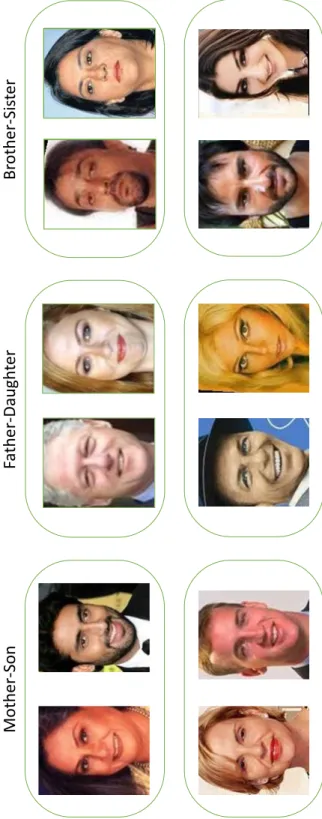
Another covariate of kinship verification is gender as there can be considerable gender differences between the kin pair. This covariate is not present in face verification and thus makes the problem of kinship verification more challenging. As shown in Figure 1.8, mother-son, father-daughter, and brother-sister have different gender variations. These variations increase the intra-class distance between the samples of the positive class.
1.3.4
Hierarchy in Kinship Verification
In this dissertation, kinship has been considered only at a single level, i.e. mother, father and their children. However, facial similarities can also exist if we consider the height of the family tree (such as grandchild-grandfather) or breadth of the family tree (such as cousins and nieces). The problem becomes more difficult as we go away from direct descendants. Thus, the hierarchy of the family tree that we are considering is an important covariate that can determine the performance of the automated kinship verification algorithm.
Naman Kohli 1.3. Characteristics and Covariates of Kinship Verification 11 Mo th er -S on Fa th er -D au gh te r Br ot he r-S iste r
Figure 1.8: Kin pairs can have considerable gender variations due to different kin relationships.
Naman Kohli 1.4. Contributions and Dissertation Structure 12
1.4 Contributions and Dissertation Structure
In this dissertation, we first systematically understand the kinship cues utilized by humans during the task of kinship verification in Chapter 2. Responses are recorded from over 450 individuals and detailed analysis is done to understand the mechanism behind kinship verification. It is observed that females might be better than males in the task of kinship verification. It is also observed that results for kinship verification differ based on the presence of a female in the stimulus shown. The effect of local and global face features is also analyzed and the binocular region is shown to have less significance in kinship verification, unlike face verification.
In Chapter 3, we introduce a novel Kinship Verification via Representation Learn-ing (KVRL) framework, that utilizes filtered contractive Deep Belief Networks to verify kin across facial images. One of the major challenges of kinship verification is limited labeled datasets. Therefore to deal with this issue, we first learn a com-pact representation of a face in an unsupervised manner utilizing over 600,000 images. Then, a multi-layer neural network is trained using the reduced representations for supervised classification of kin and non-kin.
Kinship verification across videos is explored in Chapter 4. A novel supervised mixed norm autoencoder is proposed to learn kinship-specific representation in uncon-strained videos. A pairwise constraint is enforced for better discrimination between kin and non-kin class representation. Spatio-temporal information present in video frames is utilized by creating vidlets and changes with respect to a pivot frame are learned for the final classification. To facilitate research in this area, a large video database termed as KIVI database is created and released to the public for research purposes. It is observed that the proposed algorithm outperforms existing image-based and video-image-based kinship verification algorithms.
Finally, in Chapter 5, the connection between kinship verification and face veri-fication is explored in two case studies. In the first study, we observe that kinship verification is a superset of face verification and analyze the problem of self-kinship. An ideal kinship verification algorithm will give perfect kinship verification accuracy if the input pair of face images belong to the same individual. Thus, the problem of self-kinship is similar to face verification across aging and experiments are conducted to see the performance of KVRL framework in this area. In the second study, we analyze how kinship scores can be utilized as a soft biometric for improving the perfor-mance of face verification. An experiment is designed where KVRL framework is used as a context boosting algorithm for improving existing face verification procedures.
Chapter
2
Literature and Databases
The research in automatic kinship verification started in 2010 and has come a long way since then. Progress has been made in developing databases of larger size and introducing novel deep learning architectures for better kinship verification perfor-mance. The next section will discuss the different research papers in this field and the following will showcase the databases typically utilized for this research.
2.1
Image-Based Kinship Verification Research
The research in image-based kinship verification can be divided into two groups: uti-lizing handcrafted features and utiuti-lizing deep learning based features for classification. Table 2.1 and 2.2 showcase the research progression in the area of image-based kinship verification. The research in kinship verification utilizing facial images was introduced in 2010 by Fang et al. [1]. They collected the first kin face pair dataset, Cornell Kin-Face database. They also proposed an algorithm for facial feature extraction and feature selection for verifying kin pairs. A pictorial structure model with spring-like connections was utilized along with color features, the length between facial parts, and gradient histogram for verifying kin. They demonstrated a kinship verification per-formance of 70.67% on the Cornell KinFace database. Since then, several algorithms have been proposed for detecting kin utilizing different machine learning techniques.
2.1.1
Non-Deep Learning Research
Xia et al. [32] introduced a new publicly available UB KinFace database which con-sists of 200 groups, each consisting of one image of child and parents when they were young and old. An experimental protocol where the negative kin pairs were 13
Naman Kohli 2.1. Image-Based Kinship Verification Research 14 randomly created was discussed. They proposed a transfer subspace method for kin-ship verification where the images of parents when they were young were utilized as an intermediate distribution towards which the images of old parents and images of young children can be bridged. They showed kinship verification accuracy of 60% on the UB KinFace Database. In another paper, Shao et al. [33] used Gabor fil-ters alongside metric learning and transfer subspace learning on the same database. They minimized the distance between true kin pairs while ensuring that the distance between non-kin is greater than a threshold. They reported an accuracy of 69.67% for kinship verification. Xia et al. [34] also employed the above algorithm alongside understanding semantic relevance in the associated metadata to identify kin pairs in images.
Table 2.1: Non deep-learning image-based kinship verification algorithms and databases used in their corresponding research published in the literature. The databases in order are A: Cornell Kin, B: UB KinFace, C: I and KinFaceW-II and D: Other databases
Authors Kinship Algorithm A B C D
Fang et al. [1] Gabor-based gradient orientation
pyramid 3
Siyu et al. [32] Transfer learning 3
Zhou et al. [35] Spatial pyramid based learning 3 Shao et al. [33] Gabor filters with metric
learning 3
Zhou et al. [36] Gabor-based gradient orientation
pyramid 3
Xia et al. [34] Transfer subspace learning based
algorithm 3 3
Kohli et al. [37] Self-similarity representation of
Weber faces 3 3
Fang et al. [2] Reconstruction using parts from
a set of families 3
Lu et al. [38] Multi-view NRML 3
Hu et al. [39] Large margin multi metric
Naman Kohli 2.1. Image-Based Kinship Verification Research 15
Yan et al. [40] Discriminative multimetric
learning 3 3 3
Guo et al. [41] Graph-based approach 3
Yan et al. [42] Prototype discriminative feature
learning 3 3 3
Liu et al. [43] Inheritable Fisher vector feature
based kinship 3
Alirezazadeh et al. [44]
Genetic algorithm for feature
selection 3
Wu et al. [45] Utilized color-texture features 3 3 Yan [46] Neighborhood repulsed
correlation metric learning 3 3 Lopez et al. [47] Chromaticity and color features 3 Xu and Shang [48] Used structured similarity fusion 3 Puthenputhussery et
al. [49]
SIFT flow based genetic Fisher
vector feature 3
Qin et al. [50]
Relative symmetric bilinear model and spatially voted feature selection method
3 3
Zhou et al. [51] Ensemble similarity learning 3 Liu et al. [52] Status-aware projection learning 3 Mahpod et al. [53] Multi-view hybrid distance
learning 3 3
Metric learning approaches involve learning a distance function for a task. Lu et al. [38] proposed a multi-view neighborhood repulsed metric learning approach, where a metric was learned such that kin pairs are closer to each other as compared to non-kin pairs. They also introduced two new databases, KinFaceW-I, and KinFaceW-II for promoting research in automatic kinship verification and developed fixed protocols for these databases. Each pair of images in KinFaceW-I is acquired from a different photo while for KinFaceW-II, is acquired from the same photo.
Yan et al. [40] jointly learned multiple distance metrics on different features extracted from a pair of images. The correlation of different features belonging to the same sample is maximized alongside the probability of kin images belonging together. They showed the performance of their database on four different kinship verification
Naman Kohli 2.1. Image-Based Kinship Verification Research 16 databases.
Yan et al. [42] also proposed a prototype discriminative feature learning algorithm, where mid-level features representing decision values from SVM hyperplane are uti-lized and a metric is learned that minimizes the distances between kin and maximizes neighboring non-kin samples. Experimental results showcase that learning mid-level features achieves better verification performance as compared to the original low-level features. A new ensemble similarity learning metric was proposed by Zhou et al. [51] where a sparse bilinear similarity function was utilized to model the relative char-acteristics encoded in kin images. An ensemble of similarity models was employed to achieve strong generalization ability by learning an ensemble of similarity models from the single feature space and enforcing the diversity on the fused measure space to enhance the robustness of the similarity model to the large intra-class variance of real-world kin data.
Xu and Shang [48] extracted multiple feature descriptor of the input pair of im-ages and learned a sparse bilinear similarity model for kinship verification. They utilized sparsity-inducing norms to ensure that the similarity score of kin is consis-tently higher than that of non-kin. Interactions and correlations between multiview data were leveraged by usingl2 norm on each view and l1 norm between views to
ob-tain the fused and higher-level information. Liu et al. [52] learned two status-specific projections for parent and child respectively ensuring that there is a common compo-nent that connects the two projections. These projections were linear in nature and then the objective changes to making the positive kin pair vectors parallel as com-pared to negative ones. They showed an improved performance on the KinFaceW-I and KinFaceW-II database.
Mahpod et al. [53] introduced a multi-view hybrid distance learning framework for learning a margin maximizing the multi-view image representations. Different feature descriptors were extracted from a single image to create this multi-view representation. Dual discriminative representations were learned for the parents and the children using a margin maximization learning scheme. They utilized Stochastic Gradient Descent in their formulation and showed improved results on three databases: Cornell KinFace, KinFaceW-I, and KinFaceW-II.
Several feature descriptors have been proposed for the problem of kinship veri-fication. Zhou et al. [35] presented a new Spatial Pyramid Learning based feature descriptor (SPLE) for the purpose of kinship verification. They utilized normalized absolute histogram distance and reported a performance accuracy of 67.75% for kin-ship verification on their in-house database. Kohli et al. [37] applied Weber faces
Naman Kohli 2.1. Image-Based Kinship Verification Research 17 Table 2.2: Deep learning image-based kinship verification algorithms and databases used in their corresponding research published in the literature. The databases in order are A:Cornell Kin, B: UB KinFace, C: KinFaceW-I and KinFaceW-II and D: Other databases.
Authors Kinship Algorithm A B C D
Dehghan et al. [57] Discrimination via gated
autoencoders 3
Robinson et al. [58] Fine-tuning VGG network 3 Zhang et al. [30] Deep Convolutional Neural
Networks 3
Li et al. [59] Siamese convolutional neural net 3
Li et al. [31] KinNet 3
Wang et al. [60] Denoising auto-encoder based
metric learning 3
Lu et al. [61] Discriminative deep multi-metric
learning 3
Duan et al. [62] Coarse to Fine Transfer 3 3 3 Kohli et al. [3] Kinship verification via
representation learning 3 3 3 3
for illumination correction and proposed self-similarity based approach for handling kinship variations in facial images. Self similarity descriptor computes the local self similarity cues in an image which is invariant to scale, translation and rotation and thus was applied to measure the similarity between kin pairs vs non-kin pairs.
Zhou et al. [36] also proposed Gabor based gradient oriented pyramid for the problem of kinship verification. Their hypothesis was that gradient-based feature representation methods may be more robust to practical variations existing in real-world images. They utilized SVM classifier to classify if a given pair of images was kin or not. Guo et al. [54] utilized DAISY descriptors along with the product of likelihood ratio for verifying kin. A face image was divided into multiple salient parts and the top three scores across different salient parts between a pair of images were taken into consideration to determine if they are kin or non-kin. Liu et al. [55] proposed a novel inheritable Fisher vector feature which maximizes the similarity between kin pairs while minimizing the similarity between non-kin pairs. They utilized the opponent color space [56] to extract the features and used a novel fractional power cosine similarity measure for classification.
Naman Kohli 2.1. Image-Based Kinship Verification Research 18
2.1.2
Deep Learning Research
Recently, there has been a shift in machine learning algorithms to employ deep learn-ing frameworks if there are large amounts of trainlearn-ing data available. Table 2.2 show-cases deep learning algorithms proposed in the area of kinship verification. Dehgan et al. [57] utilized gated autoencoders to fuse generated features with a discrimi-native neural layer at the end to delineate parent-offspring relationships. Firstly, a generative model utilizing gated autoencoders is used to learn the relation between the input pair of images. Discriminative training follows the generative training to ensure that the model can predict whether the input pair images are kin or not. The results showcase that mother-daughter pair has high facial similarity as compared to father-daughter pair. Zhang et al. [30] utilized facial keypoints to extract 10 im-age patches and created multiple convolutional neural networks. The CNN-Points structure was combined together in the last layer with a fully connected network and softmax activation was utilized at the end to predict kinship. Experimental results showcased the efficacy of using end-to-end deep learning framework as compared to handcrafted features for this research.
A siamese convolutional network approach was proposed by Li et al. [59] to verify kin pair. Separate four convolutional and three pooling layers were used for each input image but the weights were shared between the two networks. A distance metric loss function was utilized to ensure that the distance between kin pairs is smaller as compared to non-kin pairs. Lu et al. [61] developed a discriminative deep metric which maximizes the correlation of different features for face verification and also showed its application on kinship verification. Utilizing k different neural networks, the objective was to exploit the discriminative information from each feature while minimizing the difference between representations learned of one sample across multiple networks.
Robinson et al. [58] utilized the learned VGG convolutional neural network for the problem of kinship verification. Additionally, they also released the largest kinship database, FIW database, that contains images of over 1000 families. They showed that the combination of VGG features alongside PCA gives the best performance. The authors also report the results of family recognition where the objective is to identify the family, input face image belongs to. Li et al. [31] introduced a transfer learning approach where initially a network was trained for face classification and then fine-tuned for kinship verification. Four different residual networks were trained on MS-Celeb database for face recognition and the ensemble was retrained for kinship verification using a soft-triplet loss. They showcased improved results on the Families
Naman Kohli 2.2. Video-Based Kinship Verification Research 19 Table 2.3: Video-based kinship verification research published in literature. Authors Kinship Verification
Algorithm Databases
Dibeklioglu et al. [63] Spatio-temporal features
utilizing facial dynamics UvA-NEMO Smile Dibeklioglu [64] Visual transformation
aided contrastive learning UvA-NEMO Smile Kohli et al. [65]
Framework utilizing Supervised Mixed Norm Autoencoder
KIVI, UvA-NEMO Smile
in the Wild dataset.
Duan et al. [62] introduced a coarse to fine transfer learning framework for kinship verification and showed improvement on three different kinship databases. The initial coarse network is trained on the CASIA-WebFace database for face recognition with 10,575 classes. Importantly, the trained network is finetuned for kinship classification with every positive pair labeled as a separate class on the smaller kinship datasets. Wang et al. [60] introduced a new denoising auto-encoder based metric learning (DML) method for kinship verification in the wild. They utilized an autoencoder to learn a hidden representation by ensuring good reconstruction loss. Additionally, they enforced the constraint that the positive kin images in the hidden space are closer together and tested the framework on Family in the Wild database.
2.2
Video-Based Kinship Verification Research
Video-based kinship verification has a lot of applications particularly in surveillance and border control. Videos can provide more information as they have additional sources of information as compared to single image verification. At the same time, it is challenging to process videos since the faces presented in multiple frames do not have to be aligned to their respective kin frame. Table 2.3 shows the algorithms published in this domain. As seen in the table, research in this field has started slowly due to the lack of publicly available databases. The only database used in this research is by Dibeklioglu; the UvA-NEMO Smile database which was originally created as part of facial expression study.
spatio-Naman Kohli 2.3. Kinship Verification Databases 20 temporal appearance over smile expression to verify kin in videos. Using specific tracked landmarks, displacement signals of eyebrows, eyelids, cheeks, and lip corners are computed and facial expression dynamics are extracted. Alongside these dynamic features, temporal Completed Local Binary Patterns are computed from eyes, cheeks and lip regions. The combination of these features is given to a Support Vector Machine for classification. They achieved an accuracy of 72.89 % on spontaneous smiles.
In another paper, Dibeklioglu [64] introduced a method for learning contrastive mapping of facial appearance of kin pairs. A siamese convolutional encoder-decoder network was trained to reveal resemblance patterns between kin and a contrastive loss is used to enforce kin pairs to be close to each other. Two networks learn trans-formation from kin1 to kin2 and vice versa. Additionally, the frames of the videos are matched to have a similar expression. The authors report that an accuracy of 93.65% was observed on the controlled UvA-NEMO database.
2.3
Kinship Verification Databases
An important factor in stimulating research in kinship verification is the availability of databases. Table 2.4 showcases the existing kinship image and video-based datasets available publicly. As shown in Table 2.4, there are several image-based databases with Family in the Wild (FIW) [58] being the largest. Except for FIW and WVUkin [3], other databases focus on 4 key relationships. Figure 2.1 showcases the progression of kinship research with research initially focused on controlled frontal faces, followed by uncontrolled facial images and unconstrained face videos.
The details of the databases are presented below:
(i) Cornell Kinship [1]: It consists of 286 images pertaining to 143 subject pairs. The facial images in this database are frontal pose and have a neutral expression. (ii) KinFaceW-I [38]: This database consists of 1066 images corresponding to 533
kin pairs. It has 156 Father-Son, 134 Father-Daughter, 116 Mother-Son, and 127 Mother-Daughter kin pair images.
(iii) KinFaceW-II [38]: This database has been created such that images belonging to the kin pair subjects are acquired from the same photograph. It consists of 1000 kin pair images with an equal number of images belonging to the four kinship relationships: Father-Son, Father-Daughter, Son, and Mother-Daughter.
Naman Kohli 2.3. Kinship Verification Databases 21 Table 2.4: Summary of kinship databases in the literature. Databases highlighted have been created as part of this research.
Dataset No. of Subjects No. of Samples Relations Image CornellKin [1] 300 300 4 UB KinFace [32] 400 600 4 KFW-I [38] 1,066 1,066 4 KFW-II [38] 2,000 2,000 4 WVUKin [3] 226 904 7 Family101 [2] 607 14,816 4 TSKinFace [50] 2,589 2,000 4 FIW [58] 10,700 31,000 11 Video UvA-Nemo [63] 152 514 7 KIVI 503 503 7
(iv) UB KinFace [32]: This database consists of 200 groups consisting of 600 images. Each group has one image of the child and one image belonging to the corre-sponding parent when they were young and when they were old. The database has 91 Father-Son, 79 Father-Daughter, 15 Mother-Son, and 21 Mother-Daughter kin pair images.
(v) WVU Kinship [3]: All the above kinship datasets contain only one image per kin-pair and hence are not suitable for face recognition experiments. TheWVU kinship database[3] was developed as part of this research. It consists of 113 pairs of individuals from Caucasian and Indian ethnicity. The dataset has four images per person, which introduces intra-class variations for a specific kin-pair. These multiple images per kin-pair include variations in pose, illumination, and occlusion. It also consists of seven kin-relations:
(1) Brother-Brother (BB): 22 pairs, (2) Brother-Sister (BS): 9 pairs, (3) Sister-Sister (SS): 13 pairs,
(4) Mother-Daughter (MD): 13 pairs, (5) Mother-Son (MS): 8 pairs,
(6) Father-Son (FS): 34 pairs, and (7) Father-Daughter (FD): 14 pairs.
Naman Kohli 2.3. Kinship Verification Databases 22
(a)
(b)
(c)
Figure 2.1: Progression of research in automatic kinship verification: (a) Cornell KinFace [1] database (2010), (b) Family 101 database [2] (2013), and (c) proposed KIVI database (2018).
(vi) Family 101 [2]: The Family 101 dataset contains 101 different families with dis-tinct family names, including 206 nuclear families, 607 individuals, with 14,816 images. The database is particularly useful for family classification where the problem is identifying which family a particular image belongs to.
(vii) TSKinFace [50] : The Tri-subject kinship face database consist of images be-longing to the child, mother, and father. The database consists of 513 images of Father, Mother and Son group and 502 images of Father, Mother and Daughter
Naman Kohli 2.3. Kinship Verification Databases 23 group.
(viii) FIW [58]: The families in the wild dataset consist of 10,700 images belonging to 1000 families.
Research in kinship verification across videos is new and only Dibeklioglu et al. [66] have published papers in that field. One of the reasons for that is lack of avail-ability of a video-based kinship verification database. Previously, there has been one kinship video database, UvA-Nemo [63], which has over 500 videos encompassing 152 individuals and 7 kin-types. The database used was collected for expression-based studies and thus is not suitable for extensive kinship verification in the wild research. As part of this research, KIVI database has also been released consisting of 503 indi-viduals and 355 positive kin pairs. The number of video frames is over 250,000.
Research in any machine learning task requires having good, well-labeled and balanced datasets. Dawson et al. [67] recently concluded that some of the kinship databases consist of kin images coming from the same photograph. This can create issues as the final classifier trained on these images may not be learning kinship characteristics and can learn “same-photo” similarities. Thus, it is our view that kinship verification algorithms can be improved by utilizing large, and difficult kinship verification datasets such as Families in the Wild and KIVI database.
Chapter
3
Understanding Human Performance
for Kinship Verification
3.1
Introduction
In nature, kinship affinities have been observed in many organisms. Taylor and Suss-man [68] studied kinship affinities among Lemur catta and established that several factors such as proximity, grooming, and mating patterns are dependent on kinship among the lemurs. It has been suggested that kin-group characteristics affect the co-operation among the kin through residence and mating patterns [69].
This phenomenon has also been observed in humans where the cognitive process of humans to identify kinship relations and exploration of forming kin-based bonds has been a popular topic of interest. It has been established that humans recognize and rely on kinship affinities that trigger cognitive and social interactions, and family support networks, including an understanding of common genetic diseases for possible medical interventions. Likewise, the bonds between children and mother have been an area of huge interest in the field of psychology and neuroscience [70,71,72]. Moreover, researchers have evaluated the effect of nature vs. nurture [73] and have observed social bonds arising in a specific cultural context. The entire area of new genetics
has brought kinship to the forefront due to the prevailing understanding of disease etiology [74].
In this chapter, a human study is conducted to understand the ability of humans in identifying kin and a thorough evaluation is performed. Several studies have been performed in a similar manner in face recognition literature, to understand the recog-nition capabilities of the human mind. This would help in (a) understanding the
Naman Kohli 3.2. Experimental Design of the Study 25 underlying cues that humans use to identify kin, and (b) integrating these findings in an automatic algorithm to achieve better kinship verification accuracy. Lu et al. [38] have performed a similar human study based on kinship verification. They have focused on the overall kinship verification accuracy and concluded that using context information such as hair and background improves kinship verification.
3.2
Experimental Design of the Study
Amazon MTurk is an online platform specifically designed for aiding research by or-ganizing surveys and collecting results in a comprehensive manner. MTurk allows crowdsourcing and enables researchers to include participants across diverse demo-graphics. It has been shown to provide reliable data as compared to data provided through the traditional means of survey collection and offers a rich pool of partic-ipants [75]. It allows the creation of Human Intelligence Tasks (HITs) for surveys, studies, and experiments which are in turn completed by participants. The partic-ipants receive a reward for completing a HIT if their results are approved by the requester. In this study conducted on Amazon MTurk, a total of 479 volunteers (200 male, 279 female) participated. Among all the participants, 366 were Indians (Mean Age (M) = 33.45 years, Standard Deviation in Age (SD) = 11.67 years), 81 were Caucasians (M = 35.39 years, SD = 10.74 years), 29 were Asians (non-Indians) (M = 28.13 years, SD = 6.93 years), and 3 were African-Americans (M = 30.33 years, SD = 8.17 years).
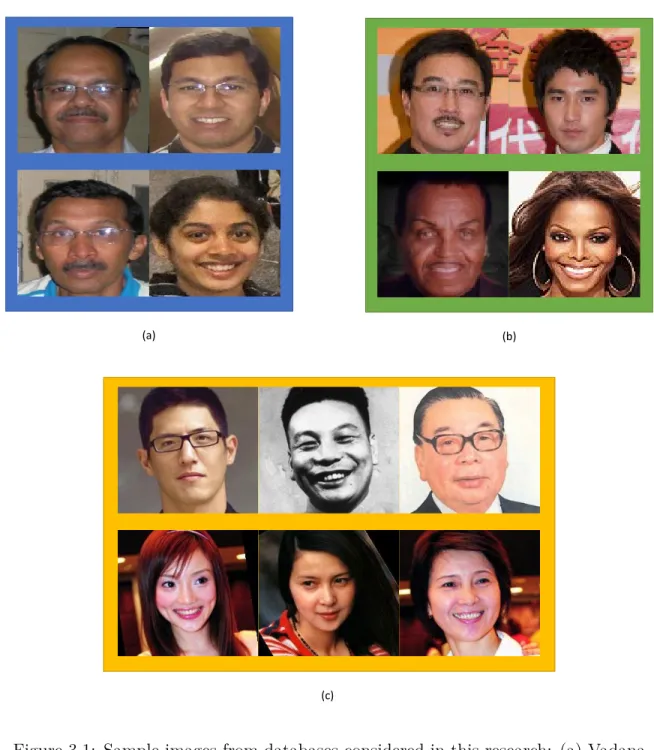
The database used for this human study contains images taken from three databases: Vadana [76, 77], Kinship Verification database [1], and UB Kin database [34, 32, 33]. Figure 3.1 showcases images belonging from these three databases. The database con-sists of 150 kin pairs and 150 non-kin pairs with 39 Sister-Sister (SS) combinations, 36 Brother-Sister (BS) combinations, 35 Brother-Brother (BB) combinations, 50 Father-Son (FS) combinations, 40 Father-Daughter (FD) combinations, 41 Mother-Daughter (MD) combinations, and 59 Mother-Son (MS) combinations. Each participant is shown five pairs of images that are assigned in a random order. The participant has to answer if the pair of images belonging to two different subjects appears to be kin to each other. Additionally, the participants are also asked if they have seen the subjects in the images before. This allows us to evaluate the differences in the responses when the participants are familiar with the stimuli.
Generally, the experiments are performed with full faces, however, it is not nec-essary that the whole face contributes in determining kinship. Therefore, we also
Naman Kohli 3.2. Experimental Design of the Study 26
(a) (b)
(c)
Figure 3.1: Sample images from databases considered in this research: (a) Vadana DB, (b) KinFace DB, and (c) UB Kin DB.
perform the experiments with individual facial regions and the performance of the participants is determined for the following visual stimulus:
1. full face,
Naman Kohli 3.3. Results and Analysis 27 3. not-T region (containing the face with the eye and nose regions obfuscated), 4. lower part of facial image, and
5. binocular region (eye strip).
Figure 3.2 illustrates different facial regions extracted from faces of subjects. The binocular region is chosen to observe the effect of eyes on kinship verification. The T region represents features in the region of the face around the eyes and nose. Fur-thermore, to observe the effect of outer facial regions, not-T region is chosen (which does not have regions that are included in the T region). The lower facial region is included to evaluate a hypothesis stated in an earlier research study [16] which claims that kinship cues are not present in this region.
3.3
Results and Analysis
In this study, we analyze (a) the gender and age demographics of participants, (b) the kinship relation between stimuli, and (c) the discriminative local and global face features that humans rely on to correctly detect kinship.
A quantitative analysis of the data is performed using three independent measures: accuracy of correct kinship detection based on responses from participants, discrim-inability or sensitivity index (d′), and using information theory to compute the kin entropy and non-kin entropy. Discriminability or sensitivity index (d′) is used in signal detection theory to quantify the difference between the mean signal and noise distributions in a given stimulus as perceived by participants.
There is an inherent uncertainty in determining the relationship between stimuli. This uncertainty can be attributed to noise and higher response categories. The stimulus information entropy H(S) and noise in the signal H(S|r) are computed from the confusion matrix using Eq. 3.1 and 3.2 respectively.
Full Face T Region Not-T Region Lower MouthRegion BinocularRegion
Naman Kohli 3.3. Results and Analysis 28 H(S) =− n ∑ i=1 p(Si)log(p(Si)) (3.1) H(S|r) =− n ∑ i=1 n ∑ j=1 p(Si, rj)log(p(Si|rj)) (3.2) I(S|r) = H(S)−H(S|r) (3.3) Here, r refers to the response of participants and S refers to the stimulus. The information entropy I(S|r) is calculated by subtracting the noise in the signal from the stimulus entropy as shown in Eq. 3.3. The information entropy is divided bylog 2 to represent in bits and larger values of the bits determine higher perceptual judgment of the partici



![Figure 2.1: Progression of research in automatic kinship verification: (a) Cornell KinFace [1] database (2010), (b) Family 101 database [2] (2013), and (c) proposed KIVI database (2018).](https://thumb-us.123doks.com/thumbv2/123dok_us/380829.2542118/40.918.190.795.122.715/progression-research-automatic-verification-cornell-kinface-database-database.webp)