2019
Data-driven cyber attack detection and mitigation for
Data-driven cyber attack detection and mitigation for
decentralized wide-area protection and control in smart grids
decentralized wide-area protection and control in smart grids
Pengyuan WangIowa State University
Follow this and additional works at: https://lib.dr.iastate.edu/etd
Part of the Computer Engineering Commons, and the Electrical and Electronics Commons
Recommended Citation Recommended Citation
Wang, Pengyuan, "Data-driven cyber attack detection and mitigation for decentralized wide-area protection and control in smart grids" (2019). Graduate Theses and Dissertations. 17597. https://lib.dr.iastate.edu/etd/17597
This Dissertation is brought to you for free and open access by the Iowa State University Capstones, Theses and Dissertations at Iowa State University Digital Repository. It has been accepted for inclusion in Graduate Theses and Dissertations by an authorized administrator of Iowa State University Digital Repository. For more information, please contact [email protected].
decentralized wide-area protection and control in smart grids
by
Pengyuan (Bruce) Wang
A dissertation submitted to the graduate faculty in partial fulfillment of the requirements for the degree of
DOCTOR OF PHILOSOPHY
Co-majors: Electrical Engineering; Computer Engineering
Program of Study Committee: Manimaran Govindarasu, Major Professor
Ajjarapu Venkataramana Doug Jacobson
Umesh Vaidya Kris De Brabanter
The student author, whose presentation of the scholarship herein was approved by the program of study committee, is solely responsible for the content of this dissertation. The Graduate College will ensure this dissertation is globally accessible and will not permit alterations after a degree is
conferred.
Iowa State University Ames, Iowa
2019
DEDICATION
TABLE OF CONTENTS Page LIST OF TABLES . . . v LIST OF FIGURES . . . vi ACKNOWLEDGEMENTS . . . viii ABSTRACT . . . ix CHAPTER 1. INTRODUCTION . . . 1
1.1 Smart Grid Overview . . . 1
1.1.1 Physical Layer . . . 2
1.1.2 Cyber Layer . . . 4
1.2 Research Objective and Contribution . . . 8
CHAPTER 2. CYBERSECURITY OF WAMPAC IN SMART GRIDS . . . 10
2.1 Cyber Vulnerabilities of WAMPAC . . . 10
2.2 Potential Threats and Attacks . . . 12
2.3 Existing Countermeasures . . . 14
2.4 Challenges and Opportunities . . . 16
2.4.1 Information and Communication Technology . . . 16
2.4.2 Smart Grid and Big Data . . . 17
2.5 Enhance WAMPAC Resilience from New Perspective . . . 20
2.6 Summary . . . 22
CHAPTER 3. MAS BASED ATTACK-RESILIENT SIPS . . . 23
3.1 Problem Statement . . . 23
3.2 Related Work . . . 24
3.3 Overview of SIPS Application . . . 26
3.4 Decentralized SIPS based on MAS . . . 27
3.4.1 SIPS Implementation within Decentralized Architecture . . . 27
3.4.2 MAS Characterization . . . 28
3.4.3 Overall SIPS Design . . . 32
3.5 Data-Driven Anomaly Detection of SIPS . . . 34
3.5.1 Cyber Physical System Operating States Categorization . . . 34
3.6 Adaptive Optimal Load Shedding . . . 42
3.6.1 Optimal Load Shedding via Dynamic Programming . . . 42
3.6.2 Adaptive Load Shedding under Data Availability Attack . . . 43
3.6.3 Agent Consensus Achievement . . . 48
3.7 Evaluation Results . . . 49
3.7.1 Experiment Set-up . . . 49
3.7.2 Anomaly Detection Evaluation . . . 56
3.7.3 Adaptive Optimal Load Shedding Evaluation . . . 59
3.8 Summary . . . 61
CHAPTER 4. CYBER ATTACK DETECTION AND MITIGATION FOR GENERATION CONTROL . . . 66
4.1 Problem Statement . . . 66
4.2 Related Work . . . 67
4.3 Power System Generation Control . . . 69
4.3.1 Primary Control - Governor Action and Load Feature . . . 69
4.3.2 Secondary Control - AGC . . . 71
4.4 Generation Attack Detection based on Semi-Supervised Clustering . . . 72
4.4.1 Behavior Patterns Observed in Frequency Control . . . 72
4.4.2 Generator Behavior and Conformity Metrics . . . 74
4.4.3 Semi-supervised Clustering Aided Multi-Class Classification . . . 78
4.4.4 Overall Detection Process . . . 79
4.5 Generation Attack Detection based on Density Sensitive Clustering . . . 81
4.5.1 Preliminary of Hierarchical DBSCAN . . . 82
4.5.2 Application of HDBSCAN in Divide & Conquer Algorithm . . . 83
4.6 Peer-Assisted Mitigation of ACE Attacks . . . 85
4.6.1 Overall Mitigation Process . . . 86
4.6.2 Random Peer Data Query as Moving Target Defense . . . 87
4.6.3 ACE Computation and Estimation based on Peer Data . . . 91
4.6.4 1-d DBSCAN based Corrupted ACE Replacement . . . 93
4.7 Evaluation Results . . . 93
4.7.1 Experiment Set-up . . . 93
4.7.2 Anomaly Detection Evaluation . . . 94
4.7.3 AGC Attacks Mitigation Evaluation . . . 103
4.8 Summary . . . 105
CHAPTER 5. CONCLUSION . . . 114
5.1 Problems Resolved and Proposed Solution . . . 114
5.2 Future Work . . . 116
LIST OF TABLES
Page
Table 3.1 Multi-class classification algorithms comparison . . . 40
Table 3.2 Power flow of critical tie-lines . . . 53
Table 3.3 Measurements of agents . . . 56
Table 3.4 Algorithms comparison for Agent 25 . . . 58
Table 3.5 Algorithms comparison for Agent 26 . . . 59
Table 3.6 Algorithms comparison for Agent 27 . . . 60
Table 3.7 Algorithms comparison for Agent 28 . . . 61
Table 4.1 Generation information . . . 94
Table 4.2 Instances summary . . . 100
Table 4.3 Centroids of clusters . . . 100
Table 4.4 Test confusion matrix with K-means clustering . . . 101
LIST OF FIGURES
Page
Figure 1.1 Smart grid domains [1] . . . 2
Figure 1.2 WAMPAC in a closed control loop . . . 7
Figure 1.3 Cybersecurity concerns of smart grid . . . 9
Figure 2.1 Holistic dissertation structure . . . 21
Figure 3.1 Power industry SIPS summary . . . 27
Figure 3.2 Peer-to-peer MAS architecture . . . 29
Figure 3.3 Agent actions as FSM . . . 31
Figure 3.4 Data propagation timing-flow among agents . . . 32
Figure 3.5 Agents overall operation flowchart . . . 33
Figure 3.6 Cyber physcial system states . . . 35
Figure 3.7 Algorithms comparison . . . 38
Figure 3.8 SVMLDT model . . . 39
Figure 3.9 Performance comparison . . . 46
Figure 3.10 Load shedding protection scheme . . . 47
Figure 3.11 Load shedding performances . . . 47
Figure 3.12 Load rejection SIPS in WECC . . . 50
Figure 3.13 IEEE-39bus with the load rejection RAS . . . 51
Figure 3.14 Communication topology . . . 52
Figure 3.15 Experiment based on PowerCyber testbed . . . 53
Figure 3.16 Frequency response without load rejection protection . . . 54
Figure 3.17 Frequency response with centralized load rejection protection . . . 54
Figure 3.18 Frequency response under replay attack with centralized load rejection pro-tection . . . 55
Figure 3.19 Accuracy of classification . . . 62
Figure 3.20 Parameter tuning for SVMLDT . . . 63
Figure 3.21 Agents overall operation flowchart . . . 64
Figure 3.22 Algorithm timing performance . . . 65
Figure 3.23 Load shedding results . . . 65
Figure 4.1 Systematic deployment of countermeasures for generation control . . . 70
Figure 4.2 AGC overview . . . 71
Figure 4.3 Balancing and frequency control . . . 73
Figure 4.4 Grouping data based on ACE variance . . . 75
Figure 4.5 Generation control just before AGC operation . . . 76
Figure 4.6 Data collection by sample windows . . . 79
Figure 4.7 Overall flowchart of anomaly detection . . . 80
Figure 4.8 Special case when HDBSCAN is not suitable . . . 84
Figure 4.9 Overall AGC attack mitigation . . . 88
Figure 4.10 IEEE 39 bus model divided into 3 BAs . . . 95
Figure 4.12 Scenario distribution and clustering results with K-means clustering . . . 99
Figure 4.13 Dendrogram of HDBSCAN . . . 102
Figure 4.14 Clustering results with HDBSCAN . . . 102
Figure 4.15 Reputation update based on 1-d clustering . . . 106
Figure 4.16 Reputation when agent 1 under constant ACE attack . . . 107
Figure 4.17 Reputation when agent 2 and 3 under flip ACE attack . . . 108
Figure 4.18 Reputation when agent 2 and 3 under constant ACE attack . . . 109
Figure 4.19 Reputation when agent 1,3 and 4 under constant ACE attack . . . 110
Figure 4.20 Reputation when agent 1-5 under scaling ACE attack . . . 111
ACKNOWLEDGEMENTS
First and foremost, sincere gratitude and thankfulness goes to my advisor Dr. Manimaran Govindarasu for his priceless guidance and advice on my research and career development during the last six years. Dr. Govindarasu has introduced me to THE field. He is always able to wisely lift the bar to the right height in the right time and then successfully persuades me to embrace the challenges. I have learned a lot from him about both research and life, as a student and also as a friend. “Always try to solve real problems” is what he encourages us to achieve and will be my life-long motto.
I really appreciate the valuable feedback from my committee members. More importantly, in another sense, my committee members are also the ones who help lay the foundation of my future career. Dr. Jacobson teaches me cyber security, the way that Dr. Ajjarapu explains the power system stability is so impressive that it will never be forgotten once you remember, Dr. Vaidya makes the non-linear system no longer obscure for me, and Kris shows me the entrance of a magnificent palace made of data. I’m grateful to what I got a chance to learn about in your classes. My family has always been an endless source of support during my PhD time. The encour-agement from my girlfriend, Elsa, is the best cure when I’m in depression. I would not be able to reach this milestone without the company of you guys. I have realized, only recently, that all kinds of difficulties become trivial when you can picture the thing that you really want to chase in your life, and this is especially true for the life with you all being part of it.
Acknowledgement should also be presented to all my group members, especially Aditya and Srayashi, who actively lend their opinions in some really inspiring discussions and always offer great help with peer reviews.
Last but not least, I’m glad that I have developed the addiction to basketball during my PhD and I’m thankful to getting to know all the mates that I’ve met on the courts.
ABSTRACT
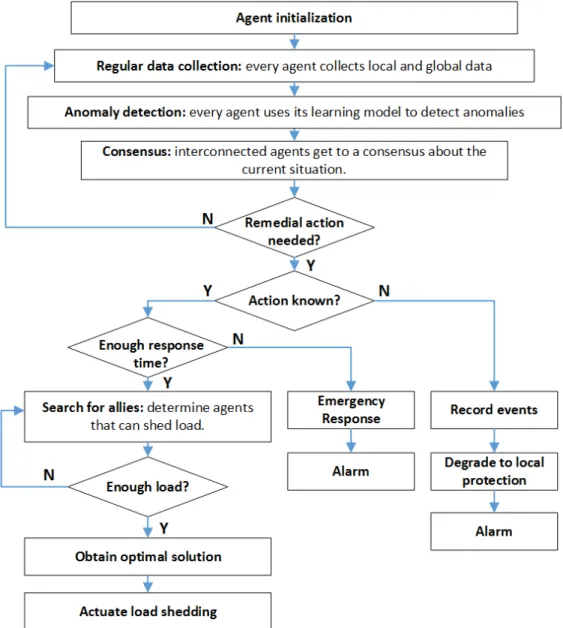
Modern power systems have already evolved into complicated cyber physical systems (CPS), often referred to as smart grids, due to the continuous expansion of the electrical infrastructure, the augmentation of the number of heterogeneous system components and players, and the consequen-tial application of a diversity of information and telecommunication technologies to facilitate the Wide Area Monitoring, Protection and Control (WAMPAC) of the day-to-day power system oper-ation. Because of the reliance on cyber technologies, WAMPAC, among other critical functions, is prone to various malicious cyber attacks. Successful cyber attacks, especially those sabotage the operation of Bulk Electric System (BES), can cause great financial losses and social panics. Appli-cation of conventional IT security solutions is indispensable, but it often turns out to be insufficient to mitigate sophisticated attacks that deploy zero-day vulnerabilities or social engineering tactics. To further improve the resilience of the operation of smart grids when facing cyber attacks, it is desirable to make the WAMPAC functions per se capable of detecting various anomalies automatically, carrying out adaptive activity adjustments in time and thus staying unimpaired even under attack. Most of the existing research efforts attempt to achieve this by adding novel functional modules, such as model-based anomaly detectors, to the legacy centralized WAMPAC functions. In contrast, this dissertation investigates the application of data-driven algorithms in cyber attack detection and mitigation within a decentralized architecture aiming at improving the situational awareness and self-adaptiveness of WAMPAC.
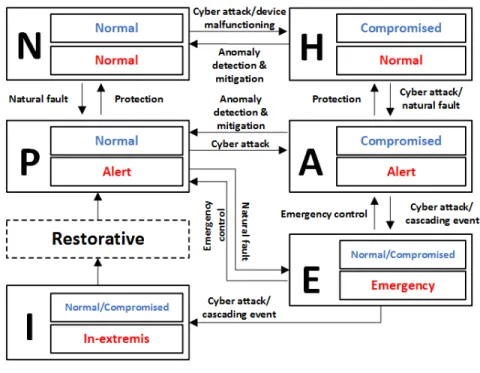
First part of the research focuses on the decentralization of System Integrity Protection Scheme (SIPS) with Multi-Agent System (MAS), within which the data-driven anomaly detection and optimal adaptive load shedding are further explored. An algorithm named as Support Vector Machine embedded Layered Decision Tree (SVMLDT) is proposed for the anomaly detection, which provides satisfactory detection accuracy as well as decision-making interpretability. The adaptive
load shedding is carried out by every agent individually with dynamic programming. The load shedding relies on the load profile propagation among peer agents and the attack adaptiveness is accomplished by maintaining the historical mean of load shedding proportion. Load shedding only takes place after the consensus pertaining to the anomaly detection is achieved among all interconnected agents and it serves the purpose of mitigating certain cyber attacks. The attack resilience of the decentralized SIPS is evaluated using IEEE 39 bus model. It is shown that, unlike the traditional centralized SIPS, the proposed solution is able to carry out the remedial actions under most Denial of Service (DoS) attacks.
The second part investigates the clustering based anomalous behavior detection and peer-assisted mitigation for power system generation control. To reduce the dimensionality of the data, three metrics are designed to interpret the behavior conformity of generator within the same bal-ancing area. Semi-supervised K-means clustering and a density sensitive clustering algorithm based on Hieararchical DBSCAN (HDBSCAN) are both applied in clustering in the 3D feature space. Aiming to mitigate the cyber attacks targeting the generation control commands, a peer-assisted strategy is proposed. When the control commands from control center is detected as anomalous, i.e. either missing or the payload of which have been manipulated, the generating unit utilizes the peer data to infer and estimate a new generation adjustment value as replacement. Linear regression is utilized to obtain the relation of control values received by different generating units, Moving Target Defense (MTD) is adopted during the peer selection and 1-dimensional clustering is performed with the inferred control values, which are followed by the final control value estimation. The mitigation strategy proposed requires that generating units can communicate with each other in a peer-to-peer manner. Evaluation results suggest the efficacy of the proposed solution in coun-teracting data availability and data integrity attacks targeting the generation controls. However, the strategy stays effective only if less than half of the generating units are compromised and it is not able to mitigate cyber attacks targeting the measurements involved in the generation control.
CHAPTER 1. INTRODUCTION
As one of the largest and most complicated artificial critical infrastructures, power girds have been undergoing rapid development and evolution worldwide since Thomas Edison and his company constructed the first direct current power system in New York City in September 1882. Over years, countless unprecedented challenges continually arise and the sophistication of power system planning, operation and maintenance never stops increasing. In the meanwhile, great number of assorted technical innovations have either been adopted by or directly emerged from the power industry. As of now, the modern power systems have already evolved into what is referred to as smart grids, with salient features such as the replacement of fossil energy resources with renewable resources, the bi-directional flow of both the electricity and information and also grid monitoring and control that is “closer” to real-time. Though the ultimate goal of power industry is to deliver the electricity to the customers, reliable and economic power generation, transmission and consumption heavily rely on heterogeneous information and communication technologies (ICT). Therefore, a smart grid is often perceived as a Cyber Physical System (CPS), which comprises a physical layer transmitting the electricity from power plants to load centers and a cyber layer that oversees and manages the operation of the physical layer.
1.1 Smart Grid Overview
According to NIST (National Institute of Science and Technology) [1], a modern power system is composed of the following domains: generation, transmission, distribution, customers, markets, operations and service providers, etc. In general, the operation of every domain relies on various interconnected primary equipment and secondary devices. Electric energy and data flow continually among these domains as depicted in Figure 1.1. The energy grid is often referred to as primary system or physical layer and the communication network and all end nodes connected to it is
Figure 1.1 Smart grid domains [1]
referred to as secondary system or cyber layer. In this context, all the equipment directly involved in the electricity generation, transmission and consumption process belong to the physical layer and all the intelligent electronic devices (IED), networking devices, computers and servers equipped to monitor, protect and control this end-to-end process constitute the cyber layer.
1.1.1 Physical Layer
The physical layer of a power system contains four aforementioned domains: generation, trans-mission, distribution and consumption. The expansion and upgrade of the physical layer never really stops since 1890’s due to the continuous increase in electricity demand. For the last two decades, the physical layer of power systems has become more heterogeneous. Renewable energy farms, Flexible AC Transmission System(FACTS) equipment, High Voltage Direct Current Trans-mission (HVDC), micro-grids, electricity storage and electric vehicles, etc. have been gradually
integrated. Accommodation of these new elements is inevitable and it also brings new challenges for the operation of power systems.
1.1.1.1 Generation
Electricity generation is the process of converting none-electric energy to electricity, which is clean and easy to transmit over long distance. Common resources utilized in generation include hydro power, nuclear, natural gas, coal, wind, solar, geothermal energy, etc. and the energy conversion is usually achieved via different types of turbines and generators.
Traditionally the electricity is generated by large generators at power plants close to the energy sources in order to improve the generation efficiency. Great number of big power plants were built up during 20th century worldwide. As of now, the Three Gorges Dam in China is the largest power plant in the world, which has 34 hydro generating units in total with the maximal capacity as 225,000 MW. Nowadays, the generation of small scales also become attractive such as micro-grids containing roof PV panels and wind turbines.
1.1.1.2 Transmission
Due to the dispersed distribution of energy resources, which are often far from the load center, people have built High Voltage Alternate Current (HVAC) electricity transmission system to deliver the electricity from power plants to customers over long distance. To reduce the energy loss during transmission (i.e. to reduce the line current), electric voltage level needs to be boosted with transformers before electricity gets sent out of power plants. In US, the commonly used AC high voltage levels include 138kV, 230kV, 345kV, 500kV and 765kV. Recently, High Voltage Direct Current (HVDC) transmission is becoming popular because of the progress achieved in power electronic devices manufacturing. The major benefits that HVDC provides include more economic solution of electricity delivery over very long distance compared to HVAC, connecting two AC systems operating at different frequencies, better system stability control, etc. Conventionally, electricity generation and high voltage transmission together is referred to as Bulk Electric System
(BES) and its reliability is of the most importance for the daily operation of power systems since severe disturbances take place in BPS can potentially result in catastrophic blackouts influencing a multitude of customers across a vast region.
1.1.1.3 Distribution
When the electric energy has been sent to load centers, the electric voltage needs to be stepped down in distribution substations. Common voltage levels at the distribution system vary from 4kV to 35kV, some industry customers can be directly connected to this voltage level and for residential and other commercial users, the voltage needs to be further lowered to 120V/220V. Besides, distribution systems allow the direct connection of renewable power plants such as wind and solar farms.
1.1.1.4 Consumption
In the old days, the domain of consumption means nothing but passive loads for power indus-try. But today, electricity consumers has become interactive with the utilities. For example, the Distributed Energy Resource (DER) technology becomes mature so customers can choose to install their own DER generation, which needs to be accommodated properly if they need to be connected back to the distribution system. On the other hand, utilities find that demand response can be adopted as an alternative to improve the reliability and security of system operation other than solely putting more capital investment to strengthen the power grid.
1.1.2 Cyber Layer
Electricity is something that cannot be stored in large amount, and therefore, the balance of generation and consumption needs to be attained in real time. Due to this and also the complexity of the interconnection and interaction within the physical layer, almost every piece of equipment of the physical layer has to be monitored, protected or controlled whenever it is energized. This is where the cyber layer functions come into play.
The cyber layer of a smart grid often comprises Information technology (IT) network and Operation Technology (OT) network. In Figure 1.1, for instance, the market and service provider are both part of the IT network while the “operations” is part of the OT network. In general, the IT network hosts functions such as corporate web server, market functions, cloud functions etc. that are not directly related to the operation of the power grid and it allows public access to a certain extent. In contrast, the OT network functions are more critical in a sense that they directly monitors and controls the day-to-day operation of the power system. IT, OT and public network are typically isolated with firewalls and authentication mechanisms like VPN (virtual private network). Like any others communication networks, the cyber layer of power system contains large number of end nodes, routing devices and communication channels. End nodes in this layer include IEDs (such as phasor measurement units, smart meters, relays), data pre-processing modules (like remote terminal units, phasor data concentrators), decision making scheme modules, etc. End nodes have to gather, report and exchange data/information with each other to achieve certain pre-designed functions.
The geographic span of the communication in cyber layer is determined by the needs of various functions. But in general, system wide communication is getting more and more popular so as to facilitate the function realization and improve the speed of operations. The two most critical wide area communication systems in smart grids are Supervisory Control and Data Acquisition (SCADA) system and Wide Area Measurement System (WAMS).
1.1.2.1 SCADA
SCADA is widely used for industrial automation system’s monitoring and control. In power system, each station has a Remote Terminal Unit (RTU) that gathers data from the local secondary devices such as transducers, sensors and meters. SCADA collects data from RTUs located at different stations and transmits them to the control center via wide area communication every a few seconds. Applications including State Estimation (SE), Automatic Generation Control (AGC), economic dispatch, contingency analysis, wide area protection and control schemes, etc. utilize
those data to monitor the operation status of power system, decide the necessary controls to launch and then send control commands back to RTUs and close the control loop. The communication protocol commonly used in SCADA system by North American utilities is DNP3, and the version that is widely used still lacks security features such as encryption or authentication.
1.1.2.2 WAMS
With the advent of Phasor Measurement Unit (PMU) and synchronized measurement technol-ogy, Wide Area Monitoring System (WAMS) emerges as an alternative to SCADA, which collects data at a much higher sampling rate and so that many applications can potentially be realized close to real time [2]. The typical sample rate in WAMS is 30, 60 or 120 samples/second. With all PMUs being synchronized to the same time source, GPS for instance, WAMS has the access not only to the voltage or current magnitudes, it can also measure the relative phasor angles directly. WAMS is often constructed in a hierarchical architecture, where Phasor Data Concentrators (PDC) at dif-ferent levels will first concentrate the data from PMUs and then forward the processed data to the control center. Nowadays, applications developed based on WAMS are mainly for monitoring, such as transient instability detection and linear state estimation. Wide area protection and controls based on WAMS data are also under development. More and more applications will be put into use when the data accuracy of WAMS gets further improved. North American Synchrophasor Initiative (NASPI) has showed a road map about the application of synchronized measurement technology in 2006 [2]. IEEE C37.118 is often adopted as the communication protocol in WAMS.
1.1.2.3 Wide Area Monitoring, Protection and Control
A group of critical functions, referred to as Wide Area Monitoring, Protection and Control (WAMPAC), exists in the cyber layer of smart grid, which help maintain the secure, reliable and economic operation of the smart grid. WAMPAC functions collect wide area measurements cyclically to attain a system-wide profile of the grid operation state, based on what coordinated and economic controls can be determined and performed appropriately. Common WAMPAC functions
Figure 1.2 WAMPAC in a closed control loop
include System Integrity Protection Schemes (SIPS, also known as remedial action schemes, system protection schemes, etc.), functions encompassed by the Energy Management System (EMS) such as State Estimation (SE), Automatic Generation Control (AGC), Optimal Power Flow (OPF), real time contingency analysis, etc. and those rely on WAMS, which include phase angle monitoring (PAM), power oscillation monitoring (POM), power damping monitoring (PDM), voltage stability monitoring (VSM), and dynamic line rating, etc. [3]
Wide area monitoring is responsible for data collection from geographically dispersed stations and it is capable of identifying disturbances and contingencies such as inter-area oscillation. Be-yond operation monitoring, wide area protection and control checks the grid operating state against predefined conditions and then determines the most appropriate remedial actions or control activ-ities. The protection or control actions will be triggered so as to alleviate undesirable operation conditions such as system oscillation and continuous frequency deviation, etc.
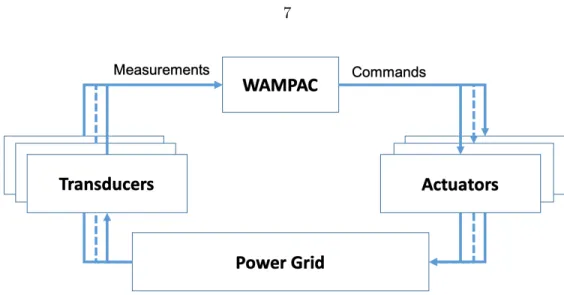
Figure 1.2depicts the WAMPAC as a closed control loop. The three major actions included in the operation of WAMPAC, i.e. measurement collection, decision making and command launch-ing, heavily rely on ICT. High speed networks and modern communication protocols ensure that the measurements and control signals get delivered in time to meet the operation requirements of critical infrastructures. The SCADA and WAMS systems introduced previously both rely on the telecommunication to interconnect substations and control center involved in the WAMPAC.
Similarly, high speed processors and efficient data processing algorithms adopted in the EMS and other standalone WAMPAC modules guarantee the wide area protection and control decisions can be achieved accurately and efficiently. After data analysis, the required control commands will be sent from control center to distributed substations for actuation through the same telecommunica-tion networks. Every link in the closed-loop of WAMPAC needs to stay flawless to guarantee the satisfactory efficacy of the entire function. Since WAMPAC directly interacts the operation of the power grids, its malfunction can be catastrophic.
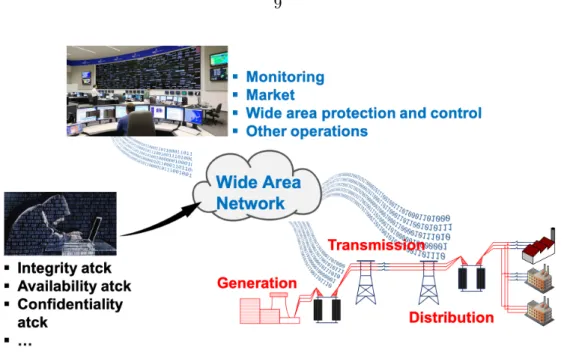
The wide deployment of ICT has greatly facilitated the management of the smart grids by enabling the implementation of WAMPAC. However, the cyber layer risks also become a great concern recently. Cyber security didn’t get as much attention as the reliability in most critical infrastructure such as the power sector in the past. The main purpose of deploying ICT was to speed up the data transmission so that the timing critical WAMPAC functions don’t get deteriorated because of latency. Therefore, we can find that the protocols used for smart grid communication often lack encryption or authentication mechanisms and many IEDs and station gateways are even directly connected to the internet. Such breach of cyber security results in the exposure of critical infrastructure to all types of cyber threats as shown by Figure.1.3. The cyber security of WAMPAC in a smart grid will be elaborated in chapter II.
1.2 Research Objective and Contribution
Considering the reliance of the operation of smart grids on ICT and the importance of WAMPAC, this dissertation selects wide area protection and wide area control functions as study objects and investigates the cyber attack detection and mitigation through architecture and function redesign so that the situational awareness, self-adaptivenes and hence the cyber attack resiliency of these critical functions get enhanced. The major contributions are listed as following.
• Wide area protection (Chapter III)- A novel Multi-Agent System (MAS) based
protec-tion architecture is adopted in the implementaprotec-tion of a load shedding protecprotec-tion scheme. A data-driven attack detection algorithm with good interpretability named as Support Vector
Figure 1.3 Cybersecurity concerns of smart grid
Machine embedded Layered Decision Tree (SVMLDT) is proposed. Besides, an adaptive op-timal load shedding strategy is designed to mitigate the impacts of Denial of Service (DoS) attacks.
• Wide area control (Chapter IV) - A station-level anomaly detection module based on
clustering is proposed for the generation control, which mainly depends on the behavior cor-relation among peer generators. To counteract the malicious attacks targeting supplementary generation control, a peer-assisted control signal estimation algorithm is presented which ad-dresses the compromised control commands by replacing them with estimated control values based on the information received from the peers with “good reputation”. The proposed solution can serve as a countermeasure to data availability and integrity attacks targeting the generation control commands.
CHAPTER 2. CYBERSECURITY OF WAMPAC IN SMART GRIDS
Although the advancement of ICT and its application have facilitated the WAMPAC functions’ realization and improved the overall efficiency of operation and maintenance of power grids, the deployment of off-the-shelf commercial ICT solutions also results in the cybersecurity issue. This chapter overviews the cybersecurity vulnerabilities and threats existing in smart grids, briefs the available countermeasures, and then discusses the opportunities to enhance the cybersecurity of critical grid functions - WAMPAC.
2.1 Cyber Vulnerabilities of WAMPAC
Cyber security was not a major concern during the WAMPAC design twenty years ago or even later, when non-digital end-to-end copper cables were still widely used in substation communication and “security through obscurity” worked well so that not many cyber attack trials were observed or reported. When people started to resort to digital WAMPAC solutions based on ICT, vendors still used to focus on improving the availability and reliability of these functions, without fully considering the potential impacts resulted from cyber disturbances. Therefore, as a legacy, most WAMPAC functions in today’s power industry lack the necessary security mechanisms and therefore are vulnerable to cyber attacks.
• Public network connectivity: Physical segregation of the IT and OT networks in
power sector is inconvenient and also expensive. To reduce the implementation cost, it’s not rare that utilities choose to leverage public accessible networks (Internet) to realize the data/information transmission involved in WAMPAC [4]. Most of the cases, the corporate networks of utilities (IT networks) are connected to the Internet such that the third party service providers and consumers can access the data and information that are intentionally shared with them. In the meanwhile, the OT network is connected to the IT network such
that the operators can have the remote access to the grid control system. Although the IT and OT networks are often separated with DMZ (Demilitarized Zone) as a way of isolation, the adversary still possess various means to infiltrate into the OT network by bypassing the authentication or ingress filtering mechanisms provided by the DMZ. For instance, the con-nection can be established with the socket request initiated from the OT network or the leakage of the remote access credentials to the OT network from an IT domain workstation. The integration and overlap between the IT and OT networks provide the attackers with po-tential chances to gain the access to the critical OT functions [5]. When the attacker finds his foothold in the OT network, he is able to access the sensitive data, alter critical information and even manipulate the settings of digital devices, etc.
• Communication protocol: Most communication protocols used today in power industry
like Modbus and DNP3 do not provide security measures. The lack of data encryption and authentication makes it possible for the threat actors to alter, intercept and spoof the data in transmission. Data theft leads to privacy concerns, and even worse, the adversary can exploit the vulnerabilities of the communication protocol to launch data integrity attack so as to cause malfunctioning by sending erroneous data or command signals to the WAMPAC functions or the actuators involved.
• IT and OT devices: The components that constitute the IT and OT networks in power
system include software, computer operating systems, IEDs, routing devices, etc. Well-known vulnerabilities of these components can be directly exploited by the attackers, and it is also not difficult for the adversary to attain the same devices or software and then find out the zero-day vulnerabilities through comprehensive testing. Trojan and virus can be delicately designed and launched to compromise those components.
• Supply chain: The vulnerabilities embedded in the supply chain also leave the adversary opportunities to carry out attacks targeting the down streaming applications. Sometimes it is relatively easier to target the vendors than directly intrude into the power system OT network.
The control access and the anomaly detection tools of the vendors are often less secure since they are not directly running the critical infrastructures. For example, backdoors can be injected into the WAMPAC software before they are brought online in the power system.
• Function design: Most WAMPAC functions are designed without fully considering the
functional robustness or resilience, such that whenever all the defensive strategies fail, it costs the adversary nothing to disable or manipulate the WAMPAC at his will.It is desirable that WAMPAC functions can stay attack-resilient itself to a certain extent and this will serve as the last line of defense.
• Human: Last but not least, human employees often turn out to be the most vulnerable link of the security chain [6]. Careless or disgruntled employees might cause great damage either indirectly or intentionally, since they may possess the privilege to access critical data base or WAMPAC configurations and setting, etc.
2.2 Potential Threats and Attacks
Various cyber threats exist in today’s smart grid [5]. Cyber threats could potentially arise from individual hackers, industrial spies, terrorists and hacktivists, nation-state affiliated adversary, and even discontented employees [7].
In general, the goal of the attackers is to interrupt the WAMPAC system by sabotaging three things: confidentiality, availability and integrity. For traditional IT sector, confidentiality is the most recognized concern since people worry about private data/info leakage and financial loss be-cause of data theft. But for the operation of critical infrastructures like a power system, availability and integrity are more critical. Most potential threat actors aim at compromising the availability and integrity of WAMPAC systems to degrade the system reliability.
A vast amount of cyber attacks targeting smart grid are happening every day, but most of them do not actually result in damages and are not reported in public. PJM Interconnections former CEO, Terry Boston, once mentioned that “the utility experiences 3,000-4,000 hacking attempts
every month [8]”. Out of so many attacking trials, a few indeed succeed. On Dec 23, 2015, a cyber attack took place in the Ukraine power grid after a 6-month-long reconnaissance and the attackers successfully disconnected 30 distribution substations for about 3 hours causing significant outages to 80,000 customers [9]. Dec 17th, 2016, another Ukranian transmission substation was disconnected from the grid by a new malware called CRASHOVERRIDE and this caused 200 MW loss of load. A couple of real cyber attacks were seen by other critical infrastructures, and researchers agree that the similar tools can be utilized against power girds too [4]. Stuxnet is a malware developed in 2005 to target Industrical Control System (ICS) SCADA systems and it reprograms ICS PLCs specifically to compromise the system control capabilities. It shows a high level of sophistication and stealth - 4 zero-day exploits are embedded and has becomes widely known after taking down 1/5 of Irans nuclear centrifuges via SIEMENS PLC devices [10]. Stuxnet was distributed through unauthenticated USB drives, while sophisticated virus and malware can also be delivered to the targets via social engineering tactics in order to infiltrate and take over the OT network [9]. In 2017, a malware named as “Triton” was used to shut down a petrochemical plant in Saudi Arabia and the target of the malware is the security instrumented systems Triconex from Schneider [11].
Except for the limited number of real attacks that have been publicly reported, different research efforts help identify the potential risk when critical power system functionality is under malicious cyber attacks [12]. Liu et al. have investigated the impacts of switching attack from the perspective of system stability [13, 14]. Cyber attacks targeting WAMPAC are identified, implemented and analyzed on hardware-in-the-loop testbeds [15, 16, 17, 18] and it was demonstrated how malicious attacks could potentially cause severe reliability and stability impacts through the experimental studies.
For most of the cyber attacks targeting on WAMPAC of smart grids, the attacks can be cat-egorized into three types according to the initial targets in the context of the closed control loop shown in Figure1.2.
• Backward path attack,i.e. measurements attack. The adversary can cause the WAMPAC
achieved either locally by tampering the the sensors or manipulating the data along the telecommunication routes with means such as Man-in-The-Middle attack (MITM). This type of attack can be detected and mitigated by countermeasures available in the control center such as centralized anomaly detection, bad data detection adopted in state estimation and other redundant data based cross-checking methods, etc.
• Forward path attack,i.e. control signals attack. If the attacker knows that the manipulated measurements are likely to be detected in control center, he might turn to the control signals seeking for better luck. For example,Area Control Error (ACE) transmitted from control center to generating stations can be changed in the WAN by MITM attack too, and not like control center, when a power plant receives an erroneous ACE value, it is much more difficult for it to detect that due to the lack of a global view.
• Direct control. Although rarely happens, potentially the adversary does have a capability to control the grid operation at will if he is able to intrude into a control center or a substation and attains the necessary control privilege. Equipment damages will be easily induced like what has been demonstrated by Idaho National Lab with the Aurora attack [19].
2.3 Existing Countermeasures
Except for cyber vulnerability, threat and risk assessment or the system restoration strategy design that serve as tactics to improve the system preparedness when facing cyber attacks [20, 21], three types of countermeasures that people often resort to as efforts to secure the critical smart grid functions like WAMPAC include adoption of conventional IT security solution, best-practice regulation, and attack resilient function design.
Conventional IT security solutions such as communication network segregation, multi-factor authentication, cryptography and IT domain IDS (intrusion detection system) and IPS (intrusion prevention system) are widely adopted as countermeasures to potential cyber attacks [22, 23, 24, 25, 26]. More secure communication protocols are developed [23, 24] for industrial control systems
that bring security features such as authentication, packets encryption, etc. Similar to trying to protect an infant from a wolf with the most solid shield, the IT domain security solutions help cover the sensitive data and components of the power grid and make it more difficult for the adversary to obtain access to those assets. Such defensive actions seek to secure the operation of power grid by pinpointing and defending every vulnerability, but unfortunately no system stays flawless. Besides, even a secure periphery is not enough to stop a disgruntled insider or the adversary who possesses tremendous resources and tactics.
Different institutes, such as North American Electric Reliability Corporation (NERC) and Na-tional Institute of Science and Technology (NIST), have made best-practice standards as mandatory compliance or recommendations for power system participants to follow [27, 28]. NERC is desig-nated by FERC and has been working on Critical Infrastructure Protection (CIP) standards posed as enforceable regulations for bulk electric systems (BES) [28]. NERC CIP 6 covers the topics as following:
• CIP-002-5.1aBES Cyber System Categorization
• CIP-003-6Security management controls
• CIP-004-6Personnel and training
• CIP-005-5Electronic security perimeters
• CIP-006-6Physical security of BES cyber systems
• CIP-007-7System security management
• CIP-008-5Incident reporting and response planning
• CIP-009-6Recovery plans for BES cyber systems
• CIP-010-2Configuration change management and vulnerability assessments
• CIP-014-2Physical security
The “Framework for Improving Critical Infrastructure Cybersecurity” proposed by NIST results from Cybersecurity Enhancement Act of 2014, and it is supposed to be “voluntarily adopted” by critical infrastructure owners [29]. This framework suggested put emphasis on the business drivers which can help the utilities secure their assets and it also advise to incorporate the cybersecurity risk into the risk management process.
Cyber security of the power system can be highly improved but again the regulation cannot cover all possible attack vectors and such that it is not able to help when facing unprecedented zero-day exploits. Recently, the idea to make WAMPAC functions themselves situation-aware and self-adaptive to achieve better cyber resilience has become attractive. Under the dome of this philosophy, the WAMPAC functions do not have to stay uncompromised all the time, but if they have the knowledge to properly deal with known or unknown situations where cyber attack occurs, its resilience will be significantly improved. Exploration in this work is mainly conducted towards this direction.
2.4 Challenges and Opportunities
History has proved that the advent of any technical innovations can become a two-edged sword. This is also true in terms of applications of ICT and big data technologies in smart grid.
2.4.1 Information and Communication Technology
Before power industry observed the advancement of information and communication technology at the beginning of 21st century, most of power plants and substations in the power system uti-lized analog devices and communication channels to monitor and control the grid operation. The efficiency of power system operation, control, maintenance and restoration is low back to that time and the capabilities of these functions are very limited too. Later on, with the progress in the IT domain, application of assorted ICT technologies becomes popular in the power industry and power systems start to enjoy many benefits like wide-area data acquisition, highly efficient and accurate
data processing, and automatic control of the system at much lower cost and evolve towards today’s “smart grid”. Market, PMU/WAMS, demand response, highly integrated renewable energy control and many other ancillary services are all representatives of successful application of ICT in power systems, and none of them can be realized without the high speed communication and information processing techniques. However, in the early days of applying ICT, the first priority in function design is the functionality and reliability rather than security, which renders the power systems no longer immune to cyber threats, as one of a few undesirable side effects along with all the benefits. Pros and cons are obvious for the ICT application in power industry, and apparently it is not possible to go back and remove ICT from power systems in order to rid the cyber issues. ICT has become an integral part of the smart grid. To the opposite, we should explore how to better apply the ICT to reduce the cyber issues it brought in the first place.
Though digital intelligent devices and optic fiber have replaced the analog transducers and copper cables, the communication pattern in today’s “smart grid” does not differ much from its predecessor. The control center still plays as a master among slaves (substations) in most inter-connected power grids. The intelligence and capabilities of the substations are limited, not by the technology but rather by the conservative attitudes to improve. The cost of ICT application keeps decreasing nowadays and the utilities do have the ability to construct their own communication infrastructure. Some utilities are even helping the rural areas with their broadband Internet access [30]. Nothing really stops a substation from being constructed in such a way that it possess high intelligence and autonomy and also the capability of peer-to-peer communication. This will be especially beneficial to improve the attack resilience of smart grid. But this time, cyber security has to be surely encompassed when applying ICT.
2.4.2 Smart Grid and Big Data
Daily operation of smart grids creates a vast amount of data that include equipment operating status, bus voltages, transmission line power flows, and load levels, cyber events logs, etc. These data, at least part of them, is required to be stored for future usage such as post event analysis
because of the valuable information is underlying. Recently, only around 2 percent of the data get utilized [31]. How to incorporate these data poses great challenges to the power system designer. A power system needs to engineered in such a way that it is able to deal with big data efficiently including mining the valuable information out of the raw data with appropriate data processing methods. Such capabilities could be leveraged to assist the development of various applications such as visualization and anomaly detection. Big data can be characterized in terms of four “V”s - i.e. volume, variety, velocity and veracity and these four facets should be fully considered when trying to develop a data-driven function.
• Volume: Like many other industrial critical infrastructures, power system operates contin-uously 24-7 and thus the sample measurements easily accumulate. For example, the second-level power consumption data of all homes in New York State within a day could be 127.1 TB [32]. The PMU data generated by US power industry only can be up to 7.5 petabytes per month [31].
• Variety: Sophistication of the power system has determined the heterogeneous of the data. Data from sources such as transducers, IEDs, control center and networking devices can be in the form of nominal data, numeric data, log texts, and even video/audio files. Reference [33] has provided a list of the possible data sources in smart grid.
• Velocity: The sampled data such as SCADA measurements and phasor measurements are
fed into the control center as data streams. Specifically for the phasor measurements, its update speed will be quite fast. The sampling rate could be up to 128 times per second.
• Veracity: Due to the flaws of sensing devices and the data transmission paths, the mea-surements could of bad quality. Therefore, bad data should also be treated as one type of anomaly.
The nature of power grid operation data has made the data storage and processing very chal-lenging, but data also contains valuable information which can significantly help with equipment
status monitoring, system overarching state detection and control decision making, given that the information can be efficiently mined out of the raw data. Many efforts have been dedicated to the design and application of data-driven methodologies in power systems. Machine learning tech-niques have demonstrated great competence in extracting information from large amount of raw data. Some general techniques summarized as below in general can help better leverage the bid data available in smart grid in an efficient way.
• Classification methods: When the number of data instances obtained is reasonably small, they could be labelled by experts indicating the class that they belong to. Then, supervised learning based classification can be utilized. After the training, a “model can be derived and it judges what class of a given data instance is. Many different classification methodologies exist for this purpose. For instance, Decision Tree (DT) delivers the detection model as a tree which embeds all decision-making procedures and the model that a Support Vector Machine (SVM) attains is a hyperplane specified by a group of optimized parameters. In the detection stage, a new data instance will be classified according to its location in terms of the hyperplane. Ensemble methods leveraging multiple simple classifiers, such as random forest and boosting, can often get better overall performance.
• Clustering: When the amount of data instances is too large to label, semi-supervised or un-supervised machine learning techniques can be applied. K-means clustering and hierarchical clustering are distance based methods that are proper for scenarios with evenly distributed data instances, and Density based methods such as Density Based Spatial Clustering for Ap-plication with Noise (DBSCAN) performs better when the clusters possess different densities.
• Data processing: Another key technique in application of machine learning is the dimen-sionality reduction. For data set with many features, dimendimen-sionality reduction is necessary in order to improve the computation efficiency and visualize the data. The selection of dimen-sionality reduction technique depends on the concrete problems. For some problems, linear techniques such as Principal Component Analysis (PCA) performs well but for the others,
if the instances are concentrated on the nonlinear manifolds in the original hyperspace, non-linear dimensionality reduction algorithms such as t-SNE is a better option. In some special scenarios, if the relationship among features are well known with domain knowledge, people should try to reduce the dimension by applying their expertise first which could often obtain better results in feature extraction.
All data mining and machine learning techniques attempt to discover certain underlying rules or patterns from available data. It is well known that model obtained via this type of techniques could only be as good as the data, and this reveals one of the salient shortcomings of the data-driven methods - the model after training is only able to make inductions but not deductions considering that it might not have fully incorporated the inherent nature of the system that it oversees. However, data-driven methods often turn out to be the best options in practice rather than model-based methods, because in most of these cases, to derive an accurate model-based solution is too difficult, if not impossible at all. Besides, the data-driven methods can automate and speed up the induction process, and they provide much better performance in terms of efficiency and efficacy compared to human experts. In the meanwhile, the application of data mining as assistance to automatic control systems such as WAMPAC often results in data processing overhead. Therefore, the selection of methodologies should be carried out based on the characteristics and needs of each concrete problem.
2.5 Enhance WAMPAC Resilience from New Perspective
Considering the vulnerabilities and threats existing in the cyber layer of a smart grid and also the mature technical progresses observed in the sectors like ICT and data science, this work selects two critical WAMAPC functions, i.e. wide-area protection and automatic generation control, and investigates the potential solutions to enhance the cyber security and resilience of the two functions based on functional decentralization and machine learning.
As detailed in Figure2.1, this work consists of two parts. Part 1 focuses on the study of System Integrity Protection (SIP) schemes, specifically explores the function decentralization based on
Figure 2.1 Holistic dissertation structure
Multi-Agent System (MAS), anomaly detection with data-driven methods and self-adaptive load control as means to make the SIP in smart grid more resilient when facing Denial of Service attack. Data integrity attack has not been considered in this part. Part II examines how peer-to-peer communication among the generating stations can help with detection and mitigation of attacks targeting the power system generation control values. Power industry domain knowledge is utilized in the feature engineering, and clustering methods are adopted to detect attack induced anomalies. Besides, a peer-assisted mitigation is proposed when the forward control path of AGC gets compromised. Both availability and integrity issues along the forward path can be mitigated, and this work does not cover cyber attacks targeting AGC measurements. Although methodologies and algorithms proposed in this work are functionally specific, the philosophy underlying can be applied to other WAMPAC functions. The proposed solutions involve the application of MAS, optimization, machine learning, moving target defense (MTD) and also data estimation, which will be further elaborated in chapter III and IV.
2.6 Summary
This chapter has provided an overview about the potential cyber vulnerabilities and threats of WAMPAC functions in smart grid. The advancement of technologies including ICT and big data provides great opportunity to upgrade the WAMPAC so that the functions per se can become situational-aware and adaptive and thus resilient when under cyber attacks.
CHAPTER 3. MAS BASED ATTACK-RESILIENT SIPS
3.1 Problem Statement
One of the most critical WAMPAC functions in nowadays smart grids is System Integrity Pro-tection Schemes (SIPS) [34]. Unlike the local equipment proPro-tection schemes, the responsibility of SIPS is not to protect any single piece of equipment such as a generator, transmission line or a bus bar. Instead, it maintains the stability of the whole system. SIP schemes collect system-wide data and information via telecommunication networks and need to carry out proper protective actions when facing predefined system conditions so that severe system problems such as catastrophic fail-ures can be prevented [35, 36, 37, 38]. The most common controls that SIP schemes could perform include load rejection, generation rejection, etc.[39, 40] and the wide application of Information and Communication Technologies (ICT) in smart grids has significantly augmented the capabilities and improved the efficacy of SIPS. Most of the SIP schemes today are installed as a centralized master-slave system, i.e. the system-wide information is collected by the master where the decision is made about current system condition. If the predefined conditions such as the disconnection of a large generator is detected by the master, it will send control commands to multiple slave stations. The role of slaves is limited to sensing and sending system measurements to the master and then following any control commands received from the master. The cyclic data collection and control actuation of SIPS heavily relies on wide area communication where abundant cyber threats exist. Concerns with conventional centralized SIPS include
1. The centralized master is an ideal target and when it is compromised, a single point failure will render the protection function completely inoperable [41].
2. Static protection settings are commonly utilized and the remedial actions might not be suit-able when system operating state changes, either naturally or due to cyber attacks [42].
To enhance the cyber attack-resilience of SIPS, and also to improve the economic performance of SIPS, a novel decentralized SIPS design is proposed in this chapter based on Multi-Agent System (MAS). In the context of a decentralized SIP scheme, cyber anomaly detection and self-adaptive control are investigated as the two main subproblems to ensure that the SIPS solution proposed possesses high level of situational-awareness and adaptiveness against cyber attacks. Assumptions made in this part are listed below.
• Substations involved in the SIPS can be upgraded into intelligent agents.
• MAS is utilized on station-level, i.e., an agent represents a whole substation.
• Peer-to-peer communication is enabled among agents and each agent only needs to exchange data with its directly connected neighbors.
• Only Denial of Service (DoS) attacks are considered. That is, it is assumed that the cyber attack only makes an agent fail to communicate with others, but not send erroneous data. Data integrity attacks can be mitigated by techniques such as cryptography.
• The legacy centralized SIPS is kept as part of the decentralized SIPS.
3.2 Related Work
This section first summarizes the efforts that have been taken to enhance the cybersecurity of SIPS, and then overviews the application of MAS, data-driven algorithms and adaptive control schemes in smart grid respectively.
A rule-based intrusion detection system with Multi-Agent System (MAS) is proposed in [41] to distinguish cyber attacks and normal faults and this study focuses on local protections. Distributed Special Protection Systems (SPS) based on agents and peer-to-peer communication is advocated in [43]. The distributed protection systems presented in that work leverage “reputation-based trust” to identify untrustworthy agents statistically and “data retransmission” mechanism to reduce the impacts of data loss. However, the proposed solution requires large amount of redundant data
being simultaneously fed into a few on-line controllers. Although the redundancy of measurements and controllers helps detect and mitigate Byzantine failures, countermeasures such as cryptography could be comparatively more effective and economic to achieve the same goal.
Multi-Agent System (MAS) is an appropriate architecture that supports decentralization. McArthur et al. have conducted a survey about the application of MAS in power system [44, 45], according to which the MAS has been applied to realize back-up protection, system condition monitoring, mar-ket and micro-grid control, etc. The authors propose two MAS organizations for dynamic voltage control in [46]. The team organization is statically assigned to one MAS and is not as flexible as the holarchy organization since it allows the MAS to exchange agents dynamically according to the current system operating condition. In [47], the authors propose a protection scheme to prevent cascading events based on MAS such that the status of system can be monitored in real time and the emergency control can be optimized. [48] proposes a MAS that can evolve during attack and X. Tong et al. studies the application of MAS to realize wide area backup protection [49]. Ref-erence [50] has proposed a layered MAS based intrusion/anomaly detection system aligning with IEC 62351. It provides good division in terms of the detection at different layers, i.e. node layer (local) or system layer (system wide). C. Rieger et al. present a hierarchical MAS architecture in [51, 52] which could naturally fit into power system architecture. Paper [53] also proposes to use hierarchical MAS to carry out anomaly detection for wide area protections. The MAS archi-tectures and agents characterization found in all the aforementioned work are inspiring, but not many explorations are conducted on the design of cyber-attack resilient functions using MAS. We can safely conclude that MAS is an attractive and promising solution that power researchers resort to in order to resolve various problems by leveraging its salient features including self-adaptive, autonomous, flexible, etc. But not much efforts are spent trying to answer how the decentralized architecture can in fact help improve the attack resiliency and what cyber concerns exist in a MAS itself.
Huge amount of data are generated in the daily operation of power system [33], both from the physical layer and the cyber layer. It is extremely hard for human operators to effectively
find the valuable information underlying. Recently, machine learning techniques and artificial intelligence have demonstrated outstanding capabilities in handling big data automatically, and many researchers are trying to leverage it to resolve the problem of data mining in smart grid. Applications in power systems of machine learning include transient instability detection [54, 55, 56, 57], bad data detection and anomaly detection [58, 59, 60], etc. Paper [58] comes up with a state based intrusion detection algorithm called common path mining. The algorithm leverages merged data sources and detect attacks if the common path deviates from the possible normal paths. [55] proposes a PMU data anomaly detection methodology based on unsupervised ensemble machine learning. [59] proposes a multiple event detection based on moving window PCA. A PCA & SVM based false data injection detection method is proposed in [61].
Unlike the common practice that massive off-line events analyses are carried out as reference of on-line applications, a decision support tool, Multi-layer Data-driven Advanced Reasoning Tool (M-DART), is presented in [62]. It handles various data sources in a dynamic way such that the massive data can be processed in time to improve the situational awareness. Most of the data-driven applications proposed are centralized implementation and needs the access to global data. How to apply the data-driven algorithms in a decentralized architecture mainly with locally accessible data is worth investigating. The redesign of critical power system functions could be the key to make the system more attack resilient.
Dynamic schemes used for load shedding are investigated in [63, 64]. Similar idea is adopted in the proposed solution. This will grant the MAS the ability to determine the optimal loads that shall be shed when the triggering condition is observed. Besides, an DoS attack adaptive version is proposed so that the SIPS can deliver the remedial actions to the best effort even under attack.
3.3 Overview of SIPS Application
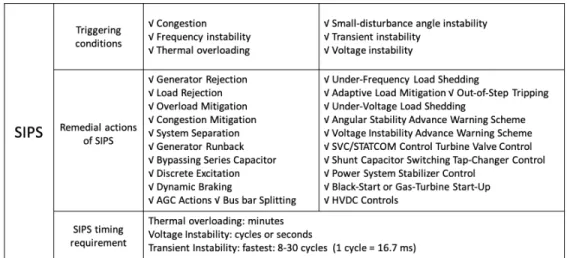
Figure3.1summarizes the common SIPS utilized in smart grids, including the trigger conditions, remedial actions and timing requirements [35]. Among all possible remedial actions, the load rejection and generation rejection are the two mostly adopted to handle the stability issues of
Figure 3.1 Power industry SIPS summary
power grids. The timing performance of SIPS also varies depending on purposes of the protection. Schemes equipped to alleviate transmission line thermal overloading conditions are often allowed up to tens of minutes.
3.4 Decentralized SIPS based on MAS
Most conventional SIP schemes comprise a master and a few geographically dispersed slaves. SIPS master is able to collect data, detect targeting events, and then determine and send the control commands to the slaves. On the other hand, slaves are only required to follow the commands from the master and correctly carry out the remedial actions. In such highly centralized schemes, the master is prone to availability attacks such as Denial of Service (DoS) and intrusion attempts like spear phishing attack. Loss of the master will either lead to hidden protection failures or immediate system impacts when under a coordinated attack. In this section, a peer-to-peer MAS architecture is proposed as an alternative for SIPS implementation.
3.4.1 SIPS Implementation within Decentralized Architecture
An agent is an object possessing a specific set of resources (processors, memories, sensors, actu-ators, etc.) and behaviors (such as informing, requesting, offering, accepting, rejecting, competing
with or assisting one another). Multi-agent System (MAS) is a group of agents that communicate and interact with each other to realize various tasks with certain level of autonomy.
Typical MAS architectures include hierarchical [46, 51], peer-to-peer [49], etc. Considering that hierarchical architectures still discriminate between agent roles, which means that the agents of more significance are more likely get attacked and other agents are not able to replace it if so, the peer-to-peer architecture is adopted in this work. The goal is to ensure that when any part of the MAS gets compromised, the rest agents are still able to provide the expected protective actions.
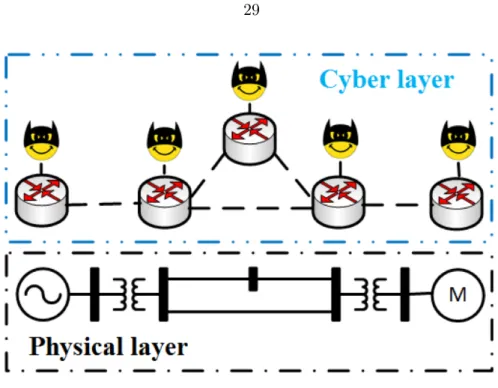
As depicted in Figure 3.2, the first principle in the proposed MAS design is that an agent represents one substation or generating plant. MAS can also be utilized at a more granular level, within one station for instance [51], but this type of MAS is out of our discussion. Communication among agents are critical. One agent needs to talk to its neighbors to realize global data propagation and to exchange specific situation information to achieve a consensus of the current system state, etc. Thus the communication architecture design can have a significant influence on the performance of MAS. Figure3.2 shows one possible communication topology, which can be exactly mapped to the physical layer. It’s a reasonable choice considering the availability of power line carrier and also that the needs of information propagation is usually constrained to a group of stations close to each other. A peer agent far away from the one needs assistance under stressed condition is not likely to help as much and neither does it need to know about the stressed condition although the relevant information can still be propagated via proper routing methodologies. In the later work, we only care about the de facto communication connection status and do not put much emphasis on the topology design itself.
3.4.2 MAS Characterization
As aforementioned, resources and behaviors are the two major facets of an agent. This section will first discuss the data sources that accessible to agents from two different perspectives and then describe the overall MAS operation.
Figure 3.2 Peer-to-peer MAS architecture
3.4.2.1 Data Sources
Locally within one substation, the data accessible to an agent include physical layer measure-ments, cyber information and processed metrics.
• Physical measurements - breaker/switch status, bus/generator terminal voltage, power
injection, power flows, and system frequency, etc.
• Cyber information - Information from cyber layer such as absence of expected
mea-surements/commands, unexpected packets, incorrect control sequential numbers, anomalous events recorded by log files and indications from security management systems, etc.
• Preprocessed metrics- agents can preprocess raw data and compute information enriched metrics to improve the efficacy of online applications. For example, the time interval between two sequential frequency dips may reveal the tendency of cascading events [65].
From the system wide perspective, the data that an agent possesses or accesses could be classified as
• Public local information - Information that could be shared with other ally agents when on request.
• Private local information - Sensitive data of an agent that could not be shared, such as the load data of a critical feeder that this agent can not lose.
• Global information - Other agents’ public local information that have been successfully propagated and collected.
Though barriers still exist to merge all the above data/information at the same module, it is technically achievable. Agents could either obtain such data from sensing devices like what an RTU does or directly get data from RTU.
3.4.2.2 Agent Actions
The coordination among agents highly relies on the information propagation protocol utilized. One possible protocol has been proposed and it only requires one agent to communicate with its directly connected neighbors. If two agents are not directly connected, they have to share the data via other intermediate agents. The main actions of an agent involve
• Inform - One agent actively informs its neighbors about the data sets it possesses. An “inform” message contains the data set(s) that just get updated and also a time stamp. For instance, an ”inform” message could read as ”obtain new data from substation i at time 16:30:00”.
• Confirm - One agent should reply to the neighbors who have sent it global information.
• Request - One agent will send out data request to its neighbors to get the data in need.
• Send- One agent sends the requested public local data back to the agent requests for it.
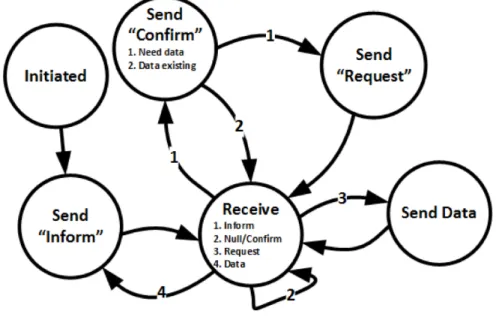
The overall behaviors of a single agent can be described by a Finite State Machine (FSM) as shown in Figure 3.3. After the “Initiated” state, the agent will first send out “Inform” packets to its neighbors and then automatically enter the “Receive” state. State transition takes place according to the type of packets that an agent has received. Numbers marked on the outbound arrows of a state correspond to the packet type labels inside the same state. For example, when in the state “Receive”, the agent will go to state “Send Confirm” following arrow 1 when it receives an “Inform” packet.
Figure 3.3 Agent actions as FSM
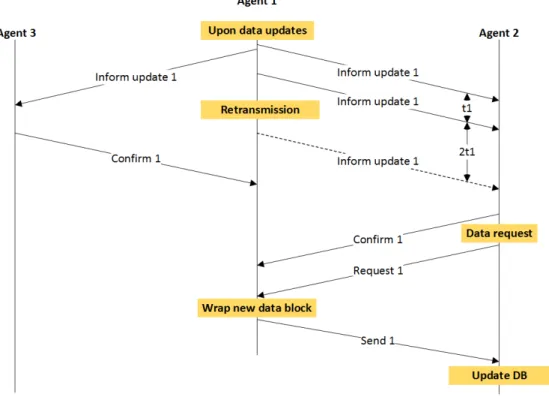
Figure 3.4 shows an example of data propagation among agents. The timing flow starts when Agent 1 has obtained a new dataset. Then Agent1 will send ”inform” message to all its neighbors except the one from whom it gets the data at the first place. In this case, Agent 2 and Agent 3 are the message receivers. As depicted, Agent 3 receives the ”inform” message without an issue, but it finds that it already has the same data set with the same time stamp. Therefore, it only replies with a ”Confirm” message. We assume that the connection between Agent 1 and Agent 2 is temporarily blocked at the beginning and thus the ”inform” message takes several trials to get to Agent 2. Agent 2 checks his database and notices that it does not have the same data set or the
![Figure 1.1 Smart grid domains [1]](https://thumb-us.123doks.com/thumbv2/123dok_us/1359307.2681880/13.918.182.728.110.552/figure-smart-grid-domains.webp)