“12-th Tyrrhenian International Workshop on Digital Communications, Portoferraio - Isle of Elba (Italy), Sept. 13-16 2000
"Analysis of File Transfer Protocol Over
Bluetooth Radio Link"
Diego Melpignano1 and Andrea Zanella2
1 Philips Research Monza, G.Casati,23, 20052 Monza (Italy),
Phone +39 039 2037809, Fax. +39 039 2037800, mailto: [email protected]
2 Department of Electronic Engineering, University of Padova,
Via Gradenigo 16/A, Padova (Italy),
Phone +39 049 8277662,Fax: +39 049 8277699 mailto: [email protected]
Abstract
TCP is the current dominant transport protocol, mainly used in fixed networks. It is well-known that TCP performance may degrade over paths that include wireless links, where packet losses are often not related to congestion, but to the unreliability of the transmission medium. In this paper, we examine this problem considering a wireless link based on Bluetooth radio equipment. Bluetooth (BT) is a low-cost system in the unlicensed 2.4GHz band. It provides a reliable data transmission using fast frequency hopping technique and Stop-and-Wait ARQ scheme. In our experiments, we have studied the performance of a heavy file transfer over a BT link, with different environmental conditions and BT radio packet formats. Results show that the best FTP performance in a wide range of radio channel conditions is obtained by using long non-FEC-protected radio packets. Nevertheless, in particularly hostile situations, the intermediate-length packet format appears more suitable. Furthermore, analysis has focused the possibility of inefficiency due to bad interaction between TCP and BT retransmission mechanisms.
1. Introduction
The increasing popularity of wireless technologies and the continuing advancements in portable computing are flowing together in a raising demand for wireless networks. This consideration is forcing researchers to study the performance of the most common data applications over different radio equipment. In particular, much work has been made about the behaviour of Transmission Control Protocol (TCP) [1,2] over wireless networks, thanks to its primary role in the Internet protocols stack. It is well know that TCP is tuned to work well in wired networks, where packet losses and unusual delay are primary due to congestion. Unfortunately, communication over wireless links suffers from sporadic high bit error rates that produce packet losses not related to congestion. These events may trigger the congestion reaction mechanisms on TCP sender ([3]), resulting in an unnecessary reduction in the end-to-end throughput and hence, sub-optimal performance.
A method proposed to alleviate these problems consists in hiding the unreliability of the wireless link from the TCP sender by using local retransmissions and forward
error correction (FEC) schemes ([4,5]). In this way, the lossy link appears as a reliable link with a reduced effective bandwidth. Unfortunately, the TCP sender may not be fully shielded from wireless losses. Indeed, the link layer retransmissions could generate sporadic long delay on segment delivery, causing the TCP sender timer to expire. These spurious timeouts trigger unnecessary segment retransmission and start the congestion control mechanisms, leading to a waste of available capacity in the wireless link and a significant degradation of end-to-end throughput. Besides, another problem is the low radio link capacity that could produce a buffer overflow at the interface between fixed and radio parts, resulting in a loss of performance. In spite of these problems, many proposals to support wireless Internet access are based on link layer approach. Some examples can be found in [6] and [7], where a radio connection based respectively on GSM and DECT technology is analysed. In this paper we consider a new link layer solution, based on the emerging Bluetooth technology ([8,9]) to supply radio link connectivity.
The Bluetooth (BT) radio technology allows users to make wireless connections between various communication devices, such as phones, desktop and notebook computers. It supports both symmetric and asymmetric connections, with up to six radio packet formats characterised by different values of packet length, time duration and error protection. With the current specification, up to seven slave devices can be set to communicate with a master radio in one device, establishing a so-called piconet. Several of these piconets can be linked together in ad-hoc scatternets to allow communication in flexible configurations. Furthermore, the use of unlicensed ISM band has a good impact on the cost of BT systems. All these aspects make BT suitable for the realisation of an ad-hoc wireless LAN, especially for short-range indoor environments.
In our experiments, we have tested the behaviour of a typical TCP/IP application, such as an FTP session, through a BT wireless connection. The experiments aim to explore the impact of single-hop radio link configuration on the end-to-end FTP performance. The results obtained show that the best FTP performance in a large range of radio channel conditions is obtained by using long non-protected radio packets. Nevertheless, in particularly hostile situations, the intermediate-length packet format appears more suitable. Furthermore, analysis has focused the possibility of inefficiency due to bad interaction between TCP and BT retransmission mechanisms.
This paper is organised as follows. Section 2 provides a brief overview of Bluetooth system and outlines the mechanisms used by TCP to react against congestion. Section 3 introduces the methodology used in carrying out the tests and defines the target metrics considered. Section 4 describes the measurement platform. Section 5 presents measurement results and their analysis. Finally, Section 6 presents a summary of results and conclusions.
2. Background
This section gives a brief overview of Bluetooth technology and of the TCP features of primary interest for our purposes. A complete description of such topics can be found in e.g. [9] for BT and [1,2] for TCP.
2.1 The Bluetooth radio system
Bluetooth (BT) is a low-cost system for medium bit-rates wireless ad-hoc networks in the unlicensed 2.4 GHz ISM band. Two up to eight BT units sharing the same channel form a piconet. In each piconet, one unit acts as master, controlling the channel access in order to avoid collisions, based on a centralised polling scheme. The channel is represented by a pseudo-random hopping sequence spanning 79 (or 23 for France, Spain & Japan) 1-MHz RF channels. The hopping sequence is unique for the piconet and is determined by the Bluetooth (BT) device address of the master, whereas the BT clock of the master determines the phase of the hopping sequence. The time is divided into time slots where each slot corresponds to a RF hop frequency. The nominal hop rate is 1600 hops/s, corresponding to a slot duration of 625µs. Full duplex is obtained with a slot-based Time-Division Duplex (TDD) scheme.
Both Synchronous Connection Oriented (SCO) and Asynchronous Connection Less (ACL) links can be established among BT terminals, respectively for coded voice and best-effort data traffic (symmetric and asymmetric), with an available bitrate of up to 721kb/s. The master maintains the SCO link by using reserved slots at regular intervals (circuit-switched connection). SCO packets are exclusively one slot long and they are never retransmitted. In the slots not reserved for SCO links, the master can exchange ACL packets with any slave on a per slot basis (packet-switched connection). A slave is permitted to return an ACL packet in the slave-to-master slot if and only if it has been addressed in the preceding master-to-slave slot, following the polling scheme mentioned above. A baseband packet can extend over one, three
or five consecutive time slots. When a multiple slot packet is used, the transmitter frequency remains unchanged for the whole packet duration, thus reducing the efficiency loss due to the PLL settling time (~220µs), occurring each time a new frequency is used.
Each packet starts with a 72-bit access code (AC), used for synchronisation and piconet identification. At the beginning of each reception slot, the BT unit correlates the sequence received to the expected AC. The incoming packet is accepted only if the correlator output exceeds a certain threshold, elsewhere it is discarded. The AC is followed by an 18-bit packet header field, coded with a 1/3 FEC code (three-time repetition of every bit), resulting in a 54-bits header. A packet received with an unrecoverable header is immediately discarded. A payload field completes the baseband data packet. Payload is covered by a 16-bit CRC code, used by a simple Stop-and-Wait ARQ scheme to verify the integrity of received data. After reception and CRC control, a baseband packet is immediately acknowledged by using the ARQN bit in the header of the reply packet. An optional 2/3 FEC code can be applied to the packet payload to reduce the number of retransmissions. Formats that
include FEC are denoted with DMn where n indicates the packet extension in number of slots, whereas DHn indicates packets without FEC. Table 1 synthesises the main characteristics of the six different ACL packet formats.
Pck Type DM1 DH1 DM3 DH3 DM5 DH5
Number of Slot 1 1 3 3 5 5
Payl Head (bit) 8 8 16 16 16 16
Payl Data (bit) 136 216 968 1464 1792 2712
FEC 2/3 no 2/3 no 2/3 no
Fw Max Rate (kbit/s) 108,8 172,8 387,2 585,6 477,8 723,2
Rv Max Rate(kbit/s) 108,8 172,8 54,4 86,4 36,3 57,6
Tot Pck Size(bits) 366 366 1626 1622 2871 2870
Table 1. ACL packet fields
2.2 TCP congestion recovery algorithms
Modern implementations of TCP include four intertwined algorithms for flow control: slow start, congestion avoidance, fast retransmit, and fast recovery. This section summarises only the main characteristics of these four algorithms, a complete description can be found in [3].
Slow Start and Congestion Avoidance
The flow control scheme used by TCP is based on a "sliding window" concept. The allowed window (awnd) is the minimum of the sender's congestion window (cwnd) and the receiver's advertisement window (rwnd). During the slow-start phase the value of cwnd is increased by one segment for each received ACK, whereas, in congestion phase, the cwnd is incremented by 1 full-sized segment per round-trip time (RTT). Slow start phase ends when cwnd exceeds a specific threshold, called ssthresh, after that congestion avoidance phase is executed. When congestion is detected, the slow start phase is restarted with a cwnd set to one 1 full-sized segment and ssthresh set to half of the amount of outstanding data in the network.
Exponential Backoff and Round Trip Estimation
TCP sender dynamically adapts the retransmission timeout (RTO) to the end-to-end delay, by using an estimation of mean (SRTT) and standard deviation (D) of the round-trip time (RTT). These values are adjusted each time an ACK is received, on the base of the following formulas
SRTT=SRTT+0.125⋅(RTT-SRTT) (1)
D=D+0.25⋅(|RTT-SRTT|-D) (2)
The retransmission timeout (RTO) is computed as
RTO=SRTT+4⋅D (3)
When a timer goes off before receiving the acknowledgement for the relative segment, the segment is retransmitted and the value of the timer is doubled (exponential backoff).
Fast Retransmit and Fast Recovery
The TCP may generate a duplicate acknowledgement (DACK) when an out-of-order segment is received ([10]). If three or more duplicate ACKs are received in a row, it is a strong indication that a segment has been lost. TCP then performs a retransmission of what appears to be the missing segment, without waiting for a retransmission timer to expire (fast retransmission). After this retransmission, congestion avoidance, but not slow start is performed (fast recovery).
3. Methodology of analysis
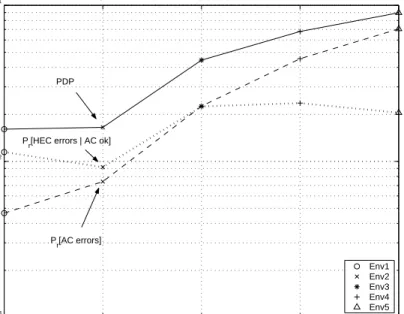
The main focus of our analysis is to study the performance of different BT packet formats and the potential protocol interactions between TCP and radio link protocol (RLP). We are only interested in stable connections that last long enough to allow for all TCP sender state variables (e.g. retransmission timer, slow-start threshold, etc.) to converge from their initial values to a stable range operation. We have therefore performed a series of large bulk data transfers (roughly 1 Mbytes) between a fixed FTP server and a nomadic FTP client. Experiments have been made in different real-world situations, obtained by moving the nomadic station around our research laboratory. Unfortunately, we have no method to precisely determine the signal strength in each situation. So, the environmental hostility has been classified on the basis of practical considerations, as the distance between BT devices, the presence or the absence of Line-of-sight (LOS), etc. This empirical classification is consistent with the measured packet drop probability (PDP), i.e. the probability that a packet is received with unrecoverable AC or Header fields. Since these fields are identical for all the packet formats, the PDP depends only on the radio channel condition. Figure 1 shows the PDP (continuous line) for the five environments considered (the others lines depicted in the figure will be discussed in Section 5), whereas Table 2 gives a synthetic description of the environments. Note that each environment has been assigned a specific mark, as shown by the legend in the figure.
Env1 2mt distance between terminals on different desks
Env2 3mt distance on different desktops and microwave oven 4m away beneath a wall
Env3 4mt distance, wall in the middle with metal whiteboards on both sides
Env4 8mt distance on the same laboratory, with many obstacles between BT devices
Env5 3mt distance on different desktops with microwave oven between them
Table 2: Environments description
Many tests have been carried out in every environment, using different BT packet types. More precisely, we have only changed the packet formats in forward direction (from master to slave), whereas in reverse direction we have always used single slot unprotected packets (DH1), because they appear ideal to carry the low traffic in this direction (mainly due to TCP acknowledgement). From data collected we evaluated the radio link "goodput", defined as the average number of data bits successfully transmitted in the unit of time. The goodput is determined by baseband packets that are not retransmitted, that is packets that arrive with correct AC, HEC and CRC fields and that are successfully acknowledged. Instead, all sent data packets determine "throughput", defined as the total amount of data bits sent per time unit.
In practice, the throughput represents the maximum link capacity obtainable with a given packet format, whereas goodput gives the effective link capacity perceived by the upper level protocol.
1 2 3 4 5
10−3 10−2 10−1
Environment
Average Packet Drop Probability (PDP) in different environments
P r[AC errors] P
r[HEC errors | AC ok]
Env1 Env2 Env3 Env4 Env5 PDP
Figure 1: PDP, PAC and PHEC in different experimental environments (see Table 1 for environments description)
Besides goodput, we considered another metric, called the "Segment Service Time" (SST) defined as the time that BT entities employ to transmit a TCP segment through the radio link. Note that SST is only a part of the end-to-end delay, since it does not include the buffering time. SST cannot be precisely measured observing the radio channel only, since we are not able to distinguish radio packets belonging to the same TCP segment. However, we can estimate its mean and standard deviation. Indeed, assuming that every packet transmission experiments the same packet retransmission probability (PRP), then the number of transmission attempts until positive acknowledgment is a modified geometrically distributed random variable, with parameter 1-PRP. Consequently, if a TCP segment is split into N radio packets, the SST is given by the sum of N independent identically distributed (i.i.d.) random variables. Thus it results a random variable with modified Pascal distribution, having mean and standard deviation (expressed in number of slots) given by
) 1 ( 1 : Mean + − = n PRP N ASST (4)
Notebook Notebook BT Client Ethernet Router
Figure 2: Measurement Platform
FTP Server TCP Snooper BT statistics ) 1 ( 1 : dev. Std + − ⋅ = n PRP PRP N DSST (5)
In the previous expressions, n+1 is the total number of slots needed for packet transmission and acknowledgement (n slot per packet in the forward direction, one slot per ACK in reverse direction).
4. Measurements Platform and Tools
The architecture of the system that we have used for measurement collection is depicted in Figure 2. An FTP server is connected to a router through a 10Base-T Ethernet. The router interfaces fixed and radio parts establishing a BT piconet with an FTP client. The piconet has been configured with master on the router and slave on the client to maximizing the link capacity in the forward direction. Router and
FTP client are running on two Pentium II notebooks, clocked to 200MHz and using the Windows 98 operating system. The radio interface runs a Bluetooth DigiAnswer firmware, release 4.02, where BT baseband processing occurs. Winsock2 TCP/IPv4 Windows implementation has been used in tests. The "TCP Snooper" entity depicted in Figure 2 uses TCPDUMP and LIBPCAP 4.05 under Linux operating system to trace the TCP behaviour. The related plots are prepared with TCPTRACE and XPLOT. Traces are collected also at the link layer exploiting the DigiAnswer Bluetooth Application Programmer's Interface to collect statistics regarding an active Bluetooth link in terms of AC, FEC and CRC errors. Unfortunately, at this stage of our work, the tracing of radio link behaviour suffers of some drawbacks. For instance, the probing programs work independently on master and slave devices, then correlating master transmissions to slave receptions, and vice versa, is not easy. Furthermore, the probing time is not always constant and sporadically can assume very high values. The result is that we are able to determine only the trend of radio connection, and not its step-by-step history. Nevertheless, the information obtained permits to draw some interesting observation about the BT performance.
5. Measurement Results
In this section we present and analyse the results obtained by using different BT packet formats in our test environments. Note that the values obtained by measurements must be considered only as indicative, because even repeated stationary measurements in an identical location often yield different results. Anyhow, our aim is to determine the most suitable packet format in each situation and this information can be extracted with sufficient clearness from the performed measurements.
In the following, we present the comparison between protected (DMn) and unprotected (DHn) formats, and successively we proceed comparing long and short packet formats. Finally we present some preliminary results about TCP behaviour over a BT radio link.
5.1 Protected vs Unprotected packet
Protecting payload with FEC produces two opposite effects: on one hand, the FEC theoretically improves the payload error probability and lowers the packet retransmission probability (PRP), on the other hand, the code overhead reduces the maximum bit rate achievable. Thus a trade-off between goodput realised by DMn and DHn packets can be expected. In reality, we have found that unprotected overrun protected formats in almost all the situations considered.
This fact can be partially explained by observing the two dashed curves depicted in Figure 1. These curves represent respectively the AC error probability (PAC) and the Header Checksum error conditioned probability (PHEC), i.e. the probability of having an HEC failure given that the AC field is good. We can note that, while the AC error probability grows rapidly passing from Env1 to Env5, the PHEC remains roughly of the same order of magnitude. This is due to the fact that the HEC is considered only when the packet has a good AC field and hence the signal strength is sufficiently high. Since the radio channel is slowly time-variant, with high probability it will remain good also during header reception. This consideration can be extended to the payload field. Indeed, if the AC and HEC fields are good, then with high probability the radio signal is strong enough to guarantee a low error probability in the payload field, and consequently the FEC results useless. Measurements confirm this observation, at least for packets with short and medium length. Instead, long packets show an effective improvement of PRP due to FEC, especially in dynamic environment. The waste of capacity caused by FEC overhead is not compensated by the code benefit on PRP; thus, at least in the considered situations, unprotected packet format results preferable protected ones.
5.2 Short vs Long packet
In this subsection we compare the performance obtained by using packet of different length. On the basis of the results presented in the previous subsection, we consider only unprotected packet formats. As already mentioned in Section 2, during the transmission of a multi-slot packet, the carrier frequency remains unchanged for the whole packet duration, thus reducing the efficiency loss due to the PLL settling
time. On the other hand, if an error occurs anywhere in the payload field, the entire packet must be retransmitted; thus in the same channel condition, long packets have higher retransmission probability than short ones. The combination of these two effects determines the effective link capacity as seen by the upper layer.
0 1 2 3 4 5 6 400 450 500 550 600 650
Average Goodput in fw direction (Kbit/sec)
Environment
Average Goodput (Kbit/sec)
DH3_DH1 DH5_DH1
Figure 3: Trade-off between DH5 and DH3 goodput
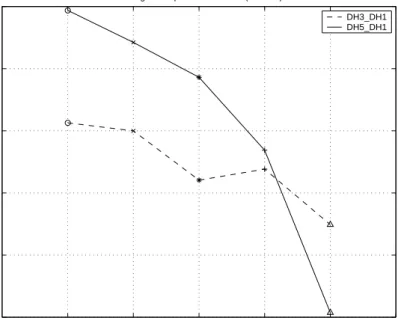
Figure 3 shows the goodput with DH5 and DH3 packets in our five test environments. For the sake of clarity, we have not plotted the curve relative to DH1 goodput, because it is much lower than the others. This is due to the very low payload capacity of DH1 packet that is not compensated by its better retransmission probability.
Curves depicted in Figure 3 show an interesting trade-off between goodput obtained with DH5 and DH3 packets. As expected, performances of both packet types progressively worsen with the increase of environment hostility; however, DH5 degrades faster than DH3 so that, in particularly unfavourable conditions, the second outruns the former.
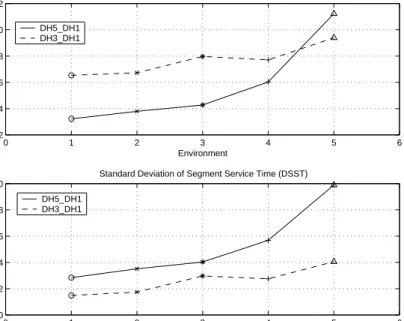
Besides goodput, the end-to-end performance is determined also by the link latency. For this reason, in Figure 4 we report the average and the standard deviation (in number of slots) of the Segment Service Time (SST) that has been introduced in
Section 3. The curves are obtained considering the default value of TCP Maximum Segment Size (MSS), corresponding to an IP datagram size of 576 bytes. Each of these IP datagrams is split in 4 DH3 packets or in 2 DH5 packets.
0 1 2 3 4 5 6 12 14 16 18 20 22
Average Segment Service Time (ASST)
Environment ASST (slot) DH5_DH1 DH3_DH1 0 1 2 3 4 5 6 0 2 4 6 8 10
Standard Deviation of Segment Service Time (DSST)
Environment
DSST (slot)
DH5_DH1 DH3_DH1
Figure 4: Estimated first order statistic of Segment Service Time
As we can observe from the upper part of Figure 4, the average Segment Service Time (ASST) follows the same trend observed for goodput. This fact does not surprise since both metrics are closely related to the average link bandwidth. More interestingly, the trend of the estimated SST standard deviation (DSST), shown on the bottom part of Figure 4, must be noticed. Indeed, we can observe that DSST is greater for DH5 than for DH3 in all the situation considered. This can be explained by the fact that each time a DH5 packet must be retransmitted a delay of 6 slots is incurred, while for DH3 packet retransmission only 4 slots are needed. In other words, the transmission time of long packet has a thick granularity compared with that of short packet, resulting in a greater deviation of segment delay around its mean. Note that the end-to-end delay could be much longer and variable than the estimated SST. Indeed, due to the low radio link capacity, segments could be buffered on the router and their delay consequently grows with the queue length. This, in turn, could lead to long latency and large round trip time deviations at the TCP sender.
5.3. TCP over BT link: Preliminary Results
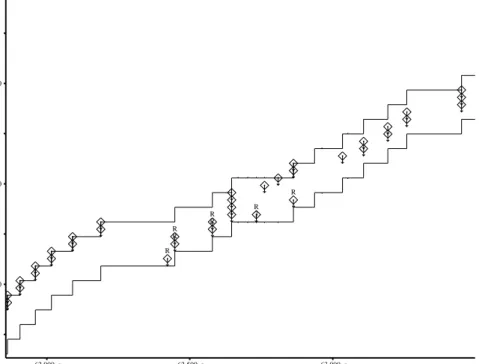
In Figure 5, an example of a trace of an FTP connection running on Bluetooth is presented, for a mobile host that moves in areas characterized by different received signal quality. It can be noticed that, under normal operation, TCP Reno adapts to the latency variations due to the Bluetooth baseband retransmissions, as expected. However, under critical channel conditions, the TCP sender timeout is triggered, resulting in unnecessary retransmissions of TCP packets and in congestion control mechanisms being invoked, which reduce the connection throughput. In the graphic, the black diamonds represent packets sent by the FTP server, while the lower and the upper lines show respectively the acknowledgement value and the transmission window size advertised by the client. After a timeout occurs at ~62.3s, packets are retransmitted by the sender (R in the figure) without the whole advertised window being exploited (slow-start phase) and the abnormal situation persists for about 1 second. In addition several duplicate acknowledgements are also generated (the small lower vertical lines).
In general, retransmissions often result in a cascade-effect whose negative impact extends for seconds.
1440000 1420000 1400000 63.000 s 62.500 s 62.000 s sequence offset relative time FTP over BT (time sequence graph)
. . . . . . . . . . . . . R . . . R 3 . . . . . R . R . R . R . R . . . . . . . . . . . .
6. Conclusions
In this paper we have presented the results of a set of measurements relative to an FTP connection over a single-hop BT radio link. Our measurement-based approach has given us the opportunity to observe the system behaviour in real-world situations and thus to analyse the performance obtained by using different Bluetooth packet formats. From the collected bulk data, we can conclude that BT protected packet formats suffer from the inefficiency of FEC overhead that is not compensated by the improvement of packet retransmission probability. Furthermore, in almost all the considered situations, DH5 packets appear more suitable than DH3 in terms of goodput and average SST; whereas in particularly hostile environments, the intermediate-length packet format seems better. Finally, in all the considered situations, the DH5 packet format is characterised by an estimated value of SST standard deviation greater than that obtained for DH3, due to the thick granularity of long packet transmission time. The effect of this delay variation on the end-to-end performance must be investigated in more detail.
Future work will focus on analysing the possible impact of BT latency on end-to-end performance, and on deriving models for the wireless link that capture the aggregate of real-world effects like noise, interference and fading.
References
[1] W. R. Stevens, «TCP/IP Illustrated, Volume 1: The Protocols,» Addison-Wesley, 1994.
[2] G. R. Wright, W. R. Stevens, «TCP/IP Illustrated, Volume 2: The Implementation», Addison-Wesley, 1995.
[3] W. Stevens, «TCP Slow Start, Congestion Avoidance, Fast Retransmit, and Fast Recovery Algorithms», RFC 2001 Jan.1997.
[4] A. DeSimone, M. C. Chuah, and O. C. Yue. «Throughput Performance of Transport-Layer Protocols over Wireless LANs,» Proc. Globecom ’93, December 1993.
[5] A. Chockalingam, M. Zorzi and V. Tralli, «Wireless TCP Performance with Link Layer FEC/ARQ,» Proc. of International Conference on Communications, pp.1212-1216, Vancouver, Canada, June 1999.
[6] S. Hoff, M. Meyer and A. Schieder, «A Performance Evaluation od Internet Access via the General Packet Radio Service of GSM,» Vehicular Technology Conference (VTC), pp.1760-1764, Ottawa, Canada, May 1998.
[7] P. Wong and F. Halsall. «Data Applications for DECT». Proc. of ICC’93, pp. 1274-1278, Geneva, Switzerland,. May 1993.
[8] Specification of Bluetooth System, ver. 1.0, July 1999
[9] The Bluetooth Special Interest Group, Documentation available at
http://www.bluetooth.com/.
[10] V. Jacobson, «Modified TCP Congestion Avoidance Algorithm», end2end-interest mailing list, April 30, 1990. ftp://ftp.isi.edu/end2end/end2end-end2end-interest- ftp://ftp.isi.edu/end2end/end2end-interest-1990.mail.