BY
HEADMAN NGILOSI HEBE
M.Ed (UNISA); B.A (Honours Psychology) (UNISA); B.A. (UNISA); SPTD (Soweto College of Education)
DISSERTATION PRESENTED FOR THE DEGREE OF
DOCTOR OF PHILOSOPHY IN THE
DEPARTMENT OF CURRICULUM STUDIES AT
STELLENBOSCH UNIVERSITY
SUPERVISOR: DISTINGUISHED PROFESSOR LLL LE GRANGE CO–SUPERVISOR: DR L RUTGERS
ii DECLARATION
By submitting this dissertation electronically, I declare that the entirety of the work contained therein is my own original work, that I am the sole author thereof (save to the extent explicitly otherwise stated), that reproduction and publication thereof by Stellenbosch University will not infringe any third party rights and that I have not previously, in its entirety or in part, submitted it for obtaining any qualification.
... ... HEADMAN NGILOSI HEBE DATE
Copyright © 2015 Stellenbosch University
All rights reserved
iii ABSTRACT
Planet Earth is plagued by a myriad of problems which have been on the increase in recent years. These include, among other things, e–waste; reduction in biodiversity, air pollution, global warming and many more. Undoubtedly, the greed of human beings more than the quest to satisfy needs has been at the core of these problems which threaten the sustainability of earth’s ecosystems. For some years now, Environmental Education (EE) has been acknowledged and, consequently, employed as the vehicle to offset the impact of the challenges which continue to degrade Planet Earth. Hence, many levels of education, especially formal education; have been making some inroads towards empowering people to change their behaviour and help others through the integration of EE in learning and teaching activities.
Unfortunately, the early childhood stage of human development has been neglected when it comes to education issues, in general (Calman and Tarr–Whelan 2005; Davis 1998), and in the context of this study, in issues concerning Environmental Education (Davis 2009). For example, Davis (2009) conducted a literature survey for the period 1996 – 2007 with a focus on environmental education/education for sustainability and childhood education and discovered that little research had been conducted in this area. Hence, she laments, “in general, early childhood education researchers have not engaged with environmental/sustainability issues, and environmental education researchers have not focused on very young children and educational settings” (Davis 2009: 229).
Accordingly, this study was undertaken in response to Davis’s (2009) outcry and the realisation that, indeed, even in the context of South Africa, there is paucity of research in the areas identified by Davis (2009). The purpose of this qualitative–interpretive paradigm guided inquiry was to investigate the extent to which Environmental Education is integrated in Grade R teaching and learning activities at selected Early Childhood Development (ECD) Centres in the North West Province of South Africa. In order to gain in–depth information and multiple perspectives (Creswell 2007) on the subject of inquiry, the maximum variation strategy, a subtype of purposeful sampling (McMillan and Schumacher 1997) was used for case selection.
iv Consequently, four Grade R offering ECD centres with diverse characteristics participated in this inquiry. From each of the selected centres, one Grade R classroom was selected for investigation. Likewise, the Grade R teachers whose classes were selected together with their principals participated in the investigation. Three data generation strategies were used in this inquiry, namely; participant observations, semi–structured interviews, and document and artefact analysis. And, in order to assign meaning to generated data, two data analysis strategies were utilized, namely; constant comparison (Leech and Onwuegbuzie 2007) and domain analysis (Neuman 2011).
Evidence from this study suggests that, to a very limited extent, some Grade R teachers do integrate environmental issues in their activities. However, this infusion of EE is done, mainly, in the form of teaching about the environment with little or no teaching in/through and for the environment. Hence, viewed from Kopelke’s (2012) perspective, this integration of environmental issues can be considered to be environmental studies. Likewise, hindrances to the integration of EE in selected Grade R classes were identified. These included the following: classroom overcrowding, underfunding, inadequate teacher training and lack of resources. On the other hand, the following were some of the factors identified as enablers of EE infusion: collaboration among the Grade R teachers, well–designed Learning and Teaching Support Material (LTSM) and, enabling curriculum frameworks. The study makes the following recommendations, among other things: the prioritisation of Grade R teacher training and remuneration, on–going and meaningful professional support for Grade R teachers, adherence to the norms and standards for Grade R funding and empowerment of School Management Teams and Senior Education Specialists to adequately support the Grade R teachers. Additionally, studies of similar nature are recommended and the study is rounded off with some guidelines on the integration of EE in Grade R.
v OPSOMMING
Planeet Aarde word deur ontelbare probleme wat in die afgelope jare verhoog geteister. Hierdie probleme sluit in, onder andere, e–afval, vermindering van biodiversiteit, lugbesoedeling, aardverwarming en nog meer. Sonder twyfel word die gulsigheid van die mens liewer as die voorsiening van behoeftes as die kern van hierdie probleme, wat die volhoubaarheid van die aarde se ekosisteme bedreig, beskou. Vir ’n paar jaar word Omgewingsopvoeding (OO) erken en gevolglik gebruik om die effek van die voortdurende uitdagings om Planeet Aarde te degradeer en te neutraliseer. Gevolglik het baie vlakke van onderwys, veral formele onderwys; deur die integrasie van Omgewingsopvoeding in leer= en onderrigaktieiteite vordering t.o.v die bemagtiging van mense gemaak om sodoende hul gedrag te verander en ander mense in die proses te help.
Ongelukkig word die vroeë kinderfasee van menslike ontwikkeling in die algemeen, verwaarlos waneer dit by onderwyskwessies kom (Calman en Tarr–Whelan 2005; Davis 1998), en veral in die konteks van hierdie studie, spesifiek die kwessies van Omgewingsopvoeding(Davis, 2009). Davis (2009) het ’n literatuuroorsig vir die tydperk 1996 – 2007 met die fokus op omgewings /opvoeding vir volhoubaarheid in kinderonderwys gedoen, en ontdek dat baie min navorsing in hierdie gebied gedoen is. Dus betreur sy die feit dat “in die algemeen navorsers in vroeë kinderonderwys nie die kwessies van volhoubaarheid aangeraak het nie en die navorsers in omgewingsopvoeding nie op baie jong kinders en hulle opvoedkundige kontekste gefokus het nie” (Davis 2009: 229).
Gevolglik is hierdie studie onderneem in respons op Davis (2009) se verweer en ook die besef dat, inderdaad; selfs in die konteks van Suid–Afrika, daar ‘n gebrek aan navorsing in die areas wat deur Davis (2009) geidentifiseer is bestaan. Die doel van hierdie kwalitatiewe– interpretatiewe ondersoek is om die mate waarin omgewingsopvoeding, in Graad R–onderrig en leeraktiwiteite by Vroeëkindontwikkeling (VKO) sentrums in die Noordwes Provinsie van Suid–Afrika geintegeer is, te ondersoek. Ten einde, in–diepte inligting en veelvuldige perspektiewe (Creswell 2007) oor die onderwerp van ondersoek te verwerf, is die maksimum variasie–strategie (McMillan and Schumacher 1997), wat ‘n sub–kategorie van doelgerigte steekproewe is as keuse vir hierdie gevallestudie gebruik.
vi Gevolglik is vier VKO–sentrums, met uiteenlopende kenmerke, wat Graad R aanbied by hierdie ondersoek betrek. Uit elke gekose sentrum is een Graad R–klaskamer vir ondersoek gekies. Terselfdetyd het die Graad R–onderwysers van die gekose klasse en hul skoolhoofde aan die ondersoek deelgeneem. Drie strategiee is gebruik om data in hierdie ondersoek te genereer naamlik; deelnemer–waarneming, semi–gestruktureerde onderhoude en die analise van dokumente en artefakte. Twee strategiee is gebruik om data te analiseer en betekenis daaraan te gee, naamlik; konstant–vergelykings (Leech and Onwuegbuzie 2007) en domein– analise (Neuman 2011).
Bewyse uit hierdie studie dui daarop dat, sekere Graad R–onderwysers tot ’n baie beperkte mate, omgewingskwessies in hul aktiwiteite integreer. Hierdie integrasie van omgewingsopvoeding sluit hoofsaaklik onderrig oor die omgewing in met min of geen onderrig of/deur en vir die omgewing. Dus, vanuit Kopelke (2012) se perspektief, kan hierdie integrasie van omgewings–kwessies in aanmerking geneem word by omgewingsstudies. Daarbenewens is ook, hindernisse tot die integrasie van OO in gekoste Graad R–klase identifiseer. Dit sluit die volgende in: oorbevolkte klaskamers, swakbefondsing, onvoldoende opleiding van onderwysers en ’n gebrek aan hulpbronne. Andersyds is die volgende faktore identifiseer as geleenthede wat die integrasie van OO kan bevorder: samewerking tussen die Graad R–onderwysers, goed ontwerpte Leer en Onderrig Ondersteuning Materiaal (LOOM) en bemagtigende kurrikulumraamwerke. Die studie maak onder andere die volgende aanbevelings: die prioritisering van Graad R–onderwyser- opleiding, deurlopende en betekenisvolle professionele ondersteuning aan Graad R–onderwysers, voldoening aan die norme en standaarde vir Graad R–befondsing, en die bemagtiging van Skoolbestuurspanne en Senior Onderwys–spesialiste tot die effektiewe ondersteuning van Graad R–onderwysers. Daarbenewens word, studies van soortgelyke aard aanbeveel en word die studie met ’n paar riglyne oor die integrasie van OO in Graad R afgerond.
vii ACKNOWLEDGEMENTS
First and foremost, I give PRAISE and a big THANK YOU to the ALMIGHTY GOD for bestowing upon me the wisdom and intellectual capacity to undertake this daunting task. I also thank HIM for the emotional, spiritual, physical and mental health as well as the financial and human support that enabled me to see this course through. HE meandered, tumbled and toiled with me throughout. Indeed, with HIM everything is possible
Likewise, it would be inappropriate not to acknowledge the many people and institutions that made it possible for me to negotiate this difficult journey. The following are, therefore, worth mentioning:
I would like to thank Stellenbosch University for accepting me into their PhD programme and thereby enable me to realise one of my long cherished goals in life. Thanks Maties! Words are not enough when it comes to my appreciation and gratitude towards my esteemed but humble supervisor and scholar of note Distinguished Professor Lesley Le Grange, first, for agreeing to be my study supervisor and, secondly, for the sterling role he played in guiding me throughout this trying journey. He was not only professional and diligent but he was also patient and constructive throughout the project. More importantly, he introduced me to the meaning of scholarliness. Equally, I was also touched by his concern for my health and wellbeing which troubled me, especially, at the beginning of this journey. Ngiyabonga, Nzululwazi! Thank you Professor!
I am equally thankful to my co–supervisor Dr Linda Rutgers, for her guidance, encouragement and support during the completion of this research inquiry. Her kind words of wisdom when she advised me to: “stay focused on your dreams and your goals. Perseverance is the key!!!” carried me through times of difficulty throughout this journey. Ke a Leboga, Baie Dankie Dr Rutgers!
I would also like to thank my wife and study partner; Gasenakeletso who inspired me and gave me courage and strength throughout the completion of this project. Thank you for the invaluable inputs my DEAR. I am glad you are my wife and partner through and through!
viii Many thanks also go to Ms Sarie Wilbers, the librarian in the faculty of education at Stellenbosch University for her prompt and positive responses to my literature needs. I also extend my appreciation to the entire library staff of Stellenbosch University for their assistance and support.
I am also very grateful to the North West University (Potchefstroom Campus) for allowing me to utilize their libraries. Additionally, my heartfelt gratitude extends to their library personnel for their friendliness and assistance throughout this study journey. I am primarily indebted to Ms Georgene Mulder for going an extra mile towards ensuring my assistance. To the North West Department of Education under the stewardship of Dr Itumeleng Molale for granting me permission to conduct this study in one of their education districts, the Dr Kenneth Kaunda District, I say Ke Leboga Go Minagane. I am particularly grateful to Dr Matlhodi Teu and her office for their timely response to my request.
More importantly, to all the Teachers, Principals, Learners and School Governing Bodies/Boards who did not only agree to participate in this inquiry but also welcomed me with open arms and made me feel at home in their institutions. I was particularly humbled by the friendliness and helpfulness of all the people I interacted with in the four institutions which participating in this investigation. I also enjoyed interacting with the young ones in various Grade R classes. THANKS a million and God Bless You All.
I am TOTALLY indebted to my family, especially, my wife Gasenakeletso and our two children, Nontsikelelo and Sandile, for their patience, understanding and support. I hope we will have enough time to spend together now that we are through with this mammoth task. I trust that there will be minimal complaint from my son; “If it’s not Lesley (my PhD supervisor) then it’s Mellony (my wife’s M.Ed supervisor)”.
ix DEDICATION
I dedicate this piece of work to:
The memory of my late father, Ndubulani, who encouraged us to pursue education. While growing up in poverty–stricken conditions, he would persistently tell us: Nifunde bantwana bam, ningafani nam. Mna, ndaphuma ku one eskolweni yilento ndikulentlupheko ndikuyo (Don’t be like me my children, pursue education. I left school in standard one; hence I am suffering the way I do). Maz’enethole Mphankomo!
The spirit of my younger brother, Nkosinathi, who had the brains, the zeal and the hunger for education but was unfortunate to meet his gruesome death at a very young age.
All the teachers and learners in the field of Early Childhood Education, globally, especially those who work under difficult conditions; on whose hands lies the greatest burden of building a strong educational foundation for a better tomorrow.
All My School Teachers and Higher Education Lecturers, especially my late high school English teacher Mr Johannes “Slow” Ramokhoase and my college English lecturer Ms Tessa Welch, for laying the foundation and inculcating the love of education in me.
Of course, my wife and kids, my eternal pillars of support and strength, for being there each time I needed them.
x TABLE OF CONTENTS DECLARATION...ii ABSTRACT...iii OPSOMMING...v ACKNOWLEDGEMENTS...vii DEDICATION...ix TABLE OF CONTENTS...x ADDENDA...xviii LIST OF FIGURES...xix LIST OF TABLES...xx
LIST OF ABBREVIATIONS AND ACRONYMS...xxi
CHAPTER ONE PROLOGUE: SETTING THE SCENE 1.1. INTRODUCTION...1
1.2. THE “SELF” IN CONTEXT: A BRIEF PERSONAL BACKGROUND...1
1.3. MOTIVATION FOR THE STUDY...8
1.4. STATEMENT OF THE PROBLEM...11
1.5. DEMARCATION OF THE STUDY...13
1.6. RESEARCH METHOD AND DESIGN...16
1.7. CLARIFICATION OF SOME KEY CONCEPTS...17
1.7.1. Exploring...17
1.7.2. Implementation...17
1.7.3. Environment...18
xi
1.7.5. Early Childhood Development/Early Childhood Education...26
1.7.6. Grade R...26
1.7.7. Early Childhood Development Centres...26
1.7.8. Independent and Public Institutions of Learning...27
1.7.9. Grade R Teacher/Grade R Practitioner...28
1.8. OUTLINE OF THESIS CHAPTERS...28
1.9. CHAPTER SUMMARY...30
CHAPTER TWO A FRAGMENTED GLOBAL APPROACH TO EARLY CHILDHOOD EDUCATION: IMPLICATIONS FOR ENVIRONMENTAL EDUCATION 2.1. INTRODUCTION………...31
2.2. THE SIGNIFICANCE OF EARLY CHILDHOOD EDUCATION…...33
2.3. EARLY CHILDHOOD EDUCATION IN SOUTH AFRICA……...36
2.3.1. Provision and Access……...37
2.3.2. Monitoring and Support……...38
2.3.3. Funding…………...41
2.3.4. Teacher Training and Qualification…...44
2.3.5. Curriculum……...48
2.3.6. The Integration of Environmental Education in Grade R……...51
2.3.6.1. Some of the Factors that Contributed to the Infusion of Environmental Learning in South Africa in the 1990s and Beyond: A Brief Reflection...55
2.3.6.2 The National Policy Guidelines that Contributed towards EE in South Africa...56
(i) The Reconstruction and Development Programme (RDP) – 1994...56
(ii) The Bill of Rights – 1996...57
(iii) The National Environmental Management Act – 1998...58
(iv) The White Paper on Education and Training – 1995...58
xii 2.3.6.3. The National Curriculum Statement Grades R – 12 (NCS) and the Integration of
Environmental Education in Grade R...60
2.4 AN INTERNATIONAL PERSPECTIVE ON EARLY CHILDHOOD EDUCATION...75
2.4.1. Provision and Access……...75
2.4.2. Monitoring and Support…...79
2.4.3. Funding……...84
2.4.4. Teacher Training and Qualification………...89
2.4.5. Curriculum……...95
2.4.6 The Integration of Environmental Education in Early Childhood Education……...103
2.5. CHAPTER SUMMARY...108
CHAPTER THREE LOCATING ENVIRONMENTAL EDUCATION IN SELECTED PARADIGMS: AN EARLY CHILDHOOD EDUCATION CONTEXT 3.1. INTRODUCTION...112
3.2. THE RATIONALE FOR THE CHOICE OF THEORIES DISCUSSED IN THIS STUDY...112
3.3. LEARNING AND DEVELOPMENT THEORIES RELEVANT TO EARLY CHILDHOOD EDUCATION...115
3.3.1. PIAGET’S COGNITIVE DEVELOPMENT THEORY...115
3.3.1.1. A Synopsis of the Theory of Cognitive Development...116
(i) Sensori–motor stage...118
(ii) Pre–operational stage...119
3.3.1.2. Applying Piaget’s Cognitivist Theory in the Integration of Environmental Education in Grade R...123
3.3.2. ERIKSON’S PSYCHOSOCIAL PARADIGM...128
xiii (i) Infancy: Trust versus Mistrust (Synthesis:
Hope)...130
(ii) Early Childhood: Autonomy versus Shame and doubt: (Synthesis: Will–power)…...131
(iii) Preschool Age: Initiative versus Guilt: (Synthesis: Purpose)…...133
3.3.2.2. Applying Erikson’s Psychosocial Theory in the Integration of Environmental Education in Grade R...134
3.3.3 VYGOTSKY’S SOCIOCULTURAL PERSPECTIVE...137
3.3.3.1. A Précis of Vygotsky Socio–cultural theory...137
(i) Language within the Socio–cultural Perspective...139
(ii) The Zone of Proximal Development...142
3.3.3.2. Application Vygotsky’s Sociocultural Theory in the Integration of Environmental Education in Grade R...145
3.3.4 BRONFENBRENNER’S BIOECOLOGICAL MODEL...152
3.3.4.1. An Outline of Bronfenbrenner’s Bio–ecological Model...153
3.3.4.2. Application of Bronfenbrenner’s Model in the Integration of Environmental Education in Grade R...158
3.3.5 THE BEHAVIOURIST THEORY...161
3.3.5.1. An Overview of the Behaviourist Theory...163
(i) Classical Conditioning...163
(ii) Operant Conditioning...165
(iii) Observational Learning...167
3.3.5.2. Application of Behaviourism in the Integration of Environmental Education in Grade R...168
3.3.6 HOWARD GARDNER’S MULTIPLE INTELLIGENCES THEORY...171
3.3.6.1. A Brief Reflection on the Multiple Intelligences Theory...174
(i) Linguistic Intelligence...174
xiv
(iii) Logical–mathematical Intelligence...176
(iv) Spatial Intelligence...177
(v) Bodily–kinaesthetic Intelligence...178
(vi) Personal (interpersonal and intrapersonal) Intelligences...178
(vii) Naturalist Intelligence...180
3.3.6.2. Application of Multiple Intelligences Theory in the Integration of Environmental Education in Grade R...181
3.4. PHILOSOPHICAL UNDERPINNINGS, EVOLUTION AND RELATIONALITY: A CRITICAL REFLECTION ON THEORIES DISCUSSED IN THIS STUDY...184
3.5. A PERSONAL DENOUEMENT: THE CASE FOR VYGOTSKY’S VIEW OF PLAY IN EARLY CHILDHOOD DEVELOPMENT...189
3.6. CHAPTER SUMMARY...193
CHAPTER FOUR METHODOLOGICAL FRAMEWORK 4.1. INTRODUCTION...196
4.2. RESEARCH METHODOLOGY...196
4.2.1. Research Paradigm: A Qualitative Interpretive Research Approach...198
4.2.2. Research Method: A Case Study Design...203
4.3. RESEARCH DESIGN...208
4.3.1. Population, Sampling and Case Selection...208
4.3.2. Data Generation and Analysis...212
4.3.2.1. Participant Observations...214
4.3.2.2. Semi–structured Interviews...220
4.3.2.3. Inspection and Analysis of Documents and an Artefact...223
4.3.2.4. Data Analysis...226
4.4. TRUSTWORTHINESS OF THE FINDINGS...239
4.4.1. Credibility...240
xv 4.4.3. Dependability...245 4.4.4. Confirmability...246 4.4.5. Reflexivity...246 4.5. ETHICAL CONSIDERATIONS...251 4.6. CHAPTER SUMMARY…...253 CHAPTER FIVE PRESENTATION AND DISCUSSION OF THE FINDINGS 5.1. INTRODUCTION……...254
5.2. NEGOTIATING ENTRY INTO THE FIELD…...254
5.3. THE RESEARCH SITES AND THE RESPONDENTS: BRIEF PROFILES…...260
5.3.1. The Research Sites…...261
5.3.1.1 Site A……...261 5.3.1.2 Site B……...264 5.3.1.3 Site C…...266 5.3.1.4 Site D…...271 5.3.2. The Respondents…………...273 5.3.2.1 Respondent W……...273 5.3.2.2 Respondent X ……...274 5.3.2.3 Respondent Y……...274 5.3.2.4 Respondent M……...275
5.4. PRESENTATION AND DISCUSSION OF THE FINDINGS…...275
5.4.1 Accessibility of Grade R……...276
5.4.2 Collegiality and Collaboration……...282
5.4.3 Institutional Power Relations: Monitoring and Support of Grade R Teachers…...287
5.4.4. The Role of Education Officials……...296
xvi
5.4.6. Enabling Curriculum Framework……...310
5.4.7. Infusion of EE: Evidence Generated from the Study……...313
5.4.8. Funding, LTSM and other Resources…...328
5.4.9. Definition of EE: Participants’ Perspectives…...339
5.4.10. Findings emanating from the Analysis of Documents...344
5.5. Syntheses: Linking the Findings to Research Questions...354
5.5.1. What opportunities/challenges/hindrances exist in respect of the implementation of environmental education in Grade–R in the North West Province? ...355
5.5.2. What types of programmes are utilised to aid the implementation of environmental education in Grade–R ...357
5.5.3. To what extent are the ECD practitioners equipped to implement environmental education? ...357
5.5.4. What impact does the funding of ECD centres have on the implementation of educational programmes, in general, and environmental education in particular, in the North West Province?...358
5.5.5. What type of support is provided by the North West Department of Education (NWDE) to the ECD centres? ...358
5.5. CHAPTER SUMMARY………...359
CHAPTER SIX EPILOGUE: SYNOPSIS, MAIN FINDINGS, CONTRIBUTIONS, LIMITATIONS AND RECOMMENDATIONS 6.1. INTRODUCTION...361
6.2. SYNOPSIS OF THE STUDY…...361
6.3. SUMMARY OF THE FINDINGS…...364
6.3.1. Factors Hindering the Integration of Environmental Education in Grade R…...364
6.3.1.1 Accessibility of Grade R…...365
6.3.1.2 Shortcomings in Respect of Support from School Management Teams……...366
xvii
6.3.2. Factors Enabling the Integration of Environmental Education in Grade R……...369
6.3.2.1 Collegiality and Collaboration…...369
6.3.2.2 Learning and Teaching Support Material……...370
6.3.2.3 Enabling Curriculum Framework……...371
6.3.3. Approaches and Programmes used in the Integration of Environmental Education in Grade R……...372
6.3.4. The Application of Learning Theories in the Integration of Environmental Education…...375
6.3.5. The Level of Grade R Teacher Qualification and Implications for the Implementation of Environmental Education……...378
6.3.6. The Funding of ECD Centres and Implications for EE Integration in Grade R…...380
6.3.7. Monitoring and Support Role Played by the NWDE towards Grade R centres…...382
6.4. CONTRIBUTIONS OF THE STUDY…...383
6.4.1. Towards Filling the Gaps in Literature…...384
6.4.2. Corroboration of Previous Research Findings…...384
6.4.3. Linking Educational Theories to Pedagogical Practices…...385
6.4.4. Guidelines for the Integration of Environmental Education in Grade R…...385
6.5. LIMITATIONS OF THE STUDY…...386
6.5.1. Recruitment of Research Participants…...386
6.5.2. The Amount of Time Spent in the Field…...386
6.5.3. The Perspective of the NWDE Officials…...387
6.5.4. Generalisability of the Findings…...388
6.6. RECOMMENDATIONS…...388
6.6.1. Policy Oriented Recommendations……...388
6.6.1.1. Access to Grade R…...388
6.6.1.2. LTSM and other Resources…...390
xviii
6.6.1.4. Funding…...392
6.6.1.5. Training, Monitoring and Support…...393
6.6.2. Research Oriented Recommendations...395
6.6.2.1. Replication and Transferability of the Study……...395
6.6.2.2. Teachers’ Reflection on their own Teaching…...395
6.7. PROPOSED GUIDELINES FOR THE INTEGRATION OF ENVIRONMENTAL EDUCATION IN GRADE R...396
6.7.1. A Holistic View of the Grade R Learner…...397
6.7.2. Authentic Experience…...397
6.7.3. Developmentally Appropriate Practice (DAP)…...398
6.7.4. Child–directed and Play–based Activities…...399
6.7.5. Accommodation of Diversity…...399
6.7.6. The Use of Various Pedagogical Approaches…...400
6.7.7. Involvement of Partnerships…...402
6.7.8. On–going Evaluation……...403
6.8. CONCLUDING COMMENTARY…...404
REFERENCES...408
ADDENDA...445
ADDENDUM A: PERMISSION AND ETHICAL CLEARANCE DOCUMENTS...446
A: 1 PERMISSION LETTERS………...446
A: 2 CONSENT FORMS: SAMPLE………...450
A: 3 ETHICAL CLEARANCE LETTER…...454
ADDENDUM B: INTERVIEW SCHEDULES AND OBSERVATION GUIDE…...455
B: 1 TEACHERS’ INTERVIEW GUIDE…...455
B: 2 PRINCIPALS’ INTERVIEW GUIDE…...457
xix
ADDENDUM C: FINDINGS – EVIDENCE/SAMPLES……...459
C: 1 PARTCIPANT OBSERVATION NOTES: SITE D……...459
C: 2 INTERVIEW WITH GRADE R TEACHER: SITE A – RESPONDENT W…...465
C: 3 DOCUMENT ANALYSIS: SAMPLES FROM SITE B…...475
C: 4 PRELIMINARY DATA ANALYSIS: SITE B…...480
C: 5 DOMAIN ANALYSIS…...488
C: 6 FINAL DATA ANALYSIS: THEMES EMERGING FROM DATA ANALYSIS…..491
C: 7 TRIANGULATION TABLE ONE: CONVERGENCE OF QUESTIONS…...495
C: 8 TRIANGULATION TABLE TWO: THEMES AND DATA SOURCES…...496
LIST OF FIGURES Figure 1.1: Map of South Africa...14
Figure 1.2: Map of Dr Kenneth Kaunda Education District…...15
Figure 1.3: Map of the North West Province……...15
Figure 1.4: The Environment...19
Figure 2.1: The Position of Environmental Education in Grade R Curriculum…...74
Figure 3.1: A Story that could be used in application of Vygotsky’s theory…...146
Figure 4.1: Data Generation Strategies………...214
Figure 4.2: Data Analysis and Presentation…...229
Figure 5.1: The external view of Site A…...262
Figure 5.2: Water basin used at site A…...263
Figure 5.3: Inside the Grade R Classroom of Site A…...263
Figure 5.4: The playground of Site A…...264
Figure 5.5: Part of the external view of Site B…...265
Figure 5.6: Some of the work done by Grade R learners at Site B…...266
Figure 5.7: One view of Site C…...267
xx
Figure 5.9: Part of the playground for Grade R learners at Site C…...268
Figure 5.10: The location of playground material prior to my arrival at Site C…...268
Figure 5.11: The location of playground material prior to my arrival at Site C…...269
Figure 5.12: One side of Site D depicting the playgrounds…...271
Figure 5.13: Part of the inside view of my host class at Site D…...272
Figure 5.14: The weather chart at Site B…...315
Figure 5.15: The modifiable weather chart used at Site D…...318
Figure 5.16: The things that can be seen in the sky…...319
Figure 5.17: Nocturnal animals…...320
Figure 5.18: The school garden of Site C prior to the visit by the Grade R class…...322
Figure 5.19: Some attention being given to the garden after the visit by Grade R class…...322
Figure 5.20: The front cover of the Workbook 3–Grade R...345
Figure 5.21: Diphologolo tse ditlhaga (Wild animals)...345
Figure 5.22: Diphologolo tsa lewatle (Ocean/Sea Animals)...346
Figure 5.23: Busy Ants! Wise Ants! ...350
Figure 5.24: Ke nna kae? (Where do I stay?)...351
Figure 5.25: Day and night activities...353
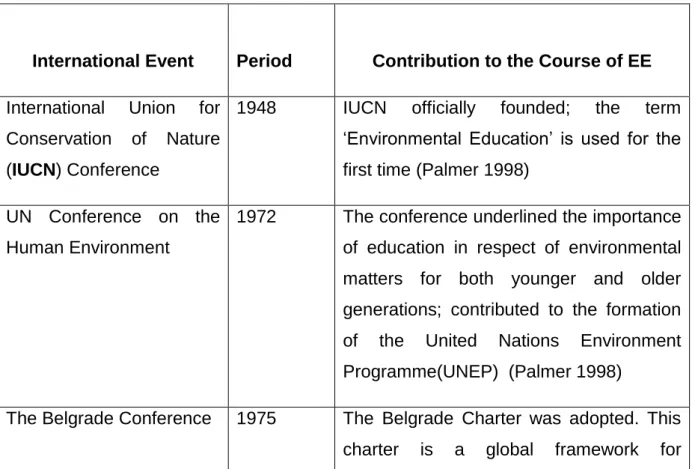
LIST OF TABLES Table 2.1: Some of the International Events that Contributed towards the Integration of EE in School Curricula...52
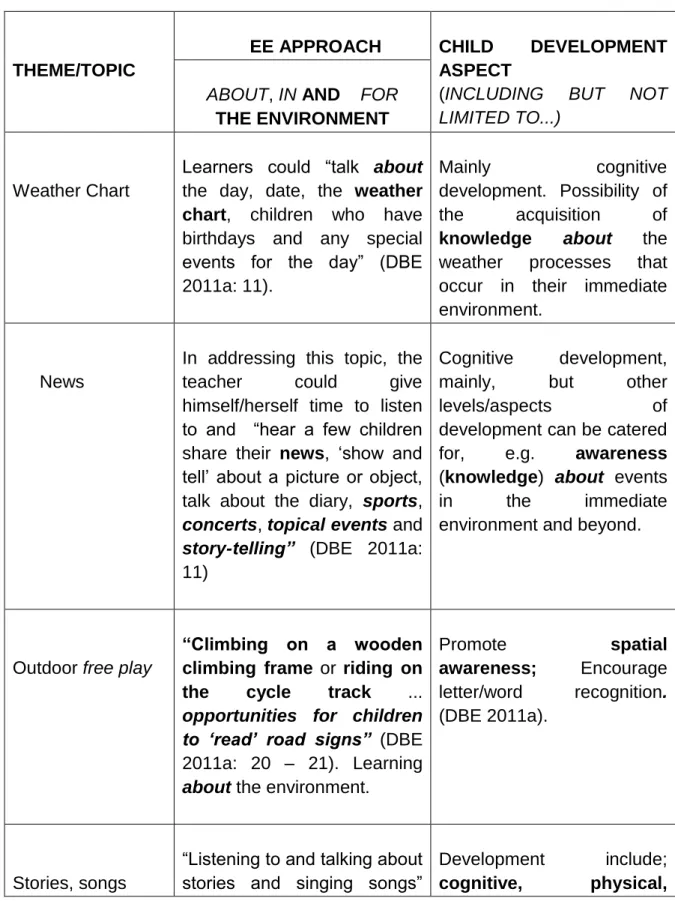
Table 2.2: The National Curriculum Expectations for EE Integration in Grade R: English Home Language...63
Table 2.3: The National Curriculum Expectations for EE Integration in Grade R: Life Skills...65
Table 2.4: The National Curriculum Expectations for EE Integration in Grade R: Mathematics...71
xxi Table 3.2: A nursery rhyme that could be used for teaching backward counting…...126 Table 3.3: An example of a problem sum that could be used in Grade R…...127 Table 3.4: A rhyme that could be used to aid the use of Vygotsky’s theory in Grade R…...149 Table 3.5: A rhyme that could be used to aid the use of Bronfenbrenner’s theory in Grade R…...160 Table 5.1: Respondent Profiles...275 LIST OF ABBREVIATIONS AND ACRONYMS
CAPS...Curriculum and Assessment Policy Statement CRT...Culturally Responsive Teaching
DBE...Department of Basic Education DCSTs...District Curriculum Support Teams DoE...Department of Education
ECD...Early Childhood Development ECE...Early Childhood Education EE...Environmental Education
EPA...Environmental Protection Authority
FUNDEB...Fundo de Manutenção e Desenvolvimento da Educação Básica
FUNDEF...Fundo de Manutenção e Desenvolvimento do Ensino Fundamental HOD...Head of Department
ISAP...Index of South African Periodicals LTSM...Learning and Teaching Support material
NAAEE...North American Association for Environmental Education NCS...National Curriculum Statement
NWDE...North West Department of Education
OECD...Organisation for Economic Co–operation and Development PED...Provincial Education Departments
xxii SAIDE...South African Institute for Distance Education
SES...Senior Education Specialist SMT...School Management Team
TVET...Technical and Vocational Education and Training
UNESCO...United Nations Educational, Scientific and Cultural Organization UNICEF...United Nations International Children's Emergency Fund
1
CHAPTER ONE
PROLOGUE: SETTING THE SCENE
1.1.INTRODUCTION
The purpose of this introductory chapter is to orientate the reader to this study. This is done by reflecting on the following aspects: the rationale/motivation for this study, statement of the problem, a reflection on the area demarcated for this study, the research method and design, used to direct this inquiry, and the clarification of some of the concepts that are deemed significant in respect of guiding the theoretical positioning of this study. However, before I do so, I commence by providing my brief background.
1.2.THE “SELF” IN CONTEXT: A BRIEF PERSONAL BACKGROUND
In qualitative research, the role of the inquirer as research instrument is acknowledged (Xu and Storr 2012; Klenke 2008). Therefore, in view of the fact that, the identity of the researcher has “the potential to impact the research process” (Bourke 2014: 1), it is expected of the researcher to identify their positionality (Holmes 2014). According to Knight (2011: 49), positionality is “a contextual subjectivity based on social dimensions such as race, class or gender and shaped by an historical matrix of habits, practices, and discourses”. Additionally, Holmes (2014: 3) points out that “positionality requires that both acknowledgement and allowance is made by the researcher in relation to their views, values and beliefs in relation to the research process and the research output(s)”.
Accordingly, in line with the preceding points, in this section I provide a brief reflection on my personal background. This should, somewhat, enable the reader to make an evaluation on how my identity or positionality impacted on this inquiry. However, it is important to mention that although “positionality can be described, at least in part, as reflexivity” (Bourke 2014: 1), in this study, reflexivity is discussed separately as one of the aspects used to ensure the trustworthiness of the findings (refer to section 4.4). Here, I focus mainly on ‘who I am’ and ‘where I come from’.
I am a ‘black’ African male, originally, from a geographical location currently referred to as the Eastern Cape Province within the Republic of South Africa. I spent the first eight years of my life in the rural village of Khubusi near a small town called Stutterheim. Those were, arguably, the most wonderful years of my life thus far! One was ‘immersed’ in serene life of
2
abundance and verdant beauty of nature; and melodious sounds of birds accompanied by rippling and burbling waves of the Khubusi River. This was in stark contrast to the perpetual hurly–burly life of uncertainly by people chasing shadows in their quest for ‘descent’ living and livelihood that characterised, virtually, all the urban and peri–urban places I found myself inhabiting in subsequent years.
My elder sister and I stayed with our paternal grandmother while both our parents toiled as “kitchen–girl” and “garden boy” for white people in Pretoria, the capital city of South Africa. I spent all my time, if not attending Khubusi Bantu Community School, in the company of my male cousins – the children of my father’s elder sister, one of my two aunts at the time. Their household was ‘wealthy’; they had livestock and arable land that was ‘decorated’ with maize all around during the crop–farming season. They also had a range of fruits such as pears, apples, fig, and so on. Therefore, while the elders spent time ploughing, tilling and discing the land, we (the boys) spent our time herding cattle and sheep in the field.
This was the period I enjoyed the most since it drew me closer to nature. The area had numerous natural features, among others, small hills, bushes, shrubs, trees, a water pond and Khubusi River to top. As young boys we would swim in the water pond (since I could not swim; I only dived in and out), hunt birds and rabbits or simply listen to the sounds of the river interspersed with melodious tunes of birds singings as if in some competition.
However, things changed when our grandmother passed on. My sister and I were forced to migrate and settle in a place called Winterveld, an urban village, in the north of Pretoria. This was a dense, crime–ridden squalor with different forms of pollution and no water facilities, among other challenges. Everything was different from what I was accustomed to; the culture, the language – in fact, although there was a variety of languages spoken, there were very few people who could speak isiXhosa. Hence, I had to enrol in one of the few private schools which offered IsiZulu, one of the four languages which, alongside isiXhosa, SiSwati and IsiNdebele, fall into the category of Nguni languages. Above all, except for our domestic dog, Rex, I was detached from nature.
As years passed away, and after completing Grade 6, the highest class at Lusizo Primary School, I had to move to Mamelodi, a township located about 75 kilometres south–east of Winterveld. This was due to the fact that Winterveld was under the governances of Bophuthatswana, one of the homelands promulgated as a consequence of the Group Areas
3
Act1 , and therefore the public schools in the area were meant to cater only for Setswana speaking learners. Additionally, even though there were schools that catered for learners who studied IsiZulu, like me, just across the railway line in Soshanguve; a township located less than 15 kilometres from Winterveld; children from Winterveld were not admitted in those schools unless they produced residential permits which depicted them as residents of Soshanguve. On the other hand, there was no red–tape in Mamelodi, hence I enrolled for my Grade 7 at Umthombo Primary School in Mamelodi West and, subsequently, proceeded to Ribane–Laka High School in Mamelodi East for my secondary school education.
It was during the to and fro commuting between Winterveld and Mamelodi that I took an interest in politics. This was during the 1980s, the period characterised by the hive of student politics, an era propelled by the famous 1976 uprising of Soweto. However, I must admit that since my father was an authoritarian who never minced his words, I was careful not to get ‘carried away’ and participate openly and actively in any form of politics. Hence, my involvement in politics while I was still living under his roof was restrained. It is for this reason that even when I returned home dripping of blood from the sjamboks of merciless white policemen from Silverton, next to Mamelodi, one day in 1985; I falsely claimed that I was not part of any grouping that ‘provoked’ the police. I only became openly and actively involved in political activism upon leaving my parents’ house after completing my Grade 12 (then referred to as Standard 10) at the end of 1988.
In 1989 I applied for admission and was, subsequently, admitted into the Senior Primary Teachers’ Diploma programme at Soweto College of Education with effect from January 1990. It was during my teacher training years that I became more active in political party, student and youth politics. Hence, in subsequent years I was elected and served in numerous leadership positions in various organisations. My participation in politics made me appreciate, even more, the plight of the marginalised and oppressed masses of our people, especially Black Africans. This entrenched my inclination towards the ideals of democracy, equal rights, political and economic emancipation and social justice for all.
1Group Areas Act of 1950 – This was one of the apartheid laws prior to the release of Nelson Mandela (and
other political prisoners) and the subsequent advent of democracy in South Africa in the 1990s. This law was meant to separate not only Black people and other racial groups from white people but even various ethnic groups had to settle in areas designated by the apartheid regime for them. For example, the people who speak Setswana were settled in a place called Bophuthatswana, the people who speak isiZulu were settled in Zululand, and so on.
4
Apart from political activism; through literature, the English Department at the teachers’ training college also played a prominent role in broadening my thinking and reflection on social, economic and political issues affecting not only South Africa at the time but one was exposed to the enduring plight of other Black people elsewhere in the African continent. Our lecturers encouraged, almost compelling us, to read almost exclusively; the African Writers Series novels and short stories. We had to read, analyse and reflect; both through discussions and writing, on how the issues addressed by various African writers resonated with South Africans. As a result, I was exposed to numerous writers, among others; Buchi Emecheta, Ngũgĩ wa Thiong'o, Tsitsi Dangarembga, Wole Soyinka, and my two favourite writers; Chinua Achebe and Bessie Head. I began to appreciate the difficulties faced by African people, especially, the impact of both Imperialism and Colonialism in terms of disturbing African ‘orderliness’ and African value systems. This ‘devaluing’ of African culture by Colonialism is, in my view, aptly captured in texts such as No Longer at Ease and Things Fall Apart by Chinua Achebe.
At the end of my three years of training I left Soweto and relocated to a small ‘unknown’ rural town of Makwassie which currently falls under the jurisdiction of the Maquassi Hills Local Municipality, an entity of the Dr Kenneth Kaunda District in the North West Province. My relocation took place in June 1993. This move was prompted by an apparent desperation by the only local high school to acquire the services of a geography teacher. My ‘displacement’ was a rather reluctant occurrence, all thanks to an incessant persuasion by a former college classmate who, in her own words, insisted that I was “the most appropriate person to assist those poor people who are struggling to get teachers”.
During my association (which lasted from 1993 to July 2010) with the local high school, I taught mainly geography from grades 10 to 122. Unfortunately, I had very limited opportunities to teach my other favourite subject, biology. This could be attributed to a persistently dominant and very ill–informed notion among the majority of the School Management Team (SMT) members; who served during ‘different eras’ while I was at that school, that “if you were hired to teach subject X, you will only teach that subject”. I found this to be an incredibly short–sighted, stifling and regressive view. Upon becoming part of the
2Grades 10, 11 and 12 are also referred to as the Further Education and Training (FET) phase in South Africa.
On the other hand, the other two classes that usually form part of secondary school education, namely Grades 8 and 9, are part of the phase known as the General Education and Training(GET) which ranges from Grades R to 9.
5
SMT, I tried all I could to persuade them to rethink their stance, but since I was a lone voice, that was all in vain.
I had a great interest in geography hence I had intended to ‘take it’ as one of major subjects once I had enrolled for my bachelor’s degree at the University of South Africa (UNISA) in 1995. Unfortunately, I could not do so since their BSc curriculum was designed in such a way that geography could only be ‘taken’ with either Mathematics or Statistics as another major subject. In view of the fact that I had ‘failed’ mathematics at Grade 12, my dream ‘fell off’. My second option was biology as a major. Although I would be able to enrol for biology together with various other subjects such as physiology, the practical component of biology kept this option out of my reach. Regrettably, since the practical sessions were held during school hours I had to forgo that dream too. At that point teachers did not enjoy the current plethora of workers’ rights, which are often abused, such as study leave. In those days the department of education was characterised by too much red–tape, hence I did not have the heart for it, particularly since I was still learning the ins and outs of the system. Ultimately, as a ‘consolation prize’ (this is how I viewed it at the time); I took English and Communication Science as my majors.
My university studies, especially English, alongside my involvement with teacher–union politics (upon my arrival at Makwassie I became active in union politics), contributed towards shaping and re–shaping my thinking, writing and interaction with people. In respect of my studies, I was particularly drawn to poetry and critical writing. Therefore, it was papers such as “Poetry: Poetic Voices” and “Protest, Satire and Subversion” at second year level, as well as “Poetry: Changing Worlds, Changing Texts” and “Literary Criticism: Writing about Writing” at third year level that contributed toward shaping my view of the world. Possibly, it is my exposure to the ‘knowledge’ and ‘reality’ gained from my interaction with the texts (human and non–human) that I am still grappling with the concept of ‘knowledge’ and ‘reality’. Accordingly, I find it difficult to ‘categorise’ people, including the ‘self’ (me), into a particular epistemological and/or ontological perspective, particularly, due to the dynamic nature of human beings. For me, ‘classification’ and ‘categorisation’ amounts to not only confining people into restrictive cubicles but it is more like othering (Staszak 2008). Nevertheless, I must admit that as each day passes by I am beginning to suspect that ‘absolute truth’ might be a fallacy. This is because human beings are dynamic and therefore it is conceivable, in my opinion; that each person would have their ‘own’ individual view of what the ‘truth’ amounts to.
6
The quest for ‘knowledge’ made me commit myself to further studies, beyond an ‘entry– level’ degree. It was thus my hunger for ‘knowledge’ and, possibly, my love for subjects like geography and biology (and, probably my childhood experiences of nature) which prompted me to apply for and, subsequently, pursue a Master of Education (with specialisation in Environmental Education) degree upon its introduction around the year 2000 at UNISA. It was my belief that the programme would enable me to gain exposure to some aspects of both geography and biology and thereby enable me to expand my ‘knowledge’ in the two subjects and beyond – and it did. I was fascinated by the modules that introduced me to environmental science (i.e. the module that was referred to as, Environmental education, definitions, concepts and literacy), especially the chemistry component since it was ‘new’ to me, and the research module.
The research module introduced me to various approaches to the research processes – qualitative, quantitative, mixed methods, action research, and so on. However, my introduction to practical research (we dealt mainly with quantitative and qualitative research), via assignments, drew me closer to qualitative research. This is mainly due to the fact that qualitative research brings the researcher closer to the respondents – it has a personal element. Hence, during the completion of my M.Ed research component and, subsequently, my PhD inquiry, I felt ‘comfortable’ and ‘at home’ with qualitative research.
In respect of my decision to undertake an inquiry whose focus is on the exploration of the implementation of EE in an area where I might not be considered a “specialist”, namely; Early Childhood Education (ECE), a few points are worth noting. Since I was uncertain which topic or theme was ‘worth’ investigating at PhD level, I began to read various texts on EE. It was during this reading that I came across Julie Davis’s (2009) article entitled; Revealing the Research ‘hole’ of Early Childhood Education for Sustainability: A Preliminary Survey of Literature. I was immediately struck by the realisation that, apparently, little research was done which focuses on EE in ECE. Admittedly, I was sceptical at first because the ‘reality’ that I was not ‘trained’ in ECE, subliminally, invoked some hesitation in me. However, after a lengthy self–reflection I was convinced that I needed to take a leap and not restrict myself into some cubicle. Fortunately, two main reasons made my decision to pursue this study ‘simple’ at the end.
To begin with, I had grown weary of the incessant pressure by what I would call the ‘Grade 12 obsessed department of education’. In my view, the department had become more
7
concerned about Grade 12 examination results to the extent that, it would seem that South Africa is tacitly moving towards the secondary school league tables – a phenomenon prevalent in United Kingdom. In my observation, over the years, this is done to the disadvantage of the lower classes. For example, in my previous position as deputy principal I had to contend with a situation where the Grade 8 and 9 learners, often, had to go through their academic years without teachers in an array of school subjects. However, the FET classes, especially, the Grade 12 class, rarely went without subject teachers. Subsequently, as an FET teacher, I was one of the teachers who had to ‘fill the educational gaps’ discernible in the majority of learners who entered this phase. Additionally, my household conversations were (and still are) characterised by interactions about educational issues since both my spouse (an ECE teacher and subject adviser with more than twenty years experience in the field) and I are in the field of education. Naturally, since I had grown tired of both the educational situation and the persistent politics surrounding promotional posts at the high school where I was stationed (and the uneven–handedness of the departmental officials in addressing the situation), I enjoyed discussing issues concerning ECE. These discussions did not only serve the purpose of diversion, if you will, but were empowering. My view of educational issues, somewhat, expanded due to my ‘new found’ interest in the ECE field. Subsequently, guided by the research gaps raised by Davis (2009); I decided to undertake my PhD with focus on EE in ECE.
In rounding off the discussion in this section, I need to point out that at the time this study was undertaken I was no longer part of the department of education. My lengthy exposure to what could be conceived in terms of Herzberg’s motivation–hygiene theory, also known as the two-factor theory (Teck–Hong and Waheed 2011; Baron and Byrne 2003) as an unhygienic work environment, which led to some deterioration in my health; culminated in my resignation. Therefore, at the time this study was undertaken, I had eventually agreed to assist UNISA as Teaching Practice Supervisor, on a part time basis. This responsibility exposed me to observations of a variety of, generally, high quality teaching lesson presentations in diverse settings by student–teachers who hailed from an array of backgrounds. Therefore, it is my contention that there is a multiplicity of factors; as briefly accounted for in this discussion, which conspired, if you will, to shape my interaction with the research processes and the texts (both human and non–human) that formed part of this inquiry. These include, among other factors, my teacher union politics, my experience as a
8
school teacher and deputy principal as well as my teaching practice supervision experience. The next point of discussion focuses on the motivation/rationale for this inquiry.
1.3.MOTIVATION FOR THE STUDY
Planet Earth is plagued by a myriad of environmental problems which “pose a threat to environmental sustainability” (Steg and Vlek 2009: 309). These include, among other things; pollution, global warming resulting, mainly, from greenhouse effect, scarcity of water, loss of biodiversity, environmental degradation due to exploration and exploitation of resources, e– waste, excessive human consumption, and so forth (Reddy 2011; Gaidajis, Angelakoglou and Aktsoglou 2010; Chan, Choy and Lee 2009; Eregha and Irughe 2009; Omubo–Pepple, Israel– Cookey and Alaminokuma 2009; Steg and Vlek 2009; Yan and Fengfeng 2008; Davis 1998). The majority of these problems can be attributed to the often unhealthy relationship we, human beings, have with nature and our general behaviour towards the environment (Liefländer, Fröhlich, Bogner and Schultz 2012; Steg and Vlek 2009). In order to offset the impact of current and prospective environmental problems on future generations and on the general well–being of the broader environment, it is necessary to equip young children with befitting competences. Hence, there is a need to expose young children to quality education that addresses a wide range of issues including, in particular, environmental matters and sustainable development issues. Environmental Education (EE)3 is, undoubtedly, the key vehicle in equipping and preparing children from the stage of early childhood, with skills, values, attitudes and knowledge that would enable them to negotiate environmental challenges so as to promote sustainable livelihoods and respect for the environment (Elliott and Davis 2009; Hägglund and Pramling Samuelsson 2009; Kaga 2008; UNESCO 2008; Yan and Fengfeng 2008; United Nations 2002; Van Wyk 2000; Arms 1994).
Evidence suggests that EE has, over the years, been acknowledged as an effective tool which plays a critical role in the broad field of education (Kudryavtsev, Krasny and Stedman 2012; Skanavis and Sakellari 2011; Tidball and Krasny 2010; Rickinson 2001). For example, it empowers the learners to gain a better understanding of the interdependence that exists between the various natural systems and the role of human beings in these systems (Davis 1998). Some approaches to EE also promote and champion the ideals of sustainable
3
Some prefer concepts such as Education for Sustainability (EfS) and Education for Sustainable Development (EfSD). However, I prefer the concept Environmental Education (EE) because this concept, viewed in the context of the Tbilisi Conference (1977), is not narrowly limited to “greening the environment” as some EfS and EfSD proponents argue but it is inclusive of both EfS and EfSD. It should also be noted that this concept is used interchangeably with the term environmental learning in this thesis.
9
development (UNESCO 2008; United Nations 2002 and UNESCO 1992). It is thus not surprising that various major world conferences such as the Tbilisi Conference on Environmental Education (UNESCO 1978), the UNESCO Conference on Environment and Development (UNESCO 1992) and the Ahmedabad Conference on Environmental Education (UNESCO 2008), to name just a few, amplified the significance of EE as one of the vehicles for attaining a sustainable world.
Similarly, literature also indicates unequivocally that it is imperative to introduce education, in general, and EE, in particular, as early as the stage of early childhood (Bokova 2010; Davis 2009; Hägglund and Pramling Samuelsson 2009; Calman and Tarr–Whelan 2005; Department of Education4 2001). Early childhood is a very important stage in human development because it is the foundation upon which the rest of human life, especially in respect of growth and development, is constructed (Spies 2011; Davis 2009). And, as the DBE (2001: 1) writes, “what happens during the early months and years have dramatic consequences for the rest of childhood and adolescence” because “experiences in children’s present life are likely to have long–lasting bearing on future competence to contribute to sustainability”(Hägglund and Pramling Samuelsson 2009: 59). More importantly, early childhood is the stage in which various skills and competences such as reasoning, problem– solving, language, perception–motor skills, and ability to relate to the environment are acquired (Bokova 2010; Kaga 2008 ; DoE 2001); and all these factors influence actions when the child reaches adulthood. Therefore, it is appropriate that education for sustainability must begin in early childhood (Davis 2009; Kaga 2008; Pramling Samuelsson and Kaga 2008). However, despite the significance of early childhood, as indicated above, this stage of human development has experienced a high level of educational neglect (Elliott and Davis 2009; Calman and Tarr–Whelan 2005; Davis 2005; DBE 2001; Davis 1998). The main concern in respect of early childhood, as far as this study is concerned, is that there is a major absence of research that gives attention to EE in the field of Early Childhood Education (ECE). For example, Davis (2009) conducted a literature survey with a focus on EE/education for sustainability (EfSD) and childhood education by examining relevant premier global journals for the period of 12 years (1996 – 2007) and discovered that there was little research conducted in this regard. She asserts that, “in general, early childhood education researchers have not engaged with environmental/sustainability issues and environmental education
4The South African National Department of Basic Education (DBE) was previously known as the Department of
10
researchers have not focused on very young children and educational settings” (Davis 2009: 229).
The paucity of research in the broader field of ECE and, more specifically, in the area of EE/EfSD in early childhood (Davis 2009) poses some hindrances in terms of influencing policy discourse and (re)directing pedagogical interaction (Reid and Scott 2006) in the field of education. Undoubtedly, there is a serious need to focus a great deal of research on ECE in order “to find out what works, why and how, and what are the barriers and opportunities for implementing education for sustainability” (Davis 2009: 237) and, to determine the context within which certain EE practices work or do not work (Sheridan, Edwards, Marvin and Knoche 2009).
In a country such as South Africa which is, just like the rest of the world, plagued by environmental challenges, a study that explores the integration of EE in ECE, as this one seeks to do, is necessary. Such a study would contribute towards filling the research gap identified by Davis (2009) in ECE, in general, and EE, in particular. This study should, among other things, contribute towards identifying effective learning and teaching methods that could enable the integration of environmental learning; and should also make it possible “to explore the ways in which early childhood already has foundations for building sustainable principles into its educational philosophies, theories and practices”(Davis 1998: 119). Additionally, this enquiry could also contribute towards identifying “developmentally and culturally appropriate practices of early childhood education for sustainable development” (Yan and Fengfeng 2008: 46). Likewise, since Grade R is a class that is meant to prepare the learners holistically for the first class of formal schooling, namely; Grade 1, this study could also provide some indication concerning the extent to which certain Early Childhood Development Centres (ECDs) in South Africa prepare their Grade–R learners for formal schooling. More importantly, through this study, the reader could gain some knowledge as regards the incorporation of EE in Grade R. For example, one could be enlightened in terms of the strategies as well as the hindrances that impact on the infusion of EE in Grade R. Hence it was essential to undertake a study of this nature. The next point of discussion focuses on the statement of the problem of this investigation.
11 1.4.STATEMENT OF THE PROBLEM
The dearth of research in the field of ECE, in general, and in the area environmental learning as a focal point within the field of ECE, in particular, has been vividly highlighted in preceding paragraphs. However, there is one key challenge that was identified by several researchers which stimulated my interest and, subsequently, prompted me to undertake this inquiry. Various researchers have berated the existence of a phenomenon in which young children are being deprived of the opportunity to engage with and are disconnected from natural outdoor settings by modern lifestyles (Prince 2010; Elliott and Davis 2009; Hacking, Barratt and Scott 2007; Davis 1998). This phenomenon which is referred to by Louv (2005: 532 cited in Davis 2009: 228) as “nature deficit disorder” inhibits environmental learning (Prince 2010; Hacking, Barratt and Scott 2007) and is, allegedly, imposed by adults. The profoundness of this occurrence is captured in Dighe (1993: 62 as cited in Elliot 2015: 47) who writes that “one can hardly imagine a generation of persons with neither interest nor knowledge of outdoors making responsible decisions about the environment”. Viewed through the lens of someone who has been in the area demarcated for this study for more than twenty years, I contend that this phenomenon is also rife in the area. This could be attributed, in part, to the fact that, the socio–ecological landscape selected for this study is characterised by an absence of some of the phenomena such as streams, rivers, nature centres, museums, zoological gardens, all of which could enable young children to interact with nature (Kola– Olusanya 2005; Oltman 2002).
The South African situation appears to be more serious than the global scenario, as outlined above, in respect of conducting research within the area of ECE and EE. This is discernible from the fact that the Boolean search of concepts such as Environmental Education and Early Childhood Development, Education for Sustainable Development and Early Childhood, Education for Sustainability and Early Childhood, in various combinations, on the Index to South African Periodicals (ISAP), the Nexus database as well as during the examination of the Southern African Journal of Environmental Education for the periods ranging from 2001 to 2011 yielded unfavourable results. For example, the nexus database yielded only one M.Ed study which focussed on the influences of policy and context on environmental teaching and learning processes in ECD. This study was completed by Priya Vallabh (2005). The only other study of relevance was accessed after a search of repositories of several South African universities. This study entitled “early childhood development as a pathway to sustainable development” was conducted by Magdelien Spies (2011) for an M.Phil thesis. Evidently,
12
there seems to be little investigation that focuses on EE in the area of ECE in South Africa, especially inquiries whose focus is on the integration of EE in Grade R.
The other problem is that there are “many different types of ECD services” (DBE 2001: 8) that are available in South Africa and these ECD centres are “largely fragmented” (DBE 2001:8). This suggests that the functioning of these learning institutions is, possibly, not well coordinated. At the same time, the school–based ECD centres (DBE 2001) are given more attention in terms of professional and financial support compared to the community–based and home–based ECD centres which receive “some or no financial support from government” (DBE 2001: 8 – 9). Therefore, the impact of “some or no financial support” on these learning centres is an aspect worth investigating.
Apart from the above points, it is worth noting that since the advent of democracy in 1994, the vigorous education policy changes in South Africa have; rightfully, sought to include environmental teaching and learning as one of the core aspects of the curriculum (DBE 2011a; DBE 2010; DBE 2003 ; DBE 2002; DBE 1995). However, in view, of the fact that the curriculum currently in use in South African public schools came into effect only in 2012, and thus, there is a need to evaluate the extent to which the teachers are able to integrate EE, a component which forms part of the principles underpinning the school curriculum in South African public schooling system (DBE 2011c).
Flowing from the preceding statements, the question that is central to this study and, thus, constitutes the main problem of this inquiry can be posed as follows:
What is the current status in respect of the implementation of Environmental Education in Grade–R of selected ECD centres in the North West Province of South Africa? The following sub–questions can also be linked to the main question of the study:
What opportunities/challenges/hindrances exist in respect of the implementation of environmental education in Grade–R in the North West Province?
What types of programmes are utilised to aid the implementation of environmental education in Grade–R?
To what extent are the ECD practitioners equipped to implement environmental education?
13
What impact does the funding of ECD centres have on the implementation of educational programmes, in general, and environmental education in particular, in the North West Province?
What type of support is provided by the North West Department of Education (NWDE) to the ECD centres?
Therefore, the major purpose of this study was to investigate whether there is an integration of EE in selected Grade R classrooms in the North West Province. The above–mentioned questions played a major role in terms of guiding the processes entailed in data generation, analysis, discussion and presentation. In the following section I reflect briefly on the area selected for this investigation.
1.5. DEMARCATION OF THE STUDY
In line with The Constitution of the Republic of South Africa (refer to figure 1.1 for the map of South Africa), the South African National Department of Basic Education, grants each of the nine provincial legislatures of the country the authority to manage “educational affairs (other than universities and universities of technology), subject to a national policy framework” (Burger 2005: 209). Hence, the North West Department of Education (NWDE), just like the other eight Provincial Education Departments (PEDs) of South Africa, has the authority to, inter alia; demarcate its own boundaries of operation. Consequently, for ease of administrative and managerial functions, the North West Provincial Department of Education is subdivided into four districts, namely; Bojanala, Dr Kenneth Kaunda, Dr Ruth Segomotsi Mompati and Ngaka Modiri Molema. Each education district is further divided into various area offices and these area offices are, in turn, split into circuits.
14 Figure 1.1: Map of South Africa
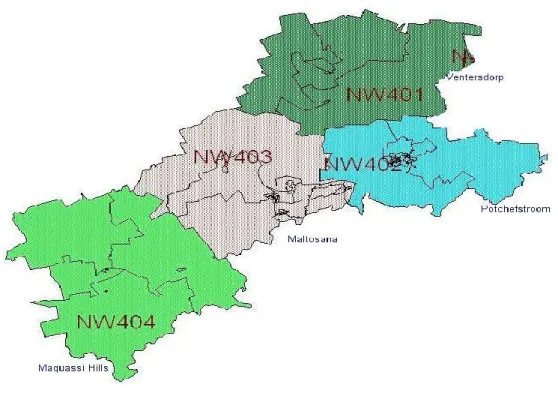
This study was conducted in the geographical area known as Maquassi Hills in the Dr. Kenneth Kaunda District. This is the location of Maquassi Hills Area Office, one of the three education offices that form part of the Dr. Kenneth Kaunda Education District. Matlosana and Tlokwe5 are the other two area offices that complete the Dr. Kenneth Kaunda Education District (refer to figure 1.2 for area offices). The four learning institutions which participated in this inquiry were located in each of the three circuits, namely; Naledi, Wolmaransstad and Tswaing which fall under the control of Maquassi Hills Area Office. These education circuits are spread across the following rural towns: Makwassie, Leeudoringstad, Wolmaransstad, Ottosdal and Sannieshof (refer to figure 1.3. for the location of these towns).
5This area office is also referred to as Potchefstroom; hence it appears as such on the map. Likewise, the town
called Ventersdorp (refer to figure 1.2.) is not a standalone as depicted on the map, it forms part of the Tlokwe area office.
15
Figure 1.2: Map of Dr Kenneth Kaunda Education District