Z. Klin. Chem. Klin. Biochem. 12. Jg. 1974, S. 166-170
The Effect of Temperature on Enzyme Activity and on the Affinity of Enzymes to their Substrates
1)
By G. Szasz ' Aus dem Institut für Klinische Chemie (Direktor: Prof. Dr. L. Roka) an den Universitätskliniken Gießen (Eingegangen am 22. Januar 1974)
The effect of temperature on the activity of several diagnostically important enzymes2) was measured. At 30° C, the measured activity of some enzymes already differs from that calculated from the Arrhenius plot, while all the enzymes investigated showed a significant deviation of activity at 37° C. This deviation is independent of the time of pre-incubation (up to 1 hour) and the sample concentration in the assay solution. The activity measured at 25° C after a pre-incubation of 1 hour was independent, of the tempe-rature of pre-incubation up to 40° C. In addition, increased tempetempe-rature decreased the affinity of 7-glutamyltransferase and leucine arylamidase for their substrates. The theoretical and practical aspects of the findings are discussed.
Der Einfluß der Temperatur auf die Aktivität mehrerer diagnostisch bedeutsamer Enzyme wurde gemessen. In der Darstellung der Beziehung zwischen Aktivität und Temperatur nach Arrhenius ist eine Krümmung der Kurve fur einige Enzyma bereits bei 30° C fest-stellbar und sie wird für alle Enzyme bei 37° C deutlich. Die Abweichung von der Geraden ist unabhängig von der Vorinkubationszeit (bis zu einer Stunde) und von der Serumkonzentration im Meßansatz. Die bei 25° C gemessene Aktivität nach einer Vorinkubation von einer Stunde ist bis 40° C von der Temperatur während der Vorinkubation unabhängig. Zusätzlich wurde eine Abnahme der Affi-nität der 7-Glutamyltransferase und der Leucin-Arylamidase zu ihren Substraten bei Erhöhung der Temperatur beobachtet. Die theo-retischen und praktischen Aspekte der Ergebnisse werden diskutiert.
The need for the international standardization of enzyme activity measurements is accepted by almost all clinical chemists. According to the Enzyme Commission of the IUB (1) the conditions should be chosen to obtain maxi-mum activity. Since almost all the kinetic factors rele-vant to the optimization are highly dependent on the assay temperature, the first step in standardisation must be an agreement upon a standard temperature. The dis-cussed alternatives are 25° C, 30° C and 37° C (2, 3). The advantage of higher temperature is the increased sensiti-vity, which permits either more analyses per time unit or the use of less sample. The extent to which the tem-perature can be raised is limited by the eventual heat-inactivation of the enzymes. The threshold for the onset of thermal inactivation may vary for the individual enzymes, even between isoenzymes and perhaps from sample to sample with different starting activities. It also depends upon the time of incubation.
We know a lot about the stability of the enzyme activity in serum stored at various temperatures, but much less about the behaviour under assay conditions. Most assay solutions are poor in protein and contain unphysiological substances in high concentration such as buffers. We therefore tried to establish the behaviour of some diagnostically important enzymes and iso-enzymes under assay conditions at different tempera-tures and at various times of incubation. In addition the Michaelis constants3.) of some enzyme were esti-mated at 25°C, 30°C and 37°C in order to study the · effect of temperature on the affinity of the enzymes to the substrates used.
Materials and Methods
Instruments
Eppendorf photometer with temperature-controlled cuvet holder, linear absorbance converter and recorder4). Eppendorf micropipets4)
Mikromix, electric stirrer4).
Haake thermostat FK with built in cooling equipment and thermosistor TP 43 (electronic temperature regulator5). Tastomed P, electronic temperature measuring instrument6). Digital pH meter, type 640T).
Glass electrode (Einstabmeßkette) Lot 405-M38). Enzymes
The serum of patients served as the souce of the enzymes. All the sera examined showed a slight to high elevation of activity. The proportion of the sample volume to the total volume of the final reaction mixture was not altered for the same serum over the whole range of temperature. The interpretation of the isoenzyme composition was based on clinical findings and was confirmed electrophoretically for the lactate dehydrqge-nase.
1) Presented at the 8th International Congress of Clinical Chemistry in Copenhagen (18. - 23. 6.1972) and the 2eme Colloque, Automation et Biologie Prospective in Pont-a-Mousson (10. - 14.10. 1972).
2) Enzymes: Aspartate transaminase (EC 2.6.1.1), Alanine transaminase (EC 2.6.1.2), Creatine kinase (EC 2.7.3.2), Lactate dehydrogenase (EC 1.1.7.27), Alkaline phosphatase (EC 3.1.3.1), Leucine arylamidase (EC unknown), -Gluta-myltransferase (EC 2.3.2.2).
3) Apparent Michaelis constant.
4) Eppendorf Gerätebau, Netheler-Hinz GmbH, Hamburg s) Gebrüder Haake, Karlsruhe.
6) Braun Electronic GmbH, Frankfurt/M. 7) Knick Elektronische Meßgeräte, Berlin. 8) Dr. W. Ingold KG, Frankfurt/M.
100
1
50
| 30 20 10 40"C - v.1 10°" *^
N^.'X5^ 30°C
•Ns>* I
50 '^^ 20-c 1 30^^ '20
α 1 . ± , 1 1 1 1 *. 1040°C
- "^^ 5
C
^'^^.^ 20°C
b 1 1 ! 1 1 1315 320 325 330 335 340 345
Temperature [10
s-K'
1]
315 320 325 330 335 340 345
Temperature HO
5^·
1]
40°C
1000
500
| 300
200^
100 ^ 5 0 £ 30 20 I I I I I J_5 320 325 330 335 340 345
Temperature HO^K"
1]
10
I I I I315 320 325 330 335 340 345
Temperature [10
5-K~
]]
Fig. 1. Effect of temperature on the activity of aspaitate aminotransferase (a), alanine aminotransferase (b), alkaline phosphatase (c) and 7-glutamyltransferase (d)
Procedure
The activities of aspartate transaminase, alanine transaminase, creatine kinase, lactate dehydrogenase, alkaline phosphatase, and leucine arylamidase were measured with the optimized standard methods9) of the German Society for Clinical
Che-mistry (4) and the τ-glutamyltransferase'with a method described previously (5) by continuous monitoring of the reaction rate for 2 minutes. Generally a pre-incubation for exactly 5 minutes preceded the activity measurement. The temperature was checked in the cuvets with the electronic temperature measuring instrument several times during the assay and it was constant at a level of ± 0.1 degree. The pH was adjusted to allow for the effect of temperature on the pH, then checked again in the thermostated cuvets. To mini-mize the methodic error, triplicate assays were performed; each plot is the result of investigations in several sera on different days.
Results
Arrhenius plot
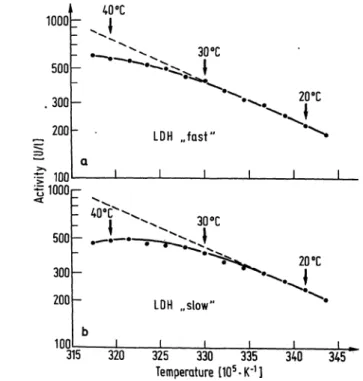
The activity of several enzymes, measured between 18
and 42 degrees at two degree intervals, was plotted
against the temperature according to Arrhenius (Fig. 1,
2 and 3). The deviation of the measured activity from
the activity calculated from the Arrhenius plot is
given in table 1. At 25°C the measured and calculated Τ
activity was the same for all enzymes and isoenzymes.
At 30°C, this was still true for aspartate
arninotrans-ferase, alkaline phosphatase and the fast moving fractions
9) Boehringer Mannheim GmbH and £. Merck, Darmstadt.
of lactate dehydrogenase, but alanine aminotransferase,
creatine kinase, γ-glutaniyltransferase and the slow
moving fractions of lactate dehydrogenase already
showed a difference of between 2 and 9 percent. The
deviation at 37°C is highly significant for every enzyme
and lies between 12 and 27 percent.
There was no significant difference between the
aspartate aminotransferase in the sera of patients with
myocardial infarction and those with liver disease;
creatine kinase was the same in the sera of patients with
myocardial infarction or skeletal muscle damage
(Fig. 2); and alkaline phosphatase was the same in the
sera of patients with obstructive jaundice or bone
disease. In spite of this the deviation of the measured
activity of the slow moving lactate dehydrogenase
(electrophoretically 50% LDH
S) from the activity
cal-culated from the Arrhenius plot was more than twice
as high as for the fast moving lactate dehydrogenase
(predominantly LDH! and LDH
2) (Fig. 3 and tab. 1).
The effect of incubation time on activity
The dependence of the activity on the time of
incu-bation was studied for alanine aminotransferase and
γ-glutamyltransferase. Sera were pre-incubated in
the assay solution for an hour at 20°C, 25°C, 30°C,
35°C, and 40°C. The reactions were then started by
the addition of 2-oxoglutarate
andL-7-glutamyl-p-nitroanilide, respectively. The activities measured
Z. Klin. Chern. Klin. Biochem. /12. Jahrg. 1974 / Heft 4
Tab. 1. Deviation between the activities measured and calculated from theArrhenius plots Aspartate amino-transferase Alanine amino-transferase Creatine
kinase Alkalinephosphatase 7-Glutamyl-transferase
Lactate dehydrogenase "fast" Lactate dehydrogenase "slow" (percent) 30° C 37°C 150 175 222 120 235 13 .,0 279 1000 ^ 500 ( 300 3 200 100 50 40 °C 315 320 325 330 335 340 345 Temperature [10s-K"1]
Fig. 2. Effect of temperature on the activity of creatine kinase (·—· skeletal muscle damage; o—o myocardial infarction) plotted according to Arrhenius.
1000' 500 .300 _ 200 =3 ξ 100 ? 1000 500 300 200
ιοο
3 40 °C I -^J^·^ 30°c - *^v LDH „fast" a 1 I I 1: -^
ι J-^ΐ^Γ
- "^^
LDH „slow" b ι ι ι ι 15 320 325 330 335 Temperature [105-K'1J 20°C *\ I I 20 °C ^^ 1 1 . 340 345Fig. 3. Effect of temperature on the activity of the lactate dehy:
drogenase (a "fast"; b "slow") isoenzymes plotted accor-ding to Arrhenius.
after a pre-incubation of one hour or 2 minutes did
not differ significantly, even when the pre-incubation
temperature was 40°C (Tab. 2).
In another series (Tab. 3), sera were preincubated for
an hour under the same conditions as above; they
were then cooled to 25°C and the reaction was started
with the corresponding substrate. The activity
mea-sured at 25°C was independent of the temperature of
the pre-incubation.
Tab. 2. Influence of pre-incubation at different temperatures on the activity (U/l)
Temperature of pre-incubation Pre- incu-bation 20°C 25°C 309C 35°C 40°C Alanine aminotransferase γ-Glutamyl-transferase 2 min 16.8 20.2 26.6 32.4 43.5 60min+ 16.3 19.2 24.4 31.2 42.0 2 min 38.2 54.4 69.6 86.8 98.2 60min* 38.2 49.4 66.8 86.8 96.6 After adding NADH and lactate dehydrogenase, incubation was continued for a further 5 min, and the reaction was started with 2-oxoglutarate.
Started by the addition of X-y-glutamyl-p-nitroanilide
Tab. 3. Influence of pre-incubation for an hour at different temperatures on the activity (U/l) :
Temperature of the pre-incubation
20° 25° 30° 35° 40° Alanine aminotransferase 7-Glutamy^ transferase Serum 1 34.4 32.6 32.6 34.4 34.4 Serum 2 60.0 60.0 57.6 58.8 58.8 SerumS 104 104 100 100 100 Serum 1 80.8 80.8 80.8 77.8 80.8 Serum 2 119 119 119 121 123 Serum 3 275 275 275 275 275 Pre-incubation for an hour, followed by a further 5 min at 25° C after adding NADH and lactate dehydrogenase, then started with 2-oxoglutarate.
Started by the addition of Ι,-r-glut myl-p^nitroan ide. Z. lain. Chem. Klin. Biochem. / 12. Jahig. 1974 / Heft 4
Effect of sample concentration in the assay
solution
Sera with high LDHs and γ-glutamyltransferase
activities were diluted 1:20 with physiological sodium
chloride solution and with human albumin or
inac-tivated serum, respectively. The activity measured at
20°C, 25°C, 30°C, 35°C, and 40°C was independent
of the diluent used (Tab. 4).
Effect of temperature on the Michaelis
constant
3)
The Micfiaelis constants of γ-glutamyltransferase
and leucine arylamidase
forZr-7-glutamyl-p-nitro-anilide andZ,-leucyl-p-nitroforZr-7-glutamyl-p-nitro-anilide, respectively were
estimated at 25°C, 30°C and 37°C. The K
mvalues of
both enzymes increase gradually with the temperature;
consequently the affinity of the enzymes to their
sub-strates decreases (Fig. 4 and 5).
-3 0.07 0.06 0.05 1 0.04 0.03 Q02 25 eC
Fig. 5. Michaelis constant of leucine arylamidase for L-leucine-p-nitroanilide at various temperatures - Lineweaver-Burk plot: Km = 0.66 (25° C), 0.81 (30° C), 1.05 (37° C) mmol/1
Discussion
According to our observations, the measured enzyme
activity at higher temperatures differs from that
cal-culated from the Arrhenius plot. For several enzymes,
a deviation is observed as low as 30°C (up to 9%) and
this becomes significant (up to 27%) at 37°C for all
0.05-25 °C
Fig. 4. Michaelis constant of -y-glutamyltransf erase for 2>y-glu-tamyl-p-nitroanilide at various temperatures - Lineweaver-Burk plot: Km = 1.47 (25° C), 1.67 (30° C), 2.60 (37° C) nunol/1 150-50 X 59,8 I 1 1 60.4 I 3 4
t [days 1
65.3 U/l l _Fig. 6. Stability of-rglutamyltransferase stored at 37° C
the enzymes studied. It is not only those enzymes
known to be temperature-sensitive that deviate from
the Arrhenius plot; the same behaviour is shown by
stable enzvmes such as Ύ-elutamvltransferase
?
ery stf
Dle enzy
mes>
sucn as7 »utmyitransieiase
(Fig. 6). Several explanations are possible for the
Tab. 4. Influence of sample concentration in the assay solution on the activity (U/l)Assay temperature Lactate dehydrogenase "slow" r-Glutamyltransferase 1:20 diluted with Human albumin NaCl, 0.9% inact. serum NaCl, 0.9% 20°C 161 157 42.8 40.4 25°C 206 195 66.8 64.2 30°C 245 235 75.0 73.0 35°C 287 261 88.4 . 86.8 40°C 255 245 100 96.6
deviation from the straight line in the Arrhenius
plot at higher temperature:
1. The enzyme protein alters its structure with
in-creasing temperature. The alteration is immediate
and reversible for the enzymes investigated up to
40°C, and it is independent of the sample
concentra-tion in the assay soluconcentra-tion. The structure of the enzyme
protein thereby becomes unfavourable for the reaction
catalyzed.
2. The optimal conditions for enzyme activity depend
on the temperature. Ellis and Goldbarg (6) found
tem-perature-dependent pH optima and K
mvalues for
lactate dehydrogenase using 2-oxobutyrate as
sub-strate. A decrease in the affinity of
-glutamyltrans-ferase and leucine arylamidase to their substrates with
increasing temperature was observed by us in this
study. It is possible that the deviation from the straight
line in the Arrhenius plot would disappear if the
condi-tions were optimized for the different temperatures used.
In my opinion both explanations might have a common
basis. Enzymes react according to the simplified
stoichiometric equations:
k-i k-2
where: E = free enzyme, S = substrate, ES = enzyme
substrate complex, P = reaction product and k = rate
constant.
The reaction velocity is generally limited by k
+2; at'
the beginning of the reaction the concentration of
the product is almost nought and the enzyme is
saturated with substrate (k+
t> k_
x), if an optimized
method is used, and k.
2therefore tends to 0. An
in-crease in temperature will therefore cause a higher
reaction rate, if the rate of splitting of ES to E and P
(k+
2) is raised. Apparently the speed of the competing
direction of the reaction (k-i) also increases, so that
one needs a higher substrate concentration for the
saturation of the enzyme. This fact can be explained
by an unfavourable structure of the enzyme protein
for the reaction catalyzed at a higher temperature. But
an unfavourable structure of an enzyme at higher
temperature is simply another way of saying that
the enzyme has suffered ä partial thermal inactivätion.
The practical aspects of this study are: the reaction
rate is obviously constant even at 31°C for at least
several minutes. Methods optimized for 25°C (4) are
at 37°C mostly suboptimal. Since the optimal
sub-strate concentration at 25° C is already, at least for
-glutamyltransferase and leucine arylamidase,
close to the limit of solubility, it will hardly be
possible to work at optimal conditions at 37°C.
Tem-perature conversion factors are not acceptable to
con-vert individual results from 37° C to 25°C, or vice
versa, since isoenzymes may be differently influenced
by temperature.
References
1. Report of the Commission on Enzymes of the International Union of Biochemistry (1961), Pergamon, Oxford. 2. King, J. (1972), Ann. Clin. Biochem. P, 197-202. 3. Bergmeyer, H. U. (1973), this J. 11, 39-45.
4. Recommendations of the German Society for Clinical Che-mistry (1972), this J. 10, 281-291.
5. Szasz, G. (1969), Clin. Chem. /5, 124-136.
6. Ellis, G. & Goldbarg, D. M. (1971), Amer. J. Clin. Pathol. 56, 627-635.
Prof. Dr. G. Szasz D.6300 Gießen Klinikstraße 32b