Technological University Dublin Technological University Dublin
ARROW@TU Dublin
ARROW@TU Dublin
Doctoral Science
2017
Representations of Idioms for Natural Language Processing:
Representations of Idioms for Natural Language Processing:
Idiom type and token identification, Language Modelling and
Idiom type and token identification, Language Modelling and
Neural Machine Translation
Neural Machine Translation
Giancarlo Salton
Technological University Dublin, [email protected]
Follow this and additional works at: https://arrow.tudublin.ie/sciendoc
Recommended Citation Recommended Citation
Salton, G. (2017) Representations of Idioms for Natural Language Processing: Idiom type and token identification, Language Modelling and Neural Machine Translation. Doctotal thesis, DIT, 2017. doi.org/ 10.21427/D77H8K
This Theses, Ph.D is brought to you for free and open access by the Science at ARROW@TU Dublin. It has been accepted for inclusion in Doctoral by an authorized administrator of ARROW@TU Dublin. For more information, please contact
Representations of Idioms for
Natural Language Processing:
Idiom type and token
identification, Language
Modelling and Neural Machine
Translation
by
Giancarlo D. Salton
Supervisors: Dr. John D. Kelleher Dr. Robert J. Ross
SCHOOL OF COMPUTING
D u b l i n I n s t i t u t e o f Te c h n o l o g y
Thesis submitted for the degree of
Doctor of Philosophy
Declaration
I certify that this thesis which I now submit for examination for the award of Doctor of Philosophy, is entirely my own work and has not been taken from the work of others, save and to the extent that such work has been cited and acknowledged within the text of my work. This thesis was prepared according to the regulations for postgraduate study by research of the Dublin Institute of Technology and has not been submitted in whole or in part for an award in any other Institute or Uni-versity.
The work reported on in this thesis conforms to the principles and re-quirements of the DIT’s guidelines for ethics in research.
DIT has permission to keep, to lend or to copy this thesis in whole or in part, on condition that any such use of the material of the thesis be duly acknowledged.
Acknowledgements
I would like to thank my family for their support and understand-ing: my mother Maria Rosa for always facing all the difficulties and challenges life has presented to her and my family with courage and giving us the strength to overcome them; my brother Guilherme Pedro whose happiness and persistence are always an inspiration; and to my auntie/godmother/second mother Dione for being always there when our parents could not be and for her great impact on making me the person I am today.
I would also like to thank my wife’s family: Antônio, Mary, Amanda, Edgar and Gregory. Their support has made our life much easier during this journey.
I would also like to thank both my supervisors for their guidance, support and friendship: my lead supervisor, Prof. John D. Kelleher, the person who took the challenge to accept me as his student without knowing me in person until the day arrived in Dublin and who who pushed me to the very best of what I could achieve. And my second supervisor, Dr. Robert J. Ross, who has also been there since the very beginning and whose advises on both the scientific and practical side helped to make the journey much less frightening.
I need also to thank all the colleagues and friends that joined or left the group along the way and made our Friday evenings in the read-ing group so very enjoyable: Paddy, Niels, Colm, Eoin, Ivan, Pierre, Hao, Fei, Elizabeth, Lucas, Alex, Kristina, Caroline, Jack, Marek, Ca-mille, Hector, Patrick, Senja, Irene and Guanhong. I also would like to thank the friends I made at the Focas Institute, especially those who also played in the tag-rugby team.
I would also like to thank Dr. Braulio A. de Melo who introduced me to research and has been a good friend ever since.
I also need to thank Vincent and Bernie Fitzgerald for their kindness, support and friendship since I arrived in Dublin.
On the business side, I would like to thank CAPES (“Coordenação de Aperfeiçoamento de Pessoal de Nível Superior”) for my scholarship (Science Without Borders, proc n. 9050-13-2).
I also thank the staff at the School of Computing who helped me a lot during the journey and thought me much during the process.
Finally I left the biggest acknowledgement to my lovely wife Acassia. Without her I would not been able to get through this journey. She shared all the good and the bad, the best and the worst of this voyage. She smiled and cried with me but she never let me get my head down. Her love and support were fundamental for me to finish this work.
Abstract
An idiom is a multiword expression (MWE) whose meaning is non-compositional, i.e., the meaning of the expression is different from the meaning of its individual components. Idioms are complex construc-tions of language used creatively across almost all text genres. Idioms pose problems to natural language processing (NLP) systems due to their non-compositional nature, and the correct processing of idioms can improve a wide range of NLP systems.
Current approaches to idiom processing vary in terms of the amount of discourse history required to extract the features necessary to build representations for the expressions. These features are, in general, stat-istics extracted from the text and often fail to capture all the nuances involved in idiom usage.
We argue in this thesis that a more flexible representations must be used to process idioms in a range of idiom related tasks. We demonstrate that high-dimensional representations allow idiom classifiers to better model the interactions between global and local features and thereby improve the performance of these systems with regard to processing idioms.
representa-tions of sentences, such as those generated by a Recurrent Neural Net-work (RNN) greatly reduce the amount of discourse history required to process idioms and that by using those representations a “general” clas-sifier, that can take any expression as input and classify it as either an idiomatic or literal usage, is feasible.
We also propose and evaluate a novel technique to add an attention module to a language model in order to bring forward past information in a RNN-based Language Model (RNN-LM). The results of our eval-uation experiments demonstrate that this attention module increases the performance of such models in terms of the perplexity achieved when processing idioms. Our analysis also shows that it improves the per-formance of RNN-LMs on literal language and, at the same time, helps to bridge long-distance dependencies and reduce the number of para-meters required in RNN-LMs to achieve state-of-the-art performance.
We investigate the adaptation of this novel RNN-LM to Neural Ma-chine Translation (NMT) systems and we show that, despite the mixed results, it improves the translation of idioms into languages that require distant reordering such as German. We also show that these models are suited to small corpora forin-domain translations for language pairs such as English/Brazilian-Portuguese.
Contents
1 Introduction 1
1.1 Contributions . . . 8
1.2 Summary and Structure . . . 10
1.3 Publications Arising from this Thesis . . . 11
2 Idioms and Statistical Machine Translation 13 2.1 Statistical Machine Translation . . . 14
2.2 Idioms in SMT . . . 17
2.3 Measuring the Impact of Idioms on SMT . . . 22
2.3.1 Datasets . . . 23
2.3.2 Experiments and Results . . . 29
2.3.3 Discussion . . . 31
2.4 Conclusions . . . 33
3 Idiom type Identification 34 3.1 Previous Work on Idiom typeIdentification . . . 36
3.1.1 Fazly’s Fixedness Model . . . 38
3.1.1.1 Baseline Syntactic Fixedness . . . . 38
3.1.1.2 Baseline Lexical Fixedness . . . 41
3.1.1.3 Baseline Overall Fixedness . . . 43
3.1.1.4 Discussion . . . 44
3.2.1 Lexical Probabilities . . . 45
3.2.2 Smoothed Lexical Probabilities . . . 47
3.2.3 Interpolated Lexical Probabilities . . . 48
3.2.4 Lexical Normalized Google Distance . . . 50
3.2.5 Linear Fixedness Models . . . 52
3.3 VNICs Extraction Task . . . 53
3.3.1 Data and Models Preparation . . . 53
3.3.2 Performance of Overall Metrics . . . 55
3.3.3 Analysis of the Retrieval Task . . . 56
3.4 VNICS Classification Task . . . 60
3.4.1 Baseline Evaluation . . . 61
3.4.1.1 Baseline Results . . . 62
3.4.2 Enhanced Evaluation . . . 63
3.4.2.1 Performance on a Balanced Dataset . 66 3.4.2.2 Performance on an Imbalanced Dataset 68 3.5 Kernel-Based Models . . . 70
3.5.1 Soft-Margin Support Vector Machines . . . 72
3.5.2 Building SVM Models from Fixedness Metrics 73 3.5.3 Classification on a Balanced Test Set . . . 75
3.5.4 Classification on an Imbalanced Test Set . . . . 76
3.6 Discussion . . . 78
4 Idiom token Identification 83
4.1 Previous Work on Idiom tokenIdentification . . . 87
4.1.1 Peng’s TopSpace Algorithm . . . 91
4.2 Skip-Thought Vectors . . . 93 4.3 Experiments . . . 97 4.3.1 Dataset . . . 98 4.3.2 Sent2vec Models . . . 103 4.3.3 Classifiers . . . 103 4.3.3.1 “Per-expression” classifiers . . . 103 4.3.3.2 “General” classifiers . . . 104 4.4 Results . . . 105 4.4.1 Per-Expression Classification . . . 106 4.4.2 General Classification . . . 108 4.5 Discussion . . . 110 4.6 Conclusions . . . 114
5 Attentive Language Models 117 5.1 RNN-Language Models . . . 119 5.2 AttentiveRNN-LMs . . . 123 5.3 LM Experiments . . . 130 5.3.1 PTB Setup . . . 130 5.3.2 wikitext2 Setup . . . 132 5.3.3 Results . . . 134
5.4 Experiments with Idiomatic Language . . . 136
5.4.1 Dataset and Baseline setup . . . 136
5.4.2 Results . . . 139
5.5 Analysis of the AttentiveRNN-LMs . . . 142
5.5.1 Regular Language . . . 143
5.5.2 Idioms . . . 147
5.5.3 Discussion . . . 148
5.6 Conclusions . . . 151
6 Attentive NMT Decoder 154 6.1 Neural Machine Translation . . . 156
6.2 AttentiveNMT . . . 163
6.3 NMT Experiments . . . 165
6.3.1 NMT Setup for English/Brazilian-Portuguese . 165 6.3.2 NMT Setup for English/German . . . 168
6.3.3 NMT Results . . . 169
6.4 Experiments with Idiomatic Language . . . 173
6.4.1 Idioms Results . . . 177
6.5 Analysis of the Models . . . 180
6.5.1 Regular Language . . . 180
6.5.2 Idiomatic Language . . . 187
6.5.3 Discussion . . . 189
7 Conclusions 194
7.1 Summary of Contributions . . . 195 7.2 Directions for Future Work . . . 197 7.3 Final Remarks . . . 199
A Individual Plots of Principal Components of Distributed
List of Figures
2.1 Box plot of BLEU scores obtained by the baseline SMT
on both high-fixed and low-fixed corpora . . . 32
3.1 Gain chart for the overall metrics in the idiom type
re-trieval task . . . 60 3.2 Distribution of VNICs and non-VNICS scored by
Syn-tactic and Lexical fixedness metrics . . . 71
4.1 Skip-Thought Vectors . . . 94 4.2 First two principal components of matrix generated by
concatenating vectors generated bySent2vec . . . 113
5.1 Illustration of a step of theAttentiveRNN-LM . . . 125 5.2 Plot of attention weights for two sentences containing
nominal modifiers . . . 143 5.3 Plot of attention weights for two sentences containing
relative clauses . . . 144 5.4 Plot of attention weights for three sentences containing
idioms extracted from the VNC-Tokens dataset . . . . 153
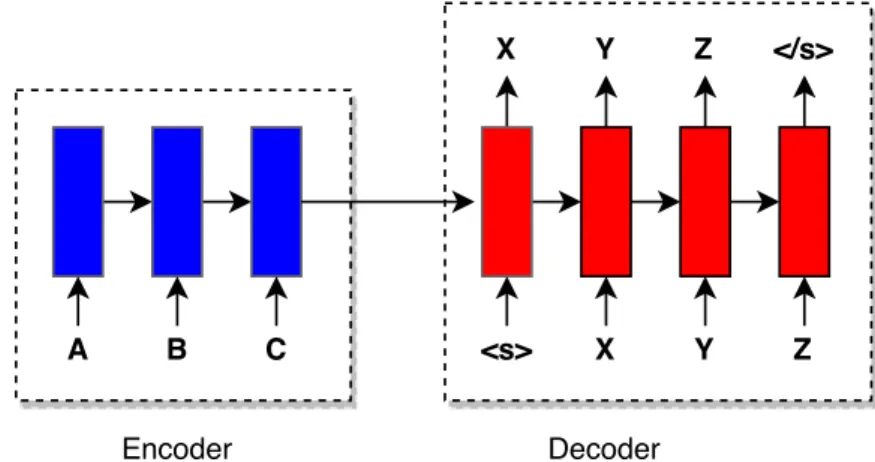
6.1 The Encoder-Decoder architecture . . . 156 6.2 The Encoder-Decoder architecture with Global Attention 160 6.3 The Encoder-Decoder architecture with Local Attention 161 6.4 BLEU scores (EN/PT) . . . 181
6.5 BLEU scores (PT/EN) . . . 182
6.6 BLEU scores (DE/EN) . . . 184
6.7 BLEU scores (EN/DE) . . . 186
List of Tables
2.1 Statistics of corpora used in the idioms’ impact
experi-ments . . . 24 2.2 List of English high-fixed verb+noun combinations and
their Brazilian-Portuguese translations . . . 28 2.3 List of English low-fixed idioms and their
Brazilian-Por-tuguese translations . . . 29 2.4 BLEU scores for theHigh-idiomatic,Low-idiomaticand
Clean corpora by a PBSMT system . . . 29 2.5 BLEU scores for individual expressions in the “
High-idiomatic Corpus” . . . 30 2.6 BLEU scores for individual expressions in the “
Low-idiomatic Corpus” . . . 31
3.1 Syntactic patterns of verb+noun idiomatic combinations 39 3.2 Results in terms of idioms found in the top 1,000
verb-+noun pairs rank produced by each metric in the idiom
typeretrieval task . . . 56 3.3 Number of verb+noun pairs that must be retrieved by
each metric to get all 414 different VNICs found in the
idiom typeretrieval task and the correspondent
3.4 Results for theidiom type classification over a balanced
test set and threshold equal to the median . . . 62 3.5 Thresholds for each metric in idiom typeclassification . 66 3.6 Results for theidiom type classification over a balanced
test set . . . 66 3.7 Results for the idiom type classification over an
imbal-anced test set . . . 69 3.8 Results for theidiom type classification over a balanced
test set using SVMs . . . 75 3.9 Results for the idiom type classification over an
imbal-anced test set using SVMs . . . 77
4.1 Expressions used in idiom token “per-expression”
clas-sification . . . 100 4.2 Expressions used inidiom token“general” classification 102 4.3 Parameters returned for theGrid-SVM-PEclassifiers . . 105
4.4 Learning rates for theSGD-SVM-PE classifiers . . . 106
4.5 Results of idiom token “per-expression” classification
onBlowWhistleandLoseHead . . . 106 4.6 Results of idiom token “per-expression” classification
onMakeSceneandTakeHeart . . . 107 4.7 Results of idiom token classification on the “general”
5.1 Perplexity results over the PTB dataset . . . 135 5.2 Perplexity results over the wikitext2 dataset . . . 136 5.3 Perplexity results on the VNC-Tokens dataset for
mod-els trained over the PTB dataset . . . 140 5.4 Perplexity results on the VNC-Tokens dataset for
mod-els trained over the wikitext2 dataset . . . 140
6.1 Results in terms of BLEU and TER score on the
Fapesp-v2 test sets (test-a and test-b) . . . 170 6.2 Results in terms of BLEU and TER score on the WMT’
2014 and WMT’ 2015 test sets . . . 171 6.3 Results in terms of BLEU and TER score on the idioms
test set extracted from the Fapesp-v2 test sets in both
directions . . . 176 6.4 Results in terms of BLEU and TER score on the
High-idiomatic Corpus andLow-idiomaticCorpus . . . 177 6.5 Results in terms of BLEU and TER score on the idioms
test set for the English/German language pair in both
Chapter 1
Introduction
Multiword expressions (MWEs) are expressions that carry a certain de-gree of idiosyncrasy in their properties and are generally acknowledged to cause problems to many areas of Natural Language Processing (NLP) (Sag et al., 2002). The idiosyncratic properties, oridiomacity, of MWEs refers to the deviation from the basic properties of the component words and, according to Baldwin and Kim (2010), five sub-types of idiomacity are recognized:
1. Lexical: This sub-type of idiomacity occurs when one or more word components do not belong to the lexicon that the MWE be-longs to. For example, ad hoc is lexically idiomatic in English as none of the component words belong to the English lexicon.
2. Syntactic: Syntactic idiomacity occurs when the syntax of the pression cannot be directly derived from its components. For ex-ample, by and large is composed of a preposition (by) and an
ad-jective (large).
3. Semantic: Also referred to as Idioms, these MWE cannot have their meaning derived from their individual constituents. For ex-ample,make a scenehas the figurative meaning of “to make a pub-lic display or disturbance” which is different from the meaning of both makeand scene.
4. Pragmatic: Occurs when the MWE is associated with a particular context. For example, good morning is a greeting associated with mornings.
5. Statistical: Statistical idiomacity, also referred to as convention-alisation or collocations, occurs when the combination of words that form the MWE occurs with higher frequency than alternative phrasings of the same expression. For example, in English it is arbitrary to say salt and pepperin preference to pepper and salt.
Although the idiomacity sub-types are clearly distinct, it is important to note that most MWEs fall into a continuum of idiomacity and can be classified into more than one sub-type, as, for example, ad hoc which has both lexical and semantic idiomacity.
In this thesis we are interested in the semantic subtype, commonly referred to as Idioms. Idioms are often defined as a class of MWEs whose meaning is non-compositional although, in fact, most idioms also
present varying degrees of syntactic and statistical idiomacity. There-fore, there is no general consensus on the definition of the characteristics that covers all members of this class (Nunberg et al., 1994). In addition, a great number of idioms follow similar patterns and can be grouped into natural classes, while others cannot be easily associated with any group (Villavicencio et al., 2004). For example, idioms present differ-ent degrees of statistical idiomacity (or fixedness). Some idioms such as by and large (“on the whole; everything considered”) make a scene
and kingdom come (“into the next world, or the eternity”), are fixed to a degree that they are considered words-with-spaces (Sag et al., 2002), and therefore can be considered high-fixed. Conversely, there are idioms such as hold fire (“wait; calm down”), that accept different degrees of variation (Copestake et al., 2002) (e.g., different lexical and syntactic choices) and thus are considered low-fixed. Although it is not the norm for idioms to have such variants (Fazly et al., 2009), variations in low-fixed idioms are too common to be ignored (Riehemann, 2001) by NLP systems. A complicating factor about idioms is that their syntactic and lexical variations are context dependent and most of the time unpredict-able. Therefore, depending on the context, they often do not retain their figurative interpretation when they undergo such variations (Fazly and Stevenson, 2006).
Another remarkable property of idioms is that some expressions can also have a literal usage. For example, compare the two sentences below,
extracted from the VNC-Tokens dataset (Cook et al., 2008):
1. No doubt you will have a word with me about this if you need fur-ther information.
2. The species name has two words: Tyrannosaurus rex is a familiar example.
The first sentence carries an idiomatic usage for the expression have a word while the second sentence can only be interpreted literally. In gen-eral, idiomatic usages of an expression are more frequent than literal usages but, depending on the context where the expression is inserted, the literal usage might become much more frequent (Li and Sporleder, 2010a). For example, in a sports context, the expression drop the ball
is expected to occur more times with its literal meaning than the fig-urative usage of “missing an opportunity”. Additionally, some idioms might have two or more unrelated figurative meanings when the context is not considered (e.g., when found listed in a dictionary) (Hashimoto and Kawahara, 2008). Examples of this phenomenon are give up the ghost(1- die; 2- stop working; 3- give up the hope) andhang one on
(1-punch someone hard; 2- get drunk).
Given the idiosyncratic properties of idioms and their pervasiveness in human languages, broad-coverage NLP systems must explicitly pro-cess idioms in order to correctly interpret these expressions and produce appropriate naturalistic language (Villavicencio et al., 2005). To achieve
this, there are two main identification tasks involving idioms:
i) idiom type identification, which is the identification of expressions that can potentially be used as idioms, independent of the context they are inserted in;
ii) and idiom token identification, the disambiguation between idio-matic and literal usages of an expression in its context.
We are interested in idioms for the following reasons: (a) idioms are pervasive across different languages and text genres, enabling compact representations of large fragments of meaning (Salton et al., 2014b); (b) as a class, idioms are relatively frequent in daily use (Sporleder et al., 2010), although occurrences of individual expressions are relatively rare (examples of such expressions are drop a line - “to contact someone with a short email, message, or phone call” - andfind one’s feet - “to be-come used to a new situation or experience”); and (c) processing idioms correctly is still considered a major challenge in NLP, negatively affect-ing applications such as parsaffect-ing, language understandaffect-ing and machine translation, among others (Sag et al., 2002; Shutova et al., 2010; Muzny and Zettlemoyer, 2013; Salton et al., 2014a, 2016; Nerima et al., 2017). Current approaches to processing idioms vary in terms of the com-plexity of representations and the length of the discourse history taken into consideration. For example, previous work inidiom token identific-ation have shown that paragraphs surrounding the candidate expression
are an important feature in distinguishing between idiomatic and literal usages (e.g., Li and Sporleder (2010a) and Peng et al. (2014)). In gen-eral, idioms are considered outliers to the discourse in which they are in-serted as the non-compositionality of these expressions introduce words into the text that one would not expect to see in that discourse context. However, as pointed out by (Li and Sporleder, 2010a), in some discourse contexts the literal usage may become more frequent (although this does not exclude the possibility of using these expressions in an idiomatic sense) and simple representations (such as topics) will fail to capture all the nuances of an idiom. In addition, NLP systems often do not have access to such a large discourse history (e.g. a number of surrounding paragraphs) to extract representations of idioms.
Processing idioms (be it for idiom type identification, idiom token
identification, language modelling or in machine translation) is difficult because idioms are complex structures that draw both on the local struc-ture of the idiom itself and also on global factors such as the discourse history and potentially other triggers (for example, see the discussion relating to the configuration hypothesis in the introduction of Chapter 4). Given this perspective on idioms, NLP models that use relatively simple representations tend to struggle. However, despite this, the state-of-the-art in many idioms processing tasks restrict themselves to simple representations, be they: raw fixedness measures; global topic models; or dictionaries.
In this thesis we investigate the usage of more complex and flexible representations (in comparison to current approaches) to unpack the en-tangled set of idiom properties and reduce the amount of surrounding text (i.e., discourse history) required to process such expressions. We argue that NLP systems should utilise more flexible and complex rep-resentations and better “history models” of discourse history to process idioms. We analyse these complex representation in a variety of idiom related tasks, ranging from problems where the discourse history can be discarded (idiom typeidentification) to tasks where the representation of discourse history is important and is either known ahead of time (idiom token identification), must be reconstructed after each input word (lan-guage modeling) or must be reconstructed after each output word (ma-chine translation). We show that complex representations are necessary to capture the subtleties of idioms and reduce the amount of surrounding text required. Furthermore, the more complex representations improve the scalability of the models in terms of either reducing the size of the models (in terms of the number of parameters) or enabling the usage of a single classifier in idiom token identification (instead of a specific classifier for each expression).
1.1
Contributions
This thesis makes the following contributions over different tasks re-garding idioms:
1. We present a quantification of the negative impact idioms cause in Statistical Machine Translation (SMT) systems and demonstrate that baseline systems are not able to easily translate idioms.
2. We demonstrate that simple statistical representations can be used to represent local context about idioms but improved results on
idiom type identification are obtained through more complex rep-resentations where the model can utilize interactional terms be-tween the features in the representation.
3. We show that by using complex distributed representations of a sentence containing a candidate idiom, the amount of surrounding text that anidiom tokenclassifier needs to maintain its level of per-formance can be reduced from several paragraphs surrounding the sentence to the sentence itself.
4. We also show that by using these complex representations of a sen-tence containing a candidate idiom, a single classifier can be de-signed for idiom token classification in stark contrast with the cur-rent approach of training a diffecur-rent classifier for each expression.
improve the systems’ ability to access historic/global context by using an attention module. In such settings where the context is re-constructed after each input, such as in Language Models based on Recurrent Neural Network (RNN-LMs), the performance of such models in terms of perplexity is greatly improved in both idioms processing and regular language. We also demonstrate that the in-clusion of the attention module helps the RNN-LM model to bridge long distant dependencies occurring in language.
6. We show that, in settings where the input context is known ahead of time but the output context is reconstructed after each prediction, that complex representations that merge both current and past con-text by means of an attention module help in bridging long distant dependencies in the output and improve idioms translation in some settings.
We believe these contributions will help to expand the frontiers of research involving idioms in NLP by pointing towards different direc-tions for work beyond traditional statistical methods. In addition, we believe our contributions will impact on a range of other research fields, including (but not limited to) language modeling, neural networks and machine translation.
1.2
Summary and Structure
The main body of this thesis is structured as follows. Chapter 2 re-views SMT systems and outlines a set of experiments that we developed to measure the impact of idioms in SMT. Chapter 3 then moves on to present an alternative set of lexical fixedness metrics to overcome limit-ations found in currentidiom typeidentification models and also demon-strates that higher dimensional representations yield improvements over simpler representations.
Chapter 4 details our investigation of distributed semantic representa-tions to build a “general” classifier foridiom tokenidentification. Build-ing a general idiom token identification model (i.e., a model that can do idiom token identification for many different idiomatic expressions) is a significant step beyond the current “per-expression” approach where a separate idiom token model is required to be trained for each idiom.
In Chapter 5 we explore the use of attention techniques to bring for-ward information about the past discourse history when reconstructing the distributed representations after each input in language modeling. Chapter 6 details our investigation into adapting the attention techniques proposed for language modeling to neural machine translation, a task where the input context is known ahead of time but where the output must be reconstructed after each output. Finally, Chapter 7 summar-izes the key contributions of this work and highlights opportunities for
additional research.
1.3
Publications Arising from this Thesis
The publications that form the basis of this thesis are listed bellow:
• Chapter 2. Salton, G. D., Ross, R. J., and Kelleher, J. D. (2014a). An Empirical Study of the Impact of Idioms on Phrase Based Stat-istical Machine Translation of English to Brazilian-Portuguese. In
Third Workshop on Hybrid Approaches to Translation (HyTra) at 14th Conference of the European Chapter of the Association for Computational Linguistics, pages 36–41
• Chapter 3. Salton, G. D., Ross, R. J., and Kelleher, J. D. (2017b). Idiom type identification with smoothed lexical features and a max-imum margin classifier. In Proceedings of the Recent Advances in Natural Language Processing (RANLP’2017), pages 642–651
• Chapter 4. Salton, G. D., Ross, R. J., and Kelleher, J. D. (2016). Idiom token classification using sentential distributed semantics. In
Proceedings of the 54th Annual Meeting on Association for Com-putational Linguistics, pages 194–204
• Chapter 5. Salton, G. D., Ross, R. J., and Kelleher, J. D. (2017a). Attentive language models. In Proceedings of The 8th Interna-tional Joint Conference on Natural Language Processing (IJCNLP
2017 )
Other relevant publications:
• In Salton et al. (2014b) we suggested a pre- and post-processing pipeline to process idioms in Statistical Machine Translation while keeping the system unchanged.
Chapter 2
Idioms and Statistical Machine
Translation
It is well known in the Natural Language Processing (NLP) field that idioms pose problems for most NLP systems (Salton et al., 2014a). In this chapter we analyse the performance of Statistical Machine Trans-lation (SMT), one of the most important Natural Language Processing (NLP) systems, when idioms are present in the input to these systems. We limit our investigation to the following question regarding idioms and SMT:
What is the impact of idioms on the performance of an SMT system?
It is commonly accepted in the Machine Translation field that the per-formance of SMT systems degrades when the input sentence contains an idiom as they often try to translate the idiom as “literal text” (Vilar et al.,
2006). However, it is difficult to find in the literature a formal measure of that impact. In this chapter we address this gap in the literature.
We proceed with a review of SMT methods in Section 2.1; and then go on to present previous, relevant work regarding idioms and other mul-tiword expressions (MWEs) in SMT in Section 2.2. Following this we then present the investigation of the question outlined above in Section 2.3; and, finally, we draw our conclusions in Section 2.4.
2.1
Statistical Machine Translation
As proposed by Brown et al. (1990), a SMT system is an application of the Bayes’ Theorem:
arg maxT P(T|S) =arg maxT P(S|T)×P(T) (2.1)
where S is the input written in the “source language”; T is the trans-lation of S written in the “target language”; P(S|T) is the Translation Model (TM) which captures the probability of producing S given the translation T; and P(T) is the Language Model (LM) which captures the probability of producing T in the target language. Note that, in the TM component, the position ofS and T are inverted so, in effect, SMT is an application of Bayes’ Noisy-Channel model. In other words, the
TM is derived in the opposite direction, from source to target.
Framed this way, a SMT system employs two distinct steps: train-ing and decodtrain-ing (Hearne and Way, 2011). In the trainingstep, the TM component is estimated on a bilingual aligned corpora, i.e., the text in the portion corresponding to the source language is aligned at sentence level to their translations in the portion corresponding to the target lan-guage. Also in the training step, the LM is estimated on monolingual data that is generally much larger than the bilingual data (Brown et al., 1993). Given a source sentence S to be translated, the decoding step involves a search for the best possible translation T allowed by the TM and the best possible reordering of the target textT given the LM.
Although the work of Brown et al. (1990) defines the fundament-als of the model, the current state-of-the-art in SMT is Phrase-based SMT (PBSMT) (Koehn et al., 2003). PBSMT extends the standard SMT word-by-word (uni-gram) approach by partitioning the source sen-tence into segments or “phrases” (i.e., higher ordern-grams). These seg-ments are then translated into the target language using the TM (which in PBSMT is a Phrase-Table (PT)) and reordered using the LM, if needed. Note that, in the case of PBSMT systems, “phrases” are generally an arbitrary subsequence of n-grams without any linguistic motivation. In addition, PBSMT systems often employ a log-linear model (Och and Ney, 2002) that enables the use of an unlimited number of features in aggregation to the original noisy-channel model. The log-linear model
is defined as:
arg maxT P(T|S) =arg maxT
M
X
m=1
λm ·hm(S, T) (2.2)
where hm(T, S) is the log-probability score assigned to a source-target
pair by the m-th feature; and λm is the weight representing the relative
importance of the m-th feature. The log-linear model with the features of the original word-by-word model of Brown et al. (1990) is represen-ted as:
arg maxT P(T|S) = arg maxT λ1 ·logP(S|T) +λ2 ·logP(T) (2.3)
whereP(S|T)is the TM;P(T)is the LM; andλ1 andλ2 are the weights
for the TM and LM respectively. By applying the log-linear model, it is possible to “tune” the weights of each feature in the model for different translation tasks. Moreover, it is easy to add more features into this setting by simply including new features into the feature set (Hearne and Way, 2011) and assigning a weight (which can be tuned later) to that feature.
to a direct translation of n-grams without any syntactic or semantic con-text, these systems are still the state-of-the-art in SMT. One consequence of these limitations however is that these systems do not model idioms explicitly (Bouamor et al., 2011).
2.2
Idioms in SMT
Constructions involving non-compositional MWEs, such as idioms, are problematic for SMT as these systems often make the assumption that text simply consists of word sequences with no semantics (or pragmat-ics) involved. Therefore, SMT systems do not make any distinction between literal and figurative meanings of MWEs. According to Cap et al. (2015), an SMT system with sufficient coverage of a particular idiom would be more likely to produce correct translations for that ex-pression when its constituent words are adjacent but, otherwise, it is difficult for the system to produce the correct translation.
A problem related to the coverage of idioms is that, in human lan-guages, idioms are very frequent as a class, given that native speakers rarely realize how often they employ such expression (Sag et al., 2002) but, however, they are not frequent in NLP resources such as in lexicons and grammars (Rondon et al., 2015).
Most work on translating non-compositional content is related to gen-eral MWEs,e.g., collocations. Despite the fact collocations also display
semantic idiomacity, these are high-fixed MWEs that are characterized by their statistical idiomacity. Approaches designed for translation of collocations are more appropriate for high-fixed idioms as they often can be treated as word-with-spaces (Sag et al., 2002). However, most idioms are low-fixed and allow different types of variations, including words in between their original constituents and, consequently, methods designed for collocations will not work for many idioms.
Following this line of research on collocations, (Zhang et al., 2008) propose a method to avoid overfitting caused by the Expectation Max-imization (EM) algorithm’s bias towards longer sentences. That prob-lem arises from the fact that the EM algorithm tries to maximize the likelihood of its training data and, therefore, prefers to “explain” a sen-tence pair with a longer and single phrase pair. The authors assign more probability mass to vectors of parameters with few non-zero values us-ing Bayesian methods and, therefore, favour more frequent and shorter phrases. Although the authors show that their method improves the translation of collocations in the form of frequent bi-grams, the method is difficult to apply for the case of given how infrequent they are in corpora and the fact that idioms typically are composed of more than two words (e.g. vern-noun idiomatic combinations or VNICs, which are idioms composed by a direct verb and a noun in the direct object pos-ition). (Ren et al., 2009) propose a method to extract bilingual MWEs from a trained PBSMT system and add them to the corpora to retrain
the system and to a bilingual dictionary that is used as a feature to guide the search for the best translation. Nevertheless, as is often the case, the phrase aligner extracts the most common phrase alignments from the corpora to the PT and, therefore, enabling the system to capture colloc-ations from corpora.
Along the same line of extracting bilingual collocations, Bai et al. (2009) develop a method to extract the MWEs and their translations from bilingual corpora based on their frequency and feed the extracted MWEs directly to the decoder once the expression is recognized. In order for this method to work, the MWE in the input must match directly one of the MWEs in the bilingual dictionary and, therefore, is more suited to the translation of collocations as they do not have changes in word order.
On a different line of research but also focusing on collocations, Xiong et al. (2010) propose a method to predict the boundaries of a MWE in which two different classifiers are trained: one classifier to pre-dict where the MWE begins; and the other to prepre-dict where the MWE ends. Therefore, these boundary predictions require the MWE, after the boundaries are predicted, to be translated as one single unit following a
word-with-spaces approach.
Focusing on monolingual collocations, Bouamor et al. (2012) de-veloped a method to extract monolingual MWEs from the source side of a bilingual corpus and then apply vector space models to extract the
candidate translations from the target side of the same bilingual corpus. The authors conduct different experiments using these bilingual diction-aries: they retrained their PBSMT systems including these MWEs in the bilingual corpus; used it as a feature to indicate whether a phrase was a MWE or not; and tried to insert this dictionary directly into the sys-tem’s phrase-table. Using either of the three methods, the authors report improvements on the translation of collocations.
In Bungum et al. (2013) the authors present an approach to find MWEs in bilingual corpora based on word sense disambiguation tech-niques. Their assumption is that a word, when in a semantically non-compositional MWE, has a different meaning than its original one and this feature can be used to identify the enclosing MWE. The authors then extract bilingual MWEs to a dictionary and use this dictionary identify MWEs in the source language. However, for their method to work, a MWE in the source language must match word-by-word a dictionary entry during the translation process.
Investigating a different set of MWEs other than collocations, Kor-doni and Simova (2014) present an evaluation regarding the impact of the verb constituents of MWEs in the form of phrasal verbs when obtain-ing word alignments for SMT systems and the impact on the output. Al-though the authors demonstrated that extracting phrasal verbs by using a separate classifier and including these phrasal verbs into the phrase-table improve the translation of such MWEs, the authors limit the study
to English MWEs that can be translated to a single word in Bulgarian. Despite these previous works on translating more general MWEs in PBSMT, to our knowledge there is little work specific to idioms. Okita (2011) discusses possible techniques that can be used to extract lin-guistic domain knowledge in order to improve word alignments when idioms are present. Although the authors addresses idioms these expres-sions are not the main focus of the work. In Ho et al. (2014) the authors describe the process they use to build a bilingual idiom dictionary and integrate it into a Chinese to English PBSMT pipeline as part of the PT component. However, as demonstrated by other authors (e.g., Okuma et al. (2008)), introducing a dictionary into a PT is problematic for the cases when the MWE is not high-fixed and, in general, introduce errors in the translation of literal language.
More recently, Cap et al. (2015) proposed a method where they tag the verbs that belong to an idiomatic construction using a “special tag” while they tag the same verbs occurring in literal constructions with a different tag. They then use this tagged corpora to train an SMT sys-tem following the intuition that the syssys-tem would be able to distinguish the correct translations for the expressions based on the tagged verbs since the system would learn when to choose each version of the tagged verbs. One limitation of this approach, however, is that the PBSMT sys-tem must be trained over the tagged corpora meaning that it must be pre-processed prior to training (i.e., the idioms must be identified
be-forehand) and, for each new idiom that was not in the original set, the system must be re-trained. In addition, another limitation of this ap-proach is that after the system has been deployed all the sentences that are input into the system for translation must also be pre-processed and tagged in a similar manner.
Finally, in the context of this thesis there are a number of other short-comings of the above work on idioms in machine translation. First, none of these works explicitly evaluate the impact of idioms on machine translation, for example by comparing the BLEU score of sentences con-taining and not concon-taining idioms. To the best of our knowledge, there is no work focusing only on the translation of figurative content in the Neural Machine Translation field.
2.3
Measuring the Impact of Idioms on SMT
In this section we gauge the impact of idioms on a PBSMT system. In order to measure this impact we ran an experiment that compared the BLEU scores (Papineni et al., 2002) of a PBSMT system when tested on three distinct bilingual corpora. Two of these test corpora consisted of sentences containing figurative usages of idioms that can also be used literally and the third corpus consisted of sentences with only literal lan-guage1. By comparing the BLEU score of the PBSMT system on each of
1In this corpus we ensured that it did not contained any literal usage of idioms or other forms of
these corpora we hope to gauge the size of the research problem idioms pose to those systems.
The description of the experiment is organized as follows: Section 2.3.1 describes the design and creation of the corpora used in the exper-iments; and Section 2.3.2 both presents the experiment and reports the results. Finally, we discuss the results in Section 2.3.3.
2.3.1 Datasets
The experiment we describe in this section had two direct targets: (a) we wish to quantify the effect of idioms on the performance of a PBSMT system; (b) we hope to better understand the differences (if any) between high-fixed and low-fixed idioms with respect to their impact on PBSMT systems.
PBSMT training requires a paired language corpus for the targeted language pair - generally the larger the corpus the better. Unfortunately, for most language pairs a large bilingual corpus does not exist and, if the corpus exists, it often requires a paid license to use (Tang, 2012). Consequently, for this experiment we created our own corpora.
We created a training corpus by concatenating the English/Brazilian--Portuguese part of the Fapesp-v2 corpus (Aziz and Specia, 2011) with a series of other corpora available made available by the OPUS Project (Tiedemann, 2012) for that language pair. The resources used in this
Table 2.1
Statistics of corpora used in the idioms’ impact experiments. EN stands for English and PT-BR for Brazilian-Portuguese, following the Internet Engineering Task Force (IETF) language codes (Phillips and Davis, 2009).
Corpus Sentences EN Tokens PT-BR Tokens
Fapesp-v2 0.15M 4.3M 4.0M
OpenSubtitles2013 37.1M 298.7M 255.8M
KDE4 0.2M 2.4M 2.6M
PHP 40.4K 0.5M 0.2M
step were the OpenSubtitles2013 corpus2, the PHP Manual Corpus3 and the KDE4 localization files (v.2)4. No special tool was used to clean these corpora prior to concatenation and the files were compiled as is. Table 2.1 presents statistics for these corpora.
The Fapesp-v2 corpus is based on scientific texts and, thus, is un-likely to have a high frequency of idioms. Thus, the main reason for the concatenation is the fact that, from the selected corpora, only the Fapesp-v2 is professionally translated and, thus, the PBSMT can extract good quality “phrases” from that corpus.
To account for idiomatic content, we also consider a different corpus type. As pointed out by Hardmeier and Volk (2009), a good subtitle must help the viewer to quickly understand the dialogue in the screen without distracting them from the video. Consequently, subtitle text is often “condensed” and likely to contain MWEs. Therefore, in order to enable the system to account for more figurative language we also in-cluded the subtitles corpus. However, using a subtitles corpus has its
2http://opus.lingfil.uu.se/OpenSubtitles2013.php 3http://opus.lingfil.uu.se/PHP.php
own challenges. The first issue to consider is that subtitles are a specific register of language which make them different from either written texts or spoken dialogue (Biber et al., 1998). The second issue is the inherent noise in these corpora resulting from the subtitles being “condensed” and, thus, presenting a different word alignment between the original text and the translated text (due to screen restrictions) (Hardmeier and Volk, 2009). In addition, most freely available subtitles are translated by volunteers and may include linguistic mistakes of various levels (Petuk-hova et al., 2012). Thus, subtitle corpora are often likely to be imperfect translations.
The focus of this experiment was to estimate the impact of the pres-ence of idioms on PBSMT systems. There are, however, many factors that can affect the performance of a PBSMT system on a given corpus and these could act as confounding factors in our analysis unless they are controlled for. One such factor is the variation in sentence length across the corpus. In order to control for this factor we filtered the training corpus so that it only contained sentences within the range of [15, 20] words. The motivation for using this range was that it contained the most common lengths in the corpus. After removing the sentences outside the specified range, the corpus used for training consisted of 17,288,109 pairs of sentences (approximately 50% of the initial collected corpus), with another 34,576 pairs of sentences (also within the range [15,20]) sampled for the “tuning” process.
As idioms are a heterogeneous class, we decided to focus on expres-sions formed from the combination of a verb and a noun as its direct object (e.g., hit+road and lose+head). These expressions are called verb+noun combinations or VNICs and they are the most frequent class of idioms in English (Villavicencio and Copestake, 2004). VNICs are also notable for their cross-lingual occurrence and high variability, both lexical and semantic (Baldwin and Kim, 2010). In addition, it is pos-sible for a particular verb+noun combination to have both idiomatic and literal usages and these usages must be distinguished if an NLP system is to process a sentence appropriately. In addition, they present varying degrees of fixedness, i.e., they allow different degrees of variation and can be classified into high-fixed and low-fixed idioms.
Given the fact that there is no readily available bilingual datasets of idiomatic expressions to test English/Brazilian-Portuguese, we had to manually build our test sets of high-fixed and low-fixed idioms (called “High-idiomaticCorpus” and “Low-idiomaticCorpus” respectively). In order to do that, we took the list of 17 high-fixed English verb+noun idioms presented by Fazly et al. (2009), and used it to build the “ High-idiomatic Corpus”. This corpus consisted of 170 sentences (within the range of[15,20]words) containing idiomatic usages of these idioms, 10 sentences per idiom in the list. These English sentences were collected from websites of idiom dictionaries5 (which contain sample sentences
5As we wanted to collect 10 sentences for each VNIC and due to the limitations of sentence length
containing usages of such idioms) and manually translated into Brazili-an-Portuguese. After that step, the translations were then checked (also manually) by a second human translator.
To build the “Low-idiomatic Corpus”, we used the list of 11 low-fixed English verb+noun idioms, e.g. get+wind, also presented in Fazly et al. (2009). This corpus consisted of 110 sentences (within the range of [15,20] words) containing idiomatic usages of these idioms, 10 sen-tences per idiom in the list. These English sensen-tences were also col-lected from websites of idiom dictionaries and manually translated into Brazilian-Portuguese. Once again, after the translation, the corpus was also manually checked by a second human translator. Table 2.2 presents the English high-fixed idioms combinations used in this experiment and their Brazilian-Portuguese translations. Table 2.3 presents the English low-fixed idioms combinations used in this experiment and their Brazi-lian-Portuguese translations.
As we are analysing the impact of idioms in a PBSMT system we must also measure the performance of the system on literal language, without figurative content similar to idioms. With that in mind, the “Clean Corpus” was built. It consisted of 850 sentences with their trans-lations and was created by sampling sentences in the same length range ([15,20] words) as those in the training corpus. These sentences were then removed from the training corpus. Given that the initial corpus was
Table 2.2
The English high-fixed idioms used in the experiment and their Brazilian-Portuguese Translations. The idioms marked with an * have direct translations of their constitu-ents resulting in a MWE with the same idiomatic meaning in Brazilian-Portuguese (these idioms are presented between double quotes and italics). Also, note that not all translations results in a verb+noun idiom in the target language.
English Brazilian-Portuguese
blow+top perder+paciência
blow+trumpet “gabar-se”
cut+figure causar+impressão
find+foot “adaptar-se”
get+nod “obter permissão”
give+sack “ser demitido”, “demitir”
have+word ter+conversa
hit+road “cair na estrada”
hit+roof “ficar zangado”
kick+heel “deixar esperando”
lose+thread “perder o fio da meada”
make+face* fazer+careta
make+mark deixar+marca
pull+plug “cancelar algo”
pull+punch “esconder algo”
pull+weight “fazer sua parte” take+heart “ficar confiante”
created from the union of corpora from different domains, the “Clean Corpus” was randomly split into 5 datasets containing 170 sentences each in an attempt to reduce the specific influence of any of those do-mains on the BLEU score. We called these “Clean1” to “Clean5”. Spe-cial care was taken to not have any idioms or any other form of figurative language in any of these five clean test corpora.
To run the experiment and perform the measurements, we trained a PBSMT system for the English/Brazilian-Portuguese language pair us-ing Moses toolkit (Koehn et al., 2007) followus-ing its “baseline” settus-ings (Koehn et al., 2008).
Table 2.3
The English low-fixed idioms used in the experiment and their Brazilian-Portuguese Translations. The idioms marked with an * have direct translations of its constituents resulting in a MWE with the same idiomatic meaning in Brazilian-Portuguese (these idioms are presented between double quotes and italics). Also, note that not all trans-lations results in a verb+noun idiom in the target language.
English Brazilian-Portuguese
blow+whistle “botar a boca no trombone”
get+wind ouvir+murmúrios
hit+wall “dar de cara num muro”
hold+fire “conter-se” lose+head* perder+cabeça make+hay dar+graças make+hit fazer+sucesso make+pile fazer+grana make+scene* fazer+cena pull+leg pegar+pé see+star* ver+estrela
2.3.2 Experiments and Results
Table 2.4 lists the BLEU scores for each of the test corpora containing idioms (“High-idiomaticCorpus” and “Low-idiomaticCorpus”) and the average BLEU scores over the clean corpora.
The differences among the BLEU scores for the clean corpus and both idiomatic corpora indicate that English VNICs pose a signific-ant challenge to baseline PBSMT systems. On the corpora containing idioms the PBSMT system achieved only half of the average score
ob-Table 2.4
BLEU scores calculated for the “High-idiomatic Corpus”, “Low-idiomatic” and the average for the “Clean Corpus”.
Corpus BLEU
High-idiomatic 23.12
Low-idiomatic 24.55
Table 2.5
BLEU scores for individual expressions in the “High-idiomaticCorpus”.
Expression BLEU Score
blow+top 22.08 blow+trumpet 19.38 cut+figure 20.15 find+foot 24.36 get+nod 22.06 give+sack 23.03 have+word 20.91 hit+road 24.53 hit+roof 21.34 kick+heel 18.85 lose+thread 21.81 make+face* 28.62 make+mark 29.46 pull+plug 19.71 pull+punch 28.34 pull+weight 19.94 take+heart 23.41
tained for literal language (“Clean Corpus”).
The second question that we examined in the experiment was whether there was a difference in performance between the high-fixed and low-fixed idioms. Table 2.5 lists the BLEU scores for each of the high-fixed verb+noun combinations used in the “High-idiomaticCorpus” and Table 2.6 lists the BLEU scores for each of the low-fixed verb+noun combinations from the “Low-idiomatic Corpus”. Figure 2.1 display a box plot of the BLEU scores obtained for individual expressions on both high-fixed and low-fixed corpora.
From Tables 2.5 and 2.6 and from Figure 2.1 we note that there is a difference in the BLEU score obtained by the SMT for both idiomatic
Table 2.6
BLEU scores for individual expressions in the “Low-idiomaticCorpus”.
Expression BLEU Score
blow+whistle 17.75 get+wind 19.06 hit+wall 16.52 hold+fire 23.26 lose+head* 37.40 make+hay 15.87 make+hit 25.48 make+pile 25.31 make+scene* 36.93 pull+leg 15.90 see+star* 37.86
corpora. Although we found a statistical difference6 between the results of the Clean and the High-idiomaticcorpora and between the results of the Clean andLow-idiomaticcorpora (p 0.05), we found that there is almost no statistical difference (p = 0.85) between the results of High-idiomatic andLow-idiomaticcorpora.
2.3.3 Discussion
One possible confounding factor in our results is the fact that both idio-matic corpora were sampled from a different distribution than the train-ing corpora. Although we acknowledge this limitation, we also expect that the trained PBSMT system was able to extract some MWEs into its PT component given that the subtitles corpora used to train the system is likely to contain such expressions. Therefore, even though the training and the idiomatic test corpora do not come from the same distribution,
15 20 25 30 35 high−fixed low−fixed Idiom Fixedness BLEU score high−fixed low−fixed Figure 2.1
Box plot of BLEU scores obtained by the baseline SMT system on individual expres-sions in both high-fixed and low-fixed corpora.
the PBSMT system should be able to handle MWEs.
Interestingly, some idioms have a direct translation (i.e. a word-to-word translation) from English to Brazilian-Portuguese that the baseline PBSMT system could handle correctly. However, the BLEU scores were still lower than those of the literal language (see the expressions marked with a * in Table 2.2 and Table 2.3).
On the differences between high-fixed and low-fixed idioms, despite the fact that the Low-fixed corpus had more variation across the res-ults for individual expressions (given that they allow more lexical and syntactic variations), we believe the absence or statistical difference in-dicates that both types of VNICs pose the same problems to PBSMT.
2.4
Conclusions
In some respects the results of this experiment are not surprising: it is generally accepted that the presence of idioms can negatively affect the performance of SMT systems. However, empirically measuring the extent of the impact of idioms on SMT system performance is novel and, furthermore, the magnitude of this estimated impact (nearly halving the systems’ BLEU score) is somewhat surprising. It is evident that the problem in translating idioms has not been solved using a baseline PBSMT system. Given the magnitude of the problem posed by idioms to PBSMT systems, it is likely that there is no simple solution to this challenge.
Although BLEU scores are generally dependent on the training and test corpora, it is worthwhile having a quantification of the potential issues that idioms pose for PBSMT. In addition, these results are a start-ing point to develop a methodology to process idioms for MT. It is thus a central argument in this thesis that idioms must necessarily be explicitly modeled within NLP systems in order for NLP systems to adequately handle the nuances of idiom processing. In order to do this we need to better capture the nature of idioms as phenomena in language. In the next chapter we turn to that task.
Chapter 3
Idiom type
Identification
The correct handling of idioms in NLP systems often requires idiom dictionaries. An example can be seen in the field of SMT, where most current systems rely on large repositories of idioms to process these expressions (Peng et al., 2014). However, generating and maintaining these dictionaries is challenging as new idioms are created on a daily basis (Fazly et al., 2009) and, therefore, compiling a dictionary by hand is expensive and time consuming. NLP systems need reliable ways of automatically identifying idioms to keep their idiom resources up-to-date (Bannard, 2007). This is particularly important for under-resourced languages where no, or very limited, idiom dictionaries may yet exist.
A less expensive method of building idiom dictionaries is to apply
idiom type identification to a selected corpora, in the desired language, to extract idioms. In our research we focus on the task of identifying
idiom types composed of a transitive verb and a noun occurring in its direct object position that have an idiomatic meaning associated
(Nun-berg et al., 1994). These expressions are referred to as VNICs - short for
verb+noun idiomatic combination. VNICs are the most frequent class of idioms (Villavicencio et al., 2004) and occur across almost all lan-guages (Baldwin and Kim, 2010). This class of idioms has been extens-ively studied and is known to exhibit varying degrees of syntactic and lexical fixedness and semantic non-compositionality. We call the task of
idiom typeidentification focused on VNICs asVNIC type identification. Within the domain of VNIC type identification, for many years the state-of-the-art method was the work of Fazly et al. (2009), who de-vised a set of fixedness metrics based on the observation that idioms are generally more lexically and syntactically fixed in comparison to non-idiomatic verb+noun combinations. Nevertheless, we believe Fazly’s et al. approach is prone to limitations and has limited results when applied to small corpora, as the case for under-resourced languages.
In this chapter we present an approach to idiom type identification based on blending a rich set of fixedness metrics with a non-linear classi-fier model to produce a new state-of-the-art forVNIC typeidentification. We begin this process by reviewing previous work on idiom type iden-tification in Section 3.1, including the current state-of-the art in VNIC type identification and discussing the limitations imposed by particular choices of that model. In Section 3.2 we propose modifications to over-come these limitations and evaluate the metrics to extract VNICs from corpora in Section 3.3.
We also assess the goodness of the metrics for VNIC type classific-ation when classifying verb+noun pairs into VNICs and non-VNICs in Section 3.4. Following that, we show that using the fixedness metrics as input features to a Support Vector Machine (SVM) classifier results in an improved method for VNIC type identification in comparison to Fazly’s et al. model in Section 3.5. Finally, we discuss the results in Section 3.6 and draw our conclusions in Section 3.7.
3.1
Previous Work on
Idiom type
Identification
Idiom typeidentification refers to the task of identifying expressions that can potentially be used as idioms. A successful idiom type classifier would identify expressions such asshoot the breeze(“have a casual con-versation”) and make the cut (“come up to a required standard”) as po-tentially having idiomatic interpretations associated with some instances of their use, and other expressions (for example “make the coffee”) as having a very low probability of being used in an idiomatic way.
Within the field of idiom type identification, researchers have pro-posed both supervised methods that rely on manually encoded know-ledge and unsupervised methods that rely on knowknow-ledge automatically extracted from corpora.
On the supervised approaches, both Copestake et al. (2002) and Vil-lavicencio et al. (2004) proposes methods based on formal grammars
to identify idiom types and other, more general, types of MWEs. It is worth mentioning the fact that, to date, the supervised methods strive to capture relevant information regarding the properties of specific idioms and thus, do not generalize beyond expressions known ahead of time. This is because they generally rely on hand-crafted rules which must be specifically designed for each particular expression (for example, by inspecting violation in selectional preferences).
Among the unsupervised approaches, Lin (1999) analyses the devi-ation of mutual informdevi-ation between two phrases to detect non-composi-tional constructions. Although designed to detect non-composinon-composi-tionality by means of measuring strength of lexical associations, this approach is designed to identify collocations and not idiom types. Bannard (2007) investigates the variability in the syntax of English idioms as a feature for identifying idiom types. Building upon the strength of lexical as-sociation and syntactic variability, Fazly et al. (2009) present a set of fixedness metrics (lexical and syntactic) designed to identify pairs con-sisting of a transitive verb and a noun in its direct object position (which we refer to as verb+noun pairs) that have an associated idiomatic ex-pression (verb+noun idiomatic constructions or VNICs). Fazly’s et al. approach to VNIC type identification is to assign to each verb+noun pair in the corpus an overall fixedness score which is a linear combination of a syntactic and a lexical fixedness metric. More recently, although not the state-of-the-art in VNIC type identification in English, Senaldi et al.
(2016) present a model using distributed semantics to identify idiom types in Italian. The authors analysed the differences between idiomatic and literal phrases in embedding spaces, in a similar fashion to lexical fixedness.
3.1.1 Fazly’s Fixedness Model
Of all the previous work, probably the most complete and relevant to our needs here is the work of Fazly et al. (2009). The authors present a set of fixedness metrics designed to identify verb+noun pairs that have an associated idiomatic expression. The authors devise an overall fixed-ness score based on the evidence that idioms are more syntactically and lexically fixed than literal constructions
Of all the previous work, probably the most complete and relevant to our needs here is the work of Fazly et al., in the following subsections we present and analyze the details of this approach: syntactic fixedness (Section 3.1.1.1); lexical fixedness (Section 3.1.1.2); and the linear com-bination of these two fixedness metrics into the overall fixedness metric (Section 3.1.1.3). We finish with a discussion about these metrics (Sec-tion 3.1.1.4).
3.1.1.1 Baseline Syntactic Fixedness
Fazly et al. (2009) propose a metric to capture the syntactic fixedness of idioms based on the observation of Riehemann (2001) that idiomatic
ex-Table 3.1
Syntactic patterns: the verb v can be in active (vactive) or passive (vpassive) voice;
the determiner (DET) can be NULL, indefinite (a/an), definite (the), demonstrative (DEM), or possessive (POSS); and the nounncan occur in singular (nsingular) or plural
(nplural).
No. Verb Determiner Noun
pt1 vactive DET:NULL nsingular pt2 vactive DET:a/an nsingular pt3 vactive DET:the nsingular pt4 vactive DET:DEM nsingular pt5 vactive DET:POSS nsingular pt6 vactive DET:NULL nplural pt7 vactive DET:the nplural pt8 vactive DET:DEM nplural pt9 vactive DET:POSS nplural pt10 vactive DET:other nsingular,plural pt11 vpassive DET:any nsingular,plural
pressions are expected to appear more frequently under their canonical syntactic form than literal combinations. The authors describes three types of syntactic variations that can be characteristic of idiomatic com-binations: “Passivization” (due to the non-referential status of the noun in the idiomatic expression); “Determiner type” (which is affected by the semantic properties of the noun); and “Pluralization” (also due to the non-referential status of the noun in such constructions). Merging these three syntactic variations, a set P of eleven syntactic patterns, as presented in Table 3.1, can be obtained.
The goal of the baseline syntactic fixedness is to compare the beha-viour of a target verb+noun pair to the behabeha-viour of a “typical” verb-+noun pair. The syntactic behaviour of a “typical” verbverb-+noun pair is defined as a prior distribution over the set P and is calculated
individu-ally for each patternpt ∈ P as follows: P(pt) = P vi∈V P ni∈N f(vi, ni, pt) P vi∈V P ni∈N P ptk∈P f(vi, ni, ptk) = f(∗,∗, pt) f(∗,∗,∗) (3.1)
where pt is the pattern we are calculating the prior of; f(∗,∗, pt) is the frequency of the pattern irrespective of any verb or noun; andf(∗,∗,∗) is the frequency of all pt ∈ P, irrespective of any verb or noun.
The syntactic behaviour of the target verb+noun pair is defined as a posterior distribution over the set P given the pair’s constituents. Thus, its syntactic behaviour is calculated for a pattern pt ∈ P:
P(pt|v, n) = f(v, n, pt)
P
ptk∈P f(v, n, ptk)
= f(v, n, pt)
f(v, n,∗) (3.2)
where pt is the pattern we are calculating the posterior of; f(v, n, pt) is the frequency of the target verb+noun pair hv, ni occurring under the syntactic pattern pt; and f(v, n,∗) is the frequency of the target verb+-noun pair occurring under any of the patternspt ∈ P.
and the “typical” verb+noun pair is calculated as the divergence between the posterior and the prior distributions over P as measured using the Kullback-Leibler divergence: Fsyn(v, n) =D(P(pt|v, n)||P(pt)) = X ptk∈P P(ptk|v, n) log P(ptk|v, n) P(ptk) (3.3)
whereP(pt|v, n)is the pattern posterior; and P(pt) is the pattern prior. Syntactic fixedness takes values in the range [0,+∞] where larger values denote higher degrees of syntactic fixedness,i.e., where the verb-+noun pair is more likely to be a VNIC.
3.1.1.2 Baseline Lexical Fixedness
Typically, idioms do not have lexical variants and, when they do, these variants are generally unpredictable (Fazly et al., 2009). Therefore, it is assumed that a verb+noun pair is lexically fixed (and likely to be a VNIC) to the extent that replacing one of its constituents by a semantic-ally similar word does not generate another valid idiomatic combination. Based on this, lexical fixedness was proposed to capture the degree to which a given verb+noun pair is lexically fixed with respect to the set of its variants. These variants are generated by replacing either the verb or the noun by a word from a set of semantically similar words and is defined as:
Ssim(v, n) ={hvi, ni|1 ≤ i ≤Kv} ∪ {hv, nji|1≤ j ≤ Kn} (3.4)
where{hvi, ni|1 ≤i ≤ Kv}is the set of similar combinations generated
by replacing the verb by a word from the set of the Kv most similar
words to that verb according to a thesaurus (while the noun is kept un-changed); and {hv, nji|1≤ j ≤Kn} is the set of similar combinations
generated by replacing the noun by a word from the set of the Kn most similar words to that noun also according to a thesaurus also (while the verb is kept unchanged).
To measure the strength of the association between the target verb+-noun pair’s constituents, Pointwise Mutual Information (PMI) (Church et al., 1991) is applied to the pair