The Use of Parametric Statistical Tests to Detect
Network Traffic Anomalies on SDN Architectures
PAULO PINTO1, LUIS PINTO2
1
Novabase IMS, Lisboa, PORTUGAL [email protected], www.novabase.pt
2
Universidade da Beira Interior, Covilhã,andCITAD,Lisbon PORTUGAL [email protected], www.ubi.pt
Abstract: - The workrealized in this paper as a twofold approach: by one side to present a proof-of-concept that illustrate the flexibility and ease of anomaly detection algorithm implementation on a SDN architecture accessing to the information (counters) existing on the controller; by other side to show the applicability of nonparametric statistics, Kendall’s W statistic, to detect network changes on SDN corresponding to possible DoS attacks.
Key-Words: -Architecture; Software Defined Networks; Denial of Service; Kendall; Parametric Statistics
1 Introduction
Watching the emergence of new technologies, like tablets or sensor computers, the question of inevitable changes springs up immediately [7]. Software Defined Networks (SDN), an operational and programming network architecture, facilitates new opportunities for innovative security applications. The SDN controller, acting as an interface point to the network, aggregates information flows that can be used by security management applications to gather feedback from network as to their well-being states. While information flow processing and analysis is a mature field its application is only beginning in SDN and there are many open questions on its use.
This article proposes an algorithm that uses hypotheses testing with Kendall’s W (coefficient of concordance) statistics to identify significantly associated, or concordant, groups of flows in a SDN indicating possible network attacks that are difficult to prevent by standard settings of information resource software, namely “Denial-of Service Attacks (DoS)”.
Our work focuses on the statistical variation analyses of the traffic flows, which is a performance measure of particular interest for
network engineering (i.e., provisioning, SLA definition, anomaly detection,etc.). The innovative aspect of our work is the use of nonparametric statistical test to detect a variation on it the network state. Theproposed statistical test does not assume an underlying model or an underlying model validation.Also, due to a low implementation complexity, O(n), the proposed algorithm can be used to monitor and test data at wired speed links.
2 Software Defined Networks (SDN)
The last decade has seen an extraordinary revolution in end use equipment. Our servers have grown a thousand-fold in their intelligence and computing capacity. The links have also undergone similar transformation.
The enormous increase in computer power together with the vastly increase connection speed between network elements has made the concept of SDN technologically feasible and economically viable. Software Defined Networking is a new approach to IP networking that centralizes the management and control plane logic in an SDN controller and creates a well-defined interface to the forwarding plane via a standardized protocol (Openflow). The intention of SDN is to spur innovation in
service creation and deployment. The network
is considered „programmable‟ and new
applications can be easily added by a variety of players.
With SDN the data in the network (e.g. stats, service state, security, etc.) can be analyzed and used by an application to create policy intent and program the network into a new configuration. Programmability (i.e. the ability to access the network via APIs and open interfaces) is central to SDN.
What’s key here is that the controller’s APIs will deliver a whole of information that paves the way to a new approach on the analytics area providing more wide available and accurate information on the traffic. It could be used in various applications such as detection of anomalies (e.g., denial of service attacks or link failures), prediction of traffic growth, or assessment of the impact on network traffic of a new customer or of a new application.
3 SDN in Different Networks
The concept of SDN is generic enough to be applied to a variety of networks. However, its applicability to each situation and the deployment in each type of network will vary. Here we look at the actual and potential uses of SDN in a few different types of networks according to Kumar [10].
SDN in campus and research networks - SDN was born in campus networks with the emphasis on cost and versatility. Campus networks are much smaller than datacenter, enterprise or service provider networks and the demands on availability as well as service levels are not stringent. This allows a fertile ground for experimentation and innovation. In campuses, the focus has been on replacing more expensive traditional routers and access devices like wireless access points using devices from alternative vendors offering higher capacity devices at much lower costs.
SDN in datacenter networks - The datacenter operators have been the first to adopt SDN in commercial networks. Many campus and research network experiments had involvement and some funding from datacenter operators and their suppliers. The single biggest factor driving SDN adoption in datacenters has been
the availability of simpler and often cheaper options for handling virtualization, virtual machine migration, multi-tenant hosting among other solutions to which may have otherwise involved enormously expensive network upgrades and equipment replacement. The concept of overlay networking, using methods like VxLAN, was born out of these needs in the datacenter, and these methods find their predominant applicability in datacenters. The diversity of network equipment is lesser in magnitude in datacenters than in service provider networks. This facilitates more rapid introduction of new technology like SDN since issues of interoperability and testing are less complex. The economies of scale are also much more promising. Datacenter networks have a smaller geographical spread than service provider networks. This makes changes to the network easier to handle. Datacenter networks also had a much greater need for SDN, coming as it does in the wake of cloud computing and virtualization which are demanding changes to the datacenter anyway. The cost justification and business case for SDN in datacenters has therefore been very easy for operators to see.
SDN in home networks - With more internet access devices like smart phones and smart TVs proliferating. Functions like firewall and anti-malware could be concentrated in datacenters by service providers and offered as value-added services to consumers thus providing a case for extending NFV into this segment of networking.
SDN in service provider networks - Service provider networks face different challenges. Diversity in proprietary networking gear has resulted in extensively elongated time cycles to change or introduce services. This, coupled with rising energy costs from legacy equipment, has caused operators to look for alternatives. After grappling with the question of SDN applicability to telecom networks, many operators have converged on NFV as a promising answer.
4 Security Considerations in SDN
SDN brings in a lot of positives with regard to securing a network, for instance Single point of control simplifies policy enforcement - Every single
flow is matched to a set policy since the IT administrator or operator does not have to install configurations and policies at a multitude of devices. Upgrades to anti-malware programs can be much easier and more comprehensive. Policies can be defined at a network level instead of at firewall / router level. NAC (Network Access Control) is more comprehensive by avoiding distribution to several access devices. For the above reasons, it is even thought that security could be the killer application for SDN adoption. However, SDN does not come without some additional and different security concerns.
SDN does introduce some new concerns as well as, for instance, DoS (Denial of Service) attacks on controller - This arises from the fundamental fact that the controller is the brain and intelligence of the network. Potential hackers could concentrate attacks on the controller alone rather than having to look for vulnerable points in the network. One example is to generate a whole lot of new flow notifications / requests to the controller seemingly from the network infrastructure. Logically, it should take less time to expose vulnerabilities in a single device than in a few 10s or 100s of devices. This will require mitigation by careful definition of policies for traffic (including notifications) in and out of the controller.
5 Network Programmability with
SDN
The concept of network programmability [11] lies at the heart of one of the key tenets of SDN. The concept of programmability can exist in, or be a feature of, a number of network devices and software components – and this is not a new concept, as network management has existed since the beginning of time for network devices. What differs now is in specifically how those devices – real or virtual- are not only managed, but also interacted with. Regardless of the type of target , the goal is to make it easily programmable and to facilitate a bidirectional channel of communication between it and the other piece of software communicating with it. This concept is in fact quite different from the traditional network management paradigm, where the manager and agent communicated in a relatively loose fashion with considerable lag between operations – including cases where essentially no feedback existed.
The flow processing analysis in SDN can be made in real-time accessing the controller flow table information and with low impact on networking performance.
6 Coefficient of Concordance W
Proposed by Maurice G. Kendall and Bernard Babington Smith, Kendall’s coefficient of concordance (W) is a measure of the agreement among several (k) quantitative or semi quantitative variables that are assessing (ranking) a set of N objects of interest. Depending on the application field, the “judges” can be variables, characters, and so on. They are dimensions of communication flows in the present article.
The degree of agreement among k judges is reflected by the degree of variance among the N sums of ranks. W, Kendall’s coefficient of concordance, is a function of that degree of variance.
To compute W [6], we first find the sum of ranks, Rj, in each column of a k x N table. Then we sum the Rj and divide that sum by N to obtain the mean value of Rj. Each of the Rj may then be expressed as a deviation from the mean value. The larger the deviations, the greater is the degree of association among the k sets of ranks. Finally, S, the sum of squares of these deviations, is found. Knowing these values, we may compute the value of W:
Equation (1 ) Kendall’s Coeficient of Concordance
When N is larger than 7, the expression given byk(N-1)W is approximately distributed as a chi square with df = N-1. That is the probability associated with the occurrence under H0 of any value as large as an observed W may be determined by finding χ2 = k(N-1)W and then determining the probability associated with so large value of χ2 referring to its distribution table of values.
7 Algorithm Development
We start by choosing the variables that best characterize a network state in a SDN- traffic models shows that two parameters, the load of the channel and the number of active flows in it, must be used for a full representation of the
network state [1]; To instantiate these two parameters we then propose the use of existing counter variables in the SDN controller: “received bytes per flow” and “flows durations” to characterize the load of the channel; and to use “active entries per table” to characterize the number of active flows.
Next, our intention is now to detect network state changes, which were originated by a Denial of Service attack, using this variables and Kendall’s W statistic hypothesis tests. Considering that [3] under a simulated attack, is expected an increase in the number of flows, a uniform size of the flows (near 50 bytes) and long streams flows (more than 5 minutes) we can test the variation of this variables on time looking for this kind of change using the Kendall’s W statistic hypothesis tests. If a change occur we may expect to find some of these variables associated indicating a possible attack.
These data variables are appropriate to be used with Kendall’s W statistics because they are all indirect measures of a common representation of the network state [1].
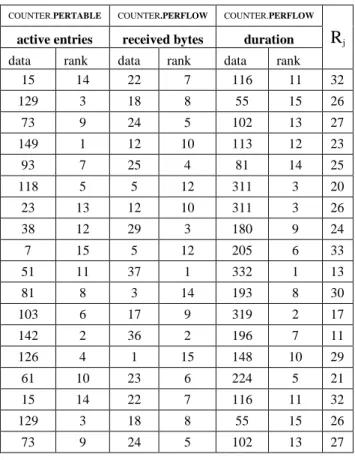
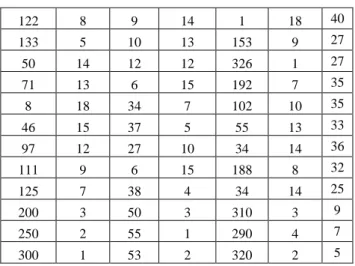
We now proceeded by generating two appropriately simulated random data tables containing information flows that instantiates the variables chosen in the previous phase and characterize a network state: Table I under normal conditions, where is expected a random number of flows, flows size and durations; Table II under a simulated attack, where is expected an increase in the number of flows, a uniform size of the flows (for test proposes we’ve consider values near 50 bytes) and long streams flows (more than 5 minutes). The data simulating these conditions is presented in Table II, rows 16, 17 and 18.
Considering the hypothesis H0 to be used by Kendall’s W Statistics: “There is no association (concordance) among the variables that characterize the network state”; we now proceed to test this hypothesis with the two different datasets contained in Table I, Table II;
Conduct an overall test of concordance of all random flows in the Table I. If not under an
attack it is expected no association among the traffic flows, i.e. using data in Table I we expect to accept H0.
Conduct an overall test of concordance of all flows in Table II. If under a DoS attack it is expected that there is at least one variable that is associated with one or some of the others, i.e. using data in Table II we expect to reject H0
TABLE I. RANDOM FLOWS
COUNTER.PERTABLE COUNTER.PERFLOW COUNTER.PERFLOW
Rj active entries received bytes duration
data rank data rank data rank
15 14 22 7 116 11 32 129 3 18 8 55 15 26 73 9 24 5 102 13 27 149 1 12 10 113 12 23 93 7 25 4 81 14 25 118 5 5 12 311 3 20 23 13 12 10 311 3 26 38 12 29 3 180 9 24 7 15 5 12 205 6 33 51 11 37 1 332 1 13 81 8 3 14 193 8 30 103 6 17 9 319 2 17 142 2 36 2 196 7 11 126 4 1 15 148 10 29 61 10 23 6 224 5 21 15 14 22 7 116 11 32 129 3 18 8 55 15 26 73 9 24 5 102 13 27
For the values in Table I we calculate W getting 0,23 and a correspondent value of k(N-1) as being 9,81 > 23,68 (the value of χ2 = 23,68 with α= 0,05 and df=14) taking us to accept H0 and conclude that there is no association among the traffic flows.
TABLE II. RANDOM AND SIMULATED ATTACK FLOWS
COUNTER.PERTABLE COUNTER.PERFLOW COUNTER.PERFLOW
Rj active entries received bytes duration
data rank data rank data rank
101 11 5 17 75 12 40 108 10 32 8 33 16 34 43 16 17 11 26 17 44 24 17 2 18 253 5 40 129 6 31 9 99 11 26 148 4 35 6 241 6 16
122 8 9 14 1 18 40 133 5 10 13 153 9 27 50 14 12 12 326 1 27 71 13 6 15 192 7 35 8 18 34 7 102 10 35 46 15 37 5 55 13 33 97 12 27 10 34 14 36 111 9 6 15 188 8 32 125 7 38 4 34 14 25 200 3 50 3 310 3 9 250 2 55 1 290 4 7 300 1 53 2 320 2 5
For the values in Table II we calculate W getting 0,55 and a correspondent value of k(N-1) as being 28,24 > 27,59 (the value of χ2 = 27,59 with α= 0,05 and df =17) taking us to reject H0 and concluding that there is at least one variable that is associated with one or some of the others indicating a possible attack.
8 SDN Experimental Architecture
Architecture is a set of rules and conventions by which we create buildings that serve the purposes for which we intend them, both functionality and aesthetically. Architecture is also driven and constrained by a number of specific factors. These includes materials available within the locale that can be used as also the technology and skills of the people. In the same way that conventional architecture defines the rules for the design and construction of the buildings, SDN architectures addresses these same issues for the design and construction of SDN communications networks and the business APIs that are implemented to use these technologies.Our concept of architecture is one that supports our testing proposes and can be designed with the elements as described in figure 1.
FIGURE I – EXPERIMENTAL ARCHITECTURE
9
Conclusion
With this work and the proposed algorithm we reach two goals: by one side we have present a proof-of-concept that illustrate the flexibility and ease of anomaly detection algorithm implementation on a SDN architecture accessing to the information (counters) existing on the controller; by other side we have shown the applicability of nonparametric statistics, Kendall’s W statistic, to detect network changes on SDN.
As a result, considering the load of the channel and the number of active flows as variables to characterize a network state in a SDN, we observed with the present work that the Kendall coefficient of concordance can be used with success to assess the degree to which a group of network communications flows in a SDN were associated.For the proof of concept realized on this work, we used a simple random generated data. Our future work consists in an evaluation of the proposed algorithm collecting data in real time on a university campus network.
References:
[1] ChadiBarakat, Patrick Thiran,
GianlucaIannaccone, Christophe Diot, and Philippe Owezarski, Modelling Internet Backbone Traffic at the Flow Level, IEEE Transactions on Signal Processing, Vol. 51, Nº. 8, August 2003
[2] F. Afanasiev, A. Petrov, V.Grachev, A. Sukhov, Flow-based analysis of Internet traffic, Russian Edition of Network Computing, 5(98), 2003, pp.92-95
[3] Aleksey A. Galtsev and Andrei M. Sukhov, Network attack detection at flow level, Smart
Spaces and Next Generation Wired/Wireless Networking, Lecture Notes in Computer Science Volume 6869, 2011, pp 326-334
[4] Pierre Legendre, Coefficient of Concordance,
Encyclopedia of Research Design, Vol. 1. ed. SAGE Publications, Inc., 2005, pp. 164-169 [5] Thomas Nadeau, Ken Gray, Software Defined
Networks, O’Reilly, 2013
[6] Sidney Siegel, Nonparametric Statistics for the Behavioral Sciences, McGraw-Hill, 1956
[7] Luis Pinto et all, Teaching Architecture Relationship Between Art and Technology (As a Tool), Proceedings of the 11th WSEAS International Conference on Education and Educational Technology (EDU’12);
[8] Young HeeGeum, Higher-Order Method for Finding Multiple Roots, Proceedings of the 16th WSEAS International Conference on Applied Mathematics
[9] NermaBascelija, Sequential and Parallel Algorithms for Cholesky Factorization of Sparse Matices, Proceedings of the 4th WSEAS European Conference for the Applied Mathematics and Informatics (AMATHI’13)
[10] Rajesh Kumar, Software Defined
Networking (SDN) - a definitive guide, Kindle edition, 2013
[11] Thomas Nadeau, Keny Gray, Software Defined Networks, O’Reilly, 2013