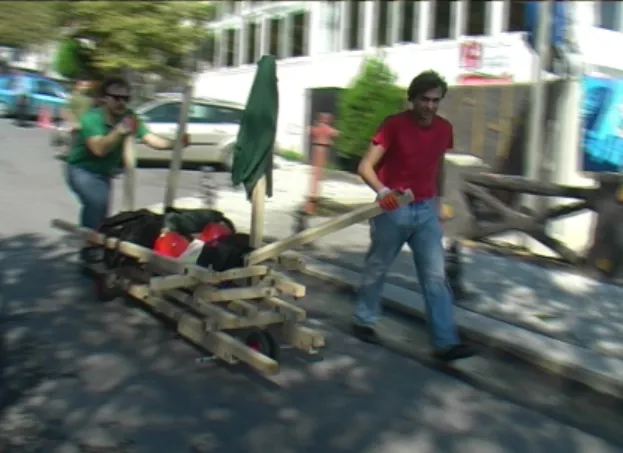
TADİLAT:
Remodel
by
Erdoğan Onur Ceritoğlu
Submitted to the Institute of Social Sciences in partial fulfillment of
the requirements for the degree of Master of Arts
Sabancı University
© Erdoğan Onur Ceritoğlu 2012. All Rights Reserved
TADİLAT: Remodel APPROVED BY: Selim Birsel ... (Thesis Advisor) Murat Germen ………. Can Altay ………... DATE OF APPROVAL: …...
ABSTRACT
TADİLAT: REMODEL Erdoğan Onur Ceritoğlu
M.A. in Visual Arts and Communication and Design Fall 2011
Thesis Advisor: Selim Birsel
Keywords: Furniture, Customization, Sustainability, Participation, Constructional waste This thesis is about work constructed with a reading of standardization and consumerism within architecture and design in domestic environment. It starts with how modernity takes over everyday life through architecture, design and art. Referring to Merzbau by Kurt Schwitters as an artistic rupture to modernism, various patterns of architectural waste used in the context of art are being explored. After a brief historical prologue, it focused on art work which are the revalue of refusal found architectural elements of the home
environment. Moving on from this theoretical frame work, first primary tryout called Kapılar (Doors) and subsequently the major work called Evci is discussed looking for answers to some questions: Can an art project be sustainable also in its context? Can the audience be included to participate in the production of art or actually be a part of that piece of art? In the light of these explorations the possibilities of a future project based on constructional junkyards are going to be mentioned.
ÖZET
TADİLAT: REMODEL
Erdoğan Onur Ceritoğlu
M.A. , Görsel Sanatlar ve Görsel İletişim Tasarımı
Sonbahar 2011
Tez danışmanı: Selim Birsel
Anahtar kelimeler: Mobilya, Tek tipleşme, Uyarlama-kişiselleştirme, Sürdürülebilirlik,
Katılımcılık, İnşaat Atıkları
Bu tez mimarlık ve tasarımın iç mekanı tek tipleştirmesi ve onu tüketim ürünü
haline getirmesi ile ilgili okulmalar ile yapılandırılmıştır. Modernitenin günlük yaşamı mimarlık, tasarım ve sanat bağlamında kontrol altına almasını tartışarak başlar. Kurt Shiwitters'ın Merzbau adlı eserini modernizme karşı bir başkaldırı referansı sayarak,
mimari atıkların sanat bağlamında kullanılmasını inceler. Tarihi bir girişten sonra, iç mekan mimarisine ait inşaat atığı niteleğindeki parçaların sanat eserlerine malzeme ve konu olduğu örneklere odaklanarak devam eder. Teorik yapılandırmanın ardından, ilk olarak öncü bir deneme çalışması özelliğindeki Kapılar, sonra bu tezin şelillendiren başlıca araştırma ve tartışma konusu Evci projesi; Sanat eseri kendi bağlamında sürdürülebilir
olabilir mi? İzleyici sanat üretimine katılabilir mi ya da sanat eserinin bir parçası olabilir
mi? gibi sorulara cevap aramaktadır. Son bölümde bu soruların cevapları doğrultusunda
yapılan çıkarımların ışığında, yapısal mimari atıkların toplandığı hurdalıkları konu alan bir projenin olasıklarından bahsedilmektedir.
ACKNOWLEGMENTS
I would like to thank my thesis advisor Selim Birsel for supporting me to continue to work in the direction of producing art when I am confused in finding my way. I am grateful to Can Altay who showed me a probability exist. I would like to thank Murat Germen for his support from the very beginning of my master degree.
I am especially grateful to my comrades, my friends; Özgür Atlagan, Berna Göl,
Güneş Direk, Didem Erk, Nihan Somay, Merve Kılıçer, Emre Bağdatoğlu, Yiğit Yüksel,
Lia Kraus.
I would like to thank for the people who looked after Evci; Ekin Sanaç, Barış
Açıkgöz, Vuslat Güldoğan, Bengi Güldoğan, Berk Güldoğan, Metin Yılmaz, Onur Tetik, Bilge Tetik, Mari Sprito and Ali Taptık.
I am grateful for my mother, Merih Ege and my father Tevfik Ceritoğlu for being
TABLE OF CONTENTS
Introduction...1
Chapter 1: Modernism versus Merzbau...4
1.Industrial Revolution and Modernism...4
2.Avant Garde: Merzbau...8
Chapter 2: Work#1: Kapılar – Doors …...12
Chapter 3: Work#2: Evci – Homebody …...16
1. The production process...19
1.1 Collecting...19
1.2 Dismantling...22
1.3 Reprocessing...23
1.4 Assembly instructions...23
1.5 Transportation: Dislocation and relocation...24
1.6 Assembling...26
1.7 Documentation...28
2. The hosts (Customization)...28
2.1 Location no#1: Ekin and Barış's flat...30
2.1.1 Interview with Ekin and Barış...31
2.2 Location no#2: Özgür and Yiğit's flat...32
2.1 Interview with Özgür...32
2.2.1 Interview with Metin (Regular guest)...34
2.3 Location no#3: Bengi and Vuslat's flat...35
2.3.1 Interview with Bengi and Vuslat...36
2.3.2 Interview with Aral and Lara (Neighbor's children)...37
2.4 Location no#4: Onur and Bilge's flat...38
2.4.1 Interview with Bilge...39
2.5 Location no#5: Thief Exhibition...39
2.6 Location no#6: Tadilat Graduation Exhibition...41
3. Chapter 4: Conclusion... ...42
4. Chapter 5: Future Work: Çıkmacılar – Construction Junkyards …...45
LIST OF FIGURES Figure 1 Over London by Rail Gustave Doré
Figure 2 Splitting by Gordon Matta-Clark Figure 3 Splitting by Gordon Matta-Clark Figure 4 Merzbau by Schwitters
Figure 5 Merzbau by Schwitters
Figure 6 The Big Crunch by Raumlaborberlin Figure 7 In Out by Whiteread
Figure 8 The Archive Series by Reis Figure 9 Kapılar
Figure 10 Kapılar Figure 11 Kapılar Figure 12 Kapılar Figure 13 Kapılar
Figure 14 Turkish IKEA Catalogue page Figure 15 Shiles House by Rural Studio Figure 16 Smoke House by Rural Studio Figure 17 Supershed by Rural Studio
Figure 18 Paper Log houses by Shigeru Ban Figure 19 Sky Cathedral by Luise Nevelson Figure 20 Evci
Figure 21 Evci
Figure 22 Soft Protection by Kozlowski Figure 23 Evci
Figure 24 Five blocks Figure 25 Five blocks Figure 26 Five blocks Figure 27 Five blocks Figure 28 Evci Figure 29 Evci
Figure 31 My home sweet home Figure 32 Evci
Figure 33 Tetra House by Kawamata Figure 34 Evci
Figure 35 Evci Location 1 Figure 36 Evci Location 1 Figure 37 Evci Location 2 Figure 38 Evci Location 2 Figure 39 Evci Location 3 Figure 40 Evci Location 3 Figure 41 Evci Location 4 Figure 42 Evci Location 4 Figure 43 Evci Location 5 Figure 44 Evci Location 5 Figure 45 Evci Location 5 Figure 46 Evci Location 6 Figure 47 Evci Location 6 Figure 48 Evci Location 6 Figure 49 Caravan by Michael Asher Figure 50 Caravan by Michael Asher Figure 51 Çıkmacılar
Figure 52 PVC and rope Figure 53 PVC and rope Figure 54 PVC and rope Figure 55 PVC and rope Figure 56 Çıkmacılar Figure 57 Çıkmacılar Figure 58 Çıkmacılar Figure 59 Çıkmacılar Figure 60 Çıkmacılar Figure 61 Çıkmacılar
Figure 62 Çıkmacılar
Figure 63 Çıkmacılar
1.Introduction
The exhibition could just be a construction site. Schwitters, Merzworld1 My practice is based on my observations of the built environment, the city and also domestic space in smaller scale. Mostly I am fascinated by the constructional scrap
disposed to the streets of Istanbul which are the signs of a growing metropolis and also occupy permanent space in the urban fabric. This scrap or rubble belongs to a home interior or a renovation rooted to an urban renewal plan or gentrification to which I am familiar with my architectural background. Going through these leftovers, one can easily observe how constructional materials change and how old craft is valuable than mass produced products. Opposing to designing and building new, I think that looking for a sustainable living is possible.
A modern metropolis is a massive construction site. Especially İstanbul as a
metropolis a rapidly developing construction network is growing constantly. It has already touched its' borders like an Ecumenopolis which seems to be on a modernist mission to fulfill its goal: a global single continuous city. In the gentrification areas where people are forced to abandon their homes, the buildings are either in a renovation process if they are historical or they are being demolished if they are squat houses built illegally, Gecekondus
(built-in overnight). The demolished houses are being replaced by housing blocks which are marketed for an ideal, standardized, modern living.
In minor scale, the construction takes places in the old flats in the central residential areas. To add some profit to the market value, all the worn out interior decoration is being 1 Notzand Obrist, Merz World: Processing the complicated Order, 10.
replaced by the new to make the space more 'livable'. During this process the construction waste is being dumped to the street where walking feels like being in a junkyard for me. All of these architectural waste, which apparently are signs of consumption society, belongs to a home, a shelter where a person feels comfortable, peaceful and safe. In order to feel comfortable, apartment goes over a customization process by the dweller. The domestic space standardized starting with Modernism for the efficiency of living
conditions is shaped, replaced or repaired by the inhabitant. And this forms a complication within modernity: the customization process is not being considered by architects. For example in Le Corbusier's Unité d'Habitation most of the built in furniture was replaced to suit the personal taste of the inhabitants.
In most cases in Istanbul, the plan of the flat changes by tearing down some walls as well as some disused chimneys to extent some rooms. The window frames are replaced by white PVC (Polyvinyl chloride) frames for better insulation. Plus, balconies are sealed off with window frames to have extra closed space. As a result, overall the look of the architecture of apartman whichmeans residential building in Turkish becomes different than what it was initially; there is a partial and fragmented character on the façade of the building because some can afford these changes and some can not.
Because of the deconstruction and remodeling processes taken place, streets of Istanbul are filled with incredible amount of used kitchen parts and construction leftovers such as wood window frames, doors, sacks full of construction rubble. In addition to this, when the current popular style and taste changes or the furniture lose their durability and property because of aging and usage, they are being disposed to the streets too. Especially in relatively wealthier neighborhoods such as Kadıköy. They all have a common feature: they are elements of domestic space or a decoration of home environment. In other words, they signify consumption of domestic architecture as I believe that they are remains of some past having an archeological value. The aim of the works in this text is to revalue these objects in order to open a discussion about their disposability and removability in the context of consumerist society. Furthermore, owing to the fact that the spread of
exchanges and encounters2 where art can be a site producing a sociability, Evci project is trying to provoke and to accomplish both individual and collective encounters by constructing an IKEA like installation from scrap furniture to the domestic space.
In first chapter, the effects of modernism on design and art being discussed in
relation to everyday. Opposing to Modernism, Merzbau by Kurt Schwitters in Avant-garde movement, is taken as a case study because it is a life span project in the domestic
environment and uses found objects from the waste which were collected from the city. In second chapter, the work called kapılar which is an installation to the gallery space is explained as a threshold for reusing refusal elements of architecture. In the following chapter, Evci as the main work of this study is explained as a furniture sculpture which is installed to flats, trying to be a part of daily lives of the hosts. The process of art
production which is considered as a whole body of an art work is described with the support of the interviews with the hosts. In the conclusion chapter an analysis of Evci
project and its impact is summarized. In final chapter, Çıkmacılar, which consists of series of photographs of the building junkyards accompanied with site drawings and anonymous notebook pages of a PVC window frame maker are being considered as a beginning of a project for a future research.
CHAPTER: 1
MODERNISM VERSUS MERZBAU
1. Industrial Revolution and Modernism
In order to comprehend the roots of industrial design and its relation to the
contemporary home environment, architecture and furniture, it is necessary to have a look at the development of the modernist metropolis after the industrial revolution. In the 18th century industrial revolution gave a strong push to industrialization and rapid urbanization. Large cities had began to appear in Europe lacking sufficient infrastructure. The
population was rising to supply the need for work power. Most of villagers left their houses which were spacious and convenient in the country side and begun to move in poor
housings around the factories which were designed to meet the need of the workers. In these shelters, the workers were enduring bad living conditions. (Fig.1) Yet meanwhile, the cities were growing in an uncontrolled way with severe class differences which also meant some parts of the cities were bound to have unhealthy schools and hospitals, lacking recreational areas as well as sufficient basic infrastructure.
For having an efficient line of production, the scientific study of production introduced mechanization which also had effected industrial production. Taylorism and later on Fordism used standardization, rationalization, and interchangeability as a tool for rationalizing industrialization. The capitalist metropolis and also homes which were counter parts of the city, needed to be rationalized and mechanized for the efficiency of living conditions. During the years following World War I, the avant-garde architects
across Germany and Austria, as well as elsewhere in Europe, searched for the standards of living in minimum space with maximum efficiency through the scientific method of Taylorism. 3
The mechanistic esthetic also effected art movements in 20th century as such, Arts and Crafts (London), De Stijl (Amsterdam), Purism (Paris), Jugendstil and Bauhaus (Berlin), Kinetic Art (Vienna), Constructivism (Russia). In different ways, they responded to the technological and political implications of industrialization by fostering new
relationships between autonomous sphere of art and the mass-produced culture of industrial design.
The ideology of the Bauhaus, believes that the formation of objects are decisive on the order of people. The beauty and efficiency of the objects makes also life
functional and productive. Moreover, the influence of the formation between objects that orientate the movement and the function of human body can be rationalized while the methods for disciplining the body can be also examined.
(Ali Artun, Design horror,)4
3 Talu, The phenomenon of home in modern culture, 70.
4 Artun, Tasarım Dehşeti http://www.aliartun.com/content/detail/23 (accessed in 24.12.2011) Figure 1 Over London by Rail Gustave Doré
http://en.wikipedia.org/wiki/File:Dore_London.jpg (accessed in 01.01.2011)
Modernization put aside the need and the taste of the dweller and dictated an order of efficient living. Besides the design parameters of dwellings were started to be regulated by the state, for example Swedish government set regulations for the minimum space and stated that every room was to serve a specific purpose in 19545. For the efficiency and functionality, the everyday was transforming into a mechanic model which was designed totally. Le Corbusier for instance, defined the house as a living machine which was aiming to reach 'the highest level of civilization'.
In spite of what the so called early 20th century Modernist such as Le Corbusier advocated, it should be remembered that home is a private space which cannot be necessarily be standardized. It is firstly a personal-private shelter. The inhabitants freely customize, modify and remodel the interior. Gordon Matta-Clark, who was trained as an architect in bachelors degree in 1968 had an ongoing struggle with architectural discourse of his time which led him to slice and dissect buildings for converting them riddled, gravity challenging, disorienting walk-through sculptures. Subsequently he inverted Le Corbusier's famous statement; machine is not for living6 in which he is criticising the capitalist regime not only transforming architecture to a commodity and but also enforcing a social structure upon private domestic space. While interpreting Matta-Clark, Dan Graham states that Matta-Clark intended his work to function as a kind of urban
propaganda – like the 1968 acts of Paris situationists, who saw their temporary spectacles as public cuts in the otherwise seamless urban fabric. 7 In his work called Splitting (Fig.2, Fig.3), he cut a suburban house into two, revealing what is inside; a hidden social suburban order which is imposed by architecture. Everyday life in suburban neighbourhoods is standardized with such impositions so that the architecture is a cover which should be sliced, spit open to the public in order to make the problem visible to public. His works can be said to be an Avant-Garde of the 70s with an argument still valid today.
5 Rothacher, Corporate cultures and global brands, 106. 6 Talu, The phenomenon of home in modern culture, 250. 7 Graham, Two way mirror power, 20.
Figure 2 Splitting by Gordon Matta-Clark
http://historyofourworld.files.wordpress.com/2010 /08/matta-clark_0002.jpg?w=720&h=559 (accessed in 05.12.2011)
Figure 3 Splitting by Gordon Matta-Clark
http://historyofourworld.files.wordpress.com/2010 /08/matta-clark_0002.jpg?w=720&h=559 (accessed in 05.12.2011)
2. Avant Garde: Merzbau
Richard Wagner, a 19th century composer referred to as an an early German Romantic, used the term Gesamtkunstwerk inhis 1849 essays 'Art and Revolution' and 'The Art Work of Future'. In these essays, he talked about unifying opera and drama
suggesting that different art practices could be brought together to form a total work of art. Later, Art Nouveau and Bauhaus adopted the term, Gesamtkunstwerk into design and architecture saying that each building part, from the accessories to the furniture, from the shell to the landscape, was to being designed. According to this adjustment, total design could only be achieved by incorporating design and art with everyday life. Many centuries after Lefebvre pointed out that the functions of the critique of everyday life can be
determined by referring to an art which immerses itself in everyday life.8 Art Nouveau aims to reconnect life and art together. It praises craftsmanship and it is against the mode of production of industrialization. On the other hand modernism, is against ornament and any other 'unnecessary additions' to the object besides its function. Art Nouveau tries to give an artistic touch to a functional object while Modernism claims that a functional object already is art. They both want to reach an understanding of a 'total work of art'. As it is today, unfortunately every object is becoming a total work of art and also a total work of design. According to both aesthetics and functionality are combined together and every object is to be designed. But, what was being ignored is that there are at least two authors of every object: the designer, the other is the owner. (or user)9 The designer or architect suggests a solution for a problem or a practical need according to the brief given by the owner. In most of the cases, the owner is being left out and forced to live in a space which lacks practicality and functionality.
8 Ross, Modernism and Theory of Art, p.65. 9 Cole, Design and Art, p.119.
DadaistMarcel Duchamp's signed urinal is not only a reaction to a mass-produced object but also a criticism of state of art in Bourgeois society in the 20th century10. Avant-Garde art of the period was ready to reject all the values of modernist society and
modernist history. Ideally art did not have to have a purpose or a function. However it had to be exhibited for being appreciated. It didn't have to confront a need and to be
commodified like a design object. On the other hand looking back from today, the
methodology and the language of global design marketing cannot be anything else, but an artistic tool for criticizing art market where art works are becoming a capitalist product.
In German Avant-Garde, Kurt Schwitters (Fig. 3, Fig. 4) turned his home which also was his studio in Hannover from 1920 until the bombing in 1943 into a complex network of architecture. It consisted of two layers; one was made from plaster and wood which was a structural support for the other one, the inner core layer. The core layer composed of discarded old-junk material and fragments that he came across the city randomly. Named as KdeE [Cathedral of Erotic Misery] it was growing like a city while he kept collecting curiosities for his cabinet. His collection included urine, pieces of hair, finger nails of his friends. In his book Inside the White Cube O'Doherty stated that Constructivist overlay that turned the Merzbau into a utopian hybrid; part practical design (desk, stool), part sculpture, part architecture.11 The architectural layer of Merzbau act as a complex built-in furniture. Moreover, James Puntam stated that home became a microcosmos in Schwitters’ art practice. 12 Dramatically such places designed by the artists are isolated from the outside world, the public. Schwitters studio was expanding into a kind of multi-purpose
environment. It served not only as a workplace but also as a theatre in which he recited his poems, a gallery in which he exhibited his own collection of pictures to provide guidance to the latest in art.13
10 Bishop, Participation, p.50.
11 O'Doherty, Inside the white cube, 45. 12 Artun, Sanatçı Müzeleri, 13.
For each member of a society, home is a microcosmos of their own. This microcosmos is an isolated unique environment, but this uniqueness is disappearing through architecture of the flats in the high rise housings which are being manufactured identically and furnished with global trends, which can clearly be said to be capitalist implementations. Local producers or craftsmen are not in demand for custom made furniture any more. Local micro economy is replaced by the bigger global industries, whose products are cheaper with their invented, designed identity. This trend is going to be explored further in the following chapter.
Schwitters defined the term Merz as an use of pre-existing old material to create new a new work of art. Because of the unwieldiness of the materials with which houses were being built, architecture had no other option but to reuse the old and incorporate it into the new design.14 Our surrounding offers us incredible amount of opportunities like repairing and recycling the old which can be part of a sustainable living but instead the society is imposed by the advertisements to consume new commodities offered by global home 14 Notz and Obrist, Merz World: Processing the complicated Order, 7.
Fig 3 Merzbau by Schwitters
http://www.tate.org.uk/research/tateresear ch/tatepapers/07autumn/orchard.htm# (accessed in 10.12.2011)
Fig 4 Merzbau by Schwitters
http://www.tate.org.uk/research/tateresear ch/tatepapers/07autumn/orchard.htm# (accessed in 10.12.2011)
product companies. Such products, which can be seen as the artefacts of globalization, washes away the traditional production of goods.
The old project to reconnect Art and Life, endorsed in different ways by Art Nouveau, the Bauhaus, and many other movements, was eventually accomplished, but according to the spectacular dictates of the culture industry, not the liberation ambitions of the avant-garde. And a primary form of the perverse reconciliation in our time is design.
Hal Foster, Design and Crime15
Can disfunctional objects disposed after a deconstruction process of a flat be a subject to an artistic production? Public installation-sculpture in Theaterplatz, Darmstadt The Big Crunch by Raumlaborberlin16 (Fig.5) is trying to find an answer to this question. This work was made from used old furniture collected by architecture students, employees of the city and the waste disposal company. Discarded pieces of furniture indicates a homely, cosy familiarity to public. According to Oliver Elser in the architecture scene, augmenting, repairing, extending and improvising is gradually becoming important in the search of new.
15 Coles, Design and Art, 69.
16 Elser, In with the old, out with the new.
Figure 5 The Big Crunch by Raumlaborberlin
http://www.raumlabor.net/wp-content/uploads/2011/09/bc_4.jpg (accessed in 10.12.2011)
CHAPTER 2 DOORS - KAPILAR
Most of the buildings in the gentrification areas in Istanbul such as Cihangir, Tarlabaşı are being repaired or go through a restoration process. The plan of the floors is also going through some changes. Some walls are being demolished as to enlarge some rooms. When a room is added to another, the door connecting the two rooms is not needed any more. In fact, the doors crafted by a carpenter are replaced with mass produced ones. Therefore, this crafted mode of wooden door production is becoming rare and distinct.
Again like disposed furniture, some doors which are still functional can be thrown away to streets. They are already produced-designed objects which serve for a specific function for security and privacy. Yet, they lose their value as an objects when the interior of the flat is remodelled. They are waste objects which will disappear, the wood might be used for heating purposes, but still they can function in the domestic environment. They can be used in another interior however they are specifically produced for the flat which they are disposed from. Their size differ to one other.
The transformation of an ordinary object into an independent and evocative sculpture through the cast in negative of its form is an influential inspiration in the In Out I-XIV
series (2000-04) by Rachel Whiteread (Fig.6) , in which the artist made a cast of both sides of fourteen house doors set together back to back. The new object is twice as thick as
the original contrasting with its familiar appearance.17 Turned inside outside by casting process, Whiteread's doors are not only detacched from their usual function, but also detached their material properties. The casts of doors appear as they are made from the same material however they were once worn-out wood.. The gesture of the artist appropriating doors from various buildings in London can be said that it is a recycling process.
In Pedro Cabrita Reis' work, the sculptural assemblages are other examples of the recycling process, characterized by the gathering and association of disposed objects and materials, which have become a lasting feature (Fig.7). In most of his works like the Portuguese pavilion in Venice Biennial, 2003, he uses everyday, found materials accompanied with pre-fabricated elements in his installations in which the process of construction is emphasized. Most of his works represents a deserted entity in which there is a feeling of an unfinished or destructed state of construction because of a recession,
because of poverty or a demolishment.
17 http://www.museomadre.it/opere.cfm?id=250 (accessed in 10.12.2011)
Figure 7 The Archive Series by Reis Figure 6 In Out by Whiteread
http://www.museomadre.it/opere.cfm? id=250 (accessed 08.12.2011)
The purpose of collecting in the context of this project called Kapılar is a way to search for new meanings through sustaining things instead of constantly replacing them with new ones. It should be emphasized that this sustainability is taken beyond its material connotation. Also the memories and meanings embedded in them, may have an
archaeological value along with their lifespan.
The doors which are from a flat from 70s in Cihangir are put together with hinges like a folding screen. While attaching them to each other the old hinges which are called
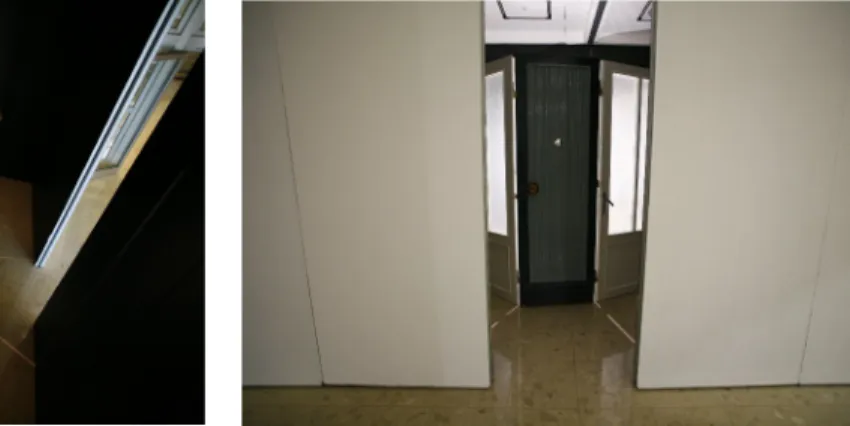
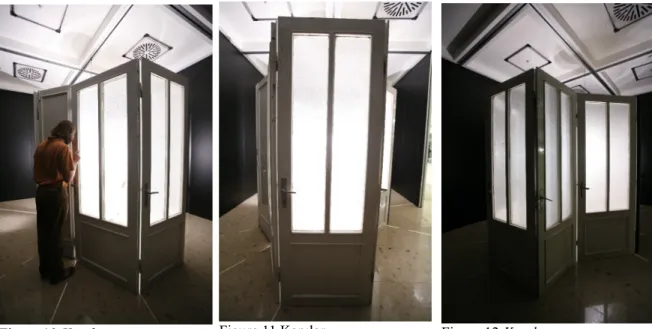
germen menteşe (a certain type of hinge considered to be an old one) are not replaced not to harm the wood. On the other edge of the door, taper part of the hinge is fixed using the same old technique for the original doors. For fixing such hinge a special tool which is not available, because it is an old technology, is used to open a cut to stick in the hinge. The first door and the last attached to each other. It creates a volume and marks a polygonal area on the plan. (Fig.8) The polygonal shape is adjustable to the space. A lighting source is placed in the middle of the polygonal shape not only to use the texture and transparency of the glass on the doors but also to represent a humanly presence in the interior space. The viewer goes around the doors looking for an entrance but there is non. Each door
represents a room which does not exist any more. The doors joined together function as a border, as a protecting territory, surrounding a space that is out of reach. A door-less space that you can not enter is ironically constructed with the doors which supposedly be a movable structure closing an entrance to a room. (Fig. 9-10-11-12)
Whiteread's doors which are leaning to the wall are more sculptural than Kapılar
because they are perceived as single cast monumentalized objects whose interaction is limited to the audience. The arrangement of doors in Reis work is still sculptural but he uses the existing material state which one can realise the poetic meaning of the old. In comparison with two works by the artists, Kapılar can be said that it is an installation because the arrangement of doors is strongly related with the rectangular room surrounding it because the polygonal shape is in contrast with a rectangular plan of a standart room and it breaks the volume of the space . In addition the audience is also expected to gaze inside, play with the door handles and the old locks. (Fig.13)
Figure 13 Kapılar
CHAPTER 3 EVCİ – HOMEBODY
Evci is an experiment on researching the effects of carpentry craftsmanship and institutionalized global furniture production on everyday life. The moving sculpture-furniture which is a composition of disposed sculpture-furniture collected from the streets of residential areas is being installed to different flats on different locations. The hosts
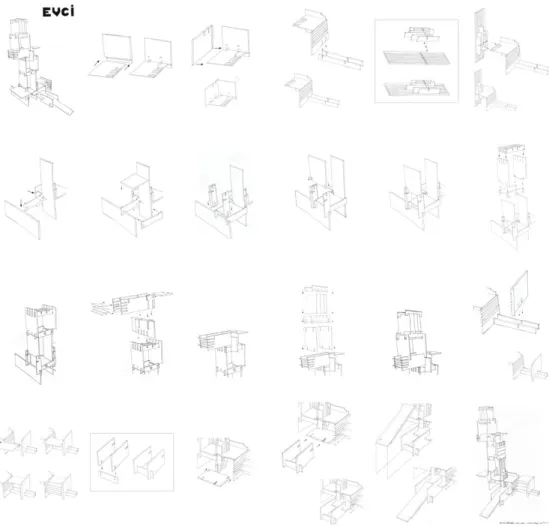
assemble Evci according to IKEA like hand drawn assembly instruction booklet while they have to adjust Evci’s oversized dimensions to their daily lives and their homes and also customise it.
IKEA firstly introduced the ready to assemble furniture (RTA) in 1956 when a Swedish draftsman called Gillis Lundgren tried to fit a table to his car. He broke the legs off the table so that he can move it in his trunk. Then he reassembled the table back at home.18 Later all the products of IKEA were being designed in this way to lower the costs. According to Rothacher, in this way shipping costs would be greatly reduced and these savings could be passed to the customers. 19The customers could get quality furniture for affordable prices. The design made mobility easier. Now, the customers can buy the furniture right away, move it by themselves with their car and assemble them within the same day. Regardlessly this fast consumption makes life easier for the impatient customer. The addictive happiness of buying furniture so easily and being able to carry it like a regular product seemingly satisfies the customer. Also assembly instruction books are designed to be extremely simple and clear. For people who can not follow the instructions there is a home service. The concept of RTA inarguably helped IKEA to become a global furniture company.
18 en.wikipedia.org/wiki/RTA_furniture (accessed in 24.12.2011) 19 Rothacher, Corporate cultures and global brands, 106.
In Turkey the furniture industry was right away challenged with the arrival of IKEA in İstanbul and therefore local carpenters who are genuine craftsmen started disappearing. While Swedish IKEA catalogue is implying an admiration to an idealized young, well sorted and modern western life style, the practical solutions offered by IKEA managed to reach many households. (Fig. 14) The order of the house supposedly could only be achieved through IKEA and its products.
In middle class neighbourhoods, old furniture is given away mostly to second hand shops or thrown away out in the streets to be replaced by Billys, Expedits and Mörrüms. It is possible to see an exact copy of your television chair or coffee table or lighting system during a visit to your relatives or friends. Either before religious holidays or during the summer when house repairs becomes most frequent, the garbage containers and streets are filled with old broken furniture and also some IKEA packaging, signifying the pattern of the replacement and may be even the addiction of consumption. The old broken furniture in the street look dislocated and unfamiliar, waiting for garbage men to be picked up by or waiting for a neighbour to be burned in a stove. Whatever history or memory there was to the object disappears eventually.
Evci is constructed with those old furniture parts collected from the street. The collecting process continues as the old furniture is thrown away and new furniture takes its
Figure 14 Turkish IKEA Catalogue page (The title: The most creative and smart solutions is right here! http://onlinecatalogue.ikea.com/TR/tr/2012/IKEA_Catalogue/ (accessed in 11.11.2011)
place, as the activity of consumption is being pursued. The structure of Evci is incomplete. It grows as the consumptions grows. When Evci which is assembled according to the instructions, is placed in the flat, it is offered to become a part of the daily life. The host family decides where to put it. If the hierarchy among the furniture in the plan of the flat is organized according to the circulation of daily life, the volume of Evci cuts the flow and directs it to another direction. The alien object to the home environment is either accepted or refused at this point, since home is a private space where the owners' characters are revealed with a preview of their belongings like nicknacks, family photos, souvenir, books, records, etc. Evci can be customized to a household shrine where these belongings can be displayed.
Customizing Evci defers according to the user profile. The attempt is to integrate an outsized object to the owners' everyday life by using familiar and cosy old home furniture parts (even with old furniture smell). In Merzbau, Schwitters integrated his life into an art installation which went for 12 years in his home and in his workshop. Some of the parts of Evci are not put together to fit into the domestic space because it is perceived like any other furniture. It is related to the plan of the space, mostly living room. The owner
requests to fit it to the space which is planned before. There are physical limitations such as ceiling height or the size of the room and also the other furnitures placed.
Evci is not a design product. In fact it looks like a furniture using assembly instructions as a camouflage. It is simply an art object that you can put together at your home, in your private space, whereas mostly art works are displayed in public spaces such as museums or galleries. Normally such sculptures are to be encountered in an art show. In home environment it is being realized differently in terms of use and customization.
Photos and drawings of Evci is given to the home owner before hand for explaining the project. Some of the proposals are rejected according to the size of it. The participant is mainly hesitant about the size of their flats. They think that the living space is not
enough for such a thing to put up. A special permission is being asked to be installed. Since the private space is exposed-invaded by Evci, the space becomes public, available for the artist. The aim of the work is to capture and document the process of the project. The hosts
are being interviewed about their experience documented with photos and videos. Home owners’ experience becomes the documentation of the artwork. Itself alone it is no longer plays a role. It could be said that the art work is constructed together with the audience.
1. The production Process
The old furniture with the aged texture and feel is disassembled at first. Then each part is reprocessed to construct a single object. New joints are cut into the parts in order to attach them to each other. An assembly instruction is drawn later like an IKEA product. The parts which are interlaced can be detached and reattached to each other easily for transportation. The order of the parts connected improvised during reprocessing in the wood workshop. The final look was not designed on purpose. The object patched with different parts from different furniture with varying textures and types of wood. As the collecting activity continued, new parts were attached to the structure like a growing parasite, spreading like unfinished Merzbau by Kurt Schwitters to create interior
complexity with haphazard proliferations.20 The limits of the height and the width of the object is limited to the size of the space. The parts can be modified to fit to the rooms of the host.
1.1 Collecting
In modern age, every object is a commodity which is being consumed until its validity or expire date. In the capitalist system, sustainability it seems has no real standing. It is all about selling larger quantities. The commodities has a shorter life span in order to sell the new. Out of date, outmoded design objects are easily being thrown away, even though they have an historical value and a certain nostalgia within them in addition to their recycling potential. They are the artefacts of modern living and the city is a source for these objects. As an inspiring example who aims to overcome impositions of capitalist system with their sustainable design approach, Rural Studio which is a design-build architecture studio run by Auburn University since 1993 aims to teach their students about social responsibilities of architecture profession while also providing sustainable, well-20 Notz and Obrist, Merz World: Processing the complicated Order, 63.
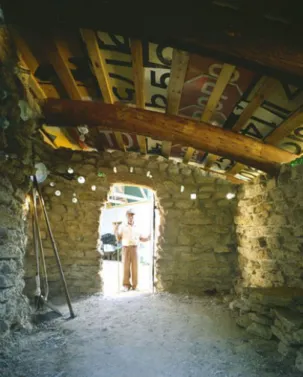
constructed environments and buildings for the poor communities in rural Alabama. In their projects they recycled tires for making staircases (Fig. 15), they used salvaged road signs and beams from for the roof (Fig. 16) , surplus license plates are used as cladding (Fig 17).
As another sustainable design precedent in architecture, Shigeru Ban who is a japanese architect, uses recycled paper tubes as a load-bearing system especially in his paper log houses which are built for the victims of the earthquakes in Kobe, in Kaynasli, and Bhuj. In Kaynasli, shredded waste paper was inserted inside the tubes along the walls Figure 15 Shiles House by Rural Studio (2002)
http://dev.rosefellowship.org/images/fellows/steve hoffman/gallery/05.jpg (accessed in 05.12.2011)
Figure 16 Smoke House by Rural Studio (1994)
http://apps.cadc.auburn.edu/rural-studio/Default.aspx (accessed in 05.12.2011)
Figure 17 Supershed by Rural Studio (1997) http://historyofourworld.files.wordpress.com/2010 /08/matta-clark_0002.jpg?w=720&h=559 (accessed in 05.12.2011)
Figure 18 Paper log housesby Shigeru Ban (2000) http://www.shigerubanarchitects.com/
and fiberglass in the ceiling, and also cupboard and plastic sheets were used for more insulation, depending on the residents needs. 21 (Fig.18)
According to James Puntam, the urge of the artist for collecting objects is a part of the urge of humanity for collecting and conserving.22 The old furniture thrown out the street occupies a large space in the public. They have an esthetic of their own. Essentially they are placed upside down or stuffed like a massive pile. They are the excrement of a consumer society. They could be repaired and function just as new if it was not possible to afford a new furniture. Most of the repairable ones are being sold in the second hand shops for cheap prices. Their potential as a ready-made art object is tempting for an artist eye. They represent loss, ageing, memory and nostalgia. With an archaeologist urge, they are being collected and conserved in the artist workshop. In this process, the workshop collection that used to be the models in the paintings of artists has been transformed into the elements of art piece itself during and after Dadaism and Surralism. 23 Collected furniture is kept as a resource of a domestic, daily life. They gain a stronger meaning in masses. For the artist, Luise Nevelson (1899-1988), the streets are resourceful who made monochromic wall sculptures with found wooden pieces, cast-off scraps, pieces found in the streets of New York. (Fig. 19) She was exploring the streets for inspiration and finding it in the wood.
21 http://www.shigerubanarchitects.com/SBA_WORKS/SBA_PAPER/SBA_PAPER_6/SBA_paper_6.html (accessed in 30.01.2012)
22 Artun, Sanatçı Müzeleri, 13. 23 Ibid, 71.
Figure 19 Sky Cathedral by Luise Nevelson (1958)
http://ateliermchugh.com/wordpress/wp-content/uploads/2011/06/normal_Louise_Nevelson_S ky_Cathedral_1958.jpg (accessed in 05.12.2011)
1.2 Dismantling
The aim of dismantling collected items is making a general new fragmented identity by distorting or may be even losing their character. (Fig. 20) The furniture collected from the street is put together in order to have one spacial single body. According to Jaroslaw Kozlowski, who collects tables, chairs, beds, wardrobes, chests, carpets collected from second hand shops, these pieces of furniture all keep their own history and their own memory, related to their function, to the places they come from and to the people they have been used by. In Evci's case, hosts who are using it, leave their mark on it also before handing it to the next host. (Fig. 21)
In Soft Protection (Fig. 22) by Jaroslaw24, all of the furniture is cut in half with a saw, which in itself is an aggressive and cruel act of violence. Next, they are collected carefully together again and glued, but in a different way and different order. As a result they almost fit each other, but not exactly. They almost look the same as before, but they are not the same any more. They almost seem to be functional, but they are not useful in any way. As a matter of fact, because of the change in their status they have become totally useless. They have a new identity, they exist for themselves and gain a kind of dignity and pride. In comparison, Evci has a new unique entity, completely different than the found furniture used to have.
24 http://www.mattsgallery.org/artists/kozlowski/exhibition-5.php (acceseed in 10.12.2011) Figure 20 Dismantled parts Figure 21 Onur stencilling on location 4
1.3 Reprocessing
Evci is an abstract manufactured object made with conventional carpentry techniques. The parts are put together spontaneously. It is a three dimensional collage. There is no drawing made beforehand. The rule is to conquer the space by in all directions.
1.4 Assembly Instructions
The sculpture is designed in parts to travel in a car easily like an IKEA product. (Fig.23) By this approach the product relates to a design product but yet it is not a design having a function for a certain problem. The instructions are especially hand drawn
because the sculpture itself is a kind of commodity but it is not mass produced, it is unique. The instructions dictate a certain way of composition of the parts.
1.5 Transportation: Dislocation and Relocation
The idea of dislocation and relocation of an art work, rooted to a collaborative work with Özgür Atlagan called Five Blocks. It was a public intervention, made from planks of wood which can be assembled as a pedestal and also a public sculpture. Making use of the modularity of the mobile pedestal / space, the work treated this mobile structure not only as a space where artworks can be installed, but also as a material itself. It takes advantage of the possibilities of the introduced alternative space and thrives to question the relation between the artwork and the space and also the concept of monumental sculptures in the urban fabric. Five Blocks (Fig. 24-25-26-27) gave hour-long breaks during its one-day course along the neighbourhood. At each stop, the mobile pedestal / space was transformed
into five rectangular prisms, fixed in the ground and at the end of an hour re-transformed into its mobile state and started to move to its new spot in order to strike its roots there.
Dislocation and relocation of Evci to different flats is an act of leaving the premisses of the gallery. Land artist Robert Smithson stated that gallery is a non-site and the work is the site.25 The site is the home of a participant and the gallery is the space where
documentation of Evci is being shown. The primary focus is the consideration of the world outside the gallery, the social and political context of the street or urban environment (Matta-Clark, Buren) or in Smithson's words: ''the open limits or edge, rather than the closed limits or centre of the gallery.'' 26
Unlike Jeroslaw Kozlowski's Soft Protection piece which he borrows furniture that is taken from domestic, daily life concept and replaced in the gallery by changing its identity, 25 Randell, Art and Architecture: A place in between, 30.
26 Doherty, Situation, 14.
Figure 25 Five blocks in location Figure 24 Five blocks in mobile state
home is the site of the work in Evci where chances of encounter is high. Gallery or
exhibition is a non-site where documentation of Evci is being displayed to the viewers. In a circulation of a conventional art work, it is firstly produced in a workshop, later it travels to an art gallery-exhibition space then if it is purchased by a collector, it is being displayed in the home of the collector. Then it travels again when it is handed to an exhibition. If Evci is being considered, the very first furniture is bought from a manufacturer or a showroom. And it is located to the interior of a house. Later, the furniture which becomes worn out after ageing is being dislocated and put in the garbage. After reprocessing is relocated back to interior where it is being exhibited. After it changes hand and goes to an another user. For packing the parts a stretch wrap is used and according to assembly order the parts are grouped and packed together (Fig. 28). The packed items are transported by a car. In some cases taxi is used (Fig. 29).
1. 6 Assembling
Assembling is a performance which is performed by the user. When a family moves from one house to another, there is a packing process. Most of the furniture is dismantled in order to be reassembled again. In the video segment called my home sweet home
(Fig. 30-31), an IKEA bed assembly is being recorded from a fixed point to capture the body movements in the space. Different periods are superposed on top each other
accompanied with Swan's Theme by Tchaikovsky. The movements are made according to the instructions in the booklet showing only how parts are connected to each other, not the body movements. The instructions sets the rule of choreography.
Figure 15 Evci in the taxi trunk Figure 29 Evci in the taxi trunk Figure 28 Packaging
Evci is a nomadic structure that travels through different kind of interior spaces. Obrist states thatSchwitters kept starting the Merzbau again and again, first before the destruction after the power aid in Hanover, after his emigration to Norway and his escaping to
England.27He carried Merzbau in his thought and reconstructed it where ever he went. During deconstruction and reconstruction of Evci, the human body moves, bends, kneels, climbs as the parts assembled together. The body moves in different directions according to the assembly instructions given by the artist or the designer. Without the assembly booklet the parts can be assembled with improvisation as well.
27 Notzand Obrist, Merz World: Processing the complicated Order, 9.
Figure 30 My Home Sweet Home Video Still Figure 31 My Home Sweet Home Video Still
1.7 Documentation
According to Dan Graham, magazines (interior decoration and design) -especially its covers- are subliminally planted in home (like the pods in Don Siegel’s 1956 film invasion of the Body Snatchers), where they implant new design ideas that are purchasable in the form of commodities by the millions of magazine readers. 28The photos taken of Evci in the flats are presenting the interior design, the existing furniture, ornamental objects and photo frames. They are all about daily everyday life. Some of the flats look like they are designed out of the IKEA catalogue. The private space is copied and reproduced like a stereotype from a magazine.
Jean Baudrillard sees everything as a simulation in which the slightest details of our behavior are ruled by neutralized, indifferent, equivalent signs.... a simulacrum which dominates [everything]29. The domination tool is the glossy IKEA catalogue or an interior decoration magazine in this case. The assembly instructions and the albums containing the photos of the participants' flats look like a reproduction of the glossy design magazine showing Evci as a commodity however the piece breaks this continuum and order of the interior design by the terms of unfamiliar physical construction to its viewer. From the domestic photos of Evci the audience comes across to private lives of the hosts. The existing furniture in the flat also expresses to others the subjective taste or lifestyle of its owner. Domestic furniture creates, in Walter Benjamin’s words, a phantasmagoria30 of the private interior - often in juxtaposition to the owner’s public image and role.31
2. The hosts (Customization)
Evci is a site specific project which is formed by the customization of the owner. It is adaptable to the space like a furniture. In Tetra House by Kawamata32, he uses scrap wood for making his scaffold like structures like a parasite going inside to outside. He travels and 28 Coles, Design and Art, 38.
29 Baudrillard, The precicion of Simulacra, http://insomnia.ac/essays/simulations/ (accessed in 25.12.2011). 30 Fantastic imagery as represented in art .
31 Coles, Design and Art, 41. 32 Kawamata, Tetra House, 4.
makes this sort of installation to sites. (Fig. 33) Each time it is different because it is site specific. Each installation have the same visual sense and physical feeling. Compared to the tetra house, Evci has a smaller scale and it is easily be constructed by the owner of the space without the presence of the artist. It occupies the space by its dimensions. It is longer than the normal ceiling height. It has to be adjusted to space. Most of the owners are not putting all the parts together completely because of the arrangement of their furniture in their living room. And because it is parasitic and it is hard to live with. What the consumers must do is to redefine the objects within the context of their own needs. This may mean a physical alteration or finding a more personal way of using something.33
The texts below are taken from the answers of the hosts to the questions (Fig.34) which are asked during the interviews. The questions mainly focuses on the definition of home and private space, the history of the flat, the time spent in the flat, the impact of Evci
in the flat and how it is being interpreted as an art installation in domestic space.
33 Coles, Design and Art, 117.
2.1 Location no#1: Ekin and Barış's flat
Ekin, 29 is a musician and Barış, 30 is an owner of a small cafe. They are married for 3 years. Their flat is in the basement floor with a small garden with 2 bedrooms and a living room in Kadıköy. They have been living in the flat for 3 years. There are frequent visitors who stays overnight.
Figure 35 Location no#1
2.1.1 Interview with Ekin and Barış
E: We are living here for 3 years. We are free on mondays. The cafe we are running is close by and we come home often during working hours. Some parts of the cafe are private spaces for example the kitchen. And also some hours when there is no customers, it is private. It was exciting to assemble it because we did not know exactly the dimensions of it. When we were moving, we dealt with IKEA assembly instructions a lot. The home electrician suggested to assemble it for us in return for money like some local carpenters put a sign on their shop window for assembly assistance. I suppose we could have used it more functionally. The cleaning lady who comes once a month she was really scared. She was about leave, we convinced her to stay. When it is gone, we realized that it is covering a large space even though we did not put all the pieces together. It is a moving structure so there will be some different results in each home.
B: The place where you sitting now is private. We use the living room most of the time. It is right in front of us always. It looks alive about to move. It occupied our private space. It did look like it is untouchable but it looked like a sculpture too. It reminded me a treehouse. I did not know that it is strong enough to carry objects. I was trying to be too careful when I was passing near it. Will it be outside?
2.2 Location no#2: Özgür and Yiğit's flat
Özgür, 27 is a visual artist. And Yiğit, 24 is a computer engineer working in an internet agency. They were flatmates for 2 years now and they met in the university. Their flat is in the 2nd floor with 2 bedrooms and a living room and it is located in Kadıköy. There are frequent visitors who stays overnight like Metin, 24 who is a mechanical engineer.
2.2.1 Interview with Özgür
We used Evci like a furniture in the flat, however I thought about how I can go beyond its use so I used it as a support structure for displaying the objects that I collected during my 2 month travel in Europe last summer. I have a habit of collecting things. I appropriated these items to point out the Touristic consumption and peeping culture of tourism. Generally people tend to display the souvenirs from their holidays on the top of their fireplace, on the bookshelf, on some corner of their flat but instead I displayed objects that some can consider them as junk on the compartments of it. Evci is constructed with disposed furniture parts. People define Evci as junk so I am filling it with junk. I filled it up with touristic junk and some souvenirs.
I used some parts of Evci like an architectural model (like a doll house) for example the ramp, I painted it to gray and marked a lane on it. And also I added a fortune teller tent to Evci made from garbage bags covering the television. Inside there is a video playing and there is a fortune teller vase filled with Christmas led lights and handkerchief packaging accompanied with a recording. The tent is called the goods of the sunken ship, the tourists sinking as they photograph Venice on the video. I added a hidden compartment in Evci which can only be seen from the gap between the wood parts by the person who sits on the observation table. Inside there is a mirror and a postcard showing a traditional dish from Urfa. There is a grid 3x3 in the upper level of the structure. I made up a XOX game. It is played with dia loops which are from a travel of a family in İstanbul. And also I placed a slight projector, projecting to the wall. It is coming out of Evci inviting people.
I was thinking about putting together these objects, Evci gave a shape to this idea by changing the circulation and flow of the apartment. If I displayed them normally, it would not make sense. With its volume and the space it occupied, it opened up a space for me even it is larger than the normal furniture in front of a wall. The objects on it and Evci itself are related to each other because they are both disposed items that can be used still.
2.2.1 Interview with Metin (Regular guest)
Last 6 months I am staying at Özgur and Yiğit's place in the weekends (friday, saturday and sunday) when I went out in Kadıköy. It is a shelter for me. I never went back to my flat where I live with my parents after a night in Kadıköy. In the living room I put the mattress on the floor and make a bed on the floor. When I first encountered Evci I was coming over to stay. Özgür and Berna were eating on it. At first I thought it was a kind of table because I could not see it all from the doorway. As I entered I saw that it is a big cupboard. It was so sudden that it was in my everyday life. It took over the living room but there was a little space for my mattress between Evci and the heater. I put the mattress in a different position. I was sleeping under the Evci laying my feet under the sofa. I realized that it occupies a big volume in the living room after we dismantled it. I could easily went to the kitchen without bruising myself.
After moving to my parents' place 2 years ago, I don't have a private space. My own room is not a private space for me. Mostly I am crashing at my friends place, private space does not exist there either. I am still a guest in their place, I try to be careful and silent. I relate private space to a place where I can relax which is in my case is the bathroom.
I thought that Evci is like a dinosaur, an animal. However it tidies up the room even though it is bigger than the conventional furniture size. It has many surfaces that can be used. I thought it is like a huge cupboard. There are lots of unnecessary furniture in my parents house like the console for the knickknacks. There is a big table for 12 people which is used every 4 months or so. As I compare Evci to that table in size and volume, Evci is more practical. It made me thought about the order of the house, how everyday should be organized in the house hold. In addition the order is being advertised in IKEA catalogue as a commodity by easily constructed beautiful designed furnitures. It is important that most of the pieces are collected from the street in spite of the consumption of furniture
nowadays. From my point of view it is an alternative to IKEA products that has been designed and advertised for the order of the house and practicality. I can see a section from my everyday in Evci. It makes me think and it transformed my life so it is an an art work for me.
2.3.1 Location no#3: Bengi, Berk and Vuslat's flat
Vuslat, 55 is a fashion designer. She is living her daughter, Bengi and her son Berk who are twins. Bengi, 26 is an architect and Berk, 26 is a machine engineer. Their flat is in the 9th floor with 4 bedrooms and a living room, located in Suadiye. They have been living in the flat for 20 years. They have a close relationship with next door neighbor. The
neighbors' son, Aral who is 8 and daughter, Lara who is 14, come and visit them very often.
Figure 39 Location no#3
2.3.1 Interview with Bengi and Vuslat
V: We have been living here for 21 years and the furniture in the living room didn't change since then. We only changed the television and the carpet. The carpet was really dirty because of our dog before he passed away. Home is my own world.
B: I generally want to be at home. I am not at home generally. I go to the university early in the morning and I come back to sleep.
V: I used to be at home 13 years, not working but now I leave home around 10.00 to go to work and come back around 19.00.
B: Nothing changed in this flat. The kitchen, our bedrooms too. I am still living with the same bedroom furniture which was bought when I was 5. You wake to an age of 10 every morning. Some how nothing is changing in this flat. We do not throw anything away. I tried to get rid of some old parts of furniture but mum did not let me.
V: When Berk an Bengi started the university, I considered to move to make the transportation easier for them but there is a strong relationship with home since my husband died. His memories and the home and us strongly attached to each other so that we did not leave. We have a long relationship with our furniture. We are kind of attached to them. I am a homey person according to my astrological sign, cancer. I like my home, I like being at home.
B: There is not a private space in this flat. The doors always are open, everywhere is open. It is not just only for here, for the neighbors too. They come and go randomly, any time. Neighbors are coming to have a look at the thing.
V: Everyone is open and comfortable because we used to live in a house with two floors. I was bruising myself by hitting around when we first moved in because our house was big with a garden. When you start working, you use the flat like a hotel. You feel lazy to make some changes. Time is being spent on traveling in the city outside home.
V: At first I was really surprised. I was not expecting something this big. When Bengi told me about Evci I was expecting something smaller. Later we got used to it. When I sat by, there was a space being formed by Evci that I can hang around, have my coffee, stretch my feet on and relax, read my newspaper. However we placed it wrongly. If we would have put it to a suitable space, we could have used it more efficiently. In front of the window, it looked a little bit, crooked. We could put it to a more suitable space because
there were a lot of furniture around. I would have prepared a place for it if i knew the dimensions. There was an old guest in the house she compared it to a scaffold. It closed the view in front of the window. I am thinking that if we had put it in front of a wall, it would be more functional.
V: There was an old guest in the house she compared it to a scaffold.
V: In every object that looks appealing there is a kind of effect of art in them. There is a craft in them. Evci is such an object. It looks like Trojan Horse. It is a furniture that I can use. There are details in it.
B: Some of the parts are really looks familiar. The part which is probably a part of a drawer is the same as my mother in low's cupboard. It looked familiar and cosy even though the parts were found in the street. But it has a balance problem on the top. It makes a little anxiety.
V: We did not have the time to make changes since we are partly living in two places, we spend summers in Diyarbakır, winters in İstanbul. I choose some furniture from the IKEA catalogue. Later when I go to the store to check them out, I find our old furniture is better, I can use them for a little while more. They don't look strong enough. In Turkish tradition strong and practical furniture is preferred.
V: The flat needs a repair. The fixtures should be changed. The wood window frames need to be changed. But I dont want to replace them with PVC frame because it is harmful for the health. All the flats in the apartment have PVC frames. There are only 4 or 5 flats left.
2.3.2 Interview with Aral and Lara (Neighbor's children)
Aral (neighbor's son): My sister thinks that it looks like a Trojan Horse like a decor. I am planning to use the surfaces for studying my classes, playing computer games with my laptop, playing the games, placing my toy cars, placing my puzzles on it. I can use it my room I have a large space in the middle. I can make it a spaceship going upwards. I can be a submarine too. We can play board games on it too.
Lara (neighbor's daughter): I need to get rid of my furniture to put it into my room. I can use it as a table to work on. It can be used from many directions in order to use it like that it needs to be placed somewhere in the middle.
2.4 Location no#4: Onur and Bilge's flat
Onur, 30 is an architect. He is living with his brother and two Erasmus students. His flat is on the 3rd floor with 4 bedrooms and a living room located in Beşiktaş. he sublets his flat to foreigners who are here for a short period of time resulting with a circulation of different tenants. His daughter, Bilge aged 8 comes 4 days a week to stay with him. He uses home as a home office.
Figure 41 Location no#4
2.4.1 Interview with Bilge
B: It is a tragic object. It is a beautiful art. When I first saw it, I was surprised. It is beautiful because it is unfamiliar and weird. People don't expect such thing. Nobody can think about such thing. It looks like a robot. It is a little bit dangerous, it might fall down. The floor at my mum's place has the same kind of wood. I want to paint it with many colors. It is a furniture-scaffold.
2.5 Location no#5: Thief Exhibition
Evci is being hosted by Protocinema which organizes moving exhibitions which are presented in temporary, disused spaces. In the exhibition, Evci is being promoted to people for hosting it who visits the exhibition and also who walks by the exhibition space. The aim is to enlarge the host circle from friends to unfamiliar people. It is being displayed like a product which is placed in the shop window. The unfamiliar scrappy look breaks the continuity of the retailer shop windows in the same street which sell home products from knickknacks to kitchenware. (Fig. 43) The sculpture accompanied with the assembly books in which four photos of previous installations are placed among the pages and an
individual calendar (Fig. 44) inviting people to sign up for hosting Evci in their homes. It was being used as an office by the curator and exhibition watcher.
Figure 44 Location no#5
2.6 Location no#6: Tadilat Graduation Exhibition
While exhibiting in the Fassart Gallery, together with Evci, there were some
additional elements which reflected the documentation process : Interview video with the hosts about their experience, copies of assembly instruction booklet, photo albums of the flats and with Evci, a sign-up calender for the viewers who like to host Evci, a map showing the previous locations where Evci had been hosted. (Fig. 48)
Figure 46 Location no#6
Figure 48 Location no#6 Figure 47 Location no#6
CHAPTER 4 CONCLUSION
All the work in this thesis is based on the observation of a developing city being under construction. As a reflection of the city, home environment, domestic space, is taken as a small scale starting point. The construction scrap found on the streets gives away how elements of design and architecture are being consumed and disposed from the interiors. The work Evci concentrates on this subject of matter and creates a space for discussion on 'home inside the home'. Believing that artistic production can be a tool for provoking and managing individual or collective encounters, provisional and nomadic constructions that artists make can present a model for circulating situations which are disturbing.34
As an artist, there is a sovereign decision35 in installing Evci, which is an outsized installation made from scrap to different houses. First the person has to be convinced to host it. The hosts willingly accept the hegemony of the artist by accepting to live with the installation which seems to be a precarious36 decision. The precariousness exists in its ephemeral temporal structure and makeshift look. According to Nicolas Bourriaud, the functional model for art projects like Evci is precarious: like in the film by Jacques Tati,
Jour de Fête (1949), a tent is put in place, disposes its effects, and then withdraws37. However some people rejected opening their homes to Evci either by saying that it is oversized or by claiming their age is too old to be available for contemporary art. In this project sovereignty of the artist is open to negotiation because it also involves
communication with the hosts since the home environment is a private zone. In the 34 Bishop, Participation, 163.
35 Groys, Politics of Installation, http://www.e-flux.com/journal/politics-of-installation/. (accessed in 30.12.2011)
36 Bourriaud, Precarious Constructions, http://classic.skor.nl/article-4416-nl.html?lang=en (accessed in 30.12.2011)