Andrew Bartolini,
Collaborative Procurement:
Using Relationships to Drive
Influence and Results
Collaborative Procurement: Using Relationships to Drive Influence and Results
REPORT SPONSORSHIP
The views and opinions in this report represent those of Ardent Partners at the time of publication. Sponsoring companies have had no measurable influence on the content and research in this report. The contents of this research report are the exclusive property of Ardent Partners. Please direct any comments or questions regarding our research sponsorship policy to Ardent’s Chief Research
Officer, Andrew Bartolini, a
Sponsor:
Puridiom, a recognized leader in procurement technology, offers innovative procure-to-pay solutions, industry-specific strategies, and best practice expertise to achieve best-in-class results. For over 30 years, Puridiom has successfully transformed procurement and accounts payable operations and delivered real savings, control, compliance, and accountability to spend activity. Puridiom clients include local and global organizations within diverse industries, including but not limited to, business services, construction, energy, entertainment, financial, government, healthcare, insurance, and non-profit. Puridiom solutions and services include stand-alone modules, a comprehensive procure-to-pay suite, cloud and on-premise deployment platforms, and business process outsourcing options. Discover real savings and learn more at
Contact:
Calla Zawoysky Puridiom 800-388-1415
Collaborative Procurement: Using Relationships to Drive Influence and Results
Collaborative Procurement: Using
Relationships to Drive Influence and Results
In 2015, Chief Procurement Officers (CPOs) are pressured to drive more value
from their departments than ever before as they attempt to stretch the limits
of their organizations while also maximizing the relationships they have
developed with suppliers and internal stakeholders. Procurement’s ability to
impact business processes, relationships, and results will certainly continue in
the future, but the depth and breadth of that impact will depend on each
organization's ability to master its processes and technologies and upon its
ability to collaborate with key internal stakeholders and suppliers alike. This
report will discuss the key stakeholders that procurement must engage to drive
both influence and results.
Collaborative Procurement: Using Relationships to Drive Influence and Results
Collaborative Procurement
“The whole notion of collaboration, both internally and externally, I think, is something that, in procurement, we have to be really religious about. We have to be really militant about it, because if we’re not, I think the forces that want to separate are greater than the forces that want to combine.” – Thomas Linton, Chief Procurement and Supply Chain Officer at Flextronics, Over the past couple of years, collaboration has taken
on greater meaning within the business world, offered up as both a tool and a solution for the hyper-kinetic world where shortened product lifecycles, linked processes, global supply chains, and other forces rule the day. But collaboration is not mere
hype; in fact, Ardent Partners research consistently finds that business leaders regard it as a top strategy for getting enterprises and procurement teams to the next level of performance. With so many stakeholders involved in the production of a widget – i.e., product development, procurement, suppliers, legal, accounts payable (“AP”), finance, treasury, and others – it is absolutely critical for procurement teams to collaborate with business stakeholders at every stage of the process. Indeed, the earlier that procurement gets engaged in a sourcing event, the earlier it can begin to influence stakeholders, align and link processes, pull more spend under management, and realize greater value for the enterprise. Put simply, enterprises and procurement teams can no longer afford to go it alone.
The new reality for enterprises in general and Chief Procurement Officers (CPOs) in particular is that they are constantly asked to do more in a marketplace that has taken on new levels of complexity and velocity. In order to meet the organizational imperative of achieving better results faster and with fewer resources, the procurement team must find new avenues to add value to the enterprise. This focus on achieving better results without additional resources forces the procurement team to find innovative methods to meet their objectives. Meeting department objectives can be difficult in this era of restricted resources, but the procurement team can be well-positioned to achieve its goals.
The fact that a procurement team is able to achieve its goals, however, does not mean that it can do so alone – especially not with a reduced headcount and tightened budget. Here, collaboration across functional lines is absolutely critical; information shared between
Collaborative Procurement: Using Relationships to Drive Influence and Results
groups as diverse as line-of-business, treasury, AP/finance, HR, and product development can be leveraged for the benefit of all stakeholders – improving existing processes, sharing more information, making more accurate financial decisions, etc. Although collaboration is but one of several links to success (technology is another one), it can be the most accessible and cost-effective means to elevate the enterprise to the next level of performance.
The modern enterprise has become increasingly collaborative in recent years. Where teams such as procurement, accounts payable, treasury, and line-of-business teams would once operate within individual silos with minimal interaction, top-performing organizations now have these teams constantly communicating and working with each other in order to drive better results. The relationships between these internal teams are very important if procurement intends to reach its goals of driving cost, process, and overall value benefits.
The Importance of Being Collaborative
Take spend under management as one example. Procurement’s impact is, in many ways, best-measured on the amount of spend it directly influences and manages. For the average procurement team, this number hovers around 61% (see Figure 1), leaving almost 40% of total spend unmanaged. In general, the higher the percentage of spend under management, the more likely that the procurement team can offer detailed financial information around what the enterprise is spending when, where, and with whom, as well as increasing the likelihood that the enterprise is working with the highest value suppliers.
Figure 1: Managed vs. Non-Managed Spend
The fact that nearly 40% of spend is not currently managed by the procurement team presents an excellent opportunity to drive further value to the organization. Managing more spend can allow for greater cost and process efficiencies overall, because the procurement
61% 39%
Managed Spend Non-Managed Spend
Collaborative Procurement: Using Relationships to Drive Influence and Results
department can provide a level of visibility into spend and a level of rigor to the sourcing and contracting process that most likely does not exist today. Procurement can then work to ensure that enterprise users buy against the contracts of preferred suppliers.
Collaboration with internal and external stakeholders is critical for the procurement team – and the enterprise as a whole – if it is to remain agile in an ever-more complex
marketplace. Enterprises simply cannot afford to have internal departments failing to collaborate across functional lines; organizational silos result in miscommunication and redundant work that drives more inefficiencies and mistakes. Procurement should look to collaborate closely with many different constituencies; Ardent Partners recommends and discusses those that should be at the top of the list.
Collaboration with Suppliers
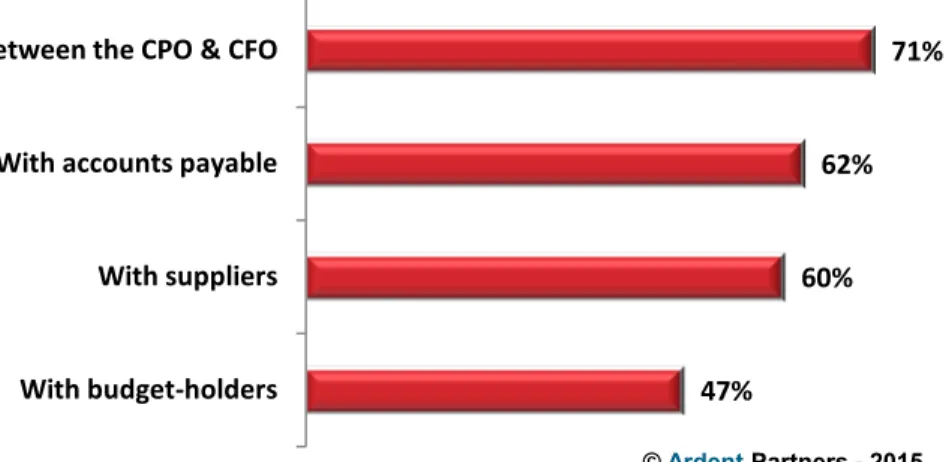
Collaborative procurement with suppliers is a must in the modern supply chain. Although a majority of CPOs and procurement teams collaborate closely with their suppliers, many do not (see Figure 2 below). This is a lost opportunity for them since suppliers’ performance can, and frequently does, have a direct impact on the buyer’s business.Strtategic suppliers should be viewed as assets worthy of investment because quality suppliers know their markets very well – they understand the gaps, limitations, risks, and opportunities, but they can be overlooked partners in mitigating supply risks and maximizing an enterprise’s supply chain. CPOs and procurement teams would be wise to leverage their supplier relationships pre- and post-sourcing for maximum value.
In that vein, procurement should work to communicate requirements to the supplier as early as possible in the sourcing process so that internal product teams or other stakeholders have enough information and time to identify the best suppliers and make any needed changes to strategy.
Procurement’s ability to impact business processes, relationships, and results will surely continue in the
future, but the depth and breadth of that impact will depend on each organization's ability to master its
processes and technologies and upon its ability to collaborate with
key internal stakeholders and suppliers alike.
“Collaboration has been at the forefront of our strategy for a long time. We’ve been working with and rewarding suppliers to bring their best ideas to us.” –Garry Christie, Director, Procurement, Advanced Micro Devices
Collaborative Procurement: Using Relationships to Drive Influence and Results
Greater supplier collaboration should also mean having streamlined transactions, which can include user-friendly punch-out catalogs and eProcurement systems. These features allow line-of-business users to leverage linked systems that allow for digital, seamless transactions between enterprise buyers, the supplier, and the AP/Finance department.
Collaboration with Accounts Payable and Treasury
For most CPOs and procurement teams, collaborating with AP is almost no longer even a question in the procurement world (see Figure 2), particularly when talking about a holistic procure-to-pay (“P2P”) workflow. Where procurement manages contracts with suppliers, AP ensures that supplier invoices are processed and timely payment is issued based on organizational policies. Thus, procurement and AP both are critical to managing supplier relationships: if procurement does not communicate contract terms or if AP takes too long to process the invoice, the supplier relationship can be negatively impacted.
AP can also provide access to spend patterns, while procurement is able use to set sourcing strategy but also see which suppliers submit timely invoices. Sharing data between these two teams creates a more holistic picture of supplier relationships than either AP or procurement could draw alone. Sharing information and a process allows both procurement and AP to make better decisions, informed by more detailed data, which can also lead to cost savings in the short and long-term.
Figure 2: Procurement Teams with ”Strong” Levels of Collaboration
47% 60% 62% 71% With budget-holders With suppliers With accounts payable Between the CPO & CFO
© Ardent Partners - 2015
“Accounts payable is not and will not be the responsibility of my team, but there's a clear interdependence. We need to work very, very closely with AP.” –Derek Batchlor, Sr. Director, Strategic Sourcing Global COE and Operations, Cargill
Collaborative Procurement: Using Relationships to Drive Influence and Results
Collaborative procurement with AP, thus, should be a strategic imperative for high-performing procurement teams. When AP and procurement collaborate closely – even on the executive level between the Chief Financial Officer and the CPO – the advantages to the business are much greater than what either team can accomplish working alone.
Over the past few years, procurement has found its responsibilities expanding beyond sourcing materials and managing contracts into new functional areas. Along with a newfound convergence with AP, this expansion has included accountability for managing or at least, impacting enterprise cash. Procurement is in a unique position to influence cash management, given its role in managing enterprise spend. As a result of this newfound focus, it follows that procurement should collaborate with the treasury team.
Treasury focuses on optimizing an enterprise’s cash through a variety of methods: paying invoices at a certain time, investing cash in short- and long-term investments. Procurement can be a strong strategic partner in working capital optimization strategies in a few key ways, including demand management, negotiating and enforcing payment terms, and managing supply holding costs. Not least of these methods are the sourcing activities that procurement already performs, seeking the best direct and indirect materials and frequently driving cost savings.
Working with treasury can offer procurement increased visibility into enterprise financial data, which would allow procurement to more effectively manage spend. Spend can be managed more effectively with better financial data. The relationship and information that treasury and procurement share can also help bring the CPO “to the table” along with the rest of the C-suite, which is paramount given how strategically important procurement has become to the enterprise.
Collaboration with Other Internal Stakeholders
Spend can be managed more effectively with greater financial data
because procurement would no longer need to rely on spend under
management numbers collected within its dedicated systems.
“We’ve seen a significant change to our business model, which means new product lifecycles, enabling us to bring more products to the market faster. We need to communicate our needs better and challenge our suppliers to meet these needs.” - Global Head of Procurement, Hi-tech Industry
Collaborative Procurement: Using Relationships to Drive Influence and Results
Collaborative procurement needs to occur with other internal stakeholders, like legal teams and line-of-business users, to ensure that procurement can best serve the enterprise. With most things that procurement touches, the sooner that it engages with these entities, the better for all. For
example, procurement can bridge the gap between the sourcing, supplier negotiation, and contract authoring and execution phases by linking these processes and collaborating with all stakeholders (product development, manufacturing, legal, and the supplier). This will ensure that product specifications and sourcing requirements that were detailed during the sourcing phase are passed along to the contracting teams or legal departments that will then author and execute the contract between the enterprise and the supplier. Linking sourcing and contracting processes via common templates, language, and platforms can go a long way towards bridging the gap between these two separate phases and making the process a more collaborative one for all.
Once the contract has been written and signed by all parties, procurement can further drive collaboration by centralizing contract documents, including terms and conditions and service-level agreements (SLAs), into a searchable repository that will provide greater access to established contracts. In turn, this promotes greater awareness of existing contracts, terms, conditions, and SLAs, which helps end users guard against last-minute supplier renegotiation attempts, supplier non- or under-performance, or poor internal contract usage and or compliance. Ultimately, contract centralization reduces duplication of efforts, maverick spend, needless spend, and savings leakage (defined as the gap between savings identified during the sourcing process and savings realized). Streamlined buyer-supplier transactions have the added benefit of improving internal collaboration between procurement and line-of-business users, since technologies like eProcurement systems ensure that internal stakeholders are purchasing against established contracts and ih maximizing the value that procurement secured during the initial sourcing event.
Recommendations
“I need to earn the investment of the business back in our team. It starts with better reporting and communicating the value that we deliver.” - Director of Procurement, Real Estate Industry
Collaborative Procurement: Using Relationships to Drive Influence and Results
Collaboration is and will remain a key aspect of procurement operations for years to come. Organizations that do not already emphasize collaborative procurement should begin to do so, as the marketplace very nearly necessitates a procurement team that actively works alongside, communicates with, and promotes internal and external stakeholder relationships. In fact, the procurement organization that works closely with other stakeholders – treasury, AP, suppliers, product development, and the line of business – will experience a wealth of cost, visibility, and spend management benefits. For procurement teams looking to be more collaborative, Ardent Partners offers the following recommendations:
• Embed procurement staff within the business – Collaboration starts with procurement putting “boots on the ground” in order to understand and influence line-of-business decisions across the enterprise – from meeting significant stakeholders, to conveying product specifications, to mitigating sudden challenges that arise. For procurement, it is much easier to influence the business from within key business units.
• Gain alignment on objectives and metrics with different stakeholders – With CPOs and procurement teams collaborating across multiple and traditionally-siloed departments, it is critical that all line-of-business executives define common objectives, metrics, and measures for success. Otherwise, the ties that bind procurement within the organization can cause fissures if departments track metrics and define success differently.
• Share procurement data with trusted stakeholders – In that vein, it is in the CPO’s best interests to share internal data with trusted stakeholders – not just to measure progress, but to drive progress. Procurement teams cannot rely on maximum collaboration with trusted partners if they are not all looking at the same things. Also, sharing data and information can extend the value of procurement beyond its four walls.
• Close the procure-to-pay loop – Collaboration between line-of-business users, procurement, and AP/finance becomes seamless and paperless with the deployment of P2P (eProcurement and ePayables) systems that allow end-users to purchase goods and services from preferred suppliers. From there, the order goes to the supplier, while the invoice goes to AP/Finance for quick and paperless remittance. Doing so saves the enterprise processing time, money, and potential late fees.
• Communicate with suppliers pre- and post-sourcing event for maximum value – Supplier communication is critical for CPOs and procurement teams, particularly to
Collaborative Procurement: Using Relationships to Drive Influence and Results
pass on product specifications, timelines, and expectations via RFIs and RFPs. It is also critical after the sourcing event has passed and agreement is being forged; that information should be converted into terms, conditions, and SLAs, and codified within the contract in order to secure the value that has been negotiated.
• Leverage supplier intelligence for enhanced risk mitigation – Lastly, CPOs and procurement teams should leverage their supplier relationships for the intelligence that suppliers have that other sources may not. Suppliers are the “tip of the spear” when it comes to the market, and although they are not the sole source of intelligence, they are valuable sources when it comes to measuring and mitigating risks, planning for near- and long-term changes within commodity markets, and taking advantage of unique opportunities as they appear.
Summary
Chief Procurement Officers and procurement teams have been moving mountains over the past few years, particularly as the expectation to “do more with same” has persisted beyond the Great Recession. But in order for them to elevate the enterprise to the next level of performance, CPOs and procurement teams must collaborate with trusted partners inside and outside of the enterprise. With collaborative procurement, overworked and understaffed procurement teams can find valuable partners within AP/treasury, product development, legal, line-of-business, and suppliers, and extend the value of procurement beyond its four walls. Common goals, shared information, linked processes and systems, and above all, mutual understanding, can enhance the value of procurement’s relationships inside and outside of the enterprise.
Collaborative Procurement: Using Relationships to Drive Influence and Results
APPENDIX
ABOUT THE AUTHORS
Andrew Bartolini, Chief Research Officer, Ardent Partners
Andrew Bartolini is a globally-recognized expert in sourcing, procurement, supply management, and accounts payable. Andrew focuses his research and efforts on helping enterprises develop and execute strategies to achieve operational excellence within their finance and procurement
departments. Andrew is also the publisher o
research site for Chief Procurement Officers and other procurement
leadersthe leading global source
for ePayables news, research, and analysis
Advisor to corporate executives and leading solution providers alike, Andrew is a sought-after presenter, having lectured and presented more than 200 times in seven different countries. Over the past decade, Andrew has benchmarked thousands of enterprises across all facets of their accounts payable, sourcing, procurement, and supply management operations and his research is currently part of the Supply Chain/Management curriculum at several US universities. He actively covers the technology marketplace as well as trends in sourcing, procurement, supply management, and accounts payable and has been published or quoted in leading business publications including The Wall Street Journal, Business Week, Investor’s Business Daily, Forbes, and Fortune, as well as the major trade publications focused on accounts payable and supply management.
Prior to becoming an industry analyst, Andrew developed, packaged, deployed, and used supply management solutions on behalf of enterprises in the Global 2000 while working for Ariba and Commerce One. Additionally, his experience in strategic sourcing (managed projects totaling more than $500 million in client spend), business process transformation, and software implementation provides a ‘real-world’ context for his research and writing. Andrew has been named a “Pro to Know” by Supply and Demand Chain Executive three times and holds a B.A. in Economics from The College of the Holy Cross and an M.B.A in Finance from Indiana University. He welcomes your comments at
Collaborative Procurement: Using Relationships to Drive Influence and Results
Matthew Delman, Senior Payables Researcher, Ardent Partners
In his long and varied career, Matthew Delman has worked as an editor, writer, and/or online marketer for The Eagle-Tribune Newspaper Group, The NASDAQ OMX Group, an investment newsletter, and a research-focused marketing services firm. Over the course of nearly 15 years as an editorial professional, Matthew has had a hand in the development of more than 2 million pages worth of print and online content.
His research focus at Ardent Partners comprises the entire accounts payable and financial operations areas including B2B payments. Matthew is also the editor fo
and interesting research, news, and analysis from the world of AP automation. He is available for briefing requests and/or third-party article contributions
Matthew York, Senior Procurement Researcher, Ardent Partners
Matthew York is a research and analytic professional with 10 years of experience working in academia, government, and industry. His primary areas of research include sourcing, contracts, procurement and supply risk. In his role at Ardent Partners, Matthew also serves as the editor of
to Ardent Partners from Aberdeen Group, where he conducted survey research and data analysis for multiple research practices, including the Global Supply Management, Supply Chain Management, and Business Intelligence practices. Prior to joining Aberdeen, Matthew served for three and a half years in the U.S. Intelligence Community as both a Human Capital Management analyst and an intelligence analyst. He earned a B.A. in Political Science from Stonehill College and an M.A. in Political Science from the University of New Hampshire. He can be reached at
Collaborative Procurement: Using Relationships to Drive Influence and Results
ABOUT ARDENT PARTNERS
Ardent Partners is a Boston-based research and advisory firm focused on defining and advancing the supply management strategies, processes, and technologies that drive business value and accelerate organizational transformation within the enterprise. Ardent
also publishes the
(and discounts on) Ardent Partners research a
CPO Rising 2015: The Procurement Event of the Year
October 20 & 21 – Boston, MA
This October, a select group of Chief Procurement Officers and other business leaders will come together at the Harvard Club (Back Bay) in Boston for the inaugural CPO Rising 2015 event, an executive symposium brought to you by Ardent Partners.
This exclusive event promises valuable networking opportunities and the interactive exchange of ideas for CPOs and other procurement executives. Attendees can expect to return home with a collection of new and innovative ideas and strategies that will help improve the performance of their organizations and increase the impact their teams have on business results.
Online registration is opening soon with “Early Bird Pricing” available until July 15. For more details and updates, visi
THE CPO IS RISING IN 2015!
Industry Standard “Fine Print:”
©2015 Ardent Partners, Ltd. All rights reserved. Reproduction and distribution of this publication in any form without prior written permission is forbidden. Solution providers and consultancies should take special note that Ardent Partners reserves the right to seek legal remedies including injunctions, impoundment, destruction, damages, and fees for any copyright infringement (which includes but is not limited to usage of any Ardent Partners content in company collateral, presentations, and websites) in accordance with the laws of the Commonwealth of Massachusetts and the United States.
The information contained herein has been obtained from sources believed to be reliable. Ardent Partners, Ltd. disclaims all warranties as to the accuracy, completeness, or adequacy of such information. Ardent Partners, Ltd. shall have no liability for errors, omissions, or inadequacies in the information contained herein or for interpretations thereof. The contents expressed herein represent Ardent Partners’ best analysis at the time and are subject to change without notice.