Exploring a Multi-Faceted Framework for SOC: How to develop secure
web-service interactions?
(An extended abstract)
Kees Leune
Willem-Jan van den Heuvel
Mike Papazoglou
Tilburg University, Infolab,
The Netherlands
Abstract
Service Oriented Computing (SOC) demands an infras-tructure that seamlessly integrates all connection points be-tween business processes, services and associated support resources. Parts of the infrastructure may be supported by existing standards such as XACML and BPEL. However, an integral and sound framework that takes into account all these issues and serves as the formal underpinning of this infrastructure is currently lacking. A multi-facetted frame-work to enforce minimal levels of security not only at the level of the network (e.g., using encryption), but also of business processes, is of paramount importance.
To address this challenge, we explore an Event-driven Framework for Service Oriented Computing (EFSOC) that is organized in four tiers: the event tier, the business process tier, the resource tier, and the access control tier. The event tier encompasses definitions of business-related events, and supports their propagation throughout the business process flow. The business process tier specifies the dynamic inter-actions between business processes and services. The re-source tier describes how service invocations interact with organizational resources, while the access control tier de-fines access roles that are allowed to invoke certain ser-vices.
1. Introduction
The manifestation of the Service-Oriented Computing (SOC) paradigm for Web applications is conducted on the basis of web services. Web service standards such as SOAP (Simple Object Access Protocol) [4], WSDL (Web Ser-vice Description Language) [5] and UDDI (Universal De-scription, Discovery and Integration protocol) [1] provide the foundations for building a service-oriented architecture (SOA). The SOA treats software resources as services avail-able on a network. To achieve this, SOA relies on
univer-sally accepted standards to provide broad interoperability among different platforms, and loose coupling to separate the participants in distributed computing interactions, so that modifying the interface of one participant in the ex-change does not affect the other. The combination of these two core principles means that enterprises can implement web services without having any knowledge of the con-sumers of those services, and vice versa.
Large scale web service deployments across multiple ap-plications and services requires appropriate security, and particularly access control mechanisms are necessary to en-sure that while a complex business process flows from one activity to the next, only authorized actors can invoke the supporting web-services. This requires deploying large-scale and reliable, Service Oriented Architectures based on the right blend of standards based technologies. This chal-lenge is only partially tackled by current standards such as WS-Security, SAML, and XACML that are rather opaque and focus at an isolated part of the overall problem do-main only, e.g., web service representation, or web service composition or web-service security. In particular, “tra-ditional” security enforcement standards typically assume that roles can be structured hierarchically. However, this assumption is not any longer realistic in the SOA as it needs event-driven integration of connection points between busi-ness processes, services and associated support resources, i.e., back-end systems. On the other hand, emerging web-service standards tend to provide rather low-level, technical solutions while neglecting business semantics that are hard-wired in business processes.
To address the challenge of developing secure interac-tions between web-services of various collaborating enter-prises, a multi-facetted framework is required. This “uni-fied” framework should be capable of associating external events, e.g., a customer (service requester) requesting to check the availability of a certain type of rental car, with the business process and services with which this event is associated as well as the resources that are invoked by these
services. In this way an organization is in a position to de-termine which services and business process are being han-dled by which actors at any point in time and what resources are affected, making it easier to safely adapt business pro-cesses in response to business changes.
In the remainder of this paper, we develop and ex-plore such a unified framework that is entitled the Event driven Framework for Service Oriented Computing (EF-SOC) framework.
2. Related Work
As the framework that is presented herein is multi-facetted, this research draws upon results from various (vir-tually) independent domains.
Firstly, this research framework builds on top of the main manifestation of service flow languages: BPEL4WS (also known as BPEL) [2] is an standardization initiative that aims to define a notation for specifying business process behavior based on web services. The initiative has duced an XML specification for describing business pro-tocols. Business protocols may be captured by specify-ing the service flow and sequence of service invocations. BPEL4WS assumes that all message exchange takes place in a point-to-point fashion. In other words, any business relation takes place between exactly two parties. The re-lationship between a service and a business process is de-scribed in terms of partner link types, which describe the roles that each partner may play in a conversation. This approach allows BPEL4WS to describe cross-business in-teraction as a large number of point-to-point message ex-changes, without immediately specifying which role each business partner plays. A comprehensive overview of the main service composition languages, including a compari-son, can be found in [13].
Although BPEL4WS includes a facility for exchanging messages between business partners, it assumes security to be an extension of the approach. In particular, security is en-forced by supplementary standards, e.g., WS-Security and WS-SecureConversation. These standards help to secure message exchanges between parties just above the transport level (SSL), and are typically build on top of SOAP as en-cryption or signature headers.
SAML [8] is another initiative that stems from the SOC domain. In contrast to WS-Security however, this language is not defined in conjunction with WSDL or BPEL. In a nut-shell, SAML is a security assertion markup language which may be used to safeguard message exchange by allowing trading partners to share authentication and authorization information. SAML conveys assertions that may be vali-dated by authorities. In addition to, for example, an au-thorization decision assertion, SAML offers a framework to define custom assertion types. Similar to WS-Security
however, SAML offers security at the level of message ex-change, not at the level of business processes.
XACML [9] is a related initiative that allows security policies to be expressed in a common, XML-based, lan-guage. Using XACML, a common way to describe how authorization requests will be treated is available. XACML defines policies in terms of rules and combining algorithms. The XACML initiative is especially relevant to EFSOC as it is a candidate for implementing a part of the access control tier.
In contrast to the above security standards, the EFSOC framework security approach explicitly relates service in-vocations in a business process context to event types. This implies that security is not implemented as a set of SOAP extensions, but rather specified at the level of business events, processes and resources. However, we believe that the above standards could be used in conjunction with EF-SOC to provide security at the ”message-level”. Moreover, the framework will offer a rich set of predefined queries to dynamically infer facts about security related issues. This feature is essential in the SOC-style eco-systems in which business processes operate in highly volatile environments and may change their resources from one moment to the next, e.g., due to load balancing, pricing or trust reasons. For example business process BP1 depends at moment X on two web-services from provider X, and the next, on ser-vices of provider A and B.
3. The EFSOC Framework
The EFSOC framework provides four tiers for support-ing event-driven access control rules for invoksupport-ing ports of business processes. In this way, the framework integrates points of access to services, which are enacted using roles, resources and events. The main constituents of each tier, and their cross-correlations are depicted in Figure-1.
3.1. Event Tier
Typically, enterprise business processes and workflows communicate with each other by continuously generating and responding to events. The Event Tier in the EFSOC meta-model aims at supporting such kind of complex events partly based on findings which are borrowed from the do-main of Complex Event Processing (CEP) [12]. Events can be simply perceived as occurrences that happen over time, and independently from each other. Events represent a spe-cific capability that is carried out by a service, and are ca-pable of carrying information themselves, e.g., a request product event can be parameterized with a product identi-fier, date and quantity.
The Event Tier in EFSOC comprises two main compo-nents: subjects and events. A subject can be either a
re-Business process Tier Resource Tier Access/Control Tier Event Tier
event generator even t m onit or system event business event
resource actor VBOS business object 0 ..* 0 ..*
role assignment role session
role type event subject 0..* 1..* 0..* 1..* 0..* 0..* 0..* 0..* initiates business service system service message0..* port 0..* 0..* 0..* business process 1..* 1..* 1..* 1..* initiates service 0..* 0..* port_type servi ce assignmen t
Figure 1. The EFSOC Framework
source or a service, and is capable of playing a certain role in the context of a business process. Subjects thus need not be necessarily human actors, but also can be implemented using an (autonomous) web-service. Events are generated and monitored by subjects and are typically part of an event chain. It should be noted that the internal structure of events (e.g., parameters, ECA rules) are for now left outside the scope of this article; only the basic framework is stipulated here.
3.2. The Business Process Tier
Our framework assumes that the coordination of web-service invocations are driven by business processes. A business process describes the flow of tasks that needs to be executed from a client request until the delivery of the required product or service, the information that is needed during each step, and the allocation of resources.
The business processes tier provides the (dynamic) allo-cation of services to specific tasks in the business process. This is achieved by defining a mapping operator between services and business processes. These mappings are named service assignments. Service assignments are persistent and may be queried run-time by a service flow engine to coor-dinate service invocation in the context of a particular busi-ness process.
To describe the features and behavior of a service we use WSDL, while the business process flow specifies the ac-tual execution order of services described by WSDL inter-faces. As observed before, several standards are proposed to specify and enact service process flows, e.g., the Business Process Execution Language (BPEL) [7], the Web Service Choreography Interface (WSCI) standard [6], and the Busi-ness Process Management Language (BPML)[3].
3.3. The Resource Tier
The Business Process Tier represents the abstract behav-ior of business processes in terms of service interactions, whereas the resource tier adopts a human resource- and im-plementation resource centric view of the services. The re-source tier distinguishes between two kinds of rere-sources; actors are active entities in an organization, such as employ-ees, processes or agents and business objects (BOs) that are objects with well-defined business semantics, such as in-voices, customers and purchase orders.
Actors are autonomous entities, e.g., human or e-agents, and reflect another alternative for enacting web-services. For example, the actor John Doe can implement a business service ”Claim Management” by giving advice about insur-ances such as whether or not to buy damage liability cover-age as a European customer in the US.
Access to a resource is provided subsidiary through a vir-tual business object (VBO). The purpose of VBOs is to hide the internal implementations of a resource in terms of enter-prise back-end services. For instance, business objects are exposed to services via their interface, and thus VBOs act as technology neutral wrappers of resources such as existing information systems of legacy applications.
Regular services may not interact directly with a re-source. For example, a VBO supports connectivity to back-end systems, provides aggregation and transformation of data, and allows for the dynamic presentation of informa-tion to authorized end-users.
As with any other service, the interface of a virtual busi-ness object service may be described using WSDL. A com-prehensive methodology for mapping virtual object services to services has been scrutinized in [15].
3.4. The Access Control Tier
To reduce the risk of interacting with potentially un-known service providers, any approach that focusses on service integration in business processes must have strong security measures to ensure that all communications are adequately safeguarded against unauthorized disclosure or manipulation. Not only must the communication be safe, once messages have been safely relayed from the service provider to the service consumer (or vice versa), there must also be an adequate access control system in place that en-forces that each service provider can only interact with busi-ness processes in exactly the way it needs to do to deliver its service.
The access control tier should be capable of taking into account several categories of interactions between services in an organization, including:
active entities that are capable of producing events which may start processes of one or more services
• two way interaction: This category of interaction is
also referred to as conversational interaction as it com-prises pairs of message exchanges between services and or subjects
The Access Control Tier deals with allocating roles to subjects. A role factors cohesive behavior of subjects into some type, e.g., the subjects John Doe and Mary Doolit-tle both are specialized in advising clients about car insur-ances. From an implementation perspective, roles are used to prevent instances of web-service implementations (e.g, Enterprise Javabeans) to switch between classes. The link-age between a subject and a role type is typified using a role assignment. In role-based access control, permissions are associated with roles and roles are assigned to users [14].
Here, we refine the definition of a subject to make it ex-plicit that any actor, service or business object is considered as a subject. Each subject may be assigned to one or more role types. A role type represents the function that a certain element fulfills in completing a business process.
Role types can be organized into role hierarchies, that are capable of indicate that one role is contained in another role. It has been proven that this containment relationship is irreflexive, a-symmetric and transitive [10]. Role type hierarchies play are an important means to substitute role instances and support the administration of access control privileges and constraints. Using role hierarchies, a role can be refined into another role that possesses stricter ac-cess control properties.
In the above, we stated that all events must originate from an authorized event generator and may only be sent to authorized event monitors. As role types can be assigned to subjects, they are a pivotal concept in our approach. A role assignment as such does not entitle the subject to any privileges. Instead, a role assignment must be explicitly ac-tivated, which results in a role session. Each role session is associated with exactly one role assignment.
A role session encompasses a set of access control poli-cies that must be satisfied before a role, engaged in a par-ticular role session, is allowed to invoke a capability of a service.
When the access control tier receives an event, it will evaluate an additional algorithm which will determine whether or not the event will be relayed to any possible event monitors. When the access control tier determines whether or not permission should be granted the event tier will receive the decision in the form of an authorization re-sponse event. Based on the contents of the authorization event, the access control tier will either relay the event, or prevent it from propagating further.
Figure 2. Infrastructure and Operational Ser-vices for EFSOC
4. Run-time Enactment of event-driven and
service-based process with EFSOC
The above introduced framework provides the structural foundation for enabling even-driven business processes that are executed by authorized service resources.
In order to facilitate the run-time enactment of event-driven processes, the EFSOC framework basically utilizes two categories of services: infrastructure (system) services and operational (event) services. Thus, EFSOC is defined recursively as a conglomerate of composite infrastructure and operational services in itself. We have depicted the ar-chitecture of the supporting infrastructure and operational services in figure 2.
4.1. Infrastructure services
To implement the runtime enactment of the framework, we are developing a number of system services. Just like business services, system services are services, however, they are provided by the EFSOC framework instead of de-signed by the user. The EFSOC framework defines four system services: an event service that provides operations for sending, monitoring and relaying events, a workflow service which provides service invocation coordination and session management, an integration gateway service that servifies resources, and lastly, an access control service. The access control service is used primarily by the event service and the workflow service to establish whether or not events are allowed to be monitored or generated by sub-jects. The integration gateway provides a suite of wrap-ping capabilities, e.g., semantic wrappers and converters, to access resources such as legacy systems, and hereby gives support for building virtual business objects. For these
pur-<wsdl:interface name="accessControlInterface"> <wsdl:operation name="requestAuthorization" pattern="http://www.w3.org/2003/06/wsdl/in-out"> </wsdl:operation> <wsdl:operation name="newRoleType" pattern="http://www.w3.org/2003/06/wsdl/in-only"> </wsdl:operation> <wsdl:operation name="newSubject" pattern="http://www.w3.org/2003/06/wsdl/in-only"> </wsdl:operation> <wsdl:operation name="newRoleAssignment" pattern="http://www.w3.org/2003/06/wsdl/in-only"> </wsdl:operation> <wsdl:operation name="addAuthorizedEventMonitor" pattern="http://www.w3.org/2003/06/wsdl/in-only"> </wsdl:operation> <wsdl:operation name="addAuthorizedEventGenerator" pattern="http://www.w3.org/2003/06/wsdl/in-only"> </wsdl:operation> </wsdl:interface>
Figure 3. WSDL excerpt of the Access Control Infrastructure Service
poses, technology such as XSLT and semantic mappings are adopted by this component.
All system services are implemented as web services and
WSDL descriptions are available [11]1.
Figure 3 illustrates partially the interface description of the access control service, which provides a number of basic operations to the event service. For example, when a subject attempts to generate an event, the event service will invoke the requestAuthorization operation of the accessControlIn-terface. The operation will decide, based on a number of rules that must be evalatued, whether or not this subject is authorized to generate this event. Once the accessCon-trolInterface has returned the decision, which is sent back to the event service in the form of a new event, the event will be relayed to the appropriate event monitors.
4.2. Operational Services
Operational services are constructed on top of the infras-tructure services (see the event interfaces which are con-nected to the four components of the architecture), and serves to instantiate the types of the EFSOC metamodel, provide run-time support for event-driven processes, and, query the framework.
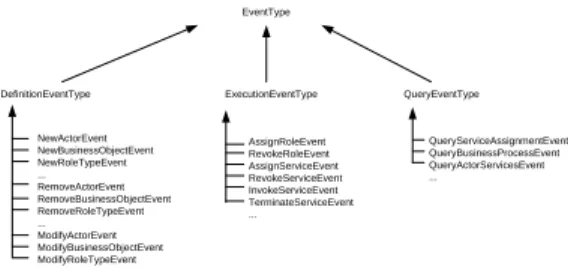
Event-driven processing may lead to large amounts of different events being generated and monitored. To address this issue, we have chosen to organize all event types in an event hierarchy as shown in figure 4. The total event space can be divided in three event categories: 1) definition event types, 2) execution event types and 3) query event types. Definition events are events that modify the existence
1WSDL definitions can be found at:
http://infolab.uvt.nl/people/kees/efsoc/systemservices/wsdl
EventType
DefinitionEventType ExecutionEventType QueryEventType
NewActorEvent NewBusinessObjectEvent NewRoleTypeEvent ... RemoveActorEvent RemoveBusinessObjectEvent RemoveRoleTypeEvent ... ModifyActorEvent ModifyBusinessObjectEvent ModifyRoleTypeEvent ... AssignRoleEvent RevokeRoleEvent AssignServiceEvent RevokeServiceEvent InvokeServiceEvent TerminateServiceEvent ... QueryServiceAssignmentEvent QueryBusinessProcessEvent QueryActorServicesEvent ...
Figure 4. The (partial) Event Taxonomy
of model elements. For example, creating a new role type
will trigger aNewRoleTypeEvent, or removing an actor
will fire off aRemoveActorEvent. Execution events are
events that represent changes in run-time properties of the model, such as service invocations, role assignments, etc. Query events can be used to inspect the state of the system. For example, to find out which actors are participating in a particular business process, a QueryBusinessProcessEvent will be generated.
The event taxonomy has been mapped to the infrastruc-ture services. In particular, the definition and execution event types are supported by the Work Flow Service, ex-cluding for those which are related to the access/control tier in EFSOC. The conformance of the result of execution event types is checked upon the existing definitions (speci-fied using the definition events) using advanced query capa-bilities in the framework. These query facilities are imple-mented in the QueryEventTypes.
5. Summary and conclusions
SOC requires instantaneous process flows throughout the enterprise to ensure that business events are propagated along the chain of connections to the appropriate and autho-rized handling services and resources. Enterprises increas-ingly expose their internal business processes to external business events. Dealing with large numbers of incoming and outgoing events implies that organizations must keep control of both their internal and cross-enterprise business processes.
In this article, we have explored a four-tiered framework and some infrastructural services that could serve as the ba-sis for securing interactions between trading partners. In contrast to existing web-service standards, this framework starts from the business processes and allows security of peer-to-peer interactions between trading partners. Actu-ally, as argued in the article, this framework can be con-structed on top of existing security standards such as SAML that merely provide (SOAP) message level security. In ad-dition, and perhaps more importantly, the framework offers
a set of queries to dynamically infer new facts, e.g., web-service X can deduce whether an incoming request to in-voke one of its port is authorized or not. This feature is of paramount importance as enterprises will have to operate in increasingly volatile business environments, with chang-ing tradchang-ing partners between one process execution and the next.
We realize that the current version of the EFSOC frame-work only provides the most basic functionality and con-structs to specify and enact event-driven business processes for Service Oriented Computing. This framework encom-passes four complementary tiers: the Event Tier, the Busi-ness Process Tier, the Resource Tier, and lastly, the Access Control Tier. This framework is capable of capturing exter-nal events and distribute them to associated interexter-nal busi-ness processes and services according to a predefined ac-cess/control scheme. There are a number of additional fea-tures, which would further enhance the usability and expres-sive power of the framework.
These include the following items:
• Extension of the EFSOC framework.
The metamodel that is presented herein, typifies the basic constituents for complex event processing in SOC. We intend to elaborate both the metamodel and the underlying formalization so that they include a type system, which can more effictively deal with recur-sively defined events and business processes.
• Development of Unified EFSOC Language.
We plan to work on a (formalized) unified language that combines and extends existing standards like BPEL, SAML and WSDL, and is based on a sound and concise formal metamodel.
• Query Language and Repository of Predefined
Queries.
We intend to design a query language and a repository system on top of the EFSOC language. In addition, we will predefine a rich set of queries to infer facts about the EFSOC framework.
An experimental system for enacting event-driven busi-ness processes within the EFSOC framework is under con-struction. This system is architected according to the orga-nization of infrastructure and operational services that was presented in section 4.
References
[1] Universal Description, Discovery, and Integration (UDDI). Technical report. http://www.uddi.org.
[2] T. Andrews, F. Curbera, H. Dholakia, Y. Goland, J. Klein, F. Leymann, K. Liu, D. Roller, D. Smith, S. Thatte, I. Trick-ovic, and S. Weerawarana. Business process execution lan-guage. Specification Version 1.1, BEA Systems, Interna-tion Business Machines CorporaInterna-tion, Microsoft Corpora-tion, SAP AG, Siebel Systems, May 2003.
[3] A. Arkin. Business process modeling language. Last call draft report, BPMI.Org, November 2002.
[4] D. Box, D. Ehnebuske, G. Kakivaya, A. Layman, N. Mendelsohn, H. F. Nielsen, S. Thatte, and D. Winer. Sim-ple Object Access Protocol (SOAP) 1.1. W3c note, W3C, May 2000. http://www.w3.org/TR/SOAP/.
[5] E. Christensen, F. Curbera, G. Meredith, and S. Weerawarana. Web Services Description Lan-guage (WSDL) 1.1. W3c note, W3C, March 2001. http://www.w3.org/TR/2001/NOTE-wsdl-20010315. [6] A. A. et al. Web service choreography interface 1.0.
Techni-cal report, BEA Systems, Intalio, SAP, Sun Microsystems, 2002. http://dev2dev.bea.com/techtrack/wsci.jsp (visited 2-7-2003).
[7] F. C. et al. Business process execution lan-guage for web-services, version 1.1. Technical re-port, BEA Systems, IBM, Microsoft, May 2003. http://www.ibm.com/developerworks/library/ws-bpel (visited: 28-6-2003).
[8] S. Farell, I. Reid, H. Lockhart, D. Orchard, K. Sankar, C. Adams, T. Moses, N. Edwards, J. Pato, B. Blakley, M. Er-dos, S. Cantor, R. B. Morgan, M. Chanliau, C. McLaren, C. Knouse, S. Godik, D. Platt, J. Moreh, J. Hodges, and P. Hallam-Baker. Assertions and Protocol for the OASIS Security Assertion Markup Language (SAML) V1.1. Com-mittee specification, OASIS, July 2003. http://www.oasis-open.org/committees/documents.php?wg abbrev=security. [9] S. Godik and T. M. (editors). eXtensible Access Control
Markup Language (XACML). OASIS Standard, OASIS, February 2003.
[10] W. Jansen. Inheritance properties of role hierarchies. In 21st National Information Systems Security Conference, Crystal City, Virginia, October 6-9 1998.
[11] K. Leune. Efsoc: Infrastructure services and prototype im-plementation. Infolab technical report, Tilburg University, October 2003.
[12] D. Luckham. The Power of Events. An Introduction to Com-plex Event Processing in Distributed Enterprise Systems. Addison-Wesley Press, April 2002.
[13] C. Pelz. web services orchestration: a review of emerg-ing technologies, tools, and standards. Technical report, HP, January 2003.
[14] R. Sandhu, E. Coyne, H. Feinstein, and C. Youman. Role-based access control models. IEEE Computer, February 1996.
[15] W.-J. van den Heuvel. Integrating Modern Business Appli-cations with Objectified Legacy Systems. PhD thesis, Tilburg University, Infolab, 2002.