THE DIFFUSION OF BROADBAND TELECOMMUNICATIONS:
THE ROLE OF COMPETITION
Mario Denni e Harald Gruber
U
NIVERSITÀ DEGLIS
TUDIR
OMAT
REU
NIVERSITÀ DEGLIS
TUDIR
OMAT
REDIPARTIMENTO DI ECONOMIA
Working Paper n° 60, 2006
Comitato Scientifico
- I “Working Papers” del Dipartimento di Economia svolgono la funzione di divulgare tempestivamente, in forma definitiva o provvisoria, i risultati di ricerche scientifiche originali. La loro pubblicazione è soggetta all’approvazione del Comitato Scientifico. - Per ciascuna pubblicazione vengono soddisfatti gli obblighi previsti dall’art. 1 del D.L.L.
31.8.1945, n. 660 e successive modifiche.
- Copie della presente pubblicazione possono essere richieste alla Redazione.
REDAZIONE:
Dipartimento di Economia Università degli Studi Roma Tre Via Ostiense, 139 - 00154 Roma
U
NIVERSITÀ DEGLIS
TUDIR
OMAT
REDIPARTIMENTO DI ECONOMIA
THE DIFFUSION OF BROADBAND TELECOMMUNICATIONS:
THE ROLE OF COMPETITION
Abstract
5
1. Introduction
6
2 The broadband market
8
3 The model
12
4 Results and discussion
16
Conclusion
22
The diffusion of broadband telecommunications:
the role of competition
Mario Denni∗ Harald Gruber∗∗ October 2005
Abstract
This paper addresses the determinants of diffusion of broadband in-frastructure by looking at the U.S. Federal States. It tries to iden-tify in particular to what extentintra- andinter-platform competition contribute to accelerating the speed of diffusion. Panel data analysis results indicate that both types of competition significantly affect the rate of diffusion, although with different effect. Intra-platform com-petition seems to have a positive impact only initially on the rate of diffusion but then dissipates. For the longer term,inter-platform has a much more important role in driving the rate of diffusion. The study takes account of the impact of other variables measuring competition in the telecommunications sector as well.
JEL classification: L1; L86; L96; O3
Keywords: Broadband; Technological diffusion; Regulation and competition.
∗
Dipartimento di Economia, Universit`a degli Studi Roma Tre. Correspondence Ad-dress: Dipartimento di Economia, Via Ostiense 139, 00154, Roma, Italia. E-mail AdAd-dress: [email protected]
∗∗
European Investment Bank. Correspondence Address: 100, Bd. K. Adenauer L-2950 Luxembourg. E-mail Address: [email protected]. The views expressed are personal and need not necessarily reflect those of the EIB.
1
Introduction
The diffusion of access to broadband services is high on the political agenda of developed countries because of the positive externalities involved with the adoption of such technology.1 The political debate rotates about what are
the policies most conducive to achieve fast and rapid diffusion of broadband access infrastructure.2 Broadband access can be provided via different
tech-nological platforms or types of networks. An important feature therefore is the role of legacy telecommunications systems in place and to which extent market power with the legacy system can be transferred also to the emerg-ing broadband market. Regulatory reform in the telecommunications sector was aimed at introducing competition during the last decade or so. Whereas this was fairly successful for certain technologies, such as mobile telecom-munications where market concentration has been reduced substantially, it was much less so for the fixed, or wireline, network. An international com-parison in the wireline access markets shows that for most OECD countries the market share of the incumbent wireline firm is well above 90 per cent. As wireline access is key in providing broadband services, policy makers have to find ways in with this market power problem. There are generally two policy issues at stake: first, the objective of rapid diffusion of broad-band access; second, the issue of economic conditions of service provision. Although the two issues are interrelated, for the sake of simplicity let us as-sume them as separate for the moment. In the political discourse, diffusion is getting the main attention, as countries are typically benchmarked by this parameter. The argumentation generally is that competition drives
diffu-1
There is for instance the Recommendation of the OECD of 12 February 2004.
2
sion (ITU, 2003). Competition can be enhanced in two ways: first, through service competition on the same network facility trough open access pro-visions; second, through facility based competition by means of alternative local access modes. The former will be referred to asintra-platform compe-tition and the latter asinter-platform competition. Substantial regulatory effort during the last decade has been devoted towards creating the condi-tions for equal access, in particular though the unbundling of infrastructure elements for local access. This turned out as being a particularly challenging task for regulators as they had to trade off the interests of new entrants for low access prices with the interests of the incumbent in terms of long-term incentives for infrastructure investments. The success of unbundling mea-sures as device for reducing incumbent’s market power turned out as being mixed so far, with regulators in countries such as the U.S. basically giving up on the objective.3 As a result the option for inducing facility based com-petition seems to be the less controversial one from a regulatory point of view, provided that market are capable of accommodating alternative in-frastructures (Faulhaber and Hagendorn, 2000). This paper addresses the determinants of diffusion of broadband infrastructure by looking at the U.S. Federal States. It tries to identify in particular to what extent intra- and
inter-platform competition contribute to accelerating the speed of diffusion. The diffusion of broadband access in the U.S. has been subject to a number of empirical studies. Aron and Burnstein (2003) have found evidence that facility based competition drives diffusion using cross section data of the U.S. Federal states. Wallsten (2005) looked into the effectiveness of regulatory
3This is generally the interpretation given by observers for the FCC not appealing to
Court’s ruling against unbundling measures imposed on incumbent local exchange carriers (see also Nuechterlein and Weiser, 2005).
and policy variables, including subsidies, to affect diffusion of broadband access. He finds that all measures, apart from access to rights of way, are not significant.4 A major novelty of this study is the use of a panel data set for the U.S. Federal States over the period 1999−2004, which provides the opportunity to achieve robust statistical results. The study is arranged as follows. Section 2 presents some background information to understand the broadband market and its institutional settings. Section 3 illustrates the diffusion model that serves for the econometric study. Section 4 presents and discusses the results and tests their robustness. Section 5 concludes.
2
The broadband market
The most common networks to provide broadband access are traditional telecommunications access networks using copper pair cable in the local loop and the cable TV networks using different versions of coaxial cables. In the U.S., as in many other countries, these infrastructures have been built long time ago and hence significant upgrade investments are required to achieve broadband transmission capability in the local access network. In the case of telecommunications infrastructure this is achieved by the switch to digi-tal subscriber line (DSL) technology,5 whereas with cable TV infrastructure it requires investments that allow also for reverse flow of traffic.6 There are also other technological platforms that can provide access to broadband
4One major limitation pointed out also by the author is that the policy variables have
no time dimension,i.e. they are assumed constant throughout the sample period.
5
DSL requires investment into the so-called central office which allows to increase the transmission capacity and splits the traffic into voice and data.
6Originally the cable TV infrastructure was designed for unidirectional traffic only,
services such as wireless services (either by satellite or by ground based in-frastructure, known also as wireless in the local loop) or via the powerline. These platforms have however found only limited application and hence the debate is concentrating on DSL and cable TV. Both systems happen to be subject to some form of regulation in most countries as they are based on infrastructures with natural monopoly features. However, as the type of service provided with each system is different (i.e. voice telecommuni-cations services or TV services respectively), they are typically subject to different regulatory regimes.7 In the US, the evolution of the telecommu-nications market is oriented by the Telecommutelecommu-nications Act of 1996. That act crystallised the policy objective of overturning the regulated monopoly regime by injecting competition in the market, and these forces should in the long term make regulation unnecessary. There are three components in this strategy; first, eliminate local telecommunications monopoly franchises by allowing entry also by others (e.g.locally franchised cable TV operators); second, by interconnection mandate, meaning that new networks would be able to interconnect; third, incumbent operators were mandated to unbun-dled network elements, such as local loop access to customers. The driving idea of the latter was that new entrants would attempt to get wholesale ac-cess to incumbent’s customers to “taste the water” and sucac-cessively possibly invest in own infrastructure. This is the “stepping stone” theory to facil-ity based competition. However, empirical evidence seems to suggest that
7
The main distinction made is between communications services an information ser-vices. Communications services are typically regulated, while information services are not. Telecommunications services fall under communications services. TV services are informa-tion services, but the cable TV companies are prevented from offering telecommunicainforma-tions services jointly.
exactly the opposite is happening. For instance, Hazlett (2005) finds that unbundling measures have actually reduced the new entrants’ investment in infrastructure. The terms for wholesale access were posed in such a way that they took out the incentives to invest in competitive infrastructure. The unbundling obligation was ultimately successfully challenged in court in 2004. As the regulator FCC did not react to this, this was widely seen as a strategy switch away from service competition on a single infrastructure towards facility based competition. Also cable TV networks, the main al-ternative network for broadband service provision, is subject to regulation in the U.S.. Whereas regulation in cable TV was mainly aimed at consumer protection from unjustified pricing policies by cable operators and in pro-viding content (Crandall and Furchtgott-Roth, 1996), cable operators are not regulated in the sale of cable modem service. Differently from an in-cumbent local exchange carriers for telecommunications, cable operators are under no obligation to offer competitors the use of infrastructure for broad-band services on a wholesale basis in order that the competitor could offer competing broadband services on a retail basis. There have been several calls for abandoning these asymmetric regulatory measures in broadband infrastructure provision. For instance, Crandall et al. (2002) argue that telecommunications should be deregulated in the provision of DSL services as they found that demand for DSL services is price-elastic and DSL ser-vice providers do not have market power. To summarise, this asymmetric regulation becomes problematic once firms coming from different industries historically providing different service, now offer the same broadband ser-vices. For instance, there is a debate in the U.S. on whether cable TV firms should be allowed to provide also voice telephony (Crandallet al. 2002), a market from which they generally are excluded. Likewise, local
telecommu-nications companies are compelled in most countries to “unbundled” local access loops,i.e.to share or entirely provide a subscriber line to other firms at cost based prices, whereas cable TV firms do not have such obligations. Legacy regulatory measures therefore are expected to have a strong bear-ing on the diffusion of broadband access, and an intense political discussion is ongoing on how these regulatory measures should be updated to take the technological developments into account (Hausmanet al. 2001). There seems to be a consensus on the claim that competition is a major driving force for the diffusion of broadband access. Competition may occur at dif-ferent levels. For instance, it may concern difdif-ferent technological platforms or networks, or it may occur on the same network when the owner of the infrastructure is obliged to unbundled network elements for other firms to provide services on the same platform. Any of the two forms of competition may have some drawbacks. Competition among platforms may lead to inef-ficient duplication of network infrastructure, or in some cases to absence of infrastructure in certain areas where demand level is not sufficiently high. Likewise, facing competition on the same platform may lead to insufficient incentives for infrastructure investment by the network owner.8 Formulat-ing optimum policies therefore remains a delicate balancFormulat-ing of the different elements. Whereas in the U.S., after the repeal of the instances brought for-ward by the defenders of unbundling measures, there is now a trend tofor-wards
8The effects of availability and competition on the adoption of broadband services
may be ambiguous. Consider, as an example, two countries: in one country half to the residents have broadband access via DSL only and the other half via cable TV only. In the other country, half of the residents have access to broadband services via both platforms, whereas the other does not have any access to broadband at all. A priori it is not clear which state would end up with a higher level of penetration (Aron and Burnstein, 2003).
greater emphasis of inter-platform competition in broadband diffusion, in other countries such as the E.U. unbundling is still considered as one of the cornerstones of driving broadband diffusion. This may be also because of more limited scope for inter-platform competition as in several E.U. coun-tries cable TV network are not present or are not capable of delivering broadband services (see European Commission, 2004).9
3
The model
This study is an empirical investigation into the diffusion of access to broad-band services in the U.S.. The data is collected at the level of Federal State and allows for a panel analysis.10 The data is semi-annual with the pe-riod of observation running form June 1999 to June 2004. The evolution of broadband subscribers is based on a logistic model of technology diffusion.11 Letyit denote the number of agents that have adopted the new technology
in state i at time t; let yit∗ denote the total number of potential adopters. The fraction of the total number of potential adopters in state ithat have adopted before timetfollows the logistic distribution function:
yit
yit∗ =
1
1 +exp(−ait−bitt)
(1) The variableait in equation (1) is a location or “timing” variable. It shifts
the diffusion function forwards or backwards, without affecting the shape of
9
On the arguments against mandatory unbundling see Criterion Economics (2003).
10
All the series related to the telecommunication industry are from various reports issued by the Federal Communications Commission (http://www.fcc.gov/wcb/iatd/ stats.html). The macroeconomic data comes from the Bureau of Economic Analysis (http://www.bea.doc.gov/bea/regional/spi).
11
the function otherwise. For example, whenaitis very high, we may say that
stateiat timetis very “advanced” in its adoption rate. The variable bit is
a measure of the diffusion growth. This can be verified from differentiating (1) with respect tot, and rearranging:
dyit dt 1 yit =bit y∗it−yit y∗it
This implies that bit equals the growth rate in the number of adopters at
timet, relative to the fraction of adopters that have not yet adopted at time
t. Equivalently, this says that the number of new adopters at timet, relative to the fraction of adopters that have not yet adopted at time t, is a linear function of the total number of consumers that have already adopted at time
t. This reflects the epidemic character of the logistic diffusion model. It can be verified that the second derivative of (1) is positive foryit/y∗it<1/2, and
negative if the reverse holds. The diffusion of the number adopters thus follows anS-shaped pattern, with a maximum diffusion speed reached when half of the total number of potential adopters has effectively adopted the new technology. In our econometric analysis we transform equation (1) as follows:
log yit yit∗ −yit
!
≡zit=ait+bitt (2)
The dependent variable, zit, is the logarithm of total number of adopters
relative to the number of potential adopters that have not yet adopted. We now specify the three essential determinants for the diffusion of mobile telecommunication services: the total number of potential adopters,y∗it; the location variable, ait; and the growth variable bit. As typically done in
diffusion studies of this kind (Dekimpe, Parker and Sarvary, 1998; Gruber and Verboven, 2001a) the parametery∗itmay be given, considering also that estimation would be problematic, since most states are still at the early
stages of diffusion. Gruber and Verboven (2001a) resolved this problem by pooling the data, and estimating a parameter, common for all countries. This facilitates estimation because one can exploit information from both countries in early and in more mature stages of diffusion. This approach was also justified in their study as they considered a relatively homogeneous group of E.U. countries. Second, this assumption makes the model linear and thus very much improves the scope for the estimation of the remaining parameters. The location variableait and the growth variablebit in (2) are
specified in a general form as:
ait = α0i +xitα (3)
bit = βi0+xitβ (4)
The parametersα0i andβi0are state-specific location and growth effects. The vectorxitincludes continuous variables affecting the location or growth
vari-ables. The dependent variable, the number of broadband subscribers may be normalised in different ways; by relating them to the total population in the state, the number of households, or by the number of fixed telecom-munications lines in the state. In line with common practice, our preferred measure of broadband penetration is the ratio of the number of broadband subscribers and population in the state.12 In any case, the choice of any of all these measures has no significant impact on the qualitative statistical results. The independent variables are as follows:
Concentration index of inter-platform competition :
HHinter = Pmi=1(Bi/T B)2, with Bi being the number of broadband
12
The main reason being that the number of households neglects the relevance of broad-band for business and the number of telecommunications lines does not take into account the diffusion of cable TV.
lines of platformi(DSL, Cable) andT B the total of broadband lines. It is the sum of the squared market shares of each platform, that is a sort of Herfindahl index computed over the technology shares (rather than firms’ shares). This index has the range of m1 < HHinter ≤ 1,
wheremis the total number of different platforms in the market. The higher the value the more the market is tilted toward a single platform. Concentration index of intra-platform competition :
HHintraj = 1/nj, with nj being the number of firms (providers) for platformj. It is the standard Herfindahl index in the symmetric case. This has the range of 0 < HHintraj ≤ 1. The higher the value the higher the market power of firms in that platform market (the more concentrated that market).
Degree of Competition in Telecommunications :
it is indicated by the number of lines served by the competitive lo-cal exchange carries over the total number of fixed lines within the state. The higher this value, the higher the competition degree of the telecommunications network.
Telecommunication Density :
for DSL technology to be viable the length of the local loop, which is the distance between the subscriber and the so-called central office should not be too large, normally within the range of a few kilometers. Thus the more central offices a state has, the more it is amenable to supplying broadband access. This density may be indicated by the ratio between the number of lines and the number of central offices. The higher this number, the lower the density of broadband access
in-frastructure. It is expected that density should have a positive impact on diffusion.
Potential for Broadband Competition on TLC Lines :
it is the share of central offices (CO) upgraded for equal access (EA) on total CO indicates the potential for broadband competition on telecommunications lines.
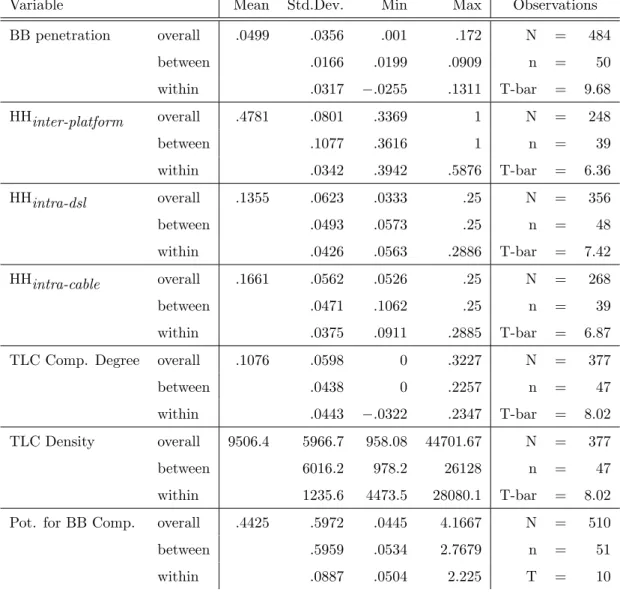
Table (1) presents some descriptive statistics on the broadband penetration rate and the included explanatory variables. Theoverall statistics are com-puted on the whole sample (50 units - the U.S. Federal States - over the ten semesters13). The other two lines instead report thebetween and thewithin
components of the overall variation of each variable. The former computes the deviations of the individual means (computed over time) from the gen-eral mean (it measures the variation across units). Then it usesnnumber of observations (the U.S. Federal States here). The latter represents the devi-ations from the individual means (the variation within units). All variables of our model show quite high coefficients of variation both cross-section and across periods confirming the relevance of our analysis.
13
The panel is unbalanced. Unbalanced panels may arise because of sample selection. A specific source of sample selection in panel surveys is attrition, that is, the fact that some of the units originally included in the panel may be lost through time. However, given the type and the sources of our dataset, here attrition may reasonably be considered as a typical case of random missing. That is, it is unrelated to the response variable. Therefore it does not bias the information carried by the sample.
4
Results and discussion
The econometric analysis has been conducted specifying three different mod-els. The first specification, which we refer to as the basic one, includes only ourintra-andinter-concentration indexes, both as location and as diffusion factors, and a variable capturing the growth in the general economic con-ditions of the states. The other two models allow for a richer framework where the other measures of the evolution of the competition degree in the telecommunications sector are accounted for.
For each specification, the Random Effects (RE) and the Fixed Effects (FE) estimators have been used and tested. Table (2) contains the results. They indicate thatinter-platform competition (HH inter) has a strong im-pact on diffusion, whatever the specification adopted. The signs of the parameter estimates however need some qualifications. Stronger platform competition has an important negative influence on the location parameter, but the impact on the diffusion speed is positive. This suggests that, in states withinter-platform competition, the initial availability of broadband is low, but in the longer term this competition effect improves and overtakes the availability effect. In other words, to reach outer areas, infrastructure competition is conducive in driving penetration. A totally different picture seems to emerge from the parameter estimates for intra-platform compe-tition. Concerning competition on cable TV platforms (HH intra-cable), the results suggest that initially competition has a positive impact, but this fades away over time. This result may be due to the fact that there are typ-ically non-overlapping cable franchises and cable operators are not required to unbundled network elements. For the wireline telecommunications (DSL) platforms (HH intra-dsl), the signs for the parameter estimates are similar.
The sign of the location parameter is positive and negative on the speed parameter. This suggests that competition on the platform would have a positive impact on diffusion only temporarily, but not in the longer run. To complete this picture the other two specifications consider other vari-ables affecting the wireline infrastructure. For instance the impact of the market share owned by competitive local exchange carriers (Tlc Competi-tion Degree in Model 1) is highly positive on location but then it lowers the diffusion over time. Similarly, the share of central offices converted to equal access (Potential for BB Competition in Model 2) and the density of broadband access infrastructure (Tlc density in Model 2) do not seem to spur broadband adoption. This suggests that infrastructure provision for
intra-platform competition may reduce the speed of diffusion. Finally the time trend is always positive regardless the specification. This captures the accelerating effect due to the general macroeconomic conditions.
The signs and significance of the estimated parameters remain fairly constant across the different specifications estimated. However, the Haus-man test for the hypothesis of no difference between the two estimators always rejects the null. Since the FE estimator is consistent when the unob-served effects and the covariates are correlated whereas RE is inconsistent, a statistically significant difference is interpreted as evidence against the appropriateness of the RE estimator.
Robustness of results
In this section some tests are carried out to check the robustness of the results to potential problems which might bias our estimates. Given the outcome of the Hausman test and the significance of all coefficients, our preferred specification is the FE estimator of Model 2.
Strict exogeneity of the covariates and the full-rank condition ensure the consistency and the asymptotic normality of the FE estimator. Assuming for the moment that these two conditions are satisfied (we address the endo-geneity issue later), correct inference requires that the idiosyncratic errors have a constant variance across time and individuals and are serially uncor-related. As to serial correlation we regress the fixed effects residuals on their lagged value. We cannot accept the null of non-significance of the coefficient then the error term of our model displays strong serial dependence. In such a case, the usual FE standard errors can be very misleading. Suspect on the accuracy of our inference arises also because of the presence of heteroskedas-ticity. So concludes in fact the test we carried out which is based on the assumption that under homoskedasticity the squared fixed effects residuals is uncorrelated with any function of the regressors.
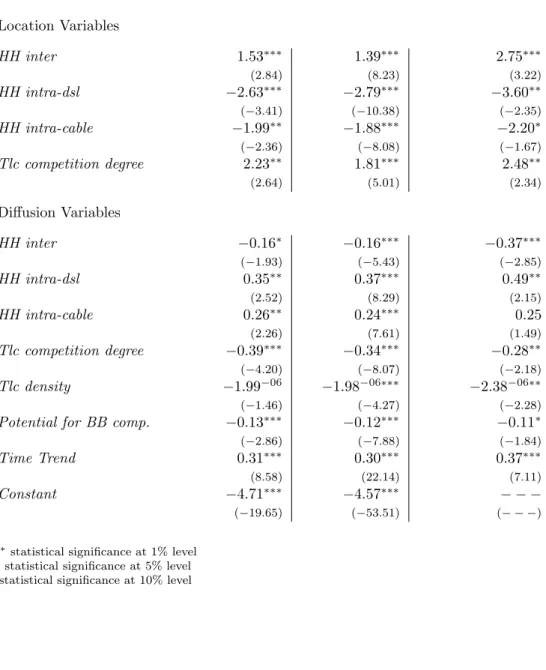
Our proposed solution for the serial dependence and the non-uniform variance in the idiosyncratic errors is twofold. First, we run a fully robust variance matrix estimator. Such an estimator is valid in the presence of any heteroskedasticity or serial dependence in the errors provided that T, the number of periods is small relative ton, the number of individuals (the U.S. Federal States in our case). Second, rather than compute a robust variance matrix for the FE estimator we allow for a more general conditional vari-ance matrix. Yet given the dimension of our dataset, using an unrestricted conditional variance matrix might lead to poor finite-sample performance of the FEGLS estimator. Then we employ a restricted form of the ma-trix. Precisely we assume that the error term has different cross-section variances and it follows a stable first-order autoregressive process. First two columns of table (3) report the results of these two robust estimates. Both models show only slight differences in the signs and sizes of the estimated
coefficients relative to the unrobust FE estimator. This means that cross-sectional heteroskedasticity and serial correlation have not seriously biased previous figures. Moreover the estimated coefficients with the FEGLS (sec-ond column of table 3) are always very significant. This is expected since the GLS estimator produces much lower standard errors than those of the robust-variance estimator since it uses more information.
There is concern about the potential simultaneity of the computed in-ter- andintra-platform competition indexes. Simultaneity would arise were these explanatory variables determined simultaneously along with the in-dependent. In such a case, there would exist correlation between the error term and the simultaneous covariates and our FE estimates would be incon-sistent. A general approach to estimate a panel data model when the strict exogeneity assumption fails is to use a transformation to remove the unob-served individual effects and then search for instruments for the endogenous regressors. A drawback with the FE transformation is that one should have strictly exogenous instruments. Using a FD transformation instead allows to remove the unobserved individual effects and lagged levels (two periods back) of the endogenous covariates can be exploited as instruments. We apply this technique to our model and the results are reported in the third column of table (3). We note that the absolute magnitudes of the estimated coefficients are always higher relative to the previous estimators. This is the prove that the simultaneity bias does produce some distortion in our previ-ous results. Remarkably our considerations about the role of theintra- and
inter-platform competition on the location and the speed of the broadband adoption process are strengthened in the light of the last results.
Finally, we want to test a dynamic specification of our model. This implies to include a lag of the dependent variable among the regressors.
Were the associated coefficient significant the adoption process would exhibit state dependence. That is, the current state of the broadband diffusion would depend on last period’s state. This is reasonable when one considers the positive indirect externalities which may arise as the adoption process evolves. The more people decide to use a broadband line, the more goods and services compatible with that technology are developed. Therefore these network effects do impact significantly the adoption process enhancing the expected benefit of new consumers from broadband lines due to the wider availability of complementary services.
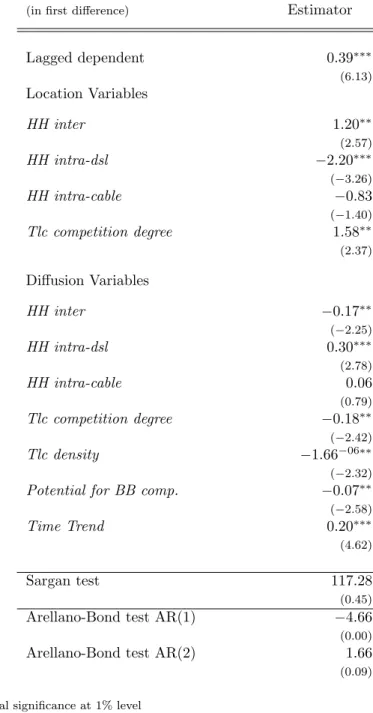
The presence of the lagged dependent variable on the right-hand side of our model causes endogeneity and prevents us from using the estima-tion methods available for static models. Rather than applying an exactly identified estimator we want to follow the procedure proposed by Arellano and Bond (1991). They suggest using the entire set of lagged values of the dependent and of the other endogenous covariates (the Herfindahl indexes in our case) as instruments in a GMM procedure. This allows to exploit the maximum information available in each period in order to improve the efficiency of the estimator. As shown in table (4) the coefficient associated to the installed base (a proxy of the network effects) is positive and highly significant. Moreover it is important to note that the inclusion of this new variable does not alter the main message of our story. Finally the lines at the bottom of the table report two different tests. The former, the Sargan test, does not reject the over-identification hypothesis confirming the valid-ity of our instruments. The latter, the AR(1) and the AR(2) Arellano-Bond tests, states the presence of a first-order serial correlation (expected since now we are working with first-differenced errors) but the absence of any serial dependence of higher order.
5
Conclusion
This paper has investigated into the determinants of diffusion of broadband access, which is considered of prime importance for sustained long-term productivity growth. Particular emphasis was placed on disentangling the effect ofintra-platform andinter-platform competition. The econometric re-sults provide robust support for the hypothesis that inter-platform is more conducive for driving diffusion than intra-platform competition. This may interpreted as follows: to drive diffusion to the maximum you should ideally need strong inter-platform competition and not to be worried about com-petition on the platform. This result also has regulatory implications which may be seen in the present context of the current regulatory debate in the US. The FCC is about to reorient its policy priorities reducing the regula-tory effort toward equal access conditions to networks incumbent wireline firms and in favour of investment incentives that promote inter-platform competition. The results of this paper are consistent with such a policy switch. The future agenda of work is to investigate whether these results are confirmed also on a cross-country basis.
References
Aron, D.J. and Burnstein, D.E., 2003, “Broadband Adoption in the United States: An Empirical Analysis”, mimeo, March;
Crandall, R.W. and Furchtgott-Roth, H., 1996, “Cable TV. Regula-tion or CompetiRegula-tion?”,The Brookings Institution, Washington, DC;
Crandall, R.W., Sidak, J.G. and Singer, H.J., 2002, “The empirical case against asymmetric regulation of broadband Internet access”,
Berkley Technology Law Journal, 17, 3, Summer;
Criterion Economics, 2003, “Competition in broadband provision and its implications for regulatory policy. A report for the Brussels Round Table”, Criterion Economics and DotEcon, mimeo, October;
European Commission, 2004, “European electronic communication reg-ulation and markets (10th Implementation Report)”. COM, 2004, 759 final;
Faulhaber, G.R. and Hagendorn, C., 2000, “The market structure of broadband telecommunications”,Journal of Industrial Economics, 48, 3, 305-329;
Geroski, P., 2000, “Models of technology diffusion”, Research Policy, 29, 4-5, 603-625;
Gruber, H. and Verboven, F., 2001, “The Evolution of Markets under Entry and Standards Regulation. The Case of Global Mobile Telecom-munications”, International Journal of Industrial Organisation, 19, 1189-1212;
Hausman, J.A., Sidak, J.G. and Singer, H.J., 2001, “Cable modems and DSL: Broadband Internet access for residential customers”, Amer-ican Economic Review. Papers and Proceedings, 91, 2, 302-307;
Hazlett, T.W., 2005, “Rivalrous telecommunications networks with and without mandatory sharing”,AEI-Brookings Joint Center for Regula-tory Studies, Working Paper 05-07, March;
ITU, 2003, “Promoting broadband: Background paper”, International Telecom-munications Union. Workshop on promoting broadband. Document PB/03 April;
Nuechterlein, J.E. and Weiser, P.J., 2005, “Digital crossroads: Amer-ican telecommunications policy in the Internet age”, Cambridge, MA, MIT Press;
Umino, A. , 2002, “Broadband infrastructure deployment: The role of government assistance”, OECD, Working Paper DSTI/Doc(2002)15, May.
Table 1: Descriptive statistics
Variable Mean Std.Dev. Min Max Observations
BB penetration overall .0499 .0356 .001 .172 N = 484 between .0166 .0199 .0909 n = 50 within .0317 −.0255 .1311 T-bar = 9.68 HHinter-platform overall .4781 .0801 .3369 1 N = 248 between .1077 .3616 1 n = 39 within .0342 .3942 .5876 T-bar = 6.36 HHintra-dsl overall .1355 .0623 .0333 .25 N = 356 between .0493 .0573 .25 n = 48 within .0426 .0563 .2886 T-bar = 7.42 HHintra-cable overall .1661 .0562 .0526 .25 N = 268 between .0471 .1062 .25 n = 39 within .0375 .0911 .2885 T-bar = 6.87 TLC Comp. Degree overall .1076 .0598 0 .3227 N = 377 between .0438 0 .2257 n = 47 within .0443 −.0322 .2347 T-bar = 8.02 TLC Density overall 9506.4 5966.7 958.08 44701.67 N = 377 between 6016.2 978.2 26128 n = 47 within 1235.6 4473.5 28080.1 T-bar = 8.02 Pot. for BB Comp. overall .4425 .5972 .0445 4.1667 N = 510 between .5959 .0534 2.7679 n = 51 within .0887 .0504 2.225 T = 10
Table 2: Static Panel - FE and RE estimators
(in parentheses: z/tstatistics for coefficients andpvalues for tests)
Basic Model 1 Model 2
FE RE FE RE FE RE Location Variables HH inter 2.69∗∗∗ 2.67∗∗∗ 1.95∗∗∗ 1.95∗∗∗ 1.53∗∗∗ 1.45∗∗∗ (8.17) (7.73) (5.57) (5.31) (4.22) (3.46) HH intra-dsl −3.29∗∗∗ −3.28∗∗∗ −1.74∗∗∗ −1.74∗∗∗ −2.63∗∗∗ −1.99∗∗∗ (−6.95) (−6.64) (−3.17) (−3.02) (−4.84) (−3.14) HH intra-cable −2.39∗∗∗ −2.31∗∗∗ −2.47∗∗∗ −2.37∗∗∗ −1.99∗∗∗ −2.32∗∗∗ (−4.43) (−4.11) (−4.75) (−4.35) (−4.05) (−3.93) Tlc competition degree 2.80∗∗∗ 3.47∗∗∗ 2.23∗∗∗ 3.46∗∗∗ (3.62) (4.43) (3.06) (4.18) Diffusion Variables HH inter −0.37∗∗∗ −0.31∗∗∗ −0.21∗∗∗ −0.17∗∗∗ −0.16∗∗ −0.07 (−6.65) (−5.48) (−3.24) (−2.54) (−2.54) (−0.95) HH intra-dsl 0.30∗∗∗ 0.32∗∗∗ 0.07 0.09 0.35∗∗∗ 0.14 (3.92) (4.00) (0.82) (1.01) (3.71) (1.28) HH intra-cable 0.25∗∗∗ 0.21∗∗∗ 0.27∗∗∗ 0.21∗∗∗ 0.26∗∗∗ 0.22∗∗∗ (3.29) (2.66) (3.61) (2.85) (3.72) (2.77) Tlc competition degree −0.42∗∗∗ −0.43∗∗∗ −0.39∗∗∗ −0.44∗∗∗ (−5.17) (−5.10) (−5.19) (−4.95) Tlc density −1.99−06∗∗∗ 1.46−06∗∗ (−2.74) (2.26)
Potential for BB comp. −0.13∗∗∗ −0.08∗∗∗
(−4.46) (−2.61) Time Trend 0.30∗∗∗ 0.28∗∗∗ 0.30∗∗∗ 0.28∗∗∗ 0.31∗∗∗ 0.23∗∗∗ (10.99) (9.80) (11.10) (9.95) (11.14) (7.44) Constant −4.74∗∗∗ −4.77∗∗∗ −4.87∗∗∗ −4.95∗∗∗ −4.70∗∗∗ −4.67∗∗∗ (−27.79) (−25.74) (−28.84) (−26.92) (−25.31) (−22.32) R2 0.96 0.96 0.97 0.97 0.97 0.97 F-test / Wald 777.20 4937.02 659.20 5311.71 622.51 4636.56 (0.00) (0.00) (0.00) (0.00) (0.00) (0.00) Hausman Test 38.25 37.40 1303.36 (0.00) (0.00) (0.00)
∗∗∗statistical significance at 1% level ∗∗statistical significance at 5% level
Table 3: Static Panel - Robust FE, FEGLS and FDIV estimators
(in parentheses: z/tstatistics for coefficients andpvalues for tests)
Robust Variance Fixed Effects FD Instrumental Matrix Estimator GLS Estimator Variable Estimator
Location Variables HH inter 1.53∗∗∗ 1.39∗∗∗ 2.75∗∗∗ (2.84) (8.23) (3.22) HH intra-dsl −2.63∗∗∗ −2.79∗∗∗ −3.60∗∗ (−3.41) (−10.38) (−2.35) HH intra-cable −1.99∗∗ −1.88∗∗∗ −2.20∗ (−2.36) (−8.08) (−1.67) Tlc competition degree 2.23∗∗ 1.81∗∗∗ 2.48∗∗ (2.64) (5.01) (2.34) Diffusion Variables HH inter −0.16∗ −0.16∗∗∗ −0.37∗∗∗ (−1.93) (−5.43) (−2.85) HH intra-dsl 0.35∗∗ 0.37∗∗∗ 0.49∗∗ (2.52) (8.29) (2.15) HH intra-cable 0.26∗∗ 0.24∗∗∗ 0.25 (2.26) (7.61) (1.49) Tlc competition degree −0.39∗∗∗ −0.34∗∗∗ −0.28∗∗ (−4.20) (−8.07) (−2.18) Tlc density −1.99−06 −1.98−06∗∗∗ −2.38−06∗∗ (−1.46) (−4.27) (−2.28)
Potential for BB comp. −0.13∗∗∗ −0.12∗∗∗ −0.11∗
(−2.86) (−7.88) (−1.84)
Time Trend 0.31∗∗∗ 0.30∗∗∗ 0.37∗∗∗
(8.58) (22.14) (7.11)
Constant −4.71∗∗∗ −4.57∗∗∗ − − −
(−19.65) (−53.51) (− − −)
∗∗∗statistical significance at 1% level ∗∗statistical significance at 5% level ∗statistical significance at 10% level
Table 4: Dynamic Panel - Arellano-Bond estimator
(in parentheses: zstatistics for coefficients andpvalues for tests)
Arellano - Bond
(in first difference) Estimator
Lagged dependent 0.39∗∗∗ (6.13) Location Variables HH inter 1.20∗∗ (2.57) HH intra-dsl −2.20∗∗∗ (−3.26) HH intra-cable −0.83 (−1.40) Tlc competition degree 1.58∗∗ (2.37) Diffusion Variables HH inter −0.17∗∗ (−2.25) HH intra-dsl 0.30∗∗∗ (2.78) HH intra-cable 0.06 (0.79) Tlc competition degree −0.18∗∗ (−2.42) Tlc density −1.66−06∗∗ (−2.32)
Potential for BB comp. −0.07∗∗
(−2.58)
Time Trend 0.20∗∗∗
(4.62)
Sargan test 117.28
(0.45)
Arellano-Bond test AR(1) −4.66
(0.00)
Arellano-Bond test AR(2) 1.66
(0.09)
∗∗∗statistical significance at 1% level ∗∗statistical significance at 5% level ∗statistical significance at 10% level