0
EARTHCUBE GOVERNANCE FRAMEWORK: A PROPOSAL
TO THE COMMUNITY
EarthCube Governance Steering CommitteeM. Lee Allison, Chair, Arizona Geological Survey Tim Ahern, IRIS Data Management
David Arctur, University of Texas at Austin Jim Bowring, College of Charleston
Gary Crane, Southeastern Universities Research Association
Cecelia DeLuca, NESII/CIRES/NOAA Earth System Research Laboratory Geoffrey Fox, Indiana University
Carroll Hood, Raytheon
Hannes Leetaru, Illinois Geological Survey Kerstin Lehnert, Columbia University
Chris MacDermaid, Colorado State University/CIRA George Percivall, Open Geospatial Consortium Mohan Ramamurthy, Unidata
Erin Robinson, Federation of Earth Science Information Partners Ilya Zaslavsky, San Diego SuperComputer Center
Arizona Geological Survey Staff Genevieve Pearthree
Kim Patten
Additional EarthCube Contributors
EarthCube Brokering Concept Team: Jay Pearlman EarthCube Stakeholder Survey: Joel Cutcher-Gershenfeld
EarthCube
Governance
Framework:
A Proposal to the
Community
Documentation, Research, and
Recommendations
September 2012, v. 1.0
2012
EarthCube Governance Working Group Presented to the National Science Foundation 9/4/2012
1
EARTHCUBE GOVERNANCE FRAMEWORK:
A PROPOSAL TO THE COMMUNITY
EarthCube Governance Steering CommitteeM. Lee Allison, Chair, Arizona Geological Survey Tim Ahern, IRIS Data Management
David Arctur, University of Texas at Austin Jim Bowring, College of Charleston
Gary Crane, Southeastern Universities Research Association
Cecelia DeLuca, NESII/CIRES/NOAA Earth System Research Laboratory Geoffrey Fox, Indiana University
Carroll Hood, Raytheon
Hannes Leetaru, Illinois Geological Survey Kerstin Lehnert, Columbia University
Chris MacDermaid, Colorado State University/CIRA George Percivall, Open Geospatial Consortium Mohan Ramamurthy, Unidata
Erin Robinson, Federation of Earth Science Information Partners Ilya Zaslavsky, San Diego SuperComputer Center
Arizona Geological Survey Staff Genevieve Pearthree
Kim Patten
Additional EarthCube Contributors
EarthCube Brokering Concept Team: Jay Pearlman EarthCube Stakeholder Survey: Joel Cutcher-Gershenfeld
In addition, there were countless members of the EarthCube Governance Forum, EarthCube community, and other interested partners that contributed to this report.
2
PREFACE
The EarthCube Governance Steering Committee was tasked with creating an initial governance framework for EarthCube, based upon the Governance Roadmap, which we presented to the National Science Foundation (NSF) and the EarthCube community prior to the June 2012 NSF EarthCube charrette (community event). The purpose of the Governance Roadmap was to provide NSF and other interested parties with a cross-spectrum of ideas and concepts from the relevant Earth science stakeholder communities regarding key elements needed for an initial EarthCube governance framework.
This Governance Framework document presents initial steps to craft a governance framework for EarthCube, and is based on action items recommended in the Governance Roadmap.
It should be noted that this report is released as a draft, and continued evolution is expected to occur as we conduct community engagement activities over the next six months. A living version is available for comments:
https://docs.google.com/document/d/1UjOwPYBnI4uihlZsh57X1DK6MAknPa_wmlQK3UXMf5I/ed it.
This material is based upon work supported in part by the National Science Foundation under Grants No. 1238951 and 0753154.
Any opinions, findings, and conclusions or recommendations expressed in this material are those of the authors and do not necessarily reflect the views of the National Science Foundation.
3
OVERVIEW OF THIS DOCUMENT
Executive Summary
Provides an overview of our key findings, process, and our community building and engagement program.
Section 1.0: Developing the Initial EarthCube Governance Framework
Describes in detail the formation of the Governance Working Group, the writing of the Governance Roadmap, and the processes that led to the writing of this Governance Framework Document. Section 2.0: Key Concepts Regarding EarthCube and Governance
Explores definitions of EarthCube and of governance, examines EarthCube’s place within existing national and international cyberinfrastructures, and offers three emerging governance concepts for EarthCube brought forth by EarthCube community participants.
Section 3.0: Initial EarthCube Governance Framework
Presents our key findings including a list of initial governance functions for EarthCube, a list of guiding principles to guide the implementation of the governance functions, and a list of several general governance recommendations for EarthCube.
Section 4.0: Community Building and Engagement Program
Describes in detail the activities we will be conducting to engage EarthCube stakeholders and build the EarthCube community. This section includes a detailed Community Engagement Work Plan. Section 5.0: Community Building and Engagement Work Plan
Includes a detailed Community Building and Engagement Work Plan divided into three main (and often iterative or simultaneous) steps.
Conclusion
Summarizes the processes, key findings, and the community building and engagement program presented in this document.
Appendices:
Includes community feedback gathered during and since the June 2012 EarthCube charrette,
including summaries of the EarthCube Working Group and Concept Team roadmaps, a master list of EarthCube governance functions, and community input from the June charrette and additional meetings, and comments posted on the EarthCube Governance Ning site. An additional list of important documents and websites is also included.
4
Contents
EarthCube Governance Framework: A Proposal to the Community ... 0
EarthCube Governance Framework: ... 1
A Proposal to the Community ... 1
Preface ... 2
Overview of This Document ... 3
Executive Summary ... 7
Introduction ... 7
Governance Framework Goals ... 8
Key Findings ... 9
Defining EarthCube and EarthCube’s Scope ... 13
Defining Governance ... 15
Community Building and Engagement Program ... 17
Community Building and Engagement Work plan ... 18
Section 1.0: Developing the Initial Framework... 19
1.1 Introduction ... 19
1.2 Forming the Governance Working Group ... 21
1.3 Writing the Governance Roadmap ... 21
1.4 Developing the Governance Framework ... 23
Section 2.0: Key Concepts Regarding EarthCube and Governance ... 25
2.1 Defining EarthCube ... 25
2.2 Defining Governance ... 27
2.3 Determining EarthCube’s Scope... 30
2.4 Emerging EarthCube Governance Concepts ... 35
2.4.1 Emerging Governance Concept:Cross-Domain Interoperability ... 35
2.4.2 Emerging Governance Concept:Three Tiers of Governance ... 39
2.4.3 Emerging Governance Concept:Outcomes of a Concept Award Principal Investigator Meeting ... 49
Section 3.0: Initial Governance Framework for EarthCube ... 52
3.1 EarthCube Governance Functions ... 52
3.2 EarthCube Governance Guiding Principles... 55
3.3 EarthCube Governance Recommendations ... 56
Section 4.0: Community Building and Engagement Program ... 57
4.1 Generating Actionable Intelligence ... 58
4.2 Messaging ... 60
4.3 Engagement ... 61
4.3.1 Community-Specific Engagement ... 62
5
Section 5.0: Community Building and Engagement Work Plan ... 74
5.1 Generate Actionable Intelligence ... 74
5.2 Develop a Messaging Strategy... 75
5.3 Engage EarthCube Stakeholders ... 77
5.4 Analysis and Synthesis ... 78
Conclusion ... 79
Appendix 1: June 2012 EarthCube Charrette Materials ... 84
EarthCube Governance Presentation: June 12, 2012 ... 84
Audience Recommendations ... 84
Governance Roadmap Pluses ... 86
Governance Roadmap Challenges ... 87
Governance Question and Answer Session: June 13, 2012 ... 88
Group Mixing: June 13, 2012 ... 95
Semantics & Ontologies and Governance ... 95
Governance and Layered Architecture Concept Team ... 97
Appendix 2: EarthCube Working Group and Concept Team Roadmap Summaries ... 99
Data Discovery, Access and Mining Working Group ... 101
Semantics and Ontologies Working Group ... 104
Workflow Working Group ... 107
Brokering Concept Team ... 110
Cross-Domain Interoperability Concept Team... 115
Earth System Models Concept Team ... 119
Layered Architecture Concept Team ... 123
Web Services Concept Team ... 127
Appendix 3: EarthCube Working Group and Concept Team Goals and Governance Needs ... 130
Introduction ... 130
Data Discovery, Access and Mining Working Group ... 131
Semantics and Ontologies Working Group ... 135
Workflow Working Group ... 137
Brokering Concept Team ... 141
Cross-Domain Interoperability Concept Team... 144
Earth System Models Concept Team ... 154
Layered Architecture Concept Team ... 156
Web Services Concept Team ... 157
Appendix 4: EarthCube Governance Functions Master List ... 158
Governance Functions from the EarthCube Governance Roadmap ... 158
Governance functions From Other EarthCube Groups ... 160
Governance Functions from An EarthCube Concept Award Principal Investigator Meeting ... 164
6
Workshops & Meetings Hosted ... 165
Community input To-Date: Workshops and Conferences ... 167
EarthCube Concept Award Principal Investigator Meeting ... 167
Boulder, CO, July 10, 2012 ... 167
ESIP Federation Mid-Year Meeting, Madison, WI, July 17-20, 2012 ... 172
Other EarthCube ESIP Workshops ... 180
Geosciences Australia seminar and roundtable ... 187
Canberra, Australia, July 30, 2012 ... 187
34th international Geological Congress ... 187
Brisbane, Australia, August 5-10, 2012 ... 187
Community Input to–Date: EarthCube Governance Ning Site ... 188
Is there a membership model for EarthCube? ... 188
Revised Classification of EarthCube Governance Functions - OPEN FOR EDITING! ... 190
EarthCube Governance Roadmap - Final Version ... 192
Additional Community Input ... 196
Appendix 6: Important Documents and WEbsites ... 197
Working Documents ... 197
Important Documents and Websites ... 197
7
EXECUTIVE SUMMARY
INTRODUCTION
EarthCube, established by the National Science Foundation (NSF), is envisioned to transform the conduct of research through the development of community-guided cyberinfrastructure for the Geosciences. EarthCube is intended to create a networked, knowledge management system that integrates Earth system and human dimensions data in an open, transparent, and inclusive manner. In order to achieve this vision, EarthCube requires broad community participation in concept, framework, and implementation, and must not be hindered by rigid preconceptions such as
assuming one particular management or organizational structure. If successful, EarthCube may be a prototype for development of similar systems across other domain sciences as part of the NSF Cyberinfrastructure for the 21st Century (CIF21) initiative and related efforts nationally and internationally.
During the spring of 2012, NSF merged several governance-related Expressions of Interest into a single Governance Working Group, led by the Governance Steering Committee, with connections to a broad network forum of individuals and organizations known as the Governance Forum. The governance research review and community engagement efforts by this group culminated in a Governance Roadmap delivered to the NSF-sponsored June charrette (community event). The Governance Roadmap was the product of six months of research on governance theory and models, historical infrastructure case studies, and community feedback and engagement. Based on our findings from the research review and from community engagement, we the crafted following definition of governance:
“Governance refers to the processes, structure and organizational elements that determine, within an organization or system of organizations, how power is exercised, how stakeholders have their say, how decisions are made, and how decision makers are held accountable.” 1 The Governance Roadmap also presented a plan with an aggressive timetable to define and implement a governance framework to enable the elements of EarthCube to become operational expeditiously. The governance framework we present in this document was produced by the initial implementation of action items 1 and 2 from the Governance Roadmap:
1. August 31, 2012: Determine the appropriate governance framework to meet community needs and NSF goals for successful cyberinfrastructure.
2. Beginning of 2013: Determine the stakeholder community and identify initial governance committee for engaging the community for input on the governance framework developed in Step 1.
3. Date TBD: Establish Terms of Reference for EarthCube Governance.
1 Allison et al., “EarthCube Governance Roadmap: Documentation, Research, and Recommendations, Version 2.0,” August, 2012, 5.
8 4. Date TBD: Implement the suggested Terms of Reference for EarthCube Governance.
GOVERNANCE FRAMEWORK GOALS
Our mission is to help ensure the timely and successful realization of EarthCube by developing and vetting a community-endorsed Governance Framework. This initial EarthCube Governance
Framework is the product of eight months of community engagement activities with Earth
scientists, industry, government agency and international representatives, in addition to extensive background research on governance models. The Framework, and corresponding community outreach, will maximize engagement of the broader EarthCube community, which in turn will minimize the risks that the community will not adopt EarthCube in its development and final states. The target community includes domain, information and computer scientists in academia,
government, and the private-sector, and both nationally and internationally.
Our goal in developing an initial Governance framework is to provide the foundation that an
eventual EarthCube governing entity(ies) will use to govern (i.e., manage and organize) EarthCube. Specifically, our aim is provide the foundation from which a governing entity can establish methods, processes, and procedures to carry out the governance functions presented in this document, according the governance guiding principles, also present in this document, with the goal of meeting the community needs and fulfilling NSF goals.
This governance framework defines a set of governance functions that need to be carried out, based on our research on governance and our community engagement to-date with EarthCube
stakeholders and other interested parties. We then provide a set of guiding principles again from community discussions that should guide implementation of the governance functions, in addition to several recommendations regarding EarthCube governance in the longer term.
We chose not to recommend any specific governance model, or set of models, for EarthCube,
because it is too early in the process and not necessarily appropriate to make this recommendation. Instead, we intend that the body or group responsible for carrying out the initial governance
functions will have to define the governance model(s) they believe is(are) most effective way for carrying EarthCube forward. It will be up to the organizations to identify what governance models they feel would be most effective to carry out functions based on guiding principles, while also meeting the goals of the community and NSF.
This approach is consistent with how organizations have traditionally proposed running large programs to NSF. It leaves open the possibility for a variety of plausible governing models for EarthCube, several of which are described in the EarthCube Governance Roadmap.2
Therefore, the goal of this document is to provide the first steps in establishing EarthCube governance. This document serves as a summary of our initial Governance Framework
9 recommendations which will need to be vetted by the community. As we engage the broader earth, computer, and information science communities, the governance functions and guiding principles will likely be modified. We plan to implement our community engagement plan throughout the second half of 2012, and present the results of our community engagement to NSF and the greater EarthCube community by early 2013. In this way, the body that implements Steps 3 and 4 of the Governance Roadmap may build on the community engagement program and Governance Framework that are initiated here.
KEY FINDINGS
Based on eight months of research we compiled and synthesized system-wide governance requirements to draft an initial set of EarthCube governance recommendations, governance functions and guiding principles. These functions, guiding principles and recommendations form the basis of an initial Governance Framework and will be revised and updated as part of an aggressive community outreach and engagement program. We plan to incorporate additional community input and release a modified version of the Governance Framework at the beginning of 2013. A summary of our initial findings is presented below.
INITIAL EARTHCUBE GOVERNANCE FUNCTIONS
We developed a master list of 143 functions (see Appendix 4: Governance Functions Master List) collected from community feedback and published research on governance. We then categorized and consolidated the 143 functions into four overarching categories:
1. Identify and Implement an EarthCube Vision, Mission, and Goals 2. Engage and Coordinate Across the EarthCube Community
3. Management: Create and Implement EarthCube By-Laws and Charter
4. Develop and Maintain a Viable Architecture and Concept of Operations that Enable the Realization of the Goals and Objectives of the EarthCube Vision
These functions identify and prioritize what we feel needs to be carried out by EarthCube
governance at this time. They are non-prescriptive, however, thereby leaving room for any number of interested individuals, institutions, organizations and consortiums from both the public and private sector to propose to NSF and the EarthCube community how these functions might be carried out.
Each function has a policy, infrastructure and services component, or a combination of two, or all three components. Each of the components is ordered according to what we feel should be implemented first, on a scale of 1-3 (1 = near term or next 6 months, 2 = mid-term or next 6-24 months, and 3 = long-term or next 2-5 years). Each function is then assigned an overall
prioritization, using the same 1-3 scale (Table 1).
This list is a living document, open for community editing and comment here:
https://docs.google.com/spreadsheet/ccc?key=0AhE8IKrxOMWndDZfTXBUUFE1QmhOT01XT2JrZ3BQ SWc#gid=0.
10 Initial EarthCube Governance Functions
EarthCube Governance Functions Overall Timing Policy Services Infrastructure
1. Identify, Implement and maintain an
EarthCube vision, mission, and goals. 1 1 2 2
1
Lead the implementation of the EarthCube
vision, mission and goals. 1 2 2 2
2
Develop metrics to evaluate progress towards
EarthCube vision, mission and goals. 1 1 3 1
3
Establish processes to prioritize goals while building an open and transparent collaborative
community for all EarthCube participants. 2 2 3 NA
2. Engage and Coordinate Across the EarthCube
Community 1 1 1 1
1
Establish processes to determine how EarthCube will collaborate with other
organizations. 1 1 1 1
2 Promote education and outreach. 1 1 1 1
3
Establish processes to seek and prioritize pilot
projects. 2 2 2 2
4 Establish processes to identify and engage potential EarthCube participants. 1 1 2 NA 5 Establish processes to recognize and respond to changing community needs. 1 1 1 1
6 Identify and manage EarthCube-wide services. 2 1 3 2
7
Identify and coordinate touchpoint services (services that link organizations, etc., to
EarthCube). 2 1 3 2
8
Promote the integration of existing communities of practice into EarthCube, and foster the
establishment of needed communities of
practice, such as software development. 2 2 3 NA
9 Manage EarthCube-wide use cases. 2 2 2 2
3. Management: Create and Implement by-laws
and charter 2 2 2 NA
1 Establish decision-making processes. 1 1 NA NA
2 Establish processes to define an EarthCube participation policy. 1 1 2 NA
3
Establish processes to identify roles and responsibilities, and determine how they may
11 4
Establish processes to ensure broad
representation in EarthCube leadership at all
levels. 1 2 3 NA
5 Establish processes to address EarthCube sustainability. 2 2 NA 3 6 Provide for the adaptive evolution of the governance framework. 2 1 NA 2 7
Establish processes to allocate resources and
make recommendations to NSF 2 2 NA NA
8
Establish processes to define and maintain
support services. 2 1 2 2
9
Establish processes to ensure EarthCube
governance is scalable. 2 2 NA NA
1
0 Establish processes to resolve disputes, address legal issues, and manage risk. 2 2 3 NA
1 1
Establish processes that encourage best practices for sharing, curation, citation, credit, production, publication, and reuse of data
models, software, and services. 2 2 3 2
4. Develop and maintain a viable architecture
and concept of operations that enable the realization of goals and objectives of the
EarthCube vision 2 2 2 3
1
Create processes to evaluate technologies, produce documentation, and recommendations
for systems requirements 2 2 NA 2
2
Create processes to identify gaps in coverage of needed cyberinfrastructure capabilities, and
determine recommendations on how to fill them 2 2 3 3
3 Establish processes for inventorying and assessing the current state of capabilities. 2 1 2 3
4
Identify optimal processes to fill
cyberinfrastructure gaps, whether these processes are bottom-up, top-down, or a
combination of both. 3 2 3 3
5
Establish processes to promote the adoption, adaptation, and only as a last resort, duplication
of existing, or development of new, capabilities. 3 2 3 2 TABLE 1. INITIAL EARTHCUBE GOVERNANCE FUNCTIONS
12
EARTHCUBE GOVERNANCE GUIDING PRINCIPLES
These guiding principles were developed in order to guide the implementation of the EarthCube governance functions.
1. EarthCube governance shall serve the advancement of interdisciplinary science through collaboration among community members and with other cyberinfrastructure initiatives. 2. EarthCube governance shall rely on open, transparent processes and shall vet and inform its
decisions through active community engagement.
3. EarthCube governance shall encourage environmentally sustainable processes and practices.
4. EarthCube governance shall support development that draws from best practices based on interoperability and reuse of resources.
5. EarthCube governance shall strive for the free and open sharing of data, information, software and services.
6. EarthCube governance shall evolve with changing technologies, practices and user needs while remaining robust.
This list is a living document, open for community editing and comment here:
https://docs.google.com/document/d/1HMSRwpTTPqSXnrspPdDd7LSU6bAvzHa0JxGm-AZkbzU/edit.
GENERAL GOVERNANCE RECOMMENDATIONS
Based on the findings of the Governance Roadmap and the community engagement process since the June 2012 NSF EarthCube charrette, we developed a list of governance recommendations. Although these recommendations focus on the mid to long-term development of EarthCube, they should be taken into consideration during the next six months, and if necessary, improved upon as further feedback is provided. It is essential to consider the long-term implications and vision of EarthCube as we work to frame it in the present.
1. An interim prototype governance body should be established in the mid-term (starting early 2013) to carry out Steps 3 and 4 of the EarthCube Governance Roadmap (establish and implement Terms of Reference for EarthCube Governance), according to the findings presented in this Governance Framework document.
2. During the building of EarthCube, we recommend establishment of an umbrella entity to coordinate governance functions across EarthCube and facilitate the optimal
13 3. During the build phase of EarthCube, we recommend EarthCube governance to focus on the
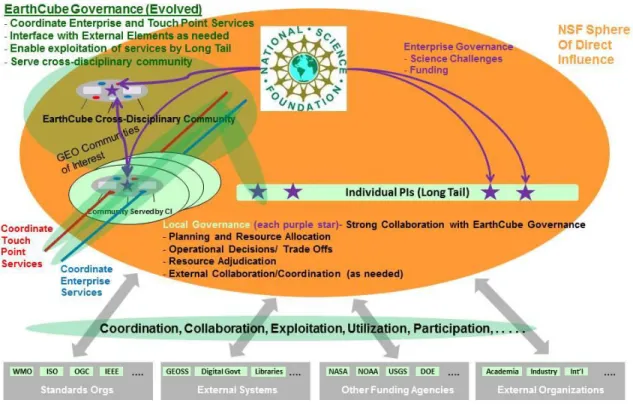
development, operation and maintenance of EarthCube-wide services and touchpoints (services that enable existing cyberinfrastructure components to interoperate effectively within EarthCube). The existing systems that are being interconnected would retain their local autonomy, continue to determine their own science priorities, and continue to serve their constituent communities. EarthCube would serve as an enabler of intra- and cross-disciplinary activity, identify gaps, and establish criteria for consistent with EarthCube infrastructure.
4. As part of the development of EarthCube-wide services and touch points, EarthCube governance would develop and maintain an effective enterprise-level architecture, proactively identify and manage enterprise-level risks, support solicitations for risk reduction prototypes, provide a community forum, and support solicitations for cross-domain testbeds.
5. As it matures, EarthCube will become responsible for discovering and encouraging the development of a set of domain science priorities with the goal of creating new cross-disciplinary research communities within EarthCube and between EarthCube and external programs.
6. EarthCube will function principally as a community service provider, not a competitor to infrastructure produced by individuals, organizations, institutions or consortiums. This list is a living document, open for community editing and comment here:
https://docs.google.com/document/d/1OqDMwRndYSt8Tx2noJbJWizeHDQ9ssNAdoFnILg_90k/edit
DEFINING EARTHCUBE AND EARTHCUBE’S SCOPE
Key questions related to all developments across the EarthCube community are: What is EarthCube and what is its scope? And, given these questions, what is the scope of EarthCube governance? While we do not present definitive answers to these questions, we do explore definitions of EarthCube and EarthCube’s scope, focusing on EarthCube within national and international cyberinfrastructure, and we introduce several emerging governance concepts brought forth by EarthCube community members that informed this discussion.
What is EarthCube?
We recognize that NSF’s definition of EarthCube has been subject to a wide variety of interpretations, including the ideas that EarthCube is:
1. An approach to respond to daunting science and cyberinfrastructure challenges 2. A knowledge management system
14 3. An architectural framework
4. A process 5. An outcome
6. An integrated system that builds on CI investments of the past two decades 7. A cyberinfrastructure
8. An integrated set of services 9. An architectural framework
10.Integrated set of solutions and best practices 11.Environment for adopting new approaches
12.Environment for human-centric interoperability of data and information 13.New modes of learning and training
Although EarthCube is still in the process of being defined, we believe it is possible to take concrete steps in moving EarthCube governance forward. In fact, the goal of the initial EarthCube
Governance Framework presented in this document and the concurrent community engagement program is to further refine community requirements for EarthCube, thereby helping to give EarthCube more definition.
What is EarthCube’s Scope?
We also recognize that EarthCube is yet a nascent activity within a rapidly growing, diverse, and wide-ranging global environment that is moving forward without, in many cases, even awareness of EarthCube. EarthCube is a significant but still modest prototype for the NSF Cyberinfrastructure 21st Century initiative (CIF21), which itself is but the contributions of one research agency in the federal government. Outside of EarthCube there are an untold number of people, programs, institutions, and organizations building and running systems and networks that make up the emerging cyberinfrastructure. These range from individual data sets and software applications to national and international cyberinfrastructure systems. Many of the contributors to
cyberinfrastructure do not yet recognize their roles in the larger picture.
One of the debates throughout the development of this Governance Framework document focused on the role of infrastructure in EarthCube, and whether or not EarthCube would be responsible for building and maintaining infrastructure, or concentrate on coordinating existing and emergent infrastructure instead. Participants came to the conclusion that EarthCube would primarily
facilitate, support, and coordinate, not compete with existing infrastructure, while leaving open the potential for building of new infrastructure if necessary (running the EarthCube website, for example, or other services the EarthCube community decides are better carried out centrally). In a facilitating role, EarthCube might for instance, identify key elements of CI that are critical for the initiative to advance, such as the Interoperability Institute proposed by the EarthCube Cross Domain Work Group. In that case, proponents of such an effort could prepare a funding proposal based on the criteria and standards determined as contributing to EarthCube success. An
endorsement by the EarthCube community (or office) of the need for such infrastructure and its consistence with EarthCube principles and functions, could be valuable or even critical to a proposal being funded. Therefore it is important to be aware of and catalogue existing cyberinfrastructures.
15 Emerging Governance Concepts for EarthCube
Finally, we present three emerging governance concepts, brought forward by stakeholders in the growing EarthCube community, which influenced our thought process in creating this document, and are related to determining the scope of EarthCube. These concepts are not exhaustive, however, and as a wider spectrum of individuals and organizations are engaged in EarthCube, a plethora of potential governance concepts is likely to emerge. Although it will eventually be necessary to decide on a structure for EarthCube governance, we concluded that it is premature at this time to make any final decisions, given that only a sliver of the potential EarthCube community has been engaged thus far.
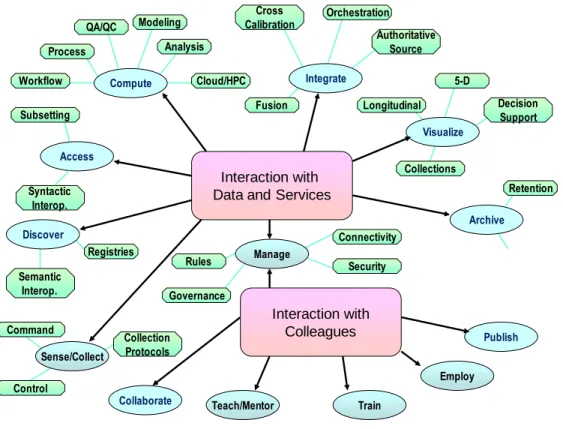
1. Domain Interoperability: This perspective, brought forth in the EarthCube Cross-Domain Interoperability Concept Team Roadmap, defines the scope of EarthCube as cross-domain integration of cross-domain systems and research sites. Although these cross-domain systems and research sites maintain local autonomy in the way they govern themselves, they are linked to EarthCube through cross-domain integration mechanisms, such as social
networking, EarthCube-wide governance policies and agreements, brokering services, and management of standards and identifiers, among many others (see Figure 5).
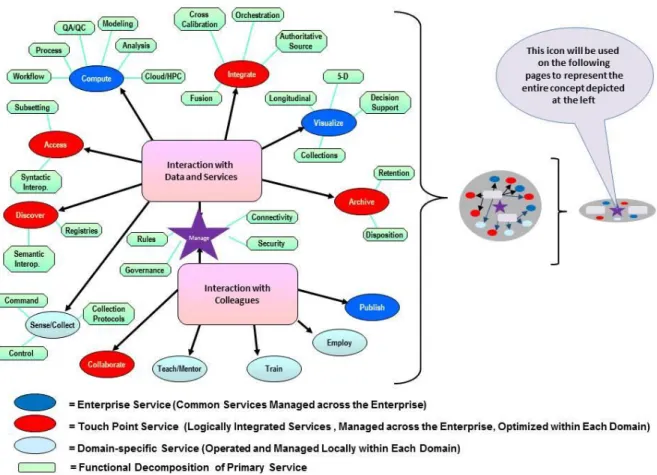
2. Three Tiers of Governance: Enterprise-Level, Touchpoints, Domain-Specific: This perspective was brought forth by Carroll Hood of the EarthCube Governance Steering Committee and categorizes EarthCube governance into three tiers:
a. Enterprise-Level: EarthCube-wide governance functions (that often exist outside of the EarthCube community as core elements of cyberinfrastructure).
b. Touchpoints: Governance functions that connect domains to EarthCube and ensure they interoperate effectively, but that are locally optimized to each entity.
c. Domain-Specific: Governance functions that are unique to a particular domain and are maintained and operated autonomously within that domain (see Figure 9). 3. EarthCube Concept Award Principal Investigator Reference Architecture: This perspective
was introduced by the EarthCube Brokering Concept Team and later modified during a Concept Award Principal Investigator meeting. Current interactions within science domain infrastructures use established catalogs, semantics, data access mechanisms, information models and policies. These interactions are facilitated through the use of brokers, which then mediate between community resources and users (see Figure 14).
DEFINING GOVERNANCE
Based on our initial community engagement, we’ve realized there are a number of definitions regarding governance. Governance of EarthCube will have to take in account all of the
interpretations of governance brought forward by EarthCube stakeholders, in particular as additional individuals are brought into the EarthCube community. In order to clarify a broader interpretation of governance, we present several definitions of governance encountered during the governance research review:
16 1. “Governancerefers to the processes, structure and organizational elements that determine,
within an organization or system of organizations, how power is exercised, how
stakeholders have their say, how decisions are made, and how decision makers are held accountable.”3
2. IT governance “specifies the decision rights and accountability framework to encourage desirable behavior in using IT. IT governance is not about making specific IT
decisions−management does that−but rather determines who systematically makes and contributes to those decisions.”4
3. Governance “provides the structure for determining organizational objectives and monitoring performance to ensure that objectives are attained.”5
4. A “governance model describes the roles that project participants can take on and the process for decision making within the project. In addition, it describes the ground rules for participation in the project and the processes for communicating and sharing within the project team and community.”6
5. Governance “aligns an organization’s practices and procedures with its goals, purposes, and values. Definitions vary, but in general governance involves overseeing, steering, and articulating organizational norms and processes (as opposed to managerial activities such as detailed planning and allocation of effort). Styles of governance range from authoritarian to communalist to anarchical, each with advantages and drawbacks.”7
We also present several governance models currently in use to gather input and make decisions within organizations, non-profits, business enterprises, and other groups. These include:
1. Benevolent Dictatorship: benevolent dictator 2. Business monarchy: top managers
3. IT monarchy: IT specialists
4. Feudal: each unit makes independent decisions
5. Federal: combination of corporate center and business units with or without IT people involved
6. IT duopoly: IT group and one other group (ex: top management or business unit leaders) 7. Anarchy: isolated individual or small group decision making
8. Meritocracy: distributed control awarded based on contributions to the project.
A further analysis of governance and governance models is presented in the Governance Roadmap or in Section 2 of this document.
3 Allison et al., “EarthCube Governance Roadmap,” 5. 4 Weill and Ross, IT Governance, 2.
5 Organization for Economic Cooperation and Development, OECD Principles of Corporate Governance quoted in Weill and Ross, IT Governance, 4-5
6 Ross Gardler and Gabriel Hanganu, “Governance Models.” 7 EarthSystem Commodity Governance Project, “Governance.”
17
COMMUNITY BUILDING AND ENGAGEMENT PROGRAM
We’ve developed an aggressive community engagement plan to vet the recommendations presented in this Governance Framework document with the broader scientific and IT communities, including: Atmospheric Scientists, Geoscientists, Ocean Scientists, Computer Scientists, Software Developers, Information and Communications Technologies Standards Communities, Business and Industry, Federal and State Governments and Decision-Makers, and International Partners. As we engage the broader cross-spectrum of EarthCube stakeholders, the Governance Framework is likely to change. We plan to implement our community engagement plan throughout the second half of 2012, and present the findings to NSF and the greater EarthCube community throughout the process with a report released in 2013. In this way, the body that implements Steps 3 and 4 of the Governance Roadmap may build on the community engagement program and Governance Framework that we recommend.
The overall community engagement strategy we plan to implement is conceptualized into three iterative, often organic phases: 1) Generating actionable intelligence, 2) Messaging, and 3) Engagement. Goals of this iterative community feedback process are to:
1. Vet the initial governance functions list and guiding principles presented in this document 2. Obtain website functionality and user requirements (user-centered design) for online
collaboration
3. Engage individuals and organizations not yet involved in EarthCube 4. Maintain momentum gained from the June 2012 NSF charrette 5. Identify gaps and overlaps in the existing EarthCube community
6. Provide for community engagement to minimize risk and ensure that EarthCube will be of use to the broader geoscience community.
Engagement activities will be focused on the broad spectrum of EarthCube participants including geo, atmosphere, ocean, computer and information sciences communities, software developers, standards bodies, IT experts, private industry, government agencies, and the international community.
18
COMMUNITY BUILDING AND ENGAGEMENT WORK PLAN
Our community engagement program will be an iterative process. Many activities will be taking place in concurrently. Each element will be incorporated into this Framework document as feedback is received. The complete work plan is presented in Section 5.0 of this document.
PART 1: GENERATE ACTIONABLE INTELLIGENCE
1. Leverage the EarthCube Stakeholder Alignment Survey to identify gaps in the current EarthCube stakeholders, if any.
2. Leverage the EarthCube Stakeholder Alignment Survey to gather community requirements on EarthCube governance
3. Create an EarthCube network map of EarthCube stakeholders 4. Develop EarthCube stakeholder profiles
PART 2: DEVELOP A MESSAGING STRATEGY
1. Determine EarthCube messaging strategies tuned to different stakeholder groups identified in Part 1.
2. Create marketing material to explain the EarthCube vision and introduce governance 3. Work with EarthCube Working Groups and Concept Teams to create short introductions to
their groups, to be included in EarthCube marketing materials 4. Use online forums to market EarthCube
5. Identify community champions
6. Publish articles in scholarly journals and trade publications
PART 3: ENGAGE EARTHCUBE STAKEHOLDERS
1. Engage EarthCube stakeholders via social media2. Engage EarthCube stakeholders via virtual meetings and workshops 3. Engage via in-person meetings and workshops
4. Gather EarthCube website requirements.
PART 4: ANALYSIS AND SYNTHESIS
1. Analyze and synthesize all input gathered from community engagement activities. 2. Incorporate this information into an updated Governance Framework document, to be
19
SECTION 1.0: DEVELOPING THE INITIAL FRAMEWORK
1.1 INTRODUCTION
Introducing EarthCubeEarthCube, launched by the National Science Foundation (NSF) in July 2011, is envisioned to transform the conduct of research through the development of community-guided
cyberinfrastructure for the Geosciences, in effect, a prototype for the NSF Cyberinfrastructure for the 21st Century (CIF21). EarthCube is both a process and an outcome, aimed to create a
networked, knowledge management system of systems and infrastructure that integrates all Earth system and human dimensions data in an open, transparent, and inclusive manner. In order to achieve this vision, EarthCube requires broad community participation in concept, framework, and implementation and must not be hindered by rigid preconceptions. If successful, EarthCube may be a prototype for deployment across other domain sciences. EarthCube was highlighted in the White House Office of Science and Technology Policy rollout of the "Big Data" initiative.
During the spring of 2012, NSF merged several governance-related EarthCube Expressions of Interest into a single Governance Working Group, led by the Governance Steering Committee, with connections to a network forum of individuals and organizations known as the Governance Forum. The work of this group culminated in a Governance Roadmap delivered to the NSF-sponsored June charrette with an aggressive timetable to define and implement a governance structure to enable the elements of EarthCube to become operational expeditiously. This governance framework document represents the implementation of initial recommendations laid out in the Governance Roadmap.
Defining Governance
Based on our initial community engagement, we’ve realized there are a number of definitions regarding governance. Even among the 250+ June EarthCube charrette virtual and in-person participants, there were several different interpretations of governance and expectations of what the Governance Roadmap would propose. For example, some participants assumed governance referred to consensus-based decision-making processes and committees, while others thought of top-down management strategies, while others interpreted governance to refer to standards. Additionally, each of the Working Groups and Concept Teams focused on different components of governance, as they relate to their specific topic of interest. For example, the Data Access,
Discovery and Management Roadmap focuses on governance related to data, while the Workflows Roadmap focuses on workflow-specific governance. While all of these interpretations are correct, governance in general is much more comprehensive, and governance of EarthCube will have to take in account all of these interpretations, and many more, as additional individuals are brought into
20 the EarthCube community. For a more comprehensive review of governance, please refer Section 2.2 of this document, or to the Governance Roadmap.8
Writing the Governance Roadmap
A key question the Governance Working Group struggled with while writing the Governance Roadmap is whether something as complex as EarthCube can be governed by one single model or by one encompassing entity? Six months of research on historical infrastructure case studies, governance theory and models, in addition to community feedback and engagement prior to writing the Roadmap, provided a venue to begin to tackle this challenging and complex question. Governance Roadmap, we learned that many large-scale, complex infrastructures, including the Internet, have no single, overarching, central control, administration, or management. No national infrastructure that we examined is governed by a single entity, let alone a single governance archetype. Although the Governance Roadmap does not provide answer to this debate, it did provide a set of action items to forge a viable path forward in crafting an initial governance framework for EarthCube.
In addition, the National Science Foundation has not historically defined a particular governing model in their solicitations. Instead, they list the functions and goals that need to be met and invite proposers to outline the organizational and management structures and procedures ("governance") best suited to achieve success. The effectiveness of those criteria is a key element in proposal evaluation.
Governance Framework Goals
The goal of writing and vetting the governance functions, guiding principles and recommendations (referred to as the ‘Governance Framework’ of ‘Framework’ in this document) across a broad spectrum of EarthCube stakeholders is to help ensure the timely and successful conceptualization and operation of EarthCube. The Framework, and corresponding community outreach, will maximize engagement of the broader EarthCube community, which in turn will minimize the risks that the community will not adopt EarthCube in its development and final states. The target community includes academia, government, and the private-sector, both nationally and internationally.
Based on community feedback to-date, we compiled and synthesized system-wide governance requirements to draft an initial set of EarthCube governance recommendations, governance functions and guiding principles. These recommendations, functions and guiding principles form the basis of an initial Governance Framework that will be revised and updated as part of an aggressive community outreach and engagement program. This is a living document and we plan to update the Governance Framework throughout this process.
21
1.2 FORMING THE GOVERNANCE WORKING GROUP
The EarthCube Governance Working Group was formed (by merging proposes of governance-related EarthCube Expressions of Interest) in March 2012 with the purpose of engaging the
geosciences community and conducting the background research needed to provide the scaffolding for a roadmap on how to implement an initial governance framework for EarthCube. The Group is composed of the Governance Steering Committee and a larger Governance Forum. Members of the Steering Committee consist of active members from the geo, atmosphere, ocean, computer and information sciences community, in addition to industry, international, and government agency partners.
The Governance Forum is composed of individuals and organizations forming a larger, broader constituency that had demonstrated their interest and participation in governance issues, and a representative from each of the EarthCube Community Groups and Concept Award Teams. The latter served as liaisons between the more technically focused groups and the Governance Working Group to help ensure unique governance issues and needs from each segment of EarthCube were identified and addressed. One of the goals of organizing the Forum was to ensure representation from each of the Geoscience and closely related domains (e.g. Earth, Atmospheres, Ocean,
Environment and Ecology), IT sectors, academia, agencies, and industry, involved in determining agendas, setting goals, and having an active role in formulating the roadmap.9
A series of virtual meetings and workshops were hosted by the Governance Steering Committee with different working groups and stakeholders, covering a range of topics, with the aim of gathering governance feedback. These workshops began to tackle the complexity, scope, and diversity of issues regarding governance of EarthCube, and were exceptional in providing the initial community feedback and basis required to author the Governance Roadmap. These workshops, in addition to a substantial background research review on governance, formed the foundation of the Governance Roadmap.
1.3 WRITING THE GOVERNANCE ROADMAP
As we were writing the Governance Roadmap, which was released in June 2012, we noted an ongoing discussion among EarthCube participants regarding whether EarthCube governance is that of a single integrated entity, or a system of governance of separate, but collective entities.
Regardless, the Roadmap argues that EarthCube governance is a process that is responsible for developing infrastructure that becomes ubiquitous and effectively invisible to users by building on existing and emerging cyberinfrastructure components. Thus, research on past infrastructure development was a key component of the Roadmap, because past infrastructure development offers several insights and case studies into analogies of where EarthCube has been, where it is going, and what governance can do immediately to move the process along.
9 For a complete list of EarthCube Governance Forum Members, see Appendix 3: Process (Expanded) of “EarthCube Governance Roadmap: Documentation, Research, and Recommendations, Version 2.0,” August, 2012
22 The Roadmap also explored the various governance models, or archetypes, varying from
centralized (“benevolent dictatorship”), to more decentralized (federalist system), to most decentralized (“crowd-sourcing” or “anarchy”), each with its own pros and cons depending on meeting different governing functions. The Roadmap then employed case studies to evaluate the governance framework of existing domain science, IT, federated, and large-scale organizations. The Roadmap did not recommend any particular governance model or framework for EarthCube, but it did outline four action items with target dates to carry out the community engagement and requirements-gathering processes necessary to implement an initial governance framework for EarthCube:
1. August 31, 2012: Determine the appropriate Governance Framework to meet community needs and NSF goals for successful cyberinfrastructure.
2. Beginning of 2013: Determine the stakeholder community and identify initial governance committee for engaging the community for input on the governance framework developed in Step 1.
3. Date TBD: Establish Terms of Reference for EarthCube Governance.
4. Date TBD: Implement the suggested Terms of Reference for EarthCube Governance. Discussion of the Working Group and Concept Team roadmaps at the June 2012 NSF EarthCube charrette demonstrated that within the EarthCube community, there are many differences in understanding about what governance is, and its potential role in EarthCube. While the Governance Group came to the charrette asking what other groups needed in terms of governance, many of the other groups assumed a governance framework, or even a specific governance model, had already been chosen. Additionally, most groups envisioned governance to primarily consist of committees and consensus-based decision-making processes.
Community input and background research indicate governance is much more comprehensive, highlighting the need for community-wide dialogue about what governance is and what it may mean for EarthCube. These differences in understanding of governance make clear the importance of conducting comprehensive stakeholder engagement to validate and enhance the
recommendations we make.
Additionally, numerous interactions with EarthCube Working Groups and Concept Teams indicate they are waiting on guidance from an enterprise-level governance body. When questioned about what governance means and what requirements are needed from such a body, however,
participants are largely unsure. This indicates that additional outreach, discussion, and education to the key stakeholder communities of EarthCube are necessary, while concurrently engaging the long-tail and domain scientists to further gauge the community needs and wants regarding EarthCube governance.
23
1.4 DEVELOPING THE GOVERNANCE FRAMEWORK
The Governance Roadmap anticipated that a successor group to the ad hoc Governance Steering Committee would be empowered by the EarthCube community and NSF to continue on after the charrette. That did not explicitly occur; rather there was a broadly accepted presumption that the existing group had achieved its goals and had the momentum, willingness, and vision to take the plan forward. Therefore, the Governance Steering Committee is moving forward with
implementing the Governance Roadmap. In an effort to be inclusive, we have recently identified, and confirmed, additional Steering Committee members who encompass key constituents in EarthCube: industry, government, and academia.
We are in the process of carrying out Tasks 1 and 2 of the EarthCube Governance Roadmap: 1) Determine the appropriate Governance Framework to meet community needs and NSF goals for successful cyberinfrastructure; and 2) Determine the stakeholder community and identify initial governance committee for engaging the community for input on the governance framework developed in Step 1. Upon closer consideration, and based on community feedback, we believe the Terms of Reference and implementation of EarthCube Governance (Tasks 3 and 4) should be performed over an extended period of time to lower the risk of acting prematurely, or without adequate community commitment. Tasks 3 and 4 will likely be implemented by a NSF initial governance award, if NSF chooses to make such an award in the future.
An initial draft of the Governance Roadmap10 with these four recommendations was posted to the EarthCube Governance Ning site for public comment and review prior to the June EarthCube charrette Although we polished and finalized the Governance Roadmap by releasing versions 1.111 and 2.0,12, instead of making substantive changes to the Roadmap, we created additional documents to provide the foundation for our Governance Framework recommendations.
We started by reviewing the draft roadmaps produced by the other EarthCube Working Groups and Concept Teams, with a focus on their goals, governance needs and wants, and their proposed internal governance framework (governance within their specific area of interest). Some of these governance wants and needs were stated explicitly; others were implicit. For more information about the other EarthCube Roadmaps, please see Appendix 2: EarthCube Working Group and Concept Team Roadmap Summaries, and Appendix 3: EarthCube Working Group and Concept Team Goals and Governance Needs.
Our goal was to gather governance use cases to evaluate potential governance models for EarthCube (see “Defining EarthCube below for more information on governance models). Upon
10 EarthCube Governance Roadmap Version 1.0 is accessible online at:
http://earthcube.ning.com/group/governance/forum/topics/roadmap-draft-june-7th 11EarthCube Governance Roadmap Version 1.1 is accessible online at:
http://earthcube.ning.com/group/governance/forum/topics/earthcube-governance-roadmap-version-1-1 12 EarthCube Governance Roadmap Version 2.0 is accessible online at:
24 attempting to map different governance models to governance use cases during the July 17th
EarthCube Governance Workshop at ESIP, we realized this approach would not give us the answers we needed in order to develop an initial governance framework for EarthCube. We thought that the governance use cases would help us identify the most appropriate governance model, or series of governance models, to carry out all the different components that will likely fall under EarthCube governance.
We came to the conclusion, however, that recommending an initial governance model, or series of models, for EarthCube was too prescriptive at this point because EarthCube and EarthCube stakeholders are still being defined. Without a definition of what EarthCube will be, and without a broad picture of what stakeholders need it to do, it makes no sense to recommend a specific governance model.
In addition, we recognized that major projects funded by NSF typically have defined their
management, organization, and procedures in their funding proposals, rather than NSF mandating them in the funding solicitations. Solicitations usually outline the functions and goals required and invite proposals to offer a governing model best suited to achieve the desired results.
Therefore we decided to take a different approach in developing a governance framework for EarthCube, focused on identifying the initial functions EarthCube governance needs to carry out, along with principles to guide the implementation of these functions, and a series of general governance recommendations for EarthCube.
First, however, we needed to consider several important questions: 1)What is EarthCube? 2) What is governance? And 3)What is EarthCube’s potential scope?
25
SECTION 2.0: KEY CONCEPTS REGARDING EARTHCUBE
AND GOVERNANCE
Much discussion has taken place regarding the definition of EarthCube itself, the definition of governance, and the scope of EarthCube. These are key questions that must be addressed throughout the EarthCube development process. This section presents various definitions of EarthCube and governance, explores EarthCube’s place in national and international
cyberinfrastructure, and offers three emerging concepts of EarthCube governance, brought forth by participants in the emerging EarthCube community.
2.1 DEFINING EARTHCUBE
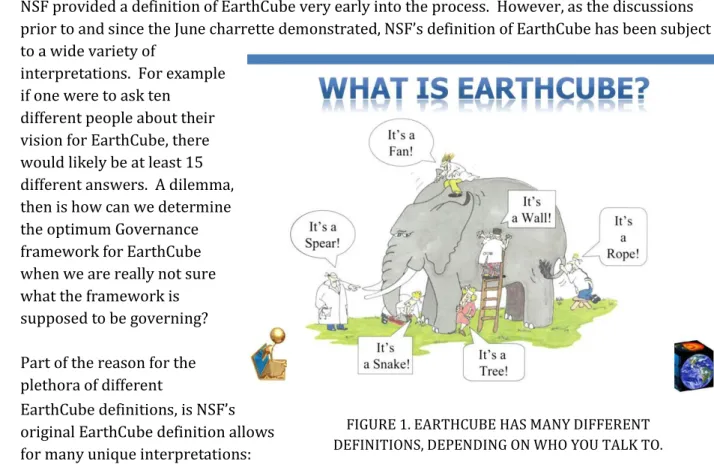
NSF provided a definition of EarthCube very early into the process. However, as the discussions prior to and since the June charrette demonstrated, NSF’s definition of EarthCube has been subject to a wide variety of
interpretations. For example if one were to ask ten
different people about their vision for EarthCube, there would likely be at least 15 different answers. A dilemma, then is how can we determine the optimum Governance framework for EarthCube when we are really not sure what the framework is supposed to be governing? Part of the reason for the plethora of different
EarthCube definitions, is NSF’s original EarthCube definition allows for many unique interpretations:
“The goal of EarthCube is to create a knowledge management system and infrastructure that integrates all geosciences data in an open, transparent and inclusive manner. No integrated framework currently exists to meet the information management challenges implicit in the GEO Vision call to action. EarthCube is this goal, as well as a process that will require years of development, investment, and community engagement. The decade-long vision for EarthCube is the convergence towards an integrated system to access, analyze and share information that is used by the entire geosciences community. This convergence can only occur through community dialogue and collaboration. NSF will facilitate this convergence through currently planned and future activities.
FIGURE 1. EARTHCUBE HAS MANY DIFFERENT DEFINITIONS, DEPENDING ON WHO YOU TALK TO.
26 Realizing EarthCube requires building a community derived and governed
cyberinfrastructure that can be easily adopted by geosciences researchers and educators. It will require the introduction of new approaches and technologies and/or combining productive tools and solutions in different ways. EarthCube will promote integration, flexibility, inclusiveness, and easy adoption by connecting the several layers of data and information management, from the resource layer with access to data and information, to the data curation and management layer, and to the overarching interface layer that exposes data and information to knowledge creation through data-enabled science. Inter-workability of data and information will be a characteristic of EarthCube, which implies interoperability and sharing, but with a human-centric focus that allows researchers and educators to easily work with multiply layers of technology and information. EarthCube will create new modes of learning and training that result in a more informed public and policy-makers while simultaneously broadening participation in the creation of a sustainable Earth system. EarthCube will be supported by the substantial cyberinfrastructure investments, including databases, software services and community facilities that have been created by the geosciences community over the past two decades. The community must build on this existing foundation of cyberinfrastructure and community knowledge to create an integrated set of services serving the entire geosciences community.
The success of EarthCube will depend in part on identification of commonalities of solutions and best practices that reside within our current infrastructure and strategic adoption of new technologies and approaches external to the community’s infrastructure. All geosciences cyberinfrastructure will evolve over time to accommodate changing user needs and emerging technologies and services. Results from the community-driven EarthCube effort will provide an architectural framework to guide the integration of efforts as well as the evolution of existing cyberinfrastructure.”13
Based on this definition, one can conclude that EarthCube is
1. An approach to respond to daunting science and cyberinfrastructure challenges 2. A knowledge management system
3. An architectural framework 4. A process
5. An outcome
6. An integrated system that builds on CI investments of the past two decades 7. A cyberinfrastructure
8. An integrated set of services 9. An architectural framework
10.Integrated set of solutions and best practices 11.Environment for adopting new approaches
12.Environment for human-centric interoperability of data and information 13.New modes of learning and training
13 National Science Foundation, “EarthCube—Building the Cyberinfrastructure to Better Understand Our Complex and Changing Planet,” 2011.
27 Clearly, these concepts are all interrelated, but it is easy to see why so many interpretations of the EarthCube vision exist simultaneously. One could argue that EarthCube incorporates all ten of the definitions above. Although EarthCube is still in the process of being defined, it is still possible to take concrete steps in moving EarthCube governance forward. In fact, the goal of the initial EarthCube Governance Framework presented in this document and the concurrent community engagement program is to further refine community requirements for EarthCube, thereby helping to give EarthCube slightly more definition.
2.2 DEFINING GOVERNANCE
Based on our initial community engagement, we’ve realized there are a number of definitions regarding governance. For example, among the 250+ June EarthCube charrette virtual and in-person participants, there were several different interpretations of governance. Some participants assumed governance referred to consensus-based decision-making processes and committees, while others thought of top-down management strategies, while others interpreted governance to refer to standards. Additionally, each of the Working Groups and Concept Teams focused on different components of governance, as they relate to their specific topic of interest. For example, the Data Access, Discovery and Management Roadmap focused on governance related to data, while the Workflows Roadmap focused on workflow-specific governance.
While all of these interpretations are correct, governance as we address it, is much more comprehensive, and governance of EarthCube will have to take in account all of these interpretations, and many more, as additional individuals are brought into the EarthCube community. In order to clarify a broader interpretation of governance, we present the following definitions:
1. “Governancerefers to the processes, structure and organizational elements that determine, within an organization or system of organizations, how power is exercised, how
stakeholders have their say, how decisions are made, and how decision makers are held accountable.”14
2. IT governance “specifies the decision rights and accountability framework to encourage desirable behavior in using IT. IT governance is not about making specific IT
decisions−management does that−but rather determines who systematically makes and contributes to those decisions.”15
3. Governance “provides the structure for determining organizational objectives and monitoring performance to ensure that objectives are attained.”16
4. A “governance model describes the roles that project participants can take on and the process for decision making within the project. In addition, it describes the ground rules for
14 Allison et al., “EarthCube Governance Roadmap,” 5. 15 Weill and Ross, IT Governance, 2.
16 Organization for Economic Cooperation and Development, OECD Principles of Corporate Governance quoted in Weill and Ross, IT Governance, 4-5
28 participation in the project and the processes for communicating and sharing within the project team and community.”17
5. Governance “aligns an organization’s practices and procedures with its goals, purposes, and values. Definitions vary, but in general governance involves overseeing, steering, and articulating organizational norms and processes (as opposed to managerial activities such as detailed planning and allocation of effort). Styles of governance range from authoritarian to communalist to anarchical, each with advantages and drawbacks.”18
The styles of governance mentioned in governance definition # 5 refer to the various governance models that determine who makes decisions and who has input within an organization. For more complex organizations, more than one governance model may be used to involve different people in making different types of decisions. For example, within any given organization or enterprise, IT-related decisions might be made in a different way and by different people than decisions regarding strategic direction. The most appropriate governance model, or series of model, for any given organization depends on that organization’s overall goals. The governance models below describe different means of making decisions (for example, in the Benevolent Dictatorship model, a lone figure makes decisions much in the same way as a benevolent dictator would do within a dictatorship):
1. Benevolent Dictatorship: benevolent dictator 2. Business monarchy: top managers
3. IT monarchy: IT specialists
4. Feudal: each unit makes independent decisions
5. Federal: combination of corporate center and business units with or without IT people involved
6. IT duopoly: IT group and one other group (ex: top management or business unit leaders)
7. Anarchy: isolated individual or small group decision making
8. Meritocracy: distributed control awarded based on contributions to the project. The governance models mentioned above determine what decisions need to be made, who makes them, and how they will be made and monitored.19 The Governance Ontology from the Earth System Commodity Governance Project breaks down these types of decisions:20
1. How do you manage what you do? Do you have any management bodies (e.g., committees, director, etc.)?
a. Strategic level
i. What is their purpose?
17 Ross Gardler and Gabriel Hanganu, “Governance Models.” 18 EarthSystem Commodity Governance Project, “Governance.” 19Weill and Ross, IT Governance, 2-3.
20 These questions are adapted from Earth System Commodity Governance, http://earthsystemcog.org/projects/cog/governance_object.
29 1. Resource allocation, strategic direction, outreach, priorities, fund
raising, etc.? ii. How many participants? iii. How often do they meet? b. Operational level
i. What is their purpose?
1. Design, review, task prioritization, testing, outreach, etc.? ii. How many participants?
iii. How often do they meet? 2. Leadership roles
a. Strategic level
i. Name and description of roles
ii. How do you decide how leadership roles are filled? b. Operational level
i. Name and description of roles
ii. Do you decide how leadership roles are filled? 3. Governance Processes
a. How do you prioritize tasks?
i. Who is engaged in prioritization? ii. How frequently does it happen? b. How do you communicate?
i. What type?
1. Telecom, mailing list, wikis, etc. ii. Purpose?
iii. Frequency? iv. Is it open?
v. Mechanisms?
c. What process do you use to identify requirements? d. Dispute adjudication
i. How do you resolve disputes? e. Policies?
i. Links to policies
f. Do you have a charter/by-laws/charter? i. If so, can it be attached?
4. Are there other aspects of management and organization that should be included that need to be considered for a governance model?
These governance models are explored in great detail in the Governance Roadmap.21 While it is important to be familiar with the variety of governance models available to make decisions within EarthCube, determining what governance models are most appropriate for EarthCube is not the purpose of this Framework document.
30 Instead, we chose not to recommend any specific governance model, or set of models, for
EarthCube, because it is too early in the process and not necessarily appropriate to make this recommendation. Instead, whichever body or group responsible for carrying out the initial governance functions will have to define the governance model(s) they believe is (are) most effective way for carrying EarthCube forward. It will be up to the organizations to identify what governance models they feel would be most effective to carry out functions based on guiding principles, while also meeting the goals of the community and NSF. This approach is consistent with how organizations have traditionally proposed running large organizations to NSF. It leaves open the possibility for a variety of plausible governing models for EarthCube, such as those described above.
2.3 DETERMINING EARTHCUBE’S SCOPE
EarthCube is just one piece within global cyberinfrastructure. It is a significant but still modest prototype for the NSF Cyberinfrastructure for the 21st Century initiative (CIF21) which itself is but the contributions of one research agency in the federal government. Outside of EarthCube there are an untold number of people, programs, institutions, and organizations building and running things that make up the emerging cyberinfrastructure. These range from individual data sets and software applications to national and international cyberinfrastructure systems. Many of the contributors to cyberinfrastructure do not yet recognize their roles in the larger picture. Although the goal of EarthCube, as stated by NSF, is to “transform the conduct of research by supporting the development of community-guided cyberinfrastructure to integrate data and information for knowledge management across the Geosciences,”22 we recognize that EarthCube is yet a nascent activity within a rapidly growing, diverse, and wide-ranging global environment that is moving forward without in many cases even awareness of EarthCube.
One of the debates throughout the development of this Governance Framework document focused on the role of infrastructure in EarthCube, and whether or not EarthCube would be responsible for building and maintaining infrastructure, or concentrate on coordinating existing and emergent infrastructure instead. Participants came to the conclusion that EarthCube would primarily
facilitate, support, and coordinate, not compete with existing infrastructure, while leaving open the potential for building of new infrastructure if necessary (running the EarthCube website, for example, or other services the EarthCube community decides are better carried out centrally). In a facilitating role, EarthCube