Education Theses, Dissertations and Projects School of Education
2012
In the Flow: A Mixed-Methods Phenomenological
Study of Optimal Experience in Adolescent
Literacy
Susan E. MilesGardner-Webb University
Follow this and additional works at:http://digitalcommons.gardner-webb.edu/education_etd
Part of theSecondary Education and Teaching Commons
This Dissertation is brought to you for free and open access by the School of Education at Digital Commons @ Gardner-Webb University. It has been accepted for inclusion in Education Theses, Dissertations and Projects by an authorized administrator of Digital Commons @ Gardner-Webb University. For more information, please [email protected].
Recommended Citation
Miles, Susan E., "In the Flow: A Mixed-Methods Phenomenological Study of Optimal Experience in Adolescent Literacy" (2012).
by Susan E. Miles
A Dissertation Submitted to the Gardner-Webb School of Education in Partial Fulfillment of the Requirements
for the Degree of Doctor of Education
Gardner-Webb University 2012
ii
This dissertation was submitted by Susan E. Miles under the direction of the persons listed below. It was submitted to the Gardner-Webb University School of Education and approved in partial fulfillment of the requirements for the degree of Doctor of Education at Gardner-Webb University.
__________________________________ ________________________
Sydney Brown, Ph.D. Date
Committee Chair
_________________________________ ________________________
Jane King, Ed.D. Date
Committee Member
_________________________________ ________________________
Nancy Breard, Ph.D. Date
Committee Member
_________________________________ _________________________
Frances B. Burch, Ph.D. Date
iii Abstract
In the Flow: A Mixed-Methods Phenomenological Study of Optimal Experience in Adolescent Literacy. Miles, Susan, 2012: Dissertation, Gardner-Webb University, Flow/ Optimal Experience/Reading Engagement/Interest/Mirror Neurons
This study is concerned with the flow experience of students while involved in
independent reading. Based on Csikszentmihalyi’s theory of flow, this experience is one of total engagement to the point of immersion involving deep concentration; enjoyment; and a loss of a sense of time, place, and self.
This is a quan>Qual study, which began with a quantitative measurement to determine a criterion sampling, followed by the primary research method, a transcendental
phenomenology of flow during voluntary, independent reading. This primary research method was used due to the lack of research available on flow in the field of literacy for purposes of expansion on flow theory in this domain and a better understanding of the antecedents, indicators, and consequences of flow in reading. Quantitative methodology was utilized to obtain the criterion sampling through the Flow State Scale (FSS). This quantitative score was “qualitized” (Tashakkori & Teddlie, 1998, p. 126), which is to transform quantitative data into qualitative, in order to compare the results of the FSS with the qualitative results (meaning units) to provide complementarity, development, and trustworthiness.
Twenty-three high school freshmen students participated in this integrated mixed methods study. One adult likewise participated by taking the online FSS to illuminate some of the freshmen participants’ answers.
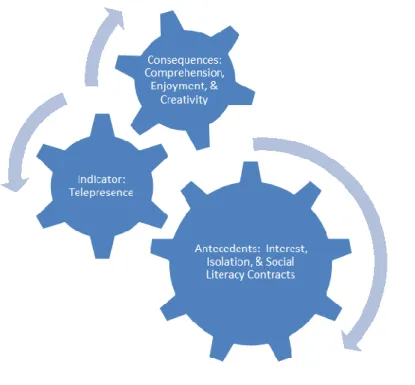
The study found three themes as antecedents of flow (interest, isolation, and social literacy contracts); one main theme indicating flow (telepresence) with four
subdimensions (vision, empathy, transformation of time, and concentration); and three themes (reading comprehension, enjoyment, and creativity) related to consequences.
iv
Table of Contents
Page
Chapter 1: Introduction ...1
Statement of the Problem ...1
Background of the Problem ...3
Topic ...9
Purpose ...9
Deficiencies in the Evidence ...9
Audience ...14
Definition of Terms ...15
Research Questions ...15
Situation of the Researcher in the Study ...16
Philosophical Rationale ...17
Chapter 2: Literature Review ...20
Overview ...20
Flow, a Potential Unifying Theme ...21
Student Engagement ...33
Interest ...34
Social Literacy Contracts ...37
Flow Theory’s Potential Future ...41
Research Questions ...41
Chapter 3: Methodology ...43
Data Collection ...51
Steps of Data Collection ...54
Instruments ...56 Data Analysis ...64 Trustworthiness Procedures ...64 Foreseen Challenges ...65 Anticipated Limitations ...66 Anticipated Outcomes ...67 Timeline ...68 Conclusion ...69 Chapter 4: Results ...70 Introduction ...70
Phase One: The Online Flow State Scale (modified FSS-2) ...71
Phase Two: Student Interviews ...81
Antecedents of Flow ...86
Telepresence, Indicator of Flow, and Subdimensions of Telepresence ...90
Consequences of Flow ...100
Trustworthiness Through Member and Peer Checking ...105
Summary ...107
Chapter 5: Discussion ...109
Overview ...109
Textural Description ...110
v
Metaphor ...111
Essence ...112
Conclusions ...112
Limitations ...117
Implications and Recommendations ...117
Summary ...119 References ...120 Appendices A Interview Protocol ...132 B Consent/Assent Form ...134 C FSS License Receipt ...137 D FSS Customization Receipt ...140 Tables 1 Levels of Flow (Guo, 2004) ...23
2 Massimini & Carli’s Eight-Channel Model of Flow ...30
3 The Nine Dimensions on the FSS-2 and Sample Items ...57
4 FSS-2 General Assessment by Dimension and Mean ...59
5 The Nine Dimensions on the IFS and Sample Items ...61
6 Codes for Table 7 ...72
7 Individual/Overall Dimension Means Compared With FSS-2 Means ...73
8 Means of the FSS-2 Dimensions Compared to the Modified FSS-2 ...74
9 Phase One: Qualitized Confirmation Codes of the Modified FSS-2 ...75
10 Phase Two: Holistic Profiles of the FSS-2 Confirming Flow Dimensions ...77
11 Qualitized Results of Data Integration ...79
12 Significant Statements Before Culling on Telepresence ...83
13 Culled Significant Statements on Interest ...87
14 Culled Significant Statements on Isolation ...89
15 Culled Significant Statements on Social Literacy Contracts ...90
16 Culled Significant Statements on Telepresence ...91
17 Culled Significant Statements on Vision ...93
18 Culled Significant Statements on Empathy ...96
19 Culled Significant Statements on Transformation of Time ...98
20 Culled Significant Statements on Attention ...99
21 Culled Significant Statements on Comprehension ...101
22 Culled Significant Statements on Enjoyment ...103
23 Culled Significant Statements on Creativity ...105
Figures 1 Csikzentmihalyi’s Four-Channel Model of Flow ...29
2 Classic Conceptual Model of the Flow Experience ...42
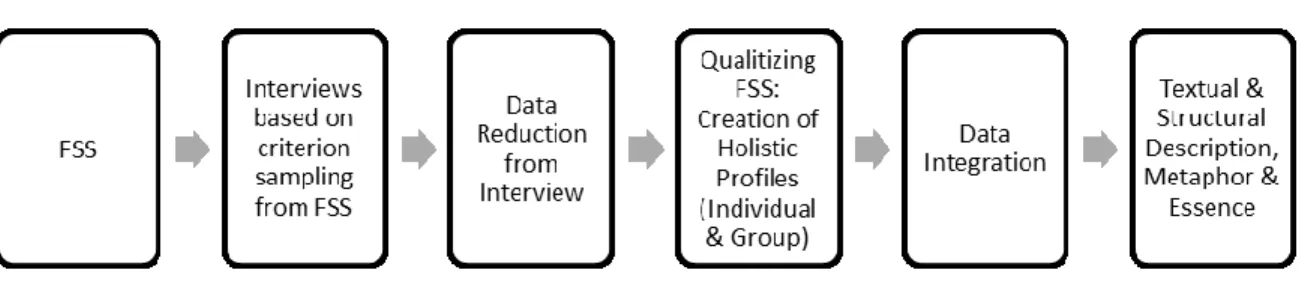
3 The Data Collection/Analysis Process of Flow ...51
4 Model of Flow in Reading ...109
Chapter 1: Introduction Statement of the Problem
The research problem. The problem studied was the application of the
psychological construct of flow theory to literacy, in particular to independent reading. Adolescent literacy is a serious concern in many high schools today. In fact, today’s lack of literacy “summon[s] the language of crisis” (National Council of the Teachers of English [NCTE], 2007, p. 1). According to recent National Assessment of Educational Proficiency (NAEP) results, proficiency in literacy for seniors in high school has dropped from 80% in 1992 to 73% in 2005 (NCTE, 2007). Not only are literacy levels declining from previous decades, but longitudinal research from 2002 to 2006 showed little to no progress being made between the eighth and twelfth grades in writing (NCTE, 2007). Furthermore, ACT scores revealed that less than half of high school graduates are college-ready in literacy (NCTE, 2007).
This lack of literacy is crucial because literacy, more than just a predictor of immediate academic success, has the long-term potential to create individual wealth and well-being as well as to contribute to the national economy and stability (Black, 2006). Moreover, the lack of literacy is disproportionately an ongoing issue among racial minorities and families of low socioeconomic status (NCTE, 2007), thus continuing the cycle of poverty and domination (Black, 2006). Students who fall behind in literacy in elementary school struggle to succeed in all or most subjects in high school (Chall, 1983). Chall (1983) further asserted that in elementary school, students learn to read; after that they must read to learn. This shift in instruction presents a further hindrance for those who have not yet become fluent in decoding and in constructing meaning from text. This lack of equity and access in literacy is an issue of social justice (Moje et al., 2004).
Flow theory might have potential to address this issue. Flow is a psychological concept developed by Mihaly Csikszentmihalyi (1997) and studied by many others, e.g., Samuel Whalen (1998), Jeanne Nakamura and Mihalyi Csikszentmihalyi (2005), and Kevin Rathunde (2003). It refers to the experience individuals subjectively undergo when totally engaged in an activity (Guo, 2004). Flow is described as a “peculiar dynamic state – the holistic sensation that people feel when they act with total involvement”
(Csikszentmihalyi, 1975, p. 36). Flow conceptualizes channeling mental and psychic energy into a focused mental state of concentration on a task at hand. Criteria for a task that could provide opportunity for flow are several-fold: appropriate level of difficulty (complex and challenging), appropriate skill set, clear-cut goals, immediate feedback from the task, and autonomy over actions taken (Csikszentmihalyi, 1990). If the task is balanced in difficulty with a student’s skill set, he/she will not enter entropy and experience boredom or anxiety, but flow. Signs of being in flow are intense
concentration, effortless involvement that takes one away from his/her surroundings, sense of control, unawareness of self, and telescoping or lengthening of time
(Csikszentmihalyi, 1990). The state of flow is often described as enjoyable, though because of the challenging nature of the task, it is not always described as pleasurable. Many who regularly experience flow are reported to say that the experience is addictive, extremely motivating, and intrinsically rewarding to the point that they want to repeat, or engage in, the same flow experience once more (Csikszentihalyi, 1990). Consequently, many researchers use the term optimal experience to reference the state of flow (Chen, 2000; Chen, Wigand, & Nilan, 1999; Csikszentmihalyi, 1990; Guo, 2004; Rathunde, 2003).
Background of the Problem
One possible contributing factor to low literacy skills is low student engagement in reading (NCTE, 2007). The root of this lack of engagement lies in the area of
motivation (Guthrie, 2001; Guthrie & Humenick, 2004). “Motivation can determine whether adolescents engage with or disengage from literacy learning” (NCTE, 2007, p. 4). The research policy statement on adolescent literacy goes on to say that unless students have engagement, their participation in literacy declines. The NCTE pinpoints another important factor tied to engagement, students’ self-efficacy. Vital to engagement in literacy is having continued successful literacy experiences. Lack of confidence and self-efficacy will cause them to disengage from reading (NCTE, 2007). Moreover, another aspect of engagement in literacy is to provide relevant and “meaningful connections” (NCTE, 2007, p. 4). Flow might have the potential to impact reading engagement, motivation, and satisfaction. One task before educators is to help readers find the match between interest, challenge, and skill level. Interestingly, these last two are criteria for flow to occur according to Csikszentmihalyi (1990) and the first criterion has been added recently to flow theory by Guo (2004).
Another potential factor related to the problem of low literacy skills might lie in book selection, tied once again to interest (Moje, 2007; Ross, 2001). Researchers who have formulated theories on motivation and engagement have cited interest as a key component, matched with skill and challenge (Csikszentmihalyi & Figurski, 1982; Gazzara, 2003). Csikszentmihalyi and Figurski’s (1982) study on flow and interest found that interest was a significant factor in positive affect and engagement, and that as choice increased, so did flow. Moreover, Guo’s (2004) study of engagement, or flow, in internet shopping specified interest as a significant factor. Utilizing the Flow State Scale (FSS),
developed by Jackson and Marsh (1996) and the Internet Flow Scale (IFS) in a Multitrait-Multimethod validity study, Guo (2004) measured playfulness and interest in relation to engagement and found that it had a direct impact on the balance of challenge and skill and an indirect impact on flow. Huang’s (2003) study found similar results. In fact, in both studies, interest was positively correlated with intrinsic motivation and flow, a stronger factor in flow in leisure settings than flow in work settings. In the domain of literacy, successful reading coaches emphasize the interest level of a book over its classic quality as a key to engagement (Moje, 2007; NCTE, 2007; Ross, 2001).
Finally, poor literacy support in the home context could be another probable factor in low literacy levels. Adolescents become engaged in literacy when they understand the social contexts and purposes of literacy (NCTE, 2007). Deborah Rowe (2008) researched students who excelled in literacy in a longitudinal, ethnographic study of social literacy contracts. She began the study while the participants were in preschool and identified nine literacy contracts established by ages two and three, if reading were a socially transactive experience in the home environment (Rowe, 2008). These students associated reading with positive affect and engagement. On the other hand, when literacy is not socially transactive in preschool years, the question should be explored if students might be left with a deficiency in literacy and corresponding lack of engagement.
Rathunde’s (1996) study indicated a correlation between flow, social relationships within the family structure, and student achievement.
Interweaving throughout the themes of engagement, interest, and socially transactive environments, the psychological construct of flow theory has potential to impact student literacy. Flow is a state of total immersion and concentration in a task to the point that time, place, and self are forgotten temporarily (Csikszentmihalyi, 1990).
This theory has been extensively researched in the arts, sports, business, and online contexts and examined for its antecedents, predictors, and impacts in these areas, yet very few studies have been done on flow in the academic setting. Exploring over 700 research studies and dissertations has revealed only five studies on flow in an educational
environment. Yet research has shown that the flow state is a reinforcing cognitive state that produces intrinsic motivation and positive affect to repeat the activity. This flow state is achieved through a match between skill and challenge, considered a flow antecedent (Csikszentmihalyi, 1990). Conversely, the negative affect towards literacy and the avoidance behavior, which struggling readers often experience (Robinson, 2010), could be typical of lack of flow, which Csikszentmihalyi (1990) termed psychic entropy. He stated if there were no match between skill and challenge, then the states of boredom or anxiety would occur, which he termed channels. Additionally, further research on flow antecedents identified interest as another possible component of the flow equation (Csikszentmihalyi & Figurski, 1982; Gazzara, 2003; Guo, 2004). Furthermore,
connecting to social literacy, several studies have found that an emotionally supportive environment can facilitate flow (Csikszentmihalyi, 1990; Fero, 2005; Gazzara, 2003; Rathunde, 1996).
In academic settings flow has potential to increase student achievement and produce the optimalization of student talent (Csikszentmihalyi, Rathunde, & Whalen, 1993). Referring to literacy, Csikszentmihalyi (1997) briefly referenced a German study that found a direct correlation between flow and reading motivation, i.e., more frequent flow experiences for those who read more often. The theory of the flow experience could possibly hold significant implications for reading affect, satisfaction, and reinforcing motivation – possibly even reading achievement itself.
The study of flow theory began in the qualitative realm. Early flow studies were qualitative through self-reports and questionnaires until enough data emerged to begin quantitative measurement of channels of flow and indicators of the state
(Csikszentmihalyi, 1975; Guo, 2004). Then research developed and tested quantitative scales, which have been predominantly the Experimental Sampling Method (ESM) and the Flow State Scale (FSS), which are quantitative measurements of the indicators, levels, antecedents, and consequences of flow (Csikszentmihalyi, 1975; Csikszentmihalyi & Csikszentmihalyi, 1988; Jackson & Marsh, 1996). The ESM (1990) was developed to sample randomly an individual’s states throughout the day in differing activities to determine if he/she were in flow, what level of flow, and consequences to the flow state. The FSS came along later and focused specifically on sports activities among athletes. The FSS measured the flow experience as perceived by elite vs. non-elite athletes, older vs. younger athletes, and male vs. female (Tenebaum, Fogarty, & Jackson, 1999). Today the FSS has two formats to measure the nine dimension of flow: one to measure active or work settings and one designed for more general measurements, perhaps applicable to leisure settings.
This research study examined literacy through the lens of flow theory. However, to make the application of flow theory to independent reading, one must understand that reading differs in nature from some of the fields in which the theory was developed. Much of the research has been done in athletics, business, the arts, and online contexts (Csikszentihalyi, 1990). In all of these there is a product created or a clear goal, a defined
win; thus, Csikszentihalyi’s criteria of clear-cut goals is essential and understandable. However, in leisure activities, particularly the experience of voluntary independent reading, this criterion might be much more amorphous, maybe nonexistent (Guo, 2004).
When an individual sits down to read a book for pleasure, a clear-cut goal might not exist in such a leisurely activity. As a result, some flow studies have labeled leisure activities as “hedonic” and “experiential” and differentiated them from work activities, which are “utilitarian” and “goal-directed” (Guo, 2004, p. 75). Leisure activities studied for flow are internet shopping/surfing and TV watching (Ghani, 1995; Nel, van Niekerk, & Davies, 1999; Skadberg & Kimmel, 2004). In fact, because these leisure activities are passive and less competitive than the traditionally studied flow activities, an entirely separate scale of measurement was developed called the Internet Flow Scale (IFS). Guo (2004) tested the IFS in his 2004 study of flow and compared it to the FSS in leisure activities. In the study, he found that some aspects of internet shopping are not goal-directed, such as unintended purchases and internet surfing. These conclusions led Guo (2004) to label some aspects of internet activity with a broader definition of a goal because an
individual’s enjoyment of the experience itself became the goal, rather than being intent on an outward goal (p. 79). Guo (2004) found the flow state in a leisure activity can be engrossing and bring pleasure and reward, similar to a goal-directed activity. Guo (2004) also found that telepresence was a missing dimension from the classic flow theory, present in some leisure activities. Telepresence is the feeling of being in another place, the mental creation of another world outside of the person’s reality (Guo, 2004).
In the field of education, there is very little research on flow. Rathunde (1993) did a study on flow’s relation to the family context and its impact on education, and another on traditional education vs. Montessori education (Rathunde, 2003). Both of these dealt solely with gifted population samples, yet very little research otherwise has been done on flow in academics and only four in literacy. Out of over 700 research studies examined in flow, only five studies applied directly to the classroom: One was in the field of writing
(Abbott, 2000), one in math (Meyer, Schweinle, & Turner, 2006), two in English (Bailey, 2011; Kerns & Bailey, 2010), and one in English language learners and literacy
(Robinson, 2010). These studies were qualitative and exploratory due to the dearth of flow research in the education field. For expansive purposes to add to the knowledge of flow theory in literacy, further exploratory research needs to be done.
When flow itself was first formulated as a psychological construct, the research was primarily qualitative. Once again, when flow was first studied in leisure activities, in particular the internet, research was initially qualitative in order to uncover its
components (Nel et al., 1999; Novak, Hoffman, & Yung, 2000). Its application to the field of education calls for further qualitative uncovering of the components, particularly as applied to literacy. Not only does flow in the field of education need to be explored but also in specific domains and disciplines like math and reading, as well as the classroom applications of the theory as they are uncovered. According to Cskiszentmihalyi and LeFreve’s (1989) research, the flow state increases affect, motivation, creativity, potency, and satisfaction. If any or all of these consequences are found with flow in independent reading, the impact could be profound. Motivation has been positively correlated with reading engagement and reading engagement with reading achievement (Guthrie, 2004; Guthrie & Wigfield, 1999; Meltzer & Hamaan, 2004; Robinson, 2010). The potential application of flow theory to literacy, specifically independent reading, could increase student frequency of reading, affect and motivation toward reading, and possibly reading achievement itself (Csikszentmihalyi, 1997; Guthrie & Wigfield, 1999). Consequently, the experience of the flow state needs to be explored to uncover the components of flow and its application to reading in relation to motivation, engagement, barriers, differing entry points, and varying responses.
Topic
The topic is the antecedents, experience, and consequences of flow in reading. Purpose
The purpose of this study was to expand on flow theory as it applies to the domain of reading independently and to construct and uncover the antecedents, experience, and consequences of flow in reading. By studying those who self-report the flow experience in independent reading, knowledge of the particular components of flow might aid in introducing the experience to those who have not previously experienced it and, as a possible outcome, increase affect, motivation, and achievement in reading.
Deficiencies in the Evidence
Though a number of research studies have been published on flow, the lack of direct evidence in the literature is large because very few research studies have been done in the academic context on flow theory, particularly flow in literacy. Some studies exist in the situations related to academics (the arts and web design), but only a few in specific core academics, such as one in math (Meyer et al., 2006), one in writing in the
elementary school (Abbott, 2000), two in the English curriculum (Bailey, 2011; Kerns & Bailey, 2010), and one with English second language learners and literacy (Robinson, 2010), which was the only one the researcher has found so far specifically in reading.
If the search is broadened to include a possible synonym of flow in reading, which is reading engagement, many research studies show up; however, after examining 200 studies on reading engagement, using this term as a synonym for flow and equivalent to it has serious difficulties. These studies rely heavily on outward observation of reading engagement instead of internal measurements done by self-reports. Measuring reading engagement by how busy students appeared outwardly as determined by teacher and/or
parent observation is problematic in equating reading engagement with flow, whose very nature is a subjective perception (Robinson, 2010). Robinson (2010) stated that Lutz, Guthrie and Davis (2006) defined reading engagement in the classroom as a “product of students’ behavioral, cognitive, affective, and social involvement” (p. 7). As applied to reading, reading engagement is always looking at an appropriate book at an appropriate time, answering questions in class, or even making interesting contributions to the class (Robinson, 2010). Furthermore, Blom-Hoffman, Dwyer, Kelleher, and Novak (2003) presented engagement in reading as “a behavior that is readily observable by teachers” (p. 132). This description of reading engagement would fall into the definition of behavioral engagement (Fredricks, Blumenfeld, & Paris, 2004; Lutz et al., 2006) and differs greatly from the inward, subjective nature of flow. Robinson (2010) further asserted that
behavioral engagement in reading is the “active participation [in class] . . . as seen through on-task behaviors, participation, relatedness, and autonomy” (p. 7). Robinson and others asserted that engagement is multi-dimensional and that there are two other forms of reading engagement: affective and cognitive (Connell, 1990; Connell, Spencer, & Aber, 1994), which are addressed further here.
Another issue with equating flow with reading engagement is that the majority of these studies when they did measure students’ reading engagement internally, often used surveys that measured student inference, relevant connections, and understanding of the text after reading, along with affect and motivation, rather than the student’s
psychological and cognitive state during reading. One exemplar is Luyton, Oescgarm, and Coe’s (2008) study that explored affect and reading frequency in a series of
statements from which students could self-report: “I read only if I have to,” “Reading is one of my favorite hobbies,” “I like talking about books with other people,” “I find it
hard to finish books,” “I feel happy if I receive a book as a present,” “For me, reading is a waste of time,” “I enjoy going to a bookstore or a library,” “I read only to get information that I need,” and “I cannot sit still and read for more than a few minutes.” The level of engagement was derived from the degree of agreement with these statements. These statements explore affective engagement but only after reading, which would be a consequence of reading once again, not the actual experience during reading itself. None of these statements address the actual experience of what is cognitively and/or
psychologically going on inside the student as he/she reads independently. Furthermore, another obstacle in equating engagement and flow in independent reading for the
purposes of this study is that many of the studies focused on reading in class rather than independent, voluntary reading for pleasure.
Another study by Skinner, Kindermann, and Furrer (2009) examined key indicators of engaged behavior, including degrees of effort exerted and persistence, as well as levels of focus and attention. They also measured perceived control and goal-based behavior. Some of these indicators – focus, control, and goals – tie in with flow theory. This study also used teacher observation of the indicators, along with student surveys that quantitatively measured enthusiasm, interest, and enjoyment – but only after
reading, once again not during. A further exemplar is a study by Schraw, Flowerday, and Resietter (1998), who explored the correlation between choice and reading engagement, specifically cognitive engagement and affective engagement. They looked at students’ emotional reactions after reading an assigned text for class that another group of students had rejected and the cognitive connections they made after reading in inference and relevancy. Once again, the study is on reading as work, on the emotions students experienced afterwards toward the texts, and on inference and relevance after reading,
which refers to the use of the text. In no way does the study qualify as an examination of the psychological state of flow during reading independently.
These studies are problematic to include in a study on flow because inference, relevance, comprehension, affect, and motivation are consequences of the reading experience, not the psychological state a student experiences while reading itself (Robinson, 2010). In fact, some have criticized the term reading engagement as very loosely used and not clearly defined; Fredericks et al. (2004) defined reading engagement as “very general rather than precise,” as an umbrella that covers and “overlaps with other constructs” and is extremely ambiguous (p. 84). Cole (2003) agreed with Fredericks et al. (2004) that engagement has become an “umbrella term” that includes interest, but not necessarily engagement to the point of losing track of time. Cole (2003) further argued that flow and engagement are separate terms altogether. Robinson (2010) further asserted that reading engagement is a “messy” construct, very broadly defined and too often outwardly observed, rather than subjectively studied (p. 7).
The term cognitive engagement in reading is more specific than reading engagement and appears promising when looking for flow. However, cognitive
engagement is defined as determining inference and relevant connections made from the text, not the subjective experience during the reading process itself (Robinson, 2010). Cognitive engagement is focused on the cognitive consequences from the reading engagement, not on the actual experience of flow or engagement while reading.
Furthermore, Csikszentmihalyi (1997) asserted that a strong sense of unconscious control is required for flow to occur, which he called the paradox of intense engagement, a belief in conflict with the deliberate, strategic use of metacognitive strategies in cognitive engagement. Also, contradicting the equation of reading engagement with flow,
Robinson (2010) in her study on flow in literacy with English language learners defined engagement by asserting that it “does not simply mean to do an activity, but it means having intense concentration that allows students to fall into another time and place regardless of the external or internal motivators that got them there in the first place” (p. 6). As Wilhem’s (2008) students suggested in his study on reading, “You gotta be the book,” the axiom that became the title of his book (p. 6). That is the essence of flow. Another deficiency in the evidence is that some of the studies in flow present somewhat conflicting and incomplete evidence. Csikszentmihalyi (1988) presented four channels related to flow and the balance of challenge and skill: anxiety, apathy, boredom, and flow. On the other hand, Massimimi and Carli (1988) asserted eight: arousal, control, flow, boredom, relaxation, apathy, worry, and anxiety. Moreover, differences exist in the application of flow to differing activities, e.g., antecedents overlap indicators in some studies, depending on the nature of the activity: leisure or work (Robinson, 2010). Finally, some studies assert certain traits are antecedents of flow while other studies present the same characteristics as indicators of flow (Robinson, 2010). Empirical research on flow during specific tasks in differing contexts has been confusing and contradictory, somewhat because of the lack of agreement on the definition and measurement of flow (Finneran & Zhang, 2005; Shin, 2006; Siekpe, 2005). Moreover, Shin (2006) asserted two different theoretical viewpoints and two different models in researching flow (Chen, Wigand, & Nilan, 1998; Guo, 2004). Even more confusingly, Chen et al. (1998) found that three of the classic flow dimensions (enjoyment, clear goals, and attention) measured significantly lower in hedonic, or experiential, activities than in goal-oriented, or work, activities.
and the lack of research on flow in literacy, an integrated mixed methods study
(quan>Qual) is needed to clarify some of these issues specifically dealing with flow in independent reading. A quan>Qual study is a research study begun with an initial quantitative measurement, which is followed up with the dominant qualitative research methodology (Sandelowski, 2000). A mixed methods approach might yield new insight, help to reconcile some of the confusion, and fill in the gaps in existing knowledge of flow theory in leisure activities, particularly in independent reading.
Audience
Those most affected by a lack of literacy skills are struggling and reluctant readers who lack motivation to read independently. In order to increase independent reading and perhaps reading achievement, the nature of the reading experience of those who enjoy reading and become totally immersed in it, as indicated by flow, needs to be examined for antecedents, indicators, and consequences of flow. Possibly these findings can be added to the body of knowledge on flow theory and aid in later research to develop a theory of flow in literacy. Only by studying those who experience flow in literacy can the aspects of flow theory as applied to literacy be uncovered. By studying those who self-report flow, perhaps these findings can be extrapolated to those who lack motivation to read independently, thus improving their affect, motivation, and skills. This precedent has been set by researchers in arts, athletics, and education (Csikszentmihalyi, 1990; Rathunde, 2003). Moreover, a greater understanding of flow in reading might aid educators in designing literacy instruction and curriculum. Finally, there might be some indication for further research into the Flow State Scale (FSS) in order to adapt the scale to measure flow in reading.
Definition of Terms
Flow. Flow is “a state in which people are so involved in an activity that nothing else seems to matter; the experience itself is so enjoyable that people will do it, even at great cost, for the sheer sake of doing it” (Csikszentmihalyi, 1990, p. 4). It is a state of “total involvement” coined by the research subjects themselves who described it with the term flow (Csikszentmihalyi, 1988).
Literacy. Literacy “encompasses reading, writing, and a variety of social and intellectual practices that call upon the voice as well as the eye and hand” (NCTE, 2007, n.p.). Moje (2007) defined literacy as interaction with written texts, which includes reading and writing as behaviors situated in social customs, purposes, and settings. Pianfetti (2001) quoted Selfe, who added, “Moreover, literacy today also includes ‘the ability to learn, comprehend, and interact with technology in a meaningful way’” (p. 256). In summary, literacy in this study will focus on the ability to decode text (print and nonprint, written or online) and to construct meaning.
Social literacy contract. A social literacy contract is “shared cultural knowledge that individuals draw on to produce and use written texts in culturally appropriate ways” (Rowe, 2008, p. 66). In other words, this is the social transaction that surrounds, interacts with, and impacts literacy.
Optimal experience. Optimal experience is defined as “flow . . . the crucial component of enjoyment” (Csikszentmihalyi & Csikszentmihalyi, 1988, p. 34) “in which actions transit seamlessly into another, displaying an inner logic of their own” (Guo, 2004, p. 11).
Research Questions
2. How do students describe the antecedents of flow in independent reading? 3. How do students describe the consequences of flow in independent reading? Situation of the Researcher in the Study
The researcher is an English teacher at a freshman academy, the new chair of the English department, and a member of the school’s newly formed literacy committee. This institution has a principal who has just completed her 2 years as lead principal, formerly was an English instructor, and emphasizes literacy across the curriculum. As a result, during the previous year the principal commissioned a committee to create and implement a literacy initiative school-wide. As a consequence of the researcher’s position, she has access to students and their demographic information and the ability to research the components of the problem.
Academic interest. The author is interested in researching the topic as a result of teaching reluctant readers for 12 years and observing their struggles. Typically observed in the classes were a resistance to and negative affect towards reading, indicated by discipline problems, avoidance behavior, or disengagement. Accompanying these were low literacy levels, poor grades, cycles of failure, and lack of literacy achievement.
Conversely, the researcher has spent the same number of years with gifted and talented students and others who enjoyed reading. Typically observed in the classes were the passion for reading and the total engagement in the literacy experience, along with high levels of motivation and achievement.
Theoretical lens. The researcher is coming from a pragmatist lens in that she believes the method should fit the research question and purpose. In other words, the research problem and questions determine the methodology. Moreover, the author
done with flow in reading. To construct the antecedents, components, and consequences of flow in literacy, an exploratory method, phenomenology, is indicated to facilitate collection and analysis of data and to communicate the findings clearly so the study can be evaluated and reproduced. Furthermore, the constructivist lens is used to examine student experiences, which are based on the students’ pluralistic perceptions of the reality of flow. Finally, through the lens of flow, the researcher herself will be taking an in-depth look at students who self-report the flow experience in independent reading.
Philosophical Rationale
These variables were researched in a mixed methods research study (quan>Qual), which was predominantly transcendental phenomenology, in order to expand on flow theory as it relates to independent reading. The research was primarily a qualitative study that used transcendental phenomenology in methodology and analysis to explore the components of flow as flow operates in the domain of literacy. However, it was also quantitative in the participant sampling selection process in order to obtain a
homogeneous, criterion sampling, for purposes of comparison in data analysis, and for trustworthiness. The Flow State Scale (FSS) was administered online to those students who desired to participate in the research and who self-reported flow. The FSS scores confirmed that the participants actually experienced flow before they were interviewed for the research. This homogeneous sampling, based on participants’ meeting the
criterion of moderate to deep flow, produced an extreme case sampling in order to study the flow experience in depth. The FSS results were also used as an “elicitation device” (Sandelowski, 2000, p. 252) to aid in the interviews due to the discrepancies that appeared between the nine class flow dimensions and the participants’ responses. The FSS results were also utilized for purposes of comparison with the findings from the
phenomenal data reduction after the interviews for the purposes of complementarity and trustworthiness. This analysis was accomplished by “qualitizing” (Tashakkori & Teddlie, 1998, p. 126) and integrating the results of the FSS with the interview themes.
Phenomenology is the best methodology to explore in depth the flow experience in this field, including the antecedents specific to literacy, the experience itself, and its consequences. These must be identified before any additional theory can be developed at a later date adapting Csikzentmihalyi’s theory of flow to literacy. This exploration used transcendental phenomenology, whose tenets were framed by Husserl (1931) and designed into the qualitative method by Moustakas (1994). The qualitative method of research, particularly phenomenology, requires a deep probing into the experience in order to let insight emerge, rather than presupposing factors and measuring them. It is a bottom-up approach as opposed to a top-down approach. However, phenomenology is not a subjective method without structure. In transcendental phenomenology, findings are organized for analysis through a phenomenological data reduction (Moustakas, 1994). This process, akin to quantitative research, is a categorization of the emerging significant statements into meaning units/themes through a constant re-reading of the data, called horizontalization (Moustakas, 1994). From these meaning units, meaning clusters are created, if enough units group together. Thus, soft data is formed into a harder format for analysis (Creswell, 1998).
Moreover, a mixed methods format can add a dimension of reliability to the research and is particularly valuable to explain data, give insight, and/or verify findings (Creswell, 2012). A mixed methods study is a procedure for “collecting, analyzing, and ‘mixing’ both quantitative and qualitative methods in a single study . . . to understand a research problem” (Creswell, 2012, p. 535). The underlying premise behind a mixed
methods study is that the use of both measures provides a better picture of the research problem than either one alone (Creswell, 2012). Researchers use mixed methods to “expand the scope of, and deepen their insights from, their studies” (Sandelowski, 2000, p. 246). In fact, some mixed-methods proponents argue that “the complexity of human phenomena mandates more complex research designs to capture them” (Sandelowski, 2000, p. 246). The purposes of using mixed methods are for triangulation,
complementarity, and development (Greene, Caracelli, & Graham, 1989), all three of which apply in this study. Furthermore, the use of a quantitative test to determine a criterion sampling is common before entering into a primarily qualitative study and often necessary to ensure a homogeneous sampling of the experience a researcher wants to explore (Brown, Sorrell, McClaren, & Creswell, 2006; Hurst, 1997; Morrow & Smith, 1995; Sandelowski, 2000). Moreover, in this integrated mixed methods study, circling back at the end of the study to the initial quantitative results, comparison can be made between those results and the meaning units/clusters from the interviews by qualitizing the quantitative data to gain a fuller picture of the flow experience (Sandelowski, 2000; Tashakkori & Teddlie, 1998). This recursive type of integration of mixed methodology of data collection, analysis, and interpretation is called a sequential mixed model study (Onwuegbuzie & Teddlie, 2003) and provides “interpretive opportunities” (Sandelowski, 2000, p. 251). Mixed method studies may use either a parallel, integrated, or iterative design (Onwuegbuzie & Teddlie, 2003). Here both an integrated and iterative design were used: integrated to determine the criterion sample (Onwuegbusie & Teddlie, 2003) and iterative for purposes of comparison and complementarity.
Chapter 2: Literature Review Overview
The lack of literacy is a serious problem in secondary education today because reading is essential to entering into the other academic domains (Chall, 1983). The literature on the complex nature of reading revealed three significant, interrelated
components: engagement; interest; and transactive, or social, environments. Components of interest are motivation (or student disposition) and relevancy, both of which produce engagement and are the result of interest and social contexts, particularly for adolescents, according to Vygotsky’s and Bruner’s theories of sociocultural learning (Eggen &
Kauchak, 1997). A possible, powerful connecting factor among these three components is the psychological construct of flow, which studies have indicated might play a significant role in increased student achievement and student motivation to repeat the activity
(Csikszentmihalyi et al., 1993). One particular aspect of flow that might hold promise for increasing flow in reading is telepresence. Research by Guo (2004) has revealed this to be another possible dimension of flow present in leisure activities. Telepresence, though not in Csikszentmihalyi’s original flow theory, is the envisioning of another place or world during the flow experience and is present only during the deepest level of flow (Guo, 2004), along with transformation of time and loss of self-awareness.
This literature review will cover the classic theory of flow as a possible unifying theme for engagement, interest, and social environments for literacy. It will also examine the levels of flow, particularly in leisure activities, which might indicate a new possible dimension to be added to classic flow theory, telepresence. The possible subdimensions of telepresence, vision and empathy, will be reviewed, including brain research on the mirror neuron system and its role in visualization and empathy. Moreover, tensions
within flow in perspective and conflicting research will be explored. Finally the themes of engagement, interest, and social literacy contracts will be discussed as they relate to flow theory and literacy.
Flow, a Potential Unifying Theme
Recurring throughout the themes of engagement, interest, and social literacy contracts is flow theory. Flow is total immersion, or engagement, in an activity to the point where time is altered (slowed or sped up) for the participant and awareness of place diminishes along with self-awareness (Csikszentmihalyi, 1990). Skadberg and Kimmel (2004) have further explored time distortion as an indicator of flow. Intrinsically rewarding, flow brings enjoyment and satisfaction; thus, it is cyclical in intrinsic
motivation, causing the participant to desire to repeat the experience and thus described as autotelic (Csikszentmihalyi, 1990; Rathunde, 2003). Hundreds of studies on flow have been done in athletics, business, interactive web contexts, and the arts, where the study of flow began (Csikszentmihalyi, 1990). Even a few researchers have examined flow in religion and teacher education; however, very few have studied flow in the academic domains. Those studies in academia are generalized to school as a whole, such as gifted adolescents in educational environments (Rathunde, 1996) and middle school students in Montessori education (Rathunde, 2003), not tailored to a specific academic domain. As of this writing, after examining over 700 studies and dissertations, this researcher could only find five in specific academic domains: math, English (2), writing, and second-language learner literacy (all cited earlier in Chapter 1).
Csikszentmihalyi’s interest in flow began with research on people’s happiness when they felt in harmony with the activities they were performing voluntarily, not for reward but from intrinsic motivation (Csikszentmihalyi, 1975). Interviewing people who
referenced this experience, which included chess players, rock climbers, dancers, etc., he noticed they frequently termed the experience flow, thus producing his appellation for the experience (Csikszentmihalyi, 1975). He then defined certain characteristics of flow: oneness with the activity; a loss of a sense of time, self, and place; intrinsic motivation; interest at the task at hand; and intense concentration (Csikszentmihalyi, 1990, pp. 48-66). Furthermore, Csikszentimihlyi asserted that a paradox exists during flow: The
balance of intense engagement requires control over a task to experience flow but without realizing the control on a conscious level (Csikszentmihalyi, 1997). He also asserted that being in flow does not mean “going with the flow”; flow is a much more assertive
experience (Csikszentmihalyi, 1990, p. 8). Going with the flow is a release of control and power where a student might just give him-/herself up to the classroom activity rather than controlling the activity. The flow experience hinges upon subconscious control and is a personal experience that exists in the crux between two sets of balances: a balance of control, of which a person is not consciously aware; and a balance of challenge and skill (Pintrich & Schunk, 2002). This experience is so rewarding, though not necessarily enjoyable due to the arduous nature of some tasks, that it brings intrinsic motivation, which leads to repetition of the activity that produced flow (Pintrich & Schunk, 2002). A student told Wilhelm (2008) during an interview on reading and flow that, “I just can’t shake a book when it’s got a hold on me. It’s hard to think of anything else” (p. 75).
Levels of flow. Guo’s (2004) research in flow in computer situations and his meta-analysis of others’ work revealed the shifting nature of flow theory in alternative contexts. He found primary antecedents to flow (challenge, skills, attention, and
involvement) and secondary antecedents (telepresence and interactivity), which increase the “subjective intensity” of the flow experience (Guo, 2004, p. 25). Telepresence is the
feeling that the sense of place is so altered that one feels as if he/she is elsewhere (Guo, 2004). This feeling is impacted by the interactivity and vividness of the computer interface experience as well as the level of curiosity and playfulness. Also, according to Guo’s (2004) study, levels of flow can be assessed: mild flow is indicated by the
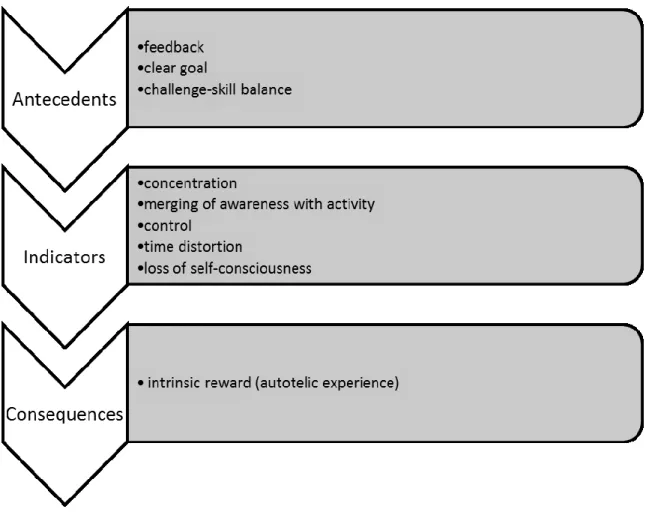
categories of enjoyment and clear goals only; moderate flow, by the addition of challenge, concentration, control, and feedback; and deep flow, by the addition of transformation of time and place and loss of self-awareness (Table 1). Moreover, his meta-analysis summarized the classic flow experience as having three preconditions (feedback, clear goal, and challenge-skill balance); five indicators (concentration, merging of awareness with the activity, control, time distortion, and loss of self-consciousness); and one consequence (the autotelic experience, which he and Csikszentmihalyi defined as intrinsically rewarding and repeated for the experience itself).
Table 1
Levels of Flow (Guo, 2004).
Mild Moderate
(includes prior level)
Deep
(includes prior levels) Enjoyment Clear Goals Challenge Concentration Control Feedback Transformation of Time Transformation of Place Loss of Self-Awareness
Telepresence, a new dimension in flow theory. Of particular interest is a new dimension of flow postulated by Guo (2004) called telepresence. Guo studied this dimension in the internet context, a leisure experience as opposed to the goal-oriented
contexts generally studied by Csikszentmihalyi. From this research Guo proposed another dimension of flow, telepresence, which is the creation of an alternate, imaginary world during flow, a dimension confirmed by the research of Hoffman and Novak (1996). Guo (2004) also found that telepresence was experienced in greater degrees in experiential, leisure activities than in goal-oriented activities. A quantitative measurement of this alternate world was added to a new flow scale created and researched by Guo (2004), called the Internet Flow Scale (IFS).
Possible subdimensions of telepresence. Although Guo (2004) did not explore in depth the subdimensions of telepresence as a dimension of flow, some possible
components of telepresence could be mental vision, imagination, and empathy because of the mental images and affect created during telepresence. Theoretically, Sadoski (1992) defined vision and imagination as “the mental process of reproducing sensory and perceptual experiences stored in memory, or of recombining parts of formerly perceived experiences to create new arrangements apart from their actual occurrence in reality” (p. 266). Merely recollecting the imagery of past events is imaging them whereas
manipulating “parts of existing images into new combinations and/or … enrich[ing] images with affective associations” is imagining them (Sadoski, 1992, p. 266). The term imagination is not to be confused with or used synonymously for creativity, according to Sadoski, because nothing completely new is created in this imagining: parts are merely moved and/or enriched to re-create. However, those who research creativity theories might argue with this assertion citing that the very definition of creativity is the re-imagining of the actual in new and possibly different ways (Csikszentmihalyi, 1996). Furthermore, Sadoski (1992) postulated that this imagining is a distinct evolutionary human trait that enables humans to envision the past and project aspects of it (actual,
manipulated, and/or enriched) into a hypothetical future, unlike animals who are “imprisoned in the present” (p. 227). Thus, humans can mentally see and create a possible alternate dimension, i.e., another world. Furthermore, Guo’s (2004) study confirmed that the interactivity and vividness of the online activity affected the degree of telepresence.
Philosopher Susanne Langer (1962) concurred with this concept of imagination and further asserted that visual imaging and imagining existed prior to verbal
communication; consequently, language developed to communicate the memories and emotions associated with the images. This theory of the communication of image and affect is possibly rooted in the study of mirror neurons. Research in mirror neurons indicate that those visualizing an event/activity experience embodied simulation and develop empathy with the person in the activity, even to the point of mirroring the movements and emotions (Gallese, 2001). Embodied simulation, the foundation of empathy and identification, “is an unconscious and prereflexive mechanism through which the actions, emotions, and sensations we observe activate internal representations of the bodily and mental states of the other” (Diamond, 2008, p. 811). Moreover,
Diamond (2008) asserted that embodied simulation “scaffolds our aesthetic response to art, music, and literature [and] underlies the dynamics of spectatorship” (p. 811). In other words, the imaging and imagining occurring during telepresence can also produce
empathy, even to the point of mirroring the emotions and physical actions of the mental scene. Furthermore, it is the organization for “unconscious fantasies and conflicts throughout life” (Diamond, 2008, p. 811), which could indicate a vicarious resolution of personal issues for the viewer/reader, perhaps even satisfaction or relief. This
introjection, according to psychoanalytical theory (Klein, 1946). The viewer/reader projects him/herself into the observed character (projection) and the character’s proposed thoughts/feelings in the scene become the viewer’s (introjections). This identification can even result in mirrored movements in the viewer as the empathy intensifies (Klein, 1946). Freud (1926) said of empathy that is the gateway to “the existence of psychic life other than our own” (p. 104) and the enablement to “take up any attitude at all towards another mental life” (1921, p. 110).
Other theorists in the field of psychoanalysis confirm the process of identification and empathy with others as a result of visualization (Etchegoyen, 1985; Olds, 2006; Pigman, 1995). However, only more recently have the neurobiological mechanisms of identification and empathy through visualization been researched. According to the research of Gallese and others, the neural structures in the brain are activated when we visualize the actions and emotions of others (Rizzolatti & Craighero, 2004; Gallese, 2001, 2005a, 2005b, 2007). The mirror neuron system is an intermediary between the experiential knowledge of one’s own physical body and the vicarious knowledge of another’s experiences, which Gallese labeled “embodied simulation,” the precursor to empathy and identification (Gallese, Eagle, & Migone, 2006; Gallese, 2005a, 2005b; Kandel, 2006; Olds, 2006).
The mirror neuron system’s possible role in telepresence. This empathy as a result of the mirror neuron activation provides a “virtual enactment of the lives of others” (Fadiga, Fogassi, Pavesi, & Rizzolatti, 1995; Gallese et al., 2006; Rizzolatti, Fadiga, Gallese, & Fogassi, 1996). According to the concept of embodied simulation, this activation of the mirror neuron system explains the empathy present when experiencing art forms (Freedberg & Gallese, 2007) and could perhaps indicate the presence of
empathy during the visualization of telepresence. Furthermore, because the mirror neuron system has plasticity, new mental experiences can create more sophisticated cognition in interpreting others’ actions, feelings, and intentions in differing societal contexts
(Fonagy, Gergeley, Jurist, & Target, 2002; Fonagy, 2003; Gallese, 2007); thus, one’s comprehension increases as does the empathy.
The question might be asked if the mental envisioning activates the mirror neuron system as does a physical vision. Through studying functional magnetic resonance imaging (fMRI), Gazzola, Azziz-Zadeh, and Keysers (2006) found that the audiovisual mirror neuron system will recreate mentally the action/event whether it is solely seen or heard or is even incomplete. Kohler et al. (2002) and Keysers et al. (2003, 2004) found likewise. The mirror neuron system will complete the event/scene. Furthermore, those who scored higher on an empathy scale showed the highest degree of activation of the mirror neuron system, suggesting a potential connection between activation of this system and empathic responsiveness to others (Gazzola et al., 2006). In fact, this identification can be so strong as to physically stimulate the viewer’s body in the same bodily locations as the character viewed, creating neuronal mappings of the body state (Damasio, 1999). This activation is called a loop, where the viewer’s body is stimulated by observation. In this process, the viewer’s somatosensory circuits are activated as the viewer perceives the viewed person’s body is tactilely affected (Gallese, 2005b). In other words, if the person viewed is caressed, then the viewer’s body identifies and empathizes to the degree that he/she is tactilely stimulated to feel the same caress in an equivalent body location. Therefore, telepresence should be explored for not only vision but also empathy.
reading; however, despite the amount of research on flow, empirical research on flow during specific tasks in differing contexts has been confusing and contradictory,
somewhat because of the vagueness of the definition and measurement of flow (Finneran & Zhang, 2005; Shin, 2006; Siekpe, 2005). There are two ways to view flow. One is as a mental mode made up of a composite of characteristics that individuals experience (Shin, 2006). From this perspective, Ghani and Deshpande (1994) asserted two key traits of flow: intense concentration on an activity and enjoyment from the activity. Webster, Trevino, and Ryan (1993) listed four: focus, control, curiosity, and interest. Another way to view flow is a balance between challenge and skill (Shin, 2006). Challenge refers to the level of difficulty and/or complexity while skill refers to the individual’s capability to handle the challenge. An individual is most likely to experience flow when the level of challenge is equal to or a little higher than the level of skill (Csikszentmihalyi, 1997). Inherent to the flow experience is the automaticity of skills needed to meet the challenge of the task, thus facilitating the flow experience (Csikszentmihalyi, 1997; Pintrich & Schunk, 2002). This second perspective is the one used in this study due to its more organic nature, in line with constructivist lens and methodology used in this study.
Moreover, Csikszentmihalyi and Csikszentmihalyi (1988) asserted that too much challenge results in frustration while too little results in boredom; consequently, his four channels of flow: anxiety, apathy, boredom, and flow. According to Csikszentmihalyi’s flow theory, anxiety results from too high a challenge with too little skill; apathy, from too low skill and too low challenge; boredom, too much skill with too little challenge; and flow, from a match between skill and challenge. Lefevre (1988) said that flow is “a balanced ratio of challenges to skill” (p. 307), and Ellis, Voelkl, and Morris (1994), “an optimal experience that stems from people’s perceptions of challenges and skills in given
situations” (p. 337). According to Csikzentmihalyi, a four-channel model explains the variety of experiences: apathy, frustration, boredom, and flow (Figure 1).
High
Anxiety Flow CHALLENGE
Low Apathy Boredom
Low SKILL High
Figure 1. Csikzentmihalyi’s Four-Channel Model of Flow.
Massimini and Carli (1988) have extrapolated on this model and increased it to an eight-channel model, which is the result of three levels in skills and challenge: arousal, flow, control, boredom, relaxation, apathy, worry, and anxiety (Table 2). Only with high challenge and high skills does flow occur.
Additionally, Shin (2006) asserted that there are two philosophical models by which to study flow: reflective and formative. The reflective model holds that
subconstructs of flow, such as curiosity, concentration, control, and challenges, are independent in nature and correlate to one another due to the influence of the latent, higher order construct of flow. In other words, the subconstructs are factors reflecting flow and each one formulates the flow construct independently (Shin, 2006; Siekpe, 2005). However, the formative model of research on flow maintains that the
subconstructs are potentially interconnected, antecedents to flow. The latter model was used in this study’s data analysis. The rationale for this choice is that the second model is more holistic and organic, which is more of a fit with the constructivist lens used in this
research study. Table 2
Massimini and Carli’s Eight-Channel Model of Flow
Challenge/Skill Balance State/Channel 1. High challenges and average skills
Arousal 2. High challenges and high skills Flow 3. Average challenges and high skills Control 4. Low challenges and high skills Boredom 5. Low challenges and average skills Relaxation 6. Low challenges and low skills Apathy 7. Average challenges and low skills Worry 8. High challenges and low skills Anxiety
Patterns within flow. Csikszentmihalyi’s research established a few patterns related to antecedents to flow and consequences of flow. He identified antecedents to flow as matching challenge and skill, focused attention, clear objectives, sense of control, and immediate feedback (Csikszentmihalyi, 1990). Interestingly, in deep play, or flow, a noted result was increased sense of control or power among students (Garvey, 1977; Sutton-Smith & Kelly-Byrne, 1984). Further research has added interest, or choice, as an antecedent (Csikszentmihalyi, 1990; Csikszentmihalyi & Figurski, 1982; Gazzara, 2003; Guo, 2004). Moreover, according to additional research, trust, or an emotionally
supportive environment, can facilitate flow (Csikszentmihalyi, 1990; Fero, 2005; Gazzara, 2003; Rathunde, 1996). Consequences of flow in general are a more ordered self, stronger self-efficacy, personal satisfaction, and positive affect. “Enjoyment appears at the boundary between boredom and anxiety, when the challenges are just balanced
with the person’s capacity to act” (Csikszentmihalyi, 1990, Kindle loc. 1173).
Antithetical to flow, Csikszentmihalyi (1990) warned of psychic entropy in the forms of anxiety or boredom, the result of a disconnect, or imbalance, between skill and challenge. Additionally, Csikszentmihalyi and Csikszentmihalyi (1988) stated that “jobs that reduce human performance to simple mechanical routines produce the opposite state of mind [of flow]: a sense of numbing boredom and a senseless waste of one’s time” (p. 136). Csikszentmihalyi and Csikszentmihalyi (1988) asserted that mere “reductionist accounts of human action, discount or ignore the most obvious aspect of the human phenomenon, namely the existence of a conscious self” (p. 15). In reference to flow in task satisfaction, Gazzara (2003) indicted Adam Smith’s reductionist approach, Fayol’s division of work into discrete parts, and Taylor’s scientific management as contributing to the isolationism that hinders flow in the workforce. Furthermore, studying task types in the workplace, Gazzara (2003) concluded that isolated and repetitive tasks impede flow and the consequent personal fulfillment. Unfortunately, today’s educational contexts too often present students with decontextualized bites of knowledge with little relevancy (Richardson, 2008).
Potential academic impact of flow. In academic settings flow has potential to influence student achievement (Csikszentmihalyi et al. 1993). Csikszentmihalyi et al. (1993) found that freshmen in high school who reported experiencing flow more often had greater achievement gains in their talents by the senior year than those students who reported less flow. Similarly, in a study on optimal experience (flow), Csikszentmihalyi et al. (1993) found that those who reported flow (as indicated by a measurement of total engagement, relevancy, and clear goals) once again had greater talent development and gains than their peers by graduation. Both studies adjusted for random variables, such as
sex, SES, and scholastic abilities and used multiple, independent methods of measuring talent development.
In the domain of literacy, struggling readers experience more isolation and emphasis on discrete literacy skills than advanced readers (Baker & Beall, 2007). According to flow theory, this isolation hinders flow (Csikszentmihalyi &
Csikszentmihalyi, 1988). Struggling readers too often focus on the micro processes of reading, rather than the macro processes of big ideas, motifs, and interconnections within and between texts (Baker & Beall, 2007; Brown & Day, 1983; Garner, 1987; Johnston & Afflerbach, 1985). Furthermore, reluctant readers often cite these very same emotions of boredom and irrelevancy, negative channels Csikszentmihalyi (1990) referenced.
Reinforcing this finding are studies on the emphasis of isolation and discrete skills in literacy, which found that phonological isolation and decoding (micro processes) did not ensure comprehension, a macro process (Juel, Griffith, & Gough, 1986; Paris &
Hamilton, 2007; Yuhill & Oakhill, 1991). In fact, struggling readers often grew in
negative affect through the emphasis on discrete skills as they viewed reading as a task, a meaningless chore, reminiscent of Dewey’s warning about the potential “drudgery” of education if real-life scenarios were not a part of the educational process (as cited in Rathunde, 2003, p. 20). On the other hand, approaching reading through a more holistic, integrated approach produced more positive affect due to a sense of relevancy and a more global picture of the text’s significance and social conversation (NCTE, 2007).
To summarize, the flow experience is one of total engagement with interest as one of the antecedents to flow. Flow’s intrinsic rewards produce motivation to repeat the experience, potentially affecting student disposition. An emotionally supportive environment can impact flow positively or negatively; furthermore, when experienced
consistently, flow has the ability to increase student achievement in the areas where flow is experienced, according to studies that find engagement with reading and reading achievement are positively correlated (Guthrie, 2004; Guthrie & Wigfield, 1999; Meltzer & Hamann, 2004). Furthermore, telepresence seems to be a potential indicator of flow in leisure contexts and might be composed of subdimensions of vision and empathy. The mirror neuron system needs to be researched for its role in flow in reading.
Student Engagement
Student engagement plays a vital role in education and is influenced by many factors. Some of those factors are related to the student’s disposition and background: family traits, socioeconomic status (SES), and ethnicity (Finn, 1993; Lee & Smith, 1993; Marks, 2000; Wentzel, 1998). Other influential factors relate to lesson planning,
implementation, and assessment (Guthrie et al., 1996). In the field of engagement in reading, Guthrie et al. (1996) studied student engagement in Self-Regulated Learning contexts (SRL) with third-grade students in a two-part study that combined six cognitive strategies with five motivation practices. They found that high student engagement in literacy developed metacognitive strategies (control and clear objectives), social
interactions, and motivation. Additionally, high student engagement in literacy shifted the locus of control for reading from external to internal (Guthrie et al., 1996), again a strong sense of feedback, objectives, and control – all antecedents of flow.
Likewise, Miller and Faircloth (2007) asserted that teacher planning, preparation, and assessments were vital in encouraging students to become more participatory in their literacy. To accomplish this goal, they also recommended that teachers foster a shift within students from an external locus of control to an internal. As part of this shift to increase engagement, educators needed to emphasize concepts of play in literacy, rather
than work, in the classroom (Rosenblatt, 1978). The shift to play in work, called Playful Literary Enterprises (PLE), increased motivation and made reading a self-perpetuating activity, increasing motivation to repeat or engage in the activity voluntarily (Bailey, 2011; Kerns & Bailey, 2010; Rosenblatt, 1978). Rosenblatt (1978) cited
Csikszentmihalyi’s flow theory and Nicholls’ (1984) concept of task involvement as the theoretical basis for play and engagement as important to literacy.
Interest
Connected to engagement in play and flow is the theme of interest, which is essential to learning in general (Bruner, 1977, 1986), and literacy in particular (NCTE, 2007). Rathunde (2003) defined “undivided interest” as two-fold: “above average
intrinsic motivation and salience” (p. 25). Consequently, student disposition and learning styles are integral to an examination of this component. Learning styles and motivation trigger interest, the core concept of “deep play” (Bailey, 2011; Kerns & Bailey, 2010), based on Bruner’s (1977, 1986) theory of play. The theory holds that in play-work (work that contains elements of play), interest is generated by students playing at real-life scenarios as they assume authentic roles and perceive relevancy, or salience (Bruner 1977, 1986; Dewey, 1997; Kerns & Bailey, 2010).
Using the Experience Sampling Method (ESM), Csikszentmihalyi and Figurski’s (1982) research explored the correlation between interest and flow. Their research project produced over 4,800 self-reports taken at designated intervals from 107 adults, who recorded their activities, thoughts, and feelings. The ESM utilizes a beeper that randomly alerts the participant to fill out the Random Activity Information Sheet (RAIS), an activity that takes approximately 1.5 minutes. Csikszentmihalyi and Figurski’s (1982) findings indicated that interest, or “voluntariness,” was a significant factor in positive