
Towards an Agent-Based
Augmented Cloud
Roman Dębski, Aleksander Byrski, and Marek Kisiel-Dorohinicki
Department of Computer Science, AGH University of Science and Technology, Kraków, PolandAbstract—In the paper an agent-based framework deployed in hybrid cluster and volunteer computing environment is presented. It utilizes two concepts proposed by the authors:
Augmented CloudandAgent Platform as a Service (AgPaaS). Both concepts are discussed in the context ofCloud Comput-ingas defined by NIST. The key idea of the presented solution is to span the cloud (i.e., computing infrastructure) beyond the data center borders by utilizing web browsers as compu-tational workers. The feasibility of the approach was demon-strated by two prototypes: the first one was based on Java Ap-plets and Adobe Flash, whereas the second one on Microsoft Silverlight. The prototypes were next used to perform simple experiments, mainly related to scalability issues. Selected re-sults from the experiments are discussed in the final part of the paper.
Keywords—Agent Platform as a Service, Augmented Cloud, Cloud Computing, Multi-Agent Systems.
1. Introduction
Many large-scale1 computational problems can be effec-tively solved in distributed environments which are based on the agent paradigm. Some examples are: marketplace simulations, modeling and control of autonomous robots and many optimization problems (complex multi-criteria, multi-modal and/or the ones in which the evaluation of a single solution is simulation based). In many of these casesscalability is the central issue. Both from the point of view of software (algorithms, logical architecture) and hardware (physical architecture).
Very often the hardware infrastructure scalability is the real issue. In the case of possible non-deterministic changes in the computation power demands2, caused, e.g., by cer-tain parameters of the computation model (cf. experiments with computational multi-agent systems presented in [1]), dynamic adaptation of the computation load is required (e.g., load balancing with diffusion-based scheduling as de-scribed in [2]). These problems are usually addressed by the choice of some cloud-oriented solutions [3]. Yet the problem of limited resources and the costs of maintaining often wasted computing power still remains open.
In the paper a new, cost effective, approach to building a highly scalable execution environment, particularly
dedi-1
The term “large-scale problem” is used here in a broad sense, referring to all problems considered difficult for all known solution methods.
2
When the demand for computation power is deterministic and can be reasonably estimated, a straightforward solution would be to use a com-puter cluster with well-defined, still limited resources.
cated for computational systems which may be realized in agent-based paradigm, is presented. It utilizes two con-cepts proposed by the authors in [4]: Augmented Cloud and Agent Platform as a Service (AgPaaS). Both concepts are discussed in the context ofCloud Computingas defined by NIST [5]. The key idea of the presented solution is to span the cloud (i.e., computing infrastructure) beyond the data center borders by utilizing web browsers as computa-tional workers.
In the first sectionAgE – as an example of an agent-based computation platform (framework) is described. Next, its web browser-based implementation is presented. In the subsequent part, the concepts of Augmented Cloud and Agent Platform as a Service are defined. Since the con-tribution is a direct follow-up of [4], experimental results extending the ones presented there, constitute the final part of the paper.
2. AgE – Agent-Based Computation
Platform
AgE platform3is designed to support building a wide range of agent-based optimization and simulation systems utiliz-ing various meta-heuristics such as evolutionary algorithms. Acomputation task to be executed on the AgE platform is defined by providing a computation description file, which includes (among other things): the computation decompo-sition details (i.e., types of agents, their structure, types of operations that specify algorithms), problem-dependent parameters and the problem stop condition. Based on the description file, on the platform start-up, the computation context is built from the necessary components. Next, all the required agents and their environments are created, con-figured and distributed among nodes. Finally, the computa-tion can be started and is performed until it reaches the stop condition. During the execution time some of the compu-tational agents are attached to the platform monitors. The monitors are responsible for collecting problem-dependent data, used to visualize the current state and the final results of the computation.
The computation task is decomposed and the sub-tasks are assigned to the computational agents. The agents are struc-tured into a tree (as shown in Fig. 1), according to the algorithm decomposition (it is worth to notice that each aggregate is also an agent). It is assumed, that all the
sub-3
tasks assigned to the agents at the same level are executed in parallel. To increase performance, the top level agents (called workplaces) along with all their children can be distributed amongst many nodes.
Fig. 1. Agent tree structure.
Agents, however, are not atomic assembly units, but they can be further decomposed into functional units according toStrategydesign pattern [6]. Strategies represent problem-dependent algorithm operators and may be exchanged with-out intruding the agents’ implementation. Their instances may be shared between agents as they provide various ser-vices to agents or others strategies.
Any part of a single agent’s task can be delegated according toStrategy design pattern (see Fig. 1). Strategies can rep-resent problem-dependent algorithm operators (mutation, evaluation of fitness, etc.) and may be exchanged with-out intruding agents’ implementation. The delegated op-erations can be executed by external resources – this ap-proach can be considered as a recommended way of the AgE platform expansion, especially in case of operations with a low communication-to-computation ratio. Fitness evaluation of a single solution can be given as an exam-ple of such delegated task (this approach was used in both prototypes discussed in the final section). In this case the computation can be based on the master-slave model [7], and the slaves (as fitness evaluators) can be: nodes con-nected in computation clusters dedicated to particular task, volunteers [8] (also web browser based [9]), or sideband computing applications [10].
3. Extending the AgE: A Web Browsers
Based Approach
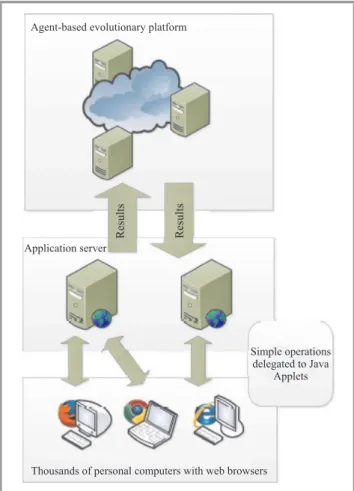
The main goal of the presented solution was to provide high scalability while remaining cost-effective. It has been achieved by utilizing web browsers as computational work-ers. The architecture of the platform is shown in Fig. 2. It is comprised of three layers:
• The agent-based environment layer provides a
hi-erarchy of agents responsible for the realization of
Fig. 2. Architecture overview.
a given meta-heuristic. During their work, they gen-erate tasks, which are delegated, usingProxy design pattern, to a connector that than passes it further to the application servers layer. Tasks are realized as asynchronous operations, so that agents can continue their work without waiting for results, unless they are required for further processing. Communication between the environment and the application servers layer is realized by sending requests, which identify tasks to be performed and input data.
• The application servers layer dispatches ordered
tasks amongst available computational workers and passes back the results to the ordering agents. The number of workers depends on the number of the users whose web browsers cooperate with the plat-form (i.e., users that visit the services associated with the platform). It makes the workers’ environment very dynamic, with the fault tolerance as the central issue to be addressed4.
• The web browser layer utilizes applets5 as
compu-tational workers which are responsible for execut-ing the ordered tasks and returnexecut-ing the results to
4
Consider users disconnecting the system in random moments.
5
Programs executed in the context of a web browser, not necessary Java applets.
the application server. The applets are downloaded by browsers when a user visit any site connected to the system.
The approach can be applied both to building new comput-ing environments and to extendcomput-ing the existcomput-ing ones. How-ever, one has to remember that the solution is suitable only for coarse grained problems (i.e., for which computation-to-communication ratio is high). Otherwise, the gained computing resources could be completely reduced by the communication overhead.
One can generalize the approach described here – it leads to the concept ofAugmented Cloud [4], which is discussed in the next section.
4. Agent Platform in Augmented
Cloud
An agent-based platform [11] dedicated for large-scale computations has to be designed for high scalability and deployed on a highly scalable execution environment like supercomputer, cluster, grid or cloud. Of the four, the last one is becoming more and more popular (also in High Per-formance Computing, e.g., [12], [13]) mainly because it is (at least can be) very cost effective [14], [15].
The approach discussed below is a hybrid of a classical cluster solution (as a backbone; can be considered as a clas-sic cloud which spans the computers in a single data cen-ter), augmented with a web browsers based environment of volunteers, acting together as anAugmented Cloud [4].
4.1. Cloud Computing
A dedicated runtime environment (e.g., supercomputer, cluster) has many advantages. Yet, its scalability is re-stricted by the available computing resources (i.e., number of processors in a supercomputer or number of nodes in the cluster). That is why nowadays we observe a migration of services, software or even a whole computing infrastruc-ture into “clouds” (like Windows Azure6, Amazon EC27, or Google App Engine).
At this point it is worth to defineCloud Computing as the term has many definitions (e.g., [3] , [5], [15]) and there seems to be no consensus on what (precisely) aCloudand Cloud Computing are [3]. According to NIST [5] Cloud Computingis a model for enabling ubiquitous, convenient, on-demand network access to a shared pool of configurable computing resources (e.g., networks, servers, storage, ap-plications, and services) that can be rapidly provisioned and released with minimal management effort or service provider interaction. The essential characteristics are: on-demand self-service, broad network access, resource pool-ing, rapid elasticity and measured service.
6
http://www.microsoft.com/windowsazure/
7
http://aws.amazon.com/ec2/
The service models defined by NIST [5] are as follows:
• Software as a Service (SaaS) – the capability
pro-vided to the consumer is to use the provider’s appli-cations running on a cloud infrastructure. The ap-plications are accessible from various client devices through a thin client interface such as a web browser (e.g., web-based e-mail). The consumer does not manage or control the underlying cloud infrastruc-ture including network, servers, operating systems, storage, or even individual application capabilities, with the possible exception of limited user-specific application configuration settings.
• Platform as a Service (PaaS) – the capability
pro-vided to the consumer is to deploy onto the cloud infrastructure consumer-created or acquired applica-tions created using programming languages and tools supported by the provider. The consumer does not manage or control the underlying cloud infrastruc-ture including network, servers, operating systems, or storage, but has control over the deployed appli-cations and possibly application hosting environment configurations.
• Infrastructure as a Service (IaaS) – the capability
provided to the consumer is to provision processing, storage, networks, and other fundamental computing resources where the consumer is able to deploy and run arbitrary software, which can include operating systems and applications. The consumer does not manage or control the underlying cloud infrastruc-ture but has control over operating systems, storage, deployed applications, and possibly limited control of select networking components (e.g., host firewalls). IBM in [16] introduces also the fourth service model – BPaaS:
• Business Process as a Service (BPaaS) – any business
process (horizontal or vertical) delivered through the cloud service model (Multi-tenant, self-service pro-visioning, elastic scaling and usage metering or pric-ing) via the Internet with access via web-centric in-terfaces and exploiting web-oriented cloud architec-ture. The BPaaS provider is responsible for the re-lated business function(s).
4.2. Augmented Cloud – Agent Platform as a Service Combining the concepts ofthe cloud(as a way of providing the illusion of infinite computing resources available on de-mand) and theweb browser-based volunteer computing[9] (as a way of collecting computational resources) leads to a practically zero-cost and highly scalable solution, which may be called anAugmented Cloud [4]. The scalability of the classical cloud is limited by the number of nodes in the data center on which the cloud is based/deployed; the pro-posed solutionaugmentsthe classical cloud by a significant increase of its scalability.
Fig. 3. Computation time [s] and speedup dependent on population sizes for different number of clients: (a), (b) – Java Applets; (c), (d) – Adobe Flash.
From the cloud computing service models [5] point of view theAugmented Cloudcan be seen as a kind of Infrastructure as a Service (IaaS) in which (at least some of) the com-putational resources are web-browsers based. So it can be just a base for the target platform mostly because this level of abstraction is too low when taking into account both the development and deployment of (multi)agent-based systems.
What is needed is a set of services/libraries forming a highly scalable(software) platform dedicated for the tar-get domain – agent-based systems. It can be considered as the second layer of the Cloud Computing Reference Ar-chitecture [16] which corresponds to the NIST Platform as a Service (PaaS) [5]. In this context it can be namedAgent Platform as a Service (AgPaaS) to emphasize the agent-orientation of the platform [4].
5. Experimental results
In order to evaluate the concept ofAugmented Cloud, com-puting time and speedup has been tested for a classical master-slave model of a parallel evolutionary algorithm, in which the computation of fitness values was delegated to browser-based slaves (as described in the previous sec-tions). The experiments were based on two prototypes: in
the first one the web browser layer was based on Java Ap-plets and Adobe Flash, and in the second one on Microsoft Silverlight. The results are described in the next two sub-sections.
5.1. Java Applet and Adobe Flash
In this case the computing environment had a two-tier/layer architecture and consisted of a backbone server running a master process and two types of clients (slaves): Java Applet based (communicating with the server using Java RMI) and the Adobe Flash based. The algorithm was solv-ing a typical benchmark optimization problem (Rastrigin function) for different population sizes and different num-ber of clients.
According to expectations, increasing the number of slaves decreases the overall computation time (see Fig. 3). This effect is strongly dependent on the technology: the Java Applet slaves (see Fig. 3(a)) are (much) less effective than the Adobe Flash ones (see Fig. 3(c)). It is mainly because of the Java RMI communication overhead.
Figures 3(b) and 3(d) show the same data but from the computation speedup perspective. One can easily notice that in case of Java Applets there is practically no speedup. It is a good visualization of the importance of computation-to-communication ratio.
Fig. 4. In the left column: computation time as a function of the number of computational nodes, presented for different numbers of intermediate nodes and for different genotype lengths, in the right column: computation time as a function of the number of computational nodes, presented for different lengths of genotype and for different number of intermediate nodes.
5.2. Microsoft Silverlight
In this experiment the computing environment had a hier-archical8, three-tier/layer structure.
• The backbone server (the master) – it was
execut-ing a simple genetic algorithm, delegatexecut-ing the
cal-8
The environment can be visualized as a tree: level 1 – the back-bone server (as the root), level 3 – the computational workers (as leaves), level 2 – controllers of sub-trees.
culation of each individual’s fitness to web browser-based computational workers (slaves) via the appli-cation controllers layer.
• Application controllers (intermediate layer) – each
controller is responsible for the pool of computational workers allocated to it; this layer can be utilized in different ways, e.g., to improve the system availabil-ity or/and reliabilavailabil-ity, to support load balancing, to control the value of computation-to-communication ratio (note: in the prototype none of the above was implemented).
• Microsoft Silverlight based computational workers.
Note: it can be noticed that the computing envi-ronment is similar to the one presented in Fig. 2, but with one exception: the AgE platform has been reduced to a single master process, which executed a simple genetic algorithm.
Figures 4(a), 4(c) and 4(e) show the computation time as a function of the number of computational nodes, for dif-ferent numbers of intermediate servers (application con-trollers). One can notice that in the context of this compu-tation, the introduction of intermediate nodes caused a sig-nificant overhead (in the whole range of analyzed compu-tational node numbers), and in consequence, worsened the computation time. But as the number of the computational nodes was increasing this overhead was becoming smaller and smaller (close to zero for the last point of the curve). So as in case of most distributed systems, the performance of this one is strongly dependent on its configuration. Figures 4(b), 4(d), and 4(f) present the same data from a different perspective.
Fig. 5. Speedup as a function of the number of computa-tional nodes: (a) in the configuration with 3 intermediate nodes, presented for different genotype lengths; (b) with the genotype length set to 5000, presented for different number of intermediate nodes.
Figures 5(a) and 5(b) present the system performance from the speedup point of view. An interesting effect is shown in Fig. 5(a): the smaller the genotype length, the bigger the speedup (and this effect is stronger as the number of computational nodes is increasing). This is again caused
by the communication overhead: the bigger the genotype length, the more time is needed by the intermediate node to transfer its data. When a controller (intermediate node) handles many computational nodes its processing is I/O bound and, in consequence, it can become a bottle-neck of the whole system.
6. Conclusion
In the course of the contribution, after describing the AgE (as an example of an agent-based computation platform), and a possible way of its extension, the concepts of Aug-mented Cloud and the Agent Platform as a Service were introduced as way to address the scalability issues, which are present in many large-scale computations performed in the agent-based distributed environments.
In the final part of the paper, selected results obtained for a proof of concept kind of prototypes were shown. The computing environment of the first prototype consisted of a backbone server (master) and the two types of clients (slaves): Java Applet and Adobe Flash ones. The second prototype had a three-tier architecture with the compu-tational workers (clients/slaves) based on Microsoft Sil-verlight.
The obtained results encourage further research and broader implementation of the Augmented Cloud concept, at the same time bringing more awareness about affecting the po-tential results by choosing appropriate technology for the implementation both of the server and web-browser clients, as well as for the communication.
In the near future the authors plan to conduct broader exper-iments with volunteer nodes based on different web tech-nologies (e.g., JavaScript/WebWorkers). A long-term goal is to further evaluate the concept of Agent Platform as a Ser-vice (AgPaaS).
Acknowledgements
The work presented in this paper was partially supported by the Polish National Center of Research and Development grant No. 0108/R/T00/2010/11.
References
[1] A. Byrski, M. Kisiel-Dorohinicki, and M. Carvalho, “A crisis man-agement approach to mission survivability in computational multi-agent systems”,Comp. Science, vol. 11, pp. 99–113, 2010. [2] M. Grochowski, R. Schaefer, and P. Uhruski, “Diffusion based
scheduling in the agent-oriented computing system”, inProc. Int. Conf. PPAM 2003. Springer, 2004.
[3] S. Lu, I. Foster, and I. Raicu, “Cloud computing and grid comput-ing 360-degree compared”, inGrid Comput. Environments Worsh. GCE’08, Austin, Texas, USA, 2008.
[4] A. Byrski, R. Debski, and M. Kisiel-Dorohinicki, “Agent-based com-puting in augmented cloud environment”, Int. J. Comp. Sys. Sci. Eng., 2012 (accepted for printing).
[5] P. Mell and T. Grance, “The nist definition of cloud computing (draft)”, Tech. rep., National Institute of Standards and Technology, 2011.
[6] E. Gamma, R. Helm, R. Johnson, and J. Vlissides,Design Patterns: Elements of Reusable Object-Oriented Software. Addison Wesley, 1995.
[7] E. Cant´u-Paz, “A summary of research on parallel genetic algo-rithms”, IlliGAL Rep. No. 95007, University of Illinois, 1995. [8] D. P. Anderson, E. Korpela, and R. Walton, “High-performance task
distribution for volunteer computing”, inProc. 1st Int. Conf. e-Sci. Grid Comput., Melbourne, Australia, 2005.
[9] L. F. G. Sarmenta and S. Hirano, “Bayanihan: Building and studying web-based volunteer computing systems using Java”,Future Gener. Comp. Systems, vol. 15, pp. 675–686, 1999.
[10] Y. Xu, “Global sideband service distributed computing method”, in Proc. Int. Conf. Commun. Netw. Distrib. Sys. Model. Simul. CNDS’98, San Diego, CA, USA, 1998.
[11] B. Czerwinski, R. Debski, and K. Pietak, “Distributed agent-based platform for large-scale evolutionary computations”, inProc. 5th Int. Conf. Complex Intel. Softw. Intensive Sys., IEEE Press, 2011. [12] K. R. Jackson et al., “Performance analysis of high performance
computing applications on the amazon web services cloud”, inProc. 2nd IEEE Int. Conf. Cloud Comput. Technol. Sci. CloudCom’10, Indianapolis, USA, 2010.
[13] J. Napper and P. Bientinesi, “Can cloud computing reach the top500”, inProc. UCHPC-MAW ’09, ACM, 2009.
[14] J. J. Mereloet al., “Browser-based distributed evolutionary compu-tation: performance and scaling behavior”, inProc. 9th Ann. Conf. Genetic Evol. Comput. GECCO ’07, New York, NY, USA, 2007, pp. 2851–2858.
[15] M. Armbrustet al., “Above the clouds: A Berkeley view of cloud computing”, Tech. rep., UC Berkeley, 2009.
[16] M. Behrendt et al., “IBM cloud computing reference architec-ture 2.0”, Tech. rep., The Open Group, 2011.
Roman Dębskiholds the M.Sc. in Computer Science (AGH University of Science and Technology) and in Mechanical Engineering and the Ph.D. in Computational Mechanics (both obtained at Cracow University of Technology). He is an in-dependent consultant with over 14 years of experience in IT. His current research focuses on the cloud computing.
E-mail: [email protected] Deptartment of Computer
AGH University of Science and Technology Mickiewicza Av. 30
30-059 Kraków, Poland
Aleksander Byrski obtained his Ph.D. in 2007 at AGH Uni-versity of Science and Technol-ogy in Kraków. He works as an assistant professor at the De-partment of Computer Science of AGH-UST. His research fo-cuses on multi-agent systems, biologically-inspired computing and other soft computing meth-ods.
E-mail: [email protected] Deptartment of Computer Science
AGH University of Science and Technology Mickiewicza Av. 30
30-059 Kraków, Poland
Marek Kisiel-Dorohinicki ob-tained his Ph.D. in 2001 at AGH University of Science and Tech-nology in Kraków. He works as an assistant professor at the Department of Computer Sci-ence of AGH-UST. His research focuses on intelligent software systems, particularly utilizing agent technology and evolution-ary algorithms, but also other soft computing techniques.
E-mail: [email protected] Deptartment of Computer Science
AGH University of Science and Technology Mickiewicza Av. 30
![Fig. 3. Computation time [s] and speedup dependent on population sizes for different number of clients: (a), (b) – Java Applets;](https://thumb-us.123doks.com/thumbv2/123dok_us/1553400.2708179/4.892.70.812.84.572/computation-speedup-dependent-population-different-number-clients-applets.webp)


