IJOPM
22,2
220
International Journal of Operations & Production Management, Vol. 22 No. 2, 2002, pp. 220-240.
#MCBUP Limited, 0144-3577 DOI 10.1108/01443570210417515
ACTION RESEARCH
Action research for operations
management
Paul Coughlan and David Coghlan
University of Dublin, Trinity College, Dublin, Ireland
Keywords Operations management, Action research, Methodology
Abstract A fundamental methodological question guides this paper: How can operations managers and researchers learn from the applied activity that characterises the practice of OM? To address this question, defines and explores the legitimacy of an action-oriented research approach in OM, and the particular logic and value of applying action research (AR) to the description and understanding of issues in OM. Begins with a review of the role of empirical research in OM and how AR features within the OM research literature. Introduces the theory and practice of AR and outlines the AR cycle and how AR is implemented. Finally, describes the skills required to engage in AR and explores issues in generating theory. Concludes with the assertion that AR is relevant and valid for the discipline of OM in its ability to address the operational realities experienced by practising managers while simultaneously contributing to knowledge.
Introduction
To the researcher and to the manager, a running operation is an enigma. On the one hand, it can be a highly visible entity where people or machines seem to be working away. On the other hand, a running operation will neither come right nor stay right of its own accord. Answers to the following questions are not obvious. What makes it work as it does? Could it work better in its current form? What different forms could it take and still achieve the same result? What market, internal or environmental change would cause most trouble to the working of the operation, and with what effect? To address such questions usefully as a manager or as a researcher is not easy. Accordingly, the fundamental methodological question arises: how can operations managers and researchers learn from the applied activity that characterises the practice of operations management (OM)? As the name suggests, AR is an approach to research that aims both at taking action and creating knowledge or theory about that action.
Action research (AR) is a generic term, which covers many forms of action-oriented research, and indicates diversity in theory and practice among action researchers, so providing a wide choice for potential action researchers as to what might be appropriate for their research question (Reason and Bradbury, 2001). The outcomes are both an action and research which, unlike traditional positivist science, aims at creating knowledge only. Westbrook (1995) presented AR as an approach that could overcome three deficiencies associated with ``traditional research topics and methods''. It has broad relevance to practitioners and applicability to unstructured or integrative issues. It can contribute to theory. He concluded that:
The grounded, iterative, interventionist nature of AR ensures closeness to the full range of variables in settings where those variables may not emerge all at once (Westbrook, 1995, p. 18).
The current issue and full text archive of this journal is available at
Action research
for operations
management
221
This paper will explore the themes and challenges facing operations managers and researchers as they attempt to learn from the applied activity that characterises the practice of OM, including:
. What is AR and when can it be used?
. What is needed before entering into action research? . How do you design an AR project?
. Implementing action research. . Action research skills.
. How do you generate theory?
. Assessing the quality of action research.
First, however, the paper will begin with a brief review of the status of empirical research in OM noting, in particular, some of the differing methodologies applied.
Empirical research in operations management
In their survey of empirical research methods in OM, Flynn et al. (1990) contended that the development of the field of OM would be enhanced by empirical work and that ``all types of empirical research'' were needed. Proposing a systematic approach for empirical research, they identified a number of data collection methods which, alone or in combination, could be used in conjunction with the research design. However, their concept of the OM researcher was largely one of an individual observing from outside of the running operation, or gathering archival, interview or survey data relating to the historical running of the operation. Only in their brief description of ``participant observation'' did they acknowledge a different type of research setting, question and characterisation of the researcher. For many types of research question, detached observation or archival study are indeed appropriate. However, the range of these questions does not define the range of research issues relevant to OM.
Scudder and Hill (1998), reviewing published empirical OM research during the period 1985-1995, found that the largest proportion of the empirical research had been done through the use of surveys. Case study methodology was used in about half as many articles as survey methodology. Notably absent was any reference to action research.
Pannirselvam et al. (1999) found that empirical studies comprised about 18 per cent of published OM research examined for the period 1992-1997. The methodologies included survey, case study, field study and laboratory experiment. While no specific reference was made to action research, they noted that:
OM research shows a trend toward more integrative research both within the OM area and also with other business disciplines, such as marketing. . .This kind of integrative research may require us to be more innovative in the future in our selection of methodologies used to conduct our research (Panniselvamet al., 1999, p. 111).
IJOPM
22,2
222
In contrast to published research, a review of pipeline research (Scudder and Hill, 1998; Pannirselvamet al., 1999) in OM can suggest changes in focus and methodology and future publication. Here, some empirical OM studies based on an application of AR have been reported. We reviewed the conference proceedings of the three most recent annual meetings (Coughlan et al., 1998; Bartezzaghiet al., 1999; Van Dierdonck and Vereecke, 2000). The review of the pipeline, summarised in Table I, suggests some application of an AR methodology. However, the low ± but increasing ± incidence of conscious application of AR suggests a potential of unnecessary threats to the validity of the research findings reported. Such threats might be reduced if the researchers recognised the demands of the approach being taken and consciously adopted appropriate strategies to maintain rigour in their research.
In sum, calls for application of empirical methodologies are appropriate as differing research questions need to be addressed. However, not all questions of interest to managers and OM researchers can be answered by surveys, case studies or participant observation. There seems to be little evidence of AR as a methodology applied in published empirical research in OM, but some evidence of applications in the pipeline. Here, then, is an opportunity for rigorous application of AR with potential to contribute to knowledge and to practice.
What is AR and when can it be used?
What is AR?
Several broad characteristics define AR (Foster, 1972; Susman and Evered, 1978; Peters and Robinson, 1984; Argyris et al., 1985; Whyte, 1991; Aguinis, 1993; Coghlan, 1994; Baskerville and Wood-Harper, 1996; Eden and Huxham, 1996; Checkland and Holwell, 1998; Greenwood and Levin, 1998; Gummesson, 2000; McDonagh and Coghlan, 2001):
. researchinaction, rather than researchaboutaction; . participative;
. concurrent with action;
. a sequence of events and an approach to problem solving.
We will discuss each in turn.
First, AR focuses on research inaction, rather than researchaboutaction. The central idea is that AR uses a scientific approach to study the resolution of
Table I. Comparison of AR studies in international conferences of the European Operations Management Association
Year Number of papers inproceedings Examples of actionresearch Characterisation asaction research
1998 96 9 1
1999 121 9 3
2000 82 8 4
Sources:Coughlanet al. (1998), Bartezzaghiet al. (1999) and Van Dierdonck and
Action research
for operations
management
223
important social or organisational issues together with those who experience these issues directly. AR works through a cyclical four-step process of consciously and deliberately: planning, taking action and evaluating the action, leading to further planning and so on.
Second, AR is participative. Members of the system which is being studied participate actively in the cyclical process outlined above. Such participation contrasts with traditional research where members of the system are objects of the study.
Third, AR is research concurrent with action. The goal is to make that action more effective while simultaneously building up a body of scientific knowledge.
Finally, AR is both a sequence of events and an approach to problem solving. As a sequence of events, it comprises iterative cycles of gathering data, feeding them back to those concerned, analysing the data, planning action, taking action and evaluating, leading to further data gathering and so on. As an approach to problem solving, it is an application of the scientific method of fact finding and experimentation to practical problems requiring action solutions and involving the collaboration and co-operation of the action researchers and members of the organisational system. The desired outcomes of the AR approach are not just solutions to the immediate problems but important learning from outcomes both intended and unintended, and a contribution to scientific knowledge and theory.
The origins of AR
AR originates primarily in the work of Kurt Lewin and his colleagues and associates. In the mid-1940s, Lewin and his associates conducted AR projects in different social settings. Through the following decades, AR in organisations developed in organisation development, particularly in the USA (French and Bell, 1999), the industrial democracy tradition in Scandinavia (Greenwood and Levin, 1998) and the socio-technical work of the Tavistock Institute in the UK (Trist and Murray, 1993). One of the best-known early organisational AR projects was a study of resistance to change in an industrial plant (Coch and French, 1948). The researchers were essentially addressing the question of how to introduce technological change into the company where there was strong resistance to change. They set up two approaches to introducing the change ± representative participation and total participation in discussing the implementation. Using these two approaches they were able to show differing effects of each approach on productivity and on the acceptance of the change. The results indicated that productivity increased faster and further beyond previous levels in groups where total participation was used as a means of introducing the change.
Contrasts with positivist science
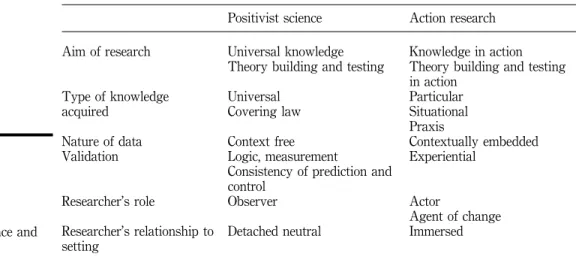
AR can be contrasted with positivist science (Susman and Evered, 1978) (Table II). The aim of positivist science is the creation of universal knowledge or covering law, while AR focuses on knowledge in action. Accordingly, the knowledge created in positivist science is universal while that created through
IJOPM
22,2
224
AR is particular, situational and out of praxis. In AR the data are contextually embedded and interpreted. In positivist science findings are validated by logic, measurement and the consistency achieved by the consistency of prediction and control. In AR, the basis for validation is the conscious and deliberate enactment of the AR cycle. The positivist scientist's relationship to the setting is one of neutrality and detachment, while the action researcher is immersed in the setting. In short, the contrast of roles is between that of detached observer in positivist science and of an actor and agent of change in action research. As Riordan (1995, p. 10) expresses it, (AR) is:
. . .a kind of approach to studying social reality without separating (while distinguishing) fact from value; they require a practitioner of science who is not only an engaged participant, but also incorporates the perspective of the critical and analytical observer, not as a validating instance but as integral to the practice (p. 10).
Major characteristics of AR
Gummesson (2000) lays out ten major characteristics of action research. We will present and discuss each in turn:
(1) Action researchers take action. Action researchers are not merely observing something happening; they are actively working at making it happen.
(2) AR always involves two goals: solve a problem and contribute to science. As we pointed out earlier AR is about researchinaction and does not postulate a distinction between theory and action. Hence the challenge for action researchers is to engage in both making the action happen and stand back from the action and reflect on it as it happens in order to contribute theory to the body of knowledge.
(3) AR is interactive. AR requires co-operation between the researchers and the client personnel, and continuous adjustment to new information and
Table II.
Comparison of positivist science and AR
Positivist science Action research Aim of research Universal knowledge Knowledge in action
Theory building and testing Theory building and testing in action
Type of knowledge
acquired UniversalCovering law ParticularSituational Praxis
Nature of data Context free Contextually embedded Validation Logic, measurement
Consistency of prediction and control
Experiential Researcher's role Observer Actor
Agent of change Researcher's relationship to
Action research
for operations
management
225
new events. In action research, the members of the client system are co-researchers as the action researcher is working with them on their issue so that the issue may be resolved or improved for their system and a contribution be made to the body of knowledge (Reason, 1999). As AR is a series of unfolding and unpredictable events, the actors need to work together and be able to adapt to the contingencies of the unfolding story. (4) AR aims at developing holistic understanding during a project and
recognising complexity. As organisations are dynamic socio-technical systems, action researchers need to have a broad view of how the system works and be able to move between formal structural and technical and informal people subsystems (Nadler and Tushman, 1984). Working with organisational systems requires an ability to work with dynamic complexity, which describes how a system is complex, not because of a lot of detail (detail complexity) but because of multiple causes and effects over time (Senge, 1990).
(5) AR is fundamentally about change. AR is applicable to the understanding, planning and implementation of change in business firms and other organisations. As AR is fundamentally about change, knowledge of and skill in the dynamics of organisational change are necessary. Such knowledge informs how a large system recognises the need for change, articulates a desired outcome from the change and actively plans and implements how to achieve that desired future (Beckhard and Harris, 1987; Nadler, 1998; Coghlan and Brannick, 2001). Such knowledge also includes how change moves through a system (Rashford and Coghlan, 1994) and the dynamics of organisational politics (Buchanan and Badham, 1999).
(6) AR requires an understanding of the ethical framework, values and norms within which it is used in a particular context. In AR ethics involves authentic relationships between the action researcher and the members of the client system as to how they understand the process and take significant action (Coghlan and Brannick, 2001). Values and norms that flow from such ethical principles typically focus on how the action researcher works with the members of the organisation.
(7) AR can include all types of data gathering methods. AR does not preclude the use of data gathering methods from traditional research. Qualitative and quantitative tools such as interviews and surveys are commonly used. What is important in AR is that the planning and use of these tools be well thought out with the members of the organisation and be clearly integrated into the AR process. It must be remembered that data collection tools are themselves interventions and generate data. A survey or interview may generate feelings of anxiety, suspicion, apathy and hostility or create expectations in a workforce. If action researchers do not attend to this and focus only on the collection of data, they may be missing significant data
IJOPM
22,2
226
that may be critical to the success of the project. In this vein, it can be seen how AR makes demands on the whole person of the action researcher. (8) Action research requires a breadth of pre-understandingof the corporate
environment, the conditions of business, the structure and dynamics of operating systems and the theoretical underpinnings of such systems. Pre-understanding refers to the knowledge the action researcher brings to the research project. Action researchers in OM, therefore, need to have not only their knowledge of operations and production, but also a broader knowledge of organisational systems, much of which is tacit (Nonaka and Takeutchi, 1995) and the dynamics of the operation in its contemporary business environment. Such a need for pre-understanding signals that an AR approach is inappropriate for researchers who, for example, think that all they have to do to develop grounded theory is just to go out into the field.
(9) AR should be conducted in real time, though retrospective AR is also acceptable. While AR is a ``live'' case study being written as it unfolds, it can also take the form of a traditional case study written in retrospect, when the written case is used as an intervention into the organisation in the present. In such a situation the case performs the function of a ``learning history'' and is used as an intervention to promote reflection and learning in the organisation (Kleiner and Roth, 1997).
(10) The AR paradigm requires its own quality criteria. AR should not be judged by the criteria of positivist science, but rather within the criteria of its own terms. Reason and Bradbury (2001) point to what they consider to be choice points and questions for quality in action research:
. Is the AR explicit in developing a praxis of relational participation?
In other words, how well does the AR reflect the co-operation between the action researcher and the members of the organisation?
. Is AR guided by a reflexive concern for practical outcomes? Is the
action project governed by constant and iterative reflection as part of the process of organisational change or improvement?
. Does AR include a plurality of knowing which ensures
conceptual-theoretical integrity, extends our ways of knowing and has a methodological appropriateness? AR is inclusive of practical, propositional and experiential knowing (Reason, 1999) and so as a methodology is appropriate to furthering knowledge on different levels.
. Does AR engage in significant work? The significance of the project
is an important quality in action research.
. Does the AR result in new and enduring infrastructures? In other
Action research
for operations
management
227
When is AR appropriate?
In general, AR is appropriate when the research question relates to describing an unfolding series of actions over time in a given group, community or organisation; understanding as a member of a group how and why their action can change or improve the working of some aspects of a system; and understanding the process of change or improvement in order to learn from it (Coghlan and Brannick, 2001).
Two examples of published research illustrate appropriate applications of AR in OM. Westbrook (1993) investigated the preconditions for priority management by summarising the sources of complexity ± variety, variation and volume. He developed a classification scheme with three main dimensions which had practical application and formed the basis for an orderbook model. Karlsson and AÊhlstroÈm (1996) examined the implementation process when implementing lean product development. Lean product development offers the potential for faster product development with fewer engineering hours, improved manufacturability of products, higher quality products, fewer production start-up problems, and faster time to market, so improving the likelihood of market success. Over two years observing and facilitating one company's efforts to make this transition, Karlsson and AÊhlstroÈm (1996) were able to identify various factors that either hindered or supported the implementation of lean product development.
In each of these cases the problem owners are both the practitioner and the researcher. Typically, the former will wish to understand the impact of changes and the process of change with a view to replication at another time or in another setting. As importantly, the researcher will wish to contribute to the understanding in the academic world of the issues under investigation.
What role does the action researcher play?
By and large, action researchers are outside agents who act as facilitators of the action and reflection within an organisation. In such cases, it is useful to talk about the action researcher and the client system, that is, those in the organisation who are engaging in the AR in collaboration with the external AR. The action researcher is acting as an external helper to the client system. Schein (1999) distinguishes between two main models of helping. One is the expert model as in the doctor-patient model as in the situation where patients go to doctors for expert diagnosis and prescriptive direction. The other is the process consultation model in which helpers work in a facilitative manner to help the clients inquire into their own issues and create and implement solutions. In this latter model, helpers work as action researchers (Schein, 1987, 1995; Coghlan, 1994). It is an approach such as this that we must apply to AR.
There is also a growing experience of AR being done from within organisations as when practising managers undertake AR projects in and on their own organisations (Bartuneket al., 2000). This is increasingly common in the context of managers participating in academic programmes (Perry and Zuber-Skerritt, 1994; Coghlan, 2001; Coghlan and Brannick, 2001). In such
IJOPM
22,2
228
contexts managers acting as action researchers take on the role of researcher in addition to their regular organisational roles.
What is needed before entering into AR?
Essentially what is needed is a real issue of both research and managerial significance upon which a group or organisation is embarking, which has an uncertain outcome and which the group or organisation is willing to subject to rigorous inquiry, particularly the analysis and implementation of action. As AR is what we might term a ``live'' case in real time, the action researcher has to gain access and to be contracted as an action researcher (Schein, 1987, 1995; Gummesson, 2000). This contract involves the key members of the organisation recognising the value of the AR approach and being willing to have the action researcher working with them in a process consultation mode. Developing the contract, a key element of the pre-step (defined in the following section) involves recognition of the different stakeholders, their differing expectations and inter-relationships.
For example, in their study of total productive maintenance implementation in the newspaper industry, Bennett and Lee (2000) took an AR approach. They noted that:
. . . Action Research not only investigated and improved management practice but also
developed managerial competences of those involved in the research. . .An Action Research team of organisation personnel was specially formed to undertake the necessary fieldwork. The team members who were specialists in their own area participated voluntarily in the study. Their satisfaction was the experience they gained from the project and the opportunity to work together as a team (Bennett and Lee, 2000, p. 35).
Similarly, in an AR study of process improvement in product development, Coughlan and Brady (1995) sought to establish benchmarks of current practice, to increase awareness of areas of management choice, and to understand the dynamics of conceptually-based collaboration among researchers and managers. The five participating firms had their expectations which served to guide specific emphases in the project. For example, one firm stated:
We want to understand how we can achieve cycle time reduction (getting it right first time will be a subset of this). To do this we need to understand the detail of the product development process. As we don't know how to benchmark, we need a facilitator (the researchers) to provide the structure for analysing the process. We will then analyse the data ourselves to identify what we need to do to achieve cycle time reduction (Coughlan and Brady, 1995, p. 43).
Parallel action research projects
When the action researchers are enrolled in an academic programme, such as one leading to a doctorate, it is useful to note that typically there are two AR projects co-existing in parallel (Coghlan and Brannick, 2001). First there is the core AR (Perry and Zuber-Skerritt, 1994) which is the project on which the student-action researcher is working within the organisation. This project has its own identity and may proceed, irrespective of whether or not it is being studied. There is also the thesis AR project (Perry and Zuber-Skerritt, 1994). This involves the action
Action research
for operations
management
229
researcher's inquiry into the organisational project. This distinction is useful as it is the thesis project which will be submitted for examination, rather than the core project. While the core project may be unsuccessful as reflected in the thesis project, the researcher's inquiry into the lack of success may be successful for the academic award the student-action researcher is pursuing.
How do you design an AR project?
Framing the issue
Framing and selecting an issue is a complex process (Coghlan and Brannick, 2001). In Bartunek et al. (2000), several examples of the scope of research projects are evident. In one case, that of a bank, the project was a practical operational issue ± there was a recurring problem which management wanted researched and resolved. This issue was identified as improving relationships between the bank and a client. Bartunek et al. (2000) also provide a more complex case. In this case, that of a manufacturing company, the development of an integrated manufacturing system involved radical changes in how the company did its business.
For the action researcher the questions of who selects the scope of the project, who provides access and who is involved in it are critical, as they are in any research project. It is common that action researchers have a project steering group, which enables them to manage the project, by:
. having a team with which to work in planning, implementing and
evaluating; and
. building insider knowledge of the organisation (Bartunek and Louis,
1996).
This group also acts as a learning group and reflects on the emergent learning from the project (Bushe and Shani, 1991).
An emergent process
An AR project is emergent, that is it emerges through the unfolding of a series of events as the designated issue is confronted, and attempts at resolution by the members of the organisation with the help of the action researcher. The enactment of the cycles of planning, taking action and evaluating can be anticipated but cannot be designed or planned in detail in advance. The philosophy underlying AR is that the stated aims of the project lead to planning the first action, which is then evaluated. So the second action cannot be planned until evaluation of the first action has taken place. As Eden and Huxham (1996) point out, the process of exploration of the data, rather than collection, must demonstrate a high degree of method and orderliness in reflecting about and holding onto the emerging research content of each episode and the process whereby issues are planned and implemented.
For example, Coughlanet al. (2001) reported on an AR initiative dealing with adopting ``world class'' operations practices in five well-established organisations. At the core of this initiative was the development of an action
IJOPM
22,2
230
learning model which would help managers and organisations to develop the capabilities of the learning organisation, enabling them to transform themselves continuously through learning to the benefit of their stakeholders. The model would be of a contingency nature, standardised in so far as is possible, and replicable both in Ireland and in Europe generally.
Working with the researchers, the firms analysed the profile of practices and performance emerging from the first self-assessment carried out as part of the project, validated the gaps appearing and explained them. Issues were identified and, in collaboration with the researchers, the firms traced the origins of these issues. It was concluded that resolution of these issues would require a great deal of change in areas such as the definition of the mission of the firms, the alignment of the organisational structure to the strategy of the firms, and in the balancing of power across differing roles. In taking action to address the emerging issues, the firms recognised their lack of data in key related process areas. As the actions progressed, the firms were helped to crystallise out these observations through their active participation in the network meetings facilitated by the researchers, carrying out the assignments set by the researchers, and through the discussions with the other firms based on their presentations.
Implementing action research
The AR cycle comprises three types of step, as illustrated in Figure 1: (1) a pre-step ± to understand context and purpose;
(2) six main steps ± to gather, feed back and analyse data, and to plan, implement and evaluate action;
(3) a meta-step to monitor.
It is the meta-step which is the focus of the academic dissertation. The researcher's AR project inquires into how the organisational AR cycles are enacted.
Pre-step: understanding context and purpose
The pre-step is driven by two questions concerning the rationale for action and for research.
Figure 1.
Action research
for operations
management
231
What is the rationale for action?The AR cycle unfolds in real time and begins with the key members of the organisation developing an understanding of the context of the action project:
. Why is this project necessary/desirable?
. What are the economic, political, social and technical forces driving the
need for action?
The analysis of these forces identifies their source, their potency and the nature of the demands they are making on the system. A second key contextual element is the degree of choice the client system has in taking action. Choices are not absolute. While there may be no control over the forces demanding action, there is likely to be a great deal of control over how to respond to those forces. In that case there is likely to be a good deal of scope as to what changes, how, and in what time scale the action can take place.
What is the rationale for research? The complementary pre-step is to ask what the rationale for the research is. This involves asking why this action project is worth studying, how AR is an appropriate methodology to adopt and what contribution it is expected to make to knowledge.
Main steps
The six main steps relate first to the data and then to the action. These steps are detailed as follows:
(1) Data gathering. Data are gathered in differing ways depending on the context. There is what are sometimes referred to as the ``hard'' data. These data are gathered through, for example, operational statistics, financial accounts and marketing reports. Then there is what are sometimes referred to as the ``soft'' data. These are gathered through observation, discussions and interviewing. The supposed ``softness'' lies in the fact that these data are largely perceptual and may be difficult to interpret validly.
For the action researcher, data generation comes through active involvement in the day-to-day organisational processes relating to the AR project. Not only are data generated through participation in and observation of teams at work, problems being solved, decisions being made and so on, but also through the interventions which are made to advance the project. Some of these observations and interventions are made in formal settings ± meetings and interviews; many are made in informal settings ± over coffee, lunch and other recreational settings.
In AR, directly observable behaviour is an important source of data for the action researcher. Observations of the dynamics of groups at work ± for example, communication patterns, leadership behaviour, use of power, group roles, norms, elements of culture, problem solving and decision making, relations with other groups ± provide the basis for inquiry into the underlying assumptions and their effects on the work and life of these groups (Schein, 1999). So, the action researcher is dealing
IJOPM
22,2
232
with directly observable phenomena in the organisations with which they are working. Here, the critical issue is that of how to be helpful to the client system and, at the same time, how to inquire in what is being observed. Observation and inquiry into how the systemic relationship between the individual, the team, the inter-departmental group and the organisation operates is critical to the complex nature of organisational problem solving and issue resolution (Rashford and Coghlan, 1994). (2) Data feedback. The action researcher takes the gathered data and feeds it
to the client system with a view to making it available for analysis. Sometimes the action researcher has gathered the data and does the reporting; at other times, the organisation itself has gathered the data and the action researcher facilitates or participates in the feedback meetings. (3) Data analysis. The critical aspect of data analysis in AR is that it is
collaborative ± both the researcher and members of the client system (for example, the management team, a customer group, etc.) do it together. This collaborative approach is based on the assumption that clients know their organisation best, know what will work and, ultimately, will be the ones to implement and follow through on whatever actions will be taken. Hence, their involvement in the analysis is critical. The criteria and tools for analysis need to be talked through and ultimately need to be directly linked to the purpose of the research and the aim of the interventions.
(4) Action planning. Following from the analysis further action is planned. In the same vein and for the same reasons as the data-gathering step, action planning is a joint activity. The AR steering group and the senior management set who does what and an appropriate time schedule. As Beckhard and Harris (1987) advise, key questions arise around:
. What needs to change?
. In what parts of the organisation? . What types of change are required? . Whose support is needed?
. How is commitment to be built? . How is resistance to be managed?
These questions are critical and need to be answered as part of the change plan.
(3) Implementation. The client implements the planned action. This involves making the desired changes and following through in the plans in collaboration with relevant key members of the organisation.
(4) Evaluation. Evaluation involves reflecting on the outcomes of the action, both intended and unintended, a review of the process in order that the next cycle of planning and action may benefit from the experience of the
Action research
for operations
management
233
cycle completed. Evaluation is the key to learning. Without evaluation actions can go on and on regardless of success or failure; errors are proliferated and ineffectiveness and frustration increased.
Meta-step: monitoring
Monitoring is a meta-step in that is occurs through all the cycles. Each AR cycle leads to another cycle, and so continuous planning, implementation and evaluation take place over time, as illustrated in Figure 2. Hence, the opportunity for continuous learning exists. It may be useful at this juncture to note that the cycles of data gathering, data feedback, data analysis, action planning, taking action and evaluation recur as particular actions are planned and implemented. Some cycles may refer to specific events in a short time cycle; others may be concurrent and over a longer time cycle. Indeed the whole AR project may be one major cycle with lots of minor cycles within it.
Ideally, those involved in the AR cycles are continually monitoring each of the six main steps, inquiring in what is taking place, how these steps are being conducted, and what underlying assumptions are operative. The steering group which is managing the whole project may not have the time to engage in a lot of introspective monitoring and may resist efforts to push it into doing so. While the steering group is focusing on the practical outcomes, the researcher is not only concerned with how the project is working but is also monitoring the learning process and inquiring into the inquiry.
AR skills
AR is a challenging approach to research because it requires confident and experienced researchers to cope with the uncertainty of the unfolding story and to be able to work as researchers exposed to the reality of organisational change in real time. This latter point involves skills in diagnosis and intervention in relation to issues and problems in organisations. For the inexperienced action researcher it is probably important to be part of a team with experienced researchers and to learn through an ``apprenticeship'' model (Eden and Huxham, 1996).
Figure 2.
IJOPM
22,2
234
Types of inquiry
AR involves core skills at engaging with others in process of inquiry and action. In his articulation of the dynamics of helping, Schein (1999) describes typology of inquiry, which provide a useful framework for the action researcher:
(1) Pure inquiryis where the action researcher prompts the elicitation of the story of what is taking place and listens carefully and neutrally. He/she asks, ``What is going on?'', ``Tell me what happened''.
(2) Exploratory diagnostic inquiryis where the action researcher begins to manage the process of how the content is analysed by the other by exploring:
. emotional processes; . reasoning; and . actions.
So the action researcher may ask ``How do you feel about this?'', ``Why do you think this happened?'', ``What did you do?'', ``What are you going to do?'', and so on.
(3) Confrontive inquiry is where the action researcher, by sharing his/her own ideas, challenges others to think from a new perspective. These ideas may refer to:
. process; and . content.
Examples of confrontive questions would be ``Have you thought about doing this. . .?'', or ``Have you considered that. . .might be a solution?''
Skills development
This typology of inquiry provides the basis for skill development for action researchers as they work at engaging members of a client system in identifying issues, diagnosing what they think are causing these issues to emerge, planning, implementing and evaluating action and learning from the experience.
The underlying assumption is that action researchers are themselves instruments in the generation of data. When they inquire into what is going on, when they show people their train of thought and put forward hypotheses to be tested, they are generating data. Accordingly, some of their core skills are in the areas of self-awareness and sensitivity to what they observe supported by the conceptual analytic frameworks on which they base their observations and interpretations. In this respect their knowledge base in the field of organisation behaviour on which they base their observations is central. In programmes that work from an AR approach, it is critical that explicit training and education be provided to enable action researchers to develop key interpersonal inquiry and helping skills.
Action research
for operations
management
235
Learning in action
When action researchers engage in the AR cycles of diagnosing, planning, action, taking action and evaluating action with others, and try to understand and shape what is going on, they are engaging in their own experiential learning cycle activities of experiencing, reflecting, interpreting and taking action (Kolb, 1984). Learning in action is grounded in the inquiry-reflection process. Inquiry can be focused outward (e.g. what is going on in the organisation, in the team, etc.?) or inward (e.g. what is going on in me?). Reflection is the process of stepping back from experience to process what the experience means, with a view to planning further action. It is the critical link between the concrete experience, the interpretation and taking new action. As Raelin (2000) discusses, it is the key to learning as it enables action researchers to develop an ability to uncover and make explicit to themselves what they planned, discovered and achieved in practice. Raelin (2000) also argues that reflection must be brought into the open so that it goes beyond their privately-held, taken-for-granted assumptions and helps them to see how their knowledge is constructed. In action research, reflection is the activity that integrates action and research.
Journal keeping
Journal keeping is a significant mechanism for developing reflective skills. Action researchers note their observations and experiences in a journal, and over time learn to differentiate between different experiences and ways of dealing with them. Journal keeping helps them reflect on experiences, see how they think about them and helps them anticipate future experiences before they undertake them (Raelin, 2000). It enables them to integrate information and experiences which, when understood, help them understand their reasoning processes and consequent behaviour and so anticipate experiences before embarking on them. Keeping a journal regularly imposes a discipline and captures their experience of key events close to when they happen and before the passage of time changes their perception of them.
McNiff et al. (1996) describe some of the useful functions a journal or research diary can have. It is a systematic and regularly kept record of events, dates and people. It can provide an interpretative, self-evaluative account of the researcher's personal experiences, thoughts and feelings, with a view to trying to understand his or her own actions. It can be a useful way of dumping painful experiences and be a reflective account where the researcher can tease out interpretations, and also be an analytic tool where data can be examined and analysed.
Writing an AR report
There are well-established conventions on writing an AR report (McNiffet al., 1996; Coghlan and Brannick, 2001). These typically suggest that the report be structured to deal with:
IJOPM
22,2
236
. purpose and rational of the research; . context;
. methodology and methods of inquiry; . story and outcomes;
. self-reflection and learning of the action researcher;
. reflection on the story in the light of the experience and the theory; . extrapolation to a broader context and articulation of usable knowledge.
This is not to say that such a structure would necessarily be expressed in a chapter on each, but rather that these issues be clearly dealt with formally. For example, the story might be spread over several chapters, depending on its length and complexity and the extent of the research process.
How do you generate theory through AR?
AR projects are situation specific and do not aim to create universal knowledge. At the same time AR must have some implications beyond those required for action or knowledge within the project. It is important, therefore, to extrapolate to other situations and to identify how the AR project could inform like organisations, similar issues and so on.
Eden and Huxham (1996) present several important useful guides to how AR contributes to theory:
. AR generates emergent theory, in which the theory develops from a
synthesis of that which emerges from the data and that which emerges from the use in practice of the body of theory which informed the intervention and research intention.
. Theory building, as a result of AR, will be incremental, moving from the
particular to the general in small steps.
. AR demands an explicit concern with theory that is formed from the
conceptualisation of the particular experience in ways that are intended to be meaningful to others.
. It is not enough to draw on the generality of AR through the design of
tools, techniques and models, as the basis for their design must be explicit and shown to be related to the theory.
Assessing the quality of AR
Action research does not have to justify itself in relation to alternative epistemologies and research approaches (Susman and Evered, 1978; Aguinis, 1993). It can be justified within its own terms, particularly those which argue that the reflection and data generation and the emergent theories cannot be captured readily by alternative approaches (Schein, 1987; Eden and Huxham, 1996). While there are no more threats to validity in AR than in any other type
Action research
for operations
management
237
of research, at the same time there are threats of validity which must be recognised and confronted.
Threats to validity
In order to maintain validity, action researchers must consciously and deliberately enact the AR cycles, testing their own assumptions and subjecting their assumptions to public testing (Argyriset al., 1985). The principal threat to validity for AR is the lack of impartiality on the part of the researcher. As action researchers are engaged in the shaping and telling of a story, they need to consider the extent to which the story is a valid presentation of what has taken place and how it is understood, rather than a biased version. Fisher and Torbert (1995) suggest four ``parts of speech'' as useful to the AR role:
(1) Framing ± explicitly stating the purpose of speaking for the present occasion, clarifying the dilemma the action researcher is trying to resolve, sharing assumptions about the situation.
(2) Advocating ± explicitly stating the goal to be achieved, asserting and option, perception, feeling or proposal for action.
(3) Illustrating± telling a bit of the concrete story that makes the advocacy concrete and orients the others more clearly.
(4) Inquiring ± questioning participants to understand their perspectives and views.
Accordingly, action researchers need to combine advocacy with inquiry, that is to present their inferences, attributions, opinions, viewpoints as open to testing and critique. This combination involves illustrating inferences with relatively directly observable data and making reasoning both explicit and publicly testable in the service of learning.
AR versus consulting
A second critique of AR is to brand it as ``consulting masquerading as research''. This is a criticism that action researchers must take seriously. There are several points to be made in answering this criticism. Gummesson (2000) presents four ways in which consultancy and AR are different:
(1) Consultants who work in an AR mode are required to be more rigorous in their inquiry and documentation.
(2) Researchers require theoretical justifications, while consultants require empirical justifications.
(3) Consultants work under tighter time and budget constraints.
(4) Consultation is frequently linear ± engage, analyse, act and disengage. In contrast, AR is cyclical ± gathering data, feeding it back to those concerned, analysing the data, planning action, taking action and evaluating, leading to further data gathering and so on.
IJOPM
22,2
238
Summary and conclusions
OM is about the way organisations produce goods and services (Slack et al., 1998). At its most basic, OM is concerned with managing capacity, flows and bottlenecks. More generally, the concerns are with the relationship between financial results (such as the accounting system reports), operational activity and the operating structure. Operating problems arise in the forms of poor designs, production bottlenecks, poor worker performance and methods, product quality and delivery. Usually, there are several internal views on the opportunities for making improvements that can realise the potential of the operation.En routeto improvement, there are lots of internal snags.
This paper has presented an in-depth review of AR as a valid methodology for research in OM. It has highlighted the need, nature and process of conceptually-based collaboration among managers and researchers around intellectually interesting and managerially relevant operational realities faced by managers. The set of iterative cycles yields insights that can deepen understanding, improve practice and extend theory.
AR then is an approach to research that does not distinguish between research and action; it addresses the theme of research in action. Accordingly, compared with other approaches to research it is an imprecise, uncertain and sometimes unstable activity, as life is. It works at gathering data with the community of practitioners who want to improve organisations and communities. Regretfully it has often become a glib term for involving clients in research and lost its role as a powerful conceptual tool for uncovering truth on which action can be taken. AR is a form of science which differs from experimental physics but is genuinely scientific in its emphasis on careful observation and study of the effects of human behaviour on human systems as they manage change. Delivering quality and rigorous AR demands a holistic attention to a number of key issues, particularly the enactment of the cycles of planning, implementation and evaluation, the quality of participation in the client system, the development of emergent theory from the action and the contribution to the client system and continuous learning.
References
Aguinis, H. (1993), ``Action research and scientific method: presumed discrepancies and actual similarities'',Journal of Applied Behavioral Science, Vol. 29, pp. 416-31.
Argyris, C., Putnam, R. and Smith, D. (1985),Action Science, Jossey-Bass, San Francisco, CA. Bartezzaghi, E., Filippini, R., Spina, G. and Vinelli, A. (1999),Managing Operations Networks,
Politecnico di Milano, Milano, Universita di Padova, Padova.
Bartunek, J.M. and Louis, M.R. (1996),Insider/Outsider Team Research, Sage, Thousand Oaks, CA. Bartunek, J., Crosta, T., Dame, R. and LeLacheur, D. (2000), ``Managers and project leaders
conducting their own action research interventions'', in Golembiewski, R.T. (Ed.),
Handbook of Organizational Consultation, 2nd ed., Marcel Dekker, New York, NY, pp. 59-70.
Baskerville, R.L. and Wood-Harper, T. (1996), ``A critical perspective on action research as a method for information systems research'',Journal of Information Technology, Vol. 11, pp. 235-46.
Action research
for operations
management
239
Beckhard, R. and Harris, R. (1987), Organizational Transitions: Managing Complex Change, 2nd ed., Addison-Wesley, Reading, MA.
Bennett, D.J. and Lee, S.J. (2000), ``Total productive maintenance implementation in the newspaper industry: an action research approach'', in Van Dierdonck, R. and Vereecke, A. (Eds),Operations Management: Crossing Borders and Boundaries ± The Changing Role of Operations, Universiteit Gent, Gent, pp. 32-9.
Buchanan, D. and Badham, R. (1999),Power, Politics and Organizational Change: Winning the Turf Game, Sage, London.
Bushe, G.R. and Shani, A.B. (1991),Parallel Learning Structures, Addison-Wesley, Reading, MA. Checkland, P. and Holwell, S. (1998), ``Action research: its nature and validity'',Systems Practice
and Action Research, Vol. 11 No. 1, pp. 9-21.
Coch, L. and French, J. (1948), ``Overcoming resistance to change'',Human Relations, Vol. 11, pp. 512-32.
Coghlan, D. (1994), ``Research as a process of change: action science in organisations'', Irish Business and Administrative Research, Vol. 15, pp. 119-30.
Coghlan, D. (2001), ``Insider action research: implications for practising managers'',Management Learning, Vol. 32 No. 1, pp. 49-60.
Coghlan, D. and Brannick, T. (2001),Doing Action Research in Your Own Organization, Sage, London.
Coughlan, P. and Brady, E. (1995), ``Self-assessment and benchmarking product development in five Irish firms'',Journal of Managerial Psychology, Vol. 10 No. 6, pp. 41-7.
Coughlan, P., Dromgoole, T. and Peppard, J. (1998),Operations Management: Future Issues and Competitive Responses, University of Dublin, Dublin.
Coughlan, P., Dromgoole, T., Duff, D. and Harbison, A. (2001), ``Continuous improvement through collaborative action learning'',International Journal of Technology Management. Eden, C. and Huxham, C. (1996), ``Action research for management research'',British Journal of
Management, Vol. 7, pp. 75-86.
Fisher, D. and Torbert, W. (1995), Personal and Organizational Transformations: The True Challenge of Continual Quality Improvement, McGraw-Hill, London.
Flynn, B., Sakakibara, S., Schroeder, R.G., Bates, K.A. and Flynn, E.J. (1990), ``Empirical research methods in operations management'',Journal of Operations Management, Vol. 9 No. 2, pp. 250-84.
Foster, M. (1972), ``An introduction to the theory and practice of action research in work organizations'',Human Relations, Vol. 25, pp. 529-56.
French, W. and Bell, C. (1999), Organization Development, 6th ed., Prentice-Hall, Englewood Cliffs, NJ.
Greenwood, D. and Levin, M. (1998),Introduction to Action Research, Sage, Thousand Oaks, CA. Gummesson, E. (2000),Qualitative Methods in Management Research, (2nd ed.), Sage, Thousand
Oaks, CA.
Karlsson, C. and AÊhlstroÈm, P. (1996), ``The difficult path to lean product development'', The Journal of Product Innovation Management, Vol. 13 No. 4, pp. 283-95.
Kleiner, A. and Roth, G. (1997), ``How to make experience your company's best teacher'',Harvard Business Review, September-October, pp. 172-7.
Kolb, D. (1984),Experiential Learning, Prentice-Hall, Englewood Cliffs, NJ.
McDonagh, J. and Coghlan, D. (2001), ``The art of clinical inquiry in information technology-related organizational research'', in Reason, P. and Bradbury, H., Handbook of Action Research, Sage, London, pp. 372-8.
IJOPM
22,2
240
McNiff, J., Lomax, P. and Whitehead, J. (1996),You and Your Action Research Project, Routledge, London.
Nadler, D. (1998),Champions of Change, Jossey-Bass, San Francisco, CA.
Nadler, D. and Tushman, M. (1984), ``A congruence model for diagnosing organisational behavior'', in Kolb, D.A., Rubin, I.M. and McIntyre, J.M., Organizational Psychology, Readings on Human Behavior in Organizations, 4th ed., Prentice-Hall, Englewood Cliffs, NJ, pp. 587-603.
Nonaka, I. and Takeutchi, H. (1995), The Knowledge-Creating Company, Oxford University Press, New York, NY.
Pannirselvam, G.P., Ferguson, L.A., Ash, R.C. and Siferd, S.P. (1999), ``Operations management research, an update for the 1990s'',Journal of Operations Management, Vol. 18, pp. 95-112. Perry, C. and Zuber-Skerritt, O. (1994), ``Doctorates by action research for senior practising
managers'',Management Learning, Vol. 25 No. 2, pp. 341-64.
Peters, M. and Robinson, V. (1984), ``The origins and status of action research'',Journal of Applied Behavioral Science, Vol. 20, pp. 113-24.
Rashford, N.S. and Coghlan, D. (1994),The Dynamics of Organizational Levels, Addison-Wesley, Reading, MA.
Raelin, J. (2000),Work-Based Learning, Prentice-Hall, Upper Saddle, NJ.
Reason, P. (1999), ``Integrating action and reflection through co-operative inquiry'',Management Learning, Vol. 30 No. 2, pp. 207-26.
Reason, P. and Bradbury, H. (2001),Handbook of Action Research, Sage, Thousand Oaks, CA. Riordan, P. (1995), ``The philosophy of action science'',Journal of Managerial Psychology, Vol. 10
No. 6, pp. 6-13.
Schein, E.H. (1987),The Clinical Perspective in Fieldwork, Sage, Thousand Oaks, CA.
Schein, E.H. (1995), ``Process consultation, action research and clinical inquiry, are they the same?'',Journal of Managerial Psychology, Vol. 10 No. 6, pp. 14-19.
Schein, E.H. (1999),Process Consultation Revisited, Building the Helping Relationship, Addison-Wesley, Reading, MA.
Scudder, G.D. and Hill, C.A. (1998), ``A review and classification of empirical research in operations management'',Journal of Operations Management, Vol. 16, pp. 91-101.
Senge, P. (1990),The Fifth Discipline, Doubleday, New York, NY.
Slack, N., Chambers, S., Harland, C., Harrison, A. and Johnston, R. (1998), Operations Management, (2nd ed.),Financial Times, Pitman Publishing, London.
Susman, G. and Evered, R. (1978), ``An assessment of the scientific merits of action research'',
Administrative Science Quarterly, Vol. 23, pp. 582-603.
Trist, E. and Murray, H. (1993),The Social Engagement of Social Science, A Tavistock Anthology. Volume II, The Socio-Technical Perspective, University of Pennsylvania Press, Philadelphia, PA.
Van Dierdonck, R. and Vereecke, A. (Eds), (2000),Operations Management, Crossing Borders and Boundaries ± The Changing Role of Operations, Universiteit Gent, Gent.
Westbrook, R. (1993), ``Orderbook models for priority management, a taxonomy of data structures'',Journal of Operations Management, Vol. 11 No. 2, pp. 123-42.
Westbrook, R. (1995), ``Action research, a new paradigm for research in production and operations management'',International Journal of Operations & Production Management, Vol. 15 No. 12, pp. 6-20.