RUNNING HEAD: Good Practices
Liberal Arts Colleges and Good Practices in Undergraduate Education: Additional Evidence*
Tricia A. Seiferta Ernest T. Pascarellaa Kathleen M. Goodmana
Mark H. Salisburya Charles F. Blaichb
aThe University of Iowa
bCenter of Inquiry in the Liberal Arts at Wabash College
Please direct questions regarding this paper to: Tricia A. Seifert
N491 Lindquist Center Iowa City, IA 52242 [email protected]
*This research was supported by a generous grant from the Center of Inquiry in the Liberal Arts at Wabash College to the Center for Research on Undergraduate Education at The University of Iowa.
Objective
The small, private liberal arts college has long been considered the ideal in providing a rigorous, high quality undergraduate education (e.g., Astin, 1999; Chickering, 1969; Chickering & Reisser, 1993; Clark, 1970; Koblick & Graubard, 2000; Pascarella & Terenzini, 1991;
Umbach & Kuh, 2006). Recently, a small body of research has systematically assessed the extent to which liberal arts colleges actually foster empirically-vetted good practices during the
undergraduate experience (e.g., Pascarella, Wolniak, Cruce, & Blaich, 2004; Pascarella, Wolniak, Seifert, Cruce, & Blaich, 2005). The purpose of our study was to determine if past findings in which students at liberal arts colleges, compared to their peers at other types of institutions, reported greater exposure to good practices in undergraduate education would replicate, while employing more stringent analytic procedures. To extend current findings on this topic, we also investigated to what extent these effects were the same for all students or differed by student characteristics.
Good Practices in Undergraduate Education
Chickering and Gamson (1987, 1991) synthesized much of the evidence on the impact of college on students and translated it into seven principles for good practice in undergraduate education. These seven principles are: a) student faculty contact, b) cooperation among students, c) active learning, d) prompt feedback to students, e) time on task, f) high academic expectations, and g) respect for diverse students and diverse ways of knowing.
Past research has empirically-vetted the seven dimensions of good practice. In the presence of controls for confounding influences, individual good practice dimensions have been positively linked to desired aspects of cognitive and non-cognitive growth during college and to career and personal benefits after college (Astin, 1993; Chickering & Reisser, 1993; Kuh, Schuh,
Whitt, & Associates, 1991; Kuh, Kinzie, Schuh, Whitt, & Associates, 2005; Pascarella & Terenzini, 1991, 2005). Other evidence on college impact not synthesized by Chickering and Gamson (1987, 1991) suggests the predictive validity of two additional dimensions of good practice in undergraduate education. These are: a) the quality of teaching received, specifically clear and well-organized instruction (Feldman, 1997; Hines, Cruickshank, & Kennedy, 1985; Pascarella, Edison, Nora, Hagedorn, & Braxton, 1996; Pascarella, Seifert, & Whitt, in press; Wood & Murray, 1999); and b) influential interactions with other students (Astin, 1993; Cruce, Wolniak, Seifert, & Pascarella, 2006; Whitt, Edison, Pascarella, Nora, & Terenzini, 1999).
Recent evidence suggests good practices correlate substantially with each other. Cruce and his colleagues (2006) found 19 individual scales measuring nearly all of the aforementioned good practice dimensions clustered into three underlying good practice scales: 1) effective teaching and interaction with faculty; 2) interaction with peers; and 3) academic challenge/high expectations. Each of these three general good practice scales had positive effects on one or more of nine cognitive and non-cognitive outcomes, controlling for potential confounding influences including a parallel precollege measure of each outcome. For example, students’ exposure to effective teaching and interaction with faculty positively influenced their reading
comprehension, critical thinking, openness to diversity and challenge, and internal locus of attribution for academic success in their first year of college. Related research has reported similar results using a global measure of good practices (Seifert, Goodman, Lindsay, Jorgensen, Wolniak, Pascarella, & Blaich, 2008).
While it has been generally assumed that students attending small private liberal arts colleges are more likely to experience good practices in undergraduate education than their counterparts at other types of postsecondary institutions (e.g., Koblick & Graubard, 2000;
Pascarella & Terenzini, 1991; “What Matters in College After College,” 2002), only recently has this assumption been examined empirically (Jayakumar, 2007; Pascarella et al., 2004, 2005; Umbach & Kuh, 2006). Using longitudinal data from the 1992-95 National Study of Student Learning (NSSL), research has estimated the net effects of liberal arts colleges (vs. research universities and regional institutions) on 19 (Pascarella et al., 2004) and 21 (Pascarella et al., 2005) separate measures of good practices in undergraduate education. Controlling for confounding influences, students attending liberal arts colleges reported greater exposure on about 80% of the good practice indicators than their counterparts attending other institutional types. Umbach and Kuh examined the extent to which liberal arts colleges fostered students’ experiences specifically with diversity. Analyzing cross-sectional data from the 2002
administration of the National Survey of Student Engagement (NSSE), they found students at liberal arts colleges had greater exposure to diversity experiences than students attending all other types of four-year institutions. The evidence is not consistent on the relative advantage that students at liberal arts colleges have in terms of exposure to diversity experiences, particularly as those experiences connect to students’ post-college lives. Jayakumar found attending a liberal arts college had no influence on the development of students’ post-college pluralistic orientation and had a negative long term effect for Whites from segregated precollege neighborhoods.
While the small body of recent research supports the contention that liberal arts colleges do, in fact, foster vetted good practices in undergraduate education, the constituent studies have a number of distinct limitations. First, the 1992-95 NSSL data analyzed by Pascarella et al. (2004, 2005) is dated; we do not know that students experience college today in ways that are similar to those of 15 years ago. Second, the research conducted by Pascarella and colleagues is limited in that the sample consisted of only five liberal arts colleges. The small number of liberal arts
colleges in the overall sample may have led to results that are attributable to an outlier institution rather than representative of all liberal arts colleges. Third, the analyses conducted used ordinary least squares regression and did not adjust for the effect of students clustered within institutions. To the extent that intra-class correlations (between-institution variances) on the good practice dimensions are expected to be substantial, there is a distinct danger that ordinary least-square parameter estimates will have standard errors that are biased downwards (Bryk & Raudenbush, 1992). In short, an unknown number of statistically significant advantages attributable to
attending a liberal arts college, as reported by Pascarella et al., might actually be nonsignificant if the researchers had taken into account the clustered nature of students within schools.
The study by Umbach and Kuh (2006) controlled for the clustering effect and had a much larger sample of institutions than the NSSL studies by Pascarella et al. (2004, 2005). However, the cross-sectional nature of the NSSE data meant that statistical adjustments could not be made for potential selection bias across institutional type on such salient student traits as precollege academic motivation or level of high school engagement. Because students who were motivated and involved in high school are more likely to seek these experiences in college, longitudinal studies can control for students “beginning” characteristics and therefore more clearly illustrate any institutional effect associated with college experiences. The higher level of diversity
experiences noted at liberal arts colleges in the Umbach and Kuh study could, in substantial part, be attributable to the characteristics of the students enrolled rather than any distinctive culture of liberal arts colleges.
Among the good practice research, Jayakumar’s (2007) study is the most
methodologically sound, in that it is both longitudinal and accounted for the nested (or clustered) nature of students within schools. It is limited in that it examined outcomes associated solely
with the good practice of developing respect for diverse students and diverse ways of knowing. Although this is a critical aspect of undergraduate education in today’s intercultural world (American Association of Colleges & Universities [AAC&U], 2004; King & Baxter Magolda, 2005; Carnevale & Desrochers 2002; Kalantzis, Cope, & Harvey 2003; Rychen & Salganik 2001, 2003; Thomas & Ely 1996), it fails to represent the breadth of good practices identified by Chickering and Gamson (1987, 1991).
Addressing sample, methodological, and outcome limitations of existing research, this study builds upon and extends the previous literature by analyzing whether the positive effects of liberal arts colleges on good practices in undergraduate education identified previously would replicate with a different sample assessed nearly 15 years after the original sample analyzed by Pascarella and colleagues (2004, 2005). Moreover, the study sought to determine whether the effects of liberal arts colleges on good practices were essentially the same for all students, or whether they differed in magnitude for different kinds of students.
METHODOLOGY Institutional Sample
The sample in the study consisted of full-time first-year students at 19 four-year and two-year colleges and universities located in 11 different states from four general regions of the United States: Northeast, Southeast, Midwest, and Pacific Coast. Institutions were selected from more than 60 colleges and universities responding to a national invitation to participate in the Wabash National Study of Liberal Arts Education (WNSLAE). Funded by the Center of Inquiry in the Liberal Arts at Wabash College, the WNSLAE is a large, longitudinal investigation of the effects of liberal arts colleges and college experiences on the cognitive and personal outcomes theoretically associated with a liberal arts education. The institutions differed on a variety of
characteristics including type, control, size, location, and student residential patterns. However, because of the study’s focus, liberal arts colleges were purposefully over-represented.
Our selection technique produced a sample with a wide range of academic selectivity, from some of the most selective institutions in the country to some that were open admissions. There was also substantial variability in undergraduate enrollment, from institutions with entering classes between 3,000 and 6,000, to institutions with entering classes between 250 and 500. According to the 2007 Carnegie Classification of Institutions, 3 of the participating
institutions were considered research universities, 3 were regional universities that did not grant the doctorate, 2 were two-year community colleges, and 11 were liberal arts colleges. The institutional sample of liberal arts colleges, research universities, and community colleges in the WNSLAE did not overlap with the NSSL institutional sample analyzed by Pascarella and colleagues (2004, 2005). Only one regional institution was in both the WNSLAE and NSSL studies.
Student Sample
The individuals in the sample were first-year, full-time undergraduate students
participating in the WNSLAE at each of the 19 institutions in the study. We selected the initial student sample in either of two ways. First, for larger institutions, we sampled students randomly from the incoming first-year class at each institution. The only exception to this was at the largest participating institution in the study, where we sampled randomly from the incoming class in the College of Arts and Sciences. Second, for a number of the smallest institutions in the study—all liberal arts colleges—the sample was the entire incoming first-year class. The
students in the sample were invited to participate in a national longitudinal study examining how a college education affects students. We informed students that they would receive a $50
monetary stipend for their participation in each wave of data collection and assured them in writing that any information they provided would be kept in the strictest confidence and never become part of their institutional records.
Data Collection
We conducted the initial data collection (lasting between 90-100 minutes) in the early fall of 2006 with 4,501 students. The data collected included a WNSLAE precollege survey asking student demographic, background, and other precollege questions. Students also completed a series of survey instruments measuring dimensions of cognitive and personal development theoretically associated with a liberal arts education.
We collected two types of data in the two-hour follow-up in spring 2007. We gathered student experience data using the NSSE (Kuh, 2001) and the WNSLAE Student Experiences Survey (WSES). These instruments were designed to elicit the extent to which students engage in, or are exposed to, empirically vetted good practices in undergraduate education. The WSES substantially overlaps with the questionnaire items used in the NSSL. We also gathered posttest data on the instruments administered during the first data collection. See Table 1 for operational definitions of all study variables.
Of the original sample of 4,501 students who participated in the fall 2006 testing, 3,081 participated in the spring 2007 follow-up data collection, for a response rate of 68.5%. To provide at least some adjustment for potential response bias by sex, race, academic ability, and institution in the sample of students, we developed a weighting algorithm from institutionally-provided data. We recognize that applying weights in this manner, while having the effect of making the overall sample more similar to the population from which it was drawn, cannot adjust for non-response bias. Useable data were available for 2,986 students. The weighted sample
consisted of 758 students at liberal arts colleges, 764 at regional institutions, 1,041 at research universities, and 423 at community colleges.
Variables
Dependent Variables: Good Practices. In operationally defining “good practices,” the literature and predictive validity evidence previously reviewed in the section on “Good Practices in Undergraduate Education” served as a conceptual guide. To measure good practices in
undergraduate education, we selected items and created scales from the WSES and NSSE that substantively reflected the empirically-vetted scales used in previous studies of good practices in undergraduate education (Cruce et al., 2006; Pascarella et al., 2004, 2005, 2006). The resulting scales and items were designed to tap a range of good practices that includes such dimensions as: student-faculty interaction, active learning/time on task, quality of teaching, prompt feedback from faculty, cooperative learning, high academic expectations, diversity experiences, influential interactions with other students, and integrative experiences.
Consistent with the data-reduction procedures of Cruce and colleagues (2006), we
submitted the numerous good practice scales and items to a principal components factor analysis. Because previous research has used items either from the NSSL (Cruce et al., 2006; Pascarella et al., 2004, 2005) or the NSSE (Pascarella et al., 2006) but not both, it was not surprising that our underlying structure of good practice dimensions was somewhat more complex than the three factors uncovered by Cruce and his colleagues. Six factors appeared to underlie the individual measures of good practices in the WNSLAE data: “Good teaching and high quality interactions with faculty,” “Academic challenge and high expectations,” “Influential interactions with peers,” “Diversity experiences,” “Frequency of interactions with faculty/professional staff,” and
The first three scales (good teaching and high quality interactions with faculty, academic challenge and high expectations, and influential interactions with peers) were essentially the same as those reported by Cruce and colleagues. However, the diversity experiences, frequency of interactions with faculty/professional staff, and cooperative learning scales became additional good practice dimensions in our analyses. We constructed the scale for each factor by first standardizing the individual good practice items loading on the factor, and then computing the mean score. Only those respondents who completed 60% of the constituent items received a scale score.
“Good teaching and high quality interactions with faculty” was a 23-item scale (α = .92) that combined items from four subscales: a) faculty interest in teaching and student development (e.g., the extent to which faculty are interested in helping students grow in more than just
academic areas), b) prompt feedback (e.g., how often faculty informed students of level of performance in a timely manner), c) quality and impact of non-classroom interactions with faculty (e.g., extent to which non-classroom interactions with faculty have had an impact on: intellectual growth), and d) overall exposure to clear and organized instruction (e.g., frequency that faculty give clear explanation).
“Academic challenge and high expectations” was a 31-item scale (α = .88) that combined items from four subscales: a) academic challenge and effort (e.g., how often one worked harder than one thought he or she could to meet an instructor’s standards or expectations), b) frequency of higher-order exams and assignments (e.g., how often exams or assignments require students to write essays), c) challenging classes and high faculty expectations (e.g., how often faculty asked challenging questions in class), and d) integrating ideas, information, and experiences (e.g.,
extent to which one agrees that courses have helped him or her understand the historical, political, and social connections of past events).
“Diversity experiences” was a 9-item scale (α = .80) that combined items from two subscales: a) diversity experiences (e.g., extent to which one’s institution encourages contact among students from different economic, social, and racial or ethnic backgrounds) and b) meaningful discussions with diverse peers (e.g., how often one had meaningful and honest discussions about issues related to social justice with diverse students).
“Influential interactions with peers” was a 9-item scale (α =.85) that combined items from a subscale and a single item: a) positive peer interactions (e.g., the student friendships one has developed at the institution have been personally satisfying) and b) co-curricular
involvement (number of hours per week spent in co-curricular activities).
“Frequency of interactions with faculty/professional staff” was a 9-item scale (α = .83) that combined items from two subscales: a) frequency of interactions with faculty (e.g., how often one discussed grades or assignments with an instructor) and b) frequency of interactions with student affairs staff (e.g., how often one discussed a personal problem or concern with student affairs professions).
“Cooperative learning” was a 4-item scale (e.g., in classes, students taught each other in addition to faculty teaching). The scale had an internal consistency reliability of .70.
Independent Variable. The major independent variable in the study was institutional type, operationalized by three dichotomous variables representing research universities, regional institutions, and community colleges. Liberal arts colleges served as the reference group.
Control Variables. Because of the methodological strength of the WNSLAE longitudinal design, the study was able to introduce a wide range of statistical controls not typically possible
in cross-sectional studies. In this particular investigation, we controlled not only for student background/precollege characteristics and high school experiences, but also for other college experiences in addition to, and perhaps attributable to the type of institution attended. The student background/precollege characteristics included: sex (female was the reference group), race/Ethnicity (African American, Asian/Pacific Islander, Latino, and Other vs. Caucasian), average parental education (a scale ranging from “did not finish high school” to “doctorate”), and tested precollege academic preparation (ACT score, SAT equivalent score, or COMPASS equivalent score for community college students; score provided by each institution). In terms of other precollege characteristics and high school experiences, we included a measure of students’ precollege academic motivation (α = .69) and high school involvement (α = .58).
To control for other college experiences that may have a confounding effect on students engagement in, or exposure to, good practices in undergraduate education, we included the following college experience variables: lived in campus housing (vs. other) during the first year of college, hours per week during the first year of college one worked both on- and off-campus (eight response options from “zero” to “more than 30 hours”), the liberal arts emphasis on one’s first year coursework (operationalized as the total number of courses during the first year of college taken in traditional liberal arts areas: “Fine Arts, Humanities, and Languages,” “Mathematics/Statistics/Computer Science,” “Natural Sciences,” and “Social Science.”)
Additional details regarding all variables, and their constituent items, used in this analysis can be found in Appendix A and B of the WNSLAE Research Methods paper at the Center for Research in Undergraduate Education’s website:
http://www.education.uiowa.edu/crue/publications/documents/RESEARCH_METHODS_Draft_ March2008.pdf
Data Analyses
For our analyses, we used a conceptual framework that hypothesized liberal arts colleges as having total, direct, and indirect effects on students’ exposure to good practices in
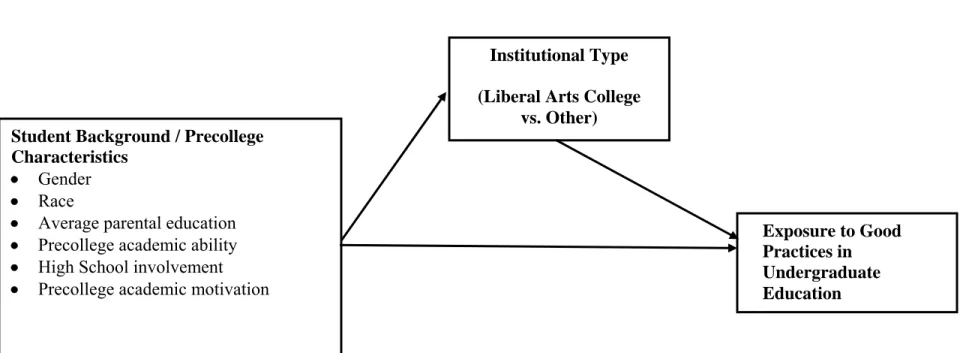
undergraduate education. To estimate these three effects, we conducted our analyses in two stages. In the first stage, we employed reduced-form equations (Alwin & Hauser, 1975) to estimate the total effect of attending a liberal arts college on exposure to good practices. Figure 1 visually portrays the conceptual model guiding these analyses. As the figure indicates, each of the six good practice scales was regressed on the three dummy variables representing
institutional type plus all student background/precollege characteristics and high school experiences specified in the section on control variables.
[Insert Figure 1 about here]
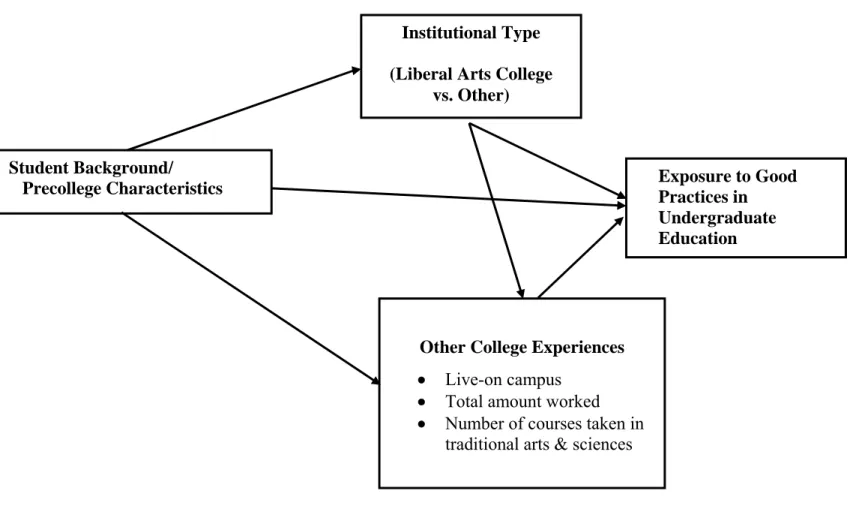
In the second stage, we estimated the direct (or unmediated) effects of attending a liberal arts college on exposure to good practices. This is visually portrayed in Figure 2. As the figure illustrates, the direct effects estimates of attendance at a liberal arts college are obtained by simply adding the battery of other college experiences to the total effects equations. The results from this set of equations also permit one to estimate the indirect effects of attendance at a liberal arts college on exposure to good practices (mediated through other college experiences) by subtracting the estimated direct effect from the total effect (Alwin & Hauser, 1975).
[Insert Figure 2 about here]
We also tested to see if the effect of attending a liberal arts college was the same for all students or if it differed by student background and precollege characteristics. In other words, we examined for the presence of conditional effects. We first created a series of cross-product terms, multiplying the institutional dummy variables by sex, parents’ education, precollege academic
preparation, high school involvement and precollege academic motivation. We added each of these blocks of cross-product terms to the regression model separately. A significant R2 increase in the variance explained indicated the presence of conditional effects (Pedhazur, 1982). For those regressions where a significant R2 was found between the full and the conditional models, we individually examined the nature of the significant conditional effects.
Our data analysis method takes into account the explicit survey design used in the study; schools served as the primary unit of sampling. Within schools, students are “clustered” or “nested.” A fundamental assumption of Ordinary Least Squares regression is that residuals are independent or are uncorrelated. Because students tend to be more like their peers within a school than with their counterparts between schools, failing to take into account the correlated nature of student residuals violates an OLS assumption (Ethington, 1997). This can result in artificially lower standard errors and erroneous significant relationships (Bryk & Raudenbush, 1992). Therefore, we account for schools as the primary sampling unit by using appropriate survey commands in our data analysis (Analyzing Correlated (Clustered) Data, n.d.).
LIMITATIONS
As with nearly all multi-institutional studies, the WNSLAE data have unequivocal limitations that should be kept in mind when interpreting the findings. First, although the overall sample included a broad range of different kinds of postsecondary institutions from 11 different states, the inclusion of only 19 institutions and the fact that institutions were not selected
randomly means that one cannot necessarily generalize the results to the population of all four-year and two-four-year institutions in the United States. Indeed, because a major purpose of the WNSLAE was to estimate the impacts of liberal arts colleges and liberal arts education, liberal arts colleges were purposefully over-sampled in the study. In turn, due to lower numbers of
students of color in private liberal arts colleges, our overall sample, while weighted to be representative of the actual institutional populations in the study, had a larger representation of Caucasian students (85%) than is found across the population of American postsecondary students. This situation was probably exacerbated by the fact that the two community colleges agreeing to participate in the study were located in the Midwest and did not have the more typically large population of minority students.
A second limitation is the fact that not all students who participated in the first
(precollege) data collection participated in the second (follow-up) data collection. The 68.5% persistence rate in the WNSLAE from the first to second data collections is quite consistent with other large longitudinal studies requiring a substantial amount of participation in terms of time and intellectual effort (see for example, the National Study of Student Learning, Pascarella, Edison, Nora, Hagedorn, & Terenzini, 1998). However, attrition from the first to second data collections is a major, if perhaps unavoidable, limitation of the study. Our weighting procedures adjusted the final sample for respondent bias by sex, race/ethnicity, tested precollege academics, and institution; but this in no way guarantees that those students who dropped out of study after the first data collection would have responded in the same way as their counterparts who persisted in the study from the first to second data collections.
RESULTS Total and Direct Effects
We present the estimated total and direct effects of liberal arts colleges (vs. other types of institutions) on good practices in undergraduate education in Table 2. Columns 1-4 in Table 2 show the total (columns 1 and 3) and direct (columns 2 and 4) effects on good practices relative to national research universities and regional institutions. Net of other causes, students attending liberal arts colleges had greater experiences of both “good teaching and high quality interactions
with faculty” and “academic challenge and high expectations” than students at either research universities or regional institutions. The net advantages of liberal arts colleges on both good practice dimensions were somewhat more pronounced in relation to research universities than regional institutions. In comparison to research universities, liberal arts colleges had an average total effect advantage of about .50 of a standard deviation on good teaching and high quality interactions with faculty and about .34 of a standard deviation on academic challenge and high expectations. This compared to respective advantages on these two good practices of about .28 and .26 of a standard deviation relative to regional institutions. Interestingly, the addition of other college experiences in the direct effects equations (columns 2 and 4) had negligible impact on either the magnitude or the statistical significance of the advantages accruing to students at liberal arts colleges. This suggests that the impacts of liberal arts colleges on “good teaching and high quality interactions with faculty” and “academic challenge and high expectations” are independent, not only of background characteristics and high school experiences, but also of whether or not one lived on campus, one’s work responsibilities during college, and the liberal arts emphasis of the coursework one took.
However, beyond “good teaching and high quality interactions with faculty” and “academic challenge and high expectations,” liberal arts colleges had only chance advantages over research universities and regional institutions on most of the other measures of good
practices. Although students at liberal arts colleges did report modest, but statistically significant total and direct advantages in cooperative learning experiences relative to their counterparts at regional institutions, there was no corresponding advantage relative to students at research universities. The parity among liberal arts colleges, research universities, and regional institutions on the “influential interactions with peers” and “frequency of interactions with
faculty/professional staff” dimensions suggests that students have similar levels of interaction with their peers and interact with faculty and staff with about the same frequency, regardless of where they attend college.
[Table 2 about here]
Columns 5 and 6 in Table 2 summarize the estimated total and direct effects of liberal arts colleges on good practices relative to community colleges. Although we reiterate the caution concerning the representativeness of the community colleges in our sample, the findings are somewhat unexpected. Net of confounding influences, students at liberal arts colleges generally reported a higher level of diversity experiences, frequency of interactions with
faculty/professional staff, and cooperative learning experiences than their counterparts at community colleges, although the total effect on frequency of interactions with
faculty/professional staff was reduced to nonsignificance once residential patterns, work, and liberal arts coursework variables were added to the model. Despite liberal arts colleges displaying advantages on several of the good practice dimensions compared to community colleges, there was parity on “good teaching and high quality interactions with faculty,” “academic challenge and high expectations,” and “influential interactions with peers.” In a secondary analysis, with controls in place for background characteristics, high school
experiences, other college experiences, and the clustering effect, we found community college students reported significantly higher levels of good teaching and high quality interactions with faculty than did their counterparts at both research universities (effect size = .685 of a standard deviation) and regional institutions (effect size = .427 of a standard deviation).
Our tests for the presence of conditional effects yielded 13 statistically significant effects. Nine of 13 conditional effects (about 70%) tended to be compensatory in nature (see Table 3). That is, attending a liberal arts college (vs. another type of college) tended to foster the greatest impact on engagement in, or exposure to good practices for students who entered postsecondary education with lower levels of tested precollege academic preparation and motivation, high school involvement, and family educational background.
[Table 3 about here]
This is most evident if one considers the conditional effects of liberal arts colleges vs. research universities. Although liberal arts colleges had an overall advantage relative to research universities in good teaching and high quality interactions with faculty, the advantage was nearly 1.6 times as strong for students in the lower half of the distribution of precollege academic preparation compared to their counterparts in the upper half of the distribution. Moreover, the conditional effects related to liberal arts colleges vs. research universities also demonstrate how estimates of total and direct general effects can, at times, be misleading. As summarized in Table 2, liberal arts colleges had no general advantage over research universities in fostering the good practice dimensions of diversity experiences and cooperative learning. However, this masked statistically significant advantages of liberal arts colleges on both good practices for students who entered postsecondary education in the lower half of the distribution of precollege academic preparation.
With one exception, attending a liberal arts college in comparison to a regional institution maintained the pattern of compensatory conditional effects on good practices. Although students with above average levels of precollege academic motivation reported greater levels of academic challenge at liberal arts colleges than at regional universities, on the whole, attending a liberal
arts college proved particularly beneficial to students with below average levels of high school involvement and tested precollege academic preparation. Students at liberal arts colleges who were involved in high school less than the average student reported more influential interactions with their peers and more engagement with cooperative learning pedagogies than their peers at regional institutions. Similarly, students, at liberal arts colleges with lower than average levels of tested precollege academic preparation reported higher levels of cooperative learning in the classroom than their peers at regional universities.
Community colleges tend to be the entry point into higher education for many students who have relatively lower levels of high school involvement, academic motivation, parental education, and precollege academic preparation. With one exception, our findings suggest attending a liberal arts college proves to be more beneficial in terms of experiencing good practices in undergraduate education for students who begin their postsecondary path with lower levels of these types of social and cultural capital as well as academic preparation. Students with lower than average levels of academic motivation at liberal arts colleges experienced lower levels of good teaching and high quality interactions with faculty than their peers at community colleges. Community colleges appear to provide a more structured and supportive learning environment for students with lower levels of precollege academic motivation than liberal arts colleges. However, attending a liberal arts college, compared to a community college, benefitted students with below average academic motivation in terms of academic challenge and high expectations; students with below average parental education reported greater levels of diversity experiences; and students with below average involvement in high school more frequently experienced cooperative learning pedagogies. The only conditional effect uncovered that did not involve these precollege characteristics was a conditional effect involving student sex. Although
students attending liberal arts colleges had an overall advantage relative to community college students in cooperative learning experiences, men almost totally enjoyed the advantage.
DISCUSSION
In general, students attending a liberal arts college, compared to another type of institution, reported greater engagement in, or exposure to, good practices in undergraduate education. Because of the extensive controls employed in the study, these effects cannot be generally explained by differences in the background characteristics, secondary school experiences, or tested academic preparation of students attending liberal arts colleges versus other institutional types. This study replicates key findings from previous research, extends the research to include community colleges, and uncovers important details embedded in the educational experience at liberal arts colleges. We discuss each of these in turn.
The significant net advantages of liberal arts colleges relative to both research universities and regional institutions on “good teaching and high quality interactions with faculty” and “academic challenge and high expectations” are remarkably consistent with the earlier findings of Pascarella et al. (2004, 2005) with the NSSL data. This clearly supports the robustness of the findings across different student and institutional samples separated by over a decade in time. However, our findings suggest that the advantages accruing to liberal arts colleges (compared to research universities and regional institutions) center on the in-class academic experience with faculty and thus may no longer be as extensive as previously indicated. We found liberal arts college students did not report any advantage in their level of diversity experiences compared to their peers at research or regional universities. This finding does not replicate the positive results of attending a liberal arts college reported by Umbach and Kuh (2006) nor does it support the negative finding reported by Jayakumar (2007). Additional
research is needed to better understand the effects of liberal arts colleges on diversity experiences but the evidence is fairly clear that liberal arts colleges provide an in-class academic experience with faculty that is based on challenge and interaction more so than research universities and regional institutions.
Since liberal arts colleges appear to provide the greatest exposure to good practices in undergraduate education, it seems to reason that educational stakeholders at larger institutions should place a priority on organizing their institutions in ways that best foster the uniquely challenging and supportive in-class environment of liberal arts colleges. In some cases, large universities have responded with initiatives to create more human scale learning environments by creating learning communities, Freshman Interest Groups, and honors programs or intentionally building smaller spaces for students to gather (Kuh, Kinzie, Schuh, & Whitt, 2005). Yet the findings of this study corroborate the widely held belief that large-scale universities are somehow less focused on creating ideal learning conditions. In the context of an increasing national emphasis on accountability in higher education (see U.S. Department of Education, 2006; Voluntary System of Accountability [VSA], 2008), larger institutions would be well-served to redouble their efforts toward providing the most effective educational environment. Since research universities, regional institutions, and community colleges educate the
overwhelming majority of American undergraduates, a large scale effort to reshape the educational experience of students at these institutions may be just as important as providing them with the financial means to enroll.
Community college research has tended to examine the effects of student background characteristics on experiences at the community college, such as interactions with faculty and peer relations (Chang, 2005; Hagedorn, Maxwell, Rodriquez, Hocevar, & Fillpot, 2000).
However, this research has not compared overall community college students’ experiences of good practices to their four-year college peers. To our knowledge, this study is the first to do so. Our findings suggest that the supportive, yet challenging, learning environment characterized by good teaching and an engaged faculty long associated with liberal arts colleges is equally present at community colleges. Despite lower levels of engagement with diversity experiences and cooperative learning pedagogies, community colleges did not differ from liberal arts colleges on either good practice measure related to the in-class academic experience with faculty. Given the connection between these good practice dimensions and student learning (Cruce et al., 2006), our findings suggest that community colleges are creating environments that promote student
learning on par with liberal arts colleges although we reiterated our earlier caution based on the small number of community colleges in the sample.
With community colleges educating 50% of all U.S. postsecondary students (Laanen, 2004) and disproportionately educating under-represented students (Bragg, 2001; Nora, n.d.) or those students with lower levels of social and cultural capital, these findings indicate that community colleges, overall, appear to be creating the kind of educational conditions that best fulfills their democratic mission. Policy makers need to recognize the critical role of community colleges in successfully educating student less likely to pursue higher education by investing in the resources and the personnel necessary to ensure that all community college students
experience the learning conditions most likely to foster success.
Lastly, this study adds substantial depth and detail to our understanding of the conditions that make a liberal arts college experience unique and advantageous. Specifically, these findings suggest that the positive effects of liberal arts colleges on good practices may often be
liberal arts colleges may be more likely to accrue to subgroups of students, particularly those who enter postsecondary education with lower levels of precollege academic preparation, academic motivation, parental education, and high school involvement. These compensatory effects advantaged students at liberal arts colleges who entered college with lower than average levels on these precollege and background characteristics compared to their peers at research universities, regional institutions, and community colleges. This adds substantial nuance to previous research suggesting that the influence of attending a liberal arts college on good practices is the same for all students (Pascarella et al., 2005).
These results have several important implications for the higher education community. First, they provide empirical evidence to support the century old claims of many liberal arts advocates. Faculty at any type of institution can teach course content but liberal arts colleges’ commitment to creating a challenging, yet supportive, learning environment sets them apart, particularly as this environment facilitates learning for students who approach postsecondary education with the greatest challenges (e.g., lower tested precollege academic preparation, motivation, and history of involvement with faculty and peers). Indeed, providing these students with the legitimate opportunity to succeed in college may require more than simply providing access. It likely requires a true institutional commitment to foster an environment based on high expectations, academic challenge and support for all students, and a dedication to undergraduate teaching and learning.
Given that attending a liberal arts college appeared to be particularly beneficial for those students who came to college with the greatest challenge, our findings add a sadly ironic twist to the efforts by many liberal arts colleges to improve their place in the popular national rankings published by U.S News, the Princeton Review, and others. By increasing an institution’s
selectivity index (and therefore, one’s overall rank), applicants who might demonstrate lower precollege academic preparation, less motivation, or less precollege involvement are less likely to be accepted into the very institutions best suited to provide them with the educational
environment vital to their ultimate success. In addition, this disconnect of educational conditions may be perpetuated by the continued growth of honors programs at large research universities and regional institutions. While such programs may provide meaningful experiences for the students who participate in them, in the context of an institution with limited resources, these findings suggest that institutions that invest in such narrowly targeted programs at the expense of other more inclusive educational conditions are in effect widening, rather than closing, the educational gap since the students who might benefit the most from increased exposure to educational good practices are those on the opposite end of the spectrum from the elite students for whom honors programs are designed.
Second, given that Cruce and colleagues (2006) found exposure to good practices to be powerful predictors of learning outcomes, our results add an important dimension to the national conversation regarding accountability for learning outcomes. To the extent that institutions choose to emphasize and reward their faculty and staff for creating environments that embody classroom-based good practices, it seems likely that student learning will be positively
influenced. Our findings suggest that efforts focused on learning outcome accountability may benefit more from improving learning environments that enhance learning than focusing solely on outcome attainment such as graduation rates (see VSA, 2008). Particularly for the large numbers of undergraduates who attend a research university or regional institution and are not among the academic elite, there is little evidence that simply identifying targeted outcomes
without fundamentally changing the learning environment is a commendable strategy for maximizing student success.
Advocates of liberal arts colleges will likely see these results as providing empirical evidence to support their longstanding claims of educational distinction. Although our findings replicate previous research in terms of the in-class academic environment nurtured by liberal arts college faculty, other critical dimensions of the learning environment, such as interactions with peers, diversity experiences, and frequency of interactions with faculty/professional staff, were more similar across institutional types than different, despite the generally smaller size and residential nature of liberal arts college campuses. This research provides educational stakeholders, regardless of institutional type, information from which they can intentionally reconsider the learning environment they create for students, asking if it best promotes student learning, and acting in ways consonant with institutional improvement.
REFERENCES
Alwin, D., & Hauser, R. (1975). The decomposition of effects in path analysis. American Sociological Review, 40(1), 37-47.
American Association of Colleges and Universities (2004). Taking responsibility for the quality of the baccalaureate degree. Washington, DC: Author.
Analyzing Correlated (Clustered) Data. (n.d). UCLA: Academic Technology Services, Statistical Consulting Group. Retrieved August 5, 2008 from
http://www.ats.ucla.edu/stat/stata/Library/cpsu.htm
Astin, A. (1993). What matters in college? Four critical years revisited. San Francisco: Jossey Bass.
Astin, A. (1999). How liberal arts colleges affect students. Daedalus, 128(1), 77-100.
B ragg, D. (2001). Community college access, mission, and outcomes: Considering intriguing intersections and challenges. Peabody Journal of Education, 76(1), 93-116.
Carnevale, A.P., & Desrochers, D. (2002). The missing middle: Aligning education and the knowledge economy. Washington DC: Office of Vocational and Adult Education, U.S. Department of Education.
Chang, J.C. (2005). Faculty-student interaction at the community college: A focus on students of color. Research in Higher Education, 46(7), 769-802.
Chickering, A. (1969). Education and identity. San Francisco: Jossey-Bass.
Chickering, A., & Gamson, Z. (1987). Seven principles for good practice in undergraduate education. AAHE Bulletin, 39(7), 3-7.
Chickering, A., & Gamson, Z. (1991). Applying the seven principles for good practice in undergraduate education. San Francisco: Jossey-Bass.
Chickering, A., & Reisser, L. (1993). Education and identity (2nded.). San Francisco: Jossey Bass.
Clark, B. (1970). The distinctive college: Antioch, Reed, and Swarthmore. Chicago: Aldine Publishing Company.
Cruce, T., Wolniak, G., Seifert, T., & Pascarella, E. (2006). Impacts of good practices on cognitive development, learning orientations, and graduate degree plans during the first year of college. Journal of College Student Development, 47(4), 365-383.
Ethington, C.A. (1997). A hierarchical linear modeling approach to studying college effects. In J.C. Smart (Ed.), Higher education: Handbook of theory and research, Volume XII (pp. 165-194). New York: Agathon Press.
Feldman, K. (1997). Identifying exemplary teachers and teaching: Evidence from student ratings. In R. Perry and J. Smart (Eds.), Effective teaching in higher education: Research and practice (pp. 368-395). Edison, NJ: Agathon Press.
Hagedorn, L., Maxwell, W., Rodriguez, P., Hocevar, D., Fillpot, J. (2000). Peer and study faculty relations in community colleges. Community College Journal of Research and Practice, 24, 587-598.
Hines, C., Cruickshank, D., & Kennedy, J. (1985). Teacher clarity and its relationship to student achievement and satisfaction. American Educational Research Journal, 22(1), 87-99. Jayakumar, U. M. (2007) Can higher education meet the needs of an increasingly diverse society
and global marketplace? Campus diversity and cross-cultural workforce
competencies. Ph.D. dissertation, University of California, Los Angeles, United States -- California. Retrieved August 6, 2008, from Dissertations & Theses: A&I database. (Publication No. AAT 3257180).
Kalantzis, M., Cope, B., & Harvey, A. (2003). Assessing multiliteracies and the new basics. Assessment in Education: Principles, Policy, & Practice, 10(1),15-26.
King, P.M., & Baxter Magolda, M.B. (2005). A developmental model of intercultural maturity. Journal of College Student Development, 46(6), 571-592.
Koblik, S., & Graubard, S. (Eds.). (2000). Distinctly American: The residential liberal arts college. Brunswick, NJ: Transaction Publishers.
Kuh, G., Kinzie, J., Schuh, J., Whitt, E., & Associates (2005). Student success in college: Creating conditions that matter. San Francisco: Jossey-Bass.
Kuh, G., Schuh, J., Whitt, E., & Associates. (1991). Involving colleges: Successful approaches to fostering student learning and development outside the classroom. San Francisco: Jossey Bass.
Laanan, F.S. (2001). Accountability in community colleges: Looking toward the 21st century. In B.K. Townsend & S.B. Twombly (Eds.), Community colleges: Policy in the future context (pp. 57-76). Westport, CT: Ablex Publishing.
Nora, A. (n.d.). Reexamining the community college mission. Retrieved August 12, 2008 from http://www.aacc.nche.edu/Content/NavigationMenu/ResourceCenter/Projects_Partnershi ps/Current/NewExpeditions/IssuePapers/Reexamining_the_Community_College_Missio n.htm
Pascarella, E., Cruce, T., Umbach, P., Wolniak, G., Kuh, G., Carini, R., Hayek, J., Gonyea, R., & Zhao, C. (2006). Institutional selectivity and good practices in undergraduate education: How strong is the link? Journal of Higher Education, 77(2), 251-285.
organization/preparation and teacher skill/clarity on general cognitive skills in college. Journal of College Student Development, 37(1), 7-19.
Pascarella, E., Seifert, T., & Whitt, E. (in press). Effective instruction and college student persistence: Some new evidence. New Directions for Teaching and Learning.
Pascarella E., & Terenzini, P. (1991). How college affects students: Findings and insights from twenty years of research. San Francisco: Jossey-Bass.
Pascarella, E., & Terenzini, P. (2005). How college affects students (Vol. 2): A third decade of research. San Francisco: Jossey-Bass.
Pascarella, E., Wolniak, G., Cruce, T., & Blaich, C. (2004). Do liberal arts colleges really foster good practices in undergraduate education? Journal of College Student Development, 45(1), 57-74.
Pascarella, E., Wolniak, G., Seifert, T., Cruce, T., & Blaich, C. (2005). Liberal arts colleges and liberal arts education: New evidence on impacts. San Francisco: Jossey-Bass/ASHE. Pedhazur, E. (1982). Multiple regression in behavioral research: Explanation and prediction
(2nd ed.). New York: Holt, Rinehart & Winston.
Rychen, D.S., & Salganik, L.H. (Eds). (2001). Defining and selecting key competencies. Seattle: Hogrefe & Huber Publishers.
Rychen, D.S., & Salganik, L.H. (Eds). (2003). Key competencies for a successful life and a well functioning society. Seattle: Hogrefe & Huber Publishers.
Seifert, T., Goodman, K., Lindsay, N., Jorgensen, J., Wolniak, G., Pascarella, E., & Blaich, C. (2008). The effects of liberal arts experiences on liberal arts outcomes. Research in Higher Education, 49(2), 107-125.
diversity. Harvard Business Review,74(5) 79-90.
Umbach, P., & Kuh, G. (2006). Student experiences with diversity at liberal arts colleges: Another claim for distinctiveness. Journal of Higher Education, 77(1), 169-192. U.S. Department of Education. (2006). A test of leadership: Charting the future of U.S. higher
education. Washington DC: Author.
Voluntary System of Accountability (2008). Overview of College Portrait. Retrieved May 14, 2008, from http://www.voluntarysystem.org/docs/cp/CollegePortraitOverview.pdf What matters in college after college. (2002, December). Minneapolis, MN: Hardwick Day. Whitt, E., Edison, M., Pascarella, E., Nora, A., & Terenzini, P. (1999). Interactions with peers
and objective and self-reported cognitive outcomes across three years of college. Journal of College Student Development, 40(1), 61-78.
Wood, A., & Murray, H. (1999). Effects of teacher enthusiasm on student attention, motivation, and memory encoding. Paper presented at the annual meeting of the American
TABLE 1 (continued)
Variable Name Operational Definition Mean SD
Community college Institutional type, coded 1=community college; 0 all others
0.14 NA Liberal arts college
(reference group)
Institutional type, coded 1=liberal arts college; 0 all others
0.25 NA
Other college experiences
Lives on-campus Residential living pattern, coded 1=lives
on-campus; 0=lives off-campus 0.77 NA
Hours worked on and off-campus Sum of two work variables, coded as 1=Did not work; 2=1-5 hours; 3=6-10 hours; 4=11-15 hours; 5=16-20 hours; 6=21-25 hours; 7=26-30 hours; 8=More than 30 hours.
3.67 2.11
Number of traditional arts & science courses in first year*
Total number of courses taken the first year in the following areas: arts & humanities, social
sciences, natural sciences, and mathematics.
6.28 2.17
Good practices: Educational practices and conditions
Good teaching and high quality interactions with faculty
23-item scale focusing on the areas of: faculty interest in teaching and student development; prompt feedback; quality of non-classroom interactions with faculty; and teaching clarity and organization. α = .92
TABLE 1 (continued)
Variable Name Operational Definition Mean SD
Academic challenge and high expectations
31-item scale on the areas of: academic challenge and effort; frequency of higher-order exams and assignments; challenging classes and high expectations; and integration of ideas, information, and experiences. α = .88
-0.07 0.46
Interactions with peers 9-item scale focusing on the areas of: number of hours engaged in co-curricular activities; degree of positive peer interactions. α = .85
-0.08 0.68
Diversity experiences 9-item scale focusing on the areas of: diversity experiences and meaningful discussions with diverse peers. α = .80
-0.11 0.62
Frequency of interacting with
faculty/professional staff 9-item scale focusing on the areas of: frequency of interactions with faculty; frequency of interactions with student affairs staff. α = .83
-0.05 0.65
Cooperative learning 4-item scale focusing on: students teaching each other; encouragement to participate in study groups; participation in study groups; working with other students on projects outside of class.
α = .70.
TABLE 2
Estimated Total (T) and Direct (D) Effects of Attending a Liberal Arts College on Good Practices in Undergraduate Education
Liberal Arts Colleges vs. Research Universities Liberal Arts Colleges vs. Regional Institutions Liberal Arts Colleges vs. Community Colleges Good Practice Dimension (1) Ta (2) Db (3) Ta (4) Db (5) Ta (6) Db
Good teaching and high quality interactions with faculty (SD = .601)c .298** (.496) (.531) .319** .170**(.283) (.273) .164** -.108 -.093 Academic challenge and high expectations (SD = .464)c .156* (.336) .169* (.364) .120** (.259) .117* (.252) .094 .111 Influential interactions with peers (SD = .677)c .071 .062 .073 .047 .205 .024 Diversity experiences (SD = .621)c .146 .160 .100 .080 .300** (.483) (.370) .230** Frequency of interactions with faculty/professional staff (SD = .652)c .082 .079 .080 .067 .220** (.337) .159 Cooperative learning (SD = .721)c .049 .080 .155* (.215) .137* (.190) .342** (.474) .248* (.344)
TABLE 2 (continued)
a Regression equations also include controls for: sex, race/ethnicity (African American, Asian/Pacific Islander, Latino, and other vs. Caucasian), average parents’ education level, tested precollege academic preparation, academic motivation, high school involvement, and the clustering effect.
b Regression equations also include controls for all variables listed in superscript “a” above, plus place of residence during college (on- or off-campus), hours of on- and off-campus
employment per week, number of liberal arts courses (i.e., fine arts, humanities, languages, natural sciences, social sciences, and mathematics) taken during the first year of college, and the clustering effect.
c The top number is the metric regression coefficient. The metric regression coefficient represents the average difference between liberal arts college students and comparison institution students on each good practice dimension, statistically adjusted for the clustering effect and for all controls listed in superscripts “a” or “b.” The number in parentheses is the effect size, or the metric regression coefficient divided by the pooled standard deviation of the good practice dimension. Thus, the effect size indicates that fraction of a standard deviation that liberal arts colleges are advantaged or disadvantaged (depending on the sign) relative to the comparison institutions. Only effect sizes associated with statistically significant metric
regression coefficients are reported. All others are considered zero. *p < .05. **p < .01.
TABLE 3
Estimated Conditional Effects of Attending a Liberal Arts College on Good Practices in Undergraduate Educationa
Institutional Type Comparison:
Good Practice Dimension Comparison Group
Metric Regression Coefficient
Liberal Arts Colleges vs. Research Universities: Good Teaching and High
Quality Interactions with Faculty
Above mean of tested
precollege academic prep. .261** (.434)
Below mean of tested precollege academic prep.
.410** (.682)
Diversity Experiences Above mean of tested
precollege academic prep. .044
Below mean of tested
precollege academic prep. .294** (.473) Cooperative Learning Above mean of tested
precollege academic prep. -.058
Below mean of tested precollege academic prep.
.211** (.293)
Liberal Arts Colleges vs. Regional Institutions: Academic Challenge and
High Expectations
Above mean of academic motivation
.194** (.418)
Below mean of academic motivation
.080
Influential Interactions with
Peers Above mean of high school involvement -.041
Below mean of high school
TABLE 3 (continued)
Institutional Type Comparison:
Good Practice Dimension
Comparison Group
Metric Regression Coefficient
Cooperative Learning Above mean of high school involvement
.092
Below mean of high school involvement
.180* (.250)
Above mean of tested precollege
academic prep. .090
Below mean of tested precollege
academic prep. .206** (.286)
Liberal Arts Colleges vs.
Community Colleges:
Good Teaching and High
Quality Interactions with Faculty
Above mean of academic motivation
.137
Below mean of academic motivation
-.258* (-.429)
Academic Challenge and
High Expectations
Above mean of academic motivation
.059
Below mean of academic motivation
.195* (.420)
Diversity Experiences Above mean of parents’ education
-.032
Below mean of parents’ education
.341** (.549)
TABLE 3 (continued)
Institutional Type Comparison:
Good Practice Dimension
Comparison Group Metric Regression Coefficient
Cooperative Learning Above mean of high school involvement
.205
Below mean of high school involvement
.401** (.556)
Above mean of tested precollege academic prep.
1.066** (1.478)
Below mean of tested precollege academic prep. .255* (.354) Men .527** (.731) Women .032
a Regression equations also include controls for: sex, race/ethnicity (African American, Asian/Pacific Islander, Latino, and other vs. Caucasian), parents’ education level, tested academic preparation, academic motivation, high school involvement, place of residence during college (on- or off-campus), hours of on- and off-campus employment per week, number of liberal arts courses (i.e., fine arts, humanities, languages, natural sciences, social sciences, and mathematics) taken during the first year of college, and the clustering effect. The top number is the metric regression coefficient and the number in parentheses is the effect size. Only statistically significant effect sizes are shown. All others are considered zero.
Student Background / Precollege Characteristics
• Gender • Race
• Average parental education • Precollege academic ability • High School involvement • Precollege academic motivation
Institutional Type (Liberal Arts College
vs. Other)
Exposure to Good Practices in Undergraduate Education
Student Background/ Precollege Characteristics
Institutional Type (Liberal Arts College
vs. Other)
Exposure to Good Practices in Undergraduate Education
Other College Experiences • Live-on campus
• Total amount worked • Number of courses taken in
traditional arts & sciences