Nijmegen
The following full text is a publisher's version.
For additional information about this publication click this link.
http://hdl.handle.net/2066/190323
Please be advised that this information was generated on 2018-05-01 and may be subject to
change.
Mixed Inductive-Coinductive Reasoning
Types, Programs and Logic
Proefschrift
ter verkrijging van de graad van doctor
aan de Radboud Universiteit Nijmegen
op gezag van de rector magnificus prof. dr. J.H.J.M van Krieken,
volgens besluit van het college van decanen
in het openbaar te verdedigen op donderdag 19 april 2018
om 16:30 uur precies
door
Henning Basold
geboren op 16 juni 1986
te Braunschweig (Duitsland)
Prof. dr. Herman Geuvers
Copromotor
Dr. Helle Hvid Hansen (Technische Universiteit Delft)
Manuscriptcommissie
Prof. dr. Bart Jacobs (Voorzitter)
Prof. dr. Neil Ghani (University of Strathclyde, Verenigd Koninkrijk)
Prof. dr. Tarmo Uustalu (Tallinn University of Technology, Estland)
Dr. Andreas Abel (Chalmers University of Technology en Götenborgs
Universitet, Zweden)
Dr. Ekaterina Komendantskaya (Heriot-Watt University, Verenigd Koninkrijk)
This research has been carried out under the auspices of the iCIS (institute for Computing and Information Science) of the Radboud University Nijmegen, the Formal Methods Group of the CWI, and the research school IPA (Institute for Programming research and Algorithmics).
This research has been supported by NWO (grant number 612.001.021).
c b a Copyright © 2018 Henning Basold, under a Creative Commons Attribution-ShareAlike 4.0
International License: http://creativecommons.org/licenses/by-sa/4.0/.
ISBN 978-0-244-67206-5 Typeset with XƎLATEX
Contents
Acknowledgements vii 1. Introduction 1 Notes . . . 16 2. Preliminaries 19 2.1. Reduction Relations . . . 192.2. General Category Theory . . . 20
2.3. Presheaves . . . 21
2.4. Fibrations . . . 24
2.5. Algebras, Coalgebras and Dialgebras . . . 25
2.5.1. Coinductive Predicates and Up-To Techniques in Lattices . . . 27
2.6. 2-Categories . . . 29
2.6.1. Adjunctions, Products, Coproducts and Exponents in 2-Categories . . . 33
2.6.2. Algebras and Coalgebras for Pseudo-Functors . . . 35
Notes . . . 36
3. Inductive-Coinductive Programming 37 3.1. Programming with Iteration and Coiteration . . . 37
3.1.1. Types and Terms of the Calculusλµν . . . 38
3.1.2. Computations inλµν. . . 43
3.2. Programming with Equations . . . 48
3.2.1. Types and Terms of the Calculusλµν= . . . 49
3.2.2. Computations inλµν= . . . 59
3.3. Relation Betweenλµν andλµν= . . . 66
3.4. Conclusion and Related Work . . . 67
Notes . . . 69
4. Observations 71 4.1. Observational Equivalence and Normalisation . . . 72
4.1.1. Observational Normalisation . . . 73
4.1.2. Tests and Observational Equivalence . . . 82
4.2. Category Theoretical Properties ofλµν and λµν=. . . 90
4.2.1. Simple Classifying Categories . . . 90
4.2.2. Classifying 2-Categories . . . 95
4.3. Conclusion and Related Work . . . 100
Notes . . . 104
5. Inductive-Coinductive Reasoning 107 5.1. Program Properties as Coinductive Predicates . . . 108
5.1.2. Observational Equivalence as Bisimilarity . . . 113
5.1.3. An Extensive Example: Transitivity of the Substream Relation . . . 119
5.2. A First-Order Logic for Observational Equivalence . . . 125
5.2.1. The LogicFOL▶ . . . 128
5.2.2. A Model, Soundness and Incompleteness . . . 137
5.3. (Un)Decidability of Observational Equivalence . . . 147
5.3.1. Observational Equivalence is Undecidable . . . 147
5.3.2. Decidability on a Language Fragment . . . 148
5.4. Discussion . . . 151
Notes . . . 157
6. Categorical Logic Based on Inductive-Coinductive Types 163 6.1. Hitchhiker’s Guide to Dependent Type Theory . . . 165
6.2. Categorical Dependent Recursive Types . . . 176
6.2.1. Introductory Example . . . 177
6.2.2. Signatures and Recursive Types . . . 178
6.2.3. Recursive-Type Complete Categories . . . 181
6.2.4. Recursive-Type Closed Categories . . . 187
6.3. Constructing Recursive Types as Polynomials . . . 188
6.4. Internal Reasoning Principles . . . 199
6.4.1. Internal Logic . . . 199
6.4.2. Induction and Dependent Iteration . . . 202
6.4.3. Coinduction . . . 210
6.5. A Beck-Chevalley Condition for Recursive Types . . . 212
6.6. Discussion . . . 216
Notes . . . 218
7. Constructive Logic Based on Inductive-Coinductive Types 223 7.1. The CalculusλPµ . . . 225
7.1.1. Raw Syntax . . . 227
7.1.2. Pre-Types and Pre-Terms . . . 228
7.1.3. Reductions on Pre-Types and Pre-Terms . . . 229
7.1.4. Well-Formed Types and Terms . . . 234
7.2. Examples . . . 237
7.3. Meta Properties . . . 243
7.3.1. Derivable Structural Rules . . . 244
7.3.2. Subject Reduction . . . 245
7.3.3. Strong Normalisation . . . 247
7.3.4. Soundness proof for saturated sets model . . . 251
7.4. Dependent Iteration . . . 255
7.5. An Application: Transitivity of the Substream Relation . . . 259
7.5.1. Some Preliminaries in Agda . . . 260
7.5.2. Streams and Bisimilarity . . . 262
7.5.3. Stream-entry Selection and the Substream Relation . . . 266
Notes . . . 273 8. Epilogue 277 References 279 Own Publications . . . 299 Subject Index 301 Notation Index 305 A. Confluence forλµν= 309 B. Proofs of Section 6.3 315 Summary 319 Samenvatting 321 Zusammenfassung 323 Curriculum Vitae 327
Acknowledgements
Ich sage: laßt alle Hoffnung fahren, ihr, die ihr in die Beobachtung eintretet. (Eng.: I say, abandon all hope, you who enter the realm of observation.)
— Galileo Galilei in Bertolt Brechts “Leben des Galilei”, Akt 9.
Before we start with the technical content of the thesis, I would like to thank a few people that contributed to its development in one way or another.
First and foremost, I would like to thank my supervisor Helle Hvid Hansen. Her infinite patience, her vast knowledge of scientific topics and the English language, and her attention to detail made me not only a better researcher but also a much better writer. Before I started my PhD, I did an internship at the CWI in Amsterdam with Marcello Bonsangue and Jan Rutten, who then also became my promoter. It was there that I met Helle the first time and we started to have scientific and non-scientific conversations. We also shared good evenings outside of work, through which I learned about very nice restaurants in Amsterdam, and one or two tricks in the kitchen. Both our discussions and Helle’s incredibly detailed feedback improved my research, mathematical and writing skills tremendously, and without them, my thesis would be far worse than it is now.
As I already mentioned, I did an internship with Jan before he became my promoter. Already at that time it became clear that Jan finds a good balance between giving one a lot of freedom and guidance. But not just that, Jan has also the ability, which amazes me every time, to make suggestions that open up new paths or lead to vast simplifications. This impression proved to be right, and I am greatly indebted to Jan in his role as my supervisor. Without him, I would have neither arrived at the research topics of my thesis nor at all where I am today. His constant support, his suggestions, feedback and his ability to listen are invaluable.
Last but not least, Herman Geuvers entered the team when my research shifted towards type theory. I learned a lot from Herman about logic and type theory. He has an enormous knowledge about these fields, and I could always come by and get an extensive answer. If the answer would be too complicated to be answered on the spot, he would go to his cabinet or bookshelf and take a printed publication, sometimes his own, that would answer the question. Indeed, the strong normalisation proof in the last chapter would not be there, had he not given me his ’94 paper on strong normalisation of the calculus of constructions. Making a long story short, Herman is another cornerstone in my development as a researcher, and I would like to wholeheartedly thank him for everything he did and the positive atmosphere he creates.
Overall, I am equally indebted to all of you, Helle, Jan and Herman, for your support, your kindness and what you have taught me. You were the best team of supervisors that I could envision! I would like to thank other people that have directly contributed to the content of this thesis. First, there is the reading committee consisting of Andreas Abel, Neil Ghani, Bart Jacobs, Ekaterina Komendantskaya and Tarmo Uustalu. I am grateful for all the time and effort they put into reviewing this, fairly lengthy, thesis and all the suggestions they made. In particular, I am happy that a fundamental flaw was found by Andreas before publication.
Next, there are all the people that I have collaborated with on publications: Damien, Helle, Henning G., Herman, Jan, Jean-Éric, Jurriaan, Katya, Marcello, Michaela, Niels and Stefan. I would like to thank all of them for being fantastic collaborators.
Finally, there are a few other people that I would like to mention because they had a direct influence on the content and even the existence of this thesis. I am especially indebted to Stefan Milius, who brought me into contact with Jan and thus opened up the path to my PhD. This resulted in an internship with Jan and Marcello. During this internship and afterwards, I had some outstanding discussions with Marcello, which resulted in my first publication. I am grateful for Marcello’s scientific guidance, which laid the foundations for my later work in theoretical computer science, particularly in the field of coalgebra.
Science demands a certain amount of dedication, a demand that can be very high at times and one that can only be fulfilled if we have people of support and collaboration around us. It is these people that I would like to dedicate the opening quote to. Brecht derived it from the inscription
“Abandon all hope, ye who enter here.” above the entrance to hell in Dante Alighieri’s La Divina
Commedia. The phrase is used by Galilei in Brecht’s play when he picks up again his studies on the rotation of the sun and describes his approach to science: Work slowly, question everything, repeat experiments and compare the outcomes, distrust everything that fits your beliefs, and only accept a result if all other possibilities can be excluded. This is a daunting task, which can not only be lonely at times but also carries the danger of becoming ignorant of the surrounding world. However, I was very lucky and met some fantastic people along the way, who reminded me about what is important in life and who were willing to share this daunting task. I mentioned my scientific collaborators and guides already above, but there are further important people in my life.
In particular, I would like to thank Pauline Chew, Simone Lederer and Jurriaan Rot. Pauline was always around with continuous support and for, often intense, conversations over food or late at night. Thank you, Pauline, for all this and, above all, for making me grow as a person. With Simone I had a perfect travel partner, who was always up for spontaneous activities in the weekend and for good conversations. To you also a big thank you, Simone, for the good time and the different perspectives you offered. And, I would like to thank you both, Pauline and Simone, for being my paranimphs. I met Jurriaan at the CWI, from where we became friends and research partners. Among the many interests that we share, our running sessions and bike rides, cooking and, of course, coalgebras are the most important ones to me. Thank you, Jurriaan, for all the good cooperation, and for your help with my thesis and articles.
The next shout goes out to my friends in Nijmegen, with whom I spent a great deal of my spare time, be it at dinners, watching films, going to concerts or to museums: Alexis, Dario, Elena, Gabriel, Jacopo, Joshua, Michael, Michele, Pauline, Robbert, Rui Fei, Simon, Sjef, Steffen and Tim, and my flatmate Katja. Some friends I also found in Amsterdam, like Nick, who was my flatmate for two years, and with whom I shared meals and good conversations in the evenings. Sung is another great person that I met at the CWI. We had many discussions about Reo and life in general. Thank you all for the pleasant time I had in the Netherlands, each of you knows what we share.
Among the fantastic people I met, there are also those that I am lucky to have or have had as colleagues. My first job was the civil service in the hospital in Braunschweig, where I found in Thomas Joosten and Jürgen Feß people, who supported me in my choice to study but also made me aware of possible pitfalls. I am thankful that I could work before and during my studies with Udo Hanfland and the people at BBR in Braunschweig, where I learned a lot about programming, project management and collaboration.
At the university in Braunschweig, I am indebted to Jiří Adámek, Michaela Huhn and Stefan Milius for their supervision of my master’s thesis. Also, I would like to thank Rainer Löwen for his lectures,
and Kristof Teichel for the good time we had racking our brains over (algebraic) topology.
The next stage was my time at the CWI, where I met many great people. The first was probably Alexandra Silva. I owe her a lot, as she brought me in contact with Nick, gave us some basic furniture and later often provided me with shelter in Nijmegen (thanks also to Neko for being such a good host!). Besides being an excellent cook, Alexandra was a good friend and colleague in Nijmegen. At CWI, I also got in contact with Matteo Mio with whom I have, on and off, good discussions about mathematics, logic, geeky topics but also some nice evenings out. Also Enric Cosme-Llópez was over at CWI as visitor and we had, both, in Amsterdam and in Lyon, a few good evenings. Since we are at it, I would like to thank also all the other people that I met at CWI: Dominik, Erik, Farhad (especially for the stories and film recommendations!), Frank (for the jokes and famous FM dinners), Joost, Julian, Kasper, Michiel, Nikos, Stijn and Vlad.
At the Radboud University itself, I crossed paths with many people that I would like to thank as well. One part of working at the university is teaching. I was lucky enough to assist in the combinatorics course given by Engelbert, who is a fabulous teacher and prepares everything so meticulously that there is nothing more that an assistant could wish for. Another part of working at the university is research and writing. I would like to thank Bart for his scientific and initial financial support, for his feedback and for managing the reading committee of my thesis. The last part of working is, of course, the environment. I am grateful for all the people at the Radboud university that made working there a pleasant experience: Aleks, Arjen, Baris, Bart, Bas S., Bas W., Bram, Camille, Dan, Elena M., Elena S., Engelbert, Erik, Fabian, Fabio, Freek, Frits, Gabriel, Guillaume, Hans, Henk, Herman, Ingrid, Irma, Jacopo, Jonce, Josef, Joshua, Jurriaan, Kasper, Kenta, Maaike, Markus, Mathys, Matteo S., Max, Maya, Michael, Michiel, Mohsen, Nicole, Niels, Paul, Perry, Peter, Ralf, Rick, Ridho, Robbert, Robert, Robin, Ronny, Ruifei, Saskia, Simone L., Simone M., Suzan, Tim, Tom C., Tom H., Twan, Zaheer. In particular, I would like to thank the Data Science group that I could still feel being a part of, even though I was technically in another group after the reorganisation.
And then there are the people that I met “in the wild”, that is, at conferences, workshops or other occasions. I am happy to be part of the coalgebra and TYPES community and would like to thank them for their very warm and welcoming atmosphere. Apart from the people that I have mentioned already, I would like to especially thank Andreas for our discussions that led me to the topics of the last two chapters; Clemens for hosting me in Edinburgh and for being a friend in general; Filippo for being a great roommate on Barbados and for initialising my contact to work in Lyon; Katya for our discussions and her invitations to Scotland; Neil for our joint workshop and his insights into category theory; Prakash for bringing together researchers through workshops and SIGLOG; Tarmo for my fantastic first experience of TYPES in Tallinn and our discussions; and finally Daniela for being a perfect flatmate and friend, who gave me also many scientific insights.
I want to end by coming back to my roots in Braunschweig, where I was happy to have found some very good friends: Anja, Christoph, Christian, Lea & Patrick and Philipp & Kathrin. Thank you all for your friendship and the great time we spent together. I would also like to express my gratitude in memory to Rudolf, Anselm, Inge, Helga & Alfred. And finally, I would like to thank my family, my parents and Virginie for their support and love.
Introduction
Thought must never submit, neither to a dogma, nor to a party, nor to a passion, nor to an interest, nor to a preconceived idea, nor to whatever it may be, save to the facts themselves, because, for thought, submission would mean ceasing to be.
— Henri Poincaré, 1909.1
The purpose of this thesis is to systematically study languages for specifying and reasoning about mixed inductive-coinductive structures and processes. We will focus mostly on type theoretic and category theoretic languages, but some of the reasoning principles are based on standard bisimula-tions and up-to techniques. In the course of this thesis, we will analyse existing simple type theories that allow the specification of inductive-coinductive processes, and we will exhibit several reasoning principles for these type theories: through category theory, by using coinductive predicates and rela-tions combined with up-to techniques, in form of a logic, and in certain cases by automatic decision procedures. Moreover, we will develop a dependent type theory, both category theoretically and as a syntactic calculus, that is based solely on inductive-coinductive types. As we will see, this type theory can serve as a framework for quite general inductive-coinductive definitions and proofs, and forms the pinnacle in expressivity of this thesis.
In the remainder of this introduction, we will motivate the study of inductive-coinductive reasoning and provide an overview of the developments that happen throughout this thesis. To illustrate why it is important to study inductive-coinductive reasoning in its own right, we will first discuss an example of an inductive-coinductive property that pervades this thesis and that illustrates beautifully how inductive-coinductive reasoning arises naturally in Mathematics and Computer Science. Afterwards, we will give a brief historical overview, discuss the problems that will be tackled in this thesis and detail the approach that we take. We will finish the introduction with a discussion of the contributions and outline of this thesis.
Background and Motivation
Are you sitting comfortably? Then let us dive into the story of mixed induction-coinduction and how it can help us in the practice of Mathematics and Computer Science.
Induction and coinduction are threads that cross the landscape of Mathematics and Computer Science as methods to define objects and reason about them. Of these two, induction is by far the better known technique, although disguised coinduction has always been around. It was only in recent years that we began to see through this disguise and developed coinduction as a technique in its own right. This led to some remarkable theory under the umbrella of coalgebra and to striking applications of coinduction.
One of the topics in coalgebra that is actively researched are so-called behavioural differential
equations (BDE) [Rut03; Rut05], which allow for very concise and intuitive process specifications, analogous to the differential equations from Mathematical Analysis. However, BDEs also inherit
from their analytic counterpart the problem that a system of equations may specify impossible behaviour, and therefore may not have a unique solution or may have no solution at all. The starting point of the research, which led up to this thesis, was thus to extend the known formats for BDEs to cover wider application areas, while guaranteeing that the specified behaviour in these more general formats is still well-defined. Once we have the ability to specify processes, it is natural to also investigate reasoning principles for such processes to, for example, to be able to compare their behaviour. Generalising process specifications and exhibiting reasoning principles for these processes were the two main goals of the NWO project “Behavioural Differential Equations” (612.001.021), in which part of the research for this thesis has been conducted. So how does mixed induction-coinduction fit into this agenda?
As it turns out, induction and coinduction are complementary techniques, they are dual in a
precise sense that we will discuss later. Being complementary, it is often necessary to use both techniques or even intertwine them. The combination of induction and coinduction allows us, for instance, to construe forms of behavioural differential equations whose expressiveness exceeds that of the currently available forms. We will also see that combined induction-coinduction is often used implicitly, just like induction and coinduction used to be. Thus, the purpose of this thesis is to systematically study the combination of induction and coinduction, which I hope, if anything, inspires others to work on and use inductive-coinductive techniques.
The perspective that we will take in this thesis is that of logic and computation. However, this should not limit the applicability of the results presented in this thesis to Computer Science. Rather, the logics developed here are largely independent of the field, as are many of the ideas. I think that many objects that occur in Mathematics, Computer Science, and other branches of science, in which we build formal models, lend themselves to a mixed inductive-coinductive description. Therefore, I wish to demonstrate, besides presenting general theory, also the use of inductive-coinductive objects in an accessible way. That being said, some parts of this thesis presuppose knowledge of category theory (Section 4.2 and Chapter 6) and an understanding of dependent type theory (Chapter 6 and Chapter 7). To support a reader unfamiliar with any of these, we provide in Section 6.1 a short introduction to dependent type theory, and introduce some notations and non-standard bits of category theory in Chapter 2. Despite these requirements, I hope that the reader may still find pleasure in reading this thesis, and may obtain new insights from examples like that in Section 7.5.
Induction and Coinduction
So what are induction and coinduction? And how can their combination contribute to our under-standing of problems in Mathematics and Computer Science and help solving these problems? The
way we will approach these questions is through the slogan that2
inductive objects describe terminating computations and values, whereas coinductive objects describe the behaviour of observable processes.
Consider, for instance, natural numbers and infinite sequences, from here on called streams, of
natural numbers. The former illustrate the idea of terminating computations that result in values:
every computation on natural numbers terminates in eitherzeroor thesuccessor of another natural
number. For instance, the number “1” is a value, since it is the successor of zero, whereas “1 + 2”
a natural number and a button labelled “tail”. If we push the button “tail”, the state of the box may change and a new number may be displayed on the box. We can observe the behaviour of the box by repeatedly pushing the “tail” button and noting down all the numbers that we see, thereby obtaining an arbitrarily long sequence of numbers. This is illustrated in the following diagram, where each square represents the unknown state of the box, the double arrows labelled “head” point to the displayed values, and “tail”-labelled arrows signify state changes through button pushes.
n0 head tail n1 head tail n2 head tail n3 head …
In fact, we can use these descriptions to characterise natural numbers and streams as follows.
First of all, for a given type3 X, we will write x : X if x is an element of type X. Let N be a
type of natural numbers and Nω a type of streams over natural numbers, both of which we will
characterise now without further specifying their internal structure.4 We have already said that the
natural numbers are characterised by having an element zero and a successor map, that is, there
is an element0 : N and a map suc: N→N. In contrast to this, the streams come with two maps
hd:Nω→N and tl: Nω→Nω that allow us to obtain the head and the tail of a stream. Note that
the structure on N allows us to construct elements of N, hence we will refer to0and suc generally
asconstructors. Streams have the dual property, their structure is determined by maps out of Nω, theobservations hd and tl that we can make on streams. Suppose now thatX is a type that comes
with a distinguished elementx0:X and a maps:X →X. We will compactly denote this as a triple
(X,x0,s)and call it analgebra. What makes N special among such algebras is that there is a unique
map f:N→X, such that, for alln:N,
f(0) =x0 and f(suc(n)) =s(f(n)). (1.1)
This is summed up by saying that (N,0,suc) is initial among all algebras (X,x0 : X,s:X → X).
Dually, streams are characterised by the property that (Nω,hd,tl) is final among all coalgebras
(Y,h:Y → N,t:Y →Y), which means that there is a unique map д:Y →Nω such that, for all
y:Y
hd(д(y)) =h(y) and tl(д(y)) =д(t(y)). (1.2)
We formulate now the properties of inductive and coinductive types more abstractly. Let1be a
type with the property that the pointx0is equivalently5 given by a mapz:1→X. If the types are
sets, then1is a set with just one element, say∗:1, and we would definez(∗) =x0. Similarly, we
require that0 :N is also given as a map zero: 1→N. These assumptions allow us to express (1.1)
more elegantly in terms of composition of maps:
f ◦zero=z and f ◦suc=s◦f. (1.3)
To express (1.2) in this way, we do not need any further assumptions:
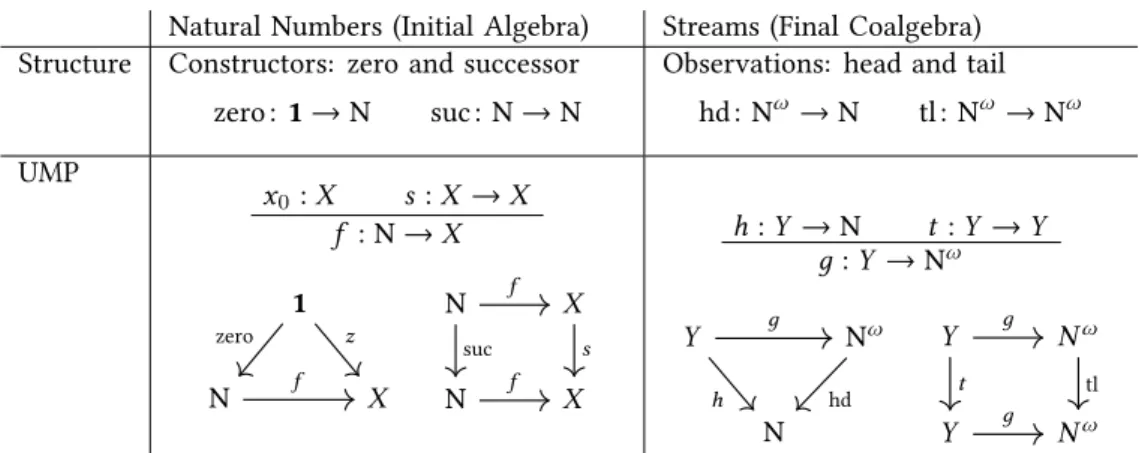
Natural Numbers (Initial Algebra) Streams (Final Coalgebra)
Structure Constructors: zero and successor
zero:1→N suc:N→N
Observations: head and tail
hd:Nω→N tl:Nω→Nω UMP x0:X s:X →X f :N→X 1 N X zero z f N X N X suc f s f h:Y →N t:Y →Y д:Y →Nω Y Nω N h д hd Y Nω Y Nω t д tl д
Table 1.1.: Defining properties of natural numbers and streams
Let us collect the defining properties of natural numbers and streams: natural numbers are determined by constructors and a universal mapping property (UMP) for maps out of N, whereas streams are
determined by their observations and a UMP for maps into Nω. This is summed up in Table 1.1,
where we express the existence of the maps f andдas proof rules and the equations (1.3) and (1.4)
as commuting diagrams.
To describe in general terms what initial algebras and final coalgebras are, we will work with a category C, which is a collection of objects and maps(also called morphisms) between them.6 We
write thenX :C, ifX is an object ofC, and f:X →Y, if f is a map fromX toY inC. The integral feature of categories is that we can compose maps of matching type: Given mapsX −→f Y →−д Z inC,
there is a composed mapд◦f:X →ZinC. This composition should also resemble the structure of
a monoid, in the sense that it is associative, and that for each objectX :Cthere is a distinguished
map idX:X →X, such that for all f:X →Y, we have f ◦idX =f and idY ◦f =f. The last bit
of lingo that we need is that of a functor. Afunctoris a mapF:C→Dbetween categoriesCand
Dthat maps objects and maps inCto objects and maps inD, while preserving the types of maps:
If f:X →Y is a map in C, then F(f) :F(X) → F(Y) is a map in D. Moreover, such a functor
must preserve identities and composition, analogous to monoid homomorphisms, which means that F(idX) =idF(X) and F(д◦f) = F(д)◦F(f). Using the language of category theory, we can now
describe abstractly what inductive and coinductive objects are.
In general, inductionarises from initial algebras andcoinduction from final coalgebras. Let Cbe
a category andF1, . . . ,Fn be functors with Fk:C→ C. An algebra for these functors7 is a tuple (X,a1, . . . ,an), whereX :Candak:Fk(X)→X. We say that an algebra(Θ,c1, . . . ,cn)isinitial, if
for each algebra(X,a1, . . . ,an)there is a unique map f: Θ→X, such that for allk= 1, . . . ,nthe
following diagram commutes.
Fk(Θ) Fk(X) Θ X ck Fk(f) ak f (1.5)
unique mapд:Y →Ωthat makes the following diagram commute fork= 1, . . . ,n. Y Ω Fk(Y) Fk(Ω) tk д dk Fk(д) (1.6)
Consequently, we call the maps dk of a final coalgebra observations. Returning to the original
terminology, initial algebras are inductive objects, while final coalgebras are coinductive objects. Moreover, it is fairly easy to see that the natural numbers object, as we described it in Table 1.1, forms with zero and suc an initial algebra for the functorsF1,F2:C→Cwith
F1(X) =1 F2(X) =X
F1(f) =idX F2(f) =f,
and that the streams object is final for the functorsG1,G2:C→C with
G1(X) =N G2(X) =X
G1(f) =idN G2(f) =f.
For instance, given an algebra(X,z,s), the equation that arises from (1.5) for the constructor zero
of the natural numbers is
f ◦zero=z◦F1(f).
SinceF1(f) =idX and by the laws of the categoryC, this equation reduces tof◦zero=z◦idX =z, which is the identity that we have already encountered in (1.3).
Weaving Together Induction and Coinduction
So far, we have explored inductive and coinductive objects separately. Let us now take a look, again with a computational angle, at an example that crucially combines inductive and coinductive objects.
Suppose we ask ourselves whether a streamσ is contained in another streamτ, that is, whether
all the entries inσ occur in order inτ. We say thatσ is a substreamofτ. For instance, a stream that only consists of ones is certainly a substream of a stream that alternates between zero and one.
We can display their relation pictorially as follows, where we draw a line between entries inσ and
τ to show how they need to be related, in order to prove thatσ is a substream ofτ.
τ: 0 1 0 1 0 1 0 · · ·
σ: 1 1 1 1 1 1 1 · · ·
τ1=tl◦τ
From this picture, we can extract a process for showing thatσ is a substream ofτ: The first entry
in σ is 1, which we can match with a 1 in τ by skipping the first entry in τ. Thus, we have
hd◦σ = hd◦τ1, where τ1 = tl◦τ. Having found the first match, we continue with the second
entry inσ. Indeed, we can match the second entry by hd◦σ1 =hd◦τ2, where σ1 = tl◦σ and
τ2=tl◦tl◦τ1. This process can be continued indefinitely, hence it is a coinductive process. However,
we note that it is important that finding an entry of σ inτ must not be an infinite process, for
otherwise the entry would actuallynotbe found. In other words, matching one entry inσ with one
inτ is a terminating computation, thus inductive.
We can define the substream relation as follows. Let us, for reasons of brevity, say thatσ is a
stream in Nω, ifσ:1→Nωand we write alsoσ :Nω. Moreover, let Rel(Nω,Nω)be the set of binary
relations between elements of Nω. The substream relation, which we will denote by ≤ here, will
be defined mutually with another relation⊴:Rel(Nω,Nω). These two relations together implement
exactly the matching process that we outlined above: The inductive part comes about by saying that σ ⊴τ, if we can obtain a streamτ1by dropping a finite prefix ofτ, such that hd◦σ =hd◦τ1. The
coinductive relation ≤ repeats this process indefinitely. Formally, the substream relation ≤ is the
largestrelation ≤:Rel(Nω,Nω), such that
∀σ,τ :Nω.σ ≤τ →σ ⊴τ, and ⊴:Rel(Nω,Nω)is theleast relation with
i) ∀σ,τ :Nω.(hd◦σ =hd◦τ)∧(tl◦σ ≤tl◦τ)→σ ⊴τ and ii) ∀σ,τ :Nω.(σ ⊴tl◦τ)→σ ⊴τ.
The clause for≤says that ifσ is a substream ofτ, thenσ is finitely matched byτ. On the other hand, the clauses of the finite matching relation⊴state thatσ ⊴τ, either if their heads match and the tail ofσ is again a substream of the tail ofτ, or ifσ finitely matchesτ after dropping the first entry fromτ. Since⊴is the least relation closed under these clauses, it indeed only allows finitely many dropping steps.
There are, of course, some subtleties in this definition and how to use it. Thus, we need a framework for inductive-coinductive definitions and reasoning, which prevents us from running into problems that are caused by those subtleties. Since, as we will see below, there are no mathematical frameworks that support inductive-coinductive reasoning to full extent, we set out in this thesis to develop such frameworks. In the end, we will have the ability to reason about the substream relation formally
and work with it in an intuitive way. For instance, if1ω is the stream of only ones and alt is the
stream alternating between 0 and 1, then an easy application is to show1ω ≤alt by simultaneously
showing that1ω ⊴alt and1ω ⊴tl◦alt.
Overall, this is an example that shows how inductive and coinductive reasoning naturally occur together and complement each other. These are the kinds of examples that motivate and drive the developments in this thesis.
Related Work and Origins
Given this motivation, let me sketch the evolution of induction and coinduction, and why we are only at beginning of the evolution of mixed induction-coinduction. This also allows us to show how this thesis fits into the existing literature.
Induction, as a proof technique on natural numbers, has been around implicitly since ancient times, for instance in a proof by Euclid of the infinitude of the prime numbers, but was only made explicit in the 17th century by Bernoulli. In the early 19th century it was popularised under the name “Mathematical Induction” [Caj18], which is still used to this date, though we will refer to it in this thesis just as induction. The name “Mathematical Induction” was chosen to distinguish it from the argumentation method of “induction”, as it is used in the natural sciences. However, the mathematical world had to wait until the end of the 19th century for a truly rigorous formulation of induction. One was given by Dedekind [Ded88] in, what we would call today, second-order logic and the other by Peano [Pea89] as a scheme in first-order logic. From there on, induction on natural numbers became a standard technique in Mathematics, and was further developed into transfinite or well-founded induction. A principal problem of restricting induction to natural numbers is that one has to code other inductive structures, like finite trees, as natural numbers. This process is sometimes referred to as “Gödelisation” because an integral part of Gödel’s incompleteness proof relies on coding formulas as natural numbers. With the advent of Computer Science it was realised that functions on inductive objects could be defined directly by “structural recursion” [Pét61] and that properties could be proved by “structural induction” [Bur69]. Throughout this thesis, we will refer to the former here just asiterationand the latter asinduction, no matter what the underlying inductive object is.
The Orgins of Coinduction
Just like induction, also coinduction has gone unnoticed for a long time. Most prominently, the methods for proving the equivalence of states in automata theory or worlds in modal logic featured concepts that are instances of coinduction. But even the function extensionality principle, namely that two functions are equal if and only if they are equal on every argument, is an instance of coinduction, as we will see. An important step towards exposing bisimulations was Milner’s work on concurrency [Mil80], where he gives an inductive definition of bisimilarity. The crucial step to exhibit the coinductive nature of bisimilarity was only taken by Park [Par81], who showed how bisimilarity can be constructed as a largest fixed point for a certain monotone function. Also set-theorists became interested in coinductive concepts, in the beginning of the 20th century only implicitly but later more explicitly. The goal there was to overcome the restrictions of the axiom of foundation, which ensures that the membership relation is well-founded. The problem then is to recover the notion of extensionality, namely that two sets shall be considered equal precisely when all their elements are equal. Aczel and Mendler [AM89] and Barwise et al. [BGM71] discovered that extensionality in non-well-founded set theory can be stated through coinduction, see also [BM96].
What really stands out in the work of Aczel [Acz88] is the use of final coalgebrasand a category
theoretical definition of bisimilarity [AM89]. From here on, coalgebras were studied in their own right as a theory of processes or systems, with Rutten [Rut00] laying the ground work for a systematic study of coalgebras and their properties. For insights into the historical development of coinduction, the reader may consult [San09], which focuses on modal logic, non-wellfounded set theory and order theory. The history of coalgebras is further discussed in [Rut00] and in the introductory texts [JR97; JR11; and Jac16].
and proof principles associated with them. Two strands, which are the ones important to us here,
are the development ofbehavioural differential equations and up-to techniques. We have mentioned
behavioural differential equations (BDE) already earlier as the starting point of this thesis. They were developed by Rutten [Rut03], building on the idea of input derivatives by Brzozowski [Brz64] and Conway [Con71], which fully specify the behaviour of certain systems. BDEs allowed Rutten to build a coinductive calculus of streams and formal power series, which he then uses to manipulate solutions of some analytic differential equations [Rut05]. This last step is an elegant reformulation of results by Pavlovic and Escardó [PE98]. The idea of using BDEs as process specification language was picked up and further developed, for example, for streams [HKR17; KNR11; Rut05], binary trees [SR10], automata theory [Han+14; KR12], context free languages [WBR11] and final coalgebras that are presented by so-called co-operations [KR08]. Up-to techniques are the other coalgebraic development that is important to us here. These were originally conceived as an improvement to coinduction by Milner [Mil89] in his work on concurrent processes, and further studied by Sangiorgi [San98]. Pous [Pou07] provided later a framework for the composition of up-to techniques, which was presented and studied by Bonchi et al. [Bon+14] in category theoretical form, and further expanded by Rot [Rot15].
Applications and Theory of Inductive-Coinductive Reasoning
The reason we went through the history of induction and coinduction is to show that both of them have been used implicitly for a long time, and only fairly recently have they been made explicit and studied in their own right. In fact, the same is true for mixed induction and coinduction. For instance, the sieve of Eratosthenes itself is an inductive-coinductive process, in that it produces the stream of prime numbers but requires an increasing, but finite, amount of computation steps to compute the next prime number, see [Ber05]. But also in the general theory of coalgebras it was realised that systems often need some further algebraic structure to, for example, model push down automata [GMS14], formulate structural operational semantics [Kli11; TP97] or define operations on coinductive objects [HKR17].
Of these, abstract generalised structural operational semantics [Bar04; TP97] is an interesting case because the studied objects there arebialgebras, that is, objects that carry both algebraic and coalgebraic structure. This happens usually because one aims to give operational semantics to a syntactic theory, hence the name of the framework. In this framework, one may find an initial bialgebra, which represents the operational semantics of the pure syntactic theory, and a final bialgebra, which models denotational semantics. Since these two bialgebras generally differ, we note that each of them only admits either induction or coinduction as proof technique, but not both.
There are many more examples, where induction and coinduction crucially occur together, like weak bisimilarity [CUV15; NU10; Rut99; San11], Kőnig’s lemma and the fan theorem [NUB11; TvD88], the study of continuous functions [GHP09a; GHP09b], Cauchy sequences, resolution for coinductive logic programs [KL17; KP11], and recursion theory [Bas18b; Cap05]. Surely, there are further examples that need to be uncovered, and I hope that this list inspires the reader to embrace the inductive-coinductive approach.
This list virtually screams for a general account of mixed induction and coinduction. So is it possible that no one has provided some general theory, given that inductive-coinductive reasoning seems to be so prevalent? Indeed, people considered general approaches to some aspects of inductive-coinductive objects. Most prominent are probably the cases of modal logic, programming and to some
that could refer to more than the (finite) number of steps that are specifiable with plain□^-formulas.
This lead Pnueli [Pnu77] to add further modal operators, resulting in linear time logic (LTL), that
allow one to state properties of finite trace prefixes and indefinitely long trace postfixes. In fact, this allows the expression of restricted inductive-coinductive modal properties. It was later realised that what LTL did could be expressed more generally as least and greatest fixed point formulas, thereby
motivating the development of the modalµ-calculus[Koz83]. The modal µ-calculus is an example
of a language, complemented by semantics [NW96] and proof systems [DHL06; Wal93], that deals with general inductive-coinductive properties, albeit in a restricted setting.
In the case of programming, many people have worked on general calculi that feature inductive-coinductive types. Probably the first to make such structures explicit and present them in a modern form were Hagino [Hag87] and Mendler [Men87; Men91]. Later, Geuvers [Geu92] studied inductive-coinductive types in their own right as well as inside the polymorphicλ-calculus of Girard [Gir71]. Most approaches, including the ones mentioned above, to programming with inductive-coinductive types are based on iteration and coiteration schemes [AMU05; Gre92; How96a; Mat99; UV99b].
However, more recently Abel and Pientka [AP13] and Abel et al. [Abe+13] suggested the use of
co-patterns, which are in a sense dual to the well-known patterns for inductive types. These copatterns enable very elegant specifications of inductive-coinductive processes by using recursive equations, as we will see throughout this thesis. In fact, the original motivation for studying copatterns was the aforementioned problem of extending behavioural differential equations, and copatterns certainly inspired parts of this thesis. Copattern specifications are now part of the Agda language [Agd15], which can serve both as a programming language and a “mathematical assistant” [Bar13]. Towards the end of this thesis, we will demonstrate that reasoning based on equational specifications with copatterns leads to compact proofs for properties of inductive-coinductive objects. Another mathem-atical assistant that should be mentioned here is Coq [Coq12], since it also provides the possibility to work with general inductive-coinductive objects, including predicates and relations. The problem with Coq is the inherently flawed view that is taken on coinductive types, as we will discuss in detail in Chapter 7. All of these existing calculi for constructing and reasoning about inductive-coinductive objects are, however, either too weak to serve as a general logic or they lack a formal correctness proof.
Then there are also order and category theory, which provide the most abstract accounts of induction and coinduction that there are. In principle, both ordered sets and categories give us the possibility to deal with higher-order recursion, in that we can construct initial and final objects that are themselves monotone functions or functors, respectively [AAG05; Kim10; Par79]. Yet this fact is hardly ever used, and it is one of the central themes in this thesis to take advantage of the construction of higher-order inductive-coinductive objects.
Speaking of category theory, Santocanale [San02b] has used categories, in which certain inductive-coinductive objects are available, to give semantics to parity games. Last but not least, inductive and coinductive objects also arose in categorical logic. For instance, in the work of van den Berg and de Marchi [vdBdM04] the aim is to formulate predicative set theory, that is, set theory without the power set axiom, by using categorical logic. This aim is very close to that of this thesis. Indeed, one of the main motivations, which drives the development of languages for inductive-coinductive reasoning here, is to contribute to foundations that allow us to formalise large parts of Mathematics and Computer Science in a constructive and computer-verifiable way. And once our reasoning
methods have evolved so far to attain this goal, we can free ourselves from Cantor’s “paradise”.
A Note on Terminology
To simplify the process of relating this thesis to existing work, we need to discuss the use of terminology here and elsewhere. In view of the type theoretic development, we will distinguish between the definition principles for maps on inductive and coinductive objects, and the associated proof principles. For the definition principle on inductive objects, the terms “recursion”, “iteration” and “induction” are often used interchangeably. However, I refrain from following this, and reserve “recursion” for general self-reference, “iteration” for the definition principle of maps out of inductive objects and “induction” for the proof principle. This matches also the traditional use of the term in recursion(or computability) theory. When it comes to coinductive objects, the situation is that “coinduction” is commonly used to refer to the definition principle (!) of maps into coinductive objects [San11]. The associated proof principle is in the theory of coalgebras called thecoinductive proof principle[JR11; Rut00] orbisimulation proof method, for an appropriate notion of bisimulation, cf. [Sta11]. We shall here, however, dualise the terminology for inductive objects and refer to the
definition principle of maps into coinductive objects as coiterationand the proof principles, which
allows us to show that elements of a coinductive object are equal, ascoinduction. This streamlines
the terminology in [Rut00] and follows, in the case of coinduction, the wording in [HJ97]. For convenience, we list this terminology with its meaning in the following table.
Inductive Objects Coinductive Objects
Definition principle Iteration: maps out of inductive
objects (also: inductive extension)
Coiteration: maps into coinduct-ive objects (also: coinductcoinduct-ive exten-sion [Rut00])
Proof principle Induction: uniqueness of iteration,
or no proper subalgebras, or min-imal structure closed under con-structors
Coinduction: uniqueness of coit-eration, or no proper quotients, or bisimilarity implies equality
Research Aims: How to Weave Induction and Coinduction
So, if induction and coinduction work so nicely together, why is it necessary to write a whole doctoral thesis on this topic? To clarify this, let us discuss the research aims that we will pursue here. First of all, some aspects in our motivating example may strike one at least as odd and as
being a burden. For instance, the necessity to represent elements of an object as maps out of1, or
even the need to rely on some external set theory to construct the substream relation. Thus, we are certainly in the need of a language that allows us to define and reason about inductive-coinductive objects in an accessible notation and without having to resort to any external theory. This leads us to our first objective, namely to
find and study languages for inductive-coinductive definitions and reasoning.
However, we know that humans make mistakes. Although we can learn from these mistakes, they should be avoided in published results that others rely on. A reasonable way to prevent mistakes
and proofs. Traditionally, we entrusted other humans with this task, with the advent of computers it was realised though that proof checking could be mechanised if only sufficiently many details are given. If we had languages, in which propositions and proofs can be implemented with reasonable effort and are automatically verifiable, then this would lead to a shift from technical (proof) details to the actual knowledge contained in publications. Hence, we obtain the requirement that
the studied languages should lend themselves to being automatically verifiable.
Once we have found such languages, we need to ask about the meaning of the objects that can be defined in those languages. In other words, we need to
provide semantics for the studied languages.
This semantics can, and will, be given in terms of category and set theoretical structures and in terms of operational semantics. Relating our languages to existing theories should be seen as a complementary perspective, which exhibits the differences between the theories.
Finally, to make the languages useful, they should
provide an abstraction level similar to category theory but make specifications and proofs easier to write and follow than in the language of categories.
This is somewhat vague, but notice that we used variables in the intuitive description of algebras
and coalgebras and the associated equations (1.1) and (1.2). That way, the behaviour of f and д
were clear from the outset. Moreover, we had to resort to identifying elements of an objectX with
maps1→X. This is not just awkward, but also not correct in general, for example in the case of
monoids or presheaves.
Put in general terms, the intention of studying languages for inductive-coinductive definitions and reasoning is to provide a framework that can serve as a logical foundation for category and set theory. Since we will give operational semantics to our languages, we gain some understanding of the languages on their own and we can equip them with meaning independent of other theories. If the languages are now sufficiently rich to accommodate category theory and set theory, then we are in the position to formalise and verify proofs for both of them. This is of course an ambitious goal that will not be fully attained in this thesis, but we will nonetheless contribute to it.
Methodology: The Weaving Tools
Having collected our research aims, let us now discuss how we will approach them. The major
viewpoint that runs trough this thesis is type theory. In type theory, one studies types and terms,
where each term crucially has a type. In particular, we will study three type theories. Two of them allow the definition of simple types like natural numbers and streams, while the third is a dependent type theory and thus will admit inductive-coinductive predicates and relations. But we will not restrict ourselves to type theory here. Indeed, we will also use category theory, coalgebraic methods and first-order logic to provide reasoning principles for the type theories.
On the Choice of Type Theory
So, why should we prefer to use type theory as framework, rather than just category theory or set theory? To explain this, we need to understand that category theory and set theory shine in certain areas but are problematic in others. For example, relationships between objects in a wide variety of situations are perfectly captured in categories, but categories in themselves are notoriously difficult to use as logic directly and the arising proofs are not automatically verifiable upfront. We saw the difficulty of using category theory already in the example, in particular in the identification of
elements with maps out of1. This difficulty will become even more visible in the elaborate example
below. Axiomatic set theory, on the other hand, allows us to mechanise proof checking, but forces us to work with explicit encodings, if not enriched with further abstractions (who would really want to write a pair as{{a},{a,b}}?). Finally, there are all kinds of philosophical issues with set theory, which I will not dwell on here too much. Let me just say that in mathematical practice, set theory is usually viewed as platonic, that is, one assumes a fixed universe of sets that exists independently
of our reality.8 Moreover, actual infinity is central to contemporary mathematical thinking and
practice [Fle07]. For example, whenever we say that(0,1,2,3, . . .)is the stream of natural numbers,
we signify that the process indicated by the dots can be completed to an entity that consists of all natural numbers. This is in stark contrast to the idea of coalgebras, which only describe the step-wise behaviour of processes. For instance, the stream of natural numbers would intuitively be specified by saying that its head is zero and that the further entries arise as the successor of the preceding entry. The point of using type theories is now that they allow us to describe infinite objects and processes abstractly, without the need to assume the existence of actual infinity, that is, without having to assume the existence of infinite sets as objects in themselves. In fact, we will see that the type theories allow us to directly express our intuitive understanding of natural numbers: the values (terms in normal form) of the natural numbers type are static representations of numbers, whereas the iteration and induction principle for that type expresses the dynamic character of counting.
Of course, one may object to this view on set theory, both on philosophical and practical grounds. However, I think that type theory is at the moment the approach that reflects, at least in principle, the mathematical practice of abstraction best. The hardest part is only to understand that proofs can be represented as terms, something we will explain in Chapter 6. Thus, the type-theoretic view on inductive-coinductive reasoning is in my opinion a fruitful one to study.
Now, this is a lot of praise for type theories, but we should also discuss their problems and disadvantages in comparison to category and set theory. The first thing that most people would notice, and which often triggers the rejection to use type theories, is the heavy syntactic burden that comes with them. This is certainly a problem, which is not yet solved. However, by using computers as “mathematical assistants” and by bringing type theories closer to mathematical practice, we should eventually overcome this burden. A good example, in my opinion, of a development in the right direction is Agda. Next, one may argue that all the abstraction that we can obtain with type theories can also be reached by using category theory. This is indeed true, but I also do not see category theory and type theory as competitors, they rather complement each other as discussed above and, for example, by Lambek and Scott [LS88]. Concerning (axiomatic) set theory versus type theory, this is mostly a philosophical issue as we saw, and merely a question of whether one accepts impredicative definitions, which were for example rejected by Poincaré; whether one accepts actual infinity, as it is rejected by constructivists and many pre-Cantorian mathematicians; and whether one is willing to combine impredicative definitions and actual infinity with the law of
Banach-Tarski paradox.
Outline and Contributions
After this somewhat philosophical digression, let us get back to the reality of this thesis and outline the scientific contributions that may be found here.
We will go through a variety of languages that present different aspects and expressivity of
inductive-coinductive objects. In particular, in Chapter 3 we study two typed calculiλµν andλµν=
that cover the natural numbers and streams types. By a typed calculus we mean a language that allows the construction of types, which correspond to the category theoretical notion of object, and terms that inhabit these types, which in turn correspond to maps. The reason for studying two languages is that the correctness of the first is easier to justify, whereas the second is easier to use but requires more advanced techniques in its justification. Both calculi have appeared in one or another form already, as we will discuss in Section 3.4. Thus, there is nothing new in the calculi themselves, but rather in the analysis of and reasoning principles for these calculi.
Analysis of and Reasoning Principles for the Calculi
λµν
and
λµν
=
In Chapter 4, we first define observational equivalence forλµν andλµν=in terms of a modal logic
and prove some basic properties of it. This equivalence builds on, but also refines, many existing ideas of program equivalences to make it work in an inductive-coinductive setting and to obtain the desired category theoretical properties. These category theoretical properties are to show that the
types in both calculi have the expected unique mapping properties up to observational equivalence,
which we will express by using 2-categories. Employing 2-categories to study properties of programs is, next to the definition of observational equivalence, the second contribution of Chapter 4. Both observational equivalence and its category theoretical properties, although not described by using 2-categories, appear already in
[BH16] Henning Basold and Helle Hvid Hansen. ‘Well-Definedness and Observational
Equivalence for Inductive-Coinductive Programs’. In: J. Log. Comput. (2016).
The established 2-categories give us already some first reasoning principles for the calculi λµν
andλµν=. However, these principles are fairly difficult to use directly, which leads us to study in
Chapter 5 three approaches to expressing and proving properties of programs of the calculi from Chapter 3. The first approach is based on bisimulations, which we prove to be adequate for the modal logic that defines observational equivalence, in the sense that bisimilarity coincides with observational equivalence. This shows that existing notions from the theory of coalgebra can be instantiated even in a mixed inductive-coinductive setting. Furthermore, we show in an extensive example that the substream relation, which we discussed earlier, is transitive. Since this relation is defined as a mixed inductive-coinductive relation, we establish an up-to technique that allows us to combine induction and coinduction in a novel way.
We will also see that it is not easy to use these bisimulations. Therefore, we are led to study another approach, which consists of providing a logic that supports reasoning about inductive and coinductive types, and the corresponding terms, equally well. The main reason for this logic
being easier to use than bisimulations is that it allows proofs to be recursive, that is, it provides a mechanism, the so-calledlater modality, for (controlled) self-references in proofs. Crucially, the later modality enables us to ensure the correctness of recursive proofs locally through inference rules and saves us from having to construct explicit bisimulations. By giving sound semantics to this logic in terms of the earlier studied bisimulations and up-to techniques, we obtain another proof method for observational equivalence. For proofs that involve induction, this method is easier to use than the method based on bisimulations. Moreover, the logic gives rise to automatically verifiable proofs, which is demonstrated in a prototype implementation that accompanies the chapter. To my knowledge, such a logic has not been studied before. However, in
[Bas18a] Henning Basold. ‘Breaking the Loop: Recursive Proofs for Coinductive Pre-dicates in Fibrations’. In: arXiv (2018). arXiv: 1802.07143.
I tried to condense the essentials of this logic and present it in the setting of general fibrations. The link between this generalisation and the here presented logic is not made in this thesis.
The last approach to proving observational equivalence we study in Chapter 5 is fully automatic. This allows us to prove or disprove the equivalence of simple terms without human intervention. Both the decision procedure for the language fragment and the accompanying correctness proofs are new, although similar approaches have been studied for non-deterministic automata. We finish Chapter 5 by showing that the automatic approach necessarily has to be restricted to fragments of the languages from Chapter 3. This approach is thus limited in its applicability, compared to the previous proof techniques.
Of these three proof techniques, the bisimulation and the automated method have been presented in [BH16]. The extensive substream example in Section 5.1.3 and the logic in Section 5.2 are unpublished.
Categorical Dependent Inductive-Coinductive Types
Note that in the definition of the substream relation we had to resort to set theory, which is external
to the categoryC. Up to Chapter 5, the provided languages only allow the simple types like that of
natural numbers or streams, and some basic reasoning about them, but it is not possible to define the substream relation directly in any of these languages. Thus, the next logical step is to provide languages that support also inductive-coinductive predicates and relations. This is the topic of the last two chapters, where we develop a dependent type theory that is purely founded on inductive-coinductive types. Preference was given to dependent type theory rather than the usual syntactic proof systems, as they appeared in Chapter 5, because type theory generalises much better the ideas behind the languages in Chapter 3 to predicates and relations. Moreover, proofs that one writes in a dependent type theory can be readily verified by means of type checking. This motivation behind dependent type theory is further explained in the guide in Section 6.1.
We develop in Chapter 6 requirements on categories that allow us to construct and reason about inductive-coinductive types, which encompass the types from Chapter 3 and inductive-coinductive
predicates and relations. Such categories will be calledµP-complete categories. Moreover, we show
that categories, which admit initial algebras for polynomial functor, are µP-complete under some
mild conditions. Both developments stem from
EPTCS. Open Publishing Association, 2015, pp. 3–17,
but the full proofs were not presented there. We further analyse in Chapter 6 the consequences of the
requirements on anµP-complete category, to the effect that we establish induction and coinduction
principles inside these categories. Finally, we give a first account of the relation of µP-complete
categories to the syntactic calculus we study in Chapter 7.
The basic idea of Chapter 6, to represent inductive-coinductive types as initial and final dialgebras, is an extrapolation of the approach by Hagino [Hag87] to dependent types. Apart from this, all the presented results in this chapter are new.
Syntactic Dependent Inductive-Coinductive Types
The final Chapter 7 provides a calculus, which casts the category theoretical language from Chapter 6 into syntactic form. To show that the resulting calculus can serve as a basis for reasoning about inductive-coinductive objects, we provide a representation of first-order intuitionistic logic in the calculus and show that it is consistent as such. In technical terms we show that the reduction relation for that calculus preserves types and is strongly normalising. Both the calculus and its mentioned properties are a novel development and have been presented in
[BG16a] Henning Basold and Herman Geuvers. ‘Type Theory Based on Dependent
Inductive and Coinductive Types’. In: Proceedings of LICS ’16. Logic In Computer
Science. ACM, 2016, pp. 327–336,
where the full proofs may be found in [BG16c]. We finish the chapter, and the thesis, with an application of inductive-coinductive reasoning, which also serves as a running example.
The Substream Relation as Running Example
Throughout this thesis we follow one example that illustrates the stages of development. This example is, how could it be any different, of mixed inductive-coinductive nature. The aim of this example is to define and reason about thesubstream relationthat we have seen earlier. In particular, we want to show that this relation is transitive. We will take our first step towards defining the substream relation in Chapter 3 by selecting entries of streams, which is interestingly an inductive-coinductive process. The substream relation is defined in Example 5.1.13 in terms of stream entry selection, which allows us to prove in Section 5.1.3 that the substream relation is transitive. In Chapter 6, we review the definition of the substream relation and obtain a direct description of it as an inductive-coinductive relation, without having to go through the process of selecting from streams. We end Chapter 7 by representing this direct definition and the transitivity proof for the substream relation in a theory of dependent inductive-coinductive types.
Further Contributions Beyond This Thesis
Apart from the above mentioned publication, the author has participated in the following contri-butions, which, unfortunately, did not make it into this thesis due to size constraints: [Bas+14a; BGvdW17; Bas+14b; Bas+15; Bas+17; BK16; BPR17].
Reading Advice
A quick word on how to read this thesis. Each chapter consists of an introduction, the main content and a discussion of the content, related work, technical contributions and future work. Moreover, the text is often annotated with further thoughts, remarks and some technical points. These annotations appear at the end of each chapter, so as to avoid disrupting the actual text with littering remarks. Let us also mention the dependencies between the content of the chapters. Chapter 3 provides the basic object languages, for which we will provide reasoning techniques in Chapter 4 and Chapter 5. The latter Chapter 5 depends crucially on the notion of program observation that we define in Chapter 4. To read the last two chapters it is not necessary to have read any of the previous ones, but it certainly helps to have done so. Also, it is not strictly necessary to read Chapter 6 before Chapter 7, although the ideas for dependent inductive-coinductive types are mainly developed in Chapter 6. Finally, since we use categories and many other technical notions, Chapter 2 provides for convenience an overview of theory that is frequently used throughout the thesis, and which can be consulted at any time.
Notes
1 In Œuvres de Henri Poincaré (1956), p. 152.
2 Sangiorgi [San11] describes coinduction as the study of cyclic processes. I find this view too
narrow, as it excludes, for instance, the sampling of physical (stochastic) processes, Brouwer’s choice sequences or real numbers that are not computable. Admittedly, in the study of languages for inductive-coinductive reasoning, the only processes we can describe by finite means necessarily have to be cyclic. However, restricting ourselves to only cyclic processes would imply, for example, that there are only countably many real numbers. Let us not get too much into philosophical discussions on Platonism etc. here, but just cherish the idea that coinductive objects appear in a wide range of situations. We will also find that function spaces are coinductive objects and, even though one can see functions as non-cyclic cyclic processes, this stretches the “cyclic processes” perspective quite a bit.
3 The word “type” has at this point no formal meaning, rather it rather refers to abstract entities, whose
only criterion is that they we are able to decide whether something is an element of it, cf. [Wet14]. Note that the use of the notationx:X for stating thatx is of typeX is consistent with the notation
for maps in categories: Given objectsAand B in a categoryC, the notation f:A→B can be read
as “f is of typeA→B”, whereA→B is the type of maps fromAtoB in the categoryC.
4 The approach of leaving the internal structure of types unspecified is typical for both category theory
and type theory. This is also their biggest strength compared to (axiomatic) set theory, where one does specify the internal structure of types, here sets, and derives their properties from there.
5 In general categories this characterisation of natural numbers does, of course, not work. For instance,
the correct way to identify the properties of natural numbers in the category of monoids and their homomorphisms is as a free monoid with one generator. Since we are more interested here in foundations for definitions and reasoning, we will not talk explicitly about categories, in which the objects have additional (algebraic) structure. That being said, the dependent type theory, which we