ScholarWorks
Walden Dissertations and Doctoral Studies Walden Dissertations and Doctoral StudiesCollection
2018
Special Educators' Perceptions on Effective
Preparation and Practice for Student Success
Anne Brackney LieseWalden University
Follow this and additional works at:https://scholarworks.waldenu.edu/dissertations Part of theElementary and Middle and Secondary Education Administration Commons, Psychiatric and Mental Health Commons,Secondary Education and Teaching Commons,Special Education Administration Commons, and theSpecial Education and Teaching Commons
This Dissertation is brought to you for free and open access by the Walden Dissertations and Doctoral Studies Collection at ScholarWorks. It has been accepted for inclusion in Walden Dissertations and Doctoral Studies by an authorized administrator of ScholarWorks. For more information, please [email protected].
Walden University
College of Education
This is to certify that the doctoral dissertation by
Aerial Anne Liese
has been found to be complete and satisfactory in all respects, and that any and all revisions required by
the review committee have been made.
Review Committee
Dr. Barry Birnbaum, Committee Chairperson, Education Faculty Dr. Asoka Jayasena, Committee Member, Education Faculty Dr. Danielle Hedegard, University Reviewer, Education Faculty
Chief Academic Officer Eric Riedel, Ph.D.
Walden University 2017
Abstract
Special Educators’ Perceptions on Effective Preparation and Practice for Student Success by
Aerial Anne Liese
MA, New Mexico Highlands University, 2005 BA, University of New Mexico, 1997
Dissertation Submitted in Partial Fulfillment of the Requirements for the Degree of
Doctor of Philosophy Education
Walden University November 2017
Abstract
Alternative school settings are success prospects for students at risk of school failure. However, research on the daily experiences of the special educators in alternate school settings tasked with educating the at-risk population, is limited. The purpose of this phenomenological study was (a) to recognize the perceptions of special educators concerning their preparation to advance the success of SEN students who are at risk of school failure; (b) to determine how to improve special educator preparation programs in alternative school settings. Deci and Ryan’s self-determination theory, focused on student success provided the study’s framework. Twelve semistructured interviews were
conducted to examine special educators’ perceptions on preparation and practice for student success. Data were analyzed through block coding, code comparison and
thematic searches. The study’s results included accounts of special educators’ perceptions and challenges related to preparation and practice for student success in alternate school settings. Emergent themes included applying classroom structure and technology, as well as individualized student instruction. Participants cited a need for rich teacher/student relationships to advance student success. Included are inferences regarding the development of teacher/student relationships. Also included are suggestions for
educational leaders to consider while preparing preparatory methods for special educators who teach within the alternative school setting such as administrator knowledge of what special educators require to teach in the alternate classroom. This study may lead to social change by providing information on special educator preparation coursework meant to develop student success for the alternative school student population.
Special Educators’ Perceptions on Effective Preparation and Practice for Student Success by
Aerial Anne Liese
MA, New Mexico Highlands University, 2005 BA, University of New Mexico, 1997
Dissertation Submitted in Partial Fulfillment of the Requirements for the Degree of
Doctor of Philosophy Education
Walden University November 2017
i
Table of Contents
List of Tables ... vii
List of Figures ... viii
Chapter 1: Introduction to the Study ...1
Introduction ...1
Background ...3
Additional Background Information ... 6
A Call for Social Change ... 8
Audience ... 14
Problem Statement ...14
Purpose Statement ...15
Research Questions ...16
Conceptual Framework ...16
Nature of the Study ...17
Operational Definitions ...18
Assumptions ...22
Scope ...22
Delimitations ...22
Limitations ...23
Significance of the Study ...24
Chapter Summary ...26
ii
Introduction ...28
Literature Search Strategy...29
Conceptual Framework ...29
Student Learning Disabilities and Emotional Disturbances Are Disproportionate ... 31
Special Educator as Teacher and Motivator ... 32
Psychological Needs within the SDT Framework ... 35
ACE Impact on Student Learning, Motivation, and School Engagement ... 37
Literature Review...41
Vocalizing the Need for Effective Special Education Teacher Preparation ... 43
Defining Alternative Education ... 45
Demographics of the Alternative School Setting ... 51
The Current State of Special Education Teacher Preparation Programs ... 53
A Need for 21st-Century Classroom Policies and Practices ... 54
Traditional Versus Alternative Routes to Special Education Teacher Licensure ... 57
The Significance of Effective Special Education Teacher Preparation ... 62
Preparing Special Educators to Know the Laws of Their Profession ... 63
Preparing Special Educators to Understand Their Student Population ... 65
Effective Special Education Teacher Preparatory Practices ... 67
Chapter Summary ...77
iii
Introduction ...79
Research Questions ...79
Research Design and Rationale ...80
The Role of the Researcher ...81
Methodology ...82
Participant Selection Logic ... 83
Instrumentation ... 84
Interview Questions ... 85
Procedures for Recruitment, Participation, and Data Collection ...86
Data Analysis Plan ... 87
NVivo Software Use ... 88
Emerging Patterns and Themes ... 88
Patterns and Themes Analysis ... 89
Issues of Trustworthiness ...89
Credibility ... 90
Transferability ... 90
Dependability ... 90
Ethical Procedures ... 91
Institutional Review Board Documents ...91
Ethical Concerns ...92
Treatment of Data ...92
iv Chapter 4: Results ...94 Introduction ...94 Research Questions ...94 Setting ...95 Participant Demographics ...96 Data Collection ...97 Data Analysis ...98 Evidence of Trustworthiness...98 Credibility ...99 Transferability ...99 Confirmability ...99 Dependability ...100 Results ...100
Emergent Theme 1: The Importance of Collaborating with Colleagues ... 103
Emergent Subtheme 1(a): Collaborating Weekly with Colleagues is Ideal ... 105
Emergent Subtheme 1(b): Coteach as Much as Possible ... 107
Emergent Theme 2: Make a Connection with Students... 108
Emergent Subtheme 2(a): While Connecting to Students Target Their Self-Esteem ... 110
Emergent Subtheme 2(b): While Connecting to Students Promote Independence ... 112
v
Emergent Theme 4: Set High Expectations ... 115
Emergent Theme 5: Focus on Language Development Challenges ... 116
Emergent Theme 6: Structure is Necessary for Student Success ... 117
Emergent Theme 7: Avoid Unrelated Work as Students Sense its Irrelevancy ... 119
Emergent Theme 8: Work Towards Transitions Using Community Resources ... 120
Emergent Theme 9: Use Individualized Instruction ... 121
Emergent Subtheme 9(a): Consider the Influence of a Student’s Background ... 123
Emergent Theme 10: Use Technology ... 124
Emergent Subtheme 10(a): Use Technology to Engage Students ... 125
Summary ...126
Chapter 5: Discussion, Conclusions, and Recommendations ...129
Introduction ...129
Interpretation of the Findings...130
Limitations of the Study...136
Recommendations for Further Research ...137
Implications...139
Reflections ...140
Conclusion ...140
vi
Appendix A: Interview Guide (Protocol/Questions) ...205 Appendix B: Demographics of Participants ...207 Appendix C: Participant Responses with Visual Representation ...208
vii List of Tables
Table 1. Special Education Services Categorized According to IDEA (as cited in Lee,
2016) ... 68
Table 2. Participant Age and Educational Pathway ... 97
Table 3. Responses to Themes and Subthemes ... 102
Table 4. Frequency of Themes for Achieving Student Success ... 130
viii List of Figures
Figure 1. Framed definition of the term perceptions ...7 Figure 2. Framed definition of the term perceptions ...8 Figure 3. Standards for the NCTQ (2013) teacher prep review as pertaining to special education ...56 Figure 4. Effective program features according to Darling-Hamond (2014) ...57 Figure 5. Maslow’s hierarchy theory vs. self-determination theory (SDT) ...135
Chapter 1: Introduction to the Study
Introduction
U.S. education reform efforts, including the Every Student Succeeds Act (ESSA, 2015), have placed pressure on education stakeholders and their accountability systems to meet expectations to prepare students for postgraduation (Cochran-Smith & Villegas, 2015; Shin, Lee, & McKenna, 2016; Sledge & Pazey, 2014). Learning institutions across the United States are being challenged to raise student success rates by implementing effective instructional strategies—evidence-based practices (EBPs)—that are grounded in research and proven to yield successful results (Cornelius & Nagro, 2014; Detrich & Lewis, 2013; McLaughlin, Smith, & Wilkinson, 2012). In this research study, student
success was defined as theacademic achievement by a student that leads to obtaining a
traditional high school diploma or general education diploma (GED; Roberson, 2015; Smith & Thomson, 2014; Sullivan & Downey, 2015).
Administrators in U.S. schools expect that special education teachers effectively use EBPs in their classrooms, as directed by the Individuals with Disability Education Act (IDEA; Broughal, 2015; Cook et al., 2015). IDEA requires that every student with special educational needs has an individual education plan (IEP) and dictates that "a
statement of the special education and related services… based on peer-reviewed
research to the extent practicable, to be provided to the child" (Sec. 20). However, the availability of EBPs for the instructional purposes of special education teachers is limited (Cook et al., 2015). To meet U.S. education reform efforts, schools nationwide must engage in new initiatives and methods to increase the availability of EBPs for students
with special needs. Educators can use these academic initiatives and methods in the
alternative school setting (Every Student Succeeds Act, 2015; IDEA, 2004; Kruse, 2012).
In this study, an alternative school setting was defined as a public high school that works to address the needs of students that “typically cannot be met in a traditional school, provides a nontraditional education, serves as an adjunct to a regular school, or falls outside the categories of regular, special, or vocational education” (Porowski, O'Conner & Luo, 2014, p. 1). An example of these initiatives includes supportive socioemotional EBPs for students who are at risk of school failure and have diagnosed special
educational needs (SEN; Edwards, 2013; Kronholz, 2012). SEN refers to students whose classroom learning is challenging, irregular, slow, or otherwise problematic in
comparison to their peers (Edwards, 2013; Kruse, 2012). SEN is legally defined under IDEA as when a student is clinically diagnosed with one or more of the disabilities classified in IDEA who requires special education services to learn because of the disability (IDEA, 2004; Lee, 2016).
SEN students, requiring an IEP and authorized under IDEA, present challenges to
special education teachers in alternative school settings (Bottom, 2016; Cannon, Gregory,
& Waterstone, 2013).A large percentage of the students in alternative schools have behavioral and emotional problems and receive special education services under one or more disability categories (Johnson & Semmelroth, 2014b; Major, 2012; Smith, 2012). The development and implementation of EBPs meant to meet the needs of this population can be a daunting task for special educators if not well-prepared (Shady, Luther, &
definitions, and instructional standards that special education teachers are expected to use (Porowski et al., 2014; Sass & Feng, 2012). Furthermore, the National Center for
Education Statistics (NCES, 2012, 2013); U.S. Department of Education (2012-2013);
Greenberg, McKee, and Walsh (2013); and Hoxby (2014) all mentioned that teacher accountability reports and teaching guidelines for alternative education programs lack purpose because the collected data underscore program inputs instead of program outcomes.
Background
Since the 1990s, stakeholders in the field of special education have created a knowledge base concerning the application of effective EBPs for SEN students. However, the profession’s progression to exercise them is slow because of inadequate preparation and training (Cochran-Smith & Villegas, 2015; Johnson & Semmelroth, 2014b).Scholars have used the terms preparation and training interchangeably. In this study, I separated the terms. Walsh (2013) explained that teacher education programs are tasked not with training the next generation of teachers but preparing them “for the
diverse population with 21st-century challenges” (p. 20). According to the American
Educational Research Association (AERA), training an educator is “an oversimplification of teaching and learning, ignoring its dynamic . . . social aspects” (as cited in Walsh, 2013, p. 20). Because of this study’s conceptual framework, self-determination theory (SDT), I focused on several aspects including (a) how special educators can motivate SEN students to succeed in the classroom by supporting their basic psychological needs
curiosity about his or her surroundings fosters interest in expanding his or her knowledge; and (c) how special educators undermine their students’ basic psychological needs, which stifles the natural, purposive striving required for academic success (Deci & Ryan, 2000;
Niemiec & Ryan, 2009). Moreover, SDT includes a focus on students and how teacher education programs can best prepare their student candidates to meet their students’ needs. Justisfication as to why SDT was chosen for the study’s framework instead of a theory of teacher preparation and/or perceptions includes (a) continued inconsistencies in teacher preparation policies and practices, (b) SDT practice in the classroom is
considered an effective EBP, and (c) a growing disproportionality in special education programs.
Inconsistencies in teacher preparation policies and practices. Special
education services, accommodations, and instructional methods differ from state to state and are frequently contingent on state laws, Common Core practices, and the percentages of SEN students within individual school districts (Samson & Collins, 2012). Because of such variances and irregularities in services, accommodations, and teaching methods, inconsistencies in educator preparation program policies and practices result (Samson & Collins, 2012). Additionally, although educators have confidence in the practice of teaching students that being self-determined is central to student success, contradicting curricular and teaching models exist (Samson & Collins, 2012).
SDT practice in the classroom is considered an EBP. SDT is considered an
effective EBP in special education, and it has been linked to student success and
Williams-Diehm, & Soukup, 2013). SDT can also be used in classroom teaching practices and the reform of educational policies (Reeve, 2012). Additionally, scholars have recognized a necessity for interventions to promote self-determination, verifying that SEN students are not as self-determined as nondisabled students (Reeves, 2012). Moreover, because SDT is concentrated on an individual’s motivation, emotions, development, and growth-oriented methods, it is deemed of significance in the educational realm. A student’s innate tendency to seek out learning and knowledge is considered an educator’s greatest resource to tap into for student success (Niemiec & Ryan, 2009).
Disproportionality in special education programs. The U.S. demographic
profile of SEN students is diverse and undergoing transformation economically, culturally, and linguistically (Cochran-Smith & Villegas, 2015). For example, male African American students remain overrepresented in special education programs and are placed in alternative school settings over other populations (Ford & Russo, 2016;
Wieringo, 2015). The NCES (2012) demonstrated that 43.6% of Latinos with special needs are labeled as learning disabled and are not receiving appropriate support for their cultural or linguistic differences. Pae, Whitaker, and Gentry (2012) stressed that by the time a teaching certificate and license are issued, special education teacher programs
should have prepared their candidates for the 21st-century classroom and the demographic
profile of students within them. Porowski et al. (2014) and Sass and Feng (2012)
Additional Background Information
Johnson and Semmelroth (2014b) and Shin et al. (2016) disclosed how special educators in the alternative school setting face additional difficulties concerning adequate preparation to implement EBPs in their classrooms. The NCES explained that more than three in five newly graduated special education teachers reported that their educational school experience left them feeling without quality preparation for “classroom realities,” because of unsatisfactory coursework (as cited in Feng & Sass, 2013, p. 122). The quality and rigor of certification standards, job confidence, and readiness to implement EBPs to produce student success is linked to preparation. In this study, I looked at special
education teachers’ perceived preparation, as guided by the mentioned aspects of SDT
that are focused on student success, for helping SEN students succeed in the alternative school setting by applying EBPs. In addition, I used teacher certification
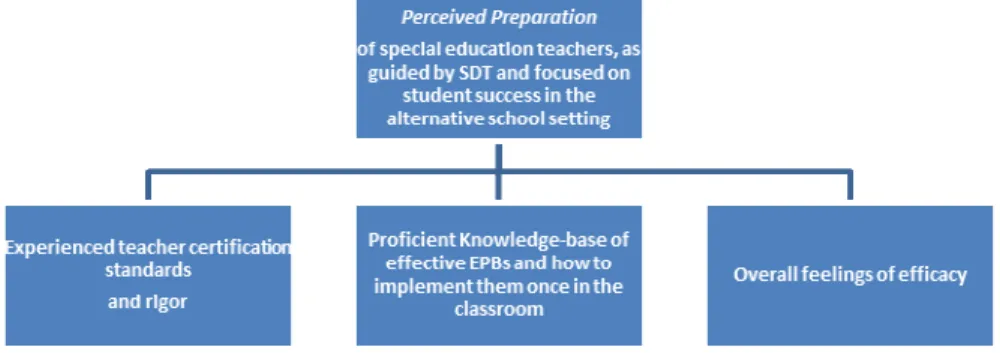
standards/coursework and their rigor, teacher proficient knowledge of effective EBPs, and readiness to implement EBPs to measure special education teachers’ perceived preparation. Efficacy was also a factor included in the measurement.
Additional challenges in the profession stem from the overlooking of special educators’ perceptions concerning their preparation and instructional practices once in the
classroom. According to Sledge and Pazey (2013), many special education teachers
expressed that their continued guidance to achieve student success after hire is given
limited attention. Johnson and Semmelroth, (2014a) and Marek (2016) mentioned that
special educators as frustrated that their principals were not prepared to recognize special educators’ diverse responsibilities and need for specialized preparation.
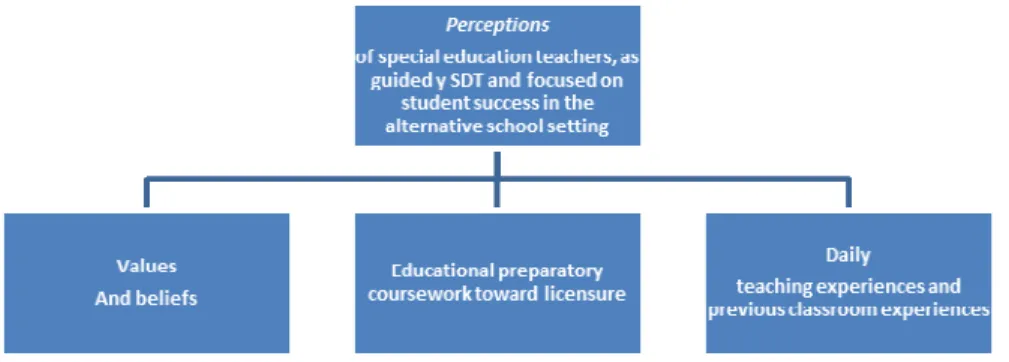
For this study, the definition of perception, as guided by SDT, was defined as the way in which a special education teacher instructing in the alternative school setting interprets and understands his or her daily teaching experiences based on his or her values, beliefs, educational training, and previous classroom experiences. Further framed definitions measuring perceptions and perceived preparation (also guided by SDT and focused on student success) are illustrated in Figure 1 and 2 for clarity throughout the study.
Figure 2. Framed definition of the term perceived preparation.
A Call for Social Change
The intention of professionals in the field of special education is to offer a
personalized education to students identified as having special needs (IDEA, 1997, 2004). The skills and expertise of a special education teacher, especially when instructing in the alternative school setting, differs from that of a general education teacher (Johnson & Semmelroth, 2014b). Sledge and Pazey (2013) established (a) the wide variety of roles that special educators assume, (b) the complexity of their schedules, (c) their varied daily roles, (d) the responsibilities they share in providing individualized instruction, and (e) the coordinating services with other professionals they must do.
Many special education teachers in the alternative school setting are also expected to take on a significant number of responsibilities outside their teaching duties (Shin et al., 2016). These responsibilities are time-consuming, involve high levels of collaboration with parents and auxiliary staff, and require the teacher to possess a distinctive skillset
Ensuring those attending university special education teaching programs are prepared to take on their roles and responsibilities is an aspect of their educational preparation toward licensure (Cochran-Smith & Villegas, 2015; Cochran-Smith et al., 2015; Shin et al., 2016).
However, according to the U.S. Education Commission (2016) and Vernon
-Dotson, Floyd, Dukes, and Darling, (2014), there is a call for change within preparatory special education teaching programs. Preparatory special education teaching programs should be more demanding when it comes to certification standards to prepare candidates for the demands of the profession and the diverse needs of the student population within the field (Cochran-Smith & Villegas, 2015; Cochran-Smith et al., 2015; Shin et al., 2016). The Council of the Great City Schools, the American Federation of Teachers, and the Council of Chief State School Officers stress that strengthening special educator preparation programs and raising their teacher effectiveness, especially for first-year teachers, is of importance. Improvement of teacher preparation program can impact student success.
The National Council for Teaching Quality (NCTQ) providedan in-depth
assessment of the nation's special education teacher preparatory programs (as cited in Greenberg et al., 2013) and concluded that, although U.S. states have altered their teacher policies, preparative teacher training practices remain unaffected. Additionally, U.S. special education teacher training programs are not producing the well-prepared special education teachers pledged by IDEA (Greenberg et al., 2014). Moreover, some school administrators across the nation are dissatisfied with U.S. special educator preparatory
programs. Administrators expressed frustration that their school districts are having to use monies to prepare teachers in skillsets they believe educators should have received in
their educational coursework towards licensure (Greenberg et al., 2014; NCTQ, 2013).
The skills and specialized expertise required of special educators and the
credentials needed to achieve full certification are outlined in the Advanced Preparation Standards (CEC, 2012a). However, according to the NCES (2012), certification
requirements for U.S. special education teachers are failing to prepare many teachers to enter the profession well-equipped to do their jobs. Poor teacher preparation due to declining certification standards is unfavorable to students because they lose educational time and skills (Aragon, 2016; Gable, Tonelson, Sheth, Wilson, & Park, 2012; Major, 2012). Furthermore, the gap in the research on special educator preparation and proficient practice is evident due to the following reasons: (a) noticeable decreases in the rigor within certification requirements (Johnson & Semmelroth, 2014a) and (b) an absence of data within the knowledge base of special educator insights into their classroom needs to properly perform their jobs (Aelterman et al., 2013). This gap has led to the unsuccessful application of effective EBPs for SEN students classified as at risk (Gable et al., 2012; Johnson & Semmelroth, 2014a).
DeMonte (2015) and Cochran-Smith and Villegas (2015) asserted that effective teacher preparation leads to student success. Teachers who feel prepared to teach typically remain in the profession longer. Coursework that focuses on methods of teaching contributes to educators’ sense of preparedness and retention in the field (Sindelar, McCray, Brownell, & Lignugaris-Kraft, 2014). Special education teachers in
alternative school settings can develop feelings of low self-efficacy if they do not feel confident and prepared in their teaching practices (Pancsofar & Petroff, 2013; Zee & Koomen, 2016). Moreover, special education teachers who experience extended periods of emotional strain, fatigue, and job dissatisfaction experience burnout (Johnson & Semmelroth, 2014b; Thurston, 2013). Instructor attrition and a decline in student success ensue (Brunsting, Sreckovic, & Lane, 2014; Major, 2012; Simon & Johnson, 2013). Farrell (2012) and DeAgelis, Wall, and Chee (2013) presented reasons as to why special education teacher attrition remains high in U.S. schools. According to Farrell and
DeAgelis et al., when many special education teachers enter the actual public school classroom, they are cut off from professional guidance and are left alone to handle difficult classroom learning and behavioral challenges. Failed accountability efforts to provide quality teacher preparation for special educators in the alternative setting has resulted in growing concerns within university education preparation programs at the federal, state, and district levels (Every Student Succeeds Act, 2015; IDEA, 2004; Jackson, 2016). Such a concern warranted this study.
Deficits in alternative education teacher preparation. According to Ladd and
Sorensen (2017), every year one out of every five U.S. students drops out of school. Finding preventative measures to decrease this mass exodus, coupled with a need to reduce its associated social and economic costs, continues to be a challenge to special education leaders nationwide (Jackson, 2016). Hoffman (2015) argued that a link exists between poor special education teacher preparation and the dropout rate. Smith and Thomson (2014) discovered that if a better educational experience had been provided that
met students’ educational needs and circumstances, school success might have been probable for many of the nation’s dropouts. However, research on the topic is scarce (Sledge & Pazey, 2013). Nevertheless, the Education Law Center (2017) stressed that effective alternative school programs that have well-prepared teachers can deter students from dropping out. Additionally, Toumbourou, Olsson, Williams, and Hallam (2013) acknowledged that if special education teachers in the alternative school setting are prepared, SEN students at risk of school failure have a greater chance of experiencing school success. With deficits such as special educator shortages, attrition, and poor preparation facing U.S. school districts, a basic reorganization of how special education preparatory teacher programs prepare their candidates may be necessary to ensure that all alternative schools provide an effective and supportive education that meets the needs of its diverse students (Allday, Neilsen-Gatti, & Hudson, 2013). These issues are further discussed in the next chapter.
Aragon (2016) and Herrenkohl and Favia (2016) inferred that several of the difficulties existing within alternative school programs include (a) a lack of offering EBP options that meet struggling SEN students’ academic needs, (b) not properly addressing SEN students’ many socioemotional needs that impede learning, and (c) a lack of finding and retaining prepared special educators to teach SEN students. Additionally, Armstrong (2014) explained that if SEN students at risk of school failure have socioemotional needs that hinder their learning, alternative school programs should provide interventions for these issues. Teagarden, Kaff, and Zabel (2013) stressed, “This is not education’s responsibility alone. Collaborative psychological services and mental health services are
necessary” (p. 12). This requires alternative education program stakeholders to hire prepared special education teachers who can provide services and strategies to teach and support their students. According to the NCES (2016), over half of all U.S. school districts have trouble recruiting highly qualified special education teachers with such
needed skills. Moreover, the NCES (2016), Greenberg et al. (2013), and the NCTQ
(2013) stated that preparation within university coursework for special educators remains unsatisfactory. With such deficits existing (Guskey, 2014), the intention of this study was to identify the perceptions of special educators’, as guided by Deci and Ryan’s (1985) SDT, preparation to educate and advance the success of SEN students who are at risk of school failure. This may increase knowledge on how educators may better serve the student population. Ultimately, the aim is to better prepare special educators to help SEN students at risk of school failure in the alternative school setting achieve student success.
SEN students who repeatedly experience school failure are more likely to be successful if offered an education that is individualized and highly structured (Leone &
Weinberg, 2012). Gable et al. (2012) and Greenberg et al. (2013) detailed the importance
of providing special educators with the preparation necessary to offer their students effective and necessary EBPs to experience school success. Little was discussed in the literature regarding special education teachers’ perceptions of their preparedness (Faez & Valeo, 2012; Farrell, 2012). However, Faez and Valeo (2012) examined the perceptions of 115 novice special education teachers concerning their preparation and self-efficacy and found that many of the teachers felt inadequately prepared to teach their student
becoming aware of special educators’ perceptions about their preparation and practices to produce student success, as was the intent of this study.
Audience
The audience targeted for this study was composed of principals, special education teachers in the alternative school setting, parents, social workers, community members, counselors, mental health practitioners, social service workers, and workers in the juvenile justice system. SEN students at risk of school failure have a higher chance of positively altering their lives when the right tools and opportunities to succeed are placed in front of them via well-prepared professionals (Wieringo, 2015). Alternative school programs grounded in this belief give school administrations a starting point to establish quality school settings where trained special educators can effectively teach and SEN students can successfully learn. A quality school setting was described as (a) a setting with high expectations and (b) a setting that builds paths to outside resources, such as mental health clinics, that help students overcome obstacles and conflicts impeding their success. Obstacles and conflicts may include substance abuse, transportation dilemmas to and from classes, legal issues, and credit recovery difficulties (Wieringo, 2015).
Gathering data regarding special educators’ perceptions of working within the alternative school setting is imperative in working towards this goal (Wieringo, 2015).
Problem Statement
Most special education teachers entering the profession are not prepared by teacher education programs to handle the academic and social-emotional related
2014; Jackson, 2016) due to decreasing certification standards and insufficient knowledge and skills, such as applying self-determination to educational practice
(Aragon, 2016; Greenberg et al., 2013). Because of teacher unpreparedness, the needs of many students requiring special education services are not being addressed. Such
circumstances make a special educators’ job to increase SEN student success rates an area of concern and worthy of study (Gagnon, Houchins, & Murphy, 2012; State of Connecticut, 2014; Wood, 2015). The special educators’ perceptions, as guided by aspects of SDT and focused on student success, of teaching in alternative high school settings and their preparation to educate SEN students who are at risk of school failure are unknown. The insufficient knowledge and skills in U.S. teacher education programs are problematic to the success of SEN students.
Purpose Statement
The purpose of this qualitative, phenomenological research study was to identify the perceptions of special educators, as guided by SDT and focused on student success, concerning their preparation to educate and advance the success of SEN students who are at risk of school failure. The intent of this study was to determine how to improve special education teacher preparation programs based on how special educators perceive their preparation experiences to teach in alternative school settings. Through the examination and analysis of interview responses, I determined special educators’ perceptions
regarding their educational preparation and practice of EBPs to educate and advance the success of SEN students who are at risk of school failure. The data collected supported the improvement of special educator preparation methods needed to educate this diverse
population. The findings were used for special education teacher preparation to help preparatory programs to better serve the needs of special education students, thereby increasing student success.
Research Questions
The following research questions, as guided by SDT and focused on student success, were addressed in the qualitative study.
RQ1: What are the perceptions of special educators teaching in alternative high school settings concerning their classroom instructional preparation to effectively educate and advance the success of SEN students who are at risk of school failure?
RQ2: How do special educators teaching in alternative high school settings perceive their preparation to proficiently practice EBPs in the classroom to educate and advance the success of SEN students who are at risk of school failure?
Conceptual Framework
Most SEN students at risk of school failure enter alternative school programs or drop out due to disengagement from school (Balfanz et al., 2014; DePaoli et al., 2015; Wieringo, 2015). There are links between student school disengagement and unfavorable psychological and educational outcomes for SEN students (Harper & Davis 2012; Wang & Peck, 2013). Educators should measure students’ school disengagement to help them
adjust their teaching practices and policies to avoid school failure (Pappa, 2014).SEN
students who are disengaged with school exhibit characteristics of apathy towards their education. To better understand the alternative education of SEN students at risk of school failure and the academic processes that special education teachers perceive to be
most needed to successfully work with them, Deci and Ryan’s (1985, 2000) SDT was used as the framework for this study. The SDT offered a framework for understanding features of youth school disengagement that typically influences school failure.
According to the SDT, people possess three instinctive emotional needs including (a) autonomy—feeling ownership for a person’s actions; (b) competence—a desire to feel successful, and (c) relatedness—feeling an attachment to others. Deci and Ryan (2000) described these needs as “nutrients that are essential for ongoing psychological growth, integrity, and well-being” (p. 229). Classroom settings that satisfy these needs include participation and skill proficiency, which inspires students’ engagement, motivation, and
self-determination to succeed in school (Pappa, 2014; Reeve, 2012). Scholars have
coupled student autonomy, competence, and relatedness to positive classroom behavior, intrinsic motivation, perseverance, and school success regardless of the student’s gender,
age, and ethnicity (Pappa, 2014; Reeve, 2012). Additionally, SDT provided a framework
for addressing research-based special education teacher preparation methods for the population of students in question. In the literature review, a more detailed explanation of SDT and how it frames the study is provided.
Nature of the Study
I used a qualitative, phenomenological approach to understand perceptions (i.e., thoughts and lived experiences) of special education teachers instructing in the alternative school setting. In the interview questions, I focused on the participants’ perceptions regarding their educational preparation and EBP proficiency to increase student success rates. This phenomenological approach was appropriate for this study because the
interview questions involved the personal perceptions, beliefs, and viewpoints of how and why these special educators determine their perceptions (Lyons, Urick, Kuron, & Schweitzer, 2015). A quantitative or mixed methods approach would not have been appropriate to implement for this type of study, due to the open-ended interview questions that were asked of the participants (Perry, Golom, & McCarthy, 2015). It would also have been a challenge to narrow the results of this sort of study to a
quantifiable or empirical conclusion. The open-ended responses from these interviews were qualitative in nature and led to inductive inferences, which differ from the empirical results sought in quantitative approaches (Hauff & Kirchner, 2014). I used face-to-face interviews that lasted between 45 to 60 minutes. By using open-ended questions, I hoped to understand special education teachers’ lived experiences regarding their preparation to educate and advance the success of SEN students who are at risk of school failure.
Operational Definitions
For this study, the following terms were used and are defined as follows:
Alternative school setting: A public high school that works to address the needs of students that “typically cannot be met in a traditional school, provides nontraditional education, serves as an adjunct to a regular school, or falls outside the categories of regular, special, or vocational education” (Porowski et al., 2014, p. 1).
Effective alternative education: An unconventional school program planned and implemented to meet the needs and improve the academic success of youth
Effective teacher preparation: The degree to which a teacher positively affects a student’s school success (Goe, 2007).
Every Student Succeeds Act (ESSA):This bill superseded the Elementary and
Secondary Education Act (ESA, 2015) (20 U.S.C. 6301 § et seq.). ESSA reaffirms
former President Barack Obama’s belief that “fundamentally every child, regardless of race, income, background, the zip code where they live, deserves the chance to make of their lives what they will" (U.S. Department of Education, 2016, p. 1).
Evidence-based practices (EBPs):EBPs are educational methods that have been documented to be effective through empirical research (Detrich & Lewis, 2013; Gable et al., 2012).
Flexibility: Providing for a student’s needs by catering to the student’s agenda, as opposed to a traditional school’s predetermined schedule (Jackson, 2016).
Individual educational plan (IEP):A legal document that defines the education of a student placed in a special education program and discusses the disability classification and services the student will receive. Also, written into the document are annual goals, objectives, and accommodations to assist the student’s learning (Zepeda, 2012).
Individuals with Disability Education Act (IDEA): Federal law that entitles all students, regardless of disabilities, race, and gender, the right to a free and appropriate public education in the least restrictive environment.
Perceptions: The way in which a special education teacher instructing in the alternative school setting interprets and understands his or her daily teaching experiences
based on his or her values, beliefs, and previous educational coursework and classroom experiences.
Preparation: Teacher certification standards and rigor, teacher knowledge of effective EBPs and readiness to implement them, as well as efficacy, were used as the measure for special education teacher perceived preparedness.
Professional development: Scheduled, focused, current, inclusive, and job embedded preparation intended to improve and develop an educator’s practices with the objective of increasing student success (Zepeda, 2012).
Self-determination theory (SDT): A theory of motivation that applies traditional empirical methods to form its concepts and to advise the methods used in classrooms (Deci & Ryan, 1985, 2000; Janssen, 2015; Shores, 2014).
Students at risk of school failure: Youth with high probabilities of not finishing high school or who are likely to leave school due to the following behaviors: poor grades, continual truancy, significant and reoccurring behavioral and/ learning challenges,
substance abuse, domestic matters, or incarceration (Bowers, Sprott, & Taff, 2012;
Roberson, 2015).
Student engagement:Student engagement or disengagement pertained to having a
significant impact on motivation and learning. It has four dominant research perspectives: behavioral, psychological, sociocultural, and holistic. Student engagement was viewed through the psychological lens (that explains engagement as individualist psycho-social processes) and the sociocultural lens (that emphasizes the criticalness of the social aspect of the framework; Kahu, 2013; Sinatra, Heddy, & Lombardi, 2015).
Students with special educational needs (SEN): Youth who qualify under IDEA (2004) for an IEP that addresses distinctive educational needs and offers personally designed services to meet those needs (Jackson, 2016). Additionally, the legal definition of a student with special educational needs is used for this study: “Individuals who have a physical or mental impairment that substantially limits one or more major life activities” (Sinatra, Heddy, & Lombardi, 2015).
Student success: Theacademic achievement by a student that leads to obtaining a traditional high school diploma or GED (Roberson, 2015; Smith & Thomson, 2014; Sullivan & Downey, 2015).
Traditional education: An all-inclusive education designed for the public in an established school environment. The student population in a traditional education school setting was typically based on the student’s area of residence instead of on his or her educational needs (Jackson, 2016).
Assumptions
In this study, it was assumed that the special education teachers interviewed reflected on their experiences thus far in the school year. There were several other assumptions within the study. The first was that all persons interviewed answered the interview questions with honesty. The next assumption was that the principal of the school in question was well-informed of the special educators involved in the interviews and their successful licensure to teach in the setting. Finally, I assumed that I did not influence how the participants choose to answer the interview questions.
Scope
This qualitative study encompassed only special education teachers in one state, from one school that is an alternative feeder high school for five traditional high schools. The study was restricted to the staff of one alternative high school where professional development took place because of the application of a school improvement plan recognized as a means of improving student success.
Delimitations
One delimitation in the study was the breadth of the terms preparation,
perceptions, and student success. It was possible that the comprehensive nature of the terms could end in differences amid specified aspects that lead to students leaving school or entering the alternative school setting. Ultimately, this range of meanings had the potential to restrict the generalizability of the study’s results. Additionally, the category of students recognized was imperative to the study, as it impacted further conclusions. For illustration, students with special educational needs who have endured adverse
childhood experiences (ACEs) are more inclined to enter the alternative school setting compared to their peers who have not experienced ACEs (Wieringo, 2015). Additionally, in this study, the legal definition of an individual with special educational needs was used: “individuals who have a physical or mental impairment that substantially limits one or more major life activities” (IDEA, 2004). This study was limited to special education teachers within one school district in New Mexico. The sample size included 12
participants who all worked within the school district and who lived in the state.
Limitations
Qualitative research is restricted to specific samplings (Merriam, 2014).
Therefore, the research results were not generalizable to every alternative school setting. Additionally, the study was restricted to a single alternative school in the Southwestern area of the United States. The alternative school was considered unique in nature. Emphasis was placed on its uniqueness because of its collected characteristics including
(a) diversity in student culture; (b) low socioeconomic status (Annie E. Casey
Foundation, 2017); (c) high dropout and incarceration rate; (d) large percentage of
minority students, and overall education limitations (Annie E. CaseyFoundation, 2017).
All these factors influenced the study’s results. This statement regarding uniqueness aided in establishing a need for lived experience data rather than a practical dataset that may be acquired through another methodology. Holistically exploring the single school site and its uniqueness added to answering the research questions, given the stated inconsistencies in teacher policies and practices and changing demographic student profile in U.S. schoolrooms. The small sample size of 12 special education teachers also
limited findings of the study. Teachers’ perceptions and practices with ninth grade students may differ from those of students in the 12th grade. In addition, because I
focused on one large alternative high school setting that is a feeder school for five smaller surrounding school districts, generalizability is limited. However, bigger school districts often have special education teacher shortages, which generates a need for alternative school programs for SEN students who are at risk of school failure. The framework of the study also involved a voluntary response rate, which was low. Nevertheless, the use of face-to-face interviews was an effective method because it gave the opportunity to clarify responses. Rich description and context were maintained through detailed journaling and field notes. A final limitation was the role of the researcher as a primary instrument of qualitative studies (Mertens, 2014). It was possible that I brought potential biases to the process. However, several steps were taken to mitigate bias including (a) all potential respondents were given an even chance to participate in the study; (b) a data analysis plan was created before the interview questions were written to ensure alignment; (c)
participant requirements were defined to achieve interview objectives prior to the research, guaranteeing appropriate scope; and (d) to eliminate misinterpretation, reports and findings were specific when referring to the population (Podsakoff, MacKenzie, & Podsakoff, 2012).
Significance of the Study
The NCES (2015) and Leone and Weinberg (2012) projected that schools nationwide would continue to receive an increased number of SEN students who are at risk of school failure. Consequently, demand for well-prepared special educators would
more than likely increase. Educational stakeholders were encouraged to evaluate the classroom preparation skills and EBP proficiency of the special education teachers in their school districts (Cochran-Smith & Villegas, 2015; Cochran-Smith et al., 2015; Shin et al., 2016). In this study, I provided stakeholders with an understanding of the influence that increased teacher preparation and EBP expertise could have on the success of SEN students who are at risk of dropping out of school. Furthermore, data regarding special education teacher perceptions concerning job readiness and EBP proficiency could help stakeholders increase knowledge related to SEN student success (Cochran-Smith & Villegas, 2015; Cochran-Smith et al., 2015; Shin et al., 2016).
The conceptual framework of the study also emphasized socioemotional health as a key component of student success, which is discussed in Chapter 2. The study could also help to ensure that school districts and their stakeholders are held accountable for student success and teacher preparation. Additionally, the exploration of relationships between quality teacher preparation and effective teaching practices supported the fostering of special education teacher growth and improvement of special educators’ self-confidence in the classroom. When teachers feel confident in their capabilities and knowledge to teach, students reap the benefits of higher levels of success as they develop confidence in their learning (Chetty, Friedman & Rockoff, 2014; DeMonte, 2015).
SEN students should receive an education that develops their potential to be
successful members of society (Sindelar et al., 2014). The ESSA (2015) and IDEA
(2004) challenged schools to raise academic rigor and implement EBPs to make certain all students achieve academically. Exploring relationships between effective EBPs and
quality special education teacher preparation has the potential to meet and exceed the standards of federal law to teach SEN students in the alternative setting. Also, I supported the assistance of at-risk SEN students to receive instruction from prepared special
education teachers who embrace active participation in learning about and using effective EBPs to improve instruction and student success.
Chapter Summary
Scholars have illustrated the importance of prepared teachers for student success. Educators, especially special educators, require adequate preparation to ensure such success (Chetty et al., 2014; Darling-Hammond, 2014). Within the alternative school classroom, special educators must question their teaching philosophies, practices, and experiences and broaden their views (Florian, 2014). The purpose of this study was to discover the perceptions of special educators regarding their preparation, practice, and professional needs to effectively teach students who are at risk of dropping out of school. Chapter 1 of this study included an introduction, the background of the problem, the problem statement, purpose, research questions, a conceptual framework, and the nature of the study. Chapter 1 also included definitions of terms used in the study, assumptions, scope and delimitations, limitations, and the study’s significance. Chapter 2 includes a literature review that consists of (a) research regarding alternative schooling for students who are at risk of school failure, (b) a review of research-based best preparation methods for special education teachers teaching within the alternative school setting, (c) and a discussion of SDT. In Chapter 3, I discuss the methodology of the study, which is comprised of the research design, research questions, population, instrumentations, data
collection procedures, and data analysis methods. In Chapter 4, I outline the study’s findings including relevant tables and figures of results from the study. In Chapter 5, I discuss the problem statement with dialogue concerning the inferences drawn from the findings, implications for practice, and further research concerns and recommendations.
Chapter 2: Literature Review
Introduction
According to the NCES (2016), approximately 13% of SEN students are serviced within the public U.S. special education system. The academic success of these students depends on effective instruction delivered by well-prepared special education teachers (Johnson & Semmelroth, 2014b; Sindelar et al., 2014; Sledge & Pazey, 2013). However, recruiting and retaining prepared special education teachers is a challenge within U.S. schools (Billingsley, Crockett, & Kamman, 2014; Boe, 2014; Cullen, Levitt, Robertson, & Sadoff, 2013; Mason-Williams, 2015). There is an inconsistent field of research on special educator preparedness (Hiebert & Morris, 2012). Prepared special educators top school district shortage lists in almost every U.S. state (Daniel, 2015). Shortage problems are directly related to poor teacher preparation (Boe, 2014; Johnson & Semmelroth, 2014a; Major, 2012). Shortage problems are particularly burdensome within inner city schools serving disadvantaged students (Scott, 2016; U.S. Department of Education, 2015; Zhang, Wang, Losinski, & Katsiyannis, 2014).
A high percentage of individuals working as special educators in U.S. schools are not prepared to teach SEN students in the alternative school setting and do not meet the required certification standards (Boe, 2014). Many are working in schools with
“emergency teaching waivers,” lacking the needed skills to teach students who have special educational needs (Billingsley et al., 2014;Boe, 2014; Florian, 2013; Johnson &
Semmelroth, 2014b;Shinn, 2015; Sledge & Pazey, 2013). Such poor teacher preparation
education system (Ford, 2012; Shady et al., 2013; Shinn, 2015) and are alarming within alternative school programs for students who are in danger of dropping out of school (Caldart-Olson & Thronson, 2013; Cullen et al., 2013). In the literature review, I focus on this vulnerable population. I explain how quality special education teacher preparation influences student success. I also present a history of alternative schools and the population of students the setting largely serves. Topics crucial to effective special education teacher preparation in the alternative school setting follow. To close the literature review, there is a discussion of research-based methods deemed effective in preparatory programs to produce effective well-prepared special education teachers.
Literature Search Strategy
I searched for peer-reviewed journals through search engines and databases including EBSCO, Sage, ProQuest, Google Scholar, and Digital Commons through Walden University Library I also searched websites of other learning institutions. Key search terms included alternative education, students at-risk of school failure, special educator preparation, and educators’ perceptions of the alternative setting, student success in the alternate school setting, alternative school reform, and SDT. The scope of this literature review entailed research studies and dissertations dated 2012 through 2017 from the Walden University Library.
Conceptual Framework
SEN students at risk of school failure who enter alternative schools are typically detached from academia and are described as apathetic and unmotivated to learn (Scott, 2016; U.S. Department of Education, 2015). Understanding what is driving such
behaviors and altering them is key to the analysis and planning of SEN students’ future school success (Lam, Wong, Yang, & Liu, 2012). I applied the SDT, established by Deci and Ryan (1985), because of its consideration as an effective EBP. It was also chosen because it is considered useful for examining detailed methods concerning how to effectively prepare special education teachers to implement EBPs and associated
variables (i.e., active engagement, intrinsic motivation) into the alternative school setting to increase student success (Aelterman et al., 2013; McMullen & Warnick, 2015; Shores, 2014).
According to SDT, individuals possess three fundamental, instinctive
psychological needs: (a) autonomy—a desire to be self-sufficient and independent; (b) competence—a desire to excel in school and feel purposeful in life; and (c) relatedness— a longing to feel a part of a group or family unit (Deci & Ryan, 1985, 2000, 2008). School settings that nurture these human psychological needs embolden classroom learning, engagement, and skill proficiency (Abels, 2015; Aelterman et al., 2013). Lam et al. (2012) claimed that students became engaged in school when their teachers used motivating instructional practices. Lam et al. demonstrated that overall student school engagement improved, as well as self-efficacy, which increased student effort towards schoolwork. When the students became engaged in school, they experienced positive emotions and increasing student success (Lam et al., 2012). SDT can be used to investigate how the fulfillment of persons’ needs for autonomy, competence, and relatedness relates to psychological well-being, drive, and healthy functional
have linked these needs not only to student success, but also to self-satisfaction, positive classroom behavior, critical thinking, and future life determination (Abels, 2015).
The development of these three basic needs link to various motivation that is intrinsic, which encourages student success and school engagement (Aelterman et al.,
2013; Farrelly, 2013). The word, engagement,as referred to within the context of SDT,is
defined as the degree to which a student allows himself or herself to become actively involved in a learning activity (Wellborn, 1991). An underlying objective of SDT is to actively engage and motivate a student, psychologically and intrinsically, to want to be successful in school (Reeve, 2012). SDT theorists stress how a person’s surroundings and teacher are factors in this goal towards individual need-fulfillment progression (Reeve, 2012). However, if a person lacks support from his or her social surroundings and teacher, his or her overall need-fulfillment progression declines (Thapa, Cohen, Guffey, & Higgins-D’Alessandro, 2013). Student learning disabilities and emotional disturbances are disproportionate in alternative schools.
Student Learning Disabilities and Emotional Disturbances Are Disproportionate
McCallum (2013) stated that minority students with learning disabilities comprise approximately half of the population of students receiving U.S. special education
services. Many of these students are taught in alternative school settings. Because of such continual disproportionality outcomes, U.S. policymakers positioned requirements in both the 1997 and 2004 reauthorizations of IDEA intended to reduce overrepresentation
problems with the rising population of marginalized students (IDEA, 2004 Vanderhaar,
mainly for students with learning disabilities and emotional disturbances (Raines, 2012; Rueda & Stllman, 2013). Academics are seeking answers as to why students who have learning disabilities and emotional disturbances are overrepresented in alternative school settings, especially alternative settings within the juvenile justice system (Aron &
Loprest, 2012; Florian, 2013).According to NCES, exact numbers are unknown due to limited research, and the available data have contrasting explanations and descriptions, creating confusion and inconsistencies (as cited in Aud et al., 2012). However, nearly 45% of SEN students in the alternative school setting have identified learning disabilities, excluding language barriers that commonly fuel frustration, poor motivation, and low
self-confidence (Gagnon et al., 2012; Mallet, 2013). Griner and Stewart (2013) stressed
that having a common set of alternative education teaching standards, policies, and definitions has the potential to address concerns with disproportionality in school settings. Additionally, teacher preparatory programs should focus on the changing
demographic profile of SEN students (Cartledge, Kea, Watson, & Oif, 2016; Doran,
2014). There is inadequate research on how teacher education programs prepare special educators for the growing academic and socioemotional diversity within U.S.
schoolrooms (Rueda, 2013; Rueda & Stillman, 2012).
Special Educator as Teacher and Motivator
Professionals in the field of special education consider the promotion of self-determination an evidence-based best practice. Researchers have linked a student’s level of self-determination to his or her academic success, mental health status, and
conceptualization framework used to examine student motivation in classroom settings. SDT includes theoretic grounds for how a teacher can situate the classroom to provide and promote ideal forms of motivation, engagement, and sustained perseverance towards learning (Deci & Ryan, 2000; Hamre et al., 2013). Vital to this mission is an educators’ ability to support students’ basic psychological needs for autonomy, competence, and relatedness (McMullen & Warnick, 2015). In this section, I outline techniques concerning how a special educator teaching in an alternative school setting can apply principles of SDT in the classroom.
Autonomy. The need for autonomy refers to an individual’s desire for life options
and the freedom to choose from them (Deci & Ryan, 2000). An educators’ support for autonomy refers to relational concerns and classroom behaviors offered to identify, nurture, and develop a student’s triggers for intrinsic motivation (cited in Aelterman et al., 2013). SDT theorizes that educators who support a student’s need for autonomy (a) fashion structured environments; (b) are involved and caring; (c) promote enthusiasm about learning; (d) enforce student independence and self-regulation of behavior (as cited in Aelterman et al., 2013). Conversely, teachers who dictate orders amid a chaotic
classroom setting, and are not genuinely involved in students’ quest for success, characteristically inhibit students’ psychological needs and hamper autonomous
motivation (Deci & Ryan, 2000). Educators supportive of a student’s autonomy (a) honor learning preferences; (b) focus on student strengths, interests and curiosities; (c)
acknowledge students’ viewpoints, difficulties and frame of mind concerning their limitations; (d) make learning relevant; (e) present applicable activities for enrichment
and to make learning inspiring (Deci & Ryan, 2000; Jang, Kim & Reeve, 2012). Conversely, educators who seek only to control students by using commands, punitive intimidations, and threatening language are predominantly ineffective (cited in Aelterman et al., 2013).
Competence. Competence signifies feeling successful when attempting mastery
over something (White, 1959). A structured classroom setting nurtures a student’s need for competence. Structure refers to the amount and quality of information provided by the educator about classroom expectations and how the student can experience success by following them (Reeve, 2012; Wehmeyer et al., 2012). Educators can offer students a structured setting by (a) clearly communicating guidelines and expectations; (b) offering guidance during instruction; (c) providing step-by-step directions for students; (d) giving positive and meaningful feedback intended to build on a student’s sense of competence (cited in Aelterman et al., 2013; Jang, Kim, & Reeve, 2012). Ineffective educators, however, promote misunderstanding in their classrooms by (a) dictating vague directions; (b) exercising confusing procedures within classwork; (c) voicing unclear feedback or harsh criticism (Jang, Kim & Reeve, 2012).
Relatedness. Relatedness involves the desire to feel a sense of intimacy,
trustworthiness, and hopefulness in relationships (Deci & Ryan, 2000). Teachers are supporting a student’s need for relatedness when they (a) demonstrate concern and respect for their students’ learning processes; (b) provide emotional support and
resources for students displaying mental difficulties (as cited in Aelterman et al., 2013). Teachers who are not supportive of a student’s need for relatedness act with indifference
and apathy in interacting with their students. A teacher’s relational connection nourishes students needed psychological requirement for relatedness, which is an essential
motivator for students to achieve success in the classroom (Deci & Ryan, 2000; Hamre et al., 2013). Hamre et al. (2013) noted the significance of relatedness after surveying 4,341 classrooms. The study indicated the importance of preparing teachers to connect to their students through the lens of SDT. Teacher support of competence and autonomy were also discovered to be pertinent aspects of sound teaching. Although the study considered over 4000 classrooms and found that instructors who are supportive of their students’ socioemotional needs, via healthy relationships, the classrooms were largely elementary settings. However, Hamre et al. (2013) reinforced that students are predominantly driven towards learning when educators make significant efforts to fulfill their students’ needs to connect to people and establish self-worth and self-governance. How such efforts are explicitly accomplished was not identified in the study.
Psychological Needs within the SDT Framework
Evidence proves that psychological forces influence student success, classroom behavior and school engagement (Long, Fecser, Morse, Newman, & Long, 2014; Teagarden et al., 2013). Psychological issues arise from various bases including a
student’s needs, thoughts, feelings, and experiences (Baglivio et al., 2014). However, the terms motivation and engagement in this study pertain to a basic psychological
perspective within the SDT framework. Therefore, motivation and engagement are parallel with a students’ inner satisfaction of his or her psychological (mental, emotional) needs (Deci & Ryan, 2012). This translates as follows: a student who perceives himself
or herself to be working with autonomy, competence, and relatedness throughout classwork and activities will experience high levels of motivation. In contrast, a student who has these three needs ignored during instruction will experience low levels of motivation.
Students who have experienced extreme trauma, also known as adverse childhood experiences (ACEs), can be at a substantial disadvantage regarding student success (Blodgett, 2013; Shankar, 2016). Early emotional trauma during brain development can significantly influence and deter learning, motivation and school engagement.
Essentially, engrained psychological complications caused by ACEs steal a student’s motivation, self-worth, and self-satisfaction (Olinger, 2015). These complications, otherwise known as at-risk student behavior, often manifest themselves in detrimental ways in and out of the classroom (Blodgett, 2013; Shankar, 2016). At-risk student behavior includes but is not limited to (a) violent conduct; (b) alcohol and/or substance abuse; (c) sexual behavior contributing to unplanned pregnancy and/or sexually
transmitted diseases (STDs); (d) poor eating habits and (e) dropping out of school (CDC, 2013b; Eaton et al., 2012). Deterring at-risk student behaviors is an imperative aspect of the study and a component of SDT because most SEN students who are at risk of school failure have endured many ACEs (CDC, 2013b). These ACEs drive at-risk behavior. I believe this statement necessitated the following section, which provides a glimpse into how ACEs negatively influence student learning, motivation, and school engagement.
Adverse childhood experiences (ACEs) defined. Adverse childhood experiences (ACEs) are characterized as mistreatment expressed through traumatic
events of abuse (physical, sexual or emotional), an absence of parental nurturance, neglect, parent death or incarceration, witnessing domestic violence (especially maternal abuse), household drug use, and/or mental conditions in the home (Foltz, Dang, Daniels, Doyle, McFee, & Quisenberry, 2013; CDC, 2013b). Research from a joint 2016 study from the University of New Mexico (UNM) School of Law and the UNM School of Medicine, and New Mexico's Children, Youth and Families Department (CYFD) yielded concerning data. The studies mentioned that youth who have experienced numerous ACEs often suffer from neuropsychological deficits which “have immediate negative consequences, such as functional changes to the developing brain, which makes [them] more likely to act out in [destructive] ways” (Olmstead, 2016, p. A1, A2; Walkley & Cox, 2013, p. 5).
ACE Impact on Student Learning, Motivation, and School Engagement
The theory of self-determination is a macrotheory of motivation and human development that has been applied to education by scholars for many years to try to understand how specific features of youth development either support or delay student success (Deci & Ryan, 2012). One feature that evidence is increasingly making clear includes that ACEs influence students’ socioemotional and cognitive development and their ability to learn (Florian, 2013). Numerous studies have shown that ACEs are psychologically detrimental and are frequently an antecedent to SEN students entering the alternative high school setting (Dupéré et al., 2015). For instance, a study published in 2016 for the New Mexico Sentencing Commission expressed that trauma from ACEs changes the brain, leaving youth with poor emotional control, little motivation, and