Competency, Attitude and Islamic Teachers’ Issue
in Using Computer for Learning and Teaching Process
Khairatul Aini and Ab Halim Tamuri
Faculty of Education
Universiti Kebangsaan Malaysia, Malaysia.
Syafrimen Syafril
Faculty of Education and Teaching
Universitas Islam Negeri Raden Intan Lampung, Indonesia. Correspondence Address: [email protected]
Received: 16 December 2018 Revised: 18 January 2019 Approved: 25 February 2019
Abstract
This research is aimed to know phases of competency, attitude and Islamic teachers’ issue in using computer for learning process. This research uses qualitative and quantitative mixed method (explanatory mixed methods design). Quantitative data were obtained from sixty-four Islamic teachers by using questionnaire and were analyzed with descriptive statistics through SPSS Windows Version 15.0. Meanwhile, Qualitative data were taken from eight teachers through intensive interview and were analyzed thematically by using software NVivo 7. Results of the research show that the teachers’ competency in using computer is still at poor phase (Mean = 2.32, SD = 0.22), while their attitude toward that issue in learning process is very positive (Mean = 3.94, SD = 0.36). Furthermore, Qualitative results find that there are four important themes related with the issue enforced by the teachers in applying computer to the learning process. Such are; i) lower self-competency to use computer, ii) lack of computer facilities provided in shool, iii) lack of computer training for the teachers, and iv) lack of time in designing computer-based learning due to over-task issue in the school.
Keywords: Competency, attitude, issue, teacher, Islamic education, computer Abstrak
Penelitian ini bertujuan untuk mengetahui tahap kompetensi, sikap dan problematika guru pendidikan Islam menggunakan komputer dalam proses pembelajaran. Penelitian ini menggunakan metode gabungan kuantitatif dan kualiatatif (explanatory mixed methods design). Data kuantitatif diambil kepada enam puluh empat orang guru pendidikan Islam menggunakan angket dan dianalisis dengan statistik deskriptif menggunakan SPSS Windows Versi 15.0. Sedangkan data kualitatif diambil kepada delapan orang guru melalui wawancara mendalam dan dianalisis secara tematik menggunakan software NVivo 7. Hasil penelitian kuantitatif menunjukkan bahwa tahap kompetensi guru dalam menggunakan komputer berada pada tahap yang rendah (Min = 2.32, SD = 0.22), adapun terkait sikap
Khalifa Journal of Islamic Education :: Volume 3, Number 1, March 2019/1440 P-ISSN : 2541-6588 ; E-ISSN : 2549-4783
guru terhadap penggunaan komputer dalam pembelajaran adalah sangat positif (Min= 3.95, SD = 0.36). Selanjutnya hasil kualitatif mendapati empat tema penting terkait permasalahan yang dihadapi guru dalam mengaplikasikan komputer dalam proses pembelajaran yaitu; i) rendahnya kompetensi diri untuk mengaplikasikan komputer, ii) minimnya fasilitas komputer yang tersedia di sekolah, iii) kurangnya pelatihan aplikasi komputer kepada guru, dan iv) guru tidak cukup waktu membuat pembelajaran berbasis komputer karena tingginya beban tugas di sekolah.
Kata Kunci: Kompetensi, sikap, problematika, guru, penddidikan Islam, komputer Introduction
A teacher has a very significant role in determining quality and education success of a country (Daulay, 2014). Moreover, the teacher in this digital era is not only responsible for the task as an educator to learners in the class, but also has more complex tasks and functions especially in using computer and techno-based media for teaching assistance, so it is necessary for the teachers to have standarized competency and professionalism (Engkizar et al. 2018). Basically, competency of a teacher must be completely universal and reflected through deep knowledge, skills, attitude and teaching value (Guskey, 2002; Anwar et al. 2018).
According to Jahnke & Kumar (2014), the teacher is a creator in a learning process, and is able to develop learners’ talents and interests. Furthermore, the teacher must also have good characteristics as an educator. The characteristics here refer to polite, patient, highly passionate, optimistic attitude and are able to develop the learners’ reasoning skills in many disciplines (Murniyetti, et al. 2016; Zafirah et al. 2018). Moreover, the teacher must also become a good figure and model for the learners (Blumenfeld et al. 1991; Adelson, 2017). By relating to the opinions above, it can be said that the teacher is very necessary in establishing learners’ success in an educational process.
All teacher category above is expected to be applied also to Islamic teachers as a professional Islamic teacher. By considering the results of the research by Yusnita et al. (2018), it was found that a teacher with good competency will be able to affect
Khalifa Journal of Islamic Education :: Volume 3, Number 1, March 2019/1440 P-ISSN : 2541-6588 ; E-ISSN : 2549-4783
results of the learners’ study and possessed high passion on working in the school environment. It is mutual with the researches conducted by Werdayanti (2008), Ismail (2010) which conclude that there is a correlation between teachers’ competency in teaching-learning process in the class and learners’ study motivation. A learning activity is one of the aspects which cannot be separated from a learner, so the task of a teacher is to create fun atmosphere in studying for every learner. According to Andrews (2004), Agusti et al. (2018), the teacher must be able to create a fun learning process for the learners, if the study atmosphere is fun, it will bring up an implication to learners’ attention or even be able to increase their interests to always study. In the writer’s opinion, the fun learning process can be implemented if the teachers have attractive strategy and learning method for the learners. One of the ways which can be done by the teachers to boost their interest in learning is by using a techno-based learning. In the context of this research, fun learning refers to a learning process which is conducted by a teacher using computer application.
An Islamic teacher has a huge responsibility to shape balanced learners under the aspects such as physical, emotional, spiritual, intellectual which are compatible with national education purpose. Those five purposes of Islamic education are taught by the teacher as a unit in one course of Islamic education in the school in which this course is one of compulsory subjects for every learner on every education level (Nata, 2012). In general, there are five aspects learned by the learners in Islamic education course. Such are al-Quran aspect, Hadist, worship, faith, morals and history of Islamic culture (Nurhayati, 2018).
All aspect which must be mastered by the learners in Islamic Education course above demands the teacher to be creative in using many kinds of learning media and devices so the learning process will be fun, because it is not relevant for the Islamic teacher to explain materials about shalat, hajj, history of Islam by only
Khalifa Journal of Islamic Education :: Volume 3, Number 1, March 2019/1440 P-ISSN : 2541-6588 ; E-ISSN : 2549-4783
writing it on a board in front of the class and by preaching. If the condition is continuously happened in the class, it can be assumed that the learners will be bored faster in the learning process.
However, a learning situation, which is afraid not to be happened above, is actually true. By considering previous studies, they show that an Islamic teacher is still at poor phase in using computer as a learning media. Some of the causes of this issue is poor teacher’s skills in using computer, lack of facilities, teachers with negative attitude (Hussin, 2017; Engkizar et al. 2018). Therefore, this research article tries to discover how phases of competency, attitude and Islamic teachers’ issue in using computer for learning process.
Literature Review
Nowadays, almost every educational fields are improving significantly, so it demands the teachers to play a strategic role in achieving learners’ success in every level of education. Success quality of learners depends on how a teacher manipulate learning process in the class. In the context of Islamic education, the issue related with poor interest of learners to join the learning process is still happening. Hence, there is no wonder if a learner is found to be bored and lazy in every lesson conducted by the teacher (Rahman et al. 2017). Moreover, Norazah & Amin (2008) argued that lack of learners’ attention during Islamic subject is caused by less creative and less innovative activities conducted by the teacher during the learning process, the teacher tends to use preaching method. In the writer’s opinion, if this situation of learning is still continuously happened, results to be gained in learning process will not be maximal.
The research related with the use of media in learning process by teachers has been conducted by many researchers before. For instance, Sjukur (2012) found that a techno-based learning is able to change learners’ study motivation to be better than conventional methods. Meanwhile Husein et al. (2017) found that the use of
Khalifa Journal of Islamic Education :: Volume 3, Number 1, March 2019/1440 P-ISSN : 2541-6588 ; E-ISSN : 2549-4783
interactive multimedia has a correlation with the concept of learners’ mastery and critical thinking skills in a learning process. Then, Ratnasari, (2012) found that the use of e-Learning as a learning media in the college can stimulate students to be more active in learning activity in the class. It is similar with the findings from Rahmatullah, (2011) which found that the techno-based learning obtains better results rather than conventional methods.
Therefore, the writer assumes that Islamic education teachers must change their conventional methods to more innovative methods based on technology, so it is able to stimulate learners’ interest and passion to be better. Some previous studies found that Islamic teachers’ failure to do changing in techno-based teaching methods is caused by less creative teachers (mean = 3.84), having no skill on computer (mean = 3.22), lack of attention on slow learners (mean = 3.92). Those mean scores show that the teachers have moderate phase of competency in delivering lessons by using computer (Najmuddin et al. 2008). Meanwhile, the results of the research conducted by Azmi & Halim (2007) found that Islamic Education learning process which based on technology such as computer and webstie has been verified to be able affecting study results, it is even be able to stimulate learners’ interest on studying in Islamic Education learning process. Referring to two results of the researchers above, it can be comprehended that techno-based learning process is among effective ways of Islamic Education learning.
Principally, the use of technology in a learning process gives an opportunity for the teacher and learners to be more creative. The findings from Husain (2014), Yazdi (2012) found that the use of information and technology in the learning process such as social network, is proven to be able improving effectivity and also efficiency in the learning process. It means that by the existances of technological devices and mediain learning this present, it demands the teachers not only to know, but also to be able applying these technologies.
Khalifa Journal of Islamic Education :: Volume 3, Number 1, March 2019/1440 P-ISSN : 2541-6588 ; E-ISSN : 2549-4783
According to Arifin (1993), Anwar et al. (2018), the use of many technological devices and media in Islamic Education learning will give impacts at least to some of the aspects. Such are; first, as a new invention to expand paradigm on Islamic education discipline, and second, the opportunity of combination between Islamic education and modern education such as sciences, humanities, economics also other professional disciplines. Meanwhile, Abu Bakar (2008) stated that history of Islam has proven that the technology has been long exist in Muslim’s life. As a proof, Baghdad as one of Islamic civilization centers had initiated paper manufacturing in 729 AD. In the opposite, Christian just used this manufacturing in 1276 AD. This fact implies that Muslim has shown big improvement on modern information aspect rather than other religion followers. In short, the use of technology in Islamic education learning will give convenience to the learners, and even to the teachers in providing learning materials. The use of technology is the necessary thing to be done, to be used as maximum as possible in order to increase the success of a learning process.
Methods
This research was conducted in sixteen Governmental Senior High School (SMAN) in Padang City, West Sumatra. In order to obtain the data, the writer used mixed quantitative and qualitative methods (Eksplanatory mixed methods design). As Creswell et al. (2003) argued that a combination of two methods in a research might give some space to the researcher obtaining more comprehensive data. Creswell (2017) also stated that the combination of two methods in a research might give detailed descriptions about an issue. In other words, the use of two methods in the research has its own advantages because the researcher obtains two sets of data which reciprocally strengthen the results of the research so the research will be strong and has a certain quality.
The source of quantitative data was obtained from sixty-four Islamic teachers by using questionnaires which is created by the writer himself based on the results
Khalifa Journal of Islamic Education :: Volume 3, Number 1, March 2019/1440 P-ISSN : 2541-6588 ; E-ISSN : 2549-4783
of relevant previous study about the use of computer in learning process. All questionnaire data were analyzed descriptively by using analyzing device software SPSS Windows 15.0. According to Wahyono (2015), descriptive analysis is one of the ways to ease the writer describing the results in a quantitative research. Then, the source of qualitative data was obtained from eight informants who are also teachers in Islamic education subject through intensive interview. All interview data were then analyzed by using thematic analysis with software Nvivo 7. Thematic analysis is one of more flexible ways to identify, analyse, and report the qualitative research data (Braun & Clarke, 2006). According to Engkizar et al. (2018), thematic analysis in present qualitative research is very popular to be used by many researchers in order to present the data, the researcher also used software such as NVivo 12 or manual ways.
Finding and Discussion
In this chapter of the article, the writer will explain it in two phases, first, results of the research in quantitative form related to the phases of competency and teachers’ attitude in Senior High School Padang City in using computer, second, qualitative results of the research related to the issue which is faced by the teachers to apply computer during learning process in the school. Both results will be discussed based on theories, experts’ opinions and results of previous studies which discussed this topic in the same context.
Phase of Islamic Education Teachers’ Competency in Using Computer for Learning Process
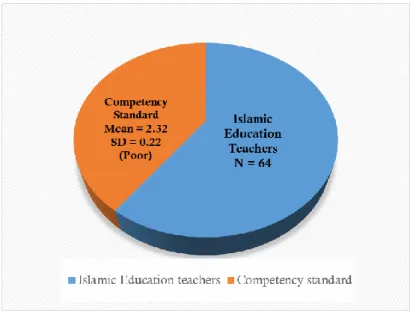
Based on the results of statistical analysis, the results show that the phase of Islamic Education teachers’ competency in using computer for learning process is poor (Mean = 2.32, SD = 0.22). Those numbers mean that the teachers have not used computer as a learning media yet. Most of them still use manual learning media which are not based on developed technology nowadays. Then, they also still use conventional teaching methods such as preaching and Q & A session in the
Khalifa Journal of Islamic Education :: Volume 3, Number 1, March 2019/1440 P-ISSN : 2541-6588 ; E-ISSN : 2549-4783
process of teaching. The details about this statistical result description can be seen in the figure 1.1 below:
Figure 1.1: Description of teachers’ competency in using computer
Islamic Education Teachers’ Attitude toward the Use of Computer in Learning and Teaching Processes
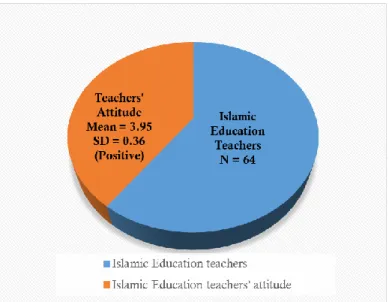
Based on the results of statistical analysis, the results show that the phase of Islamic Education teachers’ attitude toward the use of computer in teaching and learning processes is highly positive (Mean = 3.95, SD = 0.36). Those numbers mean that they have a good attitude toward the use of computer in learning and teaching process. Moreover, most of them have high interests in using computer as a learning media. The details about this statistical result description can be seen in the figure 1.2 below:
Khalifa Journal of Islamic Education :: Volume 3, Number 1, March 2019/1440 P-ISSN : 2541-6588 ; E-ISSN : 2549-4783
Figure 1.2: Description of teachers’ attitude toward the use of computer Islamic Education Teachers’ Issue on Using Computer in Learning and Teaching Process
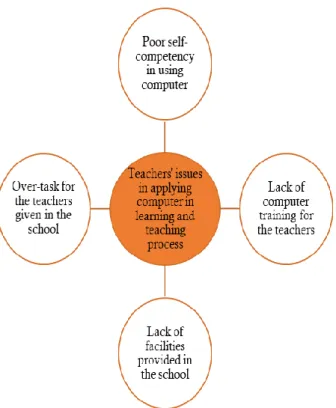
In order to obtain information related to the issue faced by Islamic Education teachers on using computer in a learning and teaching process, the writer conducted deep interviews with eight Islamic Education teachers. As a whole, the results of interview find that there are four themes for this issue. Such are: i) poor self-competency to use computer, ii) lack of computer facilities provided in the school, iii) lack of computer application training for teachers, and iv) lack of teachers’ time to design computer-based materials due to over-tasks given by school. The details about this description can be seen in the figure 1.3 below:
Khalifa Journal of Islamic Education :: Volume 3, Number 1, March 2019/1440 P-ISSN : 2541-6588 ; E-ISSN : 2549-4783
Figure 1.3: Description of Islamic Education Teachers’ Issue on the Use of Computer in a Learning and Teaching Process
Figure 1.3 above shows the issue faced by Islamic Education teachers. Four themes above were obtained during direct interviews with all informant. Below are the interview quotations with all informant in the relation with four themes above. The quotations were delivered by informants with different language styles, but if it is generalized, they told similar purposes and meanings.
First: poor self-competency in using computer. According to informants, this poor competency is happened because they have not learned about computer at all before. Therefore, the teachers expect that there will be a training from the school and Education Authorities for them. The interview quotations with informants are shown in the table 1.1. below:
Table 1.1: Interview quotations about the first theme with informants
Issue Informant Interview quotations
Poor self-competency in
Teacher ,… We have not used computer in learning and teaching process because we have no
Khalifa Journal of Islamic Education :: Volume 3, Number 1, March 2019/1440 P-ISSN : 2541-6588 ; E-ISSN : 2549-4783 using computer idea about the way to use it ,..
Teacher ,… yes,.. we are old teacher, so we have difficulties in understanding computer... hehe…
Second: Lack of computer facilities provided in the school. According to the informants, computer facilities in the school do not allow the teachers to apply computer-based learning because sometimes there are thirty to forty learners in a class while there are only fifteen to twenty computer units available. Lack of facilities is related by the informants to the condition of computer laboratory because this laboratory has not been capable yet to accommodate total of learners in every learning process. The interview quotations with informants are shown in the table 1.2. below:
Table 1.2: Interview quotations about the second theme with informants
Issue Informant Interview quotations
Lack of computer facilities in the school
Teacher ,… Sometimes I teach forty learners in a class, while the computer provided in the school only twenty units, so how can I apply computer-based learning… the facilities are still far from standard one… I hope the computer will be added more…
Teacher If we study in a computer laboratory, it might not be do because it cannot accommodate the total of learners here… I think that is also the issue in other schools... lack of provided facilities.
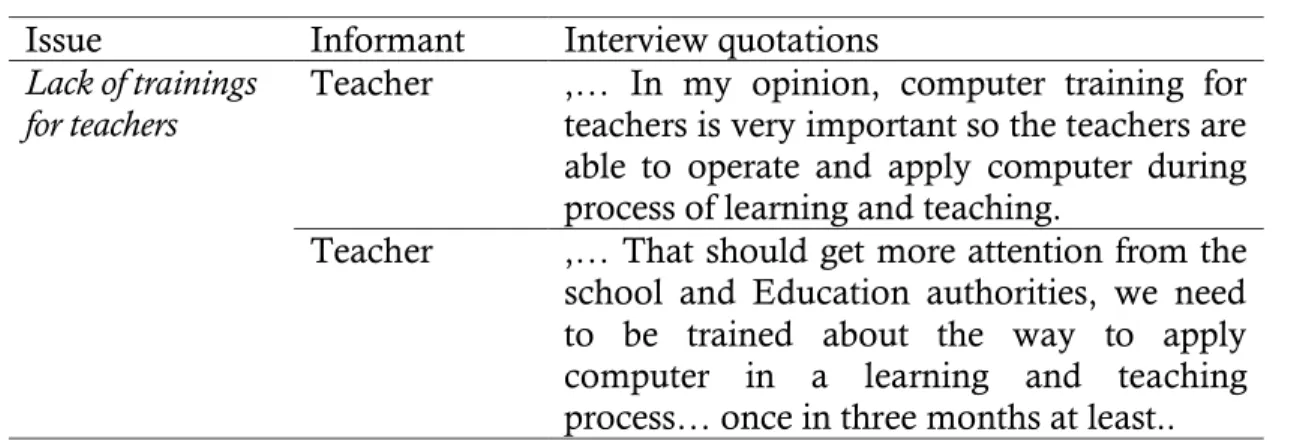
Third: Lack of computer training for teachers, this third issue has been complained by the teachers frequently. According to the informants, it is necessary for the teachers to have trainings about ways to operate computer in learning and teaching process. It is impossible for a teacher to be an expert using a device if there is no knowledge, comprehension and ways of application about it. The interview quotations with informants are shown in the table 1.3. below:
Khalifa Journal of Islamic Education :: Volume 3, Number 1, March 2019/1440 P-ISSN : 2541-6588 ; E-ISSN : 2549-4783
Table 1.3: Interview quotations about the third theme with informants
Issue Informant Interview quotations
Lack of trainings for teachers
Teacher ,… In my opinion, computer training for teachers is very important so the teachers are able to operate and apply computer during process of learning and teaching.
Teacher ,… That should get more attention from the school and Education authorities, we need to be trained about the way to apply computer in a learning and teaching process… once in three months at least..
Fourth: Lack of time to design computer-based learning due to over-task given in the school. According to the informants, sometimes teachers in the school are busy with many tasks given, so there is lack of time to develop themselves such as creating an innovation and creativity in learning by using computer. The interview quotations with informants are shown in the table 1.4. below:
Table 1.4: Interview quotations about the fourth theme with informants
Issue Informant Interview quotations
Lack of time to design computer-based learning due to over-task given in the school
Teacher ,… yes! Sometimes we have been busy with tasks given as a teacher, so there is no time to create new things… we have been exhausted after school, hehe…
Teacher I also agree, nowadays teachers have no time to create a new thing and develop themselves because there have been so many tasks to be done as a teacher in the school, there might be an intention to it, but there is so lack of time…
Teacher is a noble job, for a teacher has a role to educate, guide and train learners’ skills to live their lives. In order to accomplish tasks and responsibilities well as the educator, the teacher needs to have maximum standard, good competency also passion to continuously do self-improvement so the teacher will not be left by progressive flow especially one that is related to education technology (Priatmoko, 2018; Husni & Dafik, 2018).
Khalifa Journal of Islamic Education :: Volume 3, Number 1, March 2019/1440 P-ISSN : 2541-6588 ; E-ISSN : 2549-4783
Because of that, the writer assumes that job as a teacher will be more challenging in further. Furthermore, the design of Indonesian National education purpose has been established that Indonesia education will create a golden generation in 2050. The challenge for the teachers’ role obliges them to always train and improve themselves with many skills, improving creativity capability, open-minded, also aware to every progress in teaching and learing to be more advanced in every subject (Muhson, 2004).
In another side, if discussing a teacher in the context of Islam, the teacher is certainly required to be smart and have expanded knowledge for the further. According to Al-Kaylani (2005), the task of Islamic Education teachers in shaping a human-being is very essential, strong and continuant efforts are needed because in their hands there are responsibilities to educate godly learners, an individual who shapes a Muslim family, one who makes people telling Islamic teachings and one who cares about progress of Islam in the future.
Besides jobs, responsibilities and criteria as a teacher mentioned by the writer above, an Islamic education teacher is also required to always follow the progress of era. In the context of this research, the progress refers to the progression of technology usage in learning and teaching such as skills in using computer (Paydarfar & Moini, 1995; Lopex, 2007; Pa & Idris 2008).
Referring to the results of this research, it is clearly shown that teachers’ competency related to the skills of using computer on Senior High School in Padang City is still at poor phase. Moreover, some of the teachers are not able at all in operating computer, in other words, they are illiterate of it. This situation surely cannot be let to grow, for nowadays all learner activity indoor and especially outdoor always deals with technology, especially computer. Poor teachers’ competency in operating computer as it is shown by the results of this research is significantly different with results of the researches conducted by Sukoco et al.
Khalifa Journal of Islamic Education :: Volume 3, Number 1, March 2019/1440 P-ISSN : 2541-6588 ; E-ISSN : 2549-4783
(2014), Yusuf, (2010), Divayana & Sugiharni, (2016) which found that the use of computer in learning and teaching affects learners’ interest, motivation and their study results significantly. It means that Islamic education teachers should have started thinking to the same direction to use technology as a learning design.
However, based on the findings of this research in general, it is shown that the teachers have highly positive attitude toward the use of computer in a learning process. Moreover, they put their interest to learn and to join if there will be some trainings held by school and Education authorities. This highly positive attitude gives a hope that teachers have already had intention to change better. Related to the positive attitude shown by teachers toward the use of computer in the learning process, the same results are also found by Ahmad & Tamuri, (2010), Boon & Ngatimin, (2011) in their researches.
Next, related to the issues faced by the teachers in applying computer to their Islamic Education learning and teaching process, results of this research find that there are four themes. Such are poor self-competency in using computer, lack of computer facilities provided in the school, lack of computer trainings for the teachers, and lack of time for the teachers to design computer-based learning materials due to over-tasks given in the school. Based on interviews with all informant, a solution for the issue is that the school and other education authorities should concern with these issues.
It is actually established that computer-based learning has its own speciality and advantages rather than studying with conventional methods, especially in Islamic learning and teaching. In the writer’s opinion, the specialities of computer-based learning are, i) interactive; it means that a computer might be able to assist a teacher and learners to indirectly study, such as e-Learning, e-Blog are the learning strategies which are mostly applied by the learners nowadays, ii) repetitive; it means
Khalifa Journal of Islamic Education :: Volume 3, Number 1, March 2019/1440 P-ISSN : 2541-6588 ; E-ISSN : 2549-4783
that studying by using computer gives an opportunity for the learners to repeat studying a lesson if the lesson is forgotten or difficult to be remembered.
As the final conclusion of this article, the challenge for teaching occupation as it has been explained before needs an Islamic education teacher who wants to change to be better. The teacher must be expert, professional, smart, competent and always doing self-improvement with many skills, especially skills related to professional competency improvement such as computer mastery. Besides that, the teacher must be able to be an educator who will shape a human as the purpose of Islamic education itself; shaping the learners to be a perfect human.
Conclusion
This research has successfully discovered the phases of competency, the attitudes and the issues enforced by Islamic teachers in Senior High School at Kota Padang Sumatera Barat in using computer to Islamic course learning. As a whole, it is shown that phases of teachers’ competency are poor. Meanwhile, their attitude toward computer-based learning is highly positive. Thus, the issues enforced by the teachers in applying computer-based learning, are poor self-competency to use computer, lack of facility provided in the school, lack of computer training for them, and lack of time due to over-task given in the school. Based on the results of this research, it can be said that Islamic teachers need to improve their skills in applying computer to the learning process through computer training. Then, the school and Dinas Pendidikan Kota Padang need to provide more computer in the school, for facility accomplishment is essential in determining success of learning.
References:
Al-Kaylani, Majid ‘Arsan. (2005). Ahdaf al-tarbiyyah al-Islamiyyah. Dubai: Dar al-Qalam.
Ahmad, S. F., & Tamuri, A. H. (2010). Persepsi guru terhadap penggunaan bahan bantu mengajar berasaskan teknologi multimedia dalam pengajaran j-QAF. Journal of Islamic and Arabic Education, 2(2), 53-64.
Khalifa Journal of Islamic Education :: Volume 3, Number 1, March 2019/1440 P-ISSN : 2541-6588 ; E-ISSN : 2549-4783
Andrews, R. (Ed.). (2004). the impact of ICT on literacy education. Psychology Press. Adelson, J. (2017). The teacher as a model. In Inventing Adolescence (pp. 101-119).
Routledge.
Agusti, F. A., Zafirah, A., Engkizar, E., Anwar, F., Arifin, Z., & Syafril, S. (2018). The Implantation of Character Values toward Students through Congkak Game for Mathematics Instructional Media. Jurnal Penelitian Pendidikan, 35(2).
Anwar, F., Rahman, R., & Zein, Z. (2018). The Implementation of Teaching and Learning Process of Islamic Study in Universities in Indonesia. Khalifa Journal of Islamic Education, 1(1), 15-30.
Braun, V., & Clarke, V. (2006). Using thematic analysis in psychology. Qualitative research in psychology, 3(2), 77-101.
Boon, Y., & Ngatimin, S. (2011). Penggunaan makmal komputer dalam kalangan guru-guru Sekolah Kebangsaan Zon Jementah, daerah Segamat dalam pengajaran dan pembelajaran: Satu tinjauan. Journal of Technical, Vocational & Engineering Educational, 3(1), 132-147.
Bakar, Z. A. (2008). Kemahiran ICT di kalangan guru pelatih IPTA Malaysia. Arah Pendidikan Sdn Bhd.
Blumenfeld, P. C., Soloway, E., Marx, R. W., Krajcik, J. S., Guzdial, M., & Palincsar, A. (1991). Motivating project-based learning: Sustaining the doing, supporting the learning. Educational psychologist, 26(3-4), 369-398.
Creswell, J. W., Plano Clark, V. L., Gutmann, M. L., & Hanson, W. E. (2003). Advanced mixed methods research designs. Handbook of mixed methods in social and behavioral research, 209, 240.
Creswell, J. W., & Creswell, J. D. (2017). Research design: Qualitative, quantitative, and mixed methods approaches. Sage publications.
Divayana, D. G. H., & Sugiharni, G. A. D. (2016). Evaluasi Program Sertifikasi Komputer Pada Universitas Teknologi Indonesia Menggunakan Model CSE-UCLA. JPI (Jurnal Pendidikan Indonesia), 5(2), 158-165.
Engkizar, E., Muliati, I., Rahman, R., & Alfurqan, A. (2018). The Importance of Integrating ICT into Islamic Study Teaching and Learning Process. Khalifa Journal of Islamic Education, 1(2), 148-168.
Engkizar, E., Alfurqan, A., Murniyetti, M., & Muliati, I. (2018). Behavior and Factors Causing Plagiarism among Undergraduate Students in Accomplishing the Coursework on Religion Education Subject. Khalifa Journal of Islamic Education, 1(1), 98-112.
Guskey, T. R. (2002). Professional development and teacher change. Teachers and teaching, 8(3), 381-391.
Husni, H., & Dafik, Y.F. (2018). Management of Islamic higher education in the 4.0 industrial revolution. International Journal of Educational Studies, 15(2). Hussin, N. (2017). Penggunaan laman web sebagai transformasi dalam pengajaran
dan pembelajaran pendidikan Islam. O-JIE: Online Journal of Islamic Education, 1(2).
Khalifa Journal of Islamic Education :: Volume 3, Number 1, March 2019/1440 P-ISSN : 2541-6588 ; E-ISSN : 2549-4783
Husain, C. (2014). Pemanfaatan Teknologi Informasi dan Komunikasi dalam Pembelajaran di SMA Muhammadiyah Tarakan. Jurnal Kebijakan dan Pengembangan Pendidikan, 2(2).
Husein, S., Herayanti, L., & Gunawan, G. (2017). Pengaruh Penggunaan Multimedia Interaktif Terhadap Penguasaan Konsep dan Keterampilan Berpikir Kritis Siswa pada Materi Suhu dan Kalor. Jurnal Pendidikan Fisika dan Teknologi, 1(3), 221-225.
Ismail, M. I. (2010). Kinerja dan kompetensi guru dalam pembelajaran. Lentera Pendidikan: Jurnal Ilmu Tarbiyah dan Keguruan, 13(1), 44-63.
Jahnke, I., & Kumar, S. (2014). Digital didactical designs: Teachers’ integration of iPads for learning-centered processes. Journal of Digital Learning in Teacher Education, 30(3), 81-88.
Jasmi, K. A., Ilias, M. F., Tamuri, A. H., & Hamzah, M. I. M. (2011). Amalan penggunaan bahan Bantu mengajar dalam kalangan guru cemerlang Pendidikan Islam sekolah menengah di Malaysia. Journal of Islamic and Arabic Education, 3(1), 59-74.
Lopez, O. S. (2007). Classroom diversification: A strategic view of educational productivity. Review of Educational Research, 77(1), 28-80.
Muhson, A. (2004). Meningkatkan Profesionalisme Guru: Sebuah Harapan. Jurnal Ekonomi dan Pendidikan, 1(2).
Murniyetti, M., Engkizar, E., & Anwar, F. (2016). Pola pelaksanaan pendidikan karakter terhadap siswa sekolah dasar. Jurnal Pendidikan Karakter, 6(2).
Norazah, M. N., & Amin, E. M. (2008). Pengintegrasian ICT dalam Pendidikan: Penyelidikan, Amalan dan Aplikasi. Shah Alam: Penerbit Karisma Publications. Nurhayati, N. (2018). Tantangan dan Peluang Guru Pendidikan Agama Islam di
Era Globalisasi. Jurnal Ilmiah Iqra', 7(1).
Nata, A. (2012). Manajemen Pendidikan: Mengatasi Kelemahan Pendidikan Islam di Indonesia. Kencana.
Priatmoko, S. (2018). Memperkuat Eksistensi Pendidikan Islam di Era 4.0. TA'LIM: Jurnal Studi Pendidikan Islam, 1(2), 1-19.
Paydarfar, A. A., & Moini, R. (1995). Modernization process and fertility change in pre-and post-Islamic Revolution of Iran. Population Research and Policy Review, 14(1), 71-90.
Pa, A. N., & Idris, N. (2008). Perjuangan memperkasakan pendidikan di Malaysia: Pengalaman 50 tahun merdeka. Utusan Publications.
Ratnasari, A. (2012). Studi Pengaruh Penerapan e-Learning terhadap Keaktifan Mahasiswa dalam Kegiatan Belajar Mengajar Studi Kasus Universitas Mercu Buana Jakarta. Jurnal Fakultas Hukum UII.
Rahman, S., Nordin, A. B., & Alias, N. (2017). Penggunaan ICT merentas Kurikulum Standard Prasekolah Kebangsaan (KSPK): Tinjauan di prasekolah Kementerian Pelajaran Malaysia. JuKu: Jurnal Kurikulum & Pengajaran Asia Pasifik, 1(4), 12-20.
Khalifa Journal of Islamic Education :: Volume 3, Number 1, March 2019/1440 P-ISSN : 2541-6588 ; E-ISSN : 2549-4783
Rahmatullah, M. (2011). Pengaruh pemanfaatan media pembelajaran film animasi terhadap hasil belajar. Jurnal Penelitian Pendidikan, 12(1), 178-186.
Sjukur, S. B. (2012). Pengaruh blended learning terhadap motivasi belajar dan hasil belajar siswa di tingkat SMK. Jurnal pendidikan vokasi, 2(3).
Sukoco, S., Sutiman, S., & Wakid, M. (2014). Pengembangan Media Pembelajaran Interaktif Berbasis Komputer untuk Peserta Didik Mata Pelajaran Teknik Kendaraan Ringan. Jurnal Pendidikan Teknologi dan Kejuruan, 22(2), 215-226. Wahyono, T. (2013). 25 Model Analisis Statistik Dengan SPSS 17. Elex Media
Komputindo.
Werdayanti, A. (2008). Pengaruh Kompetensi Guru Dalam Proses Belajar Mengajar di Kelas dan Fasilitas Guru Terhadap Motivasi Belajar Siswa. Dinamika Pendidikan, 3(1).
Yazdi, M. (2012). E-learning Sebagai Media Pembelajaran InteraktifBerbasis Teknologi Informasi. In FORISTEK: Forum Teknik Elektro dan Teknologi Informasi2(1).
Yusnita, Y., Eriyanti, F., Engkizar, E., Anwar, F., Putri, N. E., Arifin, Z., & Syafril, S. (2018). The Effect of Professional Education and Training for Teachers (PLPG) in Improving Pedagogic Competence and Teacher Performance. Tadris: Jurnal Keguruan dan Ilmu Tarbiyah, 3(2), 123-130.
Yusuf, M. (2010). Peningkatkan Hasil Belajar Matematika Siswa melalui Lembar Kerja Siswa (LKS) Interaktif Berbasis Komputer di SMA Muhammadiyah 1 Palembang. Jurnal Pendidikan Matematika, 4(2), 34-44.
Zafirah, A., Agusti, F. A., Engkizar, E., Anwar, F., Alvi, A. F., & Ernawati, E. (2018). Penanaman nilai-nilai karakter terhadap peserta didik Melalui permainan congkak sebagai media pembelajaran. Jurnal Pendidikan Karakter, 8(1).