A research report submitted to the faculty of Commerce, Law and Management in
fulfillment of the requirements of a Master’s of Commerce (Taxation)
Value-Added Tax and Financial Services
Applicant: Jared Lebos
Student Number: 367240
Supervisor: Prof A P De Koker Head Of Program: Prof A P De Koker Head Of School: Prof N Padia
Degree: Master Of Commerce (Taxation)
1 | P a g e
Declaration
I declare that this research report is my own unaided work. It is submitted for the degree of Master of Commerce in the University of the Witwatersrand, Johannesburg. It has not been submitted before for any other degree or examination in any other university.
_____________________________________ Jared Lebos
2 | P a g e
Dedication Acknowledgements
This work is dedicated to;
my father who’s interest and knowledge of the subject provided the direction of this report;
my mother who’s unwavering support during the writing of this report was invaluable;
and my brother who’s extensive knowledge and experience in financial services provided a much needed source of theoretical knowledge and the application thereof in the financial sector industry.
A sincere thank you to all of you for your support.
Acknowledgements
Thank you to Professor Alwyn De Koker for guidance and support during the writing of this report and for providing an extract of his work as the basis on which this report has expanded. Thank you to Professor Michael Honiball and Mr Gerard Badenhorst who’s valued input was key to the completion of this report.
3 | P a g e
Abstract
Value-added tax (VAT) and similar taxes known as General Sales Tax (GST) are indirect taxes which are currently levied in over 150 countries world-wide. The republic of South Africa (South Africa) introduced VAT through the enactment of the Value-added Tax Act 89 of 1991. Financial services are exempt, by the Value-Added Tax Act 89 of 1991, largely due to the South African VAT system being based on the New Zealand GST system. It is generally accepted that in theory financial services should be subjected to Value-Added Tax.
This study will outline the VAT effects of certain common financial services and how financial service providers may account for the related input and output tax. Additionally the application of the VAT Act against some of the more complex financial arrangements, including new financial instruments that have gained popularity with the increased availability to technologies such as the internet, will also be examined.
This report is limited to the application of the VAT Act only and does not consider other fiscal legislation and its interaction with the VAT Act in this regard.
Key Words
4 | P a g e
Table of
Contents
Table of Acronyms
...
7
Introduction
...
8
Summary of the South African VAT system 8
Object of this research 11
Significance of this research 12
Chapter outline 13
Chapter 1 - The Exempting of Financial Services
...
15
The Legal Framework 20
Chapter 2 – The meaning of the word ‘Fee’
...
29
Chapter 3 - Common Financial Services Provided
...
37
Loan Intermediation and Lending Transactions 37
Finance Leases and Rentals 39
Sundry Services 41
Reverse Charges 43
Direct Loan Services 46
Shares 47
Securities Lending 51
Debentures and Debts 52
Collective Investment Schemes 57
Derivatives 59
Long-term Insurance Policies 61
Ancillary Services 62
Chapter 4- Input Tax
...
64
Apportionment for Financial Loan Intermediaries 70
Apportionment for Input Tax – Direct Loan Services 74
Chapter 5 - VAT In A Web of Transactions
...
76
Chapter 6 - Complex Financial Arrangements
...
80
5 | P a g e
Syndicated Loans 80
Commitment and Raising Fees 85
Profit participations 86
Sale or Repossession of Property as a Result of Default 91
Credit Guarantee 96
Credit Insurance 97
Chapter 7 – 21
stCentury Financial Services
...
99
Crowd Funding 99
Peer-to-Peer Lending 101
Cryptocurrency 103
Conclusion
...
107
Annexure A - Synopsis of South African Statutory Interpretation
. ...
111
The text based approach: 111
The text in context approach 113
Constitutional supremacy 115
The interpretation clause 117
Practical, inclusive method of interpretation (Du Plessis) 118 The judgment of Natal Joint Municipal Pension Fund v Endumeni Municipality 120
Annexure B - Calculation of interest as per the national credit act .. 125
References
...
127
Articles Online 127
Case Law 127
Acts of the Parliament of the Republic of South Africa 129
Republic of South African Government Gazette 130
Explanatory Memoranda 130
Journals 130
Commentary 130
6 | P a g e
Reference books 131
Financial Statement Extracts 132
Sundry 132
7 | P a g e
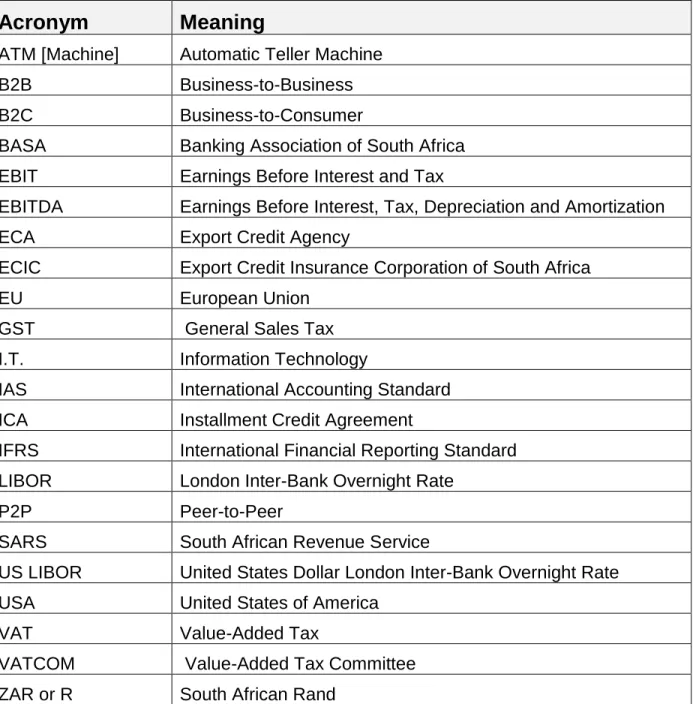
Table of Acronyms
Acronym
Meaning
ATM [Machine] Automatic Teller Machine
B2B Business-to-Business
B2C Business-to-Consumer
BASA Banking Association of South Africa EBIT Earnings Before Interest and Tax
EBITDA Earnings Before Interest, Tax, Depreciation and Amortization
ECA Export Credit Agency
ECIC Export Credit Insurance Corporation of South Africa
EU European Union
GST General Sales Tax
I.T. Information Technology
IAS International Accounting Standard
ICA Installment Credit Agreement
IFRS International Financial Reporting Standard LIBOR London Inter-Bank Overnight Rate
P2P Peer-to-Peer
SARS South African Revenue Service
US LIBOR United States Dollar London Inter-Bank Overnight Rate
USA United States of America
VAT Value-Added Tax
VATCOM Value-Added Tax Committee
8 | P a g e
Introduction
Value-added tax (VAT) and similar taxes known as General Sales Tax (GST) are indirect taxes which are currently levied in over 150 countries world-wide.1 As a tax system, VAT
has its origins in France in the form of excise largely levied on the poor. It was first introduced in 1948 and spread to Western Europe, Asia, the Pacific, Eastern Europe, Africa, North America (except the USA2) and South America.
VAT came into effect in South Africa in terms of the Value-added Tax Act 89 of 1991 (“the VAT Act”) on 30 September 1991. The VAT Act was primarily based on the New Zealand GST legislation, namely the New Zealand Goods and Service Tax Act of 1985. Prior to its introduction, the South African government had launched an in-depth study on the various VAT systems in use globally, and this resulted in the selection of New Zealand’s invoice-based VAT system as being the most appropriate for South African3 adoption. At
the time of its introduction, the standard VAT rate was 10% increasing to the current standard VAT rate of 14% with effect from 7 April 1993.
Summary of the South African VAT system
South Africa applies an invoice-based credit method of VAT with relatively few exemptions, zero-ratings and exclusions. South African VAT is a ‘destination based’ tax system meaning that exports are generally zero rated and imports are taxable. At the time of the enactment of VAT most countries utilised a destination based tax system and with
1 KPMG GLOBAL INDIRECT TAX SERVICES The 2013 Benchmark Survey on VAT/GST
2 United States of America
9 | P a g e ever increasing global trade, an origin based tax system would result in exports being taxed both in South Africa and in their destination country. This double tax would result in South African exports being uncompetitive internationally.
Prior to the introduction of VAT in South Africa, the prevailing view was that theoretically there appeared to be no reason why financial services should not be subject to VAT.
‘In theory, there does not appear to be any reason why financial services should not be subject to VAT. Financial services are a consumption expenditure just like any other service and in fact, because they form a higher proportion of budgets of higher income households there is every reason to subject them to VAT.’ 4
When VAT was enacted in 1991,5 however, South Africa followed the New Zealand GST
methodology and most domestic financial activities and exported financial services were deemed to be financial services6 and exempt from VAT or zero-rated. The list of deemed
financial services was substantially expanded when the supply of goods or services necessary for or incidental to the supply of financial services was added.7 Commencing
in 1996, the scope of exempt financial services was reduced to exclude from the exemption all domestically rendered, fee-based financial services,8 which lessened the
amount of blocked input VAT, but did not eliminate the need to allocate input tax between taxable and exempt supplies.
The South African Revenue Service (SARS) engaged with the banking industry and developed a comprehensive list on the tax status of banking services. The agreement
4 Value-Added Tax Committee (VATCOM), appointed to consider the comments and representations made by
interested parties following the publication of the draft Value-Added Tax Bill published on 18 June 1990 that would give effect to the proposal to introduce an invoice/credit value-added tax system.
5Value-Added Tax Act 89 of 1991 (SA). 6Value-Added Tax Act No. 89 of 1991, s. 2(1). 7 Listed in Value-Added Tax Act No. 89 of 1991, s. 2.
8 In terms of the addition of a proviso to Value-Added Tax Act No. 89 of 1991, s. 2(1), by the Taxation Laws Amendment Act 37 of 1996, effective as from 1 October 1996.
10 | P a g e reached by the parties in 1996 is documented,9 and has been updated as of 1 March
2006.10 The classification of various banking services rendered is provided in the form of
a schedule which lists most of the services as taxable, zero-rated, or exempt from VAT.11
This approach added some degree of certainty for both SARS and the banking industry. Notwithstanding this agreement, the commercial banks and SARS continued to have disputes over the appropriate allocation of input tax between taxable and exempt supplies. In 2003, SARS, in an effort to reduce the attendant problems, developed a standardized method of apportioning tax on business inputs between taxable and exempt banking services.
With the inclusion of fee-based financial services in the VAT base, there was a concern that transactions would be restructured or manipulated to fall either within or outside the VAT net depending on the requirements of the financial institution or the recipient. Owing to the narrow margins on interest and the fierce competition amongst banks, a taxation Commission of Inquiry at the time concluded12 that normal market forces would
prevent the risk of excessive restructuring or manipulation. Reclassification of services as interest to the benefit of individuals would be detrimental to the bank which would then be entitled to claim less input tax, a factor which also prevents manipulation.
9 Entitled ‘Value-Added Tax: Banking Services Provided and Fees Which May be Charged in Connection With Such
Services’, drawn up by the Council of South African Bankers and approved by the Commissioner for Inland Revenue (now SARS); issued on 15 August 1996 and effective as from 1 October 1996.
10 Entitled ‘Banking Services Provided and Fees which may be Charged in Connection With Such Services’, prepared
by the Indirect Tax Standing Committee of the Banking Association South Africa, and approved by SARS, revised and agreed on 2 March 2006 and effective as from 1 March 2006. Any such document issued in the future will have the status of a binding class ruling in terms of Value-Added Tax Act No. 89 of 1991, s. 41B, which will have the same binding effect as a binding class ruling issued under s. 78 of the Tax Administration Act 28 of 2011.
11 This document classified services in eight different categories: general banking services, card services, treasury
services, credit and lending services, motor and other asset finance, securities services, other services, and international services.
12 Third Interim Report of the Commission of Inquiry into Certain Aspects of the Tax Structure of South Africa (1995),
11 | P a g e The South African Competition Commission (anti-trust committee) concluded in 2008 that transactional and interbank charges (bank charges) in South Africa are higher than their international counter-parts. The market structure, because of current information asymmetries and product complexities, means that the banks have the ability to abuse their market power and conspire to charge, by international standards, high explicit fees for many banking services, especially for branded credit cards and services obtained from ATM machines.13
There is no empirical evidence available to determine whether financial institutions conceal VAT charges for services rendered to borrowers in higher interest rates charged on consumer loans, and services rendered to depositors in lower interest rates paid on deposits in order to avoid charging VAT on the value of those services. There also appears to be no evidence that the banks have altered the pricing structure for banking services to benefit from the methodology adopted.
Object of this research
Research Statement
This report seeks to identify financial services that are utilised by financial institutions in the South African economy and test them against the provisions of the VAT Act. Financial services provided by the insurance industry are not included in the scope of this report (these are however briefly discussed as they appear in the definition of financial services).
Sub-problems
13 The Competition Commission of South Africa (also known as the anti-trust committee) in its annual report in 2008.
12 | P a g e A number of sub-problems will assist in attempting to address the main research problem as detailed above.
Why are financial services exempt from VAT? What are the characteristics of a ‘fee’?
What is that effect of VAT on certain common and complex financial arrangements? What approach should be used when dealing with a transaction that contains multiple interconnected services?
Significance of this research
This research provides a number of significant contributions. Firstly the report summarizes the current status of VAT on financial services and the history thereto. It then deals with the legal framework of the VAT system and in doing so examines the interpretation of the word ‘fee’. Important submissions are made about the interpretation of the word ‘fee’ as the report (by way of examples) illustrates the complexities in differentiating fees from instruments (especially when dealing complex financial arrangements).
The report discusses the VAT consequences of common financial services and proposes how such services should be treated from a VAT perspective. The services as envisaged in section 2 of the VAT Act are dealt with in detail but at first limited to such services supplied in isolation. The discussion considers the application of VAT in transactions that contain multiple supplies and how the current legislation should be applied to such transactions.
Finally the report examines the VAT consequences on select complex financial arrangements where the line between exempt and taxable services is blurred. It provides a theoretical approach when attempting to determine the VAT consequences on such complex financial arrangements.
13 | P a g e
Chapter outline
Chapter 1 puts forward the current legal framework in which financial services are evaluated with respect to VAT. It highlights the basic operations of the VAT Act with regard to financial services and looks to the reasons provided by VATCOM for the exemption of financial services (noting that while in theory VAT could be applied to financial services, they were exempt due to practical limitations). The idea of taxable fee based financial services versus non fee based exempt financial services is introduced and sets the backdrop on which the following chapters will build.
Chapter 2 proposes an interpretation of the word ‘fee’ and submits that this is crucial in
determining if a financial service is subject to VAT. The word ‘fee’ is not defined by the VAT Act and the discussion seeks to attach meaning to the word by following the South African statutory interpretation approach.
Chapter 3 examines commonly encountered financial services and the VAT
consequences thereof. This chapter for, the most part, is limited to discussing the VAT consequences in isolation and does not assume a multi-part transaction with more than one service supplied.
Chapter 4 introduces the concept of input tax within the realm of financial services. It examines the requirements of vendors with regard to calculating their input tax entitlement. Input tax relating specifically to financial service providers is also dealt with.
Chapter 5 deals with a recent court decision regarding VAT within a ‘web of transactions’.
Financial institutions often bundle multiple services into one transaction. Often such services are a mix of taxable and exempt supplies. The chapter highlights the court’s approach to the application of VAT with respect to a ‘web of transactions’.
Chapter 6 tests some of the less common financial arrangements against the provisions
14 | P a g e occur between financial service providers and selected clients or between banks. The chapter selects limited (and simplified) examples to illustrate the types of transactions and their basic operation. The chapter also proposes the treatment of the VAT consequences of the transactions.
Chapter 7 deals with ‘twenty-first century’ financial instruments but limits its scope to
Crowd Funding, Peer-to-Peer lending and Cryptocurrency. The recent introduction of these offerings to the financial service industry has forced the discussion of these instruments in this report to be largely academic.
15 | P a g e
Chapter 1 - The Exempting of Financial Services
It is generally accepted that in theory financial services should be subjected to VAT, bearing in mind that despite being present present in the definition of financial services, some transactions, it is submitted, cannot be subject to VAT. One such example is the exchange of money or domestic currency for foreign currency. The exchange of money has no value add and should therefore be exempt. Were there to be no exemption, then the transfer of currency could fall out of the scope of the VAT Act all together14.
Financial services are exempt largely due to the South African VAT system being based on the New Zealand GST system. A report issued by KPMG on the potential implementation of VAT on financial services, by the Chinese Government, in China found that there are two main reasons why financial services are exempt:
‘The difficulty in measuring the ‘value added’ to financial services on a transaction-by-transaction basis. For example, when an individual deposits an amount of RMB 10,000 into a bank and is paid 2 percent per annum interest rate, the bank does not subsequently lend that same fixed sum amount to a borrower at say 5 percent per annum of interest, for precisely the same period of time. In practice, the 3 percent ‘value added’ by the bank in return for its services to each of the borrower and the deposit holder cannot be measured on a transaction-by-transaction basis.
Financial services facilitate the buying and selling of goods and services. The granting of an exemption from VAT recognises that lending and deposit-taking are merely the means by which businesses and individuals fund consumption activities – that is, lending to facilitate the early purchase of goods or services upon which VAT is then levied, and deposit-taking to facilitate the deferred purchase of goods and services upon which VAT is then levied.’15
14This assumes that the legal tender of South Africa (Rand) is transferred from one person to another and not some
other currency in exchange for a different currency.
16 | P a g e VATCOM16 cited the following consequences and practical implications of exempting
financial services:
‘The consequences and practical difficulties are the following:
(a) There will not be double taxation which would arise if the services were exempt and rendered to vendors.
(b) The cost of borrowing by private persons for housing, consumer durables etc. will increase by the full rate of VAT which at present levels of interest, and assuming a 10 per cent VAT rate, could amount to between 2,0 to 2,9 per cent. It could be argued that the price of many other goods and services will also increase by a similar amount and there is no reason for special treatment for financial services.
(c) The taxation will create a strong incentive for disintermediation, particularly in the case of household borrowers. Buyers will bypass financial institutions and go directly to the private investor for funds. Financial institutions will be encouraged to act as agents bringing non-vendor investors and private borrowers together.
(d) Financial institutions provide an enormous range of services and instruments which can be changed
with relative ease if more favourable tax treatment can be obtained. In addition, there are millions of investors and depositors in financial institutions. If tax is imposed the institutions will have to establish in each case whether the investor is a vendor or not. In the case of vendors, financial institutions will be required to pay VAT in addition to the rate of interest. Tax invoices will also have to be obtained from the vendors so that the institutions can claim input tax. If invoices are not required, there would be an incentive for investors who are not vendors to have themselves falsely classified as vendors by the institution as they would receive a better return (i.e. plus VAT). It would not be possible to use a monetary value to classify investors as vendors, as vendors carrying on activities other than investment also invest money. A decision will have to be made on each account to decide whether it is the investor’s business or private account.
In discussions held with financial institutions they were very strongly of the opinion that their systems could not handle the volume of transactions as well as the very large increase in paperwork. They claimed that their position could not be compared with any other vendor, because if the vast number of their “suppliers”.
17 | P a g e (e) The taxation of interest will also increase the number of vendors who will have to register. Investors,
often people who are not in business, for example, widows, pensioners, etc. will be required to submit returns.
(f) The tax will also have to be imposed on existing loans as banks would otherwise suffer losses. The
transition will require careful consideration as it will affect existing agreements.
The organisations who favour the exemption acknowledge that it does favour private consumers to the extent that VAT is not imposed on the value added by financial institutions. They point out, however, that this loss of revenue is largely compensated for by the double taxation that occurs when financial services are rendered to vendors. It is claimed that by far the largest portion of interest is paid by vendors.
The compliance costs of a full invoice VAT for financial institutions and a number of investors who will have to register is likely to be higher than the compliance costs of exemption.
It is also argued that no country has as yet been able to overcome the difficulties foreseen with taxation of financial services and it is not advisable that South Africa do pioneering work in this regard.’
It is clear from the above extracts that VAT could be levied on financial services. It is equally as clear, that doing so would result in a prohibitive administration burden on the financial institutions providing the services envisaged. Ultimately the VAT Act, when signed into power, exempted financial services and these sections have remained largely unchanged since implementation.
The financial services as set out in the VAT Act are dealt with in two sections. The definition of financial services contained in section 1 of the VAT Act. This definition simply refers the reader to section 2 of the VAT Act titled ‘financial services’. This section is as follows:
18 | P a g e
‘2. Financial services. (1) For the purposes of this Act, the following activities shall be deemed to be financial services:
(a) The exchange of currency (whether effected by the exchange of bank notes or coin, by crediting or debiting accounts, or otherwise);
(b) the issue, payment, collection or transfer of ownership of a cheque or letter of credit;
(c) the issue, allotment, drawing, acceptance, endorsement or transfer of ownership of a debt security; (d) the issue, allotment or transfer of ownership of an equity security or a participatory security; (e) . . .
( f ) the provision by any person of credit under an agreement by which money or money’s worth is provided by that person to another person who agrees to pay in the future a sum or sums exceeding in the aggregate the amount of such money or money’s worth;
(g) . . . (h) . . .
(i) the provision, or transfer of ownership, of a long-term insurance policy or the provision of reinsurance in respect of any such policy: Provided that such an activity shall not be deemed to be a financial service to the extent that it includes the management of a superannuation scheme;
( j) the provision, or transfer of ownership, of an interest in a superannuation scheme;
(k) the buying or selling of any derivative or the granting of an option: Provided that where a supply of the underlying goods or services takes place, that supply shall be deemed to be a separate supply of goods or services at the open market value thereof: Provided further that the open market value of those goods or services shall not be deemed to be consideration for a financial service as contemplated in this paragraph:
(l) . . . (m) . . . (n) . . .
Provided that the activities contemplated in paragraphs (a), (b), (c), (d) and ( f ) shall not be deemed to be financial services to the extent that the consideration payable in respect thereof is any fee, commission, merchant’s discount or similar charge, excluding any discounting cost.
(2) For the purposes of subsection (1)—
(i) “cheque” means a bill drawn on a bank payable on demand, a postal order, a money order, a traveller’s cheque, or any order or authorisation (whether in writing, by electronic means, or otherwise) to a financial institution to credit or debit any account;
19 | P a g e (ii) “currency” means any banknote or other currency of any country, other than when used as a collector’s piece, investment article, item of numismatic interest, or otherwise than as a medium of exchange;
(iii) “debt security” means— (aa)
an interest in or right to be paid money; or (bb)
an obligation or liability to pay money
that is, or is to be, owing by any person, but does not include a cheque; (iiiA) “derivative” means a derivative as defined in International Accounting Standard 39 of the International Accounting Standards issued by the International Accounting Standards Board; (iv) “equity security” means any interest in or right to a share in the capital of a juristic person or the interest in a close corporation of a member thereof;
(v) “long-term insurance policy” means any policy of insurance issued in the ordinary course of carrying on long-term insurance business as defined in section 1 (1) of the Long-term Insurance Act, 1998 (Act No. 52 of 1998);
(vA) “merchant’s discount” means a charge made to merchants for accepting a credit or debit card as payment for the supply of goods or services, or a similar charge made by a buying organisation;
(vi) “participatory security” means a participatory interest as defined in section 1 of the Collective Investment Schemes Control Act, 2002 (Act No. 45 of 2002), but does not include an equity security, a debt security, money or a cheque;
(vii) “superannuation scheme” means a scheme whereby provision is made for the payment or
granting of benefits by a benefit fund, pension fund, pension preservation fund, provident fund, provident preservation fund or retirement annuity fund as defined in section 1 of the Income Tax Act. (3) Notwithstanding subsection (2), the terms “debt security”, “equity security” and “participatory security” do not include any of the following:
(a )A long-term insurance policy or any other policy of insurance;
(b) any ownership or interest in land, other than an interest as mortgagee; (c) a share in the share capital of a share block company;
(d) any interest of a member of a close corporation which confers on the member a time-sharing interest as defined in section 1 of the Property Time-sharing Control Act, 1983 (Act No. 75 of 1983), on the terms and conditions contained in the association agreement of such close corporation;
(e) an interest in a superannuation scheme.
20 | P a g e (a) the cession, assignment, transfer or other supply of any right to receive payment in relation to any
taxable supply where, as a result of any such cession, assignment, transfer or supply, output tax in relation to that taxable supply would not be or become attributable to any tax period for the purposes of section 16 (3); or
(b) . . .
(c) the transfer of any interest in or right to be paid money that is, or is to be, owing by a share block company under its loan obligation, as defined in section 1 of the Share Blocks Control Act, to any person who is or will be a shareholder of such share block company.’17
South Africa does however have one major proviso that differentiates its tax system from most of the others. The proviso to the definition of financial services in section 2(1)18 (as
shown in the above extract) excludes certain fees charged in relation to the activities which are deemed to be financial services. The consequence of this is that certain fee based financial services will be a taxable supply.
The following analysis will elaborate on each part of the definition above.
The Legal Framework
The VAT Act by implication excludes from the exemption, explicit fees charged for the provision of certain financial services. The VAT Act achieves this by defining ‘financial services’ in a manner that excludes explicit fee-based services rendered (international financial services are treated as a zero rated export and will be discussed under the sub heading Reverse Charges in Chapter 3- Common Financial Services).
The term ‘financial services’ as so defined is descriptive rather than principle-based. The statutory definition of the term ‘financial services’ is also exclusive and exhaustive,19 and
17 Section 2 of Value-Added Tax Act No. 89 of 1991 18 of Value-Added Tax Act No. 89 of 1991
19 See Jones & Co Ltd v CIR 1926 CPD 1, 2 SATC 7 at 10. Followed and applied in Guernsey & Foreign Investment Trust Ltd v CIR 1938 CPD 158, 9 SATC 390.
21 | P a g e means the specifically defined activities which are deemed by section 2 of the VAT Act to be financial services.20
A notable feature of the definition of ‘financial services’ is its focus on transactions as opposed to the entity supplying the service. The activities included in the definition of ‘financial services’ are exempt irrespective of whether or not they are carried out by an entity, the main business of which is the provision of financial services. The result of this is that financial services, even as a byproduct of an entity’s revenue, are still exempt on a transaction by transaction basis. This impacts upon the claiming of input VAT which will be discussed in Chapter 4 - Input Tax.
The following activities listed in section 221 are deemed to be financial services:
The exchange of currency (section 2(1)(a))22:
‘(a) The exchange of currency (whether effected by the exchange of bank notes or coin, by crediting or debiting accounts, or otherwise);’
It matters not whether the process of exchange from one currency into another is in the form of bank notes, coins or by way of crediting and debiting accounts or otherwise. Only the activity of exchanging currency for a margin is considered to be a financial service. Where a business converts sales consideration received in foreign currency into local currency, such exchange into local currency is not considered to be a financial service supplied by the business.
The function of the definition of the term ‘currency’ in section 123 is to cover monies used
as a medium of exchange. It is defined as any banknote or other currency of any country, other than when used as a collector’s piece, investment article, item of numismatic
20Value-Added Tax Act No. 89 of 1991, s. 1(1), definition of ‘financial services’. 21 of Value-Added Tax Act No. 89 of 1991
22 of the Value-Added Tax Act No. 89 of 1991 23 of the Value-Added Tax Act No. 89 of 1991
22 | P a g e interest or otherwise than as a medium of exchange (section 2(2)(ii)24). Any exchange of
one recognized legal tender for another would therefore fall within the ambit of this provision, whether it be effected by bank notes or coins, by the crediting or debiting of accounts or in any other manner.
While the exchange of currency constitutes an exempt financial service, should any fee, commission or similar charge (but not any discounting cost) be levied for that service, such fee, commission or charge will be subject to tax by virtue of the proviso to section 2(1)25.
A bank providing foreign exchange facilities is engaging in exempt transactions for VAT purposes, provided no separate fee, commission or similar charge is levied for providing such exchange facilities. Where, however, no specific charge is made for exchanging currency (but the bank merely quotes a difference between the buying and selling rates), there is an argument that the difference which accrues to the agent or bank is not a ‘fee, commission or similar charge’ as contemplated in the proviso to section 2(1)26.
It is stated in the Explanatory Memorandum on the Taxation Laws Amendment Bill, 1996 that the difference in buying and selling rates ‘is consideration for the exchange of currency and, therefore, exempt from VAT’.27 However, if a travel agent (which does not
itself have the facility to provide the foreign exchange) charges a fee for arranging that a bank exchanges the currencies, this is not a financial service and is therefore subject to VAT.
If, however, a collector acquires Krugerrands and pays in foreign or local currency, the transaction is taxable, not exempt, since for the purposes of section 2(1)(a)28, the
24 of the Value-Added Tax Act No. 89 of 1991 25 of the Value-Added Tax Act No. 89 of 1991 26 of the Value-Added Tax Act No. 89 of 1991
27 [WP 3—’96] Republic of South Africa, Explanatory Memorandum on the Taxation Laws Amendment Bill, 1996 at
10.
23 | P a g e Krugerrands so acquired would not qualify as ‘currency’, and consequently no exchange of currency has occurred. But if the collector’s piece, investment article or item of numismatic interest consists of a gold coin issued by the Reserve Bank (including Krugerrands), the supply will be zero-rated (section 11(1)(k))29.
The issue, payment, collection or transfer of ownership of a cheque or letter of credit (section 2(1)(b))30:
‘(b) the issue, payment, collection or transfer of ownership of a cheque or letter of credit;’31
The issue, allotment, drawing, acceptance, endorsement, transfer of ownership of a debt security (section 2(1)(c))32:
‘(c) the issue, allotment, drawing, acceptance, endorsement or transfer of ownership of a debt security’33
A ‘debt security’ is widely defined in section 2(2)(iii)34 as an interest in or right to be paid
money that is or is to be owing by any person or an obligation or liability to pay money, but does not include a ‘cheque’ as defined. The term embraces trade debts, loan accounts, promissory notes, interest swaps and a wide variety of other rights to be paid money or obligations to pay money.
The issue, allotment or transfer of ownership of an equity security or a participatory security (section 2(1)(d))35:
‘(d) the issue, allotment or transfer of ownership of an equity security or a participatory security’’36
29 of the Value-Added Tax Act No. 89 of 1991 30 of the Value-Added Tax Act No. 89 of 1991 31 Value-Added Tax Act No. 89 of 1991, s. 2(1)(b) 32 of the Value-Added Tax Act No. 89 of 1991 33 Value-Added Tax Act No. 89 of 1991, s. 2(1)(c) 34 Value-Added Tax Act No. 89 of 1991
35 of the Value-Added Tax Act No. 89 of 1991 36 Value-Added Tax Act No. 89 of 1991, s. 2(1)(d)
24 | P a g e Such a transaction may be subject to securities transfer tax.37 The term ‘equity security’
is defined as any interest in or right to a share in the capital of a juristic person or a member’s interest in a close corporation (section 2(2)(iv))38, for example, shares in a
company. An ‘equity security’ does not include a long-term insurance policy, the ownership of or an interest in land, a share in the share capital of a share block company, any time-sharing interest conferred by a member’s interest in a close corporation or an interest in a superannuation scheme.
The term ‘participatory security’ is defined as encompassing a ‘participatory interest’ as defined in section 1 of the Collective Investment Schemes Control Act39 but does not
include an equity security, a debt security, money or a cheque (section 2(2)(vi)40).
Participatory securities also do not include any long-term insurance policy, any ownership or interest in land, a share in the share capital of a share block company, any time-sharing interest or an interest in a superannuation scheme (section 2(3)41).
The provision by any person of credit under an agreement by which money or money’s worth is provided by that person to another person who agrees to pay in the future a sum or sums exceeding in the aggregate the amount of such money or money’s worth (section 2(1)(f)42):
‘( f ) the provision by any person of credit under an agreement by which money or money’s worth is
provided by that person to another person who agrees to pay in the future a sum or sums exceeding in the aggregate the amount of such money or money’s worth;’43
37 The Securities Transfer Tax Act, 2007 calls for securities transfer tax to be levied on the transfer of securities. The
Securities Transfer Tax Administration Act, 2007 contains the administration provisions governing the payment of securities transfer tax.
38 of the Value-Added Tax Act No. 89 of 1991 39 Act 45 of 2002.
40 of the Value-Added Tax Act No. 89 of 1991 41 of the Value-Added Tax Act No. 89 of 1991 42 of the Value-Added Tax Act No. 89 of 1991 43 Value-Added Tax Act No. 89 of 1991, s. 2(1)(f)
25 | P a g e ‘Credit’ for this purpose refers to a contractual arrangement whereby a borrower receives a loan or something of monetary value and agrees to deferred repayment, which requires that interest or other monetary return becomes due and payable. An interest-free loan will therefore not qualify as an exempt supply which means that it would not be considered in the calculation of the ratio of taxable to exempt supplies for any particular organization. The provision or transfer of ownership of a long-term insurance policy or the provision of reinsurance for any such policy (section 2(1)(i)44):
‘(i) the provision, or transfer of ownership, of a long-term insurance policy or the provision of reinsurance in respect of any such policy: Provided that such an activity shall not be deemed to be a financial service to the extent that it includes the management of a superannuation scheme;’45
The term ‘long-term insurance policy’ is defined (section 2(2)(v)46) as ‘any policy of
insurance issued in the ordinary course of carrying on long-term insurance business as defined in section 1 of the Long-term Insurance Act, 1998’.47 A ‘long-term insurance
policy’ would include a funeral policy, a home service policy, an industrial policy and a sinking policy (as defined in section 1 of the Long-term Insurance Act).
The provision, or transfer of ownership, of an interest in a superannuation scheme (section 2(1)(j)48):
‘( j) the provision, or transfer of ownership, of an interest in a superannuation scheme;’49
44 of the Value-Added Tax Act No. 89 of 1991 45 Value-Added Tax Act No. 89 of 1991, s. 2(1)(h) 46 of the Value-Added Tax Act No. 89 of 1991 47 Act 52 of 1998.
48 of the Value-Added Tax Act No. 89 of 1991 49 Value-Added Tax Act No. 89 of 1991, s. 2(1)(j)
26 | P a g e A ‘superannuation scheme’ is a scheme under which provision is made for the payment or granting of benefits by a ‘benefit fund’, ‘pension fund’, ‘pension preservation fund’, ‘provident fund’, ‘provident preservation fund’ or ‘retirement annuity fund’ as defined in section 1 of the Income Tax Act 58 of 1962. Since registered medical-aid schemes are included in the definition of the term ‘benefit fund’ in section 1 of the Income Tax Act 58 of 1962, contributions to such schemes are exempt for VAT purposes, being payment for a financial service.
The buying or selling of any derivative or the granting of an option is deemed to be an exempt financial service (section 2(1)(k)50):
‘(k) the buying or selling of any derivative or the granting of an option: Provided that where a supply of the underlying goods or services takes place, that supply shall be deemed to be a separate supply of goods or services at the open market value thereof: Provided further that the open market value of those goods or services shall not be deemed to be consideration for a financial service as contemplated in this paragraph:’51
The subsequent supply of the underlying goods or services is deemed to be a separate supply and not a financial service.
The deemed financial services listed above specifically exclude the activities in sections 2(1)(a), (b), (c), (d) and (f)52 to the extent that the consideration payable for these activities
is any fee, commission, merchant’s discount or similar share, but not a discounting cost. Consequently, if any of these activities are rendered for the payment of an explicit fee, they are deemed not to be financial services to the extent of the explicit fee charged.
50 of the Value-Added Tax Act No. 89 of 1991 51 Value-Added Tax Act No. 89 of 1991, s. 2(1)(h) 52 of the Value-Added Tax Act No. 89 of 1991
27 | P a g e The scope of exempt financial services was further limited by the inclusion of a merchant’s discount as a fee-based activity.53 A ‘merchant’s discount’ is defined in section 2(2)(vA)54
as a charge made to merchants for accepting a credit or debit card as payment for the supply of goods or services, or a similar charge by a buying organization. Any service fee or charge similar to that of a merchant’s discount also excludes the underlying activity to such extent from a financial service. Although a merchant’s discount is excluded as a ‘financial service’, the High Court has ruled that discounts received by a buy-aid organization from suppliers of goods or services as a result of prompt payment, do not fall within the definition of ‘services’ in the Vat ACT, and as such are not subject to VAT.55
A discounting cost, namely, where a debt security such as a book debt is transferred at a discount to its face value, does not exclude the transfer of the debt security from a ‘financial service’. The discounting cost itself is also not subject to VAT by virtue of its specific exclusion from the proviso to section 2(1) of the VAT Act.
Where the activities deemed to be financial services comprise a ‘supply’,56 such supply
is exempt from VAT in terms of section 12(a)57. If the supply of the financial services
would, but for the provisions of section 12(a)58 qualify for VAT at the zero rate in terms of
section 1591, then the exemption provisions of section 12(a)60 do not apply and the
zero-rating takes preference. Consequently, the supply of financial services to non-residents who are not present in South Africa when the services are rendered, are subject to VAT at the zero rate and are not exempt.
53 In the proviso to Value-Added Tax Act No. 89 of 1991, s. 2(1), introduced by virtue of Taxation Laws Amendment Act 30 of 1998, s. 87(1)(a), effective as from 1 March 1999.
54 of the Value-Added Tax Act No. 89 of 1991
55Commissioner for South African Revenue Service v Cape Consumers (Pty) Ltd (61 SATC 91), 23 March 1999. 56Value-Added Tax Act No. 89 of 1991, s. 1(1), defines a ‘supply’ to include performance in terms of a sale, rental
agreement, instalment credit agreement and all other forms of supply, whether voluntary, compulsorily or by operation of law, irrespective of where the supply is effected, and any derivative of ‘supply’ shall be construed accordingly.
57 of the Value-Added Tax Act No. 89 of 1991 58 of the Value-Added Tax Act No. 89 of 1991 59 of the Value-Added Tax Act No. 89 of 1991 60 of the Value-Added Tax Act No. 89 of 1991
28 | P a g e The Tax Court61 has, however, ruled that the provisions of sections 12(a) and 1162 will
apply only if the financial services are supplied in the course or furtherance of an enterprise making taxable supplies. Therefore, where shares are held as an investment, the mere holding of shares is not an enterprise and therefore the disposal of these shares does not fall within the ambit of section 7(1)(a)63. Such a supply to a South African
resident is thus not considered to be an exempt supply in terms of section 12(a)64 or zero
rated in terms of the provisions of section 11(2)(ℓ)65 in the case of a non-resident. Such
a supply, being neither exempt nor zero rated, falls outside the scope of VAT.
On 17 July 2013 the Minister of Finance initiated a tax review to assess the South African tax policy framework and its role in supporting the objectives of inclusive growth, employment, development and fiscal sustainability. The Tax Review Committee66
established for this purpose, was specifically tasked to consider the VAT treatment of financial services and VAT apportionment within the financial sector, to review the efficiency and equity of the VAT system and specifically the advisability and effectiveness of dual rates, zero rating and exemptions.67 On 7 July 2015 the Tax Review Committee
published its first interim report on VAT for public comment.68 It identified VAT cascading
in the financial services sector as the most important area for consideration, and recommended that the various approaches adopted in other jurisdictions to mitigate VAT cascading should receive further urgent consideration.
61 Case No. VAT 382, Tax Court Cape Town 13 June 2011, para. 63.
62 of the Value-Added Tax Act No. 89 of 1991 63 of the Value-Added Tax Act No. 89 of 1991 64 of the Value-Added Tax Act No. 89 of 1991 65 of the Value-Added Tax Act No. 89 of 1991
66 Known as the Davis Tax Committee.
67 South African Treasury, 2013 Budget Review, p. 63.
68 Tax Review Committee, Media Statement: Release of Davis Tax Committee First Interim Report on VAT for Public
Comment, 7 July 2015. Available at:
http://www.taxcom.org.za/docs/20150707%20DTC%20VAT%20First%20Interim%20Report%20for%20pu blic%20comment.pdf.
29 | P a g e
Chapter 2 – The meaning of the word ‘Fee’
The proviso to subsection 1 of section 2 of the VAT Act excludes fees and other like consideration from being a financial service. The proviso reads as follows:
‘Provided that the activities contemplated in paragraphs (a), (b), (c), (d) and ( f ) shall not be deemed to be financial services to the extent that the consideration payable in respect thereof is any fee, commission, merchant’s discount or similar charge, excluding any discounting cost.’
It is submitted that the primary differentiator between taxable financial services and exempt financial services is whether the consideration for the supply is a fee or compensation similar to a fee.
‘Fee’ is not defined by the VAT Act. In order to determine what is meant by the legislator by the use of the word ‘fee’ one must apply the principles of statutory interpretation. A brief discussion of these principles and an extract from Wallis JA’s his judgement of Natal Joint Municipal Pension Fund v Endumeni Municipality is contained in ‘Annexure A’ of this report.
In accordance with the principles of statutory interpretation, one can look to other authorities if the meaning of a word or phrase is unclear. Authorities such as repealed acts, dictionaries or works of literature written by learned authors on the subject can be used as an aid in determining the meaning of the word ‘fee’.
30 | P a g e The schedule to the now repealed Usury Act69 contained definitions of certain types of
fees. These definitions will serve as an interpretive aid to the meaning of the word fee in the VAT Act.
The definitions as they appeared in the Usury Act70 are as follows:
‘ "administration fee"
means an amount payable by the borrower to the moneylender--
a) where such amount is in terms of an agreement in writing between the moneylender and
the borrower recoverable from the borrower;
b) as valuable consideration for the moneylender's administering the borrower's account; and
c) where the total amount payable per month does not exceed the amount mentioned in paragraph 3(b)(i);
"initiation fee"
means a single fee not greater than the amount mentioned in paragraph 3(b)(ii) payable by the borrower to the moneylender --
a) in terms of an agreement in writing between the moneylender and the borrower;
b) as valuable consideration for services rendered in connection with the registration of the mortgage bond in question; and
c) at the conclusion of the money lending transaction in question; ’
The definitions highlight a number of factors that need to be present in order for a transaction to be classed as a fee, the first of which would require the payment of money from one party to another in accordance with an agreement between the two parties. This in isolation would be a donation and thus the money must be transferred in return for ‘something’. That ‘something’ must be identifiable as a service rendered to the payer.
The Webster’s College Dictionary71 defines ‘fee’ as :
69 Usury Act No. 73 of 1968 70 Usury Act No. 73 of 1968 71 Webster’s College Dictionary
31 | P a g e ‘a sum charged or paid, as for professional services or a privilege’
This definition, although not as descriptive as the one contained in the schedules of the repealed Usury Act72, carries the same criteria id-est money (a sum) is transferred
(charged or paid) in return for a service.
The guidance to International Accounting Standard (‘IAS’) 18 contains descriptive examples of financial service fees. Accounting standards should be considered with extreme caution as it has been established by the courts that the accounting treatment of a transaction has no effect on the legal or economical substance of the transaction73. It is
submitted that one should view the below extracts only as a guide to possible types of fees charged for financial services rendered or ones normally contained in financial contracts.
‘Financial service fees. The recognition of revenue for financial service fees depends on the purposes for which the fees are assessed and the basis of accounting for any associated financial instrument. The description of fees for financial services may not be indicative of the nature and substance of the services provided. Therefore, it is necessary to distinguish between fees that are an integral part of the effective interest rate of a financial instrument, fees that are earned as services are provided, and fees that are earned on the execution of a significant act.’74
This extract from the descriptive examples of IAS 18 highlights some common types of financial instruments which are likely to contain both fees and interest.
‘(a) Fees that are an integral part of the effective interest rate of a financial instrument. Such fees are generally treated as an adjustment to the effective interest rate. However, when the financial instrument is measured at fair value with the change in fair value
72 Usury Act No. 73 of 1968
73See CIR v George Forest Timber Co Ltd 1924 AD 516 at 522 and 528; Pyott Ltd v CIR 1945 AD 128 at 135 and
136
32 | P a g e
recognised in profit or loss, the fees are recognised as revenue when the instrument is initially recognised.
(i) Origination fees received by the entity relating to the creation or acquisition of a financial asset other than one that under IFRS 9 is measured at fair value through profit or loss.
Such fees may include compensation for activities such as evaluating the borrower’s financial condition, evaluating and recording guarantees, collateral and other security arrangements, negotiating the terms of the instrument, preparing and processing documents and closing the transaction. These fees are an integral part of generating an involvement with the resulting financial instrument and, together with the related transaction costs * (as defined in IAS 39), are deferred and recognised as an adjustment to the effective interest rate.
(ii) Commitment fees received by the entity to originate a loan when the loan commitment is outside the scope of IFRS 9.
If it is probable that the entity will enter into a specific lending arrangement and the loan commitment is not within the scope of IFRS 9, the commitment fee received is regarded as compensation for an ongoing involvement with the acquisition of a financial instrument and, together with the related transaction costs (as defined in IAS 39), is deferred and recognised as an adjustment to the effective interest rate. If the commitment expires without the entity making the loan, the fee is recognised as revenue on expiry. Loan commitments that are within the scope of IFRS 9 are accounted for as derivatives and measured at fair value.
(iii) Origination fees received on issuing financial liabilities measured at amortised cost.
These fees are an integral part of generating an involvement with a financial liability. When a financial liability is not classified as at fair value through profit or loss, the origination fees received are included, with the related transaction costs (as defined in IAS 39) incurred, in the initial carrying amount of the financial liability and recognised as an adjustment to the effective interest rate. An entity distinguishes fees and costs that are an integral part of the effective interest rate for the financial liability from origination fees and transaction costs relating to the right to provide services, such as investment management services.
(b) Fees earned as services are provided. (i) Fees charged for servicing a loan.
Fees charged by an entity for servicing a loan are recognised as revenue as the services are provided.
33 | P a g e
(ii) Commitment fees to originate a loan when the loan commitment is outside the scope of IFRS 9.
If it is unlikely that a specific lending arrangement will be entered into and the loan commitment is outside the scope of IFRS 9, the commitment fee is recognised as revenue on a time proportion basis over the commitment period. Loan commitments that are within the scope of IFRS 9 are accounted for as derivatives and measured at fair value.
(iii) Investment management fees.
Fees charged for managing investments are recognised as revenue as the services are provided. Incremental costs that are directly attributable to securing an investment management contract are recognised as an asset if they can be identified separately and measured reliably and if it is probable that they will be recovered. As in IAS 39, an incremental cost is one that would not have been incurred if the entity had not secured the investment management contract. The asset represents the entity’s contractual right to benefit from providing investment management services, and is amortised as the entity recognises the related revenue. If the entity has a portfolio of investment management contracts, it may assess their recoverability on a portfolio basis.
Some financial services contracts involve both the origination of one or more financial instruments and the provision of investment management services. An example is a long-term monthly saving contract linked to the management of a pool of equity securities. The provider of the contract distinguishes the transaction costs relating to the origination of the financial instrument from the costs of securing the right to provide investment management services.’75
On consideration of the above examples provided by IFRS (again viewed with extreme caution) one can see that, with clever construction of the terms and conditions of a loan agreement, fees can be made to mimic what would normally be interest. It is therefore of paramount importance to determine how fees differ from interest in the context of financial services.
The National Credit Act76 requires that fees be included in the calculation for the maximum
interest that can be charged on a loan. This is done through the introduction of the concept
75 International Accounting Standard 18 Revenue Illustrative Examples paragraph 14 76 National Credit Act No. 34 of 2005
34 | P a g e of a ‘deferred amount’ and a prescribed formula for the calculation of interest (see ‘Annexure B’). This indicates that in some instances the legislator treats a fee in the same way as interest with regard to debt transactions. The provision serves as protection for borrowers against low interest-high fee loans as Lenders sometimes use fees on a loan to improve profitability and effectively increase their return on monies advanced.
Fee income in the banking sector is a large contributor to the respective bank’s revenue and profit. The chart below shows the contribution of fees to total revenue of four major banks in South Africa.
77 78
There is clearly a shift towards fee based services in the banking sector and the greater financial services sector as a whole. This shift is partly driven by the increasing revenue generated from ‘capital light’ services as well as a favoring of fees as opposed to margin
77 Extracted from respective banks annual financial statements for years ended 2013,2014,2015
78 Investec Bank Limited, ABSA Group Limited, Nedbank Group Ltd, Standard Bank Group Limited
56% 52% 33% 33% 37% 25% 28% 27% 34% 26% 30% 27%
Investec ABSA Nedbank Standard Bank
Fees as a percentage of Revenue
35 | P a g e income. Reasons for this include tighter capital controls introduced by Basel III resulting in smaller interest margins and increased regulation regarding ‘on balance-sheet financing’.
Capital light services are generally banking services that do not require a bank to hold capital against them. These services include asset management, wealth management and advisory. All these activities do not require the use of depositor’s money but are rather the result of the employees of the bank’s efforts and intellect.
It is submitted based on the previous discussion that in order for an amount to be treated as a fee, the contract must explicitly provide for the charging of this fee. It is further submitted that the party charging the fee must be providing a service that is identifiable from the underlyling financial service and that the fee relates to such additional service as stipulated in the agreement.
The definition of ‘financial services’ in section 2 of the VAT Act is central to the VAT treatment of fees on financial services. Insofar as is here relevant, the definition deems, for the purposes of the VAT, the activities listed in paragraphs (a) to (k) to be financial services. The second function is to exclude from the definition of ‘financial services’ certain fee-based activities. The proviso to section 279 states that:
‘... the activities contemplated in paragraphs (a), (b), (c), (d) and (f) [of section 2] shall not be deemed to be financial services to the extent that the consideration payable in respect thereof is any fee, commission, merchant’s discount or similar charge, excluding any discounting cost.’
The provision of credit and the granting of loans are thus excluded from the definition of ‘financial services’ to the extent that any explicit fee or commission is charged to a
36 | P a g e borrower in relation to the provision of the credit.80 Consequently, it is submitted, any
explicit fees charged to a borrower in relation to a loan are subject to VAT. Such fees include, amongst others, documentation fees, facility fees, commitment fees, raising fees, initiation fees, valuation fees and guarantee fees. Certain of these fees such as commitment fees or guarantee fees are in some cases quoted to clients as a percentage of the capital sum and almost mimic interest. This presents an opportunity for both tax planning and avoidance and will be discussed under Chapter 6 - Complex Financial Arrangements.
To the extent that the loans are granted to non-residents, the fees and interest may qualify for the rate of zero per cent in terms of section 11(2)(ℓ)81.
80Value-Added Tax Act No. 89 of 1991, proviso to s. 2(1). 81 of the Value-Added Tax Act No. 89 of 1991
37 | P a g e
Chapter 3 - Common Financial Services Provided
Loan Intermediation and Lending Transactions
Loan intermediation is the process of lending money or monies worth in return for interest. Section 2(1)(f) of the VAT Act contains the following provision:
‘the provision by any person of credit under an agreement by which money or money’s worth is provided by that person to another person who agrees to pay in the future a sum or sums exceeding in the aggregate the amount of such money or money’s worth;’
‘Credit’ for this purpose refers to a contractual arrangement whereby a borrower receives funds or something of monetary value and agrees to repayment at a future date, as well as a charge for the use of the money or money’s value, payable in favour of the lender normally referred to as interest.
The interest or monetary return in excess of the loan amount or monetary value provided constitutes consideration for the financial service supplied, which is exempt from VAT in terms of section 12 of the VAT Act. Any activity, to the extent that it involves the making of an exempt supply, is deemed not to be carrying on of an enterprise.82 An amount of
VAT paid on the acquisition of goods or services only qualifies as input tax to the extent that the goods or services are acquired for the purpose of use, consumption or supply in the course of making taxable supplies. Consequently, the VAT incurred on any goods or services acquired for the purpose of granting credit, which is an exempt supply, does not qualify as input tax.
38 | P a g e The exemption applies, irrespective of the VAT status of the recipient of the credit provided, and therefore applies to so-called to-business’ (B2B) and ‘business-to-consumer’ (B2C) transactions. This inevitably gives rise to the cascading of VAT, as many of the input costs that a financial service institution faces are taxable supplies. For example banks rely heavily on information technology (I.T.) systems for processing transactions, record keeping, accounting and reporting. The costs of such systems can be hundreds of millions of rand and the provision of the vast majority of these services are taxable supplies. The bank is therefore subjected to the additional 14% cost in the form of a denied or at best, a partial input tax deduction. The non-deductible VAT is then passed on to the recipient either in the form of a higher interest charge or fee.
An exception applies where the credit is provided to a non-resident of South Africa who is not present in South Africa when the financial service is supplied. Such supplies are subject to VAT at the rate of zero percent,83 being a taxable supply,84 which allows the
supplier to deduct the VAT incurred on related expenses as input tax. This practice is not as common as a result of exchange controls.85
All types of loans constitute financial services where the borrower agrees to pay in the future amounts exceeding in the aggregate the loan amount or monetary value advanced. Such loans would include the provision of credit on a bank overdraft or credit card, secured and unsecured loans, mortgage loans, security loans and commodity loans. The interest or similar charges in respect of the provision of these loans will comprise consideration for the exempt provision of credit, and as such will also be exempt from VAT. This includes manufactured dividends or manufactured interest in relation to
83Value-Added Tax Act No. 89 of 1991, s. 11(2)( ℓ).
84 A ‘taxable supply’ is defined in section 1(1) to mean any supply of goods or services which is chargeable with tax
under the provisions of Value-Added Tax Act No. 89 of 1991, s. 7(1)(a), including tax chargeable at the rate of zero per cent under s. 11.
85 Exchange Control Regulations as promulgated by Government Notice R.1111 of 1 December 1961 and amended