ETSI EN 300 019-2-7
V3.0.1
(2003-04)
European Standard (Telecommunications series)Environmental Engineering (EE);
Environmental conditions and environmental tests
for telecommunications equipment;
Part 2-7: Specification of environmental tests;
Portable and non-stationary use
Reference
REN/EE-01034-2-7[2]
Keywords
environment, mobile, testing
ETSI
650 Route des Lucioles
F-06921 Sophia Antipolis Cedex - FRANCE
Tel.: +33 4 92 94 42 00 Fax: +33 4 93 65 47 16
Siret N° 348 623 562 00017 - NAF 742 C Association à but non lucratif enregistrée à la
Sous-Préfecture de Grasse (06) N° 7803/88
Important notice
Individual copies of the present document can be downloaded from:
http://www.etsi.org
The present document may be made available in more than one electronic version or in print. In any case of existing or perceived difference in contents between such versions, the reference version is the Portable Document Format (PDF). In case of dispute, the reference shall be the printing on ETSI printers of the PDF version kept on a specific network drive
within ETSI Secretariat.
Users of the present document should be aware that the document may be subject to revision or change of status. Information on the current status of this and other ETSI documents is available at
http://portal.etsi.org/tb/status/status.asp
If you find errors in the present document, send your comment to:
Copyright Notification
No part may be reproduced except as authorized by written permission. The copyright and the foregoing restriction extend to reproduction in all media.
© European Telecommunications Standards Institute 2003. All rights reserved.
DECTTM, PLUGTESTSTM and UMTSTM are Trade Marks of ETSI registered for the benefit of its Members.
TIPHONTM and the TIPHON logo are Trade Marks currently being registered by ETSI for the benefit of its Members.
Contents
Intellectual Property Rights ...4
Foreword...4
1 Scope ...5
2 References ...5
3 Environmental
test
specifications...5
3.1 Specification T 7.1: Temperature-controlled locations ...6
3.2 Specification T 7.2: Partly temperature-controlled locations ...7
3.3 Specification T 7.3: Partly weatherprotected and non-weatherprotected locations ...9
3.4 Specification T 7.3E: Partly weatherprotected and non-weatherprotected locations - extended...10
4
Notes to tables ...14
4.1 General note ...14
4.2 Notes to tables 1 to 6 ...14
Annex A (informative):
Bibliography...16
Intellectual Property Rights
IPRs essential or potentially essential to the present document may have been declared to ETSI. The information pertaining to these essential IPRs, if any, is publicly available for ETSI members and non-members, and can be found in ETSI SR 000 314: "Intellectual Property Rights (IPRs); Essential, or potentially Essential, IPRs notified to ETSI in
respect of ETSI standards", which is available from the ETSI Secretariat. Latest updates are available on the ETSI Web
server (http://webapp.etsi.org/IPR/home.asp).
All published ETSI deliverables shall include information which directs the reader to the above source of information.
Foreword
This European Standard (Telecommunications series) has been produced by ETSI Technical Committee Environmental Engineering (EE).
The present document is part 2, sub-part 7 of a multi-part deliverable covering environmental conditions and environmental tests for telecommunications equipment, as identified below:
Part 1: "Classification of environmental conditions"; Part 2: "Specification of environmental tests";
Sub-part 0: "Introduction"; Sub-part 1: "Storage"; Sub-part 2: "Transportation";
Sub-part 3: "Stationary use at weatherprotected locations"; Sub-part 4: "Stationary use at non-weatherprotected locations"; Sub-part 5: "Ground vehicle installations";
Sub-part 6: "Ship environments";
Sub-part 7: "Portable and non-stationary use"; Sub-part 8: "Stationary use at underground locations".
Part 1 specifies different standardized environmental classes covering climatic and biological conditions, chemically and mechanically active substances and mechanical conditions during storage, transportation and in use.
Part 2 specifies the recommended test severities and test methods for the different environmental classes. Part 2-0 forms a general overview of part 2. The present document deals with portable and non-stationary use.
National transposition dates
Date of latest announcement of this EN (doa): 31 July 2003
Date of latest publication of new National Standard
or endorsement of this EN (dop/e): 31 January 2004
1 Scope
The present document specifies test methods and severities for the verification of the required resistibility of telecommunication equipment according to the relevant environmental class.
The tests defined in the present document apply to portable and non-stationary use of equipment, covering the environments stated in EN 300 019-1-7 [1].
2 References
The following documents contain provisions which, through reference in this text, constitute provisions of the present document.
• References are either specific (identified by date of publication and/or edition number or version number) or non-specific.
• For a specific reference, subsequent revisions do not apply. • For a non-specific reference, the latest version applies.
Referenced documents which are not found to be publicly available in the expected location might be found at
http://docbox.etsi.org/Reference.
[1] ETSI EN 300 019-1-7: "Environmental Engineering (EE); Environmental conditions and environmental tests for telecommunications equipment; Part 1-7: Classification of environmental conditions; Portable and non-stationary use".
[2] IEC 60068-2 (all parts): "Environmental testing - Part 2: Tests".
[3] ETSI EN 300 019-2-0: "Equipment Engineering (EE); Environmental conditions and
environmental tests for telecommunications equipment; Part 2-0: Specification of environmental tests; Introduction".
[4] ISO 4180-2 (1980): "Complete, filled transport packages - General rules for the compilation of performance test schedules - Part 2: Quantitive data".
[5] ETSI ETR 035: "Equipment Engineering (EE); Environmental engineering Guidance and terminology".
3 Environmental
test
specifications
The detailed descriptions of the environmental conditions are given in clauses 4 and 5 of EN 300 019-1-7 [1]. EN 300 019-2-0 [3] forms a general overview of part 2 of the present document.
The equipment under test is assumed to be in its operational state throughout the test conditions described in this part unless otherwise stated. The required performance before, during and after the test needs to be specified in the product specification. Input and load conditions of the equipment shall be chosen to obtain full utilization of the equipment under test. The heat dissipation shall be maximized, except for the steady state, low temperature test, where it shall be minimized.
3.1
Specification T 7.1: Temperature-controlled locations
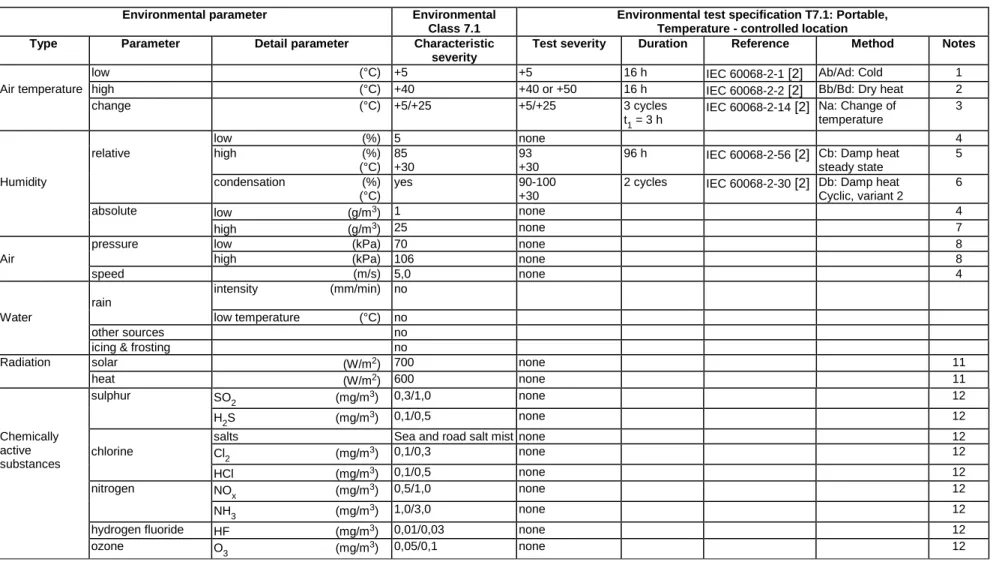
This specification applies to use at, and direct transfer between, permanently temperature-controlled enclosed locations where humidity is usually not controlled. See tables 1, 5 and 6.
Table 1: Test specification T 7.1: Temperature-controlled locations - climatic tests
Environmental parameter Environmental
Class 7.1
Environmental test specification T7.1: Portable, Temperature - controlled location
Type Parameter Detail parameter Characteristic
severity
Test severity Duration Reference Method Notes
low (°C) +5 +5 16 h IEC 60068-2-1 [2] Ab/Ad: Cold 1
Air temperature high (°C) +40 +40 or +50 16 h IEC 60068-2-2 [2] Bb/Bd: Dry heat 2
change (°C) +5/+25 +5/+25 3 cycles
t1 = 3 h
IEC 60068-2-14 [2] Na: Change of temperature 3 low (%) 5 none 4 relative high (%) (°C) 85 +30 93 +30
96 h IEC 60068-2-56 [2] Cb: Damp heat steady state 5 Humidity condensation (%) (°C) yes 90-100 +30
2 cycles IEC 60068-2-30 [2] Db: Damp heat Cyclic, variant 2
6
absolute low (g/m3) 1 none 4
high (g/m3) 25 none 7
pressure low (kPa) 70 none 8
Air high (kPa) 106 none 8
speed (m/s) 5,0 none 4
rain
intensity (mm/min) no
Water low temperature (°C) no
other sources no
icing & frosting no
Radiation solar (W/m2) 700 none 11
heat (W/m2) 600 none 11
sulphur SO2 (mg/m3) 0,3/1,0 none 12
H2S (mg/m3) 0,1/0,5 none 12
salts Sea and road salt mist none 12
chlorine Cl2 (mg/m3) 0,1/0,3 none 12 HCl (mg/m3) 0,1/0,5 none 12 Chemically active substances nitrogen NOx (mg/m3) 0,5/1,0 none 12 NH3 (mg/m3) 1,0/3,0 none 12
hydrogen fluoride HF (mg/m3) 0,01/0,03 none 12
Environmental parameter Environmental Class 7.1
Environmental test specification T7.1: Portable, Temperature - controlled location
Type Parameter Detail parameter Characteristic
severity
Test severity Duration Reference Method Notes
dust sedimentation (mg/(m2 h)) 1,5 none 13
suspension (mg/m3) 0,2 none 13 Mechanically active substances sand (mg/m3) 30 none 13 Flora and Fauna micro organisms no rodents, insects no
no: This condition does not occur in this class. none: Verification is required only in special cases. NOTES: Number of note, see clause 3.4.
3.2
Specification T 7.2: Partly temperature-controlled locations
This specification applies to use at and direct transfer between, enclosed locations having neither temperature nor humidity control but where heating may be used to avoid low temperatures. Building construction avoids extremely high temperatures. See tables 2, 5 and 6.
Table 2: Test specification T 7.2: Partly temperature-controlled locations - climatic tests
Environmental parameter Environmental
Class 7.2
Environmental test specification T7.2: Portable, Partly temperature- controlled locations
Type Parameter Detail parameter Characteristic
severity
Test severity Duration Reference Method Notes
low (°C) -5 -5 16 h IEC 60068-2-1 [2] Ab/Ad: Cold 1
Air temperature high (°C) +45 +45 or +55 16 h IEC 60068-2-2 [2] Bb/Bd: Dry heat 2
change (°C) -5/+25 -5/+25 3 cycles
t1 = 3 h
IEC 60068-2-14 [2] Na: Change of temperature 3 low (%) 5 none 4 relative high (%) (°C) 95 93 +30
96 h IEC 60068-2-56 [2] Cb: Damp heat steady state 5 Humidity condensation (%) (°C) yes 90-100 +30
2 cycles IEC 60068-2-30 [2] Db: Damp heat Cyclic, variant 2
6
absolute low (g/m3) 1 none 4
high (g/m3) 29 none 7
pressure low (kPa) 70 none 8
Air high (kPa) 106 none 8
speed (m/s) 5,0 none 4
rain
intensity (mm/min) no
Water low temperature (°C) no
other sources dripping water none 10
Environmental parameter Environmental Class 7.2
Environmental test specification T7.2: Portable, Partly temperature- controlled locations
Type Parameter Detail parameter Characteristic
severity
Test severity Duration Reference Method Notes
Radiation solar (W/m2) 700 none 11
heat (W/m2) 600 none 11
sulphur SO2 (mg/m3) 0,3/1,0 none 12
H2S (mg/m3) 0,1/0,5 none 12
salts sea and road salt mist none 12
chlorine Cl2 (mg/m3) 0,1/0,3 none 12 HCl (mg/m3) 0,1/0,5 none 12 Chemically active substances nitrogen NOx (mg/m3) 0,5/1,0 none 12 NH3 (mg/m3) 1,0/3,0 none 12
hydrogen fluoride HF (mg/m3) 0,01/0,03 none 12
ozone O3 (mg/m3) 0,05/0,1 none 12
dust sedimentation (mg/(m2 h)) 20 none 13
suspension (mg/m3) 5,0 none 13 Mechanically active substances sand (mg/m3) 300 none 13 Flora and Fauna
micro organisms moulds, fungus, etc. none 14
rodents, insects rodents, etc. none 14
no: This condition does not occur in this class. none: Verification is required only in special cases. NOTES: Number of note, see clause 3.4.
3.3
Specification T 7.3: Partly weatherprotected and non-weatherprotected locations
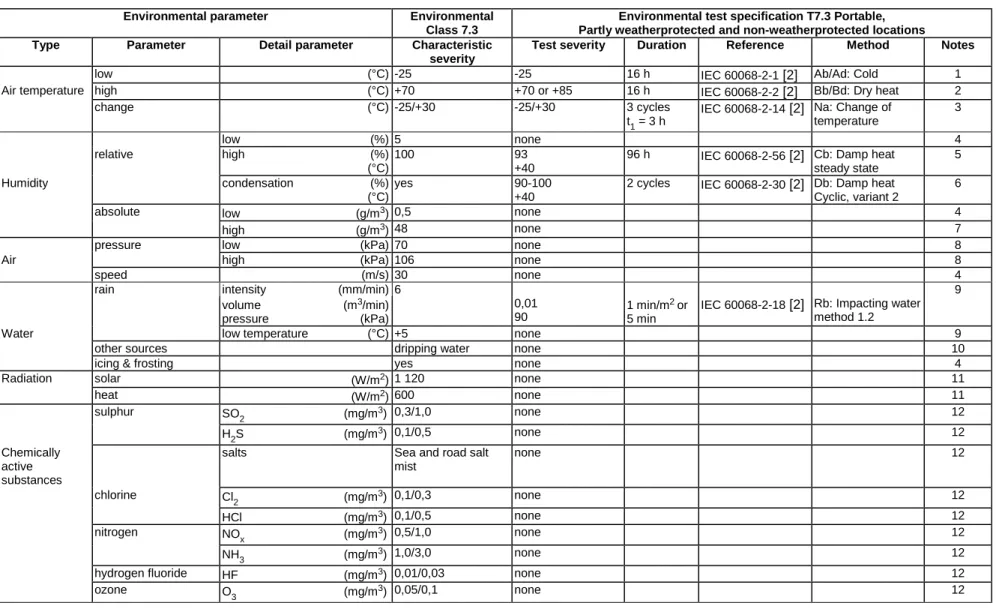
This specification applies to use at totally or partly weatherprotected locations of such construction that extremely low temperatures are avoided and to use at non-weatherprotected locations and to transfer between these locations. During cold seasons non-weatherprotected use and transfer is limited. See tables 3, 5 and 6.
Table 3: Test specification T 7.3: Partly weatherprotected and non-weatherprotected locations - climatic tests
Environmental parameter Environmental
Class 7.3
Environmental test specification T7.3 Portable, Partly weatherprotected and non-weatherprotected locations
Type Parameter Detail parameter Characteristic
severity
Test severity Duration Reference Method Notes
low (°C) -25 -25 16 h IEC 60068-2-1 [2] Ab/Ad: Cold 1
Air temperature high (°C) +70 +70 or +85 16 h IEC 60068-2-2 [2] Bb/Bd: Dry heat 2
change (°C) -25/+30 -25/+30 3 cycles
t1 = 3 h
IEC 60068-2-14 [2] Na: Change of temperature 3 low (%) 5 none 4 relative high (%) (°C) 100 93 +40
96 h IEC 60068-2-56 [2] Cb: Damp heat steady state 5 Humidity condensation (%) (°C) yes 90-100 +40
2 cycles IEC 60068-2-30 [2] Db: Damp heat Cyclic, variant 2
6
absolute low (g/m3) 0,5 none 4
high (g/m3) 48 none 7
pressure low (kPa) 70 none 8
Air high (kPa) 106 none 8
speed (m/s) 30 none 4
rain intensity (mm/min) 6 9
volume (m3/min) pressure (kPa) 0,01 90 1 min/m2 or 5 min
IEC 60068-2-18 [2] Rb: Impacting water method 1.2
Water low temperature (°C) +5 none 9
other sources dripping water none 10
icing & frosting yes none 4
Radiation solar (W/m2) 1 120 none 11
heat (W/m2) 600 none 11 sulphur SO2 (mg/m3) 0,3/1,0 none 12 H2S (mg/m3) 0,1/0,5 none 12 Chemically active substances
salts Sea and road salt
mist none 12 chlorine Cl2 (mg/m3) 0,1/0,3 none 12 HCl (mg/m3) 0,1/0,5 none 12 nitrogen NOx (mg/m3) 0,5/1,0 none 12 NH3 (mg/m3) 1,0/3,0 none 12
hydrogen fluoride HF (mg/m3) 0,01/0,03 none 12
Environmental parameter Environmental Class 7.3
Environmental test specification T7.3 Portable, Partly weatherprotected and non-weatherprotected locations
Type Parameter Detail parameter Characteristic
severity
Test severity Duration Reference Method Notes
Mechanically active substances
dust sedimentation (mg/(m2 h)) 20 none 13
suspension (mg/m3) 5,0 none 13
sand (mg/m3) 300 none 13
Flora and Fauna micro organisms moulds, fungus, etc. none 14
rodents, insects rodents, etc. none 14
no: This condition does not occur in this class. none: Verification is required only in special cases. NOTES: Number of note), see clause 3.4.
3.4
Specification T 7.3E: Partly weatherprotected and non-weatherprotected
locations - extended
This specification applies to use at totally or partly weatherprotected locations of any construction (except at Extremely Cold and Cold Climates where extremely low temperatures shall be avoided) and to use at non-weatherprotected locations and to transfer between these locations. During extremely cold seasons non-weatherprotected use and transfer is limited. See tables 4, 5 and 6.
Table 4: Test specification T 7.3E: Partly weatherprotected and non-weatherprotected locations - extended - climatic tests
Environmental parameter Environmental
Class 7.3E
Environmental test specification T7.3E Portable,
Partly weatherprotected and non-weatherprotected locations - extended
Type Parameter Detail parameter Characteristic
severity
Test severity Duration Reference Method Notes
low (°C) -40 -40 16 h IEC 60068-2-1 [2] Ab/Ad: Cold 1
Air temperature high (°C) +70 +70 or +85 16 h IEC 60068-2-2 [2] Bb/Bd: Dry heat 2
change (°C) -40/+30 -40/+30 3 cycles
t1 = 3 h
IEC 60068-2-14 [2] Na: Change of temperature 3 low (%) 5 none 4 relative high (%) (°C) 100 93 +40
21 days IEC 60068-2-56 [2] Cb: Damp heat steady state 5 Humidity condensation (%) (°C) yes 90-100 +40
6 cycles IEC 60068-2-30 [2] Db: Damp heat Cyclic, variant 2
6
absolute low (g/m3) 0,1 none 4
high (g/m3) 62 none 7
pressure low (kPa) 70 none 8
Air high (kPa) 106 none 8
Environmental parameter Environmental Class 7.3E
Environmental test specification T7.3E Portable,
Partly weatherprotected and non-weatherprotected locations - extended
Type Parameter Detail parameter Characteristic
severity
Test severity Duration Reference Method Notes
rain intensity (mm/min) 6 9
Water volume (m3/min)
pressure (kPa)
0,01
90 1 min/m
2 or
5 min
IEC 60068-2-18 [2] Rb: Impacting water method 1.2
low temperature (°C) +5 none 9
other sources Dripping water none 10
icing & frosting yes none 4
Radiation solar (W/m2) 1 120 none 11
heat (W/m2) 600 none 11 sulphur SO2 (mg/m3) 0,3/1,0 none 12 H2S (mg/m3) 0,1/0,5 none 12 Chemically active substances
salts Sea and road salt
mist none 12 chlorine Cl2 (mg/m3) 0,1/0,3 none 12 HCl (mg/m3) 0,1/0,5 none 12 nitrogen NOx (mg/m3) 0,5/1,0 none 12 NH3 (mg/m3) 1,0/3,0 none 12
hydrogen fluoride HF (mg/m3) 0,01/0,03 none 12
ozone O3 (mg/m3) 0,05/0,1 none 12
Mechanically active substances
dust Sedimentation (mg/(m2 h)) 20 none 13
Suspension (mg/m3) 5,0 none 13
sand (mg/m3) 300 none 13
Flora and fauna micro organisms moulds, fungus, etc. none 14
rodents, insects rodents, etc. none 14
no: This condition does not occur in this class. none: Verification is required only in special cases. NOTES: Number of note, see clause 3.4.
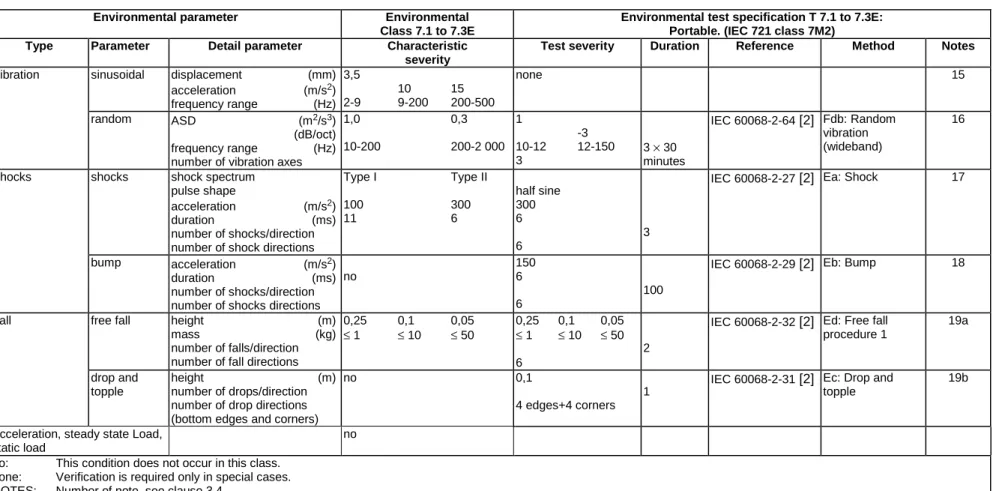
Table 5: Test specification T 7.1 to T 7.3E: Mechanical tests
Environmental parameter Environmental
Class 7.1 to 7.3E
Environmental test specification T 7.1 to 7.3E: Portable. (IEC 721 class 7M2)
Type Parameter Detail parameter Characteristic
severity
Test severity Duration Reference Method Notes
Vibration sinusoidal displacement (mm)
acceleration (m/s2) frequency range (Hz) 3,5 10 15 2-9 9-200 200-500 none 15 random ASD (m2/s3) (dB/oct) frequency range (Hz) number of vibration axes
1,0 0,3 10-200 200-2 000 1 -3 10-12 12-150 3 3 × 30 minutes IEC 60068-2-64 [2] Fdb: Random vibration (wideband) 16
Shocks shocks shock spectrum
pulse shape
acceleration (m/s2)
duration (ms) number of shocks/direction number of shock directions
Type I Type II 100 300 11 6 half sine 300 6 6 3
IEC 60068-2-27 [2] Ea: Shock 17
bump acceleration (m/s2)
duration (ms) number of shocks/direction number of shocks directions
no
150 6
6
100
IEC 60068-2-29 [2] Eb: Bump 18
Fall free fall height (m)
mass (kg) number of falls/direction number of fall directions
0,25 0,1 0,05 ≤ 1 ≤ 10 ≤ 50 0,25 0,1 0,05 ≤ 1 ≤ 10 ≤ 50 6 2
IEC 60068-2-32 [2] Ed: Free fall procedure 1 19a drop and topple height (m) number of drops/direction number of drop directions (bottom edges and corners)
no 0,1
4 edges+4 corners 1
IEC 60068-2-31 [2] Ec: Drop and topple
19b
Acceleration, steady state Load, static load
no
no: This condition does not occur in this class. none: Verification is required only in special cases. NOTES: Number of note, see clause 3.4.
Table 6: Test specifications T 7.1 to T 7.3E: Mechanical tests
Environmental parameter Environmental
Class 7.1 to 7.3E
Environmental test specification T 7.1 to 7.3E: Portable. (IEC 721 class 7M3)
Type Parameter Detail parameter Characteristic
severity
Test severity Duration Reference Method Notes
Vibration sinusoidal displacement (mm)
acceleration (m/s2) frequency range (Hz) 7,5 20 40 2-8 8-200 200-500 none 15 random ASD (m2/s3) (dB/oct) frequency range (Hz) number of vibration axes
3,0 1,0 10-200 200-2 000 2 -3 10-12 12-150 3 3 × 30 minutes IEC 60068-2-64 [2] Fdb: Random vibration (wideband) 16
Shocks shocks shock spectrum
pulse shape
duration (ms) acceleration (m/s2)
number of shocks/direction number of shock directions
Type I Type II 11 6 300 1 000 half sine 6 1000 6 3
IEC 60068-2-27 [2] Ea: Shock 17
bump acceleration (m/s2)
duration (ms) number of shocks/direction number of shock directions
no
250 6
6
100
IEC 60068-2-29 [2] Eb: Bump 18
Fall free fall height (m)
mass (kg) number of falls/direction number of directions 1,0 0,5 0,25 ≤ 1 ≤ 10 ≤ 50 1,0 0,5 0,25 ≤ 1 ≤ 10 ≤ 50 6 2
IEC 60068-2-32 [2] Ed: Free fall procedure 1
19a
drop and topple height
number of drops/direction number of drop directions (bottom edges and corners)
no 0,1
4 edges + 4 corners 1
IEC 60068-2-31 [2] Ec: Drop and topple
19b
Acceleration, steady state Load, static load
no
no: This condition does not occur in this class. none: Verification is required only in special cases. NOTES: Number of note, see clause 3.4.
4
Notes to tables
4.1 General
note
The present document applies to use of equipment installed permanently or temporally in portable and non-stationary use and the environmental conditions stated in EN 300 019-1-7 [1]. The notes have been added to explain the main reasons for recommended tests or to explain why no test has been recommended even if there is a characteristic severity given.
The relevant specification should specify when, during the environmental test programme, the equipment is in its operational state, and which performance requirements should be measured before, during and after the test, together with the appropriate pass/fail criteria.
4.2
Notes to tables 1 to 6
NOTE 1: (Air temperature, low).
The characteristic severity can be used as a cold start-up temperature, but it may be modified by the product specification. The equipment under test shall remain operational throughout this test, except for the cold start-up temperature, which shall commence once high temperate stability is achieved.
NOTE 2: (Air temperature high).
If two temperatures are given, the higher test temperature includes heat trap effect of direct solar radiation on equipment. The equipment under test shall remain operational throughout this test, except for the start-up at high temperature, which shall commence once high temperature stability is achieved. NOTE 3: (Air temperature, change).
The change of temperature test is normally used to check design tolerancing. IEC test Na is recommended with severities equal to characteristic severities. Whenever possible, the equipment function shall be monitored throughout the test.
NOTE 4: No suitable test method for this parameter in IEC 60068-2 [2]. NOTE 5: (Humidity, relative, high).
These severities are the nearest preferred values in IEC 60068-2-56 [2] test Cb. The minor differences both in temperature and in humidity conditions are considered to be insignificant.
NOTE 6: (Humidity, relative, condensation).
IEC 60068-2-30 [2] test Db is recommended with test severities not higher than climatogram limits for this class.
NOTE 7: (Humidity, absolute, high).
This effect is considered to be partly included in the damp heat test IEC 60068-2-56 [2] test Cb. NOTE 8: (Air pressure, low and high).
No test is recommended for normal applications, because the effect of air pressure is evaluated at the component level.
NOTE 9: (Water, rain).
IEC 60068-2-18 [2] test Rb method 1.2 has been chosen even though it does not imitate normal rain. It is a simple hand held shower test, which is easy to perform and can demonstrate that the specimen design is adequately toleranced to survive this condition. The greater of the two given durations should be used. The cooling effect of the low temperature of the rain is included in test Na.
NOTE 10: (Water, other sources).
No test is recommended because the effect is already included in IEC 60068-2-30 test Db or IEC 60068-2-18 [2] Test Rb.
NOTE 11: (Radiation, solar, heat).
The effect of direct solar radiation is included in the higher test value in IEC 60068-2-2 [2] Test Bb/Bd described in note 2. Photochemical tests can be made separately for components and materials. NOTE 12: (Chemically active substances).
The characteristic severities are maximum values. For chemically active substances the characteristic severities should be considered when choosing components and materials. No test is recommended in the present document.
NOTE 13: (Mechanically active substances).
The characteristic severities are much lower than lowest severity in IEC 60068-2-68 [2] Test Lb and therefore no test is recommended. This condition should be considered when designing the equipment and when choosing components and materials.
NOTE 14: (Flora, fauna).
The characteristic severities should be considered when choosing components and materials. NOTE 15: (Vibration, sinusoidal).
Random vibration is considered to be a more realistic test for this condition, therefore no sinusoidal test is recommended. The severities are given as peak values.
NOTE 16: (Vibration, random).
The most energy is in low frequencies and therefore the most realistic test has been described with a -3 dB/s slope from 12 Hz to 150 Hz. If the vibration in some direction is known to be insignificant, tests need not be performed in those directions.
ASD = Acceleration Spectral Density NOTE 17: (Shocks, shocks).
IEC test Ea half sine test method has been chosen and a non-IEC recommended test severity has been defined in order to avoid exceeding the characteristic severity. The duration of shock pulses has been changed to 6 ms to facilitate the use of standard testing equipment. Three pulses in all six directions are considered sufficient to demonstrate that the specimen design is adequately toleranced to survive this condition. If the normal attitude is specified, then the number of directions is reduced to 3.
The severities are given as peak values. NOTE 18: (Shocks, bump).
Bump test is recommended in addition to shocks as the number of expected shocks is high. Standard test severities of IEC test Eb has been chosen and are given as peak values.
NOTE 19: (Fall, drop and topple). 19a) (free fall)
IEC 60068-2-32 does not provide mass differences for falling heights therefore characteristic values are chosen as the test values. ISO 4180-2 [4] values are chosen because they are considered to be more correlated to statistics of falling heights for different masses. 19b) (drop and topple)
IEC 60068-2-31 [2] test Ec : Drop and topple test is recommended in addition to the free fall test as the exact attitude of falling equipment under test can not be specified.
Annex A (informative):
Bibliography
History
Document history
Edition 1 May 1994 Publication as ETS 300 019-2-7V2.1.2 September 2001 Publication
V3.0.0 December 2002 Publication