Lessons for Loss Given Default, Lifetime Expected Loss and
Bank Capital Requirements
A dissertation in partial fulfillment of the requirements for the degree of
Doktor der Wirtschaftswissenschaft (Dr. rer. pol.)
submitted to the
Faculty of Business, Economics, and Management Information Systems
Universität Regensburg
submitted by Steffen Krüger
Advisors:
Prof. Dr. Daniel Rösch
Prof. Dr. Alfred Hamerle
I would like to thank Prof. Dr. Daniel Rösch for his continuous support of my doctoral
thesis and his motivation, enthusiasm, and patience. His guidance and immense
knowl-edge have been invaluable. I gratefully acknowlknowl-edge Prof. em. Dr. Alfred Hamerle to be
my second advisor.
The chapters of this thesis would not have been possible without the fruitful collaboration
with several co-authors and colleagues. I want to express my gratitude to Prof. Dr. Harald
Scheule for his expertise and the invitation to his university. I would like to thank Jennifer
Betz for the great time we had when we shared an office.
Last but not least, I would like to thank my family and friends for their ongoing support.
List of Tables v
List of Figures vii
1 Introduction 1
2 Downturn LGD Modeling using Quantile Regression 12
2.1 Introduction . . . 13
2.1.1 Motivation and Literature . . . 13
2.1.2 Introductory Example . . . 15
2.2 Modeling Loss Given Default . . . 17
2.2.1 Quantile Regression . . . 17 2.2.2 Simulation Study . . . 18 2.2.3 Comparative Methods . . . 21 2.3 Data . . . 23 2.4 Empirical Analysis . . . 27 2.4.1 Quantile Regression . . . 27 2.4.2 Model Comparison . . . 31 2.5 Implications . . . 35 2.5.1 Loss Distribution . . . 35 2.5.2 Downturn LGDs . . . 38 2.6 Conclusion . . . 42
Appendix 2.A Quantile Regression . . . 43
Appendix 2.B Comparative Methods . . . 44
3.1 Introduction . . . 49
3.2 Why Care about Systematic Effects among Default Resolution Times? . 52 3.3 Methods and Data . . . 57
3.3.1 Methods . . . 57
3.3.2 Data . . . 60
3.4 Results . . . 66
3.4.1 Overview of Formal and Informal Proceedings of Resolution . . . 66
3.4.2 Loan Specific Impacts on Resolution . . . 70
3.4.3 The Systematic Movement of Resolution Processes . . . 73
3.5 Implications of Systematic DRTs . . . 86
3.5.1 Implications on Loan Level . . . 87
3.5.2 Implications on Portfolio Level . . . 91
3.6 Conclusion . . . 95
Appendix 3.A Estimation of the Cox Model . . . 97
Appendix 3.B Further Outputs . . . 99
3.B.1 Covariate Influences over Time . . . 99
3.B.2 Joint Country Regression . . . 104
3.B.3 Regression Results for Additional Macroeconomic Variables . . . . 107
4 A Copula Sample Selection Model for Predicting Multi-Year LGDs and Lifetime Expected Losses 108 4.1 Introduction . . . 109
4.2 Model . . . 111
4.2.1 Multi-Year Losses over Lifetime . . . 111
4.2.2 Default Time Model . . . 113
4.2.3 Loss Given Default Model . . . 114
4.2.4 Copula Selection Model . . . 116
4.3.3 Marginal Models . . . 124
4.3.4 Copula Models . . . 129
4.4 Applications . . . 129
4.4.1 The Term Structure of LGDs . . . 129
4.4.2 Estimation of Lifetime Expected Losses . . . 132
4.5 Conclusion . . . 135
Appendix 4.A Copula Theory . . . 137
4.A.1 Introduction . . . 137
4.A.2 Densities . . . 138
4.A.3 Properties . . . 139
Appendix 4.B Empirical Robustness Tests . . . 140
5 The Impact of Loan Loss Provisioning on Bank Capital Requirements 142 5.1 Introduction . . . 143
5.2 Capital Requirements and Provisioning . . . 144
5.2.1 Accounting Provisions . . . 145
5.2.2 Basel Expected Loss and Capital Requirements . . . 146
5.3 Data . . . 149
5.3.1 Issuer- and Bond-Specific Covariates . . . 149
5.3.2 Cyclical Behavior . . . 152
5.4 Loan Loss Provisioning . . . 154
5.4.1 12-month Expected Loss for Basel and IFRS 9 (Stage 1) . . . 154
5.4.2 Lifetime Expected Loss for GAAP 326 and IFRS 9 (Stage 2) . . . 159
5.4.3 Significant Increase in Credit Risk (SICR) . . . 163
5.5 Impact on Regulatory Capital . . . 165
5.5.1 Stylized Asset Portfolios . . . 165
5.5.2 Significant Increase in Credit Risk (SICR) . . . 167
Appendix 5.A The Performance of Macroeconomic Variables . . . 180
6 Conclusion 183
2.1 Exemplary Downturn Loss Rates Given Default . . . 17
2.2 Simulation – Data generation . . . 19
2.3 Comparative methods . . . 22
2.4 Descriptive statistics . . . 26
2.5 Parameter estimates Quantile Regression . . . 28
2.6 In-sample goodness of fit . . . 31
2.7 Out-of-sample goodness of fit . . . 34
2.8 Hit rates of VaR based Downturn LGD . . . 38
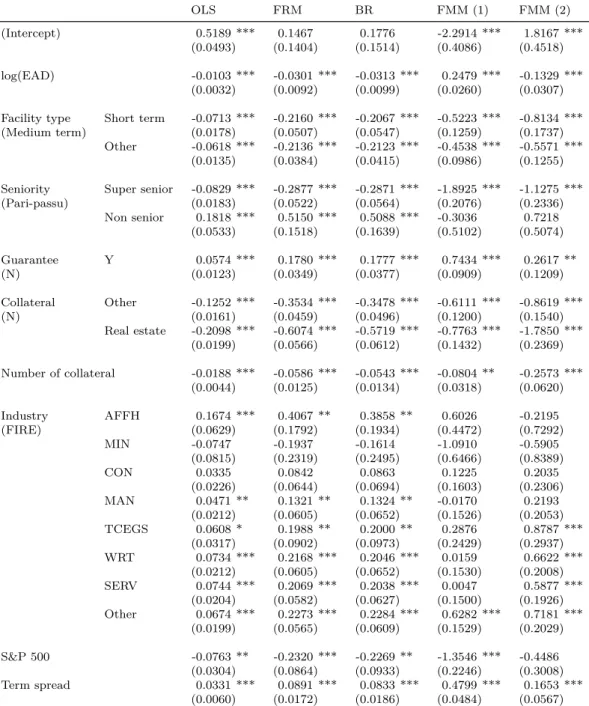
2.B.1 Parameter estimates comparative methods . . . 45
2.C.1 Effects of macroeconomic information in the first year of resolution, i.e. after default . . . 46
3.1 Descriptive statistics of DRT . . . 61
3.2 Descriptive statistics of loan specific characteristics . . . 64
3.3 Pairwise correlations of macroeconomic variables . . . 65
3.4 Overview of formal and informal proceedings . . . 67
3.5 Regression results for Model I . . . 71
3.6 Regression results for Model II . . . 78
3.7 Regression results for Model III . . . 82
3.8 Frailty impact on mean DRT . . . 83
3.9 Inferences of systematic factors on the distribution of DRTs . . . 90
3.10 Non-discounted RR by DRT buckets . . . 91
3.11 Inferences of systematic factors on the distribution of portfolio DRTs . . . 92
3.B.1 Regression results for Model III when including interactions of covariates and recessions: parameter estimates non-recession . . . 100
3.B.3 Regression results for Model I, II and III across countries . . . 105
3.B.4 Regression results for Model II with different macroeconomic variables . . 107
4.1 Descriptive statistics of bond- and issuer-specific information (1) . . . 121
4.2 Descriptive statistics of bond- and issuer-specific information (2) . . . 122
4.3 Descriptive statistics of exemplary risk-buckets . . . 124
4.4 Parameter estimates for the time-to-default . . . 126
4.5 Parameter estimates for the loss given default . . . 128
4.6 Parameter estimates for the copula . . . 129
4.7 LEL predictions for industrial bonds . . . 134
4.A.1 Copula properties . . . 139
4.B.1 Copula performance . . . 140
4.B.2 Default model performance . . . 141
5.1 Exemplary calculation of regulatory capital . . . 148
5.2 Descriptive statistics for issuer- and bond-specific covariates . . . 151
5.3 Parameter estimates Probability of Default . . . 155
5.4 Parameter estimates Loss Rate Given Default . . . 158
5.5 Parameter estimates AR model . . . 160
5.6 Credit quality distributions of stylized portfolios . . . 165
5.7 Deduction of Common Equity Tier 1 due to provisioning . . . 174
5.8 Deduction of CET 1 for different reinvestment strategies . . . 176
5.A.1 Macroeconomic variables . . . 180
5.A.2 Regression results for additional macroeconomic variables . . . 181
2.1 Stylized LGD Distributions . . . 16
2.2 Simulation – Data generation . . . 19
2.3 Simulation – Parameter estimation . . . 20
2.4 Simulation – Forecasting . . . 21
2.5 Observed Loss Rates Given Default . . . 24
2.6 Loss Rates Given Default over time . . . 25
2.7 In-sample goodness of fit (R1) . . . 32
2.8 In-sample goodness of fit (P-P plot) . . . 33
2.9 Densities of Loss Rates Given Default . . . 36
2.10 Predictions of the Value at Risk (VaR) . . . 37
2.11 Densities of Loss Rates Given Default during the economic cycle . . . 40
2.12 Downturn effects on LGD quantiles . . . 41
2.13 Predictions of Quantile Regression based Downturn LGDs . . . 41
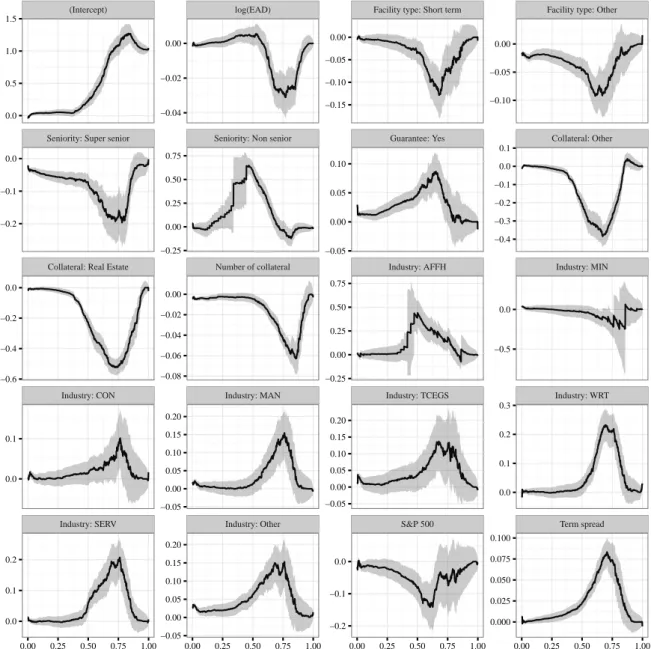
2.A.1 Parameter estimates Quantile Regression . . . 43
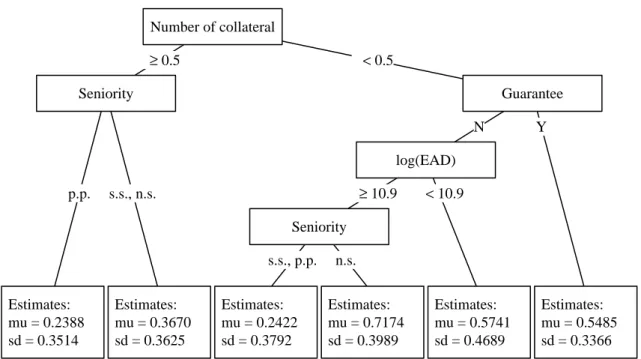
2.B.1 Estimated Regression Tree . . . 44
3.1 Systematic movements in DRTs . . . 53
3.2 Relation of DRT and non-discounted RR . . . 54
3.3 Additional required amount of stable funding . . . 56
3.4 Resolution time levels . . . 59
3.5 Observed resolution rates . . . 62
3.6 Descriptive statistics of macroeconomic variables . . . 66
3.7 Baseline intensities of resolution . . . 75
3.10 Density of DRT . . . 90
3.11 Kernel density estimates of loss on portfolio level . . . 93
3.12 Mean and VaR(95%) of loss on portfolio level . . . 95
3.B.1 Frailties when including interactions of covariates and recessions . . . 99
3.B.2 Frailty for joint country regression . . . 104
4.1 Histogram of sample LGDs . . . 119
4.2 Sample default rates and mean LGDs . . . 120
4.3 Macroeconomic variables . . . 122
4.4 Scatter plots of realized LGDs and corresponding times-to-default . . . . 123
4.5 Densities of LGDs . . . 131
4.6 Term structure of PD and LGD . . . 132
5.1 The meaning behind capital and provisions . . . 145
5.2 Empirical distribution of Losses Given Default . . . 150
5.3 Default rates and mean realized Losses Given Default . . . 153
5.4 Mean predicted Probability of Default . . . 156
5.5 Mean predicted Loss Given Default . . . 159
5.6 VIX and corresponding ACF and PACF plot . . . 160
5.7 Portfolio share of Stage 2 instruments in IFRS 9 . . . 168
5.8 Provisions and expected losses . . . 171
Introduction
Motivation
Financial institutions play a major role for the economy since they ensure the supply
of money by lending to corporations, sovereign entities and consumers (cf. Kishan and
Opiela (2000) and Gambacorta and Shin (2016)). As financial intermediaries they fulfill at
least three functions to match conflicting needs of borrowers and lenders (see e.g., Freixas
and Rochet (2008) p. 4). Maturity transformation involves the conversion of short-term
liabilities to long-term assets, e.g., deposits to loans. Size transformation encompasses
the pooling of small amounts mainly from savers to large amounts for borrowers.
Fur-thermore, financial institutions perform risk transformation, e.g., by diversification, and
help to reduce the risk for single lenders. The matching of conflicting needs is subject
to the risk of imbalances, e.g., payment difficulties of borrowers can prevent banks to
fulfill their own liabilities. Therefore, financial institutions need to hold adequate capital
reserves to protect themselves against credit risk (cf. Kim and Santomero (1988)). From
an overall economic perspective, a distressed financial sector can lead to a reduction of
lending. This can extend or intensify economic downturns, as corporations, sovereign
entities and consumers are particularly in these times dependent on intermediaries. In
extreme cases, a credit crunch can even cause a recession (cf. Akhtar (1994), Sharpe
(1995) and Ivashina and Scharfstein (2010)). A professional measurement of the risk to
which financial institutions are exposed to is a substantial basis to determine adequate
capital reserves (cf. Sharpe (1978) and Dewatripont and Tirole (1994) p. 218 f.).
The management of financial institutions’ capital reserves is subject to several
more money in order to increase returns, which can promote capital shortfalls in
reces-sions (cf. Gambacorta and Mistrulli (2004)). In addition, the measurement of credit risk
is a challenging task and requires the use of sophisticated statistical methods. Even small
mistakes in the evaluation of systematic risk, which substantially affects the credit risk
with respect to recessions, can lead to severe misjudgments (cf. Kuo and Lee (2007),
Duffie et al. (2009), Bade et al. (2011) and Rösch and Scheule (2014)).
Financial regulation can improve the capitalization of financial institutions by
mini-mum capital requirements and minimini-mum supervisory requirements to risk management.
The Basel Committee on Banking Supervision (1988, 2006, 2011) subsequently
elabo-rated three international frameworks to standardize and extend risk precaution across
countries as well as institutions. The Basel Committee was founded as a response to the
Herstatt liquidation in 1974, and in 1988 it recommended capital requirements on debt
instruments based on the underlying credit risk (Basel I). The first Accord distinguished
risk weights between different types of assets but did not account for differences within a
given category. As a result, institutions were able to hold riskier assets without having to
fulfill higher capital requirements (cf. Basel Committee on Banking Supervision (1999),
Hull (2015) p. 336, and Baesens et al. (2016) p. 7). This was one of the reasons for the
substantial revision of the framework. Basel II introduced the internal ratings-based
ap-proach that enables financial institutions to estimate credit risk by their own statistical
models. In addition, it extended capital requirements to operational and market risk, and
introduced rules for supervisory review and market discipline. The latest revision (Basel
III) is currently being introduced as a response to the global financial crises starting in
2007. Current discussion and consultation papers of financial regulatory authorities show
that the development of the regulatory framework is still far from being completed, e.g.,
Basel Committee on Banking Supervision (2015b, 2016a, 2017) and European Banking
Authority (2017).
Credit risk provides the largest share on regulatory capital requirements. For instance,
the latest Risk Assessment Report of the European Banking Authority (2016b) identifies
risk as of June 30, 2016. Credit risk of a financial instrument can be characterized by
three risk parameters that are generally modeled as stochastic variables. The probability
of default (PD) denotes the probability that a borrower will not fulfill his payment
obli-gations in a given future time period. The loss given default (LGD) specifies the share of
the outstanding debt that is lost due to default. The exposure at default (EAD) denotes
the outstanding amount. Increased credit losses during economic downturns empirically
show co-movements between risk parameters of a single instrument and those of several
borrowers. This thesis focuses on the modeling of dependencies in credit risk which is
par-ticularly crucial for adequate risk precaution prior to recessions and discusses implications
on bank capital requirements. The analyses cover, amongst others, the measurement and
statistical modeling of systematic effects on the LGD and workout processes, and the
co-movement of PDs and LGDs.
Literature
The statistical modeling and estimation of risk parameters play a major role in the
literature on credit risk. On the one hand, recent studies examine determinants of credit
risk which includes information on the underlying debt instrument and the borrower.
However, clustered defaults and higher losses during recessions are caused by systematic
risk factors, i.e., observable covariates such as macroeconomic variables and unobservable
time-varying risk factors. This motivates research on downturn effects and co-movements
of risk parameters. Workout processes of defaulted debt also are of particular interest as
they are characterized by a high degree of heterogeneity and determine realized losses.
Capital reserves basically are supposed to reduce the risk of financial distress for financial
institutions. However, legal requirements can strengthen the burden to raise capital in
recessions due to higher regulatory needs.
There are many papers dealing with the default risk of borrowers and financial
in-struments. The structural model of Merton (1974) assumes a stochastic process for the
value of a company and provides a formula for the probability that its value is less than
the default event dependent on explanatory variables. The Z-score of Altman (1968)
represents a formula to predict the probability of corporate bankruptcies based on firm
characteristics. Categorical regression models are used by Martin (1977) and, recently,
by Campbell et al. (2008), Campbell et al. (2011) and Hilscher and Wilson (2016). The
authors study the PD for discrete time periods and account for various covariates, e.g.,
firm and instrument characteristics and macroeconomic information. Survival models
ex-tend the approach to the continuous default time, i.e., by considering default intensities
as done by Lee and Urrutia (1996), Chava and Jarrow (2004), Das et al. (2007), Duffie
et al. (2007) and Orth (2013).
There are at least two definitions for loss severity that are studied in the literature,
i.e., workout and market-based LGDs. The first measure takes into account all
post-default cash flows during the workout process of post-defaulted debt. A post-defaulted marketable
debt instrument also provides a market-based LGD that characterizes the post-default
decrease in the market price of the instrument. The literature examines both types of loss
severity by several statistical models. The method of ordinary least squares is studied by
Qi and Zhao (2011) and Jankowitsch et al. (2014) for comparative reasons and to analyze
determinants of loss severity. Some models account for the property that LGDs are often
bounded by zero (no loss) and one (total loss), e.g., fractional response models (Hu and
Perraudin (2002), Dermine and Neto de Carvalho (2006) and Chava et al. (2011)) and
beta regression (Gupton (2005) and Huang and Oosterlee (2012)). Further examined
statistical methods are regression trees (Bastos (2010)) and mixture models (Altman and
Kalotay (2014) and Calabrese (2014)). Comprehensive comparisons of the performance
of LGD models are given by Qi and Zhao (2011), Loterman et al. (2012) and Yashkir and
Yashkir (2013), amongst others.
Recessions generally increase the credit risk for single debt instruments because
bor-rowers are systematically exposed to poor economic conditions in these times. Economic
downturn periods are empirically characterized by clustered defaults and high losses, and
thus indicate dependencies between the credit risk of financial instruments. Hu and
rates and realized LGDs on aggregated data. Observable macroeconomic and
industry-specific information can be included as covariates in standard regression models to account
for systematic risk (e.g., Chava and Jarrow (2004), Acharya et al. (2007) and Bellotti and
Crook (2012)). Duffie et al. (2009) and Lando and Nielsen (2010) find evidence for
addi-tional unobservable systematic effects in default risk which substantially increase credit
risk in economic downturns. The dependency between default rates and LGDs is caused
by observable systematic factors such as macroeconomic covariates (Chava et al. (2011))
and unobservable systematic factors that can be modeled by random effects (Bruche and
González-Aguado (2010), Bade et al. (2011), Bellotti and Crook (2012) and Rösch and
Scheule (2014)). The Basel Committee on Banking Supervision (2005) requires that LGD
estimates shall reflect economic downturn conditions for regulatory purposes and account
for the positive co-movement of PDs and LGDs. This is currently emphasized by the
Eu-ropean Banking Authority (2017) which also advises to account for the bimodality of
losses, i.e., the high number of total losses and recoveries.
Besides the question whether a borrower or debt instrument defaults, the literature
also deals with the timein default. For instance, Bandopadhyaya (1994), Helwege (1999),
Bris et al. (2006) and Denis and Rodgers (2007) study the time in bankruptcy and its
determinants. Dermine and Neto de Carvalho (2006) and Gürtler and Hibbeln (2013)
mention that the length of workout processes is empirically positively correlated with
LGDs, i.e., the longer a debt is in default the more severe the loss is. The consideration
of workout processes goes beyond the realized loss and provides additional information
on the emergence of losses. Betz et al. (2016) find increased LGDs for long workout
processes and time-varying levels in the length of defaults which indicates systematic
effects in workout processes and workout LGDs.
Another field of study examines whether and to what extent bank capital requirements
burden institutions, particularly in recessions. Although the Basel Accords are intended
to prevent procyclicality, Gordy and Howells (2006) and Repullo and Suarez (2013) show
that regulatory capital requirements increase in recessions. In addition to regulatory
during recessions due to the underlying incurred loss model (Laeven and Majnoni (2003),
Bikker and Metzemakers (2005) and Fonseca and González (2008)). The revised loan loss
provisioning of the International Accounting Standards Board (2014) and the Financial
Accounting Standards Board (2016) is based on an expected loss model and is intended
to reduce procyclical effects and increase transparency of provisioning. However, the
European Banking Authority (2016a) and the Basel Committee on Banking Supervision
(2017) propose a transition period to provide institutions sufficient time to raise capital.
The Basel Committee on Banking Supervision (2016b) additionally points to the volatility
of provisions due to the new standards.
Contribution
This thesis contributes to the literature on credit risk modeling and focuses on
co-movements of risk parameters that intensify losses during recessions. The models provide
more precise estimates of credit risk and a better understanding of systematic risk. This
can improve risk-based capital reserves and can help to avoid a severe underestimation
of risk and capital shortfalls in economic downturn periods. Furthermore, the discussion
of regulatory requirements and the supervision of internal risk models can benefit from
empirical results.
The literature and current discussions show that a closer look on the impact of
eco-nomic downturns on LGDs is still necessary. At the same time, the bimodality of losses,
i.e., the high number of total losses and recoveries, must be recognized. Although the
literature mentions a positive dependency between the length of workout processes and
LGDs, its significance and the role of systematic effects have not been analyzed.
Further-more, the revised loan loss provisioning will be based on lifetime expected losses and raises
the following questions amongst others. First, the sample selection of loss data causes
a positive dependency between single-period default risk and loss severity and must be
examined with respect to the maturity of financial instruments, i.e., a multi-period
mod-eling is necessary. Second, the impact of the new accounting standards on bank capital
analyzed. This covers differences between both approaches of expected losses and how
market participants and regulatory authorities may react. The research questions of the
four following studies can be summarized as:
• How can the bimodality of losses, i.e., the high number of total losses and recoveries, adequately be modeled? Do covariate effects vary over the probability distribution
of LGDs and, in particular, does the impact of economic downturns depend on
quantiles as well as firm- and instrument-specific information?
• Are there systematic co-movements in the length of workout processes? How can the dependency be explained and to what extent does it affect credit risk (i.e.,
workout LGDs) and liquidity risk (i.e., the reduction of non-performing loans)?
• How does the positive dependency between default risk and loss severity evolve over multiple periods? What conclusions are necessary for the modeling and estimation
of lifetime expected loss which is required by revised loan loss provisioning?
• What are the differences and similarities in the model requirements of the revised loan loss provisioning and the regulatory framework with respect to expected losses?
What is the impact of the new accounting standards on bank capital requirements?
The research questions are examined by advanced statistical methods. First, the
scope of LGD modeling is extended by proposing the quantile regression to separately
regress each quantile of the distribution. This approach enables a new look on covariate
and particularly downturn effects that vary over quantiles. Second, the length of workout
processes is a time variable and thus modeled by a Cox proportional hazards model, which
is similar to existing approaches on default times. Systematic effects are examined by the
inclusion of time-varying frailties. Third, lifetime expected losses are modeled by a copula
approach that combines accelerated failure time models for the default time with a beta
regression of the LGD. The use of copulas provide continuous-time LGD forecasts and
flexible dependence structures between default risk and loss severity. The fourth approach
demonstrate the impact of revised loan loss provisioning on bank capital requirements.
In addition, goodness-of-fit measures enable to validate these approaches. Simulation
studies and analyses of representative portfolios provide implications and demonstrate
the significance of empirical results.
The use of comprehensive data strengthens the validity of empirical results. The first
two studies use unique loss data from several banks on defaulted corporate loans with
jurisdiction in the United States, Great Britain and Canada. The database provides
workout LGDs and information on workout processes between 2000 and 2013, i.e.,
post-default cash-flows including repayments and costs. The other two studies use information
on US American corporate bonds that provides defaults and market-based LGDs between
1982 and 2014. Both databases contain comprehensive covariate information with respect
to the underlying instruments, borrowers and macroeconomic conditions.
This thesis presents four studies which separately examine the proposed research
questions in Chapters 2 to 5. The remaining part of the introduction summarizes each
study with respect to motivation, data, statistical method and contribution. Chapter 6
presents a conclusion and provides findings, a discussion and an outlook.
Chapter 2: Downturn LGD Modeling using Quantile Regression
The aim of capital reserves to reduce the risk of capital shortfalls is particularly
pro-nounced in recessions. The internal ratings-based approach of Basel II, therefore,
re-quires LGD estimates that reflect economic downturn conditions. The study contributes
to the literature by analyzing covariate and downturn effects on the entire bimodal shape
of losses that is characterized by the high number of total losses and recoveries. The
quantile regression of Koenker and Bassett (1978) and Koenker (2005) is used to
sepa-rately model each quantile of the distribution and to allow for quantile-specific effects of
covariates. The study is based on US American data of workout loan LGDs of small and
medium enterprises with defaults between 2000 and 2013. LGD estimates are evaluated
by goodness-of-fit measures that evaluate the entire distributional fit. The validation
The analysis of quantile-varying covariate effects shows that the bimodality of losses can
only partly be explained by firm- and loan-specific information as well as macroeconomic
conditions. The paper concludes with a discussion on the impact of economic downturns
on the distribution of loss rates and shows implications for the determination of downturn
LGDs for regulatory purposes.
Chapter 3: Macroeconomic Effects and Frailties in the Resolution of Non-Performing Loans
The workout LGD of defaulted debt is determined by incoming cash flows and direct as
well as indirect costs after default. The literature indicates that delayed workout
pro-cesses are empirically correlated with higher losses. The study analyzes determinants of
the length of workout processes and its significance for credit and liquidity risk of
finan-cial institutions. The time from default to resolution of defaulted debt is modeled by a
Cox proportional hazards model with stochastic time-varying frailties. This approach is
comparable to Duffie et al. (2009) who investigate the time to default of US American
bonds. The study uses data of defaulted loans from small and medium enterprises and
large corporates with jurisdiction in the United States, Great Britain and Canada with
defaults between 2004 and 2013. Besides firm- and loan-specific information, the
anal-ysis discusses the role of observable (e.g., macroeconomic covariates) and unobservable
(frailties) systematic factors. The latter are empirically identified to cause a significant
co-movement of workout periods. In addition to a descriptive analysis of the
correla-tion between resolucorrela-tion times and loss severity, a simulacorrela-tion study shows that economic
downturns delay workout processes and thereby increase single-loan LGDs and
portfo-lio losses. Furthermore, a second simulation study demonstrates that systematic effects
between workout processes increase stable funding needs.
Chapter 4: A Copula Sample Selection Model for Predicting Multi-Year LGDs and Life-time Expected Losses
question how the positive co-movement of default risk and loss severity for the 12-month
horizon behaves over the lifetime of financial instruments. The study develops a
copula-based approach that enables a simultaneous modeling of default risk and loss severity for
arbitrary time horizons. The rationale behind this is to combine regression models for the
default time and the LGD by flexible dependence structures. The empirical work is done
on US American corporate bond data for the years between 1982 and 2014. It controls for
firm- and bond-specific as well as macroeconomic covariates. Several accelerated failure
time models are examined to regress default times as in Lee and Urrutia (1996), Das et al.
(2007) and Orth (2013). The LGD is modeled by beta regression which is motivated by
Gupton (2005) and Huang and Oosterlee (2012). The analysis reveals that the positive
dependency of PDs and LGDs cause a decreasing term structure of loss severity, i.e., the
longer a bond survives the lower the expected LGD is. The use of several copulas also
demonstrates that correlation measures are not able to adequately capture the identified
dependence structure. Finally, the empirical results indicate that standard credit risk
models generally underestimate lifetime expected losses.
Chapter 5: The Impact of Loan Loss Provisioning on Bank Capital Requirements
The replacement of the incurred loss model for loan loss provisioning by an expected
loss approach provides a convergence to the regulatory approach. The study discusses
the new standards and remaining differences between expected losses for accounting and
regulatory purposes with respect to the rating philosophy (through-the-cycle vs.
point-in-time) and the required time period of possible losses (12-month vs. lifetime expected
losses). Standard regression techniques are used to estimate the risk parameters PD
and LGD, i.e., the Probit model (cf. Puri et al. (2017)) and a fractional response model
(cf. Chava et al. (2011)). The study uses data of US American corporate bonds that
were originated between 1991 and 2013. Expected losses for regulatory and accounting
purposes are estimated and provisions as well as capital requirements are computed for
stylized portfolios that are motivated by Gordy (2000) and Gordy and Howells (2006).
capital requirements. The impact is analyzed for different portfolio qualities, reinvestment
strategies and states in the economic cycle. In addition, the criterion of a significant
increase in default risk that determines the classification of instruments and its role for
the transparency of provisioning is discussed.
Chapters 2 to 5 consist of independent studies with varying sets of co-authors. The first
study is published as an article in a peer-reviewed academic journal. The remaining three
studies are under review at the submission date of this thesis. Since the thesis consists of
independent studies submitted to journals with different style requirements, minor formal
Downturn LGD Modeling using Quantile Regression
This chapter is joint work with Daniel Rösch1 and published as:
Krüger, S., Rösch, D. (2017). Downturn LGD modeling using quantile regression.
Journal of Banking & Finance 79, 42–56. DOI: 10.1016/j.jbankfin.2017.03.001
Abstract: Literature on Losses Given Default (LGD) usually focuses on mean pre-dictions, even though losses are extremely skewed and bimodal. This paper proposes a
Quantile Regression (QR) approach to get a comprehensive view on the entire probability
distribution of losses. The method allows new insights on covariate effects over the whole
LGD spectrum. In particular, middle quantiles are explainable by observable covariates
while tail events, e.g., extremely high LGDs, seem to be rather driven by unobservable
random events. A comparison of the QR approach with several alternatives from recent
literature reveals advantages when evaluating downturn and unexpected credit losses. In
addition, we identify limitations of classical mean prediction comparisons and propose
alternative goodness of fit measures for the validation of forecasts for the entire LGD
distribution.
JEL classification: C51; G20; G28
Keywords: downturn; loss given default; quantile regression; recovery; validation
1Chair of Statistics and Risk Management, Faculty of Business, Economics, and Business Information
2.1
Introduction
2.1.1
Motivation and Literature
Practitioners and academics have investigated several statistical models for the
measure-ment and managemeasure-ment of credit risk. Initially, the focus was on the probability of default,
whereas in recent years more attention was given to the loss in case of default. In addition,
financial institutions need to evaluate their risk exposures for regulatory capital
require-ments. Basel II introduced the internal ratings-based approach which enables institutions
to provide their own estimates for the Loss Rate Given Default (LGD). However, because
realized losses show a strong variation, particularly in recessions, the Basel Committee on
Banking Supervision (2005) points to the importance of adequate estimates for economic
downturns and unexpected losses. Thus, recent literature has started to extend the focus
on expected LGDs to modeling an entire LGD distribution, but then usually aggregates
the results to predictions of the mean.
Probably the most convenient LGD models use Ordinary Least Squares (OLS) (e.g.,
Qi and Zhao (2011)). Due to the non-normality of data, Dermine and Neto de Carvalho
(2006) point to the need of data transformation and take into account the property of
rates being between zero and one. An alternative to capture the shape of random variables
which are ratios is presented by Gupton and Stein (2005) which assume a beta distribution
for losses. Regression Trees are a non-parametric regression technique which splits the
sample into groups and uses the groups’ means as estimates (e.g., Bastos (2010)). With
respect to Downturn LGDs, Altman and Kalotay (2014) and Calabrese (2014) propose
methods to decompose losses into possible components for different stages of the economic
cycle. While the latter models take into account some aspects of Downturn LGDs, they
usually do not model the entire distribution of LGD and do not provide determinants
over the entire spectrum of LGDs.
An approach which is able to model the impact of covariates for LGDs over the
to model the asymmetric distributed ratio of house sale recoveries to indexed values
and estimate mean LGDs of secured mortgages by aggregating these results. Siao et al.
(2015) apply QR to directly predict mean workout recoveries of bonds and show an
improved performance compared to several methods by evaluating mean predictions.
The present paper extends these approaches by (1) studying a unique and comprehensive
loan database of small and medium enterprises, (2) using Quantile Regression results for
risk measures in a direct way without aggregating the distributions to mean predictions,
and (3) extending the validation of mean predictions to evaluating the entire distribution
of losses. This enables us to consider different parts of economic cycles and to provide
an alternative approach for Downturn LGDs and unexpected losses.
Generally, the definition of Loss Rates Given Default differs depending on the kind of
financial instrument. Market-based LGDs are given by one minus the ratio of bond prices
after default and the instrument’s par value. It is the loss due to the immediate drop of
bond prices after default and represents market beliefs of future recoveries. Jankowitsch
et al. (2014) investigate determinants of market-based LGDs for US corporate bonds.
Their data are almost evenly distributed due to the weighting of extreme low and high
final recoveries by mean expectations. In contrast, ultimate or workout LGDs reflect the
finally realized payoff depending on the entire resolution process of the instrument and
all corresponding cash flows and costs after default. Altman and Kalotay (2014) exhibit
the high number of total losses and recoveries for workout processes of defaulted bonds
and the difficulties of an adequate statistical modeling. Yashkir and Yashkir (2013) show
that loan LGDs are bimodal, i.e., U-shaped for personal loans in the United Kingdom.
Dermine and Neto de Carvalho (2006) as well as Bastos (2010) identify similar properties
for Portuguese loans of small and medium entities.
Some risk factors cause contrasting recoveries and LGDs during the workout process.
Examples are the nature of default, the type of resolution, the recovery of collateral, the
macroeconomic conditions during resolution and also the length of the resolution process.
The prediction of these variables is a difficult task and, thus, U-shaped loss distributions
financial penalties (fees and commissions) and high collateral recoveries cause a significant
number of LGDs lower than zero or higher than one. Most of the above-mentioned
approaches are not able to capture both properties. Therefore, we suggest Quantile
Regression which is suited to model extremely distorted distributions with bimodal shape
without specific distributional assumptions or value restrictions of realizations.
This paper contributes to the literature in the following ways. First, our approach
models the entire distribution of LGDs by Quantile Regression rather than predicting
mean values. Thus, adequate measures for downturn scenarios and unexpected losses
result can easily be derived. Second, this approach gives new insights into the impact of
covariates over the entire spectrum of LGDs. For bimodal loan loss data, we distinguish
between influences on extreme low, median and extreme high LGDs. Third, we
pro-pose several validation approaches to compare our model to most common and capable
methods by an in-sample and out-of-sample analysis.
Following this introductory remarks, we motivate the relevance of adequate
distribu-tional estimates by an example. Section 2.2 contains a description of the QR approach
and reference models. A simulation study explains theoretical advantages of the proposed
method. Section 2.3 introduces the data and shows descriptive statistics. In Section 2.4,
we show the model results and compare in-sample as well as out-of-sample performances
of all models by different validation approaches. Afterwards, we show practical
implica-tions in Section 2.5 and propose downturn measures. Section 2.6 summarizes the results.
2.1.2
Introductory Example
Most academic and practical credit risk models focus on mean LGD predictions (cf.
above mentioned literature). In addition, the Board of Governors of the Federal Reserve
System (2006) proposes the computation of Downturn LGD measures by a linear
trans-formation of means. This introductory example shows potential misleading results and
interpretations.
Consider two loans with different stylized LGD distributions with the same mean.
loan 2 be beta distributed with mean = 0.5 and variance = 0.125. Figure 2.1 shows the
probability density functions. The means are equal, but the shapes differ. The LGD of
loan 2 (dashed line) has more mass in the tails, particularly the probability of extreme
losses is higher. Therefore, unexpected downturns may have a greater impact on loan
losses compared to loan 1 (solid line). The concept of the Board of Governors of the
Federal Reserve System (2006) does not account for this behavior and postulates the
same downturn risk for both loans. The corresponding Downturn LGDs are given by
0.08 + 0.92·E(LGD) = 0.54.
Figure 2.1: Stylized LGD Distributions
0 1 2 3
0.00 0.25 0.50 0.75 1.00
Loss Given Default
Density
Loan 1 Loan 2
Notes: The figure shows two stylized LGD distributions with same means and, thus, same Downturn LGDs proposed by the Board of Governors of the Federal Reserve System (2006). However, real quantiles and downturn as well as unexpected risk differ.
This paper proposes an alternative approach of downturn considerations by using
specific quantiles of the distribution, i.e., the Value at Risk (VaR). Thus, unexpected
downturn effects are modeled more accurately. For example, the 75 % - VaR for loan 1
is 0.75 due to uniformity. Loan 2 has a 75% - VaR of 0.85 and therefore higher risk for
this unexpected downturn. In this example, differences are found for all quantiles above
the 50 % - level and, thus, for potential downturn risk (see Table 2.1). This shows the
importance of adequate LGD models for regulatory purposes and the practical assessment
of credit risk by considering the entire spectrum of the LGD distribution and not the mean
only. This can easily be achieved by Quantile Regression which we briefly describe in the
Table 2.1: Exemplary Downturn Loss Rates Given Default DLGD Value at Risk (FED) 50 % 75 % 90 % 95 % Loan 1: LGD in % 54.00 50.00 75.00 90.00 95.00 Loan 2: LGD in % 54.00 50.00 85.36 97.55 99.38 ∆LGD in % 0.00 0.00 13.81 8.39 4.62
Notes: The table shows several LGD quantiles for two exemplary loans of Figure 2.1. Both
dis-tributions have the same mean and, thus, the same Downturn LGD proposed by the Board of Governors
of the Federal Reserve System (2006): 0.08 + 0.92·E(LGD) = 0.54. However, the first loan has a
uniform distributed LGD, whereas the second follows a beta distribution. This results in different
Values at Risk.
2.2
Modeling Loss Given Default
2.2.1
Quantile Regression
Standard regressions, e.g., the method of ordinary least squares, model the mean and
do not adequately consider the entire distributional nature. They usually fail making
adequate VaR forecasts when the LGD distribution is, for instance, bimodal. A useful
alternative is Quantile Regression (QR) proposed by Koenker and Bassett (1978) and
Koenker (2005). ForY =LGDthe VaR to a certain levelτ ∈(0,1) is the (unconditional)
τ-quantile
QY(τ) = inf{y∈R|FY(y)≥τ}, (2.1)
which is the maximum loss that is exceeded in at least (1−τ)·100 % of all cases. QR allows modeling each quantile individually by separate regressions. Suppose we want to
model the (conditional) τ-quantile given some control variables, the regression equation is
with loans i = 1, . . . , n and xi as covariate vector including a one for the intercept and
β(τ) as unknown parameter vector. WithQτ(εiτ) = 0, we have theτ-quantile of the LGD given byQτ(Yi) =β(τ)0xi. There is no need to make any more model assumption for the errorsεiτ except of uncorrelatedness. Thus, non-normal, skewed and bimodal behaviors of LGDs can easily be handled. Hence, we allow for a high level of error heterogeneity. The
unknown parameter vector is estimated by minimizing the following objective function
over β(τ): n X i=1 ρτ(yi−β(τ)0xi) with ρτ(x) = τ x , if x≥0, (1−τ)|x| , else. (2.3)
Equation (2.3) shows the minimization of weighted residuals by the asymmetric loss
function ρτ. In contrast, the method of Ordinary Least Squares uses a quadratic loss function to model the mean. Here, for the right tail of the distribution positive residuals
are stronger weighted by τ ∈(0.5,1) than negative residuals by 1−τ. This leads to the regression of theτ-th quantile with an unbiased, consistent and asymptotically normally distributed estimator.
2.2.2
Simulation Study
In contrast to standard regression techniques, Quantile Regression is able to capture
several statistical issues that may cause non-normality. To illustrate this property, we
consider two exemplary simple linear models with different reasons for bimodality. Given
the data generating processes of Table 2.2, we simulate two datasets and identify serious
issues when estimating the linear models with OLS and show the capability of Quantile
Regression. For each model, a normally distributed covariate xis connected over a linear function with an intercept β1, slope β2 and an error termu.
The first model is given by an intercept of β1 = 0.5, a slope of β2 = 1 and a bimodal
error that is generated by the sum of a Gaussian and a Bernoulli distribution. The second
Table 2.2: Simulation – Data generation
Bimodal errors Binomial parameters
Model yi=β1+β2xi+ui yi=β1τi+β2τixi+ui Covariate xi as sample ofX∼N(0,0.01) Parameters β1= 0.5 β1τi =zτi β2= 1 β2τi =zτi−0.5 Zτi ∼B(0.5) Error term Ui=Vi+Wi Ui∼N(0,0.04) Vi∼N(0,0.04) Wi∼B(0.5)
Notes: We simulate bimodal data with the models shown here. All random variables are
gener-ated independently. Afterwards, we estimate both models with OLS and Quantile Regression.
the slope. Lower conditional quantiles, i.e., given the covariate information, are generated
with β1 = 0 and β2 = −0.5. In contrast, upper conditional quantiles are calculated
with β1 = 1 and β2 = 0.5. A Bernoulli distribution determines independently for each
individual whether a lower or upper quantile is generated. We refer to both models
as ‘bimodal errors’ and ‘binomial parameters’ model and independently simulate 1,000
observations each. Figure 2.2 shows the resulting bimodal distribution of the generated
data.
Figure 2.2: Simulation – Data generation
Bimodal errors Binomial parameters
0 25 50 75 100 −1 0 1 2 −1 0 1 2 y Frequenc y
Notes: The figure shows simulated observations for both linear models of Table 2.2. The left panel is generated by bimodal errors, whereas in the right panel parameters vary over quantiles.
After generating bimodal data, we estimate linear models for the dependent variable
y with an intercept β1, the covariate x and the corresponding slope β2. From this point
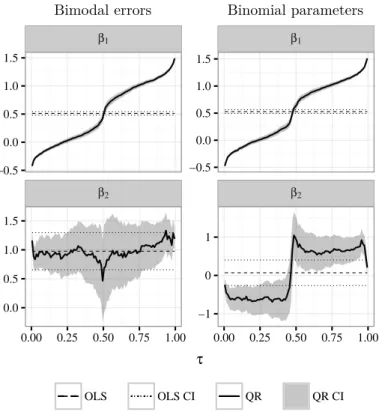
Figure 2.3 shows parameter estimates for OLS and Quantile Regression. For the model
with bimodal errors, which is shown on the left panel, OLS leads to plausible and constant
parameter estimates. QR shows varying intercepts for different quantiles, because it
aggregates the information of a regression constant and a bimodal error term. Overall,
the slope is reliably estimated by QR. For the second model with normally distributed
errors but binomial parameters, OLS is unable to capture non-constant parameters. This
leads to distorted estimates of the intercept and the slope. The latter parameter is not
even statistically significant different from zero, i.e., OLS does not capture the significant
role of the covariate. In contrast, Quantile Regression is able to capture the differences in
lower and upper quantiles. The intercept contains the two distinct values for the level as
well as the normally distributed error. The slope is identified as a statistically significant
covariate with varying influence.
Figure 2.3: Simulation – Parameter estimation
Bimodal errors Binomial parameters
β1 β2 β1 β2 −0.5 0.0 0.5 1.0 1.5 0.0 0.5 1.0 1.5 −0.5 0.0 0.5 1.0 1.5 −1 0 1 0.00 0.25 0.50 0.75 1.00 0.00 0.25 0.50 0.75 1.00 τ OLS OLS CI QR QR CI
Notes: The figure shows parameter estimates for the data shown in Figure 2.2 and generated by the models of Table 2.2. The left panel contains estimates for the model with a bimodal error term, whereas the right panel presents results for the model with binomial parameters. The confidence intervals (CI) are shown for the 95 % - level and are calculated for Quantile Regression with standard errors that are estimated by kernel estimates.
For both data generating processes, Figure 2.4 shows 1,000 independently simulated
observations each using OLS and QR parameter estimates of Figure 2.3. Neither the
bimodal error nor the binomial parameters are captured by OLS due to the assumptions
of normally distributed errors and constant parameters. Thus, only QR is able to capture
the bimodality of the data generating processes.
Figure 2.4: Simulation – Forecasting
Bimodal errors Binomial parameters
0 50 100 150 −1 0 1 2 −1 0 1 2 y Frequenc y OLS QR
Notes: The figure shows simulated data using the parameter estimates of Figure 2.3. The bimodality of the data generating process is only captured by Quantile Regression.
2.2.3
Comparative Methods
This paper compares QR to the most popular LGD models. We use the OLS method as
the first benchmark model as proposed in Qi and Zhao (2011) and calculate quantiles by
fitting a normal distribution for estimated errors. Secondly, a Fractional Response Model
(FRM) is used which transforms the dependent variable before doing an OLS to bring it
closer to normality (cf. Dermine and Neto de Carvalho (2006)). Here, we use the inverse
normal regression by transforming the LGD with the inverse cumulative density function
of the normal distribution as proposed by Hu and Perraudin (2002).2
The FRM and most LGD models assume the dependent variable to be a rate, i.e., to
be bounded by zero and one. Here, we have data with plausible values out of this range,
which is also relevant for creditors. Reasons are administrative, legal and liquidation
expenses or financial penalties (fees and commissions) and high collateral recoveries. In
2We tested several transformation, but only present the best performing alternative, i.e., the inverse
order to apply the FRM and other models for comparative reasons, we transform the
observed LGD to lie in this interval for these models.3 In addition, we add an adjustment
parameter of 10−9 to avoid values on the bounds as proposed by Altman and Kalotay
(2014). After estimation we re-transform predicted values to the observed LGD scale.
Gupton and Stein (2005) propose Beta Regression (BR) which is our third benchmark
model.
The fourth model is Regression Trees (RT) which are a non-parametric regression
technique, which splits data into groups and uses the groups’ averages of the dependent
variable as their mean prediction (see Bastos (2010)). Similar to OLS, we fit normal
distributions per group for quantile predictions.
Table 2.3: Comparative methods
Method Exemplary literature
Ordinary Least Squares Qi and Zhao (2011),
(OLS) Loterman et al. (2012)
Fractional Response Model Bastos (2010),
(FRM) Chava et al. (2011),
Qi and Zhao (2011), Altman and Kalotay (2014)
Beta Regression Huang and Oosterlee (2012),
(BR) Loterman et al. (2012),
Yashkir and Yashkir (2013)
Regression Tree Bastos (2010),
(RT) Qi and Zhao (2011),
Loterman et al. (2012), Altman and Kalotay (2014)
Finite Mixture Model Calabrese and Zenga (2010),
(FMM) Loterman et al. (2012),
Altman and Kalotay (2014) Notes: We compare the performance of each of the five models with Quantile Regression.
Finally we apply Multistage Models which estimate probabilities of low, middle or
high LGDs. Afterwards, the distribution of each component is modeled (see Altman
and Kalotay (2014)). Some of these methods directly model probabilities of obtaining
values of exactly zero or one and do not allow for values outside these bounds. Thus,
these models are not able to cover the kind of bank loan LGDs that we observe, i.e.,
with several observations lower than zero and higher than one. In contrast, a Finite
3The transformation is done byLGD
[0,1]=
LGD−min(LGD) max(LGD)−min(LGD).
Mixture Model (FMM) assumes a mixed distribution of several margins. This paper uses
a normal mixture distribution for the LGD.4 Quantiles are directly observed from mixture
distributions. Table 2.3 shows a summary of comparative methods from the literature.
2.3
Data
This paper uses a dataset of US American defaulted loans of small and medium
enter-prises from Global Credit Data (GCD) which provides the world largest LGD database.
The association consists of 52 member banks from all over the world including global
systemically important banks. Members exchange default data to develop and validate
their credit risk models. We restrict the sample to all defaults since year 2000 to ensure
the consistent default definition of Basel II. Since workout processes of recent defaults
are not necessarily completed, we do not account for defaults after 2013. Cures are not
considered because they do not provide default data with actual losses. We remove loans
with exposures at default of less than 500 US $ because of minor relevance and to satisfy
a materiality threshold.
Since we use loan data, we consider workout Recovery Rates (RR) including
post-default cash flows. The RR is the difference of all discounted incoming cash flows (CF+)
and discounted direct as well as indirect costs (CF−), divided by the exposure at default (EAD). The LGD is given as one minus the RR:
LGD = 1−
P
CF+−P CF−
EAD . (2.4)
Incoming cash flows (CF+) are: principal, interest and post-resolution payments, the
recorded book value of collateral, received fees and commissions, and waivers. Direct
and indirect costs (CF−) are: legal expenses, administrator and receiver fees, liquidation expenses, and other workout costs. In addition to the exposure at default, the nominator
4In contrast to Altman and Kalotay (2014), we do not transform the dependent variable because we
observe values out of the interval between zero and one. Actually, a transformation would lower the goodness of fit for mixture models for our dataset. Thus, we use raw data to allow a fair comparison. In addition, we tested a beta mixture distribution, which we do not report because of a worse performance compared to the normal mixture model.
of Equation (2.4) contains discounted principal advance, financial claim, interest accrual,
and fees and commissions charged. All numbers are discounted by LIBOR to the default
date.
We use two selection criteria due to Höcht and Zagst (2010), Höcht et al. (2011) and
Betz et al. (2016) to ensure consistent as well as plausible data and to detect outliers.
First, we consider loans for which the sum of all cash flows and further transactions, e.g,
charge-offs, are between 90 % and 110 % of the outstanding exposure at default. Second,
we regard loans with payments between -10 % and 110 % of the outstanding exposure at
resolution. Actually, this selection procedure is less important for Quantile Regression
because it is less sensitive to outliers. Nevertheless, we remove these loans as well as
all observations with LGDs outside of [−0.1, 1.1] to allow a fair comparison to standard regression techniques which are typically more sensitive to outliers.
Figure 2.5 shows a histogram of the final dataset. Most LGDs are nearly total losses
or total recoveries which yields to a strong bimodality. The mean is given by 0.31 and the
median by 0.09, i.e., LGDs are highly skewed. Both properties of the distribution may
favor the application of QR because most standard methods do not adequately capture
bimodality and skewness. Furthermore, many LGDs are lower than 0 and higher than
1 due to administrative, legal and liquidation expenses or financial penalties (fees and
commissions) and high collateral recoveries.
Figure 2.5: Observed Loss Rates Given Default
0 500 1000 1500
0.0 0.5 1.0
Loss Given Default
Frequenc
y
Notes: LGD calculation includes all cash flows and direct as well as indirect costs. All components are discounted to the loan’s default date.
The yearly mean LGD and the distribution of default over time are visualized in
Fig-ure 2.6. The number of observed defaults strongly increased during the Global Financial
Crises and slowly decreased in the aftermath. Loss rates were high due to the recession in
2000 and 2001 and subsequently decreased. In the last crises, the loss severity returned
to a high level, where it remains since then.
Figure 2.6: Loss Rates Given Default over time
0.0 0.1 0.2 0.3 0.4 2000 2005 2010 As ratio of 100% Mean LGD # defaults
Notes: The figure shows yearly mean LGDs and the ratio (number of defaults per year) / (total number of defaults).
Table 2.4 shows descriptive statistics for the covariates of which we can make use in the
database. For metric variables we report their means and several quantiles. For each level
of categorical variables we show means and category-specific quantiles of the LGD as well
as the number of observations per group. Medium term facilities imply higher LGDs than
other facility types. For example, the median realized LGD for medium term facilities is
0.18 compared to 0.03 for short term facilities and 0.01 for other types. The seniority plays
an important role for losses. On average non senior secured loans result in high LGDs
of 0.64 compared to the super senior category with 0.30. We distinguish between loans
with and without guarantees, i.e., whether there is an additional guarantor for a loan. In
the mean, there is only a small difference for loans with or without guarantees. However,
in the median we see a difference for loans with (0.16) and without (0.07) guarantees.
Although a guarantee should reduce future losses, it can provide asymmetric information
problems like moral hazard which can lead to higher losses. In addition, we distinguish
with real estate collateral produce lowest mean LGDs with 0.17 compared to 0.44 for loans
without any collateral. The firms’ industry affiliations may determine the magnitude of
losses. For most industries, the mean LGD is around 0.30 - 0.35. The maximum value is
given by the group of agriculture, etc. (0.46) and the minimum is given by the mining
industry (0.21). Financial affiliation results in low mean LGDs of 0.25.
Table 2.4: Descriptive statistics
Variable Level Quantiles Mean Obs.
0.05 0.25 0.50 0.75 0.95
LGD -2.99 0.32 9.01 61.56 100.00 31.27 4,308
log(EAD) 9.52 11.38 12.68 13.82 15.68 12.61 4,308
Facility type Medium term -0.90 2.40 17.52 67.46 100.00 35.58 2,372
Short term -1.30 0.87 3.28 51.87 100.00 26.57 559
Other -4.45 -1.02 1.31 49.74 100.00 25.76 1,377
Seniority code Pari-passu 2.60 6.92 17.84 65.41 102.32 35.77 713
Super senior -3.38 0.09 5.07 58.75 100.00 29.85 3,539
Non senior -0.17 16.38 91.02 100.75 100.79 63.64 56
Guarantee indicator N (no guarantee) -3.65 0.00 6.92 62.99 100.00 30.20 2,587
Y (guarantee) -0.73 1.53 15.79 60.48 100.00 32.88 1,721
Collateral indicator N (no collateral) -2.46 0.42 33.28 96.29 100.00 44.01 1,152
Other -2.24 0.72 8.02 54.76 100.00 29.33 2,464
Real estate -4.97 -0.58 1.56 22.97 95.97 16.99 692
Number of collateral 0.00 0.00 1.00 1.00 4.00 1.32 4,308
Industry
Finance, insurance, real estate (FIRE) -4.10 -0.29 5.96 43.87 100.00 25.38 646
Agriculture, foresty, fishing, hunting (AFFH) -3.80 -0.14 61.04 84.96 100.33 46.43 36
Mining (MIN) -0.42 0.71 2.06 20.83 98.94 21.43 21
Construction (CON) -3.87 -0.52 8.51 56.53 100.00 29.23 459
Manufacturing (MAN) -2.71 0.12 4.96 68.33 100.00 31.55 639
Transp., commu., elec., gas, sani. serv. (TCEGS) -1.33 0.36 22.13 59.72 100.00 34.62 173
Wholesale and retail trade (WRT) -3.41 0.05 4.55 62.60 100.00 30.93 590
Services (SERV) -3.77 0.13 5.42 81.29 100.00 33.76 704
Other (Other) 0.66 3.93 14.71 59.90 101.53 33.29 1,040
S&P 500(rel. change) -0.28 0.01 0.11 0.18 0.33 0.08 4,308
TED spread(abs. spread in p. p.) 0.13 0.19 0.26 0.46 1.32 0.44 4,308
Term spread(abs. spread in p. p.) 0.07 1.94 2.63 3.28 3.50 2.40 4,308
VIX(abs. in p. p.) 12.70 16.52 18.00 25.61 42.96 21.90 4,308
Notes: The table shows means and quantiles of empirical LGDs for categorical variables with
corresponding numbers of observation. In addition, the means and quantiles of metric variables, i.e., LGD, log(EAD) and number of collateral are given.
We also use two macroeconomic control variables. For the overall real and financial
environment, we use the relative year-on-year growth of the S&P 500. Stock exchange
per-formances are identified as general LGD drivers, e.g., by Qi and Zhao (2011) and Chava
rate as a significant variable to consider expectations of future financial and monetary
conditions. This paper uses loan data for which we find the absolute term spread between
10-years and 3-months US treasury rates to be significant drivers for LGDs which is also
identified by Lando and Nielsen (2010) as a driver of credit losses in general.
Macroeco-nomic information corresponds to each loan’s default year. Both variables result in most
plausible and significant results when testing different lead and lag structures. We also
tested other popular macroeconomic variables, e.g., inflation, the volatility index VIX,
industry production, gross domestic product, interest rates and the TED spread, which
result in less explanatory power.5
2.4
Empirical Analysis
2.4.1
Quantile Regression
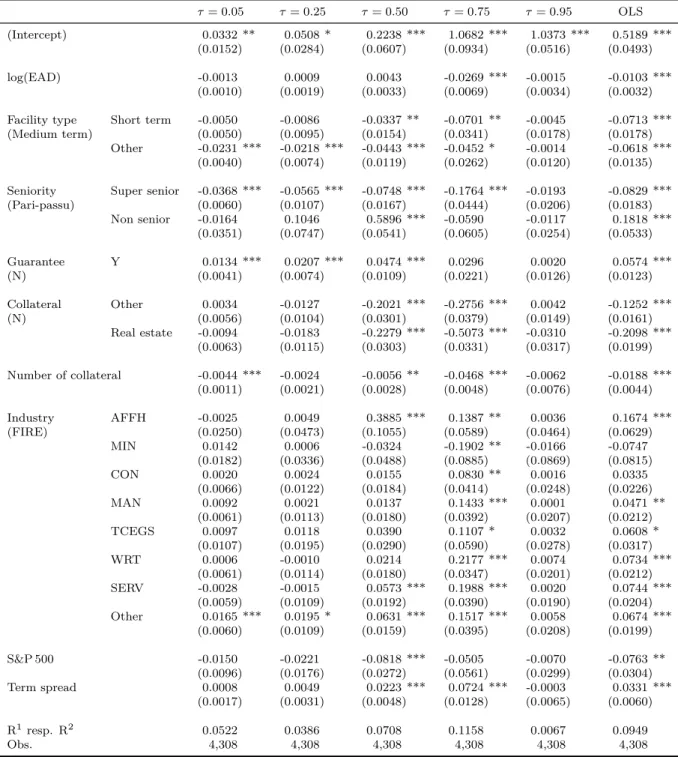
In this section the results of QR are provided. Table 2.5 shows the estimation results
of QR for the 5th, 25th, 50th, 75th and 95th percentile and the corresponding OLS
estimates. A full picture for all percentiles is given in the Appendix (Figure 2.A.1). As
can be seen the level and significance of the parameter estimates strongly depend on the
respective quantile.
The regression constant shows the behavior of the dependent variable when keeping
covariates at zero. The course does not suggest normally distributed error terms, which
would result in a smoothed s-shape. For low quantiles the intercept is near total recovery
and starts to increase monotonically around the median until it reaches its maximum
around total loss at higher quantiles. Loan losses generally exhibit a wide range regardless
of control variables, which is due to the bimodal nature of LGDs. At the tails (5th and
95th percentile) most covariates are not statistically significant different from zero. This
means that the extreme events, e.g., very high LGDs, are not explainable by our covariates
and mainly due to unpredictable events.
5We would like to thank an anonymous referee for suggesting these variables. Section 2.5.2 contains
a more detailed discussion of the choice of macroeconomic indicators on the example of the TED spread and the VIX.
Table 2.5: Parameter estimates Quantile Regression τ= 0.05 τ= 0.25 τ= 0.50 τ= 0.75 τ= 0.95 OLS (Intercept) 0.0332 ** 0.0508 * 0.2238 *** 1.0682 *** 1.0373 *** 0.5189 *** (0.0152) (0.0284) (0.0607) (0.0934) (0.0516) (0.0493) log(EAD) -0.0013 0.0009 0.0043 -0.0269 *** -0.0015 -0.0103 *** (0.0010) (0.0019) (0.0033) (0.0069) (0.0034) (0.0032)
Facility type Short term -0.0050 -0.0086 -0.0337 ** -0.0701 ** -0.0045 -0.0713 ***
(Medium term) (0.0050) (0.0095) (0.0154) (0.0341) (0.0178) (0.0178)
Other -0.0231 *** -0.0218 *** -0.0443 *** -0.0452 * -0.0014 -0.0618 ***
(0.0040) (0.0074) (0.0119) (0.0262) (0.0120) (0.0135)
Seniority Super senior -0.0368 *** -0.0565 *** -0.0748 *** -0.1764 *** -0.0193 -0.0829 ***
(Pari-passu) (0.0060) (0.0107) (0.0167) (0.0444) (0.0206) (0.0183) Non senior -0.0164 0.1046 0.5896 *** -0.0590 -0.0117 0.1818 *** (0.0351) (0.0747) (0.0541) (0.0605) (0.0254) (0.0533) Guarantee Y 0.0134 *** 0.0207 *** 0.0474 *** 0.0296 0.0020 0.0574 *** (N) (0.0041) (0.0074) (0.0109) (0.0221) (0.0126) (0.0123) Collateral Other 0.0034 -0.0127 -0.2021 *** -0.2756 *** 0.0042 -0.1252 *** (N) (0.0056) (0.0104) (0.0301) (0.0379) (0.0149) (0.0161) Real estate -0.0094 -0.0183 -0.2279 *** -0.5073 *** -0.0310 -0.2098 *** (0.0063) (0.0115) (0.0303) (0.0331) (0.0317) (0.0199) Number of collateral -0.0044 *** -0.0024 -0.0056 ** -0.0468 *** -0.0062 -0.0188 *** (0.0011) (0.0021) (0.0028) (0.0048) (0.0076) (0.0044) Industry AFFH -0.0025 0.0049 0.3885 *** 0.1387 ** 0.0036 0.1674 *** (FIRE) (0.0250) (0.0473) (0.1055) (0.0589) (0.0464) (0.0629) MIN 0.0142 0.0006 -0.0324 -0.1902 ** -0.0166 -0.0747 (0.0182) (0.0336) (0.0488) (0.0885) (0.0869) (0.0815) CON 0.0020 0.0024 0.0155 0.0830 ** 0.0016 0.0335 (0.0066) (0.0122) (0.0184) (0.0414) (0.0248) (0.0226) MAN 0.0092 0.0021 0.0137 0.1433 *** 0.0001 0.0471 ** (0.0061) (0.0113) (0.0180) (0.0392) (0.0207) (0.0212) TCEGS 0.0097 0.0118 0.0390 0.1107 * 0.0032 0.0608 * (0.0107) (0.0195) (0.0290) (0.0590) (0.0278) (0.0317) WRT 0.0006 -0.0010 0.0214 0.2177 *** 0.0074 0.0734 *** (0.0061) (0.0114) (0.0180) (0.0347) (0.0201) (0.0212) SERV -0.0028 -0.0015 0.0573 *** 0.1988 *** 0.0020 0.0744 *** (0.0059) (0.0109) (0.0192) (0.0390) (0.0190) (0.0204) Other 0.0165 *** 0.0195 * 0.0631 *** 0.1517 *** 0.0058 0.0674 *** (0.0060) (0.0109) (0.0159) (0.0395) (0.0208) (0.0199) S&P 500 -0.0150 -0.0221 -0.0818 *** -0.0505 -0.0070 -0.0763 ** (0.0096) (0.0176) (0.0272) (0.0561) (0.0299) (0.0304) Term spread 0.0008 0.0049 0.0223 *** 0.0724 *** -0.0003 0.0331 *** (0.0017) (0.0031) (0.0048) (0.0128) (0.0065) (0.0060) R1 resp. R2 0.0522 0.0386 0.0708 0.1158 0.0067 0.0949 Obs. 4,308 4,308 4,308 4,308 4,308 4,308
Notes: The table shows parameter estimates of Quantile Regression for the 5th, 25th, 50th,
75th and 95th percentiles. Standard errors are given in parentheses by kernel estimates. Significance is indicated by ‘*’ (10 %), ‘**’ (5 %) and ‘***’ (1 %). Further percentile estimates are shown in Appendix Figure 2.A.1. The last column shows OLS estimates. Reference groups of categorical variables are given in parentheses.