create a semi-formal environment
LOUISE NAGLE1JOHN LANNON JULIET MCMAHON
University of Limerick, Ireland
This paper will put forward an argument that work-integrated learning (WIL) should be semi-formal in nature and will examine the characteristics of this proposed learning environment. When a student work placement is unstructured or informal a learning framework is absent, often resulting in tacit or implicit knowledge which creates difficulties. Although the expectation of accessing a fully formal educational framework cannot be completely achievable within a busy work environment, an opportunity can be created to integrate characteristics of formal education, which leaves space for individuals to learn from each other as well as accessing formal learning experiences. This perspective also suggests that the different modes of workplace learning should be combined so that formal training utilizes informal learning. In addition, the proposed structure embraces the emerging paradigm, which integrates education into workplace learning, allowing students to gain access to diverse learning opportunities, adequate assessment, constructive feedback and reflection on learning.
Keywords: Work-integrated learning (WIL), workplace, learning, skills, employability, semi-formal work environment, informal learning
Within in the higher education (HE) and tertiary education environments work integrated learning (WIL) features more prominently than ever (Linehan & Sheridan, 2009; Martin, Rees, Edwards, & Paku, 2012). WIL is a form of work based learning (WBL) where the experience of a student applying their theoretical knowledge within a work setting can take many forms including a credited module as part of their higher education (Khampirat & McRae, 2016). For instance, in the Irish context, Quality and Qualifications Ireland (QQI), the quality assurance body for higher education, sets out the guidelines for WIL including type of experience, competency outcomes and standard of knowledge. In many cases, however, the question of how these attributes are gained or the learning framework utilized are less than clear. Such lack of clarity results in an absence of a formal learning experience on the part of the student, who is exposed to tacit knowledge and the challenge of navigating an environment to best secure opportunities of skill development.
The distinction between formal and informal learning has long been discussed in the WBL and WIL discourse (Billett, 2002; Howison, Campbell, Henderson, & Terry, 2009; Tynjälä, 2008). Attributing the term semi-formal to learning in the workplace was identified by Tynjälä (2008), however, the characteristics of this definition were not clarified. The unit of analysis within this environment is the experience of the learner (Eraut, 2000b) which is not necessarily a single incident, but can refer to experience as accumulated learning from a series of events. It will be argued that WIL programs are closer to semi-formal in nature as opposed to being considered either formal or informal.
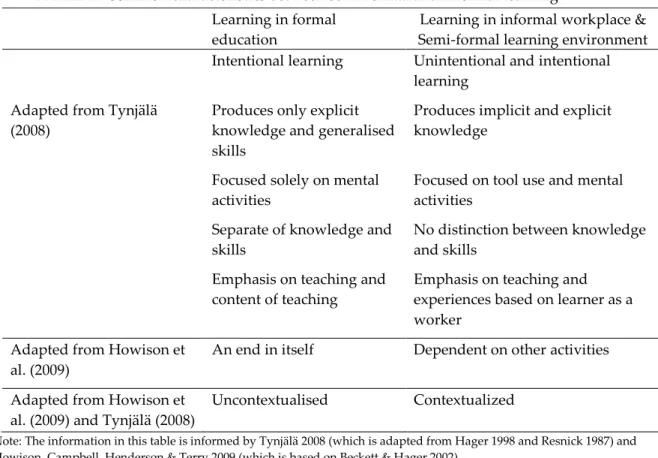
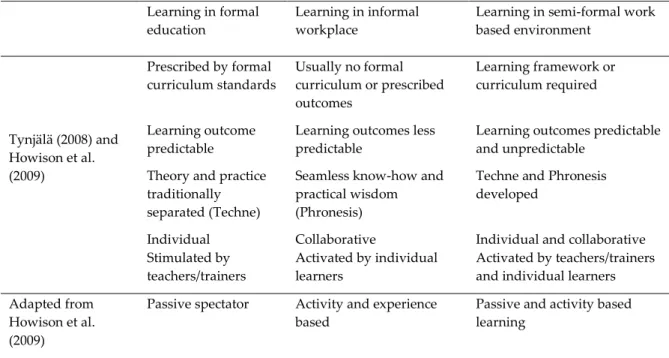
This paper presents characteristics of learning environments to explicate this argument, where initially the semi-formal learning environment is identified as having much in common with characteristics attributed to informal learning (Table 1). It will also examine how the semi-formal learning environment differs from informal learning environments by incorporating formal education attributes
1
International Journal of Work-Integrated Learning, 2018, 19(2), 181-191 182 which were not traditionally integrated into descriptions of work based learning (Table 2) Both tables are informed by Tynjälä (2008) which is adapted from Hager (1998) and Resnick (1987). The characteristics are also informed by Howison et al. (2009) which is based on Beckett and Hager (2002). CHARACTERISTICS SHARED BETWEEN SEMI-FORMAL AND INFORMAL LEARNING
Table 1 is a valuable tool to reflect on current issues defining learning in school and outside (Resnick, 1987) despite the fact that Eraut (2004) indicated that he deplored dichotomies as indicators of lazy thinking. Of course, the application of the knowledge that the student gains in higher education and then transfers while on work placement is a complex process. It is not merely a case of identifying relevant knowledge gained from formal education, then gaining an understanding of the context in which it is to be applied, and transferring this knowledge through application in the new situation. The cognitive process is much more complicated.
TABLE 1: Common characteristics between semi-formal and informal learning.
Note: The information in this table is informed by Tynjälä 2008 (which is adapted from Hager 1998 and Resnick 1987) and Howison, Campbell, Henderson & Terry 2009 (which is based on Beckett & Hager 2002).
To gain an understanding of the learning process and of a semi-structured learning environment, we initially need to examine the levels of intention related to learning in the workplace that Eraut (2004) began to explore. If we consider the term workplace learning environments it would signify that intention exists to actively facilitate learning (McRae, 2015). Models of WIL such as apprenticeship, for example, are characterized by being “mediated by the learner themselves” (Billett, 2016), implying that learners are active and self-motivated with the intention to learn. If we follow this logic, intentional active learning exists in the workplace learning environment which was traditionally considered informal and passive. These intentions take the form of common practices which are often goal driven.
Learning in formal education
Learning in informal workplace & Semi-formal learning environment
Adapted from Tynjälä (2008)
Intentional learning Unintentional and intentional learning
Produces only explicit knowledge and generalised skills
Produces implicit and explicit knowledge
Focused solely on mental activities
Focused on tool use and mental activities
Separate of knowledge and skills
No distinction between knowledge and skills
Emphasis on teaching and content of teaching
Emphasis on teaching and experiences based on learner as a worker
Adapted from Howison et al. (2009)
An end in itself Dependent on other activities
Adapted from Howison et al. (2009) and Tynjälä (2008)
International Journal of Work-Integrated Learning, 2018, 19(2), 181-191 183 They form a core element in developing organizational continuity, performance assessment and interactions which are all in the best interests of the employer (Billett, 2002).
TABLE 2: Differences between semi and informal learning.
Note: The information in this table is informed by Tynjälä 2008 (which is adapted from Hager 1998 and Resnick 1987) and Howison, Campbell, Henderson, & Terry 2009 (which is based on Beckett & Hager 2002).
Even in the absence of a structured learning framework in the workplace, there may exist a culture, which can encapsulate values and norms informing the work practices of the given environment (Lantolf, Thorne, & Poehner, 2015). This culture can encourage active learning which would require intention as opposed to the passive nature of learning in a formal education setting. In the dynamic work environment that currently exists, the need for students to become independently responsible for their own learning has been identified as integral to developing current skills (Brown, Cocking, & Bransford, 2000). Coupled with this intentional learning is unintentional learning, which is a natural by-product of observing others in work as well as engaging in new activities or work processes (Lave & Wenger, 1991; Rogoff, Baker‐Sennett, Lacasa, & Goldsmith, 1995). Therefore, both learning characterizes can occur within the workplace.
It is not sufficient within the workplace to rely on intangible cultural attributes to ensure a conducive learning environment as it can result in knowledge that is solely implicit. Although an integral element of work based learning, this form of knowledge provides both benefits and difficulties to the learner. Implicit knowledge is linked (but not unique to) informal learning and has been defined by the lack of intention to learn and a lack of awareness that learning is occurring (Eraut, 2000b). This form of learning is reactionary in nature, unplanned and often lacks reflection on actions which are essential elements of formal learning (Raelin, 2008). As it is not a deliberate mode of cognition, by its nature it lacks evaluating and problem-solving (Eraut, 2000a). On the other hand, the benefits of implicit learning cannot also be underestimated, so balance is required. Implicit learning allows for spontaneous learning, greater agency for the learner and individual freedom (Eraut, 2004). It considers the social context of learning (Rogoff, 2008; Vygotsky, 1978) where learning can be adapted to specific
Learning in formal education
Learning in informal workplace
Learning in semi-formal work based environment Tynjälä (2008) and Howison et al. (2009) Prescribed by formal curriculum standards Usually no formal curriculum or prescribed outcomes Learning framework or curriculum required Learning outcome predictable
Learning outcomes less predictable
Learning outcomes predictable and unpredictable
Theory and practice traditionally separated (Techne)
Seamless know-how and practical wisdom (Phronesis)
Techne and Phronesis developed
Individual Collaborative Individual and collaborative
Stimulated by teachers/trainers
Activated by individual learners
Activated by teachers/trainers and individual learners Adapted from
Howison et al. (2009)
Passive spectator Activity and experience based
Passive and activity based learning
International Journal of Work-Integrated Learning, 2018, 19(2), 181-191 184 situations. It is also necessary for the competent worker when encountering unstructured/unprecedented situations. This comprises of symbolic conceptual knowledge (Barley & Kunda, 1992) which describes how a novice to the work environment can learn occupational practices from others, which is difficult to observe or document (Billett & Smith, 2016). Structured learning would ensure that knowledge gained during this learning process is not solely implicit in nature but becomes explicit. This allows verbalization of knowledge, documentation of procedures and knowledge that is more easily accessible. Explicit learning allows for a more structured transfer of knowledge when a framework or curriculum is integrated into the experience.
The use of tools is relevant both within a formal and informal learning setting. However, the nature of this use differs in formal education and work related learning contexts where methods used differ. Formal education has traditionally been more reliant on writing where a “premium is placed on pure thought activities” (Hennessy, 1993, p. 2) as opposed to the use of other independent mechanisms to complete tasks using calculators for example. This approach contrasts with the real world of mental activities which engage constantly with the physical world and results in cognition which is influenced by our dependency on tools utilized. Integral elements of informal learning such as cooperating, reproducing and actively creating, involve mastery of such external tools. It can be argued that today with Higher Education Institutes (HEIs) ‘tool use’ is an integral part of learning as HEIs regularly make use of computers and engineering tools for example etc. Similarly, within many workplaces competent tool use is an integral element of work for example in clinical placement. If the learning that is gleaned from this use of tools can be considered formal in nature, it would depend on a learning framework being imposed while undertaking the tool use. This is relevant to ensure that all knowledge gained during this learning process is not implicit in nature.
In approaching tasks during WIL there should be no separation of knowledge and skills or between theory and practice. Rather a holistic approach is required. The abilities developed to recognize opportunities or engage in problem solving for example require a level of competence in applying skills (practice) as well as domain specific and strategic knowledge (theory). The distinction between knowing and doing fails to exist, so there is no separation between conceptual knowledge and problem solving for example. This enables students develop a holistic conceptualization of processes within the work environment as well as work context (Tynjälä, 2008). As situations structure cognition, tasks (activities) are not completed separately to interactions with the external world from the cognitive process behind them.
The next characteristic in Table 1 examines the ‘how’ element of learning within this proposed semi-formal learning environment and the role of teaching needs. Increasingly teaching has been integrated into the workplace to enhance learning, with a variety of pedagogic practices often supported by experts in the workplace. Three practices have recently been identified in the workplace (Billett & Smith, 2016) namely practice curriculum, practice pedagogies and learners’ personal epistemologies. The practice curriculum involves organizing structured experiences in everyday work activities. Workplaces themselves support pedagogical learning for example worker’s handover following shift work. Others include ‘practice pedagogies’ such as verbalization, mnemonics or heuristics and ‘personal pedagogies’ where there is intentional and active learning. These concepts are incorporated in forms of mentorship, which is becoming more formal in clinical placement examples of which are quoted in (Hunt, McGee, Gutteridge, & Hughes, 2012; McSharry & Lathlean, 2017) as well as within other work-placement environments (Marsick, Watkins, Callahan, & Volpe, 2006; Tynjälä, 2013).
Teaching methods such as modeling, scaffolding and fading can form part of this process (Ghefaili, 2003). In this situation, the expert has a supervisory role of providing attention to each student and
International Journal of Work-Integrated Learning, 2018, 19(2), 181-191 185 providing assistance when difficulties arise for individuals and giving attention when needed and stepping back when required. The role also requires asking stimulating questions, challenging points of view and encouraging students to question processes.
Learning within the semi-structured environment is dependent on other activities not just an end in itself and so a supportive learning environment is required (McRae, 2015). The environment external to the learner and indeed the employer organization itself is responding to new challenges which acquire adaptation to ensure survival (Puyate, 2008). The more immediate learning environment also presents barriers and opportunities for learning depending on the culture, affordance presented and politics for example. As the application of the learning forms an integral part of the process of remaining current in a field of expertise, continuous feedback to improve performance and learning is intrinsic to the emerging paradigm of learning. This involves embracing constructive criticism and reflection on the part of the learner, which are dependent on intention and motivation of both learner and employer.
The final characteristic from our Table 1 refers to contextualized learning. A negative attribute often associated with formal learning is the difficulty the learner encounters in transferring their knowledge into a different situation, which involves drawing on past experiences, as formal learning is viewed as uncontextual in nature. The symbolic manipulation associated with solving school based mathematical questions, for example, has been used in the workplace and “functions independently within the same culture, with different procedures and rates of success” (Hennessy, 1993, p. 3). Lave (1991) demonstrated that personal methods are commonly invented and used successfully by adults in a practical situation as opposed to relying on symbol manipulation (Lave, 1988) and a study of young street vendors in Brazil found that problems embedded in a familiar context were those which were solved most easily (Carraher, Carraher, & Schliemann, 1985). It must therefore, be considered that learning in the workplace is predominantly contextual nature. Sociocultural research has often emphasized the situated or contextual nature of learning, which differentiates between learning models required for formal education and in the workplace (Tynjälä, 2013) even indicating that more formal educational models are somewhat more superior to the WIL models (Howison et al., 2009).
HOW A SEMI FORMAL LEARNING ENVIRONMENT INTEGRATES ELEMENTS OF FORMAL LEARNING
In the previous section, we reviewed characteristics a proposed semi-formal work based learning environment has in common with informal learning. However, in a current dynamic environment, WIL will require elements of a more formal education. Tynjälä (2008) identified that usually no formal curriculum exists in informal workplace learning. Observations by Leong and Kavanagh (2013) align with this, indicating that there is an absence of structure in many current work integrated programs signaling that a more structured framework is required to scaffold the development of skills. Although frameworks are developed (McRae & Johnston, 2016) integrating these into practice has been challenging. From the student perspective, a lack of structure or learning framework in the workplace may result in a loss of affordances or opportunities to develop occupational knowledge (Billett, 2002). This process could involve providing additional structure to a form of learning framework or curriculum that already exists in the workplace through for example the historic concept of apprenticeship (Billett & Smith, 2016). The incorporated pedagogy can support a semi-learning work environment by establishing relevant learning outcomes which should be reflected in formative or summative assessment. This form of learning is mediated by the learner, involves individual engagements and interdependent learning. The key process has been mimesis (imitating the work of
International Journal of Work-Integrated Learning, 2018, 19(2), 181-191 186 an expert) which involves deliberate structuring of experiences the novice is exposed to within the process of practice curriculum.
The integration of WIL programs into university education has contributed to structured working environments allowing students and academics to map learning programs directly to the academic agenda through learning outcomes (McRae & Johnston, 2016). This structured integration of academic studies and practice differentiates curricular WIL from other experiential learning. It allows students to integrate learning from academia and the workplace while determining greater benefits from the experience (Patrick et al., 2008; Sattler, Wiggers, & Arnold, 2011). Universities in partnership with employers are encouraged to integrate employability skills into curriculum to enable transition into work and personal development for student. Such interventions can provide graduates with the capacity to think independently and critically while integrating into a professional labor force (Leong & Kavanagh, 2013).
The absence of a structured framework can also lead to learning outcomes which will be less predictable. This is not ideal as it can mitigate against the achievement of goals of continuity of practice for the organization which is in the best interest of the employer (Billett, 2002; Tynjälä, 2008). In contrast, if a learning framework is integrated, key learning outcomes can form an integral element of work based learning and a corresponding assessment of this learning can be implemented. The benefits will involve predictable learning outcomes which can be aligned to organizational goals and Human Resource Management (HRM) policies. This can be informed by active planning, projected skills deficits and projected future development in terms of technological advances for example.
Shifting WIL learning to a semi-formal structure allows for the development of phronesis or the seamless practical knowledge which is an essential component of a competent expert and manifests in effective use of ethical judgment, wisdom and reasoning (Nussbaum, 2001). Though experience is seen as a critical component of learning, there has historically been a distinction between the development of the intellect as promoted by Plato for example, and the more pragmatic Aristotelian development of “practical wisdom” (McRae & Johnston, 2016). This process reflects on good practice and is based in experience, where one acts with concern for the correct action within a given situation. The development of ‘moral agency’ can also be seen as an element of phronesis which is considered a characteristic an expert possesses. This phronesis is differentiated from techne in that it does not rely on means-end rationality. Rather it is concerned with judging what is good practice in a given situation which is dependent on relationships and any human concerns that are present.
In modern teaching and learning there is a role for collaborative learning. Much research within the work based learning domain has concentrated on this collaborative learning for example the concept of communities of practice (Lave, 1991), actor and networks (Hutchins, 1995) and connectivism (Downes, 2007; Siemens, 2005). Such theories recognize the social interaction and social construction of knowledge, which identifies that the knowledge of the community is constructed, distributed and validated through intense social interaction. It involves collaborative learning e.g. collective problem solving, displaying multiple roles and providing collaborative work skills. Therefore, learning can be stimulated on a group or collective basis or through individual learning based on observation, imitation and reflection.
WIL can be stimulated or activated by either the work based mentor or the individual learner (during coaching in apprenticeship for example). This process enables the student to ground their knowledge in experience. In some examples, the student will stimulate learning by asking a question of a colleague
International Journal of Work-Integrated Learning, 2018, 19(2), 181-191 187 or initiating a task. In addition, workers can engage in e-learning and aggregated learning at an individual level, as this is becoming prevalent in maintaining current skills within the workplace (Brookshire, Lybarger, & Keane, 2011; Tynjälä & Häkkinen, 2005). This will allow the concurrent development and integration of theory and experience by adopting integrative pedagogies including personal pedagogies (Billett & Smith, 2016). Rather than viewing this as a method of teaching, it can be identified as a principle which integrates ‘theory, practice and self-regulation’ (Tynjälä, 2008). A semi-formal learning environment should encourage both passive and active learning, incorporating elements of traditional formal and informal learning. Sociocultural theory recognizes that learners transition from being controlled by the learning environment and objects within it (passive) to gain control of the situation including their cognition and social interactions (Lantolf et al., 2015). This transition creates confidence and a sense of self-efficacy (Bandura, 1977). The role of the mentor in this semi-structured situated environment is to promote active learning (Collins, Brown, & Holum, 1991), as the mentor can teach students how to learn on their own in a more skilful way. The student then gains an understanding of the different conditions under which they can apply knowledge as well as the purposes or uses of it, as opposed to being passive recipients. Students, therefore, learn to transfer their skills to a new domain or context.
OTHER OBSERVATIONS
Assessment can transform implicit knowledge into explicit knowledge. However, assessment of WIL is a challenge (Jackson, 2010), particularly when we move from a standard paradigm of learning (based on the didactic school based system) to an emerging paradigm which incorporates capacity as the unit of analysis as opposed to attainment (Hager, 2004). Capacity is linked to learning, which incorporates knowledge informing judgments and expertise within a dynamic environment. Therefore, the main assumption of stable knowledge, individual knowledge assessment and comparing assessment results across participants has little meaning. Developing a capacity is relevant when related to the ability to make holistic, context sensitive judgments about how to act in situations that may be more or less novel. One strategy to achieve sound learning outcomes is to align intended learning outcomes with experiences and assessment (Biggs, 2011) which would require development of a prescribed rubric which employers could implement in assessment (Whelan, 2017).
Emotional factors of the learner need to be acknowledged within the work environment. A blend of emotional as well as intellectual aspects exist within informal learning and these become segregated within formal learning (Harris & Evans, 1991). In addition to academic and domain knowledge the student as well as the work placement supervisor can attach emotional expectations on their application of skills to the workplace (Boud, Keogh, & Walker, 1985). Reflection, which forms part of an effective learning process will invoke an emotional connection to experiences in order to learn and apply new knowledge (Harvey, Coulson, Mackaway, & Winchester-Seeto, 2010). In another way, the process of workplace learning itself incorporates emotion as it is context driven which allows negotiation of norms, enculturalisation as well as the mental and emotional attributes of integrating into a new environment or when undertaking new tasks (Zegwaard, Coll, & Hodges, 2003). In many cases it is these social and emotional skills that employers seek in students and graduates, as the capacity to deal with challenges and stress that display ‘emotional work-readiness’ (Bandaranaike & Willison, 2015). Students want the direct experience of real life problem solving (Crebert, Bates, Bell, Patrick, & Cragnolini, 2004) and an element of emotional work readiness (Bandaranaike & Willison, 2015). Such experience can be identified in the graduate’s ability to align with the goals of the group or organization
International Journal of Work-Integrated Learning, 2018, 19(2), 181-191 188 and at an optimum they will focus on achieving these goals in the face of challenges and obstacles. Within a formal classroom setting there often exists a lack of connection to real world tasks and a divorce from goal directed learning. There is opportunity to artificially construct a formal education domain through the introduction of learning tools such as case studies or real world analogies, which can be useful to incorporate goal directed learning. However, in the absence of applying knowledge and skills in the workplace the concept cannot be fully embraced.
As ill-defined situations and activities are integral to a work environment, they should be integrated into the WIL experience (Herrington, Oliver, & Reeves, 2003). This would allow a simulation of real world situations, which encourages authentic learning. Studies completed by Richmond, Richards & Britt (2015) where two work stations were developed to be less defined for occupational therapy students, necessitated peer learning and autonomous problem solving. When the scaffolding initially placed for novice workplace learners is removed the lack of structure in tasks requires exercising of cognitive processes developed, which empowers students to transfer learning into new situations and contexts (Leong & Kavanagh, 2013).
CONCLUSION
This paper argues that the workplace informs activities in which workers engage and this in turn can precept the guidance they can access. However, the process of learning within a workplace setting cannot be wholly described as informal or formal. An informal approach may leave the learning to the risk of limited affordances based on where people are positioned in an organization or to the mercy of political structures which can set a learning process up for failure. Therefore, this learning should not be limited by the work environment as it often lacks a formal learning framework. The interventions of formal learning characteristics can bridge learning gaps by introducing a curriculum, predictable learning outcomes, techne and phronesis, as well as collaborative and active learning initiated by both teacher and learner. It can also dictate how the learning is constructed ontogenically encouraging a personal pedagogy.
This analysis does imply that within a semi-formal learning environment informal learning is integral to WIL and it introduces an opportunity to provide an extensive and varied learning experience. Even within a structured WIL framework implicit knowledge will be gained by undertaking work. Such informal learning experiences incorporate intentional and unintentional learning, implicit and explicit knowledge and a focus on tool use as well as mental activities. A semi-formal learning environment also eliminating distinctions between knowledge and skills, while integrating contextualized learning which emphasizes the learner as a worker where this learning is dependent on other activities.
International Journal of Work-Integrated Learning, 2018, 19(2), 181-191 189
REFERENCES
Bandaranaike, S., & Willison, J. (2015). Building capacity for work-readiness: Bridging the cognitive and affective domains. Asia-Pacific Journal of Cooperative Education,16(3), 223-233.
Bandura, A. (1977). Self-efficacy: Toward a unifying theory of behavioral change. Psychological Review, 84(2), 191-215.
Barley, S. R., & Kunda, G. (1992). Design and devotion: Surges of rational and normative ideologies of control in managerial discourse. Administrative Science Quarterly, 37(3), 363-399.
Beckett, D., & Hager, P. J. (Eds.). (2002). Life, work and learning: Practice in postmodernity. London, UK: Routledge. Biggs, J. B. (2011). Teaching for quality learning at university: What the student does (4th ed.). Maidenhead, UK:
McGraw-Hill Education.
Billett, S. (2002). Critiquing workplace learning discourses: Participation and continuity at work. Studies in the
Education of Adults, 34(1), 56-67.
Billett, S. (2016). Toward a workplace pedagogy: Guidance, participation, and engagement. Adult Education
Quarterly, 53(1), 27-43.
Billett, S., & Smith, E. (2016). Apprenticeship as a mode of learning and model of education. Education + Training,
58(6), 613-628.
Boud, D., Keogh, R., & Walker, D. (1985). Promoting reflection in learning: A model. In D.Boud, R. Keogh, & D. Walker (Eds), Reflection: Turning experience into learning, (pp 18-40). London, UK: Kogan Page
Bransford, J. D., Brown, A. L., & Cocking, R. R. (2000). How people learn (Expanded ed.). Washington, DC: National Academy.
Brookshire, R. G., Lybarger, K. M., & Keane, L. B. (2010). Virtual workplace learning: Promises met? In M. Malloch, L. Cairns, K. Evans & B. O’Connor, The Sage handbook of workplace learning, (p.331-340). London, UK: Sage.
Carraher, T. N., Carraher, D. W., & Schliemann, A. D. (1985). Mathematics in the streets and in schools. British Journal of Developmental Psychology, 3(1), 21-29.
Collins, A., Brown, J. S., & Holum, A. (1991). Cognitive apprenticeship: Making thinking visible. American Educator, 15(3), 6-11.
Crebert, G., Bates, M., Bell, B., Patrick, C. J., & Cragnolini, V. (2004). Developing generic skills at university, during work placement and in employment: Graduates' perceptions. Higher Education Research & Development, 23(2), 147-165.
Downes, S. (2007). What connectivism is. Retrieved from https://www.downes.ca/post/38653
Eraut, M. (2000a). Non-formal learning, implicit learning and tacit knowledge in professional work. In F. Coffield (Ed.), The necessity of informal learning, (pp. 12-31) Bristol, UK: Policy Press.
Eraut, M (2000b). Non‐formal learning and tacit knowledge in professional work. British Journal of Educational Psychology, 70(1), 113-136.
Eraut, M. (2004). Informal learning in the workplace. Studies in Continuing Education, 26(2), 247-273.
Ghefaili, A. (2003). Cognitive apprenticeship, technology, and the contextualization of learning environments. Journal of Educational Computing, Design & Online Learning, 4(1), 1-27.
Hager, P. (1998). Understanding workplace learning: General perspectives. In D. Boud (Ed.), Current issues and new agendas in workplace learning (pp. 31–46). Springfield, VA: NCVER.
Hager, P. (2004). The conceptualization and measurement of learning at work. In H. Rainbird, A. Fuller, & A. Munro (Eds.), Workplace learning in context (pp. 242–258). London, UK: Routledge.
Harris, M., & Evans, J. (1991). Mathematics and workplace research. In M. Harris (Ed.), Schools, mathematics and
work (pp.123-131). London, UK: Farmer.
Harvey, M., Coulson, D., Mackaway, J., & Winchester-Seeto, T. (2010). Aligning reflection in the cooperative education curriculum. Asia-Pacific Journal of Cooperative Education, 11(3), 137-152.
Hennessy, S. (1993). Situated cognition and cognitive apprenticeship: Implications for classroom learning. Studies
in Science Education, 22, pp.1-41.
Herrington, J., Oliver, R. & Reeves, T. (2003). Patterns of engagement in authentic online learning environments. Australasian Journal of Educational Technology, 19(1), pp.59-71.
International Journal of Work-Integrated Learning, 2018, 19(2), 181-191 190 Howison, S., Campbell, W., Henderson, J., & Terry, S. (2009). Learning in the learning workplace: Tertiary
institution staff perceptions. In R. K. Coll & K. Zegwaard (Eds.), Using experience and research to inform the practice of work-integrated learning (pp. 28-33). Waiheke, New Zealand: New Zealand Association for Cooperative Learning.
Hunt, L. A., McGee, P., Gutteridge, R., & Hughes, M. (2012). Assessment of student nurses in practice: A comparison of theoretical and practical assessment results in England. Nurse Education Today, 32(4), pp.351-355.
Hutchins, E. (1995). Cognition in the wild. Cambridge, MA: MIT Press
Jackson, N. J. (2010). From a curriculum that integrates work to a curriculum that integrates life: Changing a university’s conceptions of curriculum. Higher Education Research & Development, 29(5), 491-505. Khampirat, B., & McRae, N. (2016). Developing global standards framework and quality integrated models for
cooperative and work-integrated education programs. Asia-Pacific Journal of Cooperative Education, 17(4), 349-362.
Lantolf, J. P., Thorne, S. L., & Poehner, M. E. (2015). Sociocultural theory and second language development. In B. VanPatten & J. Williams (Eds.), Theories in second language acquisition: An introduction (pp. 207–226). New York, NY: Routledge.
Lave, J. (1988). Cognition in practice: Mind, mathematics and culture in everyday life. Cambridge, UK: Cambridge University Press.
Lave, J. (1993). Situated learning in communities of practice. In L. B. Resnick, J. M. Levine, & S. D. Teasley (Eds.), Perspectives on socially shared cognition (pp. 63–82). Washington, DC: American Psychological Association. Lave, J. & Wenger, E. (1991). Situated learning: Legitimate peripheral participation. Cambridge, UK: Cambridge
University Press.
Leong, R., & Kavanagh, M. (2013). A work integrated learning (WIL) framework to develop graduate skills and attributes in an Australian university's accounting program. Asia-Pacific Journal of Cooperative Education, 14(1), 1-14.
Linehan, M., & Sheridan, I. (2009). Workplace learning courses in Irish third‐level colleges. Journal of Workplace Learning, 21(6), 496-504.
Marsick, V. J., Watkins, K. E., Callahan, W. M., & Volpe, M. (2009). Informal and incidental learning in the workplace. In M. C. Smith & N. DeFrates-Densch (Eds.), Handbook of research on adult learning and development (pp. 570–600). Oxon, UK: Routledge.
Martin, A. J., Rees, M., Edwards, M. & Paku, L. (2012). An organisational overview of pedagogical practice in work integrated learning. Asia-Pacific Journal of Cooperative Education, 13(1), 23-37.
McRae, N. (2015). Exploring conditions for transformative learning in work-integrated education. Asia-Pacific Journal of Cooperative Education, 16(2), 137-144.
McRae, N., & Johnston, N. (2016). The development of a proposed global work-integrated learning framework. Asia-Pacific Journal of Cooperative Education, 17(4), 337-348.
McSharry, E. & Lathlean, J. (2017). Clinical teaching and learning within a preceptorship model in an acute care hospital in Ireland; a qualitative study. Nurse Education Today, 51, pp.73-80.
Nussbaum, M. C. (2001). The fragility of goodness: Luck and ethics in Greek tragedy and philosophy. New York, NY: Cambridge University Press.
Patrick, C., Peach, D., Pocknee, C., Webb, F., Fletcher, M., & Pretto, G. (2008). The WIL(Work Integrated Learning) report: A national scoping study –(Australian Learning and Teaching Council [ALTC] Final report). Brisbane, Australia: Queensland University of Technology
Puyate, S. T. (2008). Constraints to the effective implementation of vocational education program in private secondary schools in Port Harcourt local government area. Asia-Pacific Journal of Cooperative Education, 9(1), 59-71.
Raelin, J. A. (2008). Work-based learning: Bridging knowledge and action in the workplace. San Francisco, CA: Jossey-Bass.
Resnick, L. B. (1987). The 1987 presidential address learning in school and out. Educational Researcher, 16(9), 13-54. Richmond, K., Richards, K., & Britt, K. (2015). The impact of an authentic, simulated learning activity on student
International Journal of Work-Integrated Learning, 2018, 19(2), 181-191 191 Rogoff, B. (2008). Observing sociocultural activity on three planes: Participatory appropriation, guided
participation, and apprenticeship. In P. Murphy, K. Hall, & J. Soler (Eds). Pedagogy and practice: Culture and identities, (pp 58-74). London, UK: Sage
Rogoff, B., Baker‐Sennett, J., Lacasa, P., & Goldsmith, D. (1995). Development through participation in sociocultural activity. New Directions for Child and Adolescent Development, (67), 45-65
Sattler, P., Wiggers, R. D., & Arnold, C. (2011). Combining workplace training with postsecondary education: The spectrum of work-integrated learning (WIL) opportunities from apprenticeship to experiential learning. Canadian Apprenticeship Journal, 5 (online). Retrieved from
http://journals.sfu.ca/caj/index.php/caj-jca/article/view/74/131
Siemens, G. (2005a). Connectivism: Learning as network-creation. ASTD Learning News, 10(1), pp.1-28. Tynjälä, P. (2008). Perspectives into learning at the workplace. Educational Research Review, 3(2), 130-154. Tynjälä, P. (2013). Toward a 3-P model of workplace learning: a literature review. Vocations and Learning, 6(1),
11-36.
Tynjälä, P., & Häkkinen, P. (2005). E-learning at work: Theoretical underpinnings and pedagogical challenges. Journal of Workplace Learning, 17(5/6), 318-336.
Vygotsky, L. (1978). Interaction between learning and development. Readings on the Development of Children, 23(3), 34-41.
Whelan, M. (2017). Road testing graduate attributes and course learning outcomes of an environmental science degree via a work-integrated learning placement. Education, 18(1), 1-13.
Zegwaard, K., Coll, R. K., & Hodges, D. (2003). Assessment of workplace learning: A framework. Asia-Pacific Journal of Cooperative Education, 4(1), 9-18.
About the Journal
The International Journal of Work-Integrated Learning (IJWIL) publishes double-blind peer-reviewed original research and topical issues dealing with Work-Integrated Learning (WIL). IJWIL first published in 2000 under the name of Asia-Pacific Journal of Cooperative Education (APJCE). Since then the readership and authorship has become more international and terminology usage in the literature has favored the broader term of WIL. In response to these changes, the journal name was changed to the International Journal of Work-Integrated Learning in 2018.
In this Journal, WIL is defined as "an educational approach that uses relevant work-based experiences to allow students to integrate theory with the meaningful practice of work as an intentional component of the curriculum". Examples of such practice includes work placements, work-terms, internships, practicum, cooperative education (Co-op), fieldwork, work-related projects/competitions, service learning, entrepreneurships, student-led enterprise, applied projects, simulations (including virtual WIL), etc. WIL shares similar aims and underpinning theories of learning as the fields of experiential learning, work-based learning, and vocational education and training, however, each of these fields are seen as separate fields.
The Journal’s main aim is to enable specialists working in WIL to disseminate research findings and share knowledge to the benefit of institutions, students, co-op/WIL practitioners, and researchers. The Journal desires to encourage quality research and explorative critical discussion that leads to the advancement of effective practices, development of further understanding of WIL, and promote further research.
Types of Manuscripts Sought by the Journal
Types of manuscripts sought by IJWIL is primarily of two forms; 1) research publications describing research into aspects of work-integrated learning and, 2) topical discussion articles that review relevant literature and provide critical explorative discussion around a topical issue. The journal will, on occasions, consider best practice submissions.
Research publications should contain; an introduction that describes relevant literature and sets the context of the inquiry. A detailed description and justification for the methodology employed. A description of the research findings - tabulated as appropriate, a discussion of the importance of the findings including their significance to current established literature, implications for practitioners and researchers, whilst remaining mindful of the limitations of the data. And a conclusion preferably including suggestions for further research.
Topical discussion articles should contain a clear statement of the topic or issue under discussion, reference to relevant literature, critical and scholarly discussion on the importance of the issues, critical insights to how to advance the issue further, and implications for other researchers and practitioners.
Best practice and program description papers. On occasions, the Journal also seeks manuscripts describing a practice of WIL as an example of best practice, however, only if it presents a particularly unique or innovative practice or is situated in an unusual context. There must be a clear contribution of new knowledge to the established literature. Manuscripts describing what is essentially 'typical', 'common' or 'known' practices will be encouraged to rewrite the focus of the manuscript to a significant educational issue or will be encouraged to publish their work via another avenue that seeks such content.
By negotiation with the Editor-in-Chief, the Journal also accepts a small number of Book Reviews of relevant and recently published books.
EDITORIAL BOARD Editor-in-Chief
Dr. Karsten Zegwaard University of Waikato, New Zealand
Associate Editors
Mrs. Judene Pretti University of Waterloo, Canada
Dr. Anna Rowe University of New South Wales, Australia
Senior Editorial Board Members
Prof. Richard K. Coll University of the South Pacific, Fiji
Prof. Janice Orrell Flinders University, Australia
Prof. Neil I. Ward University of Surrey, United Kingdom
Dr. Phil Gardner Michigan State University, United States
Dr. Denise Jackson Edith Cowan University, Australia
Copy Editor
Yvonne Milbank International Journal of Work-Integrated Learning
Editorial Board Members
Assoc. Prof. Erik Alanson University of Cincinnati, United States
Mr. Matthew Campbell Queensland University of Technology, Australia
Prof. Cheryl Cates University of Cincinnati, USA
Dr. Sarojni Choy Griffith University, Australia
Prof. Leigh Deves Charles Darwin University, Australia
Dr. Maureen Drysdale University of Waterloo, Canada
Dr. Chris Eames University of Waikato, New Zealand
Mrs. Sonia Ferns Curtin University, Australia
Dr. Jenny Fleming Auckland University of Technology, New Zealand
Dr. Thomas Groenewald University of South Africa, South Africa
Dr. Kathryn Hays Massey University, New Zealand
Prof. Joy Higgs Charles Sturt University, Australia
Ms. Katharine Hoskyn Auckland University of Technology, New Zealand
Dr. Sharleen Howison Otago Polytechnic, New Zealand
Dr. Nancy Johnston Simon Fraser University, Canada
Dr. Mark Lay University of Waikato, New Zealand
Prof. Andy Martin Massey University, New Zealand
Ms. Susan McCurdy University of Waikato, New Zealand
Dr. Norah McRae University of Victoria, Canada
Dr. Keri Moore Southern Cross University, Australia
Prof. Beverly Oliver Deakin University, Australia
Dr. Laura Rook University of Wollongong, Australia
Assoc. Prof. Philip Rose Hannam University, South Korea
Dr. David Skelton Eastern Institute of Technology, New Zealand
Prof. Heather Smigiel Flinders University, Australia
Dr. Calvin Smith Brisbane Workplace Mediations, Australia
Assoc. Prof. Judith Smith Queensland University of Technology, Australia
Prof. Yasushi Tanaka Kyoto Sangyo University, Japan
Prof. Neil Taylor University of New England, Australia
Assoc. Prof. Franziska Trede Charles Sturt University, Australia
Ms. Genevieve Watson Elysium Associates Pty, Australia
Dr. Nick Wempe Taratahi Agricultural Training Centre, New Zealand
Dr. Marius L. Wessels Tshwane University of Technology, South Africa
Dr.Theresa Winchester-Seeto University of New South Wales, Australia
International Journal of Work-Integrated Learning (IJWIL)