Army Regulation 623–105
Personnel EvaluationOfficer
Evaluation
Reporting
System
HeadquartersDepartment of the Army Washington, DC
1 April 1998
Unclassified
SUMMARY of CHANGE
AR 623–105
Officer Evaluation Reporting System
This revision:
o Requires senior raters to ensure all rated officers receive a copy of the
rater’s and senior rater’s support form shortly after assuming duties. (para
2-11, 2-15)
o Incorporates a Company Grade Officer Leader Development Program to assist in
the Army’s commitment to ensure a rapid, equal, and fair transition of junior
officers into the Army culture, and provide a common developmental framework
based on Army values and leadership doctrine. (para 3-10) It includes:
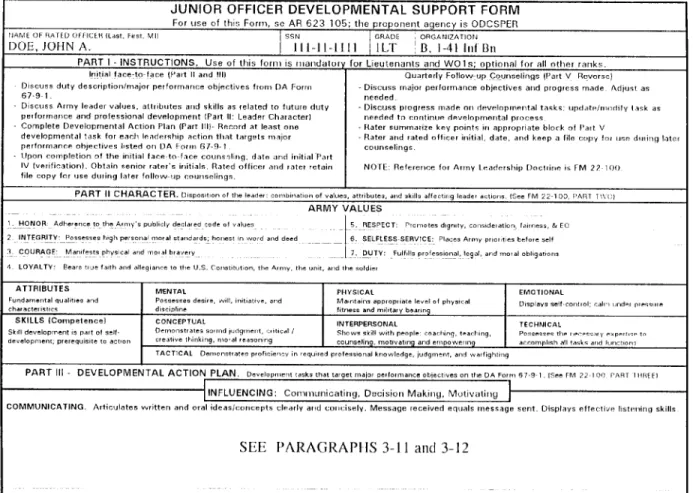
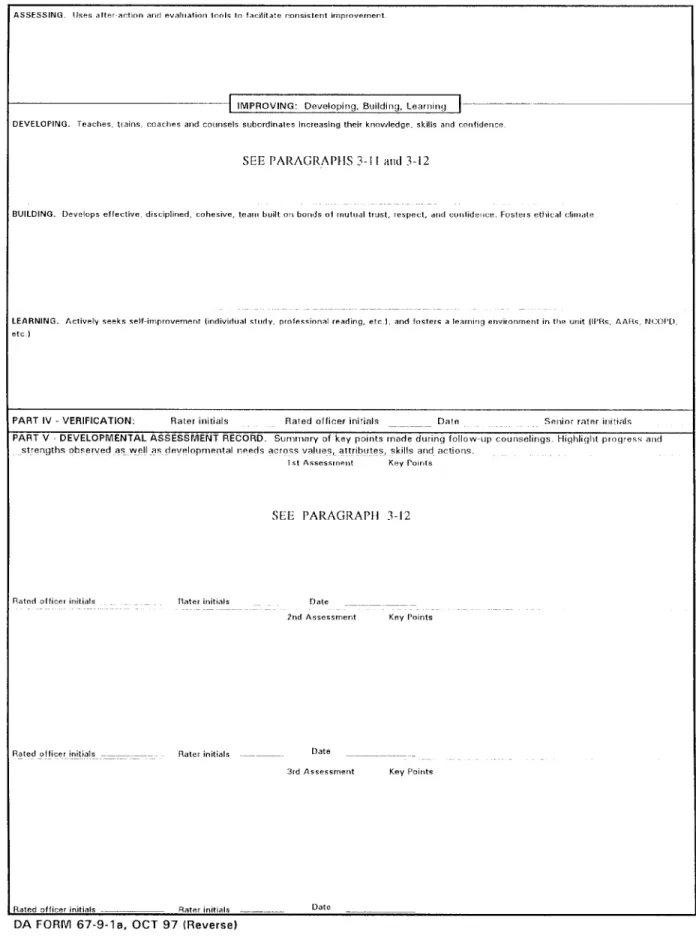
--A new DA Form 67-9-1a, Junior Officer Developmental Support Form - A
mandatory support form worksheet for LTs/WO1s on which developmental tasks in
doctrinal leadership actions and mandatory quarterly developmental
counseling summaries are recorded
--Regular Follow-up Performance Counseling - Requirement for quarterly
face-to-face performance and developmental counseling for all LTs and WO1s.
o Upgrades the rater evaluation by using rating criteria to enhance officer
corps familiarity with doctrinal Army values and leader attributes/skills/
actions, thus emphasizing and reinforcing the desired behavior that
epitomizes the officer corps, including: (para 3-19)
--A rater developed ’leader word picture’ consisting of checking several
boxes representing the rated officer’s strengths and providing prose
narrative comments based on Army doctrinal leader attributes/skills/actions.
--A focus on doctrinal Army values as a foundation of officer corps
performance.
--Emphasis on rated officer compliance with Junior Officer Developmental
Support Form requirements.
--A block which identifies any unique skills/expertise that an officer
possesses of significant value to the Army. For Army Competitive Category
CPTs - LTCs, indicate potential Career Field for future service (OPMS XXI).
o Alters the senior rater evaluation to two box checks and a narrative focused
on a rated officer’s potential. The first box check is an evaluation of the
rated officer’s promotion potential compared to all officers of the same
grade. The second box check is an evaluation of the rated officer’s potential
in comparison to a much narrower group, officers of that grade the senior
rater has senior rated or are currently in the senior rater’s population. As
an evolutionary method of senior rater accountability, less than 50% of rated
officers can receive an above center of mass rating. For Army Competitive
Category CPTS - LTCs, indicate potential Career Field for future service
(OPMS XXI). (para 3-22)
o Incorporates an HQDA electronically generated label that is placed over the
senior rater’s potential box check (Part VIIb) to control inflation and
maintain senior rater accountability. This label is a HQDA comparison of the
senior rater’s check box with the senior rater boxes and/or profile at the
time the OER processes at HQDA. (para 3-23)
o Changes the rated officer signing the OER. Instead of signing first the rated
officer now signs the OER after it has been completed by the rater,
intermediate rater (if any), and senior rater. (para 3-17)
o Deletes the requirement to place the statement ’Within body fat standards of
AR 600-9’ when a ’Yes’ is placed after the officer’s height/weight. (3-19.1)
o Modifies the requirement for complete-the-record reports from 180 rated days
to 90 rated days. (para 3-53)
o Alters the submission timeframe for reports to be received at PERSCOM from 60
days to 90 days (para 3-34).
o Provides the field greater flexibility in establishing OER submission
procedures from the field to PERSCOM (para 3-34)
Headquarters
Department of the Army Washington, DC
1 April 1998
Personnel Evaluation
Officer Evaluation Reporting System
*Army Regulation 623–105
Effective 1 June 1998
History. This revision for Army Regulation 623-105 was originally published 1 October 1997. It was authenticated by Togo D. West, J r . , S e c r e t a r y o f t h e A r m y . T h i s e l e c t r o n i c edition publishes the basic 1997 edition and i n c o r p o r a t e s C h a n g e 1 . C h a n g e 1 w a s a u t h e n t i c a t e d b y R o b e r t M . W a l k e r , A c t i n g Secretary of the Army, and printed on 1 April 1998.
Summary. This write-in change is necessary to revise the supersession notice and change the applicability paragraph. This change will effectively reinstate, until 1 October 1998, AR 623-105, dated 15 November 1981 for t h e A r m y N a t i o n a l G u a r d o f t h e U n i t e d States and Army Reserve and for those Ac-tive Army officials responsible for preparing reports on Reserve component officers. Users
of AR 623-105 are advised to take great care not to confuse the two regulations when pre-paring OERs for their officers. Effective I October 1997 active component and Title 10 Army National Guard officers must be evalu-a t e d u s i n g A R 6 2 3 - 1 0 5 , d evalu-a t e d 1 O c t o b e r 1997 (DA Form 67-9).
Applicability. This regulation applies to all Active Army officers and Title 10 officers of t h e A r m y N a t i o n a l G u a r d o f t h e U n i t e d S t a t e s ( A R N G U S ) e f f e c t i v e o n 1 O c t o b e r 1 9 9 7 . T h i s r e g u l a t i o n a p p l i e s t o a l l o t h e r A R N G U S o f f i c e r s a n d t o A r m y R e s e r v e (USAR) officers on 1 October 1997, in part, only to the extent that it deals with preparing and using the new Support Form (DA Form 67-9-1). (The Support Form information is contained in chapter 3, section 2.)
This regulation is effective on 1 June 1998 for all ARNGUS officers (except Title 10 o f f i c e r s ) a n d o n 1 O c t o b e r 1 9 9 8 f o r a l l USAR officers. The 15 November 1981 ver-sion of AR 623-105 (contained in Personnel E v a l u a t i o n s U P D A T E h a n d b o o k 6 ) w i l l remain in effect for ARNGUS officers (ex-cept Title 10 officers) and all USAR officers until these respective effective dates.
P r o p o n e n t a n d e x c e p t i o n a u t h o r i t y .
The proponent of this regulation is the Dep-uty Chief of Staff for Personnel. The DepDep-uty Chief of Staff for Personnel has the authority to approve exceptions to this regulation that
are consistent with controlling law and regu-lation. The Deputy Chief of Staff for Person-nel may delegate this approval authority, in writing, to a division chief within the propo-nent agency in the grade of colonel or the civilian equivalent.
A r m y m a n a g e m e n t c o n t r o l p r o c e s s .
This regulation contains management control provisions in accordance with AR 11-2, but does not identify key management controls that must be evaluated.
Supplementation. Supplementation of this r e g u l a t i o n a n d e s t a b l i s h m e n t o f c o m m a n d and local forms are prohibited without prior a p p r o v a l f r o m H Q D A O D C S P E R . S u b m i t y o u r r e q u e s t t o C o m m a n d e r , P E R S C O M ( T A P C - M S E ) , 2 0 0 S t o v a l l S t r e e t , Alexandria, VA 22332-0442.
Suggested Improvements. Users are in-vited to send comments and suggested im-p r o v e m e n t s o n D A F o r m 2 0 2 8 (Recommended Changes to Publications and B l a n k F o r m s ) d i r e c t l y t o C o m m a n d e r , U . S . T o t a l A r m y P e r s o n n e l C o m m a n d , A T T N : TAPC-MSE, 200 Stovall Street, Alexandria, VA 22332-0442.
Distribution. Distribution of this publica-tion is made in accordance with the initial distribution number (IDN) 095537, intended A, B, C, D, and E for Active Army, Army National Guard, and U.S. Army Reserve.
Contents (Listed by paragraph and page number) Chapter 1 Introduction, page 1 Section I Information, page 1 Purpose • 1–1, page 1 References • 1–2, page 1
Explanation of Abbreviations and Terms • 1–3, page 1 Responsibilities • 1–4, page 1
Manpower Resources • 1–5, page 1 Levels of Work • 1–6, page 1
Section II
Principles and Standards, page 1
Principles of Support • 1–7, page 1
Standards of Service • 1–8, page 2
Section III Policy, page 3
Rating Chain • 1–9, page 3
Rating Chain Performance and Potential Evaluations • 1–10,
page 3
Performance as a Member of a Court-Martial • 1–11, page 3 Performance as Counsel • 1–12, page 3
Performance as EO Officer • 1–13, page 3 Changes to an OER • 1–14, page 3 Commander’s Inquiry • 1–15, page 3 Access to Reports • 1–16, page 3 Requests For Microfiche • 1–17, page 4 Mobilization • 1–18, page 4
*On the effective date published above, this regulation supersedes AR 623-105 dated 15 November 1981 only for Active Army officers and Title 10 ARNGUS officers. It is effective on 1 June 1998 for all other ARNGUS officers and on 1 October 1998 for all USAR officers. (Note: The Support Form procedures contained in chapter 3, section 2 of this regulation are effective on 1 October 1997 for all officers).
Contents—Continued Chapter 2
The Rating Chain, page 4 Section I
Managing the Rating Chain, page 4
Overview • 2–1, page 4 Information • 2–2, page 4 Rating Chain • 2–3, page 4
Section II
Rating Chain Development and Maintenance, page 5
Rules for Designating the Rater • 2–4, page 5
Rules for Designating the Intermediate Rater • 2–5, page 6 Rules for Designating the Senior Rater • 2–6, page 6
Steps for Rating Chain Development and Maintenance • 2–7,
page 6 Section III
Rating Chain Members and Responsibilities, page 7
The Rated Officer • 2–8, page 7
Responsibilities of the Rated Officer • 2–9, page 7
Additional Rated Officer Responsibilities for LTs and WO1s • 2–9.1, page 7
The Rater • 2–10, page 7
Responsibilities of the Rater • 2–11, page 7
Additional Rater Responsibilities for LTs and WO1s • 2–11.1,
page 7
The Intermediate Rater • 2–12, page 7
Responsibilities of the Intermediate Rater • 2–13, page 8 The Senior Rater • 2–14, page 8
Responsibilities of the Senior Rater • 2–15, page 8
Additional Requirements for Senior Raters of LTs and W01s. • 2–15.1, page 8
Senior Rater Restart • 2–15.2, page 8
Section IV
Evaluation Reviews, page 8
Required Reviews • 2–16, page 8 Review Responsibilities • 2–17, page 9 Review of Relief Reports • 2–18, page 9 Supplementary Reviews • 2–19, page 10
Section V
Special Evaluation Requirements, page 10
Loss of a Rating Chain Member • 2–20, page 10
Supervisor Serving as Both Rater and Senior Rater • 2–21,
page 10
Dual Supervision • 2–22, page 10
Professors of Military Science • 2–23, page 11
Special Requirements for Warrant Officers • 2–24, page 11 Special Requirements for Chaplains • 2–25, page 11 Special Requirements for JAGC Officers • 2–26, page 11 Special Requirements for AMEDD Officers • 2–27, page 11
Chapter 3
Evaluaton Forms and Preparation, page 11 Section I
The Evaluation Process, page 11
Overview • 3–1, page 11
Evaluation Principles • 3–2, page 11 Evaluation Forms • 3–3, page 11
Section II
DA Form 67-9-1 (OER support form), page 11
Purpose and Process • 3–4, page 11 The Communication Process • 3–5, page 12 Rated Officer Responsibilities • 3–6, page 12
Rater Responsibilities • 3–7, page 13
Intermediate Rater Responsibilities • 3–8, page 13 Senior Rater Responsibilities • 3–9, page 14
Section III
DA Form 67-9-1a (Junior Officer Developmental Support Form) ( JODSF), page 14
Purpose and Process. • 3–10, page 14
Rated Officer’s Responsibilities • 3–11, page 14 Rater’s Responsibilities • 3–12, page 14
Intermediate Rater Responsibilities • 3–13, page 15 Senior Rater Responsibilities • 3–14, page 15
Section IV
DA Form 67-9 (Officer Evaluation Report) (OER), page 15
Purpose and Use • 3–15, page 15
Part I, Administrative Data • 3–16, page 15 Part II, Authentication • 3–17, page 16 Part III, Duty Description • 3–18, page 16
Part IV, Performance Evaluation - Professionalism • 3–19,
page 17
Part IVc, Height Weight/APFT • 3–19.1, page 17
Part IVd Junior Officer Developmental Support Form • 3–19.2,
page 18
Part V, Performance and Potential Evaluation (Rater) • 3–20,
page 18
Part VI, Intermediate Rater (if applicable) • 3–21, page 18 Part VII, Senior Rater • 3–22, page 18
HQDA Electronically Generated Label • 3–23, page 19
Section V
Restrictions Applying to DA Form 67-9, page 20
Each Report Must Stand Alone • 3–24, page 20 Comments Limited to the Form • 3–25, page 20 Narrative Gimmicks Prohibited • 3–26, page 20
No References Made to Unproven Derogatory Information • 3–27,
page 20
Prohibited Comments • 3–28, page 20
Comments About Marital Status and Spouse • 3–29, page 20 Classified Reports • 3–30, page 21
Participation in the Alcohol and Drug Abuse Prevention and Control Program (ADAPCP) • 3–31, page 21
Referred Reports • 3–32, page 21 Referral Process • 3–33, page 21
Preparation and Forwarding • 3–34, page 21 Enclosures • 3–35, page 22
Section VI
DA Form 67-9-2 (Senior Rater Profile Report), page 22
Purpose and Use • 3–36, page 22 Part I (Front Side) • 3–37, page 22 Part II (Reverse Side) • 3–38, page 22
Section VII
Mandatory Reports—90 Day Minimum, page 22
Basic Rule • 3–39, page 22 Change of Rater • 3–40, page 23 Change of Duty • 3–41, page 23
Annual Evaluation Report • 3–42, page 23
Departure on Temporary Duty (TDY) or Special Duty (SD) • 3–43, page 23
TDY and SD Supervisors’ Evaluations • 3–44, page 23 Officer Failing Selection for Promotion • 3–45, page 23
Section VIII
Mandatory Reports—Other Than 90-Day Minimum, page 23
Basic Rule • 3–46, page 23
Initial Tour of Extended Active Duty • 3–47, page 23 Application for Regular Army Appointment • 3–48, page 24
Contents—Continued
FLEP Officers Participating in On-The-Job Training • 3–49,
page 24
Relief for Cause • 3–50, page 24 PERSCOM Directed • 3–51, page 24
Section IX
Optional Reports, page 24
Basic Rule • 3–52, page 24
Complete-the-Record Report • 3–53, page 25 Senior Rater Option • 3–54, page 25 Rater Option • 3–55, page 25 Sixty-day Option • 3–56, page 25
Section X
Modification to Previously Submitted Reports, page 25
Basic Rule • 3–57, page 25
Newly Received Favorable Information • 3–58, page 25 Newly Received Derogatory Information • 3–59, page 25 Submitting an Addendum to a Previously Submitted Report
• 3–60, page 25
Section XI
Unit/PSB/Administrative Office Actions, page 26
Report Initiation and Processing • 3–61, page 26
Chapter 4 Section I
Managing USAR Evaluations, page 41
Overview • 4–1, page 41 Responsibilities • 4–2, page 42 The Evaluation Process • 4–3, page 42
Section II
Rating Officials and Processing Procedures, page 42
Designating Rating Officials • 4–4, page 42
Minimum Time Requirements for Rating Officials • 4–5, page 43 Instructions for Raters • 4–6, page 43
Submitting Reports • 4–7, page 43
Preparing, Processing, and Filing Reports • 4–8, page 44 Warrant Officer Evaluations • 4–9, page 45
Section III
Submitting Appeals and Instructions for Personnel Officers, page 45
Appeals • 4–10, page 45
Personnel Officer Administrative Control Requirements • 4–11,
page 45 Chapter 5
Army National Guard (ARNG) Evaluations, page 46 Section I
Managing ARNG Evaluations, page 46
Overview • 5–1, page 46
US Army Officer Evaluation System (OES) • 5–2, page 46 Functions of the Officer Evaluation Reporting System (OERS)
• 5–3, page 46
Command Responsibilities • 5–4, page 46 The Evaluation Process • 5–5, page 47
Section II Policy, page 47
The Rating Chain • 5–6, page 47 The Rated Officer • 5–7, page 47 The Rater • 5–8, page 47
The Intermediate Rater • 5–9, page 47 The Senior Rater • 5–10, page 47
Review Requirements and Responsibilities • 5–11, page 48 Special Evaluation Requirements • 5–12, page 48
Warrant Officer Evaluations • 5–13, page 48
Section III
Evaluation Principles, Forms, and Procedures, page 48
Evaluation Process • 5–14, page 48 DA Form 67-9-1 • 5–15, page 48 DA Form 67-9-1a • 5–16, page 48 DA Form 67-9 • 5–17, page 48
Restrictions applying to DA Form 67-9 • 5–18, page 50 DA Form 67-9-2 (Senior Rater Profile Report) • 5–19, page 50 Preparation of Reports • 5–20, page 50
Mandatory reports—120 day minimum • 5–21, page 50 Mandatory Reports-Other Than 120 day Minimum • 5–22,
page 51
Optional Reports • 5–23, page 51
Exceptional Processing Procedures • 5–24, page 51
Modifications to Previously Submitted Reports • 5–25, page 52
Section IV Appeals, page 52
Processing Appeals • 5–26, page 52 Submission of Appeals • 5–27, page 52 Administrative instructions • 5–28, page 52
Chapter 6
Officer Evaluation Redress Program, page 55 Section I
Managing the Redress Program, page 55
Overview • 6–1, page 55 Information • 6–2, page 55
Section II
Commander’s Inquiry, page 55
Purpose • 6–3, page 55 Policy • 6–4, page 55 Tasks • 6–5, page 56 Section III Appeals, page 56 Policies • 6–6, page 56 Timeliness • 6–7, page 56
Processing and Resolution • 6–8, page 56 Priorities • 6–9, page 57
Burden of Proof and Type of Evidence • 6–10, page 57 Officer Special Review Board • 6–11, page 57
Guidelines for Appeals Based on Substantive Inaccuracy • 6–12,
page 58
Preparation • 6–13, page 58
Appendixes
A. References, page 66
B. Warrant Officer Evaluations, page 67
C. Evaluation of U.S. Army Chaplains, page 68
D. Special Considerations for Rating JAGC Officers, page 70
E. Evaluation of U.S. Army Medical Department Officers,
page 70
F. Constructing an Evaluation Report Appeal, page 72
G. Codes for Use with DA Form 67-9, page 74
H. Personnel Center Addresses, page 74
Contents—Continued
Table 1–1: Mobilization, page 4
Table 2–1: Rules for establishing rating chains, page 5
Table 2–2: Rating Chain Development and Maintenance, page 6 Table 3–1: Sample of Nonrated Periods, page 26
Table 3–2: Temporary Duty and Special Duty not Related to Principal Duty (other than TDY or SD to attend school),
page 26
Table 3–3: Codes and Reasons for Submitting Reports, page 26 Table 3–4: Codes and Reasons for Nonrated Periods, page 27 Table 3–5: Command Codes, page 27
Table 3–6: Forwarding Reports To HQDA, page 27 Table 3–7: Initiating Evaluations, page 28
Table 3–8: Evaluation Report Administrative Control Requirements—Unit, page 29
Table 3–9: Evaluation Report Administrative Control Requirements—PSB, page 30
Table 3–10: Addendum Preparation, page 31
Table 4–1: USAR Evaluation Report Control Requirements,
page 45
Table 5–1: DISPOSITION OF ARNG OFFICER OERs, page 53 Table 5–2: Army National Guard State MILPO Codes and
Abbreviations, page 54
Table 5–3: Rules for Establishing Rating Chains for General Officers, page 54
Table 6–1: Steps in Conducting a Commander’s Inquiry, page 59 Table 6–2: Appeal Preparation and Checklist, page 59
Figure List
Figure 2–1: Sample format for a supplementary review enclosure,
page 9
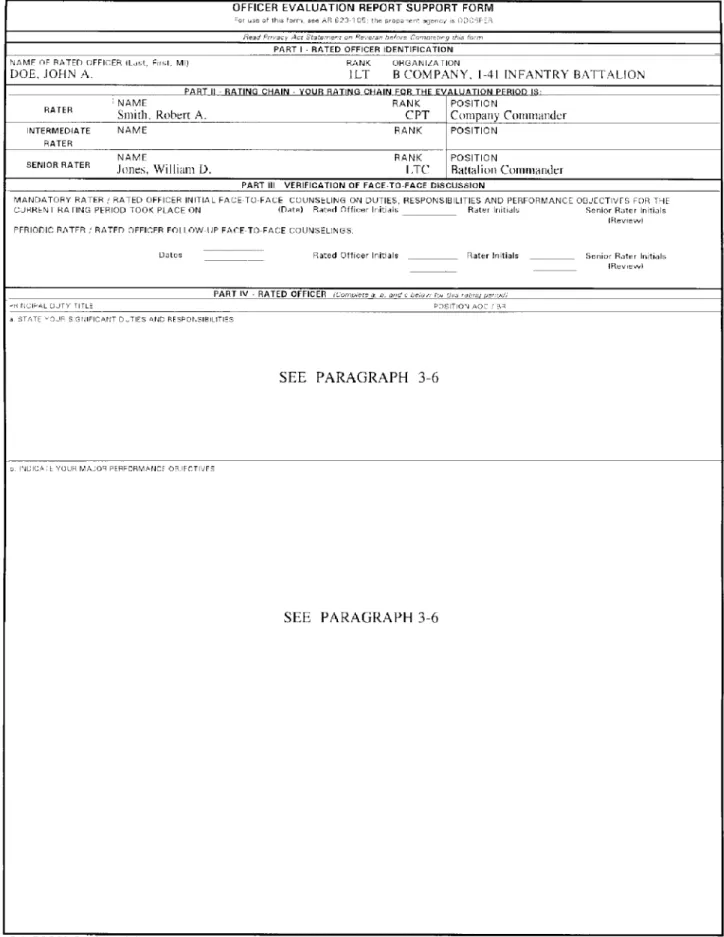
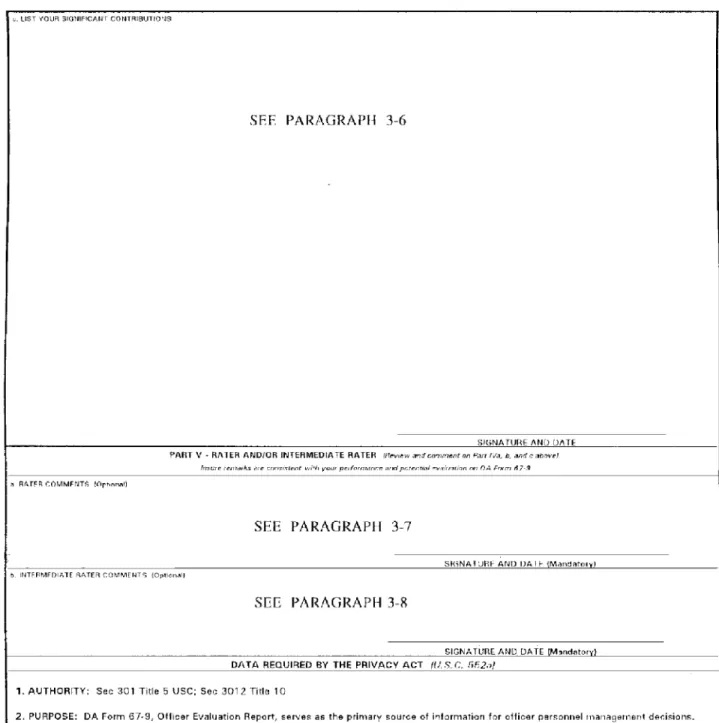
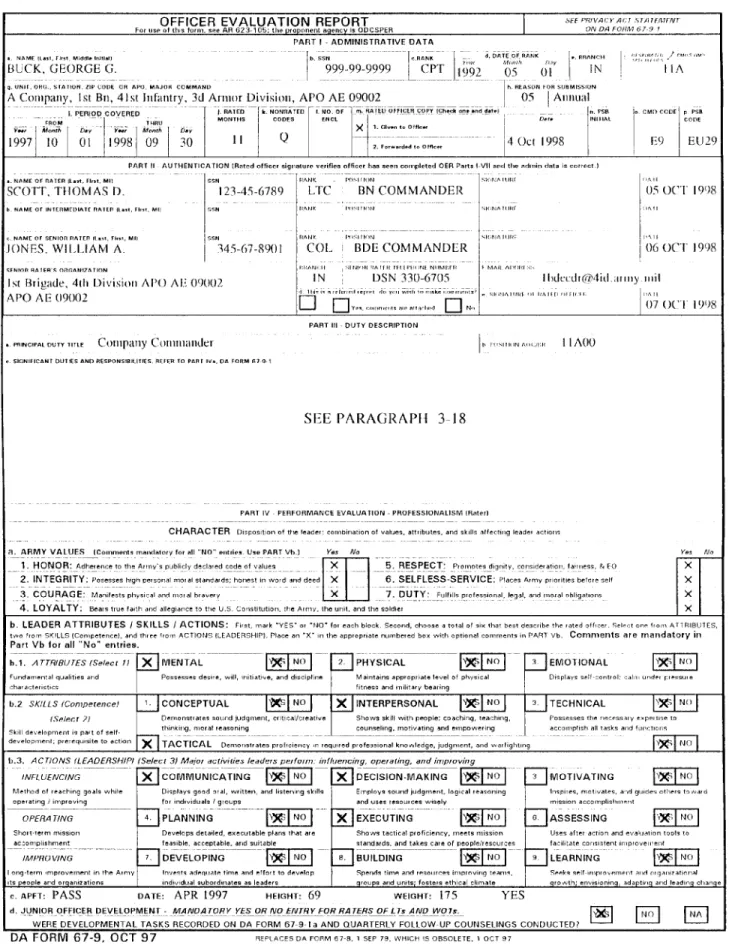
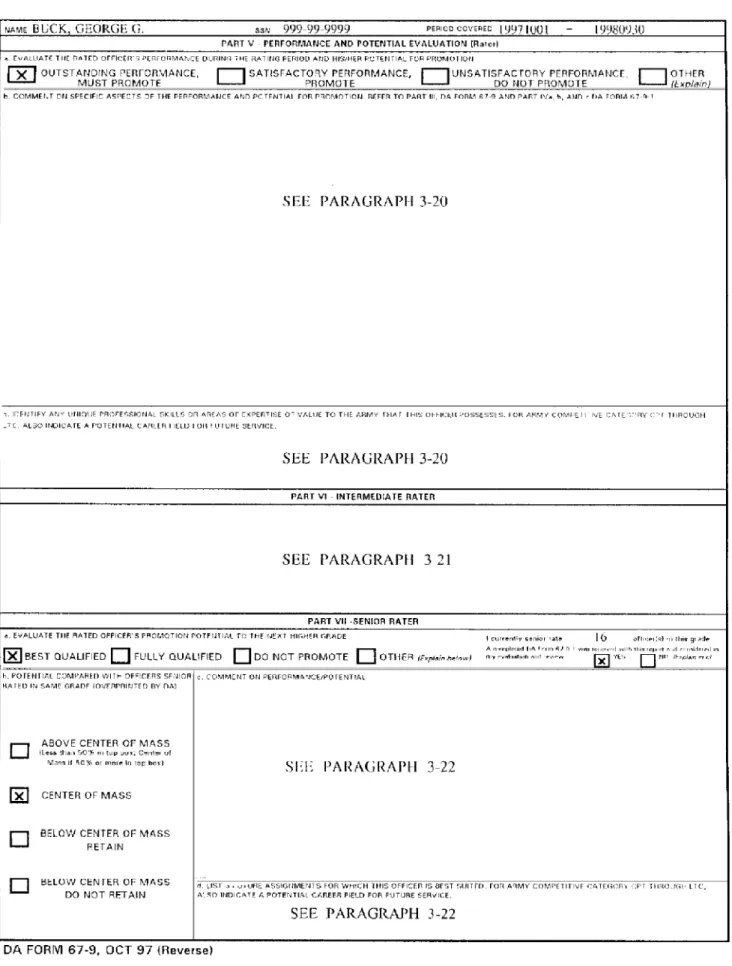
Figure 3–1: Sample DA Form 67-9-1 (Front Side), page 32 Figure 3–2: Sample DA Form 67-9-1 (Reverse Side), page 33 Figure 3–3: Sample DA Form 67-9-1a (Front Side), page 34 Figure 3–4: Sample DA Form 67-9-1a (Reverse Side), page 35 Figure 3–5: Sample DA Form 67-9) (Front Side), page 36 Figure 3–6: Sample DA Form 67-9 (Reverse Side), page 37 Figure 3–7: Sample format of Officer Evaluation Report (OER)
Referral, page 38
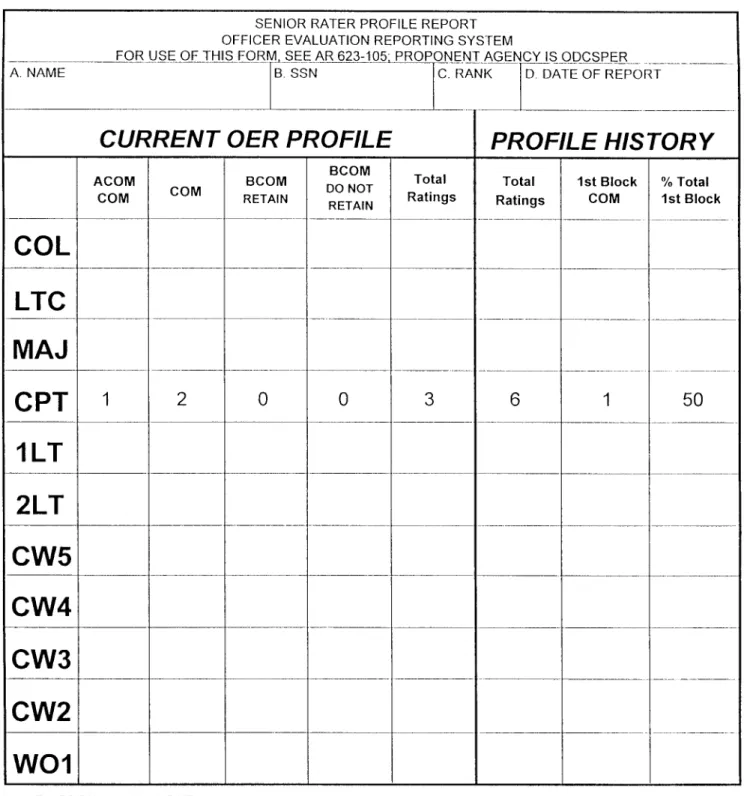
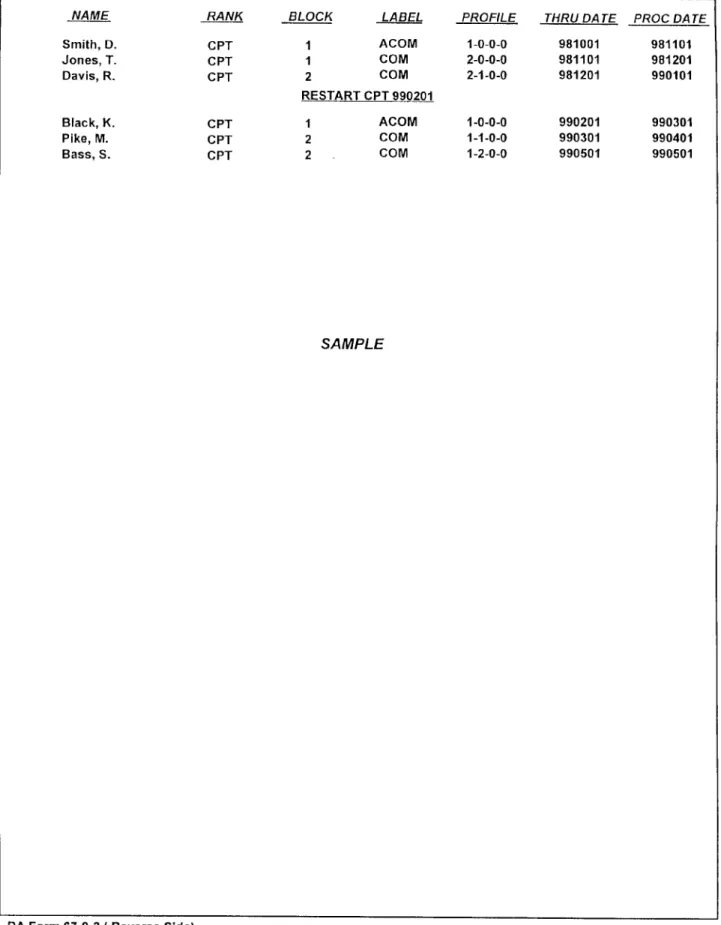
Figure 3–8: Sample DA Form 67-9-2 (Front Side), page 39 Figure 3–9: Sample DA Form 67-9-2 (Reverse Side), page 40 Figure 3–10: Sample of Commander’s memorandum used to
forward the completed addendum to HQDA, page 41
Figure 3–11: Sample format for addendum completed by each rating official submitting a modification to a previous report,
page 41
Figure 6–1: Sample format of PSB request, page 60 Figure 6–2: Sample format of substantive appeal, page 61 Figure 6–3: Sample format of administrative appeal, page 62 Figure 6–4: Sample format of combined administrative and
substantive appeal, page 63
Figure 6–5: Sample format of letter requesting third-party support,
page 64
Figure 6–6: Sample format of third party letter of support, page 65
Glossary Index
Chapter 1
Introduction
Section I Information 1–1. Purpose
a. This regulation prescribes the officer evaluation function of the
military personnel system. It is linked to AR 600-8 and provides principles of support, standards of service, policies, tasks, rules, and steps governing all work required in the field to support the Officer Evaluation System (OES) and Officer Evaluation Reporting System (OERS). It also provides guidance regarding redress programs in-cluding commander inquiries and appeals.
b. Requests for clarifications or exceptions to policy should be
sent to PERSCOM (TAPC-MSE), 200 Stovall Street, Alexandria, VA 22332-0442.
c . C o r r e s p o n d e n c e c o u r s e t r a i n i n g c o v e r i n g a d m i n i s t r a t i v e
processing of the Officer Evaluation Report (OER) is available. Additional information is available in DA Pam 351-20.
1–2. References
See Appendix A for required and related publications.
1–3. Explanation of Abbreviations and Terms
Abbreviations and special terms used in this regulation are ex-plained in the glossary.
1–4. Responsibilities
a. Commanding General, U.S. Total Army Personnel Command
(CG, PERSCOM). The CG, PERSCOM will:
(1) Act as executive agent for the Secretary of the Army and is responsible for the effective operation of the OERS.
(2) Exercise final review authority on all evaluation reports re-ceived at Department of the Army (DA). This includes —
(a) Determining that a report is correct as submitted and needs no
further action.
(b) Correcting or returning to rating officials for their correction,
reports that may be in error, may violate provisions of this regula-tion, or would result in an injustice to an individual or a disservice to the Army.
(c) Directing rating officials to submit addenda to reports needing
clarification.
(d) Collecting information to be attached as addenda to reports
when such action is necessary.
(e) Directing commanders to investigate apparent errors or
viola-tions of this regulation and to submit their findings or recommenda-tions. These will be attached to the OER or otherwise disposed of as the CG, PERSCOM deems appropriate.
(3) Direct the rendering of reports when circumstances warrant and other provisions of this regulation do not apply.
(4) Clarify policies, grant exceptions to policies, or formulate new policies, as the need arises.
(5) Dispose of Commander’s Inquiries conducted in accordance with chapter 6, and the subject evaluation, as deemed appropriate.
b. MACOM Commanders’ responsibilities are as follows:
(1) Commanders will ensure that:
(a) A copy of this regulation is available to the rated officer and
rating officials.
(b) Each rating official is fully qualified to meet his or her
responsibilities.
(c) Reports are prepared by the individuals named in the
pub-lished rating chain.
(d) Rating chains are drawn up by name, given effective dates,
published, and distributed to each rated officer and each member of the chain. Any changes to rating chains will also be published and distributed. No changes may be retroactive.
(e) Rating officials give timely counseling to subordinates on
professionalism and job performance, encouraging self-improvement when needed.
(f) Each rating official knows how the subordinates he or she
evaluates have performed.
(g) Each senior rater (and supplementary reviewer, if any)
under-stands that he or she must provide his/her support form to rated officers and examine the entries on the evaluation reports to ensure that objectivity and fairness have been maintained. When doing so, he or she must keep in mind the interests of both the Army and the rated officer. The senior rater must also understand that if he or she notes discrepancies, then corrections must be made.
(h) Each rated officer is provided a copy of his or her rater’s and
senior rater’s support forms at the beginning of the rating period and the rated officer’s completed OER at the end of the rating period.
(i) Referred reports are provided to the rated officer for
acknowl-edgment or comment before being sent to HQDA. This also applies to an OER addendum containing unfavorable information and sub-mitted under the provisions of chapter 3. In such instances, com-manders will ensure that the rated officer understands that his or her comments do not constitute an OER appeal or request for Com-mander’s inquiry.
(j) Military personnel officers meet the requirements in chapter 3. (k) Completed reports arrive at HQDA not later than 90 calendar
days after the “THRU” date of the report. The importance of the OER to many personnel actions, especially those involving DA selection boards, requires that this suspense be met.
(2) Commanders will also:
(a) Perform the duties described in chapter 6 when a report
rendered by one of their subordinates appears illegal, unjust, or otherwise in violation of this regulation.
(b) Request from Commander, PERSCOM, clarification of
poli-cies, exceptions to polipoli-cies, or new polipoli-cies, and bring to his or her attention situations that:
1. Are not clearly and adequately covered by this regulation. 2. Would result in an injustice to an individual or a disservice to
the Army if a new policy is not made or an exception not granted.
1–5. Manpower Resources
Manpower Staffing Standards Systems (MS3) recognizes the evalua-tion funcevalua-tion as being the funcevalua-tional responsibility of the Evaluaevalua-tion Work Center of the Personnel Service Battalion (PSB). Manpower officials will use the workload factors (obtained from MS3) to determine the manpower authorizations.
1–6. Levels of Work
a. Most personnel work in the field is performed at three primary
levels: unit, battalion, and installation (or some equivalent in the tactical force). The focus of the guidance in this regulation is on those levels.
(1) Unit and battalion-level work is clearly defined as to where it is performed.
(2) Installation-level work is subdivided into work centers. This regulation identifies the work center required to perform the work for manpower purposes.
b. This regulation will address the following levels of work:
(1) Soldiers. Work beginning with input from a soldier. (2) Unit. Work executed at unit level.
(3) Battalion. Work executed at battalion level.
(4) Command and Staff (C&S). Work executed within the chain of command (other than battalion). The specific C&S work center covered by this regulation is plans and staff support (SS).
(5) Personnel support (PS). Work executed in a personnel support organization. The specific PS work centers covered by this regula-tion are evaluaregula-tion (EVAL) and officer records (OFRC).
Section II
Principles and Standards 1–7. Principles of Support
The military personnel system will:
a. Evaluate the performance and potential of officers (i.e.,
war-r a n t o f f i c e war-r ( W O ) t h war-r u m a j o war-r g e n e war-r a l ( M G ) ) i n p e a c e t i m e a n d wartime.
b. Support the Army’s personnel life-cycle function of
profes-sional development.
1–8. Standards of Service
a. Officer Evaluation System (OES):
(1) The OES identifies officers who are best qualified for promo-tion and assignment to posipromo-tions of higher responsibility. It also identifies officers who should be kept on active duty, those who should be retained in grade, and those who should be eliminated. (2) Under the OES, an officer is evaluated on his or her perform-ance and potential. In this system, three kinds of evaluations are
given-(a) Duty evaluations. The OER is used for these evaluations. (b) School evaluations. The Academic Evaluation System is used
for these evaluations (AR 623-1).
(c) DA evaluations. Selection boards and personnel management
systems are used for these evaluations. Duty and school evaluations are single time-and-place evaluations and are used to make DA evaluations. DA evaluations cover an officer’s entire career.
(3) DA evaluations focus on an officer’s potential. They are judg-ments on the officer’s ability to perform at higher grades, and they are also made to judge whether an officer should be retained and given greater responsibility in his or her present grade. In making DA evaluations, three factors are considered:
(a) Army requirements for officers. The needs of the Army for
officers frequently change. At times, the Army has a need for officers with certain backgrounds, experience, and expertise. The size of the Army officer corps is also determined by law in terms of strength by grade. Army needs limit the number of selections and assignments that can be made. Thus, an officer’s potential is par-tially determined by how he or she compares with his or her peers.
(b) Duty performance. Performance of duty is an extremely
im-portant factor in determining an officer’s potential. Duty perform-ance is judged by how well an officer performs his or her tasks and how well he or she meets officer corps professional values.
(c) Officer qualifications. This is the third factor in determining
an officer’s potential. It must be considered in order to meet Army needs for outstanding leaders of troop and technical units, support-ing staff managers, and technical specialists. One consideration in determining qualifications is the different skills and backgrounds required by different specialties. Another consideration is an offi-cer’s progress through specialist fields to positions of greater re-sponsibility. In addition, his or her length of service and civil and military schooling are considered.
b. Officer Evaluation Reporting System:
(1) The OERS is an important subsystem of the OES. It largely determines the quality of the officer corps, the selection of future Army leaders, and the course of each officer’s career. It also sup-ports many current Army personnel management programs.
(a) The OER ensures that an officer’s specialties are considered
along with the specialty requirements of his or her duty position when he or she is evaluated.
(b) The emphasis on senior/subordinate communication supports
the Army’s “people-oriented programs.” It is intended to focus at-t e n at-t i o n o n c o n s at-t r u c at-t i v e p r o b l e m s o l v i n g a n d at-t h e i m p o r at-t a n c e o f sound working relationships.
(2) Although the OERS is a multi-functional system, its basic structure:
(a) Allows the rater to give shape and direction to the rated
officer’s performance.
(b) Provides a chain-of-command evaluation of an officer’s
per-formance and potential.
(c) Allows the entire evaluation reporting process to be reviewed.
(3) The primary function of the OERS is to provide information to DA for use in making personnel management decisions. This information is supplied to DA by the rating chain in the officer’s assigned attached organization.
(a) The information provided on the OER, combined with the
Army’s needs and individual officer qualifications, is used as a basis for personnel actions. Included are promotion, elimination, retention
in grade, retention on active duty, reduction in force, command selection, school selection, assignment, specialty designation, and RA integration.
(b) To ensure that sound personnel management decisions can be
made and that an officer’s potential can be fully developed, evalua-tion reports must be accurate and complete. Each report must be a comprehensive appraisal of an officer’s abilities, weaknesses, and potential. Reports that are either incomplete or fail to provide a realistic and objective evaluation make it difficult to determine an officer’s true potential.
(4) The secondary function of the OERS is to encourage officer professional development and enhance mission accomplishment.
(a) The OERS stresses the importance of sound
senior/subordi-nate relationships. It also stresses the importance of setting stand-ards and giving direction to the performance of subordinate officers. Properly used, the OERS can be a powerful leadership and manage-ment tool for the rating chain.
(b) The key to the system’s secondary function is effective
com-munication. The OERS encourages continual two-way communica-tion between senior and subordinate officer. On the one hand, such communication makes the rated officer aware of what his or her duties are and allows the officer to take part in the organization’s planning. On the other hand, such communication lets the rater guide and develop his or her subordinates, keeps the rater constantly aware of what the organization is achieving, and enables the rater to plan for mission accomplishment.
(c) Senior/subordinate communication also makes career
develop-ment information, advice, and guidance more available to the rated officer. This enables the rated officer to take advantage of his or her superior’s experience when making decisions that affect his or her career.
c. The evaluation reporting process:
(1) The OERS process is designed to:
(a) Set objectives for the rated officer that support the
organiza-tion’s mission.
(b) Review the rated officer’s objectives and update them to meet
current needs.
(c) Promote performance-related counseling to develop
subordi-nates and better accomplish the organization’s mission.
(d) Evaluate the rated officer’s performance. (e) Assess the rated officer’s potential. (f) Ensure a review of the entire process.
( g ) H a v e t h e o r g a n i z a t i o n a l r a t i n g c h a i n u s e D A F o r m 6 7 - 9
(OER), DA Form 67-9-1 (OER Support Form), DA Form 67-9-1a (JODSF) and DA Form 67-9-2 (Senior Rater Profile Report).
(2) The beginning of the rating period:
(a) The evaluation process starts at the beginning of the rating
period. The rater will ensure that the rated officer receives a copy of the rater’s and senior rater’s current support form ( DA Form 67-9-1). This provides the rated officer essential rating chain direction and focus to aid in his/her support form development. Also, the rated officer and rater have a face-to-face discussion of duties and objectives. A DA Form 67-9-1 will be used as a worksheet to record this discussion. In the case of LTs and WO1s, DA Form 67-9-1a will also be used.
(b) The first face-to-face counseling will be held within 30 days
after the beginning of the rating period. Its purpose is to develop a duty description for the rated officer and major performance objec-tives for him or her to accomplish during the rating period. It should also be used to guide the rated officer’s performance during the early part of the rating period.
(3) During the rating period:
(a) Throughout the rating period, both rater and rated officer
should continually assess whether the duty description and perform-ance objectives are adequate. If not, they will be revised and the DA Form 67-9-1 should be updated by the rated officer.
(b) During these counseling about the rated officer’s duties and
objectives, the rater should coach the rated officer on his or her personal and professional development.
(4) The end of the rating period:
DA Form 67-9 shell from the BN S1 or the supporting administra-tive office. Referring to his or her performance, experience, and discussions with the rater, the rated officer completes his or her portion of the Support Form. The rated officer then verifies the administrative data on the OER. The rater will enter and ensure the accuracy of the Army Physical Fitness Test (APFT) and height/ weight data.
(b) The PSB or administrative office will notify the rater that the
OER has been initiated. The rater will also be told the date the DA Form 67-9 was sent to the rated officer and the suspense date for returning the completed report to the PSB or administrative office.
(c) The rater and intermediate rater (if any) complete, in turn,
their portion of the DA Form 67-9-1. They also evaluate the per-formance and perper-formance based potential of the rated officer on DA Form 67-9.
(d) The senior rater provides the independent evaluation of the
rated officer’s performance based potential on the DA Form 67-9. In most cases, the senior rater also provides the final chain-of-com-mand review. To meet these responsibilities, the senior rater uses the information provided on the OER and Support Form, as well as any information he or she gets through direct or indirect contact with the rated officer and other members of the rating chain.
(e) When the senior rater has completed his or her evaluation and
review, the DA Form 67-9-1 is returned to the rated officer. When possible, the senior rater counsels the rated officer on the OER and obtains the rated officer’s signature on the DA Form 67-9. The completed DA Form 67-9 is forwarded to HQDA either directly by the Senior Rater or through the PSB/administrative office.
(f) If there is a supplementary reviewer, the DA Form 67-9-1 will
accompany the OER to the reviewing official. When the supplemen-tary reviewer has completed his or her review, he or she will return the Support Form to the rated officer. The DA Form 67-9-1 will not accompany the OER when the review will be performed by HQDA.
(5) Actions at HQDA:
(a) On arrival at DA, the DA Form 67-9 is reviewed. The senior
rater’s potential evaluation (Part VIIb) is entered into his or her automated personnel record, and his or her rating history for that particular grade is computed. The senior rater box check is then compared with the senior rater boxes and/or profile at the time the OER processes. This comparison generates a HQDA electronically generated label which overlays the check box in Part VIIb. The label will contain one of the following statements: Above Center of Mass, Center of Mass, Below Center of Mass-Retain, or Below Center of Mass-Do Not Retain. The report is then placed in the rated officer’s Official Military Personnel File (OMPF).
(b) The total cumulative rating profile of each senior rater is
printed annually on DA Form 67-9-2 and included in the senior rater’s OMPF.
Section III Policy
1–9. Rating Chain
Rating chains must correspond as nearly as practicable to the chain of command and supervision within an organization, regardless of component or geographical location. They will be established by name, given effective dates, published, and distributed to each rated officer and each member of the chain. Any changes to rating chains will also be published and distributed as they occur. No changes may be retroactive.
1–10. Rating Chain Performance and Potential Evaluations
a . P e r f o r m a n c e e v a l u a t i o n s a r e a s s e s s m e n t s o n h o w w e l l t h e
rated officer met his or her duty requirements and adhered to the professional standards of the officer corps. Performance is evaluated by considering the results achieved, how they were achieved, and how well the officer complied with professional standards.
(1) “Results achieved” consists of the degree to which the rated
officer fulfills the duties and objectives that are assigned to him or her or implied by the duty position. Due regard is given to:
(a) The efforts made by the rated officer.
(b) The results that could reasonably be expected given the time
and resources available.
(2) “How results are achieved” consists of:
(a) The means used by the rated officer to reach his or her
objectives.
(b) His or her use of available resources (e.g., personnel,
equip-ment, money, and time).
(3) “How well the rated officer complied” with professional val-ues is assessed by comparing his or her attributes/skills/actions with the standards that apply to all officers.
b. Potential evaluations are performance based assessments of the
rated officer’s ability, compared with that of his or her contem-poraries, which the senior rater rates or will rate, to perform in positions of greater responsibilities in higher grades. Assessment of potential applies to all officers, regardless of their opportunity to be selected for higher positions or grades, and ignores such factors as impending release from active duty or retirement; this assessment is continually changing and is reserved for HQDA.
1–11. Performance as a Member of a Court-Martial
Duty as a member of a court-martial will not be considered in preparing an OER.
1–12. Performance as Counsel
No rating official will give an unfavorable rating or comment re-garding a rated officer because he or she zealously represented (as a counsel) any accused or respondent before court-martial or adminis-trative board proceedings.
1–13. Performance as EO Officer
An officer, serving as an Equal Opportunity officer, either as a principal or additional duty, will not be given an unfavorable rating:
a. Because of his or her enthusiasm and zeal for implementing
the Army’s Equal Opportunity Program.
b. In retaliation for criticism of command policies and practices
related to that program.
1–14. Changes to an OER
E x c e p t t o c o m p l y w i t h t h i s r e g u l a t i o n , n o p e r s o n m a y r e q u i r e changes be made to an OER. However, members of the rating chain and the PSB will point out obvious inconsistencies or errors to the appropriate rating officials. After needed corrections are made, the record copy will be sent to HQDA.
1–15. Commander’s Inquiry
When it is brought to the attention of a commander that a report rendered by one of his or her subordinates or by a member of one of his or her subordinate commanders may be illegal, unjust, or other-wise in violation of this regulation, he or she will look into the matter. The commander will confine his or her inquiry to matters relating to the clarity of the report, the facts contained in the report, the compliance of the report with this regulation, and the conduct of the rated officer and members of the rating chain. The commander does not have the authority to direct that an evaluation be changed; he or she may not use command influence to alter the honest evaluation of an officer by a rating official. However, he or she may provide results of commander’s inquiry to the rating chain. The procedures used by the commander to process an inquiry are de-scribed in Chapter 6.
1–16. Access to Reports
Access to reports at HQDA is limited to individuals responsible for maintaining the file or authorized to use it for personnel manage-ment purposes. Access to reports at the local level is limited to those persons having command, administrative, or rating official responsibility for the report.
1–17. Requests For Microfiche
a. Officers who want to review their OERs may request a
micro-fiche copy of their file from HQDA. A request must be in writing from the officer concerned and contain his or her signature and SSN. Active Army officers should address requests to Commander, PERSCOM (TAPC-MSR-S), 200 Stovall Street, Alexandria, VA 22332-0444. Those not on active duty should address requests to Commander, U.S. Army Reserve Personnel Center, ATTN: DARP-PSE-VO, 9700 Page Boulevard, St. Louis, MO 63132-5200 or the A r m y N a t i o n a l G u a r d R e a d i n e s s C e n t e r , A T T N : N G B - A R P - C O (Customer Service), 111 South George Mason Dr., Arlington, VA 22204-1382.
b. An officer on active duty may deputize a person to review his
o r h e r f i l e a t t h e a u t h o r i z e d l o c a t i o n . O f f i c e r s a s s i g n e d t o
PERSCOM or the U.S. Army Reserve Personnel Center (ARPER-CEN) may not be deputized for this purpose. A letter from the officer whose OMPF is to be reviewed or released must be pres-ented by the deputy. The letter must:
(1) State the name and SSN of the deputy.
(2) Indicate exactly which documents the deputy is authorized to receive or review.
(3) Be signed by the officer authorizing the release and contain his or her grade and SSN.
1–18. Mobilization
See Table 1-1. Definitions of the categories of mobilization are found at JCS Pub. 1-02. Policy changes in Table 1-1 are not auto-matic at different stages of mobilization. Implementing instructions will be released by Headquarters, Department of the Army (HQDA).
Table 1–1 Mobilization
Policy and/or procedure change Selective mobilization Partial mobilization Full mobilization Total mobilization (1) Length of rating period (No policy change) (No policy change) Minimum rating period modified by
HQDA as appropriate
Minimum rating period modified by HQDA as appropriate
(2) Reasons for submission of reports
(No policy change) (No policy change) (No policy change) (No policy change) (3) Preparation and
forwar-ding requirements
(No policy change) (No policy change) Reports may be typed or neatly printed in black ink. Copy of report is required to be furnished to the rated officer
Reports may be typed or neatly prin-ted in black ink. Copy of report is re-quired to be furnished to the rated officer
(4) Use of Support Form (No policy change) (No policy change) Use of Support Form is optional Use of Support Form is optional (5) Appeals procedures (No policy change) (No policy change) Appeals may be submitted but
ac-tion at HQDA may be delayed until post-mobilization
Appeals may be submitted but ac-tion at HQDA may be delayed until post-mobilization
(6) Filing centers (No policy change) (No policy change) (No policy change) Reports for all activated components are forwarded to PERSCOM. Notes:
These policy changes do not automatically go into effect when the various stages of mobilization are declared. Messages will be released by HQDA implementing these or any other policy adjustments that may be necessary.
Chapter 2
The Rating Chain
Section I
Managing the Rating Chain 2–1. Overview
This chapter governs the development of rating chains, rating chain reviews, and special evaluation requirements.
2–2. Information
a. A rating chain is established to provide the best evaluation of
an officer’s performance and potential. A rating chain also ties the rated officer’s performance to a specific senior/subordinate relation-ship. This allows for the proper counseling to develop the rated o f f i c e r a n d a c c o m p l i s h t h e m i s s i o n . T h e s e p u r p o s e s a r e b e s t achieved within an organization’s chain of command.
b. The evaluation of officers by persons not involved with their
supervision is inappropriate.
c. Rating chains will normally consist of the rated officer, the
rater, and the senior rater. When a chain is established, the rater and senior rater are the first officials designated. Some rating chains, however, will also include an intermediate rater. An intermediate rater is designated only when a rated officer has a supervisor who is between the rater and senior rater in his chain of command. (see Table 2-1)
d. In view of the fact that the rated officer verifies the correctness
of the rating scheme in Part II of DA Form 67-9, the PSB or administrative office need not maintain copies of superseded rating schemes.
e. Special rules for designating rating officials have been made to
cover the death, relief, or incapacitation of a rating official. There are also special rules governing the rating officials for officers under dual supervision, chaplains, JAGC officers, AMEDD officers, and
professors of military science. These rules are in Section IV of this chapter.
2–3. Rating Chain
Rating chains must correspond as nearly as practicable to the chain of command and supervision within an organization, regardless of component or geographical location. They will be established by name, given effective dates, published, and distributed to each rated officer and each member of the chain. Any changes to rating chains will also be published and distributed as they occur. No changes may be retroactive.
Table 2–1
Rules for establishing rating chains
COMMANDERS ARE RESPONSIBLE FOR ESTABLISHING RATING CHAINS FOR THE ORGANIZATION COMMANDERS WILL NORMALLY RATE COMMANDERS
Requirements for Rating Officials
Rating Officials Requirements
RATER WILL NORMALLY BE IMMEDIATE SUPERVISOR OF THE
RATED OFFICER
INTERMEDIATE RATER
WILL BE SENIOR TO THE RATED OFFICER
WILL NORMALLY BE INCLUDED WHEN THERE IS A LEVEL OF SUPERVISION BETWEEN THE RATER AND SENIOR RATER IF INCLUDED, WILL BE SENIOR TO THE RATED OFFICER. SENIOR RATER
WHEN THE GRADE OF THE RATED OFFICER IS
THE MINIMUM GRADE OF THE SENIOR RATER IS:
MILITARY SENIOR RATER OR CIVILIAN PERFORMING SENIOR RATER FUNCTION,** GD MERIT/GEN SCHED NON-APPROPRIATED FUND SENIOR EXEC SVC WARRANT OFFICER SECOND LIEUTENANT FIRST LIEUTENANT 04 MAJ/CPT(P)* GM/GS-13 UA-13
A MEMBER OF THE SES MAY BE A SENIOR RATER 1LT(P)***
CAPTAIN
05
LTC/MAJ(P)*
GM/GS-13 UA-13 FOR ALL GRADES OF
RATED OFFICERS PRO-VIDED HE/SHE IS IN THE CPT(P)***
MAJOR,
06
COL/LTC(P)*
GM/GS-15 UA-15 RATED OFFICER’S CHAIN
OF SUPERVISION AND IS AT LEAST ONE LEVEL MAJ(P)***
LIEUTENANT COLONEL
06
COL/LTC(P)*
GM/GS-15 UA-15 ABOVE IMMEDIATE
SU-PERVISOR OF THE RATED OFFICER LTC(P)*** COLONEL 07 BG/COL(P)* GM/GS-16 UA-16 COL(P)*** BRIGADIER GENERAL MAJOR GENERAL
SENIOR TO THE RATER AND INTERMEDIATE RATER
Notes:
*IN A POSITION AUTHORIZED THE HIGHER GRADE (SEE PARA 2-6) **SUPPLEMENTARY REVIEW REQUIRED IN SOME CASES (SEE PARA 2-19)
***ON A PROMOTION LIST AND IN A POSITION AUTHORIZED THE NEXT HIGHER GRADE (SEE PARA 3-16)
Section II
Rating Chain Development and Maintenance 2–4. Rules for Designating the Rater
a. A rater must be an officer of the US or Allied Armed Forces
or an employee of a US Government agency (including nonap-propriated fund rating officials.)
b. The rater will normally be the immediate supervisor of the
rated officer. The immediate supervisor is the individual who directs and is most responsible for the rated officer’s performance. For chaplains see Appendix C, for JAGC officers see Appendix D, and for AMEDD officers see Appendix E.
c. In determining the eligibility of the rater the following should
be considered:
(1) A rater who has been selected for promotion and who is in an authorized position for the new grade will be considered to be serving in the new grade. The symbol “P” will be put next to his or her current grade on DA Form 67-9.
(2) A rater who has been selected for promotion but is not in a position authorized for the new grade will be considered to be
serving in his or her current grade. The symbol “P” will not be put next to his or her current grade on DA Form 67-9.
d. The rater must be senior to the rated officer in grade or date of
rank. Exceptions to this rule are as follows:
(1) A rater in a command position may rate an officer who is of the same grade but senior in date of rank if the rater has been assigned to command by direction of the President and has com-mand authority over the rated officer (the format for this assumption of command order is in AR 600-20. General Officers have approv-ing authority.) In such cases, the rater will attach a copy of his or her assignment-to-command order as an enclosure to the rated offi-cer’s report.
(2) An officer in a command position may rate an officer over whom he or she has command authority and who is senior in date of rank but ineligible by law or regulation to command troops other than those of his or her own branch, service, or department. In such cases, the rater will attach a copy of the written assumption of command as an enclosure to the rated officer’s report.
(3) An officer who is selected for promotion and who is in an authorized position for his or her new grade may rate any officer he
or she supervises if after the rater’s promotion he or she will be senior to the rated officer.
(4) A civilian rater has no minimum grade requirement. Howev-er, he or she must be the officially designated supervisor of the rated officer.
(5) An officer in a joint headquarters or activity may rate an officer who is senior in date of rank provided that:
(a) The rater is not a US Army officer.
(b) The senior rater is at least one grade senior to the rated
officer.
(c) Each instance will be approved in writing by the next senior
Army member of the command or activity. A copy of the approval will be sent to HQDA as an enclosure to the OER.
e. Commanders will normally be rated by the next higher
com-mander. An exception to this rule is allowed when a staff officer or higher level commander is the logical choice as the commander’s immediate supervisor because of functional, geographical, or techni-cal supervision requirements.
2–5. Rules for Designating the Intermediate Rater a. The intermediate rater must be an officer of the US or Allied
Forces or an employee of a US Government Agency (including nonappropriated fund employees).
b. A military intermediate rater must be senior in grade or date of
rank to the rated officer. A civilian intermediate rater has no mini-mum grade requirement; however, he or she must be an officially designated supervisor of the rated officer.
c. The intermediate rater will usually be the rater’s immediate
supervisor; however, he or she may be any supervisor between the rater and senior rater in the rated officer’s chain of command. This rule is waived when the provisions of paragraphs 2-21 or appendix C-4 apply. In cases of dual supervision the designated intermediate rater, if from a non-parent unit, may be senior to the senior rater.
2–6. Rules for Designating the Senior Rater a. Basic rules are:
(1) The senior rater must be an officer of the US Armed Forces o r a n e m p l o y e e o f D O D ( i n c l u d i n g n o n a p p r o p r i a t e d f u n d employees).
(2) Normally, the senior rater must be a supervisor above the rater and intermediate rater in the rated officer’s chain of command or supervisory chain. For chaplains see Appendix C, for JAGC officers see Appendix D, and for AMEDD officers see Appendix E. Appendix E does not apply to ARNGUS.
(3) The minimum grade for a military senior rater is major (or a promotable captain in position authorized a major or higher). The minimum grade for a civilian senior rater is GS-13 or any member of the Senior Executive Service (SES). However, a civilian senior rater must be an officially designated supervisor of the rated officer
serving at an appropriate level above the rater. Other rules on the required grades of senior raters are summarized in Table 2-1.
(4) In determining the eligibility of a senior rater the following should be considered:
(a) A senior rater who has been selected for promotion and who
is in an authorized position for the new grade will be considered to be serving in the new grade. The symbol “P” will be put next to his or her current grade on DA Form 67-9.
(b) A senior rater who has been selected for promotion but is not
in a position authorized for the new grade will be considered to be serving in his or her current grade. The symbol “P” will not be put next to his or her current grade on DA Form 67-9.
(5) The senior rater must be senior in grade or date of rank to the rated officer, the rater, and the intermediate rater. Exceptions to this rule are:
(a) A senior rater need not be senior in date of rank to the other
members of the rating chain (rater and/or intermediate rater) if he or she is authorized by paragraph 2-4d(1), (2), or (3) to rate those other members of the rating chain.
(b) A senior rater need not be senior in grade or date of rank to a
designated intermediate rater from a non-parent unit when a dual supervision situation exists.
b. Specific rules for senior raters are:
(1) To rate officers in the grades of warrant officer one through major:
(a) Military senior raters must be at least two grades higher than
the rated officer.
(b) Civilian senior raters must be at least GS-13 (or UA
(Univer-sally Administrative) equivalent) to rate officers in the grades of warrant officer through captains, and GS-15 to rate majors.
( 2 ) T o r a t e o f f i c e r s i n t h e g r a d e s o f l i e u t e n a n t c o l o n e l a n d colonel:
(a) Military senior raters must be at least one grade higher than
the rated officer.
(b) Civilian senior raters must be at least GS-15 (or UA
equiva-lent) to rate officers in the grade of lieutenant colonel.
(c) Civilian senior raters must be at least GS-16 (or UA
equiva-lent) to rate officers in the grade of colonel.
(3) To senior rate officers in the grade of brigadier general and major general, the senior rater must be senior in grade or date of rank to the other members of the rating chain.
2–7. Steps for Rating Chain Development and Maintenance
The steps for developing and maintaining a rating chain are found in Table 2-1 and Table 2-2 .
Table 2–2
Rating Chain Development and Maintenance Step Work Center Action Required
1 BN S1 Coordinate with Commander, establish by-name rating chain for officers assigned, attached, TDY, or on special duty to the unit. Identify all rating officials, to include dual supervisors and/or supplementary reviewers, for each rated officer. Include the date on which each rating official was designated.
2 BN S1 Forward draft copy of rating chain to subordinate units for review and edit.
3 UNIT Review for accuracy of information providing suggested corrections/changes as necessary. 4 BN S1 In coordination with Commander, prepare final rating chain document.
5 BN S1 Commander authenticates rating chain. Chain is published showing the effective date; copy is provided to each rated officer and rating official.
6 BN S1 Forward copy of published rating chain to supporting PSB.
7 EVAL In coordination with supported unit, use rating chain when initiating OER.
8 BN S1 Annotate changes to rating chain as a result of duty changes, rating official changes, etc. Publish authenticated revisions, with effective date, as necessary. Provide copies to each rated officer, rating official, and the supporting PSB.
Section III
Rating Chain Members and Responsibilities 2–8. The Rated Officer
a. The rated officer is the subject of the evaluation. He or she has
considerable responsibility in the evaluation process.
b. Normally, to be eligible for an evaluation report, a rated
offi-cer must complete 90 calendar days in the same position under the same rater. Nonrated periods as described in paragraph 3-16c are not included in this 90-day period. Exceptions to the 90-day require-ment are in Sections VII and VIII of Chapter 3.
c. If a rated officer has been selected for promotion and is in an
authorized position for his or her new grade, he or she is considered to be serving in that grade when determining the rating chain. The designation “P” will be entered next to his or her current grade on DA Form 67-9.
d. If a rated officer has been selected for promotion but is not in
an authorized position for his or her new grade, the officer is considered to be serving in his or her current grade when determin-ing the ratdetermin-ing chain. The designation “P” will not be used next to the officer’s current grade on DA Form 67-9.
2–9. Responsibilities of the Rated Officer
The rated officer will:
a. Perform each assigned or implied duty to the best of his or her
ability, trying always to improve on the accomplishment of the organization’s mission. To do this, the rated officer must periodi-cally evaluate his or her own performance and, when in doubt, seek the advice of his or her superiors in the rating chain.
b. Begin a discussion of his or her duty description and
perform-ance objectives with his or her rater. This must be done within 30 days after the beginning of each rating period
c. Assess throughout the rating period the validity of his or her
objectives. This may result in having to revise and update both objectives and duty description as the situation changes. The rated officer may also have to develop new objectives with the rater.
d. Describe accurately his or her duties, objectives, and
signifi-cant contributions on DA Form 67-9-1 at the end of the rating period. When doing this, the rated officer may express his or her own views; the rated officer may not be forced to alter those views. This does not prevent the rated officer and rater from discussing the entries to ensure that they are clear, concise, and accurate. Nor does it prohibit changes of the entries when the rated officer agrees with the changes.
2–9.1. Additional Rated Officer Responsibilities for LTs and WO1s
a. In addition to the rated officer responsibilities listed above,
LTs and WO1s are responsible for:
(1) Becoming familiar with the DA Form 67-9-1a, (Junior Offi-cer Developmental Support Form) and preparing to discuss their developmental plan during the initial face-to-face counseling (within first 30 days).
(2) Assess throughout the rating period the validity of his or her developmental tasks. This may result in having to revise and update both objectives and duty description as the situation changes. If changes or updates are required, the rated officer should discuss them with the rater, normally during follow up counseling sessions.
2–10. The Rater
a. The rater is the person in the rating chain who:
(1) Is most familiar with the day-to-day performance of the rated officer.
(2) Most directly guides the rated officer’s participation in the organization’s mission.
b. Normally, to evaluate an officer, the rater must be designated
and serve in that capacity for at least 90 calendar days. Exceptions to this policy are given in Sections VII and VIII of Chapter 3.
2–11. Responsibilities of the Rater
The rater will:
a. Provide his/her and the senior rater’s support forms to the
rated officer at the beginning of the rating period.
b. Discuss the scope of the rated officer’s duties with him or her
within 30 days after the beginning of the rating period. This coun-seling will include, as a minimum, the rated officer’s duty descrip-tion and the performance objectives he or she should attain. The discussion should also include the relationship of the duty descrip-tion and objectives with the organizadescrip-tion’s mission, problems, prior-ities, and similar matters.
(1) If the rated officer has been recently assigned to the organiza-tion, the rater may use the counseling to outline a duty description and performance objectives. This discussion gives the rated officer a g u i d e f o r p e r f o r m a n c e w h i l e h e o r s h e l e a r n s n e w d u t i e s a n d responsibilities.
(2) If the rater has been recently assigned, he or she might use this first counseling to ask the rated officer what he or she thinks the duty description and objectives should be. By doing this, the rater is given a quick assessment of the rated officer and the work situation. It will also help the rater develop the best duty description and permanent objectives for that officer.
c. Counsel the rated officer throughout the rating period. DA
Form 67-9-1 and DA Form 67-9-1a assist in this communication.
d. Advise the rated officer as to changes in his or her duty
description and performance objectives, when needed, during the rating period.
e. Assess the performance of the rated officer, using all
reasona-ble means. These include: (1) Personal contact. (2) Records and reports.
(3) The information provided by the rated officer on DA Form 67-9-1/67-9-1a.
f. Review the DA Form 67-9-1/67-9-1a at the end of the rating
period and, if appropriate, use DA Form 67-9-1 to provide more information about the job description or performance objectives to the intermediate rater and senior rater. The DA Form 67-9-1 is not the place for a performance evaluation.
g. Verify and enter the rated officer’s APFT and height and
weight data (Part IVc, DA Form 67-9).
h . P r o v i d e a n o b j e c t i v e a n d c o m p r e h e n s i v e e v a l u a t i o n o f t h e
rated officer’s performance and potential on DA Form 67-9.
2–11.1. Additional Rater Responsibilities for LTs and WO1s
a. The rater of LTs and WO1s will ensure the Junior Officer
Developmental Support Form (DA Form 67-9-1a, JODSF) is initi-ated at the initial face-to-face counseling. The initial developmental tasks will be established and recorded. The rater will obtain the senior rater’s approval and initials. The JODSF will then be used as a working tool throughout the remainder of the rating period.
b. Raters of LTs and WO1s will also conduct follow up
counsel-ing sessions to discuss performance, update/revise developmental tasks as required, and assess developmental progress. Summary/key comments will be recorded on the DA Form 67-9-1a.
2–12. The Intermediate Rater
a. The intermediate rater is a supervisor between the rater and
senior rater in the rated officer’s rating chain. The use of the inter-mediate rater is intended to maintain the link between the rater and senior rater in situations where there is a level of supervision be-tween them. Rating chains having no supervisor bebe-tween the rater and senior rater will not have an intermediate rater.
b. Normally, an intermediate rater must serve in that capacity for
a minimum of 60 days in order to evaluate the rated officer. He or she may evaluate the rated officer with less than 60 days as an intermediate rater if he or she has also served in a previously published rating chain, and the combined total of time served in the rating chain equals 60 days or more. For example, an officer serves in the rated officer’s rating chain as the senior rater for 32 days. Then, because of organizational shifts, he or she becomes the inter-mediate rater, a new rating chain is published, and a new senior rater is designated. If a report is due 30 days from the time he or