
Research Online
Research Online
University of Wollongong Thesis Collection
2017+ University of Wollongong Thesis Collections
2017
Multivariate Small Area Estimation for Health Indicators
Multivariate Small Area Estimation for Health Indicators
Mossamet Kamrun Nesa
University of Wollongong
Follow this and additional works at: https://ro.uow.edu.au/theses1
University of Wollongong University of Wollongong
Copyright Warning Copyright Warning
You may print or download ONE copy of this document for the purpose of your own research or study. The University does not authorise you to copy, communicate or otherwise make available electronically to any other person any
copyright material contained on this site.
You are reminded of the following: This work is copyright. Apart from any use permitted under the Copyright Act 1968, no part of this work may be reproduced by any process, nor may any other exclusive right be exercised, without the permission of the author. Copyright owners are entitled to take legal action against persons who infringe
their copyright. A reproduction of material that is protected by copyright may be a copyright infringement. A court may impose penalties and award damages in relation to offences and infringements relating to copyright material.
Higher penalties may apply, and higher damages may be awarded, for offences and infringements involving the conversion of material into digital or electronic form.
Unless otherwise indicated, the views expressed in this thesis are those of the author and do not necessarily Unless otherwise indicated, the views expressed in this thesis are those of the author and do not necessarily represent the views of the University of Wollongong.
represent the views of the University of Wollongong.
Recommended Citation Recommended Citation
Nesa, Mossamet Kamrun, Multivariate Small Area Estimation for Health Indicators, Doctor of Philosophy thesis, School of Mathematics and Applied Statistics, University of Wollongong, 2017.
https://ro.uow.edu.au/theses1/282
Research Online is the open access institutional repository for the University of Wollongong. For further information contact the UOW Library: [email protected]
Multivariate Small Area Estimation
for Health Indicators
Mossamet Kamrun Nesa
A thesis submitted in fulfillment of the requirements for the award of the degree
Doctor of Philosophy
from
University of Wollongong
Doctor of Philosophy
on the topic
Multivariate Small Area Estimation
for Health Indicators
to the
School of Mathematics and Applied Statistics
Faculty of Engineering and Information Sciences
at the University of Wollongong
submitted by
Mossamet Kamrun Nesa
Supervisor:
Assoc. Prof. Robert Clark, PhD (University of Wollongong)
Co-supervisor:
Dr. Carole. L. Birrell, PhD (University of Wollongong)
I, Mossamet Kamrun Nesa, declare that this thesis, submitted in partial fulfilment of
the requirements for the award of Doctor of Philosophy, in the School of Mathematics
and Applied Statistics, University of Wollongong, is wholly my own work unless
otherwise referenced or acknowledged. The document has not been submitted for
qualifications at any other academic institution.
Mossamet Kamrun Nesa
In order to improve the overall health condition of a population, accurate
esti-mates of health indicators are required at a fine spatial scale, such as the
adminis-trative units of a country or regions within a country. Direct estimators tend to have
unacceptably high standard errors for areas with small sample sizes. Model-based
indirect small area estimators borrow strength from related areas and achieve lower
mean squared errors.
The thesis is concerned with multivariate small area estimation (SAE), where
multiple response variables instead of a single response variable are considered
si-multaneously. Two general problems are considered: (1) the use of a multivariate
area level model to get improved estimates for each variable by area and (2) the
estimation of the cross-classification of two or more indicators by area.
The multivariate Fay-Herriot (MFH) model is the natural extension of the widely
used univariate Fay-Herriot (UFH) model where two or more response variables
are considered together. Both numerical and simulation studies are carried out to
investigate under what conditions multivariate small area estimators perform better
than separate univariate estimators. Results show that the MFH model performs
better under some conditions which depend on the values of the parameters such as
using the MFH model rather than the separate UFH model are greater when the
across-variable correlations of both sampling errors and area level random effects are
high and when the ratio of variances of sampling errors and random effects is high.
A parametric bootstrap approach is developed to allow estimation of mean squared
errors, and confidence intervals for the gain due to multivariate modelling. The
approaches are applied to a 2011/12 New Zealand Health Survey dataset. The MFH
model provides some improvements over UFH model according to mean squared
error estimates of the estimated health indicators by electoral district. However,
wide confidence intervals for the relative efficiencies associated with multivariate
modelling are seen, suggesting that it is difficult in practice to be confident about
gains from multivariate approaches.
A unit level approach for producing small area estimates of cross-classified counts
of two or more indicators is developed, based on a multinomial logit mixed model
with category specific random effects. The application is novel because contingency
tables are modelled in each small area. Other researchers have considered trinomial
data (such as unemployed, employed and inactive counts), whereas we extend these
multinomial methods to allow small area estimation of cross-classified counts. For
example, Obesity byHigh Blood Pressure counts can be estimated for each area in
a health survey. The new method is also different from the well-known existing
Structure Preserving Estimation (SPREE) approach since SPREE combines the
information of auxiliary variables from a previous census with current survey data
to improve the estimators of cells totals in a multi-way contingency table. The mean
New Zealand Health Survey are used to illustrate the approach.
Small area estimators of cross-classified counts are also developed based on
log-linear models, which are a parsimonious special case of the multinomial logit model.
A number of parsimonious log-linear models are defined and applied to the New
Zealand Health Survey data. These models did not do particularly well on the 2×2 tables considered in the application, but they are more computationally scalable to
three-way and higher order cross-classifications.
Overall, multivariate Fay-Herriot small area estimators are useful in specific
sit-uations which are identified in the thesis, however, it is difficult to be confident with
real data whether one is in such a situation. Multivariate categorical models enable
a new form of small area statistics to be calculated, namely contingency tables of
survey variables by area.
I would firstly like to express my deep gratitude to my supervisors, Associate
Professor Robert Clark and Dr. Carole Birrell. I am grateful to Robert Clark, for his
encouragement, thoughtful comments, good advice and invaluable patience during
the long journey of my study. Thank you Carole, for your invaluable discussions,
guidance and great enthusiasm.
I would also like to thank Professor Raymond Chambers (University of
Wollon-gong) for his suggestion to develop the ideas of multinomial models.
I would like to acknowledge to University of Wollongong (UOW), Australia,
for the financial support through International Postgraduate Tuition Award and
University Postgraduate Award. Thanks to Shahjalal University of Science and
Technology, Sylhet (SUST), Bangladesh, for sanctioning my study leave to complete
my study.
I would also like to thank to all academic and administrative staffs of National
Institute for Applied Statistics Research Australia (NIASRA) for their support,
encouraging words and cordial assistance.
Thanks to my friends and colleagues particularly Dr. Chandra Gulati, Dr.
Payam Mokhtarian, Dr. Bothaina Bukhatwa, Dr. Nawa and Dr. Sumonkanti Das
I am grateful to my parents and family for their support and commitment to
my education. Special thanks to my sisters Tumpa, Rupa and Pinky to take care of
my son during my second year of PhD and Nipu for her appreciable encouragement.
Thanks to Mr.Niru and Mrs.Runa for a great financial support at the very beginning
of my PhD.
I am very much thankful to my husband Mohammad Tareq Mamun Khan, for his
unfailing love, patience, support and encouragement. Most importantly, thanks to
my son Rahil Sarbi Khan, for his unconditional love, patience and sacrifice during the
journey of my PhD. Thanks baba (Sarbi) for encouraging me through the dialogue
“Mum don’t read the newspaper, do your work. You have to finish your PhD”.
1 Introduction 1
1.1 The Definition and Relevance of Small Area Estimation . . . 1
1.2 Multivariate Small Area Estimation . . . 3
1.3 Area Level Models . . . 4
1.4 Unit Level Models . . . 6
1.5 Structure of the Thesis . . . 8
2 Literature Review 11 2.1 Notation and Definitions . . . 12
2.2 Direct Estimators . . . 14
2.2.1 Design-Based Direct Estimators . . . 14
2.2.2 Model-Assisted Direct Estimators . . . 16
2.2.3 Model-Based Direct Estimators . . . 19
2.3 Indirect Small Area Estimation . . . 20
2.3.1 Synthetic Estimators . . . 20
2.3.2 Composite Estimators . . . 21
Level Models . . . 22
2.5 Small Area Estimation: Multivariate Area Level Models . . . 27
2.6 Small Area Estimation: Univariate Unit Level Models . . . 32
2.7 Small Area Estimation of a Single Classifications . . . 41
2.8 Structure Preserving Estimation Model . . . 45
3 Theoretical and Numerical Evaluation of Bivariate Fay-Herriot Model 48 3.1 Introduction . . . 48
3.2 Approximate Theoretical Relative Efficiency of Bivariate Fay-Herriot Compared to Univariate Fay-Herriot Model . . . 50
3.3 Special Cases . . . 55
3.4 Numerical Study . . . 57
3.4.1 Setting the Parameters . . . 58
3.4.2 Descriptive Summary of Numerical Study . . . 60
3.4.3 Formal Analysis of Numerical Study: Analysis of Variance . . 68
3.4.4 Formal Analysis of Numerical Study: Regression Tree . . . 71
3.5 Simulation Experiment . . . 76
3.5.1 Design of the Experiment . . . 76
3.5.2 Results of the Simulation Experiment . . . 78
4 MSE Estimation and Empirical Study for Bivariate Fay-Herriot
Model 83
4.1 Introduction . . . 83
4.2 Example Dataset: The New Zealand Health Survey . . . 85
4.2.1 Sample Design . . . 86
4.2.2 Data Variables . . . 87
4.2.3 Sampling Variance Calculation . . . 89
4.3 Methodology . . . 91
4.3.1 Model Fitting via Maximum Likelihood Estimation . . . 91
4.3.2 Parametric Bootstrap Mean Squared Error . . . 92
4.4 New Zealand Health Survey Data Analysis . . . 94
4.4.1 Results for One Pair of Variables . . . 94
4.4.2 Results for All Pairs of Variables . . . 96
4.5 Bootstrap Confidence Intervals for the Relative Efficiency . . . 99
4.5.1 Parametric Bootstrap Confidence Interval . . . 100
4.5.2 Application to New Zealand Health Survey Data . . . 101
4.5.3 Application to Simulated Data . . . 103
4.6 Summary . . . 104
5 Estimating Small Area Contingency Tables using Multinomial Mod-els 106 5.1 Introduction . . . 107
5.2 Multinomial Model for Cross-Classified Data . . . 110
5.2.2 Binomial Case . . . 112
5.2.3 Fournomial Case . . . 113
5.3 Maximum Likelihood Estimation of Parameters . . . 116
5.3.1 Calculation of the Likelihood . . . 116
5.3.2 Maximization of the Likelihood . . . 118
5.3.3 Prediction of uˆd . . . 119
5.3.4 Prediction of ˆpdr using ˆudr . . . 120
5.4 Mean Squared Error Estimation using a Parametric Bootstrap . . . 122
5.5 Multinomial Modelling in Complex Survey Design . . . 123
5.6 Outline of the Empirical Study . . . 125
5.7 Results for Obesity byHigh Blood Pressure . . . 126
5.7.1 Fitted Model for Obesity byHigh Blood Pressure . . . 126
5.7.2 Small Area Estimates and Corresponding RMSEs of Obesity byHigh Blood Pressure Contingency Tables . . . 129
5.7.3 Small Area Estimates and Corresponding RMSEs of Marginal Prevalences ofObesity and High Blood Pressure . . . 131
5.8 Results for Current Smoker byObesity . . . 135
5.8.1 Fitted Model for Current Smoker by Obesity . . . 135
Smoker by Obesity Contingency Tables . . . 138
5.8.3 Small Area Estimates and Corresponding RMSEs of Marginal Prevalences ofCurrent Smoker and Obesity . . . 140
5.9 Summary . . . 144
6 Estimating Small Area Contingency Tables using Log-linear Mod-els 146 6.1 Introduction . . . 146
6.2 Log-linear Models for Cross-Classified Data . . . 149
6.2.1 Definition of the Model . . . 149
6.2.2 Constraints and Estimation of Parameters for 2×2 Tables . . . 151
6.3 The Relationship Between Multinomial and Log-linear Models for 2×2 Tables . . . 153
6.4 Model Simplification . . . 156
6.5 Maximum Likelihood Estimation of Parameters . . . 160
6.6 Outline of the Empirical Study . . . 161
6.7 Results of Empirical Study . . . 162
6.7.1 Maximum Likelihood Parameter Estimates . . . 162
6.7.2 Small Area Estimates and Corresponding RMSEs of Current Smoker by Obesity Contingency Tables . . . 163
Prevalences ofCurrent Smoker and Obesity . . . 165
6.7.4 Model Comparison . . . 168
6.8 Simulation Experiment . . . 169
6.9 Results of Simulation Experiment . . . 174
6.9.1 Absolute Relative Bias for 2×2 Tables . . . 174
6.9.2 Absolute Relative Bias of Marginal Prevalences . . . 179
6.9.3 Relative Efficiency for 2×2 Tables . . . 182
6.9.4 Relative Efficiency of Marginal Prevalences . . . 186
6.10 Summary . . . 189
7 Conclusion 191 7.1 Summary and Conclusions . . . 191
7.2 Future Research . . . 197
A Derivations for Chapter 3 202 A.1 BLUP and MSE for UFH Estimator when Regression Parameter βis Known . . . 202
A.2 Log Likelihood for UFH Estimator . . . 207
A.3 BLUP and MSE for BFH Estimator when Regression Parameter βis Known . . . 207
A.4 Log Likelihood for BFH Estimator . . . 215
A.5 Relative Efficiency . . . 216
A.6 Special Cases . . . 216
A.6.2 Case 3 . . . 219
A.6.3 Case 4 . . . 220
A.6.4 Case 5 . . . 223
A.7 The Effects of R Ratio on Relative Efficiency . . . 228
B Additional Calculations for Chapter 4 234 B.1 Sampling Variance Calculation . . . 234
B.2 New Zealand Health Survey Data Analysis . . . 235
B.2.1 Results for One Pair of Variables . . . 235
B.2.2 Results for All Pairs of Variables . . . 237
C Additional Graphs for Chapter 5 240 C.1 Results . . . 240
C.1.1 Small Area Estimates and Corresponding RMSEs of Marginal Prevalences ofObesity and High Blood Pressure . . . 240
C.1.2 Small Area Estimates and Corresponding RMSEs of Marginal Prevalences ofCurrent Smoker and Obesity . . . 242
D Additional Tables for Chapter 6 244 D.1 Tables for Absolute Relative Bias . . . 245
D.2 Tables for Relative Efficiency . . . 256
Bibliography 261
3.1 Results of relative efficiency, RE, defined in (3.16) for the first and
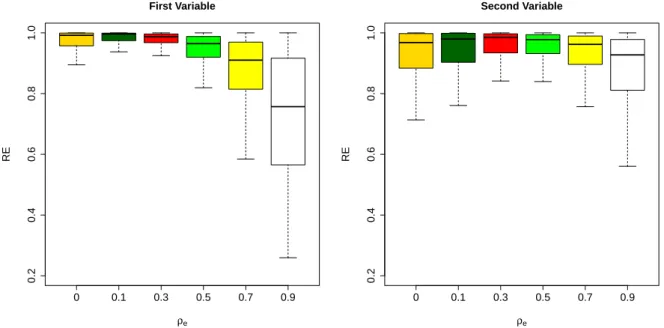
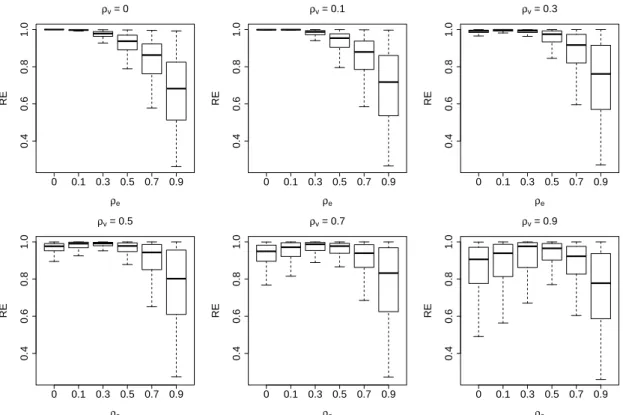
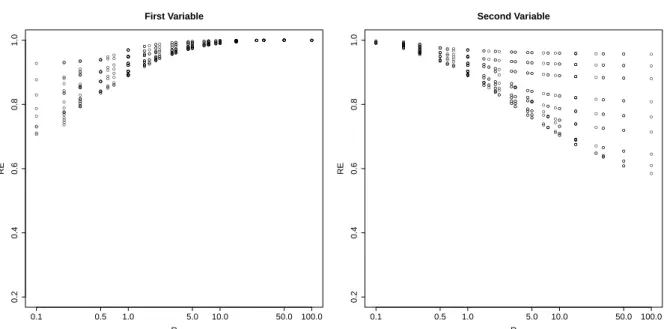
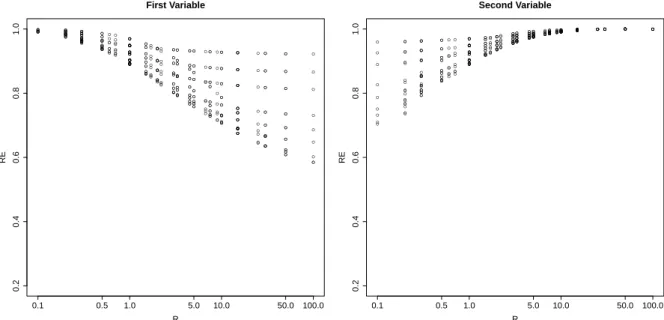
second variables with different values of ρv. . . 62
3.2 Results of relative efficiency, RE, defined in (3.16) for the first and
second variables with different values of ρe. . . 62
3.3 Results of relative efficiency, RE, defined in (3.16) with constant ρv
and different values ofρe for the first variable. . . 63
3.4 Results of relative efficiency, RE, defined in (3.16) with constant ρv
and different values ofρe for the second variable. . . 63
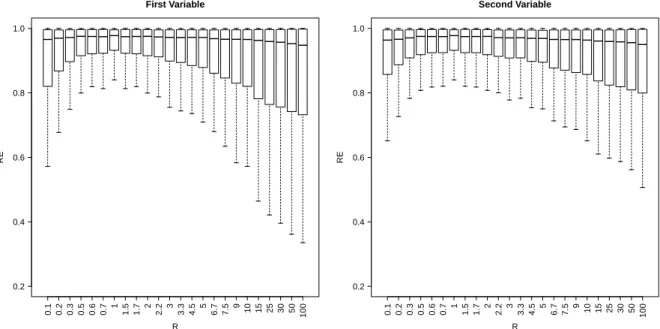
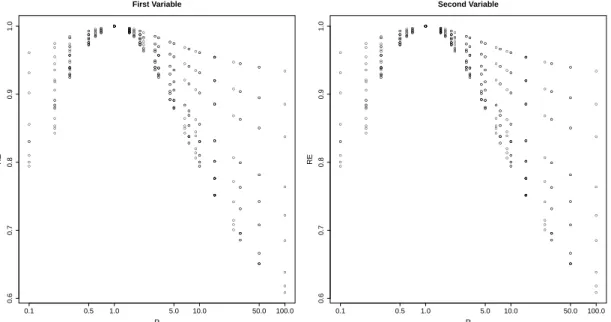
3.5 Results of relative efficiency, RE, defined in (3.16) against ratio, R=re
rv. 65
3.6 Results of relative efficiency, RE, defined in (3.16) against ratio,
R=re
rv, with ρv =ρe = 0.7. . . 66
3.7 Results of relative efficiency, RE, defined in (3.16) against ratio,
R=re
rv, with ρv = 0.7,ρe = 0.1. . . 67
3.8 Results of relative efficiency, RE, defined in (3.16) against ratio,
R=re
rv, with ρv = 0.1, ρe = 0.7. . . 68
3.9 Histogram of standardized residuals. . . 69
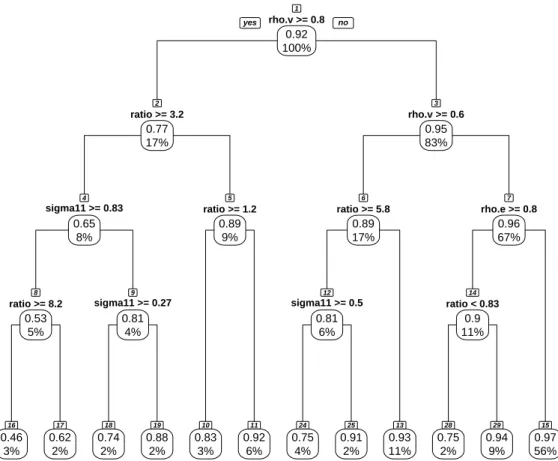
3.10 Regression tree for predicting relative efficiency (First variable). . . . 74
4.1 Distribution of area-specific sample sizes. . . 90
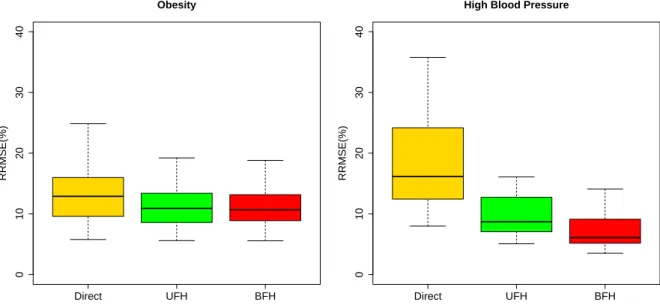
4.2 Distribution of the estimated relative root mean squared errors
(RRM-SEs%) across 63 areas forObesity(left panel) andHigh Blood Pressure
(right panel) for the direct, UFH and BFH estimators. . . 96
4.3 Distribution of the estimated median relative root mean squared
er-rors (RRMSEs%) of the direct, UFH and BFH estimates over 63 areas
for 870 ordered pairs of indicator variables. . . 98
4.4 Distribution of the estimated median relative efficiencies (REs) of
the BFH and UFH estimators relative to the direct estimators over
63 areas for 870 values of indicator variables. . . 98
4.5 Distribution of the quartiles of the relative efficiencies (REs) of BFH
relative to UFH estimators over areas based on 870 ordered pairs of
indicator variables. . . 99
4.6 Distribution of the minimum relative efficiencies (REs) of BFH
rel-ative to UFH estimators over areas based on 870 ordered pairs of
indicator variables. . . 99
4.7 Confidence Interval of the relative efficiencies (REs) of BFH over 63
areas forObesity andHigh Blood Pressure estimates. LL=Lower
Con-fidence Limit, ER=Estimated RE and UL=Upper ConCon-fidence Limit. . 102
63 areas for 870 ordered pairs of indicator variables. LL=Lower
Con-fidence Limit, ER=Estimated RE and UL=Upper ConCon-fidence Limit. . 102
4.9 Boxplots of the LL, ER and UL from the 95% Confidence Intervals
of relative efficiencies (REs) over 100 areas when ρe = 0.5 and wd=
1. LL=Lower Confidence Limit, ER=Estimated RE and UL=Upper
Confidence Limit. . . 104
5.1 Distribution of the direct estimates of Obesity prevalence by High
Blood Pressure prevalence in percentages across 63 general election
districts. . . 128
5.2 Small area estimates (SAEs) based on the fournomial model versus
the direct estimates of cells of the contingency table of Obesity by
High Blood Pressure . . . 130
5.3 Distribution of estimated root mean squared errors (RMSEs%) of the
direct and the fournomial estimators of cells of the contingency table
of Obesity byHigh Blood Pressure across the general election districts 131
5.4 Small area estimates (SAEs) based on the the binomial model and
the fournomial model versus the direct estimates of the marginal
pro-portions of Obesity and High Blood Pressure . . . 133
5.5 Distribution of root mean squared errors (RMSEs%) of the direct,
UFH, binomial and fournomial marginal estimators of Obesity and
High Blood Pressure across the general election districts. . . 134
binomial and fournomial marginal estimators of Obesity and High
Blood Pressure against sample size. . . 134
5.7 Distribution of the direct estimates ofCurrent Smoker prevalence by
Obesity prevalence in percentages across 63 general election districts. 136
5.8 Small area estimates (SAEs) based on the fournomial model
ver-sus the direct estimates of cells of the contingency table of Current
Smoker by Obesity . . . 139
5.9 Distribution of estimated root mean squared errors (RMSEs%) of the
direct and the fournomial estimators of cells of the contingency table
of Current Smoker by Obesity across the general election districts . . 140
5.10 Small area estimates (SAEs) based on the binomial model and the
fournomial model versus the direct estimates of the marginal
propor-tions of Current Smoker (CS) and Obesity (OBS) where the point
size is proportional to sample size . . . 142
5.11 Distribution of root mean squared errors (RMSEs%) of the direct,
binomial and fournomial marginal estimators ofCurrent Smoker and
Obesity across the general election districts. . . 143
5.12 Plots of root mean squared errors (RMSEs%) of the direct, binomial
and fournomial marginal estimators of Current Smoker and Obesity
against sample size. . . 143
(saturated and three non-saturated log-linear models) and direct
es-timates of the prevalence of each cell of Current Smoker and Obesity 164
6.2 Distribution of root mean squared errors (RMSEs%) of the four
log-linear estimators of the prevalences of Current Smoker by Obesity
across the general election districts . . . 165
6.3 Difference between small area estimates (SAEs) and direct estimates
based on the binomial, saturated and other log-linear models (Model
1-Model 3) of the marginal proportions ofCurrent Smoker andObesity166
6.4 Distribution of root mean squared errors (RMSEs%) of the binomial,
saturated and other log-linear (Model 1-Model 3) marginal estimators
of Current Smoker and Obesity across the general election districts. . 166
6.5 Area averages of absolute relative biases (ARBs%) of the saturated
model versus direct estimator for each cell for 48 combinations . . . . 175
6.6 Area averages of absolute relative biases (ARBs%) of the saturated
model versus Model 1 for each cell for 48 combinations . . . 176
6.7 Area averages of absolute relative biases (ARBs%) of the saturated
model versus Model 2 for each cell across 48 combinations . . . 177
6.8 Area averages of absolute relative biases (ARBs%) of the saturated
model versus Model 3 for each cell for 48 combinations . . . 178
6.9 Area averages of absolute relative biases (ARBs%) of marginal
esti-mates of the saturated model versus direct estimators for 48
combi-nations. . . 179
mates of the saturated model versus binomial model for 48
combina-tions. . . 180
6.11 Area averages of absolute relative biases (ARBs%) of marginal
esti-mates of the saturated model versus Model 1 for 48 combinations. . . 180
6.12 Area averages of absolute relative biases (ARBs%) of marginal
esti-mates of the saturated model versus Model 2 for 48 combinations. . . 181
6.13 Area averages of absolute relative biases (ARBs%) of marginal
esti-mates of the saturated model versus Model 3 for 48 combinations. . . 181
6.14 Results of relative efficiencies (REs) of the saturated model and Model
1 for each cell for 48 combinations . . . 183
6.15 Results of relative efficiencies (REs) of the saturated model and Model
2 for each cell for 48 combinations . . . 184
6.16 Results of relative efficiencies (REs) of the saturated model and Model
3 for each cell for 48 combinations . . . 185
6.17 Results of relative efficiencies (REs) of marginal estimates of the
sat-urated model and binomial model for 48 combinations. . . 186
6.18 Results of relative efficiencies (REs) of marginal estimates of the
sat-urated model and Model 1 for 48 combinations. . . 187
6.19 Results of relative efficiencies (REs) of marginal estimates of the
sat-urated model and Model 2 for 48 combinations. . . 188
6.20 Results of relative efficiencies (REs) of marginal estimates of the
sat-urated model and Model 3 for 48 combinations. . . 188
R=re
rv, with ρv =ρe = 0.1. . . 228
A.2 Results of relative efficiency, RE, defined in (3.16) against ratio,
R=re
rv, with ρv =ρe = 0.5 . . . 230
A.3 Results of relative efficiency, RE, defined in (3.16) against ratio, R=re
rv
with ρv =ρe = 0.9 . . . 230
A.4 Results of relative efficiency, RE, defined in (3.16) against ratio,
R=re
rv, with ρv = 0.5, ρe = 0.7. . . 231
A.5 Results of relative efficiency, RE, defined in (3.16) against ratio,
R=re
rv, with ρv = 0.7, ρe = 0.5. . . 231
A.6 Results of relative efficiency, RE, defined in (3.16) against ratio,
R=re
rv, with ρv = 0.9, ρe = 0.1. . . 232
A.7 Results of relative efficiency, RE, defined in (3.16) against ratio,
R=re
rv, with ρv = 0.1, ρe = 0.9. . . 232
A.8 Results of relative efficiency, RE, defined in (3.16) against ratio,
R=re
rv, with ρv = 0.9, ρe = 0.5. . . 233
A.9 Results of relative efficiency, RE, defined in (3.16) against ratio,
R=re
rv, with ρv = 0.5, ρe = 0.9. . . 233
B.1 Distribution of the estimated relative root mean squared errors
(RRM-SEs%) across 63 areas forObesity(left panel) andHigh Blood Pressure
(right panel) for the direct, UFH and BFH estimators. . . 237
rors (RRMSEs%) of the direct, UFH and BFH estimates over 63 areas
for 870 ordered pairs of indicator variables. . . 238
B.3 Distribution of the estimated median relative efficiencies (REs) of
the BFH and UFH estimators relative to the direct estimators over
63 areas for 870 values of indicator variables. . . 239
C.1 Distribution of root mean squared errors (RMSEs%) of the direct,
UFH, binomial and fournomial marginal estimators of Obesity and
High Blood Pressure across the general election districts. . . 241
C.2 Plots of root mean squared errors (RMSEs%) of the direct, UFH,
binomial and fournomial marginal estimators of Obesity and High
Blood Pressure against sample size. . . 241
C.3 Distribution of root mean squared errors (RMSEs%) of the direct,
UFH, binomial and fournomial marginal estimators ofCurrent Smoker
and Obesity across the general election districts. . . 243
C.4 Plots of root mean squared errors (RMSEs%) of the direct, UFH,
binomial and fournomial marginal estimators ofCurrent Smoker and
Obesity against sample size. . . 243
3.1 Values of parameters . . . 59
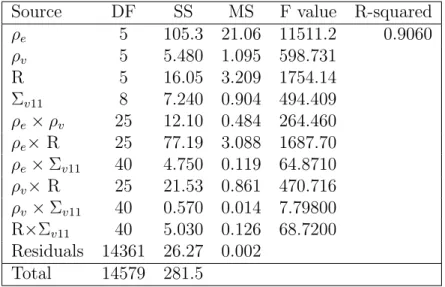
3.2 Analysis of variance (ANOVA) on relative efficiency of the first
vari-able, for up to two-way interactions . . . 70
3.3 Analysis of variance (ANOVA) on relative efficiency of the second
variable, for up to two-way interactions . . . 71
3.4 Summary table of lower relative efficiency (RE) of the first variable
from Figure 3.10 . . . 76
3.5 Summary table of lower relative efficiency (RE) of the second variable
from Figure 3.11 . . . 76
3.6 Medians of RE over D= 100 small areas with wd = 1 . . . 79
3.7 Medians of RE over D= 100 small areas with wd =
p
Z2
d1+Z
2
d2 . . . 79
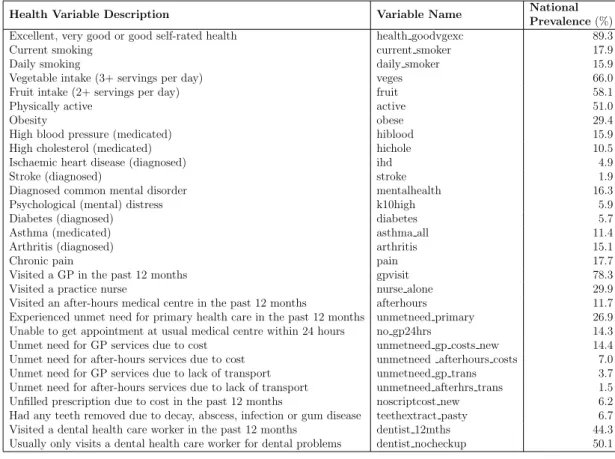
4.1 Description of the key indicators in the NZHS dataset . . . 89
4.2 Description of the covariates (Z) used in the Fay-Herriot models for
the NZHS dataset . . . 89
4.3 Estimates and 95% CIs of the elements ofΣv . . . 94
ρe = 0.5 and wd = 1. LL is the lower confidence limit, ER is the
estimated relative efficiency and UL is the upper confidence limit . . 104
5.1 Notation for joint and marginal probabilities . . . 108
5.2 Five number summary and mean of population size (Nd), sample size
(md) and effective sample size (m∗d) of general election districts in
2011/12 NZHS . . . 126
5.3 Five number summary and mean of direct estimates of the prevalence
of Obesity (OBS) and prevalence of High Blood Pressure (HBP) in
percentage across the general election districts . . . 127
5.4 National prevalences (in percentages) of Obesity prevalence by High
Blood Pressure prevalence . . . 127
5.5 Five number summary and mean of small area estimates (proportions)
and root mean squared errors (RMSEs%) estimates based on direct,
binomial and fournomial marginal proportions ofObesity (OBS) and
High Blood Pressure (HBP) . . . 135
5.6 Five number summary and mean of direct estimates of the
preva-lence of Current Smoker (CS) and prevalence of Obesity (OBS) in
percentage across the general election districts . . . 136
5.7 National prevalences in percentage of Current Smoker by Obesity . . 136
and root mean squared errors (RMSEs%) estimates based on direct,
binomial and fournomial marginal proportion ofCurrent Smoker (CS)
and Obesity (OBS) . . . 144
6.1 Coefficient of variation (CV) of the prevalences of Current Smoker
(CS), Obesity (OBS) and odds ratio (OR) under fitted model . . . 163
6.2 Five number summary of small area estimates of marginal proportion
of Current Smoker (CS) and Obesity (OBS) based on the binomial,
saturated, and Model 1 to Model 3 . . . 167
6.3 Five number summary of root mean squared errors in percentage
of marginal proportion of Current Smoker (CS) and Obesity (OBS)
based on the binomial, saturated, and Model 1 to Model 3 . . . 167
6.4 Akaike Information Criterion (AIC) and Bayesian Information
Crite-rion (BIC) of log-linear models relative to Model 2 . . . 168
6.5 Design of parameters options. Each row defines an option for a
pa-rameter or vector of papa-rameters . . . 171
6.6 Combinations of parameters . . . 173
B.1 Estimates and 95% CIs of the elements of Σv . . . 235
D.1 Area averages of absolute relative biases (ARBs%) of the direct,
sat-urated and non-satsat-urated log-linear models for panel (a) (prevalence
of Y1 = 1 andY2 = 0) . . . 245
urated and non-saturated log-linear models for panel (b) (prevalence
of Y1 = 0 andY2 = 1) . . . 246
D.3 Area averages of absolute relative biases (ARBs%) of the direct,
sat-urated and non-satsat-urated log-linear models for panel (c) (prevalence
of Y1 = 1 andY2 = 1) . . . 247
D.4 Area averages of absolute relative biases (ARBs%) of the direct,
sat-urated and non-satsat-urated log-linear models for panel (d) (prevalence
of Y1 = 0 andY2 = 0) . . . 248
D.5 Absolute biases and root mean squared errors (RMSEs) of the direct
and the saturated model in percentage for panel (a) (prevalence of
Y1 = 1 andY2 = 0) . . . 249
D.6 Absolute biases and root mean squared errors (RMSEs) of the direct
and the saturated model in percentage for panel (b) (prevalence of
Y1 = 0 andY2 = 1) . . . 250
D.7 Absolute biases and root mean squared errors (RMSEs) of the direct
and the saturated model in percentage for panel (c) (prevalence of
Y1 = 1 andY2 = 1) . . . 251
D.8 Absolute biases and root mean squared errors (RMSEs) of the direct
and the saturated model in percentage for panel (d) (prevalence of
Y1 = 0 andY2 = 0) . . . 252
proportion of the first variable (1st var) and the second variable (2nd
var) under the direct, binomial, fournomial and log-linear models. . . 253
D.10 Absolute biases and root mean squared errors (RMSEs) of the marginal
estimators of direct and saturated model in percentage for the first
variable . . . 254
D.11 Absolute biases and root mean squared errors (RMSEs) of the marginal
estimators of direct and saturated model in percentage for the second
variable . . . 255
D.12 Relative efficiencies of the saturated and non-saturated log-linear
models for panel (a) (prevalence of Y1 = 1 and Y2 = 0) . . . 256
D.13 Relative efficiencies of the saturated and non-saturated log-linear
models for panel (b) (prevalence of Y1 = 0 and Y2 = 1) . . . 257
D.14 Relative efficiencies of the saturated and non-saturated log-linear
models for panel (c) (prevalence of Y1 = 1 and Y2 = 1) . . . 258
D.15 Relative efficiencies of the saturated and non-saturated log-linear
models for panel (d) (prevalence of Y1 = 0 and Y2 = 0) . . . 259
D.16 Relative efficiencies of the marginal prevalences of binomial, fournomial
and log-linear models for the first variable (1st var) and the second
variable (2nd var) . . . 260
AIC Akaike Information Criterion
ANOVA Analysis of variance
ARB Absolute relative bias
BFH Bivariate Fay-Herriot
BIC Bayesian Information Criterion
BLUP Best linear unbiased prediction
CART Classification and Regression Tree
CI Confidence Interval
CV Coefficient of variation
EBLUP Empirical best linear unbiased prediction
FH Fay-Herriot
GED General election districts
GLMM Generalized linear mixed model
MFH Multivariate Fay-Herriot
ML Maximum likelihood
MSE Mean squared error
NZHS New Zealand Health Survey
RE Relative efficiency
RMSE Root mean squared error
RRMSE Relative root mean squared error
SAE Small area estimation
SPREE Structure Preserving Estimation
UFH Univariate Fay-Herriot
Introduction
1.1
The Definition and Relevance of Small Area
Estimation
Trustworthy official statistics on small area level are indispensable indicators of the
social, economic and business conditions of the country. Typically, such small areas
are the micro-level administrative units of a country or a state. Such area estimates
provide information for policy making, regional planning, micro and macro economic
management, labour market research, public health research and evaluation of public
policies.
Survey data are now widely used to provide estimates not only for the total
population but also for subpopulations (also known as domains). Domains can
be defined by geographic areas or sociodemographic groups or cross classification
of both. For example, a geographic domain may incorporate a state or province,
municipality, country, metropolitan area, and socio-demographic domains may be
defined by sex and age group, possibly within a large geographic area (Rao and
Molina, 2015, p.1). A domain or area is known as large when the domain-specific
sample size is large. Domains or area estimators that are obtained based only on
the sample data from the domain or area are known as direct estimators. Direct
estimation methods such as the design-based Horvitz-Thompson estimator (HT)
(Horvitz and Thompson, 1952) or the model-assisted generalized regression (GREG)
estimator (S¨arndal et al., 1992) are effective when the domain-specific sample sizes
are large. However, in practice, when the domain-specific sample sizes are not
large enough (known as small areas), sufficiently precise direct estimates cannot be
produced. In such situations, small area estimation (SAE) methods can be used to
get reliable estimates of the parameters of interest from related areas.
Indirect SAE estimators that “borrow strength” from sampled observations of
other areas through appropriate linking models are often necessary to produce small
area estimates with an adequate level of precision. Indirect estimators, for example,
synthetic and composite estimators, provide better precision than direct estimators.
Synthetic estimators for small areas are derived under the assumption that small
areas have the same characteristics (in some sense) as larger areas that contain them
(Chambers and Clark, 2012, p.162). Composite estimators are weighted averages of
direct estimators and synthetic estimators (Rao and Molina, 2015, p.57). However,
both of these estimators suffer from design-bias, which does not necessarily decrease
as the sample size increases.
Model-based small area estimation methods “borrow strength” from other areas
of population for estimating small area statistics (for example, means, totals,
propor-tions). Some SAE techniques make use of mixed models by incorporating random
effects. The random effects account for the between area variation that cannot be
on either area level or unit level models on the basis of data availability. When unit
level data are inaccessible, area level models are developed using direct area-specific
estimates available from a survey dataset and area level covariates available from a
census or administrative dataset.
Many researchers have investigated the application of area level models through
modelling one response variable on area-specific covariates, see for example Prasad
and Rao (1990), Rao (2003a). However, it may be desirable to consider multiple
dependent variables together. The focus of this thesis is on small area estimation
with multiple dependent variables.
1.2
Multivariate Small Area Estimation
This thesis will develop SAE methods considering two or more correlated response
variables together and apply the developed methodologies to health indicators on a
New Zealand Health Survey (NZHS) dataset. The main aims of this thesis are:
• to develop an area level multivariate model for multiple response variables where multiple health indicators are considered together as response variables;
• to develop a unit level approach based on multinomial logit mixed models for multiple-category response variables to produce small area estimates of
cross-classified counts of two or more health indicators by area;
• to simplify the multinomial logit mixed model using log-linear models, which will make higher order contingency tables feasible; and
• to implement the developed methodologies using health indicators in the NZHS data for examining the performances of the developed methods.
1.3
Area Level Models
The most widely used area level model in SAE is the Fay-Herriot (FH) model (Fay
and Herriot, 1979). It was used first to estimate mean per capita income for small
areas in the USA. In the univariate Fay-Herriot model (UFH), the direct survey
estimates of a single response variable in each area are regressed on area-specific
covariates obtained from census data. For example, suppose a survey is designed
to estimate per capita income. Estimates of per capita income might be obtained
with adequate precision at the country level. However, to obtain estimates for
districts, if the sample sizes are very small then the variances of the estimates will
be high. In order to improve the precision of these estimates, the area (districts)
level direct estimates are regressed on area level covariates obtained from census or
administrative data sources (Fay and Herriot, 1979).
The area level FH model is one of the most popular methods used in SAE because
of its flexibility in combining and explaining different sources of information. Also
it does not require unit level data. Various extensions of the basic area level model
have been proposed to handle correlated sampling errors, spatial dependence of the
model errors, time series and cross-sectional data (Rao and Molina, 2015, pp.83-87).
Statisticians use the UFH model for one variable or separately for each variable.
However, in some surveys it may be desirable to consider two or more correlated
can be used to incorporate the correlation among the response variables. When
mul-tiple dependent variables are correlated, MFH models may produce better results
than UFH models, but these models have received relatively little attention. There
is limited work on the benefits of MFH models. Datta et al. (1998) compared the
precision of small area estimators obtained from UFH and MFH models, showing
that more precise SAEs are obtainable using MFH models rather than using separate
UFH models for each variable. Gonz´alez-Manteigaet al.(2008) studied MFH models
with constant random effects for each variable and compared an analytic estimator
of mean squared error (MSE) with the bootstrap mean squared error estimator, and
showed that the bootstrap estimator provided lower MSEs than the analytic
estima-tor. Gonz´alez-Manteiga et al.(2008) also described a simulation study designed for
comparing MFH and UFH estimators, and concluded that multivariate modelling
reduced the MSE of the SAE estimators.
One of the focuses of this thesis is to elucidate conditions under which MFH
models work better than separate UFH models based on an approximation of MSE.
This will be investigated both theoretically and numerically for a wide range of
scenarios. The efficiency of MFH and UFH estimators are also investigated via a
simulation study following that of Gonz´alez-Manteiga et al. (2008).
In addition, a parametric bootstrap method of calculating MSE is developed
and applied to the NZHS dataset. The efficiencies of UFH and MFH estimators are
1.4
Unit Level Models
In the basic unit level model, unit values of the single response variable are regressed
on unit-specific auxiliary variables through a nested error linear regression model.
For instance, a survey may be designed to estimate the total wages and salaries of
workers. Let the survey be designed in such a way that the estimates with desired
precision are possible at the total level. If the interest is to estimate total wages
and salaries at the industry level, then the sample sizes of the industries may be
too small to obtain adequate error variances. In such a situation, auxiliary variables
such as gross business income from firm-level can be used to fit a linear mixed model
considering industry-specific random effects in order to improve the precision of the
estimates (Rao, 2003a). An earlier development of the idea of a unit level model
can be found in Battese et al. (1988) where the nested error regression model was
used to estimate the country crop areas using sample survey data in the USA. They
also used unit level auxiliary variables in their model. This type of unit level model
is appropriate for continuous response variables.
In addition, various extensions of the basic unit level model have been
consid-ered to handle binary responses (Rao and Molina, 2015, pp.88-91). For example,
generalized linear mixed models (GLMM) are used when the response variables are
binary or count values. MacGibbon and Tomberlin (1987) used a logistic regression
model with random area-specific effects to estimate the small area proportions of
binary response variables with unit level auxiliary variables. Unit level data, which
happen to all be at the area level. A number of studies have used multinomial logit
mixed models to estimate the small area population counts that are classified by a
single survey variable (e.g. labour force status) (Molinaet al., 2007, Saei and Taylor,
2012, L´opez-Vizca´ıno et al., 2013) but not for small area counts cross-classified by
multiple survey variables.
With a multi-category response variable (e.g. labour force status), GLMMs must
be used rather than linear mixed models since the variable of interest is discrete (Rao
and Molina, 2015, p.93). For example, Molina et al. (2007) estimated labour force
characteristics by small areas in the United Kingdom (UK) using a multinomial logit
mixed model with constant random effects for each category. Saei and Taylor (2012)
also proposed a multinomial logit mixed model with category-specific random effects
in estimating labour force status in the UK, showing that the multinomial models
with category-specific area random effects lead to better SAEs than models with
constant random effects for each category.
This thesis will consider estimating small area cross-classified counts of two
bi-nary health indicators, such as counts of Obesity by High Blood Pressure. A
multi-nomial logit mixed model with category-specific area random effects will be used to
estimate the population cell counts by area. This idea is one of the methodological
innovations compared to the existing literature since counts in contingency tables
are modelled in each small area rather than considering the trinomial data (such
as unemployed, employed and inactive counts). This idea can provide small area
estimates of cross-classification of multiple binary variables instead of separately
by Zhang and Chambers (2004) is an existing approach to estimating small area
cross-classified counts of response variables based on survey data where the
corre-sponding auxiliary information may come from a previous census. The proposed
method of estimating contingency table is different from the SPREE approach as it
considers the cross-classification of target variables from the current survey rather
than combining small area classifications from a previous census with
cross-classifications of target variables of current survey data.
Another contribution set out in this thesis is the development of log-linear
mod-els with category-specific random effects. These are a flexible way of simplifying
multinomial logit mixed models to obtain small area estimates of cross-classified
counts. Log-linear models will allow small area estimates of two-way and higher
order cross-classifications of response variables for each small area. To estimate the
MSE under the mixed multinomial and log-linear models, a parametric bootstrap
method is developed and data from the NZHS are used to illustrate the approach.
Moreover, a simulation study is also conducted for investigating the performance of
multinomial and log-linear models.
1.5
Structure of the Thesis
This thesis considers multivariate small area estimation with multiple continuous
and categorical response variables instead of a single response variable. In Chapter
3 and 4, the multivariate area level model is used to get estimates of each continuous
variable by area; and in Chapter 5 and 6, the estimation of the cross-classification
Chapter 2 summarizes the main literature relevant to this thesis, comprising
design-based, model-assisted and model-based estimation methods including
uni-variate and multiuni-variate Fay-Herriot models. The review also covers SAE methods
for estimating small area population counts that are cross-classified. The
multino-mial and log-linear models are also reviewed.
Chapter 3 compares the efficiency of SAEs from UFH and MFH models from both
theoretical and numerical perspectives. Expressions for the approximate relative
ef-ficiency for some special cases are derived to give insights into the circumstances
under which the MFH model provides gains over the UFH model. A numerical and
a simulation study of MFH estimation are carried out in this chapter. The numerical
study is conducted to investigate the question of whether, and under what
condi-tions, the MFH model is advantageous compared with the UFH model in small area
estimation. This is accomplished by calculating the approximate MSEs from UFH
and MFH models for a range of model parameter values. An analysis of variance
(ANOVA) approach and a regression tree approach are used to summarize the
re-sults of the numerical study. This chapter also includes a simulation study following
Gonz´alez-Manteiga et al. (2008), assuming known parameters for generating data,
to illustrate the efficiency of the MFH estimators compared to that of the UFH
estimators.
In Chapter 4, an empirical study is conducted using the New Zealand Health
Survey data. A parametric bootstrap method is used to estimate the MSE and the
estimated MSEs of the MFH and UFH SAEs are compared. In addition, parametric
calculated to assess the uncertainty around the gain of MFH over UFH.
Chapter 5 develops methods for estimating small area cross-classified counts and
the methods are assessed using the NZHS dataset. This chapter uses a
multino-mial logit mixed model to estimate small area cross-classified counts with
category-specific random effects. For example, cross-classified counts by Current Smoker by
Obesity, which constitutes a 2×2 contingency table, are estimated. Estimates of marginal prevalences are also calculated using the multinomial logit mixed model.
In addition, mean-squared errors of the estimates are calculated using a parametric
bootstrap method.
Chapter 6 defines a saturated mixed log-linear model which is equivalent to
the multinomial logit mixed model of Chapter 5. Three non-saturated log-linear
models are also developed by dropping out some parameters from the saturated
log-linear model. The efficiency of SAEs from the saturated model are compared
to those from the three non-saturated log-linear models through an empirical and
a simulation study. In the empirical study, the methods are evaluated using the
NZHS dataset to calculate SAE estimates from two-way contingency tables.
Log-linear models developed in this chapter are more parsimonious than the multinomial
model, which would be particularly important in the estimation of third or higher
order contingency tables by area.
Chapter 7 provides a summary of the major findings of this thesis and suggestions
for future research. Appendices contain proofs of all theoretical results which are
Literature Review
The term small area or small domain is commonly used to describe small
geographi-cal areas of a country or domains of a population. Classic examples of small areas or
small domains include geographical classifications such as states, countries, districts
or municipalities and subgroups such as specific races or ages in a population (Jiang
et al., 2002).
Small area estimation (SAE) methods are widely used to estimate population
parameters for targeted areas or domains with small sample size. In such situations,
direct estimates which rely on domain-specific surveyed observations may have large
sampling variance (Rao, 2003b, p.1) and indirect estimation methods are therefore
necessary in order to achieve an adequate level of precision. Design-based estimators
are examples of direct estimators, while model-based estimators may be direct or
indirect estimators. Indirect estimators based on a model borrow strength by using
observations of the variable of interest from other areas or time periods in order to
increase the effective sample size in the area and thus decrease the standard errors
(Chambers and Clark, 2012, p.162). Furthermore, auxiliary information is vital for
small area estimation because the most elaborate model cannot work properly if it
does not involve a set of covariates with good predictive power for the small area
quantities of interest (Pfeffermann, 2013).
The review in this chapter covers both design-based and model-based methods of
small area estimation. After defining the notation to be used in this thesis in Section
2.1, design-based, model-assisted and model-based direct estimators are reviewed in
Section 2.2. In Section 2.3, indirect small area estimation methods are introduced.
Section 2.4 covers literature on univariate area level small area estimation models
and multivariate area level small area estimation models are reviewed in Section
2.5. In Section 2.6, literature on univariate and multivariate unit level small area
estimation models are discussed. The related literature on multinomial models of
small area estimation are reviewed in Section 2.7. Finally in Section 2.8, SPREE
estimators which make use of log-linear models are discussed.
2.1
Notation and Definitions
A survey population,U, is partitioned intoDexclusive and exhaustive areas. There
are N distinct units in the population identified through the labels j = 1,2, . . . , Nd,
where area d consists of Nd units.
Suppose the sample is available for m ≤ D areas. A sample s of size n is randomly selected from U. The probability of including the jth element of area d
is πdj. The design weight is defined as wdj =πdj−1. Suppose Ud denotes the dth area
and sd denotes the dth surveyed area. The sample sizes nd may be random, unless
a planned sample of fixed size is taken in that area.
U = D [ d=1 Ud and N = D X d=1 Nd
and for the sample:
s= m [ d=1 sd and n = m X d=1 nd
Let y denote the characteristic of interest and let ydj denote the response value
of y for jth unit in the dth area. The variable y may be continuous or may be
binary taking values of 0 or 1. The population total and the mean for domain dare
respectively: Yd = Nd X j=1 ydj and Y¯d= Nd X j=1 ydj/Nd d= 1,2, . . . , D
The corresponding dth sample total and the dth sample mean are respectively:
yd= X j∈sd ydj and y¯d= X j∈sd ydj/nd d= 1,2, . . . , m
Let z denote a vector of pauxiliary variables which is employed to improve the
sampling plan or to enhance estimation of the variables of interest. Further, let
zdj = (zdj1, . . . , zdjp)0 define the set of unit-specific auxiliary variables for unit j in
small area d. The population total and the mean of auxiliary variable for domain
d, are respectively: Zd= Nd X j=1 zdj and Z¯d= Nd X j=1 zdj/Nd d= 1,2, . . . , D
and the correspondingdthsample total and thedthsample mean for auxiliary variable
zd = X j∈sd zdj and z¯d= X j∈sd zdj/nd d= 1,2, . . . , m
Let θd be the area target quantity (say, the mean or proportion). The aim is
to estimate the area population mean, θd when nd is small or zero. In this thesis
vectors and matrices will be in bold type.
2.2
Direct Estimators
In this section, design-based, model-assisted and model-based direct estimators
are discussed. Usually, domain estimators are direct estimators in one of these
frameworks, although there are some indirect model-assisted estimators (Hidiroglou,
2007). A direct small area estimator uses only the sample values of the target
vari-able y available for the particular area being estimated. Direct estimators can also
be defined using one or more auxiliary variables for which population values or at
least totals are known.
2.2.1
Design-Based Direct Estimators
Design-based direct estimators are based on probability sampling theory where a
random sample is drawn from a finite and fixed population with selection
probabil-ities defined by the sampling design. In this approach, the population values of a
target variable, y, are considered constant rather than random variables. Thus, no
distributional assumptions are made abouty, rather, inference is based on repeated
probability sampling from the fixed population. For example, suppose the sample
quanti-ties of interest are the domain population means ¯Yd. If auxiliary variables are not
available, a direct design-unbiased estimator of the dth area sample mean is ¯yd with
design variance of
Varp(¯yd) = (Sd2/nd)(1−nd/Nd)
(Cochran, 1977, p.30) where Sd2 =PNd
j=1(ydj −Y¯d)2/(Nd−1). The variance of ¯yd is
of order 1/nd denoted by O(1/nd). If nd is small, the variance can be large.
For unequal probability sampling, the simplest direct estimator for estimating
the area total is the well-known inverse probability estimator, also called the
Horvitz-Thompson (H-T) estimator which is
b
Yd,HT =
X
j∈sd
wdjydj (2.1)
(S¨arndal et al., 1992, pp.42-43) where wdj = πdj−1 is the design weight. In similar
way, the estimator for the small area mean is Yb¯d,HT = Ybd,HT/Nd. The estimators
are design unbiased, that is Ep(Ybd,HT) =Yd and Ep(Yb¯d,HT) = ¯Yd.
An alternative estimator of the area mean is the H´ajek estimator:
b¯ Yd,HA = X j∈sd wdj !−1 X j∈sd wdjydj ! (2.2)
(S¨arndal et al., 1992, pp.182-183). The prediction variance of these estimators are
O(1/nd). Hence the prediction variance can be large when nd is small. The above
design-based estimators allow for sample designs where nd can be random.
Signifi-cant improvements in efficiency can be obtained by controlling the sample sizes of
2.2.2
Model-Assisted Direct Estimators
Model-assisted estimators are approximately design-unbiased estimators which are
motivated by a model. The efficiency of design-based estimation can be improved
by using auxiliary variables correlated with the target variable, y. The auxiliary
variables are used as covariates in a linear regression model for y. It is usually
assumed that all population values are available for the auxiliary variables, although
it is often sufficient to have population totals.
The most commonly used model-assisted estimator is the generalized regression
(GREG) estimator which is a design-based model-assisted estimator (S¨arndalet al.,
1992, p.225). The GREG estimator can be expressed as the sum of the
Horvitz-Thompson estimator and a regression-based adjustment term. Suppose that
aux-iliary information in the form of known population totals Z = (Z1, Z2, . . . , Zp)0 is
available. Then a GREG estimator may be written as
b YGR =YbHT + (Z−ZbHT)0βˆ (2.3) where ZbHT = PD d=1 P
j∈sdwdjzdj and the regression parameters β are estimated using the sample data for Y as
ˆ β= D X d=1 X j∈sd wdjzdjzdj0 !−1 D X d=1 X j∈sd wdjzdjydj (2.4) with d= 1,2, . . . , m, j = 1,2, . . . , Nd. b
YGR can be written in the expansion form using “revised” weights wdj∗ which are
the product of the design weight wdj and a factor weightgdj. So
b YGR = D X d=1 X j∈sd w∗djydj (2.5)
(e.g. Rao and Molina, 2015, pp.13-14) where w∗dj =wdjgdj with gdj = 1 + (Z−ZˆHT)0 D X d=1 X j∈sd wdjzdjz0dj !−1 zdj .
The GREG can be applied domain by domain. Let the domain-specific auxiliary
totalsZd = (Zd1, Zd2, . . . , Zdp)0be known. In this case, a GREG estimator of domain
total Yd is given by b Yd,GR=Ybd,HT + Zd−Zbd,HT 0 ˆ βd (2.6) where Zbd,HT = Pj∈s
dwdjzdj and the regression coefficients βd of area d are esti-mated by solving the sample least squares equation, such that
ˆ βd= X j∈sd wdjzdjzdj0 !−1 X j∈sd wdjzdjydj (2.7)
(Hidiroglou, 2007). When the regression parameters, β, are estimated from all the
areas then βˆ replaces βˆd in (2.6) and the resulting GREG estimator is called the
modified direct estimator:
b Yd,GR=Ybd,HT + Zd−Zbd,HT 0 ˆ β (2.8)
The estimator (2.6) is completely area-specific which has area-specific auxiliary
totalsZd and the coefficientβd calculated from area-specific data. So it is clearly a
direct estimator. It is a model-assisted estimator in the sense that regressingyonz
is done in order to remove the unexplained variation from y to increase estimation
accuracy.
The GREG estimators (2.14), (2.6) and (2.8) are design consistent and
least squares equation, is not a design-unbiased estimate of the population
regres-sion coefficient (S¨arndal et al., 1992, p.226). They are also model-unbiased under
the assumption of a linear regression model for the response variable conditional on
the auxiliary variables (Rao, 2003b, p.13).
The GREG estimators (2.14), (2.6) and (2.8) are Horvitz-Thompson type
esti-mators and they can be written in the H´ajek form by replacing ˆYd,HT, Zˆd,HT and
ˆ ZHT by: b Yd,HA =Nd X j∈sd wdj !−1 X j∈sd wdjydj ! , b Zd,HA =Nd X j∈sd wdj !−1 X j∈sd wdjzdj ! , and b ZHA =N D X d=1 X j∈sd wdj !−1 D X d=1 X j∈sd wdjzdj !
(Hidiroglou and Patak, 2004). H´ajek forms of the GREG estimators (2.14), (2.6)
and (2.8) are given by:
e YGR =YbHA+ ZHA−ZbHA 0 ˆ β (2.9) e Yd,GR =Ybd,HA+ Zd,HA−Zbd,HA 0 ˆ βd (2.10) and e Yd,GR=Ybd,HA+ Zd,HA−Zbd,HA 0 ˆ β (2.11)
respectively (Hidiroglou and Patak, 2004). It is not obvious which of the above
GREG estimators is the best estimator. Hidiroglou and Patak (2004) examined
that GREG estimators of the H´ajek form are approximately conditionally unbiased
and have smaller conditional MSE than estimators of the Horvitz-Thompson form.
Calibration estimators (Estevao and S¨arndal, 2004) are a generalization of the
GREG estimators, which allow greater control over the properties of the estimation
weights. They are asymptotically equivalent to GREG estimators (e.g. Pfeffermann,
2013).
The most obvious advantage of design-based and model-assisted methods is that
the estimation does not rely on the assumed model although models are used for the
construction of the estimators. The estimators are unbiased and consistent under the
randomization distribution for large sample sizes within the areas. The disadvantage
of direct estimators is that they produce large variances for small sample sizes and
there is no established theory for areas which have no sample.
2.2.3
Model-Based Direct Estimators
A direct estimate for a small area is simple to interpret, since the estimated value
of the variable of interest for the area is just a weighted average of the sample data
from the same area. However, when weights are the inverses of sample inclusion
probabilities, conventional direct estimators like (2.1) and (2.2) can be quite
inef-ficient (Chandra and Chambers, 2009). In such situation, they propose the use of
model-based direct estimators (MBDE). The idea is to fit a model for the population
values, compute the weights defining the empirical best linear unbiased predictor
(EBLUP) of the population total under the model and then use the weights
the population values YU is the general linear model,
YU =ZUβ+eU (2.12)
where E(eU) = 0 and Var(eU) = ΨU (Chandra and Chambers, 2009). For known
ΨU, the best linear unbiased predictor (BLUP) of the population totalYd under the
model (2.12) is b YdBLU P = D X d=1 X j∈sd wBLU Pdj ydj (2.13)
where the EBLUP is YbdEBLU P = PD
d=1
P
j∈sdw
EBLU P
dj ydj. The MBDE of the true
mean in aread is b ¯ YM BDd = X j∈sd wdjEBLU P !−1 X j∈sd wEBLU Pdj ydj ! (2.14)
(Chandra and Chambers, 2009). More details of MBD approach is given in
Cham-bers and Clark (2012).
2.3
Indirect Small Area Estimation
In this section, some model-based indirect small area estimators such as synthetic
estimators and composite estimators are reviewed. In model-based SAE methods,
appropriate models are developed, using the observedy values (or their area sums)
and related auxiliary information available, and then the developed model is used
for estimating or predicting the area total or mean.
2.3.1
Synthetic Estimators
An alterative expression for the GREG estimator (2.8) is
b Yd,GR=Zd0βˆ+ b YdHT −Zb0dHTβˆ (2.15)
The first term of this expressions (2.15) can be considered as an estimator of
small area total and is known as the synthetic estimator (S¨arndalet al., 1992, p.339).
Hence the GREG estimator can be treated as a synthetic estimator with a correction
term for the design bias. Thus the synthetic estimator from (2.15) is
b
Yd,SY N =Zd0βˆ (2.16)
Note that the GREG estimator and synthetic estimator become equal when bias
correction (second) term of the estimator (2.15) is zero (Pfeffermann, 2013).
2.3.2
Composite Estimators
Composite estimation can be considered as a compromise between synthetic and
direct estimation. Generally, a synthetic estimator gives better results than the
traditional direct estimator when the area level sample sizes are relatively small,
whereas direct estimators perform better than the synthetic estimators for large
sample sizes. A weighted average of these two estimators is an alternative to choosing
one over the other to balance between bias and variance. This type of estimator is
commonly known as a ‘composite estimator’.
Composite estimation is a natural way to balance the potential bias of a synthetic
estimator against the instability of a direct estimator by choosing an appropriate
weight (Ghosh and Rao, 1994). The composite estimator of population total Yd for
small area d can be defined as
b
Yd,COM =φdYbd,HT + (1−φd)Ybd,SY N (2.17)
synthetic estimators of Yd. φd is a suitably chosen weight that lies between 0 and 1
(Rao, 2003b, p.57).
2.4
Small Area Estimation: Univariate Area
Level Models
Model-based SAE techniques can use mixed models with random effects. The
ran-dom effects explain the between-area variation which cannot be explained by the
auxiliary variables included in the model. Small area models can be defined at the
area or the unit level (Rao and Molina, 2015, p.76). Unit level small area models can
be developed only when auxiliary data are available for each population unit.
How-ever, such data are not available in many situations. In this case, area level small
area models, which relate small area direct estimates to the area level auxiliary data,
are applied (Jiang and Lahiri, 2006).
The basic area level model proposed by Fay and Herriot (1979) is often called
the Fay-Herriot (FH) model. It is a linear random effects model which links the
parameter of interest θd (say, a mean or proportion) in area d on the auxiliary
variables Zd= (Zd1, Zd2. . . , Zdp)
0
through the linking model:
θd=Zd0β+vd, d= 1,2, . . . , D (2.18)
whereθd=g( ¯Yd),βis a (p×1) vector of regression coefficients andvdare identically,
independently and normally distributed area-specific random effects with E(vd) =
0,Var(vd) =σv2. It is not necessary that Var(vd) are all equal.
The sampling model is:
ˆ
where ˆθd=g(Yb¯d) anded are independent sampling errors normally distributed with
E(ed) = 0, Var(ed) = ψd. The sampling model indicates how the sample estimates
are related to the unknown population values and sampling errors ed. In practice,
ˆ
θd is usually a model-assisted or design-based estimator of θd.
Combining the sampling and linking model, the typical form of the univariate
Fay-Herriot model is
ˆ
θd =Zd0β+vd+ed, d= 1,2, . . . , D (2.20)
The two error terms, vd and ed, are assumed to be independent of each other
within and across areas. Here, vd is the area-specific random effects (also called the
model error) which measures the heterogeneity among the areas after allowing for
the covariates in the model (Ghosh and Rao, 1994) andψdis a design-based sampling
variance. Usually, it is assumed that ψd is known. The variance component σv2 is
unknown and has to be estimated from data under model (2.20).
For known variance σ2
v, under model (2.20), the BLUP for θd is a weighted
average of the direct estimator ˆθdand the regression synthetic estimator Zd0βˆwhich
is ˆ θdBLU P = Zd0βˆ+γd ˆ θd−Zd0βˆ = γdθˆd+ (1−γd)Zd0βˆ (2.21) where γd = σ2 v ψd+σv2
and ˆ β= D X d=1 (ψd+σv2) −1Z dZd0 !−1 D X d=1 (ψd+σ2v) −1Z dθˆd ! (2.22)
(Rao and Molina, 2015, p.124). Since the Fay-Herriot model deals with the area
level quantities ˆθd and not with the individual observations, the BLUP estimators
are valid for general sampling designs (Rao, 2003b, p.116). When the model variance
σ2
v is relatively small, γd will be small and more weight is attached to the synthetic
estimator. On the other hand, the direct estimator is given more weight if the design
variance ψd is relatively small. Here, γd is also called a ‘shrinkage factor’ since it
‘shrinks’ the direct estimator towards the synthetic estimator Zd0βˆ in (2.16). The MSE of the BLUP estimates under the area level model (2.21) is
MSE(ˆθBLU Pd ) = E(ˆθBLU Pd −θd)2 =g1(σv2) +g2(σv2) (2.23)
(Rao and Molina, 2015, p.125) where
g1(σv2) = σ2 vψd ψd+σv2 =γdψd and g2(σv2) = (1−γd)2Zd0 " X d ZdZd0/(ψd+σv2) #−1 Zd
The first term,g1(σv2), in (2.23) isO(1) while, due to estimatingβ, the second term,
g2(σv2), is O(D
−1) for large D. It is obvious that when the variance of the model
error, vd, is small relative to the total variance, ˆθdBLU P is much more efficient than
ˆ
θd which has variance ψd (Rao and Molina, 2015, p.126).
The BLUP estimator (2.21) relies on the variance componentσ2
v which is usually
![trans Tetraaquabis[1,3 bis(4 pyridyl)propane κN]cobalt(II) biphenyl 4,4′ disulfonate monohydrate](data:image/gif;base64,R0lGODlhAQABAIAAAP///wAAACH5BAEAAAAALAAAAAABAAEAAAICRAEAOw==)