ContentslistsavailableatScienceDirect
Journal
of
Operations
Management
jou rn al h om e p a g e :w w w . e l s e v i e r . c o m / l o c a t e/ j o m
Supply
network
disruption
and
resilience:
A
network
structural
perspective
Yusoon
Kim
a,b,∗,
Yi-Su
Chen
b,c,
Kevin
Linderman
b,daCollegeofBusiness,OregonStateUniversity,Corvallis,OR97331,UnitedStates bCenterforSupplyNetworks,ArizonaStateUniversity,Phoenix,AZ85004,UnitedStates
cDepartmentofManagementStudies,CollegeofBusiness,UniversityofMichigan—Dearborn,19000HubbardDrive,FCS184,Dearborn,MI48126, UnitedStates
dDepartmentofSupplyChainandOperationsManagement,CarlsonSchoolofManagement,UniversityofMinnesota,32119thAvenueSouth,Minneapolis, MN54545,UnitedStates
a
r
t
i
c
l
e
i
n
f
o
Articlehistory:
Received10January2014
Receivedinrevisedform1August2014 Accepted16October2014
Availableonline27October2014
Keywords:
Supplynetworkdisruption Resilience
Graphtheory Complexnetworks Networkanalysis
a
b
s
t
r
a
c
t
Increasingly,scholarsrecognizetheimportanceofunderstandingsupplynetworkdisruptions.However, theliteraturestilllacksaclearconceptualizationofanetwork-levelunderstandingofsupplydisruptions. Nothavinganetworklevelunderstandingofsupplydisruptionspreventsfirmsfromfullymitigatingthe negativeeffectsofasupplydisruption.Graphtheoryhelpstoconceptualizeasupplynetworkand dif-ferentiatebetweendisruptionsatthenode/arclevelvs.networklevel.Thestructureofasupplynetwork consistsofacollectionofnodes(facilities)andtheconnectingarcs(transportation).Fromthisperspective, smalleventsthatdisruptanodeorarcinthenetworkcanhavemajorconsequencesforthenetwork.A failureinanodeorarccanpotentiallystoptheflowofmaterialacrossnetwork.Thisstudyconceptualizes supplynetworkdisruptionandresiliencebyexaminingthestructuralrelationshipsamongentitiesinthe network.Wecomparefourfundamentalsupplynetworkstructurestohelpunderstandsupplynetwork disruptionandresilience.Theanalysisshowsthatnode/arc-leveldisruptionsdonotnecessarilyleadto network-leveldisruptions,anddemonstratestheimportanceofdifferentiatinganode/arcdisruptionvs. anetworkdisruption.Theresultsalsoindicatethatnetworkstructuresignificantlydeterminesthe like-lihoodofdisruption.Ingeneral,differentstructuralrelationshipsamongnetworkentitieshavedifferent levelsofresilience.Morespecifically,resilienceimproveswhenthestructuralrelationshipsinanetwork followthepower-law.Thispapernotonlyoffersanewperspectiveofsupplynetworkdisruption,butalso suggestsausefulanalyticalapproachtoassessingsupplynetworkstructuresforresilience.
©2014ElsevierB.V.Allrightsreserved.
1. Introduction
HendricksandSinghal(2005)foundthatanannouncementof asupply disruptionlowersafirm’sstockreturnsonaverageby 20%sixmonthsaftertheannouncement.Recentindustryexamples highlightthechallengesthatcompaniesfaceinrecoveringfroma disruption.Forinstance,Toyotahadasupplynetworkdisruption intheaftermathofthe2011tsunamiinJapan.Sixmonthslater, ToyotahadtoidlesomeplantsinNorthAmericaduetoshortage ofparts(Ferreira,2012).Sometsunami-strickenJapanesesuppliers couldnolongersupplytheNorthAmericanplants,whichshutthem
∗ Correspondingauthor:CollegeofBusiness,OregonStateUniversity,Corvallis,
OR97331,UnitedStates.Tel.:+15417376066;fax:+15417374890..
E-mailaddresses:[email protected](Y.Kim),
[email protected](Y.-S.Chen),[email protected](K.Linderman).
down.Severalotherexampleshavebeendocumented,where sup-plydisruptionsinonepartoftheworldcreatedproblemsinanother partoftheworld.Oneoftheauthorsofthisstudyworkedwitha multinationalpersonalcomputer(PC)makerinthewakeofthe 2011floodsinThailand,whichthenledtoadisruptionofthe com-puterhard-diskindustry.AsthePCmanufacturerexecutiveswere investigatingtheirsupplynetwork,theybecameconcernedabout howasupplier“deepinthesupplynetwork”mightdisrupttheir operations.Inanincreasinglygloballyconnectedworld,managing supplydisruptionsinvolvesmorethanjustpreventingdisruptions atyourfacilities.Italsorequiresabroaderunderstandingofthe overallstructureofyoursupplynetwork.
Manyscholarshavebeguntostudysupplychaindisruptions. Thesestudieshavelargelyfocusedonassessingvulnerabilitiesthat firmsfaceand/orcapabilitiestheyneedtomanagethese vulnerabil-ities(Ellisetal.,2010;Sheffi,2007).However,inmanycases,supply disruptions(i.e.,stoppagesofmaterialflows)donotoriginatefrom http://dx.doi.org/10.1016/j.jom.2014.10.006
afocalfirm’sfacilities,butratherfromitssupplynetwork.Also, disruptionsatthelocalleveldonotnecessarilyleadto network-leveldisruptions.Consequently,afirm’sfailuretomanagesupply disruptionsoftenstemsfromalackofunderstandingofthe sup-plynetwork.Nonetheless,fewstudiestodatehaveexaminedhow theoverall structure of a supply network can affectdisruption risks.Inaddition,researchhasnotofferedaformaldefinitionof asupplynetworkdisruption.Asaresult,empiricalresearchcannot fullyprogressinthisarea.Thisstudydefinesasupplynetwork dis-ruptionandtakesanetworkstructuralperspectivetoaddressthe followingquestions:howdoesthesupplynetworkstructureinfluence disruptions,andhowcanoneassesstheresilienceofsupplenetwork structure?
Fromastructuralperspective,asupplynetworkcanbeviewed asacollectionofnodes(facilities)andarcs(transportationlinking facilities)(BorgattiandLi,2009).Asupplydisruptionthusdepends onthestructureofthenodesandarcsinthesupplynetwork.A dis-ruptionofanodeoranarcsometimeshaslittleoveralleffect,but othertimescanbringdowntheentiresupplynetwork—suchasthe ThailandfloodsdidforthePCindustry.Understandingtheoverall supplynetworkstructureand differentiatingbetween node/arc-levelandnetwork-leveldisruptionscanhelpbettermanagesupply disruptions.Drawingongraphtheory,thispaperadvancesamore precisedefinitionofsupplynetworkdisruption.Thedefinitionhas implicationsforhowtounderstandandmanagesupplydisruptions atthenetworklevel.Ananalysisofbasicsupplynetworkstructures demonstratesthatthestructureofthenodesandarcsinasupply networkstronglydeterminesitsriskofdisruptionandresilience.In particular,asupplynetworkwillbecomemoreresilientwhenthe overallstructureofthenodesandarcsfollowapower-law distribu-tion.Consequently,firmswillbenefitfromadeeperunderstanding ofsupplynetworkstructureandhowitinfluencesdisruptionrisk andresilienceatthenetwork-level.
Therestofthisarticleisorganizedasfollows.Section2reviews theliteratureonsupplynetworkdisruptionandresilience.Section 3drawsongraphtheorytoconceptualizeasupplynetwork, dis-ruption,andresilience.Section4developsthefourbasicsupply networkstructures basedontheliteratureand comparesthese structures on network resilience. Section 5 advances proposi-tionsabouttheconnectionbetweensupplynetworkstructureand resilience.Finally,Section6discussestheimplicationsofthisstudy forresearchandpractice.
2. Literatureonsupplynetworkdisruptionandresilience
Theliteraturehastakenvariousperspectivesonexamining sup-plydisruptionsandresilience,includingbehavioral(e.g.,Ellisetal., 2010;WagnerandNeshat,2010),conceptual(e.g.,Christopherand Peck,2004;KovácsandTatham,2009;Tang,2006),qualitative(e.g., Craigheadetal.,2007;Jüttneretal.,2003;SheffiandRice,2005), and simulation/modeling(e.g.,Nair and Vidal, 2011; Wu et al., 2007;Zhaoet al.,2011).For instance,Elliset al.(2010)used a surveytostudyhowfirmsmakedecisionsinthefaceofsupply dis-ruptions.ChristopherandPeck(2004)offeredaconceptualmodel toclassifysomesourcesofsupply chain risksandsuggest how toovercomethoserisks.Craigheadetal.(2007)employed struc-turedinterviewsandcriticalincidenttechniquetounderstandwhy disruptionseverityvariesamongsupplychains.Wuetal.(2007) utilizeda modeling approach tounderstandthepropagationof disruptionsacrosssupplychainsystems.Intermsofthelevelof analysis,theliteraturealsovariesfromthefirmlevel,tothesupply chain,tothesupplynetwork.Althoughthisresearchhasproduced usefulinsightsfromarangeofdifferentperspectives,ithasalso ledtoconfusion—especiallywhenitcomestothelevelofanalysis.
Consequently,theliteratureusesdifferenttermsandconceptsto defineandassesssupplynetworkleveldisruptionsandresilience. In the literature, a supply network disruption is generally definedasanunplannedandunanticipatedeventthatdisruptsthe normalflowofgoodsandmaterialsinasupplynetwork(Craighead etal.,2007;Hendricksand Singhal,2003;KleindorferandSaad, 2005;Svensson,2000),andviewedasamajorsourceoffirms’ oper-ationalandfinancialrisks(Stauffer,2003).Thisdefinition,while offeringageneraldescription,doesnot clearlyspecifythelevel atwhich thedisruptionoccurs andthescopeof itseffect.This becomesanimportantdistinctionsincethecauseandeffectmay occuratdifferentlevels.TheToyotaexampleservesasacasein point—adisruptionoccurredinacomponentplantinJapan(acause atthenode-level),whichledtoashutdownintheirNorthAmerican truckproduction(theeffectatthesupplynetwork-level).Failureto makethisdistinctionhasimplicationsforhowweunderstandand managedisruptions.
Theconceptofnetworkresiliencealsohasimportant implica-tionsinunderstandingsupplynetworkdisruptions(Sheffi,2007). However,theliteraturegivesnoclearconsensusonthedefinition ofresilienceinthecontextofsupplynetworkdisruptions.Table1 summarizesexistingdefinitions,measures,andlevelsofanalysisof thesupplynetworkdisruptionandresilience.Theliteraturedoes notprovideaclearformaldefinitionofsupplynetworkresilience. Somedefineitasaproperty(LongoandOren,2008),whileothers describeitasacapabilityofthesupplynetwork(Christopherand Peck,2004).Stillothersviewresilienceasbothaninherent prop-erty(toabsorbshock)andanabilitytoadapttochanges(Johnson etal.,2013).Furthermore,althoughscholarshavetreatedtheterm “disruption”asacompanionconcepttoresilience(Scholtenetal., 2014), in many cases theydo not formallydefine “disruption” andassumethatitisclearlyunderstood.Ambiguousdefinitions canleadtoconfusionandimpedescholarlydevelopment(Wacker, 2004).
Inaddition,notclarifyingthelevelofanalysiswhendefining andtheorizingaboutsupplynetworkdisruptionsexacerbatesthe problem.Theliteratureshowsinconsistenciesandambiguitywhen itcomestothelevelofanalysis.Thisbecomesproblematicsincethe behaviorofanetworkemergesfromitselements.Forexample,Wu etal.(2007)describedasupplychaindisruptionasa“disruption atasusceptiblelocationinthesupplychain”(p.1677,emphasis added),whichindicatesadisruptionasdefinedatthenodelevel. Theauthorsthentookanetworkperspectiveintheiranalysisto showhowfar-reachingtheeffectofa disruptioncanpropagate acrossasupplychain.Consequently,thereisadisconnectbetween theconceptualdefinition(atthenodelevel)andanalysis(atthe net-worklevel).Similarly,Craigheadetal.(2007)definedsupplychain disruptionsas“unplannedandunanticipatedeventsthatdisrupt thenormalflowofgoodsandmaterials.”Then,theyproposedthe nodecriticalitynotiontorefertotheimportanceofanodewithin asupplychainanddescribeitaswhateventuallydeterminesthe severityofasupplychain-widedisruption.Theassumptionisthat adisruptionatacriticalnodeinvariablyleadstoasystem-wide disruptionviacumulatingseriousconsequencesacrosstheentire supplychain.Theirdefinitionofsupplychaindisruptiondoesnot clarifyordistinguishitscauseandeffect,leadingtoinconsistencyin theleveloffocusbetweendefinitionandanalysis.Althoughthese papersadvancedourunderstandingofsupplydisruptions,atthe sametime,theylackedclarity.
Accordingto Wacker(2004), a good (operational)definition shouldbe“aconcise,clearverbalexpressionofauniqueconcept thatcanbeusedforstrictempiricaltesting”(p.631).Nonetheless, fewstudies(exceptfor SheffiandRice,2005;Zhaoetal.,2011) have offereda cleardefinition at thesupply network level, let aloneanalyticalmeasures.Further,muchoftheresearchis qual-itative innature, largelyrelying oneventor case studies(with
Table1
Existingresearchonsupplynetworkdisruptionandresilience.
Referencesa Definition Levelofdefinitionand
analysis
Methods/natureof study
Mainfindings Conceptualdefinition Operationalmeasuresb
Jüttneretal.(2003) •Disruption (vulnerability)as“the propensityofrisk sourcesandrisk driverstooutweigh riskmitigating strategies,thuscausing adversesupplychain consequences”
•Disruptionas possibilityandeffects ofrisksinsupply chains(e.g.,demand volatility,operational risks,humanrisks, marketrisks,political risksetc.)
•Unclearlevelof definition
•Literaturereview •Identifyanagendafor futureresearchand provideworking definitionsofsupplychain vulnerabilityandrisk managementbasedonthe extantliterature
•Resiliencenot definedordiscussed
•Nooperational measuresforresilience
•Multi-levelrisk sources:firm,supply network,& environmental
•Qualitative(basedon semi-structured interviews)
ChristopherandPeck (2004) •Disruptionas“an exposuretoserious disturbance” •Nooperational measuresfor disruption •Network-level definition
•Conceptual •Proposefour principles(capabilities) tocreatearesilient supplychain:build-in resiliencewhen designingasupply chain,collaboration acrosscorporate entities,agility,and riskawarenessculture
•Resilienceasthe abilityofasupplychain toreturntoitsoriginal stateormovetoanew, moredesirablestate afterbeingdisturbed
•Resilienceasfour mixed-level capabilities:supply chain(re)engineering, agility,collaboration, andriskawareness culture
•Unclearlevelof analysis
•Qualitative
SheffiandRice(2005) •Disruptionnot defined.
•Nooperational measuresfor disruption
•Node-leveldefinition •Qualitative •Classifydisruptionsinto randomeventsor intentionaldisruption
•Resilienceasthe abilityofacompanyto bouncebackfroma disruptionandcanbe achievedbyeither creatingredundancyor increasingflexibility •Resilienceas competitiveposition, supplychain responsiveness •Network-level analysis
•Interviews •Proposeavulnerability frameworkandillustrate howtomakeuseofitto identifypotential disruptions •Firm-levelresilience dependson network-level responsiveness •Suggestcreating redundancyandincreasing flexibilityaswaystobuild inresilienceinasupply chain.
Tang(2006) •Disruptionnot formallydefinedbut justreferredtoasa majorfactorthathas long-termnegative effectsonafirm’s financialperformance •N.A.(operational measuresfor disruptionorresilience notdiscussed) •Unclearlevelof definition
•Conceptual •Certain“robust”supply
chainstrategiesare presentedthatare characterizedas cost-effectiveand time-efficient,including postponement,strategic stock,flexiblesupplybase, make-and-buy,economic supplyincentives,flexible transportation,revenue management,dynamic assortmentplanning,silent productrollover
•Resiliencenot formallydefined,but justreferredtoasa situationwhereafirm candeploythe contingencyplans efficiently/effectively whenfacinga disruption. •Unclearlevelof analysis •Qualitative(basedon industryanecdotes)
Craigheadetal.(2007) •Disruptionas unplannedand unanticipatedevents thatdisruptthenormal flowofgoodsand materialswithina supplychain(adapted fromKleindorferand Saad,2005,Stauffer, 2003,andSvensson, 2000)
•Disruptionasthe numberofnodesina supplynetworkwhose abilitytoshipand/or receivegoodsand materials(i.e.,both outboundandinbound flow)hasbeen hampered
•Node-leveldefinition •Qualitative •Sixpropositionsto
prescriberelations amongsupplynetwork properties,where severityofsupplychain disruptionisviewedas afunctionofsupply chaindensity,supply chaincomplexityand nodecriticality
•Resiliencenot
defined,butreferredto
Sheffi&Rice(2005).
•Nooperational
measuresforresilience
•Unclearlevelof analysis:network-level ofanalysisoften implied •Multi-source, multi-method approach:singlecase study,structured interviewwith9firms, focusgroupsviacritical incidenttechnique
Table1(Continued)
Referencesa Definition Levelofdefinitionand
analysis
Methods/natureof study
Mainfindings Conceptualdefinition Operationalmeasuresb
Wuetal.(2007) •Disruptionas unexpectedevents occurringinasupply chain •N.A.(operational measuresfor disruptionorresilience notdiscussed) •Node-leveldefinition (implied)
•Analytical •Presentanetwork-based approachtomodelsupply chainsystemstodetermine howchanges/disruptions affectsupplychainsand howfartheeffects propagateinsupplychains
•Resiliencenot definedordiscussed
•Network-level analysis(implied)
•DisruptionAnalysis NetworkbyusingPetri net-basedmodeling approach
•Thenetworkapproach alsoembeds
decision-makinglogicinto thenetwork
LongoandOren(2008) •Disruptionnot formallydefinedbut justreferredtoas variousfirm-level disruptiveeventssuch asstrike •N.A.(operational measuresfor disruptionorresilience notdiscussed) •Supplychain-or network-level definition
•Qualitative •Suggestfour-stages supplychainresilience improvementscheme fromachange management perspective:(1) identifystrategic businessdecisionsand effectsofeachdecision onsupplychain vulnerability;(2) identifyactual guidelines;(3) categorizerisksateach level;(4)mapouta changeprocess
•Resilienceasa propertythatallowsa supplychaintoreactto internal/external risks/vulnerabilities, quicklyrecoveringan equilibriumstate capableofguarantying high perfor-mance/efficiency. •Unclearlevelof analysis •Literaturereview
KovácsandTatham (2009)
•Disruptiondefinedas large-scale
unpredictableevents andatypeofsupply chainrisks,different fromoperational vulnerabilities •N.A.(operational measuresfor disruptionorresilience notdiscussed) •Unclearlevelof definition
•Conceptual •Useresource-basedview (RBV)asthetheoretical lens
•Supplychainrisks considerallkindsof eventsfrom operational vulnerabilitiesto operational catastrophes disruptions. •Levelofanalysis: ambiguousbut network-levelimplied
•Literaturereview •Focusonhow configurationsof militaryvs. humanitarian organizationsintheir dormantstateto determinecapabilities neededtorespondto large-scaledisruptions •Resiliencenot discussed. Ponomarovand Holcomb(2009) •Disruptionnot formallydefinedbut sourcesofdisruptions arediscussed •Nooperational measuresfor disruption. •Network-level definition
•Qualitative •Reviewthe “resilience”concept fromtheecological, psychological, organizational,aswell asemerging interdisciplinary researchstreams, includingemergency managementand sustainable development perspective,andsupply chainriskmanagement perspective
•Resilienceasthe adaptivecapabilityofa supplychainto prepareforunexpected events,reactto disruptions,and recoverfromthemby maintainingcontinuity ofoperationsand controloverstructure andfunction •Resilienceaslogistics capability •Unclearlevelof analysis •Literaturereview
Ellisetal.(2010) •Disruptionas unforeseeneventsthat interferewiththe normalflowofgoods and/ormaterials withinasupplychain [adaptedfrom
Craigheadetal.,2007]
•Disruptionasthe overalldisruptionrisk includingthe probability& magnitudeof disruption •Network-level definition
•Empirical •Examinetheeffectsof
probabilityand magnitudeof disruptionsonoverall perceivedsupply disruptionrisk,which inturnaffectsbuyers’ searchforalternative suppliers
•Resiliencenot discussed.
•Nooperational measuresforresilience
•Unclearlevelof analysis
Table1(Continued)
Referencesa Definition Levelofdefinitionand
analysis
Methods/natureof study
Mainfindings Conceptualdefinition Operationalmeasuresb
WagnerandNeshat (2010)
•Disruptionas“the triggerthatleadstothe occurrenceofrisk”(p. 122)
•Notoperational measuresfordisruption discussed;butinstead, supplychain vulnerabilitydrivers categorizedintodemand side,supplyside,and supplychainstructure
•Unclearlevelof definition
•Empirical •ProposeaSCVI (supplychain vulnerabilityindex) metricthatcanbeused toassessthe vulnerabilityofsupply chainsandcompare vulnerabilitiesof supplychainsacross industries
•Arelatedconcept, “vulnerability”is discussed
•Nooperational measuresforresilience
•Levelofanalysis: multiple&mixed(a firm,supplychain, industry,andentire economy)
•Survey
•Resiliencenot discussed
JüttnerandMaklan (2011)
•Disruptions“implya certainlevelof turbulence[Hameland Valikangas,2003]and uncertaintyinthesupply chain[vanderVorstand Beulens,2002]”(p.247)
•Nooperational measuresfordisruption
•Network-level definition
•Qualitative •Suggestthatsupply chainriskand knowledge managementenhance resiliencebyimproving flexibility,visibility, velocityand collaboration capabilitiesatthe supplychain/network level •Resiliencedefinedby flexibility,velocity, visibility,and collaborationcapabilities (adaptedfrom Ponomarovand Holcomb,2009) •Resiliencemeasuredas flexibilitycapability, velocitycapability, visibilitycapability,& collaborationcapability
•Network-level analysiswithemphasis onafocalfirm
•Singecasestudy(a firmwithitsthree supplychains)
NairandVidal(2011) •Disruptionnotformally defined
•Disruptionasrandom failureandtargeted attackonnetworknodes (firms)fortheir inventorylevels, backorders,andtotal costs
•Network-level definition
•Analytical •Certainestablished networkcharacteristics (suchasaveragepath length,clustering coefficient,sizeofthe largestconnected component)are associatedwiththe robustnessofsupply networks(torandom failures/targeted attacksondemandand uptimeofnodes)
•Resilience(robustness) notformallydefined
•Resilience(robustness) asmultiplenetwork attributessuchas averagepathlength, clusteringcoefficient, sizeofthelargest connectedcomponent (LCC),andmax.distance betweennodesintheLCC
•Firm-levelanalysis •Simulation (agent-based modeling)
Zhaoetal.(2011) •Disruptions“affectthe normaloperations”(p.1) andareeitherrandomor targeted
•Nooperational measuresfordisruption
•Network-level definition
•Analytical •Suggestcentralityasa measureforanode’s importance.
•Resilienceasthe abilitytomaintain operationsand connectednessunder thelossofsome structuresorfunctions (i.e.,removalofnodes)
•Resilienceas availability(percentage ofdemandnodesthat haveaccessto supplies),connectivity (sizeofthelargest functional sub-network),and accessibility(average andmax.supplypath length)
•(Logistics) network-levelanalysis
•Simulation •Ranknetworkresilience incaseofrandom disruptions:
hierarchy>scale-free>DLA (degreeandlocality-based attachment)>random
•Ranknetworkresilience incaseoftargeted disruptions: random>DLA> scale-free>hierarchy
Johnsonetal.(2013) •Disruptionnotformally defined
•Nooperational measuresfordisruption
•Network-level definition
•Qualitative •Arguethatthree dimensionsofsocialcapital enableandfacilitatefour formativecapabilitiesof resilienceidentifiedby
JüttnerandMaklan(2011)
•Definitionofresilience borrowedfrom
PonomarovandHolcomb (2009)
•Resilienceas flexibility,velocity, visibility,collaboration (borrowedfromJüttner andMaklan(2011)
•Network-levelof analysiswithemphasis onafocalfirm
•Singlecasestudy •Theresocialcapital dimensionsarestructural (networkties,network configuration,appropriable organization),cognitive (sharedcodes/language, sharednarratives),and relational(trust,norms, obligations,identification)
•Acknowledgethe dualismofresilienceas theabilitiestoabsorb shockandtheabilityto adapttochange
Table1(Continued)
Referencesa Definition Levelofdefinitionand
analysis
Methods/natureof study
Mainfindings Conceptualdefinition Operationalmeasuresb
Scholtenetal.(2014) •Borrowedfrom
Craigheadetal.(2007) definitionofdisruption •Nooperational measuresfor disruptiondiscussed •Networklevel definition
•Qualitative •Developanintegrated supplychainresilience frameworkbyintegrating thefivecapabilities (adaptedfromChristopher andPeck,2004)anda four-phasedisaster managementprocess (mitigation,preparedness, response,andrecovery)
•Resilienceinsupply chaincontext,defined asanabilityofsupply chainstorecoverfrom inevitableand unexpected disruptions
•Resilienceasadaptive capabilitytoprepare for,respondto,and recoverfrom disruption,including horizontalandvertical collaboration,supply chain(re)engineering, agility(flexibility),risk awareness,and knowledge management
•Networklevelof analysiswithemphasis onafocalfirm
•Singlecasestudy •Knowledge managementcapability wasaddedasafifth formativeresilience element •Resilienceindisaster management,defined asanabilityofan individual,a household,a community,acountry oraregionto withstand,adapt,and quicklyrecoverfrom stressesandshocks
aReferenceslistedbyyearofpublication.
b Measuresusedtooperationalizesupplychain/networkdisruptionorresilience.
severalexceptionsincludingEllisetal.,2010;WagnerandNeshat, 2010). This naturally constrains the research for its scope and levelofanalysis.In characterizingandassessing disruptionand resilience,theresearchhaslargelyoverlookedtheoverallstructure ofasupplynetwork,whileitsimportancehasbeenacknowledged (ChristopherandPeck,2004;Johnsonetal.,2013).Consequently, thefindingsareinsightful,whereastheirgeneralizabilityand appli-cabilitybecomeratherlimited.Thisstudyaimstofilltheobserved gapsintheextantliterature,andtothatend,itisimperativeto understandthebasiccomponentsofasupplynetworkstructure. Adoptinganetworkstructuralperspective,weproposeamore pre-cise,formaldefinitionofsupplynetworkdisruptionandresilience, inwhichweclarifythenatureofthesenetwork-levelphenomena. Thisinvolvesdistinguishingbetweennode/arc-levelvs. network-leveldisruptions,whichinturnhelpsclarifythedefinitionofsupply networkresilience(PonomarovandHolcomb,2009).
3. Conceptualizingsupplynetworkdisruptionand resilience
3.1. Supplynetworkfromagraph-theoreticperspective
Graphtheoryprovidesafoundationforconceptualizinga sup-plynetwork1(Diestel,1991).GraphtheoryoriginatedfromLeonard Euler’sfamousSevenBridgesofKönigsbergproblem(Euler,1741). Theproblemwastofindawalkthroughthecitythatwouldcross eachofthesevenbridgesonceandonlyonce(GrossandYellen, 2006).Euler’sSevenBridgesproblemhasstructuralsimilaritiesto movingphysicalgoodsacrossasupplynetwork.Thisbasic prob-lemgaverisetoanareaofstudycalledgraphtheory.Agraphisa collectionofnodesconnectedbyarcs.Theconceptofagraphhas beenwidelyappliedtovariouscomplexnetworks,whichinclude
1 Throughoutthepaper,thesupplynetworkreferstothephysicalsupplynetwork.
theWorldWideWeb,powergrids,andfoodwebs(GrossandYellen, 2006;Newman,2010).
Scholarshavebeguntodrawongraphtheorytounderstand sup-plynetworks(e.g.,Adhityaetal.,2007;WagnerandNeshat,2010). Recentlysomehaveappliedgraphtheorytoexaminesupplychain risksand vulnerabilities(Thun etal.,2011;WagnerandNeshat, 2010),buttherehavebeenlimitedapplicationstotheory develop-ment.Forinstance,WagnerandNeshat(2010)usedgraphtheoryto comeupwithavulnerabilityindexforindividualnodesinasupply network.However,theydidnotdistinguishanode-leveldisruption fromanetwork-leveldisruption.Ourstudydrawsongraphtheory tounderstandthedifferencebetweenanode/arc-leveldisruption andanetwork-leveldisruption.
Fromagraph-theoreticperspective,asupplynetworkcanbe characterizedas a collection of nodes (facilities) and arcs con-nectingnodes(transportation).Understandingthebasicelements (i.e.,nodesandarcs)andtheirconfigurationinasupplynetwork thuscanhelp defineandmoreprecisely assesssupply network disruption and resilience. Graph theory helps characterize the underlyingstructureofasupplynetwork.Asaresult,graphtheory helpstoconceptualizesupplynetworkdisruptionandresilience, and understandhow differentsupply network structuresaffect resilience.Fromthisstructuralperspective,weexaminethe var-iousnetworklevelmetricsandbasicsupplynetworkstructuresto understandnetwork-levelsupplydisruptionandresilience.
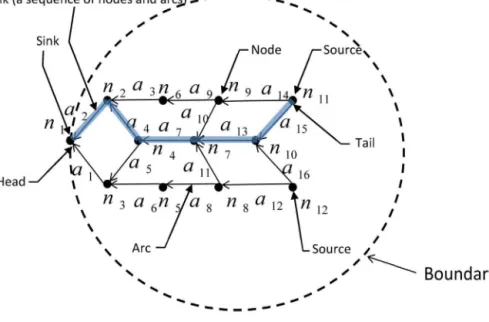
Ingeneral,graph theoryprovidesananalyticallens to char-acterizethestructural relationsamong thenodesand arcsin a network(GrossandYellen,2006).Table2summarizestheterms usedtodescribeasupplynetworkfromagraph-theoretic perspec-tive.Moreformally,agraph,denotedasG=(N,A),consistsoftwo sets,wheretheelementsinthesetNandthoseinthesetAare callednodesandarcs,respectively.EacharcinthesetAconnects twonodes,calledendpoints.Adirectedgraphordigraphisagraph withdirectedarcs,andeacharchasoneendpointdesignatedas tailandtheotherashead.Thisindicatesthedirectionofflowof goodsinthesupplynetwork.Fig.1illustratesadigraphofasupply
Fig.1.Supplynetwork.
network(SN)withthefollowingstructuralrelationships:SN=(N, A),whereN={n1,...,n12}andA={a1,...,a16}.
Somebasicconceptsingraphtheoryhelpunderstandthe struc-tureofa supply network,which leadstoadefinitionof supply networkdisruption.Thedegreeofa nodeis thenumber ofarcs attachedtothenode.Thein-degreeisthenumberofarcswhose headconnectstothenode,andout-degreethenumberofarcswhose tailconnectstothenode.Forinstance,inFig.1thenoden2has out-degree,Out(n2)equalto1andin-degree,In(n2)equalto2.Thatis, noden2receivesphysicalsupplyfromnodesn4andn6viathearcs a4anda3,respectively,andsuppliesnoden1viaarca2.Asinknode isanodewithzeroout-degreebutpositivein-degree,andasource nodeisanodewithzeroin-degreebutpositiveout-degree.Awalk inadigraphisanalternatingsequenceofnodesandarcswheretwo nodesareconnectedbythetailandheadofanarc.InFig.1,W={n11, a14,n9,a9,n6,a3,n2,a1,n1}isawalkfromn11(source)ton1(sink). ThewalkWgivesonepossiblepathwherephysicalsupplycould startatnoden11(source)andtraversethesupplynetworktoend upatnoden1(sink).
Thisstudydefinesaconnectedsupplynetworkasadigraph,i.e., anetworkwherethereexistsatleastonewalkbetweenthesource andthesinknodes2.Inotherwords,inaconnectedsupplynetwork, itispossibletogetphysicalsupplyfromthesourcenode(s)tothe sinknode.Consequently,wedefineconnectivityofasupplynetwork astheminimumnumberofnodesand/orarcsthatcanberemoved fromthenetworkuntilitbecomesdisconnected(GrossandYellen, 2006).Forinstance,thesupplynetworkinFig.1hasconnectivity of2.Disconnecting thenetwork requiresremovingatleasttwo elements,suchastwoarcs(a1anda2),oronearc(a2)andonenode (n3).
From a supply network perspective, nodes represent facili-tiessuchasfactories,warehouses,depots,orretailoutlets,where physicalgoodsarestored.Arcsrepresentconveyancemechanisms betweenthenodes, suchas air,ship, truck, railtransportation, wherephysicalgoodsareintransitfromonenodetothenext.Each archastailandheadtoindicatethedirectionofaphysicalflow.The
2Graphtheorydefinesaconnectedgraphinaslightlydifferentway.Inthetheory,
agraphismoregenerallydefinedasconnectedifforeverypairofnodesuandvthere
isawalkfromuandv(GrossandYellen,1998).Inthispaper,weadaptthisdefinition
tothesupplynetworksetting.
in-degreeandout-degreegivethenumberofagivennode’sown suppliersandcustomers,respectively.
Howone characterizesasupply network dependsonwhose perspectiveyoutake.Differentparticipantsinasupplynetwork willhavedifferentperspectivesofwhatthenetworklookslike.For instance,intheautomobileindustry,theretailers,finalassemblers, and partsuppliersallhave differentperspectivesof thesupply network structure. Since everything is ultimately connected to everythingelse,aboundaryhelpsestablishthescopeofanalysis ofsupplynetworks.Thisstudyanchorsitsperspectiveofasupply networkonafocalnode,suchasafinalassemblerinthe automo-bileindustry.Thatis,asupplynetworkisboundedbyafocalfirm andvarioussuppliersconnected,eitherdirectlyorindirectly,tothe focalfirm.Thefocalfirmthusbecomesthefinaldestinationofthe physicalflows,i.e.,thesinknodeinthesupplynetwork,andthe sourcenodeiswheretherawmaterialoriginates.Fig.1illustrates asupplynetworkmappedfromtheperspectiveofthesinknode n1,alongwiththenetworkboundary,delimitedbyadottedline,in whichtherearetwomaterialsources,n11andn12andonesink,n1. 3.2. Disruptionandresilienceinsupplynetworks
3.2.1. Nodeandarcleveldisruptions
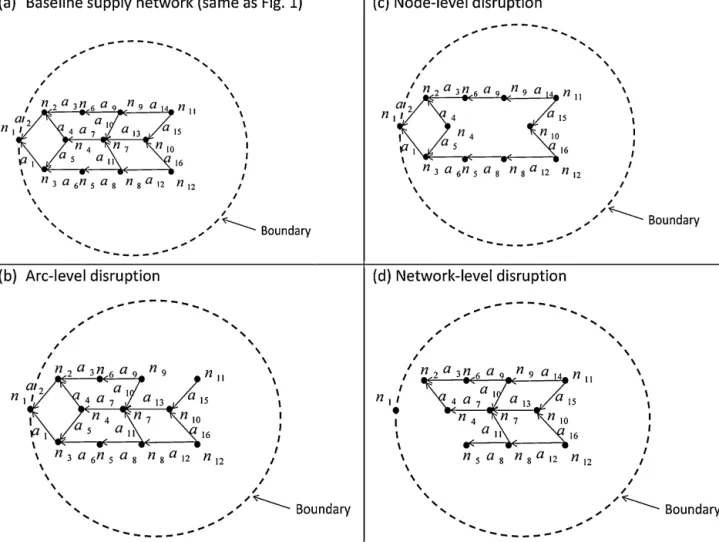
Disruptions are unplanned and unanticipated events that prevent the normal materials flow through a supply network (Svensson,2000;Craigheadetal.,2007).Wearguethataclear dis-tinctionshouldbemadebetweendisruptionsatthenode/arclevel vs.networklevel.Fromagraph-theoreticperspective,adisruption atthenode/arcleveloccursbyremovinganodeoranarcfromthe supplynetworkgraph.Thatis,thenodeorthearcbecomes inop-erableandmaterialnolongerflowsthroughthenodeoralongthe arc.Suppose,forexample,thearca14inFig.2awasremovedfrom thenetwork.Namely,theconveyancemechanismbetweenn11and n9hadanunplannedoutageandnolongeroperates.Froma graph-theoreticperspective,thisinducesasub-graph(agraphresulting fromremovingnodes/arcsfromtheoriginalgraph).Fig.2bshowsa sub-graphinducedbyremovingarca14,whichisSN=(N,A)−a14.
Noticethatevenwithouta14,therestill existwalksbetween thetwosources(n11andn12)andthesinknode(n1).Forinstance, W1={n11,a15,n10,a13,n7,a7,n4,a4,n2,a2,n1}isawalkfromn11to n1andW2={n12,a12,n8,a8,n5,a6,n3,a1,n1}isawalkfromn12ton1. Asaresult,evenwithanarc-leveldisruption(a14removed), physi-calmaterialcanstillflowacrossthenetwork.Fig.2cshowsanother
Fig.2. Examplesofsupplydisruptionsatarc-,node-,andnetwork-level.
sub-graphmadebyremovingn7,SN=(N,A)−n7.Oncen7becomes inoperable,thenallthearcsattachedton7alsobecomeinoperable. Note,however,therestillexistwalksbetweenthesourcenodesand thesinknode;specificallyW1={n11,a14,n9,a9,n6,a3,n2,a1,n1}is awalkfromn11ton1andW2={n12,a12,n8,a8,n5,a6,n3,a1,n1}is awalkfromn12ton1.Thatis,despitethenode-leveldisruption(n7 removed),materialcanstillflowthroughthenetworktothesink node.
Insum,theaboveexamplesillustratethatadisruptionateither thenodeorarcleveldoesnotnecessarilyleadtoanetwork-level disruption.Interestingly,onemayconsiderthenoden7criticalto thenetworksinceithasthehighestdegree(in-degreeplus out-degree)inthenetwork.Nonetheless,thedisruptionofthisnode doesnotdisrupttheentiresupplynetwork.Thisposesthequestion: Whatkindsofdisruptionwillleadtoadisruptionoftheentiresupply network?
3.2.2. Networkleveldisruptionandresilience
Wedefineasupplynetworkdisruptionasasituationwherethere nolongerexistsawalkbetweenthesource(s)andsinknodeasa consequenceofadisruption(s)innodesorarcs.Thatis,thesupply networkbecomesdisconnected.However,asintheabove exam-ples,adisruptionatanode(n7)orarclevel (a11)maynotlead toadisruptionatthenetworklevel.Fig.2dshowsanother situ-ation,inwhichadisruptionoccurredwithboththenoden3 and thearca2,SN=(N,A)−n3−a2.Asaconsequenceofremovingthe twoelements,n3anda2,fromthesupplynetwork,therenolonger existsawalkbetweenthesourcesandsinknode.Thisillustratesa
situationwherenode/arc-leveldisruptionsledtoanetwork-level disruption.Here,onemayconcludethatanetwork-leveldisruption involvesinvariablymorethanonedisruptioninanodeand/orarc. However,adisruptionofasinglenode/singlearccouldalsolead toadisruptionofanentirenetwork,whichdependsonthe (rela-tive)positionsofnodes/arcsinthenetworkandtheoverallnetwork structure.
Takentogether,theaboveillustrationspointouttheneedto differentiatebetweenanode/arc-leveldisruptionanda network-leveldisruption.Theseillustrationsalsosuggestthatthepositions, orstructure,ofnodes(facilities)andarcs(transportation)ina sup-plynetworkaffectsitsdisruptionrisk.Inotherwords,theoverall configurationofthenodes/arcsinanetworkinfluencestheextent towhichthenetworkstaysconnectedorresilient.Whilenetwork resiliencecanbedefinedinanumberofways(Newman,2010), in keeping withour definitionof a supply network disruption, wedefinesupplynetworkresilienceasanetwork-levelattributeto withstanddisruptionsthatmaybetriggeredatthenodeorarclevel. Consequently,supplynetworkresilienceisanemergentstructural propertyofasupplynetwork.Therefore,differentnetwork struc-tureswillhavedifferentdegreesofsupplynetworkresilience.
4. Supplynetworkstructuresandresilience
Complexadaptivesystemstheoryprovidesa useful theoreti-calframeworkforexaminingsupplynetworkstructures(Langton, 1990; Kauffman,1993).Based on this theory,researchers have developedanalyticframeworksforstudyingtherelationsamong
Fig.3. Fourbasicsupplynetworkstructuresandthecorrespondentnodedegreedistributions.
the elements of a system. In particular, the NK model helps understand complex systems (Kauffman and Levin, 1987; Kauffman,1993).Thismodelfocusesontheinteractions(or con-nections) of the elements in a system and their system-wide impact.Thishelpsassessthestructureofthesupplynetwork ele-mentsandtheassociatedbroad-scaleimpactontheoverallsupply network.UndertheNKmodel,Nreferstothenumberofelements (i.e.,nodes)inasystemandKreferstothedegreeofinteraction amongtheelements(i.e.,arcs).Forinstance,ifN=10andK=2,then thereare10nodesandtheaverageof2arcspernode(atotalof20 interactions[arcs])inthenetwork.
Scholarshaveidentifiedsomearchetypesthatcancharacterize basicnetworkstructures(GhemawatandLevinthal,2008;Rivkin, 2000; Rivkin and Siggelkow, 2003, 2007; Schilling and Phelps, 2007).Theyinclude:random,local,small-world,block-diagonal, scale-free,preferential-attachment,centralized,dependent, hier-archical,anddiagonal.RivkinandSiggelkow(2007)appliedthese structurestodecision-makingmodels,wheretheyholdN×K(or NK) constant and investigatethe effects of differentstructures at thesame level of complexity. In this study,we adapt these fundamentalstructurestorepresentbasicsupplynetwork struc-tures.Thisanalysisfocusesonfourbasicnetworkstructuresthat
Table2
Terminologiesanddefinitionsforsupplynetworkgraphs.
Term Definition Denotation/example*
Graph Astructuredefinedbyasetof nodesandasetofarcswhich depictsasupplynetwork
G=(N,A)/Fig.1
Node Apointonagraph,which representsaphysicallocation inasupplynetwork(e.g. manufacturingfacility, warehouse,retailstore)
ni,Fori=1,...,12
Arc Alinethatconnectstopoints inagraph,whichrepresentsa conveyancemechanism betweentwophysical locationsinasupplynetwork (e.g.railroadshippingfroma manufacturetoawarehouse)
ai,Fori=1,...,12
Digraph Agraphwhereallarcshavethe headandtail,whichgivesa directionfromonenodeto anothernode,whereby indicatingthedirectionofthe overallnetworkflow.Ina supplynetwork,this representsthedirectionofthe overallflowofphysicalgoods (e.g.arailroadshipsfromthe manufacturetothewarehouse)
Fig.1
Tail Oneendofthearcsina digraph,whichindicateswhere thephysicalgoodoriginates
SeeFig.1
Head Oneendofthearcsina digraph,whichindicatesthe destinationofphysicalgoods
SeeFig.1
In-degree Thenumberofheads connectedtoanode
In(ni)(e.g.,In(n2)=2)
Out-degree Thenumberoftailsconnected toanode
Out(ni)(e.g., Out(n2)=1)
Source Anodethathasazero in-degreeandpositive out-degree.Forexample,araw materialsupplierthatdoesnot receiveanyproduct,butonly furnishesit
n11andn12
Sink Anodethathasazero out-degreeandpositive in-degree.Forexample,a supplynetworkmayendata retailerwherethephysical goodisnotshippedanywhere else,butonlyreceivesit
n1
Walk Asequenceofalternating nodesandarcsthatoriginates fromthesourcenode(s)and ultimatelyendsatthesink node
W={n11,a15,n10,a13, n7,a7,n4,a4,n2,a2,n1}
* BasedonasupplynetworkillustratedinFig.1.
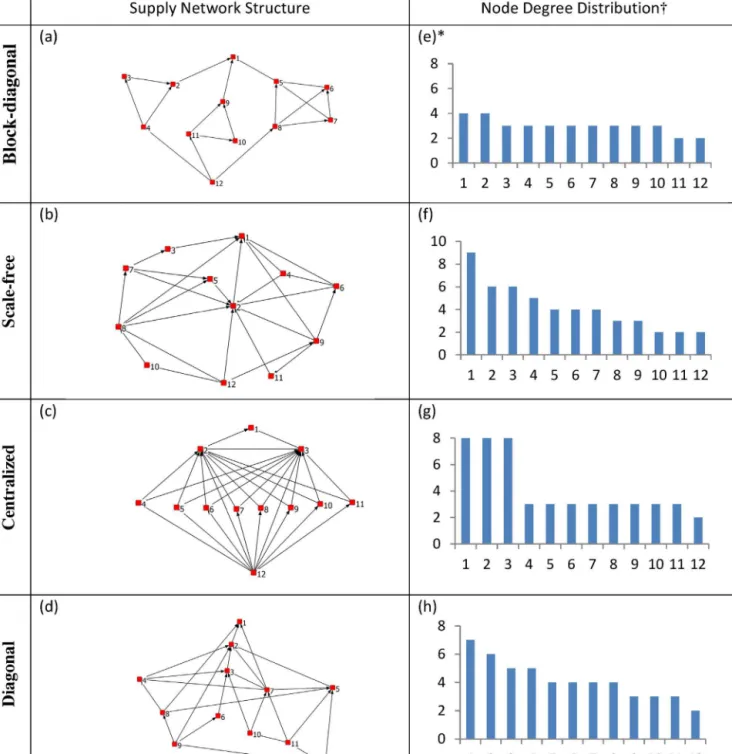
oftenoccurinreal-worldsupplychainmanagementsettings: block-diagonal,scale-free,centralized,anddiagonal(seeFig.3).
Weexcludetheothersixstructuresfromtheanalysisforthe fol-lowingreasons.Thefirstthree–random,local(asimplelinearchain ofnodes),andsmall-world(locallyclusterednodeslinkedviaafew long-distancebridgingarcs)–arerarelyfoundinpractice.Thatis, inaphysicalsupply networksetting, itishard toconceiveof a practicalsituationwherethenodesandarcsaredeterminedby ran-domassignment(random),whereallthenodesandarcsarelinearly alignedtoformasinglechainorwalk(local),orwherethenetwork nodesarearrangedintolocal,distantlyseparatedclusterswithonly long,indirectlinksamongthem(small-world).Also, preferential-attachment,dependent,andhierarchicalarestructurallyakintothe scale-free,centralized,anddiagonal,respectively,wherethe lat-terthreeareviewedasrelativelymorerealisticorbasicinterms
ofphysicalsupplynetwork.Wedidanalyzethese“kin”structures, buttheydidnotappreciablydifferfromthestructureswediscuss. Hence,wefocusonthefourfundamentalstructuresandadaptthem tothesupplynetworkcontext,wherematerialflowsfromonenode toanotherviaadirectedarc(digraph).Consequently,the complex-ity(NK)variessomewhatacrossthesebasicstructures,butNKis keptasclosetothesamevalueaspossible.Todothis,wehold N(numberof nodes)constant, and allowsmalldeviations in K (numberofarcs)tomakeeachstructuremeaningfultothe sup-plynetworksetting.WhilewetrytokeepKsimilaracrossthefour networkstructures,morefocusisonmakingthepatternsof con-nectionscorrespondtotheconceptualdefinitionofeachstructure. Thishelpscapturetheessentialdifferencesofthebasicstructures. Forinstance,giventhesameN,theblock-diagonal(disjointed mul-tiplehigh-densityclusters)andcentralized(networkconnections concentratedonjustafewnodes)patternshavedifferentbybut almostthesamelevel ofK(seeFig.3).Inaddition,theanalysis assumesthateverynodeandarcinthesupplynetworkshasthe samerisk(orprobability)ofdisruption,whichfurtherhelpsisolate theanalysistofocusonstructuraldifferences.
ConsistentwithRivkinandSiggelkow(2007),Nissetto12for eachsupplynetwork.Also,eachnetworkisassumedtohaveasingle sinkandasinglesource(Fig.3),whichreflectsthemostbasicsupply networkstructureandallowsformoremeaningfulcomparisons (BorgattiandLi,2009).Thenodesinthenetworksusethefollowing labelingscheme—thesinknodeislabelednumber1,thesource node12,andtheremainingnodes2to11,wherealowernumberis giventoamoredownstreamnode(towardn1)andahighernumber toamoreupstreamnode(towardn12).Thetotalnumberofarcs rangesfrom18(block-diagonal)to29(centralized)foreachofthe basicsupplynetworkstructures.
Afewextraconstraintshelpmakethestructuresmore compa-rable.First,allnodesexceptthesourceandsinknodes,haveboth in-degreeandout-degreegreaterthanzero.Inthesupplynetwork context,itmakesnosensetoexaminenodesisolatedfromthe net-work.Also,wearrangethenetworkconnectionsinsuchawaythat physicalflowsalwaysgofromupstreamtodownstream.Thatis, thereisnosuchacasewhere,foragivenspecificnode,anincoming arccomesfromalower-numbered(downstream)nodeoran out-goingarcgoestoahigher-numbered(upstream)node.Thisfurther helpskeepthevariationincomplexitytoaminimumacrossthe fournetworkstructuresandfacilitatetheirstructuralcomparisons onresilience.Moredetaileddescriptionsofthefourbasicsupply networkstructuresalongwithindustryexamplesfollow.
4.1. Basicsupplynetworkstructures 4.1.1. Block-diagonal
Thisnetworkstructure(Fig.3a)hasclustersofnodesbetween thesourceandsink,whereconnectionsoccurwithinclustersbut notbetweenclusters(RivkinandSiggelkow,2007).Ingeneral,this patternrelatestothenotionof decomposability(Simon, 1962). In a supply network context, this characterizes a network that makesmodularproducts(Starr,1965;Sturgeon,2002)suchas per-sonalcomputer(PC),bicycles,andfinancialservices.Forinstance, considera typicaldesktopPCsupplychain. Itcomprises a final assemblerand various modulesuppliers,each of which isfully responsiblefordesigningand manufacturingtheassigned mod-ule.Todoso,eachofthesesupplierstightlycoordinatesitsown cluster(block)ofparts-suppliersorsub-assemblers(Baldwinand Clark,1997).Thisbasicsupplynetworkstructurewasadaptedfrom RivkinandSiggelkow(2007).
4.1.2. Scale-free
Thescale-free network pattern captures“therich-get-richer” dynamic(BarabásiandAlbert,1999).Inthisnetwork,afewnodes
havedisproportionatelymanyconnections,whilemostoftheother nodes have only a few connections. The networking structure thusresembles the“hub-and-spoke”or “core-periphery”model (BorgattiandEverett,1999).Consequently,thenodedegree dis-tributionofthenetworkappearsashighlyskewedandfollowsa power-laworParetodistribution(Mitzenmacher,2004).This net-workstructure (Fig. 3b)is adapted fromRivkin and Siggelkow (2007).Inthesupplynetworkcontext,thismayreflectasituation whereasmallgroupoftop-tiersuppliersworkcloselytogether andcollectivelyinfluencesupplyflowsfromupstreamparticipants. ThisstructuremirrorsakeiretsusupplynetworksuchasToyota city(Markusen,1996), inwhicha smallnumberof“core”firms (i.e.,thefocalmanufactureranditshighlyintegratedtopsuppliers) jointlycontrolandmanagelargernumbersof“peripheral”firms (Gerlach,1992).TheaerospaceindustryaroundtheSeattleregion offersanotherexampleofthisnetworkstructure(Grayetal.,1996), wherenumeroussuppliersclusteraroundafewcorefirms. 4.1.3. Centralized
Thecentralizednetworkstructure(Fig.3c)takesthenotionof highlycentralnodestotheextreme(Barabási,2002).Inthis struc-ture,afewnodesconnectto(almost)allothernodes,whilethe othernodeslinkonlytothefewhighlycentralnodes(Rivkinand Siggelkow,2007).Barabási(2002:103)describesthisasa “winner-take-all”structure.Inthesupply networksetting,this structure mirrorsthesituationwherethesourcenodedirectlyconnectstothe fewcentralnodesaswellastomostofthenodesin-between.This typeofsupplynetworkoccursinthePratotextileindustrial dis-trictofTuscany,Italy(Paniccia,1998);thenetworkrevolvesaround afewcoordinatingagentscalled“impannatori.”InthePrato tex-tileindustry,afewcentralbrokersprocurerawmaterials,allocate orders,giveinstructionstoanumberofsmall-tomedium-sized specialistsubcontractors(suppliers)intheregion,andeven mar-ketend-productstocustomerfirms,andconsequentlyexertalot ofcloutinthesupplynetwork.Anotherreal-worldexamplecomes fromafieldstudyexperiencedbyoneoftheauthorsofthisstudy, whereonemajorautomakeremploys‘black-boxsourcing’(Clark andFujimoto,1991)inproducingnavigationandstereosystems. Thatis,thetop-tiersuppliersassumecompleteresponsibilityfor designing,engineering,andproducingtheentiresystemsonbehalf ofthecustomerfirm,wheretheyplanandmanageallthenecessary stepsinthedevelopmentprocess,evenworkingdirectlywithall thetertiary-levelsuppliersoftheautomaker.
4.1.4. Diagonal
Thisbasicsupplystructureisbasedonthehierarchical inter-action patterns. In this structure (Fig. 3d) connections occur sequentially,whereeverynodetakessupplyfromitslower-tier nodes,but not fromthenodes aboveit (Rivkin and Siggelkow, 2007).This typeof connectionpatternembodiesa multi-tiered supplynetworkstructure.Inthisstructure,mostofthenodesin betweenthesourceand sinkcanbepartitionedintosubsets of nodesthatformtiers,inwhich theconnectionsprimarilyoccur acrossdifferenttiers.Consequently,directarcstothesinknode comeonlyfromtop-tiernodes.Unlikeinthe“pure”hierarchical structure,however,inthediagonalstructurenoteveryhigher-tier nodetakesdeliveryfromallthenodesbelowit.Thistypeofpattern typicallyoccursinmilitarylogisticsnetworks(Zhaoetal.,2011), whereprecedentactivitieshavetobecompletedbeforethenext activitiescanbegin.Also,thismaybethecaseforsomeOEMsin theautomotiveindustry,inwhichtheydirectlyselectandmanage their1st-tiersuppliersanddevolveonthesesuppliersthetasksof selectingandmanaginglargernumbersoftheirownsuppliers(i.e., theOEMs’2nd-tiersuppliers),andthenthe1st-tiersuppliersfollow suitandsoforth(ChoiandHong,2002).
4.2. Resilienceofbasicsupplynetworks
We evaluatethefour basicsupply network structuresusing severalwell-establishednetworkanalysismetricsthatmayhave implicationsfornetworkresilience.Inaddition,weproposeanew measureofsupplynetworkresiliencethatcorrespondstoour def-inition.The fourbasicnetworkstructures arecompared onthe various network metrics for their resilience and we determine howmuchtheexistingnetworkmetricspredictsupplynetwork resilience when compared to our measure of supply network resilience.
4.2.1. Networkandresiliencemetrics
Thenetworkliteraturehasidentifiedseveralmetricsfor net-worksthatmayhelpunderstandsupplynetworkresilience.These metricsinclude:networkdensity,averagedegree,walks,average walklength,maximumandminimumwalklengths,connectivity, betweennesscentrality,andnetworkcentralization.Network den-sityreferstoaratioofthenumberoftotalexistingarcstothetotal numberofpossiblearcsinthenetwork.Theaveragedegreeisthe averagenumberofarcsacrossallthenodesinanetwork.The aver-age,maximum,and minimumwalklengths referto,respectively, the averagelengthof the identified multiplewalks, the length ofthelongestwalk,andthelengthoftheshortestwalkforeach basicsupplynetwork.Theconnectivityistheminimumnumberof nodesand/orarcsthatmustberemovedtodisconnectthenetwork (Harary,1969;WassermanandFaust,1994).Betweennesscentrality isbasedonthenode-levelbetweennesscentralityCB(ni)(Freeman, 1977)definedasfollows: CB(ni)=
j<k gjk(ni) gjk ,wheregjkisthetotalnumberofshortestpathsbetweeneachpair ofnodes,andgjk(ni)isthenumberofthoseshortestpathsthat containni.Theeachnode’s(ni)betweennessistheprobabilitythat thenodeliesonshortestpathsbetweenothernodes.After calculat-ingthismetricforallthenodesinanetwork,theaverageofthese valuesgivesthenetwork-levelbetweennesscentrality.Thismetric assesseshowoftenthenodesinanetworklieontheshortestpath betweenallcombinationsofpairsofothernodesinthenetwork. Thecentralization(C)foreachnetworkiscalculatedusinga def-initionfordegree-basednetworkcentralization(Freeman,1979):
C=
gi=1[CD(n∗)−CD(ni)] max
gi=1[CD(n∗)−CD(ni)],
whereCD (ni)isnode-leveldegreecentrality,andCD (n*)is the maximumvalueinthenetwork.
Finally,weuseasimulationmodeltocomputethesupply net-workresilience.Recall,asupplynetworkdisruptionoccurswhenthe networknolongerhasawalkfromthesourcetothesinknodedue todisruptionsofnodesandarcs.Thus,tocalculatesupplynetwork resilience,weestimatethelikelihoodthatthereexistsatleastone walkbetweenthesourceandsinknodeswithrandomremovalof nodesand/orarcsin-betweenthetwoendpoints.Thatis,each sim-ulationrundeterminesifanetworkdisruptionoccursinthefaceof node/arcdisruptions.Morespecifically,foreachbasicsupply net-work,wecalculatedaratioofthetotalnumberofcombinations ofnode/arcremovalsthatdonotleadtoadisruptionofthe net-workoverthetotalnumberofpossiblecombinationsofnode/arc removals(asdeterminedbythetotalnumberofthegiven simu-lationruns),whichmayormaynotleadtoanetworkdisruption. Formally,
Table3
Networkmetricsandresilienceforfourbasicsupplynetworkstructures.
Networkmetrics Block-diagonal Scale-free Centralized Diagonal
Node/arcs 12/18 12/25 12/29 12/25
Networkdensity .14 .19 .22 .19
Averagedegree 1.50 2.08 2.42 2.08
Resilience .11 .30 .16 .13
Walks 8 19 27 21
Averagewalklength 6.5 6.89 5.44 8.62
Max.walklength 9 11 7 13
Min.walklength 5 3 3 5
Connectivity 3 4 2 3
Betweennesscentrality 1.33 1.67 .75 2.58
Centralization(%) 10.91 52.73 67.27 30.91
Supply network resilience
=
total number of node/arc disruptions, which does not result in a supply network disruption
total number of node/arc disruptions
Weexcludethesourceandsinknodeinthiscalculationbecause thiswouldautomaticallyleadtoadisruption,andbecauseourfocus isonunderstandinghowthestructureofrelationshipsamongthe componentsinbetweenthesourceandsinkaffectsresilienceat thenetworklevel.Nonetheless,includingthetwoendpointsinthe analysiswouldnotchangethemetrictoomuchevenformoderately sizednetworks(suchasonesunderconsiderationinthisstudy).
Toassessthismetricforthefourbasicnetworkstructures,we developasimulationmodelusingvisualbasic.Ineachsimulation run,werandomlyremoveeachofthenodesandarcs(betweenthe sourceandsink)ortheircombinationswithequalprobabilityof failure.Thenwedetermineifthereexistsatleastawalkfromthe sourcetothesinknode(i.e.,thenetworkwasnotdisrupted).We ranthisprocesswithfourdifferentsamplesizes(i.e.,numbersof iteration)of5000,10,000,15,000,and30,000timesandthen,for eachsamplesize,computedthetotalnumberoftimeswhenthe networkwasnotdisruptedover thetotalnumber ofsimulation runs(5000,10,000,15,000,or30,000).Thisgivesanestimateofthe supplynetworkresilienceforeachofthefourbasicsupplynetwork structures.Theanalysisgaveveryconsistentresultsacrossthefour differentiterationsofsamplesizes.Table3reportsthelevelsof supplynetworkresiliencebasedon30,000simulationruns,which isaccuratetoatleasttwodecimalplaces(seeauthorsfordetailsof thevisualbasicsoftwareandsimulationmodel).
Fortheanalysis,weconstructedabinaryadjacencymatrixor sociomatrix(WassermanandFaust,1994)foreachbasicnetwork. Thematriceswereinputs toasimulation modelthat computes supplynetworkresilienceandtheUCINET6socialnetwork soft-warethatanalyzesthenetworkdatafortheothernetworkmetrics (Borgattietal.,2002).Table3givesthesevariousmetricsforthe foursupplynetworkstructures.
4.2.2. Comparisonsofsupplynetworksonresilience
Thebasicsupplystructuresshowdifferentscoresonthe met-rics,includingthesupplynetworkresilience.Table3showsthat thescale-freenetworkstructurehasbyfarthehighestresilience (.30),much higherthan thecentralizedstructure (.16),thenext highest.Therefore,theresultshelpshowhowwelleachofthe net-workmetricscanpredictresilience.First,onemightassumethat adensernetwork(i.e.,highernumber ofnetwork arcs)tendsto bemoreresilient.However,intermsofnetworkdensityand aver-agedegree,thecentralizedstructurehasthehighestvalues,dueto itsslightlyhighertotalnumbersofarcs.Also,intuitionmight sug-gestthatmorewalksfromthesourcetothesinkwouldresultin highernetworkresilience.Table3showsthatthecentralized struc-tureagainhasthemostwalks(27),butitisnotthemostresilient.
Thediagonalstructurehasthesecondmostwalks(21),butwithan evenlowerresiliencescore(.13).Theaverage,maximum,and min-imumwalklengthsofeachstructurealsodidnotpredictnetwork resilience.Onthesemetrics,thediagonalstructurehasthehighest scores.
Thenetwork-levelmetricsofbetweennesscentralityand central-izationalsodidnotcorrelatewithresilience.Onemightassumethat themoreoftenthenodesbridgeothernodesinanetworkorthe moreconcentratedthenetworkconnectionsaroundafewnodes inanetwork,themoreresilientthesupplynetworkwillbeto ran-domfailures.However,diagonal structurescoreshighestonthe betweennesscentralitymetricbutsecondlowestonresilience.The centralizedstructurescoreshighestoncentralization,butagainis notthemostresilient.Theconnectivitymetricappearstobemore predictiveofnetworkresiliencewhencomparedwiththeother metrics.Thescale-freestructurehasthehighestconnectivity(4). However,thecentralizedstructurehasthelowestconnectivity(2), albeitthesecondmostresilient.Further,thediagonaland block-diagonalstructurestiefortheconnectivityat3,whiletheformer isrelativelymoreresilient.Thismetriccannotdistinguishamong thethreelessresilientnetworkstructures.Wealsoexaminedother networkarchetypes(afterstructuraladaptationstothesupply net-workcontext)andfoundsimilarresults.
Taken together, the above results indicate that well estab-lished network metrics do notconsistently nor reliablypredict networkresilience.Interestingly,denserormerelymorecomplex networksdonotnecessarilyhavehigherresilience.Thisimplies thatfromanetworkperspective,redundancymaynotalwayslead tohigherresilience,whichcontradictssomeoftheconventional viewsonsupply networkresilience(see Sheffi,2005).Thisalso conflictssomeresearchonsupplynetworkresiliencethatargues fortheassociationbetweenthewell-establishednetworkmetrics andresilience(e.g.,Nair andVidal, 2011).Overall, theseresults suggestthatstructureplaysasignificantroleinsupplynetwork resilience.Researchersthusneedtocarefullyconsidertheirchoices ofmetricstoassessresiliency.Taken-for-grantedassumptions(e.g., thatredundancyleadstohigherresilience)mayleadtoan erro-neousconclusion(e.g.,thathigheraveragedegreewillhavehigher resilience).Rather,theremaybeanon-linearrelationbetweenthe existingmetricsand resilience,whichiscontingentonnetwork structure.Scholarsconductingempiricalresearchonsupply net-workresilienceneedtobecarefulabouthowtheyconceptualize andusemetrics.Assuch,networkresiliencerepresentsan under-examinednetworkproperty,andmeritsfurtherresearch.Asastep inthisdirection,weadvancesomepropositionsthatlinksupply networkstructuretoresilience.
5. Propositiondevelopment
The abovecomparisons demonstrate that network structure affectsnetworkresilience.Anetwork-leveldisruptionoccurswith theremovalof allpossiblewalksbetweenthesourceand sink. Removingnodesorarcsfromanetworkpotentiallychangesthe numberof walks,which mayultimately disrupttheentire net-work(Newman,2003).Assumingthateverynode(facility)andarc (transportation)inasupplynetworkhasequalriskoffailure, dif-ferentconfigurationsofthenodesandarcswillleadtodifferent chancesofreducingthenumberofwalksinthefaceofnode/arc disruptions,whichdeterminesthelikelihoodofnetwork disrup-tion.
In the literature on complex networks, many scholars have advocatedexaminingnetworkresiliencefromastructural perspec-tive.Albert etal. (1999)studied theeffectof nodedeletion on networkresilienceintheInternetandtheWorldWideWeb.The sameauthorsstudiedtheattack-toleranceofcomplexnetworks
(Albertetal.,2000),andfoundthatnetworkswithahighlevelof centralitytendtobemorerobusttorandomremovalofnodes/arcs. Thesocial-ecological systems literaturehasalsoexaminedhow networkstructure (ofhumans,communities,and organizations) affectsanabilitytoadaptandwithstanddisruptions.Forinstance, Holmeetal.(2002)studiedvulnerability(measuredbytheaverage inverseshortestpathlength)ofvariousvirtualsocialnetworkswith removalofbothnodesandarcs.Adgeretal.(2005),fromastructural perspective,investigatedsocial-ecologicalsystemsfortheir vulner-abilitytodisastersandsuggestedthatamulti-levelstructurecan bettercopewithunexpectedexternalshocks.Thepreviousstudies suggestthatnetwork structuralproperties,particularly connect-ednessandcentrality,affecttheresilienceofcomplexnetworks (Albert etal.,2000;Dunneetal.,2004;Janssenetal.,2006).As aresult,thisstudybuildsuponpriorresearchbyexaminingthe networkstructureeffectonsupplydisruptionandresilience.
Ouranalysisprovidesfurthersupportfor thesignificantlink betweennetworkstructureandnetworkresilience,andsupports thisargumentinthecontextofsupplynetwork.Eachofthefour structuresreflectstheuniquearchetypeofsupplynetwork con-figuration.While theyappeardifferentfromeachotherinform (Fig.3),thefourstructuresareanalyticallycomparable.Theywere alladaptedfromtheexistingarchetypes(inRivkinandSiggelkow, 2007)tothesupplynetworksetting,sothattheyhavesimilarlevels ofcomplexity(NK).However,theanalysisdemonstratesthatthese basicsupplystructureshavedifferentlevelsofnetworkresilience. Forinstance,Table3showsthatthescale-freestructurehasthe highestresilience,buthasrelativelylowscoresonthedensity, aver-agedegree,numberofwalks,betweennesscentrality,andnetwork centralizationmetrics.Weneedtonotethatthenumberofarcs (i.e.,inter-firmconnections)itselfmaynotbeareliablepredictorof resilience,whichcontradictssomeoftheconventionalviewsthat promoteredundancyinnetworkelementstoincreaseresilience (Sheffi,2005).Apparently,thereexiststructuraldifferencesacross thebasicsupplynetworks,thatis,inthewaythatthenodesandarcs areconfiguredinthenetwork,whichgreatlyaffectsthenetwork disruptionriskandresilience.
If we can observe much smaller differences in resilience betweennetworksof similarstructure than betweendissimilar structures,thisshouldfurthersupporttheargument.In a post-hocanalysis,weadaptthepreferential-attachment,dependent,and hierarchicalstructuresbasedonRivkinandSiggelkow(2007)and comparetheirresiliencetotheirstructuralcousins,i.e.,scale-free, centralized,anddiagonal,respectively3.Whilewestillfinda dif-ferenceinresiliencelevelbetweeneachpairofstructuralcousins, thespread ineachpairismuchsmallercomparedwiththe dif-ferencesbetweendissimilarstructures.These observationsthus lendsupportforourargumentthatthesupplynetworkstructure significantlyaffectsthedegreeofnetworkresilience.
Proposition1(P1). Ceterisparibus,thestructureofasupply net-workaffectstheresilienceofthesupplynetwork.
Whatspecificstructuralcharacteristic(s)affectthedifferences inresilienceamongthesupplynetworks?Theanalysisand observa-tionssuggestthattheoverallarrangementofthenodesandarcsin asupplynetworkinfluencesthelikelihoodofnetworkdisruption. Namely,degreedistributionofasupplynetworkplaysacriticalrole indeterminingitsresilience.
Thedegreedistribution(degreeofanodeequalsthenumberof arcsattachedtoit)reflectstheoverallpatternofconnectednessin anetwork(Strogatz,2001).Thereareavarietyofdifferentwaysin whichnodesorarcscanberemovedfromanetwork.Weassume, arguably,inasupplynetwork,anodeorarcdisruptionrandomly
3Theadditionalanalysisresultsareavailableuponrequest.
Many nodes with few arcs
Rank-order of nodes by their k arcs A few nodes with many arcs
N um be r of arcs (k)
Fig.4. Power-lawdistribution.
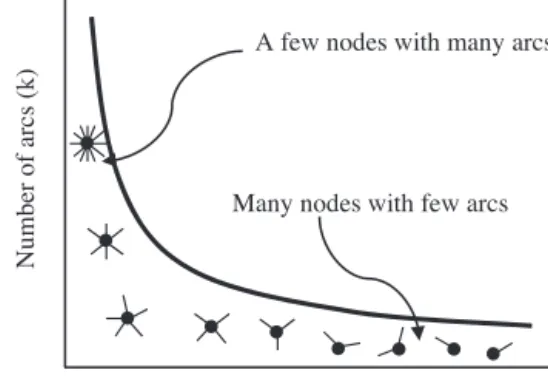
occurs.Thatis,theindividualnodesandarcshaveapproximately thesameleveloffailurerisk.Givensuchrandomfailurenatureof thenetworkelements,configuringtheminsuchawaythateach ofthemcarriesthesameweight(i.e.,thesamedegree)intermsof connectingthesupplynetworkmaynothelpmitigatesupply dis-ruptionrisk.Failureofanynode(andsubsequentlyagivennumber ofarcsattachedtoit)willnotonlyremovetheseelementsfrom thenetwork,but alsocrippleasmanyothernodesof thesame importancebyreducingtheirdegreeandremovingpathsbetween them,whichcansignificantlydisturbthematerialflowsand dis-ruptthewholenetwork.Drawingoncomplexsystemstheory,we proposethatanetworkexhibituniquepropertiestofailurewhen its(node)degreedistributionfollowsapower-law(Newman,2010). Networkstructuresthatfollowapower-lawfeatureskeweddegree distributions(seeFig.4).
The power-law distribution, sometimes called scale-free (BarabásiandAlbert,1999)orParetodistribution(Newman,2005), reflectsasituationwhereafewnodesinanetworkhave dispropor-tionatelyhighdegreeandmanyoftheothernodeshavelowdegree. Thisformofdegreedistributionhasbeenrecognizedasaunique structuralfeatureofmanyattack-tolerantcomplexnetworks.Albert etal.(2000)observethatsomeorganicnetworkssuchasthe Inter-netandtheWorldWideWebfollowapower-lawintheirdegree distributions.Furthermore,theyfoundthattheaveragepathlength betweenpairsofnodesinthosenetworkswasalmostunaffectedby randomremovalofnodes.Drawingonthesameidea,Broderetal. (2000)arguedthattodestroytheconnectednessintheWorldWide Web,onewouldneedtoremoveallnodeswithdegreegreaterthan five.GiventhehighlyskeweddegreedistributionoftheWeb,only asmallproportionofallnodeshavedegreegreaterthanfive.These studiessuggestthataskeweddegreedistributioncanenhancethe resilienceofcomplexnetworks,especiallytorandomshocks.
Innetworksthatfollowapower-lawdistribution,mostofthe nodeshavelow degreeandthereforelieonfewpathsbetween others. Consequently, averagepath length would increase only marginally,ifnotatall,withrandomremovalofnode/arcfromthe network.Inotherwords,randomnode/arcremovalrarelyaffects theoverallconnectednessofanetworkwiththisstructure.This hasimplicationsforreducingsupply networkdisruptions.From theperspectiveofthefocalfirmofasupplynetwork(e.g.,OEMs intheautomotiveindustry),ifitskeysuppliersareclosely con-nectedtooneanothertothepointwheretheyevensharepreferred tertiary-levelorraw-materialsuppliers,itisequivalenttothe cre-ationofpotentialalternativewalks,which canmake thesupply systemfairlyrobusttorandomfailuresthatmayoccureven“deep inthesupplynetwork.”Toyotasupplynetworkprovidesacasein pointintheAisinfirecase(NishiguchiandBeaudet,1998).A1997 fireatafactoryofAisinSeiki,themainsupplierofthebrakevalvesto
Toyota,threatenedtohaltToyota’soperationsforweeks.However, theabruptnode-levelfailure,insteadofleadingtoanetwork-level disaster,wasavertedduetotheexistenceofalternativewalksin thenetwork.Toyota’stop-tiersupplierssharedtheinformationand managementoftheupstreamsideofthenetwork,whichenabled themtosetupalternativeproductioncapabilitiesoutsideofAisin, andthewholeprocesswasorchestratedwithverylimiteddirect controlfromToyota.Therefore,everythingelsebeingequal,a sup-plynetworkstructurewithnodedegreedistributionconforming toapower-lawbecomeslessvulnerabletonetwork-level disrup-tions,comparedtonetworkswiththedistributiondeviatingfrom apower-law(Albertetal.,2000).
Ourtheoreticalandcomputationalanalysesofthebasicnetwork structuressupportthisargument.Fig.3,panelse–hillustratesthis pointinthenode-degreehistogramplotsforthefourbasicsupply networkstructures.Thehorizontalaxisoneachhistogram rank-orders12nodesbydegree,andtheverticalaxisdenotethenode degree.Comparisonsofthehistogramsshowthatthemostresilient supplynetwork,scale-free,mostcloselyfollowsapower-law dis-tribution.Bydefinition,mostofthenodesinthenetworkhavelow degree,whilejustafewnodeshavefairlyhighdegree,whichresults inalongtailtotherightofthehistogram(Barabási,2005). Observ-ingthehistograms,wecanalsonoticethat,nexttothescale-free,the centralizedstructureappearstoresembleapower-lawpatternfor itsdegreedistribution.Itisnotsurprising,thus,toseethestructure havingthesecondhighestresiliencelevel.Nonetheless,the central-izedstructurescoresmuchlower(.16),comparedtothescale-free (.30).Thecentralizedpattern,asnotedearlier,takesthenotionof highlycentralnodestotheextreme,andsotherearevirtuallyno connectionsamongthelower-degreenodes.Thiscantranslateinto limitedconnectednessinthenetwork(i.e.,limitedalternativepaths tothecentralnodesaswellastothesink).Hence,thestructure, despiteitsslightlymorearcs(29)thanscale-free(25),showsmuch lowerresilience.Consequently,thedegreedistributionofasupply networkinfluencesitsresiliencetoagreaterextent,comparedwith othernetwork-levelmetrics.
Proposition2(P2). Themorecloselyasupplynetworkfollows apower-lawforthedegreedistributionofthenodes,themore resilientthesupplynetworkwillbecome.
6. Discussionandconclusion
Scholarshavebeguntostudysupplynetworkdisruptionand resilience,but largelyatthenodelevel(Craighead etal.,2007). However,thiscanbemisleadingwhenlookingatdisruptionsfroma networkperspective.Complexitytheoryarguesthatsystem behav-ioremergesfromtheactionsorinteractionsofthecomponentsof asystem.Thispaperdevelopsanetworkperspectiveofdisruptions andresiliencetoshowhowdisruptionsandresilienceemergefrom thenetworkcomponents.Anetworkviewaltershowwemanage andconductresearchonsupplynetworkdisruptions.Fig.2 illus-tratestheimportanceofunderstandingthesupplynetworkasa whole.BylookingatindividualnodesinFig.2,somewould con-sidernoden7tobethemostcriticalnodeduetoitscentrallocation andhighdegree(Craigheadetal.,2007).However,disruptingthis nodedoesnotdisruptthenetwork(seeFig.2c).Withoutan under-standingofthestructureofthenetwork,managersmayunwittingly allocateresourcesonlytoincreasetheresilienceofthewrongnodes inthenetwork.Managers(andscholars)maybemisledby look-ingatonlythenodesofasupplynetworkandnotconsideringthe overallstructure.
Thisstudymakesthefollowingcontributionstotheliterature. First, it provides a formal definition of a supply network dis-ruptionbydifferentiatingitfromdisruptionsofnodesandarcs. Existingdefinitionsofsupply networkdisruptiondonot clearly
specifythelevelsofeffectandanalysis,althoughnode-level dis-ruptions do not invariably lead to a disruption of a network. Ourdefinition,however,distinguishesbetweennode/arc-levelvs. network-leveldisruptions.Thisdistinctionhelpsexamine disrup-tionsatthesupplynetworklevelandhighlighttheimportanceof takinganetworkperspectivetounderstandresilience.Fromthis perspective,resilienceatthenodelevelisdifferentthanthatat thenetworklevel,whichaffectshowwestudyandmanage sup-plynetwork resilience. Second,we investigatethe resilienceof fourbasicsupplynetworkstructures.Thesestructuresmaponto prototypesofreal-worldsupplynetworks.Thisgives fundamen-talinsightintotheeffectofdifferentsupplynetworkstructureson resilience.Third,wedevelopametricforsupplynetworkresilience thatcorrespondstoourdefinitionofsupplynetworkdisruption, andcompareittosomeconventionalnetworkmetrics.The stan-dardnetworkmetricsdonotreliablydistinguishamongdifferent supplynetworksonresilience.Consequently,scholarsshould care-fullydefinemetricswhenevaluatingsupplynetworkresilience.For instance,Craigheadetal.(2007)definesthetermnodecriticality intermsoftheimportanceofeachnodewhenviewedin isola-tionwithinthenetwork.Fromanetworkperspective,ourresearch showsthatnodecriticalityneedstobeunderstoodintermsofthe overallnetworkstructure.
6.1. Implicationsforresearch
Failuretoclarifythelevelof analysisin supplynetwork dis-ruptionscan beproblematic in a couple of ways. First, it risks committing theecological fallacy (over-generalizingfindings at a higher level to a lower level) or theatomistic fallacy (over-generalizingfindings atalowerlevel toa higherlevel),bothof whichcouldleadtomisleadingconclusions.Forinstance,creating redundancyinnodes(i.e.,redundantfacilities)orarcs(i.e.,alternate shippingchannels)inthenetworkmayhavenoeffecton over-allresilienceofthenetwork.Althoughpriorresearch(e.g.,Sheffi andRice,2005)advocatesredundancyasastrategy for mitigat-ingsupplynetworkdisruptions,thepotentialbenefitsneedtobe understoodin thecontextofthewholesupply network.Failure toclarifythelevelofanalysisinpriorresearchcandiminishthe applicabilityofthefindings.Bydrawingongraphtheoryand for-mallydefiningasupplynetworkintermsofthestructuralelements (i.e.,nodesandarcs),wedevelopamoreprecisedefinitionthat differentiatesasupplynetworkdisruptionfromanode/arc-level disruption,whichclarifiesthelevelofanalysisandwillincrease theapplicabilityofthefindings.
Second,research onsupply network resiliencehasnot fully incorporatedtheroleofnetworkstructure.Manystudies(except forSheffi,2007[cf.TheResilientEnterprise])haveapproachedthe issueatanindividualfirmlevel,anddonotfullyconsiderthe struc-tureofsupplynetworks.But,weshowthatnetworkresilienceis contingentonnetworkstructure.Managingsupplydisruptionsby focusingonnode-levelrisksgivesonlyincompletesolutionsfor improvingresilience.Forexample,somepriorstudiesconsidered howfacility location(node-level) decisionscanimprove supply chainresilience(HaleandMoberg,2005;ReidandSanders,2010). However,afacilitylocationdecisioncanaltertheoverallstructure ofthesupplynetwork.Withoutincorporatingthebroadernetwork implications,suchnode-levelplanninganddecisionsmaybe sub-optimal.
Thisstudyalsoshowsthatestablishednetworkanalyticmetrics donotpreciselypredicttheresilienceofsupplynetworks.Although someresearchershaveargued,forinstance,thathigh-degreenodes (Craigheadetal.,2007)andshortaveragepathlength(Nairand Vidal,2011)playcriticalrolesinnetworkdisruption,ouranalysis showsthatnodefailureandaveragewalklengtharenotnecessarily relatedwithanetworkdisruption.Further,theresults(inTable3)