A Set Of Heuristics for User Experience Evaluation in E-commerce Websites
Laia Bonastre, Toni Granollers
University of Lleida
Lleida, Spain
[email protected], [email protected]
Abstract—Electronic Commerce (e-commerce) websites need
to provide customers with a positive User Experience
(UX) to be successful and competitive. In this paper, it is
presented a set of 64 heuristics as a tool to evaluate the
grade of UX achievement of these kinds of sites. The set
is based on three studies which provide functional
requirements and guidelines in regard to the quality of
e-commerce web sites. The main contribution of this work
is the standardization of these recommendations by
formulating them in interrogative sentences to facilitate
the evaluation of e-commerce sites. Each heuristic is
accompanied by examples and suggestions that facilitate
their evaluation by a provided scoring system.
Keywords-Heuristic evaluation; E-commerce; User
Experience.
I.
I
NTRODUCTIONBusiness-To-Consumer (B2C) websites are complex
interactive systems whose primary goal is to draw a visitor
into completing an online purchase. It is well know that User
eXperience (UX) is one of the most critical factors for
Electronic Commerce (e-commerce) success and as such, it
has become a competitive requirement. The standard ISO
DIS 9241-210:2008 [7] gives one of the most popular
definitions, it says that UX is: “A person's perceptions and
responses that result from the use and/or anticipated use of a
product, system or service”. Morville [14] has contributed in
the field of UX providing seven well-known facets, these are:
useful, usable, findable, valuable, desirable, accessible and
credible.
However, it seems that UX is not as implemented in
e-commerce sites as it should be. According to Baymard
Institute [1], the average shopping cart abandonment rate
from 18 different studies is 67%. Therefore, enhancing the
UX is required in B2C sites as this in turn contributes to an
increase in the number of orders. The first step to improve the
UX in existing and new e-commerce websites is their
evaluation.
One of the most used evaluation inspection methods is
the Heuristic Evaluation (HE). It can be applied during the
development process of interactive systems or used on real
operational systems. The HE is an effective method to review
interfaces by taking the recommendations based on User
Centered Design rules and contrasting them with the website.
These recommendations come in different guises, such as
design principles, heuristics, guidelines, best practices or
user interface design patterns and standards [10] that are
supposed to serve interface designers and evaluators.
Despite this, only heuristics are usually orientated as an
evaluation more than a design tool. This is because they are
often written in interrogative sentences instead of being
written in declarative sentences. An study presented by
Masip et al. [11] reveal that evaluators prefer interrogative
sentences because they are more intuitive.
Another difficulty of HE is that it is necessary to adapt
the heuristic set to the specific features of each interactive
system. Thus, evaluators have to combine different
recommendations sources in order to review the specific
application domain. This involves a long reviewing process
as guideline collections inevitably induce conflict between
various resources. Guidelines conflicts are caused by the
different characteristics of each set of recommendations.
For instance, level of detail, format, scope, language,
classification of the principles, updating, level of validity
and quality and development phase for use [16]. In
addition, each set uses different scoring systems to score the
recommendations, so it is necessary to adjust it in the
resultant set.
The process of combining different heuristic sets
usually finishes up with a long list of duplicated
recommendations, similar statements using different terms
and potentially conflicting guidelines. A clean-up and
selection process is then required to provide a reliable,
consistent and easy to use heuristic set [9]. Furthermore, the
majority of the recommendation sets are written in
declarative sentences. The evaluators can keep to this way
of writing, as it eases the adaptation process of the heuristic
set, but then the implementation of the evaluation process
will be a far more complicated task.
For e-commerce websites the adaptation of the heuristic
set is especially challenging. It is possible to use universal
usability principles, such as Nielsen's [15], but they do not
cover all the aspects involved in B2C sites. Additional
heuristics appear to be needed to support e-commerce
specific components and functionalities, such as shopping
cart, customer service, checkout and registration process,
category and product pages. Moreover, there are some
factors that are especially important for the customer, such
as trustworthiness, safety and privacy.
Some specific e-commerce user interface
recommendations are available; for example, the Bauer's
guidelines for Product Pages [2] or the Guidelines of
E-Commerce Checkout Design presented by Holst [6]. As of
the two previous examples, most of the sets of
recommendations found for e-commerce websites are partial,
presenting principles only for some aspects of B2C websites,
such as shopping cart, product pages, checkout process, etc.
In addition, any recommendations written in interrogative
sentences have been found in this field.
For all the reasons above, it is proposed to pull all the
e-commerce principles from the literature together and
standardize them into interrogative sentences to be ready for
evaluators to use. A scoring system is also suggested to ease
the reviews and overall scoring of B2C sites. The resultant
heuristic set will prevent the problems that arise from the
combination of the recommendations taken from different
sources. The aim of this paper is to begin with the
recommendations standardization by providing ”a first set of
heuristics“ to evaluate the UX in e-commerce websites.
This paper is structured as follows: first, in the
methodology section, the procedure to obtain the heuristic set
and the scoring system are explained. Then, in section 3, the
resultant set and its detailed organization and presentation are
shown. Finally, in the conclusion section, the main
conclusions and the future work are shortly described.
II.
M
ETHODOLOGYThe heuristic set introduced is based on the analysis of
three studies, these studies present guidelines or functional
requirements for e-commerce websites. The selected studies
are Liang and Lai [8], Lightner [9] and Cao et al. [3]. They
were selected due to their similarity as their criterion is used
to test on-line bookstores. These studies do not cover all the
aspects of User Experience but as stated, this paper's aim is
just to begin the standardization.
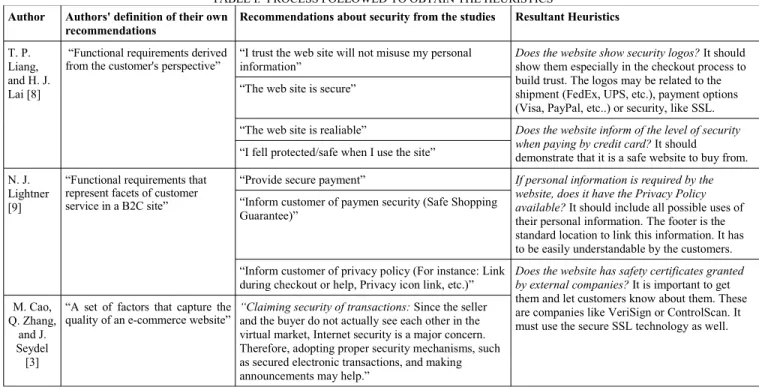
The first thing to do to obtain the proposed heuristic set
was to deduce and recollect all the recommendations given
by the three studies. Then, each recommendation was
rewritten formulating an interrogative sentence and
providing examples or advice to facilitate their scoring. In
table I, an applied example is shown in order to clarify the
process followed to obtain the heuristics. In the first column
there are cited the three studies. In the second column there
are quoted the author's definitions of their own
recommendations. In the next column there are the
guidelines about security extracted from the studies.
Finally, in the last column, the resultant heuristics which
are inspired by the three authors' recommendations are
presented.
TABLE I. PROCESS FOLLOWED TO OBTAIN THE HEURISTICS
Author Authors' definition of their own recommendations
Recommendations about security from the studies Resultant Heuristics
T. P. Liang, and H. J. Lai [8]
“Functional requirements derived
from the customer's perspective” “I trust the web site will not misuse my personal information”
Does the website show security logos? It should show them especially in the checkout process to build trust. The logos may be related to the shipment (FedEx, UPS, etc.), payment options (Visa, PayPal, etc..) or security, like SSL. “The web site is secure”
“The web site is realiable” Does the website inform of the level of security when paying by credit card? It should demonstrate that it is a safe website to buy from. “I fell protected/safe when I use the site”
N. J. Lightner [9]
“Functional requirements that represent facets of customer service in a B2C site”
“Provide secure payment” If personal information is required by the website, does it have the Privacy Policy available?It should include all possible uses of their personal information. The footer is the standard location to link this information. It has to be easily understandable by the customers. “Inform customer of paymen security (Safe Shopping
Guarantee)”
“Inform customer of privacy policy (For instance: Link during checkout or help, Privacy icon link, etc.)”
Does the website has safety certificates granted by external companies? It is important to get them and let customers know about them. These are companies like VeriSign or ControlScan. It must use the secure SSL technology as well. M. Cao,
Q. Zhang, and J. Seydel [3]
“A set of factors that capture the quality of an e-commerce website”
“Claiming security of transactions: Since the seller and the buyer do not actually see each other in the virtual market, Internet security is a major concern. Therefore, adopting proper security mechanisms, such as secured electronic transactions, and making announcements may help.”
Following that, the heuristics were organized based on
the stages of customer's buying behavior described by Engel
et al. [5]. Consequently, as it is explained in the next section,
the heuristics are organized in the following six parts: Need
intends to facilitate the evaluators' understanding of
customer behavior to enhance the HE results. If during the
reviewing of the interface the evaluators follow the stages
of the purchase decision process they will understand the
heuristic was assigned either a “yes” or “no” answers or a 1
to 5 Likert scale. To obtain a global score for the evaluated
websites the affirmative answers get 5 points and the
negative answers get 1. For the other system, the evaluator
can grade the level of accomplishment between 1 to 5. The
scale is represented as: 1 strongly disagree, 2 disagree, 3
neither agree nor disagree, 4 agree and 5 strongly agree. The
first scoring system is assigned to the questions that either
have or do not have specific features or functionalities. The
Likert Scale system is attached to the heuristics that require a
ranged score as they depend on expert opinion. Eventually, it
is possible to combine scores together to obtain a total score
out of 233 points. This eases the comparison between
different websites, and is useful to estimate the level of UX
that a website has according to the heuristic set.
III.
R
ESULTSIn this section, a set of 64 heuristics ready to be rated by
experts is presented. The set is the result of the compilation
and standardization of the recommendations from the three
selected studies.
A. Heuristics organisation
As it is pointed out at the Methodology section, the
heuristics are gathered in 6 groups according to the stages of
the Buying Decision Process described by Engel et al. [5].
1) Need Recognition and Problem Awareness
(Table II):
It is
the first step of the process. Without the recognition of
the need a purchase cannot take place. In this stage,
customers use search and navigation tools to find a product
or service which covers their needs. The website has to
stimulate the desire to purchase to enhance that needs.
2) Information Search
(Table III):
This is the next step
customers may take after they have recognized their
problems and needs in order to find out what they feel is the
best solution. The customers search for information
sources related to the products which can cover their
needs.
3) Purchase Decision Making
(Table IV): At this stage,
consumers evaluate different products on the basis of
varying product attributes to find the product which offers
more benefits. After that process, the customers make a
choice.
4) Transaction
(Table V):
The checkout is the last step
in the Buying Decision Process. It has to be clear and
trustworthy to drive the customers to finish a purchase.
5) Post-Sales Behaviour
(Table VI):
At this stage,
companies should carefully create positive post-purchase
communication to engage the customers. Also, the system
has to facilitate tools to modify or follow customer's
orders.
6) Factors That Affect The UX During The Whole
Purchase Process
(Table VII):
There are many factors that
affect whole purchase process and contribute in providing
a satisfactory UX. One of the most important is
trustworthiness because the customers have to believe that
the website is reliable to finish a purchase.
B. Heuristics presentation
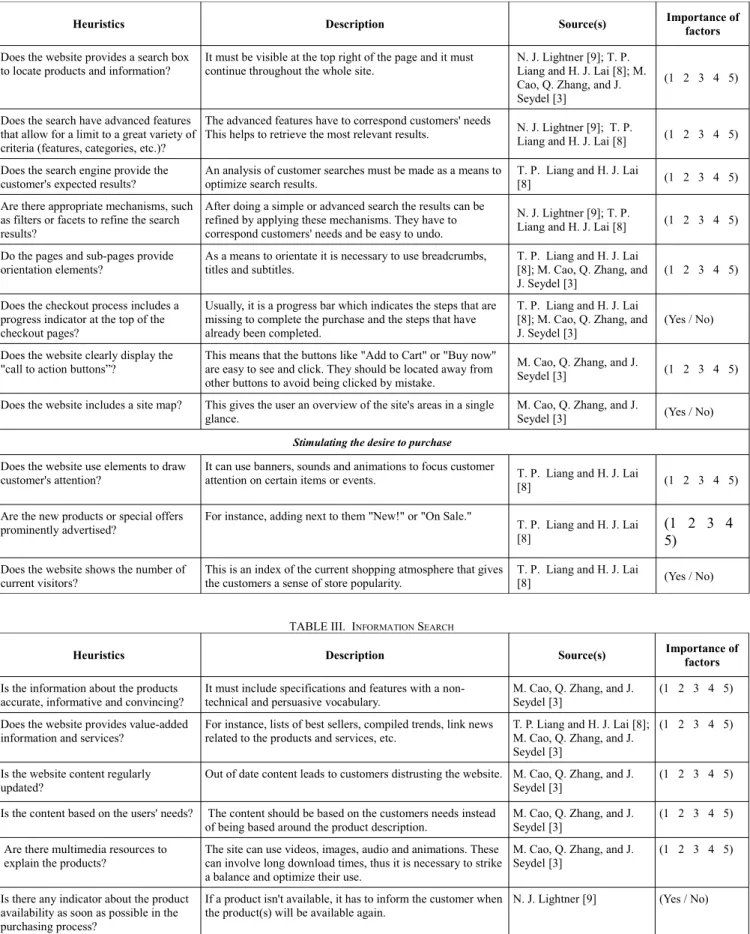
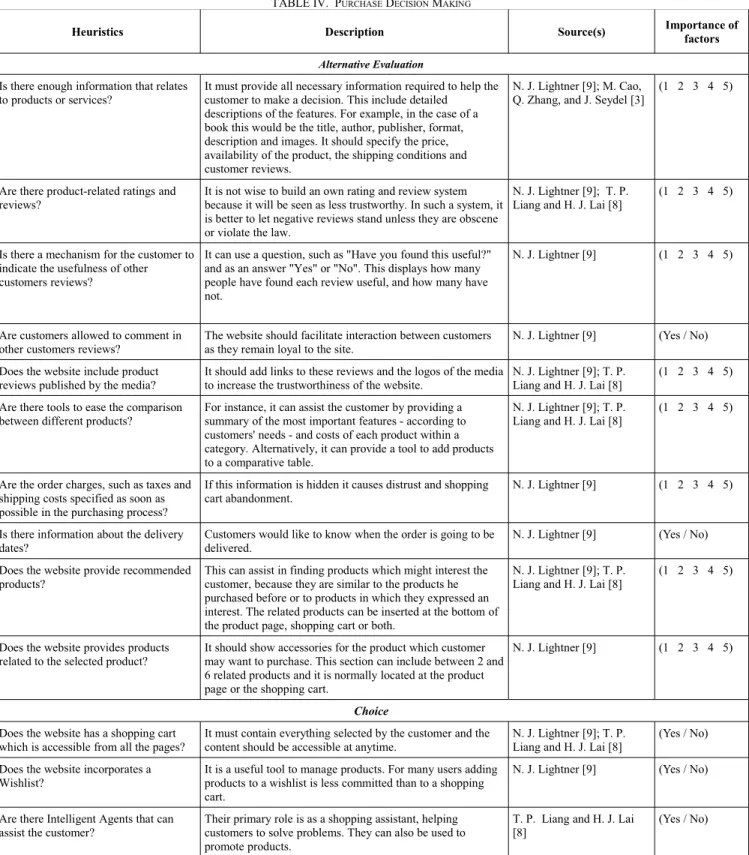
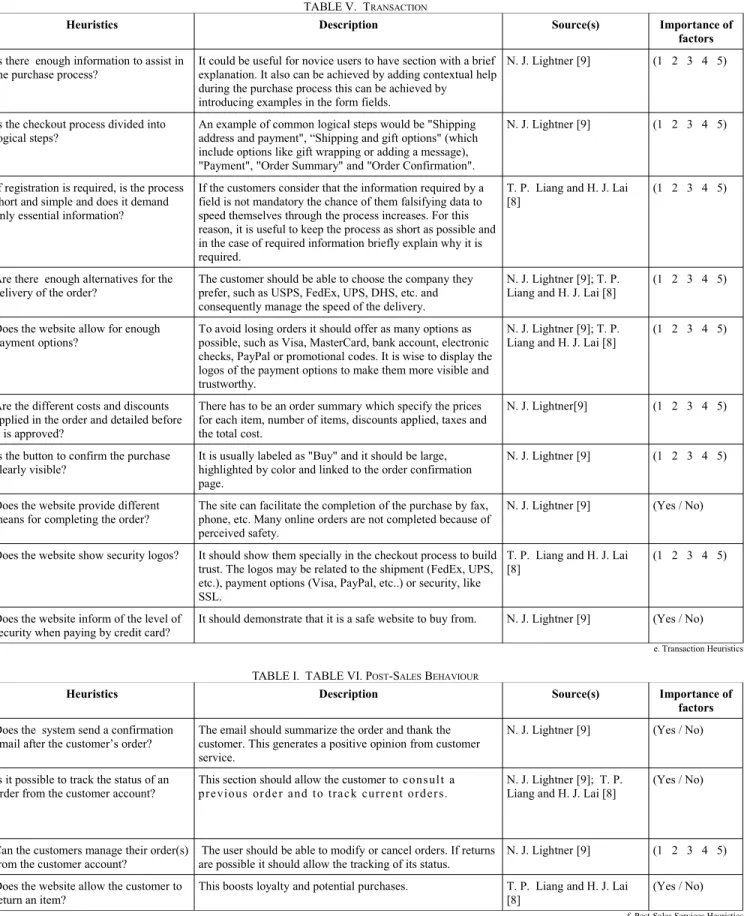
The heuristics are presented in the following six tables.
It is shown according to the column order: the heuristics
formulated as a questions to contrast with the website, a
short explanation or examples to assist the rating decision
making, the sources where the recommendation come from
and the most appropriate rating system. It is recommended
to add an additional column where experts can write their
observations and reasons for scoring the heuristics in a
manner of their choosing.
TABLE II. NEED RECOGNITION AND PROBLEM AWARENESS
Heuristics Description Source(s) Importance offactors
Search and navigation tools
Is the navigation obvious enough throughout the related sections?
Customer should be able to move easily through the different sections. For instance, between the shopping cart, the detailed description of the products and the shipping information.
M. Cao, Q. Zhang, and J.
Seydel [3] (1 2 3 4 5) Does the website use a clear user-logical
hierarchy of categories to classify products and to find them?
The categories should be easy to identify and differentiate by the customer.
T. P. Liang and H. J. Lai [8]; N. J. Lightner [9]; M. Cao, Q. Zhang, and J. Seydel [3]
(1 2 3 4 5) Do Category Pages include appropriate
filters or facets by features?
They have to correspond customers' needs and be easy to undo. They are especially useful in shops that have a large amount of products.
N. J. Lightner [9]; T. P.
Heuristics Description Source(s) Importance offactors
Does the website provides a search box to locate products and information?
It must be visible at the top right of the page and it must continue throughout the whole site.
N. J. Lightner [9]; T. P. Liang and H. J. Lai [8]; M. Cao, Q. Zhang, and J. Seydel [3]
(1 2 3 4 5)
Does the search have advanced features that allow for a limit to a great variety of criteria (features, categories, etc.)?
The advanced features have to correspond customers' needs
This helps to retrieve the most relevant results. N. J. Lightner [9];Liang and H. J. Lai [8] T. P. (1 2 3 4 5) Does the search engine provide the
customer's expected results?
An analysis of customer searches must be made as a means to optimize search results.
T. P. Liang and H. J. Lai
[8] (1 2 3 4 5)
Are there appropriate mechanisms, such as filters or facets to refine the search results?
After doing a simple or advanced search the results can be refined by applying these mechanisms. They have to correspond customers' needs and be easy to undo.
N. J. Lightner [9]; T. P.
Liang and H. J. Lai [8] (1 2 3 4 5) Do the pages and sub-pages provide
orientation elements? As a means to orientate it is necessary to use breadcrumbs, titles and subtitles. T. P. Liang and H. J. Lai [8]; M. Cao, Q. Zhang, and J. Seydel [3]
(1 2 3 4 5) Does the checkout process includes a
progress indicator at the top of the checkout pages?
Usually, it is a progress bar which indicates the steps that are missing to complete the purchase and the steps that have already been completed.
T. P. Liang and H. J. Lai [8];M. Cao, Q. Zhang, and J. Seydel [3]
(Yes / No) Does the website clearly display the
"call to action buttons”?
This means that the buttons like "Add to Cart" or "Buy now" are easy to see and click. They should be located away from other buttons to avoid being clicked by mistake.
M. Cao, Q. Zhang, and J.
Seydel [3] (1 2 3 4 5) Does the website includes a site map? This gives the user an overview of the site's areas in a single
glance.
M. Cao, Q. Zhang, and J.
Seydel [3] (Yes / No)
Stimulating the desire to purchase
Does the website use elements to draw customer's attention?
It can use banners, sounds and animations to focus customer
attention on certain items or events. T. P. Liang and H. J. Lai [8] (1 2 3 4 5) Are the new products or special offers
prominently advertised?
For instance, adding next to them "New!" or "On Sale."
T. P. Liang and H. J. Lai
[8]
(1 2 3 4
5)
Does the website shows the number of current visitors?
This is an index of the current shopping atmosphere that gives the customers a sense of store popularity.
T. P. Liang and H. J. Lai
[8] (Yes / No)
TABLE III. INFORMATION SEARCH
Heuristics Description Source(s) Importance offactors
Is the information about the products accurate, informative and convincing?
It must include specifications and features with a non-technical and persuasive vocabulary.
M. Cao, Q. Zhang, and J. Seydel [3]
(1 2 3 4 5) Does the website provides value-added
information and services?
For instance, lists of best sellers, compiled trends, link news related to the products and services, etc.
T. P. Liang and H. J. Lai [8]; M. Cao, Q. Zhang, and J. Seydel [3]
(1 2 3 4 5)
Is the website content regularly updated?
Out of date content leads to customers distrusting the website. M. Cao, Q. Zhang, and J. Seydel [3]
(1 2 3 4 5) Is the content based on the users' needs? The content should be based on the customers needs instead
of being based around the product description.
M. Cao, Q. Zhang, and J. Seydel [3]
(1 2 3 4 5) Are there multimedia resources to
explain the products?
The site can use videos, images, audio and animations. These can involve long download times, thus it is necessary to strike a balance and optimize their use.
M. Cao, Q. Zhang, and J. Seydel [3]
(1 2 3 4 5)
TABLE IV. PURCHASE DECISION MAKING
Heuristics Description Source(s) Importance offactors
Alternative Evaluation
Is there enough information that relates
to products or services? It must provide all necessary information required to help the customer to make a decision. This include detailed descriptions of the features. For example, in the case of a book this would be the title, author, publisher, format, description and images. It should specify the price, availability of the product, the shipping conditions and customer reviews.
N. J. Lightner [9]; M. Cao,
Q. Zhang, and J. Seydel [3] (1 2 3 4 5)
Are there product-related ratings and
reviews? It is not wise to build an own rating and review system because it will be seen as less trustworthy. In such a system, it is better to let negative reviews stand unless they are obscene or violate the law.
N. J. Lightner[9]; T. P.
Liang and H. J. Lai [8] (1 2 3 4 5)
Is there a mechanism for the customer to indicate the usefulness of other customers reviews?
It can use a question, such as "Have you found this useful?" and as an answer "Yes" or "No". This displays how many people have found each review useful, and how many have not.
N. J. Lightner [9] (1 2 3 4 5)
Are customers allowed to comment in other customers reviews?
The website should facilitate interaction between customers as they remain loyal to the site.
N. J. Lightner [9] (Yes / No) Does the website include product
reviews published by the media?
It should add links to these reviews and the logos of the media to increase the trustworthiness of the website.
N. J. Lightner[9];T. P. Liang and H. J. Lai [8]
(1 2 3 4 5) Are there tools to ease the comparison
between different products?
For instance, it can assist the customer by providing a summary of the most important features - according to customers' needs - and costs of each product within a category. Alternatively, it can provide a tool to add products to a comparative table.
N. J. Lightner[9]; T. P. Liang and H. J. Lai [8]
(1 2 3 4 5)
Are the order charges, such as taxes and shipping costs specified as soon as possible in the purchasing process?
If this information is hidden it causes distrust and shopping cart abandonment.
N. J. Lightner [9] (1 2 3 4 5)
Is there information about the delivery dates?
Customers would like to know when the order is going to be delivered.
N. J. Lightner [9] (Yes / No) Does the website provide recommended
products?
This can assist in finding products which might interest the customer, because they are similar to the products he purchased before or to products in which they expressed an interest. The related products can be inserted at the bottom of the product page, shopping cart or both.
N. J. Lightner[9]; T. P. Liang and H. J. Lai [8]
(1 2 3 4 5)
Does the website provides products related to the selected product?
It should show accessories for the product which customer may want to purchase. This section can include between 2 and 6 related products and it is normally located at the product page or the shopping cart.
N. J. Lightner [9] (1 2 3 4 5)
Choice
Does the website has a shopping cart which is accessible from all the pages?
It must contain everything selected by the customer and the content should be accessible at anytime.
N. J. Lightner[9]; T. P. Liang and H. J. Lai [8]
(Yes / No) Does the website incorporates a
Wishlist?
It is a useful tool to manage products. For many users adding products to a wishlist is less committed than to a shopping cart.
N. J. Lightner [9] (Yes / No)
Are there Intelligent Agents that can assist the customer?
Their primary role is as a shopping assistant, helping customers to solve problems. They can also be used to promote products.
T. P. Liang and H. J. Lai [8]
(Yes / No)
TABLE V. TRANSACTION
Heuristics Description Source(s) Importance of
factors
Is there enough information to assist in
the purchase process? It could be useful for novice users to have section with a brief explanation. It also can be achieved by adding contextual help during the purchase process this can be achieved by introducing examples in the form fields.
N. J. Lightner [9] (1 2 3 4 5)
Is the checkout process divided into logical steps?
An example of common logical steps would be "Shipping address and payment", “Shipping and gift options" (which include options like gift wrapping or adding a message), "Payment", "Order Summary" and "Order Confirmation".
N. J. Lightner [9] (1 2 3 4 5)
If registration is required, is the process short and simple and does it demand only essential information?
If the customers consider that the information required by a field is not mandatory the chance of them falsifying data to speed themselves through the process increases. For this reason, it is useful to keep the process as short as possible and in the case of required information briefly explain why it is required.
T. P. Liang and H. J. Lai
[8] (1 2 3 4 5)
Are there enough alternatives for the
delivery of the order? The customer should be able to choose the company they prefer, such as USPS, FedEx, UPS, DHS, etc. and consequently manage the speed of the delivery.
N. J. Lightner[9]; T. P.
Liang and H. J. Lai [8] (1 2 3 4 5) Does the website allow for enough
payment options?
To avoid losing orders it should offer as many options as possible, such as Visa, MasterCard, bank account, electronic checks, PayPal or promotional codes. It is wise to display the logos of the payment options to make them more visible and trustworthy.
N. J. Lightner [9];T. P. Liang and H. J. Lai [8]
(1 2 3 4 5)
Are the different costs and discounts applied in the order and detailed before it is approved?
There has to be an order summary which specify the prices for each item, number of items, discounts applied, taxes and the total cost.
N. J. Lightner[9] (1 2 3 4 5)
Is the button to confirm the purchase
clearly visible? It is usually labeled as "Buy" and it should be large, highlighted by color and linked to the order confirmation page.
N. J. Lightner [9] (1 2 3 4 5)
Does the website provide different means for completing the order?
The site can facilitate the completion of the purchase by fax, phone, etc. Many online orders are not completed because of perceived safety.
N. J. Lightner [9] (Yes / No)
Does the website show security logos? It should show them specially in the checkout process to build trust. The logos may be related to the shipment (FedEx, UPS, etc.), payment options (Visa, PayPal, etc..) or security, like SSL.
T. P. Liang and H. J. Lai [8]
(1 2 3 4 5)
Does the website inform of the level of security when paying by credit card?
It should demonstrate that it is a safe website to buy from. N. J. Lightner [9] (Yes / No)
e. Transaction Heuristics
TABLE I. TABLE VI. POST-SALES BEHAVIOUR
Heuristics Description Source(s) Importance of
factors
Does the system send a confirmation
email after the customer’s order? The email should summarize the order and thank the customer. This generates a positive opinion from customer service.
N. J. Lightner [9] (Yes / No)
Is it possible to track the status of an order from the customer account?
This section should allow the customer to consult a previous order and to track current orders.
N. J. Lightner [9]; T. P. Liang and H. J. Lai [8]
(Yes / No)
Can the customers manage their order(s) from the customer account?
The user should be able to modify or cancel orders. If returns are possible it should allow the tracking of its status.
N. J. Lightner [9] (1 2 3 4 5) Does the website allow the customer to This boosts loyalty and potential purchases. T. P. Liang and H. J. Lai (Yes / No)
TABLE VII. FACTORS THAT AFFECT THE USER EXPERIENCE DURING THE WHOLE PURCHASE PROCESS
Heuristics Description Source(s) Importance of
factors
Is the response time of the website
reasonable? Customers do not tolerate long waiting times. If the time to download a page is not reasonable for them they may leave the site.
M. Cao, Q. Zhang, and J.
Seydel [3] (1 2 3 4 5) Is the waiting time for the search results
reasonable?
This depends on the size of the database. If the waiting time is going to be long, it would be wise to include small illustrations and animations to keep the customers waiting.
M. Cao, Q. Zhang, and J. Seydel [3]
(1 2 3 4 5)
Is the interface's style consistent? It reduces the cognitive load and facilitates the ease of orientation.
T. P. Liang and H. J. Lai [8]
(1 2 3 4 5) Does the website presents an innovative
and attractive image?
This helps to differentiate it from the competition and it is highly appreciated by customers. For this reason, they spend a longer amount of time on the site.
M. Cao, Q. Zhang, and J. Seydel [3]
(1 2 3 4 5)
Is the website exciting? It can include resources, such as interactive materials, downloadable applications, games, personalized information, etc. This benefits the playfulness and entertainment on the site and consequently the customer's satisfaction.
M. Cao, Q. Zhang, and J.
Seydel [3] (1 2 3 4 5)
Does the website personalize any type of contact with the customer?
For example, when the system send an email it can include the customer's name.
M. Cao, Q. Zhang, and J. Seydel [3]
(1 2 3 4 5) Does the website offer the possibility for
the customer to become a VIP?
This exclusivity increases the satisfaction and loyalty of the customers who spend more money.
T. P. Liang and H. J. Lai [8]
(Yes / No)
Trust building
If personal information is required by the website, does it have the Privacy Policy available?
It should include all possible uses of their personal information. The footer is the standard location to link this information. It has to be easily understandable by the customers.
N. J. Lightner [9]; M. Cao, Q. Zhang, and J. Seydel [3]
(1 2 3 4 5)
Does it have the shipping, return or exchange Policy and other shop rules available?
This information can be included in the FAQs or in a specific section of the store. These resources have to be easily understandable by the customers.
N. J. Lightner [9] (1 2 3 4 5)
Does the website has safety certificates
granted by external companies? It is important to get them and let customers know about them. These are companies like VeriSign or ControlScan. It must use the secure SSL technology as well.
N. J. Lightner [9]; T. P.
Liang and H. J. Lai [8] (Yes / No) Is contact information visible during the
purchase process?
The telephone number should be shown at least to answer any questions about orders.
T. P. Liang and H. J. Lai [8]
(Yes / No) Does the website provide different
means for customers to contact the company?
For example forms, email and phone as these improve customer confidence.
N. J. Lightner [9]; M. Cao, Q. Zhang, and J. Seydel [3]
(1 2 3 4 5)
Is the best way to contact the company clarified for each type of concern?
It should specify the best means of contact for each type of question. For example, if it's a technical question, a matter of sales or about returning an item.
N. J. Lightner [9] (1 2 3 4 5)
Does the website gives the address of the company?
It can be shown in the information about the company, in the FAQs and in the checkout process to give credibility to the page.
N. J. Lightner [9] (Yes / No)
Does the website has a FAQ section that covers common customer questions?
It has to cover the most common questions detected by the customer service. For example, it can answer questions concerning the return policy. The information included has to be easily understandable and useful.
N. J. Lightner [9] (1 2 3 4 5)
Does the company responds to comments and concerns expressed by the customers?
Either through private means like email or public, like a product review.
N. J. Lightner [9]; M. Cao, Q. Zhang, and J. Seydel [3]
(1 2 3 4 5)
Is the appearance of the website safe and reliable?
Security is independent from the graphic design but the perception of security is very important for the customer. For instance, the introduction of elements, such as the image of a padlock affects positively this perception.
M. Cao, Q. Zhang, and J. Seydel [3]
(1 2 3 4 5)
IV. C
ONCLUSIONANDFUTUREWORKAs we pointed out in the methodology section, the
heuristics presented above are derived from functional
requirements expressed by customers and from factors that
capture the quality of e-commerce websites. Therefore, they do
not equally cover every UX's facet mentioned in the
introduction. The only aspect that any of the three studies have
considered is the accessibility. None the less, it is quite
common to check it separately with online tools that
automatically analyze it and provide quantitative results [4].
Anyway, as a future work, it is planned to integrate
accessibility requirements in the proposed model to improve
the consistency of the evaluation.
The presented heuristic set is an assisting tool for
evaluators based on proved standards to review the aspects of a
website that can affect UX. It is an open list that is going to be
extended in a broader study by adding more recommendations
to create a greater and more exhaustive set of heuristics. The
set will be updated and adapted by modifications, updates and
additions because of the continuous evolution of e-commerce
sites. The follow up study's goal is to cover as many B2C
websites and UX's aspects as possible. In this way, the set can
serve a wide range of e-commerce sites that may require only
small adjustments depending on the website features. Thus, the
set might require some revision to discard the sections and
heuristics which do not apply.
Moreover, it is necessary to add that the current set of
heuristics has some more limitations apart from the ones
mentioned. The heuristics understandability has been checked
by two experts, but the set has not yet been used to review any
e-commerce websites. Consequently, it is not possible to prove
empirically its efficiency.
Finally, as future work, it has been planned to follow this
research introducing the presented heuristics into the
Open-HEREDEUX repository [12][13]. This will enable to start an
experimental test with two objectives: enhance the database of
Open-HEREDEUX heuristics (introducing a specific set for
e-commerce systems) and validate the set of guidelines presented
in this paper. The second goal will consist in evaluating
different e-commerce sites (between 5 and 10) in order to
obtain and analyze the results. This also will serve to refine the
e-commerce set of heuristics.
R
EFERENCES[1] Baymard Insitute, “18 Cart abandonment rate statistics” [Retrieved: January, 2014]. Available at URL:
<http://baymard.com/lists/cart-abandonment-rate>
[2] S. Bauer, “It works for you: A user-centric guideline to product pages”, in Smashing Magazine, January 10, 2012 [Retrieved: January, 2014]. Available at URL:
<http://uxdesign.smashingmagazine.com/2012/01/10/it-works-for-you-a-user-centric-guideline-to-product-pages/>
[3] M. Cao, Q. Zhang, and J. Seydel, “B2C E-commerce web site quality: An empirical examination”, in Industrial Management & Data Systems, 105 (5), pp. 645-661.
[4] Web Accessibility Initiative, “Complete list of web accessibility evaluation tools” [Retrieved: January, 2014]. Available at URL:
<http://www.w3.org/WAI/RC/tools/complete>
[5] J. F. Engel, R. D. Blackwell, and D. T. Kollat, Consumer behavior, 3rd ed. Hinsdale: Dryden Press, 1978.
[6] C. Holst, “Fundamental guidelines of e-commerce checkout design”, in Smashing Magazine, April 6, 2011 [Retrieved: January, 2014]. Available at URL:
<http://uxdesign.smashingmagazine.com/2011/04/06/fundam ental-guidelines-of-e-commerce-checkout-design>
[7] ISO DIS 9241-210:2008, “Ergonomics of human system interaction – Part 210: Human-centered design for interactive systems (formerly known as 13407)”. Switzerland: International Standardization Organization, 2008.
[8] T. P. Liang, and H. J. Lai, “Effect of store design on consumer purchases: An empirical study of on-line bookstores”, in Information & Management, 39 (6), pp. 431-444.
[9] N. J. Lightner, “Evaluating e-commerce functionality with a focus on customer service”, in Communications of the ACM, 47 (1), pp. 88-92.
[10] L. Masip, [et al.], “A design process for exhibition design choices and trade-offs in (potentially) conflicting user interface guidelines”, in Lecture Notes in Computer Science, Volume 7623, pp 53-71
[11] L. Masip, T. Granollers, and M. Oliva, “A Heuristic Evaluation Experiment To Validate The New Set Of Usability Heuristics”, in Proceedings of the 8th International Conference on Information Technology: New Generations, (Washington, DC, USA, 2011), IEEE Computer Society, pp. 429-434.
[12] L. Masip, M. Oliva, and T. Granollers, “OPEN-HEREDEUX: open heuristic resource for designing and evaluating user experience”, in Proceedings of the 13th IFIP TC 13 International conference on Human-Computer Interaction (INTERACT'11), Pedro Campos, Nuno Nunes, Nicholas Graham, Joaquim Jorge and Philippe Palanque (Eds.), Part IV. Springer Verlag, Berlin, Heidelberg, pp. 418‐ ‐ 421.
[13] L. Masip, M. Oliva, and T. Granollers, “The open repository of heuristics”, in Proceedings of the 13th International Conference on Interacción Persona-Ordenador (INTERACCION '12). ACM, New York, NY, USA.
[14] P. Morville, “User Experience Design”, in Semantic Studios, June 21, 2004 [Retrieved: January, 2014]. Available at URL: <http://semanticstudios.com/publications/semantics/000029.p
hp>
[15] J. Nielsen, “Heuristic evaluation”, in Usability Inspection Methods, J. Nielsen and R.L. Mack, Eds. New York: John Wiley & Sons, 1994, pp. 25-62.
[16] J. Vanderdonckt, “Development milestones towards a tool for working with guidelines”, in Interacting with computers, 12 (2), pp. 81-118.