Valparaiso University
ValpoScholar
Business Faculty Presentations College of Business
2017
Examining Private-Label Brand Equity
Dimensions: Do Brand Equity Dimensions Differ
for Different PLBs of the Same Store?
Paul Trapp
Valparaiso University
Musa Pinar
Valparaiso University
Tulay Girard
Follow this and additional works at:https://scholar.valpo.edu/cba_fac_presentations
This Conference Proceeding is brought to you for free and open access by the College of Business at ValpoScholar. It has been accepted for inclusion in Business Faculty Presentations by an authorized administrator of ValpoScholar. For more information, please contact a ValpoScholar staff member at
Recommended Citation
Trapp, Paul; Pinar, Musa; and Girard, Tulay, "Examining Private-Label Brand Equity Dimensions: Do Brand Equity Dimensions Differ for Different PLBs of the Same Store?" (2017).Business Faculty Presentations. 11.
Examining private-label brand equity dimensions: Do brand equity
dimensions differ for different PLBs of the same store?
Trapp, Paul
College of Business Administration Valparaiso University Valparaiso, IN 46383, USA
Phone: (219) 464-5036 E-mail: [email protected]
Pinar, Musa
College of Business Administration Valparaiso University Valparaiso, IN 46383, USA
Phone: (219) 464-5401 E-mail: [email protected]
Girard, Tulay1
The Pennsylvania State University-Altoona
Division of Business, Engineering & Information Systems Technology Devorris Downtown Center, 209 Aaron
1431 12th Avenue Altoona PA 16601 Phone: (814) 949-5259 E-mail: [email protected]
Submitted for presentation to Atlantic Marketing Association 42nd Annual Conference, September 27-30, 2017, Williamsburg, VA
Examining private-label brand equity dimensions: Do brand equity
dimensions differ for different PLBs of the same store?
INTRODUCTION
Private-label brands (PLB) today are a well-estblished facet in many product categories worldwide as they offer benefit to both retailers and consumers. Some retailers offer different PLBs for various product categories, as well as for different price points. As a result of the success of PLBs and their growth in market share, PLBs have increasingly captured the attention of researchers. Even so, the consumer-based brand equity (CBBE) of PLBs (PL-CBBE) has remained largely unexplored (Ailawadi & Keller 2004; Cuneo, Lopez, & Yague 2012; Jara & Cliquet 2012). To help fill this void, this study examines the CBBE of two different product category PLBs of the same retailer, holding the retailer constant. Specifically, the study examines and compares the CBBE and its underlying dimensions for Wal-Mart’s Great Value (grocery, consumable household goods) and Equate (beauty, health, pharmacy) PLBs.
BACKGROUND
Brand equity has been described in different ways. However, it is widely accepted that the brand equity concept pertains to the added value associated with a branded product/service in
comparison with an unbranded product/service (French & Smith 2013; Keller 2013). Drawing on cognitive psychology, CBBE is defined as “the differential effect of brand knowledge on
consumer response to the marketing of the brand” (Keller 1993, p. 2). In essence, “brand
knowledge is the source of brand equity” (Keller 2003, p. 596), which is accumulated over time through customers’ feelings and responses related to the brand (Keller 2013). Aaker (1991) made the first attempt to conceptualize it as a multifaceted construct, consisting of brand awareness, brand association, perceived quality, and brand loyalty.
As the importance of PLBs has become more apparent, numerous studies have been conducted related to PLBs, such as impact of consumer demographics on PLB proneness and purchase behavior (e.g. Ailawadi, Neslin, & Gedenk 2001; Baltas & Argouslidis 2007;
Richardson, Jain, & Dick 1996; Shukla, Banerjee, & Adidam 2013), buying proneness between PLBs and manufacturer brands (e.g. Hoch 1996; Narasimhan & Wilcox 1998; Quelch & Harding 1996; Richardson et al. 1996), similarities and differences between national and PLBs (e.g. Ailawadi et al. 2001; Garretson, Fisher, & Burton 2002), antecedents that affect attitudes toward PLBs (e.g. Baltas 2003; Batra & Sinha 2000; Richardson et al. 1996), and the link between private-label share and store loyalty (e.g. Ailawadi, Pauwels, & Steenkamp 2008; Baltas,
Argouslidis, & Skarmeas 2010; Bonfrer & Chintagunta 2004; Gonzalez-Benito & Martos-Partal 2012; Koschate-Fischer, Cramer, & Hoyer 2014; Kumar & Steenkamp 2007; Martos-Partal & Gonzalez-Benito 2011; Sudhir & Talukdar 2004).
Jara and Cliquet (2012) found that retailer brand awareness and perceived quality are the two main factors that systematically explain the performance of the retail (i.e., organizational) brand. It seems that store image (or brand association) and store loyalty may also improve as consumers become more familiar with PLBs as suggested by Ailawadi and Keller (2004). This is consistent with research that PLBs can create and foster store loyalty (Collins-Dodd & Lindley 2003; Dhar, Hoch, & Kumar 2001; Richardson et al.1996), including various empirical studies supporting the link between private label purchase share and store loyalty (e.g., Ailawadi et al. 2001; Baltas et al. 2010; Bonfrer & Chintagunta 2004; Gonzalez-Benito & Martos-Partal 2012; Koschate-Fischer et al. 2014; Kumar & Steenkamp 2007; Martos-Partal & Gonzalez-Benito 2011). Although these studies, and the previously cited studies, addressed distinctive topics related to PLBs, there is still scant research on PL-CBBE (Ailawadi & Keller 2004; Cuneo et al.
2012; Girard, Trapp, Pinar, Gulsoy, & Boyt 2016; Girard, Pinar, İpek, & Bıçakcıoğlu 2016; Jara & Cliquet 2012; Keller, Dekimpe, & Geyskens 2016).
Based on prior brand equity research (Aaker 1991, 1996; Aaker 1997; Yoo & Donthu 2001; Yoo, Donthu, & Lee. 2000) and private-label/store brand research (Ailawadi et al. 2008; Cuneo et al. 2012; Jara & Cliquet 2012; Richardson et al. 1996), PL-CBBE is conceptualized as multiple constructs (e.g., Aaker 1991, 1996; Keller 1993; 2013) and may be measured with eight brand equity dimensions. These PL-CBBE dimensions are brand awareness, perceived quality, brand association, perceived value, perceived risk, retail store loyalty, PLB loyalty, and overall PLB equity. The literature suggests positive relationships among all of the antecedent
dimensions of the CBBE except for perceived risk.
In order to achieve the broadly stated objective and explore the nature of the PL-CBBE structure for each product category (i.e., Equate, Great Value), the following research questions were addressed:
RO 1: Examine consumer purchase behaviors for PLBs in general, as well as for Great Value and Equate to determine consumers’ acceptance level of PLBs, as well as compare the purchase behaviors associated with Great Value and Equate.
RO 2: Develop measurement scales for PL-CBBE, and examine the significance of the relationships of the PL-CBBE dimensions of the PLBs (Great Value and Equate).
RO 3: Compare the mean values of the PL-CBBE of the two product categories to determine if the underlying dimensions differ, given both are offered by the same retailer (Wal-Mart).
In order to accomplish the study objectives and investigate the research questions, an identical survey-instrument was designed to measure the PL-CBBE for the two product-category PLBs (Great Value, Equate). The scale measures of each CBBE-dimension for this study were
compiled from the literature utilizing the following sources: brand awareness (Aaker 1996; Buil, de Chernatony, & Martinez 2008; Lassar, Mittal, & Sharma 1995; Netemeyer, Krishnan, Pullig, Yagci, Ricks, & Wirth 2004; Tong & Hawley 2009), perceived quality (Aaker 1991, 1996; Buil et al. 2008; Pappu, Quester, & Cooksey 2005, 2006; Tong & Hawley 2009; Yoo et al.
2000), brand associations (Aaker 1996; Aaker 1997; Buil et al. 2008; Keller 1993, 2013; Pappu et al. 2005), brand loyalty – Great Value and Wal-Mart (Buil et al. 2008; Kim & Kim 2004; Tong & Hawley 2009; Yoo et al. 2000; Yoo & Donthu 2001), perceived value (Aaker 1996; Buil et al. 2008; Lassar et al. 1995; Netemeyer et al. 2004; Richardson et al. 1996), perceived
risk (Jara & Cliquet 2012; Richardson et al. 1996; Wu, Yeh, & Hsiao 2011), and Great Value brand equity (Buil et al. 2008; Tong & Hawley 2009).
The survey-instrument included the brand equity dimensions of brand awareness, perceived quality, brand association, perceived-value, perceived-risk, retail store-loyalty, PLB -loyalty, and overall-PLB-equity. The individual dimension items, measured on a seven-point agreement (Likert) scale, were modified to properly achieve the objectives of this study. The survey also included questions to determine purchase share behavior to discover what percent of total monthly purchases were spent on Great Value and Equate PLBs as well as their all grocery spending. Several pretests were conducted, beginning with experts knowledgeable about scale development and private-label branding, and then with actual customers of the two PLBs. Demographic questions concerning age, gender, size of household, education, and income were also included on the survey (A copy of the survey instrument is available upon request).
The survey instrument was administered online to purchasers of the PLBs included in the study (Great Value, Equate) following a procedure initially used by Bitner, Booms, and Tetreault (1990), employing trained undergraduate students to distribute an email invitation linked to the survey. Selection of Great Value and Equate users as respondents is consistent with prior brand equity research that surveyed respondents with brand experience (e.g., Bauer, Sauer, & Schmitt 2005; Biscaia, Correia, Ross, Rosado, & Maroco 2013; Ross 2006; Ross, James, & Vargas 2008). This approach is based on a suggestion by Berry (2000) that consumer experience is critical in the development of brand-equity, where he stresses the importance of actual, direct -consumer experience with a brand.
RESULTS
The survey method produced a total of 421 surveys: 270 for the Great Value brand and 151 for the Equate-brand. As illustrated in Table 1, 59.5% of all respondents were female and 40.5% male, and while the majority of Great Value respondents were female (69.8%), the opposite was true for Equate (59.3% male). The respondent for both GV and Equate tend to be middle-aged or younger with about 67% between the ages of 21 and 59 years old, where 40% of GV and 34.5% of the Equate respondents were in 21-30 age group. With respect to family size, about 45% of respondents for both groups were from households of three to four persons. As for income
distribution shown in Table 1, while there is no clear dominant pattern for both PLB respondents, about 27% of the respondents were in income range of $30,000 to $60,000. Respondents from both PLBs tended to be educated, with 63% of GV respondents having a college or graduate education, and 54% of Equate respondents in the same two education categories.
Table 1: Demographic Profiles of Respondents by Each PLB
All Respondents Great Value Equate
Male 166 40.5 80 30.2 86 59.3 Female 244 59.5 185 69.8 59 40.7
Total 410 100.0 265 100.0 145 100.0
Age n Percent n Percent n Percent
Under 21 31 7.6 18 6.8 13 9.0 21-30 156 38.0 106 40.0 50 34.5 31 40 44 10.7 29 10.9 15 10.3 41-50 75 18.3 43 16.2 32 22.1 51-60 71 17.3 46 17.4 25 17.2 61-70 24 5.9 18 6.8 6 4.1 71 or older 9 2.2 5 1.9 4 2.8 Total 410 100.0 265 100.0 145 100.0
Family Size n Percent n Percent n Percent
1 person 84 20.6 59 22.3 25 17.4 2 persons 42 10.3 11 4.2 31 21.5 3 persons 107 26.2 75 28.4 32 22.2 4 persons 80 19.6 48 18.2 32 22.2 5 persons 67 16.4 53 20.1 14 9.7 6 persons 18 4.4 14 5.3 4 2.8 > 6 persons 10 2.4 4 1.5 6 4.2 Total 408 100.0 264 100.0 144 100.0
Income (in 000) n Percent n Percent n Percent
< $15 81 20.7 53 21.0 28 20.1 $15-$30 38 9.7 21 8.3 17 12.2 $30-$45 47 12.0 29 11.5 18 12.9 $45-$60 57 14.6 38 15.1 19 13.7 $60-$75 35 9.0 18 7.1 17 12.2 $75-$90 34 8.7 22 8.7 12 8.6 $90-$105 19 4.9 15 6.0 4 2.9 >$1005 80 20.5 56 22.2 24 17.3 Total 391 100.0 252 100.0 139 100.0
Education n Percent n Percent n Percent
Less than HS 3 0.7 n/a n/a 3 2.1 HS degree 89 21.8 61 23.1 28 19.4 Assoc. or Jr. College 72 17.6 36 13.6 36 25.0 College 164 40.2 107 40.5 57 39.6 Graduate 80 19.6 60 22.7 20 13.9
Total 408 100.0 264 100.0 144 100.0
As stated in RO1, in order to determine consumers’ acceptance level of PLBs, as well as compare the purchase behaviors associated with Great Value and Equate, consumer purchase behaviors for PLBs in general, as well as specifically for Great Value and Equate were
examined. Based on the results for purchase shares of all PLBs shown in Figure 1, 18.4 % of the respondents indicated that all PLBs represent 1-10% of their monthly purchases, 19.4% of the
respondents indicated that all PLBs represent their 11-20% of monthly purchases, and 20.6% indicated that PLBs represent 21-30% of their monthly purchases. Interestingly, 15.6% and 12.7% of the respondents indicated that all PLBs represent 41-50% and more than 50% of their monthly purchases, respectively. These monthly purchase distributions of all PLBs purchases from all stores suggest that PLBs seem to be fairly well accepted by consumers.
Figure 1 also shows the distributions of respondents’ monthly purchases of the Great Value and Equate brands of products. The results show that both Great Value and Equate represent a smaller share of respondents’ monthly purchase shares, where 44.3% of respondents indicated that the Great Value brand of products represents 1-10% of purchases and 53.7% of respondents indicated that the Equate brand of products represents 1-10% of their purchases. Both brands’ purchase shares decline drastically in consumers’ larger monthly purchases. For example, 6.5% of respondents indicated that the Great Value brand of products represents 41-50% of their monthly purchases and 3.4% indicated that the Equate brand of products represents 41-50% of their purchases. The Chi-square test for Great Value and Equate purchase
distributions (p (5, 418 = .394) is not statically significant (p>.05); consumers’ monthly purchase
44.3 21.0 17.1 8.0 6.5 3.1 53.7 14.1 12.1 10.1 3.4 6.7 18.4 19.4 20.6 13.4 15.6 12.7 0.0 10.0 20.0 30.0 40.0 50.0 60.0 1 - 10% 11 - 20% 21 - 30% 31 - 40% 41 - 50% > 50%
Figure 1: Monthly Purchase Shares
shares of these two PLBs are not significantly different. This indicates that both the Great Value brand of products and the Equate brand of products have similar levels of consumer acceptance. These results suggest that while the Great Value and Equate brands have similar levels of consumer acceptance (market penetration), as shown in Figure 1, their levels of consumer acceptance are fairly low when considering consumers’ purchase of all PLBs.
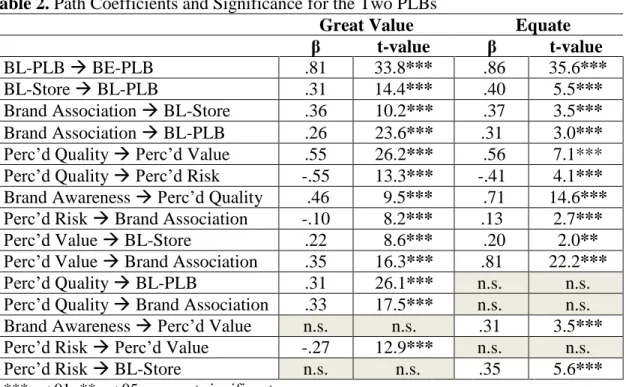
To achieve RO2, after the measurement scales for PL-CBBE were developed through pretests, the significance of the relationships of the PL-CBBE dimensions of the two PLBs (Great Value, Equate) was examined using PLS-SEM in SmartPLS 3. The discriminant and convergent validity of the measurement models were tested by using the procedure suggested by Fornell and Larcker (1981). The items for the Great Value PL-CBBE model had the minimum recommended level of loadings of .70 or higher (Hair, Hult, Ringle, & Sarstedt 2014). The construct Cronbach’s alphas and construct reliability values were above the recommended level of .70 (Hair, Sarstedt, Ringle, & Mena 2012), indicating internal reliability and convergent validity of the measurements for each PL-CBBE dimension in both models. The average variance extracted values were higher than the square of the inter-construct correlations, which confirms discriminant validity. The PLS algorithm converged in five iterations for Great Value and eight iterations for Equate.The Equate PL-CBBE model revealed similar findings except for the brand loyalty and brand equity dimensions did not discriminate. This means that the
perceptions of the Equate purchasers are almost the same for these two dimensions, which is supported by the path coefficient of .86 between brand loyalty and brand equity of Equate.
The significant path coefficients (standard betas) among the eight latent constructs in the two PL-CBBE models are presented in Table 2. Most relationships were significant for both the Great Value and Equate brands. The signs of the significant relationships between perceived risk
and brand association, perceived risk and perceived value, and perceived risk and store brand loyalty were positive for Equate and negative for Great Value. This may suggest that because Equate is a personal care and over-the-counter (OTC) medicine PLB, increased perceived risk for Equate makes brand association, perceived value, and store loyalty significantly more important for customers. The results also showed that there were still a few differences in the significance of the relationships between the Great Value and Equate CBBE dimensions. This suggests that these two brands hold different levels of importance in consumers’ mind for some of the brand equity dimensions. The R2 ranged from 0.21 to 0.70 for Great Value, and 0.17 to 0.74 for Equate, indicating each antecedent PL-CBBE dimension significantly contributed to predicting overall PL-CBBE. The PLS models are not presented due to the page limitations but are available from the authors upon request.
Table 2. Path Coefficients and Significance for the Two PLBs
Great Value Equate
β t-value β t-value
BL-PLB BE-PLB .81 33.8*** .86 35.6***
BL-Store BL-PLB .31 14.4*** .40 5.5***
Brand Association BL-Store .36 10.2*** .37 3.5***
Brand Association BL-PLB .26 23.6*** .31 3.0***
Perc’d Quality Perc’d Value .55 26.2*** .56 7.1*** Perc’d Quality Perc’d Risk -.55 13.3*** -.41 4.1***
Brand Awareness Perc’d Quality .46 9.5*** .71 14.6***
Perc’d Risk Brand Association -.10 8.2*** .13 2.7***
Perc’d Value BL-Store .22 8.6*** .20 2.0**
Perc’d Value Brand Association .35 16.3*** .81 22.2***
Perc’d Quality BL-PLB .31 26.1*** n.s. n.s.
Perc’d Quality Brand Association .33 17.5*** n.s. n.s. Brand Awareness Perc’d Value n.s. n.s. .31 3.5***
Perc’d Risk Perc’d Value -.27 12.9*** n.s. n.s.
Perc’d Risk BL-Store n.s. n.s. .35 5.6***
*** p<.01; ** p<.05; n.s.: not significant
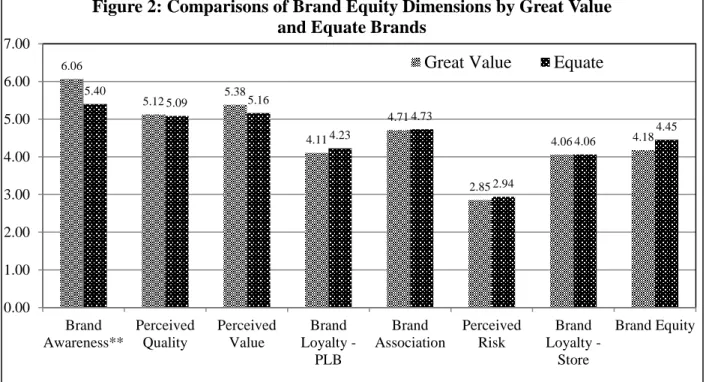
In order to accomplish RO3, we calculated the mean values of brand equity dimensions and compared the respondents’ perceptions of the Great Value and Equate brands (Figure 2). The
respondents have fairly favorable perceptions of the brand awareness, perceived quality,
perceived value, and risk dimensions of both PLBs. The other dimensions are perceived close to a neutral level. Second, the mean comparisons found a significant difference between Great Value and Equate for only brand awareness (p < .01). While both brands have fairly high levels of awareness, the Great Value brand of products have a significantly higher brand awareness (M=6.06) than that of Equate (M=5.40). Since the other PLB equity dimensions are not
significantly different (p > .05), respondents have similar perceptions of these dimensions. This could be expected because both PLBs are offered by the same retailer.
DISCUSSION
In this study, we examined consumer purchase behaviors for PLBs in general, andfor Great Value and Equate, in order to determine acceptance levels of PLBs, as well as specifically for Great Value and Equate. The purchase shares of both Wal-Mart PLBs are the highest in the
1-6.06 5.12 5.38 4.11 4.71 2.85 4.06 4.18 5.40 5.09 5.16 4.23 4.73 2.94 4.06 4.45 0.00 1.00 2.00 3.00 4.00 5.00 6.00 7.00 Brand Awareness** Perceived Quality Perceived Value Brand Loyalty -PLB Brand Association Perceived Risk Brand Loyalty -Store Brand Equity
Scale: 1=Strongly disagree & 7=Strongly agree; ** p<.01
Figure 2: Comparisons of Brand Equity Dimensions by Great Value and Equate Brands
10% purchase category, higher than that of all PLBs purchased in the same category. The purchase shares of the two PLBs are at competitive levels with all PLBs purchased in the higher purchase share category of 11-20%. As the purchase share categories increase beyond 20%, the purchase shares (consumer acceptance) of the two Wal-Mart PLBs fall behind consumer purchases of all PLBs (Figure 1). This indicates that while consumers seem to have accepted PLBs in general, Great Value and Equate have lower levels of acceptance among consumers.
We also developed measurement scales and tested the PLS-SEM dimensions of the two PLBs. The dimensions passed the discriminant and convergent validity tests. In addition, the two models displayed similarities and a few differences in significant relationships. One possible explanation for the differences is that because the nature and inherent risks perceived of the products sold under the Great Value and Equate brands differ, the importance of some of these relationships also differ across the different PLBs of the same store. This is an important finding because it provides insights to the management of the retail stores in that they need to assess the CBBE dimensions of each of their PLBs to pinpoint where they need improvements. For
instance, the relationships between perceived quality and PLB loyalty, perceived quality and brand association, and perceived risk and perceived value were not significant for the Equate brand. For the Equate brand, the importance of the quality does not lead to increased or decreased importance of loyalty to the brand or increased importance in brand associations. Similarly, perceived risk does not necessarily influence perceptions of the value created by the Equate brand. For the Great Value brand, the relationships between brand awareness and perceived value, and perceived risk and store brand loyalty were not significant. One possible explanation is that because Wal-Mart shoppers already know the brand, customers’ perceived value is not influenced by it. Similarly, customers’ risk perceptions in the Great Value brand of
products do not influence their store brand loyalty.
With RO3,because both PLBs (Great Value and Equate) are offered by the same retailer (Wal-Mart), our goal was to compare the PL-CBBE of these two PLBs in different product categories to discover if the respondents (customers) perceive the brand equity dimensions the same or different. The Great Value brand awareness was significantly higher than the Equate brand. However, customer perceptions of the quality, value, brand loyalty, associations, risk, store loyalty, and brand equity were the same for both PLBs of Wal-Mart.
LIMITATIONS AND SUGGESTIONS FOR FUTURE RESEARCH
Two significant limitations must be noted. This study used an online convenience sampling method, but purposefully selected target sample from purchasers of the PLBs under
investigation. Thus, it is recommended that the measurement scale be tested with larger samples in future studies. Second, as this study investigated only two PLBs offered by the same retailer, future studies may benefit from including and comparing other retailers, and PLBs in different product categories and price levels, to cross-validate the findings. Similarly, studying and comparing focused PLB retailers such as ALDI and Migros with conventional retailers (e.g., Wal-Mart, Edeka, Tesco) would be instructive. As the findings reveal, understanding the interrelationships of the antecedent constructs could be beneficial for any PLB in developing more successful marketing and branding strategies.
REFERENCES
Aaker, D. A. (1991), Managing Brand Equity, Free Press, New York, NY. Aaker, D. A. (1996), Building Strong Brands, Free Press, New York, NY.
Aaker, J. L. (1997), “Dimensions of brand personality,” Journal of Marketing Research, 34 (3), 347-56.
Ailawadi, K. L., K. Pauwels, and J-B. E.M. Steenkamp (2008), “Private label use and store loyalty,” Journal of Marketing, 72 (6), 19-30.
Ailawadi, K. L., and K. L. Keller (2004), “Understanding retail branding: Conceptual insights and research priorities,” Journal of Retailing, 80 (4), 331-42.
Ailawadi, K. L., S. Neslin, and K. Gedenk (2001), “Pursuing the value conscious consumer: Store brands versus national brand promotions,” Journal of Marketing, 65 (1), 71-89. Baltas, G. (2003), “A combined segmentation and demand model for store brands,” European
Journal of Marketing, 37 (10), 1499-1513.
Baltas, G., and P. C. Argouslidis (2007), “Consumer characteristics and demand for store brands,” International Journal of Retail & Distribution Management, 35 (5), 328-341. Baltas, G., P. C. Argouslidis, and D. Skarmeas (2010), “The role of consumer factors in multiple
store patronage: A cross-benefit approach,” Journal of Retailing, 86 (1), 37-50.
Batra, R., and I. Sinha (2000), “Consumer-level factors moderating the success of private label brands,” Journal of Retailing, 76 (2), 175-91.
Bauer, H. H., N. E. Sauer, and P. Schmitt (2005), “Consumer-based brand equity in the team sport industry,” European Journal of Marketing, 39 (5/6), 496-523.
Berry, L. L. (2000), “Cultivating service brand equity,” Journal of the Academy of Marketing Science, 28 (1), 128-37.
Biscaia, R., A. Correia, S. Ross, A. Rosado, and J. Maroco (2013), “Spectator-based brand equity in professional soccer,” Sport Marketing Quarterly, 22, 20-32.
Bitner, M. J., B. H. Booms, and M. S. Tetreault (1990), “The service encounter: Diagnosing favorable and unfavorable incidents,” Journal of Marketing, 54 (1), 71-84.
Bonfrer, A., and P. K. Chintagunta (2004), “Store brands: Who buys them and what happens to retail prices when they are introduced,” Review of Industrial Organization, 24 (2), 195-218.
Buil, I., L. de Chernatony, and E. Martinez (2008), “A cross-cultural validation of the consumer-based brand equity scale,” Journal of Product and Brand Management, 17 (6), 384-92. Collins-Dodd, C., and T. Lindley (2003), “Store brand and retail differentiation: The influence of
store image and store brand attitude on store own brand perceptions,” Journal of Retailing and Consumer Services, 10 (6), 345-52.
Cuneo, A., P. Lopez, and M. J. Yague (2012), “Private label brands: Measuring equity across consumer segments,” Journal of Product and Brand Management, 21 (6), 428-438. Dhar, S., S. J. Hoch, and N. Kumar (2001), “Effective category management depends on the role
of the category,” Journal of Retailing, 77 (2), 165-184.
Fornell, C., and D. F. Larcker (1981), “Evaluating structural equation models with unobservable variables and measurement error,” Journal of Marketing Research, 18 (1), 39-50. French, A., and G. Smith (2013), “Measuring brand association strength: A consumer based
brand equity approach,” European Journal of Marketing, 47 (8), 1356-1367.
Garretson, J. A., D. Fisher, and S. Burton (2002), “Antecedents of private label attitude and national brand promotion attitude: Similarities and differences,” Journal of Retailing, 78 (20), 91-99.
Girard, T. Trapp, P. Pinar, M, Gulsoy, T. and Boyt, T. E. (2016), “Consumer-Based Brand Equity of a Private-Label Brand: Measuring and Examining Determinants”, Journal of Marketing Theory and Practice, 25 (1), 39-56, DOI: 10.1080/10696679.2016.1236662 Girard, T., M. Pinar, İ. İpek, and N. Bıçakcıoğlu (2016), “Özel Markalı Ürünlerin Tüketici
Temelli Marka Değeri: İki Ülkede Ampirik Bir Karşılaştırma - Private-Label Brand Equity: An Empirical Comparison in Two Countries” 21. Türkiye Ulusal Pazarlama Kongresi (The 21st Turkish National Marketing Conference), Kutahya, Turkey, October.
Gonzalez-Benito, O., and M. Martos-Partal (2012), “Role of retailer positioning and product category on the relationship between store brand consumption and store loyalty,” Journal of Retailing, 88 (2), 236-249.
Hair, J., M. Sarstedt, C. M. Ringle, and J. A. Mena (2012), “An assessment of the use of partial least squares structural equation modeling in marketing research,” Journal of the Academy of Marketing Science, 40 (3), 414-33.
Hair, J., T. M. Hult, C. M. Ringle, and M. Sarstedt (2014), A Primer on Partial Least Squares Structural Equation Modeling (PLS-SEM), Sage, Los Angeles, CA.
Hoch, S. J. (1996), “How should national brands think about private labels?,” Sloan Management Review, 37 (2), 89-102.
Jara, M., and G. Cliquet (2012), “Retail brand equity: Conceptualization and measurement,” Journal of Retailing and Consumer Services, 19 (1), 140-49.
Keller, K. L. (1993), “Conceptualizing, measuring and managing customer based brand equity,” Journal of Marketing, 57 (1), 1-22.
Keller, K.L. (2003), “Brand synthesis: the multidimensionality of brand knowledge,” Journal of Consumer Research, 29 (4), 595-600.
Keller, K. L. (2013), Strategic Brand Management: Building, Measuring, and Managing Brand Equity, 4th ed., Pearson, Boston, MA.
Keller, K. L., M. G. Dekimpe, and I. Geyskens (2016), “Let your banner wave? Antecedents and performance implications of retailers’ private-label branding strategies”, Journal of Marketing, 80 (4), 1-19.
Kim, W. G., and H-B. Kim (2004), “Measuring customer-based restaurant brand equity: Investigating the relationship between brand equity and firms’ performance,” Cornell Hotel and Restaurant Administration Quarterly, 45 (2), 115-31.
Koschate-Fischer, N., J. Cramer, and W. D. Hoyer (2014), “Moderating effects of the
relationship between private label share and store loyalty,” Journal of Marketing, 78 (2), 69-82.
Kumar, N., and J-B. E. M. Steenkamp (2007), Private Label Strategy, Harvard Business School Press, Cambridge, MA.
Lassar, W., B. Mittal, and A. Sharma (1995), “Measuring consumer-based brand equity,” The Journal of Consumer Marketing, 12 (4), 11-19.
Martos-Partal, M., and O. Gonzalez-Benito (2011), “Store brand and store brand loyalty: Moderating role of store brand positioning,” Marketing Letters, 22 (3), 297-313.
Narasimhan, C., and R. T. Wilcox (1998), “Private labels and the channel relationship: A cross-category analysis,” Journal of Business, 71 (4), 573-600.
Netemeyer, R., B. Krishnan, C. Pullig, M. Yagci, J. Ricks, and F. Wirth (2004), “Developing and validating measures of facets of customer-based brand equity,” Journal of Business Research, 57 (2), 209-24.
Pappu, R., P. G. Quester, and R. W. Cooksey (2005), “Consumer-based brand equity: Improving the measurement–empirical evidence,” Journal of Product and Brand Management, 14 (3), 143-54.
Pappu, R., P. G. Quester, and R. W. Cooksey (2006), “Consumer-based brand equity and country-of-origin relationships,” European Journal of Marketing, 40 (5/6), 696-717. Quelch, J., and D. Harding (1996), “Brands versus private labels: Fighting to win,” Harvard
Richardson, P. S, A. Jain, and A. Dick (1996), “Household store brand proneness: A framework,” Journal of Retailing, 72 (2), 159-85.
Ross, S. D. (2006), “A conceptual framework for understanding spectator-based brand equity,” Journal of Sport Management, 20, 22-38.
Ross, S. D., J. D. James, and P. Vargas (2008), “Development of a scale to measure team brand associations in professional sport,” Journal of Sport Management, 20, 260-79.
Shukla, P., M. Banerjee, and P. T. Adidam (2013), “The moderating influence of socio-demographic factors on the relationship between consumer psychographics and the attitude towards private label brands,” Journal of Consumer Behaviour, 12 (6), 423-435. Sudhir, K., and D. Talukdar (2004), “Does store brand patronage improve store patronage,”
Review of Industrial Organization, 24, 143-160.
Tong, X., and J. M. Hawley (2009), “Measuring customer-based brand equity: Empirical evidence from the sportswear market in China,” Journal of Product and Brand Management, 18 (4), 262-271.
Wu, P. C. S., G. Y. Y. Yeh, and C-R. Hsiao (2011), “The effect of store image and service quality on brand image and purchase intention for private label brands,” Australasian Marketing Journal, 19 (1), 30-39.
Yoo, B., and N. Donthu (2001), “Developing and validating a multidimensional consumer-based brand equity,” Journal of Business Research, 52 (1), 1-14.
Yoo, B., N. Donthu, and S. Lee (2000), “An examination of selected marketing mix elements and brand equity,” Journal of the Academy of Marketing Science, 28 (2), 195-211.