The College at Brockport: State University of New York
The College at Brockport: State University of New York
Digital Commons @Brockport
Digital Commons @Brockport
Kinesiology, Sport Studies and Physical
Education Faculty Publications
Kinesiology, Sport Studies and Physical
Education
10-2011
Teaching Dance to Elementary Students
Teaching Dance to Elementary Students
Pamela Haibach
State University of New York College at Brockport, [email protected]
Jennifer Battisti
Follow this and additional works at: https://digitalcommons.brockport.edu/pes_facpub
Part of the Kinesiology Commons
Repository Citation
Repository Citation
Haibach, Pamela and Battisti, Jennifer, "Teaching Dance to Elementary Students" (2011). Kinesiology,
Sport Studies and Physical Education Faculty Publications. 114.
https://digitalcommons.brockport.edu/pes_facpub/114
Citation/Publisher Attribution:Citation/Publisher Attribution:
Taylor & Francis makes every effort to ensure the accuracy of all the information (the “Content”) contained in the publications on our platform. However, Taylor & Francis, our agents, and our licensors make no representations or warranties whatsoever as to the accuracy, completeness, or suitability for any purpose of the Content. Any opinions and views expressed in this publication are the opinions and views of the authors, and are not the views of or endorsed by Taylor & Francis. The accuracy of the Content should not be relied upon and should be independently verified with primary sources of information. Taylor and Francis shall not be liable for any losses, actions, claims, proceedings, demands, costs, expenses, damages, and other liabilities whatsoever or howsoever caused arising directly or indirectly in connection with, in relation to or arising out of the use of the Content. This article may be used for research, teaching, and private study purposes. Any substantial or systematic reproduction, redistribution, reselling, loan, sub-licensing, systematic supply, or distribution in any form to anyone is expressly forbidden. Terms & Conditions of access and use can be found at http:// www.tandfonline.com/page/terms-and-conditions
This Article is brought to you for free and open access by the Kinesiology, Sport Studies and Physical Education at Digital Commons @Brockport. It has been accepted for inclusion in Kinesiology, Sport Studies and Physical Education Faculty Publications by an authorized administrator of Digital Commons @Brockport. For more information, please contact [email protected].
This article was downloaded by: [SUNY Brockport]
On: 03 October 2014, At: 07:57
Publisher: Routledge
Informa Ltd Registered in England and Wales Registered Number: 1072954 Registered office: Mortimer
House, 37-41 Mortimer Street, London W1T 3JH, UK
Journal of Physical Education, Recreation & Dance
Publication details, including instructions for authors and subscription information:
http://www.tandfonline.com/loi/ujrd20
Progression Through Movement
Editor Ferman Konukman , Jennifer Battisti
a& Pamela S. Haibach
aa
Department of Kinesiology, Sport Studies and Physical Education , The College at
Brockport , Brockport , NY 14420
Published online: 26 Jan 2013.
To cite this article: Editor Ferman Konukman , Jennifer Battisti & Pamela S. Haibach (2011) Progression Through
Movement, Journal of Physical Education, Recreation & Dance, 82:8, 14-16, DOI:
10.1080/07303084.2011.10598670
To link to this article: http://dx.doi.org/10.1080/07303084.2011.10598670
PLEASE SCROLL DOWN FOR ARTICLE
Taylor & Francis makes every effort to ensure the accuracy of all the information (the “Content”) contained
in the publications on our platform. However, Taylor & Francis, our agents, and our licensors make no
representations or warranties whatsoever as to the accuracy, completeness, or suitability for any purpose of
the Content. Any opinions and views expressed in this publication are the opinions and views of the authors,
and are not the views of or endorsed by Taylor & Francis. The accuracy of the Content should not be relied
upon and should be independently verified with primary sources of information. Taylor and Francis shall
not be liable for any losses, actions, claims, proceedings, demands, costs, expenses, damages, and other
liabilities whatsoever or howsoever caused arising directly or indirectly in connection with, in relation to or
arising out of the use of the Content.
This article may be used for research, teaching, and private study purposes. Any substantial or systematic
reproduction, redistribution, reselling, loan, sub-licensing, systematic supply, or distribution in any
form to anyone is expressly forbidden. Terms & Conditions of access and use can be found at
http://
Editor: Fer
man Konukman
14 JOPERD • Volume 82 No. 8 • October 2011
Teaching T
ips
D
ance is one of the four major art forms, which also in-cludes theater, music, and visual art. Educating elementary-age students on the fine art of dance can be important in the advance-ment of their artistic, cognitive, social, and aesthetic and kines-thetic awareness (McCutchen, 2006). In addition to being one of the major art forms, dance is a physical activity that can provide physiological and psychologi-cal benefits, including muscular flexibility, aerobic capacity, self-esteem, and motivation (Quin, Frazer, & Redding, 2007).Educators sometimes overlook dance while teaching physical education in schools, which can cause elementary students to be apprehensive to try dance at a later age. Early introduction to dance affords students the tools and confidence to progress and express themselves through cre-ative movement. This article will provide helpful hints on class structure, leading the class, class activities, and student feedback to teach a successful dance unit.
Class Structure
Providing an organized, uniform class will give students a way to understand that dance is disciplined and controlled. Class structure will vary based on the age and develop-mental level of the students.
Ages 3 to 6 Years. Try to keep them engaged at all times and keep classes moving to prevent distraction and detachment. The form of dance most appropriate for this age group is known as cre-ative movement or crecre-ative dance; it is an art form that follows natu-ral movement patterns rather than a particular style such as ballet (Stinson, 1988). To be most
effec-tive, teach at a beginning level and target the class as a whole.
Ages 7 to 10 Years. Expect more focus from this age group. This group should alternate between a group focus and an individual focus, depending on the maturity level of the students. Discuss ap-propriate dance etiquette with the class and progressively increase the difficulty of the lessons to fur-ther challenge the students.
Ages 10 and Above. These students should be able to main-tain control and understand the etiquette expected within class. Targeting this group as individu-als can help students progress and become confident in relying on their own talents and skills. Students should be able to handle more complex lessons and activi-ties by this age.
Leading Class
As an educator, being confident in the topic can cultivate an interest in the activity. When class begins, address and counter some stereo-types of dance as well as discuss some of the benefits of dance. Ask students to name some of the dif-ferent styles of dance and discuss how they differ. This discussion can focus on dances familiar to the local culture or may extend to dances across many cultures. Children may be surprised to dis-cover the breadth and diversity of dance. If students are having dif-ficulty thinking of styles of dance, you may want to prompt them by asking about dances from popular television shows or songs from their favorite artists.
Always begin class with a stretch and warm-up sequence. Dance is a full-body workout be-cause legs, arms, and core work simultaneously to move the body
through sequences. Educate young dancers on the importance of stretching and warming-up be-fore full dance movement by ex-plaining to students that muscles need to be properly prepared for movement as a part of injury prevention. Begin with a dynamic stretch that encourages students to move and warm up the body using full range of motion of the limbs. Dynamic stretching can be any type of movement-based warm-up, such as light walking in place, aerobics, or smaller dance movements. After dynamic stretching, do some static stretch-ing to increase flexibility in the legs by stretching the muscle to the tension point.
When stretching is finished, instruct students through a couple of core-strengthening exercises to improve the students’ balance and posture. When adding a new core exercise, such as crunches or standing core exercises, begin by demonstrating and explaining the movement. This allows students to see a model of the form and learn how to perform it with proper technique to avoid injury and strain on the body.
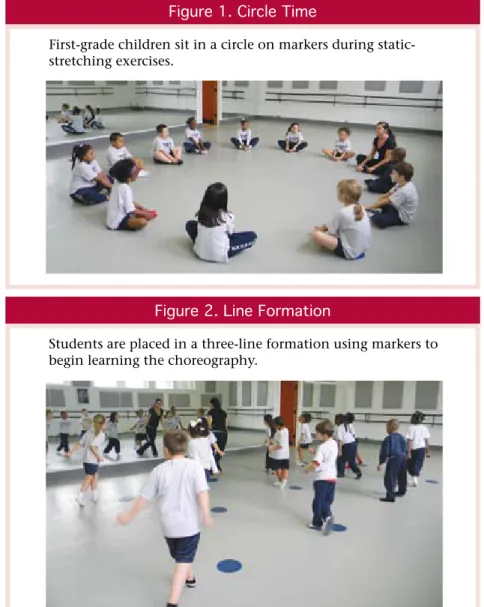
Because the attention span is shorter for younger students, ages three to six years, stretching may follow a different sequence, such as beginning the class sit-ting in a circle (figure 1). Circle time allows students to see their classmates and have a social ses-sion with the teacher. Use static stretches during circle time to calm the students and increase their focus. Try to do a warm-up stretch while having a fun discus-sion on “how their day is going” or “what fun plans they have for the upcoming holiday.” Giving young students a topic to focus
Progression Through Movement:
Teaching Dance to Elementary Students
Jennifer Battisti Pamela Haibach
Editor: Fer
man Konukman
Teaching T
ips
on allows the instructor to stretch and lead class without students detaching from the activity. Then instruct students to stand up and continue with dynamic stretch-ing. Begin with simple move-ments such as moving the hips or marching in place.
An effective activity to intro-duce dance in the classroom is to play a game. Choose an upbeat song familiar to the age group you are instructing and encour-age them to dance freely to the music. As the music progresses, randomly push the pause button throughout the song, instructing the children to sit down on the floor as quickly as possible when the music stops. The last child to sit down is out for the round;
con-tinue pausing till only one dancer is left. This game should warm the students up to dancing with the other children and help them to become comfortable with the open space.
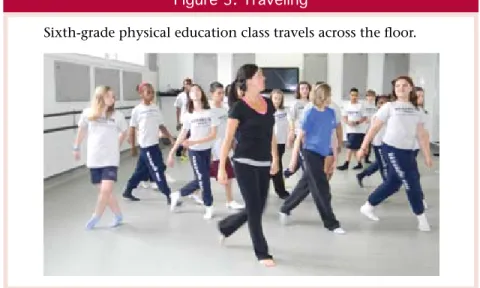
After playing the activity, you can move younger students into the line formation to begin teaching dance sequences or to continue the standing stretches (figure 2). Give students a place on the floor in two or three lines, so that they are able to have space and can see the teacher. Setting place markers in front of each student prevents them from wan-dering closer to other classmates. Provide the students with an incentive for staying behind the marker or have them sit down on
the marker if they cannot properly stand behind it.
For older students, you do not need to give assigned spots un-less you feel the class needs them to stay quiet and focused. Allow students to make lines themselves with their own area for movement space. If students cannot stay focused when near one another, do not hesitate to move their posi-tions in the room.
Class Activities
When planning class activities, keep in mind the developmental and maturity level of the group, and be prepared for potential challenges that may arise. For the younger students, playing games or traveling across the room while taking part in basic dance move-ment will provide them with a bet-ter experience by allowing them to move while learning dance steps.
Ages 3 to 6 Years. Have stu-dents practice learning laterality (left and right) and body labeling by playing a game such as Simon Says. For example, the teacher could instruct students to “touch your right knee with their right hand” or “shake your left leg.” Next, divide the class into about three lines and instruct students to travel across the room, choosing fundamental locomotor skills such as walking, skipping, or galloping. If the movement seems easy, have them lead with the right foot first and then switch to the left foot.
Ages 7 to 10 Years. Instruct them to travel across the room with more complex movements such as jumping, hopping, or turning. Explain the movement patterns us-ing simple terminology and try to avoid dance jargon when teaching students who are unfamiliar with dance. After traveling, teach easy, shorter durations of choreography using movements that are familiar to the students.
Ages 10 and Above. Progress to more challenging dance move-ments and incorporate longer combinations across the floor
Figure 2. Line Formation
Students are placed in a three-line formation using markers to begin learning the choreography.
Figure 1. Circle Time
First-grade children sit in a circle on markers during static- stretching exercises.
Editor: Fer
man Konukman
16 JOPERD • Volume 82 No. 8 • October 2011
Teaching T
ips
(figure 3). Allow students to do the combination more than once to get used to the movement and have more opportunities to learn the choreography. Be careful to teach sequences that are devel-opmentally appropriate to the level of the class. If students are struggling with the choreography, break the sequence down into smaller portions and teach ac-cording to the capabilities of the class. Choreography that is too challenging can discourage the students and possibly compro-mise their technique.Provision of Feedback
Providing individual feedback throughout the class is a way to guide movements and motivate students to improve. Progress will likely be delayed if feedback is not provided (Haibach, Reid, & Col-lier, 2011), because students are relying on themselves to achieve progress and may not know what they are doing incorrectly. Pro-viding students with feedback is a way to increase progress and movement ability. Feedback should be given using simple ter-minology and should target one problem at a time to avoid over-loading the student.
Ages 3 to 6 Years. Focus on positive feedback by encouraging them when they are doing some-thing correctly. If the movement is incorrect, tell the students what components they did correctly and demonstrate again. During the demonstration, cue the stu-dents into the parts they need to improve. Try to keep their confi-dence level high while they are trying to learn the movement and avoid negative comments, such as “that was bad” or “why can’t you get that?” Let the students know that it is okay to make mistakes and continue to encourage them throughout the learning process.
Ages 7 to 10 Years. Provide feedback on both the correct and incorrect aspects of their move-ment. Demonstrations with verbal
feedback and manual guidance can be very effective. Children in this age group should be able to understand corrections better than the younger students. Explain how the student performed and then explain how the movement should be performed, demon-strating the incorrect and correct movement so that the students can see the difference.
Ages 10 and Above. Continue these techniques and add peer feedback. Peer feedback is another positive way to increase correction retention. Peer teaching can maxi-mize cooperation among students and can provide additional feed-back to students beyond that of a single instructor (Boyce, Markos, Jenkins, & Loftus, 1996).
Conclusion
Dance education can improve physical development, emotional maturity, social awareness, and cognitive development. Incorporat-ing dance in the physical education curriculum is a great way to offer variation and get students out of their typical comfort zone. Creating exciting and productive classes to inspire future artists is the first step to introducing dance education.
Acknowledgments
The authors wish to thank dance instructor Kristie Schillaci, Director of Dance Pam Schickler, and the
first- and sixth-grade students of Nazareth Elementary School for their involvement in the photo-graphs for this article.
References
Boyce, A., Markos, N., Jenkins, D., & Loftus, J. (1996). How should feedback be delivered? Journal of Physical Education, Recre-ation & Dance, 67(1), 18-22. Haibach, P. S., Reid, G., & Collier,
D. (2011). Motor learning and motor development. Cham-paign, IL: Human Kinetics. McCutchen, B. (2006).
Teach-ing dance as art in education. Champaign, IL: Human Kinetics. Quin, E., Frazer, L., & Redding, E.
(2007). The health benefits of creative dance: Improving chil-dren’s physical and psychologi-cal wellbeing. Education and Health, 25(2), 31-33.
Stinson, S. (1988). Dance for young children: Finding the magic in movement. Reston, VA: American Alliance for Health, Physical Education, Recreation & Dance.
—Jennifer Battisti (jbatt6@brockport. edu) is a graduate student, and Pa-mela S. Haibach ([email protected]) is an associate professor, in the Department of Kinesiology, Sport Studies and Physical Educa-tion at The College at Brockport, in Brockport, NY 14420.
Figure 3. Traveling
Sixth-grade physical education class travels across the floor.