CHAPTER 3
Cost-Estimation Techniques
The objective of Chapter 3 is to present an assortment of methods for estimating important factors in an engineering economy study.
The High Cost of Office Rental Space
I
n 2008, your multinational firm needs to acquire a total of 50,000 square feet of additional office space in London, Hong Kong, and New York City. You have been tasked with developing a cost estimate for 20,000 square feet of space in London, 10,000 square feet of space in Hong Kong, and 20,000 square feet of space in New York City. While researching this topic, you find an article inUSA Today (April 10, 2007, page B-1) that provides the following annual cost estimates per square foot of rental space in the three cities: London, $233.57; Hong Kong, $201.29; and New York City, $175.00. How much should your firm expect to pay per year for the 50,000 square feet of office space? In Chapter 3, you will learn about several techniques that are highly useful in estimating the costs of engineering projects.not be an embarrassment for the engineer if newer techniques, professional staffing, and a greater awareness are assigned to the engineering cost estimating function. —Phillip F. Ostwald (1992)
3.1
Introduction
In Chapter 1, we described the engineering economic analysis procedure in terms of seven steps. In this chapter, we address Step 3, development of the outcomes and cash flows for each alternative. Because engineering economy studies deal with outcomes that extend into the future, estimating the future cash flows for feasible alternatives is a critical step in the analysis procedure. Often, the most difficult, expensive, and time-consuming part of an engineering economy study is the estimation of costs, revenues, useful lives, residual values, and other data pertaining to the alternatives being analyzed. A decision based on the analysis is economically sound only to the extent that these cost and revenue estimates are representative of what subsequently will occur. In this chapter, we introduce the role ofcost estimatingin engineering practice. Definitions and examples of important cost concepts were provided in Chapter 2.
Whenever an engineering economic analysis is performed for a major capital investment, the cost-estimating effort for that analysis should be an integral part of a comprehensive planning and design process requiring the active participation of not only engineering designers but also personnel from marketing, manufacturing, finance, and top management. Results of cost estimating are used for a variety of purposes, including the following:
1. Providing information used in setting a selling price for quoting, bidding, or evaluating contracts
2. Determining whether a proposed product can be made and distributed at a profit (for simplicity, price=cost+profit)
3. Evaluating how much capital can be justified for process changes or other improvements
4. Establishing benchmarks for productivity improvement programs
There are two fundamental approaches to cost estimating: the “top-down” approach and the “bottom-up” approach. The top-down approach basically uses historical data from similar engineering projects to estimate the costs, revenues, and other data for the current project by modifying these data for changes in inflation or deflation, activity level, weight, energy consumption, size, and other factors. This approach is best used early in the estimating process when alternatives are still being developed and refined.
The bottom-up approach is a more detailed method of cost estimating. This method breaks down a project into small, manageable units and estimates their economic consequences. These smaller unit costs are added together with other types of costs to obtain an overall cost estimate. This approach usually works best when the detail concerning the desired output (a product or a service) has been defined and clarified.
SECTION3.1 / INTRODUCTION 73
EXAMPLE 3-1
Estimating the Cost of a College Degree
A simple example of cost estimating is to forecast the expense of getting a Bachelor of Science (B.S.) from the university you are attending. In our solution, we outline the two basic approaches just discussed for estimating these costs.
Solution
A top-down approach would take the published cost of a four-year degree at the same (or a similar) university and adjust it for inflation and extraordinary items that an incoming student might encounter, such as fraternity/sorority membership, scholarships, and tutoring. For example, suppose that the pub-lished cost of attending your university is $15,750 for the current year. This figure is anticipated to increase at the rate of 6% per year and includes full-time tuition and fees, university housing, and a weekly meal plan. Not included are the costs of books, supplies, and other personal expenses. For our initial estimate, these “other” expenses are assumed to remain constant at $5,000 per year.
The total estimated cost for four years can now be computed. We simply need to adjust the published cost for inflation each year and add in the cost of “other” expenses.
Tuition, Fees, “Other” Total Estimated
Year Room and Board Expenses Cost for Year
1 $15,750×1.06=$16,695 $5,000 $21,695 2 16,695×1.06= 17,697 5,000 22,697 3 17,697×1.06= 18,759 5,000 23,759 4 18,759×1.06= 19,885 5,000 24,885 Grand Total $93,036
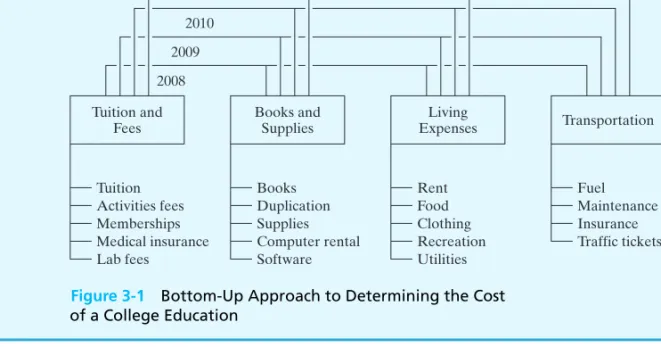
In contrast with the top-down approach, a bottom-up approach to the same cost estimate would be to first break down anticipated expenses into the typical categories shown in Figure 3-1 for each of the four years at the university. Tuition and fees can be estimated fairly accurately in each year, as can books and supplies. For example, suppose that the average cost of a college textbook is $100. You can estimate your annual textbook cost by simply multiplying the average cost per book by the number of courses you plan to take. Assume that you plan on taking five courses each semester during the first year. Your estimated textbook costs would be
5 courses semester (2 semesters) 1 book course $100 book =$1,000.
The other two categories, living expenses and transportation, are probably more dependent on your lifestyle. For example, whether you own and operate an automobile and live in a “high-end” apartment off-campus can dramatically affect the estimated expenses during your college years.
Tuition and Fees Tuition Activities fees Memberships Medical insurance Lab fees Books and Supplies Books Duplication Supplies Computer rental Software Living Expenses Rent Food Clothing Recreation Utilities Transportation Fuel Maintenance on car Insurance Traffic tickets 2008 2009 2010 2011
Sum over Four Years to Obtain Total Cost of a B.S. at Your University
Figure 3-1 Bottom-Up Approach to Determining the Cost of a College Education
3.2
An Integrated Approach
An integrated approach to developing the net cash flows for feasible project alternatives is shown in Figure 3-2. This integrated approach includes three basic components:
1. Work breakdown structure (WBS) This is a technique for explicitly defining, at successive levels of detail, the work elements of a project and their interrelationships (sometimes called awork element structure).
2. Cost and revenue structure (classification) Delineation of the cost and revenue categories and elements is made for estimates of cash flows at each level of the WBS.
3. Estimating techniques (models) Selected mathematical models are used to estimate the future costs and revenues during the analysis period.
These three basic components, together with integrating procedural steps, provide an organized approach for developing the cash flows for the alternatives.
Describe project in work breakdown structure (WBS) form (Basic Component 1)
Delineate cost and revenue
categories
and elements
Describe a
feasible alternative using project
WBS
Determine
WBS level(s) for
estimating Estimating techniques (models) Cost and revenue database Develop
cash flow for alternative
Last alternative ? Ye s No Stop (Basic Component 3) (Basic Component 2)
Define Cash flow perspective Estimating baseline Study (analysis) period
Figur e 3-2 Integrated Approach for Developing the Cash Flows for Alternatives
As shown in Figure 3-2, the integrated approach begins with a description of the project in terms of a WBS. WBS is used to describe the project and each alternative’s unique characteristics in terms of design, labor, material requirements, and so on. Then these variations in design, resource requirements, and other characteristics are reflected in the estimated future costs and revenues (net cash flow) for that alternative.
To estimate future costs and revenues for an alternative, the perspective (viewpoint) of the cash flow must be established and an estimating baseline and analysis period defined. Normally, cash flows are developed from the owner’s viewpoint. The net cash flow for an alternative represents what is estimated to happen to future revenues and costs from the perspective being used. Therefore, the estimated changes in revenues and costs associated with an alternative have to be relative to a baseline that is consistently used for all the alternatives being compared.
3.2.1
The Work Breakdown Structure (WBS)
The first basic component in an integrated approach to developing cash flows is the work breakdown structure (WBS). The WBS is a basic tool in project management and is a vital aid in an engineering economy study. The WBS serves as a framework for defining all project work elements and their interrelationships, collecting and organizing information, developing relevant cost and revenue data, and integrating project management activities.
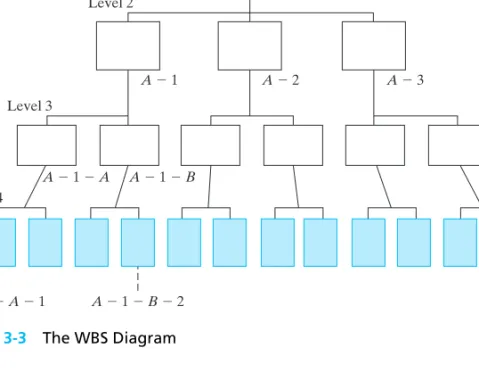
Figure 3-3 shows a diagram of a typical four-level WBS. It is developed from the top (project level) down in successive levels of detail. The project is divided into its major work elements (Level 2). These major elements are then divided to develop Level 3, and so on. For example, an automobile (first level of the WBS) can be divided into second-level components (or work elements) such as the chassis, drive train, and electrical system. Then each second-level component of the WBS can be subdivided further into third-level elements. The drive train, for example, can be subdivided into third-level components such as the engine, differential, and transmission. This process is continued until the desired detail in the definition and description of the project or system is achieved.
Different numbering schemes may be used. The objectives of numbering are to indicate the interrelationships of the work elements in the hierarchy. The scheme illustrated in Figure 3-3 is an alphanumeric format. Another scheme often used is all numeric—Level 1: 1-0; Level 2: 1-1, 1-2, 1-3; Level 3: 1-1-1, 1-1-2, 1-2-1, 1-2-2, 1-3-1, 1-3-2; and so on (i.e., similar to the organization of this book). Usually, the level is equal (except for Level 1) to the number of characters indicating the work element.
Other characteristics of a project WBS are as follows:
1. Both functional (e.g., planning) and physical (e.g., foundation) work elements are included in it:
(a) Typical functional work elements are logistical support, project management, marketing, engineering, and systems integration.
(b) Physical work elements are the parts that make up a structure, product, piece of equipment, or similar item; they require labor, materials, and other resources to produce or construct.
SECTION3.2 / ANINTEGRATEDAPPROACH 77 Level 1 Level 2 A ⫺ 0 A ⫺ 1 A ⫺ 1 ⫺ A A ⫺ 1 ⫺ A ⫺ 1 A ⫺ 1 ⫺ B ⫺ 2 A ⫺ 1 ⫺ B A ⫺ 2 A ⫺ 3 Level 3 Level 4
Figure 3-3 The WBS Diagram
2. The content and resource requirements for a work element are the sum of the activities and resources of related subelements below it.
3. A project WBS usually includes recurring (e.g., maintenance) and nonrecurring (e.g., initial construction) work elements.
EXAMPLE 3-2
A WBS for a Construction Project
You have been appointed by your company to manage a project involving construction of a small commercial building with two floors of 15,000 gross square feet each. The ground floor is planned for small retail shops, and the second floor is planned for offices. Develop the first three levels of a representative WBS adequate for all project efforts from the time the decision was made to proceed with the design and construction of the building until initial occupancy is completed.
Solution
There would be variations in the WBSs developed by different individuals for a commercial building. A representative three-level WBS is shown in Figure 3-4. Level 1 is the total project. At Level 2, the project is divided into seven major physical work elements and three major functional work elements. Then each of these major elements is divided into subelements as required (Level 3). The numbering scheme used in this example is all numeric.
Commercial Building Project 1-0 Site W ork and F oundation 1-1 Exterior 1-2 Interior 1-3 Roof 1-4
1-4-1 Framing 1-4-2 Sheathing 1-4-3 Roofing
1-3-1 Framing 1-3-2 Flooring/Stairways 1-3-3 Walls/Ceilings 1-3-4 Doors 1-3-5 Special Additions
1-2-1 Framing 1-2-2 Siding 1-2-3 W
indows
1-2-4 Entrances 1-2-5 Insulation
1-1-1 Site Grading 1-1-2 Excavation 1-1-3 Sidewalks/Parking 1-1-4 Footing/F
oundation 1-1-5 Floor Slab Electrical Systems 1-5 Mechanical Systems 1-6 Real Estate 1-7 Project Management 1-8 Arch/Engr . Services 1-9 Sales 1-10 1-10-1 Leasing/Asset Sale s 1-10-2 Admin. Support 1-10-3 Le g al
1-9-1 Design 1-9-2 Cost Estimating 1-9-3 Consultin
g 1-8-1 Admin. Support 1-8-2 Technical Mgt. 1-8-3 Le g al 1-6-1 Heating/Cooling 1-6-2 Hot W ater 1-6-3 Lavatories
1-5-1 Service Delivery 1-5-2 Devices 1-5-3 Li
g htin g LEVEL 1 2 3 2 3 Figur e 3-4 WBS (Three Levels) for Commercial Building Project in Example 3-2
SECTION3.2 / ANINTEGRATEDAPPROACH 79
3.2.2
The Cost and Revenue Structure
The second basic component of the integrated approach for developing cash flows (Figure 3-2) is the cost and revenue structure. This structure is used to identify and categorize the costs and revenues that need to be included in the analysis. Detailed data are developed and organized within this structure for use with the estimating techniques of Section 3.3 to prepare the cash-flow estimates.
The life-cycle concept and the WBS are important aids in developing the cost and revenue structure for a project. The life cycle defines a maximum time period and establishes a range of cost and revenue elements that need to be considered in developing cash flows. The WBS focuses the analyst’s effort on the specific functional and physical work elements of a project and on its related costs and revenue.
Perhaps the most serious source of errors in developing cash flows is overlooking important categories of costs and revenues. The cost and revenue structure, prepared in tabular or checklist form, is a good means of preventing such oversights. Technical familiarity with the project is essential in ensuring the completeness of the structure, as are using the life-cycle concept and the WBS in its preparation.
The following is a brief listing of some categories of costs and revenues that are typically needed in an engineering economy study:
1. Capital investment (fixed and working) 2. Labor costs
3. Material costs 4. Maintenance costs
5. Property taxes and insurance 6. Overhead costs
7. Disposal costs 8. Revenues
9. Quality (and scrap) costs 10. Market (or salvage) values
3.2.3
Estimating Techniques (Models)
The third basic component of the integrated approach (Figure 3-2) involves estimating techniques (models). These techniques, together with the detailed cost and revenue data, are used to develop individual cash-flow estimates and the overall net cash-flow for each alternative.
The purpose of estimating is to develop cash-flow projections—not to produce
exact dataabout the future, which is virtually impossible. Neither a preliminary
estimate nor a final estimate is expected to be exact; rather, it should adequately suit the need at a reasonable cost and is often presented as a range of numbers.
Cost and revenue estimates can be classified according to detail, accuracy, and their intended use as follows:
1. Order-of-magnitude estimates:used in the planning and initial evaluation stage of a project.
2. Semidetailed, or budget, estimates: used in the preliminary or conceptual design stage of a project.
3. Definitive (detailed) estimates:used in the detailed engineering/construction stage of a project.
Order-of-magnitude estimates are used in selecting the feasible alternatives for the study. They typically provide accuracy in the range of±30 to 50% and are developed through semiformal means such as conferences, questionnaires, and generalized equations applied at Level 1 or 2 of the WBS.
Budget (semidetailed) estimates are compiled to support the preliminary design effort and decision making during this project period. Their accuracy usually lies in the range of±15%. These estimates differ in the fineness of cost and revenue breakdowns and the amount of effort spent on the estimate. Estimating equations applied at Levels 2 and 3 of the WBS are normally used.
Detailed estimates are used as the basis for bids and to make detailed design decisions. Their accuracy is±5%. They are made from specifications, drawings, site surveys, vendor quotations, and in-house historical records and are usually done at Level 3 and successive levels in the WBS.
Thus, it is apparent that a cost or revenue estimate can vary from a “back of the envelope” calculation by an expert to a very detailed and accurate prediction of the future prepared by a project team. The level of detail and accuracy of estimates should depend on the following:
1. Time and effort available as justified by the importance of the study 2. Difficulty of estimating the items in question
3. Methods or techniques employed 4. Qualifications of the estimator(s)
5. Sensitivity of study results to particular factor estimates
As estimates become more detailed, accuracy typically improves, but the cost of making the estimate increases dramatically. This general relationship is shown in Figure 3-5 and illustrates the idea that cost and revenue estimates should be prepared with full recognition of how accurate a particular study requires them to be.
SECTION3.2 / ANINTEGRATEDAPPROACH 81 Figure 3-5 Accuracy of Cost and Revenue Estimates versus the Cost of Making Them Cost of Estimate
as a Percentage of Project Cost
Order -of-Magnitude Estimates Accuracy (⫾%) 5 10 25 Levels 3 – 4 in WBS Levels 1–2 in WBS 50 Detailed Estimates
3.2.3.1 Sources of Estimating Data The information sources useful in cost and revenue estimating are too numerous to list completely. The following four major sources of information are listed roughly in order of importance:
1. Accounting records. Accounting records are a prime source of information for economic analyses; however, they are often not suitable for direct, unadjusted use.
A brief discussion of the accounting process and information was given in Appendix 2-A. In its most basic sense, accounting consists of a series of procedures for keeping a detailed record of monetary transactions between established categories of assets. Accounting records are a good source of historical data but have some limitations when used in making prospective estimates for engineering economic analyses. Moreover, accounting records rarely contain direct statements of incremental costs or opportunity costs, both of which are essential in most engineering economic analyses. Incremental costs are decision specific for one-of-a-kind investments and are unlikely to be available from the accounting system.
2. Other sources within the firm. The typical firm has a number of people and records that may be excellent sources of estimating information. Examples of functions within firms that keep records useful to economic analyses are engineering, sales, production, quality, purchasing, and personnel.
3. Sources outside the firm. There are numerous sources outside the firm that can provide helpful information. The main problem is in determining those that are most beneficial for particular needs. The following is a listing of some commonly used outside sources:
(a) Published information. Technical directories, buyer indexes, U.S. government
publications, reference books, and trade journals offer a wealth of infor-mation. For instance, Standard and Poor’s Industry Surveys gives monthly information regarding key industries. The Statistical Abstract of the United
Statesis a remarkably comprehensive source of cost indexes and data. The
Bureau of Labor Statistics publishes many periodicals that are good sources of labor costs, such as theMonthly Labor Review, Employment and Earnings,
Current Wage Developments, Handbook of Labor Statistics,and theChartbook on Wages, Prices and Productivity.
(b) Personal contacts are excellent potential sources. Vendors, salespeople,
professional acquaintances, customers, banks, government agencies, chambers of commerce, and even competitors are often willing to furnish needed information on the basis of a serious and tactful request.
4. Research and development (R&D). If the information is not published and cannot be obtained by consulting someone, the only alternative may be to undertake R&D to generate it. Classic examples are developing a pilot plant and undertaking a test market program.
The Internet can also be a source of cost-estimating data, though you should assure yourself that the information is from a reputable source. The following Web sites may be useful to you both professionally and personally.
www.enr.com Engineering News-Record Construction and labor costs www.kbb.com Kelley Blue Book Automobile pricing
www.factsonfuel.com American Petroleum Institute Fuel costs
3.2.3.2 How Estimates Are Accomplished Estimates can be prepared in a number of ways, such as the following examples:
1. Aconferenceof various people who are thought to have good information or
bases for estimating the quantity in question. A special version of this is the Delphi method, which involves cycles of questioning and feedback in which the opinions of individual participants are kept anonymous.
2. Comparison with similar situations or designs about which there is more
information and from which estimates for the alternatives under consideration can be extrapolated. This is sometimes called estimating by analogy. The comparison method may be used to approximate the cost of a design or product that is new. This is done by taking the cost of a more complex design for a similar item as an upper bound and the cost of a less complex item of similar design as a lower bound. The resulting approximation may not be very accurate, but the comparison method does have the virtue of setting bounds that might be useful for decision making.
3. Using quantitative techniques, which do not always have standardized names.
Some selected techniques, with the names used being generally suggestive of the approaches, are discussed in the next section.
3.3
Selected Estimating Techniques (Models)
The estimating models discussed in this section are applicable for order-of-magnitude estimates and for many semidetailed or budget estimates. They are useful in the initial selection of feasible alternatives for further analysis and in the conceptual or preliminary design phase of a project. Sometimes, these models can be used in the detailed design phase of a project.
SECTION3.3 / SELECTEDESTIMATINGTECHNIQUES(MODELS) 83
3.3.1
Indexes
Costs and prices∗ vary with time for a number of reasons, including (1) technological advances, (2) availability of labor and materials, and (3) inflation. An indexis a dimensionless number that indicates how a cost or a price has changed with time (typically escalated) with respect to a base year. Indexes provide a convenient means for developing present and future cost and price estimates from historical data. An estimate of the cost or selling price of an item in yearncan be obtained by multiplying the cost or price of the item at an earlier point in time (yeark) by the ratio of the index value in yearn(I¯n) to the index value in yeark
(I¯k);†that is, Cn=Ck ¯ In ¯ Ik , (3-1)
where k=reference year (e.g., 2000) for which cost or price of item is known; n=year for which cost or price is to be estimated(n>k);
Cn=estimated cost or price of item in yearn;
Ck=cost or price of item in reference yeark.
Equation (3-1) is sometimes referred to as theratio techniqueof updating costs and prices. Use of this technique allows the cost or potential selling price of an item to be taken from historical data with a specified base year and updated with an index. This concept can be applied at the lower levels of a WBS to estimate the cost of equipment, materials, and labor, as well as at the top level of a WBS to estimate the total project cost of a new facility, bridge, and so on.
EXAMPLE 3-3
Indexing the Cost of a New Boiler
A certain index for the cost of purchasing and installing utility boilers is keyed to 1988, where its baseline value was arbitrarily set at 100. Company XYZ installed a 50,000-lb/hour boiler for $525,000 in 2000 when the index had a value of 468. This same company must install another boiler of the same size in 2007. The index in 2007 is 542. What is the approximate cost of the new boiler?
Solution
In this example, nis 2007 andkis 2000. From Equation (3-1), an approximate cost of the boiler in 2007 is
C2007=$525,000(542/468)=$608,013.
Indexes can be created for a single item or for multiple items. For a single item, the index value is simply the ratio of the cost of the item in the current year to the cost of the same item in the reference year, multiplied by the reference year factor
∗The termscostandpriceare often used together. The cost of a product or service is the total of the resources, direct
and indirect, required to produce it. The price is the value of the good or service in the marketplace. In general, price is equal to cost plus a profit.
(typically, 100). A composite index is created by averaging the ratios of selected item costs in a particular year to the cost of the same items in a reference year. The developer of an index can assign different weights to the items in the index according to their contribution to total cost. For example, a general weighted index is given by
¯
In=W1(Cn1/Ck1)+W2(Cn2/Ck2)+ · · · +WM(CnM/CkM)
W1+W2 + · · · +WM × ¯
Ik, (3-2)
where M=total number of items in the index(1≤m≤M); Cnm=unit cost (or price) of themth item in yearn;
Ckm=unit cost (or price) of themth item in yeark;
Wm=weight assigned to themth item;
¯
Ik =composite index value in yeark.
The weightsW1,W2,. . .,WMcan sum to any positive number, but typically sum
to 1.00 or 100. Almost any combination of labor, material, products, services, and so on can be used for a composite cost or price index.
EXAMPLE 3-4
Weighted Index for Gasoline Cost
Based on the following data, develop a weighted index for the price of a gallon of gasoline in 2006, when 1992 is the reference year having an index value of 99.2. The weight placed on regular unleaded gasoline is three times that of either premium or unleaded plus, because roughly three times as much regular unleaded is sold compared with premium or unleaded plus.
Price (Cents/Gal) in Year
1992 1996 2006
Premium 114 138 240 Unleaded plus 103 127 230 Regular unleaded 93 117 221
Solution
In this example,kis 1992 andnis 2006. From Equation (3-2), the value of¯I2006is (1)(240/114)+(1)(230/103)+(3)(221/93)
1+1+3 ×99.2=227.5.
Now, if the index in 2008, for example, is estimated to be 253, it is a simple matter to determine the corresponding 2008 prices of gasoline fromI¯2006=227.5:
Premium: 240 cents/gal
253 227.5
SECTION3.3 / SELECTEDESTIMATINGTECHNIQUES(MODELS) 85
Unleaded plus: 230 cents/gal
253 227.5
=256 cents/gal, Regular unleaded: 221 cents/gal
253 227.5
=246 cents/gal.
Many indexes are periodically published, including the Engineering News RecordConstruction Index (www.enr.com), which incorporates labor and material costs and the Marshall and Stevens cost index.
3.3.2
Unit Technique
Theunit techniqueinvolves using a per unit factor that can be estimated effectively. Examples are as follows:
1. Capital cost of plant per kilowatt of capacity 2. Revenue per mile
3. Capital cost per installed telephone 4. Revenue per customer served
5. Temperature loss per 1,000 feet of steam pipe 6. Operating cost per mile
7. Construction cost per square foot
Such factors, when multiplied by the appropriate unit, give a total estimate of cost, savings, or revenue.
As a simple example, suppose that we need a preliminary estimate of the cost of a particular house. Using a unit factor of, say, $95 per square foot and knowing that the house is approximately 2,000 square feet, we estimate its cost to be $95×2,000=$190,000.
While the unit technique is very useful for preliminary estimating purposes, such average values can be misleading. In general, more detailed methods will result in greater estimation accuracy.
3.3.3
Factor Technique
Thefactor techniqueis an extension of the unit method in which we sum the product of several quantities or components and add these to any components estimated directly. That is,
C= d Cd+ m fmUm, (3-3)
where C=cost being estimated;
Cd=cost of the selected componentdthat is estimated directly;
fm=cost per unit of componentm;
Um=number of units of componentm.
As a simple example, suppose that we need a slightly refined estimate of the cost of a house consisting of 2,000 square feet, two porches, and a garage. Using a unit factor of $85 per square foot, $10,000 per porch, and $8,000 per garage for the two directly estimated components, we can calculate the total estimate as
($10,000×2)+$8,000+($85×2,000)=$198,000.
We can also answer the question posed at the beginning of the chapter (page 71) using the factor technique. The rental expense per year will be approximately 20,000×$233.57 in London plus 10,000×$201.29 in Hong Kong plus 20,000×$175.00 in New York City. The total expense will be $10,184,300 per year for the additional office space.
The factor technique is particularly useful when the complexity of the estimating situation does not require a WBS, but several different parts are involved. Example 3-5 and the product cost-estimating example to be presented in Section 3.5.1 further illustrate this technique.
EXAMPLE 3-5
Analysis of Building Space Cost Estimates
The detailed design of the commercial building described in Example 3-2 affects the utilization of the gross square feet (and, thus, the net rentable space) available on each floor. Also, the size and location of the parking lot and the prime road frontage available along the property may offer some additional revenue sources. As project manager, analyze the potential revenue impacts of the following considerations.
The first floor of the building has 15,000 gross square feet of retail space, and the second floor has the same amount planned for office use. Based on discussions with the sales staff, develop the following additional information:
(a) The retail space should be designed for two different uses—60% for a restaurant operation (utilization=79%, yearly rent =$23/sq.ft.) and 40% for a retail clothing store (utilization=83%, yearly rent=$18/sq.ft.). (b) There is a high probability that all the office space on the second floor will
be leased to one client (utilization=89%, yearly rent=$14/sq.ft.).
(c) An estimated 20 parking spaces can be rented on a long-term basis to two existing businesses that adjoin the property. Also, one spot along the road frontage can be leased to a sign company, for erection of a billboard, without impairing the primary use of the property.
SECTION3.4 / PARAMETRICCOSTESTIMATING 87
Solution
Based on this information, you estimate annual project revenue (R) asˆ ˆ R=W(r1)(12)+ϒ(r2)(12)+ 3 j=1 Sj(uj)(dj),
whereW =number of parking spaces; ϒ=number of billboards;
r1=rate per month per parking space=$22; r2=rate per month per billboard=$65;
j=index of type of building space use;
Sj=space (gross square feet) being used for purposej;
uj=spacejutilization factor (% net rentable);
dj=rate per (rentable) square foot per year of building space used
for purposej. Then, ˆ R= [20($22)(12)+1($65)(12)] + [9,000(0.79)($23) + 6,000(0.83)($18)+15,000(0.89)($14)] ˆ R=$6,060+$440,070=$446,130.
A breakdown of the annual estimated project revenue shows that 1.4% is from miscellaneous revenue sources;
98.6% is from leased building space.
From a detailed design perspective, changes in annual project revenue due to changes in building space utilization factors can be easily calculated. For example, an average 1% improvement in the ratio of rentable space to gross square feet would change the annual revenue (R) as follows:ˆ
Rˆ = 3 j=1 Sj(uj+0.01)(dj)−($446,130−$6,060) =$445,320−$440,070 =$5,250 per year.
3.4
Parametric Cost Estimating
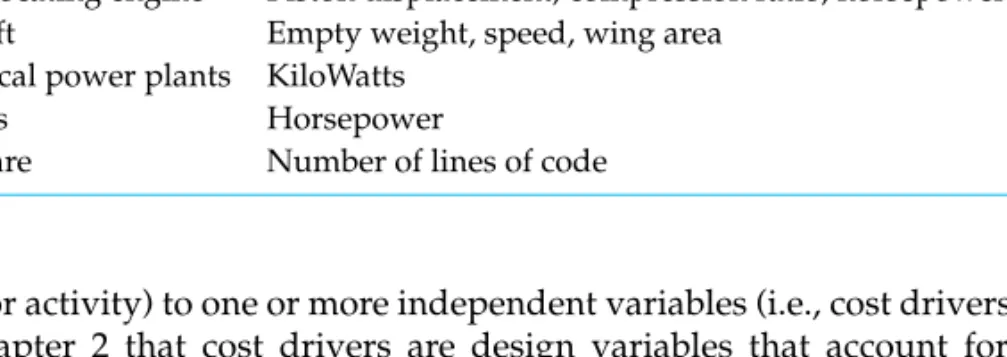
Parametric cost estimating is the use of historical cost data and statistical techniques to predict future costs. Statistical techniques are used to develop cost estimating relationships (CERs) that tie the cost or price of an item (e.g., a product, good,
TABLE 3-1 Examples of Cost Drivers Used in Parametric Cost Estimates
Product Cost Driver (Independent Variable)
Construction Floor space, roof surface area, wall surface area Trucks Empty weight, gross weight, horsepower
Passenger car Curb weight, wheel base, passenger space, horsepower Turbine engine Maximum thrust, cruise thrust, specific fuel consumption Reciprocating engine Piston displacement, compression ratio, horsepower Aircraft Empty weight, speed, wing area
Electrical power plants KiloWatts Motors Horsepower
Software Number of lines of code
service, or activity) to one or more independent variables (i.e., cost drivers). Recall from Chapter 2 that cost drivers are design variables that account for a large portion of total cost behavior. Table 3-1 lists a variety of items and associated cost drivers. The unit technique described in the previous section is a simple example of parametric cost estimating.
Parametric models are used in the early design stages to get an idea of how much the product (or project) will cost, on the basis of a few physical attributes (such as weight, volume, and power). The output of the parametric models (an estimated cost) is used to gauge the impact of design decisions on the total cost.
Various statistical and other mathematical techniques are used to develop the CERs. For example, simple linear regression and multiple linear regression models, which are standard statistical methods for estimating the value of a dependent variable (the unknown quantity) as a function of one or more independent variables, are often used to develop estimating relationships. This section describes two commonly used estimating relationships, the power-sizing technique and the learning curve, followed by an overview of the procedure used to develop CERs.
3.4.1
Power-Sizing Technique
Thepower-sizing technique, which is sometimes referred to as anexponential model, is frequently used for developing capital investment estimates for industrial plants and equipment. This CER recognizes that cost varies as some power of the change in capacity or size. That is,
CA CB = SA SB X , CA=CB SA SB X , (3-4)
SECTION3.4 / PARAMETRICCOSTESTIMATING 89
where CA=cost for plant A
CB=cost for plant B
(both in $ as of the point in time for which the estimate is desired);
SA =size of plant A
SB=size of plant B
(both in same physical units);
X=cost-capacity factorto reflect economies of scale.∗
The value of the cost-capacity factor will depend on the type of plant or equipment being estimated. For example, X = 0.68 for nuclear generating plants and 0.79 for fossil-fuel generating plants. Note thatX <1 indicates decreasing economies of scale (each additional unit of capacity costs less than the previous unit),X>1† indicates increasing economies of scale (each additional unit of capacity costs more than the previous unit), andX=1 indicates a linear cost relationship with size.
EXAMPLE 3-6
Power-Sizing Model for Cost Estimating
Suppose that an aircraft manufacturer desires to make a preliminary estimate of the cost of building a 600-MW fossil-fuel plant for the assembly of its new long-distance aircraft. It is known that a 200-MW plant cost $100 million 20 years ago when the approximate cost index was 400, and that cost index is now 1,200. The cost-capacity factor for a fossil-fuel power plant is 0.79.
Solution
Before using the power-sizing model to estimate the cost of the 600-MW plant (CA), we must first use the cost index information to update the known cost of
the 200-MW plant 20 years ago to a current cost. Using Equation (3-1), we find that the current cost of a 200-MW plant is
CB=$100 million 1,200 400 =$300 million.
So, using Equation (3-4), we obtain the following estimate for the 600-MW plant: CA=$300 million 600-MW 200-MW 0.79 CA=$300 million×2.38=$714 million.
Note that Equation (3-4) can be used to estimate the cost of a larger plant (as in Example 3-6) or the cost of a smaller plant. For example, suppose we need to estimate the cost of building a 100-MW plant. Using Equation (3-4) and the data
∗This may be calculated or estimated from experience by using statistical techniques. For typical factors, see
W. R. Park,Cost Engineering Analysis(New York: John Wiley & Sons, 1973), 137.
†Precious gems are all example to increasing economies of scale. For example, a one-carat diamond typically costs
for the 200-MW plant in Example 3-6, we find that the current cost of a 100-MW plant is CA=$300 million 100 MW 200 MW 0.79 CA=$300 million×0.58=$174 million.
3.4.2
Learning and Improvement
A learning curve is a mathematical model that explains the phenomenon of
increased worker efficiency and improved organizational performance with repetitive production of a good or service. The learning curve is sometimes called an experience curveor a manufacturing progress function; fundamentally, it is an estimating relationship. The learning (improvement) curve effect was first observed in the aircraft and aerospace industries with respect to labor hours per unit. However, it applies in many different situations. For example, the learning curve effect can be used in estimating the professional hours expended by an engineering staff to accomplish successive detailed designs within a family of products, as well as in estimating the labor hours required to assemble automobiles.
The basic concept of learning curves is that some input resources (e.g., energy costs, labor hours, material costs, engineering hours) decrease, on a per-output-unit basis, as the number of units produced increases. Most learning curves are based on the assumption that a constant percentage reduction occurs in, say, labor hours, as the number of units produced isdoubled. For example, if 100 labor hours are required to produce the first output unit and a 90% learning curve is assumed, then 100(0.9)=90 labor hours would be required to produce the second unit. Similarly, 100(0.9)2=81 labor hours would be needed to produce the fourth
unit, 100(0.9)3=72.9 hours to produce the eighth unit, and so on. Therefore, a 90% learning curve results in a 10% reduction in labor hours each time the production quantity is doubled.
Equation (3-5) can be used to compute resource requirements assuming a constant percentage reduction in input resources each time the output quantity is doubled.
Zu=K(un), (3-5)
where u=the output unit number;
Zu=the number of input resource units needed to produce output unitu;
K=the number of input resource units needed to produce the first output unit;
s=the learning curve slope parameter expressed as a decimal (s=0.9 for a 90% learning curve);
n= logs
SECTION3.4 / PARAMETRICCOSTESTIMATING 91
EXAMPLE 3-7
Learning Curve for a Formula Car Design Team
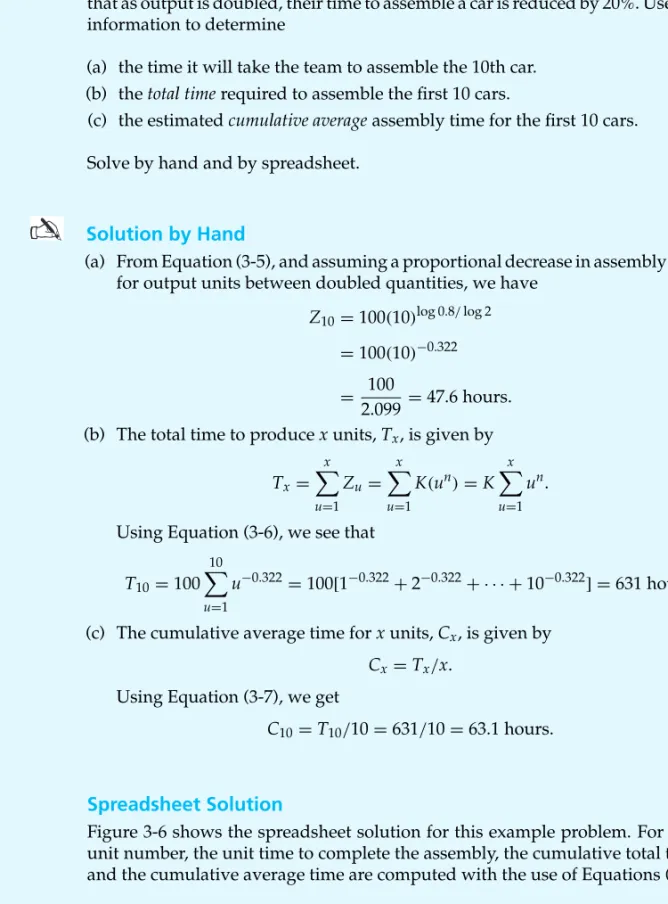
The Mechanical Engineering department has a student team that is designing a formula car for national competition. The time required for the team to assemble the first car is 100 hours. Their improvement (or learning rate) is 0.8, which means that as output is doubled, their time to assemble a car is reduced by 20%. Use this information to determine
(a) the time it will take the team to assemble the 10th car. (b) thetotal timerequired to assemble the first 10 cars.
(c) the estimatedcumulative averageassembly time for the first 10 cars. Solve by hand and by spreadsheet.
Solution by Hand
(a) From Equation (3-5), and assuming a proportional decrease in assembly time for output units between doubled quantities, we have
Z10 =100(10)log 0.8/log 2 =100(10)−0.322 = 100
2.099 =47.6 hours. (b) The total time to producexunits,Tx, is given by
Tx= x u=1 Zu= x u=1 K(un)=K x u=1 un. (3-6)
Using Equation (3-6), we see that
T10 =100
10
u=1
u−0.322=100[1−0.322+2−0.322+ · · · +10−0.322] =631 hours. (c) The cumulative average time forxunits,Cx, is given by
Cx=Tx/x. (3-7)
Using Equation (3-7), we get
C10=T10/10=631/10=63.1 hours.
Spreadsheet Solution
Figure 3-6 shows the spreadsheet solution for this example problem. For each unit number, the unit time to complete the assembly, the cumulative total time, and the cumulative average time are computed with the use of Equations (3-5),
= LOG(B2) / LOG(2)
= $B$1 * A6 ^ $B$4 = AVERAGE($B$6:B6) = SUM($B$6:B6)
SECTION3.4 / PARAMETRICCOSTESTIMATING 93
(3-6), and (3-7), respectively. Note that these formulas are entered once in row 6 of the spreadsheet and are then simply copied into rows 7 through 15.
A plot of unit time and cumulative average time is easily created with the spreadsheet software. This spreadsheet model can be used to examine the impact of a different learning slope parameter (e.g.,s=90%) on predicted car assembly times by changing the value of cell B2.
3.4.3
Developing a Cost Estimating Relationship (CER)
A CER is a mathematical model that describes the cost of an engineering project as a function of one or more design variables. CERs are useful tools because they allow the estimator to develop a cost estimate quickly and easily. Furthermore, estimates can be made early in the design process before detailed information is available. As a result, engineers can use CERs to make early design decisions that are cost-effective in addition to meeting technical requirements.
There are four basic steps in developing a CER:
1. Problem definition
2. Data collection and normalization 3. CER equation development
4. Model validation and documentation
3.4.3.1 Problem Definition The first step in any engineering analysis is to define the problem to be addressed. A well-defined problem is much easier to solve. For the purposes of cost estimating, developing a WBS is an excellent way of describing the elements of the problem. A review of the completed WBS can also help identify potential cost drivers for the development of CERs.
3.4.3.2 Data Collection and Normalization The collection and normaliza-tion of data is the most critical step in the development of a CER. We’re all familiar with the adage “garbage in—garbage out.” Without reliable data, the cost estimates obtained by using the CER would be meaningless. The WBS is also helpful in the data collection phase. The WBS helps to organize the data and ensure that no elements are overlooked.
Data can be obtained from both internal and external sources. Costs of similar projects in the past are one source of data. Published cost information is another source of data. Once collected, data must be normalized to account for differences due to inflation, geographical location, labor rates, and so on. For example, cost indexes or the price inflation techniques to be described in Chapter 8 can be used to normalize costs that occurred at different times. Consistent definition of the data is another important part of the normalization process.
3.4.3.3 CER Equation Development The next step in the development of a CER is to formulate an equation that accurately captures the relationship between
TABLE 3-2 Typical Equation Forms
Type of Relationship Generalized Equation
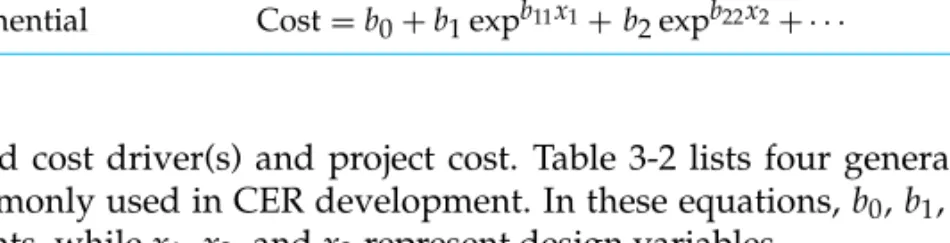
Linear Cost=b0+b1x1+b2x2+b3x3+ · · ·
Power Cost=b0+b1xb11
1 x
b12
2 + · · ·
Logarithmic Cost=b0+b1log(x1)+b2log(x2)+b3log(x3)+ · · ·
Exponential Cost=b0+b1expb11x1+b
2expb22x2+ · · ·
the selected cost driver(s) and project cost. Table 3-2 lists four general equation types commonly used in CER development. In these equations,b0,b1,b2, andb3 are constants, whilex1,x2, andx3represent design variables.
A simple, yet very effective, way to determine an appropriate equation form for the CER is to plot the data. If a plot of the data on regular graph paper appears to follow a straight line, then a linear relationship is suggested. If a curve is suggested, then try plotting the data on semilog or log-log paper. If a straight line results on semilog paper, then the relationship is logarithmic or exponential. If a straight line results on log-log paper, then the relationship is a power curve.
Once we have determined the basic equation form for the CER, the next step is to determine the values of the coefficients in the CER equation. The most common technique used to solve for the coefficient values is the method of least squares. Basically, this method seeks to determine a straight line through the data that minimizes the total deviation of the actual data from the predicted values. (The line itself represents the CER.) This method is relatively easy to apply manually and is also available in many commercial software packages. (Most spreadsheet packages are capable of performing a least-squares fit of data.) The primary requirement for the use of the least-squares method is a linear relationship between the independent variable (the cost driver) and the dependent variable (project cost).∗
All of the equation forms presented in Table 3-2 can easily be transformed into a linear form. The following equations can be used to calculate the values of the coefficientsb0andb1in the simple linear equationy=b0+b1x:
b1= n n i=1 xiyi− n i=1 xi n i=1 yi n n i=1 x2i − n i=1 xi 2 , (3-8) b0= n i=1 yi−b1 n i=1 xi n . (3-9)
Note that the variablenin the foregoing equations is equal to the number of data sets used to estimate the values ofb0andb1.
∗In addition, the observations should be independent. The difference between predicted and actual values is assumed
to be normally distributed with an expected value of zero. Furthermore, the variance of the dependent variable is assumed to be equal for each value of the independent variable.
SECTION3.4 / PARAMETRICCOSTESTIMATING 95
EXAMPLE 3-8
Cost Estimating Relationship (CER) for a Spacecraft
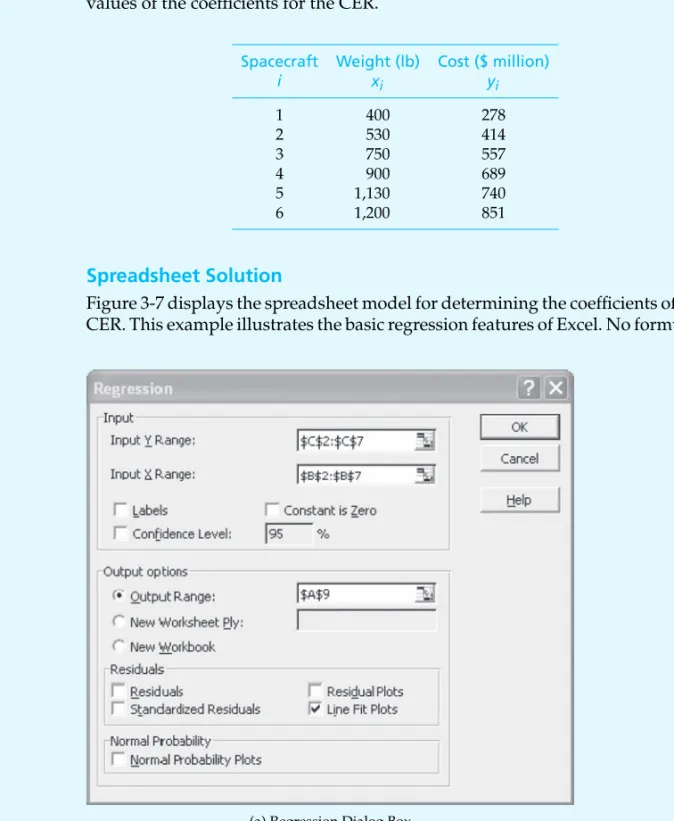
In the early stages of design, it is believed that the cost of a Martian rover spacecraft is related to its weight. Cost and weight data for six spacecraft have been collected and normalized and are shown in the next table. A plot of the data suggests a linear relationship. Use a spreadsheet model to determine the values of the coefficients for the CER.
Spacecraft Weight (lb) Cost ($ million)
i xi yi 1 400 278 2 530 414 3 750 557 4 900 689 5 1,130 740 6 1,200 851
Spreadsheet Solution
Figure 3-7 displays the spreadsheet model for determining the coefficients of the CER. This example illustrates the basic regression features of Excel. No formulas
(a) Regression Dialog Box Figure 3-7 Spreadsheet Solution, Example 3-8
(b) Regression Results Figure 3-7 (continued)
are entered, only the cost and weight data for the spacecraft. The challenge in spreadsheet regression lies in making sure that the underlying regression assumptions are satisfied and in interpreting the output properly.
The Tools|Data Analysis|Regression menu command brings up the
Reg-ression dialog box shown in Figure 3-7(a) and shows the values used for this model. The results of the analysis are generated by Excel and are displayed beginning in cell A9 of Figure 3-7(b). For the purposes of this example, the coefficientsb0andb1of the CER are found in cells B25 and B26, respectively.
SECTION3.4 / PARAMETRICCOSTESTIMATING 97
The resulting CER relating spacecraft cost (in millions of dollars) to space-craft weight is
Cost=48.28+0.6597x,
wherexrepresents the weight of the spacecraft in pounds, and 400≤x≤1,200.
3.4.3.4 Model Validation and Documentation Once the CER equation has been developed, we need to determine how well the CER can predict cost (i.e., model validation) and document the development and appropriate use of the CER. Validation can be accomplished with statistical “goodness of fit” measures such as standard error and the correlation coefficient. Analysts must use goodness of fit measures to infer how well the CER predicts cost as a function of the selected cost driver(s). Documenting the development of the CER is important for future use of the CER. It is important to include in the documentation the data used to develop the CER and the procedures used for normalizing the data.
The standard error (SE) measures the average amount by which the actual cost values and the predicted cost values vary. The SE is calculated by
SE= n i=1 (yi−Costi)2 n−2 , (3-10)
where Costi is the cost predicted by using the CER with the independent
variable values for data set i and yi is the actual cost. A small value of SE is
preferred.
The correlation coefficient(R)measures the closeness of the actual data points to the regression line (y=b0+b1x). It is simply the ratio of explained deviation to total deviation. R= n i=1 (xi− ¯x)(yi− ¯y) n i=1 (xi− ¯x)2 n i=1 (yi− ¯y)2 , (3-11) wherex¯ = 1nni=1xiandy¯ = n1 n
i=1yi. The sign (+/−) ofRwill be the same
as the sign of the slope (b1) of the regression line. Values ofRclose to one (or minus one) are desirable in that they indicate a strong linear relationship between the dependent and independent variables.
In cases where it is not clear which is the “best” cost driver to select or which equation form is best, you can use the goodness of fit measures to make a selection.
In general, all other things being equal, the CER with better goodness of fit measures should be selected.
EXAMPLE 3-9
Regression Statistics for the Spacecraft CER
Determine the SE and the correlation coefficient for the CER developed in Example 3-8.
Solution
From the spreadsheet for Example 3-8 (Figure 3-7), we find that the SE is 41.35 (cell B15) and that the correlation coefficient is 0.985 (cell B12). The value of the correlation coefficient is close to one, indicating a strong positive linear relationship between the cost of the spacecraft and the spacecraft’s weight.
In summary, CERs are useful for a number of reasons. First, given the required input data, they are quick and easy to use. Second, a CER usually requires very little detailed information, making it possible to use the CER early in the design process. Finally, a CER is an excellent predictor of cost if correctly developed from good historical data.
3.5
Cost Estimation in the Design Process
Today’s companies are faced with the challenge of providing quality goods and services at competitive prices. The price of their product is based on the overall cost of making the item plus a built-in profit. To ensure that products can be sold at competitive prices, cost must be a major factor in the design of the product.
In this section, we will discuss both a bottom-up approach and atop-down approach to determining product costs and selling price. Used together with the concepts of target costing, design-to-cost, and value engineering, these techniques can assist engineers in the design of cost-effective systems and competitively priced products.
3.5.1
The Elements of Product Cost and “Bottom-Up”
Estimating
As discussed in Chapter 2, product costs are classified as direct or indirect. Direct costs are easily assignable to a specific product, while indirect costs are not easily allocated to a certain product. For instance, direct labor would be the wages of a machine operator; indirect labor would be supervision.
Manufacturing costs have a distinct relationship to production volume in that they may be fixed, variable, or step-variable. Generally, administrative costs are fixed, regardless of volume; material costs vary directly with volume; and equipment cost is a step function of production level.
The primary costs within the manufacturing expense category include engineering and design, development costs, tooling, manufacturing labor,
SECTION3.5 / COSTESTIMATION IN THEDESIGNPROCESS 99
materials, supervision, quality control, reliability and testing, packaging, plant overhead, general and administrative, distribution and marketing, financing, taxes, and insurance. Where do we start?
Major types of costs that must be estimated are as follows:
1. Tooling costs, which consist of repair and maintenance plus the cost of any new equipment.
2. Manufacturing labor costs, which are determined from standard data, historical records, or the accounting department. Learning curves are often used for estimating direct labor.
3. Materials costs, which can be obtained from historical records, vendor quotations, and the bill of materials. Scrap allowances must be included. 4. Supervision, which is a fixed cost based on the salaries of supervisory personnel. 5. Factory overhead, which includes utilities, maintenance, and repairs. As discussed in Chapter 2 and Appendix 2-A, there are various methods used to allocate overhead, such as in proportion to direct labor hours or machine hours. 6. General and administrative costs, which are sometimes included with the
factory overhead.
A “bottom-up” procedure for estimating total product cost is commonly used by companies to help them make decisions about what to produce and how to price their products. The term “bottom-up” is used because the procedure requires estimates of cost elements at the lower levels of the cost structure, which are then added together to obtain the total cost of the product. The following simple example shows the general bottom-up procedure for making a per-unit product cost estimate and illustrates the use of a typical spreadsheet form of the cost structure for preparing the estimate.
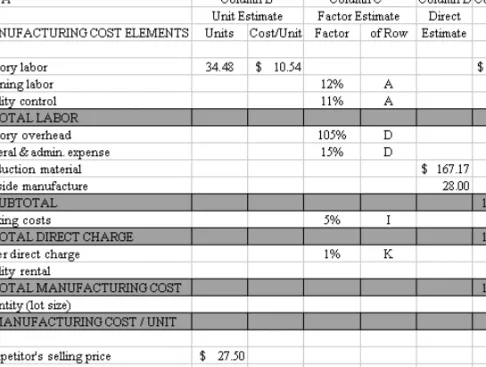
The spreadsheet in Figure 3-8 shows the determination of the cost of a throttle assembly. Column A shows typical cost elements that contribute to total product cost. The list of cost elements can easily be modified to meet a company’s needs. This spreadsheet allows for per-unit estimates (column B), factor estimates (column C), and direct estimates (column D). The shaded rows are selected subtotals.
Typically, direct labor costs are estimated via the unit technique. The manu-facturing process plan is used to estimate the total number of direct labor hours required per output unit. This quantity is then multiplied by the composite labor rate to obtain the total direct labor cost. In this example, 36.48 direct labor hours are required to produce 50 throttle assemblies and the composite labor rate is $10.54 per hour, which yields a total direct labor cost of $384.50.
Indirect costs, such as quality control and planning labor, are often allocated to individual products by using factor estimates. Estimates are obtained by expressing the cost as a percentage of another cost. In this example, planning labor and quality control are expressed as 12% and 11% of direct labor cost (row A), respectively. This gives a total labor cost of $472.93. Factory overhead and general and administrative expenses are estimated as percentages of the total labor cost (row D).
Entries for cost elements for which direct estimates are available are placed in column D. The total production materials cost for the 50 throttle assemblies is
Figure 3-8 Manufacturing Cost-Estimating Spreadsheet
$167.17. A direct estimate of $28.00 applies to the outside manufacture of required components. The subtotal of cost elements at this point is $1,235.62.
Packing costs are estimated as 5% of all previous costs (row I), giving a total direct charge of $1,297.41. The cost of other miscellaneous direct charges are figured in as 1% of the current subtotal (row K). This results in a total manufacturing cost of $1,310.38 for the entire lot of 50 throttle assemblies. The manufacturing cost per assembly is $1,310.38/50=$26.21.
The price of a product is based on the overall cost of making the item plus a built-in profit. The bottom of the spreadsheet in Figure 3-8 shows the computation of unit selling price based on this strategy. In this example, the desired profit (often called the profit margin) is 10% of the unit manufacturing cost, which corresponds to a profit of $2.62 per throttle assembly. The total selling price of a throttle assembly is then $26.21+$2.62=$28.83.
3.5.2
Target Costing and Design to Cost:
A “Top-Down” Approach
Traditionally, American firms determine an initial estimate of a new product’s selling price by using the bottom-up approach described in the previous section. That is, the estimated selling price is obtained by accumulating relevant fixed and variable costs and then adding a profit margin, which is a percentage of total manufacturing costs. This process is often termeddesign to price. The estimated selling price is then used by the marketing department to determine whether the new product can be sold.
In contrast, Japanese firms apply the concept oftarget costing, which is a top-down approach. The focus of target costing is “whatshouldthe product cost” instead of “whatdoesthe product cost.” The objective of target costing is to design costs
SECTION3.5 / COSTESTIMATION IN THEDESIGNPROCESS 101
out of products before those products enter the manufacturing process. In this top-down approach, cost is viewed as an input to the design process, not as an outcome of it.
Target costing is initiated by conducting market surveys to determine the selling price of the best competitor’s product. A target cost is obtained by deducting the desired profit from the best competitor’s selling price:
Target cost=Competitor’s price−Desired profit. (3-12) Desired profit is often expressed as a percentage of the total manufacturing cost, called the profit margin. For a specific profit margin (e.g., 10%), the target cost can be computed from the following equation:
Target cost= Competitor’s price
(1+Profit margin). (3-13)
This target cost is obtained prior to the design of the product and is used as a goal for engineering design, procurement, and production.
EXAMPLE 3-10
Target Costing at the Throttle Assembly Plant
Recall the throttle assemblies discussed in the previous example. Suppose that a market survey has shown that the best competitor’s selling price is $27.50 per assembly. If a profit margin of 10% (based on total manufacturing cost) is desired, determine a target cost for the throttle assembly.
Solution
Since the desired profit has been expressed as a percentage of total manu-facturing costs, we can use Equation (3-13) to determine the target cost:
Target cost= $27.50
(1+0.10)=$25.00.
Note that the total manufacturing cost calculated in Figure 3-8 was $26.21 per assembly. Since this cost exceeds the target cost, a redesign of the product itself or of the manufacturing process is needed to achieve a competitive selling price.
Figure 3-9 illustrates the relationship between target costing and the design process. It is important to note that target costing takes place before the design process begins. Engineers use the target cost as a cost performance requirement. Now the final product must satisfy both technical and cost performance require-ments. The practice of considering cost performance as important as technical performance during the design process is termeddesign to cost. The design to cost procedure begins with the target cost as the cost goal for the entire product. This target cost is then broken down into cost goals for major subsystems, components, and subassemblies. These cost goals would cover targets for direct material costs and direct labor.
Once cost goals have been established, the preliminary engineering design process is initiated. Conventional tools, such as WBS and cost estimating, are
Desired Profit T arget Cost (TC) Engineering Design Marketing Intelligence V alue Engineering
⫺⫽
⫹⫽
Abandon ? Ye s Ye s No No Compare is TC ⬎ TMC ?Estimated Selling Price
Desired Profit (% of
TMC)
T
otal Manufacturing Cost (TMC) ⫽
Direct Cost ⫹ Overhead DESIGN T O PRICE PR OCESS DESIGN T O COST LOOP NO TE: DOUBLE-HEADED ARR O W S REPRESENT TW O-W A Y INFORMA TION FLO W W
ork Breakdown Structure
Life Cycle Cost Cost Estimating
T echniques Activity-Based Costing Preliminary T A RGET COSTING PR OCESS EXIT Selling Price of Best Competitor Figur e 3-9 The Concept of T arget Costing and Its Relationship to Design
SECTION3.5 / COSTESTIMATION IN THEDESIGNPROCESS 103
used to prepare a bottom-up total manufacturing cost projection (discussed in the previous section). The total manufacturing cost represents aninitialappraisal of what it would cost the firm to design and manufacture the product being considered. The total manufacturing cost is then compared with the top-down target cost. If the total manufacturing cost is more than the target cost, then the design must be fed back into thevalue engineering process(to be discussed in Section 3.5.3) to challenge the functionality of the design and attempt to reduce the cost of the design. This iterative process is a key feature of the design to cost procedure. If the total manufacturing cost can be made less than the target cost, the design process continues into detailed design, culminating in the final design to be produced. If the total manufacturing cost cannot be reduced to the target cost, the firm should seriously consider abandoning the product.
Figure 3-10 illustrates the use of the manufacturing cost-estimating spreadsheet to compute both a target cost and the cost reductions necessary to achieve the target cost. As computed in Example 3-10, the target cost for the throttle assembly is $25.00. Since the initial total manufacturing cost (determined to be $26.21 in Figure 3-8) is greater than the target cost, we must work backward from the total manufacturing cost, changing values of a chosen (single) cost element to the level required to reduce the cost to the desired target. This method of establishing new cost targets for individual elements can be accomplished by trial and error (manually manipulating the spreadsheet values) or by making use of the “solver” feature of the software package (if one is available). Figure 3-10 shows one possible result of this process. If the process of assembling the throttles could be made more efficient, such that
total direct labor requirements are reduced to 34.48 hours (instead of 36.48), the target cost could be realized. Now the challenge is to find a way, either through product or process redesign, to reduce the direct labor requirements.
EXAMPLE 3-11
Cost Goal for Production Material at the Throttle Assembly Plant
Given the current estimated total manufacturing cost of $26.21, as shown in Figure 3-8, determine a cost goal for production material that would allow us to achieve a target cost of $25.00.Solution
With the spreadsheet in Figure 3-8 as a starting point, one approach to determining a cost goal for production material would be to iteratively change the value entered in Row G and Column D until the desired total manufacturing cost of $25.00 is obtained. The following table shows a series of costs for production material and the resulting total manufacturing cost per assembly:
Production Material Total Manufacturing Cost per 50 Assemblies ($) Cost per Assembly ($)
167.17 26.21 150.00 25.84 140.00 25.63 130.00 25.42 120.00 25.21 110.00 25.00
As seen in the table, a production material cost of $110 per batch of 50 assemblies would result in a total manufacturing cost of $25.00, the target cost. Now it is left to design engineers to determine if a different, less costly material could be used or if process improvements could be made to reduce material scrap. Other possibilities would be to negotiate a new purchase price with the supplier of the material or seek a new supplier.
The chapter case study on the demanufacturing of computers illustrates the versatility of target costing concepts.
3.5.3
Value Engineering
This section introduces the topic of value engineering (VE). The objective of VE is very similar to that of design to cost. The VE objective is to provide the required product functions at a minimum cost. VE necessitates a detailed examination of a product’s functions, and the cost of each, in addition to a