Popularity, Interoperability, and Impact of Programming Languages
in 100,000 Open Source Projects
Tegawend´e F. Bissyand´e1∗ , Ferdian Thung2, David Lo2, Lingxiao Jiang2 and Laurent R´eveill`ere1
1Laboratoire Bordelais de Recherche en Informatique, France
2Singapore Management University, Singapore
{bissyande,reveillere}@labri.fr,{ferdianthung,davidlo,lxjiang}@smu.edu.sg
Abstract—Programming languages have been proposed even before the era of the modern computer. As years have gone, computer resources have increased and application domains have expanded, leading to the proliferation of hundreds of programming languages, each attempting to improve over others or to address new programming paradigms. These languages range from procedural languages like C, object-oriented languages like Java, and functional languages such as ML and Haskell. Unfortunately, there is a lack of large scale and comprehensive studies that examine the “popular-ity”, “interoperabil“popular-ity”, and “impact” of various programming languages. To fill this gap, this study investigates a hundred thousands of open source software projects from GitHub to answer various research questions on the “popularity”, “interoperability” and “impact” of various languages measured in different ways (e.g., in terms of lines of code, development teams, issues, etc.).
Keywords-Programming languages; Popularity; Interoper-ability; Open source; Software projects; GitHub
I. INTRODUCTION
Computers have a unique purpose: to perform instructions given to them by us humans. A natural question arises when a computer tries to understand and perform any given in-struction: in what format the instructions should be so that it may be easy for humans to describe and easy for computers to understand. Assembly languages, mostly low-level and specific to certain computer architectures, have early been proposed to ease the programming of computer instructions by using mnemonics. To improve developer productivity and facilitate large scale software development and maintenance, many higher-level languages with a stronger abstraction from the details of a computer have also emerged. 70 years after the apparition of the modern computer, hundreds, if not thousands, of programming languages have existed—the
Wikipedia Internet encyclopedia lists about 600 languages1.
Various programming languages have their advantages and disadvantages. Assembly languages are often accredited to be easier to work with hardware and execute more efficiently, while higher-level languages often provide a rich set of grammatical rules and vocabulary that makes
∗The work was done while the author was visiting Singapore Manage-ment University.
1http://en.wikipedia.org/wiki/List of programming languages
programming much easier for developers. Some program-ming languages have been introduced fairly recently, while others have been used for decades. For example, C# was only introduced in 2001, while C has been in use since 1972. There are also various ways to classify languages into various categories, including procedural languages (e.g., Fortran, Pascal, and ANSI C), aspect-oriented languages (e.g., AspectJ), object-oriented languages (e.g., Java and C++), and functional languages (e.g., Haskell). Thus, there are a wide variety of options that developers can choose when writing applications.
Due to the wide variety of programming languages out there, there is a need to investigate the popularity, interop-erability, and impact of different programming languages. “Popularity” of programming languages is a challenging property to assess. In this study we investigate different correlations of software development metrics with the use of common programming languages. We use the term “interop-erability” to refer to the extent to which two programming languages are used together in software projects. An under-standing of these factors could help, for example, developers select languages to use or learn, and could help managers assess developer pool sizes in function of their skills in programming languages.
Despite the above-mentioned benefits, there have been, however, limited studies that investigate the popularity, inter-operability, and impact of different programming languages. Thus there is a need for a comprehensive analysis of these factors based on a large number of projects written in various programming languages. In this work, we fill this need by investigating a hundred thousands projects and analyze these factors by answering a set of research questions. Since “popularity”, “interoperability” and “impact” are concepts that involve many variations, we explore these properties of programming languages across several dimensions. In par-ticular, our study aims at answering the following questions: RQ1: How popular are the various programming languages in terms of adoption in real-world software projects? RQ2: How many projects are written in more than one programming language and what is the degree of interoperability of each language towards the others?
RQ3: Is there a correlation between the programming lan-guage used and the project success?
RQ4: What is the correlation between the programming language used and the number of issue reports? RQ5: How does the programming language correlate with
the size of the development team?
A previous study related to ours is the TIOBE program-ming community index which ranks various programprogram-ming languages [15]. The ranking is based on “the number of skilled engineers world-wide, courses, and third-party
vendors”.2 The rank is computed by performing searches
on a number of search engines including Google, Bing, Yahoo!, Wikipedia, Amazon, YouTube, and Baidu. The data used by TIOBE is not freely available and we could not find a description of the exact methodology for the ranking on TIOBE’s site. Different from TIOBE’s ranking, we investigate the popularity, interoperability, and impact of programming languages from a different angle: we do not look into search engines or analyze skilled engineers, courses, or third party vendors; rather, we analyze a hundred thousands of open source software projects. We believe that analyzing actively developed software artifacts is a promising way to understand how programming languages
are being used. We describe our approach in detail in this
paper and make our data publicly available3. Conway has
also provided a ranking of languages based only on their appearance in GitHub projects [2]. In this study we further investigate the amount of lines of code written for each language.
Our study is made possible by the availability of a large amount of data in GitHub. Millions of projects are publicly available for download in GitHub. There are small and large projects; large ones include the Linux kernel (with over 10,000,000 lines of code written by more than 9,000 contributors). The availability of a wealth of project data allows us to explore a variety of interesting questions on the popularity and impact of various programming languages. We are however aware that the findings based on these open source projects are only meant to shed light, to some extent, on the usage of common programming languages. Some languages might be under-represented in the dataset of projects because of the constraints in their development context. For example, the VHDL language, which is seldom in our dataset, is widespread for embedded systems in the industry, a domain that tend not to publish their work to open source platforms. Aside from such cases, our study provides a clear picture on the popularity of programming languages in public domain.
For this study, we have obtained 100,000 git repositories from GitHub. We have analyzed the contents of each of the git repositories to find software code. We count the numbers
2http://www.tiobe.com/index.php/content/paperinfo/tpci as of June 2012 3Upon request.
of lines of code written in various programming languages. Based on this information, we can answer our formulated questions related to the popularity and interoperability of programming languages. We also collect various information related to project success, reported issues, and team sizes. The contributions of this work are as follows:
1) As far as we know, we are the first to analyze the pop-ularity of various programming languages by analyzing a hundred thousands of open source software projects. We report the popularity of various programming lan-guages in various dimensions: the numbers of projects written in a language, the numbers of lines of code written in a language, and the numbers of developers that “read”/“write” a language.
2) We analyze the interoperability of various programming languages based on projects that are developed using more than one programming language. We measure how close a pair of programming languages are based on their interoperability.
3) We describe the correlation between programming lan-guages and project “success” in the developer commu-nity, reported bugs, and development team sizes. The rest of this paper is organized as follows. In Sec-tion II, we provide preliminary informaSec-tion on various programming languages and GitHub. In Section III, we elab-orate the methodology of our empirical study. In Section IV, we present the results of our study. We list the threats to validity in Section V. Section VI discusses related work. We conclude and describe future work in Section VII.
II. PRELIMINARIES
In this section, we introduce various programming lan-guages, and briefly describe GitHub and the kind of projects it hosts.
A. Programming Languages
Programming languages define the grammar and seman-tics used by human beings to communicate and interact with machines. Programming languages, such as the one used by Ada Lovelace in her first program [5], have existed before the invention of modern computers in the 1940s. With the advent of the computer, programmers started to use assembly languages. Seventy years later, hundreds of programming languages have been invented. While some have been dis-carded with the arrival of their better alternatives, others have kept their usage trends. A few more recent programming languages have quickly gained momentum in the last years. Each programming language belongs to a category that is more or less suitable for different programming tasks and computing environments. We only focus on 30 commonly known programming languages that appear in our dataset. Table I describes each language, its category, and its year of apparition. The oldest one, Fortran, was proposed 56 years ago, while the most recent, C# appeared about 10
Table I
30 COMMONPROGRAMMINGLANGUAGES
Language Main classifications Appearance
Fortran Imperative / Procedural 1957
Lisp Functional / Interpreted 1958
COBOL Imperative / Compiled 1959
Yacc Syntax handling 1970
Pascal Imperative / Procedural 1970
ANSI C Imperative / Procedural 1972
ML Functional / Compiled 1973
Sed Command Line/Parsing 1973
Lex Lexical analysis 1975
Shell (sh) Command Line / Interpreted 1977
Awk Rule based / Scripting 1977
C Shell (csh) Command Line / Interpreted 1978
Ada Concurrent 1980
VHDL Dataflow 1980s
Modula-3 Imperative / Object-Oriented 1980s
C++ Imperative / Object-Oriented 1983
Perl Imperative / Object-Oriented 1983
Objective-C Object-oriented 1983
Erlang Functional / Compiled 1986
Tcl Scripting 1988
Expect (exp) Scripting / Automation 1990
Haskell Functional 1990
Python Interpreted / Object-Oriented 1991
Fortran 90 (f90) Imperative 1991 JavaScript Object-Oriented 1995 Java Object-Oriented 1995 PHP Imperative 1995 Ruby Imperative 1995 JSP Imperative 1999 C# Imperative/Functional/Object-Oriented 2001
years ago. These languages are classified into categories with functional and object-oriented features, compiled and interpretive designs, scripting and execution purposes, etc.
Given the capabilities of general purpose programming languages, a programming task can often be implemented in any of them. Then, why a language would be preferred against another? It is important to understand such a question as it may provide insights for designing better languages. Before understanding “why”, it is important to know what the “popular” programming languages are and what the impact of a language is on the evolution of a project, which are the topics of this paper.
B. GitHub
GitHub is a project hosting site that has introduced the
concept of social coding by providing many
developer-friendly features. It can be viewed as a socio-technical network. GitHub has thus gained a wide acceptance and adoption among developers, and its website indicates that it
is currently4 hosting more than 3,000,000 project
reposito-ries. Thanks to GitHub’s extensive REST [4] APIs5, we are
able to identify about 1,300,000 million repositories whose contents are publicly available for use.
GitHub uses git [7] as its revision control system for
source code versioning. It enablesforking, which allows to
create copies of repositories, and it supports pull requests
for merging changes from copies to the source repository, to facilitate contributions from developers who are not project team members. Aside from source code revision control, GitHub integrates common software development facilities, such as bug/issue trackers and wiki pages.
4http://github.com as of June 2012 5http://developer.github.com
A large number of projects, such as those from the Apache community, which are developed outside the GitHub platform, i.e., autonomously or on other platforms such as Sourceforge, have their repositories mirrored in GitHub. This fact indicates that by using GitHub projects, we do not limit ourselves to the GitHub community or to git. Furthermore, a
number of famous companies such as FacebookTMhost open
source versions of their projects on GitHub. This suggests that our project dataset contains projects managed by diverse communities. While the large number of projects hosted by GitHub and its extensive APIs for accessing the projects enable large studies like ours, there are still some challenges that we need to address, such as (1) collecting and managing huge amount of data, and (2) inferring important information which are not directly available from the APIs, such as the number of source lines of code in a project.
III. METHODOLOGY
To perform our empirical study, we need a large number of projects that may represent the universe of all projects. The software projects should be written for various purposes by diverse teams in a variety of languages. We have done a manual exploratory survey of the projects on GitHub, inves-tigating the development teams, the application domains and the range of programming languages used in the projects. We have thus found that projects hosted by GitHub are very diverse and thus suitable to the requirements of our study. We have also found that GitHub is used as the main development platform for over a million projects, and that it may also be used as a mirror for popular projects, such as Apache or Linux.
For our study, we consider the first 100,000 projects returned by the GitHub APIs. There appears to be no distinct
ordering scheme in the returned list of projects6which also
vary on subsequent requests. Given these projects, we extract several types of information for each project:
General project information: Each repository is
moni-tored by GitHub and tracked based on different features. In
this paper, we consider the concepts of watchersand forks.
“Watchers” is a metric for measuring interest and activity in a project. It gives an indication of the amount of attention that is given to a project by the developer community: an aspect of project “success”. Watchers typically use project releases, report bugs, and incidentally promote the project in their socio-technical network. “Forks” is a metric for mea-suring the active involvement of the developer community in the growth of a project’s code base and the improvement of its quality. While these metrics are not absolute, they provide good insights on the “success” of a project.
Source Lines of code: To compute the number of
physical source lines of code (sloc), we download each
project’s code repository and rely on the SLOCCount7 tool.
6The list is available at http://momentum.labri.fr/orion/project list.txt 7http://www.dwheeler.com/sloccount/
This tool computes actual lines of code, ignoring code comments and blank lines. It supports 29 of the languages considered in our study. We have extended SLOCCount to add support for the 30th language, namely JavaScript.
Developer contributions: We also consider the
contrib-utors for a given project inferred from the commits. Whether a contributor to a project is registered or not in GitHub, his information is always available in the git repositories that he contributes to. This inference is particularly important for projects that are just mirrored in GitHub but whose development is done on the project’s own website.
Issue Reports: Finally, we consider issue reports as
an important artefact of software development process. For each project repository, we have crawled the corresponding issues database on GitHub. Though an “issue” may refer to a bug report or a feature request, we study them together as both are good indications of the interest that the programmer community gives to a project.
Based on the aforementioned information for each project, we extensively explore the popularity and impact of pro-gramming languages in various dimensions.
IV. EMPIRICALEVALUATION
In this section, we investigate the research questions de-scribed in Section I to assess the popularity of programming languages. We investigate beforehand the dataset to ensure that most of the projects are non toy projects of substantial sizes. To this end we count the total lines of source code (LOC) in each project. Fig. 1 plots the percentages of projects with different numbers of lines of source code. Over 70% of the projects contain more than 1,000 LOC. Around 35% of the projects include more than 5,000 LOC, while more than 20% contain more than 10,000 LOC. Finally, over 600 projects contain more than 1,000,000 LOC. This distribution suggests that a significant number of the projects in the dataset are of substantial sizes.
% of Projects 02 0 4 0 6 0 > 1,000 > 5,000 > 10,000 > 50,000 > 100,000 > 500,000 > 1,000,000
Figure 1. Distribution of the Dataset Projects in Terms of Total LOC
A. RQ1: Popular Programming Languages
To provide insights into the first research question, we investigate the popularity of the 30 programming languages in terms of the number of lines of code in the 100,000 software projects that are written in each particular language, the number of projects that contain code in each particular language, and the number of developers that are involved in a project that contain code in each particular language. We describe the results of our study in the following paragraphs.
Table II
Programming Language Popularity—Lines of Code
Rank Language # LOC % LOC
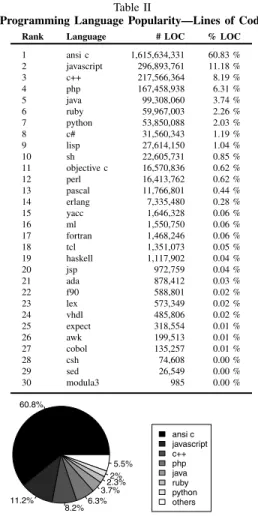
1 ansi c 1,615,634,331 60.83 % 2 javascript 296,893,761 11.18 % 3 c++ 217,566,364 8.19 % 4 php 167,458,938 6.31 % 5 java 99,308,060 3.74 % 6 ruby 59,967,003 2.26 % 7 python 53,850,088 2.03 % 8 c# 31,560,343 1.19 % 9 lisp 27,614,150 1.04 % 10 sh 22,605,731 0.85 % 11 objective c 16,570,836 0.62 % 12 perl 16,413,762 0.62 % 13 pascal 11,766,801 0.44 % 14 erlang 7,335,480 0.28 % 15 yacc 1,646,328 0.06 % 16 ml 1,550,750 0.06 % 17 fortran 1,468,246 0.06 % 18 tcl 1,351,073 0.05 % 19 haskell 1,117,902 0.04 % 20 jsp 972,759 0.04 % 21 ada 878,412 0.03 % 22 f90 588,801 0.02 % 23 lex 573,349 0.02 % 24 vhdl 485,806 0.02 % 25 expect 318,554 0.01 % 26 awk 199,513 0.01 % 27 cobol 135,257 0.01 % 28 csh 74,608 0.00 % 29 sed 26,549 0.00 % 30 modula3 985 0.00 % 60.8% 11.2% 8.2%6.3% 3.7% 2.3%2% 5.5% ansi c javascript c++ php java ruby python others
Figure 2. Language Popularity — Lines of Code
Table II shows the ranking of various programming languages in terms of total lines of code written in each language. C code dominates with 1.6 billion lines of code (60.83% of all LOC that we analyze). Next to C code is JavaScript and C++ code, which have 296 (11.18%) and 217 (8.19%) millions lines of code respectively. PHP and Java follow with 6.31% and 3.74% of all LOC respectively. Other well-known languages, such as Ruby, Python, and C#, only account for 2.26%, 2.03%, and 1.19% of all LOC. Functional languages, such as ML and Haskell, appear in more than 1.5 (0.06%) millions and 1 million (0.04%) LOC. The least popular programming languages in terms of LOC are C-Shell, Sed, and Modula3.
Figure 2 represents the distribution of LOC for the top-ranked languages. The predominance of C can be related to the fact that many operating system kernels, including the Linux kernel (10,064,207 lines of C code as of June 2012) and its device-specific flavors, are among the projects with the largest code bases and are written in C.
Language popularity can also be measured in terms of its adoption by the number of software projects using the language. Thus, for each programming language, we count the number of projects that contain code written in this
Table III
Programming Language Popularity—Appearance in Projects
Rank Language # Projects % Projects
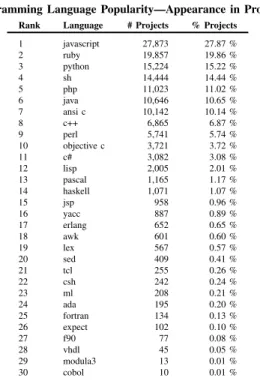
1 javascript 27,873 27.87 % 2 ruby 19,857 19.86 % 3 python 15,224 15.22 % 4 sh 14,444 14.44 % 5 php 11,023 11.02 % 6 java 10,646 10.65 % 7 ansi c 10,142 10.14 % 8 c++ 6,865 6.87 % 9 perl 5,741 5.74 % 10 objective c 3,721 3.72 % 11 c# 3,082 3.08 % 12 lisp 2,005 2.01 % 13 pascal 1,165 1.17 % 14 haskell 1,071 1.07 % 15 jsp 958 0.96 % 16 yacc 887 0.89 % 17 erlang 652 0.65 % 18 awk 601 0.60 % 19 lex 567 0.57 % 20 sed 409 0.41 % 21 tcl 255 0.26 % 22 csh 242 0.24 % 23 ml 208 0.21 % 24 ada 195 0.20 % 25 fortran 134 0.13 % 26 expect 102 0.10 % 27 f90 77 0.08 % 28 vhdl 45 0.05 % 29 modula3 13 0.01 % 30 cobol 10 0.01 %
language. Table III details the ranking of the programming languages in this scenario. This metric (i.e., popularity by the number of projects) is similar to GitHub’s own metric. Our findings are globally similar to the ranking provided by
GitHub and used by Conway in his study.8JavaScript largely
outranks other programming languages with 27,873 projects, which represents 27.87% of all projects in our dataset. The next ones in the ranking are also other scripting languages that are popularly used in 19.86% (Ruby), 15.22% (Python), and 14.44% (Shell) of the projects, respectively. Then follow general-purpose programming languages, such as Java, C, C++, and C#, which are used in 10.65%, 10.14%, 6.87%, and 3.08% of the projects respectively.
We also note that the Haskell functional language has gained popularity with 1,071 projects (1.07%) containing Haskell code. Based on this metric, Haskell outranks ML, its counterpart functional language. Finally, the least popular programming languages are VHDL, Modula3, and Cobol, which, even when combined, are found in less than 1% of all projects.
Table IV details the distribution of the top-10 main languages in the projects. In this study, we consider a
language to be the main language for a project when it is
the language with the most lines of code. The top ranks are still held by scripting languages. However, when we compare the numbers of projects in Table IV with those in Table III, we can see that scripting languages are often used as supporting languages. For example, although JavaScript appears in almost 28 thousands projects, it is the main
8http://redmonk.com/sogrady/2012/09/12/language-rankings-9-12/
language in only about 9 thousands (34.50% of all projects with some JavaScript code); The Shell scripting language appears in over 14 thousands projects, but it is the main language in only 3 thousands (22%) projects. Compiled programming languages, such as Java, C, and C++ are used
more often as main languages (>50%) in projects.
Table IV
Language Popularity—Top-10 Main Languages in Projects
Rank Language # Projects
1 ruby 12,642 2 python 10,165 3 javascript 9,616 4 java 8,861 5 php 7,886 6 ansic 6,307 7 c++ 4,477 8 sh 3,311 9 objective c 2,982 10 perl 2,472
Another metric that we use to investigate the popularity of a language is the number of developers using it in their projects. For computing the ranking, we assume that all developers in a project are knowledgeable in the main language of the project. Figure 3 illustrates the distribution of developers for the top ranked languages. Overall, C appears to be the most popular language among developers, followed by Ruby, Python, Java, and C++. JavaScript and C# are only used by 8.97% and 3.42% of the developers. The detailed results for all languages are shown in Table V. Languages such as C-Shell, Modula3, and Cobol appear to be used by relatively insignificant numbers of developers.
% De v elopers 0 5 10 15 20 ansicruby python java c++ php javascript shell perl c#
Figure 3. Language Popularity—Adoption by Developers. Percentages of developers that adopt different programming languages.
Ansi C, JavaScript and C++ top our ranking in terms of LOC. Most of the projects in our dataset contain code in JavaScript, Ruby in Python. Finally, Ansi C, Ruby and Python are used in projects with the largest developer pools. These findings suggest that these languages should be learned.
B. RQ2: Multi-Language Projects
Developers often rely on different programming languages to implement different functionalities in a single project. The second research question investigates the interoperability of languages to identify the languages that are popularly used in multi-language projects. We assume that two languages are “interoperable” if they are used in a same project.
Table V
Programming Language Popularity—Developer Pool. Numbers and percentages of developers that adopt different programming
languages.
Rank Language # Developers % Developers
1 ansi c 48,373 22.08% 2 ruby 34,878 15.92% 3 python 29,764 13.58% 4 java 27,567 12.58% 5 c++ 26,708 12.19% 6 php 22,790 10.40% 7 javascript 19,651 8.97% 8 sh 11,345 5.18% 9 perl 7,587 3.46% 10 c# 7,499 3.42% 11 objective c 6,405 2.92% 12 lisp 3,644 1.66% 13 haskell 2,026 0.92% 14 erlang 1,757 0.80% 15 pascal 1,161 0.53% 16 ml 408 0.19% 17 tcl 213 0.10% 18 jsp 151 0.07% 19 fortran 75 0.03% 20 yacc 67 0.03% 21 ada 48 0.02% 22 vhdl 48 0.02% 23 f90 28 0.01% 24 sed 8 0.00% 25 expect 7 0.00% 26 lex 5 0.00% 27 awk 4 0.00% 28 csh 3 0.00% 29 modula3 3 0.00% 30 cobol 1 0.00% Table VI
Language Interoperability. Numbers and percentages of projects written in multiple programming languages, that include different
programming languages. Rank Language # Multi Language % Multi Language
Projects Projects 1 javascript 18,353 21.81% 2 sh 12,456 14.80% 3 ruby 9,782 11.62% 4 python 7,757 9.22% 5 ansi c 7,646 9.09% 6 php 6,160 7.32% 7 c++ 4,577 5.44% 8 java 4,163 4.95% 9 perl 3,841 4.56% 10 objective c 1,593 1.89% 11 c# 1,391 1.65% 12 lisp 1,239 1.47% 13 pascal 958 1.14% 14 jsp 925 1.10% 15 yacc 884 1.05% 16 awk 598 0.71% 17 lex 567 0.67% 18 haskell 464 0.55% 19 sed 405 0.48% 20 erlang 394 0.47% 21 tcl 243 0.29% 22 csh 241 0.29% 23 ada 187 0.22% 24 ml 153 0.18% 25 fortran 129 0.15% 26 exp 101 0.12% 27 f90 71 0.08% 28 vhdl 33 0.04% 29 modula3 10 0.01% 30 cobol 9 0.01%
Table VI shows that scripting languages are ranked the first in terms of interoperability. The top-1, JavaScript, is used in over 18 thousands (21.81 %) of multi-language projects, followed by Shell (14.80%), Ruby (11.62%), and Python (9.22%). The C programming language, PHP, C++, and Java also appear in respectively 9.09%, 7.32%, 5.44% and 4.95% of the multi-language projects. On the other hand, Haskell and ML are less interoperable, appearing in 0.55% and 0.18% of the projects. The least interoperable languages are VHDL, modula3, and Cobol which, together, appear in less than 1% of multi-language projects.
We further survey the interoperability of languages by detailing the relationships among them to establish how lan-guages interoperate and which ones are mostly used together. The relationship graph in Figure 4 gives an overview of how languages interoperate within projects. The thicker the edge between two nodes in the graph, the more projects contain code in the two corresponding languages. We observe that all languages interoperate with one another, though with different degrees of interoperability. Shell is the language that interoperates the most with other languages. Shell is indeed a scripting language that is used in many projects to write automation scripts for compilation, install, launch, etc. A subset of languages that consists of shell, ansi c, ruby, php, java, c++, c#, perl, javaScript, and python, are used together more often than the others. Objective C appears to be less interoperable with others. ML and Haskell have weak relationships with other languages.
Figure 4. Language Interoperability—All Languages. Relationships among the 30 languages in Table I. The thicker a line between two languages, the more projects contain code written in these two languages.
Figure 5 focuses on the interoperability of a subset of mainstream languages. The graph shows that JavaScript interoperates well with php and ruby, two other common languages used in web programming.
Finally, in Figure 6, we explore the relationships between ANSI C and all other languages. The graph reveals that C interoperates well with many languages. This is possibly related to the fact that mainstream languages, such as C++, Java, Objective C, and C# are derivatives of C. Furthermore, we note that C and C++ interoperate the best with each other.
JavaScript, Shell and Ruby appear to be used together with most of the languages. Ansi C and its derivatives, which are syntaxically close, also interoperate very well. Web programming languages are often used together in projects.
Figure 5. Language Interoperability—Mainstream Languages. Rela-tionships among mainstream languages. The thicker a line between two languages, the more projects contain code written in these two languages.
Figure 6. Language Interoperability—ANSI C. Relationships between ANSI C with other languages. The thicker a line between two languages, the more projects contain code written in these two languages.
C. RQ3: Programming Languages and Success
In the third research question, we investigate the lan-guages used by successful projects. To estimate the success of a project, we rely on the amount of interest shown to the project that could be measured based on social coding features of GitHub.
1) Watchers: A project is found successful user-wise if
many GitHub userswatchits development. Table VII details
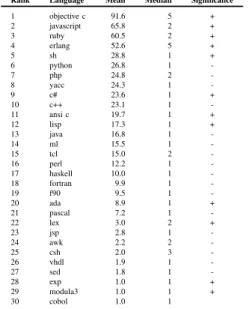
the average numbers of watchers per project containing code in each programming languages. In this scenario, we con-sider only one main language per project to reduce outliers in multi-language projects. Objective-C is thus the language of the most number of watched projects: on average 91 watchers per project. The median number of watchers, i.e., 5, is also the highest. Erlang has the same median number of watchers as Objective-C, but there are 6 times more Objective-C projects than Erlang’s. In terms of the average number of watchers per project, JavaScript-based and Ruby-based projects are also popular. Among mainstream com-piled languages, C# and C++ appear the first, each of which
Table VII
Language and Project Success — Watchers. Means and medians of numbers of watchers for projects written in different languages.
Rank Language Mean Median Significance
1 objective c 91.6 5 + 2 javascript 65.8 2 + 3 ruby 60.5 2 + 4 erlang 52.6 5 + 5 sh 28.8 1 + 6 python 26.8 1 -7 php 24.8 2 -8 yacc 24.3 1 -9 c# 23.6 1 + 10 c++ 23.1 1 -11 ansi c 19.7 1 + 12 lisp 17.3 1 + 13 java 16.8 1 -14 ml 15.5 1 -15 tcl 15.0 2 -16 perl 12.2 1 -17 haskell 10.0 1 -18 fortran 9.9 1 -19 f90 9.5 1 -20 ada 8.9 1 + 21 pascal 7.2 1 -22 lex 3.0 2 + 23 jsp 2.8 1 -24 awk 2.2 2 -25 csh 2.0 3 -26 vhdl 1.9 1 -27 sed 1.8 1 -28 exp 1.0 1 + 29 modula3 1.0 1 + 30 cobol 1.0 1
has on average 23 watchers per project. Projects using C or Java as the main language have on average 19 or 16 watchers respectively. Once again, Modula3 and Cobol appear at the bottom of the ranking.
We use the Mann-Whitney-Wilcoxon (MWW) test, a non-parametric statistical hypothesis test, to assess the statistical significance of the difference between the distribution of projects for a given language and the distribution of projects
for the next language in the table. The + sign, in the
Significancecolumn, indicates that the mean value for the
corresponding language in a row is significantly higher than the mean for the language in the following row. Otherwise,
a- sign is indicated. Projects written in Objective C have
significantly more watchers than those written in JavaScript which in turn have significantly more watchers than those written in Ruby.
2) Forks: GitHub also tracks the number of forks for
a given project. This number is a useful indication of the number of non-team developers volunteering to participate in the development of the project. Similar to the estimation of interest using the number of watchers, we present mean and median numbers of forks per project per language. The detailed results are presented in Table VIII. Objective-C still tops the ranking with an average of 12 forks and a median value of 2. The Lex and C-Shell languages have the same median value as Objective-C, but they are actually used in relatively fewer projects (Cf. Table III). JavaScript and Ruby are also still highly ranked. Overall, the results of analyzing interest using the number of forks are in line with those using the number of watchers.
Once again, the MWW test reveals that the differences of mean values are statistically significant for Objective C, Ruby, Erlang, JavaScript and a few more languages.
Table VIII
Language and Project Success — Forks. Means and medians of numbers of forks for projects written in different languages.
Rank Language Mean Median Significance
1 objective c 12.1 2 + 2 ruby 10.9 1 + 3 erlang 9.9 1 + 4 javascript 8.9 1 + 5 c# 6.4 1 -6 php 6.1 1 + 7 sh 5.7 1 + 8 python 5.6 1 + 9 c++ 5.2 1 + 10 java 5.1 1 + 11 lisp 4.4 1 -12 ansi c 4.2 1 -13 ada 3.7 1 -14 pascal 3.6 1 -15 tcl 3.0 1 -16 perl 2.9 1 -17 ml 2.8 1 -18 yacc 2.6 1 -19 fortran 2.4 1 -20 haskell 2.4 1 -21 lex 2.3 2 -22 f90 1.6 1 -23 csh 1.5 2 -24 jsp 1.4 1 -25 vhdl 1.4 1 -26 exp 1.0 1 -27 sed 1.0 1 + 28 awk 1.0 1 + 29 modula3 1.0 1 + 30 cobol 1.0 1
Objective C and Ruby appear to be the languages that are used in projects that tend to draw the most interest. A quick sampling of projects written in Objective C shows that many of them are for iOS (iPhone) applications.
D. RQ4: Programming Languages and Issues
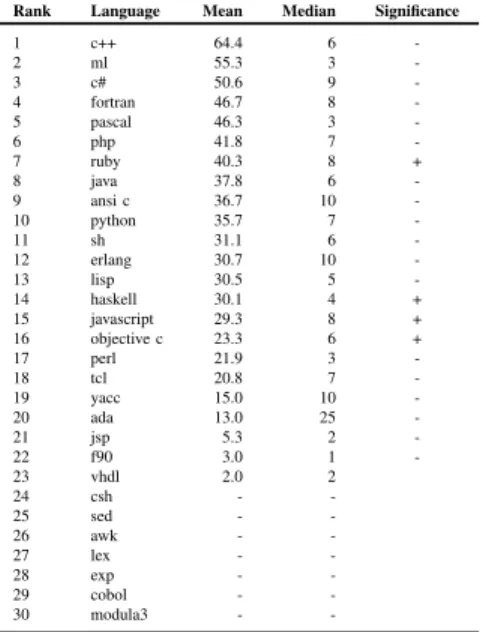
To investigate the correlation between programming lan-guages and issues, we compute the mean and median num-bers of issues per project for each language. Since many projects do not enable its issue tracker on GitHub as their development activities occur in their own websites where they have their own issue/bug tracking systems, we only consider those projects with at least 1 issue reported in GitHub. The results are presented in Table IX. C++ is the language used in projects with the most issues reported (64 issues per project on average, and a median value of 6). ML and C# follow in the ranking with an average of 55 and 50 issues per project.
Figure 7 shows the distribution of the number of issues for the top-10 languages drawn as boxplots. Each boxplot presents 5 vertical lines. From left to right, the first line indi-cates the MINIMUM, i.e., the least value, excluding outliers
which are identified by the R system9 (when constructing a
Modified Boxplot). Data points on the left of this line are
outliers (determined by the R statistical computing tool). The second line indicates the LOWER QUARTILE, i.e, 25 % of data points are on the left side of this line. The third line is the MEDIAN, the middle of the dataset. The fourth line indicates the UPPER QUARTILE, i.e., 25% of data points are on the right side of this line. Finally, the fifth line indicates the MAXIMUM, i.e., the greatest value, excluding
9http://r-project.org
Table IX
Language and Issues. Means and medians of number of issues for projects written in different programming languages.
Rank Language Mean Median Significance
1 c++ 64.4 6 -2 ml 55.3 3 -3 c# 50.6 9 -4 fortran 46.7 8 -5 pascal 46.3 3 -6 php 41.8 7 -7 ruby 40.3 8 + 8 java 37.8 6 -9 ansi c 36.7 10 -10 python 35.7 7 -11 sh 31.1 6 -12 erlang 30.7 10 -13 lisp 30.5 5 -14 haskell 30.1 4 + 15 javascript 29.3 8 + 16 objective c 23.3 6 + 17 perl 21.9 3 -18 tcl 20.8 7 -19 yacc 15.0 10 -20 ada 13.0 25 -21 jsp 5.3 2 -22 f90 3.0 1 -23 vhdl 2.0 2 24 csh - -25 sed - -26 awk - -27 lex - -28 exp - -29 cobol - -30 modula3 -
-outliers (determined by the tool). All data points on the right side of this line are outliers.
Aside from Pascal, ML, and Fortran, which are used by few projects, the box plots are similar for the rest of the languages. This suggests that there is no clear correlation between a programming language and the number of issues for the language. Finally, the results of the MWW tests, which are included in the table, reveal that the differences are not, for most of the languages, statistically significant.
● ●●● ● ● ● ● ●● ●● ● ● ●● ● ● ●●●●●●●●● ●●●●●●●●●● ● ●● ● ●●●●●●●●●●●●●●●●●●●●●●●●●●●●●●●●●●●●●●●●●●●● ● ● ● ● ●●●●●●●● ●● ● ●●●● ● ●●●●●●● ●●● ●●● ●●●●●●●●●●●●●●●●●●●●●●●●●●●●●●●●●●●●●●●●●●●●●●●●●● ● ●●● ● ● ● ● ●● ●●●● ●●●●●●●● ●●● ● ● ●●●●●●●●●● ● ● ●●●●● ●●●●●●●●●●●●●●● ● ● ●● ●● ●●● ● ● ● ● ● ●●● ●●● ● ● ●● ●● ●●●●● ●● ● ● ● ● ● ●●●● ●●●●●●● ●●●●●●●●●●● ● ●● ● ●●● ● ●●●●● ●● ●●●●●●●●● ●● ● ● ● ●● ● ● ● ●●●●● ●●●●● ● ● ● ●● ● ● ● ● ● ● ●●● ●●●●●● ●●●●● ●●●●● ● ●●● ● ●●●●●●●●●●●●●●●●●●●●●●●●●●●●●●●●●●●●●●●●●●●●●●●●●●●●●●●●●●●●●●●●●●●●●●●●●●●●●●●●●●●●● ●●● ●●●●●●●● ●● ●●●●●●●●●●●●●● ●●●●●●●●●●●●●●●●●●●●● ● ● ● ● ● ●●●●●●●●●● ●●●● ●●●●●● ●●●●● ●● ● ●●●●●●●●●●●●●●●●●●●●●●●●●●●●●●●●●●●●●●●●●●●●●●●●●●●●●●●●●●●●● ● ●● ●● ● ● ●●●● ● ● ● ●●●●●●●●●●●●●●●●●●●●●●●●●●●●●●●●●●●●●●●●●●●●●●●● ●●● ●●●●●●● ● ● ●●●●●●●●●●●● ● ●● ●●● ● ● ●● ●●● ● ● ● ● ● ● ● ● ● ● ● ●●●● ●●●●● ●●●● ●●● ● ● ● ● ● ●● ● ● ● ●●●●●●●●●●●●●●●●●●●●●●●●●●●●●●●●●● ●●●● ● ●●● ●●● ● ● ● ● ●●●●●●●●●●●●●●●●●●●●●●●●●●●●●●●●●●●●●●●●●●●●●●●●●●●●●●●●●●●●●●●●●●●●●●●●●●●●●●●●●●●●●●●●●●●●●●●●●●●● ●●●●●●●●● ● ● ● ●●●●●●●●●●●●●●●●●●●●●●●●●●●●●●●●●●●●●●●●●●●●●●●●●●●●●●●●●●●●●●●●●●●●●●●●●●●●●●●●●●●●●●●●● ●● ●●● ●●●●●●●●●●●●●●●●●●●●●●●●●●●●●●●●●●●●●●●●●●●●●●●●●●●●●●●●●● ●● ●● ● ● ● ● ● ● ● ● ●●●●●●● ●● ● ●●● ●●●● ●●● ● ●● ●●●●● ●●● ●●●●●●●●●●●●●●●●●●●●●●●●●●●●●●●●●●●●●●●●●● ●●●●●●●●●●●●●●●●●●●●●●●●●●● ●●●●●●●●●●●●●●●●● ● ● ● ● ● ●●●●●●●●●●●●●●●●●●●●●●●●●●●●●●●●●●●●●●●●●●●●●●●●●●●●●●●●●●●●●●●●●●●●●●●●●●●●●●●●●●●●●●●●●●●●●●●●●●●●●●●●●●●●●●●●●●●●●●●●●●●●●●●●●●●●●●●●●●●●●●●●●● ●●●●●●● ●● ●● ● ● ●●●●●●●●●●●●●●●●●●●●●●●●●●●●●●● ● ●● ●●●●●●●●●● ●●●●● ●● ● ● ●●●●●●●●●●●●●●●●●●●●●●●●●●●●●●●●●●●●●●●●●●●●●●●●●●●●●●●●●●●●●●●● ●●●●●●●●●●●●●●●●●●●●●●●●●●●●●●●●●●●●●●●●●●●●●●●●●●●●●●●●●●●●●●●●●●●●● ●● ●●●● ● ●●●●●●●●●●●●●●● ●● ● ●●● ● ● ●●●●●●●●●●● ● ● ●●●●● ●● ●●●●●●● ●●●●●●●●●●●●●●●●●●●●●●●●●●●●●●●●●●●●●●●●●●●●●●●●●●●●●●●●● ●●●●●●●●●●●●●●●●●●●●●●●●●●●●●●●●●●●●●●●●●●●●●●●●●●●●●●●●●●●●●●●●●●●●●●●●●●●●●●●●●●●●●●●●●●●● ● ●●● ● ●●●●●●●●●●●●●●●●●●●●●●●●●●●●●●●●●●●● ●● ● ●●● ● ●●●●●●●●●●●●●●●●●●●●●●●●● ●●●●●●● ●● ● ● ●●●●●●●●●●●●●●●●●●●●●●●●●●●●●●●●●●●●●●●●●●●●●●●●●●●●●●●●●●●● ● ● ●● ● ● ●● ●● ● ● ● ●●●●●● ●●● ●●●●●●●●●● ●● ●●●●● ● ● ● ● ● ● ● ●●●●●●●●●●●●●●●●●●●●●●●●●●●●●●●●●●●●●●●●●●● ●●●● ● ● ●●●●●●●●●●●●●●●●●●●●●●●●●●●●●●●●●●●●●●●●●●● ●●●●●●●●●●●●●●●●●●●●●●●● ● ● ●●● ●●●●●●●●●●●●●●●●●●●●●●●●●●●●●●●●●●●●●●●●●●●●●●●●●●●●●●●●●●●●●●●●●●●●●●●●●●●●●●●●●●●●●●●●●●●●●●●●●●●●●●●●●●●●●●●●●●●●●●●●●●●●●●●●●●●●●●●●●●●●●●● ●●● ●●●●●● ● ● ● ● ● ●● ● ●●●●●●●●●●●● ●●●●●●●●●●●●●●● ● ● ● ● ●●●●●●●●●●●●●●●●●●●●●●●●●●●●●●●●●●●● ●●●●● ●●●●●● ●● ●● ●●● ● ●●●● ● ● ● ● ● ● ● ● ●● ●● ● ● ● ● ● ● ●● ● ●●●●●●●●●●●●●●●●●●●●●●●●●●● ●● ●● ●● ●●●●●●●●●●●●●●●●●●●●●●●●●●●●● ●●●●●●● ●●● ● ● ● ● ● ● ● ● ● ●● ● ● ●●●●●●●●●●●●●●●●●●●●●●●●●●●●●●●●●●●●● ●●●●●●●●●●●●●●●●●●●●●●●●●● ●●● ● ● ● ● ●● ●●●●●●● ● ● ● ● ●●●●● ●●●●●●●●●●●●●●●● ●●● ●●● ● ●● ● ●●●●●● ●●●●●● ●● ●● ●●● ● ●●●● ●● ● python ansi c java ruby php pascal fortran c# ml c++ 1 10 100 1000 10000 # of issues
Figure 7. Number of Issue Reports for the Top-10 Languages with the Highest Average Number of Issue Reports
The prevalence of issue reports for a given project does not appear to be correlated to the programming language used to write the software code.
E. RQ5: Programming Languages and Teams
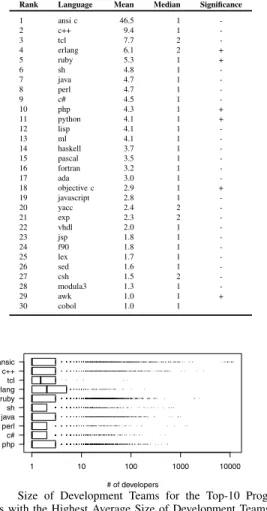
Finally, we investigate the constitution of development teams based on the used language, so as to identify lan-guages that are more “collaboration friendly”. We compute the average and median numbers of developers per project for each programming language.