Emergency System for Advance Registration of Volunteer
Health Professionals (ESAR-VHP) Program
Interim Technical and Policy Guidelines,
Standards, and Definitions:
System Development Tools
Interim: Insert Month & Year
Department of Health and Human Services
Assistant Secretary for Preparedness and Response
Office of Preparedness and Emergency Operations
National Healthcare Preparedness Programs
Emergency System for Advance Registration of Volunteer Health Professionals
(ESAR-VHP)
2
Emergency System for Advance Registration of Volunteer
Health Professionals (ESAR-VHP) Program
Interim Technical and Policy Guidelines,
Standards, and Definitions: System
Development Tools
Interim: Insert Month &Year
Department of Health and Human Services
Assistant Secretary for Preparedness and Response
Office of Preparedness and Emergency Operations
National Healthcare Preparedness Programs
Emergency System for Advance Registration of Volunteer Health Professionals
(ESAR-VHP)
3
Introduction
Previous versions of the Interim Technical and Policy Guidelines, Standards and Definitions
(Guidelines) provided information and guidance on ten diverse topics such as program planning,
authorities and emergency operations, and system operations and maintenance. This document,
however, focuses on providing the technical information that States need to develop systems
capable of registering a wide range of health care volunteers, verify their credentials and
qualifications, and assign volunteers to one of four credential levels. Non-technical information
and guidance on planning and operational issues will appear in future versions of the Guidelines.
Included here are the new and updated interim standards for 20 health care professional
occupations. These standards supplant the material in Chapters 4 and 12 of the June 2005
version of the Interim Technical and Policy Guidelines, Standards and Definitions. The
occupations included in this document were chosen based on their ability to provide, or assist in
providing, services needed to treat injuries and preserve life during or immediately following a
declared emergency. Please review this document carefully as a number of changes have been
made since the last version of the Guidelines was released. A “Summary of Changes” section
has been added that identifies the major changes that have been made.
This document comprises three major sections: (1) ESAR-VHP Compliance Requirements; (2)
Credential Elements and Credential-Level Classification; and (3) Data Dictionary.
The ESAR-VHP Compliance Requirements section specifies the capabilities and procedures that
State ESAR-VHP programs must have in place to ensure effective management and
inter-jurisdictional movement of volunteer health personnel in emergencies. This section incorporates
a number of revisions and replaces the ESAR-VHP Draft Compliance Requirements dated
October 31, 2006.
The Credential Elements and Credential-Level Classification section identifies the specific
credentials and other qualifications that States must collect via their registration system for each
of the 20 occupations. This section also identifies the verification requirements that States must
adhere to when assigning a volunteer to one of the four credential levels that are described in
further detail in this section.
The Data Dictionary section provides a detailed “Description” of the data elements that system
developers must include in their State volunteer registration system. Data elements include
information such as name, address, contact information, and occupation specific credentials and
the data needed to verify them such as the name on a license, license number, and the date of
expiration. Each data element is also coded to indicate whether the data element needs to be
verified and whether it is to be used in assigning volunteers to a credential level. There are a few
optional data elements identified that States may include or exclude at their own discretion. The
Data Dictionary also contains additional, or suggested, information about each data element that
system developers might find useful when developing their database, including: system
nomenclature for each data element; a description of the data type; and a suggested field size for
collecting each data element. Again, these additional items are provided for convenience and are
not required to be used by any State.
4
Each State should continue to develop its volunteer registry in accordance with the standards
presented here. Only through adherence to a common set of standards and guidelines will States
be able to develop the capability to quickly and efficiently identify and respond to requests for
volunteers from another State or the Federal government.
The development of the Guidelines is an iterative process. As a result, the ESAR-VHP program
will continue to depend on having a close working relationship with the States and its other
partners to develop the critical policies and procedures needed to govern the activation and
deployment of volunteers during a declared emergency.
5
Table of Contents
Section
Page
INTRODUCTION... 3
1.0 EMERGENCY SYSTEM FOR ADVANCE REGISTRATION OF VOLUNTEER HEALTH PROFESSIONALS (ESAR‐ VHP) COMPLIANCE REQUIREMENTS (REVISED MARCH 2010) ...12
1.1 ESAR‐VHP ELECTRONIC SYSTEM REQUIREMENTS...12
1.2 ESAR‐VHP OPERATIONAL REQUIREMENTS...14
1.3 ESAR‐VHP EVALUATION AND REPORTING REQUIREMENTS...15
1.4 GLOSSARY...16
1.5 SUMMARY OF CHANGES...18
2.0 TOOL 1: CREDENTIAL ELEMENTS AND CREDENTIAL‐LEVEL CLASSIFICATION ...20
2.1 CREDENTIAL LEVELS...20
ESAR‐VHP Credential Level 1...20
ESAR‐VHP Credential Level 2...21
ESAR‐VHP Credential Level 3...21
ESAR‐VHP Credential Level 4...21
2.2 CREDENTIAL ELEMENTS...21
Healthcare Diagnosing and Treating Professionals ...24
Healthcare Technologists and Technicians ...37
3.0 TOOL 2: DATA DICTIONARY ...46
3.1 NONPROFESSION‐SPECIFIC DATA ELEMENTS...48
3.2 HEALTHCARE DIAGNOSING AND TREATING PROFESSIONALS...54
Advanced Practice Registered Nurse...54
Clinical Social Worker...58
Dentist...61
Marriage and Family Therapist...65
Mental Health Counselor ...67
Pharmacist ...70 Physician ...74 Physician Assistant ...78 Psychologist...82 Registered Nurse ...86 Respiratory Therapist ...90 Veterinarian ...93
3.3 HEALTHCARE TECHNOLOGIST AND TECHNICIAN...97
Cardiovascular Technologist and Technician ...97
Diagnostic Medical Sonographer ...100
Emergency Medical Technician and Paramedic...102
Licensed Practical Nurse/Licensed Vocational Nurse ...104
Medical and Clinical Laboratory Technician...106
Medical and Clinical Laboratory Technologist ...109
Medical Records and Health Information Technician ...112
Radiologic Technologist and Technician ...114
APPENDIX A: VERIFICATION AUTHORITIES FOR CREDENTIALS REQUIRED FOR ASSIGNING ESAR‐VHP LEVEL ....118
ADVANCED PRACTICE REGISTERED NURSE: VERIFICATION AUTHORITIES...118
6
PHYSICIAN: VERIFICATION AUTHORITIES, AMERICAN OSTEOPATHIC MEDICAL SPECIALTIES AND SUBSPECIALTIES...123
PHYSICIAN ASSISTANT: VERIFICATION AUTHORITIES...125
CARDIOVASCULAR TECHNOLOGIST/TECHNICIAN: VERIFICATION AUTHORITIES...125
DIAGNOSTIC MEDICAL SONOGRAPHER: VERIFICATION AUTHORITIES...125
EMERGENCY MEDICAL TECHNICIAN/PARAMEDIC: VERIFICATION AUTHORITIES...126
MEDICAL/CLINICAL LABORATORY TECHNICIAN: VERIFICATION AUTHORITIES...126
MEDICAL/CLINICAL LABORATORY TECHNOLOGIST: VERIFICATION AUTHORITIES...127
MEDICAL RECORDS/HEALTH INFORMATION TECHNICIAN: VERIFICATION AUTHORITIES...127
RADIOLOGIC TECHNOLOGIST/TECHNICIAN: VERIFICATION AUTHORITIES...128
APPENDIX B: VERIFICATION AUTHORITIES FOR CREDENTIALS NOT REQUIRED FOR ASSIGNING ESAR‐VHP LEVEL ...129
DENTIST: SPECIALTY VERIFICATION AUTHORITIES...129
MENTAL HEALTH COUNSELOR: VERIFICATION AUTHORITIES...130
PHARMACIST: VERIFICATION AUTHORITIES...130
PSYCHOLOGIST: VERIFICATION AUTHORITIES...131
REGISTERED NURSE: VERIFICATION AUTHORITIES (SEE APRN SECTION IN APPENDIX A FOR ADVANCED PRACTITIONER CERTIFICATIONS.) ...132
RESPIRATORY THERAPIST: VERIFICATION AUTHORITIES...135
VETERINARIAN: AMERICAN BOARDS OF VETERINARY SPECIALISTS OF THE AMERICAN VETERINARY MEDICAL ASSOCIATION...136
APPENDIX C: THE UNITED STATES AND U.S. MUNICIPALITIES, DEPENDENCIES, AND FORMER DEPENDENCIES .138 APPENDIX D: SELECTED LANGUAGES USED IN THE UNITED STATES AND U.S. DEPENDENCIES AND FORMER DEPENDENCIES ...139
7
List of Exhibits
Exhibits
Page
Table 2‐1. Master List: ESAR‐VHP Required Credentials and Relevant Verification Authorities ...22
Table 2‐2. Advanced Practice Registered Nurse: Credential Elements and Associated Credential Levels...24
Table 2‐3. Clinical Social Worker: Credential Elements and Associated Credential Levels ...26
Table 2‐4. Dentist: Credential Elements and Associated Credential Levels ...27
Table 2‐5. Marriage and Family Therapist: Credential Elements and Associated Credential Levels ...28
Table 2‐6. Mental Health Counselor: Credential Elements and Associated Credential Levels...29
Table 2‐7. Pharmacist: Credential Elements and Associated Credential Levels ...30
Table 2‐8. Physician: Credential Elements and Associated Credential Levels ...31
Table 2‐9. Physician Assistant: Credential Elements and Associated Credential Levels...32
Table 2‐10. Psychologist: Credential Elements and Associated Credential Levels ...33
Table 2‐11. Registered Nurse: Credential Elements and Associated Credential Levels ...34
Table 2‐12. Respiratory Therapist: Credential Elements and Associated Credential Levels ...35
Table 2‐13. Veterinarian: Credential Elements and Associated Credential Levels ...36
Table 2‐14. Cardiovascular Technologist/Technician: Credential Elements and Associated Credential Levels ...37
Table 2‐15. Diagnostic Medical Sonographer: Credential Elements and Associated Credential Levels...38
Table 2‐16. Emergency Medical Technician/Paramedic: Credential Elements and Associated Credential Levels...39
Table 2‐17. Licensed Practical Nurse/Licensed Vocational Nurse: Credential Elements and Associated Credential Levels...40
Table 2‐18. Medical/Clinical Laboratory Technician: Credential Elements and Associated Credential Levels...41
Table 2‐19. Medical/Clinical Laboratory Technologist: Credential Elements and Associated Credential Levels ...42
Table 2‐20. Medical Records/Health Information Technician: Credential Elements and Associated Credential Levels...43
Table 2‐21. Radiologic Technologist/Technician: Credential Elements and Associated Credential Levels ...44
Table 3‐1. Identity or Personal Information ...48
Table 3‐2. Contact Information...48
Table 3‐3. Emergency Contact Information...49
Table 3‐4. Consents and Pledges ...50
Table 3‐5. Deployment Preferences ...50
Table 3‐6. Language Skills ...51
Table 3‐7. Disaster Training ...51
8
Table 3‐9. Education ...52
Table 3‐10. Experience ...53
Table 3‐11. APRN Unencumbered License or Equivalent State Authorization...54
Table 3‐12. APRN Specialty Certification ...54
Table 3‐13. APRN Clinically active in a hospital ...55
Table 3‐14. APRN Clinically Active ...56
Table 3‐15. APRN Record of Adverse Actions...57
Table 3‐16. APRN Inspector General Status...57
Table 3‐17. APRN DEA Registration ...57
Table 3‐18. CSW Unencumbered License or Equivalent State Authorization ...58
Table 3‐19. CSW Clinically active in a hospital...59
Table 3‐20. CSW Clinically Active...59
Table 3‐21. CSW Inspector General Status ...60
Table 3‐22. Dentist Unencumbered License or Equivalent State Authorization ...61
Table 3‐23. Dentist Specialty Certification...61
Table 3‐24. Dentist Clinically active in a hospital...62
Table 3‐25. Dentist Clinically Active...63
Table 3‐26. Dentist Record of Adverse Actions ...64
Table 3‐27. Dentist Inspector General Status...64
Table 3‐28. Dentist DEA Registration...64
Table 3‐29. MFT Unencumbered License or Equivalent State Authorization...65
Table 3‐30. MFT Clinically active in a hospital ...66
Table 3‐31. MFT Clinically Active ...66
Table 3‐32. MFT Inspector General Status ...67
Table 3‐33. MHC Unencumbered License or Equivalent State Authorization ...67
Table 3‐34. MHC Certification/Registration ...68
Table 3‐35. MHC Clinically active in a hospital ...68
Table 3‐36. MHC Clinically Active ...69
Table 3‐37. MHC Inspector General Status...70
Table 3‐38. Pharmacist Unencumbered License or Equivalent State Authorization ...70
9
Table 3‐40. Pharmacist Clinically active in a hospital ...71
Table 3‐41. Pharmacist Clinically Active ...72
Table 3‐42. Pharmacist Inspector General Status...73
Table 3‐43. Pharmacist DEA Registration ...73
Table 3‐44. Physician Unencumbered License or Equivalent State Authorization ...74
Table 3‐45. Physician Specialty Certification ...74
Table 3‐46. Physician Clinically active in a hospital ...76
Table 3‐47. Physician Clinically Active ...76
Table 3‐48. Physician Record of Adverse Actions ...77
Table 3‐49. Physician Inspector General Status...77
Table 3‐50. Physician DEA Registration ...78
Table 3‐51. PA Unencumbered License or Equivalent State Authorization...78
Table 3‐52. PA Certification/Registration ...79
Table 3‐53. PA Clinically active in a hospital...79
Table 3‐54. PA Clinically Active ...80
Table 3‐55. PA Record of Adverse Actions...81
Table 3‐56. PA Inspector General Status ...81
Table 3‐57. PA DEA Registration...81
Table 3‐58. Psychologist Unencumbered License or Equivalent State Authorization ...82
Table 3‐59. Psychologist Specialty Certification ...83
Table 3‐60. Psychologist Clinically active in a hospital ...84
Table 3‐61. Psychologist Clinically Active ...84
Table 3‐62. Psychologist Record of Adverse Actions ...85
Table 3‐63. Psychologist Inspector General Status...85
Table 3‐64. Psychologist DEA Registration ...86
Table 3‐65. RN Unencumbered License or Equivalent State Authorization ...86
Table 3‐66. RN Specialty Certification ...87
Table 3‐67. RN Skill by Practical Experience Without Formal Training...88
Table 3‐68. RN Clinically active in a hospital...88
Table 3‐69. RN Clinically Active...89
Table 3‐70. RN Inspector General Status...89
10
Table 3‐72. RT Certification/Registration ...91
Table 3‐73. RT Specialty Certification ...91
Table 3‐74. RT Clinically active in a hospital ...92
Table 3‐75. RT Clinically Active ...92
Table 3‐76. RT Inspector General Status ...93
Table 3‐77. Veterinarian Unencumbered License or Equivalent State Authorization...93
Table 3‐78. Veterinarian Specialty Certification ...94
Table 3‐79. Veterinarian Clinically Active ...95
Table 3‐80. Veterinarian Inspector General Status ...96
Table 3‐81. Veterinarian DEA Registration ...96
Table 3‐82. Cardiovascular Technologist and Technician Unencumbered License or Equivalent State Authorization...97
Table 3‐83. Cardiovascular Technologist and Technician Certification/Registration ...98
Table 3‐84. Cardiovascular Technologist and Technician Clinically active in a hospital ...98
Table 3‐85. Cardiovascular Technologist and Technician Clinically Active ...99
Table 3‐86. Cardiovascular Technologist and Technician Inspector General Status ...99
Table 3‐87. DMS Certification/Registration...100
Table 3‐88. DMS Clinically active in a hospital...101
Table 3‐89. DMS Clinically Active...101
Table 3‐90. DMS Inspector General Status...102
Table 3‐91. EMT and Paramedic Unencumbered License or Equivalent State Authority...102
Table 3‐92. EMT and Paramedic Certification/Registration ...103
Table 3‐93. EMT and Paramedic Clinically Active ...103
Table 3‐94. EMT and Paramedic Inspector General Status ...104
Table 3‐95. LPN and LVN Unencumbered License or Equivalent State Authority ...104
Table 3‐96. LPN and LVN Clinically active in a hospital...105
Table 3‐97. LPN and LVN Clinically Active...105
Table 3‐98. LPN and LVN Inspector General Status ...106
Table 3‐99. Medical and Clinical Laboratory Technician Unencumbered License or Equivalent State Authority....106
Table 3‐100. Medical and Clinical Laboratory Technician Certification/Registration...107
Table 3‐101. Medical and Clinical Laboratory Technician Clinically active in a hospital ...108
11
Table 3‐103. Medical and Clinical Laboratory Technician Inspector General Status...109
Table 3‐104. Medical and Clinical Laboratory Technologist Unencumbered License or Equivalent State Authority...109
Table 3‐105: Medical and Clinical Laboratory Technologist Certification/Registration ...110
Table 3‐106. Medical and Clinical Laboratory Technologist Clinically active in a hospital ...110
Table 3‐107. Medical and Clinical Laboratory Technologist Clinically Active ...111
Table 3‐108. Medical and Clinical Laboratory Technologist Inspector General Status ...111
Table 3‐109. Medical Records and Health Information Technician Certification/Registration ...112
Table 3‐110. Medical Records and Health Information Technician Clinically active in a hospital...113
Table 3‐111. Medical Records and Health Information Technician Clinically Active...113
Table 3‐112. Medical Records/Health Information Technician Inspector General Status ...114
Table 3‐113. Radiologic Technologist and Technician Unencumbered License or Equivalent State Authority...114
Table 3‐114. Radiologic Technologist and Technician Certification/Registration ...115
Table 3‐115. Radiologic Technologist and Technician Specialty Certification ...115
Table 3‐116. Radiologic Technologist and Technician Clinically active in a hospital ...116
Table 3‐117. Radiologic Technologist and Technician Clinically Active ...116
12
1.0 Emergency System for Advance Registration of
Volunteer Health Professionals (ESAR-VHP) Compliance
Requirements (revised March 2010)
The ESAR-VHP compliance requirements identify capabilities and procedures that State
1ESAR-VHP programs must have in place to ensure effective management and inter-jurisdictional
movement of volunteer health personnel in emergencies. Each State must meet all of the
compliance requirements.
1.1 ESAR-VHP Electronic System Requirements
1.
Each State is required to develop an electronic registration system for recording and
managing volunteer information based on the data definitions presented in the Interim
ESAR-VHP Technical and Policy Guidelines, Standards and Definitions (Guidelines).
These
systems
must:
a) Offer Internet-based registration. Information must be controlled and managed by
authorized personnel who are responsible for the data.
b) Ensure that volunteer information is collected, assembled, maintained and utilized
in a manner consistent with all Federal, State and local laws governing security
and confidentiality.
c) Identify volunteers via queries of variables as defined by requestor.
d) Ensure that each State ESAR-VHP System is both backed up on a regular basis
and that the backup is not co-located.
Each electronic system must be able to register and collect the credentials and
qualifications of health professionals that are then verified with the issuing entity or
appropriate authority identified in the ESAR-VHP Guidelines.
a) Each State must collect and verify the credentials and qualifications of the
following health professionals. Beyond this list of occupations, a State may
register volunteers from any other occupation it chooses. The standards and
requirements for including additional occupations are left to the States.
1)
Physicians (Allopathic and Osteopathic)
2)
Registered Nurses
3)
Advanced Practice Registered Nurses (APRNs) including Nurse Practitioners,
Certified Nurse Anesthetists, Certified Nurse Midwives, and Clinical Nurse
Specialists
4)
Pharmacists
1
For purpose of this document, State refers to States, Territories, New York City, Chicago, Los Angeles County, the District of Columbia, Commonwealths, or the sovereign nations of Palau, Marshall Islands, and Federated States of Micronesia.
13
5)
Psychologists
6)
Clinical Social Workers
7)
Mental Health Counselors
8)
Radiologic Technologists and Technicians
9)
Respiratory Therapists
10)
Medical and Clinical Laboratory Technologists
11)
Medical and Clinical Laboratory Technicians
12)
Licensed Practical Nurses and Licensed Vocational Nurses
13)
Dentists
14)
Marriage and Family Therapists
15)
Physician Assistants
16)
Veterinarians
17)
Cardiovascular Technologists and Technicians
18)
Diagnostic Medical Sonographers
19)
Emergency Medical Technicians and Paramedics
20)
Medical Records and Health Information Technicians
b) States must add additional professions to their systems as they are added to future
versions of the ESAR-VHP Guidelines.
2.
Each electronic system must be able to assign volunteers to all four ESAR-VHP
credential levels. Assignment will be based on the credentials and qualifications that the
State has collected and verified with the issuing entity or appropriate authority.
3.
Each electronic system must be able to record ALL volunteer health
professional/emergency preparedness affiliations of an individual, including local, State,
and Federal entities.
The purpose of this requirement is to avoid the potential confusion that may arise from
having a volunteer appear in multiple registration systems (e.g., Medical Reserve Corps
(MRC), National Disaster Medical System (NDMS), etc.).
4.
Each electronic system must be able to identify volunteers willing to participate in a
Federally coordinated emergency response.
a) Each electronic system must query volunteers upon initial registration and/or
re-verification of credentials about their willingness to participate in emergency
responses coordinated by the Federal government. Responses to this question,
posed in advance of an emergency, will provide the Federal government with an
estimate of the potential volunteer pool that may be available from the States
upon request.
b) If a volunteer responds “Yes” to the Federal question, States may be required to
collect additional information (e.g., training, physical and medical status, etc.).
5.
Each State must be able to update volunteer information and re-verify credentials every 6
14
Note: ASPR is reviewing this requirement regularly for possible adjustments based on
the experience of the States.
1.2 ESAR-VHP Operational Requirements
1.
Upon receipt of a request for volunteers from any governmental agency or recognized
emergency response entity, all States must: 1) within 2 hours query the electronic system
to generate a list of potential volunteer health professionals to contact; 2) contact
potential volunteers; 3) within 12 hours provide the requester an initial list of willing
volunteer health professionals that includes the names, qualifications, credentials, and
credential levels of volunteers; and 4) within 24 hours provide the requester with a
verified list of available volunteer health professionals.
2.
All States are required to develop and implement a plan to recruit and retain volunteers.
ASPR will assist States in meeting this requirement by providing professional assistance
to develop a National public education campaign, tools for accessing State enrollment
sites, and customized State recruitment and retention plans. This will be carried out in
conjunction with existing recruitment and retention practices utilized by States.
3.
Each State must develop a plan for coordinating with all volunteer health
professional/emergency preparedness entities to ensure an efficient response to an
emergency, including, but not limited to, Medical Reserve Corps (MRC) units and the
National Disaster Medical System (NDMS) teams.
4.
Each State must develop protocols for deploying and tracking volunteers during an
emergency (Mobilization Protocols):
a) Each State is required to develop written protocols that govern the internal
activation, operation, and timeframes of the ESAR-VHP system in response to an
emergency. Included in these protocols must be plans to track volunteers during
an emergency and for maintaining a history of volunteer deployments. ASPR may
ask for copies of these protocols as a means of documenting compliance. ASPR
will include protocol models in future versions of the ESAR-VHP Guidelines.
b) Each State ESAR-VHP program is required to establish a working relationship
with external partners, such as the local and/or State Emergency Management
Agency and develop protocols outlining the required actions for deploying
volunteers during an emergency. These protocols must ensure 24 hour/7 days-a-
week accessibility to the ESAR-VHP system. Major areas of focus include:
1) Intrastate deployment: States must develop protocols that coordinate the
use of ESAR-VHP volunteers with those from other volunteer
organizations, such as the Medical Reserve Corps (MRC).
2) Interstate deployment: States must develop protocols outlining the steps
needed to respond to requests for volunteers received from another State.
States that have provisions for making volunteers employees or agents of
the State must also develop protocols for deployment of volunteers to
other States through the State Emergency Management Agency via the
Emergency Management Assistance Compact (EMAC).
15
Each State must have a process for receiving and maintaining the security
of volunteers’ personal information sent to them from another State and
procedures for destroying the information when it is no longer needed.
3)
Federal deployment: Each State must develop protocols necessary to
respond to requests for volunteers that are received from the Federal
government. Further, each State must adhere to the protocol developed by
the Federal government that governs the process for receiving requests for
volunteers, identifying willing and available volunteers, and providing
each volunteer’s credentials to the Federal government.
1.3 ESAR-VHP
Evaluation
and Reporting Requirements
1.
Each State must develop a plan for regular testing of its ESAR-VHP system through
drills and exercises. These exercises must be consistent with the ASPR Hospital
Preparedness Program (HPP), Centers for Disease Control and Prevention (CDC) Public
Health Emergency Preparedness (PHEP) Program, and ASPR ESAR-VHP Program
requirements for drills and exercises.
2.
Each State must develop a plan for reporting program performance and capabilities.
Each State will be required to report program performance and capabilities data as
specified by the ASPR Hospital Preparedness Program (HPP), CDC Public Health
Emergency Preparedness (PHEP) Program, and/or the ASPR ESAR-VHP Program.
States will report the number of enrolled volunteers by profession and credential level,
the addition of program capabilities as they are implemented, and program activity during
responses to actual events.
16
1.4 Glossary
Terms used in this ESAR-VHP publication.
authority Constitutional, statutory, regulatory, or other legal powers of State governments to control functions of the State’s ESAR-VHP systems.
background check Search for existence of criminal records for an applicant.
Boolean or Y/N Data field that stores the value “true” or “false” and is useful for asking ESAR-VHP applicants to answer “yes/no” or “true/false” questions.
certification Formal document that shows an applicant has successfully completed the education, training, and experience needed to specialize in a certain healthcare area.
Registration and certification are sometimes synonymous; both often require education, training, and passing an examination. Certification or registration is sometimes a prerequisite for taking a State licensure examination or, sometimes, accepted in lieu of taking a licensure examination.
credential License, diploma, or other documented evidence of, or testimony to, a person’s education, training, or other abilities.
credential level One of four categories in which volunteers are assigned based on the number of credentials and other qualifications that can be verified. Each level helps identify how volunteers might best be used.
database Collection of data stored in an electronic system that can be arranged, displayed, and printed in various forms without affecting data integrity.
database label Field name composed of only alphanumeric characters and underscores; no spaces or other types of characters allowed.
data element Discrete piece of information about a volunteer that is stored in a database. date type A field that can store a valid, formatted date.
disaster As referenced in the Homeland Security Act of 2002, includes both natural disasters and severe fires, floods, and explosions, regardless of cause. (Adopted from the Robert T. Stafford Disaster Relief and Emergency Assistance Act. (2002), Pub. L. 106-390)
equivalent State authorization
Any recognized authority, governmental or private, that can issue documentation attesting to the legitimacy of an applicant’s credentials (e.g., registration with the National Registry of Emergency Medical Technicians, certification issued by the National Board for Respiratory Care, certification issued by the American Registry of Radiologic Technologists).
healthcare volunteer
A qualified healthcare professional who voluntarily renders aid or performs a health service without pay or other remuneration.
17
Inspector General status
Whether or not a specific healthcare practitioner is on the List of Excluded Individuals/Entities maintained by the Office of the Inspector General, DHHS and, therefore, barred from participating in a Federally funded healthcare program. Among the reasons for inclusion in the list are convictions for program-related fraud, patient abuse, adverse license-board actions, and default on a Health Education Assistance Loan. The List of Excluded Individuals/Entities can be found at http://oig.hhs.gov/fraud/exclusions/listofexcluded.html
jurisdiction A county, municipality, city, town, township, local public authority, school district, special district, intrastate district, council of governments (regardless of whether the council of governments is incorporated as a nonprofit corporation under State law), regional or interstate government entity, or local government agency or
instrumentality; an Indian tribe or authorized tribal organization, or, in Alaska, a Native village or Alaska Regional Native Corporation; a rural community,
unincorporated town or village, or other public entity. (Adopted from the definition for “local government” in Section 2 (10), Homeland Security Act of 2002, Pub. L. 107-296, 116 Stat. 2135 [2002].)
licensure Affirmation by a duly constituted government, usually the State, that a specific individual has met certain prescribed qualifications and is therefore recognized under law to engage in certain activities.
nomenclature Suggested title for each data element included in the ESAR-VHP database. public health
emergency
An occurrence or imminent threat of an illness or health condition that is caused by: (1) bioterrorism; (2) a novel or previously controlled disease or biological toxin; (3) a natural disaster; (4) a chemical attack or accidental release; or (5) a nuclear attack or accident. In addition, the occurrence must pose a high probability of large numbers of deaths, disabilities, or substantial risk of future harm to a large number of people in the affected population.
The definition of “public health emergency” varies from State to State. The above is based on the Model State Emergency Health Powers Act, which many States have adopted, in whole or in part.
privileges Authorization from an employer, such as a hospital, entitling certain healthcare professionals (advanced practice registered nurse, dentist, physician [doctor of medicine and doctor of osteopathy], physician assistant, and psychologist) to provide patient care, treatment, and services at that hospital.
registration See certification. situational
orientation
On-the-spot explanation of a specific event relayed to emergency responders to help them provide an appropriate and efficient response.
specialty certification
Recognition by a recognized national certifying organization of a healthcare
professional's education, training, and skills in a specialty practice area of his or her profession.
string Data field that can store any type of text information and has a predetermined size limit. Allowable values are numbers, letters, punctuation, symbols, or all displayable ASCII characters for a specific code page (e.g., unicode or U.S. English).
Unencumbered license
Free of any licensure restriction that impedes or prohibits the ability of a license holder to practice within the profession.
18
1.5 Summary
of
Changes
In addition to expanding the Guidelines to include standards for registering 20 types of health
professionals, a number of other changes have been made. These changes include the creation of
a new occupation to replace two of the existing occupations and changes to the list of specific
credentials or qualifications that need verification prior to assigning volunteers to a credential
level. The following identifies and provides a rationale for changes that have been made since
the June 2005 release of the Interim Technical and Policy Guidelines Standards, and Definitions,
Version 2:
1.
A
Clinical Social Worker
occupation was added and the
Medical and Public Health Social
Workers
and
Mental Health and Substance Abuse Social Workers
were dropped.
This change was adopted because it was generally felt that the Clinical Social Worker title is
more widely recognized by the health care community; that it clearly identifies a healthcare
professional capable of providing independent care; and that most social workers in the
medical and public health and mental health and substance areas are clinical social workers.
2.
Degree or Diploma:
The need to verify a volunteer’s degree or diploma has been dropped as
a required element for assigning a volunteer to Levels 1, 2, or 3 Confirming a volunteer’s
education or experience is only required for assignment to Level 4.
The decision to drop degree or diploma is based on the assumption that a volunteer must
demonstrate successful completion of all educational requirements and possess a degree or
diploma as a prerequisite for licensure or certification. Demonstration that a volunteer has
the education or experience in a certain profession represents the minimum qualifications and
has been deemed sufficient for assignment to Level 4.
3.
Specialty Certification/Registration:
This credential was added to differentiate it from
general certification.
Some occupations offer both general and subspecialty certification and it would be valuable
to know both. For instance, a physician board certified in family medicine could also have
subspecialty certification in geriatrics.
4.
Active Clinical (Hospital) Privileges:
Renamed Clinically active in a hospital. Verification
that a health care volunteer is actively engaged in providing clinical care, either as a hospital
employee or by virtue of having hospital privileges, is now a requirement for assignment to
Level 1 for all occupations, not just physicians.
Hospital representatives have indicated that other than verification of licensure, the single
most important qualification they would look for when considering whether to use a
volunteer is to know if the volunteer has privileges or is employed in a hospital.
5.
National Practitioner Data Bank:
This qualification has been renamed Adverse Actions.
ASPR is exploring means of identifying adverse actions taken against the licenses or
certifications of health professionals. With respect to physicians and physician assistants,
ASPR has established an agreement with the Federation of State Medical Boards (FSMB) to
provide information on adverse actions taken against physicians and physician assistants
seeking to register as ESAR-VHP volunteers. States should work with ASPR to obtain
access to it and are required to query this database.
19
6.
Inspector General Status:
All volunteers at all credential levels must meet this qualification
and any individual whose name appears on the List of Excluded Individuals/Entities (LEIE)
is to be excluded as a volunteer.
The list identifies individuals who have been excluded from billing Medicare, Medicaid, and
other Federally funded healthcare programs due to fraud, patient abuse, or licensing board
actions that have been taken against them. In addition, no payment will be made by Federal
programs to any entity employing an excluded individual. The LEIE is maintained by the
Department of Health and Human Services, Office of the Inspector General, and is available
free of charge. The web site from which the list can be downloaded or queried is
http://oig.hhs.gov/fraud/exclusions/listofexcluded.html.
7.
Data elements:
A revised and expanded set of data elements for use in developing a
volunteer database is provided. The data elements are provided to help States develop
registries that use common nomenclature.
20
2.0 Tool 1: Credential Elements and Credential-Level
Classification
This section of the manual provides the specific information that States will need to collect and
then examine or verify prior to registering and classifying healthcare volunteers from a specified
set of occupations. Beyond this list of occupations, a State may register volunteers from any
other occupation it chooses. The standards and requirements for including additional
occupations are left to the States.
ASPR feels that the 20 healthcare occupations described in tables 1-2 to 1-21 are critical to
rendering aid in a disaster and must therefore be included in each State’s registration system.
The three criteria ASPR uses for identifying such critical healthcare occupations are as follows:
The occupation is consistent with the Standard Occupational Classification System
published by the U.S. Office of Management and Budget and has discrete duties and
responsibilities;
The primary duties and responsibilities of the occupation are to provide direct patient
care or services that assist with direct patient care (or assist in providing care to
populations); and
Verifiable and obtainable credentials must exist for the occupation.
ASPR may identify additional occupations for inclusion in State registries at a later time. States
may, at their own discretion, add additional occupations to their registry.
2.1 Credential
Levels
To make the most effective use of healthcare workers who may have varying levels of clinical
competency, ASPR has also developed a system of classifying and assigning volunteers into one
of four “credential levels.” Following is a basic description of what is required for assignment to
each credential level, why each credential level was developed, and how volunteers in each level
might be used in a disaster.
ESAR-VHP Credential Level 1
Level 1 ensures that an adequate supply of hospital-qualified health professionals is available to
work in hospitals in times of an emergency. Hospital-qualified health professionals are
distinguished from other health professionals through a rigorous and constant review of
credentials and performance. ASPR standards for assignment to Credential Level 1 were
developed in consultation with the hospital industry and reflect the level of review hospitals
would require before accepting a volunteer into their facility.
Assignment to Level 1 requires confirmation that the volunteer is clinically active in a hospital,
either as an employee or by virtue of having hospital privileges. Implicit in this requirement is
the ability to practice in a full and unrestricted manner within the State and meet other
21
ESAR-VHP Credential Level 2
Level 2 ensures the availability of highly qualified individuals who may deliver services in a
wide variety of settings such as clinics, nursing homes, and shelters. Typically, these health
professionals possess all the credentials and qualifications of a Level 1 health professional except
that they are not employed in a hospital nor do they have hospital privileges.
Assignment to Level 2 requires confirmation that the volunteer is clinically active in any setting
other than a hospital (e.g., clinic, private practice, nursing home, etc.). Implicit in this
requirement is the ability to practice in a full and unrestricted manner within the State and meet
other occupational specific qualifications identified later in this document.
ESAR-VHP Credential Level 3
Level 3 classifies individuals who meet the basic qualifications necessary to practice in the State
in which they are registered.
Assignment to Level 3 requires verification of a volunteer’s license, certification, or other State
requirement to practice. In situations where the State does not govern a profession, ASPR has
identified requirements that are deemed to be usual and customary for employment in the
profession, which must be verified.
ESAR-VHP Credential Level 4
Level 4 classifies individuals who have healthcare experience or education in an area that would
be useful in providing basic healthcare not controlled by scope of practice laws and to assist
clinicians.
Assignment to Level 4 requires that the volunteer possess verified documentation of healthcare
education or experience. This level may include, but is not limited to, healthcare students or
retired healthcare professionals who no longer hold a license.
2.2 Credential
Elements
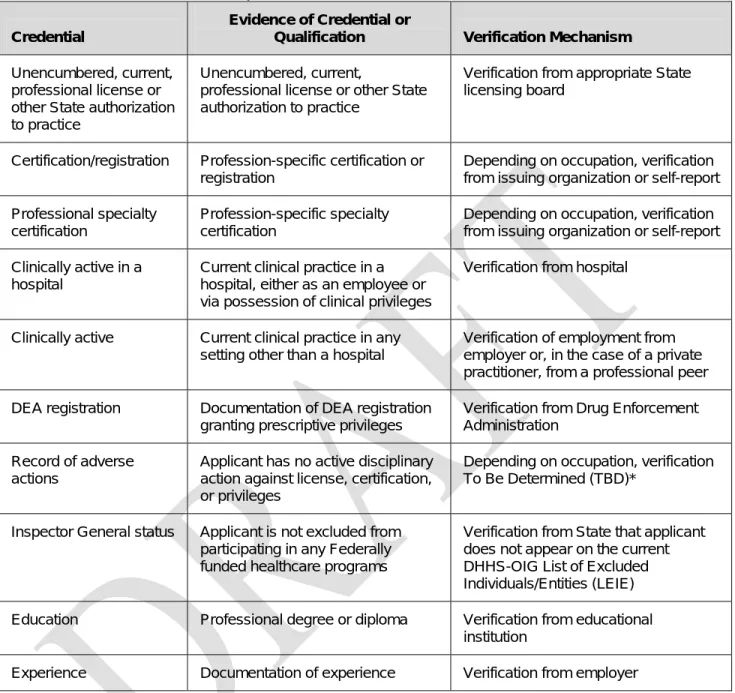
Table 2-1 lists, in the aggregate, the credential and qualification information that an ESAR-VHP
system must currently be able to collect and verify. However, the number and type of credentials
required of each applicant can differ from profession to profession. For example, the
ESAR-VHP system collects information on DEA registration only from applicants whose professions
allow them to prescribe or dispense medication. Similarly, not all occupations require a State
license or other State authorization to practice.
Note that the only requirement that must be met by all volunteers types across all credential
levels is that the individual not be included on the U.S. Department of Health and Human
Services, Office of the Inspector General’s, List of Excluded Individuals/Entities (LEIE).
Individuals whose name appears on this list, and employers who employ them, are excluded
from participating in Federally funded programs such as Medicare and Medicaid. This is
available at http://oig.hhs.gov/fraud/exclusions/listofexcluded.html.
22
Table 2-1. Master List: ESAR-VHP Required Credentials and Relevant Verification Authorities
Credential
Evidence of Credential or
Qualification Verification Mechanism
Unencumbered, current, professional license or other State authorization to practice
Unencumbered, current,
professional license or other State authorization to practice
Verification from appropriate State licensing board
Certification/registration Profession-specific certification or registration
Depending on occupation, verification from issuing organization or self-report Professional specialty
certification
Profession-specific specialty certification
Depending on occupation, verification from issuing organization or self-report Clinically active in a
hospital
Current clinical practice in a hospital, either as an employee or via possession of clinical privileges
Verification from hospital
Clinically active Current clinical practice in any
setting other than a hospital
Verification of employment from employer or, in the case of a private practitioner, from a professional peer
DEA registration Documentation of DEA registration
granting prescriptive privileges
Verification from Drug Enforcement Administration
Record of adverse actions
Applicant has no active disciplinary action against license, certification, or privileges
Depending on occupation, verification To Be Determined (TBD)*
Inspector General status Applicant is not excluded from
participating in any Federally funded healthcare programs
Verification from State that applicant does not appear on the current DHHS-OIG List of Excluded Individuals/Entities (LEIE)
Education Professional degree or diploma Verification from educational
institution
Experience Documentation of experience Verification from employer
*ASPR is exploring means of identifying adverse actions taken against the licenses or certifications of health professionals. With respect to physicians and physician assistants, ASPR has established an agreement with the Federation of State Medical Boards (FSMB) to provide information on adverse actions taken against physicians and physician assistants seeking to register as ESAR-VHP volunteers. States should work with ASPR to obtain access to it and are required to query to this database.
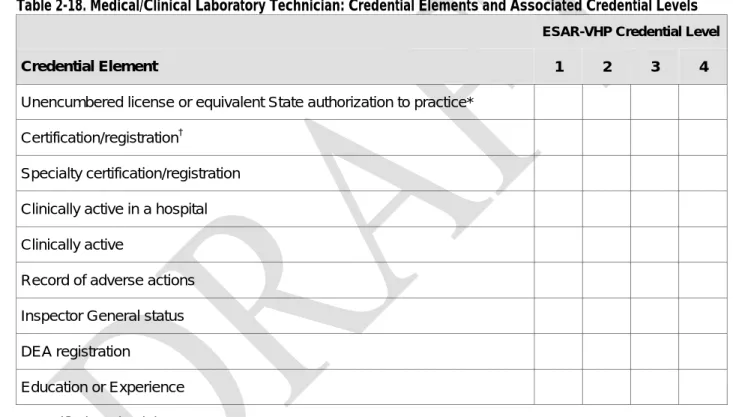
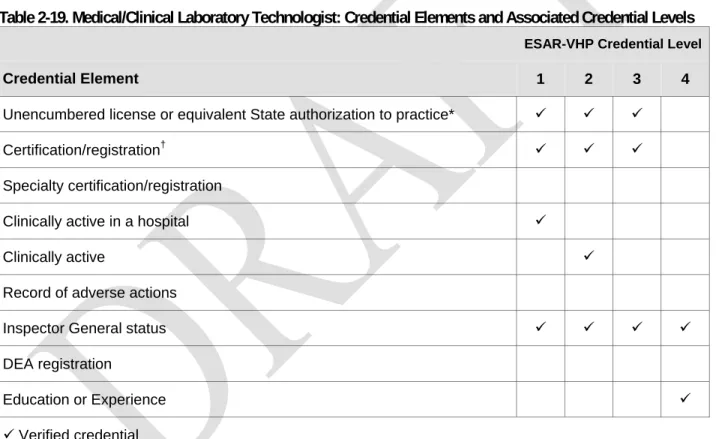
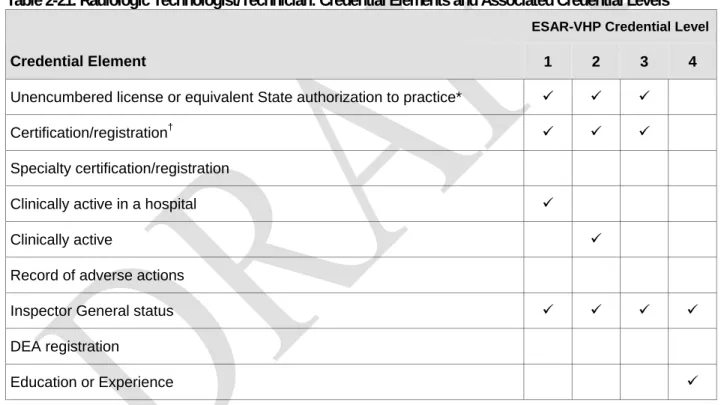
Tables 2-2 to 2-21 below explain the scope of work for each of the 20 professions included in
this document. They also define, per profession, the set of credentials that must be collected,
verified, and then used in assigning a volunteer-applicant to a credential level.
The certifying bodies and the certifications/registrations that need verification as a condition for
credential level assignment appear in appendix A. Only credentials from these organizations are
23
acceptable for assignment to a credential level. Verification authorities for credentials that are
required, but do not enter into a credential-level determination, are listed in appendix B.
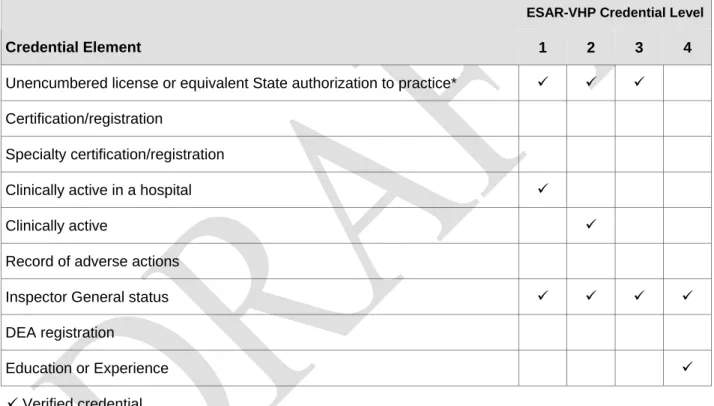
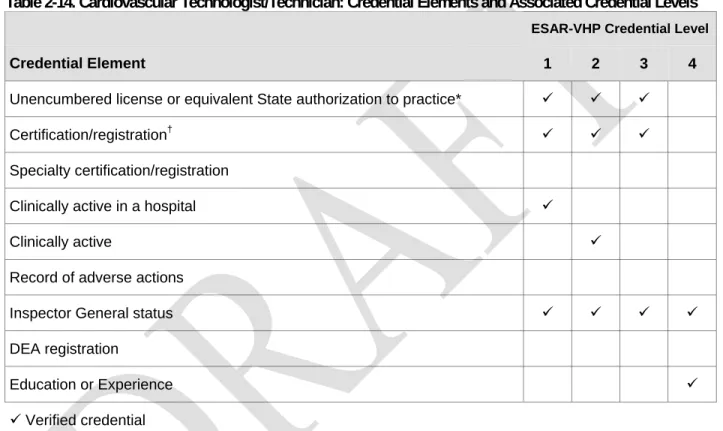
The tables 2-2 to 2-21 display the credential-level requirements for each profession, with the
occupations grouped alphabetically under one of two categories: (1) healthdiagnosing and
-treating professions, followed by (2) health technologists and technicians.
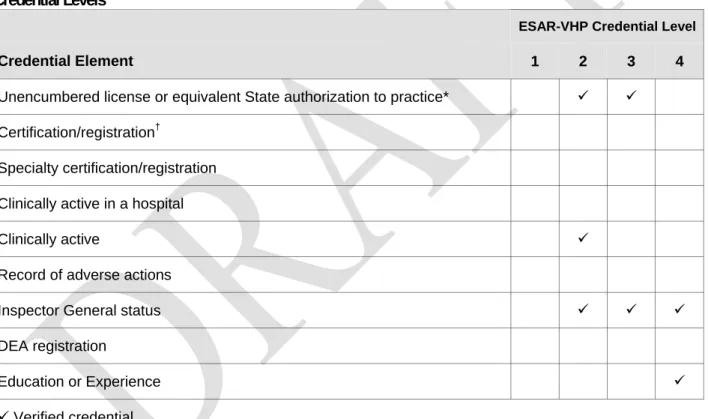
The left-hand column displays the credentials that ASPR requires of a volunteer-applicant during
registration. The check marks in columns numbered 1, 2, 3, and 4 identify the
occupation-specific credentials ASPR requires per profession. Once verified, these data will determine the
relevant credential-level for an applicant. Upon assignment to a credential level, the applicant
achieves volunteer status. If a State cannot verify all the credentials needed to assign the
applicant to one of the four levels, the applicant cannot be accepted as a healthcare volunteer.
Notes under the tables describe special circumstances associated with a particular credential for
that occupation.
24
Healthcare Diagnosing and Treating Professionals
Advanced Practice Registered Nurse (APRN)
The advanced practice registered nurse is a registered nurse who has met the educational and
clinical-practice requirements for working as a nurse practitioner, clinical nurse specialist,
certified nurse midwife, or certified nurse anesthetist, and has passed an advanced practice
certification exam. APRNs are State-approved to practice collaboratively with, or independently
of, another healthcare professional in a range of settings: home, hospital, institution, office,
industry, school, community agency, public or private clinic, private practice, etc.
Services include diagnosing and managing common acute illnesses and chronic stable
conditions, making referrals, and conducting comprehensive healthcare assessments focused on
health promotion and disease prevention.
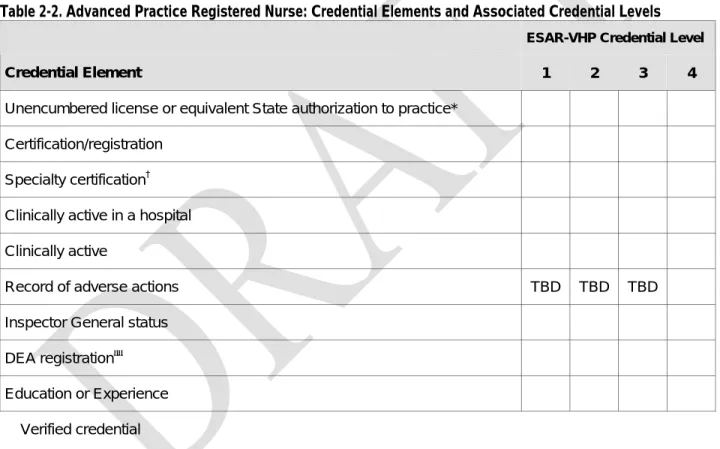
APRN credentials that require verification for credential-level assignment are shown below.
Table 2-2. Advanced Practice Registered Nurse: Credential Elements and Associated Credential Levels
ESAR-VHP Credential Level
Credential Element 1 2 3 4
Unencumbered license or equivalent State authorization to practice*
Certification/registration
Specialty certification†
Clinically active in a hospital
Clinically active
Record of adverse actions TBD TBD TBD
Inspector General status
DEA registration§§
Education or Experience
Verified credential
* Unencumbered license or equivalent State authorization to practice: All States that allow APRNs to practice in their State require APRNs to acquire an additional license specifying in which category they fall. Depending on the State, the State may issue either a separate license or add a special designation to the APRN’s RN license. As of March 2006, Georgia was the only State that did not recognize APRNs in some capacity.
Some APRNs have been grandfathered into the profession. Even if not master’s degree-prepared or certified by a national certifying organization, they still retain the authority to practice as an APRN.
† Specialty certification: APRN categories and specialties within the category and their verification
authorities are listed by category in appendix A. Verification can be done through State licensing boards.
25
§§ DEA registration: Only nurse practitioners are eligible to obtain a DEA license, and then only in some States. Verification of a DEA license is required only for an NP in States allowing NPs to prescribe medications.
26
Clinical Social Worker (CSW)
Clinical social workers provide mental health services for the prevention, diagnosis, and
treatment of mental, behavioral, and emotional disorders in individuals, families, and groups.
Their goal is to enhance and maintain their patients’ physical, psychological, and social function.
Various nongovernmental organizations offer certification or registration to individuals in
various specialties within this profession. Although not needed to qualify as an ESAR-VHP
volunteer, these credentials may provide useful information about a volunteer’s capability in an
emergency.
CSW credentials that require verification for credential-level assignment are shown below.
Table 2-3. Clinical Social Worker: Credential Elements and Associated Credential Levels
ESAR-VHP Credential Level
Credential Element 1 2 3 4
Unencumbered license or equivalent State authorization to practice
Certification/registration
Specialty certification/registration
Clinically active in a hospital
Clinically active
Record of adverse actions
Inspector General status
DEA registration
Education or Experience
27
Dentist (DDS)
The dentist diagnoses, prevents, and treats diseases, injuries, and malformations of the teeth,
gums, and related oral structures. Dentists fill cavities, straighten teeth, and repair fractured
teeth. They also extract and replace missing teeth, treat dental tissue-disease affecting vitality of
teeth, and provide instruction on diet as related to dental health. The dentist may also possess a
State-issued certificate to administer general anesthesia in an office setting.
DDS credentials that require verification for credential-level assignment are shown below.
Table 2-4. Dentist: Credential Elements and Associated Credential Levels
ESAR-VHP Credential Level
Credential Element 1 2 3 4
Unencumbered license or equivalent State authorization to practice*
Certification/registration
Specialty certification
Clinically active in a hospital
Clinically active
Record of adverse actions TBD TBD TBD
Inspector General status
DEA registration
Education or Experience
28
Marriage and Family Therapist (MFT)
A marriage and family therapist is a mental health professional trained in psychotherapy and
family systems and is qualified to diagnose and treat mental and emotional disorders within the
context of various family systems.
MFT credentials that require verification for credential-level assignment are shown below.
Table 2-5. Marriage and Family Therapist: Credential Elements and Associated Credential Levels
ESAR-VHP Credential Level
Credential Element 1 2 3 4
Unencumbered license or equivalent State authorization to practice*
Certification/registration
Specialty certification/registration
Clinically active in a hospital
Clinically active
Record of adverse actions
Inspector General status
DEA registration
Education or Experience
Verified credential
* Unencumbered license or equivalent State authorization to practice: As of March 2006, 48 States licensed or certified marriage and family therapists.
29
Mental Health Counselor (MHC)
A mental health counselor counsels individuals and groups in order to promote optimum mental
health with an emphasis on prevention. MHCs help people deal with addiction and
substance-abuse; family-, parenting-, and marital-problems; suicidal thinking; stress management;
problems with self-esteem; and issues associated with aging and mental and emotional health.
Various nongovernmental organizations offer certification or registration to individuals in
various specialties within this profession. These credentials are not needed to qualify as a
volunteer but may provide useful information about a volunteer’s capability in an emergency.
For a list of these credentials, see appendix B.
MHC credentials that require verification for credential-level assignment are shown below.
Table 2-6. Mental Health Counselor: Credential Elements and Associated Credential Levels
ESAR-VHP Credential Level
Credential Element 1 2 3 4
Unencumbered license or equivalent State authorization to practice*
Certification/registration
Specialty certification/registration
Clinically active in a hospital
Clinically active
Record of adverse actions
Inspector General status
DEA registration
Education or Experience
Verified credential
* Unencumbered license or equivalent State authorization to practice: As of March 2006, California and Nevada do not license or recognize mental health counseling. Guam and the Virgin Islands also do not license the profession.
30
Pharmacist
A pharmacist compounds and dispenses medications according to prescriptions from physicians,
dentists, or other State-authorized practitioners allowed to prescribe medicine. Pharmacists
provide information to patients on the use of medicines and advise healthcare practitioners on the
selection, dosage, possible interactions, and side-effects of medication. Most pharmacists
practice within the general practice of the profession, but a pharmacist can acquire one or more
specialties.
Various nongovernmental organizations offer certification or registration to individuals in
various specialties within this profession. These credentials are not needed to qualify as a
volunteer but may provide useful information about a volunteer’s capacity in an emergency. For
a list of these credentials, see appendix B.
Pharmacist credentials that require verification for credential-level assignment are shown below.
Table 2-7. Pharmacist: Credential Elements and Associated Credential Levels
ESAR-VHP Credential Level
Credential Element 1 2 3 4
Unencumbered license or equivalent State authorization to practice
Certification/registration
Specialty certification/registration
Clinically active in a hospital
Clinically active
Record of adverse actions
Inspector General status
DEA registration §§
Education or Experience
Verified credential
§§ A pharmacist is not required to have an individual DEA license in order to dispense drugs provided they work in an institution (e.g., hospital or drug store) that possess an institutional DEA license. Thus, verification for credential level is only required if the volunteer provides a DEA license number on the application form.
31
Physician (MD and DO)
The doctor of medicine (MD) and the doctor of osteopathy (DO) are licensed in every State to
practice medicine and perform the most complex procedures by virtue of education, training, and
demonstrated competence. The MD or DO can practice as an employee of a healthcare facility
or as an independent practitioner granted privileges to admit and treat patients in a hospital.
A variety of specialty certifications are available to physicians from board-certifying
organizations such as the American Board of Medical Specialties (ABMS), the American
Osteopathic Association (AOA) specialty boards, and other organizations. The ESAR-VHP
Program requires the collection and verification of specialty-certification data from the ABMS
and AOA for physicians because it helps identify the particular area of medicine in which the
physician has been trained and has demonstrated competency.
MD and DO credentials that require verification for credential-level assignment are shown
below.
Table 2-8. Physician: Credential Elements and Associated Credential Levels
ESAR-VHP Credential Level
Credential Element 1 2 3 4
Unencumbered license or equivalent State authorization to practice
Certification/registration
Specialty certification/registration*
Clinically active in a hospital§§
Clinically active
Record of adverse actions
Inspector General status
DEA registration
Education or Experience
Verified credential
* Specialty certification/registration: Certifying bodies and the certifications they offer appear in appendix A, first for MDs and then for DOs.
§§
Clinically active in a hospital: In addition to verifying Specialty certification/registration,
States must also verify the specialty in which the volunteer reports having privileges. This is necessary since many physicians have privileges in areas in which they are not board certified.
32
Physician Assistant (PA)
Physician assistants practice medicine under the supervision of physicians and surgeons. They
should not be confused with medical assistants, who perform routine clinical and clerical tasks.
PAs are formally trained to provide diagnostic, therapeutic, and preventive healthcare services,
as delegated by a physician. Working as members of the healthcare team, they take medical
histories, examine and treat patients, order and interpret laboratory tests and X rays, and make
diagnoses. They also treat minor injuries by suturing, splinting, and casting. PAs record
progress notes, instruct and counsel patients, and order or carry out therapy. In 48 States and the
District of Columbia, physician assistants may prescribe medications. PAs also may have
managerial duties. Some order medical supplies or equipment and supervise technicians and
assistants.
PA credentials that require verification for credential-level assignment are shown below.
Table 2-9. Physician Assistant: Credential Elements and Associated Credential Levels
ESAR-VHP Credential Level
Credential Element 1 2 3 4
Unencumbered license or equivalent State authorization to practice*
Certification/registration†
Specialty certification/registration
Clinically active in a hospital
Clinically active
Record of adverse actions
Inspector General status
DEA registration
Education or Experience
Verified credential
* Unencumbered license or equivalent State authority: Not all States license PAs. However, PAs are
able to practice in all States under a license or other specified State authority.
† Certification/registration: To practice in any State, a PA must pass the certifying examination administered by the National Commission on Certification of Physician Assistants.
33
Psychologist
Psychologists diagnose and evaluate mental and emotional disorders, the behavioral aspects of
physical disorders, and use tools such as cognitive-behavioral and interpersonal psychotherapy
and hypnosis to treat patients. They conduct interviews and psychological tests, and may
conduct complex treatment programs, sometimes in conjunction with physicians or other medical
specialists.
Various nongovernmental organizations offer certification or registration to individuals in
various specialties within this profession. These credentials are not needed to qualify as a
volunteer but may provide useful information about a volunteer’s capability in an emergency.
For a list of these credentials, see appendix B.
Psychologist credentials that require verification for credential-level assignment are shown
below.
Table 2-10. Psychologist: Credential Elements and Associated Credential Levels
ESAR-VHP Credential Level
Credential Element 1 2 3 4
Unencumbered license or equivalent State authorization to practice*
Certification/registration*
Specialty certification/registration
Clinically active in a hospital†
Clinically active
Record of adverse actions TBD TBD TBD
Inspector General status
DEA registration§
Education or Experience
Verified credential
* Unencumbered license or equivalent State authorization to practice: Scope-of-practice laws within a
State may vary; some States limit practice to a psychologist specialization (e.g., school psychologist). § DEA registration: Psychologist has a verified current DEA registration. Psychologists have
prescriptive privileges in a limited number of States and Territories. DEA information will need to be collected and verified in these jurisdictions only.
34
Registered Nurse (RN)
A registered nurse assesses patient healthcare problems and needs, develops and implements
nursing-care plans, maintains medical records, and administers nursing care to ill, injured,
convalescent, and disabled patients. An RN also advises patients on healthcare maintenance and
disease prevention or provides case management.
Various nongovernmental organizations offer certification or registration to individuals in
various specialties within this profession. These credentials are not needed to qualify as a
volunteer but may provide useful information about a volunteer’s capability in an emergency.
For a list of these credentials, see appendix B.
RN credentials that require verification for credential-level assignment are shown below.
Table 2-11. Registered Nurse: Credential Elements and Associated Credential Levels
ESAR-VHP Credential Level
Credential Element 1 2 3 4
Unencumbered license or equivalent State authorization to practice
Certification/registration
Specialty certification/registration [TBD]
Clinically active in a hospital
Clinically active
Record of adverse actions
Inspector General status
DEA registration
Education or Experience
Verified credential